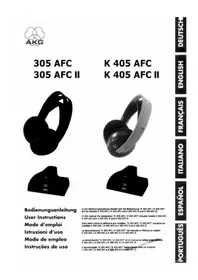
K305 AFC - Earphones AKG - Free user manual and instructions
Find the device manual for free K305 AFC AKG in PDF.



| Product type | Semi-open dynamic wireless headphone |
| Brand | AKG |
| Model | K305 AFC |
| Frequency response | 20 Hz - 22 000 Hz |
| Headphone power supply | 3 V DC (2 NiCd rechargeable batteries 1.2 V or AAA batteries 1.5 V) |
| Headphone battery life | Approximately 10 hours (with NiCd batteries) |
| Headphone weight (with batteries) | Approximately 230 g |
| Max sound pressure level | >110 dB SPL |
| Distortion | < 1% |
| Modulation | FM |
| Frequency band | 864 or 914 MHz (LPD band) |
| Maximum range | Approximately 100 m (free field) |
| Transmitter power supply | 12 V DC, 200 mA (via supplied mains adapter) |
| Transmitter weight | Approximately 260 g |
| Main functions | Autotuning (automatic frequency adjustment), volume control, battery charging, automatic muting in case of interference |
| Connectivity | RCA audio inputs (R/L) and 3.5 mm jack socket, mains adapter |
| Safety | Use exclusively recommended rechargeable batteries/batteries; do not open the housing; do not expose to heat, moisture or dust |
| Maintenance and cleaning | Clean with a soft, dry cloth; do not use alcohol, gasoline or thinner |
| General information | Compliant with European and FCC directives; warranty valid under conditions; spare parts available from AKG dealer |
Frequently Asked Questions - K305 AFC AKG
User questions about K305 AFC AKG
0 question about this device. Answer the ones you know or ask your own.
Ask a new question about this device
Download the instructions for your Earphones in PDF format for free! Find your manual K305 AFC - AKG and take your electronic device back in hand. On this page are published all the documents necessary for the use of your device. K305 AFC by AKG.
USER MANUAL K305 AFC AKG
In this manual the designation *K 305 APC / K 405 APC includes models K 305 AFC K 405 APC and K 305 APC II and K 405 APC II.
6.1 Connecting the Transmitter to AC Power . . . . . . 7
6.2 Connecting the Transmitter to Your Audio Source . 7
6.3 Charging the Batteries in the Headphones . . . 7
6.4 Replacing Batteries 8
6.5 Setting Up the System 8
6.6 POWER ON/CHARGE LED Status 8
-
Important Notes 8
-
Specifications. 8
- Troubleshooting 9
10.Warranty 9
1 Introduction
Dear customer:
Thank you for purchasing an AKG product.
The K 305 AFC/K 405 AFC wireless headphone system is based on advanced UHF transmission technology.
In order to make optimum use of the benefits of your K 305 AFC/K 405 AFC, please take a few minutes to read the instructions below carefully before operating the equipment. Please keep the manual for future reference.
2 Description
The K 305 AFC/K 405 AFC headphone system
- uses state-of-the-art UHF radio transmission technology;
- features an "Autoluning" function that automatically tunes the headphones to the transmitter frequency for optimum reception;
- connects to any audio, video, or TV set with a headphones, line, or recording output;
- provides perfect sound reproduction, full mobility, and signal transmission through walls and ceilings over a distance of up to 330 feet (100 m).
The K 305 AFC/K 405 AFC system is available for two different LPD frequency bands: 914 MHz for the US and 864 MHz for various European countries.
To share your listening enjoyment with other persons, you can operate your transmitter with several headphones simultaneously.
K 305 AFC/K 405 AFC headphones are available separately.
3 Precautions
- Operate the headphones with two AAA size 1.2 V rechargeable (supplied) or 1.5 V dry batteries only.
- Never try to charge dry batteries using the transmitter's charging feature.
- Before charging the headphones batteries, always make sure that the batteries in the headphones are rechargeable types.
- Dispos of spent dry or rechargeable batteries conforming to local waste disposal rules. Never throw batteries into fire.
- Operate the transmitter with the supplied 12 VDC, 200mA AC adapter only. Check that the AC voltage stated on the AC adapter is the same as that available in your country. Using the transmitter with a different AC adapter voids the warranty.
- Always switch the headphones OFF after use.
- Never try to open the headphone or transmitter case. Refer servicing to qualified service personnel only.
- Never place the equipment near heat sources such as radiators or electric heaters or expose it to direct sunlight, excessive dust, humidity, rain, temperatures below freezing, or impacts.
- Never use alcohol, petroleum-based cleaners, or paint thinkers to clean the headphones or transmitter.
- If you do not use your headphones system for an extended period of time (e.g., when traveling), disconnect the AC adapter from the AC outlet.
- Also refer to section 7 Important Notes.
4 Unpacking
Your headphones system package contains the following components:

K 305 AFC or K 405 AFC headphones

T 305 AFC or T 405 AFC transmitter
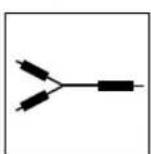
Connecting cable with stereo mini jack plug and L/R RCA plugs for con- necting the transmitter to your audio source
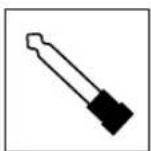
AC adapter for powering the transmitter
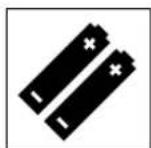
Two 1.2 V AAA size NiCd rechargeable batteries for powering the headphones (inside the headphones)
If anything is missing, contact your AKG dealer immediately.
5 Controls
5.1 Headphones (Fig. 1)
- POWER switch
- Green POWER indicator LED
- Charging contacts
- Battery compartment (beneath the ear pad)
- AUTOTUNING switch: activates the automatic tuning function
- VOLUME control
5.2 Transmitter (Fig. 2)
- AUDIO IN L/R,OO:audio input sockets
- DC 12 V: DC input jack for AC adapter
- FREQ ADJUST: frequency tuning control
- Charging pins
- POWER ON/CHARGE: tri-color LED indicating charging and operating modes
6 Operating Notes
6.1 Connecting the Transmitter to AC Power
-
Connect the cable on the supplied AC adapter to the DC 12 V jack [8] on the transmitter rear panel as shown in fig. 3.
-
Check that the AC voltage stated on the AC adapter is the same as that available in your country. If it is, connect the AC adapter to a convenient AC outlet (see fig. 4). The transmitter will automatically be ready to operate.
Note that the transmitter will switch on as soon as it detects an audio signal at the AUDIO IN jacks or the OO jack.
6.2 Connecting the Transmitter to Your Audio Source
You may connect the transmitter to a headphones output [mini jack or 1 / 4'' jack], LINE, or REC outputs.
6.2.1 Connecting to a Headphones Output
- Before connecting the transmitter to your audio source, switch the audio source OFF.
- Referring to fig. 5, plug the red RCA connector (right channel) on the supplied connecting cable into the red AUDIO IN R socket [7] and the white RCA connector (left channel) into the white AUDIO IN L socket [7] on the transmitter rear panel.
- Connect the stereo mini jack plug on the connecting cable to the headphones output of your audio source (refer to fig. 6).
- If the headphones output on your equipment is a 1/4'' jack, plug the supplied mini jack to 1/4'' adapter jack onto the connecting cable. Connect the adapter jack to the headphones output.
6.2.2 Connecting to a LINE or REC Output
- Before connecting the transmitter to your audio source, switch the audio source OFF.
- Referring to fig. 7, plug the red RCA connector (right channel) on the supplied connecting cable into the red LINE OUT R or REC OUT R socket and the white RCA connector (left channel) into the white LINE OUT L or REC OUT L socket on your audio source.
- Connect the stereo mini jack plug on the connecting cable to the ① jack (7) on the transmitter rear panel (see fig. 8).
6.3 Charging the Batteries in the Headphones
In order to ensure the longest possible service life for the rechargeable batteries, we deliver them uncharged. Therefore, charge the supplied batteries before first operating your headphones system.
The supplied batteries have been inserted into the headphones for your convenience.
WARNING: If you operate the headphones on dry batteries (see section 6.4), never try to charge the batteries using the transmitter's charging feature. This would cause serious damage to your headphone system. Dispose of spent batteries conforming to local waste disposal rules.
- Use the POWER switch (1) to switch the headphones off. When the power is off, the POWER LED (2) will be dark.
- Referring to fig. 11, place the headphones on the transmitter such that the charging pins (10) on the transmitter will engage the charging contacts (3) on the bottom of the left-hand earphone. The POWER ON/CHARGE LED (11) on the transmitter will
light red to indicate that the batteries in the headphones are being charged. If signal is present at the transmitter audio input, the POWER ON/CHARGE-LED (11) will light orange. The batteries will be fully charged after approximately 7 hours. (The POWER ON/CHARGE LED (11) will continue lighting red.) You may leave the headphones on the transmitter for as long as you like without risking to overcharge the batteries.
Important: In order to maintain full battery capacity for as long as possible, discharge the batteries completely about once a month:
Switch the headphones on and leave them outside the transmitter until the POWER LED (2) extinguishes. Press the POWER switch (1) once to switch the headphones off. Recharge the batteries as described above.
6.4 Replacing Batteries
The capacity of any rechargeable battery will decrease over time. If you feel that you need to recharge the supplied batteries more often than would be convenient, you may consider replacing the batteries with new AAA size 1.2 V rechargeable or 1.5 V alkaline dry batteries.
- Remove the ear pad from the left-hand earphone as shown in fig. 9.
- Remove the old batteries.
- Referring to fig. 10, insert the new batteries into the battery compartment (4). Make sure to align the batteries with the polarity marks inside the battery compartment.
- Replace the ear pad on the arophone aligning the four pins on the ear pad with the matching openings in the arophone base plate.
6.5 Setting Up the System
- Remove the headphones from the transmitter.
- Switch ON the audio source to which the transmitter is connected. If audio signal is present at the transmitter input, the POWER ON/CHARGE LED [11] on the transmitter will light green.
Note: If no signal arrives at the transmitter input for approx. 3 minutes, the transmitter will automatically switch off and the POWER ON/CHARGE LED [1] will extinguish.
-
Set the FREQ ADJUST control (9) on the transmitter to its center position.
-
Use the POWER switch (1) to switch the headphones on, so that the green POWER LED (2) will light. Press the AUTOTUNING switch (5) on the headphones.
The Autoluning function will automatically tune the reception frequency to the carrier frequency set on the transmitter. After a few seconds, you should hear the signal in the headphones clearly and free of interference.
If your first try fails, set the FREQ ADJUST control (9) to a different position and press AUTOTUNING (5) again. Be sure not to rotate FREQ ADJUST (9) all the way CW or CCW because optimum reception may not always be guaranteed at the ends of the frequency band.
- Set the VOLUME control (6) on the headphones to the desired volume level.
Note: If the transmitter signal is disturbed, e.g., by reflections (multi-path reception) or shadow effects, the headphones will automatically mute. This function eliminates interference related noise.
6.6 POWER ON/CHARGE LED Status
If LED is... Transmitter...
...lighting green: ...is connected to AC power and audio source and receives signal. Headphones are not on the transmitter, charging function is off.
...lighting orange: ...is connected to AC and audio source and receives signal. Headphones are on the transmitter, charging function is on.
...lighting red: ...has detected no signal for several minutes, headphones are on the transmitter, charging function is on.
...dark: ...has detected no signal for several minutes, headphones are not on the transmitter, charging function is off, OR ...is not connected to AC power.
7 Important Notes
- Operating switches on or connecting the transmitter to your audio source may cause clicks which at high volume settings may affect your hearing. Therefore, be sure to set the VOLUME control on the headphones to minimum before switching between different sources (tuner, turntable, CD player, etc.) or connecting the transmitter.
- Listening over headphones at high volume levels, particularly over extended periods of time, may damage your hearing.
- Your K 305 AFC/K 405 AFC is a radio frequency device that conforms to the strict European and FCC standards. For physical reasons that have nothing to do with the quality of the product, extremely strong interference sources may affect reception. In order to maintain interference-free listening pleasure, do not operate your K 305 AFC/K 405 AFC in the close vicinity of radio equipment, cellular telephones, or directly above TV or computer monitor picture tubes. The supplied connecting cable is long enough to allow the transmitter to be placed at a safe distance from interference sources.
Interference caused by other users of the 914 or 864 MHz LPD band are beyond AKG's control.
8 Specifications
System Performance
Modulation: FM
Carrier frequency band: 914/864 MHz (LPD band)
T 305 AFC/T 405 AFC Transmitter
Power supply: 12 VDC, 200 mA
Radiation angle: approx. 360^
Weight: approx. 9.2 oz. (260 g)
Max. range: approx. 330 ft. [100 m]
K 305 AFC Headphones
Power supply: 3 VDC (2 x 1.2 V AAA size NiCd
rechargeable batteries supplied)
Battery life: approx. 10 hours
(NiCd rechargeable batteries)
Frequency range: 20 Hz to 22,000 Hz
K 405 AFC Headphones
Power supply: 3 VDC (2 x 1.2 V AAA size NiMh
rechargeable batteries supplied)
Battery life: approx. 20 hours
[NiMh rechargeable batteries]
Frequency range: 20 Hz to 24,000 Hz
K 305 AFC/K 405 AFC Headphones
Max.SPL: >110 dB SPL
Weight: approx. 8.1 oz. [230 g]
Distortion: <1%
Type: semi-open dynamic headphones
9 Troubleshooting
| Symptom | Possible Cause | Remedy |
| No sound. | 1. AC adapter is not connected to transmitter and/or AC outlet.2. Transmitter is not connected to audio source.3. Connected audio source is switched off.4. Volume control on audio source is at zero.5. Batteries are low.6. Headphones are switched off.7. VOLUME control on headphones is at zero. | 1. Connect AC adapter to transmitter and/or AC outlet.2. Connect transmitter to audio source.3. Switch audio source on to feed signal to transmitter input.4. Set audio source volume to desired level.5. Charge batteries.6. Switch headphones on.7. Set VOLUME control to desired level. |
| POWER ON/CHARGE LEDdoes not light. | 1. Transmitter is not connected to AC power.2. Batteries are not correctly aligned with polarity marks.3. Headphones are incorrectly positioned on trans-mitter. | 1. Connect transmitter to AC power.2. Check orientation of batteries in battery compa-ment.3. Place headphones on transmitter correctly. |
| Headphone soundis in mono. | 1. Connected audio source operates in mono mode.2. Transmitter is not correctly connected to audio source. | 1. Switch audio source to stereo mode.2. Check cable connection between transmitter and audio source. |
| Noise. | 1. Transmitter and receiving frequencies are not identical.2. Audio level at transmitter input is too low.3. Input signal is noisy.4. Batteries are low. | 1. Press AUTOTUNING switch on headphones or use FREQ ADJUST control to select different carri-er frequency and press AUTOTUNING on head-phones.2. Increase audio source volume.3. Check audio source.4. Charge batteries. |
| Distorted sound. | 1. Audio level at transmitter input is too high.2. Transmitter and headphones carrier frequencies do not match exactly.3. Batteries are low. | 1. Decrease audio source volume.2. Use FREQ ADJUST control on transmitter to select carrier frequency and press AUTOTUNING switch on headphones.3. Charge batteries. |
10 Warranty Conditions
AKG warrants AKG products against evident defects in material and workmanship for a period of one year from the date of original purchase for use. This Warranty does not cover damage resulting from misuse or abuse, or lack of reasonable care, or inadequate repairs performed by unauthorized service centers. Performance of repairs or replacements under this Warranty is subject to submission of the sales slip. Shipment of defective items for repair under this Warranty will be at the customer's own risk and expense. This Warranty is valid for the original purchaser only.
This Warranty does not cover dry or rechargeable batteries.
Limited Warranty (valid in the United States only)
AKG warrants AKG products against evident defects in material and workmanship for a period of one year and agrees to repair or, at our option, replace any defective unit without charge for either parts or labor.
This Warranty does not cover dry or rechargeable batteries.
Important: This Warranty does not cover damage resulting from accident, misuse or abuse, lack of reasonable care, the affixing of any attachment not provided with the product, loss of
parts, or connecting the product to any but the specified receptacles. This Warranty is void unless service or repairs are performed by an authorized service center. No responsibility is assumed for any special, incidental, or consequential damage. However, the limitation of any right or remedy shall not be effective where such is prohibited or restricted by law. Simply take or ship your AKG products prepaid to our service department. Be sure to include your sales slip as proof of purchase date. (We will not repair transit damage under the no-charge terms of this Warranty.)
Note: No other warranty, written or oral, is authorized by AKG Acoustics.
This Warranty gives you specific legal rights, and you may also have other rights which vary from state to state. Some states do not allow the exclusion or limitation of incidental or consequential damage or limitations on how long an implied warranty lasts, so the above exclusion and limitations may not apply to you.
Table des matieres
9 Characteristicas techniques
Datas del problema
DECLARATION OF CONFORMITY
Document No.329 / 11 - 2002
replaces No. 256 / 07 - 2001
Type of Product: Wireless Stereo Headphone Set
Brand, Model No.: K 305 AFC + T 305 AFC
K 305 AFC II + T 305 AFC II
K 405 AFC + T 405 AFC
K 405 AFC II + T 405 AFC II (including power supply)
Drawing-No.: 6000H08..
Manufacturer: AKG Acoustics GmbH A-1230 Wien, Lemböckgasse 21 - 25 AUSTRIA
We declare that the above mentioned product is in conformity with the following European Directive:
No.99/5 EC;
Radio Equipment and
Telecommunications Terminal Equipment
The conformity is achieved by fulfilling the following European Standard(s):
EN 301489-9 V1.1.1; EN 300220-3 V1.1.1; EN 60950:1992 + A1:1993 +
A2:1993 + A3:1995 + A4:1997 + A11:1997
Product testing was carried out by:
TUV Österreich, Notified Body 0408
Deutschstrasse 10
1230 Wien, Austria
Manufacturer's Signature:
huluaos
Managing Director
Dr. Hugo Lenhard-Backhaus
This declaration certifies the accordance with the above mentioned EC-Directive but does not assure certain attributes of the product.
AKG Acoustics GmbH hereby declares that the product K 305 AFC + T 305 AFC, K 305 AFC II + T 305 AFC II, K 405 AFC + T 405 AFC, K 405 AFC II + T 405 AFC II, complies with the essential requirements and other relevant provisions of Directive 1999/5/EC.

A Hageman International Company
AKG Acoustics GmbH
Lmbckgasse 21-25, P.O.B. 158, A-1230 Vienna/AUSTRIA, Tel: (43 1) 86 654-0*, Fax: (43 1) 86 654-516, http://www.akg-acoustics.com, e-mail: sales@akg-acoustics.com
AKG Acoustics, Harman Pro GmbH
Bodenseestra 228, D-81243 Munchen/GERMANY, Tel: (089) 87 16-0, Fax: (089) 87 16-200, http://www.alkg-acoustics.de, e-mail: info@akg-acoustics.de
AKG ACOUSTICS, U.S.
1449 Donelson Pike, Nashville, TN 37217, U.S.A., Tel: (615) 360-0499, Fax: (615) 360-0275, http://www.akgonline.com, e-mail: akgusa@harman.com
For other distributors worldwide see our website: http://www.akg-acoustics.com

- Introduction
- Description
- Precautions
- Unpacking
- Controls
- Headphones (Fig. 1)
- Transmitter (Fig. 2)
- Operating Notes
- Connecting the Transmitter to AC Power
- Connecting the Transmitter to Your Audio Source
- Connecting to a Headphones Output
- Connecting to a LINE or REC Output
- Charging the Batteries in the Headphones
- Replacing Batteries
- Setting Up the System
- POWER ON/CHARGE LED Status
- If LED is... Transmitter...
- Important Notes
- Specifications
- System Performance
- T 305 AFC/T 405 AFC Transmitter
- K 305 AFC Headphones
- K 405 AFC Headphones
- K 305 AFC/K 405 AFC Headphones
- Troubleshooting
- Warranty Conditions
- Limited Warranty (valid in the United States only)
- Table des matieres
- DECLARATION OF CONFORMITY
Brand : AKG
Model : K305 AFC
Category : Earphones