AVR882 - AV receiver DENON - Free user manual and instructions
Find the device manual for free AVR882 DENON in PDF.


| Product Type | Audio-Video Receiver |
| Brand | Denon |
| Model | AVR882 |
| Output Power (Front) | 80 W + 80 W (8 Ω, 20 Hz - 20 kHz, 0.08 % THD) |
| Output Power (Center) | 80 W (8 Ω, 20 Hz - 20 kHz, 0.08 % THD) |
| Output Power (Surround) | 80 W + 80 W (8 Ω, 20 Hz - 20 kHz, 0.08 % THD) |
| Recommended Speaker Impedance | 6 to 16 Ω |
| Frequency Response | 10 Hz - 100 kHz (+1, -3 dB, TONE DEFEAT ON) |
| Signal-to-Noise Ratio | 100 dB (IHF-A weighted, TONE DEFEAT ON) |
| Total Harmonic Distortion | 0.008 % (20 Hz - 20 kHz) |
| Analog Audio Inputs | CD, DVD, TV/DBS, VCR1, VCR2, TAPE, PHONO, V.AUX |
| Digital Inputs | 1 coaxial, 2 optical |
| Preamp Outputs | Front, Center, Surround, Subwoofer |
| External 6-Channel Input (EXT. IN) | Yes |
| Built-in Decoders | Dolby Digital, DTS, Dolby Pro Logic II |
| DSP Modes | 5CH Stereo, Mono Movie, Rock Arena, Jazz Club, Video Game, Matrix, Virtual Surround |
| Personal Memory Plus Function | Yes (per source memories) |
| Remote Control | RC-897 with preset codes |
| Dimensions (W x H x D) | 434 x 171 x 417 mm |
| Weight | 10.9 kg |
| Power Supply | 120 V AC, 60 Hz |
| Power Consumption | 4.5 A |
| Supplied Accessories | Owner's manual, remote control (RC-897), R6P/AA batteries (2), AM loop antenna, FM indoor antenna, FM antenna adapter |
| Protection Circuit | Yes (high speed, cuts output in case of short circuit or overheating) |
| Usage Precautions | Avoid high temperatures, ensure adequate ventilation, handle power cord with care, protect from moisture and dust, do not block ventilation holes, do not disassemble the unit |
Frequently Asked Questions - AVR882 DENON
User questions about AVR882 DENON
0 question about this device. Answer the ones you know or ask your own.
Ask a new question about this device
Download the instructions for your AV receiver in PDF format for free! Find your manual AVR882 - DENON and take your electronic device back in hand. On this page are published all the documents necessary for the use of your device. AVR882 by DENON.
USER MANUAL AVR882 DENON
FOR ENGLISH READERS PAGE 2 - PAGE 48, 94, 95
■ We greatly appreciate your purchase of this unit.
■ To be sure you take maximum advantage of all the features this unit has to offer, read these instructions carefully and use the set properly. Be sure to keep this manual for future reference should any questions or problems arise.
"SERIAL NO.
PLEASE RECORD UNIT SERIAL NUMBER ATTACHED TO THE REAR OF THE CABINET FOR FUTURE REFERENCE"
POUR LES LECTEURS FRANCAIS PAGE 2, 49 - PAGE 95
The lightning flash with arrowhead symbol, within an equilateral triangle, is intended to alert the user to the presence of uninsulated "dangerous voltage" within the product's enclosure that may be of sufficient magnitude to constitute a risk of electric shock to persons.

The exclamation point within an equilateral triangle is intended to alert the user to the presence of important operating and maintenance (servicing) instructions in the literature accompanying the appliance.
WARNING: TO REDUCE THE RISK OF FIRE OR ELECTRIC SHOCK, DO NOT EXPOSE THIS APPLIANCE TO RAIN OR MOISTURE.
CAUTION
TO PREVENT ELECTRIC SHOCK, MATCH WIDE BLADE OF PLUG TO WIDE SLOT, FULLY INSERT.
ATTENTION
POUR ÉVITER LES CHOCS ÉLECTRIQUES, INTERODUIRE LA LAME LA PLUS LARGE DE LA FICHE DANS LA BORNE CORRESPONDANTE DE LA PRISE ET POUSSER JUSQU' AU FOND.
This device complies with Part 15 of the FCC Rules. Operation is subject to the following two conditions: (1) This device may not cause harmful interference, and (2) this device must accept any interference received, including interference that may cause undesired operation.
This Class B digital apparatus meets all requirements of the Canadian Interference-Causing Equipment Regulations.
natural_image
Illustration of a sun-drowning accident scene with a damaged box and a firecracker (no text or symbols)natural_image
Cartoon illustration of a sad rectangular object with eyes and nose, emitting smoke or vapor (no text or symbols)* (For sets with ventilation holes)
natural_image
Cartoon illustration of a spray bottle pouring liquid into a container (no text or symbols)- Do not let insecticides, benzene, and thinner come in contact with the set.
- Read Instructions - All the safety and operating instructions should be read before the appliance is operated.
- Retain Instructions – The safety and operating instructions should be retained for future reference.
- Heed Warnings – All warnings on the appliance and in the operating instructions should be adhered to.
- Follow Instructions – All operating and use instructions should be followed.
- Water and Moisture – The appliance should not be used near water – for example, near a bathtub, washbowl, kitchen sink, laundry tub, in a wet basement, or near a swimming pool, and the like.
- Carts and Stands – The appliance should be used only with a cart or stand that is recommended by the manufacturer.
6A. An appliance and cart combination should be moved with care. Quick stops, excessive force, and uneven surfaces may cause the appliance and cart combination to overturn. - Wall or Ceiling Mounting – The appliance should be mounted to a wall or ceiling only as recommended by the manufacturer.
- Ventilation – The appliance should be situated so that its location or position does not interfere with its proper ventilation. For example, the appliance should not be situated on a bed, sofa, rug, or similar surface that may block the ventilation openings; or, placed in a built-in installation, such as a bookcase or cabinet that may impede the flow of air through the ventilation openings.
- Heat – The appliance should be situated away from heat sources such as radiators, heat registers, stoves, or other appliances (including amplifiers) that produce heat.
- Power Sources – The appliance should be connected to a power supply only of the type described in the operating instructions or as marked on the appliance.
-
Grounding or Polarization – Precautions should be taken so that the grounding or polarization means of an appliance is not defeated.
-
Power-Cord Protection – Power-supply cords should be routed so that they are not likely to be walked on or pinched by items placed upon or against them, paying particular attention to cords at plugs, convenience receptacles, and the point where they exit from the appliance.
- Cleaning – The appliance should be cleaned only as recommended by the manufacturer.
- Power Lines – An outdoor antenna should be located away from power lines.
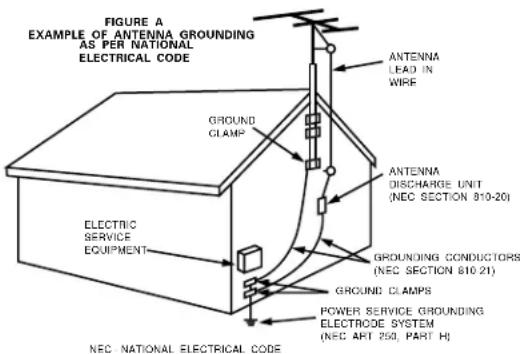
- Outdoor Antenna Grounding – If an outside antenna is connected to the receiver, be sure the antenna system is grounded so as to provide some protection against voltage surges and built-up static charges. Article 810 of the National Electrical Code, ANSI/NFPA 70, provides information with regard to proper grounding of the mast and supporting structure, grounding of the lead-in wire to an antenna-discharge unit, size of grounding conductors, location of antenna-discharge unit, connection to grounding electrodes, and requirements for the grounding electrode. See Figure A.
- Nonuse Periods – The power cord of the appliance should be unplugged from the outlet when left unused for a long period of time.
- Object and Liquid Entry – Care should be taken so that objects do not fall and liquids are not spilled into the enclosure through openings.
- Damage Requiring Service – The appliance should be serviced by qualified service personnel when:
A. The power-supply cord or the plug has been damaged; or
B. Objects have fallen, or liquid has been spilled into the appliance; or
C. The appliance has been exposed to rain; or
D. The appliance does not appear to operate normally or exhibits a marked change in performance; or
E. The appliance has been dropped, or the enclosure damaged.
- Servicing – The user should not attempt to service the appliance beyond that described in the operating instructions. All other servicing should be referred to qualified service personnel.
INTRODUCTION
Thank you for choosing the DENON A/V Surround receiver. This remarkable component has been engineered to provide superb surround sound listening with home theater sources such as DVD, as well as providing outstanding high fidelity reproduction of your favorite music sources. As this product is provided with an immense array of features, we recommend that before you begin hookup and operation that you review the contents of this manual before proceeding.
TABLE OF CONTENTS
1 Before Using 4
2 Cautions on Installation 5
3 Cautions on Handling 5
4 Features....5
5 Part Names and Functions....6, 7
6 Read this first 8
7 Setting up the Speaker Systems....8
8 Connections 9\~15
9 Using the Remote Control Unit....16
10 Setting up the system 17-21
11 Remote Control Unit....22\~24
12 Operation 25\~29
13 Surround....30\~34
14 DSP Surround Simulation 35\~39
15 Listening to the Radio....40-42
16 Last Function Memory 43
17 Initialization of the Microprocessor 43
18 Additional Information....44\~46
19 Troubleshooting 47
20 Specifications 48
List of Preset Codes....94, 95
ACCESSORIES
Check that the following parts are included in addition to the main unit:
① Operating instructions ....1
② Warranty ( for North America model only ) ....1
③ Service station list....1
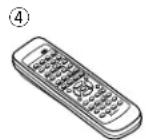
④ Remote control unit (RC-897)....1
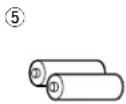
⑤ R6P/AA batteries ....2
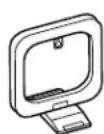
⑥ AM loop antenna ....1
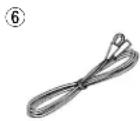
⑦ FM indoor antenna....1
⑧ FM antenna adaptor....1

1 BEFORE USING
Pay attention to the following before using this unit:
- Moving the set
To prevent short circuits or damaged wires in the connection cords, always unplug the power cord and disconnect the connection cords between all other audio components when moving the set.
- Before turning the power operation switch on
Check once again that all connections are proper and that there are not problems with the connection cords. Always set the power operation switch to the standby position before connecting and disconnecting connection cords.
- Store this instructions in a safe place.
After reading, store this instructions along with the warranty in a safe place.
- Note that the illustrations in this instructions may differ from the actual set for explanation purposes.
• V. AUX terminal
The AVR-1802's front panel is equipped with a V. AUX terminal. Remove the cap covering the terminal when you want to use it.

2 CAUTIONS ON INSTALLATION
Noise or disturbance of the picture may be generated if this unit or any other electronic equipment using microprocessors is used near a tuner or TV.
If this happens, take the following steps:
• Install this unit as far as possible from the tuner or TV.
- Set the antenna wires from the tuner or TV away from this unit's power cord and input/output connection cords.
- Noise or disturbance tends to occur particularly when using indoor antennas or 300 Ω/ohms feeder wires. We recommend using outdoor antennas and 75 Ω/ohms coaxial cables.
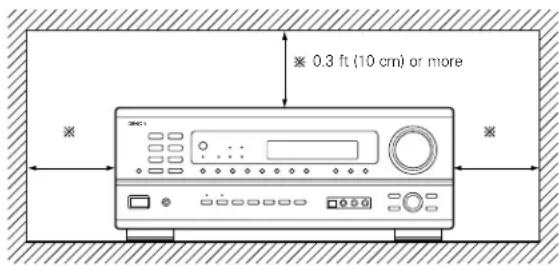
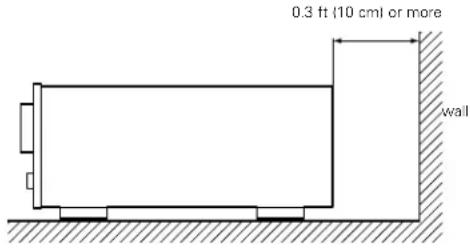
For heat dispersal, leave at least 0.3 ft (10 cm) of space between the top, back and sides of this unit and the wall or other components.
3 CAUTIONS ON HANDLING
- Switching the input function when input jacks are not connected
A clicking noise may be produced if the input function is switched when nothing is connected to the input jacks. If this happens, either turn down the MASTER VOLUME control or connect components to the input jacks.
- Muting of PRE OUT jack, HEADPHONE jack and SPEAKER terminals
The PRE OUT jack, HEADPHONE jack and SPEAKER terminals include a muting circuit. Because of this, the output signals are greatly reduced for several seconds after the power operation switch is turned on or input function, surround mode or any other set-up is changed.
If the volume is turned up during this time, the output will be very high after the muting circuit stops functioning. Always wait until the muting circuit turns off before adjusting the volume.
4 FEATURES
1. Dolby Pro Logic II decoder
Dolby Pro Logic II is a new format for playing multichannel audio signals that offers improvements over conventional Dolby Pro Logic. It can be used to decode not only sources recorded in Dolby Surround but also regular stereo sources into five channels (front left/right, center and surround left/right). In addition, various parameters can be set according to the type of source and the contents, so you can adjust the sound field with greater precision.
2. Dolby Digital decoder
Dolby Digital, a digital discrete system in which the different channels are completely independent, recreates "three-dimensional" sound fields (sounds with a sense of distance, movement and position) with no crosstalk between channels for greater reality. In addition, the 5 channels (excluding the 0.1 channel for low frequency effects) have a playback range extending to 20 kHz, the same as the range of CDs, thus resulting in clearer, more richly expressive sound.
3. DTS (Digital Theater Systems) decoder
DTS provides up to 5.1 channels of wide-range, high fidelity surround sound, from sources such as laser disc, DVD and specially-encoded music discs.
- Whenever the power operation switch is in the STANDBY state, the apparatus is still connected on some AC line voltages.
Please be sure to unplug the cord when you leave home for, say, a vacation.
4. High performance DSP simulates 7 sound fields
Playback is possible in 7 surround modes: 5-channel Stereo, Mono Movie, Rock Arena, Jazz Club, Video Game, Matrix and Virtual. You can enjoy a variety of sound effects for different movie scenes and program sources even with stereo sources not in Dolby Surround.
5. Personal Memory Plus function
Personal Memory Plus is an advanced version of Personal Memory. With Personal Memory Plus, the set automatically memorizes the surround mode, channel volume, surround parameters, etc., for each of the separate input sources.
6. Remote control unit with pre-memory function
This unit comes with a remote control unit equipped with a pre-memory function. The remote control command codes for DENON remote controllable AV components as well as for DVD players, LD players, video decks, TVs, etc., of other major manufacturers are prestored in the memory.
7. 6CH EXT. IN jack
This unit is equipped with 6CH EXT. IN jacks for use with audio formats of the future.
5 PART NAMES AND FUNCTIONS
Front Panel
- For details on the functions of these parts, refer to the pages given in parentheses ( ).
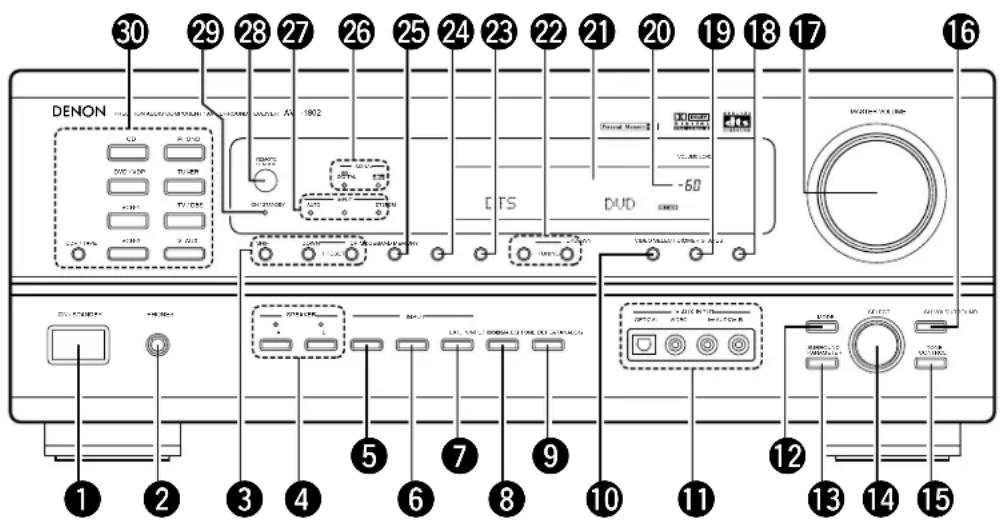
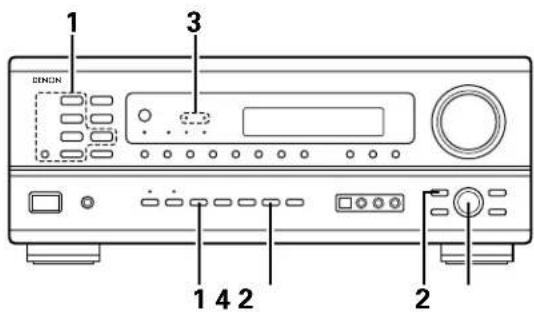
① Power operation switch .....(18, 25, 40)
2 Headphones jack (PHONES)....(28)
3 Preset stations selector buttons....(42)
4 SPEAKER A/B buttons....(25, 28, 43)
5 INPUT MODE button....(26, 29, 33)
6 ANALOG button .....(26, 29)
⑦ EXT. IN button .....(26, 29)
⑧ CINEMA EQ button .....(33)
9 TONE DEFEAT button .....(27)
10 VIDEO SELECT button .....(28)
11 V. AUX INPUT jacks .....(4, 10)
12 SURROUND MODE button....(27, 31, 33, 38)
13 SURROUND PARAMETER button....(31, 38)
14 SELECT knob (27, 30, 31, 33, 38)
15 TONE CONTROL button....(27)
16 CH VOL button .....(30)
17 MASTER VOLUME control....(27)
18 STATUS button .....(28)
19 DIMMER button .....(28)
20 Master volume indicator (VOLUME LEVEL)....(27)
21 Display
22 TUNING UP/DOWN button .....(41)
23 MEMORY button....(40, 42)
24 MODE button....(41)
25 BAND button .....(41)
26 SIGNAL indicators....(27)
27 INPUT mode indicators....(27)
28 Remote control sensor (REMOTE SENSOR) .....(19)
29 Power operation indicator
30 Input source selector buttons .....(26, 31, 33)
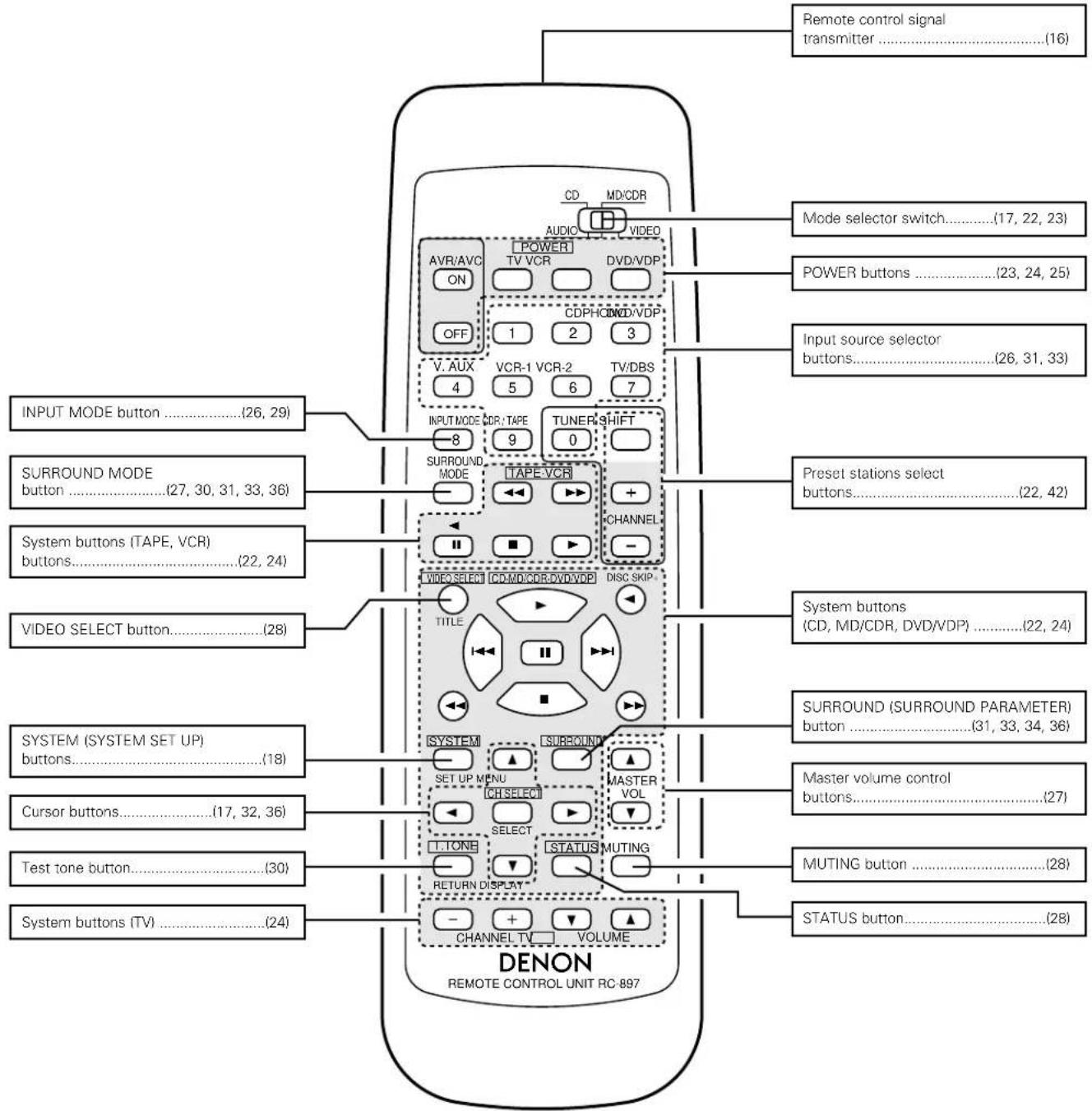
Remote control unit
- For details on the functions of these parts, refer to the pages given in parentheses ().
6 READ THIS FIRST
This AV Surround Receiver must be setup before use. Following these steps.
Step 1 (page 8 to 15)
Choose the best location to setup the Speakers and connecting the components.
Step 2 (page 16)
Next, insert the batteries into the remote control unit.
Step 3 (page 17 to 21)
Finally, setting up the system.
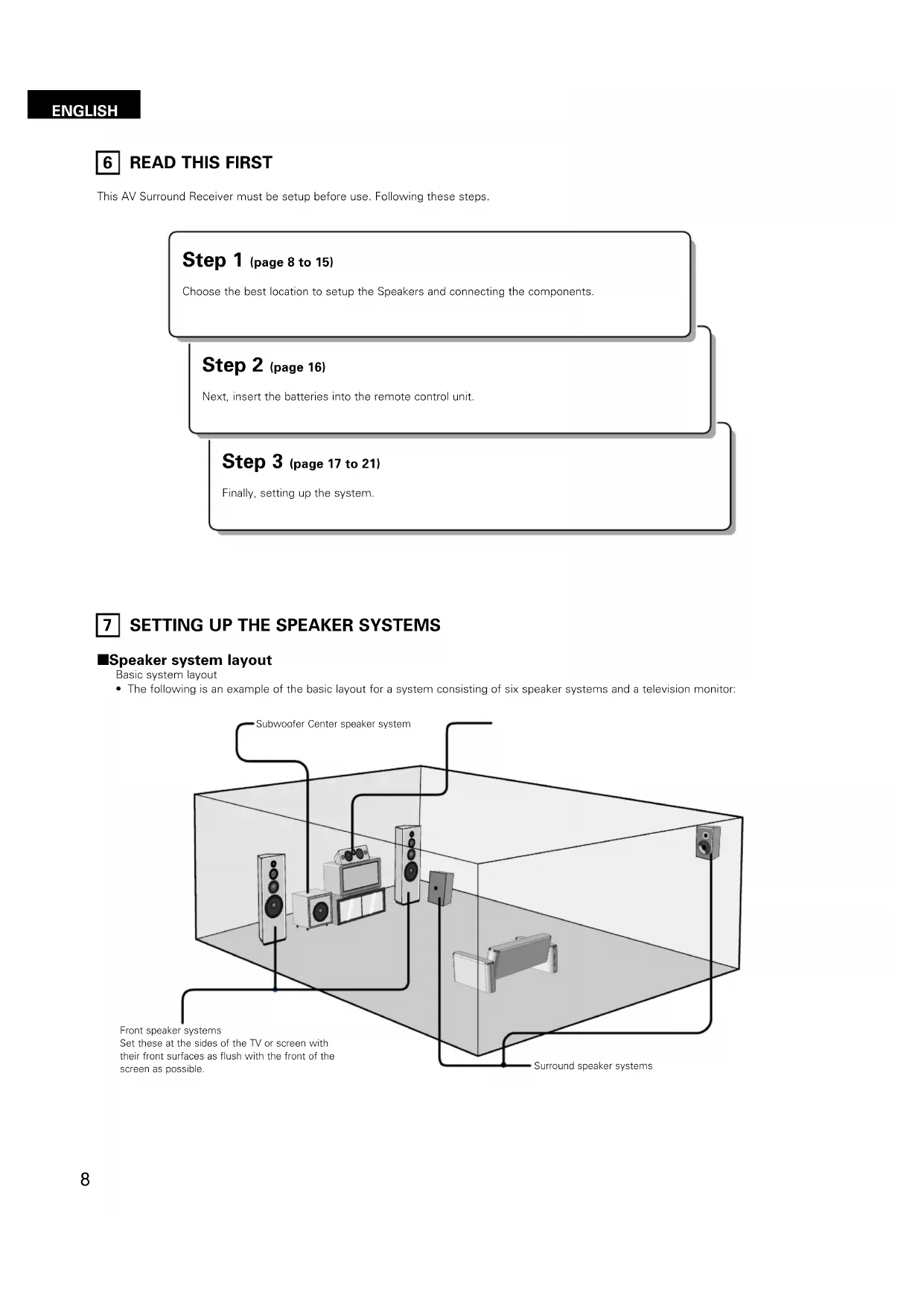
7 SETTING UP THE SPEAKER SYSTEMS
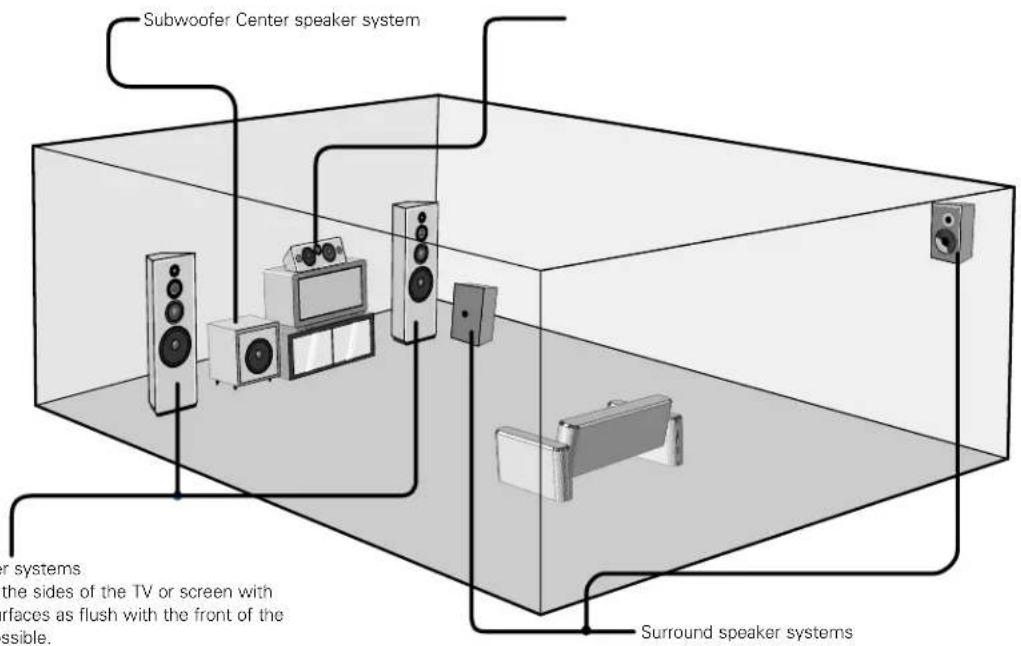
■Speaker system layout
Basic system layout
- The following is an example of the basic layout for a system consisting of six speaker systems and a television monitor:
8 CONNECTIONS
- Do not plug in the power cord until all connections have been completed.
- Be sure to connect the left and right channels properly (left with left, right with right).
- Insert the plugs securely. Incomplete connections will result in the generation of noise.
-
Use the AC OUTLETS for audio equipment only. Do not use them for hair driers, etc.
-
Note that binding pin plug cords together with power cords or placing them near a power transformer will result in generating hum or other noise.
-
Noise or humming may be generated if a connected audio equipment is used independently without turning the power of this unit on. If this happens, turn on the power of this unit.
-
Analog recording of signals input to the AVR-1802 in digital format is not possible. To record in analog, also connect the analog signals of the player to the AVR-1802's analog input terminals.
- The AVR-1802's OPTICAL OUT terminal is an optical digital output terminal for connection of a CDR recorder, MD recorder or other digital recording device. Use it for digital recording.
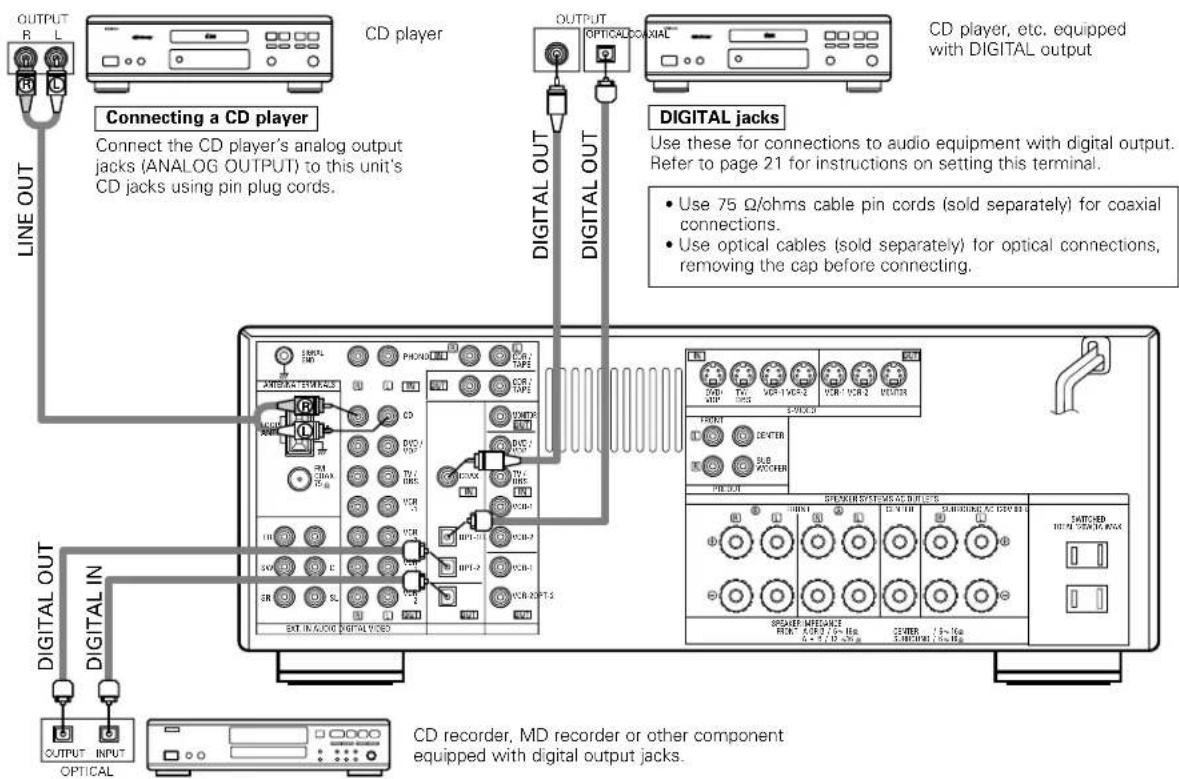
Connecting the audio components
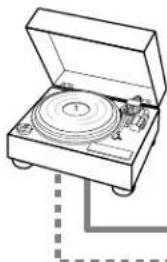
Connecting a turntable
Connect the turntable's output cord to this unit's PHONO jacks, the L (left) plug to the L jack, the R (right) plug to the right jack.
NOTE:
This unit cannot be used with MC cartridges directly. Use a separate head amplifier or step-up transformer.
If humming or other noise is generated when the ground wire is connected, disconnect the ground wire.
natural_image
Line drawing of a vintage rotary disc with a circular dial and base mount (no text or symbols)Ground wire
Turntable (MM cartridge)
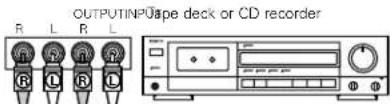
LINE IN LINE OUT
Connecting a tape deck
Connections for recording:
Connect the tape deck's recording input jacks (LINE IN or REC) to this unit's tape recording (OUT) jacks using pin plug cords.
Connections for playback:
Connect the tape deck's playback output jacks (LINE OUT or PB) to this unit's tape playback (IN) jacks using pin plug cords.
Connecting the pre-out jacks
Use these jacks if you wish to connect external power amplifier(s) to increase the power of the front and center channels, or for connection to powered loudspeakers. Connect the internal amplifier's subwoofer to the subwoofer terminal. (Refer to page 14.)
INT
FRC
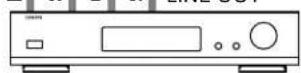
Decoders with 6-channel analog outputs, etc.
AC OUTLETS
- SWITCHED
(total capacity - 120 W (1 A.))
The power to these outlets is turned on and off in conjunction with the POWER switch on the main unit, and when the power is switched between on and standby from the remote control unit. No power is supplied from these outlets when this unit's power is at standby. Never connect equipment whose total capacity is above 120 W (1 A.)
NOTE:
Only use the AC OUTLETS for audio equipment. Never use them for hair driers, TVs or other electrical appliances.
Connecting the video equipments
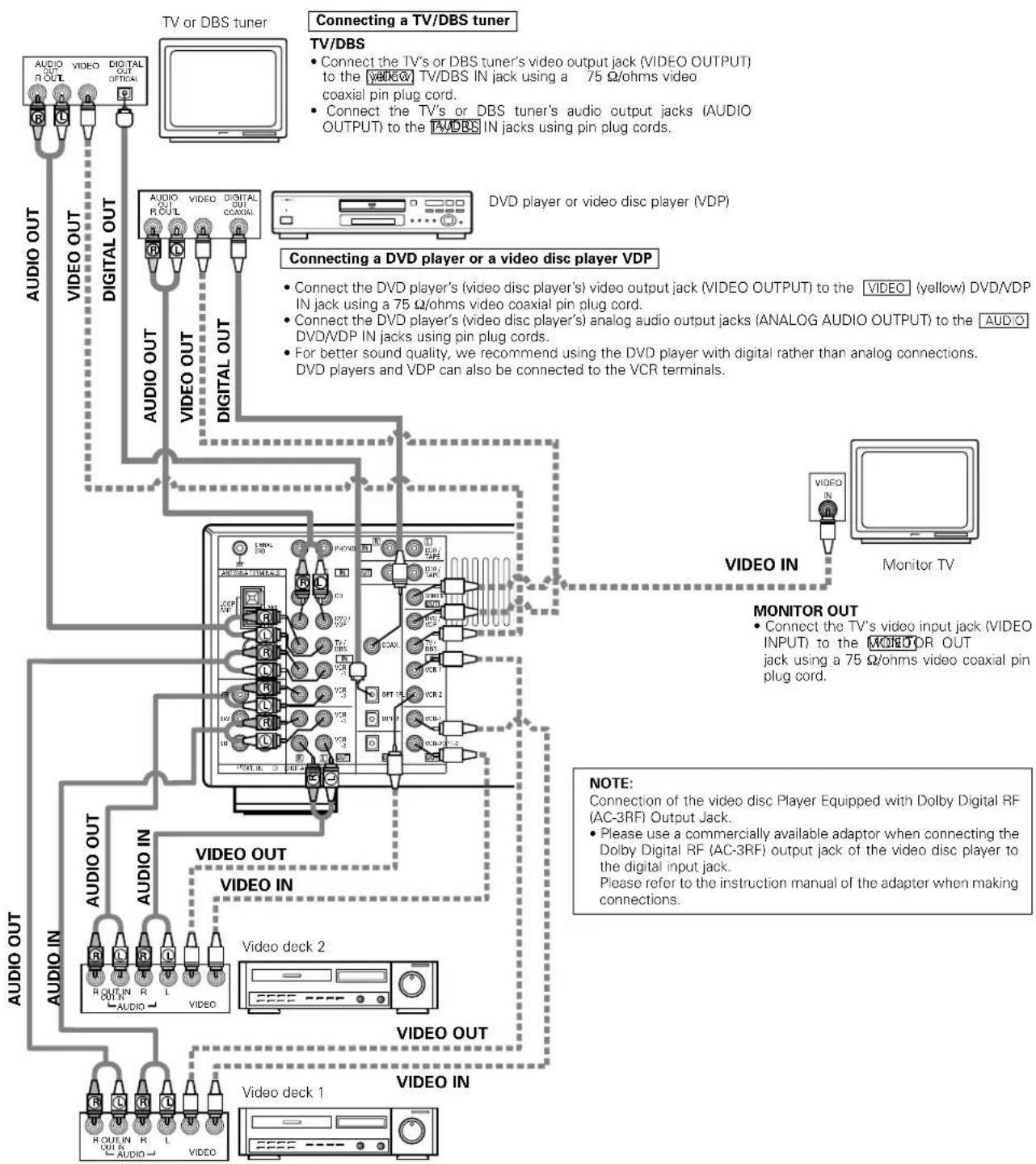
To connect the video signal, connect using a 75 Ω/ohms video signal cable cord. Using an improper cable can result in a drop in sound quality.
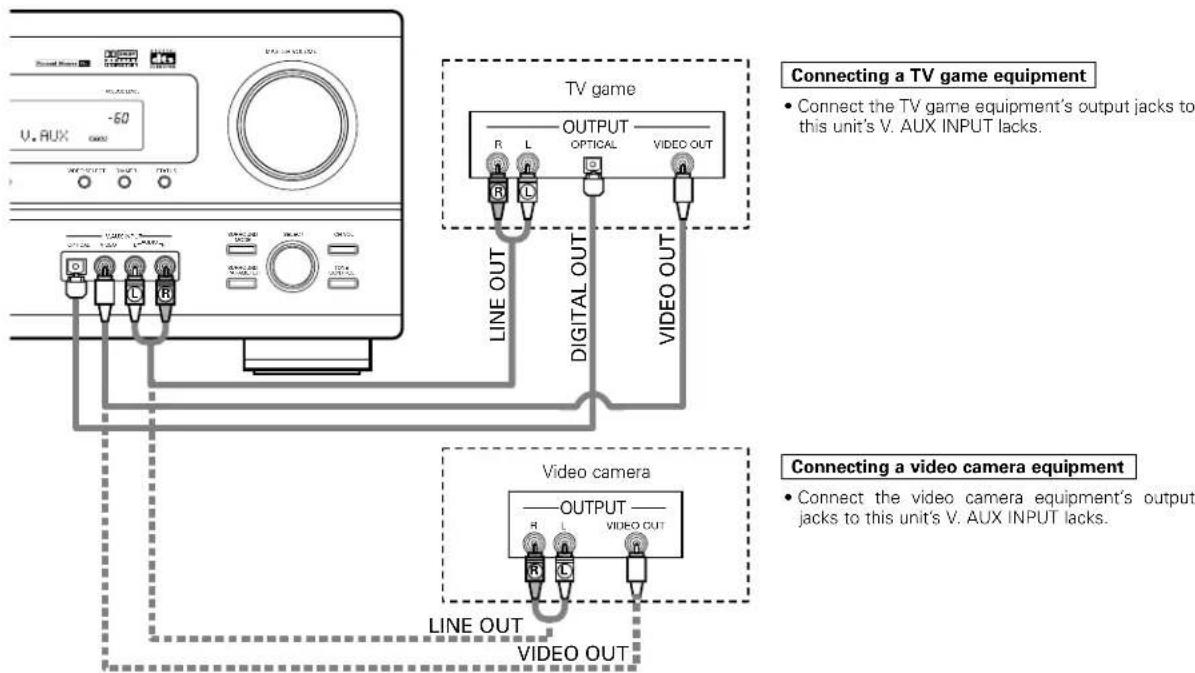
※ The V. AUX terminal is covered with a cap. Remove this cap in order to use the terminal. (See page 4 for instructions on removing the cap.)
flowchart
graph TD
    A["TV or DBS tuner"] --> B["Connecting a TV/DBS tuner"]
    B --> C["TV/DBS"]
    C --> D["Connect the TV's or DBS tuner's video output jack (VIDEO OUTPUT) to the VIDEO TV/DBS IN jack using a 75 Ω/ohms video coaxial pin plug cord."]
    C --> E["Connect the TV's or DBS tuner's audio output jacks (AUDIO OUTPUT) to the AADBS IN jacks using pin plug cords."]
    A --> F["DVD player or video disc player (VDP)"]
    F --> G["Connecting a DVD player or a video disc player VDP"]
    G --> H["Connect the DVD player's (video disc player's) video output jack (VIDEO OUTPUT) to the VIDEO (yellow) DVD/VDP IN jack using a 75 Ω/ohms video coaxial pin plug cord."]
    G --> I["Connect the DVD player's (video disc player's) analog audio output jacks (ANALOG AUDIO OUTPUT) to the AUDIO DVD/VDP IN jacks using pin plug cords."]
    G --> J["For better sound quality, we recommend using the DVD player with digital rather than analog connections. DVD players and VDP can also be connected to the VCR terminals."]
    A --> K["MONITOR OUT"]
    K --> L["Connect the TV's video input jack (VIDEO INPUT) to the MONITOR OUT jack using a 75 Ω/ohms video coaxial pin plug cord."]
    K --> M["NOTE: Connection of the video disc Player Equipped with Dolby Digital RF (AC-3RF) Output Jack."]
    K --> N["Please use a commercially available adaptor when connecting the Dolby Digital RF (AC-3RF) output jack of the video disc player to the digital input jack. Please refer to the instruction manual of the adapter when making connections."]
    A --> O["VIDEO OUT"]
    O --> P["Video deck 2"]
    O --> Q["VIDEO OUT"]
    O --> R["VIDEO OUT"]
    O --> S["VIDEO OUT"]
    O --> T["VIDEO OUT"]
    O --> U["VIDEO OUT"]
    O --> V["VIDEO OUT"]
Connecting a video decks
- There are two sets of video deck (VCR) jacks, so two video decks can be connected for simultaneous recording or video copying.
Video input/output connections:
- Connect the video deck's video output jack (VIDEO OUT) to the [VIDEO] (yellow) VCR-1 IN jack, and the video deck's video input jack (VIDEO IN) to the [VIDEO] (yellow) VCR-1 OUT jack using 75 Ω/ohms video coaxial pin plug cords.
Connecting the audio output jacks:
- Connect the video deck's audio output jacks (AUDIO OUT) to the AUDIO VCR-1 IN jacks, and the video deck's audio input jacks (AUDIO IN) to the AUDIO VCR-1 OUT jacks using pin plug cords.
※ Connect the second video deck to the VCR-2 jacks in the same way.
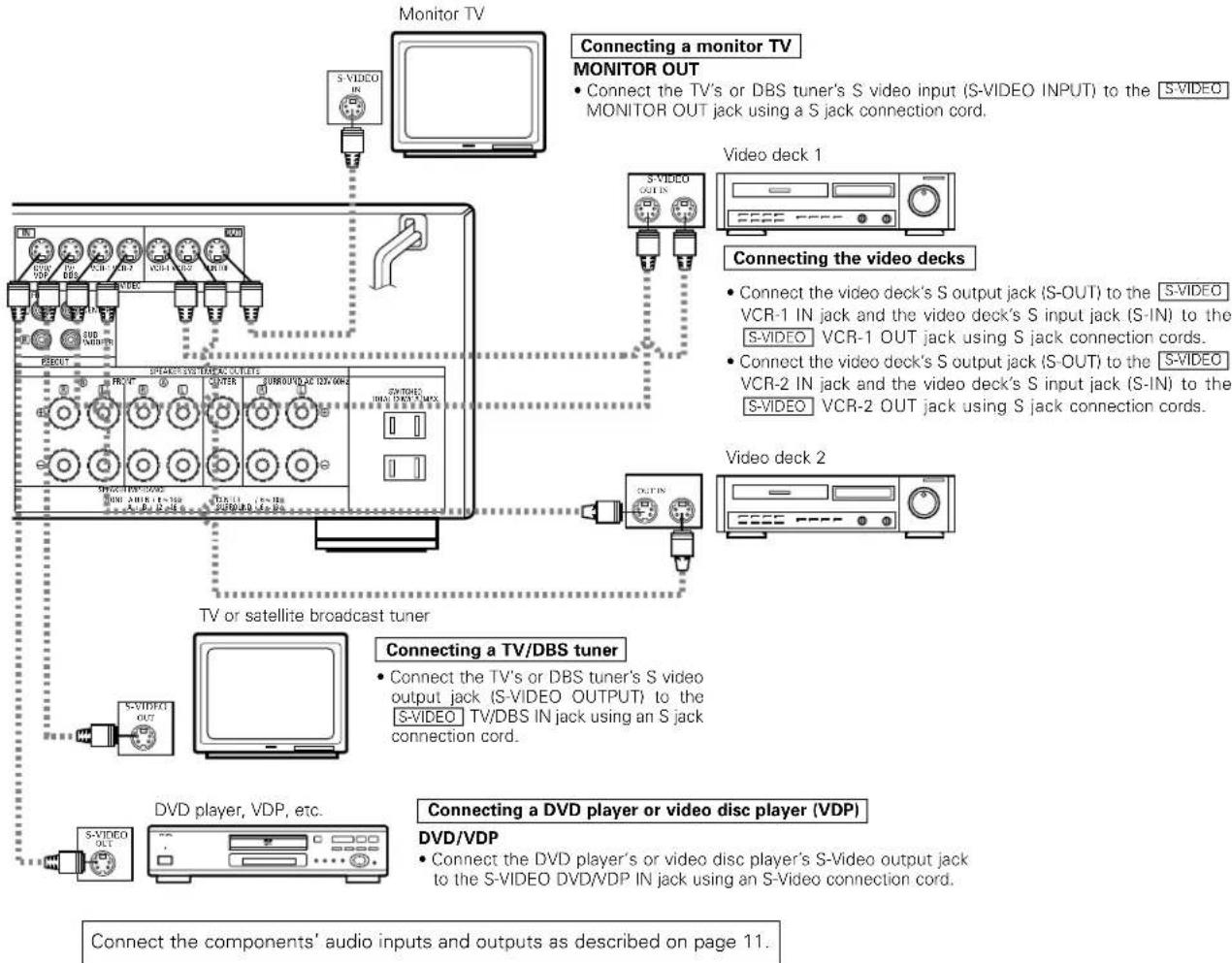
Connecting a video component equipped with S-video jacks
- When marking connections, also refer to the operating instructions of the other components.
• A note on the S input jacks
The input selectors for the S inputs and pin jack inputs work in conjunction with each other.
• Precaution when using S-jacks
This unit's S-jacks (input and output) and video pin jacks (input and output) have independent circuit structures, so that video signals input from the S-jacks are only output from the S-jack outputs and video signals input from the pin jacks are only output from the pin jack outputs. When connecting this unit with equipment that is equipped with S-jacks, keep the above point in mind and make connections according to the equipment's instruction manuals.
flowchart
graph TD
    A["Monitor TV"] --> B["TV or satellite broadcast tuner"]
    B --> C["Connecting a TV/DBS tuner"]
    C --> D["DVD player, VDP, etc."]
    D --> E["Connecting a monitor TV MONITOR OUT"]
    E --> F["Connecting a monitor TV MONITOR OUT"]
    F --> G["Video deck 1"]
    G --> H["Connecting the video decks"]
    H --> I["Connecting the video deck's S output jack (S-OUT) to the S-VIDEO VCR-1 IN jack and the video deck's S input jack (S-IN) to the S-VIDEO VCR-1 OUT jack using S jack connection cords."]
    H --> J["Connecting the video deck's S output jack (S-OUT) to the S-VIDEO VCR-2 IN jack and the video deck's S input jack (S-IN) to the S-VIDEO VCR-2 OUT jack using S jack connection cords."]
    G --> K["Video deck 2"]
    K --> L["Connecting a video deck"]
    L --> M["Connecting a video deck's S output jack (S-OUT) to the S-VIDEO VCR-1 IN jack and the video deck's S input jack (S-IN) to the S-VIDEO VCR-1 OUT jack using S jack connection cords."]
    G --> N["Video deck 1"]
    N --> O["Connecting the video deck's S output jack (S-OUT) to the S-VIDEO VCR-1 IN jack and the video deck's S input jack (S-IN) to the S-VIDEO VCR-1 OUT jack using S jack connection cords."]
    G --> P["Video deck 2"]
    P --> Q["Connecting the video deck's S output jack (S-OUT) to the S-VIDEO VCR-2 IN jack and the video deck's S input jack (S-IN) to the S-VIDEO VCR-2 OUT jack using S jack connection cords."]
Connecting the antenna terminals
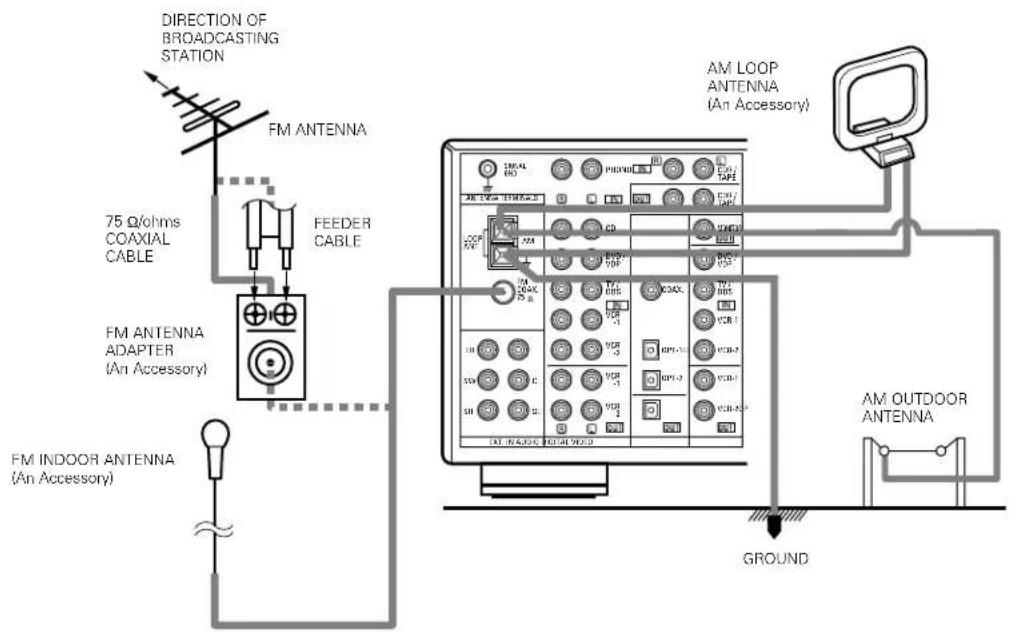
Connection of AM antennas
AM loop antenna assembly
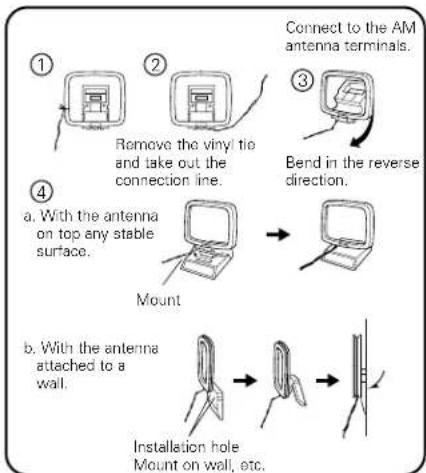
flowchart
graph TD
    A["①: Remove the vinyl tie and take out the connection line."] --> B["②: Connect to the AM antenna terminals."]
    B --> C["③: Bend in the reverse direction."]
    C --> D["④: Mount installation hole, which is attached to a wall."]
FM antenna adapter assembly
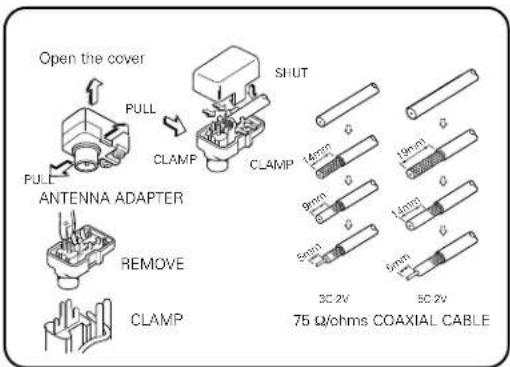
Note to CATV system installer:
This reminder is provided to call the CATV system installer's attention to Article 820-40 of the NEC which provides guidelines for proper grounding and, in particular, specifies that the cable ground shall be connected to the grounding system of the building, as close to the point of cable entry as practical.
Notes:
- Do not connect two FM antennas simultaneously.
- Even if an external AM antenna is used, do not disconnect the AM loop antenna.
- Make sure AM loop antenna lead terminals do not touch metal parts of the panel.
Speaker system connections
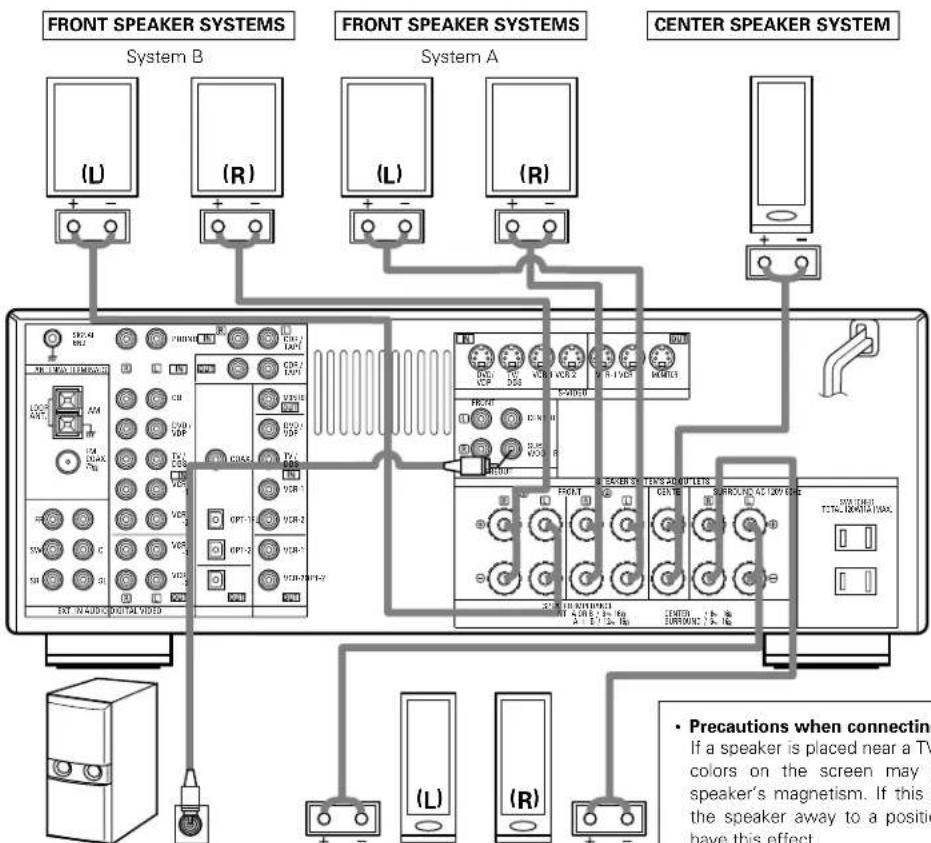
- Connect the speaker terminals with the speakers making sure that like polarities are matched (⊕ with ⊕, Θ with Θ). Mismatching of polarities will result in weak central sound, unclear orientation of the various instruments, and the sense of direction of the stereo being impaired.
- When making connections, take care that none of the individual conductors of the speaker cord come in contact with adjacent terminals, with other speaker cord conductors, or with the rear panel.
NOTE:
NEVER touch the speaker terminals when the power is on. Doing so could result in electric shocks.
Speaker Impedance
- When speaker systems A and B are use separately, speakers with an impedance of 6 to 16/ ohms can be connected for use as front speakers.
- Be careful when using two pairs of front speakers (A + B) at the same time, since use of speakers with an impedance of 12 to 16 Ω/ohms.
- Speakers with an impedance of 6 to 16 Ω/ohms can be connected for use as center and surround speakers.
- The protector circuit may be activated if the set is played for long periods of time at high volumes when speakers with an impedance lower than the specified impedance are connected.
Connecting the speaker cords
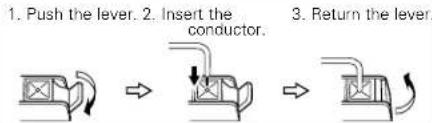
- Loosen by turning counterclockwise.
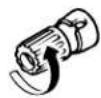

- Insert the cord, 3. Tighten by turning
clockwise.
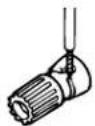

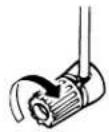
Connecting banana plugs
banana plug
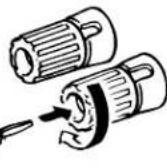
Turn clockwise to tighten, then insert the banana plug.
flowchart
graph TD
    subgraph FRONT SPEAKER SYSTEMS
        A1["(L)"] --> B1["+"]
        A2["(R)"] --> B2["+"]
        C1["(L)"] --> D1["+"]
        C2["(R)"] --> D2["+"]
    end

    subgraph FRONT SPEAKER SYSTEMS
        E1["(L)"] --> F1["+"]
        E2["(R)"] --> F2["+"]
        G1["(L)"] --> H1["+"]
        G2["(R)"] --> H2["+"]
    end

    subgraph CENTER SPEAKER SYSTEM
        I1["(L)"] --> J1["+"]
        I2["(R)"] --> J2["+"]
        K1["(L)"] --> L1["+"]
        M1["(R)"] --> L2["+"]
    end

    B1 --> N1["EXT N400C DIGITAL VIDEO"]
    B2 --> N2["EXT N400C DIGITAL VIDEO"]
    B3 --> N3["EXT N400C DIGITAL VIDEO"]
    B4 --> N4["EXT N400C DIGITAL VIDEO"]
    B5 --> N5["EXT N400C DIGITAL VIDEO"]
    B6 --> N6["EXT N400C DIGITAL VIDEO"]
    B7 --> N7["EXT N400C DIGITAL VIDEO"]
    B8 --> N8["EXT N400C DIGITAL VIDEO"]
    B9 --> N9["EXT N400C DIGITAL VIDEO"]
    B10 --> N10["EXT N400C DIGITAL VIDEO"]
    B11 --> N11["EXT N400C DIGITAL VIDEO"]
    B12 --> N12["EXT N400C DIGITAL VIDEO"]
    B13 --> N13["EXT N400C DIGITAL VIDEO"]
    B14 --> N14["EXT N400C DIGITAL VIDEO"]
    B15 --> N15["EXT N400C DIGITAL VIDEO"]
    B16 --> N16["EXT N400C DIGITAL VIDEO"]
    B17 --> N17["EXT N400C DIGITAL VIDEO"]
    B18 --> N18["EXT N400C DIGITAL VIDEO"]
    B19 --> N19["EXT N400C DIGITAL VIDEO"]
    B20 --> N20["EXT N400C DIGITAL VIDEO"]
    B21 --> N22["EXT N400C DIGITAL VIDEO"]
    B22 --> N23["EXT N400C DIGITAL VIDEO"]
    B23 --> N24["EXT N400C DIGITAL VIDEO"]
    B24 --> N25["EXT N400C DIGITAL VIDEO"]
    B25 --> N26["EXT N400C DIGITAL VIDEO"]
    B26 --> N27["EXT N400C DIGITAL VIDEO"]
    B27 --> N28["EXT N400C DIGITAL VIDEO"]
    B28 --> N29["EXT N400C DIGITAL VIDEO"]
    B29 --> N30["EXT N400C DIGITAL VIDEO"]
    B30 --> N31["EXT N400C DIGITAL VIDEO"]
    B31 --> N32["EXT N400C DIGITAL VIDEO"]
    B32 --> N33["EXT N400C DIGITAL VIDEO"]
    B33 --> N34["EXT N400C DIGITAL VIDEO"]

    style FRONT SPEAKER SYSTEMS fill:#f9f,stroke:#333
    style CENTER SPEAKER SYSTEM fill:#ccf,stroke:#333

    note right of B3: Precautions when connecting to the screen may be a speaker's magnetism. If this is the speaker away to a position, there are no effect on the screen. The diagram includes multiple input/output ports and connection points.
Connection jack for subwoofer with built-in amplifier (super woofer), etc.
※ To achieve Dolby Digital (AC-3) playback effect, use a unit that can sufficiently reproduce frequencies of under 80 Hz.
• Precautions when connecting speakers
If a speaker is placed near a TV or video monitor, the colors on the screen may be disturbed by the speaker's magnetism. If this should happen, move the speaker away to a position where it does not have this effect.
Protector circuit
- This unit is equipped with a high-speed protection circuit. The purpose of this circuit is to protect the speakers under circumstances such as when the output of the power amplifier is inadvertently short-circuited and a large current flows, when the temperature surrounding the unit becomes unusually high, or when the unit is used at high output over a long period which results in an extreme temperature rise.
When the protection circuit is activated, the speaker output is cut off and the power supply indicator LED flashes. Should this occur, please follow these steps: be sure to switch off the power of this unit, check whether there are any faults with the wiring of the speaker cables or input cables, and wait for the unit to cool down if it is very hot. Improve the ventilation condition around the unit and switch the power back on.
If the protection circuit is activated again even though there are no problems with the wiring or the ventilation around the unit, switch off the power and contact a DENON service center.
Note on speaker impedance
- The protector circuit may be activated if the set is played for long periods of time at high volumes when speakers with an impedance lower than the specified impedance (for example speakers with an impedance of lower than 4 Ω/ohms) are connected. If the protector circuit is activated, the speaker output is cut off. Turn off the set's power, wait for the set to cool down, improve the ventilation around the set, then turn the power back on.
9 USING THE REMOTE CONTROL UNIT
Following the procedure outlined below, insert the batteries before using the remote control unit.
Range of operation of the remote control unit
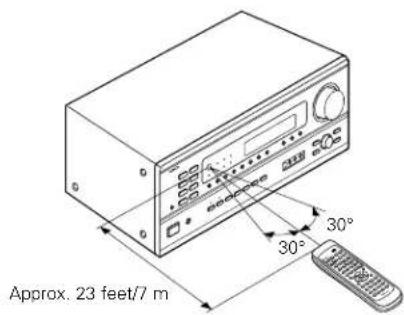
Point the remote control unit at the remote control sensor as shown on the diagram at the left.
NOTES:
- The remote control unit can be used from a straight distance of approximately 23 feet/7 meters, but this distance will shorten or operation will become difficult if there are obstacles between the remote control unit and the remote control sensor, if the remote control sensor is exposed to direct sunlight or other strong light, or if operated from an angle.
- Neon signs or other devices emitting pulse-type noise nearby may result in malfunction, so keep the set as far away from such devices as possible.
Inserting the batteries
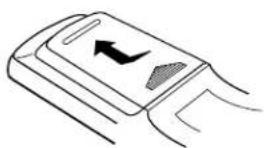
①Press as shown by the arrow and slide off.
natural_image
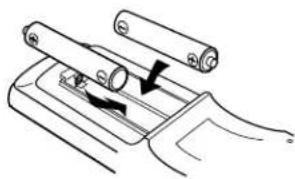
Line drawing of a device with an arrow indicating direction (no text or symbols)②Insert the R6P/AA batteries properly, as shown on the diagram.
natural_image
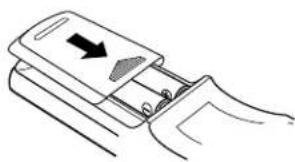
Diagram of a mechanical device with two rollers and directional arrows indicating movement (no text or symbols)③Close the lid.
natural_image
Line drawing of a hand inserting a device into a device slot (no text or symbols)NOTES:
- Use only R6P/AA batteries for replacement.
- Be sure the polarities are correct. (See the illustration inside the battery compartment.)
- Remove the batteries if the remote control transmitter will not be used for an extended period of time.
- If batteries leak, dispose of them immediately. Avoid touching the leaked material or letting it come in contact with clothing, etc. Clean the battery compartment thoroughly before installing new batteries.
- Have replacement batteries on hand so that the old batteries can be replaced as quickly as possible when the time comes.
- Even if less than a year has passed, replace the batteries with new ones if the set does not operate even when the remote control unit is operated nearby the set. (The included battery is only for verifying operation. Replace it with a new battery as soon as possible.)
10 SETTING UP THE SYSTEM
- Once all connections with other AV components have been completed as described in "CONNECTIONS" (see pages 9 to 15), make the various settings described below on the display. These settings are required to set up the listening room's AV system centered around the this unit.
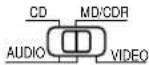
1 Set the slide switch to "AUDIO".
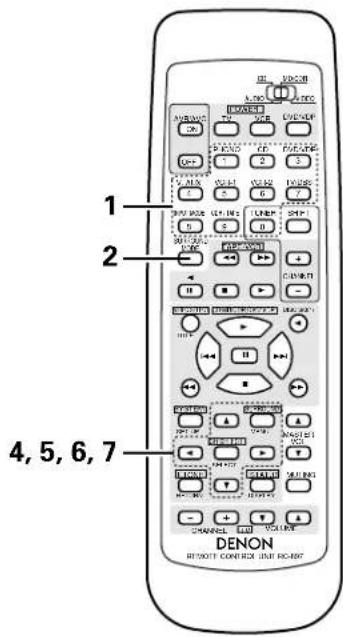
2 Use the following buttons to set up the system:
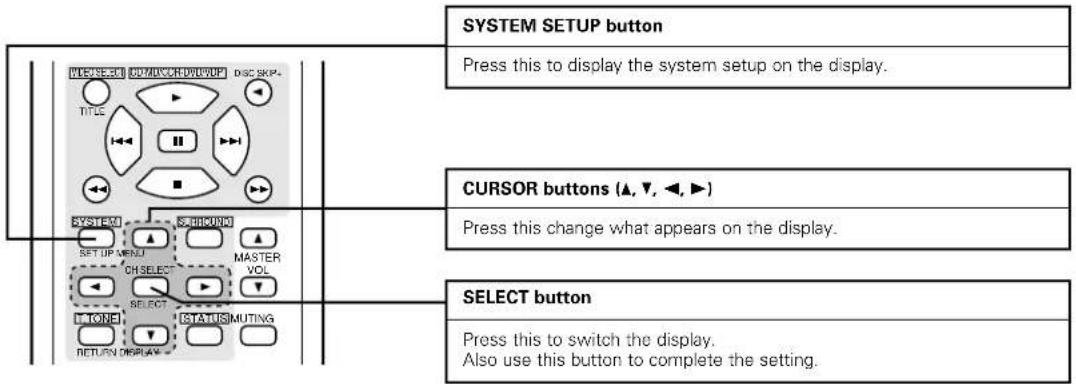
- System setup items and default values (set upon shipment from the factory)
| System setup Default settings | ||||||||||
| Speaker Configuration | Input the combination of speakers in your system and their corresponding sizes (SMALL for regular speakers, LARGE for full-size, full-rangel to automatically set the composition of the signals output from the speakers and the frequency response. | Front Sp. | Center Sp. Surround Sp. Sub Woofer | |||||||
| Large | Small Small Yes | |||||||||
| Subwoofer Mode | This selects the subwoofer speaker for playing deep bass signals. | Subwoofer mode = Normal | ||||||||
| Delay Time | This parameter is for optimizing the timing with which the audio signals are produced from the speakers and subwoofer according to the listening position. | Front & Subwoofer Center | Surround L & R — | |||||||
| 12 ft (3.6 m) | 12 ft (3.6 m) | 10 ft (3.0 m) | — | |||||||
| Digital Input | This assigns the digital input jacks for the different input sources. | Digital Inputs | COAXIAL | OPTICAL-1 | OPTICAL-2 | |||||
| Input source | DVD/WDP | TV/DBS | CDR/TAPE | |||||||
| Channel Level | This adjusts the volume of the signals output from the speakers and subwoofer for the different channels in order to obtain optimum effects. | Front L | Front R | Subwoofer | Center | Surround L | Surround R | — | ||
| 0 dB | 0 dB | 0 dB | 0 dB | 0 dB | 0 dB | — | ||||
NOTE:
- The system setup is not displayed when "HEADPHONE ONLY" is selected.
Before setting up the system
1
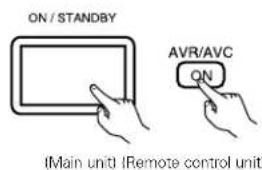
Check that all the components are correct, then press the POWER operation switch on the main unit or the POWER button on the remote control unit to turn on the power.
2
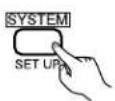
Press the SYSTEM button to enter the setting.

NOTE: Please make sure the "AUDIO" position of the slide switch on the remote control unit.
3
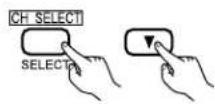
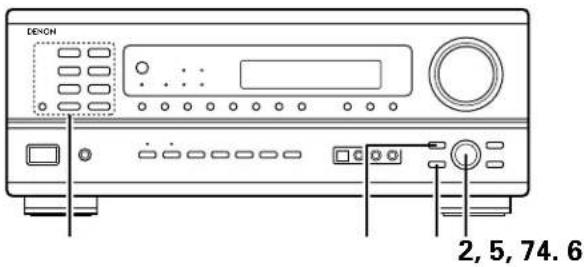
Press the SELECT or (down) button to switch to the speaker configuration set up.
NOTE:
Press the SYSTEM button again to finish system set up. System set up can be finished at any time. The changes to the settings made up to that point are entered.
Setting the speaker configuration
1
Use the (left) and (right) buttons to select your front speaker type.
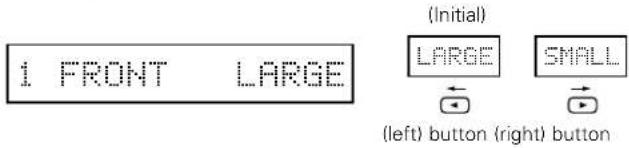
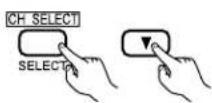
Press the SELECT or (down) button to switch to the center speaker setting.
2
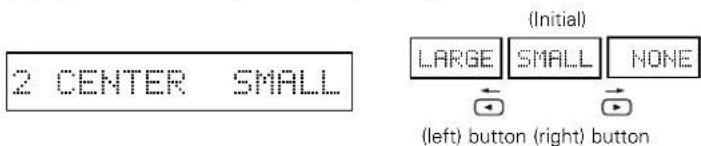
Use the (left) and (right+buttons to select your center speaker type.
Press the SELECT or (down) button to switch to the surround speaker setting.
NOTE:
- When "Small" has been selected for the front speakers, "Large" cannot be selected for the center speaker.
3
Use the (left) and (right) buttons to select your surround speaker type.
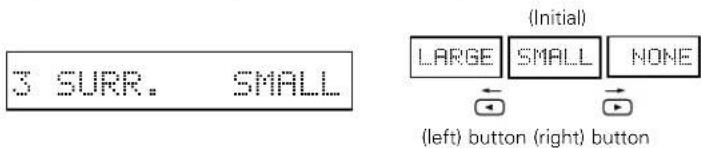
Press the SELECT or (down) button to switch to the subwoofer setting.
NOTE:
- When "Small" has been selected for the front speakers, "Large" cannot be selected for the surround speakers.
4
Use the (left) and (right+buttons to select your subwoofer setting.
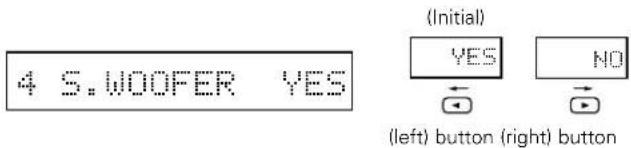
Press the SELECT or (down) button to enter the settings and switch to the SUBWOOFER MODE setting.
- Parameters
Large..... Select this when using speakers that can fully reproduce low sounds of below 80 Hz.
Small..... Select this when using speakers that cannot reproduce low sounds of below 80 Hz with sufficient volume. When this setting is selected, low frequencies of below 80 Hz are assigned to the subwoofer.
None..... Select this when no speakers are installed.
Yes/No.... Select "Yes" when a subwoofer is installed, "No" when it's not installed.
NOTE:
Select "Large" or "Small" not according to the physical size of the speaker, but according to the bass reproduction capacity at 80 Hz. If you cannot determine the best setting, try comparing the sound when set to "Small" and when set to "Large", at a level that will not damage the speakers.
Caution:
In case the subwoofer is not used, be sure to set "Subwoofer = No", or the bass sound of front channel is divided to subwoofer channel and not reproduced in some mode.
Setting the SUBWOOFER MODE
1
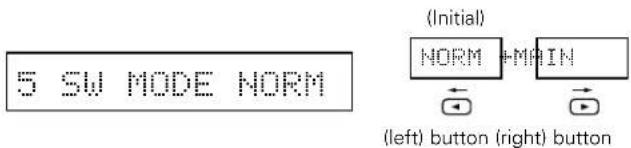
Use the (left) and (right+buttons to select the Subwoofer mode.
Press the SELECT or (down) button to enter the setting and switch to the SPEAKER DISTANCE setting.
NOTES:
— Assignment of low frequency signal range —
- The signals produced from the subwoofer channel are LFE signals (during playback of Dolby Digital or DTS signals) and the low frequency signal range of channels set to "SMALL" in the setup. The low frequency signal range of channels set to "LARGE" are produced from those channels.
— Subwoofer mode —
- The subwoofer mode setting is only valid when "LARGE" is set for the front speakers and "YES" is set for the subwoofer in the "Speaker Configuration" settings (see pages 18, 19). If "SMALL" is set for the front speakers or "NO" is set for the subwoofer, the subwoofer mode setting does not affect playback of low frequency signal range.
- When the “+MAIN” playback mode is selected, the low frequency signal range of channels set to “LARGE” are produced simultaneously from those channels and the subwoofer channel. In this playback mode, the low frequency range expand more uniformly through the room, but depending on the size and shape of the room, interference may result in a decrease of the actual volume of the low frequency range.
- When the "NORM" playback mode is selected, the low frequency signal range of channels set to "LARGE" are only produced from those channels. In this playback mode there tends to be little interference of the low frequency range in the room.
- Try playing the music or movie source and select the playback mode providing the stronger low frequency range sound.
Setting the delay time
Input the distances from the listening position to the speakers and set the surround delay time.
Preparations:
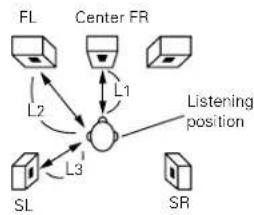
Measure the distances from the listening position to the speakers (L1 to L3 on the diagram at the right).
L1: Distance from center speaker to listening position
L2: Distance from front speakers to listening position
L3: Distance from surround speaker to listening position
CAUTION:
※ Set the center speaker at the same distance from the front speakers (left and right) or the subwoofer, or so that the difference in distance (L2 - L1) is 5 feet or less.
※ Set the surround speakers (left and right) at the same distance from the front speakers (left and right) or the subwoofer, or so that the difference in distance (L2 – L3) is 15 feet or less.
flowchart
graph TD
    FL["FL"] -->|L2| CenterFF["Center FR"]
    CenterFF -->|L1| CenterFF
    CenterFF -->|L3| SL["SL"]
    CenterFF -->|Listening position| SR["SR"]
    CenterFF -->|Listening position| CenterFF
    CenterFF -->|Listening position| CenterFF
1
Use the (left) and (right) buttons to set the distance from the front speakers and subwoofer to the listening position.
6 FRNT/5W 12ft
- The number changes in units of 1 foot each time one of the buttons is pressed. Select the value closest to the measured distance. (/SW" appears only when subwoofer = yes.)
Press the SELECT or (down) button to switch to the center speaker setting.
NOTE:
- The speaker distance can be adjusted between 0 and 60 feet in steps of 1 foot.
2
Use the (left) and (right) buttons to set the distance from the center speakers to the listening position.
7 CENTER 12ft
- The number changes in units of 1 foot each time one of the buttons is pressed. Select the value closest to the measured distance.
Press the SELECT or (down) button to switch to the surround speaker setting.
NOTE:
- No setting when "None" has been selected for the center speaker.
3
Use the (left) and (right) buttons to set the distance from the surround speakers to the listening position.
8 SURR. 10ft
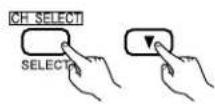
- The number changes in units of 1 foot each time one of the buttons is pressed. Select the value closest to the measured distance.
Press the SELECT or (down) button to enter the setting and switch the DIGITAL input (COAX) setting.
NOTE:
- No setting when "None" has been selected for the surround speakers.
Digital input setup
Input the type of components connected to the digital input terminals.
1
Use the (e) and (right) buttons to set the type of device connected to the COAXIAL input (COAXIAL) terminal.
9 COAX DVD

(left) button (right) button

- Select "OFF" if nothing is connected.
Press the SELECT or (down) button to switch the optical input 1 (OPT 1) setting.
2
Use the (left) and (right) buttons to set the type of device connected to the OPTICAL input (OPTICAL) terminal.
10 OPTI TV

(left) button (right) button

- Select "OFF" if nothing is connected.
Press the SELECT or (down) button to switch the optical input 2 (OPT 2) setting.
3
Use the (left) and (right) buttons to set the type of device connected to the OPTICAL input (OPTICAL) terminal.
11 OPT2 CDR

(left) button (right) button
- Select "OFF" if nothing is connected.
Press the SELECT or (down) button if you want to start the settings over front the beginning.
NOTE: PHONO, TUNER and V. AUX cannot be selected.
After setting up the system
1
Press the SYSTEM button to finish system set up.
This completes the system setup operations. Once the system is set up, there is no need to make the settings again unless other components or speakers are connected to or the speaker layout is changed.
11 REMOTE CONTROL UNIT
Operating DENON audio components
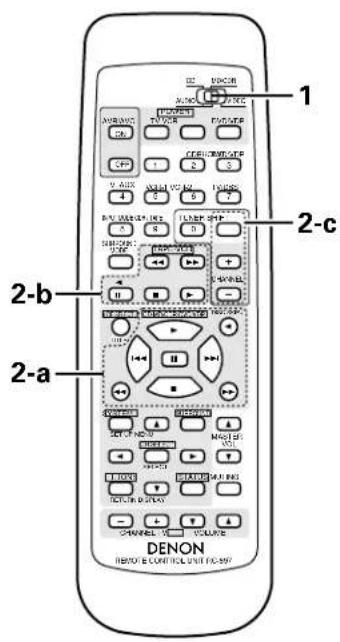
DENON remote-controllable audio components can be controlled using this unit's remote control unit. Note that some components, however, cannot be operated with this remote control unit.
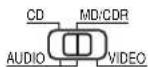
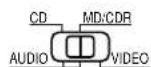
1 Set the slide switch to the position for the component to be operated (CD or MD/CDR).
2 Use the buttons shown below to operate the audio component. For details, refer to the respective component's manual.
a. For CD player and MD/CD recorder
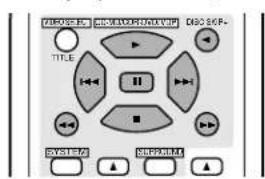
◀◀,▶▶ : Manual search (reverse and forward) ■ : Stop ▶ : Play I◀◀,▶▶▶ : Auto search ■ ■ : Pause DISC SKIP+ : Switch discs (for CD changers only)
b. For tape deck (TAPE)
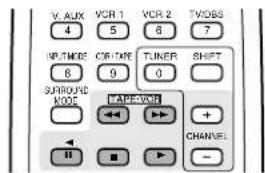
◀◀ : Rewind ▶▶ : Fast-forward ■ : Stop ▶ : Forward play ◀ : Reverse play
c. For TUNER
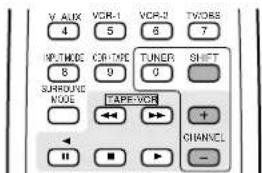
SHIFT : Switch preset channel range CHANNEL : Preset channel up/down (+,-)
NOTE:
- Tape deck (TAPE) and tuner can be operated when the switch is at "AUDIO" position.
Preset memory (Audio component)
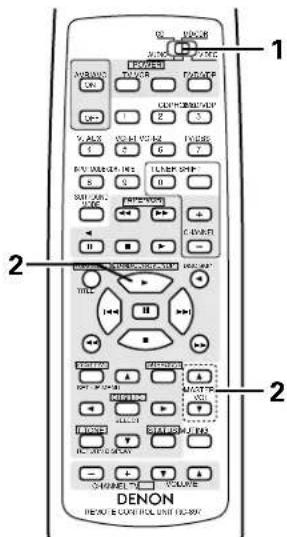
DENON components can be operated by setting the preset memory for MD or CDR. Operation in not possible for some models.
1 Set the slide switch to "MD/CDR".
2 Holding in the PLAY (▶) button, press the button for the components you want to set. (Refer to table 1.)
Table 1: Combinations of Personal System Codes
| MASTERVOL | MASTERVOL | |
| PLAY (▶) | MD | CDR |
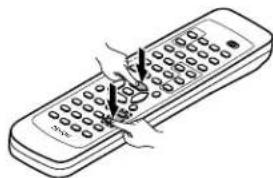
natural_image
Line drawing of a remote control with a hand inserting a button (no text or symbols)NOTE:
- The memory can only be preset for either the MD or the CDR. ※ Preset codes set upon shipment from the factory and when reset.
Preset memory (Video component)
DENON and other makes of components can be operated by setting the preset memory for your make of video component.
This remote control unit can be used to operate components of other manufacturers without using the learning function by registering the manufacturer of the component as shown on the List of Preset Codes (pages 94, 95).
Operation is not possible for some models.
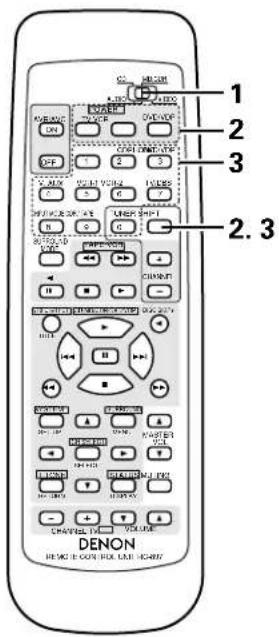
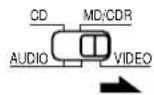
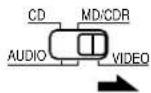
1 Set the slide switch to "VIDEO".
2 Holding in the SHIFT button ①, press the POWER button ② of the components (DVD/VDP, VCR or TV) you want to set.
※ Press and hold in the SHIFT button.
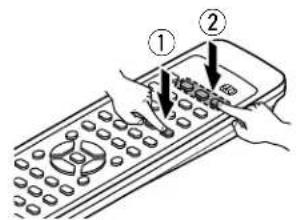
3 Holding in the SHIFT button ①, press the number buttons ② to input the preset code (consisting of 2-digit numbers) for the manufacturer of the component whose signals you want to store in the memory.
See the list on pages 94 and 95 for the preset codes (consisting of 2-digit numbers).
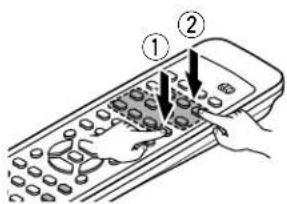
4 To continue registering other components, repeat steps 2 to 3.
NOTES:
- The signals for the pressed buttons are emitted while setting the preset memory. To avoid accidental operation, cover the remote control unit's transmitting window while setting the preset memory.
• Some models and years of manufacture of components of the manufacturers listed on the List of Preset Codes cannot be used. - The unit is equipped with several types of remote control codes which depend on the manufacturer. If there is no operation, please change the preset code (a 2-digit number) and try again.
Operating a video component stored in the preset memory
1
Set the slide switch to "VIDEO".
2
Operate the video component.
- For details, refer to the component's operating instructions.
※ Some models cannot be operated with this remote control unit.
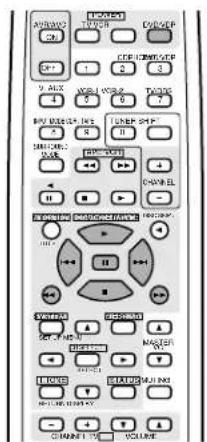
a. For DVD player
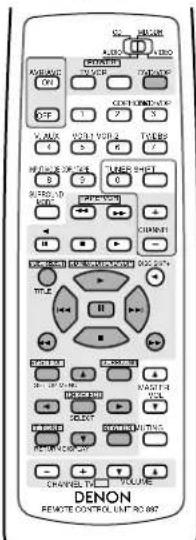
POWER : Turns power on and off
: Stop
: Play
◀◀,▶▶: Auto search (cue)
◀◀,▶▶ : Manual search (forward and reverse)
II : Pause
TITLE : Call out title
MENU : Call out menu
DISPLAY : Switch display
SET UP : DVD setup
Some manufacturers use different names for the DVD remote control buttons, so also refer to the instructions on remote control for that component.
b. For video disc player (VDP)
POWER : Power on/off
◀◀,▶▶ : Manual search (forward and reverse)
: Stop
: Play
◀◀,▶▶ : Auto search (cue)
II : Pause
c. For video deck (VCR)
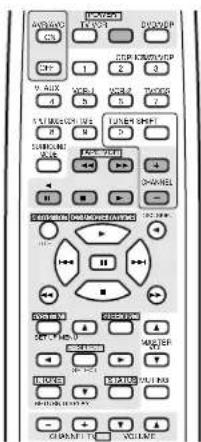
POWER : Power on/off
◀◀,▶▶ : Manual search (forward and reverse)
: Stop
: Play
II : Pause
CHANNEL : Switch channel
(+,-)
d. For monitor TV
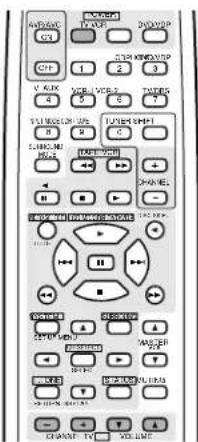
POWER : Power on/off
VOLUME : Volume up/down
(▲,▼)
CHANNEL : Switch channel (+, -)
NOTE: The TV can be operated when the switch is at any position.
12 OPERATION
Before operating
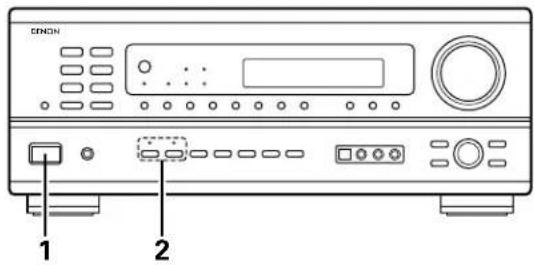
Preparations:
Check that all connections are proper.
1
Turn on the power.
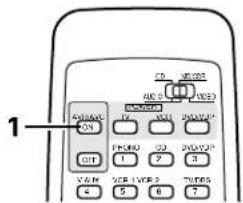
Press ON/STANDBY on the main unit or the AVR/AVC on the remote control unit to turn on the power
(Main unit) (Remote control unit)
- ON/STANDBY
When the button is pressed, the power turns on and the display lights after approximately 1 second.
When pressed again, the power turns off, the standby mode is set and the display turns off.
Several seconds are required from the time the power operation switch is set to the "ON" position until sound is output. This is due to the built-in muting circuit that prevents noise when the power switch is turned on and off.
2
Select the front speakers.
Press SPEAKER A or B turn the speaker on.
(Main unit)
Playing the input source
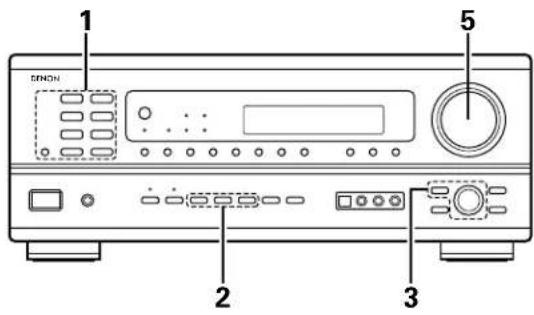
1 Press the button for the program source to be played.
EX 1: CD

(Main unit) (Remote control unit)
EX 2: CDR/TAPE

(Main unit) (Remote control unit)
2 Select the input mode. To select the input m
- Selecting the analog mode. Press ANALOG to switch to the analog input.
(Main unit)
- Selecting the external input (EXT. IN) mode. (In this case play the component connected to the "EXT. IN" terminal.) Press EXT. IN to switch the external input.
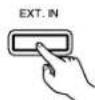
(Main unit)
- Selecting the AUTO, PCM and DTS modes. The mode switches as shown below each time INPUT MODE is pressed.
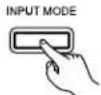
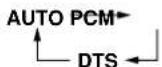
(Main unit)
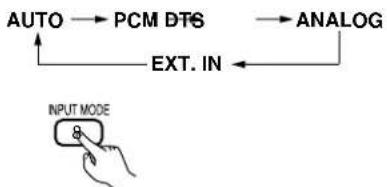
To select the input mode from the remote control unit.
- The mode switches as shown below each time INPUT MODE is pressed.
flowchart
graph TD
    A["AUTO"] --> B["PCM DTS"]
    B --> C["ANALOG"]
    C --> D["EXT. IN"]
    D --> E["INPUT MODE"]
(Remote control unit)
Input mode selection function
Different input modes can be selected for the different input sources. The selected input modes for the separate input sources are stored in the memory.
①AUTO (All auto mode)
In this mode, the types of signals being input to the digital and analog input jacks for the selected input source are detected and the program in this unit's surround decoder is selected automatically upon playback. This mode can be selected for all input sources other than PHONO, CDR/TAPE and TUNER.
The presence or absence of digital signals is detected, the signals input to the digital input jacks are identified and decoding and playback are performed automatically in DTS, Dolby Digital or PCM (2 channel stereo) format. If no digital signal is being input, the analog input jacks are selected.
Use this mode to play Dolby Digital signals.
②PCM (exclusive PCM signal playback mode)
Decoding and playback are only performed when PCM signals are being input.
Note that noise may be generated when using this mode to play signals other than PCM signals.
③DTS (exclusive DTS signal playback mode)
Decoding and playback are only performed when DTS signals are being input.
④ANALOG (exclusive analog audio signal playback mode)
The signals input to the analog input jacks are decoded and played.
⑤EXT. IN (external decoder input jack selection mode)
The signals being input to the external decoder input jacks are played without passing through the surround circuitry.
NOTE:
- Note that noise will be output when CDs or LDs recorded in DTS format are played in the "PCM" (exclusive PCM signal playback) or "ANALOG" (exclusive analog audio signal playback) mode. Select the AUTO or DTS (exclusive DTS signal playback) mode when playing signals recorded in DTS from a laser disc player.
Notes on playing a source encoded with DTS
- Noise may be generated at the beginning of playback and while searching during DTS playback in the AUTO mode. If so, play in the DTS mode.
- In some rare cases noise may be generated when you preform the operation to stop playback of a DTS-CD or DTS-LD.
3
Select the play mode.
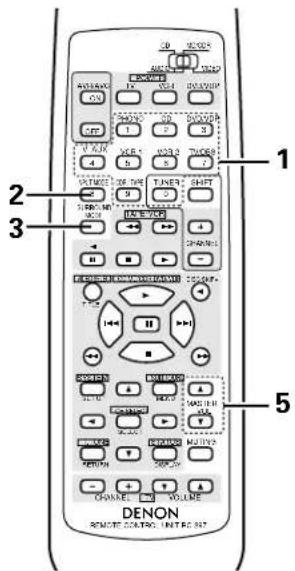
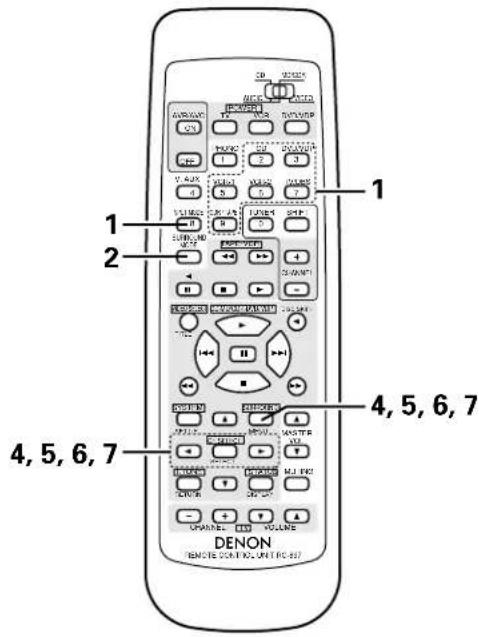
Press the SURROUND MODE button, then turn SELECT knob.

(Main unit) (Remote control unit)
※ To select the surround mode while adjusting the surround parameters, channel volume or tone control, press the surround mode button then operate the selector.
(Main unit)
4
Start playback on the selected component.
- For operating instructions, refer to the component's manual.
5
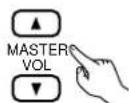
Adjust the volume.

displayed on the master volume level display.
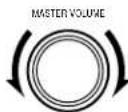
(Main unit) (Remote control unit) The volume level is
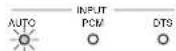
Input mode display
• In the AUTO mode
• In the DIGITAL PCM mode
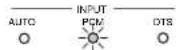
• In the DIGITAL DTS mode
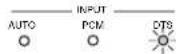
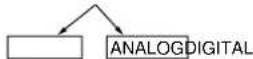
• In the ANALOG mode
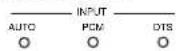
One of these lights, depending on the input signal.


Input signal display
• DOLBY DIGITAL
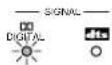
• DTS
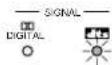
• PCM
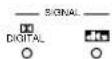
※ The DiGCTAR lights when digital signals are being input properly. If the DiGCTAR does not light, check whether the digital input component setup (page 21) and connections are correct and whether the component's power is turned on.
※ The volume can be adjusted within the range of -60 to 0 to 18 dB, in steps of 1 dB. However, when the channel level is set as described on page 30, if the volume for any channel is set at +1 dB or greater, the volume cannot be adjusted up to 18 dB. (In this case the maximum volume adjustment range is "18 dB — (Maximum value of channel level)").
Input mode when playing DTS sources
- Noise will be output if DTS-compatible CDs or LDs are played in the "ANALOG" or "PCM" mode.
When playing DTS-compatible sources, be sure to connect the source component to the digital input jacks (OPTICAL/COAXIAL) and set the input mode to "DTS".
NOTE:
- The Ritter will light when playing CD-ROMs containing data other than audio signals, but no sound will be heard.
After starting playback
[1] Adjusting the sound quality (tone)
1
The tone switches as follows each time TONE CONTROL is pressed.
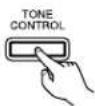
BASS FREBLE
2
With the name of the volume to be adjusted selected, turn SELECT knob to adjust the level.
• To increase the bass or treble: Turn the control clockwise. (The bass or treble sound can be increased to up to +12 dB in steps of 2 dB.)
- To decrease the bass or treble: Turn the control counterclockwise. (The bass or treble sound can be decreased to up to -12 dB in steps of 2 dB.)

(Main unit)
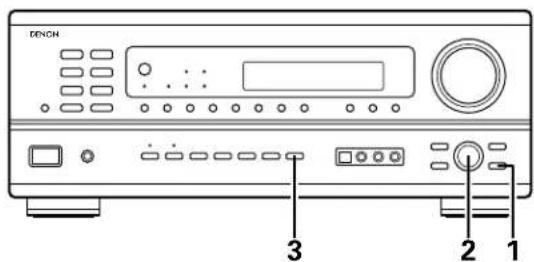
3
If you do not want the bass and treble to be adjusted, turn on the tone defeat mode.
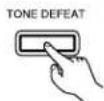
(Main unit)
※ The signals do not pass through the bass and treble adjustment circuits, providing higher quality sound.
[2] Listening over headphones NOTE:
1
Connect the headphones to the PHONES jack of the front panel.
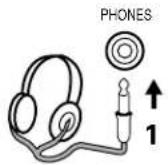
2
Press SPEAKER A or B to turn the speaker off.
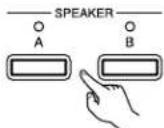
Cautions:
- No sound is produced from the headphones when speakers A or B are turned on.
- When an external power amplifier is connected to the front preout jacks, turn off the external power amplifier's speaker switch.
[3] Turning the sound off temporarily (muting)
1
Use this to turn off the audio output temporarily. Press MUTING.

※ Cancelling MUTING mode. Press the MUTING button again. Muting mode will also be cancelled when MASTER VOL is adjusted up or down.
[4] Combining the currently playing sound with the desired image
1
Simulcast playback Use this switch to monitor a video source other than the audio source.
VIDEO SELECT

(Main unit)
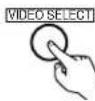
(Remote control unit)
Press VIDEO SELECT repeatedly until the desired source appears on the display.
※ Cancelling simulcast playback.
- Select "SOURCE" using the video select button.
- Switch the program source to the component connected to the video input.
[5] Checking the currently playing program source, etc.
1
Front panel display
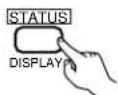
- Descriptions of the unit's operations are also displayed on the front panel display. In addition, the display can be switched to check the unit's operating status while playing a source by pressing STATUS.

(Main unit)
(Remote control unit)
2
Using the dimmer function
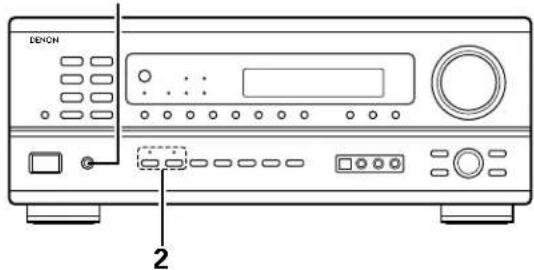
- Use this to change the brightness of the display. The display brightness changes in four steps (bright, medium, dim and off) by pressing the main unit's DIMMER repeatedly.

(Main unit)
※ The brightness changes in 3 steps each time the button is pressed, and finally the display turns off.
To prevent hearing loss, do not raise the volume level excessively when using headphones.

Playback using the external input (EXT. IN) jacks
1
Set the external input (EXT. IN) mode.
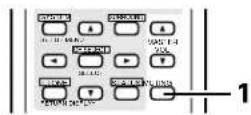
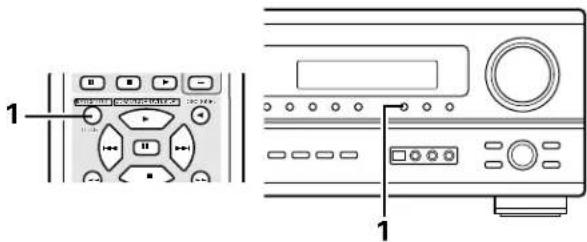
Press the EXT. IN to switch the external input.
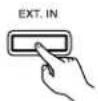
(Main unit)

(Remote control unit)
Once this is selected, the input signals connected to the FL (front left), FR (front right), C (center), SL (surround left), and SR (surround right) channels of the EXT. IN jacks are output directly to the front (left and right), center, surround (left and right) speaker systems without passing through the surround circuitry.
In addition, the signal input to the SW (subwoofer) jack is output to the PRE OUT SUBWOOFER jack.
2
Cancelling the external input mode
To cancel the external input (EXT. IN) setting, press the INPUT MODE (AUTO, PCM, DTS) or ANALOG button to switch to the desired input mode. (See page 26.)
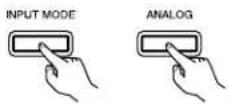
(Main unit)

(Remote control unit)
- When the input mode is set to the external input (EXT. IN), the play mode (STEREO, DOLBY/DTS SURROUND, 5CH STEREO or DSP SIMULATION) cannot be set.
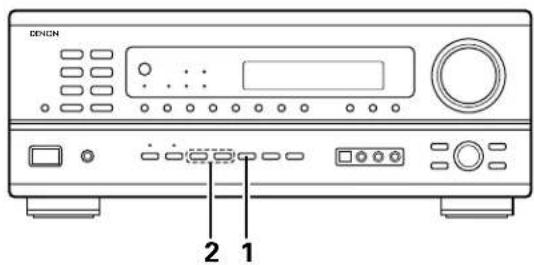
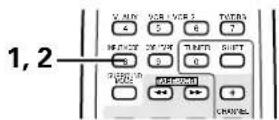
NOTES:
- In play modes other than the external input mode, the signals connected to these jacks cannot be played. In addition, signals cannot be output from channels not connected to the input jacks.
- The external input mode can be set for any input source. To watch video while listening to sound, select the input source to which the video signal is connected, then set this mode.
Recording the program source (recording the source currently being monitored)
1
Follow step 1 to 3 under "Playing the input source" (page 26, 27).
2
Start recording on the tape or video deck.
For instructions, refer to the component's operating instructions.
Simultaneous recording
The signals of the source selected with the function selector button are output simultaneously to the CDR/TAPE and VCR REC OUT jacks. If a total of two tape and/or video decks are connected and set to the recording mode, the same source can be recorded simultaneously on every decks.
NOTES:
- The AUDIO IN's signal selected with the function selector button are output to the CDR/TAPE and VCR AUDIO OUT jacks.
- The DIGITAL IN's signal selected with the function selector button are output to the DIGITAL OUT (OPTICAL) jack.
13 SURROUND
Before playing with the surround function
- Before playing with the surround function, be sure to use the test tones to adjust the playback level from each speakers. This adjustment can be performed from the remote control unit, as described below.
- The adjustment with the test tones is only effective in the DOLBY/DTS SURROUND modes. The adjusted playback levels for the different surround modes are automatically stored in the memory of each surround modes.
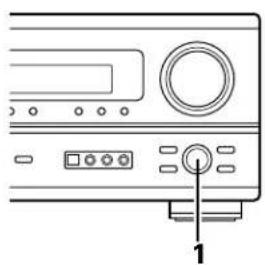
1 Set the DOLBY/DTS SURROUND (Dolby Pro Logic II or Dolby Digital or DTS) modes.

(Main unit)
(Remote control unit)
2 Press T. TONE button.
(Remote control unit)
Test tones are output from the different speakers. Use the channel volume adjust buttons to adjust so that the volume of the test tones is the same for all the speakers.
(Remote control unit)
NOTE: Please make sure the "AUDIO" position of the slide switch on the remote control unit.
natural_image
Front view of a computer monitor with control buttons and a dial (no text or symbols visible)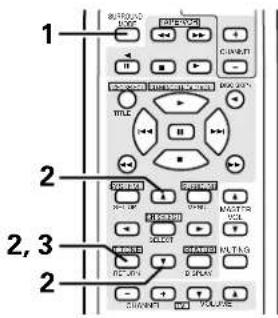
2 After completing the adjustment, press T. TONE button again.
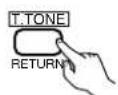
(Remote control unit)
• After adjusting using the test tones, adjust the channel levels either according to the playback sources or to suit your tastes, as described below.
1 Select the speaker whose level you want to adjust.

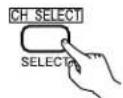
(Main unit) (Remote control unit)
The channel switches as shown below each time the button is pressed.

NOTE: Please make sure the "AUDIO" position of the slide switch on the remote control unit.
2 Adjust the level of the selected speaker.

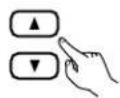
(Main unit) (Remote control unit)
※ The level of the selected speaker can be adjusted within the range of +12 to -12 dB using the SELECT (up and down) buttons.
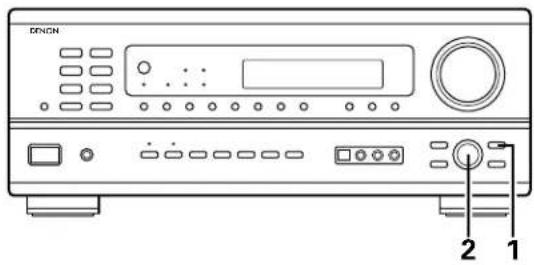
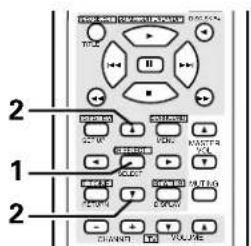
Dolby Surround Pro Logic II mode
1 Select the function to which the component you want to play is connected.
EX:
(Main unit)

(Remote control unit)
2 Select the Dolby Surround Pro Logic II mode.
Select the DOLBY PRO LOGIC II mode using the SELECT knob.
The surround mode switches when the SURROUND MODE button is pressed. Select the DOLBY PRO LOGIC II mode.

(Main unit)
(Remote control unit)
• The Dolby Pro Logic indicator lights.
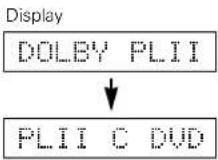
Light
PRO LOGIC
3 Play a program source with the mar DOBY SURROUND
- For operating instructions, refer to the manuals of the respective components.
Select the surround parameter mode.
(Main unit)
(Remote control unit)
※ To perform this operation from the remote control unit, check that the mode selector switch is set to "AUDIO".
5 Select the optimum mode for the source.

(Main unit)
(Remote control unit)

flowchart
graph LR
    A[" "] --> B["MODE"]
    B --> C["SELECT"]
    D["OR"] <--> E["NOT"]
    F["→"] --> G["OK"]
6 Set the surround parameters according to the mode.
(Main unit)
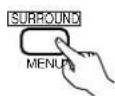
(Remote control unit)
- The mode switches as shown below each time the button is pressed.
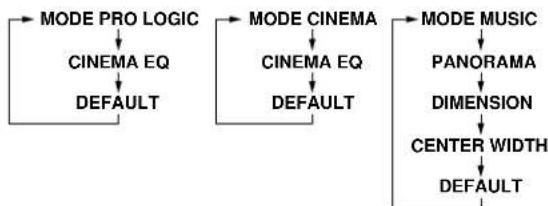
flowchart
graph TD
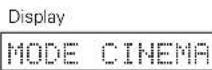
    A["MODE PRO LOGIC"] --> B["CINEMA EQ"]
    B --> C["DEFAULT"]
    D["MODE CINEMA"] --> E["CINEMA EQ"]
    E --> F["DEFAULT"]
    G["MODE MUSIC"] --> H["PANORAMA"]
    H --> I["DIMENSION"]
    I --> J["CENTER WIDTH"]
    J --> K["DEFAULT"]
7
Set the various surround parameters.
• CINEMA EQ setting
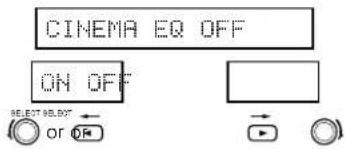
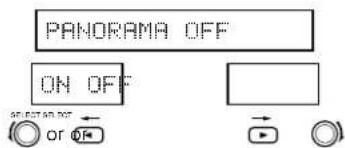
• PANORAMA setting
• DIMENSION setting
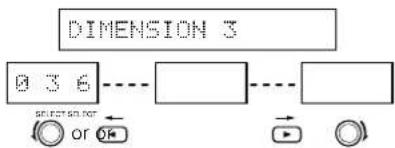
- CENTER WIDTH setting
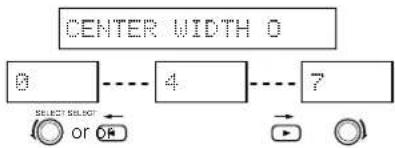
- DEFAULT setting

※ Select "Yes" to reset to the factory defaults.
NOTE:
- When making parameter settings, the display will return to the regular condition several seconds after the last button was pressed and the setting will be completed.
Surround parameters ①
Pro Logic II Mode:
The Cinema mode is the standard required mode for all A / V systems.
The Music mode is recommended as the standard mode for autosound music systems (no video), and is optional for A / V systems.
The Pro Logic mode offers the same robust surround processing as original Pro Logic in case the source contents is not of optimum quality.
Select one of the modes ("Cinema", "Music" or "Pro Logic").
Panorama Mode:
This mode extends the front stereo image to include the surround speakers for an exciting "wraparound" effect with side wall imaging.
Select "OFF" or "ON".
Dimension Control:
This control gradually adjust the soundfield either towards the front or towards the rear.
The control can be set in 7 steps from o to 6.
Center Width Control:
This control adjust the center image so it may be heard only from the center speaker; only from the left/right speakers as a phontom image; or from all three front speakers to varying degrees.
The control can be set in 8 steps from 0 to 7.
Dolby Digital mode (only with digital input) and DTS Surround (only with digital input)
1
Select the input source.
Playback with a digital input
①Select an input source set to digital (COAXIAL/OPTICAL) (see page 21).
EX:
(Main unit)
(Remote control unit)
② Set the input mode to "AUTO" or DTS.
(Main unit) (Remote control unit)

2
Select the Dolby/DTS Surround mode.
(Remote control unit)
When performing this operation from the main unit's panel, press SURROUND MODE, then turn SELECT knob and select "DOLBY/DTS".
- The following appears on the display. (DOLBY PL II, PRO LOGIC, DOLBY DIGITAL, DTS SURROUND)

(Main unit)
3
Play a program source with the


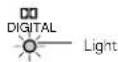
• The Dolby Digital indicator lights when playing Dolby Digital sources.
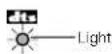
- The DTS indicator lights when playing DTS sources.
4
Set the surround parameter according to the source. First, press the SURROUND button.
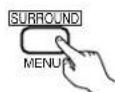
(Remote control unit)
NOTE: Please make sure the "AUDIO" position of the slide switch on the remote control unit.
CINEMA EQ OFF
The CINEMA EQ mode can be set directly using the main unit's CINEMA EQ button.

(Main unit)
• CINEMA EQ mode turns on and off each times the CINEMA EQ button is pressed.
(Remote control unit)
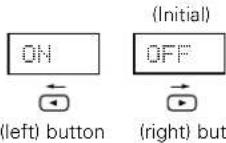
Use (left) and (right) buttons to set the CINEMA EQ.
(Remote control unit)
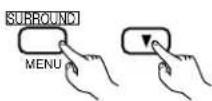
Press SURROUND or (down) button to switch to the D.COMP. setting.
5

(Remote control unit)
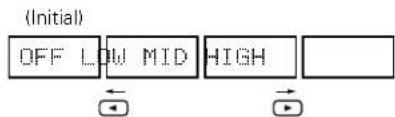
Use (left) and (right) buttons to set the D. COMP.

(left) button (right) button
(Remote control unit)
Press SURROUND or (down) button to switch to the LFE setting.
NOTE:
This parameter is not displayed during DTS playback.
6
(Remote control unit)
Use (left) and (right) buttons to set the LFE level.
LFE 9dB
(Remote control unit)
- The level can be adjusted in units of 1 dB from -10 to 0 dB. Set to the desired level according to the speaker systems being used and the source to be played.
Press SURROUND or (down) button to switch to the default setting.
7
(Remote control unit)
To reset the settings to the factory defaults, use □ (left) and ▶ (right) buttons to display "Yes".

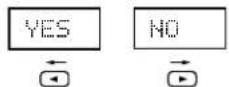
(left) button (right) button
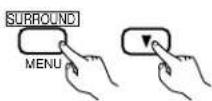
(Remote control unit)
Press SURROUND or (down) button to switch to the CINEMA EQ. setting.
NOTE:
- When making parameter settings, the display will return to the regular condition several seconds after the last button was pressed and the setting will be completed.
Surround parameters ②
CINEMA EQ. (Cinema Equalizer):
The Cinema EQ function gently decreases the level of the extreme high frequencies, compensating for overly-bright sounding motion picture soundtracks. Select this function if the sound from the front speakers is too bright.
This function only works in the Dolby Pro Logic, Dolby Digital and DTS Surround modes.
D.COMP. (Dynamic Range Compression):
Motion picture soundtracks have tremendous dynamic range (the contrast between very soft and very loud sounds). For listening late at night, or whenever the maximum sound level is lower than usual, the Dynamic Range Compression allows you to hear all of the sounds in the soundtrack (but with reduced dynamic range). (This only works when playing program sources recorded in Dolby Digital.) Select one of the four parameters ("OFF", "LOW", "MID" (middle) or "HI" (high)). Set to OFF for normal listening.
LFE (Low Frequency Effect):
Program source and adjustment range
- Dolby Digital: -10 dB to 0 dB
- DTS Surround: -10 dB to 0 dB
※ When Dolby Digital encoded software is played, it is recommended that the LFE LEVEL be set to 0 dB for correct Dolby Digital playback.
※ When DTS encoded movie software is played, it is recommended that the LFE LEVEL be set to 0 dB for correct DTS playback.
※ When DTS encoded music software is played, it is recommended that the LFE LEVEL be set to -10 dB for correct DTS playback.
- This unit is equipped with a high performance DSP (Digital Signal Processor) which uses digital signal processing to synthetically recreate the sound field. One of 7 preset surround modes can be selected according to the program source and the parameters can be adjusted according to the conditions in the listening room to achieve a more realistic, powerful sound. These surround modes can also be used for program sources not recorded in Dolby Surround Pro Logic or Dolby Digital.
Surround modes and their features
| 1 | 5CH STEREO | In this mode, the signals of the front left channel are output from the left surround channel, the signals of the front right channel are output from the right surround channel, and the same (in-phase) component of the left and right channels is output from the center channel. This mode provides all speaker surround sound, but without directional steering effects, and works with any stereo program source. |
| 2 | MONO MOVIE (NOTE 1) | Select this when watching monaural movies for a greater sense of expansion. |
| 3 | ROCK ARENA | Use this mode to achieve the feeling of a live concert in an arena with reflected sounds coming from all directions. |
| 4 | JAZZ CLUB | This mode creates the sound field of a live house with a low ceiling and hard walls. This mode gives jazz a very vivid realism. |
| 5 | VIDEO GAME | Use this to enjoy video game sources. |
| 6 | MATRIX | Select this to emphasize the sense of expansion for music sources recorded in stereo. Signals consisting of the difference component of the input signals (the component that provides the sense of expansion) processed for delay are output from the surround channel. |
| 7 VIRTUAL | Select this mode to enjoy a virtual sound field, produced from the front 2-channel speakers. | |
※ Depending on the program source being played, the effect may not be very noticeable.
In this case, try other surround modes, without worrying about their names, to create a sound field suited to your tastes.
NOTE 1: When playing sources recorded in monaural, the sound will be one-sided if signals are only input to one channel (left or right), so input signals to both channels. If you have a source component with only one audio output (monophonic camcorder, etc.) obtain a "Y" adaptor cable to split the mono output to two outputs, and connect to the L and R inputs.
NOTE:
Only the STEREO mode can be used when playing PCM signals with a sampling frequency of 96 kHz (such as from DVD-Video discs that contain 24 bit, 96 kHz audio). If such signals are input during playback in one of the other surround modes, the mode automatically switches to STEREO.
If the DTS signals are input during playback in VIRTUAL surround mode, the mode automatically switches to STEREO.
Personal Memory Plus
This set is equipped with a personal memorize function that automatically memorizes the surround modes and input modes selected for the input different sources. When the input source is switched, the modes set for that source last time it was used are automatically recalled.
※ The surround parameters, tone control settings and playback level balance for the different output channels are memorized for each surround mode.
DSP surround simulation
- To operate the surround mode and surround parameters from the remote control unit.
1
Select the surround mode for the input channel.
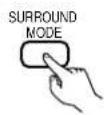
(Remote control unit)
The surround mode switches in the following order each time the SURROUND MODE button is pressed:
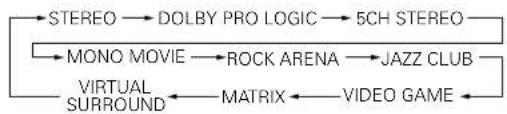
flowchart
graph LR
    A["STEREO"] --> B["DOLBY PRO LOGIC"]
    B --> C["5CH STEREO"]
    D["MONO MOVIE"] --> E["ROCK ARENA"]
    E --> F["JAZZ CLUB"]
    G["VIRUAL SURROUND"] --> H["MATRIX"]
    H --> I["VIDEO GAME"]
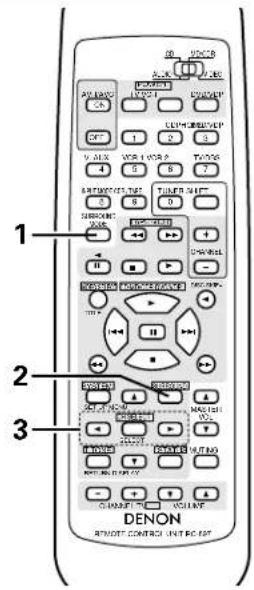
2
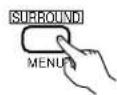
(Remote control unit)
To enter the surround parameter setting mode, press the SURROUND button.
- The surround parameter switches in the following order each time the SURROUND button is pressed for the different surround modes.
(Remote control unit)
Display the parameter you want to adjust, then use the (left) and (right) buttons to set it.
Use the (left) and (right) buttons to set the room size.

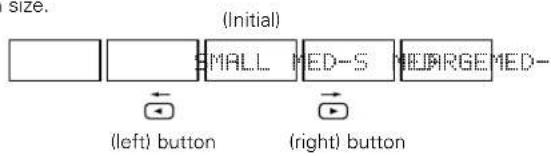
flowchart
graph LR
    A["Start"] --> B["(Initial)"]
    B --> C["MALL"]
    C --> D["ED-S"]
    D --> E["EARGE"]
    E --> F["End"]
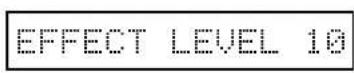
(2) EFFECT LEVEL
(Remote control unit)
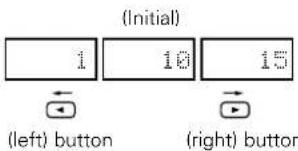
Use the (left) and (right) buttons to set the effect level.
(3) DELAY TIME

(Remote control unit)
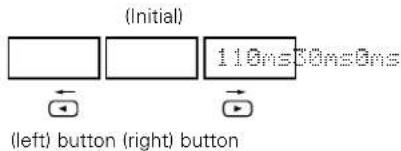
Use the (left) and (right) buttons to set the delay time.

(4) DEFAULT

(Remote control unit)
To reset the settings to the factory defaults, use the ▶ (left) and ▶ (right) buttons to display "Yes".

NOTE:
- When making parameter settings, the display will return to the regular condition several seconds after the last button was pressed and the setting will be completed.
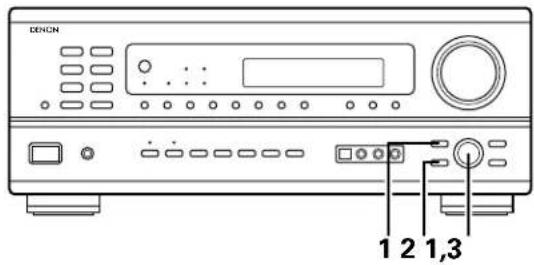
- Operating the surround mode and surround parameters from the main unit's panel.
1
Turn the SELECT knob to select the surround mode.

(Main unit)

flowchart
graph LR
    A["When turned clockwise"] --> B["STEREO BOLBY PRO LOGIC 5CH STEREO MONO MOVIE ROCK ARENA"]
    B --> C["JAZZ CLUB VIDEO GAME MATRIXVIRTUAL SURROUND"]
    D["When turned counterclockwise"] --> E["STEREO BOLBY PRO LOGIC 5CH STEREO MONO MOVIE ROCK ARENA"]
    E --> F["JAZZ CLUB VIDEO GAME MATRIXVIRTUAL SURROUND"]
※ To select the surround mode while adjusting the surround parameters, channel volume or tone control, press the surround mode button then operate the selector.
(Main unit)
2
Press SURROUND PARAMETER.
Press and hold in the surround parameter button to select the parameter you want to set.
- The parameters which can be set differ for the different surround modes. (Refer to "Surround Modes and Parameters" on page 39.
(Main unit)
3
Display the parameter you want to adjust, then turn the SELECT knob to set it.
NOTE:
- When playing PCM digital signals or analog signals in the 5CH STEREO, ROCK, ARENA, JAZZ CLUB, VIDEO GAME, MONO MOVIE or MATRIX surround modes and the input signal switches to a digital signal encoded in Dolby Digital, the Dolby surround mode switches automatically. When the input signal switches to a DTS signal, the mode automatically switches to DTS surround.
Surround parameters ③
ROOM SIZE:
This sets the size of the sound field.
There are five settings: "small", "med.s" (medium-small), "medium", "med.l" (medium-large) and "large". "small" recreates a small sound field, "large" a large sound field.
EFFECT LEVEL:
This sets the strength of the surround effect.
The level can be set in 15 steps from 1 to 15. When the surround mode is set to "VIRTUAL", the effect level can be set in steps from 1 to 10. Lower the level if the sound seems distorted.
DELAY TIME:
In the matrix mode only, the delay time can be set within the range of 0 to 110 ms.
■Surround modes and parameters
| Mode | Channel output | When playing Dolby Digital signals | When playing DTS signals | When playing PCM signals | When playing ANALOG signals | |||
| FRONT L/R | CENTER | SURROUND L/R | SUB-WOOFER | |||||
| STEREO | ○ | × | × | ◎ | ○ | ○ | ○ | ○ |
| EXTERNAL INPUT | ○ | ◎ | ◎ | ◎ | × | × | × | ○ |
| DOLBY PRO LOGIC II | ○ | ◎ | ◎ | ◎ | ○ * | × | ○ | ○ |
| DOLBY DIGITAL | ○ | ◎ | ◎ | ◎ | ○ | × | × | × |
| DTS SURROUND | ○ | ◎ | ◎ | ◎ | × | ○ | × | × |
| 5CH STEREO | ○ | ◎ | ◎ | ◎ | × | × | ○ | ○ |
| ROCK ARENA | ○ | ◎ | ◎ | ◎ | × | × | ○ | ○ |
| JAZZ CLUB | ○ | ◎ | ◎ | ◎ | × | × | ○ | ○ |
| VIDEO GAME | ○ | ◎ | ◎ | ◎ | × | × | ○ | ○ |
| MONO MOVIE | ○ | ◎ | ◎ | ◎ | × | × | ○ | ○ |
| MATRIX | ○ | ◎ | ◎ | ◎ | × | × | ○ | ○ |
| VIRTUAL | ○ | × | × | ◎ | ○ | × | ○ | ○ |
* Only for 2 ch contents.
O:Signal
×: No signal
◎: Turned on or off by speaker configuration setting
○ : Able
×: Unable
| Mode | Parameter (default values are shown in parentheses) | |||||||||||
| SURROUND PARAMETER | PRO LOGIC II MUSIC MODE ONLY | CINEMA EQ | Dolby Digital signals | DTS signals | ||||||||
| TONE CONTROL | ROOM SIZE | EFFECT LEVEL | DELAY TIME | MODE | PANORAMA | DIMENSION | CENTER WIDTH | D.COMP. | LFE | LFE | ||
| STEREO | ○(0dB) | × | × | × | × | × | × | × | × | ○(OFF) | ○(0dB) | ○(0dB) |
| EXTERNAL INPUT | ○(0dB) | × | × | × | × | × | × | × | × | × | × | × |
| DOLBY PRO LOGIC II | ○(0dB) | × | × | × | ○(ONEMA) | ○(OFF) | ○(3) | ○(0) | ○(OFF) | ○(OFF) | ○(0dB) | - |
| DOLBY DIGITAL | ○(0dB) | × | × | × | × | × | × | × | ○(OFF) | ○(OFF) | ○(0dB) | - |
| DTS SURROUND | ○(0dB) | × | × | × | × | × | × | × | ○(OFF) | × | - | ○(0dB) |
| 5CH STEREO | ○(0dB) | × | × | × | × | × | × | × | × | × | × | × |
| ROCK ARENA | ○(0dB) | ○(Medium) | ○(10) | × | × | × | × | × | × | × | × | × |
| JAZZ CLUB | ○(0dB) | ○(Medium) | ○(10) | × | × | × | × | × | × | × | × | × |
| VIDEO GAME | ○(0dB) | ○(Medium) | ○(10) | × | × | × | × | × | × | × | × | × |
| MONO MOVIE | ○(0dB) | ○(Medium) | ○(10) | × | × | × | × | × | × | × | × | × |
| MATRIX | ○(0dB) | × | × | ○(30msed) | × | × | × | × | × | × | × | × |
| VIRTUAL | ○(0dB) | × | ○(10) | × | × | × | × | × | × | ○(OFF) | ○(0dB) | × |
O:Adjustable
×: Not adjustable
15 LISTENING TO THE RADIO
Auto preset memory
This unit is equipped with a function for automatically searching for FM broadcast stations and storing them in the preset memory.
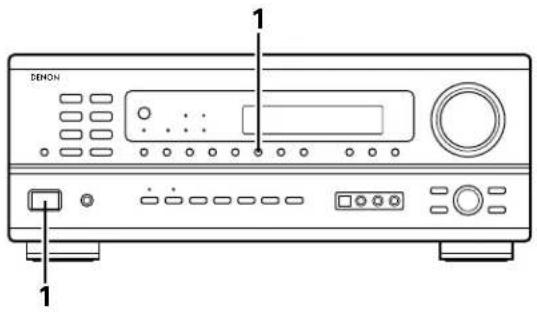
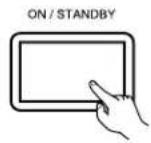
1 When the main unit's power operation switch turn on while pressing the set's MEMORY button the unit automatically begins searching for FM broadcast stations.
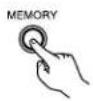
2 When the first FM broadcast station is found, that station is stored in the preset memory at channel A1. Subsequent stations are automatically stored in order at preset channels A2 to A8, B1 to B8, C1 to C8, D1 to D8 and E1 to E8, for a maximum of 40 stations.
3 Channel A1 is tuned in after the auto preset memory operation is completed.
NOTES:
- If an FM station cannot be preset automatically due to poor reception, use the "Manual tuning" operation to tune in the station, then preset it using the manual "Preset memory" operation.
- To interrupt this function, press the power operation button.
■DEFAULT VALUE
| AUTO TUNER PRESETS | |
| A1 ~ A8 87.5/89.1/98.1/107.9/90.1/90.1/90.1/90.1 MHz | |
| B1 ~ B8 520/600/1000/1400/1500/1710 kHz/90.1/90.1 MHz | |
| C1 ~ C8 90.1 MHz | |
| D1 ~ D8 90.1 MHz | |
| E1 ~ E8 90.1 MHz | |
Auto tuning
1
Press TUNER to set the input function to "TUNER".
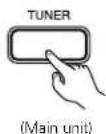
2
Watching the display, press BAND to select the desired band (AM or FM).
3
Press MODE to set the auto tuning mode.
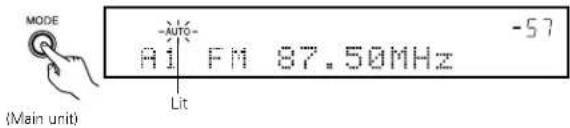
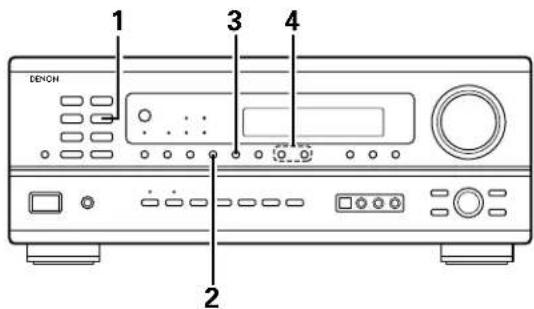
4
Press TUNING UP or DOWN.
• Automatic searching begins, then stops when a station is tuned in.
NOTE:
- When in the auto tuning mode on the FM band, the "STEREO" indicator lights on the display when a stereo broadcast is tuned in. At open frequencies, the noise is muted and the "TUNED" and "STEREO" indicators turn off.
Manual tuning
1
Press TUNER button to set the input function to "TUNER".
2
Watching the display, press BAND button to select the desired band (AM or FM).
3
Press MODE button to set the manual tuning mode. Check that the display's "AUTO" indicator turns off.
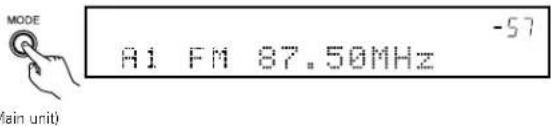
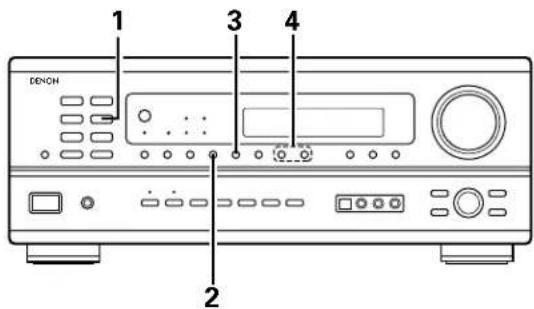
4
Press TUNING UP or DOWN button to tune in the desired station.
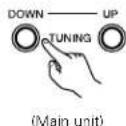
- The frequency changes continuously when the button is held in.
NOTE:
- When the manual tuning mode is set, FM stereo broadcasts are received in monaural and the "STEREO" indicator turns off.
Preset stations
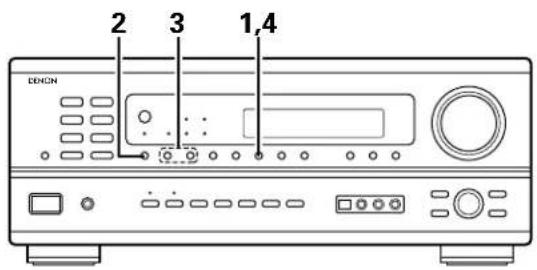
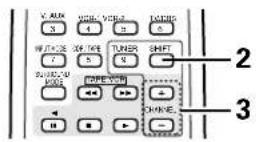
Preparations:
Use the "Auto tuning" or "Manual tuning" operation to tune in the station to be preset in the memory.
1
Press MEMORY button.

(Main unit)
2
Press SHIFT button and select the desired memory block (A to E).

(Main unit) (Remote control unit)

NOTE: Please make sure the "AUDIO" position of the slide switch on the remote control unit.
3
Press PRESET UP or DOWN button to select the desired preset channel (1 to 8).
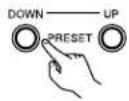
(Main unit) (Remote control unit)
4
Press MEMORY button again to store the station in the preset memory.

(Main unit)
※ To preset other channels, repeat steps 1 to 4. A total of 40 broadcast stations can be preset – 8 stations (channels 1 to 8) in each of blocks A to E.
Recalling preset stations
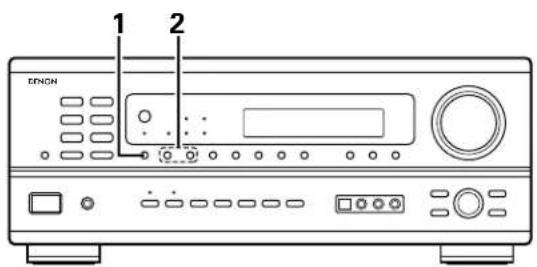
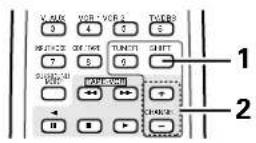
1
Watching the display, press SHIFT button to select the preset memory block.

(Main unit) (Remote control unit)

NOTE: Please make sure the "AUDIO" position of the slide switch on the remote control unit.
2
Watching the display, press PRESET UP or DOWN button to select the desired preset channel.
(Main unit) (Remote control unit)
16 LAST FUNCTION MEMORY
- This unit is equipped with a last function memory which stores the input and output setting conditions as they were immediately before the power is switched off.
- The unit is also equipped with a back-up memory. This function provides approximately one week of memory storage when the main unit's power switch is off and with the power cord disconnected.
17 INITIALIZATION OF THE MICROPROCESSOR
When the indication of the display is not normal or when the operation of the unit does not show the reasonable result, the initialization of the microprocessor is required by the following procedure.
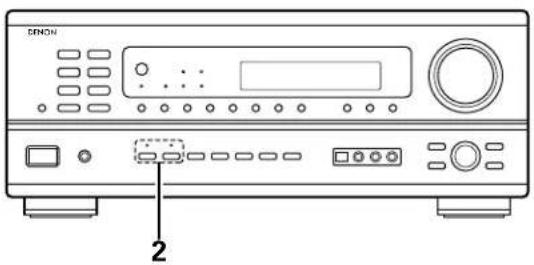
1 Switch off the unit and remove the AC cord from the wall outlet.
2 Hold the following SPEAKER A button and B button, and plug the AC cord into the outlet.
3 Check that the entire display is flashing with an interval of about 1 second, and release your fingers from the 2 buttons and the microprocessor will be initialized.
NOTES:
- If step 3 does not work, start over from step 1.
- If the microprocessor has been reset, all the button settings are reset to the default values (the values set upon shipment from the factory).
18 ADDITIONAL INFORMATION
Speaker setting examples
Here we describe a number of speaker settings for different purposes. Use these examples as guides to set up your system according to the type of speakers used and the main usage purpose.
(1) Basic setting
Use this setting if your main purpose is to listen to movie music and when using one set (two speakers) of regular single-way or two-way speakers as the surround speakers.
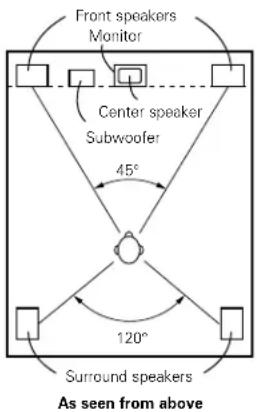
- Set the front speakers with their front surfaces as flush with the TV or monitor screen as possible. Set the center speaker between the front left and right speakers and no further from the listening position than the front speakers.
- Consult the owner's manual for your subwoofer for advice on placing the subwoofer within the listening room.
- If the surround speakers are direct-radiating (monopolar) then place them slightly behind and at an angle to the listening position and parallel to the walls at a position 60 to 90 centimeters (2 to 3 feet) above ear level at the prime listening position.
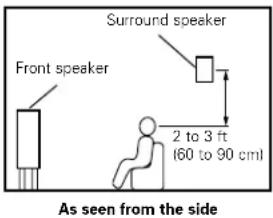
(2) Using diffusion type speakers for the surround speakers
For the greatest sense of surround sound envelopment, diffuse radiation speakers such as bipolar types, or dipolar types, provide a wider dispersion than is possible to obtain from a direct radiating speaker (monopolar). Place these speakers at either side of the prime listening position, mounted above ear level.
Path of the surround sound from the speakers to the listening position
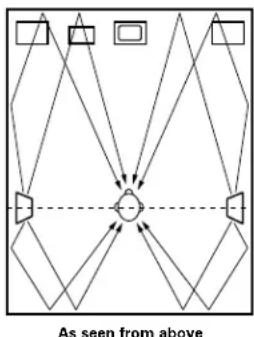
flowchart
graph TD
    A["Rectangle"] --> B["Circle"]
    C["Triangle"] --> B
    D["Square"] --> B
    E["Circle"] --> B
    F["Triangle"] --> B
    G["Square"] --> B
    H["Circle"] --> B
    I["Square"] --> B
    J["Circle"] --> B
    K["Circle"] --> B
    L["Circle"] --> B
    M["Circle"] --> B
    N["Circle"] --> B
    O["Circle"] --> B
    P["Circle"] --> B
    Q["Circle"] --> B
    R["Circle"] --> B
    S["Circle"] --> B
    T["Circle"] --> B
    U["Circle"] --> B
    V["Circle"] --> B
    W["Circle"] --> B
    X["Circle"] --> B
    Y["Circle"] --> B
    Z["Circle"] --> B
    AA["Circle"] --> B
    AB["Circle"] --> B
    AC["Circle"] --> B
    AD["Circle"] --> B
    AE["Circle"] --> B
    AF["Circle"] --> B
    AG["Circle"] --> B
    AH["Circle"] --> B
    AI["Circle"] --> B
    AJ["Circle"] --> B
    AK["Circle"] --> B
    AL["Circle"] --> B
    AM["Circle"] --> B
    AN["Circle"] --> B
    AO["Circle"] --> B
    AP["Circle"] --> B
    AQ["Circle"] --> B
    AR["Circle"] --> B
    AS["Circle"] --> B
    AT["Circle"] --> B
    AU["Circle"] --> B
    AV["Circle"] --> B
    AW["Circle"] --> B
    AX["Circle"] --> B
    AY["Rectangle"] --> Z
    AZ["Triangle"] --> Z
    BA["Square"] --> Z
    BB["Square"] --> Z
    BC["Circle"] --> Z
    BD["Circle"] --> Z
    BE["Square"] --> Z
    BF["Circle"] --> Z
    BG["Square"] --> Z
    BH["Circle"] --> Z
    BI["Square"] --> Z
    BJ["Circle"] --> Z
    BK["Square"] --> Z
- Set the front speakers, center speaker and subwoofer in the same positions as in example (1).
- Set the surround speakers directly at the sides of the listening position and 60 to 90 centimeters (2 to 3 feet) above ear level.
- The signals from the surround channels reflect off the walls as shown on the diagram at the left, creating an enveloping and realistic surround sound presentation.
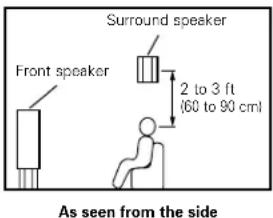
Surround
This unit is equipped with a digital signal processing circuit that lets you play program sources in the surround mode to achieve the same sense of presence as in a movie theater.
Dolby Surround
(1) Dolby Digital (Dolby Surround AC-3)
Dolby Digital is the multi-channel digital signal format developed by Dolby Laboratories.
Dolby Digital consists of up to "5.1" channels - front left, front right, center, surround left, surround right, and an additional channel exclusively reserved for additional deep bass sound effects (the Low Frequency Effects - LFE - channel, also called the ".1" channel, containing bass frequencies of up to 120 Hz).
Unlike the analog Dolby Pro Logic format, Dolby Digital's main channels can all contain full range sound information, from the lowest bass, up to the highest frequencies – 22 kHz. The signals within each channel are distinct from the others, allowing pinpoint sound imaging, and Dolby Digital offers tremendous dynamic range from the most powerful sound effects to the quietest, softest sounds, free from noise and distortion.
■Dolby Digital and Dolby Pro Logic
| Comparison of home surround systems | Dolby Digital | Dolby Pro Logic |
| No. recorded channels (elements) | 5.1 ch | 2 ch |
| No. playback channels | 5.1 ch | 4 ch |
| Playback channels (max.) | L, R, C, SL, SR, SW | L, R, C, S (SW - recommended) |
| Audio processing | Digital discrete processing Dolby Digital (AC-3) encoding/decoding | Analog matrix processing Dolby Surround |
| High frequency playback limit of surround channel | 20 kHz | 7 kHz |
■Dolby Digital compatible media and playback methods
Marks indicating Dolby Digital compatibility:

The following are general examples. Also refer to the player's operating instructions.
| Media | Dolby Digital output jacks | Playback method (reference page) |
| LD (VDP) | Coaxial Dolby Digital RF output jack※ 1 | Set the input mode to “AUTO”. (Page 26) |
| DVD | Optical or coaxial digital output (same as for PCM)※ 2 | Set the input mode to “AUTO”. (Page 26) |
| Others (satellite broadcasts, CATV, etc.) | Optical or coaxial digital output (same as for PCM) | Set the input mode to “AUTO”. (Page 26) |
※ 1 Please use a commercially available adapter when connecting the Dolby Digital RF (AC-3RF) output jack of the LD player to the digital input jack.
Please refer to the instruction manual of the adapter when making connection.
※ 2 Some DVD digital outputs have the function of switching the Dolby Digital signal output method between "bit stream" and "(convert to) PCM". When playing in Dolby Digital surround on this unit, switch the DVD player's output mode to "bit stream". In some cases players are equipped with both "bit stream + PCM" and "PCM only" digital outputs. In this case connect the "bit stream + PCM" jacks to this unit.
(2) Dolby Pro Logic II
- Dolby Pro-Logic II is a new multi-channel playback format developed by Dolby Laboratories using feedback logic steering technology and offering improvements over conventional Dolby Pro Logic circuits.
- Dolby Pro Logic II can be used to decode not only sources recorded in Dolby Surround (※) but also regular stereo sources into five channels (front left, front right, center, surround left and surround right) to achieve surround sound.
- Whereas with conventional Dolby Pro Logic the surround channel playback frequency band was limited, Dolby Pro Logic II offers a wider band range (20 Hz to 20 kHz or greater). In addition, the surround channels were monaural (the surround left and right channels were the same) with previous Dolby Pro Logic, but Dolby Pro Logic II they are played as stereo signals.
- Various parameters can be set according to the type of source and the contents, so it is possible to achieve optimum decoding (see page 30).
※ Sources recorded in Dolby Surround
These are sources in which three or more channels of surround have been recorded as two channels of signals using Dolby Surround encoding technology.
Dolby Surround is used for the sound tracks of movies recorded on DVDs, LDs and video cassettes to be played on stereo VCRs, as well as for the stereo broadcast signals of FM radio, TV, satellite broadcasts and cable TV.
Decoding these signals with Dolby Pro Logic makes it possible to achieve multi-channel surround playback. The signals can also be played on ordinary stereo equipment, in which case they provide normal stereo sound.
There are two types of DVD Dolby surround recording signals.
①2-channel PCM stereo signals
②2-channel Dolby Digital signals
When either of these signals is input to the AVR-1802, the surround mode is automatically set to Dolby Pro Logic II when the "DOLBY/DTS SURROUND" mode is selected.
■Sources recorded in Dolby Surround are indicated with the logo mark shown below.
Dolby Surround support mark:

Manufactured under license from Dolby Laboratories.
"Dolby", "Pro Logic" and the double-D symbol are trademarks of Dolby Laboratories.
DTS Digital Surround
Digital Theater Surround (also called simply DTS) is a multi-channel digital signal format developed by Digital Theater Systems.
DTS offers the same "5.1" playback channels as Dolby Digital (front left, front right and center, surround left and surround right) as well as the stereo 2-channel mode. The signals for the different channels are fully independent, eliminating the risk of deterioration of sound quality due to interference between signals, crosstalk, etc.
DTS features a relatively higher bit rate as compared to Dolby Digital (1234 kbps for CDs and LDs, 1536 kbps for DVDs) so it operates with a relatively low compression rate. Because of this the amount of data is great, and when DTS playback is used in movie theaters, a separate CD-ROM synchronized with the film is played.
With LDs and DVDs, there is of course no need for an extra disc; the pictures and sound can be recorded simultaneously on the same disc, so the discs can be handled in the same way as discs with other formats.
There are also music CDs recorded in DTS. These CDs include 5.1-channel surround signals (compared to two channels on current CDs). They do not include picture data, but they offer surround playback on CD players that are equipped with digital outputs (PCM type digital output required).
DTS surround track playback offers the same intricate, grand sound as in a movie theater, right in your own listening room.
■DTS compatible media and playback methods
Marks indicating DTS compatibility:


The following are general examples. Also refer to the player's operating instructions.
| Media | Dolby Digital output jacks | Playback method (reference page) |
| CD | Optical or coaxial digital output(same as for PCM) ✗ | Set the input mode to “AUTO” or “DTS” (page 26).Never set the mode to “ANALOG” or “PCM”. ✗ 1 |
| LD (VDP) | Optical or coaxial digital output(same as for PCM) ✗ | Set the input mode to “AUTO” or “DTS” (page 26).Never set the mode to “ANALOG” or “PCM”. ✗ 1 |
| DVD | Optical or coaxial digital output(same as for PCM) ✗ | Set the input mode to “AUTO” or “DTS” (page 26). |
※ 1 DTS signals are recorded in the same way on CDs and LDs as PCM signals. Because of this, the un-decoded DTS signals are output as random "hissy" noise from the CD or LD player's analog outputs. If this noise is played with the amplifier set at a very high volume, it may possibly cause damage to the speakers. To avoid this, be sure to switch the input mode to "AUTO" or "DTS" before playing CDs or LDs recorded in DTS. Also, never switch the input mode to "ANALOG" or "PCM" during playback. The same holds true when playing CDs or LDs on a DVD player or LD/DVD compatible player. For DVDs, the DTS signals are recorded in a special way so this problem does not occur.
※ 2 The signals provided at the digital outputs of a CD or LD player may undergo some sort of internal signal processing (output level adjustment, sampling frequency conversion, etc.). In this case the DTS-encoded signals may be processed erroneously, in which case they cannot be decoded by this unit, or may only produce noise. Before playing DTS signals for the first time, turn down the master volume to a low level, start playing the DTS disc, then check whether the DTS indicator on this unit (see page 33) lights before turning up the master volume.
※ 3 A DVD player with DTS-compatible digital output is required to play DTS DVDs. A DTS Digital Output logo is featured on the front panel of compatible DVD players. Recent DENON DVD player models feature DTS-compatible digital output – consult the player's owner's manual for information on configuring the digital output for DTS playback of DTS-encoded DVDs.
“DTS” and “DTS Digital Surround” are registered trademarks of Digital Theater Systems, Inc.
19 TROUBLESHOOTING
If a problem should arise, first check the following.
-
Are the connections correct?
-
Have you operated the receiver according to the Operating Instructions?
-
Are the speakers, turntable and other components operating property?
If this unit is not operating properly, check the items listed in the table below. Should the problem persist, there may be a malfunction.
Disconnect the power immediately and contact your store of purchase.
| Symptom Cause Measures | Page | |||
| Common problems arising when listening to the CD, records, tapes, and FM broadcasts, etc. | DISPLAY not lit and sound not produced when power switch set to on. | Power cord not plugged in securely. | Check the insertion of the power cord plug.Turn the power off with the remote control unit after turning the POWER operation switch on. | 925 |
| DISPLAY lit but sound not produced. | Speaker cords not securely connected.Improper position of the audio function button.Volume control set to minimum.MUTING is on.Digital signals not input Digital input selected. | Connect securely.Set to a suitable position.Turn volume up to suitable level.Switch off MUTING.Input digital signals or select input jacks to which digital signals are being input. | 14, 1526272827 | |
| DISPLAY not displayed and the "ON/STANDBY" LED flashes at a high rate | Speaker terminals are short-circuited.Block the ventilation holes of the set.The unit is operating at continuous high power conditions and/or inadequate ventilation. | Switch power off, connect speakers properly, then switch power back on.Turn off the set's power, then ventilate it well to cool it down.Once the set is cooled down, turn the power back on.Turn off the set's power, then ventilate it well to cool it down.Once the set is cooled down, turn the power back on. | 14, 155, 155, 15 | |
| Sound produced only from one channel. | Incomplete connection of speaker cords.Incomplete connection of input/output cords. | Connect securely.Connect securely. | 14, 159 ~ 14 | |
| Positions of instruments reversed during stereo playback. | Reverse connections of left and right speakers or left and right input/output cords. | Check left and right connections. | 14 | |
| Remote control unit. | This unit does not operate properly when remote control unit is used. | Batteries dead.Remote control unit too far from this unit.Obstacle between this unit and remote control unit.Different button is being pressed. and ends of battery inserted in reverse. | Replace with new batteries.Move closer.Remove obstacle.Press the proper button.Insert batteries properly. | 161616—16 |
Note:
When a subwoofer has been connected and the virtual surround function is being used, the signal played from the subwoofer channel is LFE only (only when playing Dolby Digital or DTS signals) for initial factory settings (i.e., the setting of the front speaker is "LARGE" and the setting of the subwoofer mode is "NORM").
When subwoofer effects are felt to be weak, while in the system setup mode try setting the subwoofer mode to “+MAIN”, or the front speaker to “SMALL” in the Speaker Configuration settings.
Making these settings will result in the low-frequency sounds of the front channel being played from the subwoofer.
20 SPECIFICATIONS
■Audio section
- Power amplifier
Rated output:
Front: 80 W + 80 W (8 Ω/ohms, 20 Hz \~ 20 kHz with 0.08% T.H.D.) 115 W + 115W (6 Ω/ohms, 1 kHz with 0.7% T.H.D.)
Center: 80 W (8 Ω/ohms, 20 Hz \~ 20 kHz with 0.08% T.H.D.)
15 W (6 Ω/ohms, 1 kHz with 0.7% T.H.D.)
Surround: 80 W + 80 W (8 Ω/ohms, 20 Hz \~ 20 kHz with 0.08% T.H.D.) 115 W + 115W (6 Ω/ohms, 1 kHz with 0.7% T.H.D.)
Dynamic power:
100 W × 2 ch (8 Ω/ohms)
145 W x 2 ch (4 Ω/ohms)
170 W x 2 ch (2 Ω/ohms)
Output terminals:
Front: A or B 6 to 16 Ω/ohms A + B 12 to 16 Ω/ohms
Center/Surround: 6 to 16 Ω/ohms
- Analog
LINE input - PRE OUT
Input sensitivity / input impedance:
Frequency response:
S/N ratio:
Total harmonic distortion:
Rated output:
200 mV / 47 kΩ/kohms
10 Hz \~ 100 kHz: +1, -3 dB (TONE DEFEAT ON)
100 dB (IHF-A weighted) (TONE DEFEAT ON)
0.008% (20 Hz \~ 20 kHz)
1.2 V
■Video section
- Standard video jacks
Input / output level and impedance:
Frequency response:
- S-video jacks
Input / output level and impedance:
1 Vp-p, 75 Ω/ohms
5 Hz \~ 10 MHz — +1, -3 dB
Y (brightness) signal — 1 Vp-p, 75 Ω/ohms
C (color) signal — 0.286 Vp-p, 75 Ω/ohms
5 Hz \~ 10 MHz — +1, -3 dB
Tuner section
Receiving range:
Usable sensitivity:
50 dB quieting sensitivity:
[FM] (note: μV at 75 Ω/ohms, 0 dBf = 1 × 10 ^-15 W)
87.50 MHz \~ 107.90 MHz
1.0 μV (11.2 dBf)
MONO 1.6 μV (15.3 dBf)
STEREO 23 μV (38.5 dBf)
MONO 80 dB (IHF-A weighted)
STEREO 75 dB (IHF-A weighted)
MONO 0.15% (1kHz)
STEREO 0.3% (1kHz)
■General
Power supply:
Power consumption:
Maximum external dimensions:
Weight:
AC 120 V, 60 Hz
4.5 A
434 (W) × 171 (H) × 417 (D) mm (17-3/32" × 6-47/64" × 16-27/64")
10.9kg (24 lbs 0.5 oz)
■Remote control unit (RC-897)
Batteries:
External dimensions:
Weight:
R6P/AA Type (two batteries)
54 (W) × 172 (H) × 27.2 (D) mm (2-1/8" × 6-49/642" × 1-5/64")
120 g (Approx. 4.2 oz) (including batteries)
INTRODUCTION
2 PRECAUTIONS D'INSTALLATION
SYSTEME D'ENCEINTES D'AMBIANCE
SYSTEME D'ENCEINTES CENTRALES
natural_image
Line drawing of a device with an arrow indicating direction (no text or symbols)natural_image
Diagram of a mechanical device with rollers and a handle, showing motion direction (no text or symbols)③Refermer le couvercle.
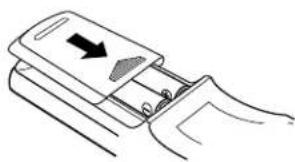
natural_image
Line drawing of a hand holding a device with an arrow indicating direction (no text or symbols)REMARQUES:
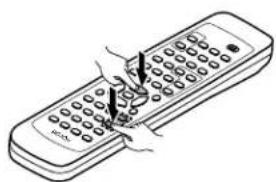
natural_image
Line drawing of a hand holding a remote control with a scroll (no text or symbols)REMARQUE:
2
natural_image
Line drawing of a computer monitor with control panel and buttons (no text or symbols)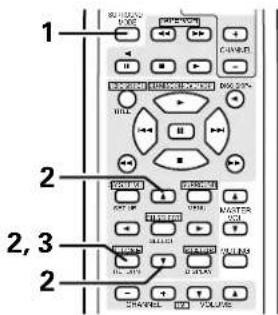
natural_image
Line drawing of a device front panel with buttons and ports (no text or symbols)2,5,74.6
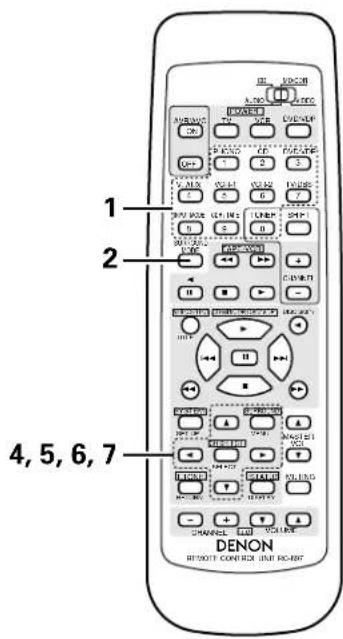
6
• Réglage PANORAMA
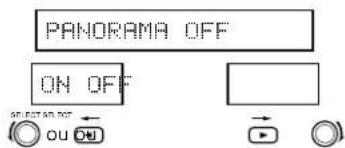
• Réglage DIMENSION
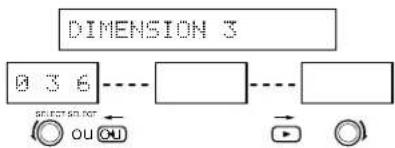
→
(left) button
(right) button
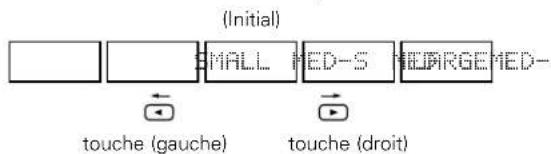
flowchart
graph LR
    A["Initial"] --> B["Mobile"]
    B --> C["ED-S"]
    C --> D["EJARGE"]
    D --> E["touche (gauche)"]
    D --> F["touche (droit)"]
(2) EFFECT LEVEL
(Unité principale)
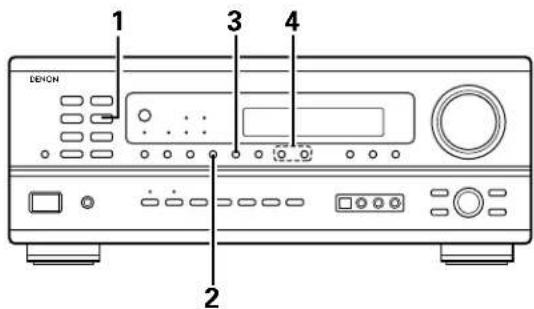
4
Speaker setting examples
DTS Digital Surround
JC Penny 02, 05, 07, 08, 09, 21
JVC 07, 09, 28, 29, 30, 31
Kendo 11
Kenwood 07, 09, 11
Loewe 11, 26
Luxor 10
LXI 02, 08, 11, 12, 25
Magnavox 04, 19, 21
Marantz 07, 09
Marta 11
Matsui 11
Memorex 21, 25
Minolta 02, 05
Mitsubishi 06, 28, 32, 33, 34, 35
Multitech 12, 32, 36
NEC 07, 09, 28, 61
Nokia 08,10
Nokia Oceanic 10
Okano 16
Olympic 04,21
Orion 20
Panasonic 04, 18, 21, 37, 56, 57, 63, 64
Pentax 02, 05
Philco 04, 21
Philips 04, 19, 21, 26, 38, 39
Phonola 26
Pioneer 04, 58
Quasar 04, 21
RCA/PROSCAN 01, 02, 04, 05, 19, 21, 24, 40, 41, 62
Realistic 08, 12, 21, 25, 33, 42
Samsung 36, 40, 43, 44, 45, 46
Sansui 09
Sanyo 08, 25, 47
Schneider 26
Scott 06, 24, 25, 32, 33, 34, 36, 40
Seleco 15
Sharp 10, 42, 60
Siemens 08
Signature 2000 10, 12
Sony 48, 49, 50, 51, 52, 53
Sylvania 04, 12, 19, 21
Symphonic 12
Tandberg 23
Tashiro 11
Tatung 07, 09
Teac 07, 09, 12
Technics 04, 21
Telefunken 54, 55
Thorn 08, 11
Toshiba 24, 41, 59
Universum 11, 20, 54
W. WHouse 11
Wards 10, 11, 25, 42
Yamaha 06, 07, 08, 09
TV
Admiral 06, 07
Aiwa 08
Akai 09, 10
Alba 10
AOC 03
Bell & Howell 06
Bestar 11
Blaupunkt 12, 13
Blue sky 11
Brandt 14
Brocsonic 03
Bush 10
Clatronic 11
Craig 15
Croslex 16
Curtis Mathis 03, 17
Daewoo 03, 11, 15, 18, 19
Daytron 04
Dual 11
Emerson 03, 04, 15, 20
Ferguson 14, 45, 46
First line 11
Fisher 09,21
Fraba 11
GE 03, 07, 22, 23, 24
Goldstar 03, 04, 11, 25
Goodmans 10, 11, 14
Grundig 12, 26, 27
Hitachi *[01], 02, 03, 04
ICE 10
Irradio 10
Itt/Nokia 28, 29
JC Penny 03, 07, 22, 25
JVC 10,30,31
Kendo 11
KTV 03,04
Loewe 11,32
LXI 03, 07, 16, 17, 21
Magnavox 03, 04, 16
Matsui 09
Mitsubishi 03, 05, 33, 34
NEC 03, 34
Nokia 28, 29
Nokia Oceanic 29
Nordmende 45, 46
Onwa 10
Panasonic 22, 23, 24, 35
Philco 03, 04, 16
Philips 16
Pioneer 17, 23, 36, 37
Portland 03,38
Quasar 22, 23
Radio Shack 03, 05, 07
RCA 03, 07, 22, 38, 39, 40
SABA 14, 41, 45, 46
Samsung 03, 04, 32, 42
Sanyo 09, 21, 48
Schneider 10
Scott 03
Sharp 04, 06, 20
Siemens 12
Signature 06
Sony 43
Sylvania 03,16
Telefunken 41, 44, 45, 46
Thomson 14, 46
Toshiba 06, 17, 47
Videch 01, 03
Wards 03, 04, 20
Yamaha 05, 06
*[ ] : Preset codes set upon shipment from the factory.

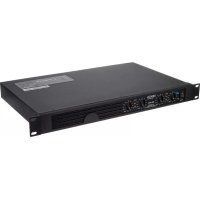
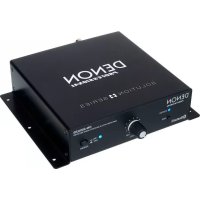
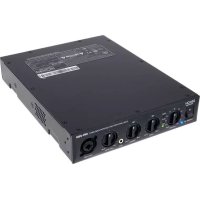
- CAUTION
- ATTENTION
- INTRODUCTION
- TABLE OF CONTENTS
- ACCESSORIES
- Check that the following parts are included in addition to the main unit:
- BEFORE USING
- Pay attention to the following before using this unit:
- - Moving the set
- - Before turning the power operation switch on
- - Store this instructions in a safe place.
- - Note that the illustrations in this instructions may differ from the actual set for explanation purposes.
- • V. AUX terminal
- CAUTIONS ON INSTALLATION
- CAUTIONS ON HANDLING
- FEATURES
- Dolby Pro Logic II decoder
- Dolby Digital decoder
- DTS (Digital Theater Systems) decoder
- High performance DSP simulates 7 sound fields
- Personal Memory Plus function
- Remote control unit with pre-memory function
- 6CH EXT. IN jack
- PART NAMES AND FUNCTIONS
- Front Panel
- Remote control unit
- READ THIS FIRST
- Step 1 (page 8 to 15)
- Step 2 (page 16)
- Step 3 (page 17 to 21)
- SETTING UP THE SPEAKER SYSTEMS
- ■Speaker system layout
- CONNECTIONS
- Connecting the audio components
- Connecting a turntable
- NOTE:
- Connecting a tape deck
- Connections for recording:
- Connecting the pre-out jacks
- INT
- FRC
- AC OUTLETS
- Connecting the video equipments
- Connecting a video decks
- Connecting a video component equipped with S-video jacks
- Note to CATV system installer:
- Notes:
- Speaker system connections
- Speaker Impedance
- Connecting the speaker cords
- • Precautions when connecting speakers
- Protector circuit
- Note on speaker impedance
- USING THE REMOTE CONTROL UNIT
- Range of operation of the remote control unit
- Inserting the batteries
- SETTING UP THE SYSTEM
- Set the slide switch to "AUDIO".
- Use the following buttons to set up the system:
- Before setting up the system
- 1
- 2
- 3
- Setting the speaker configuration
- 4
- - Parameters
- Caution:
- Setting the SUBWOOFER MODE
- — Assignment of low frequency signal range —
- — Subwoofer mode —
- Setting the delay time
- Preparations:
- Digital input setup
- After setting up the system
- REMOTE CONTROL UNIT
- Operating DENON audio components
- Preset memory (Audio component)
- Preset memory (Video component)
- Operating a video component stored in the preset memory
- OPERATION
- Before operating
- Playing the input source
- Select the input mode. To select the input m
- To select the input mode from the remote control unit.
- Input mode selection function
- Notes on playing a source encoded with DTS
- 5
- After starting playback
- [1] Adjusting the sound quality (tone)
- [2] Listening over headphones NOTE:
- Cautions:
- [3] Turning the sound off temporarily (muting)
- [4] Combining the currently playing sound with the desired image
- [5] Checking the currently playing program source, etc.
- Playback using the external input (EXT. IN) jacks
- Recording the program source (recording the source currently being monitored)
- Simultaneous recording
- SURROUND
- Before playing with the surround function
- Dolby Surround Pro Logic II mode
- 7
- Surround parameters ①
- Pro Logic II Mode:
- Panorama Mode:
- Dimension Control:
- Center Width Control:
- Dolby Digital mode (only with digital input) and DTS Surround (only with digital input)
- 6
- Surround parameters ②
- CINEMA EQ. (Cinema Equalizer):
- D.COMP. (Dynamic Range Compression):
- LFE (Low Frequency Effect):
- Personal Memory Plus
- DSP surround simulation
- Surround parameters ③
- ROOM SIZE:
- EFFECT LEVEL:
- DELAY TIME:
- LISTENING TO THE RADIO
- Auto preset memory
- Auto tuning
- Manual tuning
- Preset stations
- Recalling preset stations
- LAST FUNCTION MEMORY
- INITIALIZATION OF THE MICROPROCESSOR
- ADDITIONAL INFORMATION
- Speaker setting examples
- Basic setting
- Using diffusion type speakers for the surround speakers
- Surround
- Dolby Surround
- Dolby Digital (Dolby Surround AC-3)
- ■Dolby Digital compatible media and playback methods
- Dolby Pro Logic II
- ■Sources recorded in Dolby Surround are indicated with the logo mark shown below.
- DTS Digital Surround
- ■DTS compatible media and playback methods
- TROUBLESHOOTING
- SPECIFICATIONS
- ■Audio section
- - Analog
- ■Video section
- Tuner section
- ■General
- ■Remote control unit (RC-897)
- PRECAUTIONS D'INSTALLATION
- REMARQUES:
- REMARQUE:
- EFFECT LEVEL
Brand : DENON
Model : AVR882
Category : AV receiver