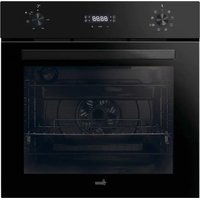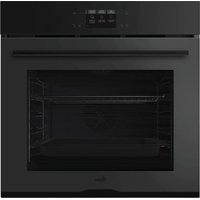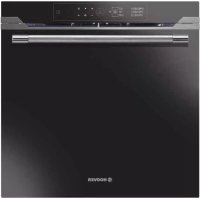
HKEEPHEAT 700 PLUS - Oven HOOVER - Free user manual and instructions
Find the device manual for free HKEEPHEAT 700 PLUS HOOVER in PDF.


User questions about HKEEPHEAT 700 PLUS HOOVER
0 question about this device. Answer the ones you know or ask your own.
Ask a new question about this device
Download the instructions for your Oven in PDF format for free! Find your manual HKEEPHEAT 700 PLUS - HOOVER and take your electronic device back in hand. On this page are published all the documents necessary for the use of your device. HKEEPHEAT 700 PLUS by HOOVER.
USER MANUAL HKEEPHEAT 700 PLUS HOOVER
- During cooking, moisture may condense inside the oven cavity or on the glass of the door. This is a normal condition. To reduce this effect, wait 10-15 minutes after turning on the power before putting food inside the oven. In any case, the condensation disappears when the oven reaches the cooking temperature.
- Cook the vegetables in a container with a lid instead of an open tray.
- Avoid leaving food inside the oven after cooking for more than 15/20 minutes.
- WARNING: the appliance and accessible parts become hot during use. Be careful not to touch any hot parts.
- WARNING: the accessible parts can become hot when the oven is in use. Children must be kept at a safe distance.
- WARNING: ensure that the appliance is switched off before replacing the bulb, to avoid the possibility of electric shocks.
- WARNING: in order to avoid any danger caused by the accidental resetting of the thermal interruption device, the appliance should not be powered by an external switching device, such as a timer, or be connected to a circuit that is regularly switched on and off.
Children under 8 must be kept at a safe distance from the appliance if not continuously supervised.
Children must not play with the appliance. - The appliance can be used by those aged 8 or over and by those with limited physical, sensorial or mental capacities, without experience or knowledge of the product, only if supervised or provided with instruction as to the operation of the appliance, in a safe way with awareness of the possible risks.
- Cleaning and maintenance should not be carried out by unsupervised children.
- Do not use rough or abrasive materials or sharp metal scrapers to clean the oven door glasses, as they can scratch the surface and cause the glass to shatter.
- The oven must be switched off before removing the removable parts and, after cleaning, reassemble them according the instructions.
- Only use the meat probe recommended for this oven.
- Do not use a steam cleaner for cleaning operations.
- Connect a plug to the supply cable that is able to bear the voltage, current and load indicated on the tag and having the earth contact. The socket must be suitable for the load indicated on the tag and must be having the earth contact connected and in operation. The earth conductor is yellow-green in colour. This operation should be carried out by a suitably qualified professional. In case of incompatibility between the socket and the
appliance plug, ask a qualified electrician to substitute the socket with another suitable type. The plug and the socket must be conformed to the current norms of the installation country. Connection to the power source can also be made by placing an omnipolar breaker between the appliance and the power source that can bear the maximum connected load and that is in line with current legislation. The yellow-green earth cable should not be interrupted by the breaker. The socket or omnipolar breaker used for the connection should be easily accessible when the appliance is installed.
- The disconnection may be achieved by having the plug accessible or by incorporating a switch in the fixed wiring in accordance with the wiring rules.
- If the power cable is damaged, it must be substituted with a cable or special bundle available from the manufacturer or by contacting the customer service department.
The type of power cable must be H05V2V2-F. - This operation should be carried out by a suitably qualified professional. The earth conductor (yellow-green) must be approximately 10 mm longer than the other conductors. For any repairs, refer only to the Customer Care Department and request the use of original spare parts.
- Failure to comply with the above can compromise the safety of the appliance and invalidate the guarantee.
- Any excess of spilled material should be removed before cleaning.
- A long power supply failure during an occurring cooking phase may cause a malfunction of the monitor. In this case contact customer service.
- The appliance must not be installed behind a decorative door in order to avoid overheating.
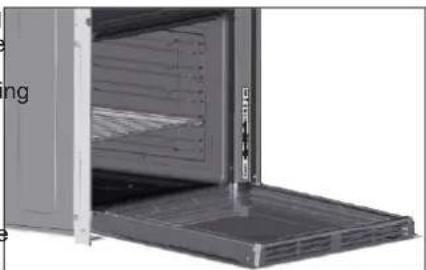
- When you place the shelf inside, make sure that the stop is directed upwards and in the back of the cavity.
The shelf must be inserted completely into the cavity - WARNING: Do not line the oven walls with aluminum foil or single-use protection available from stores. Aluminum foil or any other protection, in direct contact with the hot enamel, risk melting and deteriorating the enamel of the insides.
- WARNING: Never remove the oven door seal.
- CAUTION: Do not refill the cavity bottom with water during cooking or when the oven is hot.
- No additional operation/setting is required in order to operate the appliance at the rated frequencies.
General Instructions
4
1.1 Safety indications
1.2 Electrical safety
1.3 Recommendations
1.4 Installation
1.5 Waste management
1.6 Conformity declaration
Product Description
5
2.1 Overview
2.2 Accessories
2.3 First use
2.4 Use of Keepheat functions
Use of the Oven
7
3.1 Display description
3.2 Product Setting
3.3 Operating In Manual Mode
3.4 Operating In Recipes Mode
3.5 Operating In Special Functions Mode
3.6 Operating In My Chef Mode
3.7 Function Descriptions
3.8 WIFI Function
3.9 Cooking Modes
3.10 Keep Heat Function Modes
3.11 Preservation Guidelines
3.12 Recipes
Oven Cleaning and Maintenance
16
4.1 General notes on cleaning
4.2 Maintenance
- Removal of the oven window
- Removal and cleaning of the glass door
- Changing the bulb
Troubleshooting
17
5.1 F.A.Q.
1. General Instructions
We thank you for choosing one of our products. For the best results with your oven, you should read this manual carefully and retain it for future reference. Before installing the oven, take note of the serial number so that you can give it to customer service staff if any repairs are required. Having removed the oven from its packaging, check that it has not been damaged during transportation. If you have doubts, do not use the oven and refer to a qualified technician for advice. Keep all of the packaging material (plastic bags, polystyrene, nails) out of the reach of children. When the oven is switched on for the first time, strong smelling smoke can develop, which is caused by the glue on the insulation panels surrounding the oven heating for the first time. This is absolutely normal and, if it occurs, you should wait for the smoke to dissipate before putting food in the oven. The manufacturer accepts no responsibility in cases where the instructions contained in this document are not observed.
NOTE: the oven functions, properties and accessories cited in this manual will vary, depending on the model you have purchased.
1.1 Safety Indications
Only use the oven for its intended purpose, that is only for the cooking of foods; any other use, for example as a heat source, is considered improper and therefore dangerous. The manufacturer cannot be held responsible for any damage resulting from improper, incorrect or unreasonable usage.
The use of any electrical appliance implies the observance of some fundamental rules:
-
do not pull on the power cable to disconnect the plug from the socket;
-
do not touch the appliance with wet or damp hands or feet;
- in general the use of adaptors, multiple sockets and extension cables is not recommended;
- in case of malfunction and/or poor operation, switch off the appliance and do not tamper with it.
1.2 Electrical Safety
ENSURE THAT AN ELECTRICIAN OR QUALIFIED TECHNICIAN MAKES THE ELECTRICAL CONNECTIONS.
The power supply to which the oven is connected must conform with the laws in force in the country of installation. The manufacturer accepts no responsibility for any damage caused by the failure to observe these instructions. The oven must be connected to an electrical supply with an earthed wall outlet or a disconnector with multiple poles, depending on the laws in force in the country of installation. The electrical supply should be protected with suitable fuses and the cables used must have a transverse section that can ensure correct supply to the oven.
CONNECTION
The oven is supplied with a power cable that should only be connected to an electrical supply with 220-240 Vac 50Hz power between the phases or between the phase and neutral. Before the oven is connected to the electrical supply, it is important to check:
-
power voltage indicated on the gauge;
-
the setting of the disconnector.
The grounding wire connected to the oven's earth terminal must be connected to the earth terminal of the power supply.
WARNING
Before connecting the oven to the power supply, ask a qualified electrician to check the continuity of the power supply's earth terminal. The manufacturer accepts no responsibility for any accidents or other problems caused by failure to connect the oven to the earth terminal or by an earth connection that has defective continuity.
NOTE: as the oven could require maintenance work, it is advisable to keep another wall socket available so that the oven can be connected to this if it is removed from the space in which it is installed. The power cable must only be substituted by technical service staff or by technicians with equivalent qualifications.
1.3 Recommendations
After each use of the oven, a minimum of cleaning will help keep the oven perfectly clean.
Do not line the oven walls with aluminium foil or single-use protection available from stores. Aluminium foil or any other protection, in direct contact with the hot enamel, risks melting and deteriorating the enamel of the insides. In order to prevent excessive dirtying of your oven and the resulting strong smokey smells, we recommend not using the oven at very high temperature. It is better to extend the cooking time and lower the temperature a little. In addition to the accessories supplied with the oven, we advise you only use dishes and baking moulds resistant to very high temperatures.
1.4 Installation
The manufacturers have no obligation to carry this out. If the assistance of the manufacturer is required to rectify faults arising from incorrect installation, this assistance is not covered by the guarantee. The installation instructions for professionally qualified personnel must be followed. Incorrect installation may cause harm or injury to people, animals or belongings. The manufacturer cannot be held responsible for such harm or injury.
The oven can be located high in a column or under a worktop. Before fixing, you must ensure good ventilation in the oven space to allow proper circulation of the fresh air required for cooling and protecting the internal parts. Make the openings specified on last page according to the type of fitting.
1.5 Waste management and environmental protection
This appliance is labelled in accordance with European Directive 2012/19/EU regarding electric and electronic appliances (WEEE). The WEEE contain both polluting substances (that can have a negative effect on the environment) and base elements (that can be reused). It is important that the WEEE undergo specific treatments to correctly remove and dispose of the
pollutants and recover all the materials. Individuals can play an important role in ensuring that the WEEE do not become an environmental problem; it is essential to follow a few basic rules:
-
the WEEE should not be treated as domestic waste;
-
the WEEE should be taken to dedicated collection areas managed by the town council or a registered company.
In many countries, domestic collections may be available for large WEEEs. When you buy a new appliance, the old one can be returned to the vendor who must accept it free of charge as a one-off, as long as the appliance is of an equivalent type and has the same functions as the purchased appliance.
SAVING AND RESPECTING THE ENVIRONMENT
Where possible, avoid pre-heating the oven and always try to fill it. Open the oven door as infrequently as possible, because heat from the cavity disperses every time it is opened. For a significant energy saving, switch off the oven between 5 and 10^ minutes before the planned end of the cooking time, and use the residual heat that the oven continues to generate. Keep the seals clean and in order, to avoid any heat dispersal outside of the cavity. If you have an electric contract with an hourly tariff, the "delayed cooking" programme makes energy saving more simple, moving the cooking process to start at the reduced tariff time slot.
1.6 Declaration of compliance
By placing the mark on this product, we are confirming compliance to all relevant European safety, health and environmental requirements which are applicable in legislation for this product.
With this the Candy Hoover Group, declares that this appliance marked with C complies with the essential requirements of the Directive 2014/53/EU.
To receive a copy of the declaration of conformity, please contact the manufacturer at: www.candy-group.com.
2. Product Description
2.1 Overview
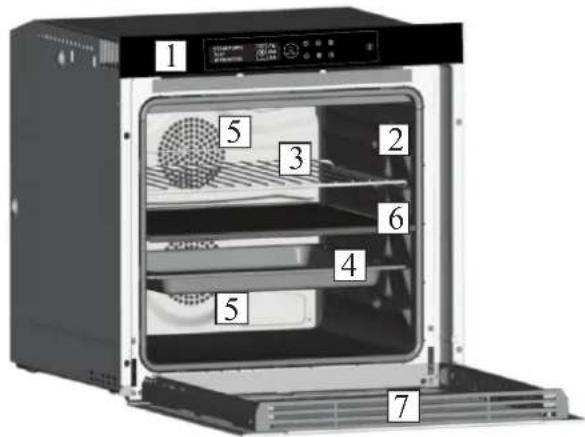
- Control panel
- Shelf positions
- Metal grill
- Drip pan
- Fan (behind the steel plate)
- Separator
7.Oyen door
2.2 Accessories
1 Drip pan
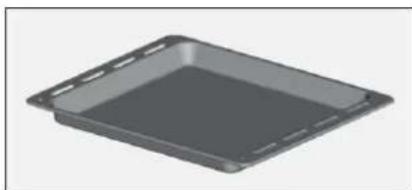
It collects the residues that drip during the cooking of food on the grills.
2 Metal grill
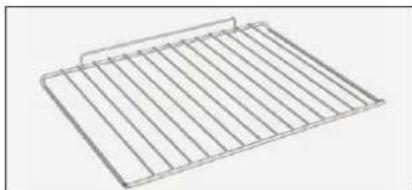
It holds baking trays and plates.
3 Separator
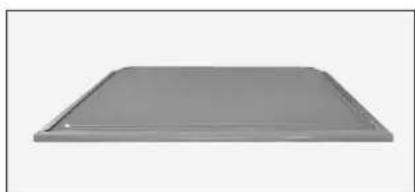
The separator divides oven into two cavities. It separates upper and lower cavity when you want to use oven in dual mode.
Note: It must be used in third shelf.
Warning: Never leave the separator inside the oven when the Pyrolytic mode is on.
4 Led vision
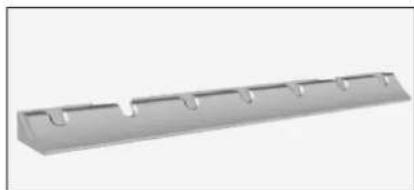
It is an illumination system which replaces the traditional « light bulb ». 14 LED (for non-pyrolitic versions) lights are integrated within the door. These produce white high quality illumination which enables to view the inside of the oven with clarity without any shadows on all the shelves.
Advantages :
This system, besides providing excellent illumination inside the oven, lasts longer than the traditional light bulb its easier and to maintain and most of all saves energy.
-Optimum view
-Long life illumination
- Very low energy consumption, -95% in comparison with the traditional illumination.
2.3 First Use
PRELIMINARY CLEANING
- Clean the oven before using for the first time.
- Wipe over external surfaces with a damp soft cloth.
- Wash all accessories and wipe inside the oven with a solution of hot water and washing up liquid.
- Set the empty oven to the maximum temperature and leave on for about 1 hour, this will remove any lingering smells of newness.
2.4 Use of Keepheat functions
PRESERVATION PROCESS
Please enter to Manual Mode to access to preservation mode section.
For more details about preservation please refer to chapter 3.11 and 3.12.
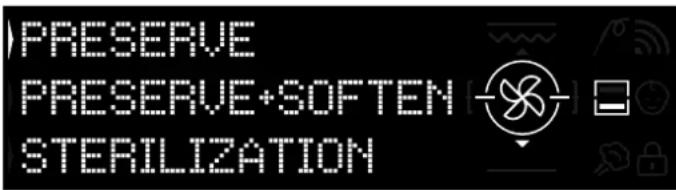
Figure 1
In order to ensure all preservation advantages and consumption benefits, we invite you to check the provided quick guide, which refers to the specific temperature required for each type of food, preservation and sterilization modes.
In order to preserve food in the healthiest, safest and best way, it is necessary to follow these steps:
- Use the function "sterilize" to sterilize recipients*
- Portion pre-cooked food
- Pack food in suitable sterilized recipients or vacuum bags**
- Select the most suitable function according to the type of food***
- Start preservation****
- Consume food*
NOTE:
Sterilization modes: including also tips and tricks.
Sterilization process must be applied only in half cavity mode.
*Recipients can vary according to the type of food. In particular:
- Liquid or semi-liquid preparations (ex. Soups): use rigid containers as jars and cover the surface with some oil. Reduce at minimum the volume occupied by liquid. Alternatively, it is possible to use vacuum bags. Sous vide kit with related user manual is included in the product only for specific models.
- Solid-malleable preparations (ex. lasagna, flans): use pans, trays or recipients hermetically covered.
- Solid-shaped preparations (ex. meat, fish): use only vacuum bags. Avoid preserving solid preparations partially immersed in liquids. It is necessary to preserve separately solids and liquids and then mix them.
- Dry preparations: use vacuum bags.
TIP:
***It is suggested to preserve meat, cereals and legumes at 70^ (preserve + soften), all the other preparations at 63^ (preserve function).
WARNING:
*** Do not preserve spinaches.
- Please note that vegetables and baked pastry must be preserved just for few days.
- We suggest pre-heating of the oven for 20 minutes.
**** Food can be consumed.
- Immediately: food is packed immediately after cooking, it is still warm and will be preserved in the oven for a short time before eating. Within 4 hours it can be even not packed at all.
- After a minimum of 4 hours in the oven: cold food is already preserved in vacuum bags.
- After a minimum of 5 hours in the oven: cold food is preserved not in vacuum bags.
- After 1 week: food is cooked, correctly packed and preserved in the oven.
- In case of black out, it is possible to consume food until 1 hour. After 1 hour, the oven must be reset from the beginning.
COOK + PRESERVE PROCESS
- Use the function "sterilization" to sterilize recipients
- Portion raw ingredients
- Pack food in suitable sterilized recipients or vacuum bags
- Select the "Cook + Preserve" function according to the type of food*
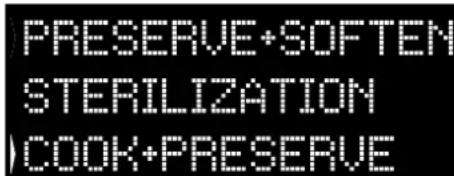

Figure 2
- Set the cooking time
- Start cooking cycle
- After finishing cooking time, the product automatically switches to preservation mode
- Consume food
*It is suggested to cook meat and legumes.
CALIBRATION
Calibration is a dedicated system for Keepheat, which allows verifying correct functioning of temperature probe.
NOTE:
- If the oven works correctly, "CALIBRATION OK" will appear on display.
- Calibration cycle could be executed in any time, but after few number of cooking processes the pop up "CALIBRATION SUGGESTED" will appear on display while selecting Preservation mode menu.
3. Use of the Oven
3.1 Display description

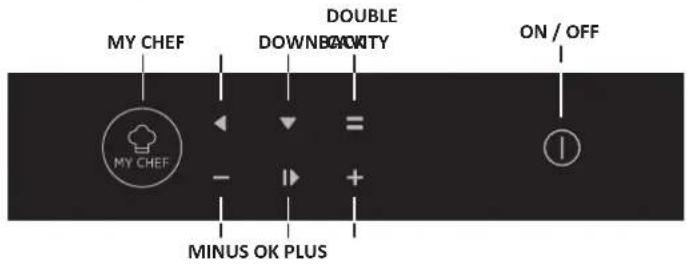
ON/OFF ① The oven is switched on and off with this button.
3.2 Product Setting
- At first launch you need to follow an installation process to be able to use the oven. Press ON/OFF to go ahead. (Figure 3)

Figure 3
- Select the language from the drop down menu. (Figure 4)

Figure 4
- Press OK to go ahead. (Figure 5)

Figure 5
- Set the time by pressing the PLUS and MINUS buttons. Press OK to go ahead. (Figure 6)

Figure 6
- The installation process is completed. Press OK then go to home page to start use the oven
For more details see quick guide.
3.3 Operating In Manual Mode
- Press the OK button when arrow on the display at MANUAL to set a cooking in 3 simple steps. (Figure 7)

Figure 7
- If the oven is switched off, the display shows the clock. When the oven is inactive, all the functions are available except the cooking duration and end of cooking.
-
If the clock is not set, the oven does not work: the display flashes, showing "12:00".
-
Select the desired Cooking mode by pressing OK while arrow on the display at desired function. Press DOWN in order to see all available functions. (Figure 8)

Figure 8
- Press PLUS or MINUS to select the desired temperature in selected function. Press OK to go ahead or BACK to return to the cooking functions selection. (Figure 9)

Figure 9
- Press DOWN to change the cooking duration. It is done by pressing PLUS and MINUS Buttons while arrow on the display at DURATION Tab. Press OK to begin the cooking or BACK to return to the temperature setting. (Figure 10)

Figure 10
- In the OPTIONS, it is possible to:
exclude pre heating,
- set end of cooking time.
When a cooking is running you can:
-
change the temperature
-
change the cooking duration
-
press STOP to finish the cooking

Figure 11
3.4 Operating In Recipes Mode
Please refer to chapter 3.12 Recipes.
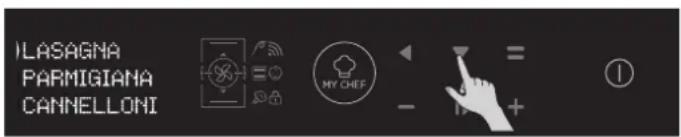
Figure 12
3.6 Operating In My Chef Mode
Please refer to chapter 3.7 Function Descriptions.
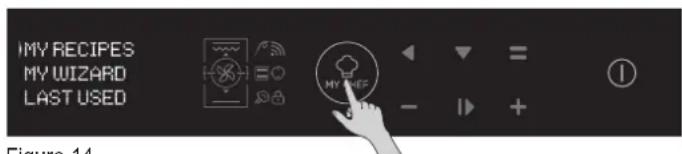
Figure 14
3.5 Operating In Special Functions Mode
Please refer to chapter 3.9 Cooking Modes.

Figure 13
3.7 Function Descriptions
| FUNCTION DESCRIPTION | |
| CHILD LOCK Entering in the setting menu from the home page, with this function it is possible to lock the oven when it is off. When the child lock is set the icon is on. | |
| MEAT PROBE If the meat probe is detected (by the Sys Info message) the icon is switched on and any running cooking program is stopped. If the meat probe is removed while a cooking program is running, the program is stopped and return home menu. | |
| ONE-FI Enter in the setting menu from the home page. With this functon it is possible to set the Wifi. NOTE: Please see the dedicated chapter 3.8 Wi-Fi Function. | |
| DOUBLE CAVITY (backlighted): With this button, with a double oven with the separator inside the cavity, it is possible to select the upper or the lower cavity. | |
| MY CHEF With this button, when the oven is not off or it is not cooking, it is possible to enter in a special menu where there are; ·“MY RECIPES” (that is a list of stored recipes, max 5; if no recipe is stored it is shown a black display with “---”), ·“MY WIZARD” (that is the last program received by App; if no programs were received it is shown a black display with “---”) ·“LAST USED” (that is the last cooking program used, different from Preservation cooking programs; if no program is stored it is shown a black display with “---”) | |
H-KEEPHEAT is fully connected, equipped with countless and innovative functions to cook and preserve your food thanks to extra Tips&Hints dedicated.
- Get access to dedicated low-temperature recipes
- Access My Chef and get more than 150 extra recipes
- Manage H-KEEPHEAT
For more details, please check related Quick Guide, at the following link: http://go.candy-group.com/hoover-ov.
WIRELESS PARAMETERS
| Parameter | Specifications (Wi-Fi) | Specifications (Bluetooth) |
| Wireless Standart | 802.11 b/g/n Bluetooth v4.2 | |
| Frequency Range | 2,412 GHz. - 2,484 GHz | 2,412 GHz. - 2,484 GHz |
| Max Transmit Power | 802.11b. DSSS 1 Mbps= +19.5 dBm | Basic data rate: RF Transmit Power (Typ): +4 dBm Enhanced data rate: RF Transmit Power (Typ): +2 dBm BLE: RF Transmit Power (Typ): +7.5 dBm |
| 802.11b. CCK 11 Mbps= +18.5 dBm | ||
| 802.11g. OFDM 54 Mbps= +18.5 dBm | ||
| 802.11n. MCS7= +14 dBm | ||
| Minimum Receiving Sensitivity | 802.11b =1024 bytes -80 dBm | Basic data rate: Sensitivity@ 0.1% BER: -98 dBm Enhanced data rate: Sensitivity@ 0.01% BER: -98 dBm BLE: Sensitivity@ 0.1% BER: -98 dBm |
| 802.11g =1024 bytes -70 dBm | ||
| 802.11n =1024 bytes -65 dBm | ||
| 802.11n HT40 =1024 bytes -65 dBm |
| Product information for networked equipment | |
| Power consumption of the product in networked standby if all wired network ports are connected and all wireless network ports are activated: | 2,0 W |
| How to activate wireless network port: | Navigate to settings -> ONE-FI ->If display shows ONE-FI RESET (means that oven is not enrolled wifi module is off and user can only start a new 5nrol5ent)Press the confirm button►Wifi module is switched on and wifi icon blinks 1s on 1s off.If display shows ONE-FI OFF (means that oven is enrolled but wifi module is off)Press the up or down arrow to toggle to ONE-FI ON and press the confirm button►Wifi module is switched on and wifi icon is always on. |
| How to deactivate wireless network port: | Navigate to settings -> ONE-FI ->If display shows ONE-FI READ ONLY (means that oven is enrolled and wifi mod is on)Press the up or down arrow to toggle to ONE-FI OFF and press the confirm button►Wifi module is switched off and wifi icon is not shown. |
Quick Guide Hoover OVEN - Enrollment on App Procedure for devices with Bluetooth 4.0 (or higher)
This quick guide illustrates the steps to follow to enroll your appliance on the App Hoover Wizard, using a device with Bluetooth 4.0 (or higher) technology. In this case, the procedure is simplified and faster (Easy Enrollment).
If you are using a device without Bluetooth technology (or less than 4.0), please follow the instructions described on the next section.
STEP1
- Mark down the appliance Serial Number.
- Mark down the Wi-Fi Name and Password (WPA/ WEP Key) which are normally placed on the back of your Wi-Fi router. NOTES
- The frequency of the home Wi-Fi network has to be set on the 2.4 GHz band. You cannot configure the appliance if your home network is set to the 5 GHz band.
- If you are having trouble locating the WPA/WEP Password, please contact your Internet Provider.
Please make sure your smartphone is connected to the same WiFi network and has the Bluetooth enabled within the "Settings". Refer to the manual for more details.
STEP2
- Download the Hoover Wizard App from the Store.
- Open the Hoover Wizard App and create your user profile by taping on "Register". Accept the privacy policy and fill in the required fields. NOTES
- The App is available for Android (version 4.4 or higher) and iOS (version 8.0 or higher) devices.
- If you already have a Hoover Wizard user profile, you can login using your credentials.
STEP3
- In the homepage, tap on the icon with the three bars on the top left to enter your profile, then tap on "REGISTER NEW APPLIANCE" and select the name of the product that you want to enroll.
STEP4
- Insert the purchase date of your appliance (DD/MM/YYYY), then tap on "Proceed".
STEP5
- Insert the 16 digits of the serial number or scan the QR code on the appliance. Tap on "Next". Check data correctness of the data and tap on "Confirm". Once the system has recognized the product, tap on "Next".
STEP6
1)Tap on the icon ONE-Fl.
2)Set the oven on ONE-FI RESET (the oven will beep).
3)The WIFI icon will blink.
- In App - Tap on "Confirm". Wait for APP to connect to the appliance.
NOTES
- Enrollment must be completed within 5 minutes.
- In case of any issue, tap "Retry", making sure you have enabled Bluetooth on your device (smartphone / tablet). If the process has not been completed correctly yet, tap on "Proceed with Standard Enrollment".
- To ensure correct data transfer, we recommend you to stay with the device close to the appliance.
STEP7
- Insert the password of your home Wi-Fi network.
- Select the type of password (WEP or WPA), then tap on "Confirm".
The enrollment process is now finished. NOTES - If this is not automatically synchronised by the App, please insert the name of your home Wi-Fi network in the first box; pay attention to the difference between lowercase and uppercase.
IF THE SET UP IS NOT SUCCESSFUL
It's important to establish a good Wi-Fi signal strength between the home router and the appliance: low Wi-Fi signal strength would cause the failure of the final stage of the set up. To assess if this is the case, start the connection process again from Step 1; when you get to Step 6, when you get to Step 6, place your device (smartphone or tablet) next to the router and search for "WIFIOVEN-xyzk" net generated by the appliance. If this does not come up as an option, it means that the router cannot see the appliance. In this case, we highly recommend you to bring the router near the appliance (if possible) or contact your internet provider to purchase a compatible "Wi-Fi Range Extender" to increase the signal strength.
Remote control mode
- Tap on the icon ONE-FL.
- Set the oven on ONE-FI ON (the oven will beep).
- The WIFI icon will blink.
Quick Guide Hoover OVEN - Enrollment on App
Procedure for devices without Bluetooth 4.0 (or less than 4.0) This quick guide outlines the steps you should follow to enroll your appliance using the App Hoover Wizard, utilizing a device without Bluetooth technology. We recommend you to proceed with a smartphone/tablet equipped with this technology to make the procedure simpler.
STEP1
- Make a note of the appliance Serial Number and Wi-Fi Name and Password (WPA/WEP Key), which are normally found on the back of your Wi-Fi router.
- Please make sure that your smartphone/ tablet is connected to the same Wi-Fi network.
NOTES
- The frequency of the home Wi-Fi network has to be set on the 2.4 GHz band. You can not configure the appliance if your home network is set to the 5 GHz band.
-If you are having trouble locating the WPA/WEP Password, please contact your Internet Provider.
STEP2
- Download the Hoover Wizard App from the Store.
-
Open the Hoover Wizard App and create your user profile by taping on "Register". Accept the privacy policy and fill in the required fields. NOTES
-
The App is available for Android (version 4.4 or higher) and iOS (version 8.0 or higher) devices.
- If you already have a Hoover Wizard user profile, you can login using your credentials.
STEP3
- In the homepage, tap on the icon with the three bars on the top left to enter your profile, then tap on "REGISTER NEW APPLIANCE" and select the name of the product that you want to enroll.
STEP4
- Insert the purchase date of your appliance (DD/MM/YYYY), then tap on "Proceed".
- Insert the 16 digits of the serial number or scan the QR code on the appliance. Tap on "Next". Check data correctness and tap on "Confirm". Once the system has recognized the product, tap on "Next".
STEP5
1) Tap on the icon ONE-FL.
2) Set the oven on ONE-FI RESET (the oven will beep) and wait 5 min.
3) The WIFI icon will blink.
In App - Tap on "Confirm". NOTES
- Enrollment must be completed within 5 minutes.
- To ensure correct data transfer, we recommend that you stay with
the device close to the appliance.
STEP6
- Exit the Hoover Wizard App.
- Go to your device Wi-Fi settings.
STEP7
- In the list of available Wi-Fi networks, select "WIFIOVEN-xyzk".
NOTES
- If you do not find it, wait few more seconds or proceed with a new scan.
STEP8
- Exit from the settings of your device.
- Return to the Hoover Wizard App and wait for the App to detect the appliance.
- Once the "Wi-Fi Network is active" screen appears, tap on "Next".
STEP9
- Insert the password of your home Wi-Fi network.
- Select the type of password (WEP or WPA), then tap on "Confirm". NOTES
- If this is not automatically synchronised by the App, please insert the name of your home Wi-Fi network in the first box; pay attention to the difference between lowercase and uppercase.
STEP10
- Wait until the end of the data transfer process between the App and the product, then tap on "Confirm". "CONNECTED" appears on the appliance display and then "REMOTE CONTROL ON".
- The enrollment process is now finished.
IF THE SET UP IS NOT SUCCESSFUL
It's important to establish a good Wi-Fi signal strength between the home router and the appliance: low Wi-Fi signal strength would cause the failure of the final stage of the set up. To assess if this is the case, start the connection process again from Step 1; when you get to Step 5, place your device (smartphone or tablet) next to the router and search for "WIFIOVEN-xyzk" net generated by the appliance. If this does not come up as an option, it means that the router cannot see the appliance. In this case, we highly recommend you to bring the router near the appliance (if possible) or contact your internet provider to purchase a compatible "Wi-Fi Range Extender" to increase the signal strength.
Remote control mode
- Tap on the icon ONE-FI.
- Set the oven on ONE-FI ON (the oven will beep).
- The WIFI icon will blink.
3.9 Cooking Modes
| Suggested temperature °C | Function(Depends on the oven model) | Full cavity* | Upper cavity** | Lower cavity*** |
| L3 | GRILL: use the grill with the door closed.The top heating element is used alone and you can adjust the temperature. Five minutes preheating is required to get the elements red-hot. Success is guaranteed for grills, kebabs and gratin dishes. White meats should be put at a distance from the grill; the cooking time is longer, but the meat will be tastier. You can put red meats and fish fillets on the shelf with the drip tray underneath. | √ | ||
| 180°C | MULTI-LEVEL: This function ensures cooking different food at the same time in one or more shelf positions. Heat penetrates into the food better and both cooking and preheating times are reduced. This cooking method gives better heat distribution and smells are not mixed. Allow about ten minutes extra when cooking food at the same time.This function is particularly indicated also for gratin and lasagna (200°C). | √√√ | ||
| 230°C | CONVECTION + FAN: This function gives better heat distribution thanks to the combination of the fan and heating elements. This function is ideal for bakery such as bread, pizza and focaccia, ensuring an homogeneous cooking result thanks to assisted heat distribution. | √ | ||
| 160°C | BOTTOM HEATING: Using the lower element. Ideal for cooking all pastry based dishes. Use this for flans, quiches, tarts, pate and any cooking that needs more heat from below. | √ | ||
| 170°C | BOTTOM HEATING + FAN: the bottom heating element is used with the fan circulating the air inside the oven. This function is ideal for cakes, tarts and croissants. It prevents food from drying and encourages rising process for a perfect cooking result. Place the shelf in the bottom position. | √ | √ | |
| 180-200 °C160-170 °C | *CONVENTIONAL: This function uses both top and bottom heating elements.Preheat the oven for about ten minutes. This method is ideal for all roasted meat (180/200°C) and fish (160-170°C).Place the food and its dish on a shelf in mid position. | √ | ||
| 210°C | DEFROST: The fan circulates air at room temperature around the frozen food so that it defrosts in a few minutes without the protein content of the food being changed or altered. | √ | ||
| 40°C | LEAVENING: Thanks to a very gentle warming of the cavity, this function ensures bread or bakery food rising during cooking process | √ | ||
| 200°C | GRILL+FAN: use the turbo-grill with the door closed.The top heating element is used with the fan circulating the air inside the oven.Preheating is necessary for red meats but not for white meats. Ideal for cooking thick food items, whole pieces such as roast pork, poultry, etc. Place the food to be grilled directly on the shelf centrally, at the middle level. Slide the drip tray under the shelf to collect the juices. Make sure that the food is not too close to the grill. Turn the food over halfway through cooking. | √ | √ | |
| 180°C | *MASTER BAKE: This function allows to cook in a healthier way, by reducing the amount of fat or oil required. The combination of heating elements with a pulsating cycle of air ensured a perfect baking result. This function is particularly indicated for gratin. | √ |
*Tested in accordance with the EN 60350-1 for the purpose of energy consumption declaration and energy class.
3.10 Keep Heat Function Modes
| Pre-set temperature °C | KEEPHEAT Function (Depends on the oven model) | Full cavity* | Upper cavity** | Lower cavity*** |
| 63 | PRESERVE: This function allows preserving all food such as meat, fish, legumes. | √ | √ | |
| 70 | PRESERVE + SOFTEN: This function allows preserving fat meat, cereals and legumes improving their tenderness and juiciness. | √ | √ | |
| 70 + 63 | COOK + PRESERVE: This function allows to cook at low temperature, ensuring food tenderness and succulence (especially for meat) and to switch automatically to preservation. | √ | √ | |
| 121 (for 15 min) | STERILIZE: This function is mandatory before preservation and it allows sterilizing jars. | √ | √ |
To use the Full Cavity Mode, remove the separator from the oven.
To use the half cavity, use the separator in the oven. Delta temperature between upper and lower cavity can vary from 160^ to 240^ .
NOTES:
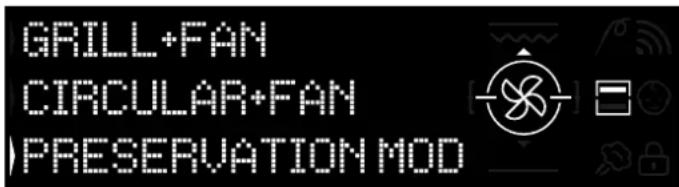
Figure 15
Keep Heat Functions are only available for half cavity functions.
- For use, please insert separator to oven.
- Please wait for screen showing half cavity as seen in the Figure 15.
- Press Double cavity button on the screen in order to select cavity you want to start preservation mode.
- Then please refer to 3.3 Operating In Manual Mode in order to start any keep-heat functions.
3.11 Preservation Guidelines
| PRODUCT CATEGORY | FOOD | RECOMMENDED STORAGE TEMPERATURE | RECOMMENDED CONTAINER | RECOMMENDATIONS |
| White meat Grilled chicken breast 70°C Vacuum bag Salt before cooking | ||||
| Stewed chicken 70°C Vacuum bag If there is plenty of sauce, transfer the sauce in a separate bag | ||||
| Chicken thighs in white wine 70°C Vacuum bag If there is plenty of sauce, transfer the sauce in a separate bag | ||||
| Cubed turkey in sauce 70°C Vacuum bag If there is plenty of sauce, transfer the sauce in a separate bag | ||||
| Pork escalopes 70°C Vacuum bag Divide slices of meat into several bags to avoid excessive overlaps | ||||
| Pork stew 70°C Vacuum bag If there is plenty of sauce, transfer the sauce in a separate bag | ||||
| Pork fillet with herbs 70°C Vacuum bag Salt before cooking | ||||
| Stewed sausages 70°C Vacuum bag If there is plenty of sauce, transfer the sauce in a separate bag | ||||
| Pork shank 70°C Vacuum bag If there is plenty of sauce, transfer the sauce in a separate bag | ||||
| Stewed veal 70°C Vacuum bag If there is plenty of sauce, transfer the sauce in a separate bag | ||||
| Roast veal 70°C Vacuum bag Salt before cooking | ||||
| Veal escalopes | 70°C Vacuum bag Salt before cooking | |||
| Veal ossobuco | 70°C | Vacuum bag | If there is plenty of sauce, transfer the sauce in a separate bag | |
| Veal shank | 70°C Vacuum bag Salt before cooking | |||
| Stewed ribs | 70°C Vacuum bag Salt before cooking | |||
| Red meat | Beef stew | 70°C | Vacuum bag | If there is plenty of sauce, transfer the sauce in a separate bag |
| Braised beef | 70°C | Vacuum bag | If there is plenty of sauce, transfer the sauce in a separate bag | |
| Roast beef | 70°C Vacuum bag Season with herbs and reduce salt | |||
| Stewed meatballs | 70°C | Vacuum bag | If there is plenty of sauce, transfer the sauce in a separate bag | |
| Pizzaola style meat 70°C Vacuum bag If there is plenty of sauce, transfer the sauce in a separate bag | ||||
| Lamb sirloin 70°C Vacuum bag Season with herbs and reduce salt | ||||
| Roasted lamb leg | 70°C Vacuum bag Season with herbs and reduce salt | |||
| Stewed lamb | 70°C Vacuum bag If there is plenty of sauce, transfer the sauce in a separate bag | |||
| Duck breast 70°C Vacuum bag Season with herbs and reduce salt | ||||
| Duck thigh 70°C Vacuum bag Salt before cooking | ||||
| Mixed meatloaf | 70°C | Vacuum bag | Season with herbs and reduce salt | |
| White fish | Fillet of sea bass, Livornese style | 63°C | Vacuum bag | If there is plenty of sauce, transfer the sauce in a separate bag |
| Fillet of sea bass in white wine | 63°C | Vacuum bag | If there is plenty of sauce, transfer the sauce in a separate bag | |
| Sea bream in white wine | 63°C | Vacuum bag | If there is plenty of sauce, transfer the sauce in a separate bag | |
| Stewed monkfish | 63°C | Vacuum bag | If there is plenty of sauce, transfer the sauce in a separate bag | |
| Stewed squids | 63°C | Vacuum bag | If there is plenty of sauce, transfer the sauce in a separate bag | |
| whole fish 63°C Vacuum bag Salt before cooking | ||||
| roast fish | 63°C | Vacuum bag | Salt before cooking | |
| Grilled fish | 63°C | Vacuum bag | Do not put lemon with the fish in the bag, it would become bitter | |
| Grilled squids | 63°C | Vacuum bag | Salt before cooking | |
| Clams | Stewed cuttlefish | 63°C | Vacuum bag | If there is plenty of sauce, transfer the sauce in a separate bag |
| Boiled octopus | 63°C | Vacuum bag | Cook directly in a vacuum bag without adding water | |
| Stewed curled octopus | 63°C | Vacuum bag | If there is plenty of sauce, transfer the sauce in a separate bag | |
| Shellfish | Prawns in white wine | 70°C | Vacuum bag | increase the storage temperature (see table) |
| Prawn sauce | 70°C | Vacuum bag | increase the storage temperature (see table) | |
| Vegetables | Cauliflower | 63°C | Vacuum bag | cook with a few drops of vinegar to reduce oxidation |
| Courgettes stirried with garlic and parsley | 63°C | Vacuum bag | cook with a few drops of vinegar to reduce oxidation | |
| Mediterranean sweet peppers | 63°C | Vacuum bag | cook with a few drops of vinegar to reduce oxidation | |
| Peppers stirried with garlic and parsley | 63°C | Vacuum bag | cook with a few drops of vinegar to reduce oxidation | |
| Broccoli | 63°C | Vacuum bag | cook with a few drops of vinegar to reduce oxidation | |
| Artichokes stirried with garlic and parsley | 63°C | Vacuum bag | cook with a few drops of vinegar to reduce oxidation | |
| Grilled vegetables | 63°C Vacuum bag salt before cooking | |||
| Roasted pumpkin | 63°C Vacuum bag salt before cooking | |||
| Vegetables au gratin | 63°C | Vacuum bag | salt before cooking | |
| Stewed peas | 63°C Vacuum bag salt before cooking | |||
| Boiled legumes | 63°C Vacuum bag drain well from the cooking water | |||
| Stewed legumes | 63°C | Vacuum bag | If there is plenty of sauce, transfer the sauce in a separate bag | |
| Boiled cereals | 63°C Vacuum bag salt before cooking | |||
| Couscous | 63°C Vacuum bag drain well from the cooking water | |||
| First courses | Polenta | 63°C | Vacuum bag | cook to a fairly dry consistency before storing |
| Vegetarian crêpes | 63°C | Vacuum bag | Bag each portion individually to prevent breakage | |
| Cereal pies 63°C Vacuum bag Season with herbs and reduce salt | ||||
| Bulgur | 63°C Vacuum bag Season with herbs and reduce salt | |||
| Quinoa | 63°C Vacuum bag Season with herbs and reduce salt | |||
| Soups | Pulses soup | 63°C | Vacuum container | Once the container is filled, add a little oil on the surface to reduce oxidation |
| Cereal soup | 63°C | Vacuum container | Once the container is filled, add a little oil on the surface to reduce oxidation | |
| Vegetable soup | 63°C | Vacuum container | Once the container is filled, add a little oil on the surface to reduce oxidation | |
| Vegetable cream | 63°C | Vacuum container | Once the container is filled, add a little oil on the surface to reduce oxidation | |
| Cream of legumes | 63°C | Vacuum container | Once the container is filled, add a little oil on the surface to reduce oxidation | |
| Meat broth | 70°C | Vacuum container | Maintain a delicate taste as the flavour will tend to concentrate during storage | |
| Vegetable stock | 63°C | Vacuum container | Maintain a delicate taste as the flavour will tend to concentrate during storage | |
| Fruit | Baked apples | 83°C | Vacuum bag | Season with spices and cinnamon before baking |
| Baked pears | 63°C | Vacuum bag | Season with spices and cinnamon before baking | |
3.12 Recipes
| Traditional cooking | ||||
| Title | Cooking mode Temperature (℃) Duration (m) | Category | ||
| Rice with cuttlefish and peas | conventional 200 20 | first course | ||
| Leek tart | conventional 175 40 | vegetables | ||
| Croissants | convection + fan 200 | 180 5-10 cakes | ||
| Quiche Lorraine | conventional 190 30 | first course | ||
| Tarte tatin | conventional 220-1 | 80 15-30 | cakes | |
| Fish lasagne | conventional 190 20 | fish | ||
| Baked tomatoes | convection + fan 200 | 30/40 | vegetables | |
| Roast beef | conventional 200 90 | meat | ||
| Empanadas | conventional 200 15 | meat | ||
| Sw ordfish rolls | conventional 180 | 8/10 | fish | |
| Low temperature cooking | ||||
| Title | Cooking mode | Temperature (°C) | Duration (minutes) | Category |
| Praw n and mango salad | cook & preserve | 70 | 25 first course | |
| Octopus w ith potatoes | multilevel | 90 | 90 first course | |
| Courgette and pea purée | multilevel | 90 | 35 vegetables | |
| Cacio e pepe' gnocchi | multilevel | 100 12 | pasta&bastery | |
| Tomato and ricotta orecchiette | multilevel | 100 | 9 | pasta&bastery |
| Scallops, fennel and olives | cook & preserve | 70 | 12 | fish |
| Salmon w ith citrus fruits and ginger | cook & preserve | 70 | 14 | fish |
| Seabass w ith artichokes | cook & preserve | 70 | 22 | fish |
| Duck w ith juniper berries | cook & preserve | 70 120 | meat | |
| Medium-rare veal tagliata | cook & preserve | 70 | 20 | meat |
| Veal w ith tuna sauce | multilevel | 80 | 120-40 | meat |
| Caesar salad | multilevel | 80 120 | vegetables | |
| Salt cod w ith peppers and broccoli | multilevel | 80 | 30 | fish |
| Asparagus and saffron orzotto | multilevel | 90 | 90 vegetables | |
| Ratatouille | multilevel | 80 | 45 vegetables | |
| Cauliflower er panna cotta | multilevel | 90 | 90 vegetables | |
| Pumpkin and carrot mash | multilevel | 90 | 40 vegetables | |
| Courgettes w ith mint | multilevel | 80 | 30 vegetables | |
| Pears, red w ine and cinnamon | multilevel | 90 120 | cakes | |
| Crème brûlée | multilevel | 80 | 40 | cakes |
4. Oven cleaning and maintenance
4.1 General notes on cleaning
-
The lifecycle of the appliance can be extended through regular cleaning.
-
Wait for the oven to cool before carrying out manual cleaning operations.
WARNING:
-
Never use abrasive detergents, steel wool or sharp objects for cleaning, so as to not irreparably damage the enamelled parts.
-
Use only water, soap or bleach-based detergents (ammonia).
GLASS PARTS
It is advisable to clean the glass window with absorbent kitchen towel after every use of the oven. To remove more obstinate stains, you can use a detergent-soaked sponge, well wrung out, and then rinse with water.
OVEN WINDOW
If dirty, the seal can be cleaned with a slightly damp sponge.
ACCESSIONS
Clean accessories with a wet, soapy sponge before rinsing and drying them: avoid using abrasive detergents.
DRIP PAN
After using the grill, remove the pan from the oven.
- Pour the hot fat into a container and wash the pan in hot water, using a sponge and washing-up liquid.
NOTES:
- If greasy residues remain, immerse the pan in water and detergent. Alternatively, you can wash the pan in the dishwasher or use a commercial oven detergent.
- Never put a dirty pan back into the oven.
4.2 Maintenance
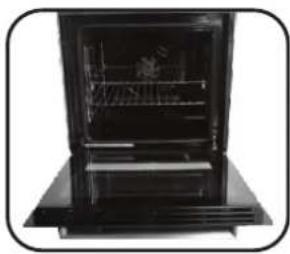
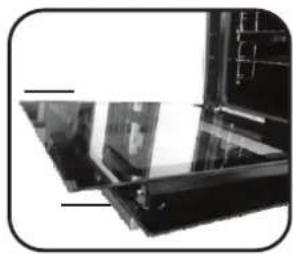
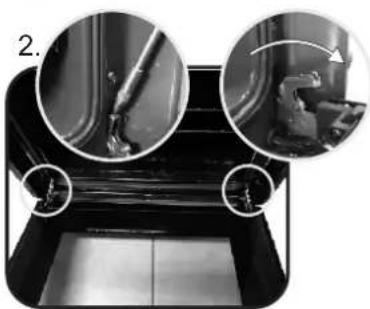
REMOVAL OF THE OVEN DOOR
- Open the front window.
- Open the clamps of the hinge housing on the right and left side of the front window by pushing them downwards.
- Replace the window by carrying out the procedure in reverse.
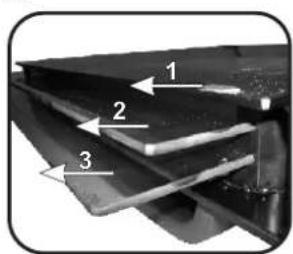
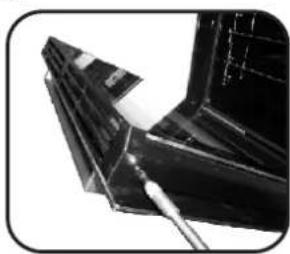
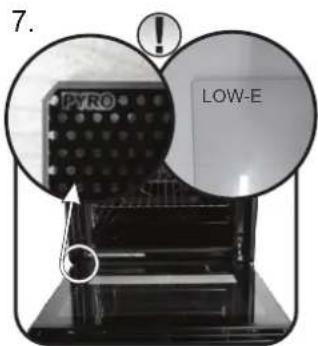
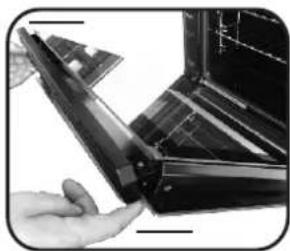
REMOVAL AND CLEANING OF THE GLASS DOOR
- Open the oven door.
2.3.4. Lock the hinges, remove the screws and remove the upper metal cover by pulling it upwards.
5.6. Remove the glass, carefully extracting it from the oven door - At the end of cleaning or substitution, reassemble the parts in reverse order.
1.
5.
6.
3.
4.
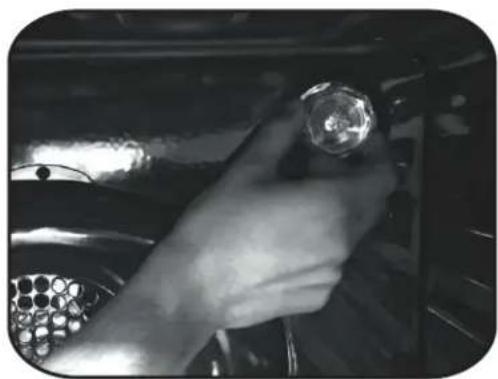
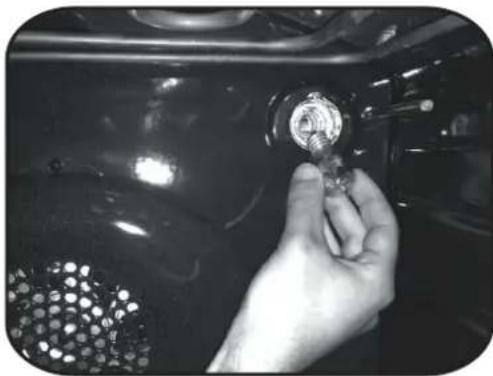
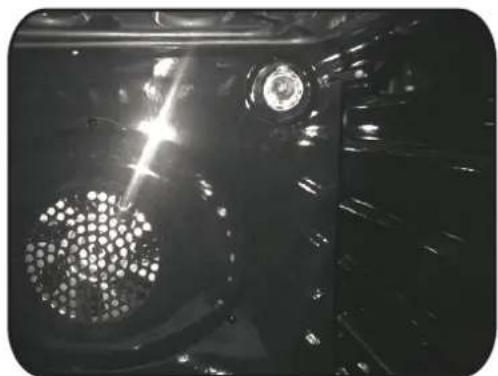
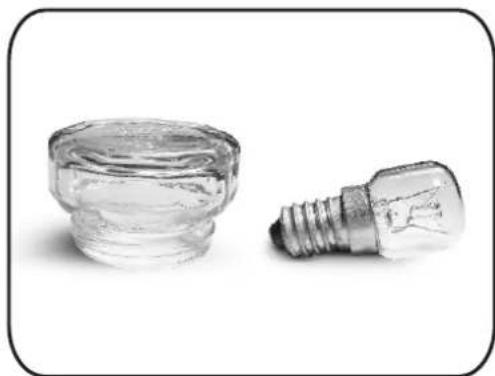
CHANGING THE BULB
- Disconnect the oven from the mains supply.
- Undo the glass cover, unscrew the bulb and replace it with a new bulb of the same type.
- Once the defective bulb is replaced, replace the glass cover.
5. Troubleshooting
5.1 FAQ
| PROBLEM POSSIBLE CAUSE SOLUTION | ||
| The oven does not heat up | The clock is not set Set the clock | |
| The oven does not heat up | The child lock is on | Deactivate the child lock |
| The oven does not heat up | A cooking function and temperature has not been set | Ensure that the necessary settings are correct |
| No reaction of the touch user interface | Steam and condensation on the user interface panel | Clean with a microfiber cloth the user interface panel to remove the condensation layer |