 ManualGo.com
BAS 505 Precision - Saw METABO - Free user manual and instructions
Find the device manual for free BAS 505 Precision METABO in PDF.



| Technical Features | METABO BAS 505 Precision band saw, 400 W power, adjustable cutting speed, 120 mm cutting capacity. |
|---|---|
| Usage | Ideal for woodworking, cutting composite materials, and creating complex shapes. |
| Maintenance and Repair | Regularly check blade tension, clean debris after each use, lubricate moving parts. |
| Safety | Wear safety glasses, avoid loose clothing, unplug the device when changing the blade. |
| General Information | 3-year warranty, weight 12 kg, compact dimensions for easy storage. |
Frequently Asked Questions - BAS 505 Precision METABO
Download the instructions for your Saw in PDF format for free! Find your manual BAS 505 Precision - METABO and take your electronic device back in hand. On this page are published all the documents necessary for the use of your device. BAS 505 Precision by METABO.
USER MANUAL BAS 505 Precision METABO
5HOD]LRQHGLSURYD&HQWURSURYHVRWWRVFULWWR'RFXPHQWD]LRQHWHFQLFDSUHVVRYHGLVRWWR
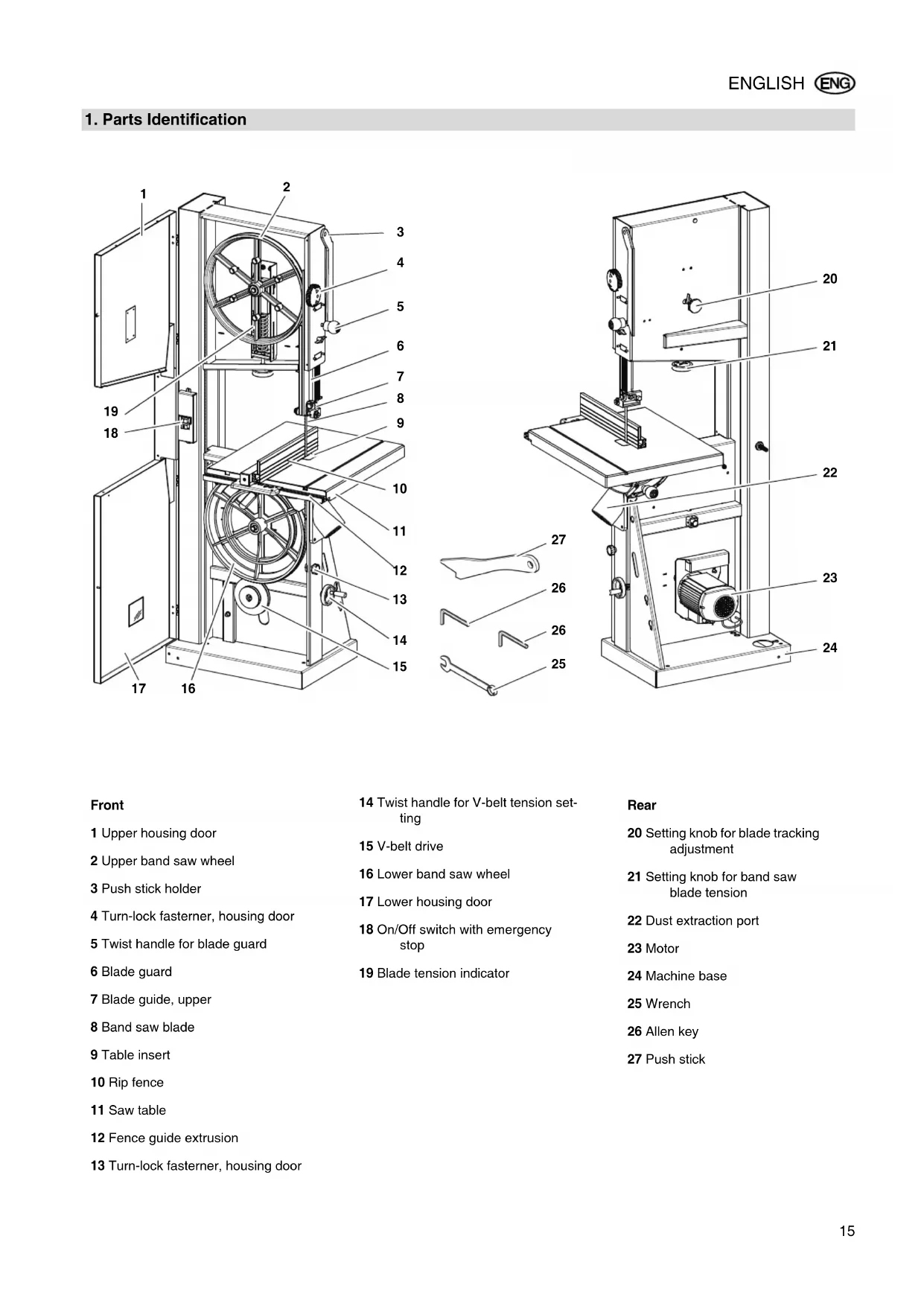
Front 1 Upper housing door 2 Upper band saw wheel 3 Push stick holder 4 Turn-lock fasterner, housing door 5 Twist handle for blade guard 6 Blade guard 7 Blade guide, upper 8 Band saw blade 9 Table insert 10 Rip fence 11 Saw table 12 Fence guide extrusion 13 Turn-lock fasterner, housing door 14 Twist handle for V-belt tension set- ting 15 V-belt drive 16 Lower band saw wheel 17 Lower housing door 18 On/Off switch with emergency stop 19 Blade tension indicator Rear 20 Setting knob for blade tracking adjustment 21 Setting knob for band saw blade tension 22 Dust extraction port 23 Motor 24 Machine base 25 Wrench 26 Allen key 27 Push stick XA0046E6.fm Original operating instructions DEUTSCH16 ENGLISH
4.1 Specified conditions of use .........16
4.2 General Safety Instructions.........16
6.6 Rip fence installation...................20
6.7 Dust collector connection............20
6.8 Changing the Band Saw Blade ...20
7.1 Adjusting the Upper
8.1 Band saw blade alignment ..........23
These operating instructions have been written to make it easier for you, the user, to learn how to operate this machine and to do so safely. These instructions should be used as follows: Read instructions before use. Pay special attention to the safety infor
mation. These instructions are intended for persons with basic technical knowl
edge regarding the operation of a device like the one described herein. If you have no experience whatsoever, you are strongly advised to seek competent advise and guidance from an experienced person before operating this machine. Keep all documents supplied with this machine for future reference. Retain your proof of purchase in case of a future warranty claim. If you lend or sell this machine be sure to have these instructions go with it. The equipment manufacturer is not liable for any damage resulting from neglect of these operating instruc
tions. Information in this manual is denoted as follows: Danger! Risk of personal injury or environmental damage. Risk of electric shock! Risk of personal injury by electric shock. Drawing-in/trapping haz- ard! Risk of personal injury by body parts or clothing being drawn into the rotating saw blade. Caution! Risk of material damage. Note: Additional information. At times numbers are used in illus- trations (1, 2, 3, ...). These numbers indicate component parts; are consecutively numbered; correspond with the number(s) in brackets (1), (2), (3) ... in the neighbouring text. Numbered steps must be carried out in sequence. Instructions which can be carried out in any sequence are marked with a bullet (•). Listings are indicated by an En Dash
Danger! Start the saw only after the following preparations have been completed: saw is mounted; saw table is installed and aligned; the V-belt tension checked; safety devices have been checked. Connect the saw to the mains supply only after all of the above preparations are completed! Oth
erwise there is a risk of an unin- tentional starting of the saw, which can cause severe personal injury.
4.1 Specified conditions of
use This machine is intended for indoor use in dry rooms only. Any outdoor use is not permitted! The machine is suitable for cutting wood, wood-derived materials and plastics. Do not cut round stock transverse to its longitudinal axis without suitable jigs or fixtures. The rotating saw blade could turn the work piece. When sawing thin stock layed on edge, a suitable guide must be used for firm support. Any other use is not as specified. The manufacturer is not liable for any dam- age caused by unspecified use. Modification of the machine or use of parts not approved by the equipment manufacturer can cause unforeseeable damage!
4.2 General Safety Instruc-
tions When using this machine observe the following safety instructions, to minimize the risk of personal injury or material damage. Please also observe the special safety instructions in the respective sections. Where applicable, follow the legal directives or regulations for the pre
vention of accidents pertaining to the use of band saws.
General hazards! Keep your work area tidy – a messy work area invites accidents. Be alert. Know what you are doing. Set out to work with reason. Do not operate device while under the influ
ence of drugs, alcohol or medica- tion. Consider environmental conditions. keep work area well lighted. Prevent adverse body positions. Ensure firm footing and keep your balance at all times. Use suitable workpiece supports when cutting long stock. Table of Contents
2. Please Read First!
3. Initial Operation
ENGLISH Do not operate the machine near inflammable liquids or gases. The machine shall only be started and operated by persons familiar with bandsaws and who are at any time aware of the dangers associ
ated with the operation of such machine.
Persons under 18 years of age shall use this device only in the course of their vocational training, under the supervision of an instructor. Keep bystanders, particularly chil- dren, out of the danger zone. Do not permit other persons to touch the machine or power cable while it is running. Do not overload device – use it only within the performance range it was designed for (see “Technical Speci
Danger! Risk of electric shock! Do not expose machine to rain. Do not operate the machine in damp or wet environment. Prevent body contact with earthed objects such as radiators, pipes, cooking stoves, refrigerators when operating this device. Do not use the power cable for any purpose it is not intended for.
Risk of injury by moving parts! Do not operate the machine without installed guards. Always keep sufficient distance to the band saw blade. Use suitable feeding aids if necessary. Keep suf
ficient distance to driven compo- nents when operating the electric tool. Wait for the band saw blade to come to a complete stop before removing cutoffs, scrap, etc. from the work area. Cut only stock of dimensions that allow for safe and secure holding while cutting. Do not attempt to stop the band saw blade by pushing the workpiece against its side. Ensure the tool is disconnected from power before servicing. When turning ON the machine (e.g. after servicing) ensure that no tools or loose parts are left on or in the machine. Unplug the tool when not in use.
Cutting hazard, even with the cutting tool at standstill! Wear gloves when changing cutting tools. Store band saw blades in such man- ner that nobody will get hurt.
Risk of kickback (workpiece is caught by the band saw blade and thrown against the operator)! Do not jam workpieces. Cut thin or thin-walled work pieces only with fine-toothed band saw blades. Always use sharp band saw blades. If in doubt, check workpiece for inclusion of foreign matter (e.g. nails or screws). Cut only stock of dimensions that allow for safe and secure holding while cutting. Never cut several workpieces at the same time – and also no bundles containing several individual pieces. Risk of personal injury if individual pieces are caught by the band saw blade uncontrolled. When cutting round stock, use a suitable jig to prevent the workpiece from turning.
Drawing-in/trapping hazard! Ensure that no parts of the body or clothing can be caught and drawn in by rotating components (no neck
ties, no gloves, no loose-fitting clothes; contain long hair with hair
net). Never saw workpieces containing the following materials: ropes strings cords cables wires.
Danger due to insufficient per- sonal protection equipment! Wear hearing protection. Wear safety goggles. Wear dust mask. Wear suitable work clothes. When working outdoors wearing of non-slip shoes is recommended.
Risk of injury by inhaling wood dust! Some types of wood dust (e.g. oak, beech and ash) may cause cancer when inhaled. Work only with a suit
able dust extractor attached to the saw. The dust collector must comply with the specifications stated in the Technical Data. Make sure that as little as possible wood dust can escape into the envi- ronment: remove wood dust deposit in the work area (do not blow away!); fix any leakages on the dust col- lector; keep your work area well venti- lated at all times.
Hazard generated by modifica- tion of the machine or use of parts not tested and approved by the manu- facturer! Strictly follow these instructions when assembling the device. Use only parts approved by the manufacturer. This applies espe
cially for: band saw blades (see “Technical Specifications” for stock nos.); safety devices (see "Spare parts list" for stock numbers). Do not change any parts.
Hazard generated by tool defects! Keep device and accessories in good repair. Observe the mainte
nance instructions. Prior to any use check the machine for possible damage: before operat
ing the machine all safety devices, protective guards or slightly dam- aged parts need to be checked for proper function as specified. Check to see that all moving parts work properly and do not jam. All parts must be correctly installed and meet all conditions necessary for a proper operation of the device. Before switching on: Check if saw blade coasts down for more than 10 seconds; if more than 10 seconds, have motor replaced by a qualified electrician. Damaged protection devices or parts must be repaired or replaced by a qualified specialist. Have dam
aged switches replaced by a service centre. Do not operate tool if the switch cannot be turned ON or OFF. Keep handles free of oil and grease.
Danger from blocking work- pieces or workpiece parts! If blockage occurs:
4. Clear blockage with suitable tool.18
4.3 Symbols on the machine
Danger! Disregard of the following warnings could lead to serious personal injury or material damage. Read instructions. Unplug mains cable. Band saw blade running direction. Information on the nameplate:
Upper blade guard The upper blade guard (37) protects against unintentional contact with the saw blade and from chips flying about. In order for the upper blade guard to pro- vide adequate protection against contact with the band saw blade, it must always be set as close as possible against the workpiece (max. distance 3 mm). Lower blade guard The lower blade guard (38) protects against inadvertent contact with the band saw blade below the saw table. The lower blade guard must be installed during operation. Housing doors The housing doors (36) protect against contact with the rotating parts inside the machine. The housing doors are equipped with interlocking contacts. These turn the motor OFF when one housing door is opened while the saw is running. The housing doors must be closed while the machine is in use. Push stick The push stick serves as an extension of the hand and protects against accidental contact with the saw blade. The push stick must always be used if the distance between band saw blade and a rip fence is less than 120 mm. Guide the push stick at an angle of 20 … 30 against the saw table's sur- face. When the push stick is not used, it can be stored on the push stick holder pro- vided at the band saw frame. Replace the push stick if damaged. Set upper blade guide to its lowest position. Remove projecting accessories. Transport the saw with the help of a second person. For transport use the original pack- ing where possible.
Note: In this chapter the essential oper- ating elements of the machine are intro- duced. The proper use of the saw is detailed in chapter “Operation”. Read this chapter before using the saw for the first time. ON/OFF switch To start = press green switch button (39).
In the event of a power failure an under- voltage relay will trip. This prevents the starting of the machine when the power is restored. To restart, the green switch button must be pressed. Turn-lock fastener, housing door Open and close the housing door using the turn-lock fastener (41). Opening the housing door:
1. Rotate the upper turn-lock fastener
clockwise approx. one turn and the lower turn-lock fastener anticlock- wise approx. one turn. The housing door opens slightly. This activates the door interlock which switches the motor off. 28 Manufacturer 29 Serial number 30 Machine designation 31 Motor specifications (see also "Technical Specifications") 32 CE mark – This machine meets the EC directives as per declara
tion of conformity 33 Waste disposal symbol – Device can be disposed of by returning it to the manufacturer 34 Date of manufacture 35 Dimensions of approved band saw blades
Danger from exposed bandsaw blades and wheels! If after one turn the motor does not switch off or the door immediately opens wide, the door interlock or the closure system is defective. Shut down the saw and return it to the Ser
vice Centre in your country for repair.
2. Rotate the turn-lock fastener further.
The housing door opens wide. Closing the housing door: Press on the housing door and rotate the upper turn-lock fastener anticlockwise and the lower turn- lock fastener clockwise all the way. The housing door is completely con- tacting the housing. Setting knob for band saw blade ten- sion With the setting knob (42) the band saw blade tension is corrected, if necessary: Turning the setting knob clockwise increases the blade tension.
Turning the setting knob counter- clockwise reduces the blade tension. Setting knob for blade tracking adjustment With the setting knob (43) the tilt of the upper band saw wheel can be adjusted, if necessary. This tracking adjustment is required to have the blade run dead cen
tre on the rubber tyres of the band saw wheels: turning clockwise = blade moves to the rear Turning counter-clockwise = blade moves to the front. Setting knob for drive belt tension With the setting knob (44) the drive belt tension is corrected, if necessary: Turning the adjustment knob anti- clockwise decreases the blade ten- sion. Turning the setting knob clockwise increases the blade tension. Saw table tilt After loosening the locking screw (46) the saw table (45) tilts steplessly through 20° against the blade. Rip fence The rip fence (47) is clamped to the front. The rip fence can be used on both sides of the blade.
6.1 Aligning the saw table
The saw table needs to be aligned in two planes laterally, in order for the blade to run dead centre through the table insert; at right angles to the band saw blade. Saw table lateral alignment
1. Loosen lock lever (48) and hexagon
Danger! Risk of injury, even with the band saw blade at standstill. To loosen and tighten the fastening screws use a tool that allows for keeping your hand at a sufficient distance from the band saw blade.
2. Loosen the four fastening screws
3. Align saw table so that the blade
runs through the centre of the table insert's slot.
4. Tighten the four fastening screws
much that the saw table can still easily be tilted.
6. Tighten lock lever (48).
Aligning the saw table at right angles to the band saw blade
2. Check band saw blade tension (see
“Care and Maintenance”).
3. Loosen lock lever (48).
4. Using a try square, set the table at
right angles to the blade and tighten the lock lever (48) again.
5. Loosen locking nut (51) and adjust
limit stop screw (52) until it touches the saw housing.
For a firm stand the saw must be mounted on a stable supporting floor:
1. Drill four holes in the supporting
2. Put fixing bolts through the base
plate and secure with nuts.
6.3 Installing the Saw Table
1. Fit limit stop screw (53) to the under-
side of the saw table.
2. Guide saw table over the band saw
blade and place it on the table trun- nion.
3. Attach the saw table with four each
screws (54) and washers to the table trunnion.
Danger! Too much tension can cause the band saw blade to break. Too little tension can cause the driven band saw wheel to slip and the band saw blade to stop.
Check tension by pushing with a finger, halfway between table and upper blade guide, against the side of the blade (the blade should flex not more than 1-2 mm). Check adjustment at the blade tension indicator. The scale indi
cates the correct adjustment in dependence on the band saw blade width.
installation Fasten the fence guide extrusion (56) with four thumb screws and washers to the saw table.
6.6 Rip fence installation
The rip fence can be used on both sides of the blade.
1. Place rip fence on rip fence guide.
2. Tighten lock lever (57) of rip fence.
6.7 Dust collector connec-
Danger! Some types of saw dust (e.g. of oak, beech and ash wood) can cause can
cer when inhaled: always use a dust collector when working indoors (required air speed at the saw's suc
Caution! Operation without a dust collector is only possible: outdoors; for short-term operation (up to 30 minutes maximum); with dust respirator. If no dust collector is used chips will accumulate, which need to be removed periodically. Connect dust collector or industrial vac- uum with a suitable adaptor to the dust extraction port.
6.8 Changing the Band Saw
Danger! Risk of injury, even with the band saw blade at standstill. Wear gloves when changing blades. Use only suitable band saw blades (see “Technical specifications”).
1. Loosen the four thumb screws and
remove the fence guide extrusion (58) for the rip fence.
2. Open housing door.
3. Adjust upper blade guide (59) to its
guard and slide hand guard into its lower position.
5. Open the lower blade guard (60).
6. Loosen setting knob (62) until the
band saw blade has slackened.
7. To remove the band saw blade,
guide it through the slot in the saw table, the blade guard on the upper blade guide (61), the lower blade guard (60) and the blade guides.
Danger! Use a suitable transport device to transport wide clamped saw blades.
8. Fit fresh band saw blade. Observe
correct position: the teeth point towards the front (door) side of the saw.
9. Center band saw blade on the rub-
ber tyres of the band saw wheels.
10. Tighten setting knob (62) until blade
does no longer slip off the band saw wheels.
11. Clamp band saw blade (see section
"Clamping the band saw blade").
12. Close lower blade guard (60) and
slide hand guard into upper position or against the table's edge, tighten knurled nut (63).
13. Close housing door.
align band saw blade (see sec- tion "Aligning the band saw blade"); align blade guides (see “Care and maintenance”); let saw test run for at least one minute; stop saw, unplug and recheck settings.
15. Fasten the fence guide extrusion
(58) to the saw table with the four thumb screws and washers.
6.9 Mains connection
Danger! High voltage Operate saw in dry environment only. Operate saw only on a power source matching the following requirements (see also 'Technical Data'): mains voltage and system fre- quency conform to the voltage and frequency shown on the device's name plate; fuse protection by a residual current operated device (RCD) of 30 mA sensitivity; outlets properly installed, earthed, and tested; three-phase outlets with neu- tral wire installed;
Note: Check with your local Electricity Board or electrician if in doubt whether your house service connection meets these requirements. Position power supply cable in a way that it does not interfere with the work and is not damaged. Protect power supply cable from heat, aggressive liquids and sharp edges. Use only rubber-insulated exten- sion cables of sufficient lead cross section (3 x 1.5 mm
, for machines with 3-phase motor: 5 x 1.5 mm
Do not pull on power supply cable to unplug.
change of direction of rotation (only for version with AC motor): This can lead to the workpiece being hurled away when attempting to make a cut. The direction of rotation must therefore be checked every time the saw is connected to another outlet.
If the direction of rotation is incorrect, the electrical connection must be changed by a qualified electrician!
1. After the saw and all of its safety
devices have been assembled, con
nect it to the mains supply.
2. Start saw and switch OFF immedi-
tion of the band saw blade: In the cutting area the band saw blade must run downwards.
4. If the band saw blade turns in the
wrong correction, unplug the power supply cable at the saw.
5. Have the electric supply changed by
a qualified electrician!
Danger! To reduce the risk of personal injury as much as possible, the following safety recommendations should be observed when operating the saw. Use personal protection equip- ment: dust respirator; hearing protection; safety goggles. Cut only one work piece at a time. Always hold the work piece down on the table. Do not jam the workpiece. Do not attempt to stop the band saw blade by pushing the work
piece against its side. Sawing of bowed or irregular work pieces: hold the workpiece firmly against the table and feed in at a uniform speed. Keep your hands in the safe area. If the type of work requires, use the following: push stick – if distance rip fence – band saw blade less than 120 mm; work support – for long stock, which would otherwise fall off the table on completion of the cut; dust collector; a circle cutting device when cutting circular pieces; a guide when cutting small wedges; an appropriate jig when cutting round stock, to keep it from turning;
ENGLISH a suitable guide for firm sup- port when cutting thin stock layed on edge. Before starting work, check to see that the following are in proper working order: band saw blade; upper and lower blade guard. Replace damaged parts immedi- ately. Assume correct work position (the band saw blade's teeth must point towards the operator). Never cut more than one work- piece at a time – and also no bun- dles containing several individual pieces. Risk of personal injury if individual pieces are caught by the saw blade uncontrolled.
Drawing-in/trapping hazard! Do not wear loose clothing, jewel- lery, or gloves, which may get caught and wound up by revolv
ing machine parts. Contain long hair with a hairnet. Never cut stock to which ropes, cords, strings, cables and wires are attached or which contain such materials.
7.1 Adjusting the Upper
Blade Guide The height of the upper blade guide (66) needs to be adjusted: prior to every cutting operation, to accommodate the height of the workpiece (the upper blade guide should be set approx. 3 mm above the workpiece); after adjustments of band saw blade or saw table (e.g. band saw blade change, tensioning of the band saw blade, saw table alignment).
Danger! Turn the machine OFF and wait for the band saw blade to stop before adjusting the upper blade guide or the saw table.
the twist handle (64) to the desired height.
3. Re-tighten screw (65).
Cutting speed adjustment
1. Open the lower housing door.
2. Slacken the V-belt by turning the
tension crank handle anticlockwise.
3. Put V-belt on the required pulley of
the driving wheel (lower band saw wheel) and the corresponding motor pulley – note label inside the lower housing door.
Caution! The V-belt must run either on both front or both rear pulleys. Never have the V-belt run diagonally! V-belt on front pulley = low speed, high torque. V-belt on rear pulleys = high speed, low torque.
4. Re-tighten the V-belt by rotating the
crank clockwise (the V-belt must be able to be depressed in the middle about 10 mm).
5. Close the lower housing door.
1. Check the band saw blade tension
(see 'Tensioning the band saw blade').
2. If necessary, adjust the table tilt.
3. Select rip fence and table tilt for the
type of cutting operation to be car- ried out.
Hazard generated by a jam- ming workpiece! When sawing with the rip fence and a tilted saw table, the rip fence must be installed on that side of the saw table which is tilted downward.
Note: Always make a trial cut in a piece of scrap to verify settings; correct if nec- essary before cutting the workpiece.
5. Place workpiece on the saw table.
7. Cut workpiece in a single pass.
8. Switch off if no further cutting is to
be done immediately afterwards.
9. If no further cutting is to be done
immediately afterwards: decrease the bandsaw blade tension and attach a notice indicating that the bandsaw blade tension must be reset prior to the next cutting opera
Danger! Prior to all servicing:
1. switch machine OFF;
2. Wait for saw blade to stop
3. Unplug mains cable.
Check that all safety devices are operational again after each service. Replace damaged parts, especially safety devices, with genuine replacement parts only, since parts not tested and approved by the manufacturer can cause unforesee
able damage. Repair and maintenance work other than described in this section should only be carried out by qualified spe
Danger! If the table insert is damaged, small objects may get caught between the table insert and the kerf plate and block the saw blade. Replace dam
aged table inserts immediately! Speed adjustment By shifting the drive belt the band saw can be operated at two speeds (see “Technical specifications”): 408 m/min for hard wood, plastics and non-ferrous metals (with special band saw blade); 965 m/min for all kinds of wood.
Caution! The drive belt must not run in a diago- nal position; this will damage the belt
8.1 Band saw blade align-
ment If the band saw blade does not run in the centre of the rubber tyres, the tracking needs to be corrected by adjusting the tilt of the upper band saw wheel:
Turn setting knob (67) clockwise if the band saw blade runs towards the front of the saw. Turn setting knob (67) counter- clockwise if the band saw blade runs towards the rear of the saw.
ment The upper blade guide consists of: a thrust bearing (supports the band saw blade from the rear), two guide bearings (providing lateral support). All bearings need to be readjusted after every band saw blade change or track- ing.
Note: Periodically check all bearings for wear, if necessary replace both guide bearings at the same time. Adjusting the thrust bearing
2. Loosen the thrust bearing's (69) lock
3. Adjust thrust bearing position (dis-
tance thrust bearing - band saw blade = 0.5 mm – if the band saw blade is turned by hand, it must not touch the thrust bearing).
4. Tighten the thrust bearing lock
screw. Adjusting the guide bearings
1. Loosen knurled nut (72).
2. Set guide bearings (73) with the
knurled thumb screws (71) against the band saw blade.
3. Turn band saw wheel by hand in a
clockwise direction several times to bring the guide bearings in correct position – both guide bearings should just touch the band saw blade.
4. Retighten knurled nut (72) to lock
the knurled thumb screw (71).
8.3 Aligning the Lower Blade
Guide The lower blade guide consists of: a thrust bearing (supports the band saw blade from the rear), two guide bearings (providing lateral support). These parts need to be readjusted after every band saw blade change or track- ing adjustment:
sary replace both guide bearings at the same time. Basic alignment
1. Open the lower housing door.
2. Slide hand guard into lower position
and open lower blade guard (74).
3. Loosen the screw (75) for the lower
until band saw blade is centred between the guide bearings (76).
5. Tighten screw (75).
Adjusting the thrust bearing
1. Loosen the thrust bearing's lock
2. Adjust thrust bearing position (81)
(distance thrust bearing - band saw blade = 0.5 mm – if the band saw blade is turned by hand, it shall not touch the thrust bearing).
3. Tighten the thrust bearing lock
screw (80). Adjusting the guide bearings
2. Set guide bearings (77) with the
knurled thumb screws (79) against the band saw blade.
3. Turn band saw wheel by hand clock-
wise a few times to ensure that the guide bearings are in correct posi- tion – both guide bearings should be lightly touching the band saw blade.
4. Retighten knurled nut (78) to lock
the knurled thumb screw .
5. Close lower blade guard (74)
6. Close the lower housing door.
8.4 Replacing the Band Saw
Tyre Periodically check band saw tyres for wear. Replace only in pairs:
1. Remove band saw blade (see “Care
2. Lift band saw tyre with a small
screwdriver, then pull off the band saw wheel.
3. Mount new band saw tyres and rein-
stall the band saw blade.
8.5 Replacing the Table
Insert The table insert needs replacement when its slot has become enlarged or damaged.
1. Remove table insert (82) from saw
table (push up from underneath).
Danger! Never touch the band saw blade or the band saw wheel with a brush held in your hand when the saw is in oper- ation! Prior to all servicing:
1. Switch machine OFF.
2. Wait for saw blade to stop
1. Open housing door.
2. Remove chips and saw dust with
brush or vacuum cleaner.
3. Close housing door.
Danger! Store saw so that it cannot be started by unauthor- ised persons and nobody can get hurt.
Caution! Do not store saw unprotected out- doors or in damp environment.
Caution! Fold bandsaw blades when not in use and store dry. Keep surfaces of the saw table clean – in particular, remove resin residue with a suitable cleaning and maintenance spray (optional acces
sory). Afterwards, apply a light coat of slid- ing compound (e.g. Waxilit). For special tasks the following accesso- ries are available at your specialised dealer – see back cover for illustrations: A Circle Cutting Attachment For cutting circles of 120 to 260 mm diameter. Optimal cutting results when using a band saw blade for contoured cutting and radii. B Wheel Set For easy transport. C Rip Fence For making accurate long cuts. D Mitre Fence Steplessly adjustable mitre angle from 90 to 45. E Precision Roller Guide Provides optimal band saw blade guiding and prolonged service life. F Belt Sanding Attachment For finishing cut edges. G Dust collection adapter for Ø 100 mm port. H Dust collector helps to protect your health and to keep the shop clean. I WAXILIT Sliding Compound Improves workpiece sliding on the saw table. J Care and Maintenance Spray For removing resin residue and pre- serving metal surfaces. K Sanding Belt 80 grit, 3380 x 25 (pack of 3) L Sanding Belt 120 grit, 3380 x 25 (pack of 3) M Band Saw Blade A6 For cutting NF-metals N Band Saw Blade A4 For contour cutting and small radii. O Band Saw Blade A6 For cutting wood, straight cuts. P Band Saw Blade A6 For cutting wood, universal cuts. Q Band Saw Blade A8 For cutting firewood.
Danger! Repairs to electric tools must only be carried out by qualified electricians! Electric tools in need of repair can be sent to the Service Centre of your coun- try. Refer to the spare parts list for the address. Please attach a description of the fault to the electric tool. The machine's packing can be 100% recycled. Worn out power tools and accessories contain considerable amounts of valua- ble raw and rubber materials, which are recyclable. These instructions are printed on paper produced with elemental chlorine-free bleaching process.
Danger! Before carrying out any fault servic- ing, always do the following:
3. Wait until the band saw blade has
come to a complete stop. Check to see that all safety devices are operational after each fault ser
ENGLISH Motor does not run Undervoltage relay tripped by power fail- ure: switch on again. No mains voltage check cable, plug, outlet and mains fuse. Band saw blade wanders off the line of cut or runs off the band saw wheels Band saw blade is not running properly on the band saw wheels: Correct tracking (see “Care and Maintenance”). Band saw blade breaks Incorrect tension: correct band saw blade tension (see “Care and Maintenance”). Load too high: reduce pressure against band saw blade (reduced feed rate). Incorrect band saw blade: replace band saw blade (see “Care and Maintenance”): Contour cuts = narrow band saw blade, Straight cuts = wide band saw blade. Band saw blade warped Load too high: avoid lateral pressure on the band saw blade. Saw vibrates Insufficient mounting: Fasten saw properly to a suitable floor (see “Initial Operation”). Saw table loose: Align and fasten saw table. Motor mount loose: Check fastening screws, tighten if necessary. Dust extraction port blocked No dust collector connected or suction capacity insufficient: Connect a dust collector or increase suction capacity (air speed 20 m/ sec at dust extraction port).
Rated no-load speed min
Weight Machine ready for work (with accessories supplied) kg 133 133 Permissible ambient temperature for operation Permissible temperature for transport and storage ° C ° C 0 to +40 0 to +40 0 to +40 0 to +40 Noise emission value (DIN EN 1870-1*) at idle A-sound pressure level L
A-sound power level LWA Uncertainty K dB (A) dB (A) dB (A) 75,0 84,6 4,0 75,0 84,6 4,026 ENGLISH
14.1 Available Band Saw Blades
Noise emission value (DIN EN 1870-1*) during sawing A-sound pressure level L
- The values stated are emission values and as such do not necessarily constitute values which are safe for the workplace. Although there is a correlation between emission levels and environmental impact levels, whether further precautions are neces
sary cannot be derived from this. Factors influencing the actually present environmental impact level in the workplace include the characteristics of the work area and other noise sources, i.e. the number of machines and other neighbouring work processes. Also, permissible workplace values may vary from country to country. This information is intended to assist the user in his estimate of hazards and risks. Application Dimensions mm Tooth spacing Stock number NF-metals 3380 x15 x 0.5 A2 090 902 9210 Contour cutting 3380 x 6.0 x 0.5 A4 090 902 9180 Wood – straight cuts 3380 x 25 x 0.5 A6 090 900 0416 Wood – universal cuts 3380 x 15 x 0.5 A6 090 902 9171 Firewood 3380 x 25 x 0.5 A8 090 900 0424 WNB DNB27 FRANÇAIS