
Backmeister Multi 68211 - Bread maker UNOLD - Free user manual and instructions
Find the device manual for free Backmeister Multi 68211 UNOLD in PDF.



| Product type | Multifunction bread machine |
| Brand | Unold |
| Model | Backmeister Multi 68211 |
| Bread weight | 750 g to 1000 g |
| Rice capacity | Up to 250 g |
| Number of bread programs | 12 programs: Basic, White bread, Whole wheat, Cake, Quick, Baking powder, Sourdough, Dough, Knead, Jam, Bake, Yogurt |
| Number of cooking programs | 4 programs: Rice, Rice pudding, Vegetables/Soup, Pot-au-feu |
| Keep warm function | Yes (bread: 1 h, rice: up to 12 h) |
| Timer | Programming up to 13 hours in advance |
| Browning degree setting | 3 levels: light, medium, dark |
| Bread weight setting | 2 levels: ST. I (750 g) and ST. II (1000 g) |
| Housing material | White plastic |
| Container material | Quantum® non-stick coating (induction) |
| Dimensions of bread/yogurt container | Diameter 18 cm, height 14.8 cm |
| Dimensions of rice/vegetable container | Diameter 24.3 cm, height 14.8 cm |
| Power cord length | 100 cm, removable |
| Viewing window | Yes, in the lid |
| Included accessories | 2 containers (bread/yogurt with lid, rice/vegetables), kneading paddle, 2 spoons, liquid measuring cup, rice cup, paddle hook, instruction manual with recipes |
| Cleaning | Clean containers and accessories with a mild cleaner; do not immerse the appliance; do not scratch the non-stick coating |
| Safety | Power failure protection; automatic shutdown in case of excessive temperature or improperly installed container; do not use outdoors |
Frequently Asked Questions - Backmeister Multi 68211 UNOLD
User questions about Backmeister Multi 68211 UNOLD
0 question about this device. Answer the ones you know or ask your own.
Ask a new question about this device
Download the instructions for your Bread maker in PDF format for free! Find your manual Backmeister Multi 68211 - UNOLD and take your electronic device back in hand. On this page are published all the documents necessary for the use of your device. Backmeister Multi 68211 by UNOLD.
USER MANUAL Backmeister Multi 68211 UNOLD
This service can only be offered in Germany.
KCLASSISCHES WEISSBROT
BAYERISCHES VOLLKORNNBROT
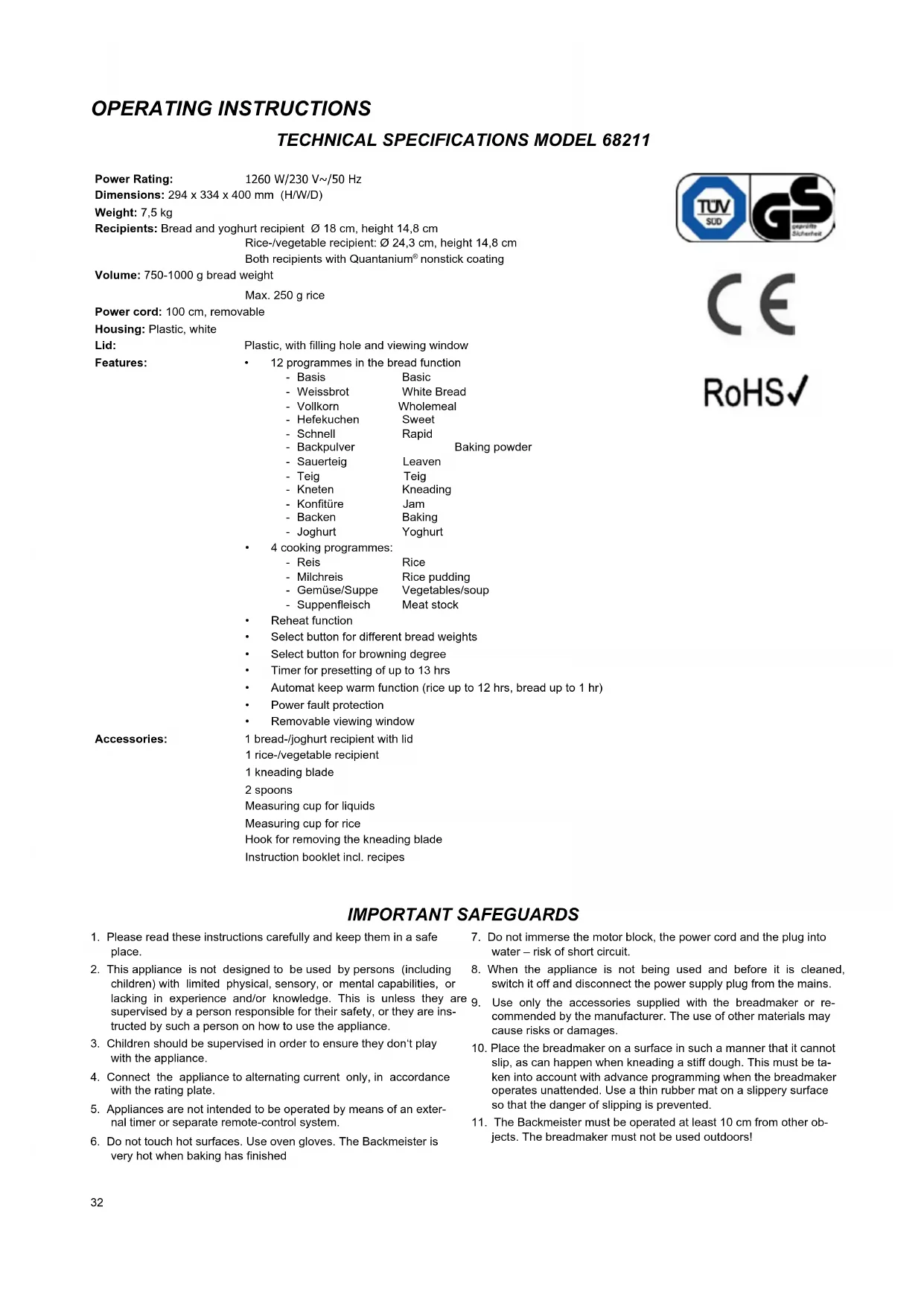
Power Rating: 1260 W/230 V~/50 Hz
Dimensions: 294 × 334 × 400 mm( H/W/D)
Weight: 7,5 kg
Recipients: Bread and yoghurt recipient 0 18 cm, height 14,8 cm
Rice-vegetable recipient: 24,3 cm, height 14,8 cm
Both recipients with Quantum® nonstick coating
Volume: 750-1000 g bread weight
Max. 250 g rice
Power cord: 100 cm , removable
Housing: Plastic, white
Lid:
Plastic, with filling hole and viewing window
Features:
12 programmes in the bread function
- Basis
Basic
- Weissbrot
White Bread
Vollkorn
Wholemeal
- Hefekuchen
Sweet
- Schnell
Rapid
-Backpulver
Baking powder
- Sauerteig
Leaven
- Teig
Teig
- Kneten
Kneading
- Konfiture
Jam
-Backen
Baking
- Joghurt
Yoghurt
4 cooking programmes:
- Reis
Rice
- Milchreis
Rice pudding
- Gemüse/Suppe
Vegetables/soup
- Suppenfleisch
Meat stock
Reheat function
- Select button for different bread weights
- Select button for browning degree
Timer for presetting of up to 13 hrs - Automat keep warm function (rice up to 12 hrs, bread up to 1 hr)
Power fault protection - Removable viewing window
Accessories:
1 bread-/joghurt recipient with lid
1 rice-/vegetable recipient
1 kneading blade
2 spoons
Measuring cup for liquids
Measuring cup for rice
Hook for removing the kneading blade
Instruction booklet incl. recipes


IMPORTANT SAFEGUARDS
- Please read these instructions carefully and keep them in a safe place.
- This appliance is not designed to be used by persons (including children) with limited physical, sensory, or mental capabilities, or lacking in experience and/or knowledge. This is unless they are supervised by a person responsible for their safety, or they are instructed by such a person on how to use the appliance.
- Children should be supervised in order to ensure they don't play with the appliance.
- Connect the appliance to alternating current only, in accordance with the rating plate.
- Appliances are not intended to be operated by means of an external timer or separate remote-control system.
-
Do not touch hot surfaces. Use oven gloves. The Backmeister is very hot when baking has finished
-
Do not immerse the motor block, the power cord and the plug into water - risk of short circuit.
- When the appliance is not being used and before it is cleaned, switch it off and disconnect the power supply plug from the mains.
- Use only the accessories supplied with the breadmaker or recommended by the manufacturer. The use of other materials may cause risks or damages.
- Place the breadmaker on a surface in such a manner that it cannot slip, as can happen when kneading a stiff dough. This must be taken into account with advance programming when the breadmaker operates unattended. Use a thin rubber mat on a slippery surface so that the danger of slipping is prevented.
-
The Backmeister must be operated at least 10 cm from other objects. The breadmaker must not be used outdoors!
-
Ensure that the power supply cable does neither come into contact with hot surfaces, nor hang down from the worktop so that children cannot pull the cable.
- Never place the breadmaker on a gas or electric hob or alongside a hot baking oven.
- Utmost care must be taken when moving the breadmaker when it contains hot liquids (jam).
- Never remove the baking mould during operation.
- Never fill the baking mould with more than the specified quantities, particularly with white bread. The bread will not be uniformly baked and the dough will overflow! Please refer to the corresponding instructions.
- Provide close supervision when testing new recipes.
- Never switch on the appliance without properly placed bread pan.
-
Never beat the bread pan on a working top or edge to remove the pan. This may entail damages.
-
Metal foils or other materials must not be inserted into the breadmaker as this increases the risk of a fire or short circuit.
- Never cover the breadmaker with a towel or any other material. Heat and steam must be able to escape freely. A fire can be caused if the breadmaker is covered by, or comes into contact with, combustible material, e.g. curtains.
- Before a certain type of bread is baked overnight, you should always try out the recipe first to confirm the correct mixing ratio of the individual ingredients, that the dough is not too stiff or thin, or that the quantity is not excessive and overflow.
- Check the plug and power cord regularly for wear and damage. In case of a fault, please send the appliance for inspection/repair to our after sales service (address see last page). Inadequate repair may constitute a risk for the user and result in the loss of guarantee.
The appliance is provided for domestic use only. The manufacturer does not assume any warranty in case of improper, incorrect or commercial use or after repair by unauthorized third parties.
BEFORE USING THE BREADMAKER FOR THE FIRST TIME
- Please check, if all parts and accessories are complete and faultless.
- Before using the machine for the first time, remove all packing materials and loose parts from the inside.
- Wipe the bread pans of the Backmeister with warm water and a mild detergent and clean the kneading blades.
- Wipe the exterior of the appliance with a damp cloth. Do not immerse the appliance into water.
- Dry all parts thoroughly. Place the bread pan into the machine.
LOCATION
Use the appliance in a room with a minimum temperature of 18°C up to a maximum temperature of approx. 34°C . If the room temperature is
- Put the plug into a power socket. The breadmaker is now ready for operation and can be programmed.
- During the first operation cycle, steam may be produced. We recommend to use the appliance for the first time with only the bread pan inserted (no kneading blades, no ingredients) in the program BAKING POWDER. Afterwards let the appliance cool down.
- Now your breadmaker is ready for baking the first bread.
too low, the yeast can not leaven properly, if the room temperature is too hot, the ingredients may become sour.
POWER SUPPLY
As soon as the appliance is connected to the mains by putting the plug into a power socket, a short signal sounds and the display shows 0:00.
The figures blink and the display background is lighted in blue. The appliance is now ready for use.
CLEANING AND MAINTENANCE
- When opening the bread maker after use, be cautious because of probably escaping hot steam. Use oven mitts to remove the hot baking or cooking recipients.
- Always switch off the appliance and remove the plug from the mains before cleaning it. Always allow the breadmaker to cool down before it is cleaned and stored. It takes approximately 30 min. for the breadmaker to cool down before it can be used again.
- Before the Backmeister is used for the first time, wash the baking container and kneading blade with warm water and a mild washing-up liquid. All parts must be dried thoroughly before mounting them.
- Remove all ingredients and crumbs from the lid, case and baking chamber with a moist cloth. Never immerse the breadmaker in water and never fill the baking chamber with water.
- Wipe the recipient with a moist cloth. The inside of the recipient can be rinsed with warm water and a mild washing-up liquid. Do not soak the recipient in water for long time. Do not use any sharp or abrasive detergents.
- Both the kneading blade and driving shaft should be cleaned immediately after use. The kneading blade may be difficult to remove if it remains in the baking tin. In such an event fill the container
with warm water and allow it to soak for approx. 30 minutes. The kneading blade can then be easily removed for cleaning.
- The recipients are equipped with a high quality QUANTANIUM® non-stick coating. Never use metal objects or scourers to clean the surface of the non-stick container. It is normal for the colour of the non-stick surface to change in the course of time. This does not influence the non-stick function.
- Condensation from the steam accumulates between the inside and outside lid during baking and flows off the lid when baking has been completed. This is normal. Any discolouration of the lid is of no consequence, but it can be removed with an appropriate cleaner.
- Before the breadmaker is packed away for storage ensure that it has completely cooled down, is clean and dry, and that the lid is closed.
By pressing the button FUNKTION/FUNCTION once the function mode BROT/KUCHEN/YOGHURT-BREAD/CAKE/YOGHURT is activated, the die control lamp BROT/KUCHEN/YOGHURT-BREAD/CAKE/YOGHURT is lit. The display shows the basic set-ting: programme BASIC, programme time 3.00 hours, the arrows at the upper edge of the display are pointing to browning degree MITTEL/MEDIUM and bread size ST.1.
By pressing the button FUNKTION/FUNCTION twice, the function mode REIS/RICE is activated, the control lamp REIS/RICE is lit. The display shows the basic setting: programme BASIC , programme time 0:40 hours, the arrows at the left side of the displays point to REIS/RICE .
Please bear in mind:
The button FUNKTION/FUNCTION cannot be used as long as a programme is running.
MENUBUTTON
After having selected the desired function mode with the button FUNKTION/FUNCTION, you can now select the required programme by using the button MENU/MENU.
A. FUNCTION MODE BROT/BREAD
In the function mode BROT/BREAD you can choose the programm by pressing the button MENU/MENU. Each time the pressing of the button is confirmed by a short signal.
The following programmes are available:
- BASIC for white - and mixed grain bread, the standard programme for all types of bread
- WEISSBROT for an especially light white bread
- VOLLKORN for wholemeal bread
- HEFEKUCHEN for the preparation of sweet yeast pastries
- SCHNELL for the rapid preparation of white - and mixed grain bread
- BACKPULVER for cakes prepared with baking powder
- SAUERTEIG for pure sour dough bread
- TEIG for the preparation of dough without baking
- KNETEN for kneading of short pastry, strudel pastry etc., without baking
- KONFITÜRE for preparing jam and marmelade
We recommend to use a second recipient, which is used only for the preparation of jam. Because of fruit acid bread baked in the same recipient might stick to the recipient.
-
BACKEN for baking of separately prepared yeast dough or batter (by hand or in the programme TEIG). This ramme is not suitable for baking short pastry, choux pastry etc.
-
JOGHURT for preparing yoghurt
The left side of the display shows the selected programme.
The button STUFE allows now to select the bread size:
ST. I = approx. 750 g bread
ST. II approx. 1000 g bread
The bread size can only be selected in the programmes BASIS, WEISSBROT, VOLLKORN and HEFEKUCHEN.
The button TEMPERATUR allows to select the desired browning degree:
HELL = light
MITTEL = medium (standard setting)
DUNKEL = dark
The browning degree can only be adjusted in the programmes BASIS, WEISSBROT, VOLLKORN, HEFEKUCHEN, SCHNELL, BACKPULVER; SAUERTEIG, BACKEN and JOGHURT.
Please bear in mind:
The choice of the browning degrees affects mainly the sides and bottom of the bread. For safety reasons the appliance is only heated from the bottom. Therefore the crust on top of the bread is always quite light and soft.
- Subject to the presetting of the browning degrees and the bread size, the programme time may differ by some minutes from the time table.
B. FUNCTION MODE REIS/RICE
In the function mode REIS/RICE you can choose the programme by pressing the button MENÜ/MENU. Each time the pressing of the button is confirmed by a short signal.
The following programmes are available:
- REIS for cooking rice or brown rice in water
- MILCHREIS for cooking rice pudding
- GEMÜSE/SUPPE for cooking vegetables or soup
- SUPPENFLEISCH for soft cooking of meat, poultry etc. in stock
The arrow at the left resp. right side of the display shows the respective programme.
Please use the timer function only for recipes which you have already prepared successfully with close monitoring of the cooking and do not modify these recipes any more.
CAUTION:
If there is too much dough in the recipient, the dough may flow over the recipient and may burn on the heating element.
The programmes (except SCHNELL, BACKPULVER, SAUERTEIG, TEIG, KNETEN, KONFITURE, BACKEN, JOGHURT, REIS) can be started with a time delay of maximum 12 hours. Please add the amount of time when the programme shall start to the preparation to the preset time of the respective programme plus the eventual keep-warm time of 1 hour to max. 1 hour 20 minutes (after the end of the respective programme).
Example:
It is 20:00 h in the evening and you wish to have a fresh bread at 7:00 h in the morning:
Fill the ingredients in the correct order in the recipient and place the recipient in the appliance. Take care that there is no direct contact between the yeast and the liquid.
Select the desired programme with the button MENU/MENU and the required browning degree with the button TEMÜPERATURE/BROWNING as well as the bread size with the button FUNKTION/FUNCTION.
The example is based on programme 1 = BASIS, STEP II with a preset programme time of 3:30 hours.
The time (in our example 20:00 h) between the presetting of the appliance and the time, when you want to have the fresh bread (7:00 h) is 11 hours.
By pressing the button ZEITWAHL/TIMER and the buttons STD/HRS and MIN you have to increase the programme time in Steps of 10 minutes to a total time of 11 hours. As soon as this time is shown in the display, you can start the programme by pressing the button START/STOP.
The programme is then started at the necessary time during the night to be finished at 7 h in the morning. If the bread is not removed at this time, the keep-warm time of 1 hour starts.
Please bear in mind:
- Do not use any perishable ingredients such as milk, eggs, fruit, yoghurt, onions etc. when using the timer function.
The alert signal for adding ingredients such as nuts, grains or fruit cannot be deactivated, i.e. it also sounds during night time.
START/STOP BUTTON
To start and to stop the programme.
By pressing the button START/STOP once, the chosen programme is started. A short signal confirms the start and the colon in the time display starts to blink. As soon as the programme has started no other button than the button START/STOP is activated.
In the function mode BROT/BREAD the rotating symbol is shown during the kneading phases.
During the rising and baking phase the symbol blinks.
At the beginning of the keep-warm time the red control lamp lights up and the symbol continues to blink.
In the function mode REIS/RICE the symbol is blinking during the cooking phase. During the keep warm time the symbol continues to blink and the red control lamp lights up.
The button START/STOP allows to stop the programme in any position. Press the button for a few seconds until the signal sounds. The display shows the starting position of the respective programme. You can now choose another programme by using the MENU button.
KEEPING WARM FUNCTION
After the end of the baking / cooking programme, the keep-warm phase is started, except in the programmes TEIG/DOUGH, KNEADING/KNEAD, KONFITÜRE/JAM, VEGETABLES/SOUP, SUPPENFLEISCH/MEAT STOCK, YOGHURT/YOGHURT. The basic setting for the keep-warm time in the function mode BROT/BREAD is 1 hour.
By pressing the button WARMHALTEN/AUFWÄRMEN-KEEP WARM/REHEAT once, the keep-warm function is activated. You hear a short signal and the red control lamp switches on. The display lights up and shows 0:00 . The maximum presetting time is 12 hours.
Whenever the keep-warm function is activated in the function mode REIS/RICE, you can activate the reheat function by pressing the button KEEPING WARM/AUFWÄRMEN-KEEP WARM/REHEAT once again in order to reheat cold rice or vegetables or meat. The display lights up and shows 0:00 . As soon as the food in the recipient has been warmed, the reheat function is stopped automatically. This is confirmed by a long signal.
In the function mode BROT/BREAD the presettings for the keep-warm function cannot be modified.
Please bear in mind:
- The green control lamp lights during the keep warm time.
- The red control lamp lights during the reheat function.
THE FUNCTIONS OF THE BREADMAKER
ALARM FUNCTION
The alarm sounds:
whenever the appliance is connected to the mains; this means, that the appliance is ready for operation and can be programmed;
- when pressing one of the activated programme buttons in order to confirm the respective setting;
- during the first kneading process, to warn that seeds, fruit, nuts or other ingredients can now be added. This alarm cannot be suppressed, e.g. during night time. As soon as the signal sounds, you can open the filling hole in the lid and add the respective ingredients.
- At the end of the baking a beep sounds ten times. By pressing the button START/STOP you can now stop the programme. If this is not done, the one hour keep warm function period starts.
At the end of the keep warm period, the appliance beeps often to indicate that the programme is finished and the bread can be taken out of the appliance. This signal cannot be suppressed.
SAFETY FUNCTIONS
- After the programme start the lid should only be opened during the kneading phases to add ingredients, but never during the rising or baking phases, as the dough would collapse.
- If the room temperature is too low in the function mode BROT/BREAD (below -5°C ), the display shows the error L:LL and a signal sounds.
- If the room temperature for a new programme is too high (over 60°C ), the display shows H:HH. In this case press the button START/STOP, remove the recipient and wait until the appliance has cooled down. Then restart the programme. The automatic temperature control does not work in the programmes BAKE and JAM.
- The automatic temperature control works also in the time delay function directly before starting the programme.
- Please bear in mind that the appliance has no top heating for safety reasons. Therefore the upper bread crust is not as dark as the sides and the underside. The installation of an additional top heating is not allowed for safety reasons.
- If the bread recipient is not correctly inserted, the display shows the symbol and a signal sounds.
- If the rice recipient is not correctly inserted, the display shows the symbol and a signal sounds.
THE PROGRAMMES IN THE FUNCTION MODE BREAD/CAKE/YOGHURT
| 1 2 3 4 5 | |||||||||
| BASIS WEISSBROT VOLLKORN HEFEKUCHEN SCHNELL | |||||||||
| BASIC WHITE BREAD WHOLEMEAL YEAST CAKE RAPID | |||||||||
| Bread weight adjustable | ST. I ST. II ST. I ST. II ST. I ST. II ST. I ST. II | ||||||||
| Timer function | ······ | ······ | |||||||
| Browning degree adjustable | ······ | ······ | |||||||
| Signal for adding of Ingredients | ······ | ········· | |||||||
| Total time | 2:53 | 3:00 | 3:40 | 3:50 | 3:32 | 3:40 | 2:50 | 2:55 | 1:58 |
| 1. Kneading | 9 | 10 | 16 | 18 | 9 | 10 | 10 | 10 | 7 |
| 1. Rising | 20 | 20 | 40 | 40 | 25 | 25 | 5 | 5 | 5 |
| 2. Kneading | 14 Add ingredients Display 2:16 | 15 Add ingredients Display 2:21 | 19 Add ingredients Display 2:31 | 20 Add ingredients Display 2:36 | 18 Add ingredients Display 2:54 | 20 Add ingredients Display 3:01 | 20 Add ingredients Display 2:26 | 20 Add ingredients Display 2:31 | 8 |
| 2. Rising | 25 | 25 | 30 | 30 | 35 | 35 | 30 | 30 | |
| 3. Rising | 45 | 45 | 50 | 50 | 70 | 70 | 55 | 55 | 25 |
| Baking | 60 | 65 | 65 | 70 | 55 | 60 | 55 | 60 | 55 |
| Keeping warm bei 72°C | 60 | 60 | 60 | 60 | 60 | 60 | 60 | 60 | 60 |
| 6 | 7 | 8 | 9 | 10 | 11 | 12 | |
| BACK-PULVER | SAUERTEIG | TEIG | KNETEN | KONFITÜRE | BACKEN | JOGHURT | |
| BAKINGPOWDER | SOURDOUGH | DOUGH | KNEADING | KONFITÜRE | BAKING | YOGHURT | |
| Bread weight adjustable | ST. II | ||||||
| Timer function | · | · | · | · | · | ||
| Browning degree adjustable | · | ··· | |||||
| Signal for adding of Ingredients | · | · | |||||
| Total time | 1:08 | 12:23 | 1:30 | 0:15 | 1:20 | 1:00 - 1:20 | 4:00 - 8:00 |
| 1. Kneading | 10 | 15 | 20 | 15 | 15 | 30 | |
| 1. Rising | 5 9 hrs | 2:30-6:30 | |||||
| 2. Kneading | 20 18 | ||||||
| 2. Rising | 30 | 65 | 30 | 60 | |||
| 3. Rising | 35 45 | 40 | |||||
| Baking | 70 | 60 | 45 | 60-80 | |||
| Keeping warm bei 72°C | 60 60 | 60 60 |
THE PREPARATION OF BREAD, CAKE OR DOUGH
LOCATION
Place the appliance always in a room with a minimum temperature of 18°C and a maximum temperature of approx. 34°C . If the room temperature is too low, the yeast does not rise properly. If the room temperature is too high, the ingredients may perish.
INSERTING THE BREAD PAN
Hold the recipient with both hands at the edge and place it in the middle of the baking chamber. Turn the recipient clockwise until it clicks into place.
When you bake bread, we recommend to fill the hole of the kneading blade with heat resisting margarine in order to avoid the dough penetrating into the hole and sticking after baking. For the preparation of yoghurt this is not necessary. Then place the kneading blade on the shaft.
POURING IN THE INGREDIENTS
The ingredients must be poured into the pan in the order described in the recipe.
In case of very heavy dough, e.g. with a high rye portion, we recommend to fill in first the liquid, then the flour and other ingredients and finally the yeast to ensure better kneading results. When using the time preset function, it must be ensured that no contact between the water and the yeast takes place before the program is started.
SELECTING THE PROGRAMME
Close the lid of the bread maker and put he plug into the power socket. If no recipient has been inserted, the display shows the adjacent warning. Please check if the recipient has been correctly inserted and has clicked into place.
With the button FUNKTION/FUNCTION you select first the function mode BROT/BREAD, then you select the desired programme with the button MENU.
Now choose the bread size wuth the button STUFE and the browning degree with the button TEMPERATUR.
Please bear in mind that die bread size and browning degree cannot be modified in all programmes.
If desired you can now preset the starting time with the function button ZEITWAHL.
Finally press the button START/STOP. After that a correction is not possible.
MIXING AND KNEADING DOUGH
The Breadmaker mixes and kneads the dough automatically as long as necessary to reach the proper consistency.
PAUSE
After each kneading process there is a pause to allow the liquid to slowly penetrate the yeast and the flour.
DOUGH RISING
After each kneading phase the Breadmaker produces the optimal temperature for the rising of the dough.
BAKING
The bread maker automatically regulates the baking temperature and the timing.
KEEPING WARM
When the baking has finished, a beep sound indicates that the bread or food can be removed. At the same time the keep-warm time of 1 hour starts. If you want to remove the bread before the keep-warm phase has ended, just press the button START/STOP and take out the bread.
END OF THE PROGRAMME
After the end of the program process, take out the recipient with the help of oven cloths by turning it counterclockwise.
Stand it on end and, when the bread does not immediately fall onto the cooling wire, waggle the kneading drive from below until the bread falls out.
Do not dash the bread recipient on an edge or table, as the warm bread pan may be deformed.
If the kneader sticks in the bread, use the hook to remove it. Push it on the underside of the still-warm bread in the (almost) round opening of the kneader and fold it on the bottom edge of the kneader, ideally at the point where the kneader blade is. Then pull the kneader up with the hooked skewer. You can then see exactly where the blade is in the bread.
Please wait approx. 30 minutes before cutting the bread. Home-made bread does not contain any preservatives and should be used within 2-3 days.
QUESTIONS AND ANSWER CONCERNING THE USE OF THE BREADMAKER
The bread rises, but sinks in the baking phase
a) if a "V"-formed channel appears in the bread flour gluten is missing, that means that the flour contains too little protein (occurs in rainy summers) or the flour is damp. Help: Add to the flour 1 tablespoon of wheat gluten for every 500g of flour.
b) if the bread sinks like a funnel in the middle then it could be that:
- the water temperature was too high,
- too much water was used.
- flour gluten is missing.
Why has bread from the breadmaker another taste than out of the oven?
This is due to the different humidity. In an oven, the bread becomes more dry because of the larger space, in the breadmaker, the bread remains moister.
When can the Breadmaker lid be opened during the baking process?
Basically it is possible when the kneading is taking place. During this time, one can add small amounts of flour or liquid when applicable.
If the bread has to have a particular appearance after baking, take the following steps: before the last rising, carefully and shortly open the lid (see the program process table), make a cut in the crust with a sharp pre-warmed knife, sprinkle seeds on the surface or spread a potato-flour and water mixture on the crust so that it shines after baking. This is the last phase in which the BREADMAKER lid can be opened, otherwise the bread will sink.
The bread sticks in the pan after baking
Allow the bread to cool off for approx. 10 minutes. Stand the pan on its head - if appropriate, lightly waggle the wing screw (kneader connection) at the underside of the bread pan. Before placing the kneading blade, fill the hole in it with heat-resistant margarine (full-fat), this avoids dough penetrating between kneading blade and shaft. Before baking begins, rub a little oil on the kneaders. If you intend to make jam in the breadmaker we recommend to buy a second bread pan exclusively for making jam, as bread may stick in the pan if jam has been prepared in the same one before.
How can the holes in the bread from the kneader be avoided?
Before the last rising phase, you can remove the kneader with floured fingers (see the timing of the program process on the display).
Should you not wish to do that, use the hooked skewer after baking. If care is taken, larger holes are avoidable.
The dough flows over the bread pan
This may happen, when wheat flour is used, as wheat contains more gluten and thus rises more. In this case
a) reduce the flour amount and adapt the other ingredients. The bread will nevertheless have the desired volume.
b) add 1 tablespoon of liquid butter or margarine.
What do the type figures mean with flour?
The lower the figure the less roughage is contained in the flour and the lighter it is and the more it rises because it contains a higher proportion of gluten.
Please find below a schedule with the different types for Germany, Austria, and Switzerland as well as some rough explanations.
| Description German Type No. | Austrian Type No. | Swiss Type No. | |
| Wheat flour | very fine, white, for cake | 405 480 | 400 |
| white flour for bread 55 | 0 780 550 | ||
| medium flour 1050 | 1600 1100 | ||
| wholemeal flour, rough | 1600 1700 | 1900 | |
| Rye flour | very fine 815 500 | 720 | |
| fine 997 960 1 | 100 | ||
| medium 1150 960 | 1100 | ||
| wholemeal, rough 174 | 2500 1900 |
What is wholemeal flour?
Wholemeal flour can be made from all sorts of grain, even wheat. The designation whole meal means that the flour is ground from the whole grain and thus has more roughage. Therefore wheat wholemeal flour is darker. Wholemeal bread is not necessarily darker as is often assumed.
What has to be taken into account when using rye flour?
Rye flour does not contain any binding substances, thus bread made from it does not rise very much. To make it edible, a RYE WHOLEMEAL BREAD must be made with leaven dough.
The dough will only rise when using rye flour that contains no gluten, if at least 1/4 of the amount is replaced by wheat flour type 550.
What means binding substances in the flour?
The higher the type figure in the above schedule, the lower the contained binding substances. This means in general that flours with high type figures do not rise as much as flour with low type figures. The flour with the highest portion of binding substances is wheat flour of type 550.
Which are the different kind of flour and how are they used?
a) Corn, rice, potato flour
is ideal for persons suffering from a gluten allergy or from sprue or coeliakia. In the following you will find recipes as well as contact addresses of manufacturers for special allergy products.
b) Spelt flour
is quite expensive, but completely free of chemical deposits, as spelt only grows on very poor ground and does not tolerate any fertilizers. Spelt flour is ideal for persons suffering from allergies. All recipies for flour types 405 - 550 - 1050 can also be prepared with spelt flour.
c) Hard wheat flour (durum)
is ideal for French baguette due to its consistency, but can be replaced by semolina.
How can fresh bread be made more edible?
If a boiled mashed potato is added to the dough, the fresh bread is more edible.
In what proportion can one use rising substances?
It can be bought in various quantities, so the manufacturer's instructions on the packing have to be followed and the quantity set in relation to the amount of flour used, with both yeast and leaven dough. The rising capacity of yeast depends on the freshness of the yeast as well as on the water quality. If the water is very soft, the yeast will rise much more, so it may become necessary to reduce the yeast by up to 25% if you live in regions with soft water.
The bread tastes of yeast:
a) if sugar is used, leave it out but the bread will not be so brown,
b) add wine vinegar to the water, for a small loaf = 1 tablespoons - for a large loaf 1.5 tablespoons
c) replace the water with buttermilk or kefir, which is possible with all recipes and is recommended due to the freshness of the bread.
Following is a table listing the ways of alleviating faults that may occur:
BREADMAKER FAULTS
| Fault | Cause | Remedy |
| Smoke coming out of the baking chamber or vents | Ingredients sticking to baking chamber or on the outside of the baking tin | Switch off the machine, disconnect the mains plug; wait until cooled down, then clean the baking cham-ber and tin. |
| Bread has partly collapsed and is moist at the bottom | Bread remained too long in tin after being kept warm | Remove bread at the latest after end of keep-warm function, to allow the steam to escape. |
| Bread cannot be easily removed from the tin. | The loaf is sticking to the kneading knife. | Before baking the next bread, clean kneading knife and shaft. If necessary fill the tin with warm water and soak for 30 minutes. The kneading knife can then be easily removed. |
| Ingredients have not been properly mixed or the bread has not been properly baked. | Incorrect program | Check selected menu; set another program. |
| START/STOP button was touched while breadmaker was operating | Discard ingredients and start anew | |
| The lid was opened several times during operation | Only open the lid when display reads more than 1:30. Ensure that the lid is properly closed after it has been opened. | |
| Prolonged power failure during operation | Discard ingredients and start anew. | |
| Kneader rotation is blocked. | Check whether kneder is blocked by grains. Remove tin and check whether catch rotates. If not send breadmaker for repair. |
RECIPME MISTAKES
| Mistake Cause RemedyBread rises too much. Too much yeast, too much flour not enough salt, or a combination of these causes | a/b |
| Bread does not rise or only insufficiently No or insufficient yeastOld yeast.Liquid too hotYeast came into contact with liquidWrong or old flour.Too much or insufficient liquid.Not enough sugar | a/be c d e a/b/g a/b |
| Dough rises and flows over the baking tin. | f/k c |
| Bread has collapsed. Bread volume larger than the bread pan causing it to collapseToo early or too fast yeast fermentation due to warm water, warm baking chamber or high humidity level. | a/f c/h/i |
| Bread is dented after baking. Not enough gluten in the flour.Too much liquid | l a/b/h |
| Stiff, lumpy texture Too much flour or insufficient liquidNot enough yeast or sugarToo much fruit, wholemeal or other ingredients.Old or poor quality flour | a/b/g a/b b e |
| Not baked in the centre. | a/b/g h g |
| g | |
| Open, coarse texture or full of holes. Too much water.No salt.High amount of moisture; water was too warm.Liquid was too hot. | g b h/i c |
| Mushroom-like surface that has not been baked properly | a/f f a/b a/b b |
| Sweet ingredients in addition to the sugar. | |
| Unevenly sliced or lumpy bread. | Bread has not cooled down sufficiently. |
| j |
*Remedying the mistakes
a) Measure the ingredients correctly.
b) Match the quantity of ingredients accordingly and check whether an ingredient has been forgotten.
c) Use another liquid or allow it too cool down to room temperature.
d) Add the ingredients in the sequence listed in the recipe. Produce a small hole in the centre and immediately add the crumbled or dried yeast. Avoid direct contact between yeast and liquid.
e) Only use fresh and properly stored ingredients.
f) Reduce the overall quantity; do not use more that the specified quantity of flour. Reduce all ingredients by one third.
g) Correct the amount of liquid. If moist ingredients are used then the amount of liquid must be reduced.
h) Use 1-2 tablespoons less during wet weather.
i) Do not use the timing program in hot weather. Use cold liquids. Use the program SCHNELL or ULTRA-SCHNELL to shorten the rising phases.
j) Immediately remove the bread from the tin after baking and allow it to cool down on a grid for at least 15 minutes before it is cut.
k) Diminish the yeast or all ingredients by one quarter of the specified amount.
I) Add one tablespoon of wheat gluten to the dough.
COMMENTS ON BAKING
1.INGREDIENTS
As each ingredient has a particular role in the success of bread-making, the measuring is as important as the correct order of adding ingredients.
The important ingredients, such as liquid, flour, salt, sugar and yeast (both dry and fresh yeast can be used) affect the successful re-sults in the preparation of bread and dough. Therefore always use the appropriate quantities in the correct proportions to one another.
Use lukewarm ingredients if you are starting to bake immediately. If the TIME program is to be used, the ingredients must be cold so that the yeast does not ferment too soon.
Margarine, butter and milk only affect the taste of the bread.
Sugar can be reduced by 20% so that the crust will be lighter and thinner without otherwise affecting the baking results. Should you pre-fer a softer and lighter crust, you can replace the sugar with honey.
Gluten, that is formed through kneading, provides the structure of the bread. The ideal flour mixture contains 40% wholemeal flour and 60% white flour.
Should you wish to add whole grains, soak them overnight. Appropriately reduce the quantity of flour and liquid (up to 1/5 less).
Leaven is indispensable in the making of rye flour bread. It contains milk and acetic bacteria that cause the bread to be light and slightly sour. Making it up oneself takes up quite some time. Therefore we use in the following recipes concentrated leaven-dough powder which comes in packs of 15 g (for 1 kg of flour). The quantities in the recipes (\%) - 3/4 - 1 bag) must be adhered to cut down on bread crumbing.
If leaven-dough powder is used in other concentrations, (packs of 100 g for 1 kg flour), 1 kg flour must be reduced by 80 g or as appro-priate to suit the recipe.
Liquid leaven dough, available packed in bags, can also be used well. As far as quantities are concerned adjust to the details on the packing. Fill the leaven dough into a measuring cup and add the appropriate quantity of liquid mentioned in the recipe.
Wheat leaven dough, that can also be bought dried, improves the dough quality, the freshness and the taste. It is milder than rye leaven dough.
Bake leaven bread in the BASIS or the VOLLKORN programs, so that it rises and bakes properly.
Wheat bran / gluten should be added to the dough when a particularly roughage-full and light bread is required. Use 1 tbsp for 500g of flour and rise the quantity of liquid by 1/2 tbsp.
Wheat germ is a natural helper out of grain protein. It makes the bread lighter, gives a better volume, sinks less often and is more wholesome. This is particularly the case with wholemeal breads and pastries and those made from self-ground flour.
Colour malt, which we use in several recipes, is a dark-roasted barley malt. It is used to obtain a darker crumb and crust (such as black bread). A rye malt is also available and is not so dark. Such malts are available in whole food shops.
Bread seasoning can be added to all mixed breads. The quantity used depends on the taste and the guidelines of the manufacturer.
Pure lecithin powder is a natural a natural emulsion that rises the baking volume, makes the crumb tender and softer and prolongs the freshness.
All the above boldly-printed baking substances and ingredients are available in whole food, health food shops and the health food departments of grocery stores or from flour mills.
2. ADJUSTING THE INGREDIENTS
In cases where certain ingredients are increased or reduced, ensure that the proportions in the original recipe are maintained. In order to achieve a perfect result, take note of the following basic rules on adjusting the ingredients:
Liquid/flour: The dough must be soft (not too soft), slightly sticky and not stringy. Light dough is in a ball, whereas with heavier dough, such as rye wholemeal or other wholemeal breads, this is not the case. Check the dough 5 minutes after the first kneading. Should it be too moist, add more flour until the correct consistency is achieved. If the dough is too dry, knead in spoonful by spoonful of water.
Replacing liquids: Should you replace ingredients in the recipes which contain liquid (such as cream-cheese, yoghurt, etc.), the appropriate liquid quantities must be adjusted accordingly. When using eggs, break them into the measuring cup and fill up with liquid to the required le
vel.
If you live high up (above 2,500 ft.), the dough rises more quickly. In such regions the amount of yeast can be reduced by 1/4 to 1/2 tsp, to avoid excessive rising. The same is the case in regions where soft water is present.
3. ADDING AND MEASURING THE INGREDIENTS AND QUANTITIES
Always add the liquid first and then the yeast. Only in case of very heavy dough such as rye bread, we recommend to fill in the flour and the dry yeast first and to pour the liquid on top to ensure proper kneading. However, if this is combined with the TIME function, make sure, that any contact between yeast and liquid is avoided until the program starts.
In order to prevent the yeast from fermenting too soon (in particular using the time delay), contact between the yeast and the liquid must be avoided.
Always use the same units in measuring, which means that with the indication of tablespoon and teaspoons either use the measuring spoon supplied or spoons which are normally used in the household.
Weighing in grams is preferable due to their accuracy.
The supplied measuring cup can be used for millilitres measurements. Abbreviations in the recipes mean:
tbsp = tablespoon (or measuring spoon large)
tsp. = level tea spoon (or measuring spoon)
g = grams
ml = millilitres
bag = bag package dry yeast of 7 g content for 500 g flour - corresponds to 20 g fresh yeast
4. ADDING OF FRUIT, NUTS OR SEEDS
Should you wish to include further ingredients, this can be done in all programs (except jams) as soon as the beep sound is heard. If the ingredients are added too soon, they can be ground up by the kneader.
Should there be no sizes mentioned in the recipes because they do not exist in the prescribed program, then the small and also the large quantities will be successful for the appropriate type in the mentioned program. The programs without size selection are pro-grammed appropriately.
5. BREAD WEIGHTS AND VOLUMES
In the following recipes you will find exact details of bread weight that our advisor, Ms. Blum has ascertained after baking: You will es-tabish that the weights for pure white bread are less than those for wholemeal bread. This is because white flour rises more and there-fore is somewhat limited.
In spite of these exact weight details, certain differences may occur. The actual bread weight is very much dependant on the humidity in the air on preparation.
All breads that have a high proportion of wheat will achieve a greater volume and in the highest weight class will rise above the pan edge after the last rising. Nevertheless, they do not overflow. The bread bulging over the pan edge will be somewhat lighter browned as the bread in the pan.
It is recommended that the FAST program is used for sweet breads, then the lesser quantities (only these) can be baked with the pre-scribed recipe also in the HEFEKUCHEN program; thus the bread will be lighter. Select the yeast pastries program and then the stage I.
6. BAKING RESULTS
The baking results are in particular dependent upon the local situation (soft water, high humidity, great heights state of the ingredients, etc.).
For this reason, the figures in the recipes are only clues and have to be adapted accordingly. If one or other recipe is not successful, do not give up, moreover try to find out the cause and try again, for example with alternative quantity proportions.
Before you bake a bread overnight with the time delay, we recommend that you make a trial bread so that the recipe can be altered, if needed.
THE PREPARATION OF YOGHURT
Cleanliness and exact temperature control are the most important factors during the preparation of yoghurt. We recommend to use a yoghurt thermometer.
We have used VITAL ferment of the company A. Vogel, which are available in German chemists or health-food shops.
Please contact the manufacturer, if you want to know these products are also distributed in your country or use products which are available on your national market:
For approx. 1 liter of yoghurt you need:
1 liter of milk (fresh milk, homogenized milk or soy milk)
1 sachet of yoghurt ferment
Poss. 2-3 tbsp milk sugar to get a firm yoghurt
Please follow the instruction of the ferment manufacturer and use the type of milk indicated on the package. The indications below are for products of the above manufacturer.
Yoghurt L (+) for cow milk (full-fat and low-fat), lactose-free milk and soy milk. The yoghurt prepared with this ferment can be used up to 14 times to produce another set of yoghurt. In order to reuse the yoghurt just keep 4-5 tblsp of the prepared yoghurt and add it to the milk when preparing the next batch of yoghurt. However, the maximum storage time for the yoghurt is maximum 3 days. After this time you should either prepare the next batch of yoghurt or use fresh ferment.
When using soy milk, you should add one additional table-spoon of sugar to get a firm yoghurt.
Yoghurt Natur for cow or goat milk can bis used up to 24 ti-mes for the preparation of fresh yoghurt.
1 liter of fresh or freshly pasteurized full-fat milk (optionally soy milk).
When using fresh milk, the milk should be heated to 85 - 90°C before
preparing the yoghurt and should be used at a temperature of approx.
38-39°C. The heating destroys poten-tial germs.
We recommend a programme time of 7 hours and 30 minutes. If the yoghurt is still too sour you can reduce the programme time by pressing the button MIN in steps of 10 minutes by 1-1,5 hrs.
Principally the yoghurt becomes the more firm the longer you run the programme.
INSERT THE BAKING RECIPIENT
The Quantumium-coated bread recipient is also used for the preparation of yoghurt. Please clean the recipient and the kneading blade very carefully before preparing the yoghurt in order to remove all eventual residues from previous preparation. Sterilize the recipient by pouring boiling water into the recipient. Shake it carefully and pour the water out. Then insert the recipient and the kneading blade in the baking chamber.
FILL IN THE INGREDIENTS
For the preparation of yoghurt you need:
Full-fat yoghurt
- 1 liter of full fat milk (approx. 38 - 39°C warm), e.g. homogenized milk
- 1 sachet of yoghurt ferment Natur
- Poss. 2 tbsp milk powder
Soy yoghurt:
- 1 liter of soy milk (approx. 38 - 39°C warm)
- 1 sachet of yoghurt ferment L (+)
- Poss. 1 tblsp of cane sugar
Fill the ingredients in the bread recipient and close the recipient with the separate plastic lid.
SELECT THE PROGRAMME
Close the bread maker lid and put the plug into a power socket. If no recipient is inserted, the display shows Please check, if the recipient is correctly inserted and clicked into place.
First press the button FUNKTION/FUNCTION to select the function mode BROT/BREAD, then press MENU to select the programme YOGHURT. The display shows the programme number 12 for the programme YOGHURT.
The basic presetting is 4 hours at medium temperature.
By pressing the button STD/HRS and MIN the preparation time can be extended to a maximum time of 8 hours. The longer the preparation time, the more firm the yoghurt.
By pressing the button TEMPERATUR you can adjust the temperature to low (display HELL) or high (display DUNKEL). The higher the temperature, the more firm the yoghurt.
We recommend a preparation time of 7,5 hours at medium temperature. If you want a firm yoghurt in short time, you can reduce the time by pressing the button MIN in steps of 10 minutes and increase the temperature.
Please bear in mind:
The timer function is not available in the programme YOGHURT.
After having done all presettings you can start the programme by pressing the button START/STOP.
Please avoid any shocks or vibrations during the preparation.
END OF THE PROGRAMME
After the end of the programme remove the recipient by turning it counterclockwise.
Fill the yoghurt into a suitable storage recipient and store it in the refrigerator. The full taste develops in about 12 hours.
Do not add fruit, chocolate chips etc. during the preparation time.
Flavours can be added to the finished and cooled yoghurt.
THE PROGRAMMES IN THE FUNCTION MODE REIS/RICE
COOKING TIMES FOR COOKING PROGRAMMES
| REIS/RICE MILCHREIS RICE PUDDING | GEMÜSE/SUPPE VEGET./SOUP | SUPPENFLEISCHEAT MEAT | AUFWÄRMEN REHEAT | ||
| Max. 40 min. Presetting in steps of 10 min. 20 - 40 min. adjustable | min. Presetting in steps of 10 min. 20 - 60 min. adjustable | Max. 2:30 hrs. Presetting in steps of 10 min. 1:30 - 2:30 adjustable | Max. 20 min. | ||
| Preheat 2,5 min. 2,5 min. 2,5 min. | |||||
| Cook Preset cooking time | full heating power Switch-off at 110°C | Preset cooking time full heating power Switch-off at 110°C | Preset cooking time full heating power Switch-off at 85°C | Preset cooking time full heating power Switch-off at 85°C | |
| Keeping warm at approx. 70°C | Max. 12 hrs Max. 12 hrs | hrs Max. 12 hrs Max. 12 hrs Not adjustable | |||
| Maximum programme time incl. keep-warm time | 12 hrs. 12 hrs. 12 hrs. | 12 hrs. | |||
| Temperature choice | Not adjustable Not adustable Not adjustable | Not adjustable Not adjustable | |||
THE PREPARATION OF RICE
The programme REIS/RICE is suitable for cooking of brown rice as well as of white rice. For the preparation of rice you should use the large recipient without kneading blade.
One level measuring spoon of rice corresponds to one portion with approx. 60g
Fill water and rice according to the marking. Example: for 4 portions fill in water up to the marking 4, then add 4 measuring spoons of uncooked rice and a little bit salt.
Place the viewing window on the lid, but don't close it firmly as the steam should be allowed to escape.
Press the button FUNKTION/FUNCTION to select the function mode RICE , then the button MENU to select the programme REIS .
The arrow in the displays point the upper left side REIS.
Adjust the cooking time with the button MIN in steps of 10 minutes:
White rice, al dente 20 minutes
White rice,soft 30 minutes
Brown rice 40 minutes (add 1 additional measuring spoon of water)
Soaked spelt can be prepared in the same way (cooking time approx. 40 minutes).
After the end of the programme you can take out the rice. If the rice is kept in the appliance with the keep-warm function it continues to soak.
Beware of escaping hot steam!
THE PREPARATION OF RICE PUDDING
Fill up to 4 measuring spoons of pudding rice into the recipient. Add two measuring spoons of milk for each measuring spoon of rice. Add sugar, vanilla, butter, sultanas or fruit to taste.
If you prefer your rice quite soft, add 1-2 additional measuring spoons of milk.
Press the button FUNKTION/FUNCTION to select the function mode RICE then the button MENU/MENU to select the programme MILCHREIS/RICE PUDDING. The arrow in the displays point the lower left side MILCHREIS/RICE PUDDING.
The rice becomes quite soft in the programme MILCHREIS/RICE PUDDING. If you want the rice more firm, we recommend to press the button START/STOP after 32 minutes.
During cooking you can open the bread maker to add ingredients.
After the end of the programme you can take out the rice. If the rice is kept in the appliance with the keep-warm function it continues to soak.
Beware of escaping hot steam!
THE PREPARATION OF VEGETABLES/SOUP
The programme GEMUSE/SUPPE is provided for the preparation of all kinds of vegetables. The following schedule shows the approximate cooking times.
Please add some salt and spices or herbs to taste.
The times below are calculated for 500g of fresh vegetables and 500ml of cold water. When preparing frozen vegetables, the time must be increased in steps of 10 minutes. If this should be too long, you can stop the programme at any time by pressing the button START/STOP.
After cooking take the vegetables out of the recipient and serve them either pure or with melted butter or a sauce. The sauce can easily be prepared by using the cooking liquid, but should be prepared separately on the stove.
You can also prepare a soup with the cooked vegetabkes. Just add 200 ml of cream and mash the vegetables with a blender.
Then season the vegetables with salt and pepper, some lemon juice or Worcester sauce. Garnish the soup with fresh herbs.
| Cooking time | Vegetable type |
| 20 minutes | BeansPeasSweet cornCarrots (cubed)Cauliflower (florets)Brokkoli (florets)Kohlrabi (sticks)Brussels sprouts |
| 30 minutes | Boiled potatoesSmall jacket potatoesBlack salsifySmall beetrootFennel (whole or halves) |
| Cooking time | Vegetable type |
| 40 minutes | Medium to large jacket potatoes |
| Large beetroot | |
| celeriac | |
| Cauliflower, whole | |
| 60 minutes | Stock from 500 g bones and and 1 l water (e.g. as basis for stews, cream soups, sauces) |
THE PREPARATION OF COoked MEAT
The programme SUPPENFLEISCH/MEAT STOCK is ideal for the gentle preparation of meat, e.g. for meat stock or for boiling fowl etc. The stock can be used separately or as as basis for stews, cream soups, sauces.
This programme is also suitable for the preparation of veal for frikasse (cooking time approx. 1,5 hrs) or veal tongue (cooking time approx. 1,5-2 hrs.)
Beef stock:
1 kg beef without bones
1 I cold water
1 carrot
1/4 celeriac
1/2leek
1 tsp salt
2 pinches of nutmeg
Fill all ingredients into the large recipient and place the recipient in the breadmaker.
Place the viewing window on the lid, but don't close it firmly, as steam must escape.
Then press the button FUNKTION/FUNCTION to select the function mode REIS/ RICE, then the button MENU/MENU to select the programme SUPPENFLEISCHEMAT STOCK. The arrow points to the lower right side SUPPENFLEISCHEMAT STOCK. Adjust the cooking time to 2 hours.
At the end of the programme take out the meat and follow your recipe, e.g. beef with horseradish or onion sauce.
Beware of escaping hot steam!
Boiling fowl:
1 boiling fowl of approx. 1kg
1 I cold water
1 bay leaf
1 tsp pepper grains
1 parship
1 carrot
1/4 celeriac
1/2leek
1 tsp salt
Fill all ingredients into the large recipient and place the recipient in the breadmaker.
Place the viewing window on the lid, but don't close it firmly, as steam must escape.
Then press the button FUNKTION/FUNCTION to select the function mode REIS/ RICE, then the button MENU/MENU to select the programme SUPPENFLEISCHEMAT STOCK. The arrow points to the lower right side SUPPENFLEISCHEMAT STOCK. Adjust the cooking time to 2 hours.
At the end of the programme take out the meat and follow your recipe, e.g. fricassee.
Beware of escaping hot steam!
Traditional White Bread
| Level I Level II | ||
| Bread weight, approx. 500 g 750 g | ||
| Water 230 ml 350 ml | ||
| Salt ¾ tsp. 1 tsp. | ||
| Sugar ¼ tsp. 1 tsp. | ||
| Semolina 100 g 150 g | ||
| Flour, Type 550 230 g 350 g | ||
| Dry Yeast ½ Sach. ¼ Sach. | ||
| Programme: QUICK WHITE BREAD | ||
Sweet Bread
| Level I Level II | ||
| Bread weight, approx. | 500 g | 750 g |
| Fresh milk 180 ml 275 ml | ||
| Margarine/butter | 15 g | 25 g |
| Eggs | 1 | 2 |
| Salt | ½ tsp. | 1 tsp. |
| Honey | 1 lbs. | 2 lbs. |
| Flour Type 550 | 330 g | 500 g |
| Dry yeast | ½ Sach. | ¾ Sach. |
| Programme: | QUICK or SWEET | |
Note:
The bread turns out more fluffy in the Sweet Programme, thus quantities in Level I should not be exceeded.
Potato Bread
| Level I | Level II | |
| Bread weight, approx. | 660 g 1000 g | |
| Water or milk | 200 ml | 300 ml |
| Margarine or butter | 15 g | 25 g |
| Egg | 1 small | 1 |
| Mashed boiled potatoes | 100 g 150 g | |
| Salt | ½ tsp. 1 tsp. | |
| Sugar | ½ tsp. 1 tsp. | |
| Flour Type 1050 | 420 g 630 g | |
| Dry yeast | 2/3 Sach. | 1 Sach. |
| Programme: | QUICK |
WHOLEMEAL BREADS
100% Wholemeal Bread
| Level I | Level II | |
| Bread weight, approx. | 560 g | 850 g |
| Water | 230 ml 350 ml | |
| Salt | 1/2 tsp. | 1 tsp. |
| Honey | 1 tsp. | 1 tsp. |
| Wheat wholemeal flour 360 g | 540 g | |
| Dry yeast | 1/2 Sach. | 3/4 Sach. |
| Programme: | WHOLEMEAL | |
Seven-Grain Bread
| Level I | Level II | |
| Bread weight, approx. | 530 g | 800 g |
| Water | 230 g | 350 ml |
| Margarine/butter | 15 g | 25 g |
| Salt | ½ -1 tsp. | 1 tsp. |
| Sugar | ½-1 tsp. | 1 tsp. |
| Vinegar | 1 tsp. | 1 tbs. |
| Wheat wholemeal flour 250 g | 375 g | |
| Mixed grains | 100 g | 150 g |
| Dry yeast | ½ Sach. | ¾ Sach. |
| Programme: | WHOLEMEAL | |
| Note:If whole grains are used they must be soaked prior to baking. Use soaking water for baking. | ||
Raisin Bread
| Level I Level II | ||
| Bread weight, approx. | 560 g | 850 g |
| Water | 180 ml 275 ml | |
| Margarine/butter | 20 g | 30 g |
| Salt | 1 pinch | ½ tsp. |
| Honey | 1 tsp. 1 lbs. | |
| Flour Type 405 | 330 g | 500 g |
| Cinnamon | ½ tsp. ¼ tsp. | |
| Dry yeast | ½ Sach. ¾ Sach. | |
| Raisins | ||
| (or dried fruit) | 50 g | 75 g |
| Programme: | QUICK or SWEET | |
Buttermilk Bread
| Level I | Level II | |
| Bread weight, approx. | 570 g | 860 g |
| Buttermilk | 250 ml | 375 ml |
| Salt | 1/2 tsp. | 1 tsp. |
| Sugar | 1/2 tsp. | 1 tsp. |
| Flour Type 1050 | 330 g | 500 g |
| Dry yeast | 1/2 Sach. | 3/4 Sach. |
| Programme: | BASIC or QUICK | |
Farmers Bread
| Level I | Level II | |
| Bread weight, approx. | 520 g | 780 g |
| Water | 200 ml | 300 ml |
| Salt | 1/2 tsp. | 1 tsp. |
| Wheat sourdough* | 15 g | 25 g |
| Flour Type 1050 | 330 g | 500 g |
| Sugar | 1/2 tsp. | 1 tsp. |
| Dry yeast | 1/2 Sach. | 3/4 Sach. |
| Programme: | BASIC | |
Note:
- Dry wheat sourdough improves the dough consistency, freshness and flavor. It is milder than rye sourdough.
Spelt Bread
| Level I | Level II | |
| Bread weight, approx. | 620 g | 940 g |
| Buttermilk | 260 ml | 400 ml |
| Spelt wholemeal flour | 150 g | 230 g |
| Rye wholemeal flour | 120 g | 180 g |
| Spelt grit coarse | 120 g | 180 g |
| Sunflower seeds | 50 g | 75 g |
| Salt | ½ tsp. | 1 tsp. |
| Sugar | 1 tsp. | 1 tsp. |
| Dry sourdough ¼ Sach. | 3/4 Sach. | |
| Dry yeast | ½ Sach. | 3/4 Sach. |
| Programme: | WHOLEMEAL | |
HINT
Prior to final rising brush bread with warm water, sprinkle with spelt flakes or oats after slightly squeezing them in your hand.
Yoghurt Wholemeal Bread
| Level I | Level II | |
| Bread weight, approx. | 530 g | 800 g |
| Water or milk | 165 ml 250 ml | |
| Yoghurt | 100 g | 150 g |
| Salt | 1/2 tsp. | 1 tsp. |
| Sugar | 1 tsp. | 1 tsp. |
| Vinegar | 1/2 lbs. | 3/4 lbs. |
| Wheat wholemeal flour 330 g | 500 g | |
| Dry yeast | 1/2 Sach. | 1 Sach. |
| Programme: | BASIC or WHOLEMEAL | |
SOUR DOUGH BREAD
Programme 7 = Sour dough allows to prepare a classical sour dough bread. This programme is also recommended for bread mixtures for rye bread or wholemeal rye bread.
In this programme the ingredients are kneaded and the rest for 9 hours at 25°C . The usual preparation and baking programme starts.
Bread without yeast is normally very firm and moist. Therefore we recommend to use yeast in addition to the sour dough/leaven. How-ever, pure rye bread will always be very firm, even if yeast is added.
SOUR DOUGH BREAD
| Step II | |
| Bread weight, approx. | 900 g |
| water (when using dried leaven) | 450 ml (530 ml) |
| Leaven extract (Optionally dried leaven) | 15 g (100 g) |
| Spelt wholemeal flour | 200 g |
| Rye flour | 100 g |
| Wheat wholemeal flour | 200 g |
| Sunflower seeds | 2 el |
| Salt | 2 tsp |
| Rye malt | 2 tsp |
| Honey | 1 el |
| Dry yeast | 7 g |
| Programme: | SAUERTEIG |
SOUR DOUGH BREAD II
| Step II | |
| Bread weight, approx. | 1000 g |
| Water | 530 ml |
| Dried leaven | 100 g |
| Rye leaven | 420 g |
| Rye wholemeal flour | 180 g |
| Caraway, ground | 1 tsp |
| Salt | 2 tsp |
| Rye malt | 1 tsp |
| Honey | 1 el |
| Dry yeast | 7 g |
| Programme: | SAUERTEIG |
RYE BREAD
| Step II | |
| Bread weight, approx. | 1000 g |
| Water | 400 ml |
| Natural leaven (optionally 15 g leaven concentrate) | 150 g |
| Spelt wholemeal flour | 250 g |
| Rye wholemeal flour | 250 g |
| Sunflower seeds | 100 g |
| Karaway, ground | ½ tsp |
| Salt | 1½ tsp |
| Dry yeast | 7 g |
| Programme: | SAUERTEIG |
TIPP:
For a spice bread you can add the following spices:
1 / 2 tsp ground black pepper, 1 / 4 tsp rosemary, 1 tsp caraway,
1 / 4 tsp cardamom, 1 pinch of anisseed, 1 pinch of fennel seeds.
ALL KINDS OF TASTY TREATS FROM THE BREAD BAKEHOUSE
These can be really well made in the programme HEFEKUCHEN, in particular when making sweet breads to achieve a more fluffy bread result. However in this case only Level I quantities can be used as the volume would otherwise become too large and the dough could overflow..
Mixed Breakfast Bread
| Level I Level II | ||
| Bread weight, approx. 500 g 750 g | ||
| Milk 165 ml 250 ml | ||
| Wheat flour Type 405 280 g 425 g | ||
| Sugar 1 tbs. 1 1/2 tbs. | ||
| Salt 1/2 tsp. 1 tsp. | ||
| Dried plums and apricots, chopped | 20 g 30 | |
| Crispy muesli | 30 g 50 g | |
| Desicated coconut | 1/2 tbs. 1/4 tbs. | |
| Butter 15 g 25 g | ||
| Dry yeast | 1/2 Sach. | 3/4 Sach. |
| Programme: | QUICK or YEAST CAKE | |
HINT:
Crispy muesli can also be replaced by chocolate muesli or your favorite kind.
Cottage Cheese Bread
| Level I | Level II | |
| Bread weight, approx. | 530 g 800 g | |
| Water or milk | 130 ml | 200 ml |
| Margarine/butter | 20 g | 30 g |
| Whole eggs | 1 small | 1 |
| Salt | ½ tsp. 1 tsp. | |
| Sugar | 1 tsp. | 1 lbs. |
| Cottage Cheese | 80 g | 125 g |
| Flour Type 550 | 330 g 500 g | |
| Dry yeast | ½ Sach. | ¼ Sach. |
| Programme: | QUICK | |
Egg Bread
| Level I Level II | ||
| Bread weight, approx. | 480 g | 730 g |
| Top up eggs with water or milk up to | 1 | 2 |
| 180 ml | 275 ml | |
| Margarine/butter | 15 g | 25 g |
| Salt | ½ tsp. | 1 tsp. |
| Sugar | ½ tsp. | 1 tsp. |
| Flour Type 550 | 330 g | 500 g |
| Yeast | ½ Sach. | ¾ Sach. |
| Programme: | BASIC | |
HINT
Beat egg in measuring cup firstly. Then top up with water until required quantity. Bake bread immediately and enjoy while it's freshly baked.
Carrot Bread
| Level I | Level II | |
| Bread weight, approx. | 530 g | 800 g |
| Water | 180 ml | 275 ml |
| Butter | 15 g | 25 g |
| Flour Type 550 | 330 g | 500 g |
| Carrots, finely chopped* 40 g | 60 g | |
| Salt | ½ tsp. | 1 tsp. |
| Sugar | ½ tsp. | 1 tsp. |
| Dry yeast | ½ Sach. | ¾ Sach. |
| Programme: | BASIC or QUICK | |
French Herb Bread
| Level I Level II | ||
| Bread weight, approx. 560 g 850 g | ||
| Water 230 ml 350 ml | ||
| Wheat flour Type 550 350 g 525 g | ||
| Durum wheat flour 50 g 75 g | ||
| Sugar 1/2 tsp. 1 tsp. | ||
| Salt 1/2 tsp. 1 tsp. | ||
| Chopped parsley, dill, cress 1 tbs | 1 1/2 tbs. | |
| Garlic clove, crushed 1 clove | 2 cloves | |
| Butter 10 g 15 g | ||
| Dry yeast | 1/2 Sach. | 3/4 Sach. |
| Programme: | BASIC or QUICK | |
HINT:
The number of garlic cloves can be increased by four times the indicated quantity, sliced finely, roasted lightly in butter, cooled and added to other ingredients. It's delicious. Likewise salt can be replaced with herb salt.
Pizza Bread
| Level I Level II | ||
| Bread weight, approx. 610 g 920 g | ||
| Water 250 ml 375 ml | ||
| Oil | 1 tsp. 1 tbs. | |
| Salt 1/2 tsp. 1 tsp. | ||
| Sugar 1/2 tsp. 1 tsp. | ||
| Oregano | 1/2 tsp. 3/4 tsp. | |
| Parmesan cheese | 1 1/2 tbs. | 2 1/2 tbs. |
| Polenta | 65 g 100 g | |
| Flour Type 550 | 315 g 475 g | |
| Dry yeast | 1/2 Sach. | 3/4 Sach. |
| Programme: | QUICK | |
Fig-Walnut Bread
| Level I | Level II | |
| Bread weight, approx. | 600 g | 900 g |
| Water | 230 ml | 350 ml |
| Wheat flour Type 1050 | 170 g | 260 g |
| Rye flour | 260 g | 400 g |
| Salt | 1 level tsp. | 1 tsp. |
| Round figs, finely chopped | 30 g | 50 g |
| Walnut kernels, chopped 30 g | 50 g | |
| Honey | 1 tsp. | 1 1/2 tsp. |
| Dry sourdough | 1/2 Sach. | 3/4 Sach. |
| Dry yeast | 1/2 Sach. | 3/4 Sach. |
| Programme: | BASIC | |
HINT:
When using fresh walnuts where the kernel skin is still white, the bread will taste slightly bitter but very delicious and is perfect with young wine.
Wedding Bread (Bread and Salt)
| Level I | Level II | |
| Bread weight, approx. | 600 g | 900 g |
| Buttermilk | 165 ml | 250 ml |
| Water | 100 ml | 150 ml |
| Rye flour | 115 g 175 g | |
| Kibbed rye Type 1700 | 115 g 175 g | |
| Wheat flour Type 550 | 150 g | 225 g |
| Sugar | 1level tsp. | 1 tsp. |
| Salt | 1level tsp. | 1 tsp. |
| Dry sourdough | 1/2 Sach. | 3/4 Sach. |
| Dry yeast | 2/3 Sach. | 1 Sach. |
| Programme: | BASIC | |
HINT:
Press a new 5cm clay pot into the centre of the bread after the final kneading process. This will be baked in with the bread. After it has cooled off salt can be placed into the pot. Perfect for an original wedding or housewarming present.
BREADS MADE WITH BREADMIX
Using modern breadmixes is very simple as most breadmixes already contain the required amount of yeast. You only need to spare a few minutes at the beginning:
Pour liquid into baking pan,
- Add appropriate amount of breadmix,
| Step I | Step II | |
| Breadmix | Min. 250 g | Max. 500 g |
| Liquid | 150 ml | 300 ml |
If required, add dry yeast,
- Insert baking pan into the appliance
- Select programme (BASIC),
- Select loaf size and crust,
Press Programme and start the cycle.
We recommend the BASIC programme for breadmixes. When using wholemeal mixes you can also use the WHOLEMEAL programme. The RAPID programme can also be used, however bread tends to remain more solid in this programme.
Ensure to follow the instructions on the breadmix packaging, however use slightly less water than indicated. Use min. 250 g and max. 500 g breadmix with appropriate amount of liquid and dry yeast, if required.
CIABATTA
| Step I | Step II | |
| Bread weight, approx. | 480 g | 730 g |
| Water, lukewarm | 200 ml | 310 ml |
| Bread mixture for Ciabatta | 415 g | 625g |
| Dry yeast(if not contained) | ½ bag | ¾ bag |
| Program: | BASIS or SCHNELL | |
TIPP:
You may also use this mixture to prepare dough in the program DOUGH and to form buns, which are baked in the oven.
WHOLEMEAL RYE BREAD
| Step I | Step II | |
| Bread weight, approx. | 610 g | 920 g |
| Water, lukewarm | 280 ml | 425 ml |
| Bread mixture for wholemeal rye bread | 400 g | 600 g |
| Dry yeast (if not contained) | 2/3bag | 1 bag |
| Program: | Vollkorn (Wholemeal) Or SOUR DOUGH | |
GLUTEN-FREE BREADS
We have conducted baking trials in our Breadmaker using various flour mixtures which are partially based on cornstarch, rice starch or potato starch for persons who suffer from a grain-allergy or must stick to specific diet-plans. We have achieved great baking results with products produced by Schär and Hammermühle Diät GmbH. For more information and enquiries on gluten-free products or other allergies please contact:
Hotline Fa. Schär Italy 0039 (0) 473 29 33 00 www.schaer.com
Hotline Hammermühle Germany 0049 (0) 6321 95890 www.hammermuehle-shop.de
Our recipes are based on ingredients which are available on the German market. Please replace these with products available in your country. If in doubt, please obtain information on preparation options and suitability from the product manufacturer. Supplier contact details for your country can be obtained from the above mentioned websites via the internet.
All flour types listed are suitable for cakes and breads required for special diets (coeliac's) within a diet-plan. Breads baked in the Breadmaker will remain relatively solid, even when adding increased quantities of yeast or gluten-free baking powder. Place ingredients listed in the recipes mentioned below as per indicated sequence into baking pan. Select the following programmes:
a) for making bread
for a hefty crust select the programme "Basic", dark, for a lighter crust select "Quick" dark
b) for making dough which you wish to process: Programme "Dough"
If flour residue builds up on the edge of the bread pan, briefly open the machine during the kneading process and push the flour towards the centre of the bread pan with a dough scraper. Re-close the appliance.
Remove the kneading blade after opening the machine as the bread will only rise slightly and it will otherwise produce a hollow space in this area and will arise after baking. Drizzle a few drops of oil over the dough and brush with fingers or a dough scraper. Greasing is important as otherwise the bread will tear to deeply during the baking process. Close the machine. Allow the ready-baked bread to cool on a wire rack.
We recommend to slice the cooled bread and freeze this in portions to avoid rapid drying up of the bread. If required, the bread slices can be warmed up on the toaster.
HAMMERMUHLE GLUTEN-FREE BREADMIXES
| White bread, gluten-free | ||
| > gluten-free | egg-free | |
| > milk-free | soy-free | |
| Bread weight approx. 750 g | ||
| Water 290 ml | ||
| Margarine (milk-free) 15 g | ||
| Bread flour White Bread 375 g | ||
| Dry yeast | 1 1/3 tsp | |
| Programme: | BASIS | |
| 100 g contains approx. 969 kJ/232 kcal | Protein 2 g Carbohydrate 85 g Fat 0,5 g | |
| Sunflower Seed Bread, glutenfree | |
| > gluten-free > egg-free | |
| Bread weight approx. | 750 g |
| Buttermilk | 270 ml |
| Butter / margarine | 13 g |
| Coarse flour mis | 250 g |
| Sunflower seeds | 2 tbs |
| sugar | 2/3 tbs |
| salt | 1 1/3 tsp |
| dry yeast | 1 1/4 tsp |
| Programme: | BASIS |
| 100 g contain approx. Protein 2 g 876 kJ/210 kcal Carbohydrate 46 g Fat 5 g | |
| Chestnut bread, gluten-free | |
| > gluten-free > egg-free > milk-free > soy-free | |
| Bread weight approx.. | 750 g |
| Water | 290 ml |
| Oil | 15 g |
| Bread flour mix chestnut bread | 375 g |
| Dry yeast | 1 1/3 tsp |
| Programme: | BASIS |
| 100 g contains approx. Eiweiß 2 g 1494 kJ/352 kcal Kohlenhydrate 85 g Fett 0,5 g | |
| Yeast dough | |
| Weight: | 750 g |
| Milk | 250 ml |
| Margarine/Butter | 80 g |
| Egg, medium-sized | 2 |
| Flour mix light | 350 g |
| Sugar | 8 tbs |
| Salt | 1¼ tsp |
| Vanilla or grated lemon zest | optional |
| Dry yeast | 1 tsp |
| Programme: | TEIG |
| light flour mix for forming | 100-150 g |
| 100 g enthalten ca. 1135 kJ/271 kcal | Eiweiß 5 g Kohlenhydrate 43 g Fett 9 g |
| HINT: Process dough for sweet cookies and cakes. If required, brush tops of pastry with beaten egg/milk mixture. | |
BREADMIX DR. SCHÄR
| SCHÄR-Gluten-Free Bread Flour MIX B - White Bread I | |
| Bread weight | 850 g |
| Warm water | 430 ml |
| Vinegar | 1 EL |
| Bread flour MIX B | 525 g |
| Salt | 1/2 TL |
| Dry yeast | 1,5 sachet. |
| Programme: | BASIS |
| SCHÄR--Gluten-Free Bread Flour MIX B - Bread with Olive Oil | |
| The programme "Baking Powder" only has 1 baking level.. | |
| Bread weight | 900 g |
| warm water | 350 ml |
| Olive oil | 3 EL |
| Egg white | 2 |
| Bread flour MIX B | 500 g |
| Salt | 1 TL |
| Sugar | 1 TL |
| Baking powder | 1 Pckg. |
| Programme: | BACKPULVER |
| HINT: Always remove kneading blade prior to baking. Otherwise a large cavity will form. | |
DOUGH PROCESSING
Your BACKMEISTER MULTI allows to prepare yeast dough in the programme DOUGH as well as short pastry in the programme KNEAD. These doughs can then used to prepare different cakes and pastries in the conventional stove. During kneading you can add additional ingredients such as nuts, seeds, fruit, chocolate chips etc. in the programme DOUGH as soon as the signal sounds.
Please bear in mind:
Each stove functions differently. Please observe also the instructions of the stove manufacturer concerning baking times and temperatures.
YEAST DOUGH
A basic dough for cakes with fruit, cream cheese of poppy seeds
| Ingredients for a round form, 26 cm or a baking sheet | |
| Milk, warm 125 ml | |
| Flour, type 405 400 g | |
| Butter, melted 80 g | |
| Sugar 100 g | |
| Vanilla sugar 1 sachet. = 7 g | |
| salt 1 pinch | |
| Dry yeast 1 sachet | |
| • Fill all ingredients into the recipient. Start the programme DOUGH. • Take out the dough and roll it to the desired size. Place the dough on the respective baking sheet and let it rise another 15-20 minutes. • Distribute a topping of your choice on the cake. | |
| Programme: 8 - DOUGH | |
Poppy seeds topping
1 l milk, 70 g semolina, 250 g ground poppy seeds, 3 tbsp sugar, 1 sachet vanilla sugar, 2 tbsp rham, to taste 100 g sultanas
Heat milk with semolina in a saucepan on the stove, then add the poppy seeds under stirring. Let the mixture cool down. Add sugar, vanilla sugar, rum and sultanas. Distribute the topping on the dough.
Second topping:
500 g sour cream, 2 tbsp flour, 1 tbsp sugar, 2 eggs
Mix the ingredients and distribute this topping on the poppy seed topping.
Place the baking sheet in the middle of teh stove and bake the cake at 160°C circulating hot air approx. 45-60 minutes.
COCONUT RING
1 basic recipe yeast cake
Filling:
150 g coconut flakes, 200 ml cream, 3 tbsp sugar, 2 tbsp rum, 1 tbsp sugar, 3 tbsp sultanas to taste
Mix all ingredients and distribute the mixture on the rolled dough, leaving an esge of 3cm at the sides. Tthen roll the dough, form a ring and place the ring on a greased baking sheet. Pierce the upper side with a fork and brush the top with some milk.
Bake at 160°C circulating hot air for approx. 30 minutes.
TIPP: Replace the coconut flakes by ground almonds or nuts. The filling becomes very juicy if you add a rasped apples.
"SCHMIEREPLONTZ" - FRANKONIAN SPECIALITY
1 basic recipe yeast cake
Cream cheese topping:
1 kg low fat white cheese, 500 g cottage cheese, 2 wgg whites, 1 pinch of salt, 5 tbsp sugar, 1 sachet vanilla sugar, 250 g sultanas, 4 tbsp flour
Mix all ingredients and distribute the mixture on the rolled dough.
"Schmiere" (Special topping):
2 egg yolks, 250 ml sour cream, 260 ml cream, 1 sachet vanilla sugar, 3 tbsp flour, 2 pinches salt, 1 tbsp cinnamon, 80 g butter (or 3 slices of smoked bacon)
Mix egg yolks, cream, sugar, flour, salt and cinnamon.
Melt butter in a pan, let it cool down and add it to the topping.
When using bacon, cut the bacon into small cubes and melt it in a pan. Add the melted grease to the topping.
Distribute this topping on top.
Bake at 160°C circulating hot air for approx. 25-30 minutes.
QUARK-OIL-DOUGH
A basic dough for flat cakes with cream cheese, fruit or or poppy seeds
| Ingredients for a round form, 26 cm or a baking sheet | |
| Low fat white cheese | 250 g |
| Egg | 1 |
| Oil | 125 ml |
| Sugar | 100 g |
| Salt | 1 pinch |
| Flour | 400 g |
| Baking powder | 1 1/2sachet |
| • Fill all ingredients into the recipient. Start the programme KNEAD • Remove the dough from the recipient, roll it and place it on a baking sheet. • Distribute a topping of your choice on the dough. | |
| Programme: | KNEAD |
WHOLEMEAL QUARK OIL DOUGH
| Ingredients for a round form, 26 cm or a baking sheet | |
| Low fat white cheesek 250 g | |
| Egg | 1 |
| Oil | 125 ml |
| Cane sugar or honey | 100 g |
| Salt | 1 Prise |
| Spelt wholemeal flour | 350 g |
| Tartar baking powder 1 1/2 Sachet | |
| · Fill all ingredients into the recipient. Start the programme KNEAD · Remove the dough from the recipient, roll it and place it on a baking sheet. · Distribute a topping of your choice on the dough. | |
| Programme: | KNEAD |
Both doughs can be topped with 1,2 - 1,5kg fruit (e.g. cherries, plums, rhubarb, blackberries etc.). Spread about 4-5 tbsp bread crumbs and some cinnamon on top.
Optionally you can add crumbles on top:
250 g flour, 170 g sugar, 170 g warm butter, 1 s. vanilla sugar Fill the ingredients into the recipient and knead them in the programme KNEAD for some minutes, until you get crumbles. Distribute the crumbles on the topping.
Place the baking sheet in the middle of the stove.
Bake at 160°C circulation hot air for approx. 25-30 minutes.
STRUDELTEIG
Strudel Dough
| Water 150 ml | |
| Salt 1/2 tsp. | |
| Olive Oil 2 tbs. | |
| Wheat wholemeal flour 300 g | |
| Wheat germ 1 tbs. | |
| Dry yeast 1/2 Sachet | |
| Place ingredients in baking pan, place in oven and select programme KNEADING.After kneading remove from oven, cover baking pan with damp cloth and allow dough to rest for approx. 30 minutes.Roll out dough very thin on silicone mat to approx. 50x60 cm. Brush dough with melted butter. Sprinkle with bread crumbs.Divide dough into 2 parts and top dough with filling. Leave an uncovered edge of approx. 5 cm on all sides. | |
| Programme: KNEAD | |
| Sweet Filling | |
| Apples, plums or cherries 1 kg | |
| Cinnamon 1 tsp. | |
| Sugar 2 tbs. | |
FILLED DOUGHNUTS
Ingredients:
500 g flour, 1 bag dry yeast, 100 g sugar, 125 ml milk, 100 g soft butter, 2 eggs, 1 pinch of salt, 1 bag vanilla sugar, 1 tbsp rum, 200 g rosebud jam
Preparation:
Prepare a dough from flour, yeast, sugar, warm milk, butter, eggs, salt, vanilla sugar and let the dough rise.
Roll the dough 1 cm thick, and mark circles with a glass. Put 1 tsp of jam on each circle, cover it with the second dough plate and cut out the circles. Put the balls on a wood surface, cover it with a towel and let it rise for another 30 min.
Heat oil to 180°C . Fry the doughnuts 3 min. from each side, take it out of the oil and sprinkle it with powder sugar.
CROISSANTS
| Ingredients for approx. 14 pcs | |
| Top up egg with water or milk up to | 1 225 ml |
| Butter | 60 g |
| Salt | 1 tbs |
| Sugar | 2 tbs |
| Flour Type 405 | 400 g |
| Dry yeast | ¾ Pckg. |
| Programme: | TEIG |
- Remove dough from pan, knead through, allow to rise and knead through again.
- Refrigerate covered for 30 minutes.
- Roll out dough in a rectangle and brush with melted butter (do not grease edges). Fold dough threefold on top of each other (similar to a letter). Repeat this process three times.
- Refrigerate dough in a plastic bag for min. 1 hour or overnight.
- Roll out dough in a rectangle and cut into 9 squares. Cut each square diagonally.
Lightly roll triangles starting at the broad side and place on greased baking tray. - Brush with beaten egg and bake in preheated oven at 190°C for 20 minutes. Do not open oven during baking process!
PREZELS
| Ingredients for approx. 9-10 pcs | |
| Water | 200 ml |
| Salt | 1/4 tsp |
| Flour Type 405 | 360 g |
| Sugar | 1/2 tsp |
| Dry yeast | 1/2 sachet. |
| Egg (lightly beaten) for brushing | 1 |
| Mix ingredients for filling and place on dough. Leave an uncovered edge of approx. 5 cm on all sides. Fold edge up and roll strudel using the silicon mat. Place strudel on baking tray lined with baking paper, brush with melted butter and bake for approx. 1 hour. The second strudel can be frozen when rolled and can be baked directly without defrosting (Baking time: an additional 10 minutes). | |
| Vegetable Filling | |
| Carrots, zucchini, turnip, pumpkin, well drained spinach, sliced julienne or chopped | 1 kg |
| Dill, dried 1 tbs. | |
| Vegetable stock, granulated 1 tbs. | |
| Mix ingredients for filling and sprinkle over dough. (Proceed as mentioned above). | |
| Meat Filling | |
| Pork Mince | 1 kg |
| Onion, diced finely | 1 |
| Eggs | 2 |
| Parsley, finely chopped | 1 Bunch |
| Bread crumbs | 3 tbs. |
| Mix ingredients for filling and sprinkle over dough. (Proceed as mentioned above). | |
CREAM CHEESE DOUGHNUTS
Ingredients:
100 g soft butter, 150 g sugar, 2 bags vanilla sugar, 4 eggs, 1/2 tsp cinnamon, 500 g cream cheese, 250 g flour
Preparation:
Prepare a dough from butter, sugar, vanilla sugar, eggs, cream cheese and flour.
Heat the oil to 175°C . Make small balls by means of a spoon and give them into the hot oil.
Attention: Do not fry too many balls at the same time, as the fat will become foamy.
Bake the balls about 1.5 min. on each side and take them out of fat.
Turn in sugar mixed with cinnamon.
| coarse salt for sprinkling | |
| ·Place all ingredients, excl. egg and coarse salt, in bread pan. Select programme DOUGH and press start ·When you hear the beep and the display shows "0:00", press STOP. ·Preheat oven to 200°C ·Divide dough into pieces and form long thin rolls with each pie- ce. ·Create a pretzel with each piece and place it on a greased ba- king tray. ·Brush each pretzel with beaten egg and sprinkle with coarse salt. ·Bake in preheated oven at 200°C for 12-15 minutes. | |
| Programme | TEIG |
WHOLEMEAL PIZZA
| Ingredients for approx. 2 Pizzas | |
| Water | 150 ml |
| Salt 1/2 tsp. | |
| Olive oil | 2 tbs. |
| Wheat wholemeal flour | 300 g |
| Wheat germ | 1 tbs. |
| Dry yeast | 1/2 Sachet |
| Roll out dough, place in round pan. Allow to rise for 10 minutes. Spread pizza sauce over dough and add your favorite toppings. Bake for 20 minutes. | |
| Programme: | DOUGH |
SWEET YEAST PASTRY
| for two small or one large baking tray or one plaited yeast bun | |
| Flour 500 g | |
| Dry yeast 1 Sachet | |
| Sugar 100 g | |
| Butter 80 g | |
| Salt 1 Pinch | |
| Milk 220 ml | |
| Egg 1 | |
| Programme: DOUGH | |
| 1. Place ingredients into baking pan, place in oven and select pro- gramme DOUGH. 2. Remove baking pan from oven when programme has ended. 3. Roll out dough to size of baking tray, cover with your favorite top- pings. Allow to rise again in oven at 50°C for approx. 20 minutes. Bake at 200°C. The second half of the dough can be frozen. | |
CHRISTSTOLLEN (German Christmas Cake)
| Weight 1000 g | ||
| Milk 125 ml | ||
| Butter melted 125 g | ||
| Egg 1 | ||
| Rum 3 EL | ||
| Flour Type 405 500 g | ||
| Sugar 100 g | ||
| Candied lemon peel | 50 g | |
| Candied orange peel | 25 g | |
| Almondmeal | 50 g | |
| Sultanas | 100 g | |
| Salt | 1 pinch | |
| Cinnamon 2 pinches | ||
| Dry yeast | 2 sachets | |
| Remove dough from pan - press into Stollen Form and bake at 180°C (fan forced oven at 160°C) for approx. 1 hour. | ||
| For brushing | ||
| melted butterr | 250 g | |
| icing sugar | 200 g | |
| Brush Stollen several times with melted butter after baking and sprinkle sufficiently with icing sugar. Wrap cooled Christstollen in aluminium foil and allow to infuse, to enable aroma to evolve.. | ||
| Programme: | TEIG | |
CAKE - BASIC RECIPE
A creamed cake can also be easily made in the BACKMEISTER MULTI As the appliance operates with a kneading blade and not with mixing tools, the cake becomes more solid, which does not influence the flavor. Please note the "Baking Powder" programme can not be pre-set. Various ingredients can be added to the basice recipe. The sky is the limit. Please ensure that the quantities mentioned below must not be exceeded, as this may cause the cake to undercook.
When the cake is baked remove the baking pan from the machine. Place the pan on a damp cloth and allow cake to cool in the pan for approx. 15 minutes. Now you can easily remove the cake with a plastic spatula from the sides of the pan and turn it upside down carefully.
Basic Recipe - Creamed Cake
| Ingredients for weight of approx. 700 g | |
| Eggs | 3 |
| Soft butter | 100 g |
| Sugar | 100 g |
| Vanilla sugar | 1 Sach. |
| Flour Type 405 | 300 g |
| Baking powder | 1 Sach. |
| Optional ingredients for a variation of the basic recipe: | |
| Ground nuts | 50 g |
| or: Grated chocolate | 50 g |
| or: Desicated coconut | 50 g |
| or: Peeled and diced (1 cm) apple | 50 g |
| Programme: | BAKING POWDER |
COOKING JAM
Jam or marmelade can be quickly and easily made in the BACKMEISTER MULTI. You will end up with a very special, delicious and tasty jam. This is how:
- Rinse fresh, ripe fruit. Peel apples, peaches, pears and other hard-peel fruits.
Always use the indicated quantities as this is exactly adapted to the Jam programme. Otherwise the mixture will cook too early and will overspill. - Weigh the fruit, cut in small pieces or puree with a blender, e.g. the ESGE Zauberstab® and place into container.
- Add preserving sugar "2:1", amount as indicated. Only use this sugar and not normal household sugar or preserved sugar "1:1", as this will prevent the jam from setting.
- Mix fruit with sugar and start cycle which will stop fully automatic.
The appliance will make a beeping sound after 1:20 Hrs and you can fill jam into jars. Seal the jar securely.
Strawberry jam
| Fresh strawberries washed, cut or mashed | 600 g |
| Preserving sugar „2:1“ | 400 g |
| Lemon juice | 1-2 tsp |
| • Mix all ingredients in the container with a rubber scraper. • Select the program „KONFITÜRE“ (jam and start. • Remove sugar residues from the side with of a rubber scraper. • After the beep remove the container from the machine. Attention: HOT! • Fill the jam into glasses and close them carefully. | |
| Programme: | KONFITÜRE |
Orange marmelade
| Oranges and lemons, peeled and cubed | 600 g | |
| Preserving sugar „2:1“ | 400 g | |
| • Peel oranges and cut them into small cubes. • Add sugar and mix all ingredients in the container., • Select the program „KONFITÜRE“ (jam) and start. • Remove sugar residues from the side withs of a rubber scraper. • After the beep remove the container from the machine. Attention: HOT! • Fill the jam into glasses and close them carefully. | ||
| Programme: | KONFITÜRE | |
SPECIFICATIONS TECHNIQUES MACHINE A PAIN 68211
Puissance: 1260 W/230 V~/50 Hz
Dimensions: 294 × 334 × 400 mm (H/L/P)
Poids: 7,5kg
RIZ POLI, MOUT 30 MINUTES
RIZ COMPLET 40 MINUTES (AJOUTER 1 CUILERE DE L'EAU EN PLUS)
VRAGEN OVER HET APPARAAT EN DE WERKING IN DE FUNC TIE BROOD BAKKEN
40 minutes (1 schoplepel water extra)
| Ingredientes para un molde desmontable, 26 cm o una bandeja para hora. | |
| Quark desnatado 250 g | |
| Huevo | 1 |
| Aceite | 125 ml |
| Azúcar de caña (o miel) | 100 g |
| Sal 1 pizca | |
| Harina integral de espelta | 350 g |
| Levadura química de cremor tártaro | 1 1/2 sobrecito |
| Vierta todos los ingredientes en el contentedor. Seleectione el programa KNETEN (amasar) e iniece. | |
| Tras el horneado, sáquela del molde, extiendala con un rodillo hastaSEOSEOSEOSEOSEOSEOSEOSEOSEOSEOSEOSEOSEOSEOSEOSEOSEOSEOSEOSEOSEOSEOSEOSEOSEOSEOSEOSEOSEOSEOSEOSEOSEOSEOSEOSEOSEOSEOSEOSEOSEOSEOSEOSEOSEOSEOSEOSEOSEOSEOSEOSEOSEOSEOSEOSEOSEOSEOSEOSEOSEOSEOSEOSEOSEOSEOSEOSEOSEOSEOSEOSEOSEOSEOSEOSEOSEOSEOSEOSEOSEOSEOSEOSEOSEOSEOSEOSEOSEOSEOSEOSEOSEOSEOSEOSEOSEOSEOSEOSEO SEOESEOSEOSEOSEOSEOSEOSEOSEOSEOSEOSEOSEOSEOSEOSEOSEOSEOSEOSEOSEOSEOSEOSEOSEOSEOSEOSEOSEOSEOSEOSEOSEOSEOSEOSEOSEOSEOSEOSEOSEOSEOSEOSEOSEOSEOSEOSEOSEOSEOSEOSEOSEOSEOSEOSEOSEOSEOSEOSEOSEOSEOSEOSEOSEOSEOSEOSEOSEOSEOSEOSEOSEOSEOSEOSEOSEOSEOSEOSEOSEOSEOSEOSEOSEOSEOSEOSEOSEOSEOSEOSEOSEOSEOSEOSEOSEOSEOSEOSEOseo | 100 g |
| Sal 1 pizca | |
| Harina integral de espelta | 350 g |
| Levadura química de cremor tártaro | 1 1/2 sobrecito |
| Vierta todos los ingredientes en el contentedor. Seleectione el programa KNETEN (amasar) e iniece. | |
| Tras el horneado, séquela del molde, extiendala con un rodillo hastaSEOSEOSEOSEOSEOSEOSEOSEOSEOSEOSEOSEOSEOSEOSEOSEOSEOSEOSEOSEOSEOSEOSEOSEOSEOSEOSEOSEOSEOSEOSEOSEOSEOSEOSEOSEOSEOSEOSEOSEOSEOSEOSEOSEOSEOSEOSEOSEOSEOSEOSEOSEOSEOSEOSEOSEOSEOSEOSEOSEOSEOSEOSEOSEOSEOSEOSEOSEOSEOSEOSEOSEOSEOSEOSEOSEOSEOSEOSEOSEOSEOSEOSEOSEO SEOESEOSEOSEOSEOSEOSEOSEOSEOSEOSEOSEOSEOSEO SEOESEOSEOSEOSEOSEOSEOSEOSEOSEOSEOSEOSEOSEOSEOSEOSEOSEOSEOSEOSEOSEOSEOSEOSEOSEOSEOSEOSEOSEOSEOSEOSEOSEOSEOSEOSEOSEOSEOSEOSEOSEOSEOSEOSEOSEOSEOSEOSEOSEOSEOSEOSEOSEOSEOSEOSEOSEOSEOSEOSEOSEOSEOSEOSEOSEOSEOSEOSEOSEOSEOSEOSEOSEOSEOSEOSEOSEOSEOSEOSEOSEOSEOSEOSEO SEOESEOSEOSEOSEOSEOSEOSEOSEOSEOSEOSEOSEOSEOseo | 100 g |
PRIPRAVA MASA NA POLEVKU
RECEPTY NA CELOZRNNY CHLEB
100% CELOZRNNY CHLEB
| St. I St. II | |
| Hmotnost chleba, cca 560 g 850 g | |
| Voda 230 ml 350 ml | |
| Sul 1½ lžičky 1 lžička | |
| Med 1 lžička 1 lžička | |
| Celozrnna pšeničná mouka 360 g 540 g | |
| Sušené droždi 1/2 bal. 3/4 bal. | |
| Program/y: | VOLLKORN |
CHLEBSPSENICNYMIKLICKY
| St. I St. II | ||
| Hmotnost chleba, cca 560 g 850 g | ||
| Voda 230 ml 350 ml | ||
| Margarín/máslo | 20 g | 30 g |
| Sül | ½ lžičky 1 lžička | |
| Cukr | ½ lžičky 1 lžička | |
| Pšeničné otruby | 50 g | 75 g |
| Pšeničné kličky | 30 g | 50 g |
| Ocet | 1 lžička 1 lžiće | |
| Celozrná pšeničné mouka 260 g 400 g | ||
| Sužené droždí ½ bal. ¾ bal. | ||
| Program/y: | VOLLKORN | |
PŠENICNY CELOZRNNY CHLÉB
Waste Disposal / Environmental Protection
Our appliances are produced on a high quality level for a long lifetime. Regular maintenance and expert repairs by our after-sales service can extend the useful life of the appliance. If an appliance is defective and repair is not possible we ask you to follow the following instructions for disposal.
Do not dispose this appliance together with your standard household waste. Please bring this product to an approved collection point for recycling of electric and electronic products. Dispos the electrical element/heating element via electrical waste, all other components according to the material and the respective local regulations (e.g. glass, metal, plastic).
By separate collection and disposal of waste products you help to protect natural resources and ensure, that the product is disposed in an adequate way to protect health and environment.
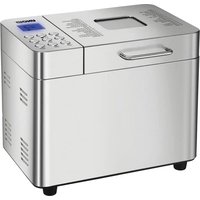




- IMPORTANT SAFEGUARDS
- THE APPLIANCE IS PROVIDED FOR DOMESTIC USE ONLY. THE MANUFACTURER DOES NOT ASSUME ANY WARRANTY IN CASE OF IMPROPER, INCORRECT OR COMMERCIAL USE OR AFTER REPAIR BY UNAUTHORIZED THIRD PARTIES
- BEFORE USING THE BREADMAKER FOR THE FIRST TIME
- LOCATION
- POWER SUPPLY
- CLEANING AND MAINTENANCE
- MENUBUTTON
- FUNCTION MODE BROT/BREAD
- PLEASE BEAR IN MIND
- FUNCTION MODE REIS/RICE
- CAUTION
- EXAMPLE
- START/STOP BUTTON
- KEEPING WARM FUNCTION
- THE FUNCTIONS OF THE BREADMAKER
- ALARM FUNCTION
- SAFETY FUNCTIONS
- THE PROGRAMMES IN THE FUNCTION MODE BREAD/CAKE/YOGHURT
- THE PREPARATION OF BREAD, CAKE OR DOUGH
- INSERTING THE BREAD PAN
- POURING IN THE INGREDIENTS
- SELECTING THE PROGRAMME
- MIXING AND KNEADING DOUGH
- PAUSE
- DOUGH RISING
- BAKING
- KEEPING WARM
- END OF THE PROGRAMME
- QUESTIONS AND ANSWER CONCERNING THE USE OF THE BREADMAKER
- THE BREAD RISES, BUT SINKS IN THE BAKING PHASE
- WHY HAS BREAD FROM THE BREADMAKER ANOTHER TASTE THAN OUT OF THE OVEN
- WHEN CAN THE BREADMAKER LID BE OPENED DURING THE BAKING PROCESS
- THE BREAD STICKS IN THE PAN AFTER BAKING
- HOW CAN THE HOLES IN THE BREAD FROM THE KNEADER BE AVOIDED
- THE DOUGH FLOWS OVER THE BREAD PAN
- WHAT DO THE TYPE FIGURES MEAN WITH FLOUR
- WHAT IS WHOLEMEAL FLOUR
- WHAT HAS TO BE TAKEN INTO ACCOUNT WHEN USING RYE FLOUR
- WHAT MEANS BINDING SUBSTANCES IN THE FLOUR
- WHICH ARE THE DIFFERENT KIND OF FLOUR AND HOW ARE THEY USED
- CORN, RICE, POTATO FLOUR
- SPELT FLOUR
- HARD WHEAT FLOUR (DURUM)
- HOW CAN FRESH BREAD BE MADE MORE EDIBLE
- IN WHAT PROPORTION CAN ONE USE RISING SUBSTANCES
- THE BREAD TASTES OF YEAST
- REMEDYING THE MISTAKES
- COMMENTS ON BAKING
- 1.INGREDIENTS
- ADJUSTING THE INGREDIENTS
- ADDING AND MEASURING THE INGREDIENTS AND QUANTITIES
- ADDING OF FRUIT, NUTS OR SEEDS
- BREAD WEIGHTS AND VOLUMES
- BAKING RESULTS
- THE PREPARATION OF YOGHURT
- INSERT THE BAKING RECIPIENT
- FILL IN THE INGREDIENTS
- FULL-FAT YOGHURT
- SOY YOGHURT
- SELECT THE PROGRAMME
- THE PROGRAMMES IN THE FUNCTION MODE REIS/RICE
- COOKING TIMES FOR COOKING PROGRAMMES
- THE PREPARATION OF RICE
- THE PREPARATION OF RICE PUDDING
- THE PREPARATION OF VEGETABLES/SOUP
- THE PREPARATION OF COOKED MEAT
- BEEF STOCK
- BOILING FOWL
- WHOLEMEAL BREADS
- SOUR DOUGH BREAD
- TIPP
- ALL KINDS OF TASTY TREATS FROM THE BREAD BAKEHOUSE
- HINT
- BREADS MADE WITH BREADMIX
- GLUTEN-FREE BREADS
- DOUGH PROCESSING
- YEAST DOUGH
- POPPY SEEDS TOPPING
- SECOND TOPPING
- COCONUT RING
- FILLING
- SCHMIEREPLONTZ" - FRANKONIAN SPECIALITY
- CREAM CHEESE TOPPING
- SCHMIERE" (SPECIAL TOPPING)
- QUARK-OIL-DOUGH
- WHOLEMEAL QUARK OIL DOUGH
- STRUDELTEIG
- STRUDEL DOUGH
- FILLED DOUGHNUTS
- INGREDIENTS
- PREPARATION
- CROISSANTS
- PREZELS
- CREAM CHEESE DOUGHNUTS
- WHOLEMEAL PIZZA
- CAKE - BASIC RECIPE
- COOKING JAM
- SPECIFICATIONS TECHNIQUES MACHINE A PAIN 68211
- VRAGEN OVER HET APPARAAT EN DE WERKING IN DE FUNC TIE BROOD BAKKEN
- PRIPRAVA MASA NA POLEVKU
- RECEPTY NA CELOZRNNY CHLEB
- 100% CELOZRNNY CHLEB
- CHLEBSPSENICNYMIKLICKY
- PŠENICNY CELOZRNNY CHLÉB
- WASTE DISPOSAL / ENVIRONMENTAL PROTECTION
Brand : UNOLD
Model : Backmeister Multi 68211
Category : Bread maker