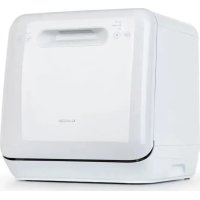
Aquatica - Dishwasher Klarstein - Free user manual and instructions
Find the device manual for free Aquatica Klarstein in PDF.


| Technical Features | Built-in dishwasher, capacity for 12 place settings, energy class A++ |
|---|---|
| Dimensions | Width: 60 cm, Height: 85 cm, Depth: 60 cm |
| Washing Programs | 6 programs, including eco, quick, intensive, delicate, prewash, and auto |
| Water Consumption | Average consumption of 9 liters per cycle |
| Usage | Easy to use with an intuitive control panel and LED indicators |
| Maintenance | Filters to be cleaned regularly, spray arms to be checked for proper functioning |
| Safety | Overflow protection system, child safety lock |
| General Information | 2-year warranty, user manual included, customer service available |
Frequently Asked Questions - Aquatica Klarstein
User questions about Aquatica Klarstein
0 question about this device. Answer the ones you know or ask your own.
Ask a new question about this device
Download the instructions for your Dishwasher in PDF format for free! Find your manual Aquatica - Klarstein and take your electronic device back in hand. On this page are published all the documents necessary for the use of your device. Aquatica by Klarstein.
USER MANUAL Aquatica Klarstein
Berlin Brands Group UK Limited
35 Ballards Lane
London,N3 1XW
United Kingdom
Dear Customer,
Congratulations on purchasing this device. Please read the following instructions carefully and follow them to prevent possible damages. We assume no liability for damage caused by disregard of the instructions and improper use. Scan the QR code to get access to the latest user manual and more product information.

CONTENTS
Safety Instructions 28
Quick Start Guide 30
Device Overview 32
Control Panel and Buttons 33
Adding Rinsing Salt 34
Loading the Baskets (EN 60436) 36
Detergent Types 37
Adding Detergent 38
Washing Programmes (EN 60436) 38
Operation in Detail 39
Cleaning and Care 42
Troubleshooting 44
Product Data Sheet 49
Disposal Considerations 50
Manufacturer & Importer (UK) 50
SAFETY INSTRUCTIONS

WARNING
Risk of explosion! Under certain conditions, Hydrogen gas may be produced in a hot-water system that has not been used for two weeks or more. HYDROGEN GAS IS EXPLOSIVE. If the hot-water system has not been used for such a period, before using the dishwasher turn on all hot-water faucets and let the water flow from each for several minutes. This will release any accumulated hydrogen gas. As the gas is flammable, do not smoke or use an
open flame during this time.
- Do not abuse, sit on, or stand on the door or dish basket of the dishwasher.
- Do not touch the heating element during or immediately after use.
- Do not operate your dishwasher unless all enclosure panels are properly in place.
- Open the door very carefully if the dishwasher is operating. There is a risk of water squirting out.
- Do not place any heavy objects or stand on the door when it is open. The appliance could tip forward.
- When using your dishwasher, you should prevent plastic items from contacting with heating element.
- Check that the detergent receptacle is empty after completion of the wash cycle.
- Do not wash plastic items unless they are marked dishwasher safe or the equivalent.
- For plastic items not so marked, check the manufacturer's recommendations.
- Use only detergent and rinse additives designed for an automatic dishwasher.
- Never use soap, laundry detergent, or hand washing detergent in your dishwasher.
- Other means for disconnection from the supply must be incorporated in the fixed wiring with at least 3mm contact separation in all poles.
- Keep children away from detergent and rinse aid, keep children away from the open door of the dishwasher, there could still be some detergent left inside.
- Young children should be supervised to ensure that they do not play with the appliance.
- This device may be only used by children 8 years old or older and persons with limited physical, sensory and mental capabilities and / or lack of experience and knowledge, provided that they have been instructed in use of the device by a responsible person who understands the associated risks.
-
Dishwasher detergents are strongly alkaline. They can be extremely dangerous if swallowed. Avoid contact with skin and eyes, and keep children away from the dishwasher when the door is open.
-
The door should not be left in the open position since this could present a tripping hazard.
- If the supply cord is damaged, it must be replaced by the manufacturer or its service agent or a similarly qualified person in order to avoid a hazard.
- Please dispose of packing materials properly.
- During installation, the power supply must not be excessively or dangerously bent or flattened.
- Do not tamper with controls.
- The appliance is to be connected to the water mains using new hose sets, and the old hose-sets
should not be reused. - Make sure that the carpet must not obstruct the openings at the bottom base.
- Use the dishwasher only for its intended function.
- The dishwasher is intended for indoor use only.
- The dishwasher is not designed for commercial use. It is intended for use in domestic households and in similar working and residential environments.

CAUTION
Risk of injury! Locate sharp items so that they are not likely to damage the door seal. Load sharp knives with the handles up to reduce the risk of cut-type injuries. Warning: Knives and other utensils with sharp points must be loaded in the basket with their points down or placed in a horizontal position.

WARNING
Risk of suffocation! Packaging material could be dangerous for children! For disposing of package and the appliance please go to a recycling centre. Cut off the power supply cable and make the door closing device unusable.
QUICK START GUIDE
(1) Setting up water drainage
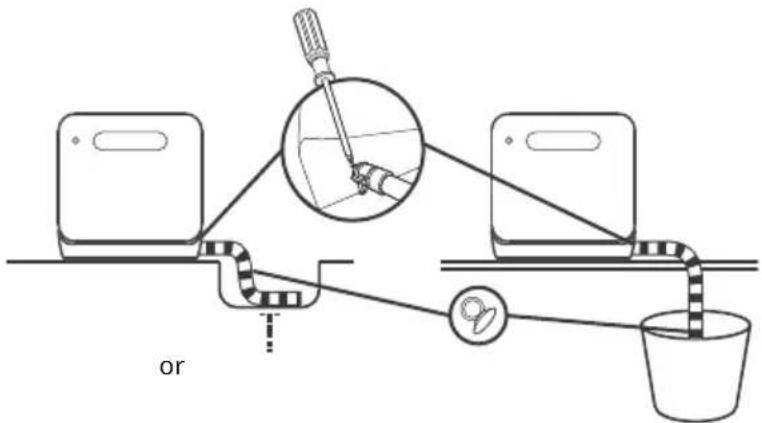
Insert the end of the drain hose into a sink or bucket.
Fix the drain hose with the back pipe of the machine. The interface is fitted with clamps and tightened with a screwdriver.
OR: Fix the drain hose with suction cups.
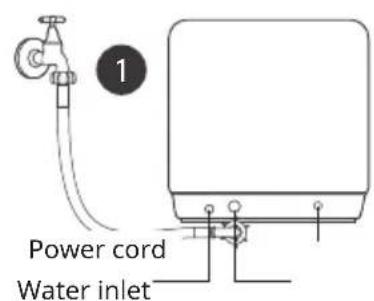
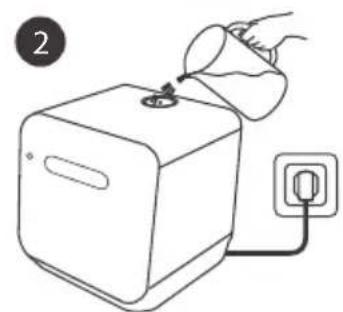
(2) Setting up the water supply
Note: Before adding water, press the Power button to turn on the dishwasher.
You can fill the device with water in two ways:
Permanent connection via the tap (1)
- Manual filling via the cap at the top of the device (2)
Drain pipe How to tell if there is enough water in the tank: or
- If the tank is filled with enough water, a short beep sounds for 3 seconds.
(3) Filling the device
- Remove the larger food residues from the dishes.
- Open the door, place the dishes in the basket and add detergent.
| Populate the device by size and from both sides to the center. All cutlery should be tilted to improve cleaning performance. The arm may be blocked by improper placement of the cutlery, in which case dishes may not be properly cleaned. | Left Right |
| Place the dishes dirty side down in the basket and tilt slightly to allow water to drain off. | × √ |
| At this place the detergent is filled in. | |
(4) Starting the device
| Close the door, select a program and start the device. |
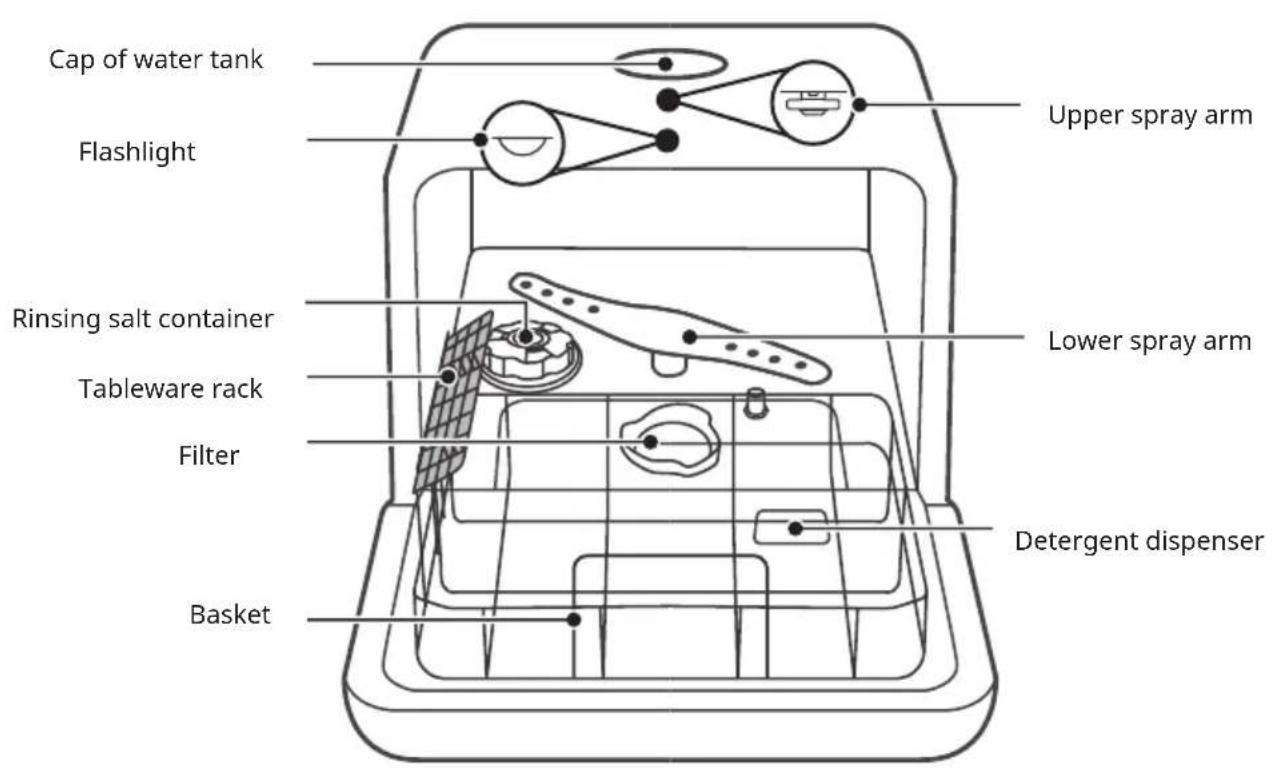
DEVICE OVERVIEW
CONTROL PANEL AND BUTTONS
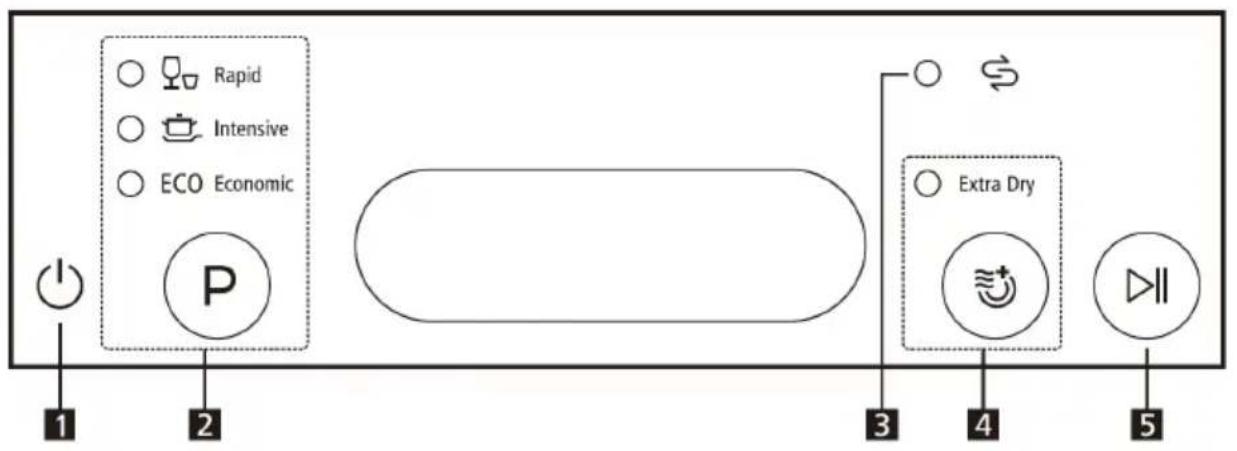
| 1 Power Switch the un | it on and off. | |
| 2 Programme | Press the key repeatedly to select the desired programme. | |
| ♀ | Rapid: Short wash cycle for dishes with light soiling and dishes that do not need to be dried. | |
| ♂ | Intensive: For heavily soiled pots and pans and for dishes with dried food leftovers. | |
| ECO | Eco: Standard programme for dishes with normal soiling. Environmentally friendly programme, as it is very energy and water saving. | |
| 3 Display | ♂ | Washing salt: when the relevant symbol lights up on the screen, it means that the dishwashing salt needs to be topped up. |
| 4 Extra Dry | Press the button for extra dry dishes. | |
| 5 Start/Pause | Press this key to start or stop the dishwasher. The indicator light flashes when the dishwasher starts. | |
ADDING RINSING SALT
Note: If your dishwasher does not have a water softener (on some models), you can skip this section.
Only use rinsing salt that is intended for use in the dishwasher. The salt container is under the basket and should be filled as follows:
- Any other type of salt that is not specifically designed for the dishwasher, especially table salt, will damage the container. In the case of damage caused by the use of unsuitable salt, the manufacturer will not be liable for any damage caused.
- Fill the device with rinsing salt before starting a run. This avoids spilled salt grains that remain on the floor of the machine for an indefinite period, which can lead to corrosion.
How to fill in the rinsing salt
| A | Remove the basket and unscrew the cap from the salt container. |
| B | Add 1 liter of water to the salt container before the first wash. |
| C | Insert the end of the funnel (supplied) into the hole and pour in about 130 g of salt. It is normal for a small amount of water to come out of the salt container. |
| D | After filling, tighten the cap clockwise. |
| E | The salt warning lamp usually goes out within 2-6 days after filling the salt container. |
| F | Immediately after filling the salt into the salt container, a washing program should be started (e.g., the quick program "Rapid"). Otherwise, the filter system, the pump or other important parts of the machine may be damaged by salt water. |
Important instructions
- The salt container should only be refilled when the salt warning light on the control panel is lit. Depending on how well the salt dissolves, the salt warning light will still light up when the salt container is filled. If there is no salt warning light on the control panel (on some models), you can use the cycles the dishwasher has undergone to determine when to refill with salt.
- If you spill some salt, start the quick program (Rapid) to remove the excess salt.
How to adjust the amount of rinsing salt correctly
Step 1: Call up rinsing salt settings
Close the door within 60 seconds of powering on, press and hold the Start/Pause button for 5 seconds.
Step 2: Adjust the amount of rinsing salt according to water hardness
Press the Start/Pause button to select the correct setting according to your water hardness: H1 > H2 > H3 > H4 > H5 > H6.
For the correct water softener setting, refer to the table below in the „Water hardness and rinsing salt quantity" section.
Step 3: Leave rinsing salt settings
If you do not make another setting for 5 seconds, the unit will automatically exit the settings and enter standby mode.
Water hardness and rinsing salt quantity
| Water hardness | Softener setting(Display) | Display indicator ● OFF ○ ON | |||
| ○dH 1) | Mmol/l 2) | Intensive Eco | Extra Drying | ||
| 0-5 0 - 0.94 | H1 | ○ ○ | ● | ||
| 6-11 1.0 - | 2.0 H2 | ○ ● | ○ | ||
| 12-17 2.1 - | 3.0 H3 | 3) | ○ ● | ● | |
| 18-22 3.1 - | 4.0 H4 | ● ○ | ○ | ||
| 23-34 4.1 - | 6.0 H5 | ● ○ | ● | ||
| 35-55 | 6.1 - 9.8 | H6 | ● ● | ○ | |
| (1) German water hardness. (2) Millimoles, international water hardness. (3) Default when first started | |||||
Note: Ask your local water supplier about the degree of hardness of your tap water.
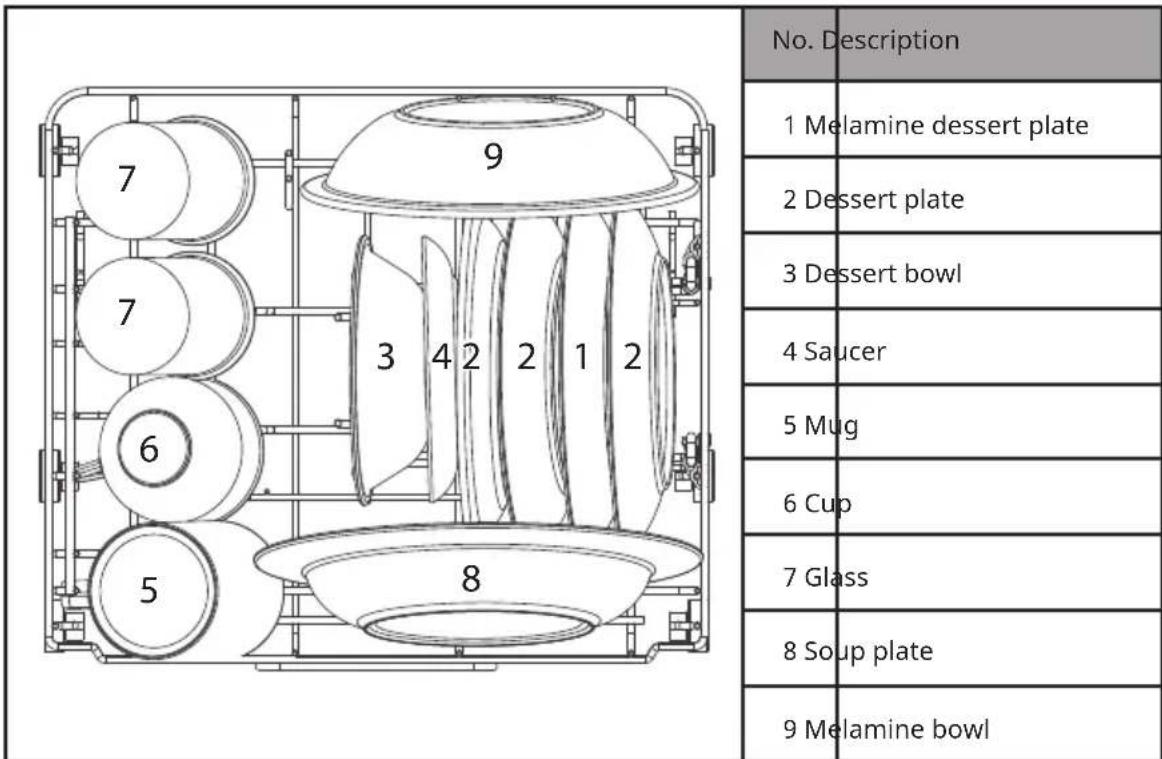
LOADING THE BASKETS (EN 60436)
Crockery basket
Cutlery basket
| 7 | No. Description |
| 1 Knife | |
| 2 Serving fork | |
| 3 Fork | |
| 4 Soup spoon | |
| 5 Teaspoon | |
| 6 Dessert spoon | |
| 7 Serving spoon | |
| 8 Gravy ladle |
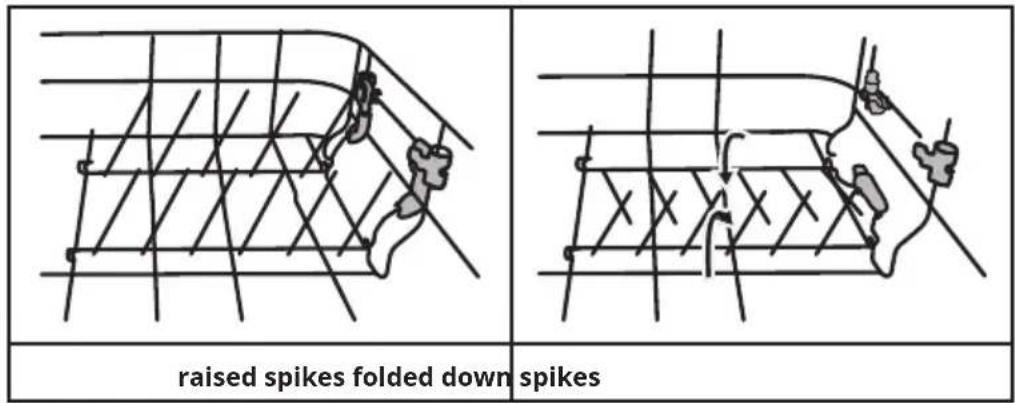
Folding spikes
The spikes are used for holding plates and platters. They can be folded down to make more room for dishes, pots, pans and other large items.
DETERGENT TYPES
Notes on the use of detergent
- Only use detergent specifically for dishwashers.
- Never use any other rinse aid and detergents. This will damage the appliance.
- Dishwasher detergent may contain corrosive ingredients. Keep dishwasher detergent out of the reach of children.
- The rinse aid is released during the final rinse to prevent water from forming droplets on your dishes and utensils, which can leave spots and streaks.
Concentrated Detergent
Due to their chemical composition, dishwashing detergents can be divided into two types:
- Conventional alkaline detergents with corrosive components
- Weak alkaline detergents with natural enzymes
Detergent tabs
The detergent tabs of different brands dissolve at different speeds in the machine. For this reason, they often can not develop their full cleaning power in short programs. Therefore always use the long programs in conjunction with detergent tabs to ensure that the tab dissolves completely.
ADDING DETERGENT
Always fill the detergent chamber immediately before starting a program and follow the instructions in the program table. Your dishwasher requires less detergent and rinse aid than standard equipment. Usually one tablespoon of detergent is enough for a normal rinse load. Heavily soiled dishes require more detergent. Put the detergent into the chamber shortly before starting, otherwise it may become damp and not dissolve as well.
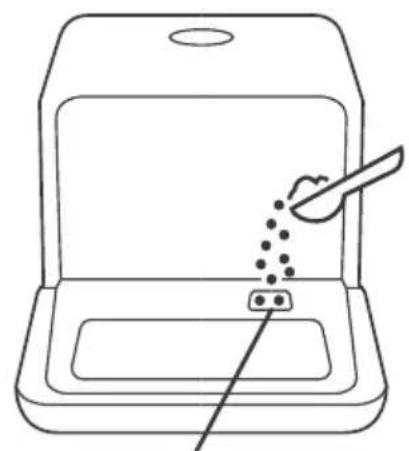
At this place you fill in the detergent.
WASHING PROGRAMMES (EN 60436)
| Program | Rinsing cycle | Detergent Pre/Main | Time (min) | Energy (kWh) | Water (L) |
| Rapid | Wash (45 °C) Rinse Rinse (55 °C) | 6 g 29.0 | 350 5.0 | ||
| Wash (62 °C) Rinse Rinse (70 °C) Drying | 6 g 160 | 0.500 5.0 | |||
| Intensive | |||||
| ECO | Wash (55 °C) Rinse Rinse (68 °C) Drying | 6 g 160 | 0.425 5.0 | ||
| *EN 60436 | |||||
| *EN 60436: The ECO program was used for the test run in accordance with EN 60436. | |||||
- The eco programme is suitable to clean normally soiled tableware. For this use, it is the most efficient programme in terms of its combined energy and water consumption. It is used to assess compliance with the EU ecodesign
legislation.
- This program involves manually opening the door and adding 3ml of rinse within a countdown time of 67-70 minutes. The extra drying indicator light flashes quickly at a frequency of 5Hz for 3 minutes. The buzzer beeps once every 2 seconds and emits a continuous beep of 4 sounds. Before the fourth beep of the buzzer, open and close the door, then the buzzer will stop, and the extra drying indicator light will stop flashing (returning to the state before flashing). After the fourth beep of the buzzer, open and close the door within 3 minutes, and the extra drying indicator light will stop flashing (return to its previous state before flashing).
- Loading the household dishwasher up to the capacity indicated by the manufacturer will contribute to energy and water.
- Incorrect loading can have these consequences:
- a deteriorated cleaning result
- damage to property due to the blocking of the spraying arms.
- Manual pre-rinsing of tableware items leads to increased water and energy consumption and is not recommended.
- Washing tableware in a household dishwasher usually consumes less energy and water in the use phase than hand dishwashing when the household dishwasher is used according to the manufacturer's instructions.
- The values given for programmes other than the eco programme are indicative only.
OPERATION IN DETAIL
Starting the washing process
1 Pull out the basket.
2 Add a suitable detergent.
3 Insert the plug into the socket.
4 Press the Power button to turn on the unit.
5 Connect the inlet hose to the faucet and make sure that the water supply is set to full pressure OR manually add the water to the tank.
6 Select the desired program. When a program is selected, the corresponding indicator will light up.
7 Press the Start/Pause button to start the dishwasher.
Note: If you press the Start/Pause button to pause during washing, the dishwasher will beep every minute until you press the Start/Pause button again to start.
Changing the program
If possible, a running program should be changed directly after the start. Otherwise, the detergent may have already dissolved and run out of the machine with the water. If this is the case, the dishwasher needs to be reset and the detergent dispenser must be refilled. To reset the dishwasher, follow the instructions below:
1 Press the Start/Pause button to pause the washing.
2 Press Program button for more than 3 seconds, the machine will be in stand by state.
3 Press the Program button to select the desired program.
4 Press the Start/Pause button, the dishwasher will start.
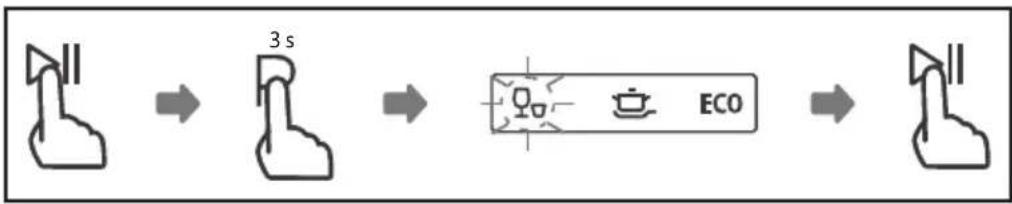
Note: If you open the door while the unit is running, the machine will stop automatically. When you close the door again and press the Start/Pause button, the unit will continue to move for 10 seconds. If your model has broken remember function, the machine will go on to finish the selected program after the power cut.
Adding dishes later
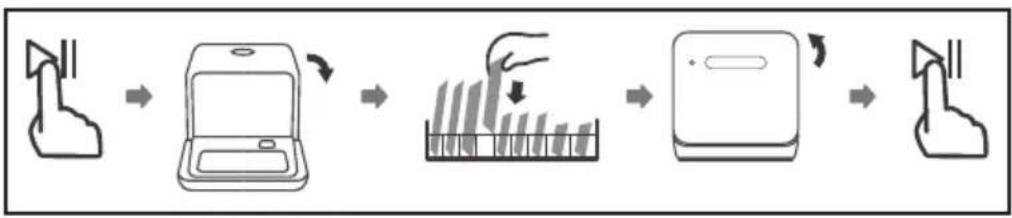
A forgotten dish can be added any time before the detergent dispenser opens. In this case, follow the instructions below:
1 Press the Start/Pause button.
2 Open the door a little to stop the washing.
3 After the spray arms stop working, you can open the door completely.
4 Add forgotten dishes.
5 Close the door.
6 Press the Start/Pause button to start the dishwasher again.
After the end of the program
At the end of the program, the buzzer will sound for 8 seconds. Press the power button to turn off the power. Turn off the tap and open the dishwasher door. Wait a few minutes before unloading the dishwasher to avoid scalding. The dishes are still very hot after drying and can easily break. They will also dry better.
1. Switch off the dishwasher:
- Press the Power button.
- Turn off the water tap!
2. Open the door carefully:
- Hot dishes are sensitive to knocks. The dishes should be allowed to cool down around 15 minutes before removing from the appliance.
- Open the dishwasher's door, leave it ajar and wait a few minutes before removing the dishes. In this way they will be cooler and the drying will be improved.
3. Unloading the dishwasher
- It is normal that the dishwasher is wet inside.

CAUTION
Risk of scalding! Never open the door during the washing process, as the hot water may scald you. Drain water from the water tank
- In standby mode, press and hold the Program and Extra Drying buttons simultaneously for 3 seconds to drain the water tank.
CLEANING AND CARE
Note: Never use the dishwasher without filters!
Make sure the filter is properly assembled. The performance may be affected and dishes and utensils could become damaged.
Cleaning the filter system
The filter system removes dirt and food residues, allowing the clean water to be re-circulated for cleaning. In order for the device to perform at its best you should clean the filters once a week. We recommend removing coarse dirt and food residues after each wash, by rinsing the filter and cup under running water. To remove the filter assembly, pull the cup handle in the upward direction.
| Fine filter: Filters out dirt and residues and prevents them from getting back onto the dishes during the washing process. Main filter: Leftovers and dirt particles are crushed by a special nozzle on the spray arm and discharged through the drain. | |
| Step 1: Unscrew the complete filter set counterclockwise. | |
| Step 2: Lift fine filter (B) up from main filter (A). When you have cleaned the filters, replace them in reverse order. |
Note: Do not tap the filters when cleaning. Otherwise you may bend them, which would have a negative impact on the performance of the dishwasher.
Cleaning the dishwasher
- Clean the control panel with a slightly damp cloth and then dry it thoroughly.
- Maintain the housing with a suitable polishing wax.
- Do not use sharp objects, scouring pads, aggressive detergents, scouring agents or paper towels to protect the stainless steel surface from scratches and stains.
- Clean the edge of the door with a warm, damp cloth. To prevent water from entering the locking mechanism or electrical components, do not use spray cleaners.
Removal of foreign objects
- Check the sieves and the tub after each use of the dishwasher. Foreign objects (e.g. broken glass, plastic particles, bones or toothpicks, etc.) reduce the cleaning performance and can cause damage to the drain pump. Remove the sieve system as described in this chapter. Remove foreign objects by hand.
- Caution. If you cannot remove the objects, contact an authorised service centre. Reinstall the filter system as described in this chapter.
How to protect the device from frost damage
In winter, take the following precautions to protect the machine against frost. Perform the following steps after every program run:
1 Pull the plug out of the socket.
2 Close the water supply and remove the inlet hose from the inlet valve.
3 Drain the water from the hose and valve into a vessel.
4 Reattach the inlet hose to the inlet valve.
5 Remove the filter from the bottom of the tub and use a sponge to soak up excess water.
Cleaning the spray arms
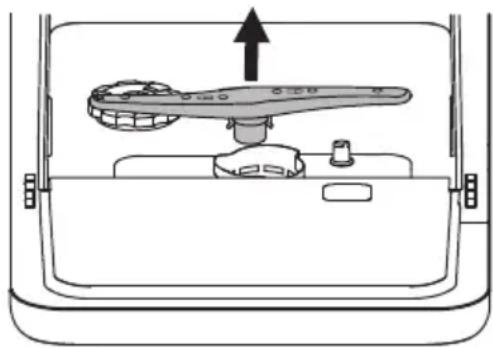
The spray arms can be easily removed for regular cleaning of the nozzles to avoid clogging.
1 Grasp the centre of the spray arm and pull it up to remove it.
2 Wash the spray arms under running water and carefully reinsert them. Check that the spray arms are seated correctly and make sure that their rotation is not obstructed in any way.
TROUBLESHOOTING
| Problem Possible Causes | Solution | |
| Dishwasher does not start. | Fuse blown, or the circuit break tripped. | Replace fuse or reset circuit breaker. Remove any other appliances sharing the same circuit with the dishwasher. |
| No power. Make sure the dishwasher is turned on and the door is closed securely. Make sure the power cord is properly plugged into the wall socket. | dishwasher is turned on and the door is closed securely. Make sure the power cord is properly plugged into the wall socket. | |
| Water inflow abnormal or water pressure is too low. | Check that the water supply is connected properly and the water is turned on. | |
| Door of dishwasher not properly closed. | Make sure to close the door properly and latch it. | |
| Water not pumped form dishwasher | Twisted or trapped drain hose. | Check the drain hose. |
| Filter clogged. Check the filters. | ||
| Kitchen sink clogged. Check the kitchen sink to make sure it is draining well. If the problem is the kitchen sink that is not draining, you may need a plumber rather than a serviceman for dishwashers. | ||
| Stained tub interior Detergent with colour-ant may have been used. | Make sure that the detergent has no colourant. | |
| Problem Possible Causes Solution | ||
| Suds in the tub Wrong detergent. Use only the dedicated dishwasher detergent to avoid suds. If suds exist in the washer. Open the door for 20-30 minutes to allow the foam to evaporate. If the foam still exists in the liner. Add 1.5 litre of water to the liner, close the dishwasher door and run a forced drain to drain it with the water. Repeat above operation until the foam is cleared. | ||
| Spilled rinse-aid. Always wipe up rinse-aid spills immediately. | ||
| White film on inside surface | Hard water minerals. To clean the interior, use a damp sponge with dishwasher detergent and wear rubber gloves. Never use any other cleaner than dishwasher detergent otherwise, it may cause foaming or suds. | |
| There are rust stains on cutlery. | The affected items are not corrosion resistant. | Avoid washing items that are not corrosion resistant in the dishwasher. |
| A program was not run after dishwasher salt was added. Traces of salt have gotten into the wash cycle. | Always run a wash program without any crockery after adding salt. | |
| The lid of the softer is loose. | Check the softener lid is secure. | |
| Knocking noise in the dishwasher | A spray arm is knocking against an item in a basket | Interrupt the program and rearrange the items which are obstructing the spray arm. |
| Rattling noise in the dishwasher | Items of crockery are loose in the dishwasher. | Interrupt the program and rearrange the items of crockery. |
| Problem Possible Causes | Solution | |
| Knocking noise in the water pipes | This may be caused by on-site installation or the cross-section of the piping. | This has no influence on the dishwasher function. If in doubt, contact a qualified plumber. |
| The dishes are not clean. | The dishes were not loaded correctly. | Follow the instructions for loading the dishwasher. |
| Use more detergent, or change our detergent. | Select the Intensive program. | |
| Not enough detergent was dispensed | Use more detergent, or change your detergent. | |
| Items are blocking the movement of the spray arms. | Rearrange the items so that the spray can rotate freely. | |
| The filter combination is not clean or is not correctly fitted in the base of washcabinet. This may cause the spray arm jets to get blocked. | Clean and/or fit the filter correctly. Clean the spray arm jets. | |
| Cloudiness on glassware. | Combination of soft water and too much detergent. | Use less detergent if you have soft water and select a shorter cycle to wash the glassware and to get them clean. |
| White spots appear on dishes and glasses. | Hard water can cause limescale deposits. | Add more detergent. |
| Black or grey marks on dishes | Aluminium utensils have rubbed against dishes | Use a mild abrasive cleaner to eliminate those marks. |
| Detergent left in dispenser | Dishes block detergent dispenser | Re-loading the dishes properly. |
| Problem Possible Causes Solution | ||
| The dishes are not drying. | Improper loading Load the dishwasher as suggested in the directions. | |
| Dishes are removed too soon. | Do not empty your dishwasher immediately after washing. Open the door slightly so that the steam can come out. Take out the dishes until the inside temperature is safe to touch. Unload the lower basket first to prevent the dropping water from the upper basket. | |
| Wrong program has been selected. | With a short program, the washing temperature is lower, decreasing cleaning performance. Choose a program with a long washing time. | |
| Use of cutlery with a low-quality coating. | Cutlery or dishes of this type are not suitable for washing in the dishwasher. | |

WARNING
Risk of electric shock or other personal injury!
Do not repair the appliance yourself. The dishwasher may only be repaired by qualified personnel. The repair must be carried out professionally.
Error signals
When some malfunctions come on, the appliance will show a signal to warn you:
| Program light Meanings | Possible Causes | |
| Extra Drying: Fast flickering | Longer inlet time. A flow meter, drain valve, or pump failure. It should be repaired by a qualified specialist. | |
| ECO and Extra Drying: Light fast flickering | Not reaching required temperature | Heating tube or thermistor anomaly. It should be repaired by a qualified specialist. |
| Intensive: Light fast flickering | Overflow. Some element of dishwasher leaks. | Some element of dishwasher leaks. Contact a qualified specialist. |
| Rapid and Extra Drying: Light fast flickering | Touch button adhesion displayed | Splay damage or material defects. Contact a qualified specialist. |
| Rapid, Intensive and Extra Drying: Light fast flickering | Communication anomaly | Contact a qualified specialist. |
| The selected program indicator Keep lighting and beep one time per minute. | Water tank doesn’t get enough water within 3 minutes | It should be added more water until listening a quick beep. Then press Start/Pause button to ensure that the machine is working properly. |
- If water runs out, first shut off the water supply before contacting customer service or a specialist company.
- If there is water in the base pan due to overfilling or a small leak, remove it before restarting the dishwasher.
- In case of repair, please contact a qualified repair service in your area. Spare parts for the item are available until 31.12.2028.
Information according to Regulation (EU) No. 2019/2017
| Name or trademark of the producer: Klarstein | ||||
| Address of the producer: Wallstraße 16, 10179 Berlin, Deutschland. | ||||
| Item number: 10047348 | ||||
| General product parameters: | ||||
| Parameter Value Parameter Value | ||||
| Standard place settings 2 | Dimension | in cm | Height 44 | |
| Width 42 | ||||
| Depth 44 | ||||
| EEI 49.9 Energy efficiency | class D | |||
| Cleaning performance index | 1.125 | Drying performance index | 0.865 | |
| Energy consumption in kWh [per cycle], based on the eco programme using cold water fill. Ac- tual energy consump- tion will depend on how the appliance is used. | 0.314 | Water consumption in litres [per cycle], based on the eco program. Ac- tual water consumption will depend on how the appliance is used and on the hardness of the water. | 5 | |
| Program duration (h:min) | 2:45 Type | Free-standing | ||
| Airborne acoustical noise emissions (dB(A) re 1 pW) | 58 | Airborne acoustical noise emission class | D | |
| Off-mode (W) n. a. Standby mode (W) | 0.49 | |||
| Delay start (W) (if applicable) | 1.00 | Networked standby (W) (if applicable) | n. a. | |
| Minimum duration of the guarantee offered by the manufacturer: 24 months | ||||
| Additional information: | ||||
| Weblink to the supplier's website, where the information in point 6 of Annex II to Commission Regulation (EU) 2019/2022 is found: www.klarstein.co.uk | ||||
DISPOSAL CONSIDERATIONS
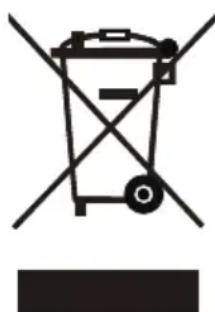
If there is a legal regulation for the disposal of electrical and electronic devices in your country, this symbol on the product or on the packaging indicates that this product must not be disposed of with household waste. Instead, it must be taken to a collection point for the recycling of electrical and electronic equipment. By disposing of it in accordance with the rules, you are protecting the environment and the health of your fellow human beings from negative consequences. For information about the recycling and disposal of this product, please contact your local authority or your household waste disposal service.
MANUFACTURER & IMPORTER (UK)
Manufacturer:
Chal-Tec GmbH, Muhlenstrasse 25, 10243 Berlin, Germany.
Importer for Great Britain:
Berlin Brands Group UK Limited
35 Ballards Lane
London,N3 1XW
United Kingdom
Contact: info@electronic-star.de
Chere cliente, cher client,
Pointes supports escamotables
FICHE DE DONNÉES PRODUIT
Berlin Brands Group UK Limited
35 Ballards Lane
London,N3 1XW
United Kingdom
Gentile clientele,
RICERCA DEI PROBLEMI RISOLUZIONE DEI PROBLEMI
Berlin Brands Group UK Limited
35 Ballards Lane
London,N3 1XW
United Kingdom
Estimado cliente:
Berlin Brands Group UK Limited
35 Ballards Lane
London,N3 1XW
United Kingdom


KLARSTEIN

- Dear Customer,
- CONTENTS
- SAFETY INSTRUCTIONS
- WARNING
- CAUTION
- QUICK START GUIDE
- Filling the device
- Starting the device
- DEVICE OVERVIEW
- CONTROL PANEL AND BUTTONS
- ADDING RINSING SALT
- How to fill in the rinsing salt
- Important instructions
- How to adjust the amount of rinsing salt correctly
- Step 1: Call up rinsing salt settings
- Step 2: Adjust the amount of rinsing salt according to water hardness
- Step 3: Leave rinsing salt settings
- Water hardness and rinsing salt quantity
- LOADING THE BASKETS (EN 60436)
- Folding spikes
- DETERGENT TYPES
- Notes on the use of detergent
- Concentrated Detergent
- Detergent tabs
- ADDING DETERGENT
- WASHING PROGRAMMES (EN 60436)
- OPERATION IN DETAIL
- Starting the washing process
- Changing the program
- Adding dishes later
- After the end of the program
- Switch off the dishwasher:
- Open the door carefully:
- Unloading the dishwasher
- CLEANING AND CARE
- Cleaning the filter system
- Cleaning the dishwasher
- Removal of foreign objects
- How to protect the device from frost damage
- Cleaning the spray arms
- TROUBLESHOOTING
- Error signals
- DISPOSAL CONSIDERATIONS
- MANUFACTURER & IMPORTER (UK)
- Manufacturer:
- Importer for Great Britain:
- Pointes supports escamotables
- FICHE DE DONNÉES PRODUIT
- Gentile clientele,
- RICERCA DEI PROBLEMI RISOLUZIONE DEI PROBLEMI
Brand : Klarstein
Model : Aquatica
Category : Dishwasher