MEXN5300BT - Car stereo SONY - Free user manual and instructions
Find the device manual for free MEXN5300BT SONY in PDF.


User questions about MEXN5300BT SONY
0 question about this device. Answer the ones you know or ask your own.
Ask a new question about this device
Download the instructions for your Car stereo in PDF format for free! Find your manual MEXN5300BT - SONY and take your electronic device back in hand. On this page are published all the documents necessary for the use of your device. MEXN5300BT by SONY.
USER MANUAL MEXN5300BT SONY
FM/MW/LW CD Bluetooth® Car Audio
Operating Instructions
GB
Bedienungsanleitung
DE
Mode d'emploi
FR
To cancel the demonstration (DEMO) display, see page 18.
For the connection/installation, see page 33.
For safety, be sure to install this unit in the dashboard of the car as the rear side of the unit becomes hot during use. For details, see "Connection/Installation" (page 33).
Made in Thailand
This product is classified as a Class 1 Laser product under IEC/EN 60825-1:2007 and IEC/EN 60825-1:2014.
- Emission Duration: Continuous
• Laser Output: Less than 55.8 μW
• Wavelength: 775 nm to 800 nm
The nameplate indicating operating voltage, etc., is located on the bottom of the chassis.
The validity of the CE marking is restricted to only those countries where it is legally enforced, mainly in the countries EEA (European Economic Area) and Switzerland.
CE
Hereby, Sony Corporation declares that this equipment is in compliance with Directive 2014/53/EU.
The full text of the EU declaration of conformity is available at the following internet address:
http://www.compliance.sony.de/
Notice for customers: the following information is only applicable to equipment sold in countries applying EU Directives
This product has been manufactured by or on behalf of Sony Corporation. EU Importer: Sony Europe B.V. Inquiries to the EU Importer or related to product compliance in Europe should be sent to the manufacturer's authorized representative, Sony Belgium, bijkantoor van Sony Europe B.V., Da Vincilaan 7-D1, 1930 Zaventem, Belgium.
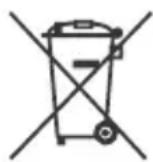
Disposal of waste batteries and electrical and electronic equipment (applicable in the European Union and other countries with
separate collection systems)
This symbol on the product, the battery or on the packaging indicates that the product and the battery shall not be treated as household waste. On certain batteries this symbol might be used in combination with a chemical symbol. The chemical symbol for lead (Pb) is added if the battery contains more than 0.004% lead. By ensuring that these products and batteries are disposed of correctly, you will help to prevent potentially negative consequences for the environment and human health which could be caused by inappropriate waste handling. The recycling of the materials will help to conserve natural resources. In case of products that for safety, performance or data integrity reasons require a permanent connection with an incorporated battery, this battery should be replaced by qualified service staff only. To ensure that the battery and the electrical and electronic equipment will be treated properly, hand over these products at end-of-life to the appropriate collection point for the recycling of electrical and electronic equipment. For all other batteries, please view the section on how to remove the battery from the product safely. Hand the battery over to the appropriate collection point for the recycling of waste batteries. For more detailed information about recycling of this product or battery, please contact your local Civic Office, your household waste disposal service or the shop where you purchased the product or battery.
CAUTION
The following frequency 65 – 74 MHz range is not allocated to sound broadcasting in the European Common Allocations table and cannot be used in Europe.
Warning if your car's ignition has no ACC position
Be sure to set the AUTO OFF function (page 19). The unit will shut off completely and automatically in the set time after the unit is turned off and the clock is displayed (i.e. press and hold OFF for 1 second), which prevents battery drain. If you do not set the AUTO OFF function, press and hold OFF until the display disappears each time you turn the ignition off.
Disclaimer regarding services offered by third parties
Services offered by third parties may be changed, suspended, or terminated without prior notice. Sony does not bear any responsibility in these sorts of situations.
About the NFC function
The model supporting the NFC function described in this manual is as follows: - M E X - N 5 3 0 0 B T
Important notice
Caution
IN NO EVENT SHALL SONY BE LIABLE FOR ANY INCIDENTAL, INDIRECT OR CONSEQUENTIAL DAMAGES OR OTHER DAMAGES INCLUDING, WITHOUT LIMITATION, LOSS OF PROFITS, LOSS OF REVENUE, LOSS OF DATA, LOSS OF USE OF THE PRODUCT OR ANY ASSOCIATED EQUIPMENT, DOWNTIME, AND PURCHASER'S TIME RELATED TO OR ARISING OUT OF THE USE OF THIS PRODUCT, ITS HARDWARE AND/OR ITS SOFTWARE.
Dear customer, this product includes a radio transmitter.
According to UNECE Regulation no. 10, a vehicle manufacturers may impose specific conditions for installation of radio transmitters into vehicles.
Please check your vehicle operation manual or contact the manufacturer of your vehicle or your vehicle dealer, before you install this product into your vehicle.
Emergency calls
This BLUETOOTH car handsfree and the electronic device connected to the handsfree operate using radio signals, cellular, and landline networks as well as user-programmed function, which cannot guarantee connection under all conditions. Therefore do not rely solely upon any electronic device for essential communications (such as medical emergencies).
On BLUETOOTH communication
- Microwaves emitting from a BLUETOOTH device may affect the operation of electronic medical devices. Turn off this unit and other BLUETOOTH devices in the following locations, as it may cause an accident.
- where inflammable gas is present, in a hospital, train, airplane, or petrol station
- near automatic doors or a fire alarm
- This unit supports security capabilities that comply with the BLUETOOTH standard to provide a secure connection when the BLUETOOTH wireless technology is used, but security may not be enough depending on the setting. Be careful when communicating using BLUETOOTH wireless technology.
- We do not take any responsibility for the leakage of information during BLUETOOTH communication.
If you have any questions or problems concerning your unit that are not covered in this manual, consult your nearest Sony dealer.
Table of Contents
Guide to Parts and Controls.... 5
Getting Started
Detaching the Front Panel 7
Resetting the Unit....7
Setting the Clock....7
Checking the Battery Voltage 8
Preparing a BLUETOOTH Device 8
Connecting a USB Device.... 10
Connecting Other Portable Audio Device 10
Listening to the Radio
Listening to the Radio ..... 11
Using Radio Data System (RDS)....11
Playback
Playing a Disc 12
Playing a USB Device 12
Playing a BLUETOOTH Device 13
Searching and Playing Tracks 13
Handsfree Calling (via BLUETOOTH only)
Receiving a Call.... 14
Making a Call.... 14
Available Operations During Call ..... 15
Useful Functions
"Sony | Music Center" with iPhone/Android™ Smartphone 16
Using Voice Recognition (Android Smartphone only). 17
Using "Siri Eyes Free" 17
Settings
Canceling the DEMO Mode 18
Basic Setting Operation.... 18
General Setup (GENERAL) 19
Sound Setup (SOUND) 20
Display Setup (DISPLAY) 20
BLUETOOTH Setup (BLUETOOTH) ..... 21
"Sony | Music Center" Setup (SONY APP) 22
Additional Information
Updating the Firmware 22
Precautions.... 22
Maintenance.... 24
Specifications 24
Troubleshooting 27
Messages 30
Connection/Installation
Cautions 33
Parts List for Installation 33
Connection (For MEX-N5300BT) ..... 34
Connection (For MEX-N4300BT) 35
Installation 38
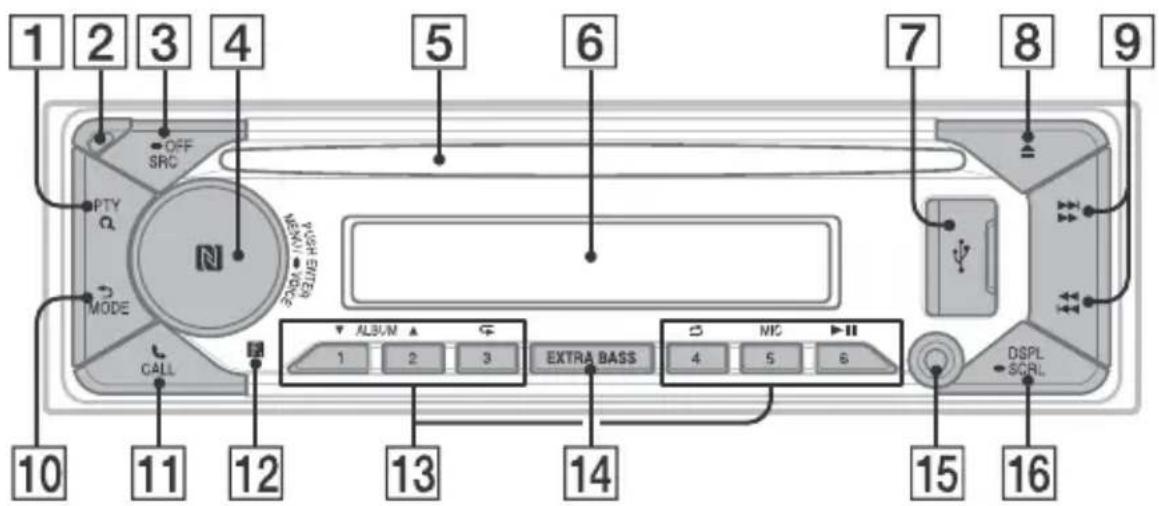
Guide to Parts and Controls
Main unit
text_image
1 2 3 4 5 6 7 8 9 OFF SRC PTY MODE CALL 10 11 12 13 14 ALBUM 2 3 EXTRA BASS 4 5 6 NIC DSPL SCRIL1 PTY (program type)
Select PTY in RDS.
Q (browse) (page 13, 14)
Enter the browse mode during playback.
(Not available when a USB device in Android mode or iPod is connected.)
2 Front panel release button
3 SRC (source)
Turn on the power.
Change the source.
OFF
Press and hold for 1 second to turn the source off and display the clock.
Press and hold for more than 2 seconds to turn off the power and the display.
4 Control dial
Rotate to adjust the volume.
PUSH ENTER
Enter the selected item.
Press SRC, rotate then press to change the source (timeout in 2 seconds).
MENU
Open the setup menu.
- VOICE (page 15, 17, 18)
Press and hold for more than 2 seconds to activate voice dial, voice recognition (Android smartphone only), or the Siri function (iPhone only).
N-Mark (MEX-N5300BT only)
Touch the control dial with Android smartphone to make BLUETOOTH connection.
5 Disc slot
6 Display window
7 USB port
8 ▲ (disc eject)
9 / ( S E E K - / + )
Tune in radio stations automatically. Press and hold to tune manually.
◀◀/▶▶I (prev/next)
◀◀/▶▶ (fast-reverse/fast-forward)
10 (back)
Return to the previous display.
MODE (page 11)
11 CALL
Enter the call menu. Receive/end a call. Press and hold for more than 2 seconds to switch the BLUETOOTH signal.
12 Receptor for the remote commander
13 Number buttons (1 to 6)
Receive stored radio stations. Press and hold to store stations.
ALBUM ▼/▲
Skip an album for audio device. Press and hold to skip albums continuously. (Not available when a USB device in Android mode or iPod is connected.)
(repeat)
(Not available when a USB device in Android mode is connected.)
(shuffle)
(Not available when a USB device in Android mode is connected.)
MIC (page 15)
▶II (play/pause)
14 EXTRA BASS
Reinforces bass sound in synchronization with the volume level. Press to change the EXTRA BASS setting: [1], [2], [OFF].
15 AUX input jack
16 DSPL (display)
Press to change display items.
- SCRL (scroll)
Press and hold to scroll a display item.
Getting Started
Detaching the Front Panel
You can detach the front panel of this unit to prevent theft.
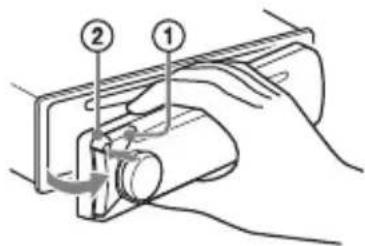
1 Press and hold OFF ① until the unit turns off, press the front panel release button ②, then pull the panel towards you to remove.
text_image
Diagram showing a hand operating a mechanical device with labeled parts 1 and 2, indicating a step or operation.Caution alarm
If you turn the ignition switch to the OFF position without detaching the front panel, the caution alarm will sound for a few seconds. The alarm will only sound if the built-in amplifier is used.
Serial numbers (MEX-N5300BT only)
Make sure the serial numbers on the bottom of the unit and the back of the front panel are matched correctly. Otherwise you cannot make BLUETOOTH pairing, connection and disconnection by NFC.
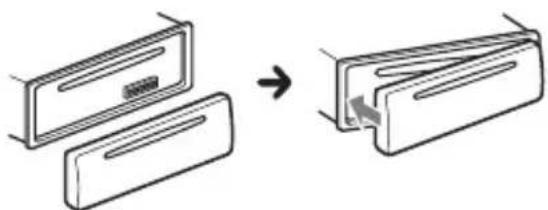
Attaching the front panel
natural_image
Diagram showing a device being processed into a folder, with no text or symbols present.Resetting the Unit
Before operating the unit for the first time, after replacing the car battery, or changing the connections, you must reset the unit.
1 Press DSPL and CALL for more than 2 seconds.
Note
Resetting the unit will erase the clock setting and some stored contents.
Setting the area/region
After resetting the unit, the area/region setting display appears.
1 Press ENTER while [SET AREA] is displayed.
The area/region currently set appears.
2 Rotate the control dial to select [EUROPE] or [RUSSIA], then press it.
3 Rotate the control dial to select [YES] or [NO], then press it.
If the setting area/region is changed, the unit is reset, then the clock is displayed.
This setting can be configured in the general setup menu (page 19).
Setting the Clock
1 Press MENU, rotate the control dial to select [GENERAL], then press it.
2 Rotate the control dial to select [SET CLOCK], then press it.
3 Rotate the control dial to select [MANUAL], then press it.
The hour indication flashes.
4 Rotate the control dial to set the hour and minute.
To move the digital indication, press
5 After setting the minute, press MENU.
The setup is complete and the clock starts.

To display the clock
Press DSPL.
To set the clock automatically
Select [AUTO
Checking the Battery Voltage
You can check the current battery voltage. (Not available while the source is off and the clock is displayed.)
1 Press DSPL repeatedly until the battery voltage display appears.
Preparing a BLUETOOTH Device
You can enjoy music, or perform handsfree calling depending on the BLUETOOTH compatible device such as a smartphone, cellular phone and audio device (hereafter "BLUETOOTH device" if not otherwise specified). For details on connecting, refer to the operating instructions supplied with the device.
Before connecting the device, turn down the volume of this unit; otherwise, loud sound may result.
Connecting with a Smartphone using One-touch connection (NFC) (MEX-N5300BT only)
By touching the control dial on the unit with an NFC* compatible smartphone, the unit is paired and connected with the smartphone automatically.
* NFC (Near Field Communication) is a technology enabling short-range wireless communication between various devices, such as mobile phones and IC tags. Thanks to the NFC function, data communication can be achieved easily just by touching the relevant symbol or designated location on NFC compatible devices.
For a smartphone with Android OS 4.0 or lower installed, downloading the app "NFC Easy Connect" available on Google Play is required. The app may not be downloadable in some countries/regions.
1 Activate the NFC function on the smartphone.
For details, refer to the operating instructions supplied with the smartphone.
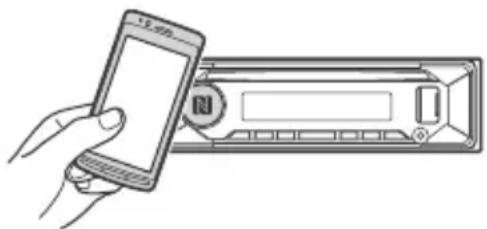
2 Touch the N-Mark part of the unit with the N-Mark part of the smartphone.
natural_image
Line drawing of a hand holding a smartphone next to a CD-ROM device (no text or symbols visible)Make sure that lights up on the display of the unit.
To disconnect using NFC
Touch the N-Mark part of the unit with the N-Mark part of the smartphone again.
Notes
- When making the connection, handle the smartphone carefully to prevent scratches.
- One-touch connection is not possible when the unit is already connected to two NFC compatible devices. In this case, disconnect either device, and make connection with the smartphone again.
Pairing and connecting with a BLUETOOTH device
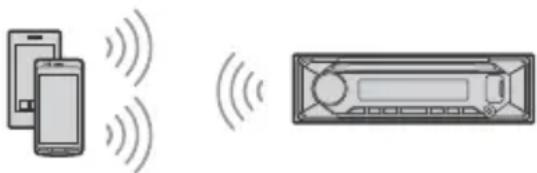
When connecting a BLUETOOTH device for the first time, mutual registration (called "pairing") is required. Pairing enables this unit and other devices to recognize each other. This unit can connect two BLUETOOTH devices (two cellular phones, or a cellular phone and an audio device).
natural_image
Illustration showing two smartphones with wireless signal waves, and a CD-ROM device (no text or symbols)1 Place the BLUETOOTH device within 1 m (3 ft) of this unit.
2 Press MENU, rotate the control dial to select [BLUETOOTH], then press it.
3 Rotate the control dial to select [SET PAIRING], then press it.
4 Rotate the control dial to select [SET DEVICE 1]* or [SET DEVICE 2]*, then press it.
flashes while the unit is in pairing standby mode.
* [SET DEVICE 1] or [SET DEVICE 2] will be changed to the paired device name after pairing is complete.
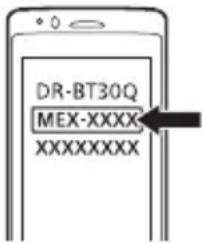
5 Perform pairing on the BLUETOOTH device so it detects this unit.
6 Select [MEX-xxxxx] (your model name) shown in the display of the BLUETOOTH device.
If your model name does not appear, repeat from step 2.
text_image
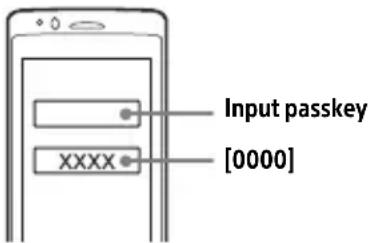
DR-BT30Q MEX-XXXX- XXXXXXXXX7 If passkey* input is required on the BLUETOOTH device, input [0000].
* Passkey may be called "Passcode," "PIN code," "PIN number" or "Password," etc., depending on the device.
text_image
Input passkey [0000]When pairing is made, stays lit.
8 Select this unit on the BLUETOOTH device to establish the BLUETOOTH connection.
or lights up when the connection is made.
Note
While connecting to a BLUETOOTH device, this unit cannot be detected from another device. To enable detection, enter the pairing mode and search for this unit from another device.
To start playback
For details, see "Playing a BLUETOOTH Device" (page 13).
To disconnect the paired device
Perform steps 2 to 4 to disconnect after this unit and the BLUETOOTH device are paired.
Connecting with a paired BLUETOOTH device
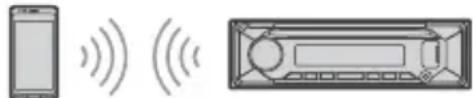
To use a paired device, connection with this unit is required. Some paired devices will connect automatically.
natural_image
Diagram showing a smartphone and a device with sound waves, no text or symbols present1 Press MENU, rotate the control dial to select [BLUETOOTH], then press it.
2 Rotate the control dial to select [SET BT SIGNL], then press it.
Make sure that lights up.
3 Activate the BLUETOOTH function on the BLUETOOTH device.
4 Operate the BLUETOOTH device to connect to this unit.
or lights up.
Icons in the display:
| Lights up when handsfree calling is available by enabling the HFP (Handsfree Profile). | |
| Lights up when the audio device is playable by enabling the A2DP (Advanced Audio Distribution Profile). |
To connect the last-connected device from this unit
Activate the BLUETOOTH function on the BLUETOOTH device.
To connect with the audio device, press SRC to select [BT AUDIO] and press ▶II (play/pause).
To connect with the cellular phone, press CALL.
Note
While streaming BLUETOOTH audio, you cannot connect from this unit to the cellular phone. Connect from the cellular phone to this unit instead.
Tip
With BLUETOOTH signal on: when the ignition is turned to on, this unit reconnects automatically to the last-connected cellular phone.
To install the microphone
For details, see "Installing the microphone (MEX-N5300BT only)" (page 37).
Connecting with an iPhone/iPod (BLUETOOTH Auto Pairing)
When an iPhone/iPod with iOS5 or later installed is connected to the USB port, the unit is paired and connected with the iPhone/iPod automatically.
To enable BLUETOOTH Auto Pairing, make sure [SET AUTOPAIR] in [BLUETOOTH] is set to [ON] (page 21).
1 Activate the BLUETOOTH function on the iPhone/iPod.
2 Connect an iPhone/iPod to the USB port.

text_image
Diagram showing cable connection between a device and a smartphone, with numbered components indicating connection steps.Make sure that lights up on the display of the unit.
Notes
- BLUETOOTH Auto Pairing is not possible if the unit is already connected to two BLUETOOTH devices. In this case, disconnect either device, then connect the iPhone/iPod again.
- If BLUETOOTH Auto Pairing is not established, see "Preparing a BLUETOOTH Device" (page 8).
Connecting a USB Device
1 Turn down the volume on the unit.
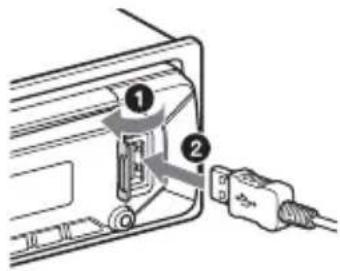
2 Connect the USB device to the unit.
To connect an iPod/iPhone, use the USB connection cable for iPod (not supplied).
text_image
Diagram showing a device with labeled components and connection arrows, likely illustrating a cable or cable assembly.Connecting Other Portable Audio Device
1 Turn off the portable audio device.
2 Turn down the volume on the unit.
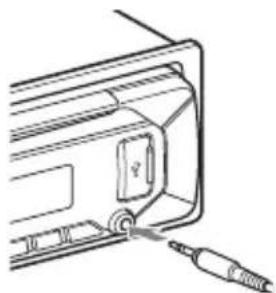
3 Connect the portable audio device to the AUX input jack (stereo mini jack) on the unit with a connecting cord (not supplied)*.
* Be sure to use a straight type plug.
natural_image
Line drawing of a mechanical component with a screw inserted, showing no text or symbols4 Press SRC to select [AUX].
To match the volume level of the connected device to other sources
Start playback of the portable audio device at a moderate volume, and set your usual listening volume on the unit.
Press MENU, then select [SOUND] → [SET AUX VOL] (page 20).
Listening to the Radio
Listening to the Radio
To listen to the radio, press SRC to select [TUNER].
Storing automatically (BTM)
1 Press MODE to change the band (FM1, FM2, FM3 or MW/LW).
2 Press MENU, rotate the control dial to select [GENERAL], then press it.
3 Rotate the control dial to select [SET BTM], then press it.
The unit stores stations in order of frequency on the number buttons.
Tuning
1 Press MODE to change the band (FM1, FM2, FM3 or MW/LW).
2 Perform tuning.
To tune manually
Press and hold ◀◀◀ /▶▶▶ I (SEEK −/+ ) to locate the approximate frequency, then press ◀◀◀ /▶▶▶ I (SEEK −/+ ) repeatedly to fine adjust to the desired frequency.
To tune automatically
Press ◀◀◀/▶▶▶I (SEEK -/+).
Scanning stops when the unit receives a station.
Storing manually
1 While receiving the station that you want to store, press and hold a number button (1 to 6) until [MEM] appears.
Receiving the stored stations
1 Select the band, then press a number button (1 to 6).
Using Radio Data System (RDS)
Setting alternative frequencies (AF) and traffic announcement (TA)
AF continuously retunes the station to the strongest signal in a network, and TA provides current traffic information or traffic programs (TP) if received.
1 Press MENU, rotate the control dial to select [GENERAL], then press it.
2 Rotate the control dial to select [SET AF/TA], then press it.
3 Rotate the control dial to select [SET AF-ON], [SET TA-ON], [SET AF/TA-ON] or [SET AF/TA-OFF], then press it.
To store RDS stations with the AF and TA setting
You can preset RDS stations along with an AF/TA setting. Set AF/TA, then store the station with BTM or manually. If you preset manually, you can also preset non-RDS stations.
To receive emergency announcements
With AF or TA on, emergency announcements will automatically interrupt the currently selected source.
To adjust the volume level during a traffic announcement
Level will be stored into memory for subsequent traffic announcements, independently from the regular volume level.
To stay with one regional program (REGIONAL)
When the AF and REGIONAL functions are on, you will not be switched to another regional station with a stronger frequency. If you leave this regional program's reception area, set [SET REGIONAL] in [GENERAL] to [SET REG-OFF] during FM reception (page 19).
This function does not work in the UK and some other areas.
Local Link function (UK only)
This function enables you to select other local stations in the area, even if they are not stored on your number buttons.
During FM reception, press a number button (1 to 6) on which a local station is stored.
Within 5 seconds, press again a number button of the local station. Repeat this procedure until the local station is received.
Selecting program types (PTY)
1 Press PTY during FM reception.
2 Rotate the control dial until the desired program type appears, then press it.
The unit starts to search for a station broadcasting the selected program type.
Type of programs
NEWS (News), AFFAIRS (Current Affairs), INFO (Information), SPORT (Sports), EDUCATE (Education), DRAMA (Drama), CULTURE (Culture), SCIENCE (Science), VARIED (Varied), POP M (Pop Music), ROCK M (Rock Music), EASY M (Easy Listening), LIGHT M (Light classical), CLASSICS (Serious classical), OTHER M (Other Music), WEATHER (Weather), FINANCE (Finance), CHILDREN (Children's program), SOCIAL (Social Affairs), RELIGION (Religion), PHONE IN (Phone In), TRAVEL (Travel), LEISURE (Leisure), JAZZ (Jazz Music), COUNTRY (Country Music), NATION M (National Music), OLDIES (Oldies Music), FOLK M (Folk Music), DOCUMENT (Documentary)
Playback
Playing a Disc
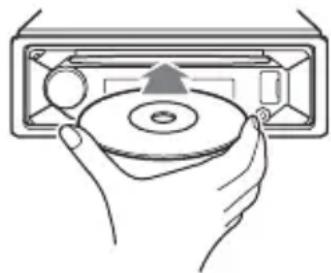
1 Insert the disc (label side up).
natural_image
Hand holding a CD inside a device casing, showing an open lid and arrow indicating rotation (no text or symbols)Playback starts automatically.
Playing a USB Device
In these Operating Instructions, "iPod" is used as a general reference for the iPod functions on an iPod and iPhone, unless otherwise specified by the text or illustrations.
For details on the compatibility of your iPod, see "About iPod" (page 23) or visit the support site on the back cover.
AOA (Android Open Accessory) 2.0, MSC (Mass Storage Class) and MTP (Media Transfer Protocol) type USB devices* compliant with the USB standard can be used. Depending on the USB device, the Android mode or MSC/MTP mode can be selected on the unit.
Some digital media players or Android smartphones may require setting to MTP mode.
* e.g., a USB flash drive, digital media player, Android smartphone
Notes
- For details on the compatibility of your USB device, visit the support site on the back cover.
- Smartphones with Android OS 4.1 or higher installed support Android Open Accessory 2.0 (AOA 2.0). However, some smartphones may not fully support AOA 2.0 even if Android OS 4.1 or higher is installed.
For details on the compatibility of your Android smartphone, visit the support site on the back cover.
- Playback of the following files is not supported. MP3/WMA/AAC/FLAC:
- copyright-protected files
- DRM (Digital Rights Management) files
- Multi-channel audio files
MP3/WMA/AAC: - lossless compression files
Before making a connection, select the USB mode (Android mode or MSC/MTP mode) depending on the USB device (page 19).
1 Connect a USB device to the USB port (page 10).
Playback starts.
If a device is already connected, to start playback, press SRC to select [USB] ([IPD] appears in the display when the iPod is recognized).
2 Adjust the volume on this unit.
To stop playback
Press and hold OFF for 1 second.
To remove the device
Stop playback, then remove the device.
Caution for iPhone
When you connect an iPhone via USB, phone call volume is controlled by the iPhone, not the unit. Do not inadvertently increase the volume on the unit during a call, as a sudden loud sound may result when the call ends.
Playing a BLUETOOTH Device
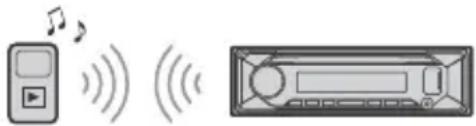
You can play contents on a connected device that supports BLUETOOTH A2DP (Advanced Audio Distribution Profile).
natural_image
Illustration of a vinyl record and audio device with sound waves (no text or symbols)1 Make BLUETOOTH connection with the audio device (page 8).
To select the audio device, press MENU, then select [BLUETOOTH] → [SET AUDIODEV] (page 21).
2 Press SRC to select [BT AUDIO].
3 Operate the audio device to start playback.
4 Adjust the volume on this unit.
Notes
- Depending on the audio device, information such as title, track number/time and playback status may not be displayed on this unit.
- Even if the source is changed on this unit, playback of the audio device does not stop.
- [BT AUDIO] does not appear in the display while running the "Sony | Music Center" application via the BLUETOOTH function.
To match the volume level of the BLUETOOTH device to other sources
Start playback of the BLUETOOTH audio device at a moderate volume, and set your usual listening volume on the unit.
Press MENU, then select [SOUND] → [SET BTA VOL] (page 20).
Searching and Playing Tracks
Repeat play and shuffle play
Not available when a USB device in Android mode is connected.
1 During playback, press (repeat) or 📋 (shuffle) repeatedly to select the desired play mode.
Playback in the selected play mode may take time to start.
Available play modes differ depending on the selected sound source.
Searching a track by name ("Quick-BrowZer™")
Not available when a USB device in Android mode or iPod is connected.
1 During CD or USB playback, press (browse)* to display the list of search categories.
When the track list appears, press (back) repeatedly to display the desired search category.
* During USB playback, press (browse) for more than 2 seconds to directly return to the beginning of the category list.
2 Rotate the control dial to select the desired search category, then press it to confirm.
3 Repeat step 2 to search the desired track.
Playback starts.
To exit the "Quick-BrowZer" mode
Press Q (browse).
Searching by skipping items (Jump mode)
Not available when a USB device in Android mode or iPod is connected.
1 During CD or USB playback, press (browse).
2 Press ▶▶▶I (SEEK +).
3 Rotate the control dial to select the item.
The list is jumped in steps of 10% of the total number of items.
4 Press ENTER to return to the "Quick-BrowZer" mode.
The selected item appears.
5 Rotate the control dial to select the desired item, then press it.
Playback starts.
Handsfree Calling (via BLUETOOTH only)
To use a cellular phone, connect it with this unit. You can connect two cellular phones to the unit. For details, see "Preparing a BLUETOOTH Device" (page 8).

text_image
Diagram showing a smartphone, wireless signal, and CD interface with icons for phone, wireless device, and Bluetooth.Receiving a Call
1 Press CALL when a call is received with a ringtone.
The phone call starts.
Note
The ringtone and talker's voice are output from the front speakers. To select the speakers for handsfree calling, press MENU, then select [BLUETOOTH] → [SET VOICE-OUT] (page 21).
To reject the call
Press and hold OFF for 1 second.
To end the call
Press CALL again.
Making a Call
You can make a call from the phonebook or call history when a cellular phone supporting PBAP (Phone Book Access Profile) is connected.
When two cellular phones are connected to the unit, select either phone.
From the phonebook
1 Press CALL.
When two cellular phones are connected to the unit, rotate the control dial to select either phone, then press it.
2 Rotate the control dial to select [PHONE BOOK], then press it.
3 Rotate the control dial to select an initial from the initial list, then press it.
4 Rotate the control dial to select a name from the name list, then press it.
5 Rotate the control dial to select a number from the number list, then press it.
The phone call starts.
From the call history
1 Press CALL.
When two cellular phones are connected to the unit, rotate the control dial to select either phone, then press it.
2 Rotate the control dial to select [RECENT CALL], then press it.
A list of the call history appears.
3 Rotate the control dial to select a name or phone number from the call history, then press it.
The phone call starts.
By phone number input
1 Press CALL.
When two cellular phones are connected to the unit, rotate the control dial to select either phone, then press it.
2 Rotate the control dial to select [DIAL NUMBER], then press it.
3 Rotate the control dial to enter the phone number, and lastly select [ ] (space), then press ENTER*.
The phone call starts.
* To move the digital indication, press ◀◀◀ /▶▶▶ (SEEK −/+).
Note
[_] appears instead of [#] on the display.
By redial
1 Press CALL.
When two cellular phones are connected to the unit, rotate the control dial to select either phone, then press it.
2 Rotate the control dial to select [REDIAL], then press it.
The phone call starts.
By voice tags
You can make a call by saying the voice tag stored in a connected cellular phone that has a voice dialing function.
1 Press CALL.
When two cellular phones are connected to the unit, rotate the control dial to select either phone, then press it.
2 Rotate the control dial to select [VOICE DIAL], then press it.
Alternatively, press and hold VOICE for more than 2 seconds.
3 Say the voice tag stored on the cellular phone.
Your voice is recognized, and the call is made.
To cancel voice dialing
Press VOICE.
Available Operations During Call
To adjust the ringtone volume
Rotate the control dial while receiving a call.
To adjust the talker's voice volume
Rotate the control dial during a call.
To adjust the volume for the other party (Mic gain adjustment)
Press MIC.
Adjustable volume levels: [MIC-LOW], [MIC-MID], [MIC-HI].
To reduce echo and noise (Echo Canceler/Noise Canceler Mode)
Press and hold MIC.
Settable mode: [EC/NC-1], [EC/NC-2].
To switch between handsfree mode and handheld mode
During a call, press MODE to switch the phone call audio between the unit and cellular phone.
Note
Depending on the cellular phone, this operation may not be available.
Useful Functions
"Sony | Music Center" with iPhone/Android™ Smartphone
Downloading the latest version of "Sony | Music Center" application is required from the App Store for iPhone or from available on Google Play for Android smartphone.
Notes
- For your safety, follow your local traffic laws and regulations, and do not operate the application while driving.
- "Sony | Music Center" is an app for controlling Sony audio devices which are compatible with "Sony | Music Center", by your iPhone/Android smartphone.
- What you can control with "Sony | Music Center" varies depending on the connected device.
- To make use of "Sony | Music Center" features, see the details on your iPhone/Android smartphone.
- For further details on "Sony | Music Center," visit the following URL: http://www.sony.net/smcqa/
- Visit the website below and check the compatible iPhone/Android smartphone models.
For iPhone: visit the App Store For Android smartphone: visit Google Play
Establishing the "Sony | Music Center" connection
1 Make the BLUETOOTH connection with iPhone/Android smartphone (page 8).
To select the audio device, press MENU, then select [BLUETOOTH] → [SET AUDIODEV] (page 21).
2 Launch the "Sony | Music Center" application.
3 Press MENU, rotate the control dial to select [SONY APP], then press it.
Connection to iPhone/Android smartphone starts. For details on the operations on iPhone/Android smartphone, see the help of the application.
If the device number appears
Make sure that the number is displayed (e.g., 123456), then select [Yes] on the iPhone/Android smartphone.
To terminate connection
Press MENU, rotate the control dial to select [SONY APP], then press it.
Selecting the source or application
You can operate to select the desired source or application on iPhone/Android smartphone.
To select the source
Press SRC repeatedly. Alternatively, press SRC, rotate the control dial to select the desired source, then press ENTER.
To display the source list
Press SRC.
Announcement of SMS by voice guide (Android smartphone only)
Messages of SMS are automatically read out through the car speakers when they are received.
For details on settings, refer to the help of the application.
Replying a message of SMS (Android smartphone only)
You can reply a message by touching the reply icon.
1 Activate the "Sony | Music Center" application, then touch the [Reply] (reply) icon.
The message input display appears on the "Sony | Music Center" application.
2 Input a reply message by voice recognition. The list of message candidates appears on the "Sony | Music Center" application.
3 Rotate the control dial to select the desired message, then press it. The message is sent out.
Making sound and display settings
You can adjust the settings relating to sound and display via iPhone/Android smartphone.
For details on settings, refer to the help of the application.
Using Voice Recognition (Android Smartphone only)
1 Press and hold VOICE to activate voice recognition.
2 Say the desired voice command into the microphone.
To deactivate voice recognition
Press VOICE.
Notes
• Voice recognition may not be available in some cases.
- Voice recognition may not work properly depending on the performance of the connected Android smartphone.
- Operate under conditions where noise such as engine sound is minimized during voice recognition.
Using "Siri Eyes Free"
"Siri Eyes Free" allows you to use an iPhone handsfree by simply speaking into the microphone. This function requires you to connect an iPhone to the unit via BLUETOOTH. Availability is limited to iPhone 4s or later. Make sure that your iPhone is running the latest iOS version.
You must complete BLUETOOTH registration and connection configurations for the iPhone with the unit in advance. For details, see "Preparing a BLUETOOTH Device" (page 8). To select the iPhone, press MENU, then select [BLUETOOTH] → [SET AUDIODEV] (page 21).
1 Activate the Siri function on the iPhone.
For details, refer to the operating instructions supplied with the iPhone.
2 Press and hold VOICE for more than 2 seconds.
The voice command display appears.
3 After the iPhone beeps, speak into the microphone.
The iPhone beeps again, then Siri starts responding.
To deactivate "Siri Eyes Free"
Press VOICE.
Notes
- The iPhone may not recognize your voice depending on usage conditions. (For example, if you are in a moving car.)
- "Siri Eyes Free" may not function properly, or the response time may lag in locations where iPhone signals are difficult to receive.
- Depending on the iPhone's operating condition, "Siri Eyes Free" may not function properly, or may quit.
- If you play a track with an iPhone using the BLUETOOTH audio connection, when the track starts playback via BLUETOOTH, "Siri Eyes Free" automatically quits and the unit switches to the BLUETOOTH audio source.
- When "Siri Eyes Free" is activated during audio playback, the unit may switch to the BLUETOOTH audio source even if you do not specify a track to play.
- When connecting the iPhone to the USB port, "Siri Eyes Free" may not function properly, or may quit.
- When connecting the iPhone to the unit via USB, do not activate Siri with the iPhone. "Siri Eyes Free" may not function properly, or may quit.
- There is no audio sound while "Siri Eyes Free" is activated.
Settings
Canceling the DEMO Mode
You can cancel the demonstration display which appears when the source is off and the clock is displayed.
1 Press MENU, rotate the control dial to select [GENERAL], then press it.
2 Rotate the control dial to select [SET DEMO], then press it.
3 Rotate the control dial to select [SET DEMO-OFF], then press it.
The setting is complete.
4 Press (back) twice.
The display returns to normal reception/play mode.
Basic Setting Operation
You can set items in the following setup categories:
General setup (GENERAL), Sound setup (SOUND), Display setup (DISPLAY), BLUETOOTH setup (BLUETOOTH), "Sony | Music Center" setup (SONY APP)
1 Press MENU.
2 Rotate the control dial to select the setup category, then press it.
The items that can be set differ depending on the source and settings.
3 Rotate the control dial to select the options, then press it.
To return to the previous display
Press ↩ (back).
General Setup (GENERAL)
AREA (area)
Specifies the area/region to use this unit: [EUROPE], [RUSSIA].
If the area/region currently set is changed, this unit is reset, then the clock is displayed.
(Available only while the source is off and the clock is displayed.)
DEMO (demonstration)
Activates the demonstration: [ON], [OFF].
CLOCK (clock) (page 7)
Sets the clock: [AUTO
CAUT ALM (caution alarm)
Activates the caution alarm: [ON], [OFF] (page 7).
(Available only while the source is off and the clock is displayed.)
BEEP (beep)
Activates the beep sound: [ON], [OFF].
AUTO OFF (auto off)
Shuts off automatically after a certain time when the unit is turned off and the clock is displayed (i.e. press and hold OFF for 1 second): [ON] (30 minutes), [OFF].
STEERING (steering)
Registers/resets the setting of the steering wheel remote control.
(Available only while the source is off and the clock is displayed.)
STR CONTROL (steering control)
Selects the input mode of the connected remote control. To prevent a malfunction, be sure to match the input mode with the connected remote control before use.
CUSTOM (custom)
Input mode for the steering wheel remote control
PRESET (preset)
Input mode for the wired remote control excluding the steering wheel remote control
(Automatically selected when [RESET CUSTOM] is performed.)
EDIT CUSTOM (edit custom)
Registers the functions (SOURCE, ATT, VOL +/-, SEEK +/-, VOICE, ON HOOK, OFF HOOK) to the steering wheel remote control:
1 Rotate the control dial to select the function you want to assign to the steering wheel remote control, then press it.
2 While [REGISTER] is blinking, press and hold the button on the steering wheel remote control you want to assign the function to. When registration is complete, [REGISTERED] is displayed.
③ To register other functions, repeat steps ① and ②.
(Available only when [STR CONTROL] is set to [CUSTOM].)
RESET CUSTOM (reset custom)
Resets the registered functions of the steering wheel remote control: [YES], [NO].
(Available only when [STR CONTROL] is set to [CUSTOM].)
Notes
- While making settings, only button operation on the unit is available. For safety, park your car before making this setting.
- If an error occurs while registering, all the previously-registered information remains. Restart registration from the function where the error occurred.
- This function may not be available on some vehicles. For details on the compatibility of your vehicle, visit the support site on the back cover.
USB MODE (USB mode)
Changes the USB mode: [ANDROID], [MSC/MTP].
(Available only when the USB source is selected.)
AF/TA (alternative frequencies/traffic announcement)
Selects the alternative frequencies (AF) and traffic announcement (TA) setting: [AF-ON], [TA-ON], [AF/TA-ON], [AF/TA-OFF].
(Available when any source is selected.)
REGIONAL (regional)
Restricts reception to a specific region: [ON], [OFF].
(Available only when FM is received.)
BTM (best tuning memory) (page 11) (Available only when the tuner is selected.)
FIRMWARE (firmware)
(Available only while the source is off and the clock is displayed.)
Checks/updates the firmware version. For details, visit the support site on the back cover.
FW VERSION (firmware version)
Displays current firmware version.
FW UPDATE (firmware update)
Enters firmware update process: [YES], [NO].
Updating the firmware takes a few minutes to complete. During the update, do not turn the ignition to the OFF position, nor remove the USB device.
Sound Setup (SOUND)
This setup menu is not available when the source is off and the clock is displayed.
EQ10 PRESET (EQ10 preset)
Selects an equalizer curve from 10 equalizer curves or off:
[OFF], [R&B], [ROCK], [POP], [HIP-HOP], [EDM], [JAZZ], [SOUL], [COUNTRY], [KARAOKE]*, [CUSTOM].
The equalizer curve setting can be memorized for each source.
* [KARAOKE] reduces the vocal sound but cannot fully remove it during playback. Also, using a microphone is not supported.
EQ10 CUSTOM (EQ10 custom)
Sets [CUSTOM] of EQ10.
Setting the equalizer curve: [BAND1] – [BAND10] (32 Hz, 63 Hz, 125 Hz, 250 Hz, 500 Hz, 1 kHz, 2 kHz, 4 kHz, 8 kHz, 16 kHz).
The volume level is adjustable in 1 dB steps, from -6 dB to +6 dB.
BALANCE (balance)
Adjusts the sound balance: [RIGHT-15] - [CENTER] - [LEFT-15].
FADER (fader)
Adjusts the relative level: [FRONT-15] - [CENTER] - [REAR-15].
([ATT] is displayed at the lowest setting.)
Selects the subwoofer phase: [SUB NORM], [SUB REV].
LPF FREQ (low pass filter frequency)
Selects the subwoofer cut-off frequency: [80Hz], [100Hz], [120Hz].
HPF FREQ (high pass filter frequency)
Selects the front/rear speaker cut-off frequency: [OFF], [80Hz], [100Hz], [120Hz].
AUX VOL (AUX volume)
Adjusts the volume level for each connected auxiliary device:
[+18dB] - [0dB] - [-8dB].
This setting negates the need to adjust the volume level between sources.
(Available only when the AUX is selected.)
BTA VOL (BLUETOOTH audio volume)
Adjusts the volume level for each connected BLUETOOTH device: [+6 dB] - [0 dB] - [-6 dB].
This setting negates the need to adjust the volume level between sources.
(Available only when the BT audio or application is selected.)
Display Setup (DISPLAY)
DIMMER (dimmer)
Change the display brightness:
For MEX-N5300BT:
[OFF], [ON], [AT] (auto), [CLK] (clock).
([AT] is available only when the illumination control lead is connected, and the head light is turned on.)
For MEX-N4300BT:
[OFF], [ON], [CLK] (clock).
To set this function to be active only during a fixed period, select [CLK], then set the start and end times.
- To set the brightness when the dimmer function is activated:
Set [DIMMER] to [ON], then adjust [BRIGHTNESS].
- To set the brightness when the dimmer function is deactivated:
Set [DIMMER] to [OFF], then adjust [BRIGHTNESS].
The brightness setting is stored and applied when the dimmer function is activated or deactivated.
BRIGHTNESS (brightness)
Adjusts the display brightness. The brightness level is adjustable: [1] - [10].
BUTTON-C (button color) (MEX-N5300BT only)
Sets a preset color or customized color for the buttons.
COLOR (color)
Selects from 15 presets colors, 1 customized color.
CUSTOM-C (custom color)
Registers a customized color for the buttons.
RGB RED, RGB GRN, RGB BLUE
Adjustable color range: [0] - [32] ([0]
cannot be set for all color ranges).
DSPL-C (display color) (MEX-N5300BT only)
Sets a preset color or customized color for the display.
COLOR (color)
Selects from 15 presets colors, 1 customized color.
CUSTOM-C (custom color)
Registers a customized color for the display.
RGB RED, RGB GRN, RGB BLUE
Adjustable color range: [0] - [32] ([0]
cannot be set for all color ranges).
SND SYNC (sound synchronization)
Activates the synchronization of the illumination with the sound: [ON], [OFF]. (Not available when no source is selected and the clock is displayed.)
AUTO SCR (auto scroll)
Scrolls long items automatically: [ON], [OFF].
(Not available when the AUX or tuner is selected.)
BLUETOOTH Setup (BLUETOOTH)
PAIRING (pairing) (page 8)
Connects up to two BLUETOOTH devices: [DEVICE 1], [DEVICE 2].
[DEVICE 1] or [DEVICE 2] will be changed to the paired device name after pairing is complete.
AUDIODEV (audio device)
Selects the audio device.
[*] appears on the device paired with [DEVICE 1] or the current A2DP compatible audio device.
RINGTONE (ringtone)
Selects whether this unit or the connected cellular phone outputs the ringtone: [1] (this unit), [2] (cellular phone).
AUTO ANS (auto answer)
Sets this unit to answer an incoming call automatically: [OFF], [1] (about 3 seconds), [2] (about 10 seconds).
AUTOPAIR (auto pairing)
Starts BLUETOOTH pairing automatically when iOS device version 5.0 or later is connected via USB: [ON], [OFF].
BT SIGNL (BLUETOOTH signal) (page 9)
Activates/deactivates the BLUETOOTH function.
BT INIT (BLUETOOTH initialize)
Initializes all the BLUETOOTH related settings (pairing information, device information, etc.): [YES], [NO].
When disposing the unit, initialize all the settings.
(Available only while the source is off and the clock is displayed.)
VOICE-OUT (voice output)
Selects the speakers for handsfree calling: [VOICE FRONT] (front speakers), [VOICE REAR] (rear speakers), [VOICE ALL] (all speakers).
(Available only while the source is off and the clock is displayed.)
"Sony | Music Center" Setup (SONY APP)
Establish and terminate "Sony | Music Center" function (connection).
Additional Information
Updating the Firmware
To update the firmware, visit the support site on the back cover, then follow the online instructions.
Note
During the update, do not remove the USB device.
Precautions
- Do not leave the front panel or audio devices on the dashboard.
- When the unit is turned on, the power antenna (aerial) extends automatically.
- Do not splash liquid onto the unit.
Moisture condensation
Do not splash liquid onto the discs. When moisture condensation occur inside the unit, remove the disc and wait for about an hour for it to dry out; otherwise the unit will not operate properly.
Notes on discs
- Do not expose discs to direct sunlight or heat sources such as hot air ducts, nor leave it in a car parked in direct sunlight.
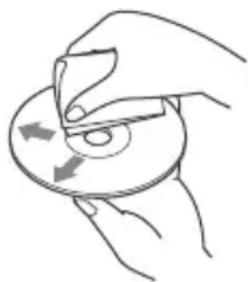
- Wipe the discs with a cleaning cloth from the center out. Do not use solvents such as benzine, thinner, commercially available cleaners.
- This unit is designed to play discs that conform to the Compact Disc (CD) standard. DualDiscs and some of the music discs encoded with copyright protection technologies do not conform to the Compact Disc (CD) standard, therefore, these discs may not be playable by this unit.
natural_image
Illustration of a hand holding a CD or DVD disc with arrows indicating direction (no text or symbols)• Discs that this unit CANNOT play
- Discs with labels, stickers, or sticky tape or paper attached. Doing so may cause a malfunction, or may ruin the disc.
- Discs with non-standard shapes (e.g., heart, square, star). Attempting to do so may damage the unit.
- 8 cm (B4 in) discs.
Notes on CD-R/CD-RW discs
- If the multi-session disc begins with a CD-DA session, it is recognized as a CD-DA disc, and other sessions are not played.
• Discs that this unit CANNOT play - CD-R/CD-RW of poor recording quality.
- CD-R/CD-RW recorded with an incompatible recording device.
- CD-R/CD-RW which is finalized incorrectly.
- CD-R/CD-RW other than those recorded in music CD format or MP3 format conforming to ISO9660 Level 1/Level 2, Joliet/Romeo or multi-session.
Playback order of audio files
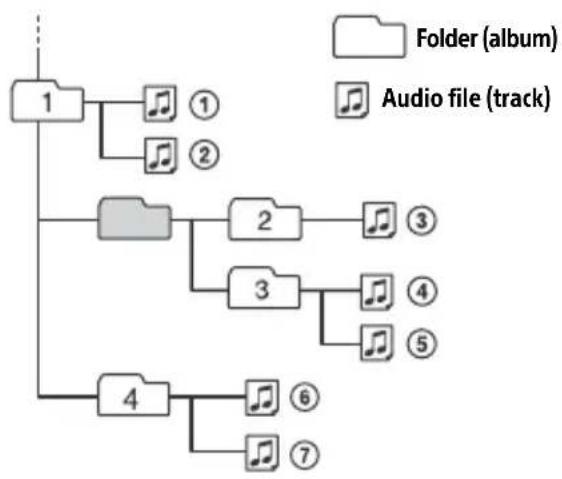
flowchart
graph TD
    A["1"] --> B["①"]
    A --> C["②"]
    A --> D["③"]
    A --> E["④"]
    A --> F["⑤"]
    A --> G["⑥"]
    A --> H["⑦"]
    B --> I["Folder (album)"]
    C --> J["Audio file (track)"]
    D --> K["2"]
    E --> L["3"]
    F --> M["4"]
    G --> N["5"]
    H --> O["6"]
About iPod
- You can connect to the following iPod models. Update your iPod devices to the latest software before use.
Compatible iPhone/iPod models
| Compatible Model | Bluetooth® | USB |
| iPhone X √ | √ | |
| iPhone 8 √ | √ | |
| iPhone 8 Plus √ | √ | |
| iPhone 7 √ | √ | |
| iPhone 7 Plus √ | √ | |
| iPhone SE √ | √ | |
| iPhone 6s √ | √ | |
| iPhone 6s Plus √ | √ | |
| iPhone 6 √ | √ | |
| iPhone 6 Plus √ | √ | |
| iPhone 5s √ | √ | |
| iPhone 5c √ | √ | |
| iPhone 5 √ | √ | |
| iPhone 4s √ | √ | |
| iPod touch (6th generation) | √ | √ |
| iPod touch (5th generation) | √ | √ |
| iPod nano (7th generation) | √ |
- Use of the Made for Apple badge means that an accessory has been designed to connect specifically to the Apple product(s) identified in the badge, and has been certified by the developer to meet Apple performance standards. Apple is not responsible for the operation of this device or its compliance with safety and regulatory standards.
Please note that the use of this accessory with an Apple product may affect wireless performance.
If you have any questions or problems concerning your unit that are not covered in this manual, consult your nearest Sony dealer.
Maintenance
Cleaning the connectors
Avoid touching the connectors directly. The unit may not function properly if the connectors between the unit and the front panel are not clean. In order to prevent this, detach the front panel (page 7) and clean the connectors with a cotton swab. Do not apply too much force. Otherwise, the connectors may be damaged.
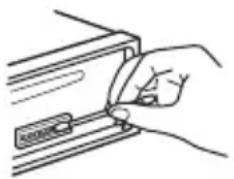
natural_image
Line drawing of a hand inserting a small object into a device (no text or symbols)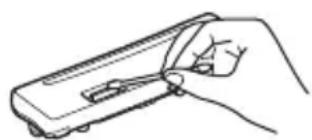
natural_image
Line drawing of a hand holding a small object, possibly a tool or device (no text or symbols present)Note
For safety, do not remove the front panel while driving.
Specifications
Tuner section
FM
Tuning range:
When [AREA] is set to [EUROPE]:
87.5 MHz - 108.0 MHz
When [AREA] is set to [RUSSIA]:
FM1/FM2: 87.5 MHz – 108.0 MHz (at 50 kHz step)
FM3: 65 MHz – 74 MHz (at 30 kHz step)
Usable sensitivity: 7 dBf
Signal-to-noise ratio: 73 dB
Separation: 50 dB at 1 kHz
MW/LW
Tuning range:
531 kHz - 1,602 kHz (MW),
153 kHz - 279 kHz (LW)
Sensitivity: MW: 26 μV, LW: 50 μV
CD Player section
Signal-to-noise ratio: 95 dB
Frequency response: 20 Hz – 20,000 Hz
Maximum number ^*1 of:
Folders (albums)*2: 150
Files (tracks) and folders*3: 300
Displayable characters for a folder/file name:
32 (Joliet)/64 (Romeo)
Corresponding codec: MP3 (.mp3), WMA
(.wma), AAC (.m4a)
*1 CD-R/CD-RW only
*2 including the root folder
*3 may be less than the measured value if folder/file names contain many characters
USB Player section
Interface: USB (Full speed)
Maximum current: 1 A
Maximum number of recognizable folders and files:
Folders (albums): 256
Files (tracks) per folder: 256
Compatible Android Open Accessory
protocol (AOA): 2.0
Corresponding codec:
MP3 (.mp3)
Bit rate: 8 kbps – 320 kbps (Supports VBR (Variable Bit Rate))
Sampling rate: 16 kHz – 48 kHz
WMA (.wma)
Bit rate: 32 kbps – 192 kbps (Supports VBR (Variable Bit Rate))
Sampling rate: 32 kHz, 44.1 kHz, 48 kHz
AAC (.m4a, .mp4)
Bit rate: 16 kbps - 320 kbps (stereo)
Sampling rate: 8 kHz – 48 kHz
FLAC (.flac)
Bit depth: 16 bit, 24 bit
Sampling rate: 44.1 kHz, 48 kHz
Supported file system: FAT16, FAT32
Wireless Communication
Communication System:
BLUETOOTH Standard version 3.0
Output:
BLUETOOTH Standard Power Class 2
(Max. Conducted +1 dBm)
Maximum communication range*1: Line of sight approx. 10 m (33 ft)
Frequency band:
2.4 GHz band
(2.4000 GHz - 2.4835 GHz)
Modulation method: FHSS
Compatible BLUETOOTH Profiles ^2 :
A2DP (Advanced Audio Distribution Profile) 1.3
AVRCP (Audio Video Remote Control Profile) 1.3
HFP (Handsfree Profile) 1.6
PBAP (Phone Book Access Profile)
SPP (Serial Port Profile)
Corresponding codec:
SBC (.sbc), AAC (.m4a)
*1 The actual range will vary depending on factors such as obstacles between devices, magnetic fields around a microwave oven, static electricity, reception sensitivity, antenna (aerial)'s performance, operating system, software application, etc.
*2 BLUETOOTH standard profiles indicate the purpose of BLUETOOTH communication between devices.
NFC Communication
Frequency band: 13.56 MHz
Power amplifier section
Output: Speaker outputs
Speaker impedance: 4 Ω - 8 Ω
Maximum power output: 55 W × 4 (at 4 Ω)
General
Power requirements: 12 V DC car battery (negative ground (earth))
Rated current consumption: 10 A
Dimensions:
Approx. 178 mm × 50 mm × 176 mm
(7 1/8 in × 2 in × 7 in) (w/h/d)
Mounting dimensions:
Approx. 182 mm × 53 mm × 159 mm
(7 1/4 in × 2 1/8 in × 6 3/8 in) (w/h/d)
Mass: Approx. 1.2 kg (2 lb 11 oz)
Package contents:
Main unit (1)
Microphone (1) (MEX-N5300BT only)
Parts for installation and connections (1 set)
Optional accessories/equipment:
Microphone: XA-MC10 (MEX-N4300BT only)
Ask the dealer for detailed information.
Design and specifications are subject to change without notice.
Copyrights
The Bluetooth ^® word mark and logos are registered trademarks owned by the Bluetooth SIG, Inc. and any use of such marks by Sony Corporation is under license. Other trademarks and trade names are those of their respective owners.
The N-Mark is a trademark or registered trademark of NFC Forum, Inc. in the United States and in other countries.
Windows Media is either a registered trademark or trademark of Microsoft Corporation in the United States and/or other countries.
This product is protected by certain intellectual property rights of Microsoft Corporation. Use or distribution of such technology outside of this product is prohibited without a license from Microsoft or an authorized Microsoft subsidiary.
Apple, iPhone, iPod, iPod nano, iPod touch, and Siri are trademarks of Apple Inc., registered in the U.S. and other countries. App Store is a service mark of Apple Inc.
IOS is a trademark or registered trademark of Cisco in the U.S. and other countries and is used under license.
Google, Google Play and Android are trademarks of Google LLC.
libFLAC
Copyright (C) 2000-2009 Josh Coalson Copyright (C) 2011-2013 Xiph.Org Foundation
Redistribution and use in source and binary forms, with or without modification, are permitted provided that the following conditions are met:
- Redistributions of source code must retain the above copyright notice, this list of conditions and the following disclaimer.
- Redistributions in binary form must reproduce the above copyright notice, this list of conditions and the following disclaimer in the documentation and/or other materials provided with the distribution.
- Neither the name of the Xiph.org Foundation nor the names of its contributors may be used to endorse or promote products derived from this software without specific prior written permission.
THIS SOFTWARE IS PROVIDED BY THE COPYRIGHT HOLDERS AND CONTRIBUTORS "AS IS" AND ANY EXPRESS OR IMPLIED WARRANTIES, INCLUDING, BUT NOT LIMITED TO, THE IMPLIED WARRANTIES OF MERCHANTABILITY AND FITNESS FOR A PARTICULAR PURPOSE ARE DISCLAIMED. IN NO EVENT SHALL THE FOUNDATION OR CONTRIBUTORS BE LIABLE FOR ANY DIRECT, INDIRECT, INCIDENTAL, SPECIAL, EXEMPLARY, OR CONSEQUENTIAL DAMAGES (INCLUDING, BUT NOT LIMITED TO, PROCUREMENT OF SUBSTITUTE GOODS OR SERVICES; LOSS OF USE, DATA, OR PROFITS; OR BUSINESS INTERRUPTION) HOWEVER CAUSED AND ON ANY THEORY OF LIABILITY, WHETHER IN CONTRACT, STRICT LIABILITY, OR TORT (INCLUDING NEGLIGENCE OR OTHERWISE) ARISING IN ANY WAY OUT OF THE USE OF THIS SOFTWARE, EVEN IF ADVISED OF THE POSSIBILITY OF SUCH DAMAGE.
Troubleshooting
The following checklist will help you remedy problems you may encounter with your unit. Before going through the checklist below, check the connection and operating procedures.
For details on using the fuse and removing the unit from the dashboard, see "Connection/Installation" (page 33).
If the problem is not solved, visit the support site on the back cover.
General
No sound or the sound is very low.
→ The position of the fader control [FADER] is not set for a 2-speaker system.
→ The volume of the unit and/or connected device is very low.
- Increase the volume of the unit and connected device.
No beep sound.
→ An optional power amplifier is connected and you are not using the built-in amplifier.
Stored stations and correct time are erased.
The fuse has blown.
Makes a noise when the position of the ignition is switched.
→ The leads are not matched correctly with the car's accessory power connector.
During playback or reception, the demonstration mode starts.
→ If no operation is performed for 5 minutes with [DEMO-ON] set, the demonstration mode starts. – Set [DEMO-OFF] (page 19).
The display disappears from/does not appear in the display window.
→ The connectors are dirty (page 24).
The display/illumination flashes.
→ The power supply is not sufficient. - Check that the car battery supplies enough power to the unit. (The power requirement is 12 V DC.)
The operation buttons do not function. The disc will not eject.
→ The connection is not correct.
- Press DSPL and CALL for more than 2 seconds to reset the unit. The contents stored in memory are erased.
The clock set automatically is not accurate.
→ The clock data on radio waves is not accurate.
- Set the clock manually (page 7).
Radio reception
The radio reception is poor.
Static noise occurs.
→ Connect the antenna (aerial) firmly.
65 MHz to 74 MHz in FM3 cannot be tuned in.
→ [AREA] is set to [EUROPE]. - Set [AREA] to [RUSSIA] (page 19).
RDS
RDS services cannot be received (when [AREA] is set to [RUSSIA]).
→ FM3 is selected.
- Select FM1 or FM2.
→ RDS services are unavailable in the current region.
The SEEK starts after a few seconds of listening.
→ The station is non-TP or has weak signal. – Deactivate TA (page 11).
No traffic announcements.
→ Activate TA (page 11).
→ The station does not broadcast any traffic announcements despite being TP.
- Tune in another station.
PTY displays [----].
→ The current station is not an RDS station, or the radio reception is poor.
Program service name flashes.
→ There is no alternative frequency for the current station.
- Press ◀◀◀/▶▶▶ (SEEK −/+ ) while the program service name is flashing. [PI SEEK] appears and the unit starts searching for another frequency with the same PI (program identification) data.
CD playback
The disc does not play.
→ Defective or dirty disc.
→ The CD-R/CD-RW is not for audio use (page 23).
MP3/WMA/AAC files cannot be played.
→ The disc is incompatible with the MP3/WMA/AAC format and version. For details on playable discs and formats, visit the support site on the back cover.
MP3/WMA/AAC files take longer to play than others.
→ The following discs take a longer time to start playback.
- A disc recorded with a complicated tree structure.
- A disc recorded in Multi Session.
– A disc to which data can be added.
USB device playback
A USB device takes longer to play.
→ The USB device contains files with a complicated tree structure.
The audio file cannot be played.
→ For details on supported formats, see "Specifications" (page 24). If the audio file still cannot be played, refer to the operating instructions supplied with the USB device, or contact the manufacturer of the USB device.
Operations for skipping an album, skipping items (Jump mode), and searching a track by name ("Quick-BrowZer") cannot be performed.
→ Set [USB MODE] to [MSC/MTP] (page 19).
The sound cannot be output during playback in Android mode.
→ Check the status of the audio playback application on the Android smartphone.
NFC function (MEX-N5300BT only)
One-touch connection (NFC) is not possible.
→ If the smartphone does not respond to the touching.
- Check that the NFC function of the smartphone is turned on.
- Move the N-Mark part of the smartphone closer to the N-Mark part on this unit.
- If the smartphone is in a case, remove it.
→ NFC receiving sensitivity depends on the device.
If One-touch connection with the smartphone fails several times, make BLUETOOTH connection manually.
BLUETOOTH function
The connecting device cannot detect this unit.
→ Before the pairing is made, set this unit to pairing standby mode.
→ While connected to two BLUETOOTH devices, this unit cannot be detected from another device.
- Disconnect either connection and search for this unit from another device.
→ When the device pairing is made, set the BLUETOOTH signal output to on (page 9).
Connection is not possible.
→ The connection is controlled from one side (this unit or BLUETOOTH device), but not both.
- Connect to this unit from a BLUETOOTH device or vice versa.
The name of the detected device does not appear.
→ Depending on the status of the other device, it may not be possible to obtain the name.
No ringtone.
→ Adjust the volume by rotating the control dial while receiving a call.
→ Depending on the connecting device, the ringtone may not be sent properly.
- Set [RINGTONE] to [1] (page 21).
→ The speakers are not connected to the unit.
- Connect the speakers to the unit. To select the speakers for ringtone, press MENU, then select [BLUETOOTH] → [SET VOICE-OUT] (page 21).
The talker's voice cannot be heard.
→ The speakers are not connected to the unit.
- Connect the speakers to the unit. To select the speakers for talker's voice, press MENU, then select [BLUETOOTH] → [SET VOICE-OUT] (page 21).
A call partner says that the volume is too low or high.
→ Adjust the volume accordingly using Mic gain adjustment (page 15).
Echo or noise occurs in phone call conversations.
→ Lower the volume.
→ Set EC/NC Mode to [EC/NC-1] or [EC/NC-2] (page 16).
→ If the ambient noise other than the phone call sound is loud, try reducing this noise. E.g.: If a window is open and road noise, etc., is loud, shut the window. If an air conditioner is loud, lower the air conditioner.
The phone is not connected.
→ When BLUETOOTH audio is played, the phone is not connected even if you press CALL.
- Connect from the phone.
The phone sound quality is poor.
→ Phone sound quality depends on reception conditions of cellular phone.
- Move your car to a place where you can enhance the cellular phone's signal if the reception is poor.
The volume of the connected audio device is low (high).
→ Volume level will differ depending on the audio device.
- Adjust the volume of the connected audio device or this unit (page 20).
The sound skips during playback of a BLUETOOTH audio device.
→ Reduce the distance between the unit and the BLUETOOTH audio device.
→ If the BLUETOOTH audio device is stored in a case which interrupts the signal, remove the audio device from the case during use.
→ Several BLUETOOTH devices or other devices which emit radio waves are in use nearby.
- Turn off the other devices.
- Increase the distance from the other devices.
→ The playback sound stops momentarily when the connection between this unit and the cellular phone is being made. This is not a malfunction.
The connected BLUETOOTH audio device cannot be controlled.
→ Check that the connected BLUETOOTH audio device supports AVRCP.
Some functions do not work.
→ Check if the connecting device supports the functions in question.
A call is answered unintentionally.
→ The connecting phone is set to answer a call automatically.
Pairing failed due to a timeout.
→ Depending on the connecting device, the time limit for pairing may be short.
- Try completing the pairing within the time.
Cannot pair.
→ The unit may not be able to pair with a previously paired BLUETOOTH device after initializing the unit if the pairing information of the unit is on the BLUETOOTH device. In this case, delete the pairing information of the unit from the BLUETOOTH device, and then pair them again.
BLUETOOTH function cannot operate.
→ Turn off the unit by pressing OFF for more than 2 seconds, then turn the unit on again.
No sound is output from the car speakers during handsfree call.
→ If the sound is output from the cellular phone, set the cellular phone to output the sound from the car speakers.
"Siri Eyes Free" is not activated.
→ Perform the handsfree registration for an iPhone that supports "Siri Eyes Free".
→ Set the Siri function on the iPhone to on.
→ Cancel the BLUETOOTH connection with the iPhone and the unit, and reconnect.
"Sony | Music Center" operation
Application name is mismatched with the actual application in "Sony | Music Center".
→ Launch the application again from the "Sony | Music Center" application.
While running the "Sony | Music Center" application via BLUETOOTH, the display automatically switches to [BT AUDIO].
→ The "Sony | Music Center" application or BLUETOOTH function has failed.
→ Run the application again.
The "Sony | Music Center" application is automatically disconnected when the display switches to [IPD].
→ The "Sony | Music Center" application on iPhone/iPod does not support iPod playback.
- Change the source of the unit to other than [IPD], then establish the "Sony | Music Center" connection (page 16).
The "Sony | Music Center" connection is automatically disconnected when the USB mode of the unit is changed to [ANDROID].
→ The Android smartphone is not supporting playback in Android mode. - Set the USB mode of the unit to [MSC/MTP], then establish the "Sony | Music Center" connection (page 16).
Messages
The following messages may appear or flash during operation.
INVALID: The selected operation could be invalid.
READ
→ Wait until reading is complete and playback starts automatically. This may take some time depending on the file organization.
_ (underscore): The character cannot be displayed.
For CD playback:
CD ERROR
→ Clean or insert the disc correctly, or make sure the disc is not blank or defective.
CD NO DISC
→ Insert a disc containing playable files (page 24).
CD NO MUSIC
→ Insert a disc containing playable files (page 24).
CD PUSH EJT: The disc could not be ejected properly.
→ Press ≧ (eject).
LLLL or : The beginning or the end of the disc has been reached.
For USB device playback:
HUB NO SUPRT: USB hubs are not supported.
IPD STOP: iPod playback has finished.
→ Operate your iPod/iPhone to start playback.
NOT SUPPORT - ANDROID MODE
→ A USB device not supporting AOA (Android Open Accessory) 2.0 is connected to the unit while [USB MODE] is set to [ANDROID]. – Set [USB MODE] to [MSC/MTP] (page 19).
USB ERROR
→ Connect the USB device again.
USB NO DEV
→ Make sure the USB device or USB cable is securely connected.
USB NO MUSIC
→ Connect a USB device containing playable files (page 24).
USB NO SUPRT
→ For details on the compatibility of your USB device, visit the support site on the back cover.
USB OVERLOAD: The USB device is overloaded.
→ Disconnect the USB device, then press SRC to select another source.
→ The USB device has a fault, or an unsupported device is connected.
For RDS operation:
NO AF: No alternative frequencies.
→ Press ◀◀◀/▶▶▶I (SEEK -/+ ) while the program service name is flashing. The unit starts searching for another frequency with the same PI (program identification) data ([PI SEEK] appears).
NO PI: No program identification. The selected station has no PI (program identification) data.
→ Select another station.
NO TP: No traffic programs.
→ The unit will continue searching for available TP stations.
For BLUETOOTH function:
BTA NO DEV: The BLUETOOTH device is not connected or recognized.
→ Make sure the BLUETOOTH device is securely connected, or the BLUETOOTH connection is established with the BLUETOOTH device.
ERROR: The selected operation could not be performed.
→ Wait for a while, then try again.
UNKNOWN: A name or phone number cannot be displayed.
WITHHELD: The phone number is hidden by the caller.
For "Sony | Music Center" operation:
APP ----: A connection with the application is not established.
→ Make the "Sony | Music Center" connection again (page 16).
APP DISCNCT: The application is disconnected.
→ Make the "Sony | Music Center" connection (page 16).
APP DISPLAY: A screen setting display of the application is open.
→ Exit the screen setting display of the application to enable button operation.
APP LIST: The contents list of the USB is open.
→ Exit the list of the application to enable button operation.
APP MENU: A setting display of the application is open.
→ Exit the setting display of the application to enable button operation.
APP NO DEV: The device with the application installed is not connected or recognized.
→ Make the BLUETOOTH connection and establish the "Sony | Music Center" connection again (page 16).
APP SOUND: A sound setting display of the application is open.
→ Exit the sound setting display of the application to enable button operation.
OPEN APP: The "Sony | Music Center" application is not running.
→ Launch the application.
For steering wheel remote control operation:
ERROR
→ Register again from the function where the error occurred (page 19).
TIMEOUT
→ Try completing the registration while [REGISTER] is blinking (about 6 seconds) (page 19).
For firmware update operation:
FILE ERROR: The updater is not stored in the USB device.
→ Store the updater in the USB device, then try again (page 22).
UPDATE ERROR - PRESS ENTER: Firmware update is not completed properly.
→ Press ENTER to clear the message, then try again.
During the update, do not turn the ignition to the OFF position, nor remove the USB device (page 22).
If these solutions do not help improve the situation, consult your nearest Sony dealer. If you take the unit to be repaired because of device playback trouble, bring the device that was used at the time the problem began.
Connection/Installation
Cautions
- Run all ground (earth) leads to a common ground (earth) point.
- Do not get the leads trapped under a screw, or caught in moving parts (e.g., seat railing).
- Before making connections, turn the car ignition off to avoid short circuits.
- Connect the power supply lead ⑥ to the unit and speakers before connecting it to the auxiliary power connector.
- Be sure to insulate any loose unconnected leads with electrical tape for safety.
Precautions
- Choose the installation location carefully so that the unit will not interfere with normal driving operations.
- Avoid installing the unit in areas subject to dust, dirt, excessive vibration, or high temperature, such as in direct sunlight or near heater ducts.
- Use only the supplied mounting hardware for a safe and secure installation.
Note on the power supply lead (yellow)
When connecting this unit in combination with other stereo components, the amperage rating of the car circuit to which the unit is connected must be higher than the sum of each component's fuse amperage rating.
Mounting angle adjustment
Adjust the mounting angle to less than 30^ .
Parts List for Installation
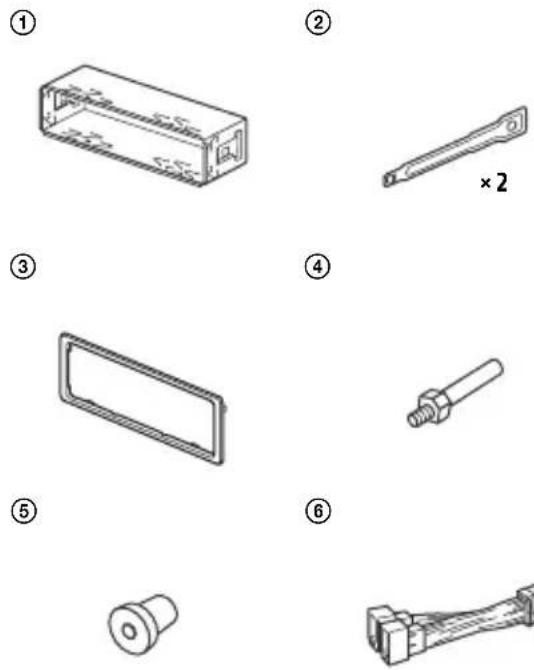
text_image
Diagram showing six labeled technical components or parts, including a rectangular housing, screwdriver, and mechanical parts.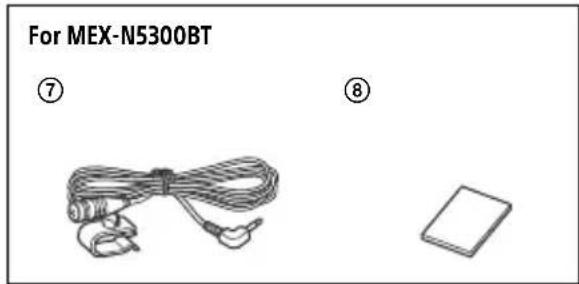
text_image
For MEX-N5300BT ⑦ ⑧- This parts list does not include all the package contents.
- The bracket ① and the protection collar ③ are attached to the unit before shipping. Before mounting the unit, use the release keys ② to remove the bracket ① from the unit. For details, see "Removing the protection collar and the bracket" (page 38).
- Keep the release keys ② for future use as they are also necessary if you remove the unit from your car.
Connection (For MEX-N5300BT)
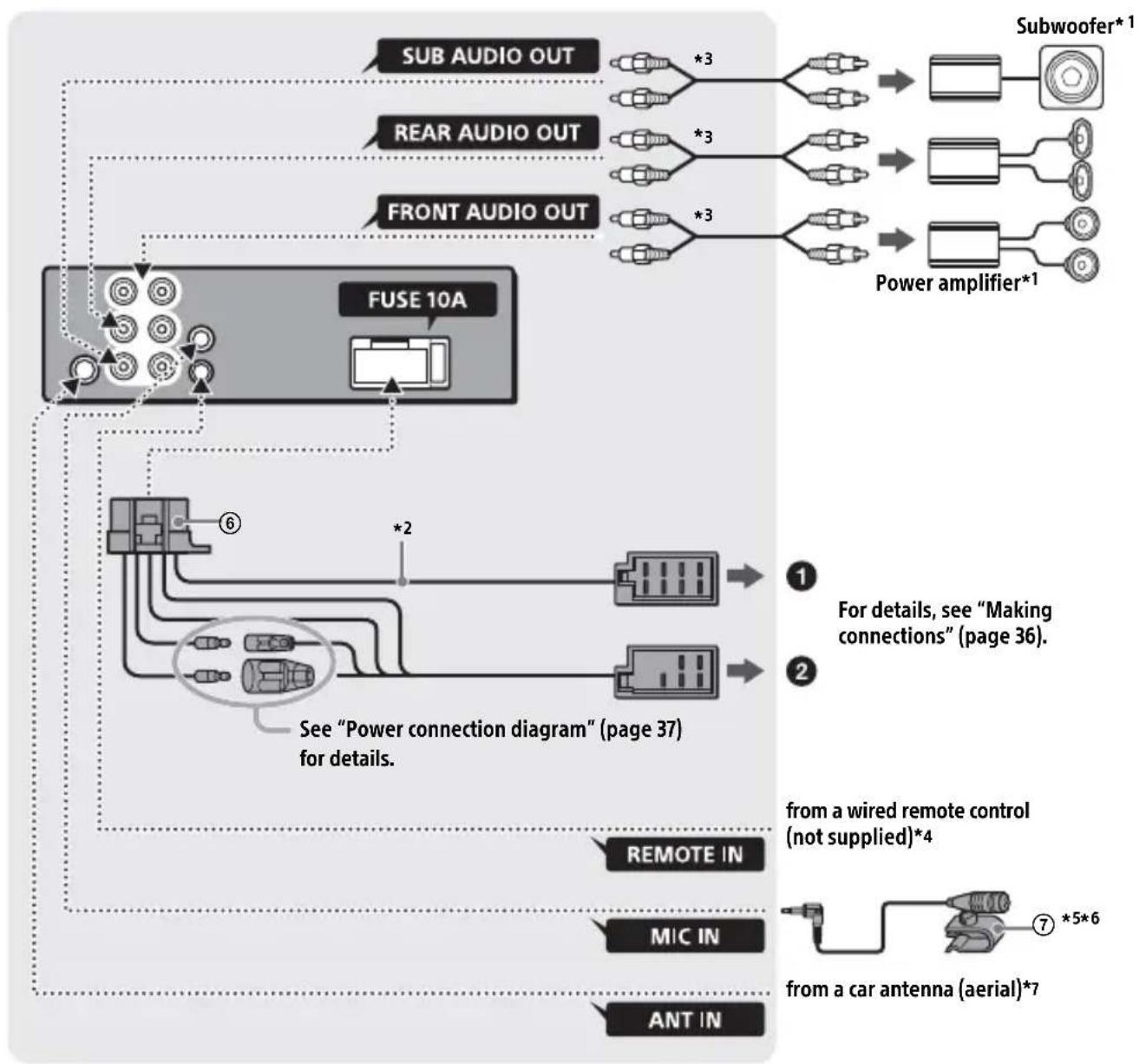
flowchart
graph TD
    A["FUSE 10A"] --> B["Sub AUDIO OUT"]
    A --> C["REAR AUDIO OUT"]
    A --> D["FRONT AUDIO OUT"]
    B --> E["*3"]
    C --> F["*3"]
    D --> G["*3"]
    E --> H["Power amplifier*1"]
    F --> H
    G --> H
    H --> I["Subwoofer*1"]
    I --> J["Page 36"]
    K["See "Power connection diagram" (page 37) for details."] --> L["① For details, see "Making connections" (page 36)."]
    K --> M["② from a wired remote control (not supplied)*4"]
    N["REMOTE IN"] --> O["⑦ *5*6"]
    P["MIC IN"] --> Q["⑦ from a car antenna (aerial)*7"]
    R["ANT IN"] --> S["⑦ from a car antenna (aerial)*7"]
Connection (For MEX-N4300BT)
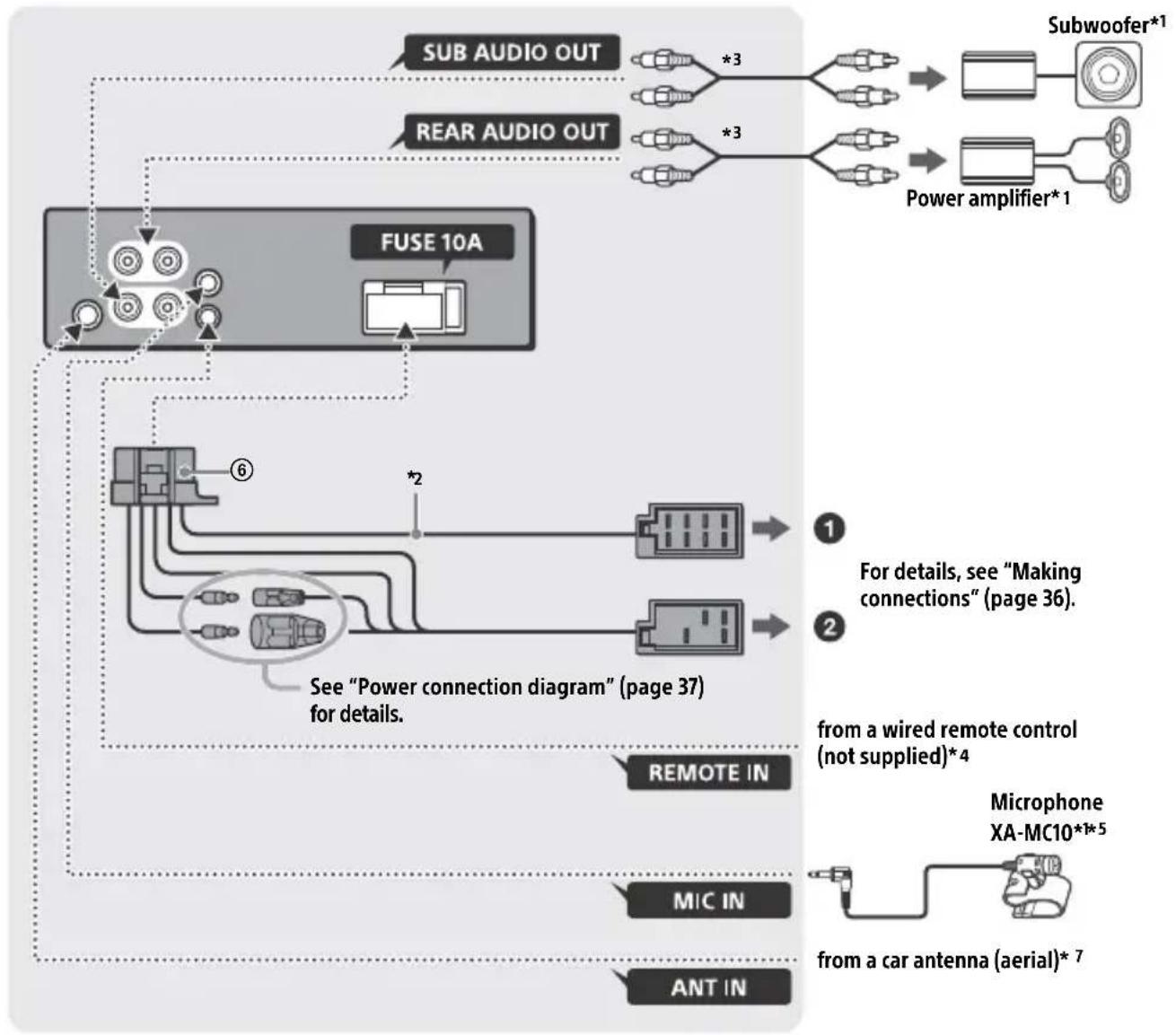
flowchart
graph TD
    A["SUB AUDIO OUT"] --> B["*3"]
    C["REAR AUDIO OUT"] --> D["*3"]
    E["FUSE 10A"] --> F["⑥"]
    G["Subwoofer*1"] --> H["Power amplifier*1"]
    I["See "Power connection diagram" (page 37) for details."] --> J["*2"]
    K["Remote IN"] --> L["①"]
    M["MIC IN"] --> N["②"]
    O["ANT IN"] --> P["③"]
    Q["Microphone XA-MC10*1*5"] --> R["④"]
    S["from a wired remote control (not supplied)*4"] --> T["⑤"]
    U["from a car antenna (aerial)*7"] --> V["⑥"]
*1 Not supplied
*2 Speaker impedance: 4 Ω - 8 Ω × 4
*3 RCA pin cord (not supplied)
*4 Depending on the type of car, use an adaptor for a wired remote control (not supplied). For details on using the wired remote control, see "Using the wired remote control" (page 38).
*5 Whether in use or not, route the microphone input cord such that it does not interfere with driving operations. Secure the cord with a clamp, etc., if it is installed around your feet.
*6 For details on installing the microphone, see "Installing the microphone (MEX-N5300BT only)" (page 37).
*7 Depending on the type of car, use an adaptor (not supplied) if the antenna connector does not fit.
Making connections
If you have a power antenna (aerial) without a relay box, connecting this unit with the supplied power supply lead ⑥ may damage the antenna (aerial).
① To the car's speaker connector
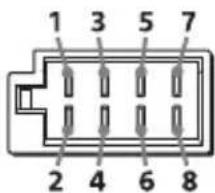
text_image
1 3 5 7 2 4 6 8| 1 | Rear speaker(right) | ⊕ | Purple |
| 2 | Purple/blackstriped | ||
| 3 | Front speaker(right) | ⊕ | Gray |
| 4 | Gray/blackstriped | ||
| 5 | Front speaker(left) | ⊕ | White |
| 6 | White/blackstriped | ||
| 7 | Rear speaker(left) | ⊕ | Green |
| 8 | Green/blackstriped |
② To the car's power connector
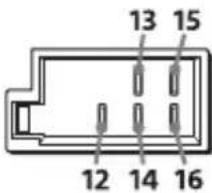
text_image
13 15 12 14 16| 12 | continuous power supply | Yellow |
| 13 | power antenna (aerial) /power amplifier control (REM OUT) | Blue/white striped |
| 14* | switched illumination power supply | Orange/ white striped |
| 15 | switched power supply | Red |
| 16 | ground (earth) Black |
* MEX-N5300BT only
Subwoofer Easy Connection
You can use a subwoofer without a power amplifier when it is connected to a rear speaker lead.
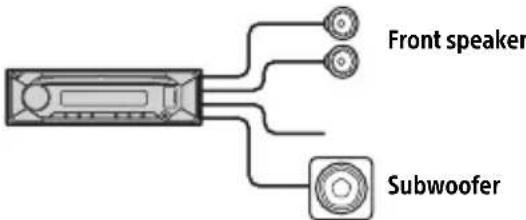
text_image
Front speaker SubwooferNotes
- Preparation of the rear speaker leads is required.
- Use a subwoofer with an impedance of 4 to 8 , and with adequate power handling capacities to avoid damage.
Memory hold connection
When the yellow power supply lead is connected, power will always be supplied to the memory circuit even when the ignition switch is turned off.
Speaker connection
- Before connecting the speakers, turn the unit off.
- Use speakers with an impedance of 4 Ω to 8 Ω, and with adequate power handling capacities to avoid damage.
Power connection diagram
Check your car's auxiliary power connector, and match the connections of leads correctly depending on the car.
Auxiliary power connector
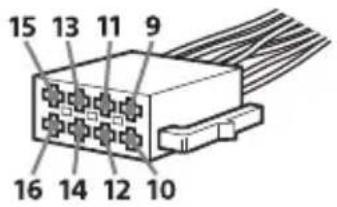
text_image
15 13 11 9 16 14 12 10Common connection
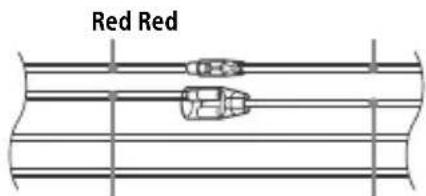
text_image
Red RedYellow Yellow
| 12 | continuous power supply | Yellow |
| 15 | switched power supply Red |
When the positions of the red and yellow leads are inverted
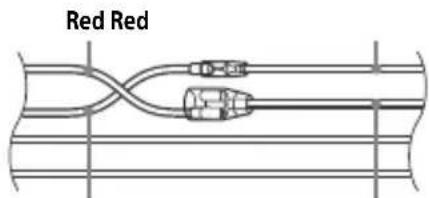
text_image
Red RedYellow Yellow
| 12 | switched power supply | Yellow |
| 15 | continuous power supply | Red |
When the car without ACC position
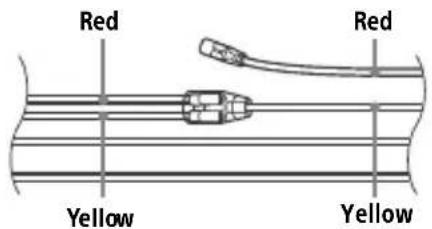
text_image
Red Red Yellow YellowAfter matching the connections and switching power supply leads correctly, connect the unit to the car's power supply. If you have any questions and problems connecting your unit that are not covered in this manual, consult the car dealer.
Installing the microphone (MEX-N5300BT only)
To capture your voice during handsfree calling, you need to install the microphone ⑦.
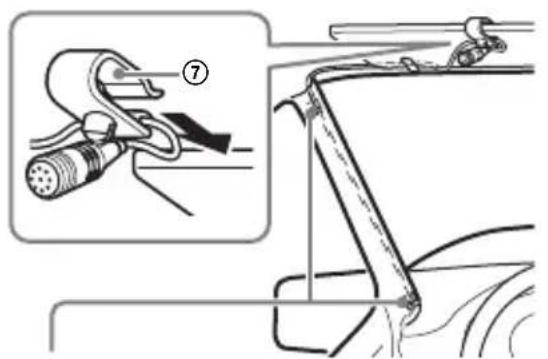
text_image
Technical diagram showing cable installation with labeled component ⑦ and magnified detail viewClip (not supplied)
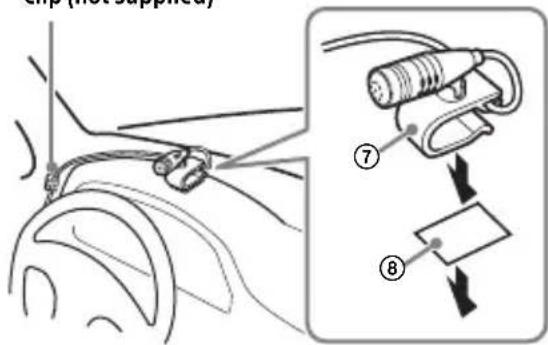
text_image
Diagram showing a cable or cable connector being inserted into a device, with labeled parts ⑦ and ⑧.Cautions
- It is extremely dangerous if the cord becomes wound around the steering column or gearstick. Be sure to keep it and other parts from interfering with your driving operations.
- If airbags or any other shock-absorbing equipment is in your car, contact the store where you purchased this unit, or the car dealer, before installation.
Note
Before attaching the double-sided tape ⑧, clean the surface of the dashboard with a dry cloth.
Using the wired remote control
1 To enable the wired remote control, set [STR CONTROL] in [SET STEERING] to [PRESET] (page 19).
Installation
Removing the protection collar and the bracket
Before installing the unit, remove the protection collar ③ and the bracket ① from the unit.
1 Pinch both edges of the protection collar ③, then pull it out.
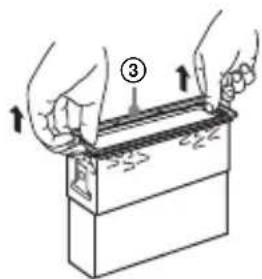
text_image
Diagram showing hands operating a mechanical component with numbered parts and directional arrows indicating motion or assembly.2 Insert both release keys ② until they click, and pull down the bracket ①, then pull up the unit to separate.
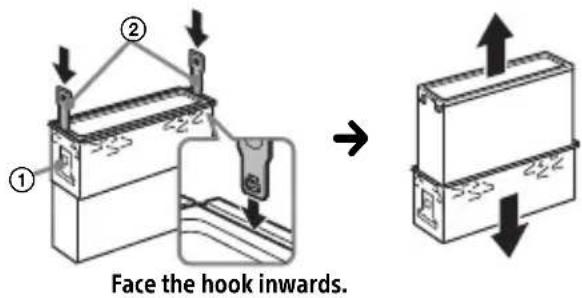
text_image
Face the hook inwards.Mounting the unit in the dashboard
Before installing, make sure the catches on both sides of the bracket ① are bent inwards 2 mm (3/32 in).
1 Position the bracket ① inside the dashboard, then bend the claws outward for a tight fit.
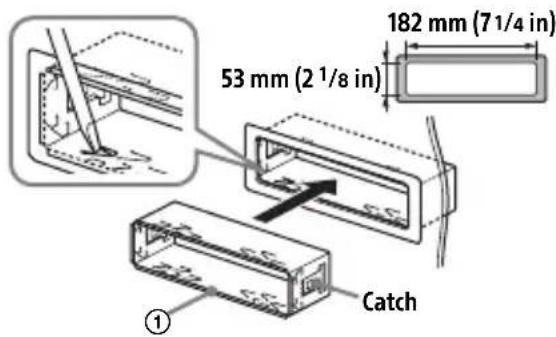
text_image
182 mm (7 1/4 in) 53 mm (2 1/8 in) Catch ①2 Mount the unit onto the bracket ①, then attach the protection collar ③.
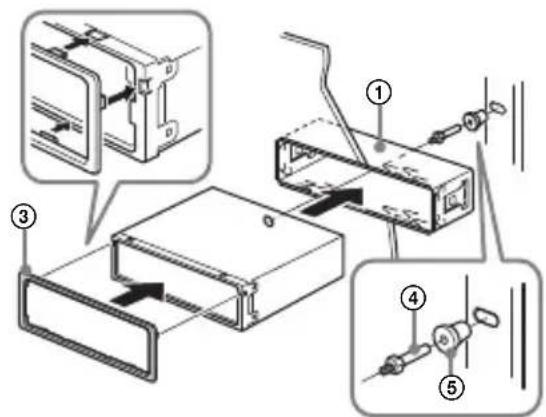
text_image
Technical diagram showing exploded view of a device with labeled components and directional arrows indicating assembly or connection.Notes
- If the catches are straight or bent outwards, the unit will not be installed securely and may spring out.
- Make sure the 4 catches on the protection collar ③ are properly engaged in the slots of the unit.
Detaching and attaching the front panel
For details, see "Detaching the Front Panel" (page 7).
Resetting the unit
For details, see "Resetting the Unit" (page 7).
Fuse replacement
When replacing the fuse, be sure to use one matching the amperage rating stated on the original fuse. If the fuse blows, check the power connection and replace the fuse. If the fuse blows again after replacement, there may be an internal malfunction. In such a case, consult your nearest Sony dealer.
Fuse (10 A)
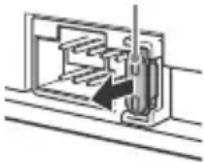
9 ↗ ( S E E K - / + )
text_image
Diagram showing a hand holding a device with labeled parts 1 and 2, indicating a mechanical or electrical component.Warnton
natural_image
Diagram showing two rectangular compartments evolving into a folded or sealed container (no text or symbols)natural_image
Line drawing of a hand holding a smartphone next to a device with a circular label (no text or symbols on the device itself)natural_image
Illustration showing a smartphone connected to a CD and a CD-ROM device, both emitting sound waves (no text or symbols)text_image
DR-BT30Q MEX-XXXX XXXXXXXXXnatural_image
Diagram showing a smartphone and a device with sound waves, no text or symbols presenttext_image
Diagram showing cable connection between a device and a smartphone, with numbered components for identification.text_image
Diagram showing a device with labeled parts, including numbered callouts and a cable connection.natural_image
Line drawing of a device's internal component with a cable inserted (no text or symbols)natural_image
Hand holding a CD inside a rectangular device with an arrow indicating upward motion (no text or symbols)natural_image
Illustration of a vinyl record and audio device with sound waves (no text or symbols)text_image
Diagram showing a smartphone connected to wireless signals and a device with wireless icons, likely illustrating mobile phone or network communication.FW VERSION (Firmwareversion)
natural_image
Illustration of hands holding a CD or DVD disc with arrows indicating direction (no text or symbols)natural_image
Line drawing of a hand inserting a small object into a device (no text or symbols)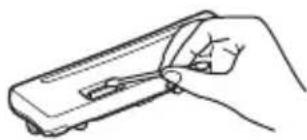
natural_image
Line drawing of a hand holding a pen or stylus (no text or symbols)Hinweis
87,5 MHz - 108,0 MHz
531 kHz - 1.602 kHz (MW)
153 kHz - 279 kHz (LW)
Abtastrate: 16 kHz - 48 kHz
WMA (.wma)
Bitrate: 32 Kbps – 192 Kbps
Abtastrate: 32 kHz, 44,1 kHz, 48 kHz
AAC (.m4a, .mp4)
Bitrate: 16 Kbps - 320 Kbps (stereo)
Abtastrate: 8 kHz – 48 kHz
FLAC (.flac)
A2DP (Advanced Audio Distribution Profile) 1.3
AVRCP (Audio Video Remote Control Profile) 1.3
HFP (Handsfree Profile) 1.6
PBAP (Phone Book Access Profile)
SPP (Serial Port Profile)
Copyright (C) 2000-2009 Josh Coalson
Copyright (C) 2011-2013 Xiph.Org Foundation
text_image
Diagram showing six labeled technical components or parts, including a rectangular housing, screwdriver, and mechanical parts.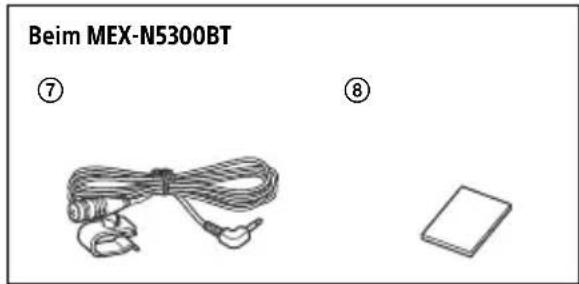
text_image
Beim MEX-N5300BT ⑦ ⑧text_image
Diagram showing a car's seatbelt mechanism with labeled parts and directional arrows indicating assembly or repair.Vorsichtsmaßnahmen
text_image
Diagram showing hands holding a rectangular object with numbered label and directional arrows indicating movement or forcetext_image
Diagram illustrating a mechanical assembly process with labeled components and directional arrows indicating movement or assembly.text_image
Technical diagram showing exploded view of a device with labeled components and directional arrows indicating assembly or installation steps.Hinweise
Raccordement/Installation
Attention. 38
9 ↗ ( S E E K - / + )
text_image
Diagram showing a hand operating a mechanical device with labeled parts 1 and 2, indicating a step or operation.natural_image
Diagram showing a device being processed into a folder, with no text or symbols present.natural_image
Line drawing of a hand holding a smartphone next to a device with a circular label (no text or symbols visible)natural_image
Illustration showing a smartphone and a CD with wireless signal waves (no text or symbols)text_image
DR-BT30Q MEX-XXXX- XXXXXXXXX▶II (Lecture/pause).
text_image
Diagram showing cable connection between a device and a smartphone, with numbered components and connecting lines.text_image
Diagram showing a device with labeled components, including numbered parts and a cable connection.natural_image
Line drawing of a mechanical component with a screw inserted, showing no text or symbolsnatural_image
Hand holding a CD inside a rectangular device with an arrow indicating rotation (no text or symbols)La lecture commence.
natural_image
Illustration of a music device emitting sound waves next to a speaker (no text or symbols)text_image
Diagram showing a smartphone, wireless signal transmission, and a CD-ROM with Bluetooth interface[MIC-LOW], [MIC-MID], [MIC-HI].
EDIT CUSTOM (modifier personnalisation)
[OFF], [R&B], [ROCK], [POP], [HIP-HOP], [EDM], [JAZZ], [SOUL], [COUNTRY], [KARAOKE]*, [CUSTOM].
[BAND1] – [BAND10] (32 Hz, 63 Hz, 125 Hz, 250 Hz, 500 Hz, 1 kHz, 2 kHz, 4 kHz, 8 kHz, 16 kHz).
natural_image
Illustration of hands holding a CD or DVD disc with arrows indicating direction (no text or symbols)natural_image
Line drawing of a hand inserting a small object into a device (no text or symbols)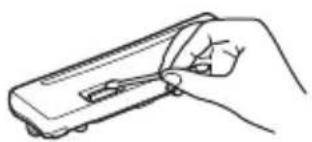
natural_image
Line drawing of a hand holding a small object, possibly a tool or device (no text or symbols present)Remarque
87,5 MHz - 108,0 MHz
153 kHz - 279 kHz (LW (GO))
Protocole AOA (Android Open Accessory)
compatible : 2.0
Norme BLUETOOTH version 3.0
Puissance :
Jumelage impossible.
Raccordement/Installation
Attention
text_image
Technical diagram showing a cable clamp installation with labeled component ⑦, including a magnified inset view.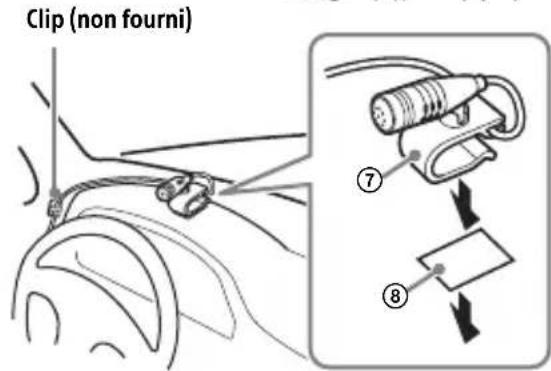
text_image
Clip (non fourni) ⑦ ⑧Attention
text_image
Diagram showing hands holding a rectangular object with numbered parts and arrows indicating movement or assemblytext_image
Diagram illustrating a mechanical assembly process with labeled components and directional arrows indicating movement or assembly.text_image
Technical diagram showing exploded view of a device with labeled components and directional arrows indicating assembly or connection.Remarques
text_image
Diagram showing a hand operating a cylindrical device with labeled parts 1 and 2, indicating mechanical or electrical components.natural_image
Diagram showing a device being processed into a folder, with no text or symbols present.natural_image
Line drawing of a hand holding a smartphone next to a device with a circular button (no text or symbols)natural_image
Illustration showing a smartphone and a CD with wireless signal waves (no text or symbols)text_image
DR-BT30Q MEX-XXXX XXXXXXXXXnatural_image
Diagram showing a smartphone and a CD with sound waves, no text or symbols presenttext_image
Diagram showing cable connection between a device and a smartphone, with numbered components indicating connection steps.text_image
Diagram showing a device with labeled parts, including numbered annotations ① and ② indicating specific components or functions.natural_image
Line drawing of a device component with a cable inserted, showing no text or symbolsnatural_image
Hand holding a CD inside a rectangular device with an arrow indicating rotation (no text or symbols)natural_image
Illustration of a music device with sound waves and a speaker (no text or symbols)text_image
Diagram showing a smartphone connected to wireless signals and a device with a notification icon, likely illustrating mobile phone or app interface.[OFF], [R&B], [ROCK], [POP], [HIP-HOP], [EDM], [JAZZ], [SOUL], [COUNTRY], [KARAOKE]*, [CUSTOM].
"Sony | Music Center" (SONY APP)
natural_image
Illustration of hands holding a CD or DVD disc with arrows indicating direction (no text or symbols)natural_image
Line drawing of a hand inserting a small object into a device (no text or symbols)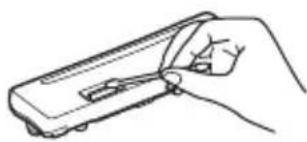
natural_image
Line drawing of a hand holding a small object, possibly a tool or device (no text or symbols visible)Nota
87,5 MHz - 108,0 MHz
531 kHz - 1.602 kHz (MW)
153 kHz - 279 kHz (LW)
Cartelle (album)*2: 150
Interfaccia: USB (Full speed)
Cartelle (album): 256
(2,4000 GHz - 2,4835 GHz)
A2DP (Advanced Audio Distribution Profile) 1.3
AVRCP (Audio Video Remote Control Profile) 1.3
HFP (Handsfree Profile) 1.6
PBAP (Phone Book Access Profile)
SPP (Serial Port Profile)
text_image
Technical diagram showing cable installation with labeled component ⑦ and magnified detail viewtext_image
Technical diagram showing cable fastening technique with labeled components and directional arrowsAttenzione
text_image
Diagram showing hands holding a rectangular object with numbered parts and directional arrows indicating movement or assembly.text_image
Diagram illustrating a mechanical assembly process with labeled components and directional arrows indicating movement.text_image
Technical diagram showing exploded view of a device with labeled components and assembly stepsNote
text_image
Diagram showing a hand holding a device with labeled parts 1 and 2, indicating a mechanical or electrical component.Alarma de precaución
natural_image
Diagram showing a device being processed into a folder, with no text or symbols present.natural_image
Line drawing of a hand holding a smartphone next to a device with a circular dial (no text or symbols visible)natural_image
Illustration showing a smartphone and a CD with wireless signal waves (no text or symbols)text_image
DR-BT30Q MEX-XXXX- XXXXXXXXXtext_image
Diagram showing cable connection between a device and a smartphone, with numbered components indicating connection steps.text_image
Diagram showing a device with labeled components and connection to an external cable, marked with numbers 1 and 2.natural_image
Line drawing of a cable connector with a plug inserted into a device (no text or symbols)4 Pulse SRC para seleccionar [AUX].
Escuchar la radio
Escuchar la radio
natural_image
Hand holding a CD inside a rectangular device with an arrow indicating rotation (no text or symbols)natural_image
Illustration of a music device with sound waves and a speaker (no text or symbols)text_image
Diagram showing a smartphone connected to wireless signals and a CD-ROM with app icons, likely illustrating mobile phone or audio interface concepts.Recibir una llamada
[BAND1] – [BAND10] (32 Hz, 63 Hz, 125 Hz, 250 Hz, 500 Hz, 1 kHz, 2 kHz, 4 kHz, 8 kHz, 16 kHz).
natural_image
Line drawing of a hand holding a CD or DVD disc with arrows indicating rotation (no text or symbols)natural_image
Line drawing of a hand inserting a card into a folder (no text or symbols)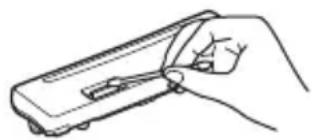
natural_image
Line drawing of a hand holding a pen or stylus (no text or symbols)Nota
text_image
Technical diagram showing cable installation with labeled component ⑦, including a magnified inset of the cable being inserted.Gancho (no suministrado)
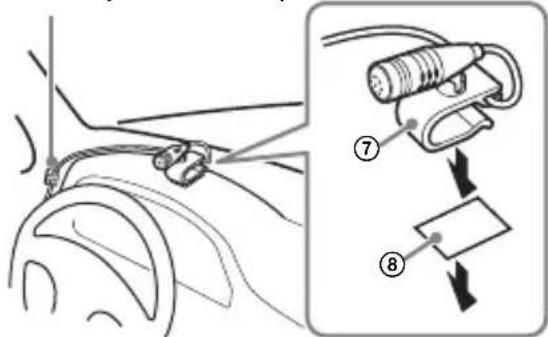
text_image
Diagram showing cable fastening technique with labeled parts and directional arrowsPrecauciones
text_image
Diagram showing hands installing or adjusting a rectangular object with numbered label ③, likely illustrating a mechanical or architectural modification.text_image
Technical diagram showing exploded view of a device with labeled components and directional arrows indicating assembly or installation steps.Notas
Hereby, Sony Corporation declares that this equipment is in compliance with Directive 2014/53/EU. The full text of the EU declaration of conformity is available at the following internet address: http://www.compliance.sony.de/
Eesti keel
If you have any questions or for the latest support information on this product, please visit the web site below:
Site d'assistance
Register your product online now at:
Support by Sony app - Find information and get notification about your product:
App. de smartphone
https://sony.net/SBS

Made for