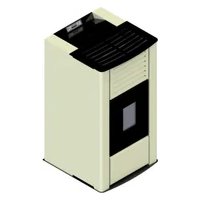
Club Ermetica - Pan Cola - Free user manual and instructions
Find the device manual for free Club Ermetica Cola in PDF.



| Product type | Wood pellet stove |
| Brand | Cola |
| Model | Club Ermetica |
| Nominal power | 8.2 kW |
| Heatable volume | 234 m³ (coefficient 35 W/m³) |
| Electrical supply | 230 V - 50 Hz |
| Fuel | Wood pellets (diameter 6±0.5 mm, length 6-30 mm, max humidity 10%, max ash content 1.5%) |
| Ignition type | Automatic (electric resistance) |
| Control | Infrared remote control + control panel |
| Programming | Daily, weekly, weekend |
| Special functions | Turbo, Quick, Comfort, Magic Cleaning, Standby |
| Safety | Safety thermostat (tank), vacuum switch, flowmeter, overvoltage protection, tank door microswitch, explosion flaps |
| Provided accessories | Power cord, manual, key, remote control |
| Routine maintenance | Daily cleaning of the brazier, ash drawer every 2-3 days, glass regularly |
| Annual maintenance | By authorized service center (complete cleaning, check) |
| Safety distance | 1 m in front, respect fire clearance (see fig 2.1) |
| Flue diameter | 80 mm |
| Warranty | According to applicable standards, normal wear excluded |
Frequently Asked Questions - Club Ermetica Cola
User questions about Club Ermetica Cola
0 question about this device. Answer the ones you know or ask your own.
Ask a new question about this device
Download the instructions for your Pan in PDF format for free! Find your manual Club Ermetica - Cola and take your electronic device back in hand. On this page are published all the documents necessary for the use of your device. Club Ermetica by Cola.
USER MANUAL Club Ermetica Cola
484210860-M5_06/18 Hardware-M_Software7.0
Leggere attentamente le istruzioni prima dell'installazione, utilizzo e manutenzione. Il manuale è parte integrante dell'apparecchio. Read the instructions carefully before installation, use and maintenance. The manual is an integral part of the unit. Lire attentivement les instructions avant d'installer, d'utiliser et d'entretenir le poèle. Le manuel fait partie intégrante de l'appareil. Vor Installation, Gebrauch und Wartung muss cette Anleitung aufmerksam durchgeleen werden. Das Handbuch ist wesentlicher Bestandteil des Geräts. Lea atentamente las instrucciones antes de realizar la instalacion, el uso y el mantenimiento. El manual es parte integrazione del equipo.
COLA guarantees its products, except for parts subject to normal wear, in accordance with the current regulations. For the warranty terms, please contact the importer or the authorised agent who can integrate the compulsory warranty period with an additional period under his sole and exclusive responsibility.
The product warranty is invalidated for any trouble, breakage or accident due to failure to comply with or apply the instructions provided in this manual.
The CE marking certifies that the products meet the essential requirements of the relevant directives in force. The Declaration of Performance and EC Declaration of Conformity can be found on the Company's website at www.colastufe.com or by asking them to the importer or the authorised agent.
FR 49-65
CE MARKING INFORMATION
INFORMATIONS RELATIVES AU MARQUAGE CE
Type of equipment and use
Name and address of the manufacturer
Residential space heating appliance fired by wood pellets.
+390456144043/+390456144048
Info@anselmocola.com
| Marchio commerciale:Trademark - Marque - Marken - Marca - Marca - Marka | ANSELMO COLA |
| Modello:Type designation - Modèle - Model - Model - Model - Model | CLUB ERMETICA |
| Classe di efficienza energetica:Energy efficiency class - Classe d'efficacità energetiqueEnergieeffizienzklasse - Clase de efficienza energeticaClasa de randament energetic - Klasa efektywnosci energetycznej | A+ |
| Potenza termica diretta in kW:Direct heat output in kW - Puisance thermique directe en kWDirekte Wärmeleistung in kW - Potenza calorifica directa en kWPuterea termica direcţă in kW - Bezposrednia moc cieplna produktu w kW | 8,2 |
| Potenza termica indiretta in kW:Indirect heat output in kW - Puisance thermique indirecte en kWIndirekte Wärmeleistung in kW - Potenza calorifica indirecta en kWPuterea termica indiretta in kW - Pošrednia moc cieplna produktu w kW | 0,0 |
| Indice di efficienza energetica 'IEE':Energy Efficiency Index 'EEI': ùdice de l'efficacità energetique 'IEE'Energieeffizienzindex 'EEI': ùndice de Efficienza Energetica 'IEE'Indice de randament energetic 'IEE': Wskaznik efektywnosci energetycznej 'IEE' | 128 |
| Efficienza utile alla Potenza nominale 'ŋ th,nom' in %:Useful efficiency at nominal heat output 'ŋ th,nom' in %Le rendentut utile à la puissance thermique nominale 'ŋ th,nom' en %Brennstoff-Energieeffizienz bei Nennwärmeleistung'ŋ th,nom' in %La efficienza energetica util a potenza calorifica nominale 'ŋ th,nom' en %Randamentul energetic util la putere termica nominalä 'ŋ th,nom' in %Sprawnosć uzytkowa przy nominalej 'ŋ th,nom' w % | 91,8 |
| Efficienza utile alla Potenza minima 'ŋ th,min' in %:Useful efficiency at minimum heat output 'ŋ th,min' in %Le rendentut utile à la charge minimale 'ŋ th,min' en %Brennstoff-Energieeffizienz bei Mindestlast 'ŋ th,min' in %La efficienza energetica util a carga minima 'ŋ th,min' en %Randamentul energetic util la sarcină minimă 'ŋ th,min' in %Sprawnosć uzytkowa przy minimnym obciązeniu 'ŋ th,min' w % | 95,1 |
Comply with the warnings and instructions concerning installation and routine maintenance provided in the instruction manual.
1.1. Introduction
1.2. Using the manual
1.3. Safety rules
1.4. Technical description
1.5. Permissible use and fuel
1.6. Accessories supplied
1.7. Reference standards
1.8. Dataplate
1.9. Stove decommissioning
1.10. Instructions for requesting assistance and replacement parts
2. TRANSPORT AND INSTALLATION
2.1. Packing, handling, shipment and transport
2.2. Place of installation, positioning and fire-prevention safety
2.3. Air inlet
2.4. Fume exhaust
2.4.1. Types of installation
2.5. Brazier and baffle position check
2.6. Electrical connection
2.7. Emergency
3. STOVE SAFETY
3.1. Safety distance from flammable materials
3.2. Fume exhaust safety
3.3. Combustion chamber overpressure safety
3.4. Overheating - pellet hopper temperature safety thermostat
3.5. Safety against flare-back in the pellet chute
3.6. Overcurrent electrical protection device
3.7. Power failure safety
3.8.Fume fan failure
3.9. Pellet tank door safety
4. STOVE USE
4.1. Introduction
4.2. Use via remote control
4.2.1 Lighting
4.2.2 Work phase
4.2.3 Shutdown
4.2.4 Remote control additional functions
4.2.5 Replacing the battery
4.3. Use via control panel
4.4. Optional probe and external thermostat
4.5. Idle period (end of season)
5 STOVE CLEANING
5.1 Cleaning the brazier
5.2 Cleaning the ash container
5.3 Cleaning the glass and air slots
5.4 Cleaning the fume extractor and combustion chamber
5.5 Cleaning the air flow meter
5.6 Cleaning the ceramic surfaces (ceramic models)
5.7 Cleaning the flue - flue connection
6 MAINTENANCE
6.1 Introduction
7 TROUBLESHOOTING
7.1 Alarm management
8 INSTALLER
8.1 Menu installer settings
1 GENERAL INFORMATION
1.1 Introduction
Dear Customer,
First of all we wish to thank you for the trust placed in us by purchasing one of our products. Please read and carefully follow the advice given in this installation, use and maintenance manual in order make best use of the product. All the documents regarding the unit's certifications or declarations, in particular the Declaration of Conformity and Declaration of Performance, can be found through the website of the relevant trademark.
1.2 Using the manual
The Manufacturer reserves the right to make technical or aesthetic changes to the products at any time without notice.
Stove installation, use and maintenance operations must comply with the requirements given in this manual as well as the European, National, Regional, Provincial and Municipal regulations.
The drawings, measurements, diagrams and any other configurations are given only by way of example.
This manual is an integral part of the product; make sure it always stays with the stove, even if sold, transferred to another owner or installed in another place, so that it can be consulted at any time.
If lost or damaged, ask the Authorised Service Centre for a copy so that the stove always has its own manual.

This symbol indicates the presence of an important message; failure to pay attention to it can result in serious damage to the stove and even injury
Pay special attention to "words in bold face"
1.3 Safety rules.
- Read the use and maintenance manual before installing, lighting and servicing the stove.
- Installation, the electrical connection, testing and maintenance must be carried out by a qualified and/or authorised technician.
- Connect the stove to an approved flue by means of an inspectionable terminal; several units can be connected only if allowed by the local regulations and by the flue inspection Body.
- Connect the stove to the suction system by means of a pipe or air inlet from outside.
- Connect the stove to an approved 230V - 50Hz electrical socket.
- Make sure the electrical system and the sockets are suitable for the maximum absorption of the unit, specified on the label and in this manual.
- The stove must be unplugged and cold before carrying out any maintenance.
- Do not use flammable liquids or substances to light the stove or rekindle the flame: when the stove is lit, pellet ignition is automatic.
The pellet stove must only be fed with wood pellets having the characteristics described in this manual. - The stove must not be used as an incinerator.
- Never block the combustion air inlet and fume outlet openings.
- Do not handle easily flammable or explosive substances near the stove while it is operating.
- Do not remove or modify the pellet hopper protection grille or the safety devices.
- Do not operate the stove with the fire door open and/or the glass damaged or broken.
During operation the intense heat generated by combustion of the pellets makes the external surfaces of the stove very hot, and in particular the fire door, handle and flue pipe. Therefore avoid contact with these parts without suitable protection. - Keep objects that are flammable and/or not heat resistant at a suitably safe distance.
- Clean the brazier regularly every time the stove is lit or whenever reloading pellets.
- Have the duct and smoke baffles inside the combustion chamber cleaned regularly by qualified personnel.
- Avoid the creation of smoke and unburnt products during lighting and/or normal operation; an excessive accumulation of unburnt pellets in the brazier must be eliminated manually before carrying out relighting.
Inform children and guests of the dangers here above mentioned, these have to be anyway controlled and must not play with the device.
The device can be used by children aged less than 8 years, and by people with reduced physical, sensory or mental capabilities, or lack of experience or knowledge, provided under supervision or after the same has received instructions relating to 'safe use of and understanding of the dangers inherent in it. children should not play with the appliance
The cleaning and the ordinary maintenance to be accomplished by the user should not be executed by children nor guests which are not under surveillance.
In case of operating problems, the stove can be relit only after eliminating the cause of the problem.
Any tampering and/or unauthorized replacements with non-original parts of the stove can create a risk for the user's safety and relieves the manufacturer of any civil or penal liability. - Only use original replacement parts recommended by the manufacturer.

The manufacturer declines any liability for problems, damage or accidents caused by failure to follow or apply the instructions contained in this manual.
1.4 Technical description
The stove works exclusively on pellets, providing healthy and safe heat in the room. The stove's automatic control systems guarantee optimum heat output and complete combustion; there are also safety systems to guarantee safe operation for the stove parts and for the user.
When correctly installed, the unit works in any outside climatic conditions, and in any case in critical conditions (strong wind, frost, etc.) the safety systems can cut in, shutting down the stove.
The stove model CLUB ERMETICA with nominal power of 8,2kW ensures a maximum heatable volume of 234m^3 considering the coefficient of a building's energy requirements equal to 35 W/m3, and may vary depending on the insulation, type and climatic zone which are important variables for the correct choice of unit.
For technical data, refer to the table on page 5. For pellet heating stove dimensions refer to fig.1.
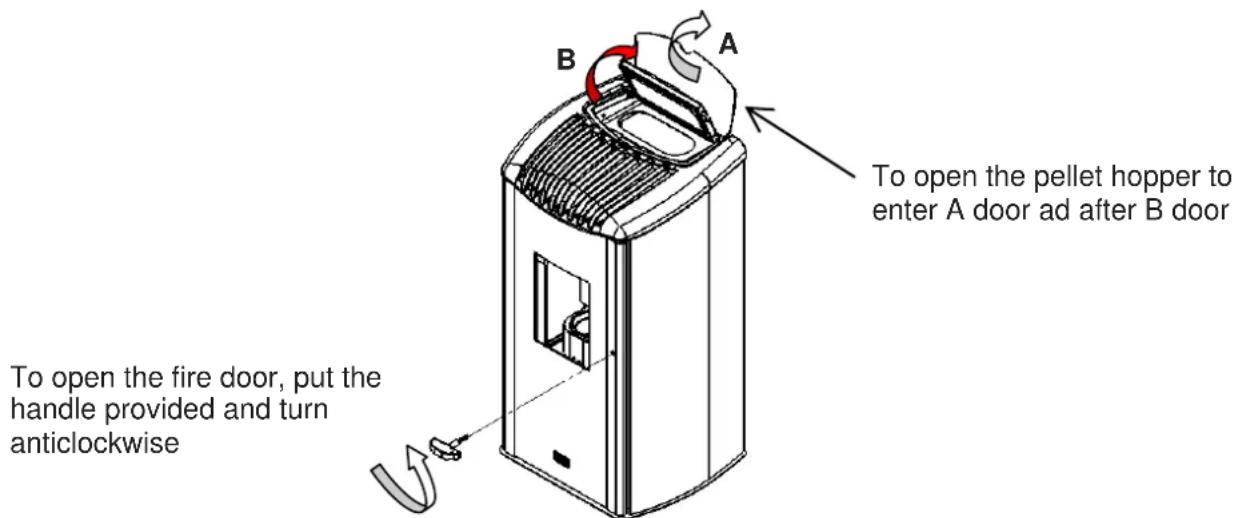
CLUB ERMETICA pellet heating stove fire door – pellet hopper door opening - closing
1.5 Permissible use and fuel
The pellet stoves work exclusively on pellets in different types of wood complying with Standard DIN plus 51731 or EN ISO 17225-2 or Ö-Norm M 7135 or having the following characteristics:
| Heat value | min. 4.8 kWh/kg (4180 kcal/kg) |
| Density | 680-720 kg/m3 |
| Moisture | max. 10% weight |
| Diameter: | 6 ±0.5 mm |
| Ash percentage | max. 1.5% weight |
| Length: | min. 6 mm- max. 30 mm |
| Composition: | 100% untreated wood from the wood industry or post consumer without added binding substances or bark, complying with current regulations |
| Packing | in bags made from environmentally friendly or biodegradable material or paper |
The pellet hopper is at the back of the stove. The door opening is located in the top part and loading occurs manually with the stove on or off, making sure not to overfill and operate in complete safety.
The use of pellets with characteristics different from those tested by the technician during first lighting involves a new setting of the boiler pellet loading parameters; this operation is not covered by the warranty.

- Store the pellets in a dry place.
- For reasons of regular and efficient operation, pellets or other fuels cannot be manually loaded in the brazier
- Do not load non-conforming fuels in the hopper.
- Do not load foreign bodies such as containers, boxes, bags, metals, etc., in the hopper.
- The use of poor quality and non-conforming pellets damages and compromises stove operation, invalidating the warranty with the exclusion of liability of the manufacturer.

- Do not place the pellet bag or any loads on the ceramic outer frame avoid its possible cracks and / or breaks;
Failures to follow such procedure will invalidate the warranty with the exclusion of liability by the manufacturer.
1.6 Accessories supplied
The supply includes:
- Electrical power cable;
- Installation, use and maintenance manual;
- Opening - closing key;
- Remote Control.
1.7 Reference standards
Standard UNI 10683:2012: Installation requirements for heat generators burning wood or other solid biofuels;
Standard UNI EN14785:2006: Requirements for design, manufacture, construction, safety and performance, instructions and marking, together with the relevant test methods for approval of units burning pellets;
Standard CEI EN 60335-1: Safety of electrical appliances for domestic and similar use - part 1;
Standard CEI EN 60335-2-102: Safety of electrical appliances for domestic and similar use - part 2;
Standard CEI EN 55014-1: Electromagnetic resistance - Requirements for electrical appliances, electric tools and similar electric equipment - Part 1: Emission of interference;
Standard CEI EN 55014-2: Electromagnetic resistance - Requirements for electrical appliances, electric tools and similar electric equipment - Part 2: Immunity; Product family standard;
Standard CEI EN 61000-3-2: Limits for harmonic current emissions (Input current ≤ 16 A per phase);
Standard CEI EN 61000-3-3: Limitation of voltage fluctuations and flicker in low voltage supply systems for equipment with nominal current ≤ 16A
Standard CEI EN 62233: Measuring methods for electromagnetic fields of electrical household appliances and similar with reference to human exposure.
Standards DIN plus 51731 - EN ISO 17225-2 - Ö-Norm M 7135: Standards regarding the specifications and classification of pellets.
1.8 Dataplate
The data plate is located on the inside of the pellet hopper door or on the back of the stove. It gives all the stove's characteristic data, including the manufacturer's details, serial number, CE marking, test laboratory and the Declaration of Performance reference number.
1.9 Stove decommissioning
When definitively deciding to not to use the stove any more, we recommend to disconnect the power supply and to empty the pallet tank completely. In order to eliminate the stove, it is necessary to packaged it with a strong packaging and then take contact with local organisation which follows the selling off operations respecting the local rules. Otherwise we recommend to back the stove directly to the distributor when buying a similar new one.
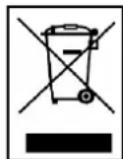
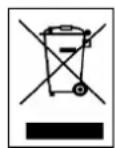
The picture of the bin crossed is labelled on the equipment, and it means that when the device is out of use it has to be kept separated by other wastes.
1.10 Instructions for requesting assistance and replacement parts
To request any assistance and/or replacement parts contact your dealer, area importer or the nearest authorised service centre, clearly specifying the following: stove model, serial number, date of purchase, list of replacement parts, details of faults or malfunctioning.

- All operations on components must be carried out by authorised and/or qualified personnel.
- Make sure all electrical connections are disconnected and that the stove is cold before any work on it.
- Only use original replacement parts.
2 TRANSPORT AND INSTALLATION
2.1 Packing, handling, shipment and transport
The stove complete with packing can be lifted using a lift truck, stove ing the forks (of suitable length) in the special spaces in the wooden pallet. Make sure the equipment used for lifting and transport can take the weight of the stove, specified on the dataplate and in this manual.
Avoid taking the load in areas where it could be a danger if dropped.
Open the packing, remove the stove from the pallet and position it in the required place, making sure it complies with that provided for. Set the stove down on the floor carefully without bumping and position it in the required place. Make sure the floor can take the weight of the stove, otherwise consult a specialised technician.
Disposal or recycling of the packing must be carried out by the end-user in compliance with the current local regulations.
2.2 Place of installation, positioning and fire-prevention safety
The place of installation must be sufficiently ventilated to allow the removal of any combustion smoke leaks.
The unit is suitable for operation in domestic environments with min. temperature not below 0^
To prevent the risk of fire, the structures surrounding the stove must be protected from the heat.
Floors in wood or in any flammable material must be suitably protected at the base with steel or toughened glass panels; the protection must cover the base and also a certain area in front of the stove.
Any wooden boards or beams above or crossed by the flue must be suitably protected in conformity with the requirements of the specific current installation standards.
The minimum front distance for the protection of flammable objects is 1m . The minimum safety distances from flammable materials must comply with the table - fig 2.1
Every installation must provide for an easily accessible technical space for periodical maintenance.
The stove is provided with 4 adjustable feet to facilitate positioning on not perfectly flat floors. To adjust the height, tilt the stove slightly and turn the feet as required.
The stove is supplied with the ambient sensor fixed through a wrapper on the back of the stove; we recommend to remove the wrapper and to locate the sensor in the best position possible as to improve the temperature registration in accordance with the ambient context and the length of the cable.
As for temperature registration done at a certain distance we reccomend to install the ambient thermostat/ambient programming clock-thermostat - see. par.4.8.

- The stove cannot be installed in bedrooms, bathrooms and in general in rooms where another heating unit is already installed without an independent air inflow.
- With wooden floors, install a floor protection base in conformity with the current regulations.
- Suitable fire-prevention devices should be arranged for any eventuality.
- Do not install the stove in places with an explosive atmosphere.
2.3 Air inlet
The attack suction or air intake of the stove is placed rearwardly and is of circular cross section with a diameter of 50~mm . In the room where the stove is installed it must pour a quantity of air at least equal to that required for combustion; for this reason the combustion air must ensure a flow of air, clean and free of polluting elements, to satisfy a regular combustion at maximum power without any hindrance or obstruction of the passage section. The devices ponds must be taken throughout the combustion air from the outside environment and can be installed in homes or well insulated high energy efficiency.
For it to be soddisfattii requirements of tightness the combustion air inlet must be connected:
- directly to the outside of the dwelling with an appropriate tube minimum internal diameter of 50~mm and a maximum length of 2m fitted at the ends of a suitable grid wind protection (curve downwards + insect mesh) and positioned so to avoid the obstruction ( rif. fig.2.3);
- on the pickup tube air combined with the exhaust pipe ( rif. fig.2.4).

- It is recommended to connect the unit to the external air intake pipes and fittings that guarantee tightness to meet the requirements for the installation of a device pool.
- With the installation of fig.2.4 is an increase in temperature of the exhaust fumes therefore we recommend to reset the parameters of the stove and check the operation.
2.4 Fume exhaust
The fumes can be exhausted through a connection to a conventional flue or an external duct with double wall or insulated pipe. The fume exhaust connections must guarantee a minimum draught of 10Pa so that the evacuation of fumes is assured in case of a temporary power failure.
The tests on the airtight stove mod. CLUB ERMETICA have been run with a maximum length of the chimney of 6 meters and 80mm excluding the T pipe, according to European Laws EN1856-2.

- The installer must check the efficiency and state of the flue and its conformity with the local, national and European regulations.
- Certified pipes and connections with adequate seals guaranteeing their tightness must be used.
- In case of fire, shut down the stove, promptly call the fire department, and avoid continual attempts to extinguish it.
- Clean the flue and respective connection at least once a year.
2.4.1 Types of installation
Listed below are definitions and requirements for correct installation of an exhaust flue in accordance with Italian Standard UNI10683 (fig 2.2):
FLUE : a vertical duct for collecting and expelling, at an appropriate height from ground, the fumes coming from a single unit and, where permitted, more than than one.
FLUE technical requirements : it must be fumetight, isolated and insulated depending on its use;
- it must have a mainly vertical path with axis deviation < 45^ ;
- it must be at a suitable distance from flammable materials with insulation or air gap;
- it must preferably have a constant, free and independent round internal section;
- it is advisable for the flue to have an inspectionable chamber for the collection of solid materials
- and any condensate, placed under the beginning of the fume duct.
FLUE CONNECTION or DUCT: duct or connection element between the unit and flue for evacuation of fumes.
DUCT technical requirements: - it must not cross rooms in which the installation of combustion units is not allowed;
- flexible metal tubes or fibre cement pipes are prohibited;
- the use of counter-sloping elements is prohibited;
- horizontal sections must have an upward slope of at least 3^
-
the length of the horizontal section must be minimal and not more than 3m
-
there must not be more than 3 changes of direction, without the T union;
- with change of direction >90^ a max. of 2 bends can be used with length in horizontal projection not exceeding 2m .
- the fume duct must have a constant section and allow the recovery of soot.
CHIMNEY CAP : a device placed on the top of the flue to facilitate the dispersion of fumes into the atmosphere. CHIMNEY CAP technical requirements : it must have a section equivalent to that of the flue; - it must have a useful section not less than double the internal section of the flue;
- it must prevent the entry of rain and foreign bodies and ensure the discharge of fumes in any atmospheric condition;
- it must ensure an adequate dilution of fumes and be positioned outside the backflow area;
- it must be without mechanical means of suction.

- The direct discharge of the fuel products must be at roof and is forbidden to confined spaces, even with clear sky.
- With the standard installation displayed in picture 2.3 the stove is configured with the debimeter on while on the installation in picture 2.4 the technician must deactivate such component and reset the stove's parameters.
- The installation must be performed by qualified personnel, who will assume full responsibility for the installation and its operation of the installed.
2.5 Brazier and baffle position check
Before lighting the stove make sure the brazier is in the correct position, i.e. fitted in the special slots. Also make sure the top smoke baffle is properly fitted. A wrongly positioned baffle can result in malfunctioning and excessive blackening of the glass.

At every stove lighting, check the correct position of the brazier on the brazier holder.
2.6 Electrical connection
Connect one end of the power cable the wall socket.
The voltage supplied by the system must match that specified on the stove dataplate and in the technical data section of this manual. Plug the device power cord must be connected only AFTER the end of the installation and assembly of the device and must remain accessible. During stove idle periods it is advisable to remove the power cable. (wiring diagram fig. 3)

- Make sure the electrical system is equipped with an earth and differential switch in accordance with the current Regulations.
- The power cable must never touch the stove exhaust pipe.
2.7 Emergency
Suitable fire-prevention devices should be arranged for any eventuality.
In case of a fire, proceed as follows:

- Immediately disconnect the plug.
- Extinguish the fire using suitable fire-extinguishers.
- Call the fire department immediately.
- Do not use jets of waters to extinguish the fire.
3 STOVE SAFETY
3.1 Safety distance from flammable materials
To prevent the risk of fire, stove positioning must respect a minimum distance from flammable materials, according to that given in the technical table of the manual and on the dataplate.
Pay attention to the type of floor: for delicate and flammable materials it is advisable to use plates in steel or toughened glass as a support base (see section 2 - Transport and Installation). In case of particularly fragile objects such as furniture, curtains or sofas, increase the stove distance considerably.
3.2 Fume exhaust safety
In normal operation the combustion chamber is in a negative pressure, guaranteeing seal against possible smoke leaks in the room. If a certain vacuum level is not reached or the fume exhaust outlet is blocked, the vacuum switch detects the lack of a negative pressure inside the combustion chamber or the air flow meter detects a lack of air flow and, through the electronic controller, switches off the auger rotation motor, signalling the anomaly with a message on the control panel 'AL 8 NO NEG PRESS' or 'AL 9 INSUF DRAUGHT'.
3.3 Combustion chamber overpressure safety
Any and/or sudden overpressures in the combustion fumes inside the chamber and fume exhaust ducts are discharged by opening of the safety valves located on the heat exchanger. During normal operation these valves are kept closed by their weight and the negative pressure in the combustion chamber, guaranteeing a seal against any smoke escaping.

Periodically check closing, the integrity of the device and its operation.
3.4 Overheating - pellet hopper temperature safety thermostat
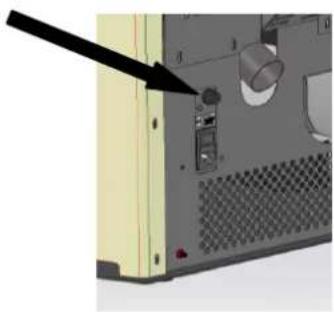
A temperature probe is connected to a safety thermostat above the pellet chute which automatically interrupts the pellet supply in case of excessive heating >85^ . In this case the extractor and/or fans continue working, allowing the stove to cool down rapidly. The fault is displayed on the control panel with a message 'AL 7 THERMAL SAF'. In case of activation, proceed as follows:
Allow the stove to cool down for at least 45 minutes.
Reset the thermostat by pressing the button near the switch on the back of the stove, after unscrewing the protection cap (figure opposite).
Restart the stove normally.
3.5 Safety against flare-back in the pellet chute
The solutions preventing flare-back are:
negative pressure in the combustion chamber see par. 3.2.
the siphon shape of the pellet chute.
the hopper temperature safety see par. 3.4.
3.6 Overcurrent protection device
The unit is protected against overcurrent by 2A fuses on the power supply of the main stove switch located at the back.
3.7 Power failure safety
In case of brief power failures, the stove relights automatically.
A temporary power failure does not limit stove safety and the hopper temperature does not reach high values (< 85^) , given the small quantity of pellets burning in the brazier.
This anomaly can result in some smoke briefly escaping into the room, which does not involve any risk.

Do not tamper with the safety devices.
3.8 Fume extractor fan failure
If the fume extractor fan stops for any reason, the electronic controller instantly stops the pellet feed, displaying the message 'AL 4 FAN FAIL'.
The safety microswitch intervenes when the pellet tank door is opened during the normal operations of the product. In such case the motherboard will stop immediately the pellet loading and the message AL 8 NO DEPRESSURE will be displayed within seconds.
4 STOVE USE
The stove has the advantage of combining heat from a wood flame with the convenience of automatic control of temperature and the possibility of programming lighting and shutdown.
4.1 Introduction
For safe and reliable use:
- when lighting the first time, unpleasant odors may be created, therefore ensure good ventilation of the room, especially during the first period of operation;
- the hopper must only be filled with pellets; make sure the bag does not come into contact with the hot surfaces of the insert;
- do not put any type of fuel other than recommended wood pellets in the hopper;
- the unit must not be used as a waste incinerator;
- the insert must work only and exclusively with the fire door always closed;
- the fire door seals should be checked periodically to ensure air tightness;
to ensure efficient and correct operation, it is necessary to clean the brazier whenever pellets are loaded; - when lighting the insert for the first time, make sure to allow it to get hot gradually without overheating;
during lighting, operation and shutdown, the insert may creak a little due to the heat expansion.
The insert is operated using a remote control provided with seven buttons and an LCD display. The remote control enables insert lighting and shutdown, adjustment during operation and the setting of management programs.
The insert also has a button control panel, which can be used instead of the remote control if necessary, allowing only some functions.
Given fig. 4.1 - 4.2 is the radio remote control and control panel with the main functions of the buttons.
4.2 Use via remote control
The remote control is a device that transmits via radio waves, therefore it does not have to be pointed at the receiver unit in the control panel.
In an open space, the remote control operating range is over 10 meters. In the presence of walls or other obstacles, the range can be reduced by a few meters.
Before using the remote control it is necessary to carry out tuning with the electronic board of the insert. This may be necessary at first activation or when the data communication channel between the board and remote control is interrupted. In this case, the display will show the message SEARCHING FIELD. The tuning operation may also be required when there are other appliances which create interference with the insert.
To carry out this operation, proceed as follows:
- Disconnect the stove power supply.
- Press buttons P3 and P5 at the same time. The message RADIO ID 0#. will appear. With the scroll buttons select NEW UNIT' and confirm with buttons P5.
Select the ID value with the P1 and P2 buttons from 0 to 64 (default ID = 0 ).
- Connect the stove power supply.
- Within 10 seconds after turning on the power, confirm the selected channel by pressing button P5. The message UNIT LOADED and then stove status will appear in quick succession while the emergency LEDs remain stationary for a short time in confirmation of acquisition.
If the message SEARCHING FIELD appears, tuning was unsuccessful and the procedure must be repeated.
The remote controller display changes according to the status of the insert, or the menu displayed. When idle, the display shows the following items:
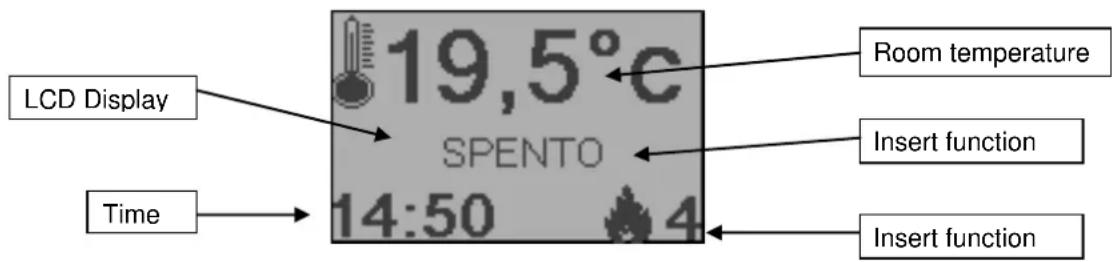
During the normal operation, the data transmission happens to regular intervals of time.
To turn on the radiocommando to press the key P3 with the visualization of the state of the insert with some second of delay.
To press the key P4 to access the menu, P5 to activate the function, P1 and P2 for the choice of the parameter.
Following the available functions are listed:
- BACK ILLUMINATION (adjustable duration from 2 to 10 sec)
- POWER ON (Time ON of the radicomando)
BRIGHTNESS' (ON. OFF) - CONTRASTt (Regulation contrast)
- BUZZER (I Play to the pressure of the keys of the radiocommando)
4.2.1 Lighting
Before lighting the stove:
- make sure to have read and understood the instructions in the manual;
the hopper must be filled with pellets; - the combustion chamber must be clean;
- the brazier must be completely free, clean of any combustion residuals and properly positioned in the brazier holder;
- check the hermetic closure of the fire door and ash pan;
make sure the stove is completely inserted in its compartment and that it is properly electrically powered.

- At first lighting, remove any components that could burn (instructions/label) from the insert firebox.
- Any lightings done after long unit idle periods require the renewal of any pellets that have been inside the hopper for a long time (in being a damp fuel no longer suitable for combustion) and complete cleaning of the combustion chamber.
- Do not use flammable liquids to light the unit.
- In case of persistent failed lighting, contact the Service Center.
To light the stove press button P3 on the remote control. The message START will appear on the LCD display. This phase is automatic and is managed entirely by the electronic control, without any possibility of changing the parameters.
The stove carries out the startup phases in sequence according to the procedure defined by the parameters. If the fume temperature has not reached the minimum permissible value, the stove goes in alarm status. If the temperature is reached, after a certain time, the insert goes in work status.
4.2.2 Work phase
After the startup phase, the insert goes to WORK mode, which is normal operation. The heating power can be adjusted with the remote control. Press P1 and P2 to set the power from a minimum value of 1 to a maximum value of 5. Using the remote control it is also possible adjust the room temperature. Then press buttons P1 and P2 to set the room temperature, from a minimum value of 7^ to a maximum value of 40^ .
The stove automatically adjusts the ventilation of hot air according to the current work phase.

- Make sure to check the pellet level in the hopper so that the flame does not go out due to lack of fuel.
- Make sure the unit is off when loading pellets.
- The pellet hopper cover must always remain closed, to be opened only during fuel loading.
- The bags of pellets must be kept at least 1.5m from the stove
If the STANDBY mode is not activated and the set temperature is reached, or if the fume temperature has reached the set maximum value, the LCD display shows the message MODULATE or MODULATE F and the stove activates the flame modulation procedure without any intervention by the user.
If, on the other hand, STANDBY mode is activated, the stove activates the modulation mode for a few minutes
when the SET temperature is reached. If the temperature remains above the set value, the stove shuts down. Restart occurs after the room temperature falls below the set value by a few degrees (default 2^ ).
If the temperature increases again, above a set limit, the HOT FUMES alarm appears and the insert activates the shutdown procedure.
During normal operation, the BRAZIER CLEANING mode is activated for several seconds at fixed intervals.
4.2.3 Shutdown
To shut down the stove, just press button P3 for about 3 seconds. The auger is immediately stopped and the fume exhaust fan goes to high speed, with the message FINAL CLEANING appearing on the display. The fume exhaust and air ventilation motors will remain on until the insert temperature has fallen sufficiently.
At the end of the operation the message OFF will appear on the display.
During the shutdown phase the stove cannot be restarted until the fume temperature has dropped below a fixed value for a given time. If the on button is pressed the message AWAITING COOL will be displayed.
4.2.4 Additional remote control functions
The display on the remote control shows all the information on stove operation.
The basic functions are:
| STATUS | DESCRIPTION |
| OFF | Stove off |
| START | The initial ignition start phase is in progress |
| PELLET LOADING | Pellet loading in progress during the ignition phase |
| AWAITING FLAME | This is the phase prior to the flame appearing. |
| FLAME PRESENT | The flame has appeared and the stove is in the heating phase |
| WORK | Normal work phase |
| MODULATE- MODULATE F | Power reduced because temp. reached or high fume temp. |
| BRAZIER CLEANING | Automatic cleaning at regular intervals |
| FINAL CLEANING | Final stove cleaning, before shutdown |
| STANDBY | Stove off for temperature reached and awaiting request |
| AWAITING COOL- | The stove cannot be relit because awaiting cooling |
The remote control has a keylock function. This is available only if enabled by the specialized technician during the first installation. From the main menu, press buttons P5 and P3 in rapid succession, to activate or deactivate the keylock function. The two messages shown opposite appear on the display.
Press button P5 to access the list of submenus. They allow the electronic controller settings to be changed. The various submenus can be scrolled by pressing buttons P1 and P2, and can be accessed by pressing button P5 and exited by pressing P3.
MENU 01 - Adjust fans
To set the hot air flow manually, the fan speed can be selected by choosing a value of 1 to 5; whereas for the fan speed to be automatic and follow the selected power, choose the value A.
MENU 02 - Set clock
Before operating the stove, the current time and date must be set in order to have a reference for possible chrono programming. The electronic control has a 3-volt lithium battery model CR2032 that gives the internal clock an operation autonomy; battery replacement is necessary if the clock does not keep the time with the stove not powered, or a series of zeros appears at restart: call an authorized service center.
To set the clock, access the menu by pressing STOVE and set the day with buttons P1 and P2. Press P7 again to set the hours, minutes, day, month and year.
MENU 03 - Set chrono
Allows all time programming functions to be enabled/disabled. To enable the chrono, access the first submenu ENABLE CHRONO and set it to ON with buttons P1 or P2. The manual commands from the emergency panel or remote control have priority over programming.
The stove is equipped with three different types of programming: daily, weekly and weekend.
Chrono enabling is signaled by the LEDs shown in the picture below. Daily, weekly and weekend programming is active only if the general chrono is enabled.
Access the second submenu DAY PROGRAM to enable or disable daily programming with buttons P1 and P2.
Then press button P7 and then buttons P1 and P2 to set up to two operation phases delimited by the set times.
Access the second submenu WEEK PROGRAM to enable, disable and set the weekly programming functions.
Follow the same procedures of the previous paragraph. Up to four operation phases delimited by the set times and days can be set.

Carry out programming making sure not to overlap the hours of activation and/or deactivation on the same day in different programs.
Access the third submenu WEEKEND PROGRAM to enable, disable and set the weekly programming functions for the weekend. Follow the same procedures of the previous paragraph. Up to two operation phases delimited by the times can be set.

To avoid unwanted startup and shutdown operations, activate only one program at a time.
MENU 04 - Select language
With this selection it is possible to set the desired language from those available.
MENU 05 - Standby mode
By selecting ON in STANDBY mode the corresponding symbol on the display lights up and the stove shuts down automatically when the room temperature T has reached the set value (Tset + ΔT) for a given time.
The next restart in automatic will be possible only when the room temperature falls below the set value by a few degrees and precisely (Tset - T ) where T default = 2^ .
With the OFF selection, the modulation function is active but not the STANDBY mode. Therefore when the temperature exceeds the set value the stove will operate at minimum power.
MENU 06 - Buzzer mode
With this selection it is possible to activate or deactivate the stove acoustic signals for alarms.
MENU 07 - Initial load
Allows the preloading of pellets for a given time. This function can only be activated when the stove is off and is used if the auger is empty due to no more pellets. It is started with button P1 and stops with button P3.
MENU 08 - Stove/stove status
This selection is reserved for the COLA service center authorized technician.
MENU 09 - Technician settings
This selection is reserved for the COLA service center authorized technician.

Modification of the technical parameters of menu 09 must be done by authorized and competent personnel; any random changes made can cause serious damage for which COLA declines any liability.
MENU 10 - Installer settings
This selection is reserved for the qualified installer and/or COLA service center authorized technician.
MENU 11 - MAGIC CLEANING function: pressing this button while the machine is working will force BRAZIER CLEANING. When OFF, activating this function will put the machine into FINAL CLEANING. From the state of FINAL CLEANING, if this button is pressed again it will discharge the FINAL CLEANING timer thus leaving intact the safety checks on the flue gas temperature.
MENU 12 - ACTIVE FUNCTIONS - OFF - the stove remains on the configured SET.
TURBO function: like the QUICK function with the difference that the heater does not modulate P1 power with set ambient or set water satisfied but modulates only in the flue gas safety condition.
QUICK function: pressing this button forces the machine power onto P5, saving the previous set power. Ventilation, too, if present, is forced onto AUTOMATIC (so maximum ventilation); saving the previous ventilation value. When pressed with the comfort function activated, it restores power and ventilation to the previous saved value. With set ambient or set water satisfied the heater modulates P1 power together with ventilation.
COMFORT function: pressing this button forces power and ventilation onto P1. Deactivating this function will take the power and ventilation to the value prior to activation. This function observes and performs STANDBY.
4.2.5 Replacing the battery
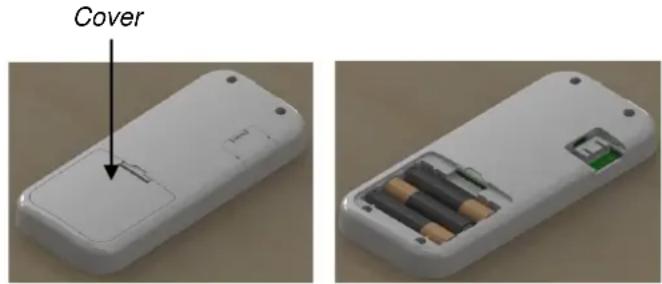
The remote control is powered by three batteries located in the back of the device. For insertion and possible replacement, proceed as follows:
- Open the cover on the back of the remote control;
- Replace the AAA 1.5 V batteries, respecting the polarity;
- Close the remote control

- Keep the remote control away from direct heat sources and water.
- The battery of the remote control must be replaced and disposed of in a safe way, respecting the local regulations;
4.3 Use via control panel
To access the panel, remove the protection profile in the bottom of the stove.
Press button P3 on the control panel for a few seconds to turn the stove on and off. Use buttons P1 and P2 to set the maximum power, indicated by the LED of button P2. Then the medium power equal to power 3, indicated by lighting up of the LED of buttons P1 and P2, and lastly the minimum power, indicated by the LED of button P1. It is not possible to set the temperature, the intermediate operating powers or access the various menus with the emergency panel.
4.4 Optional probe and external thermostat
The standard unit controls the room temperature by means of a probe that adjusts the power according to the set temperature. The probe is positioned in the remote control and measures the temperature in the place where the remote control is located. The user can choose to use an external thermostat, connected directly to the motherboard, whose sensor can be located in the most suitable place.
In case of an external thermostat, it is necessary to use a 'normally open' type.
Contact an authorized technician and follow the following instructions:
- turn the unit off at the main switch and disconnect the power cable;
remove the stove from the compartment and access the motherboard;
referring to the wiring diagram, connect the two thermostat wires to the respective terminals TERM of the board; -
refit everything, then set RADIO PROBE in menu 10;
-
Then set as follows:
-
in case of external thermostat: Set a temperature of 7^ on the remote control and adjust the external thermostat setting as desired;
- in case of external chronothermostat: Set a temperature of 7^ on the remote control and adjust the external chronothermostat setting as desired.
It is compulsory to disable the chrono function in menu 03 and set the STANDBY function to ON. When the set temperature is reached, the stove will shut down and not go to modulation.
In any case, it is advisable to use the stove time programming function and only the external chronothermostat setting function. This will avoid creating conflicts between the stove programming and that of the chronothermostat.
- Check correct operation.
In case of an optional probe, contact an authorized technician and proceed as follows:
- turn the unit off by disconnecting the power cable or by using the external switch;
- remove the coating stove and access the motherboard;
referring to the wiring diagram, connect the two wires of the probe to the respective terminals N.AMB of the board and place the probe head in the position deemed most appropriate; - refit everything and then set LOCAL PROBE in menu 10;
- check correct operation.
4.5 Idle period (end of season)
If the stove is not used for long periods, and/or at the end of each season, it is advisable to proceed as follows
-
remove all the pellets from the hopper;
-
disconnect the power supply by disconnecting the power cable or by using the external switch;
- clean thoroughly and, if necessary, have any damaged parts replaced by qualified personnel;
- in case of removal of the stove , arrange it in a safe and dry place, protected from the atmospheric agents.
5 STOVE CLEANING
Stove cleaning is very important to ensure correct operation and to prevent: blackening of the glass, poor combustion, deposits of ash and unburnt products in the brazier, reduced thermal efficiency.
The stove must only operate with the fire door closed.
The fire door seals must be checked periodically to prevent any air from entering; the combustion chamber and pellet duct work in a negative pressure and the fume exhaust in a positive pressure.
Routine cleaning is normally carried out by the customer following the instructions in the manual, whereas extraordinary maintenance, at least once a year, must be performed by the authorised Service Centre.

- Cleaning operations for all parts must be carried out with the stove unplugged and cold;
- Dispose of cleaning waste in accordance with the current local regulations;
- The stove must not be operated without its cladding;
- Avoid the creation of smoke and unburnt products during lighting and/or normal operation.
Given below are the control and/or maintenance operations for correct stove use and operation.
| Parts / PeriodType of cleaning | 1 dayroutinecleaning | 2-3 daysroutinecleaning | 1 monthroutinecleaning | 2-3 monthsroutinecleaning | 1 yearextraordinarycleaning: carried outby the Service Centre |
| Brazier | ■ | ||||
| Ash compartment pan | ■ | ||||
| Glass | ■ | ||||
| Baffle - fume exchanger | ■ | ■ | |||
| Manifold - fume extractor | ■ | ■ | |||
| Glass - door seal | ■ | ||||
| Pipe - flue connection | ■ |
5.1 Cleaning the brazier
Remove the brazier and the ash deposited in the combustion chamber and brazier holder. A suitable vacuum cleaner may be used for this purpose. This operation must be carried out daily, especially in case of accumulated unburnt matter, to ensure perfect combustion conditions, since the brazier holes allow the flow of combustion air.
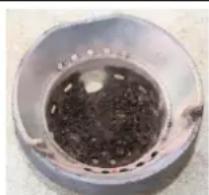
Brazier dirty
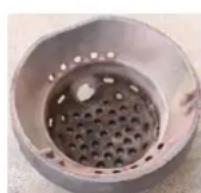
Brazier clean
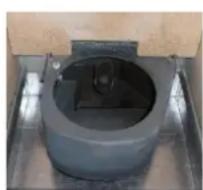
Brazier Holder clean

The brazier must rest on the brazier holder and precisely on the entire ring band without air gaps.
5.2 Cleaning the ash container
The ash container is located directly under the brazier - brazier holder. To clean it, open the fire door and remove the ash and any combustion residuals using a suitable vacuum cleaner.
The door must be closed after cleaning. The ash container can be cleaned every 2-3 days depending on stove use.
5.3 Cleaning the glass and air slots
The glass can be cleaned using a damp cloth and specific non-abrasive detergents.
Special slots between the glass, glass stops and fire door at the top and bottom allow air to circulate on the inside surface of the glass. These slots must be kept clean of any deposits of ash and dust. Therefore periodically clean all around the the inner side of the glass.
5.4 Cleaning the fume extractor and combustion chamber
The combustion chamber must be cleaned at least once a year, removing all combustion residuals from the internal baffles and flueways. To do this, remove the cover and the top front panel of the stove. Remove the cast iron exchanger by undoing the fixing screws then clean the baffles and the chamber.
Also make sure to clean the fume extractor located under the chamber, accessed by removing the inspection port located on the front lower part of chamber. Every 3-4 months clean the inside walls (insulating-refractory) of the combustion chamber using suitable equipment (brushes) and replace them if necessary.
Every 1800 hours of operation or 2000Kg pellet, by means of a message 'SERVICE DUE', the stove signals the need for extraordinary maintenance (not under warranty) to be performed by qualified personnel who will carry out complete cleaning and reset the message.

Any knocking or forcing can damage the fume extractor, making it noisy during operation; therefore it is advisable to have this operation carried out by qualified personnel.
5.5 Cleaning the air flow meter
The air flow meter (it measures the flow of combustion air) installed inside the inlet pipe requires periodical internal cleaning every 3-4 months, using suitable equipment (blowing compressed air or suitable brushes).
5.6 Cleaning the ceramic surfaces (ceramic models)
The ceramic tiles are handicraft products and therefore may have minor surface imperfections such as tiny spots or slight colour differences. It is advisable to use a soft dry cloth to clean the ceramic surfaces; the use of detergents could highlight any flaws.
5.7 Cleaning the flue - flue connection
The flue connection must be cleaned at least once a year or whenever necessary depending on stove use and the type of installation.
Cleaning requires the suction and removal of the residuals in all the vertical and horizontal sections as well as the bends from the stove to the flue.
It is advisable to also clean the flue every year, to ensure correct and safe evacuation of fumes.

For any maintenance or end of season cleaning, COLA recommends contacting an authorised service centre, which will also check the wear on the stove's internal components.
6 MAINTENANCE
6.1 Introduction
Operations on the internal parts of the stove must be carried out by qualified personnel. Contact the nearest authorised service centre (removing the cladding, stove internal parts, electrical components - fig. 5.1 - 5.2 - 5.3)

Make sure the stove is unplugged and cold before carrying out any work on it.
7 TROUBLESHOOTING
7.1 Alarm management
Alarms are indicated by an acoustic signal (if activated) and a message on the control panel.
In case of an alarm the shutdown procedure is automatically activated. Cancel the signalling by pressing button P4 and wait until the stove reaches OFF status. Eliminate the cause and restart the stove according to the normal procedure described in this manual.
Listed below are the alarms that can appear on the control panel, with the causes and cures:
| ALARMS - MESSAGES | |||
| Signalling | Fault | Possible causes | Cures |
| AL 1 POWER FAILURE | Occurs in case of a power failure during the operation phase | Electrical system power failure in the stove installation room | - Turn the stove OFF by pressing button P4 and repeat the lighting procedure - Other reinstatement operations must be carried out by a service centre |
| AL 2 FUME PROBE | Occurs in case of a fume temperature detection probe fault | - Probe fault - The probe is disconnected from the board | Reinstatement operations must be carried out by a service centre |
| AL 3 HOT FUMES | Occurs if the probe detects a high fume temperature | - Overheating due to use of the stove for too long - The tangential fan is faulty or not powered - Excessive pellet load | - Wait for the stove to cool and repeat the lighting procedure - Other reinstatement operations must be carried out by a service centre |
| AL 4 FAN FAIL | Occurs when the fume exhaust fan is faulty | - The fume fan is blocked - The speed control sensor is faulty - No power to the fume fan | Reinstatement operations must be carried out by a service centre |
| AL 5 NO IGNITION | Pellets do not ignite in the lighting phase | - The pellet hopper is empty. - The heater is faulty, dirty or incorrectly positioned. - Incorrect pellet load setting. | - Check the presence of pellets in the hopper. - Repeat the lighting procedure - Other reinstatement operations must be carried out by a service centre |
| AL 6 NO PELLETS | The flame goes out during the operation phases | - The pellet hopper is empty - The pellet feed gearmotor is faulty or not powered | - Check the presence of pellets in the hopper - Repeat the lighting procedure - Other reinstatement operations must be carried out by a service centre |
| AL 7 THERMAL SAF | Occurs in case of intervention of the auger duct temperature safety thermostat. | - Overheating due to use of the stove for too long - Brazier clogged with excessive accumulated ash | Reset the safety thermostat by pressing the reset button and repeat the lighting procedure |
| AL 8 NO NEG PRESS | In the work phase the stove detects a pressure lower than the vacuum switch threshold setting. In the work phase the stove detects a opening the pellet hopper door. -The system is stopped. | - The combustion chamber is dirty - The fume duct is blocked - The fire door is not closed - The overpressure valves are open-jammed - The vacuum switch is faulty - the pellet tank door is open; - the microswitch is defective; | - Check the cleanness of the fume duct and the combustion chamber, hermetic closure of the door and the overpressure valve. Then repeat the lighting procedure -Check hermetic closing of the pellet hopper door. -Other reinstatement operations must be carried out by a service centre |
| AL 9 INSUFF DRAUGHT | The combustion air flow has dropped below a predefined threshold | - The combustion chamber is dirty - The fume duct is blocked - The fire door is not closed - The overpressure valves are open-jammed - The air flow meter is dirty or faulty | - Check the cleanness of the flue pipe, the combustion chamber and the air flow meter; hermetic closure of the door and the overpressure valves. Then repeat the lighting procedure -Other reinstatement operations must be carried out by a service centre |
| AL b AUG TRIAC ERROR | Occurs when the gearmotor runs continuously | - Incorrect parameters entered - Faulty main board | Reinstatement operations must be carried out by a service centre |
| AWAITING COOL | Occurs on relighting the stove immediately after turning it off | Stove still too hot to start a lighting phase | Wait for the stove to cool and repeat the lighting procedure |
| AIR FLOW METER FAILURE | Occurs when the air flow meter is disconnected. The control does not detect the amount of combustion air and does not shut down the stove | The air flow meter connection cable has been disconnected | The stove continues its normal operation and safety is guaranteed by the remaining devices. It is advisable to contact a service centre as soon as possible |
| SERVICE DUE | -Occurs when the stove has exceeded 1800 hours of operation or 2000 Kg pellet, since the previous servicing. | The stove requires extraordinary maintenance | The stove continues its normal operation. It is advisable to contact a service centre as soon as possible |
8 INSTALLER
8.1 Menu installer settings
The following instructions are intended only for technical personnel specialised in heating units manufactured by COLA.

Changing the parameters in a non-appropriate way can cause serious damage to people, the units and the environment. In this case, Cola s.r.l. declines any liability.
To access the INSTALLER SETTINGS menu, press button P3 - MENU and use the scroll buttons to display the item INSTALLER SETTINGS and then press button P3 - MENU. Use the scroll buttons to display access key 10 and press button P3 - MENU.again.
The various parameters can be displayed with the scroll buttons; access with button P3 - MENU, edit them with the scroll buttons and exit with ESC.
It contains the adjustment parameters given below.
| Parameter code | Description |
| 10-01 | For increasing or decreasing auger OFF duration for all powers. |
| 10-02 | For increasing or decreasing fume extractor speed for all powers, by a value of 5% for each unit. |
| 10-03 | Enable key lock. |
| 10-04 | Adjustment probe temperature setting ON/OFF delta (see parameter 10-07) |
| 10-05 | Stove shutdown delay. Valid only in case of Standby set to ON. |
| 10-06 | For enabling self-calibration. |
| 10-07 | For selecting the probe on which stove adjustment is to be set: - LOCAL PROBE: probe on stove and connected to the mainboard. - RADIO PROBE: probe located on the radio remote control. |
The Manufacturer reserves the right to make technical or aesthetic changes to the products at any time without notice. The drawings, measurements, diagrams and any other configurations are given only by way of example.
COLA S.r.l. - Viale del Lavoro, 7/9 - 37040 Arcole (VR) Italy - Tel. 045 7635780 - 045 6144043 - Cod. Fisc. - P.IVA e Iscr. Reg. Impr. 02990180230 Capitale Sociale Euro 52.000,00 i.v. - R.E.A. VR-301021 - Socio Unico - Fax Amministrazione 045 6100317 - Fax Commerciale 045 7639032 Fax Assistenza 045 7639030 - Fax Logistica 045 6144048 - e-mail: info@anselmocola.com - website: www.colastufe.com Direzione e coordinamento della Ferroli S.p.A.