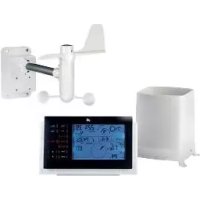
IAN 288624 - Weather Station AURIOL - Free user manual and instructions
Find the device manual for free IAN 288624 AURIOL in PDF.


| Product type | Premium weather station with anemometer and rain gauge |
| Brand | Auriol |
| Model | IAN 288624 |
| Weather station power supply | 6 AA 1.5 V batteries |
| Anemometer power supply | 2 AA 1.5 V batteries |
| Rain gauge power supply | 2 AA 1.5 V batteries |
| Battery life | Approximately 90 days |
| Indoor temperature range | 0.0 °C to +50.0 °C |
| Outdoor temperature range | -20.0 °C to +60.0 °C |
| Humidity range | 20 to 99% |
| Atmospheric pressure range | 850 to 1050 hPa / mb |
| Wind speed range | 0-30 m/s (0-108 km/h) |
| Rainfall range | 0-9999 mm |
| Transmission frequency | 433.050 to 434.790 MHz |
| Outdoor sensor range | 25 m in open area |
| Main functions | DCF-77 radio-controlled clock, alarm, weather forecast, pressure, indoor/outdoor temperature/humidity, wind speed/direction, rainfall, heat index, dew point, wind chill, min/max |
| Display | LCD screen with backlight |
| Mounting | Station: on stand or wall; anemometer: on mast Ø 25-31 mm; rain gauge: on flat surface |
| Outdoor protection rating | IPX4 (water splashes) |
| Maintenance | Clean with a damp cloth, replace batteries, clean the rain gauge leaf filter |
| Safety | Keep out of reach of children, do not ingest batteries, observe polarity |
| Box contents | Weather station, anemometer, rain gauge, screws, wall plugs, mounting ties, 10 AA batteries |
| Repairability | Battery and leaf filter replacement possible; no specific spare parts mentioned |
Frequently Asked Questions - IAN 288624 AURIOL
User questions about IAN 288624 AURIOL
0 question about this device. Answer the ones you know or ask your own.
Ask a new question about this device
Download the instructions for your Weather Station in PDF format for free! Find your manual IAN 288624 - AURIOL and take your electronic device back in hand. On this page are published all the documents necessary for the use of your device. IAN 288624 by AURIOL.
USER MANUAL IAN 288624 AURIOL
text_image
PDF online www.lidl-service.com WALI-Service.comPREMIUM-WETTERSTATION / PREMIUM WEATHER STATION / STATION MÉTÉO PREMIUM
DE AT CH
PREMIUM-WETTERSTATION
Operation and Safety Notes
NL BE
PREMIUMWEERSTATION
GB / IE Operation and Safety Notes Page 24
Premium-Wetterstation
1. Einleitung
natural_image
Technical line drawing of a mechanical device with internal components and mounting brackets (no text or symbols)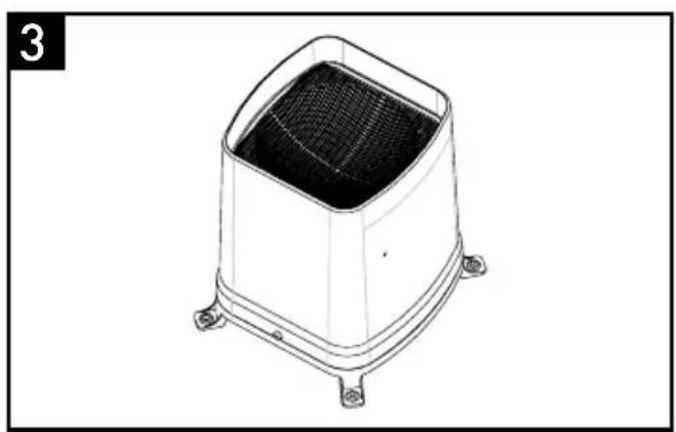
natural_image
Technical line drawing of a square-shaped electronic component with mounting feet (no text or symbols)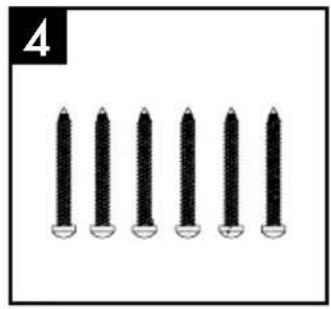
natural_image
Six black screwdrivers arranged in a row, no text or symbols visible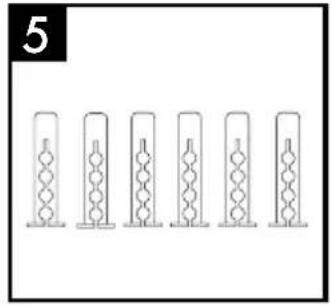
natural_image
Six identical cylindrical objects with diamond-shaped bases arranged in a row, no text or symbols visible.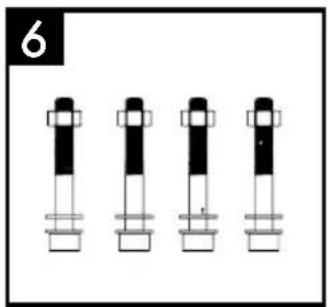
natural_image
Four identical cylindrical mechanical components with black and white segments, arranged horizontally (no text or symbols visible)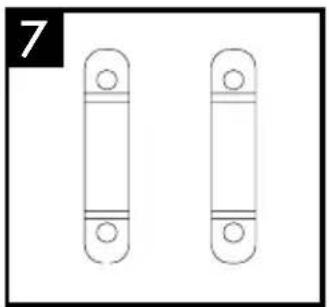
natural_image
Two identical rectangular electronic components with circular ends, no text or symbols visible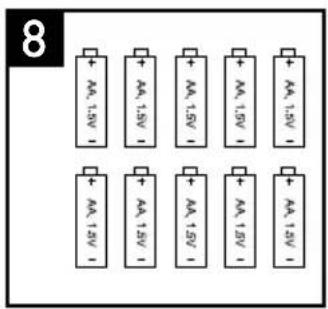
text_image
8 + AA, 1.5V - + AA, 1.5V - + AA, 1.5V - + AA, 1.5V - + AA, 1.5V - + AA, 1.5V -text_image
PHO 0.5 x 3 Ø 5 mm 5 mm 10 mmWandmontage Wetterstation:
natural_image
Technical line drawing of a mechanical component with mounting holes and a central shaft (no text or symbols)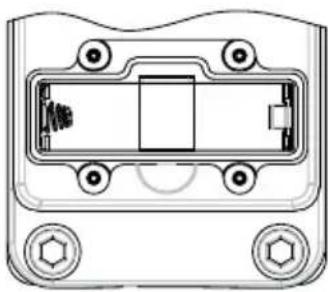
natural_image
Technical line drawing of a mechanical component with mounting holes and internal structure (no text or symbols)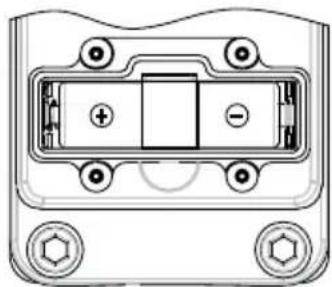
natural_image
Technical diagram of a battery pack with mounting holes and internal compartments (no text or labels)Wetterstation:
natural_image
Diagram of a device rear panel with ventilation slots and indicator lights (no text or labels)Regenmesser:
natural_image
Technical line drawing of a mechanical device with mounting brackets and internal components (no text or symbols)12. Geräteübersicht
Wetterstation:
other
| Metric | Value | | :--- | :--- | | CHD IN | 188.8°E MAX 98% | | HEAT INDEX DEW POINT MAX MIN | 188.8°E | | ZONE ALARM | 38:88 Zr | | RAINFALL DAILY MONTHLY WEEKLY TOTAL | 88.88 In mm | | Speed AVERAGE GUST ALARM Hi MAX MN Wind Chi ALARM Lo | 188.8 Beaufort mph m/s km/h knots | | SEA LEVEL PRESSURE 38.88 In Hg mb hPa | 188.8 In Hg mb hPa |natural_image
Technical line drawing of a mechanical device with no visible text or symbolstext_image
ALARM -17:16text_image
ALARM 17:16text_image
9:37 → 17:16 → 17:16flowchart
graph LR
    A["0.0 km/h"] --> B["0.0 mph"]
    B --> C["0.0 m/s"]
    D["0.0 m/s"] --> E["0.0 units"]
    E --> F["0 Deafort"]
text_image
Wind Speed AVERAGE ▲Hi 10.0 km/htext_image
Wind Chill CH! ALARM 18°Ctext_image
Wind ALARM Chill CH I -18°Ctext_image
RAINFALL 6.15 TOTAL intext_image
HEAT INDEX 26.5°C → DEW POINT 9.5°C24.5 Regenmenge
natural_image
Weather icons including sun, clouds, and raindrops (no text or symbols)text_image
CH d IN +188.8°E MAX MIN 88% HEAT INDEX DEW POINT MAX MIN +188.8°E-
Introduction......Page 25
-
General information....Page 25
-
Intended use Page 25
-
Technical data ......Page 25
-
Simplified EU declaration of conformity....Page 26
-
Safety information ......Page 26
-
Scope of delivery......Page 27
-
Definition of terms......Page 27
-
Functions ...... Page 28
-
Commissioning Page 28
-
Inserting and replacing batteries ......Page 30
-
Product overview......Page 32
-
Preparing the wind gauge and rain gauge and registering on the weather station ......Page 33
13.1 Calibrating the wind gauge......Page 33
13.2 Preparing the rain gauge....Page 33
13.3 Automatic wind gauge and rain gauge registration on the weather station....Page 34
13.4 Manual wind gauge and rain gauge registration on the weather station......Page 34
- Weather station basic settings Page 34
14.1 Setting....Page 34
14.2 DCF-77 synchronisation....Page 35
14.3 Setting the time zone....Page 35
-
Alarm function Page 36
-
Setting the air pressure unit Page 37
-
Air pressure adjustment ......Page 37
-
Setting the wind speed unit ......Page 37
-
Setting the wind alarm....Page 37
-
Setting the wind chill alarm Page 38
-
Switching the Wind Alarm and the Wind Chill Alarm on and off Page 38
-
Setting the rain gauge unit ......Page 39
-
Setting the temperature unit......Page 39
-
Display....Page 39
24.1 Date and time ......Page 39
24.2 Time zone....Page 39
24.3 Temperature and air humidity indoors/outdoors Page 39
24.4 Displaying Heat Index and Dew Point......Page 39
24.5 Rainfall quantity....Page 39
24.6 Ice/frost alarm Page 40
24.7 Wind direction....Page 41
24.8 Wind speed ......Page 41
24.9 Air pressure change Page 41
24.10 Minimum and maximum values......Page 41
24.11 Weather forecast ......Page 41
24.12 Weather trend....Page 41
- Maintenance Page 41
25.1 Battery charge indicator......Page 41
25.2 Rain gauge leaf filter Page 42
- Troubleshooting errors in the measuring results Page 42
26.1 Trouble-shoot on weather station......Page 42
-
Cleaning Page 43
-
Disposal Page 43
Premium weather station
1. Introduction
We congratulate you on the purchase of your new product. You have chosen a high quality product. The instructions for use are part of the product. They contain important information concerning safety, use and disposal. Before using the product, please familiarise yourself with all of the safety information and instructions for use. Only use the unit as described and for the specified applications. If you pass the product on to anyone else, please ensure that you also pass on all the documentation with it.
2. General information
ATTENTION! READ OPERATING INSTRUCTIONS BEFORE USE! KEEP OPERATING INSTRUCTIONS IN A SAFE PLACE! THIS PRODUCT IS NOT A TOY! KEEP OUT OF REACH OF CHILDREN.
Read the operating instructions carefully and use the product as described in the instructions to avoid injury and damage. We accept no responsibility for damage resulting from inappropriate use and failure to comply with the safety instructions.
Symbols used in these instructions:

WARNS OF RISK OF INJURY!
The word DANGER warns of possible risks of severe or fatal injury.
The word CAUTION warns of possible risks of minor injury or damage.

POINTS TO FURTHER INFORMATION!
3. Intended use
The weather station informs you of the current weather conditions and provides a weather forecast. The weather station is equipped with a rain gauge,
wind gauge, barometer, radio clock and calendar. Only for personal use. Not for commercial use.
4. Technical data
Measuring Range:
Room Temperature: 0.0 °C to +50.0 °C,
Resolution: 0.1 °C
32.0 °F to 122.0 °F,
Resolution: 0.1 °F
Outside Temperature: -20.0 °C to +60.0 °C
Resolution: 0.1 °C
-4.0 °F to +140.0 °F
Resolution: 0.1 °F
Air humidity: 20 to 99 %
Resolution 1 %
Air pressure: 850 mb to 1050 mb
850 hPa to 1050 hPa
25.1 inHg to 31 inHg
(mercury column in inches)
Wind speed: 0–30 m/s
0-108km/h
0-67 mph
0-58.3 knot
0-11 Beaufort
Rainfall measurement: 0–9999 mm
0-393.66 inch
Frequency Band: 77.5 kHz, 433.050 to
434.790 MHz
Outdoor sensor range: 25 m (open area)
Transmitted maximum
radio-frequency power: 433.9 MHz, <10 dBm
Exceeded range of measurement:
The following displays can be expected outside of the range of measurement:
Readings below the measurement values:
- Room temperature below 0 °C: LL.L
- Outdoor temperature below -50 °C: LL.L
- Air humidity below 20 %: 20 %
- Air pressure below 850 hPa: 850 hPa
- Heat Index below 14 °C: LL.L
- Dew Point below 0 °C: LL.L
- Wind Chill below -90 °C: LL.L
Values above the measurement values:
- Room temperature above 50 °C: HH.H
- Outdoor temperature above 70 °C: HH.H
- Air humidity above 99 %: 99 %
- Air pressure above 1050 hPa: 1050 hPa
- Heat Index above 60 °C: HH.H
- Dew Point above 60 °C: HH.H
- Wind Chill above 60 °C: HH.H
- Rainfall quantity above 9999 mm: HHH
- Wind speed above 50 m/s: 50 m/s
- Degree of protection for wind gauge and rain gauge: IPX4 (splash-proof)


WARNING!
The display becomes increasingly less clear in temperatures under approximately -20 ^ . Depending on the type of battery, power limitations are to be expected at low temperatures (normally as of -20 ^ ). Do not place the weather station or the external sensor in direct sunlight.

CAUTION!
At temperatures above 60 °C (also depending on the type of battery), the battery acid may leak.
Power Supply:
Weather station: 6 x 1.5 V === (Direct current) battery, type AA
Wind gauge: 2 x 1.5 V === (Direct current) battery, type AA
Rain gauge: 2 x 1.5 V === (Direct current) battery, type AA
Operating life with
full batteries: approx. 90 operating days.
5. Simplified EU declaration of conformity
Hereby, OWIM GmbH & Co. KG, Stiftsbergstraße 1, DE-74167 Neckarsulm, GERMANY, declares that the product Premium weather station H13726, is in
compliance with Directives 2014/53/EU, 2011/65/EU and 2009/125/EC.
The full text of the EU declaration of conformity is available at the following internet address: www.owim.com
6. Safety information

■ Swallowing batteries could be fatal. Keep batteries and the weather station out of the reach of children. Consult a doctor immediately if a battery is swallowed.

DANGER OF INJURY!
■ Remove the batteries from the product when empty.
■ Never short-circuit the connection poles.
This product can be used by children aged from 8 years and above and persons with reduced physical, sensory or mental capabilities or lack of experience and knowledge if they have been given supervision or instruction concerning use of the product in a safe way and understand the hazards involved. Children shall not play with the product. Cleaning and user maintenance shall not be made by children without supervision.

CAUTION - MATERIAL DAMAGE!
■ Only use the specified battery type.
■ Ensure correct polarity.
- Check the batteries regularly for leaks.
If the product is not used for long periods of time, remove the batteries.
- Do not immerse the weather station or the external sensor in water or other liquids.
■ Follow the instructions for cleaning and storage in this manual.
7. Scope of delivery
text_image
1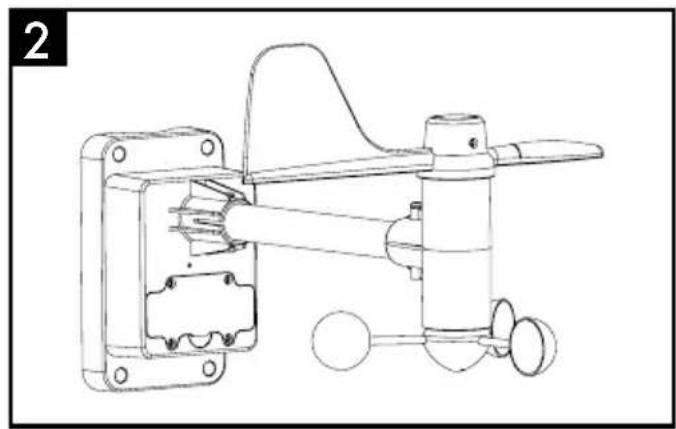
natural_image
Technical line drawing of a mechanical device with internal components and mounting brackets (no text or symbols)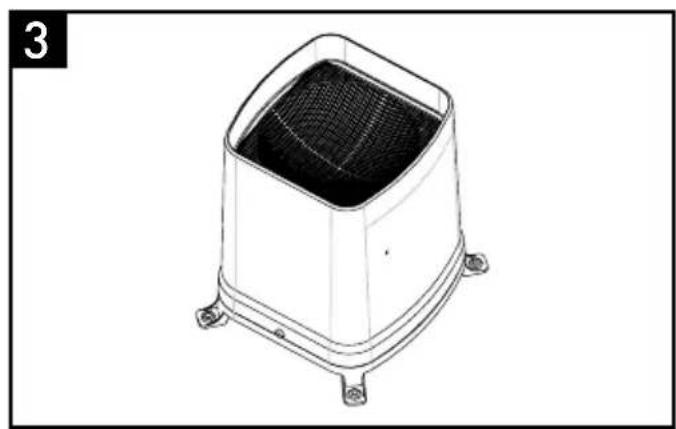
natural_image
Technical line drawing of a square industrial component with internal mesh structure and mounting feet (no text or symbols)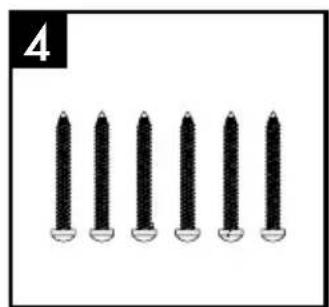
natural_image
Six black screwdrivers arranged in a row, no text or symbols visible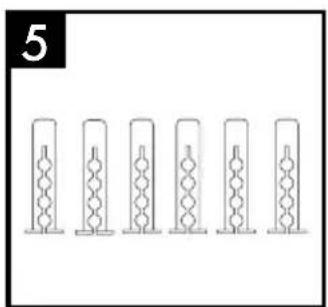
natural_image
Five identical cylindrical objects with internal diamond-like structures, arranged horizontally (no text or symbols)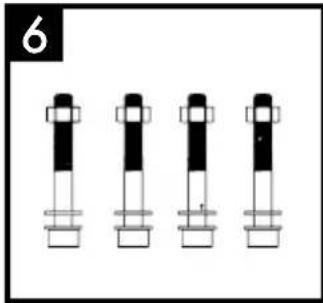
natural_image
Four identical cylindrical mechanical components with black and white segments, arranged horizontally (no text or symbols visible)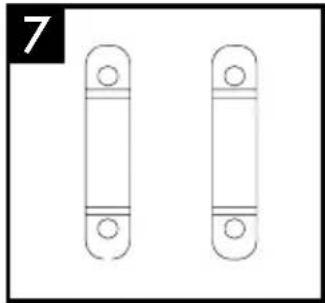
natural_image
Two identical rectangular objects with circular ends, no text or symbols present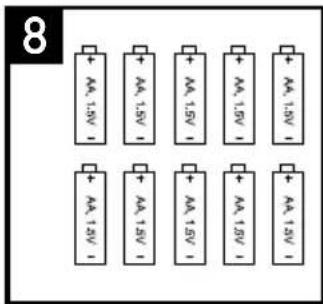
text_image
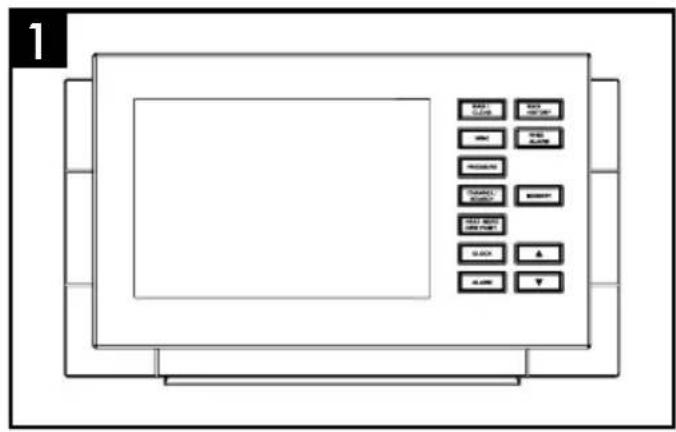
8 + AA, 1.5V - + AA, 1.5V - + AA, 1.5V - + AA, 1.5V - + AA, 1.5V - + AA, 1.5V -1 1 weather station with stand
2 1 wind gauge with integrated temperature and air humidity sensor
3 1 rain gauge with leaf filter
4 6 screws suitable for ∅ 5 mm dowels
5 6 dowels ∅ 5 mm
6 4 hexagonal socket head bolt M6 including 4 nuts and 8 washers
7 2 mounting clamps for wind gauge
8 10 pcs AA battery
8. Definition of terms
Dew Point:
The dew point (Dew Point) refers to the point at which the air releases water vapour in the form of fog and / or condensate.
Example: if the air is cooled down constantly and the air humidity stays the same, the relative air humidity increases to 100 %. This means that the dew point has been reached and the cooled air contains the maximum possible water vapour at this temperature.
Heat Index:
The heat index (Heat Index) is the air temperature felt on the human body taking into consideration the measured air temperature and the air humidity.
Wind Chill:
The wind chill (Wind Chill) refers to the difference between the measured (air temperature) and the
temperature felt on the human body, which depends on the wind speed. The wind chill is the measurement used for wind-dependant cooling of an object. Humans feel this wind chill particularly on the face. As wind chill can only be calculated for temperatures close to or under the 0 °C limit, it is mostly replaced by the heat index for higher temperatures (Heat Index).
9. Functions
Weather station:
- Radio-controlled DCF-77 time signal reception with time display, time-zone setting
- Date display
- Alarm clock with snooze function
- Room temperature and interior humidity display with storage of the minimum and maximum measurement values
- Outside temperature and outside humidity display with storage of the minimum and maximum measured values
- Barometric pressure display
- Weather trend display
- Battery status display (weather station, wind gauge and rain gauge)
- Wind direction display
- Wind speed with wind alarm
- Dew point display (Dew Point)
- Ice/frost alert
- Precipitation display
- Wind speed and wind direction display
- Wind chill display (Wind Chill)
- Can be mounted standing or hanging
- For indoor use only
Wind gauge:
- Transmits the wind speed, temperature and humidity to the weather station on 434 MHz frequency
- Assembled on a mast of approx. ∅ 25-31 mm
- Can only be assembled in areas free from buildings, walls or other obstructions, as the measurement values will otherwise be impaired.
Rain gauge:
- Transmits rainfall quantity to the weather station on 434 MHz frequency
- Easy to stand or mount with screws on an even surface
- It is best to stand or mount the rain gauge in an areas which are not protected from rain.

CAUTION!
Comply with the following safety instructions when using the wind gauge and rain gauge:
- Never immerse the measuring products in water or other liquids
- Never place the measuring products in ovens or microwaves
- Never expose the measuring products to temperatures below -20^ or above 60^
- Keep the measuring product away from chemicals
10. Commissioning

WARNING!
Familiarize yourself with the weather station, wind gauge and rain gauge before assembly. The operating instructions are easier to understand if you are holding the products in your hand while reading them.
Setting up the weather station:
The weather station comes with a pre-assembled stand, making it easy to set up the weather station in the desired position.
Note: Remove the protection foil form the display (weather station) before use.
Note: Remove all packing material before use
text_image
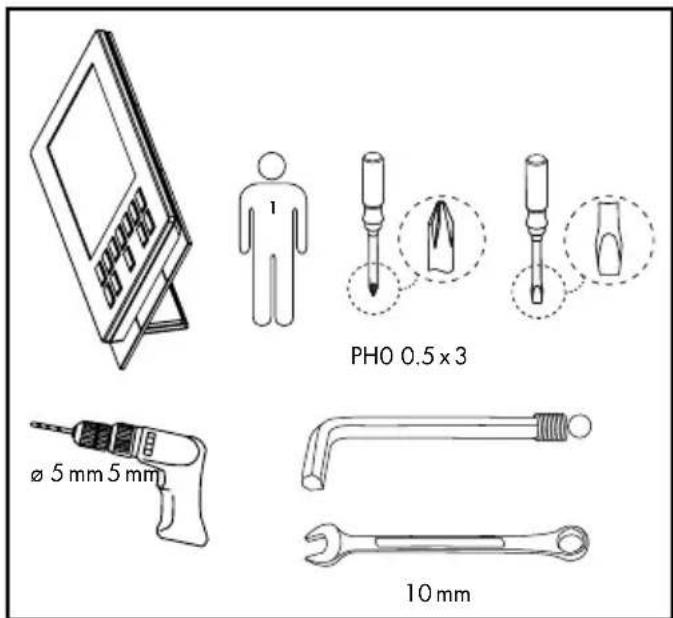
PHO 0.5 x 3 Ø 5 mm 5 mm 10 mmWeather station – wall mounting:
- Mark the drill holes (horizontal distance approximately 11.3 cm) for the weather station and make sure that no electrical or water lines will be damaged before drilling the holes ( 5 mm).
- Push the dowel into the drilled hole until it is flush with the wall.
- Screw the supplied screws into the dowels, allowing them to protrude slightly for the weather station to be hung on.
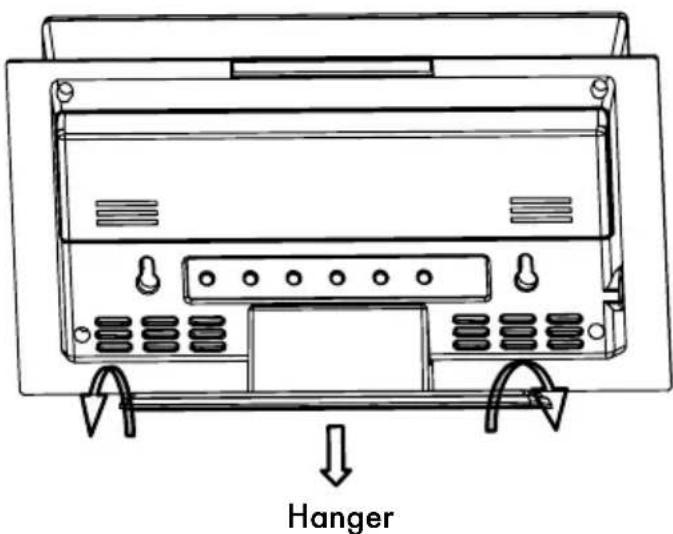
The pre-assembled stand can be removed from the weather station. Fold the stand downwards and pull it out of the slot. To attach again, follow the same procedure in reverse order.
text_image
Hanger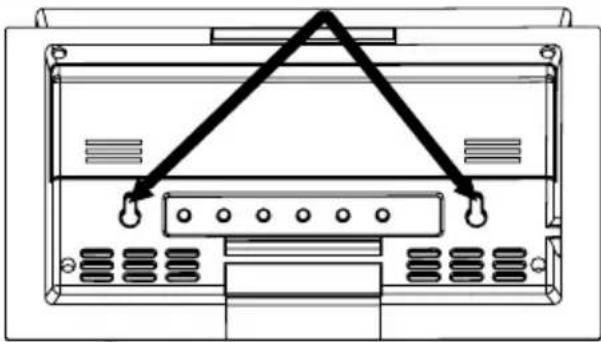
natural_image
Diagram of a device rear panel with connectors and ports, no text or symbols presentWind gauge assembly:
Choose a suitable location for your wind gauge.
- The wind gauge must be set up outdoors.
- The wind must be able to access the wind gauge from all sides to enable the wind force and wind direction to be measured accurately.
- Ensure that the vane and the wind wheel are not blocked to guarantee accurate measurements.
- The wind gauge must be assembled within the signal transmission range. Walls reduce the transmission range. Check the signal reception on the weather station before final assembly.
Ideally, the wind gauge should be mounted on a mast or roof of a house, where the wind can act directly on the wind gauge.
A mast is required with a diameter of approx. 25–31 mm (not included) which stands stable and vertical. Mount the wind gauge as shown below with the hexagonal socket head bolt, washers, mounting screws and nuts provided. After assembly, ensure that the wind gauge is positioned horizontally with a stable hold.
The wind gauge must be positioned horizontally to guarantee accurate measurements.
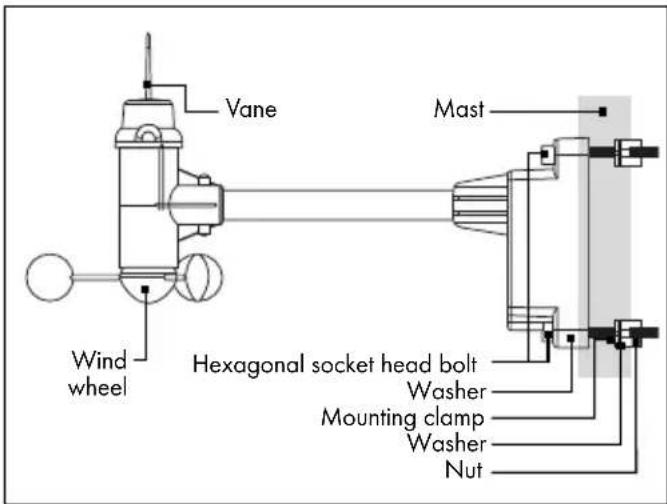
text_image
Vane Wind wheel Mast Hexagonal socket head bolt Washer Mounting clamp Washer NutSetting up the rain gauge:
Choose a suitable location for the rain gauge.
- The rain gauge must be positioned outdoors. The product must not be impaired by objects and obstructions. Do not position under trees or next to walls.
- The rain must be able to fall on the rain gauge without obstructions to achieve an accurate rainfall measurement.
- Ensure that rain water does not accumulate under the rain gauge. It must be able to flow off freely.
- The rain gauge must be assembled within the range of the signal transmission. Walls reduce the transmission range. Check the signal reception on the weather station before final assembly.
When you have found a suitable position, ensure that the surface is completely horizontal to guarantee accurate rainfall measurement.
The rain gauge can simply be stood in the desired position or fixed with the screws provided.
- Mark the drill holes using the rain gauge before drilling the holes (ø 5 mm), ensure that no electrical cables or water pipes can be damaged.
- Push the supplied dowel into the drilled hole until it is flush with the wall.
- Fix the rain gauge with the screws provided.
11. Inserting and replacing batteries
Put the batteries first into the outdoor sensor (wind gauge / rain gauge), then into the weather station.
Wind gauge:
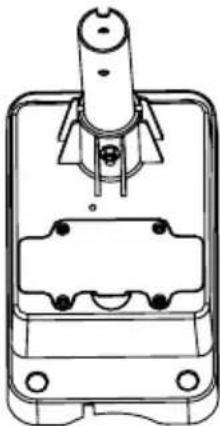
- The wind gauge must be recalibrated when using it for the first time as well as every time the battery is replaced. Please refer to section 13.1. To open the battery compartment, loosen the 4 cross-head screws on the battery compartment cover.
- Lift off the battery compartment cover.
- Insert the batteries (2 x 1.5 V type AA) ensuring correct polarity. Ensure that the black strap lies under the batteries. This strap can be used to remove the batteries when they need to be replaced.
- Place the battery compartment lid on the battery compartment again. Ensure that the sealing ring on the battery compartment is positioned correctly in the recess. Only then is the battery compartment waterproof.
- Tighten the 4 screws on the battery compartment cover again.
natural_image
Technical line drawing of a mechanical component with mounting holes and a central pin (no text or symbols)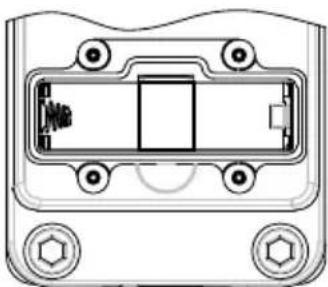
natural_image
Technical line drawing of a mechanical component with mounting holes and internal structure (no text or symbols)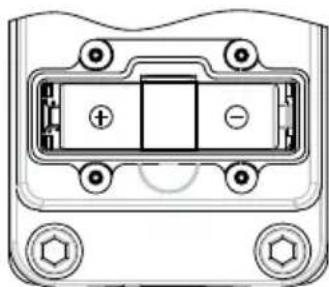
natural_image
Technical diagram of a mechanical or electrical component with no visible text or symbolsWeather station:
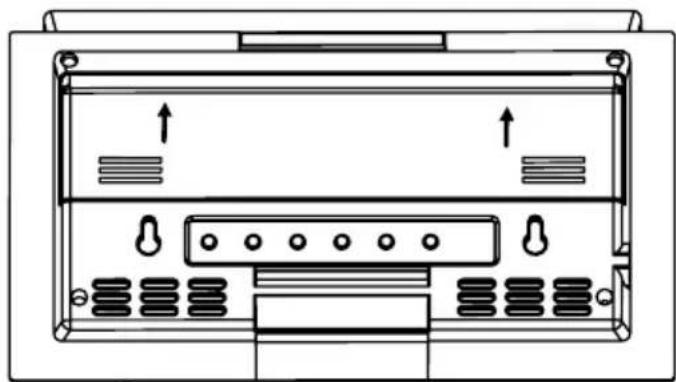
- Open the battery compartment on the rear of the weather station in the direction of the arrow.
- Insert the batteries (6 x 1.5 V type AA) ensuring correct polarity. When one of the two battery rows is full, a beep sounds.
- Place the battery compartment cover on the battery compartment to close. Push the battery compartment cover in the opposite direction to the arrows until it engages.
natural_image
Diagram of a device rear panel with labeled ports and connectors (no text or symbols)Rain gauge:
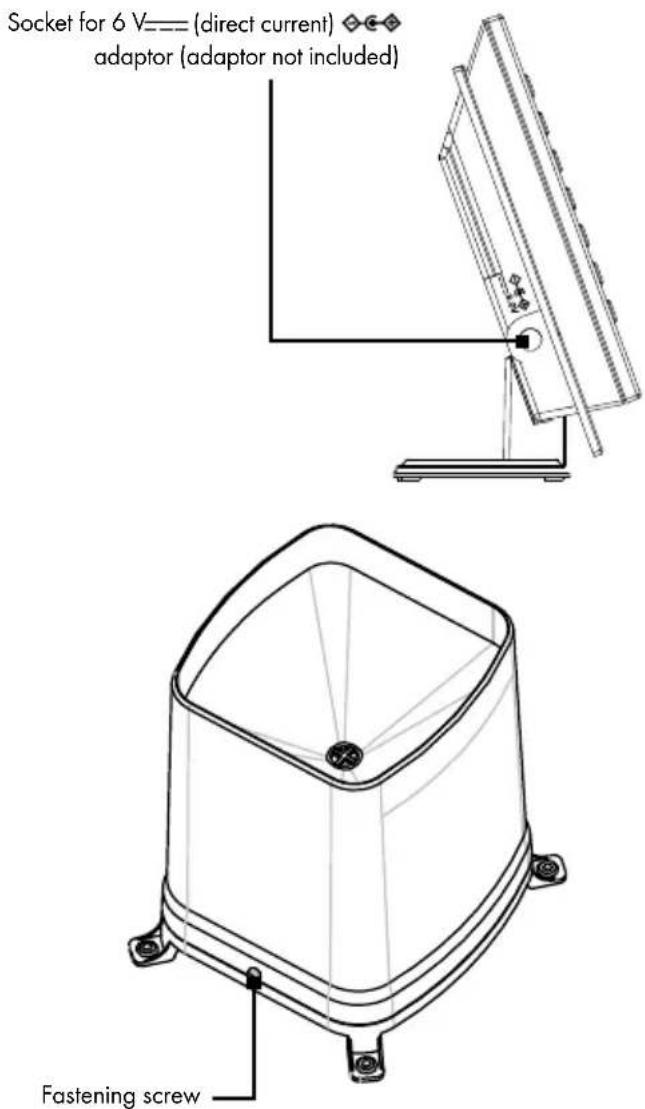
- Use a slotted screwdriver to loosen the 2 adjacent fastening screws on the housing of the rain gauge.
- Lift the housing carefully off the base of the product.
- To open the battery compartment, loosen the 4 cross-head screws on the battery compartment cover.
- Lift off the battery compartment cover.
- Insert the batteries (2 x 1.5 V type AA) ensuring correct polarity.
- Place the battery compartment lid on the battery compartment again. Ensure that the sealing ring on the battery compartment is positioned correctly in the recess. Only then is the battery compartment waterproof.
- Tighten the 4 screws on the battery compartment cover again.
- Place the housing carefully over the base of the product.
- Fix the housing onto the base of the product again with fastening screws.
text_image
Socket for 6 V——(direct current) adaptor (adaptor not included) Fastening screw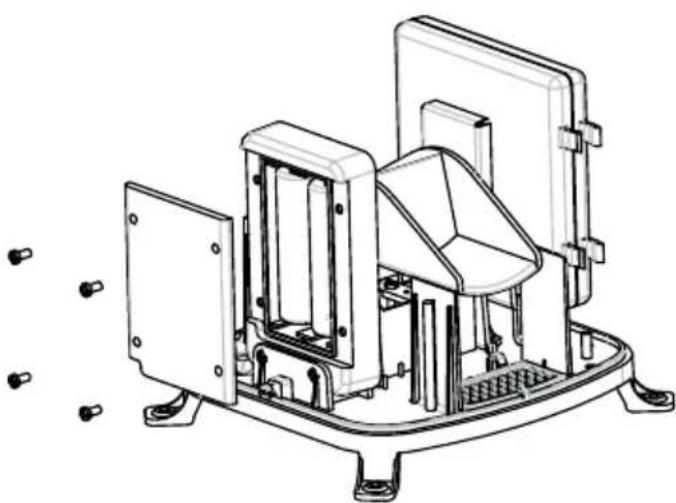
natural_image
Technical line drawing of a mechanical device with mounting flanges and internal components (no text or symbols)12. Product overview
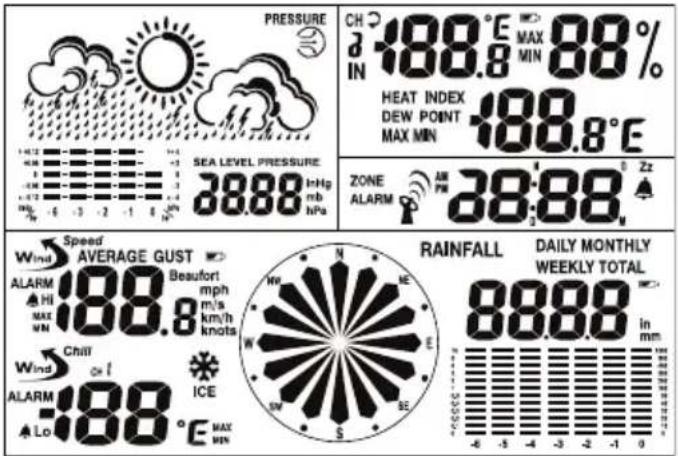
Weather Station:
Weather forecast and air pressure
Temperature display and air humidity indoors/outdoors
other
| Metric | Value | | :--- | :--- | | CH IN | 188.8°E MAX 88% | | HEAT INDEX DEW POINT MAX MIN | 188.8°E | | ZONE ALARM | 38.88 | | RAINFALL DAILY MONTHLY WEEKLY TOTAL | 88.88 in mm | | SPEED AVERAGE GUST ALARM Hi MAX Min Wind Alarm Lo | 188.8 | | BEAUTORT mph m/s km/h knots | 188.8 | | ICE MAX MIN | 188.0 |Wind speed, wind direction and rainfall quantity
Time and alarm
Buttons - front side
| Button Press | once Press for | ap-prox. 3 sec. |
| RAIN/CLEAR | Precipitationquantity day/week/month/total | Delete data |
| WIND Average | wind speed (AVER-AGE) and gusts of wind (GUST) | |
| PRESSURE Air | pressure unit modification(inHg, mb or hPa) | Air pressure adjustment |
| CHANNEL/SEARCH | Channel selec-tion (inside, out-side or alternate) | Search for transmitter sensors |
| HEAT INDEX | Switch display between temper-ature felt by humans (Heat Index) and dew point (Dew Point) | |
| DEW POINT |
| Button Press | once Press for | ap-prox. 3 sec. |
| CLOCK Switch | display between local time, date and day of the week | Set date and time |
| ALARM Display | and active/deactivate alarm time | Set alarm time |
| RAIN HISTORY | Current precipitation display and precipitation display for the last 6 days / weeks/months | |
| WIND ALARM | Display of Wind Alarm and Wind Chill Alarm | |
| MEMORY Display | play of automatically saved min. and max. values for temperature, air humidity, dew temperature (Dew Point), temperature felt by humans (Heat Index), wind chill (Wind Chill) and wind speed | |
| ▲ Settings | forwards | Settings fast-forwards |
| ▼ Settings back | Settings rewind |
Buttons - back side
| Button | Press once Press for approx. 3 sec |
| WIND AL♠ | Switch the Wind Alarm and Wind Chill Alarm on and off |
| Button Press | once Press for | ap-prox. 3 sec. |
| WIND UNIT Set | the windspeed unit(Beaufort, mph,m/s, km/h or knots) | |
| RAIN UNIT Set | the rainfallquantity measurement unit(mm or inch) | |
| Search for the DCF-77 transmission signal | ||
| ZONE Switch between local time and world time | Set world time | |
| C/F Switch from °C to °F | ||
| SNOOZE / LIGHT | Snooze function/ background lighting | |
Wind gauge:
Housing with built-in temperature gauge and air humidity gauge
Vane with built-in compas
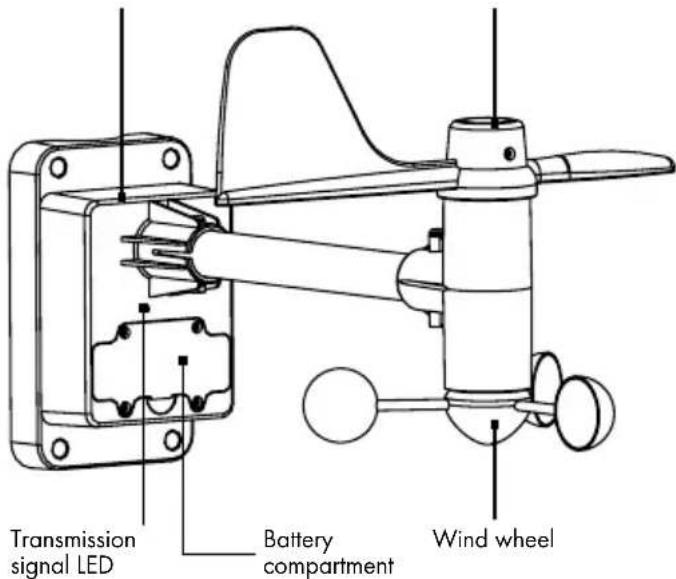
text_image
Transmission signal LED Battery compartment Wind wheel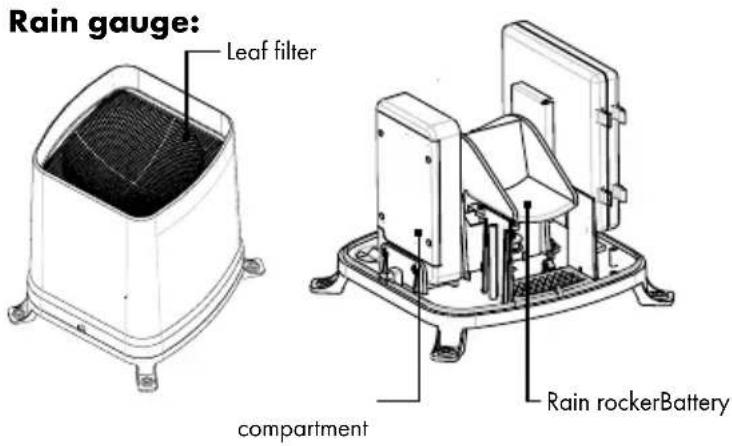
text_image
Rain gauge: Leaf filter compartment Rain rockerBattery13. Preparing the wind gauge and rain gauge and registering on the weather station
13.1 Calibrating the wind gauge
The wind gauge must be recalibrated when using it for the first time as well as every time the battery is replaced. Follow the procedure outlined below:
- Before inserting the battery, point the vane north.
- Be sure the wind wheel and vane are not turning.
- Insert the batteries, ensuring correct polarity (see the instructions listed under Point 11. Inserting and replacing batteries / Wind gauge).
- The transmission signal LED lights up briefly. The wind gauge is now calibrated.
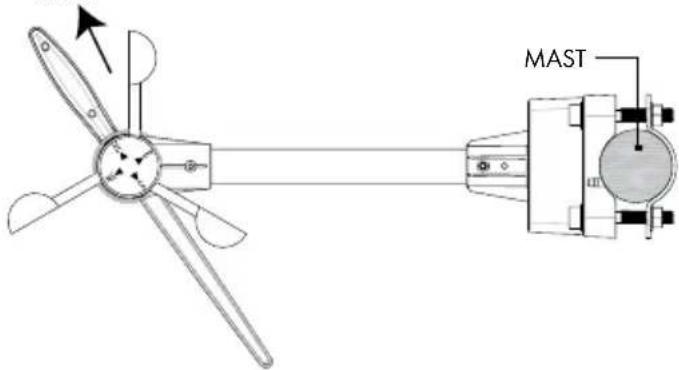
text_image
MAST13.2 Preparing the rain gauge
- Insert the batteries in the rain gauge (see the instructions listed under Point 11. Inserting and replacing batteries/Rain gauge).
- Remove the transport protection which holds the rain rocker.
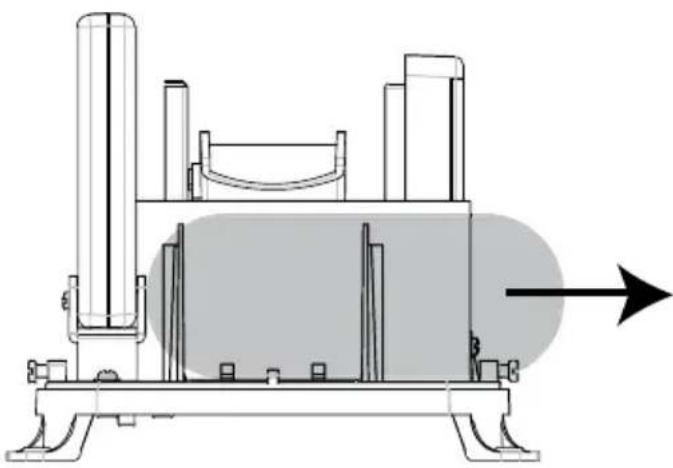
natural_image
Technical line drawing of a mechanical assembly with no visible text or symbols13.3 Automatic wind gauge and rain gauge registration on the weather station
After inserting batteries in the wind gauge and the rain gauge, insert batteries in the weather station (see the instructions listed under Point 11. Inserting and replacing batteries / Weather station).
The weather station searches automatically for the transmission signals from the wind gauge and rain gauge. The process takes approx. 4 minutes.
13.4 Manual wind gauge and rain gauge registration on the weather station
After the batteries have been replaced in the wind gauge and rain gauges, they must be registered again on the weather station. After replacing the batteries and calibrating the wind gauge, press the CHANNEL / SEARCH button on the weather station for approx. 5 seconds. The entry is confirmed with a confirmation tone. The measurement value displays now flash on the wind gauge and rain gauge displays. The process can take up to 4 minutes
14. Weather station basic settings
14.1 Setting
- 12/24 hour format
- Time
- Date format
- Date
Jump to the next menu item with the CLOCK button. Press ▲ and ▼ to make the settings. If none of the setting buttons has been pressed for approx. 60 seconds, the weather station returns automatically to the time display.
12/24 hour format:
While in the time display, press the CLOCK button for approximately 3 seconds to access the setting mode. 24 h flashes on the display. Press ▲ and ▼ to switch between 24 h and 12 h display. AM / PM is displayed in the morning / in the afternoon to the left of the time in 12 h display mode.

text_image
24h 12h 759 500Hours:
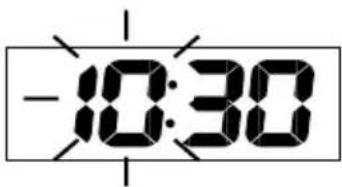
Press the CLOCK button to set the hour. The hours now flash on the display. Use ▲ and ▼ to set the hour.
text_image
-10:30Minutes:
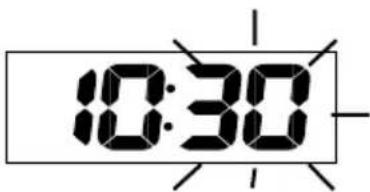
Press the CLOCK button again to set the minutes. The minutes now flash on the display. Use ▲ and ▼ to set the minutes.
text_image
10:30Year:
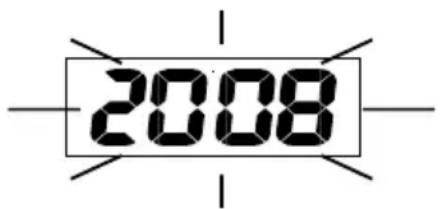
Press the CLOCK button a second time to set the year. The year now appears on the display. Use ▲ and ▼ to set the year.
text_image
2008Date format:
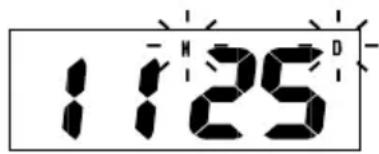
Press the CLOCK button again to set the month format. The letters D (D = Day) and M (M = Month) flash in the date on the display. Use ▲ and ▼ to set the date format.
text_image
1125Month:
Press the CLOCK button again to set the month. The month now flashes on the display. Press ▲ and ▼ to set the month.
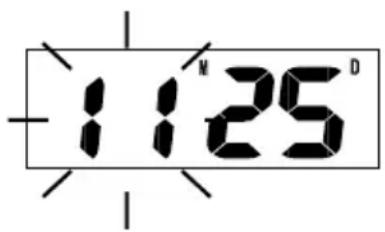
text_image
1125 M DDay:
Press the CLOCK button again to set the day. The date now flashes on the display. Press ▲ and ▼ to set the day.
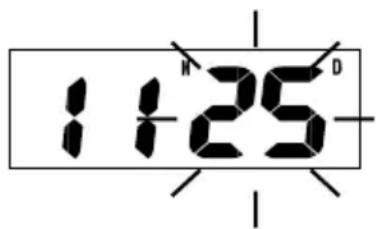
text_image
1125Press the CLOCK button again to return to the time display.
14.2 DCF-77 synchronisation
This functions sets the time and date automatically. Press ⚡ on the back side to activate the synchronisation for radio-controlled DCF-77 time information. Press ⚡ and the ⚡ symbol appears on the display. When the transmission signal is received, a ⚡ symbol appears. If no radio waves appear, no DCF 77 reception is available in this location. If the reception is stable, the ⚡ symbol is shown continuously on the display after approx. 3–5 minutes.
Press 📋 again to deactivate the DCF-77 synchronisation.

WARNING!
The displays for time and date in Central Europe are transferred via DCF-77 radio signals. The transmitter is close to Frankfurt and transmits on a transmission radius of approximately 1500 km. If your weather station receives this signal, it is not necessary to switch to and from daylight savings time.
The reception quality can be restricted by the geographical location (e.g. deep valleys) or structural conditions (e.g. behind concrete walls).
Electromagnetic fields can also have a negative influence on signal (DCF) reception. Position the weather station and the external sensor in a suitable location. Follow the instructions listed under "DCF-77 synchronisation" to switch on the transmission signal again.
14.3 Setting the time zone
You can switch between local time and the selected zone time while the time is displayed. The time zones are divided into 24 zones. You can select a time zone from +12 hours to -12 hours.
Setting the time zone:
Press and hold the ZONE button on the back side for approximately 3 seconds. A confirmation signal sounds and 0 flashes on the display.
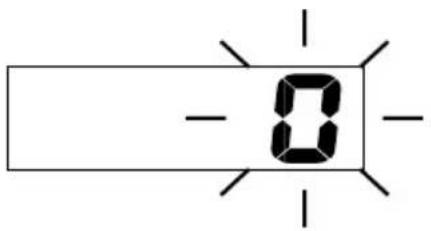
text_image
0Press ▲ and ▼ to set the time zone. You can select a time zone from +12 hours to -12 hours.
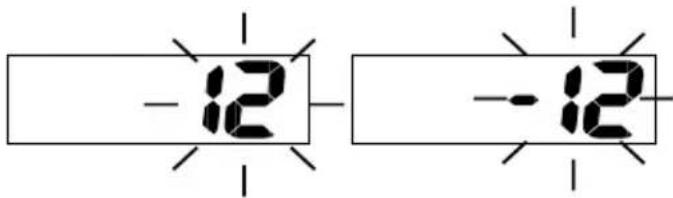
text_image
-12 -12Press the ZONE button to return to the time display. If no setting button is pressed for 60 seconds while in the time zone setting mode, the weather station automatically returns to the time display.
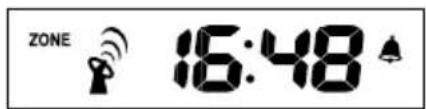
You can use the ZONE button to display the selected time zone. ZONE appears next to the time. By pressing the ZONE button again, you are returned to your local time.
text_image
ZONE 16:48
WARNING!
When setting the time zone, use the following specifications:
Set -1 Hr.:
Atlantic, Great Britain, Ireland, Iceland, Portugal
Set 0 Hrs.:
Albania, Belgium, Bosnia-Herzegovina, Denmark, Germany, France, Gibraltar, Italy, Croatia, Liechtenstein, Luxembourg, Malta, Macedonia, Monaco, The Netherlands, Norway, Austria, Poland, San Marino, Sweden, Switzerland, Serbia, Slovakia, Slovenia, Spain (with the exception of the Canary Islands), Czech Republic, Hungary
Set +1 Hr.:
Bulgaria, Estonia, Finland, Greece, Latvia, Lithuania, Moldova, Romania, Turkey, Ukraine, Cyprus
All other time zones can be found in your Atlas or on the Internet.
15. Alarm function
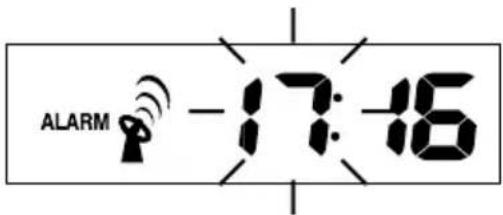
To set the alarm time, press and hold the ALARM button for 3 seconds while the time is displayed. When the confirmation signal has sounded, ALARM appears on the display and the hours flash.
text_image
ALARM -17:16Use ▲ and ▼ to set the hours.
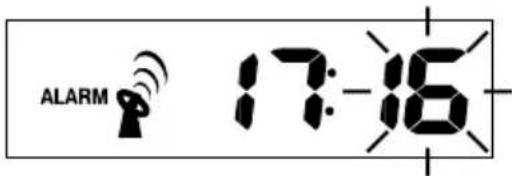
Press the ALARM button again to jump to the minute setting. The minutes flash in the display.
text_image
ALARM 17:16Use ▲ and ▼ to set the minutes. Press the ALARM button to return to the time display.
The alarm function is activated and appears next to the time.
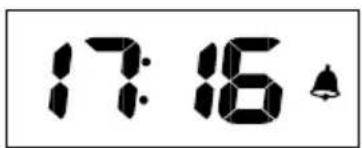
text_image
17:15Deactivating the alarm function:
Press the ALARM button twice while the time is displayed until ⬆ disappears.

text_image
9:37 17:16 17:16Press the ALARM button again to reactivate the alarm function. Press the CLOCK button to return to the time display.
If no button is pressed for approximately 20 seconds while the switch is being made, the weather station automatically returns to the time display.
Switching the alarm signal off:
The alarm signal sounds for approx. 2 minutes and flashes on the display. The alarm can be turned off prematurely by pressing the ALARM button.
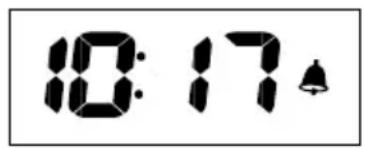
text_image
10:17Snooze function:
Press the SNOOZE / LIGHT button to pause the alarm signal for approx. 10 minutes. During this period, flashes above the time display.
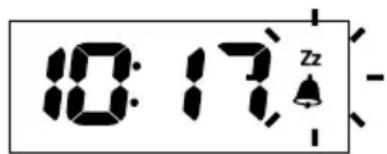
text_image
10:17 ZzThe alarm signal then sounds again for approximately 2 minutes. You can interrupt the alarm signal again with the SNOOZE / LIGHT button or switch it off with the ALARM button.
16. Setting the air pressure unit
Press the PRESSURE button to switch between the units hPA (Hectopascal), mb (Millibar) and inHg (Mercury column in inches).

text_image
SEA LEVEL PRESSURE 10 13 hPa SEA LEVEL PRESSURE 10 13 mb SEA LEVEL PRESSURE 29.91 mmHg17. Air pressure adjustment
When batteries have been inserted in the weather station, an air pressure of 1013 hPa appears on the display. This value is pre-set. You can adjust the air pressure to suit your current location. First find out the current air pressure value, e.g. from the newspaper or Internet.
Hold the PRESSURE button down for approx. 3 seconds until you hear a confirmation tone. The air pressure value now flashes on the display. Use ▲ or ▼ to set the desired value. Press the PRESSURE button to return to the standard display. The standard display will also appear automatically if no setting button is pressed for approx. 1 minute.
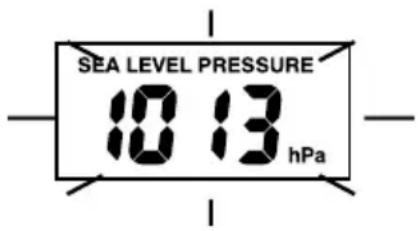
text_image
SEA LEVEL PRESSURE 10:13 hPa18. Setting the wind speed unit
The wind speed can be displayed in 5 different units.
- km / h (kilometres per hour)
- mph (miles per hour)
- m / s (meters per second)
- knots
- Beaufort
Press the WIND UNIT button on the rear side of the weather station to switch between the different units.
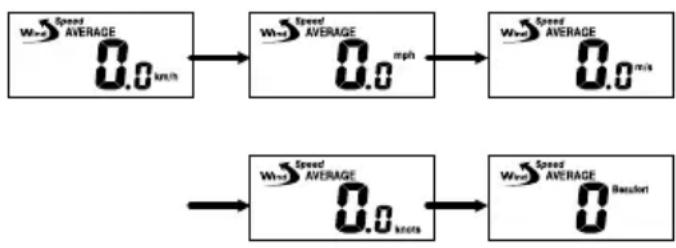
flowchart
graph LR
    A["0.0 mph"] --> B["0.0 mph"]
    B --> C["0.0 m/s"]
    D["0.0 knots"] --> E["0.0 Bestort"]
19. Setting the wind alarm
A wind alarm can be set for gusts (maximum speed for the last 10 minutes). Press the WIND ALARM button on the backside until ALARM and GUST appears on the display.
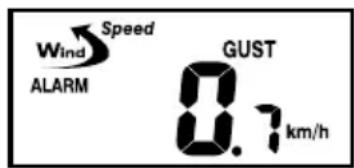
text_image
Wind Speed ALARM GUST 0.7 km/hHold the WIND ALARM button down for approx. 3 seconds until a confirmation tone sounds and the value flashes.
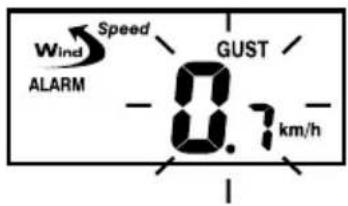
text_image
Wind Speed ALARM GUST -0.7 km/hUse ▲ or ▼ to set the desired value. Press the WIND ALARM button to confirm the entry and ▲Hi appears on left next to the wind speed.
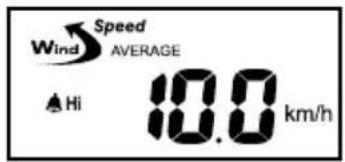
text_image
Wind Speed AVERAGE ▲ Hi 10.0 km/hThe wind alarm is now activated. Press WIND AL on the back side to deactivate the wind alarm again. Press WIND AL until disappears.
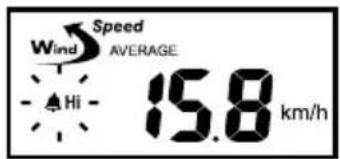
If a gust of wind reaches or exceeds the set value, a warning signal sounds for approx. 1 minute and Hi flashes in the display.
text_image
Wind Speed AVERAGE Hi 15.8 km/hPress WIND ALARM to stop the alarm tone prematurely. ▲Hi flashes until the gusts of wind (over the last 10 minutes) fall below the set limit value again.
20. Setting the wind chill alarm
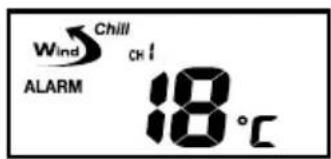
A Wind Chill Alarm can also be set. Press the WIND ALARM button until ALARM appears next to the Wind Chill temperature.
text_image
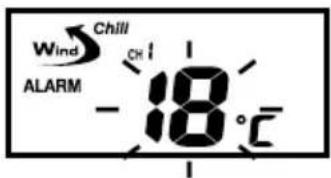
Wind Chill CHI ALARM 18°CHold the WIND ALARM button down for approx. 3 seconds until a confirmation tone sounds and the value flashes.
text_image
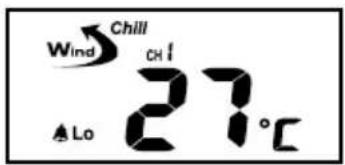
Wind ALARM Chill 18°CUse ▲ or ▼ to set the desired value. Press the WIND ALARM to confirm the entry, which then appears on left next to the Wind Chill temperature ▲Lo
text_image
Wind Chill CH I 27°C LoThe Wind Chill Alarm is now activated. Press the WIND AL button to deactivate the Wind Chill Alarm. Press WIND AL until disappears.
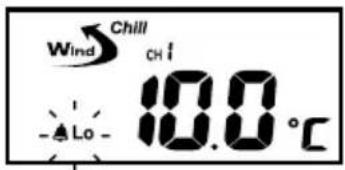
If the Wind Chill Temperature reaches or falls below the set value, a warning signal sounds for approx. 1 minute and ▲Lo flashes in the display.
text_image
Wind Chill CHI -Lo- 10.0°CPress WIND ALARM to stop the alarm tone prematurely. ▲Lo flashes until the Wind Chill Temperature rises above the limit value again.
21. Switching the Wind Alarm and the Wind Chill Alarm on and off
Press the WIND AL button to switch the wind alarm and Wind Chill Alarm on and off. If the alarm is switched on, the relevant alarm symbol Hi / Lo appears.
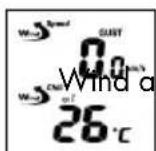
nd Wind Chill Alarm off
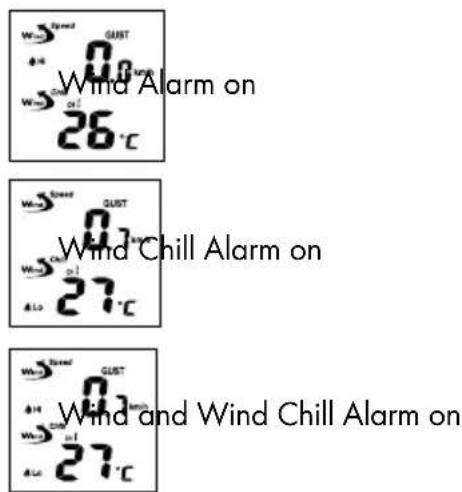
text_image
Wind Alarm on 26°C Wind Chill Alarm on 27°C Wind and Wind Chill Alarm on 27°C22. Setting the rain gauge unit
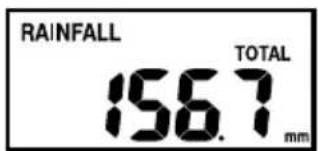
You can choose between displaying the rainfall quantity in mm (millimetres) or in (inches). Press the RAIN UNIT button on the rear side of the weather station. Each time the button is pressed, the unit on the display changes.
text_image
RAINFALL 156.7 TOTAL mm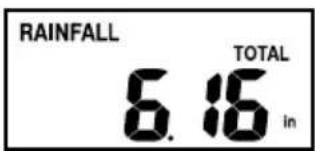
text_image
RAINFALL 6.15 TOTAL in23. Setting the temperature unit
The temperatures can be displayed in °C (Grad Celsius) or in °F (Grad Fahrenheit). Press the C / F button on the rear of the weather station to switch between the two units. Each time the button is pressed, the unit on the display changes.
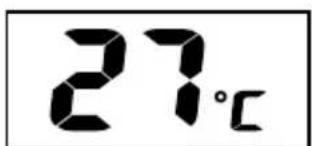
text_image
27°C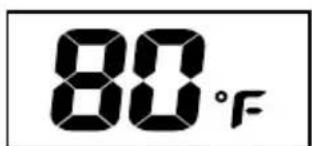
text_image
80°F24. Display
Background illumination:
Press the SNOOZE / LIGHT button to switch on the background illumination. After approx. 10 seconds, the background illumination switches off automatically.
24.1 Date and time
Press the CLOCK button to switch between the time, date and day of the week. If no button has been pressed for a period of approximately 20 seconds, the time display appears automatically.

text_image
16:48 → 11:25 → 70 Time Date Day of the week24.2 Time zone
You can use the ZONE button on the backside to display the selected time zone. ZONE appears next to the time. By pressing the ZONE button again, you are returned to your local time.
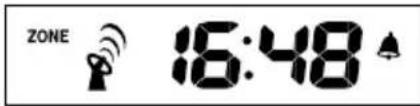
text_image
ZONE 16:4824.3 Temperature and air humidity indoors/outdoors
Press the CHANNEL / SEARCH button to display the temperature and air humidity for indoors or outdoors. The values for indoors and outdoors can also be displayed alternately. Then, ○ appears on the display.

24.4 Displaying Heat Index and Dew Point
Press the HEAT INDEX; DEW POINT button to switch between the Heat Index and Dew Point.

text_image
HEAT INDEX 26.6°C → DEW POINT 9.6°C24.5 Rainfall quantity
The weather station has an automatic memory for the amount of rainfall. The rainfall quantity can be
displayed in different chronicles either as a digital value or in diagram form:
Digital value:
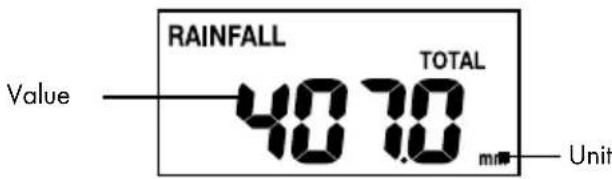
text_image
RAINFALL TOTAL Value 40.70 mm UnitDiagram:
Unit in inches Unit in millimetres
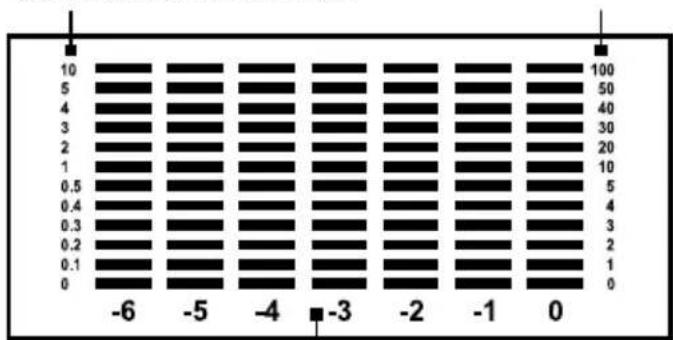
bar
| Value | |---| | 10 | | 5 | | 4 | | 3 | | 2 | | 1 | | 0.5 | | 0.4 | | 0.3 | | 0.2 | | 0.1 | | 0 | -6 -5 -4 -3 -2 -1 0 100 50 40 30 20 10 5 4 3 2 1 0The rainfall over the past days / weeks / months from the current time (0) up to 6 days / weeks / months earlier (-6)
Press the RAIN / CLEAR button to switch between the following rainfall quantity displays:
- Total rainfall quantity
- Rainfall quantity each day
- Rainfall quantity each week
- Rainfall quantity each month
The current value is displayed. A diagram is shown under this value containing the relevant history of the last 6 units.
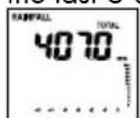
Overall quantity
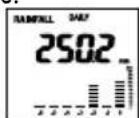
Quantity each day
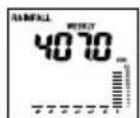
Quantity each week
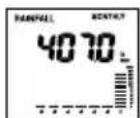
Quantity each month
Detailed information can be displayed on the history.
Example:
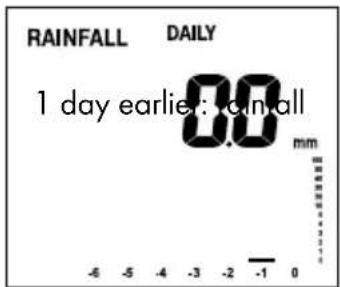
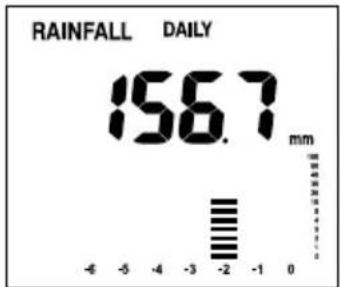
Press the RAIN / CLEAR until the rainfall quantity is shown. The value shown represents the rainfall quantity for the current day. Underneath this value, a diagram is shown containing the rainfall quantity for the current day and the past 6 days.
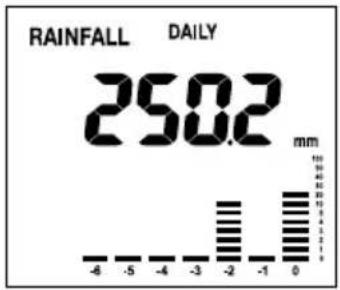
bar
RAINFALL DAILY | Rainfall (mm) | Value | | :--- | :--- | | -6 | 0 | | -5 | 0 | | -4 | 0 | | -3 | 0 | | -2 | 10 | | -1 | 5 | | 0 | 15 | | 1 | 10 | | 2 | 5 | | 3 | 0 | 250.2 mmPress the RAIN HISTORY button to view the details. Every time the button is pressed, the display moves forward by one day.
Below, you will find a display for the past 2 days:
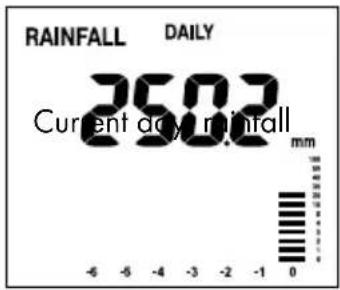
text_image
RAINFALL DAILY 2502 Current day rainfall mm -6 -5 -4 -3 -2 -1 0quantity 250.2 mm with bar display at 0
text_image
RAINFALL DAILY 1 day earlier: d-in-all -6 -5 -4 -3 -2 -1 0quantity 0.0 mm with bar display at -1
text_image
RAINFALL DAILY 156.7 mm -6 -5 -4 -3 -2 -1 02 days earlier: rainfall quantity 156.7 mm with bar display at -2
You can display the history for weekly and monthly quantities using the same procedure.
There is no history for the total amount (TOTAL).
24.6 Ice/frost alarm
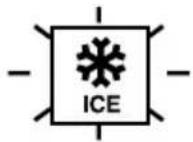
As soon as the outdoor temperature falls below 4 °C, the frost alarm symbol appears on the display. This warns of possible ground frost.
24.7 Wind direction
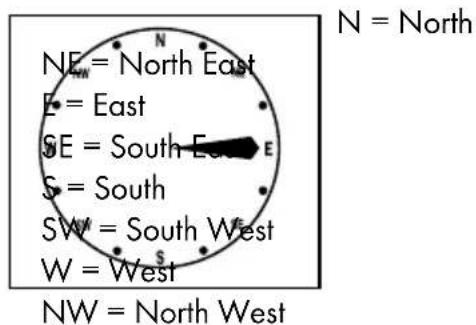
The wind gauge automatically shows the average wind direction for the last 2 minutes.
text_image
N = North NE = North East E = East SE = South East S = South SW = South West W = West NW = North West24.8 Wind speed
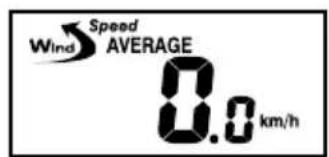
The weather station shows the average wind speed (AVERAGE) for the last 2 minutes and the maximum speed for gusts of wind (GUST) in the last 10 minutes. Press the WIND button to switch between the two displays.
text_image
Wind Speed AVERAGE 0.0 km/h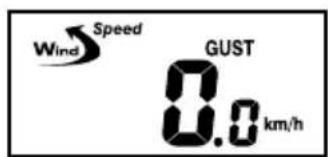
text_image
Wind Speed GUST 0.0 km/h24.9 Air pressure change
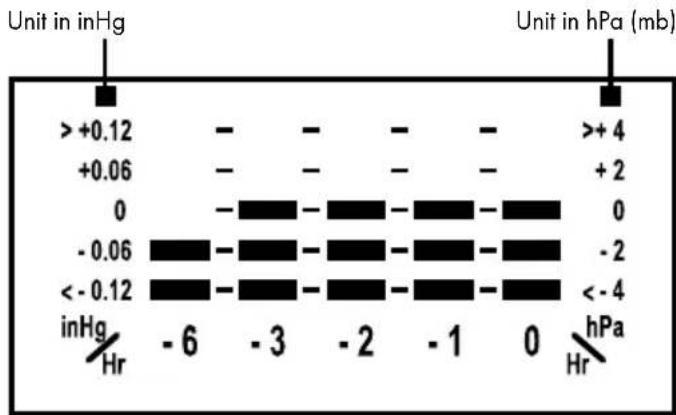
The weather station shows the changes in air pressure over the last 6 hours.
bar
| pH Range | inHg (mb) | hPa (mb) | | :--- | :--- | :--- | | > +0.12 | - | - | | +0.06 | - | - | | 0 | - | - | | -0.06 | - | - | | < -0.12 | - | - | | inHg / Hr | -6 | -3 | | -2 | -1 | -1 | | 0 | 0 | hPa / Hr | Unit in inHg: > +0.12; Unit in hPa: > +4; Unit in hPa: +2; Unit in hPa: 0; Unit in hPa: -2; Unit in hPa: < -4Hour trend
24.10 Minimum and maximum values
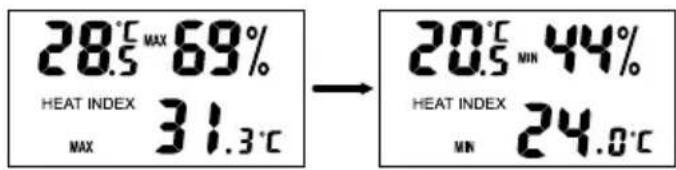
Use the MEMORY button to display saved minimum and maximum values.
text_image
28.5° MAX 69% HEAT INDEX MAX 31.3°C → 20.5° MIN 44% HEAT INDEX MIN 24.0°C24.11 Weather forecast
The weather station can predict the weather for the next 12–24 hours. The weather prediction function is based on the change in air pressure and is up to 75% accurate. Since the weather can never be predicted with 100% correctness, the manufacturer cannot be held responsible for incorrect weather predictions.

natural_image
Simple line drawings of suns, clouds, and raindrops (no text or symbols)Sunny Mainly sunny Rain StormsCloudy
24.12 Weather trend
The weather trend is also shown in addition to the weather forecast. There is an arrow for increasing, stable and decreasing.
25. Maintenance
25.1 Battery charge indicator
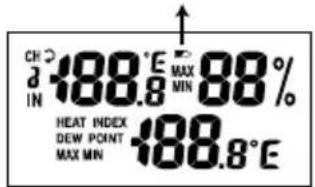
If the battery is empty, the symbol appears in the display. There is a separate symbol for the weather station, the wind gauge and the rain gauge.
text_image
CH IN +188.8°E MAX MIN 88% HEAT INDEX DEW POINT +188.8°E MAX MINIf the indoors temperature is displayed, the battery charge indicator applies for weather station. If the outside temperature is shown, the battery charge indicator applies for the wind gauge.
bar
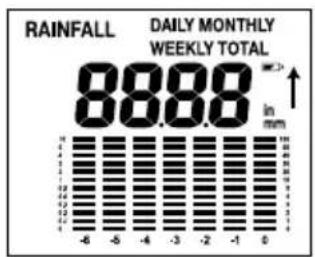
DAILY MONTHLY WEEKLY TOTAL | Rainfall (mm) | Value | | :--- | :--- | | -6 | 88.88 | | -5 | 88.88 | | -4 | 88.88 | | -3 | 88.88 | | -2 | 88.88 | | -1 | 88.88 | | 0 | 88.88 |Battery charge indicator for the rain gauge
Replace the batteries as soon as ▶ appears in the display. If the batteries are weak or empty, it is impossible to guarantee accurate measurement results. The procedure for replacing the batteries is outlined under point 11. Inserting and replacing batteries.
25.2 Rain gauge leaf filter
Remove foliage and any other objects which collect in the leaf filter of the rain gauge regularly. Only then can precise rain measurement be guaranteed.
26. Troubleshooting errors in the measuring results
26.1 Trouble-shoot on weather station
● = Fault
● = Possible cause
O = Solution
● = Wind speed, wind direction, wind-chill data part were shown “—”.
● = Wind sensor was disconnected from the main unit.
O = Re-insert the wind sensor's battery. Connect the wind sensor to main unit again
● = Always have a "Beep" sound at the main unit.
● = Wind-chill alert was activated. When the wind-chill alert is activated, in the 1st minute, first 10s "Beep", 2nd "Beep, Beep", after that 40s "Beep, Beep, Beep, Beep". From the 2nd minute and afterwards, it will have a "Beep, Beep, Beep, Beep" in each minute.
O = Re-set the wind-chill alert
● = Annoying "Beep" sound was found when inserting battery to the main unit.
- = Inserting the rain gauge battery (the lever at the middle position) when pairing to the main unit. Then the rain gauge enters the test mode. Lever at the middle position
O = Lever at the left hand side position Put the rain gauge lever to the left hand side or right hand side first. Then insert the battery to the rain gauge when pairing to the main unit.
WARNING! The weather station and the outside sensor contain sensitive electronic components.
Radio waves transmitted e.g. from mobile telephones, walkie talkies, radios, remote controls or microwaves may influence the functionality of the weather station and the outside sensor and lead to imprecise measurements. It is therefore important to maintain as great a distance as possible between the weather station and the external sensor and products which send out radio waves. Electrostatic charge can also influence the measuring results. In this case, reset the weather station and the external sensor. This is done by removing the batteries and inserting them again after approximately 5 seconds.
NOTE! All saved data is lost.
Obstacles such as concrete walls can also cause that the reception is disturbed. In this case, change the location (eg near a window). Please take note that the external sensor should always be set up within max. 25 meters (open space) from the base station. The specified range is the free-field range and means that no obstacle should be between the remote sensor and the base station. A "visual contact" between remote sensor and base station often improves the transmission.
Cold (outdoor temperatures below 0^ C) can reduce the battery power of the outdoor sensor and thereby negatively impair the radio transmission.
Another factor that may cause harmful interference, are dead or weak batteries in the outdoor sensor. Replace them by new ones.
If your weather station is not working correctly, please remove the batteries for a short while and then replace them.
27. Cleaning
Only clean the product with a damp cloth. Never immerse the weather station, wind gauge or rain gauge in water.
28. Disposal
The packaging is made entirely of recyclable materials, which you may dispose of at local recycling facilities. The Green Dot is not valid for Germany.
Observe the marking of the packaging materials for waste separation, which are marked with abbreviations (a) and numbers (b) with following meaning: 1-7: plastics / 20-22: paper and fibre-board / 80-98: composite materials.

The product and packaging materials are recyclable, dispose of it separately for better waste treatment. The Triman logo is valid in France only.

Contact your local refuse disposal authority for more details of how to dispose of your worn-out product.
To help protect the environment, please dispose of the product properly when it has reached the end of its useful life and not in the household waste. Information
on collection points and their opening hours can be obtained from your local authority.
Faulty or used batteries / rechargeable batteries must be recycled in accordance with Directive 2006/66/EC and its amendments. Please return the batteries / rechargeable batteries and/or the product to the available collection points.
Environmental damage through incorrect disposal of the batteries / rechargeable batteries!
Batteries / rechargeable batteries may not be disposed of with the usual domestic waste. They may contain toxic heavy metals and are subject to hazardous waste treatment rules and regulations. The chemical symbols for heavy metals are as follows: Cd = cadmium, Hg = mercury, Pb = lead. That is why you should dispose of used batteries / rechargeable batteries at a local collection point.

text_image
1 SIN LAIN WIN MINI PICKLE TOMES RISK SIN MINI SIN MINI SIN MINI SIN MINI SIN MINI SIN MINI SIN MINI SIN MINI SIN MINI SIN MINI SIN MINI SIN MINI SIN MINI SIN MINI SIN MINI SIN MINI SIN MINI SIN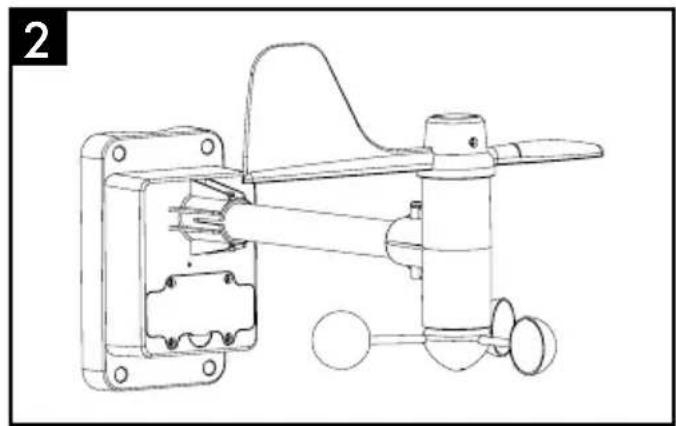
natural_image
Technical line drawing of a mechanical device with internal components and mounting brackets (no text or symbols)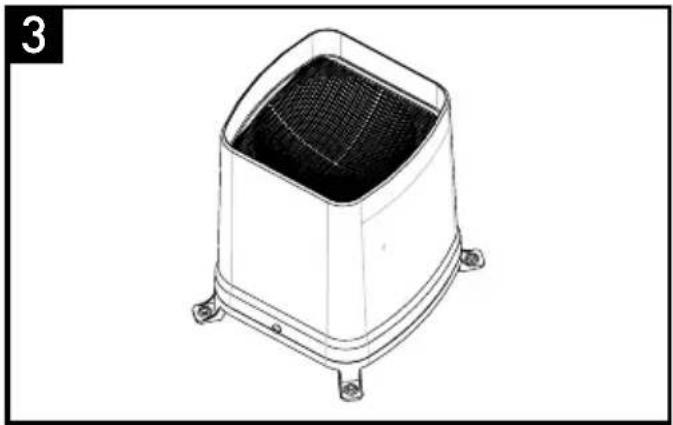
natural_image
Technical line drawing of a square electronic component with a mesh grille and mounting feet (no text or symbols)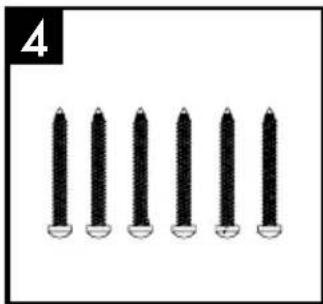
natural_image
Six black screwdrivers arranged in a row, no text or symbols visible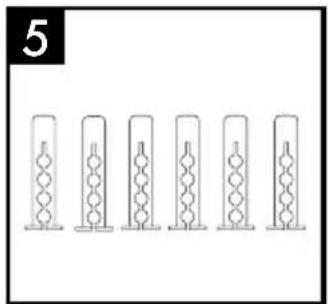
natural_image
Five identical cylindrical objects with diamond-shaped bases arranged horizontally, no text or symbols visible.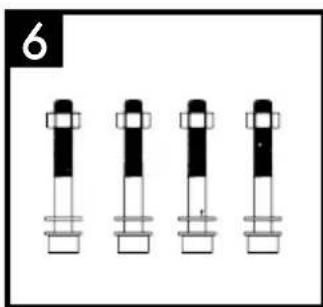
natural_image
Four identical cylindrical objects with black and white segments, arranged horizontally (no text or symbols)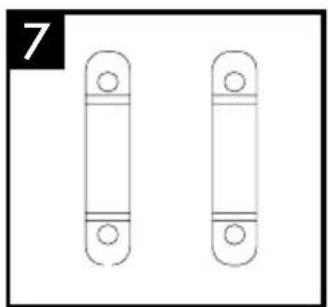
natural_image
Two identical rectangular objects with circular ends, no text or symbols present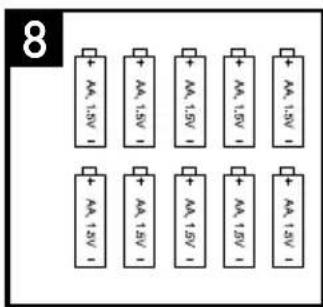
text_image
8 + AA, 1.5V - + AA, 1.5V - + AA, 1.5V - + AA, 1.5V - + AA, 1.5V - + AA, 1.5V - + AA, 1.5V -natural_image
Technical line drawing of a mechanical component with mounting holes and a central pin (no text or symbols)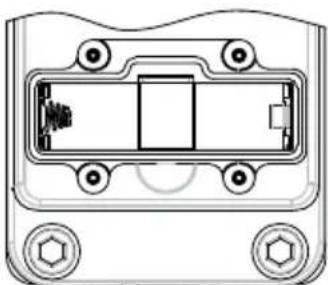
natural_image
Technical line drawing of a mechanical component with mounting holes and internal structure (no text or symbols)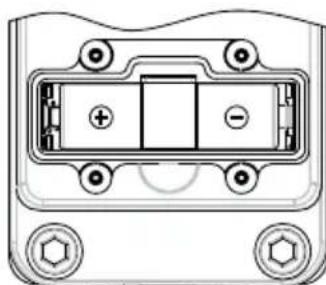
natural_image
Technical diagram of a battery pack with labeled terminals and internal components (no text or symbols)Station météo :
natural_image
Diagram of a computer monitor rear panel showing internal components and ventilation slots (no text or labels)Pluviomètre :
natural_image
Technical line drawing of a mechanical device with mounting flanges and internal components (no text or symbols)natural_image
Technical line drawing of a mechanical device with no visible text or symbolstext_image
ALARM -17:16text_image
ALARM 17:16text_image
937° → ALAM 17:16° → ALAM 17:16flowchart
graph LR
    A["1: W-h Speed AVERAGE 0.0 km/h"] --> B["2: W-h Speed AVERAGE 0.0 mph"] --> C["3: W-h Speed AVERAGE 0.0 m/s"]
    D["4: W-h Speed AVERAGE 0.0 m/s"] --> E["5: W-h Speed AVERAGE 0.0 mph"] --> F["6: W-h Speed AVERAGE 0.0 mph"]
text_image
Wind Speed AVERAGE ▲Hi 10.0 km/htext_image
Wind Chill CHI ALARM 18°Ctext_image
RAINFALL 6.15 TOTAL intext_image
16:48 → 11:25° → 10:00 Heure Date Jour24.2 Fuseau horaire
text_image
HEAT INDEX 26.6°C → DEW POINT 9.6°C24.5 Pluviométrie
text_image
N MW W SW S NE E SE$$ N = N o r d $$
$$ N E = N o r d - e s t $$
$$ E = E s t $$
$$ S E = S u d - e s t $$
$$ S = S u d $$
$$ S W = S u d - o u e s t $$
$$ W = O u e s t $$
$$ N W = N o r d - o u e s t $$