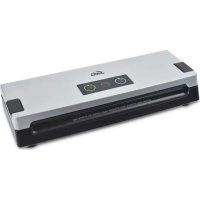
Vac Mini 5701 - Vacuum packaging machines Solis - Free user manual and instructions
Find the device manual for free Vac Mini 5701 Solis in PDF.


User questions about Vac Mini 5701 Solis
0 question about this device. Answer the ones you know or ask your own.
Ask a new question about this device
Download the instructions for your Vacuum packaging machines in PDF format for free! Find your manual Vac Mini 5701 - Solis and take your electronic device back in hand. On this page are published all the documents necessary for the use of your device. Vac Mini 5701 by Solis.
USER MANUAL Vac Mini 5701 Solis
Solis of Switzerland AG
Solis-Haus · Europaastrasse 11 CH-8152 Glattbrugg-Zurich · Schweiz
Telefon +41 44 874 64 54 • Telefax +41 44 874 64 99
info@solis.ch • www.solis.ch • www.solis.com
CONSEILS DE SECURITE IMPORTANTS
Tension/frequency 220-240V/50Hz
Performance 100 Watt
Dimensions env.39,5x5,5x8,0cm(LxHxP)
Poids env.0,83 kg
Solis of Switzerland SA
Solis-Haus · Europastrasse 11 · CH-8152 Glattbrugg-Zurich · Suisse
Telephone +41 44 874 64 54 • Telefax +41 44 874 64 99
info@solis.ch • www.solis.ch • www.solis.com
IMPORTANTI ISTRUZIONI DI SICUREZZA
Dimensioni ca. 39,5 x 5,5 x 8,0 cm (L x A x P)
Peso ca. 0,83 kg
Solis of Switzerland SA
Solis-Haus · Europaastrasse 11 CH-8152 Glattbrugg-Zurigo · Svizzera
Telefono +41 44 874 64 54 • Fax +41 44 874 64 99
info@solis.ch • www.solis.ch • www.solis.com
IMPORTANT SAFETY PRECAUTIONS
Please read through this user manual thoroughly before using your vacuum sealer, so that you become familiar with your appliance and can use it safely. We thoroughly recommend that you keep these instructions and, if you pass the appliance on, that you also hand these instructions to the new owner.
For your own safety, please observe the following safety measures when using elec trical appliances:
- To avoid electric shock, neither the vacuum sealer, power cable nor plug are allowed to come into contact with water or other liquids. Water can enter the housing and damage the appliance! If the appliance or power cable / plug should come into contact with liquids, immediately pull the plug out from the socket using dry rubber gloves. Do not use the appliance again until you have had it's ability to function safely checked by Solis or a Solis approved service centre.
- Never touch or operate the appliance resp. pull or connect the power plug with wet or moist hands or feet.
- Before using the appliance, check that the voltage stated on the type plate of the appliance matches your mains voltage. Do not connect the power plug to a plug board to which other appliances are connected.
- Do not let the power cord hang over table edges so that the appliance can not be pulled down. Make sure that neither the power cord nor the plug or the vacuum sealer itself come into contact with hot surfaces like e.g. a stove top or a heater. Never wrap the cord around the appliance.
-
Keep the appliance away from hot gas, hot ovens and other heat-emitting appliances or heat sources. Never use the appliance on a hot or wet surface. Never place the appliance near moisture, heat and naked flames. Keep the appliance away from moving parts or appliances.
-
Never carry the appliance by the power cord and do not place anything on the power cord. Never pull on the power cord to disconnect the appliance from the power mains. Only pull on the plug.
- We recommend that you do not use an extension cable with this appliance. Do not place the appliance directly underneath a power socket.
- Please always make sure that the latching mechanism is unlocked (push release button) before disconnecting the appliance's power plug from the power socket.
- During use, the appliance has to be placed on a solid, heat- and moisture-resistant, stable and dry surface like a table or work surface. The appliance is not designed for outdoor use.
- Unplug the appliance when it is not in use or unattended, and before cleaning. We recommend the use of a residual current device (RCD safety switch) to ensure additional protection during the use of electrical appliances. It is advisable to use a safety switch with a rated residual operating current of 30mA maximum. For professional advice consult an electrician.
- Do not make any adjustments to the appliance, cable, plug or accessories.
- Incorrect use may cause injury!
- Never take hold of an appliance that has fallen into water. Always take the plug out of the power socket before removing the appliance from the water. Do not use the appliance again until you have had it's ability to function safely checked by Solis or a Solis approved service centre.
- Never place the appliance where it could fall into water or may come into contact with water (e.g. in or near a sink).
- Never submerge the appliance, power cable or plug in water, or bring it into contact with water or other liquids.
-
Place the appliance so that it is never exposed to direct sunlight.
-
Never put sharp or pointed objects and tools into the appliance openings. The appliance may become damaged - danger of electric shock!
- Do not shake or relocate the appliance while it is in operation.
- Only use the appliance as described in this manual. Only use with the provided accessories or accessories recommended by Solis, incorrect accessories can lead to damage of the appliance, resp. to fire, electric shock or personal damage.
- Never start the appliance using a remote or timer.
- This appliance is only for domestic use and is not suitable for commercial use.
- Remove and discard all packaging materials and potential stickers or labels before using the appliance for the first time.
- Check the appliance before each use and ensure that the appliance, power cord and plug are not damaged.
- In order to avoid electric shock, do not use the appliance if the cable or plug are damaged or the appliance is otherwise faulty, dropped or damaged. Never attempt repairs yourself, but take your appliance to Solis or a Solis approved service centre in order to get it inspected or mechanically and electrically repaired.
- People with limited physical, sensorial or mental capabilities as well as unknowing or inexperienced people and children must not use the vacuum sealer except when supervised or thoroughly instructed on how to use the appliance by a person responsible for their safety. Additionally, they must be aware of the dangers arising from the appliance and know how to operate it safely. Cleaning and maintenance of the appliance must not be done by unsupervised children. Under no circumstances may the appliance be used or cleaned by children under the age of 8.
-
Always keep the appliance and power cord out of the reach of children.
-
Children must be supervised, so that they do not play with the appliance.
- CAUTION: The sealing bar gets very hot during operation! Do not touch the sealing bar during or shortly after use.
- To prevent the sealing bar from overheating, a cool down time of at least 1 minute has to be kept after each sealing resp. vacuum sealing process.
- The appliance is not designed for permanent use. Therefore, please let the appliance cool down after using it 5 times for 5 minutes. Only then vacuum resp. seal the next bag.
- Before using, always check that your hands are clean and dry.
- Please avoid sucking in liquids to avoid impaired weld quality. Potentially sucked in liquid is collected in the vacuum chamber. In this case, use a kitchen paper to absorb the liquid and wipe the vacuum chamber clean with a moist rag.
- Use exclusively Solis vacuum bags that were designed for this appliance. Only use the appliance for vacuuming and sealing, never use for any other purpose.
- Unwind the power cord fully before plugging the plug into the socket.
- Oils or lubricants must not be used with this appliance.
APPLIANCE DESCRIPTION
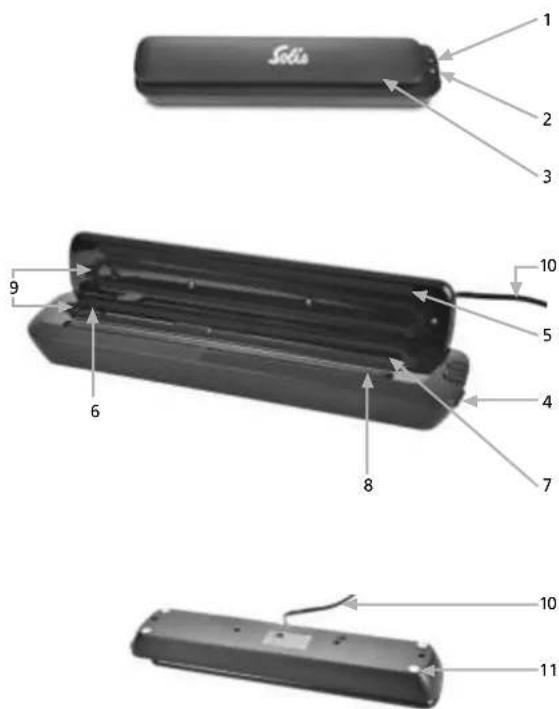
APPLIANCE DESCRIPTION
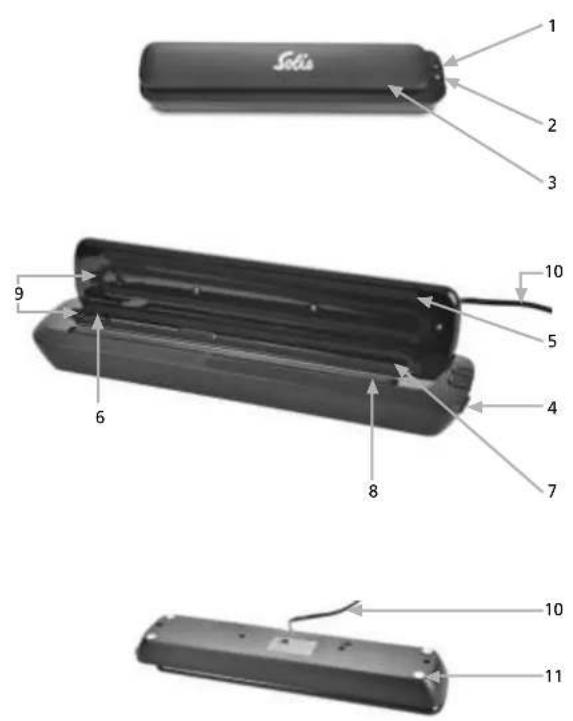
1 Function button Seal
for sealing bags.
2 Function button VAC Seal / STOP
- for automatically vacuuming and sealing a bag resp. for stopping the appli
A precise description of the buttons and their functions can be found on page 86.
3 Appliance lid
4 Release button
pressing this button unlocks the appliance lid, allowing it to be opened.
CAUTION: Do not push down on the release button to close the lid, only on the front part of the appliance lid!
5 Rubber contact strip
- the counterpart of the sealing bar which makes sure that the end of the bag is pressed flat against the sealing bar, to provide an optimal seal.
6 Air-extraction opening
- for sucking air out of the vacuum bag.
7 Vacuum chamber
the open end of the bag is placed here so that the air can be extracted from the bag.
8 Sealing bar
- the sealing bar heats up, sealing the end of the bag with a weld.
9 Upper and lower seal
- so that the end of the bag is shut airtight, allowing all of the air to be removed.
10 Power cable
11 Non-slip rubber feet
to ensure safe footing when the appliance is operating.
APPLIANCE DESCRIPTION
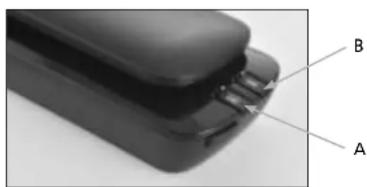
THE FUNCTION BUTTONS
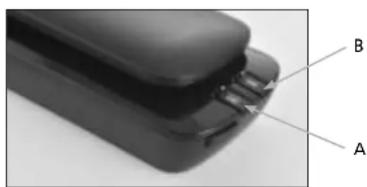
For your control, the control light by the activated button lights up as long as the function is in use. Once the function has been completed, the corresponding control light goes out.
A Vac Seal/STOP
Button with two functions:
- Vacuuming and automatic sealing
Pressing this button once will first start the vacuuming process and then automatically complete the weld. During the vacuuming process, the VAC Seal/STOP control light lights up. Once the sealing process starts, the light by Seal lights up as well. Both lights go out when both processes have been completed.
- Stop function
Press the VAC Seal/STOP button again while the appliance is in use to immediately interrupt the vacuum reap. sealing process. The control lights go out.
B Seal
Button with two functions:
- For manually sealing film bags
As an example: If you want to make a bag from film roll and therefore have the need to weld shut one end of the bag, press the Seal button. As long as the Seal function is in use, the control light is lit up.
- For stopping the vacuuming process and immediately sealing the bag in the VAC Seal function
As an example: If you have selected the VAC Seal function and, while vacuuming, notice that the pressure on the foods placed in the bag is getting to high, you can immediately interrupt the vacuum pump and start the sealing process, simply by pressing the Seal button. As long as the appliance is sealing, the control light is lit up. The control light goes out once the process has been completed.
FIRSTUSE
CAUTION: Before using the appliance always make sure that the appliance and the bags are absolutely clean, dry and without damage so that food does not get contaminated.
APPLIANCE INSTALLATION
Place the appliance on a sufficiently large, moisture- and heat-resistant, horizontal, clean and dry work surface. Note that you also need space for the food filled bags to be vacuumed.
Plug the power plug into a suitable power outlet.
NOTE: Should you use ready made vacuum bags, you can proceed directly to point II. of these instructions.
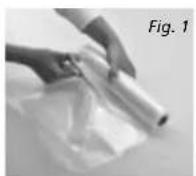
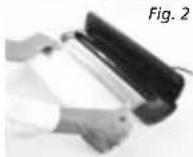
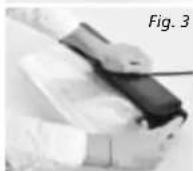
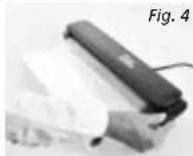
I. SEALING A BAG FROM VACUUM FILM: FUNCTION Seal (B)
- Cut a suitable bag length from the film. (see Fig. 1)
- Open the appliance lid 3 by pressing the release button 4 (in case the appliance lid is locked) and open the lid.
- Place the open bag end on the sealing bar 6 of the open appliance. The bag end should not extend into the vacuum chamber 7 (see Fig.2)
- Close the lid and firmly push it down with one hand, touching the area in the centre, to the front. Make sure that the lid is well shut and that the rubber strip and sealing bar line up properly. Simultaneously, press the Seal (B) button to seal the end of the bag. The control light lights up as soon as the appliance starts sealing and goes out once the sealing process has been completed. (see Fig.3)
IMPORTANT: You have to push down on the centre front of the lid for the entire duration of the sealing process!
- Once the indicator light by Seal goes out, press the release button to open the cover. (see Fig. 4)
- Remove the bag with the sealed end.
- Check if the seal seam is straight and without creases. Should this not be the case, cut the seal seam off and repeat the process.
(see Fig. 5)
II. AUTOMATIC VACUUMING AND SEALING A FILLED BAG: FUNCTION VAC Seal (A)
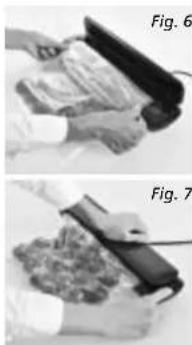
Fig. 6
- Open the appliance lid 3 by pressing the release button 4 (in case the appliance lid is locked) and open the lid.
- Place the fresh food into the bag. Please use the original Solis vacuum bags or vacuum films exclusively to avoid damage to the appliance and to ensure best results.
For item-numbers and descriptions, please read the enclosed order form. You can purchase accessories for your vacuum sealer in good retailers or by mailing Solis of Switzerland Ltd.
Telephone: 0848804884, Fax: 0848804890, email: info.ch@solis.com or www.solis.ch (shipping only within Switzerland).
3. Clean the open end of the bag inside and out, then smooth it flat. The end must be free of dust and wrinkles.
Fig. 8 4. Place the open bag end in the vacuum chamber 7. CAUTION: The air-extraction opening 6 must not be covered by the bag end (see Fig. 6!)
-
Push down on the centre front of the lid with one hand to air-tightly close the lid and allow a vacuum to be created inside. Simultaneously, press the VAC Seal/STOP (A) button. Now, your appliance automatically vacuums and seals the bag (see fig. 7). During the vacuuming process, the control light by VAC Seal/STOP lights up. Once the sealing process starts, the Seal control light is lit up as well.
NOTE: The appliance produces a fairly high vacuum pressure in the bag. If this pressure might crush fragile food then observe the vacuum pressure in the bag during vacuuming. When the desired vacuum is achieved, press the Seal (B) button. The appliance switches off the extraction pump from vacuuming and begins sealing the bag. -
Once the vacuuming and sealing processes have been completed, meaning both control lights have gone out, press the release button to the right of the appliance. The lid opens and you can remove the bag (see Fig. 8).
- Check whether the new seal seam is straight and uncreased (see Fig. 9). Should this not be the case, repeat the process after cutting off the weld.
GOOD TO KNOW:
- In order for the appliance to perform best, it should be left for 1 minute to cool before you inserting the next bag. Always wipe away any leaked fluid in the vacuum chamber after each use.
- If you do not respect the one minute of cool down time and try to proceed with vacuuming, the heating element will overheat and the appliance might be permanently damaged.
- The appliance only works properly with Solis vacuum bags and films, please do not use any other bags to achieve optimal results and prevent damage to the appliance.
There are Solis vacuum bags in different sizes or vacuum bag film with which you can set the bag size. Always choose a bag size appropriate for the food. Keep in mind that the bag should be at least 8~cm larger than the food and you will need an additional 2~cm for the seal.
For item numbers and descriptions, please refer to the enclosed order form. You can find accessories for your vacuum sealer in good stores or you get them from Solis of Switzerland Ltd. Telephone: 0848 804 884, telephone: 0848 804 890, email: info.ch@solis.com or www.solis.ch (Shipping only within Switzerland).
- Use scissors to open a vacuum sealed bag and take out the food.
TIPS FOR OPTIMAL VACUUMING
- Do not overfill the bag. Always leave enough empty space at the end of the bag so that it can be placed in the vacuum chamber without problem and without wrinkles or creases. Calculate for 8 cm of space between bag contents and bag end plus 2 cm for the weld and 2,5 cm for every planned opening and re-vacuuming.
- The open bag end should not be wet, since wet bags can not be sealed.
- Clean the open bag end and pull it straight, before you seal it. Make sure that there is no food residue on the end of the bag and that there are no creases in the end of the bag. The sealed seam must be completely smooth, otherwise it will not be airtight.
- Never leave too much air in the bag. Press on the bag a little to get most of the air out before vacuuming. Too much air in the bag means more work for the extraction pump, which could overload the motor. The consequence could be that not all of the air is vacuumed out of the bag.
- Please do not vacuum seal any foods with sharp edges, like e.g. fish bones and mussels. The sharp edges could cut open the film so that it is not air-tight any longer. To prevent this, you can wrap the sharp edges with folded kitchen paper to prevent them from damaging the bag resp. cause holes.
- You should wait for 60 seconds after every vacuum programme before you vacuum the next bag, so that the appliance can cool down.
- If the necessary vacuum pressure has not been reached after approx. four minutes, the appliance will switch off automatically. In this case please check if the bag is not air-tight or the bag end is not clean and inserted evenly into the vacuum chamber or what else might be the reason.
- Always make sure that the seals around the vacuum chamber are clean. Clean and dry the seals if necessary.
- Smell amounts of liquid, crumbs or food particles might get sucked into the vacuum chamber, block the extraction pump and damage your appliance. To avoid this, we recommend freezing moist or juicy foods before vacuum sealing them or placing a folded kitchen paper in the bag as packing beneath the weld. Also freeze soups or liquid foods in bags before vacuum sealing them. When vacuum sealing powdery or finely ground foods, do not overfill the bag and place a sheet of kitchen paper as a seal in the bag before vacuuming it.
- In general fruits should be pre-frozen and vegetables blanched before vacuuming in order to achieve best results.
-
Sensitive foods such as pastry or berries should be pre-frozen for 24 hours before being vacuum sealed to prevent damage being caused by the vacuum pressure.
-
Keep perishable foods in the freezer or fridge. Vacuum packing extends the life of food, but does not turn it into a "preserve", e.g. a stable product at ambient temperature.
- Fill a bag 2/3 full with water, seal the end of the bag (do no vacuum!) and lay the bag in the freezer. You can use the ice for cooling drinks but also for sporting injuries.
- Many foods are already vacuum packed when bought, such as cheese or ready meals. With our vacuuming-appliance, you can vacuum them again (in Solis bags!), if the packaging has been opened, so that it stays fresh and retains it's full flavour. However, these foods should still only be consumed up until the date printed on the original packaging.
- Cereals such as flour, rice and cake mixes stay fresh longer if they are vacuum packed. Nuts and spices hold their flavour better and will not go rancid. Ideal for long journeys.
- Powdered or small grain foods can be vacuumed, if kitchen paper is placed on top of the food as a barrier so that the powder or grains can not get into the extraction pump.
- Foods with sharp edges and points, such as bones or dry pasta should be wrapped in kitchen paper so that they can no longer damage the bag or cause punctures.
- You can also vacuum pack more than just food. Camping products such as matches, first aid bandages or clothing stay clean and dry when vacuum packed. Vacuum packed silverware doesn't tarnish, a vacuum packed candle is always advisable.
- The main use of the vacuum sealer is to conveniently keep many foods fresh for longer without losing their flavour. In general you could say that vacuum packing quadruples the shelf life of foods in comparison to traditional storage methods. Once you have enjoyed the advantages of this appliance, it will soon become indispensable to you and you will have to throw much less food away and thereby save money.
- Sensible ideas:
a) Cook larger portions in advance and vacuum into individual portions or meals.
b) Vacuum packing is excellent for keeping pre-prepared foods fresh for pick nicks, camping expeditions and barbecues.
c) Vacuum packing reduces freezer burn.
d) Vacuum pack meat, fish, poultry and seafood before you put them in the fridge or freeze them.
e) Also keeps dried fruits, beans, nuts and cereals fresh for longer.
- Vacuum packing enables you to live health consciously, or pre-cooking meals specifically with suitable ingredients if you suffer from allergies; you can weigh ingredients exactly if you want to diet and have to work in an office, or if you would like to take vacuumed home-made meals in, without any hassle.
- You can also use vacuum packing for valuable objects: photos, important documents, stamp collections, credit cards, comics, screws, nails, medicine, plasters - everything is perfectly preserved and protected from dirt and moisture when it's vacuum packed.
NOTES:
After vacuuming, always store with the lid open, never with the lid locked shut, otherwise the seals will deform and affect the function of the appliance.
We assume no liability for damages to any items or foods which are caused by the vacuuming and / or sealing.
- Always use the freshest possible foods.
- Delicate products such as meat, fish, berries etc. should be pre-frozen so that they are not crushed during vacuuming.
Foods can be frozen for up to 24 hours without freezer burn occurring - this fact is something we will make use of. Ideally food should be split into portions before freezing. As soon as they are frozen (after about 24 hours) vacuum them in Solis vacuum bags and return them to the freezer.
- If you wish to vacuum pack soups, stews or other liquid dishes, then they must be pre-frozen, until they have a solid consistency. After vacuuming the dish can be put back in the freezer.
- The same method applies for products with high fluid content. The infiltration of fluid into the vacuum system can cause damage to the appliance. This is not covered by the guarantee.
- If you wish to vacuum and freeze foods without pre-freezing them, the length of the bag should be 5cm longer than would normally be required since food expands when frozen.
- Fresh vegetables should be cleaned or peeled and before freezing they should be blanched in boiling water (or if necessary a microwave oven can be used). This ensures that the vegetables remain fresh. After allowing the food to cool, it can be split into suitable portions and frozen in Solis vacuum bags.
- If you wish to vacuum and freeze meat or fish without pre-freezing them then we recommend that you line the Solis vacuum bag with kitchen paper so that the kitchen paper will catch any escaped moisture. Foods that are meant to be vacuum sealed in a number of layers (e.g. hamburgers, crèpes or tortillas) are best placed in the bag separated by a sheet of baking paper.
DEFROSTING FROZEN SOLIS VACUUM BAGS
Defrosting meat, fish, fruit, vegetables and other delicate foods: These foods should be defrosted slowly in the refrigerator.
Defrosting bread and pastry. These foods can be defrosted at room temperature. If this is the case you should cut open the bag to allow the steam to escape.
Always consume food immediately after defrosting and do not re-freeze.
WHY DO VACUUM PACKED FOODS LAST LONGER?
- Chemical reactions in food with air, ambient temperature and dampness, enzym-reactions, the formation of micro-organisms or contamination by insects can spoil food.
- The main reason why food nutrients lose their firmness and flavour is the oxygen in the air. The formation of micro-organisms is usually caused by air, because this removes the moisture of the foods, on the other hand, it also transports ambient moisture back into the food if they are not hermetically sealed. Frozen foods get in the freezer air often the freezer burn.
- The vacuum-system removes up to 90% of air from the packaging. Because 21% of the air consist of oxygen, only 2 - 3% of oxygen remain in a vacuum sealed bag. However in an oxygen content of less than 5% , most micro-organisms cannot multiply.
- In general, micro-organisms can be divided into three categories: mould, yeasts and bacteria, they are present everywhere, but can only cause damage in certain conditions.
- In an environment with little air or moisture, mould cannot develop. In moisture, sugar and warmth, yeast can spread with or without air, cooling slows the growth of yeast and freezing stops it altogether.
- Bacteria can spread with or without air. One of the most dangerous bacteriums is Clostridium botulinum which can, under certain conditions, spread without air - it only needs a temperature of between 4^ and 46^ . It spreads in food without acid, in environments with little acid and in temperatures that are above 4^ for long periods of time.
- The bacterium Botulinum cannot do any harm to frozen, dried or acid rich foods or foods with a high salt or sugar content.
The following foods can be lightly infected with Botulinum:
- Foods without acid e.g. meat, seafood, poultry, fish, eggs, mushrooms and olives in brine
- Foods with little acid like most vegetable
-
Foods with moderate acid content such as tomatoes, onions, chilli-peppers, figs and cucumbers.
-
To store the above at-risk foods, you should keep them in the refrigerator for short term storage or in the freezer, for long term storage, and after heating they need to be eaten straight away.
-
Some enzymes in foods can change the colour, texture and flavour of foods, which depends on storage time, storage temperature and oxygen. To prevent this enzyme reaction, vegetable should be blanched or steam cooked for a short time, or cooked in the microwave. Foods with a high acid content such as most fruits, must not be blanched. In this case, vacuum packing is enough to slow or inhibit the enzyme reaction.
-
Some dry foods, such as flour and cereals, contain insect larvae. If the food isn't vacuum packed, these can hatch during storage, making the food inedible. To prevent this these foods should be vacuurned.
- Generally, foods should be stored at low temperatures since most micro-organisms can also spread without air.
- If the temperature in your fridge is above 4^ then this can, most of all during long-term storage, support the growth of dangerous micro-organisms. Therefore the temperature setting in your fridge should be max. 4^ or less.
- If the temperature in your freezer is -17^ or less, it is ideal for storing food, but remember: freezing does not kill micro-organisms, it only slows their growth.
- The shelf life of vacuum packed dried foods is also longer, the cooler the storage temperature is: For every 10^ cooler the storage temperature, the shelf life extends by 3 - 4 times.
FURTHER TIPS FOR SUCCESSFUL VACUUMING:
- Always wash your hands before preparing and vacuuming, equally the materials and appliance which you use, should be absolutely clean.
- As soon as the foods have been vacuumed, put them in the fridge or freezer, do not leave them to sit at room temperature. Make sure that the temperature in the refrigerator or freezer does not increase.
- Vacuum packing extends the shelf life of dried foods, foods with high fat content quickly become rancid in warm temperatures and oxygen. Vacuum packing extends the shelf life of nuts, coconuts or cereals. Store these in a cool, dark place.
- Vacuum packing does not extend the shelf life of fruit and vegetables such as apples, bananas, potatoes and root vegetables, unless they are peeled first!
- Cabbage vegetables such as broccoli, cauliflower or cabbage give off gas when vacuum packed fresh for refrigeration. To preserve them, they must be first blanched, then frozen before packing.
WHAT YOU SHOULD GENEALLY KNOW WHEN PROCESSING FOOD:
The following food safety instructions are based on scientific findings and experience and are important for your health and optimal storage of foods:
- As soon as you thaw, or remove foods from the fridge, consume them immediately.
- Canned or ready vacuum packed foods can be vacuum packed again after opening. Follow the instructions, storing foods in a cool place once opened (not at room temperature!) and treating vacuumed foods just as carefully as fresh foods. Take note of the use by date printed on the original packaging.
- Never defrost foods in warm water or with the help of other heat sources (e.g. microwave), regardless of whether they are vacuum packed or not. Foods are most gently defrosted in the fridge.
- Do not consume highly perishable foods that have been stored for hours at room temperature. This is especially dangerous if they are in a thick sauce, if they are vacuum packed, or if they are kept in a low oxygen environment.
- Distribute vacuum bags evenly in the freezer so that they freeze as quickly as possible.
ACCESSIONS:
| Item No | Item |
| 922.52 | Vacuum films |
| 2 rolls 15 x 600 cm | |
| 922.51 | 2 rolls 20 x 600 cm |
| 922.50 | 2 rolls 30 x 600 cm |
| *food safe | |
| 922.61 | Vacuum bags |
| 50 bags 20 x 30 cm | |
| 922.64 | 50 bags 30 x 40 cm |
| *food safe |
You can purchase accessories for your vacuum appliance in good stores or from Solis of Switzerland Ltd.
Phone: 0848 804 884, Fax: 0848 804 890
email: info.ch@solis.com, www.solis.ch
(shipment only within Switzerland).
CLEANING AND CARE
To clean your vacuum-appliance, please proceed as follows:
- Always first pull the plug out of the socket.
- Never submerge the appliance in water or other liquids and do not hold the appliance under running water.
- Do not use aggressive cleaning agents, solvents or abrasive materials for cleaning with appliance, these could damage the surfaces.
- Wipe the appliance with mild cleaning agents and with a soft, damp cloth.
NOTE: The vacuum chamber can be cleaned with a moist towel. Let both seals dry completely afterwards. - Leave the appliance to completely air dry, before storing or using the appliance.
NOTES: The appliance must not be oiled. Never wrap the power cord around the appliance!
STORING THE APPLIANCE
- CAUTION: Before storing, always check that the lid of the appliance is not locked shut! Otherwise the seals will become no longer airtight.
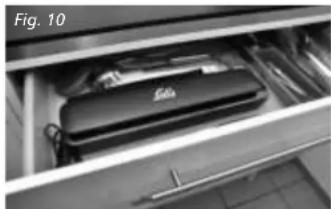
Store the appliance in an even, dry and dark place, outside of the reach of children, best in the original packaging. The vacuum sealer can be stored standing on the appliance bottom or space-savingly lying on the long side (see Fig. 10).
Always store the appliance with the lid open after vacuuming. Never leave the lid locked, as this will deform the seals and impair the appliance functionality. Furthermore, nothing must be placed on top of the appliance to avoid pressure building up on the seals. Seals are consumable supplies and are not covered by warranty.
PROBLEMS AND POSSIBLE CAUSES
THE APPLIANCE DOESN'T WORK
- Check that the plug is plugged into the correct socket.
- Check whether the power cable is damaged. If this is the case, bring the appliance to Solis or a Solis approved service centre to get the cable replaced.
- Check whether the socket is working by connecting another electrical device.
- Check that the end of the bag is correctly in the vacuum chamber.
- Firmly push down on the centre front of the lid with one hand while sealing resp vacuum sealing so that a vacuum can develop in the vacuum chamber.
THE APPLIANCE DOES NOT SEAL THE BAG
- Make sure that the end of the bag is correctly positioned on the sealing bar, as described in section I. (page 88) resp. section II. (pages 89/90).
- Firmly push down on the centre front of the lid with one hand while sealing resp. vacuum sealing so that a vacuum can develop in the vacuum chamber.
THE AIR IS NOT COMPLETELY SUCKED OUT OF THE BAG
- So that the bag gets completely sealed, the open end of the bag must lie completely in the vacuum chamber without any wrinkles.
- Check that the sealing bar and the seals around the vacuum chamber are free from dirt and in the correct position. Also, the seals must not be broken or porous. Clean the seals and the sealing bar.
- Check whether the bag has a hole in it. To do this, seal the bag with some air in it and submerge it in water. If bubbles rise from it, it is leaking, use another bag.
- Use bags and films from Solis exclusively!
- Perhaps the bag is not completely sealed, because of crumbs, fat or liquid in the seal or the bag was not flat and has wrinkles or creases. Open the bag, clean the inside of the bag end, the sealing bar and the rubber contact strip and make sure to place the bag end absolutely evenly in the vacuum chamber.
- Check if the lid was firmly closed – if it can be opened without you having to press the release button, the lid was not closed air-tightly. For this reason, you should always push down on the center front of the lid with one hand while vacuuming.
THE APPLIANCE DOES NOT SEAL AFTER VACUUMING
- In the appliance there is a vacuum pressure sensor. If the pressure is not high enough, the sealing process will not automatically start. Check the sealing bar and the seals for contamination and clean if necessary. Also check that they are in the correct position and start the appliance again.
- Check whether the seals are broken or twisted. Put them back in place or replace them with new ones - Solis or your nearest Solis service station can help you further.
- Check whether the bag has a hole in it. To do this, seal the bag with some air in it and submerge it in water. If bubbles rise from it, it is leaking, use another bag.
- Perhaps the bag is not completely sealed, because of crumbs, fat or liquid in the seal or the bag was not flat and has wrinkles or creases. Open the bag, clean the inside of the bag end, the sealing bar and the rubber contact strip and make sure to place the bag end absolutely evenly in the vacuum chamber.
AIR GOES BACK INTO THE BAG AFTER IT HAS BEEN SEATED
- Perhaps the bag is not completely sealed, because of crumbs, fat or liquid in the seal or the bag was not flat and has wrinkles or creases. Open the bag, clean the inside of the bag end, the sealing bar and the rubber contact strip and make sure to place the bag end absolutely evenly in the vacuum chamber.
- Some foods produce natural gasses or ferment, such as e.g. fresh fruit and vegetables. If you suspect this to be the case, open the bag and check the food. If it is fermenting, throw the bag away. Temperature fluctuations in refrigerators can also spoil vacuum packed foods. If in doubt, always throw the food away.
- Do not vacuum any hot or warm foods! Warm resp. hot foods decrease in volume once they cool down, making it look as if air has entered the vacuum bag.
- Check if the bag has a hole which has let air in. Sharp edges of foods should be covered or "padded" with folded kitchen paper, so that the edges cannot cause holes.
THE BAG BOILS OR DOES NOT SEAL PROPERLY
Should the sealing bar or the rubber contact strip overheat, the bag can melt. In this case, switch the appliance off, open the lid and let the two described parts cool down for at least 5 minutes.
STORAGE TIMES
| Storage type Food | Tempera- ture | Normal storage time | Storage time with vacuum packing in Solis bags | |
| Refrigerator | Raw, red meat | \( 5 \pm {2}^{ \circ }\mathrm{C}\;2 - 3 \) days | 8-9 days | |
| Raw, white meat | \( 5 \pm {2}^{ \circ }\mathrm{C}\;2 - 3 \) days | 6-8 days | ||
| Game meat 5±2 °C 2-3 days | 5-7 days | |||
| Salami, sliced 5±2 °C 4-6 days | 20-25 days | |||
| Soft cheese 5±2 °C 5-7 days | 14-20 days | |||
| Hard cheese 5±2 °C 15-20 days | 25-60 days | |||
| Fresh fish Seafood | \( 5 \pm {2}^{ \circ }\mathrm{C}\;1 - 3 \) days 4-5 days | |||
| Cooked meat 5±2 °C 3-5 days | 10-15 days | |||
| Vegetables 5±2°C 1-3 days | 7-10 days | |||
| Fruit \( 5 \pm 2{}^{ \circ } \) C 5-7 days 14 | 20 days | |||
| Eggs | \( 5 \pm {2}^{ \circ }\mathrm{C}{10} \) | 15 days 30-50 days | ||
| Freezer | Meat | \( - {18} \pm {2}^{ \circ }\mathrm{C} \) | 3-5 months | > 1 year |
| Fish | \( - {18} \pm {2}^{ \circ }\mathrm{C} \) | 3-4 months | > 1 year | |
| Seafood | \( - {18} \pm {2}^{ \circ }\mathrm{C} \) | 3-5 months | > 1 year | |
| Storage type Food | Food | Tempera- ture | Normal storage time | Storage time with vacuum packing in Solis bags |
| Room- temperature | Bread | 25±2 °C | 1-2 days | 6-8 days |
| Sponge | 25±2 °C | 4-6 months | > 1 year | |
| Flour | 25±2 °C | 4-5 months | > 1 year | |
| Pasta/Rice | 25±2 °C | 5-6 months | > 1 year | |
| Peanuts Pulses | 25±2 °C | 3-6 months | > 1 year | |
| Medical supplies | 25±2 °C | 3-6 months | > 1 year | |
| Tea | 25±2 °C | 5-6 months | > 1 year | |
| Coffee, ground | 25±2 °C | 2-3 months | > 1 year |
TECHNICAL INFORMATION
Model no. E1800-C, type 5701
Product Vacuum sealer
Voltage / frequency 220-240V/50 Hz
Power 100 Watt
Dimensions ca. 39,5 x 5,5 x 8,0 cm (L x H x D)
Weight ca. 0.83 kg
Technical changes reserved

DISPOSAL

EU 2011/65/EU
Information for correct disposal of the product in accordance with the European Directive EU 2011/65/EU
At the end of its working life this equipment must not be disposed of as an household waste. It must be taken to special local community waste collection centres or to a dealer providing this service. Disposing of electrical and electronic equipment separately avoids possible negative effects on the environment and human health deriving from an inappropriate disposal and enables its components to be recovered and recycled to obtain significant savings in energy and resources. In order to underline the duty to dispose of this equipment separately, the product is marked with a crossed-out dustbin.
Solis of Switzerland Ltd reserves the right to carry out technical and visual changes and modifications to improve the product at any time.

HELPLINE:
091 802 90 10
This item stands out due to its long-life cycle and reliability. Despite this though, if a malfunction ever occurs, simply give us a call. Often a breakdown can be easily and quickly remedied with the right up or technique without having to straight away send off the device for repair. We will give you all the advice and practical support you require.
Keep the original packaging in a safe place so that you may use it in the event that transportation or shipping of the product becomes necessary.
Solis of Switzerland Ltd
Solis-House • Europastrasse 11 • CH-8152 Glattbrugg-Zurich • Switzerland Phone +41 44 874 64 54 • Fax +41 44 874 64 99
info@solis.ch · www.solis.ch · www.solis.com
APPARAATBESCHRIJVING
APPPARAATBESCHRIJVING
APPARAATBESCHRIJVING
DE FUNCIEKNOPPEN
Solis of Switzerland AG
Solis-Haus · Europaastrasse 11 CH-8152 Glattbrugg-Zurich · Zwitserland
Telefoon +41 44 874 64 54 • Fax +41 44 874 64 99
info@solis.ch • www.solis.ch • www.solis.com