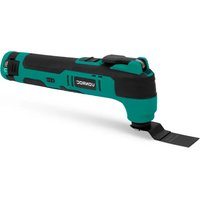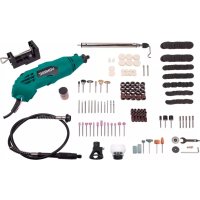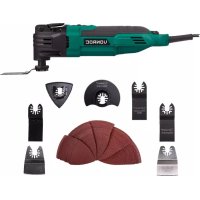
CT502DC - Multitools Vonroc - Free user manual and instructions
Find the device manual for free CT502DC Vonroc in PDF.


| Product type | Cordless multi-tool |
| Brand | Vonroc |
| Model | CT502DC |
| Power supply | Li-ion battery 8 V, 900 mAh |
| Charger input voltage | 100-240 V~ 50/60 Hz, 0.2 A |
| Charger output voltage | 9.0 V DC, 0.5 A |
| Charging time | 2-3 hours |
| No-load speed | 5,000 - 25,000 rpm |
| Max. disc diameter | 35 mm |
| Chuck clamping capacity | 3.2 mm |
| Weight | 0.26 kg |
| Sound pressure level (Lpa) | 76 ± 3 dB(A) |
| Sound power level (Lwa) | 87 ± 3 dB(A) |
| Vibration value | 2.35 ± 1.5 m/s² |
| Main functions | Grinding, sanding, metal brushing, polishing, engraving, cutting |
| Speed adjustment | Electronic, 5 speeds |
| Lighting | Work LED |
| Safety | Double insulation, spindle lock, overload protection |
| Maintenance and cleaning | Clean with a soft damp cloth, do not use solvents |
| Spare parts and repairability | Repairs only by authorized professional; use original parts |
| Warranty | Legal warranty against manufacturing defects |
Frequently Asked Questions - CT502DC Vonroc
User questions about CT502DC Vonroc
0 question about this device. Answer the ones you know or ask your own.
Ask a new question about this device
Download the instructions for your Multitools in PDF format for free! Find your manual CT502DC - Vonroc and take your electronic device back in hand. On this page are published all the documents necessary for the use of your device. CT502DC by Vonroc.
USER MANUAL CT502DC Vonroc
natural_image
White silhouette of a bottle with a stopper, against a black background (no text or symbols)EN Original Instructions 05
natural_image
Four different types of light gray and dark gray objects with stems, arranged in a row (no text or symbols)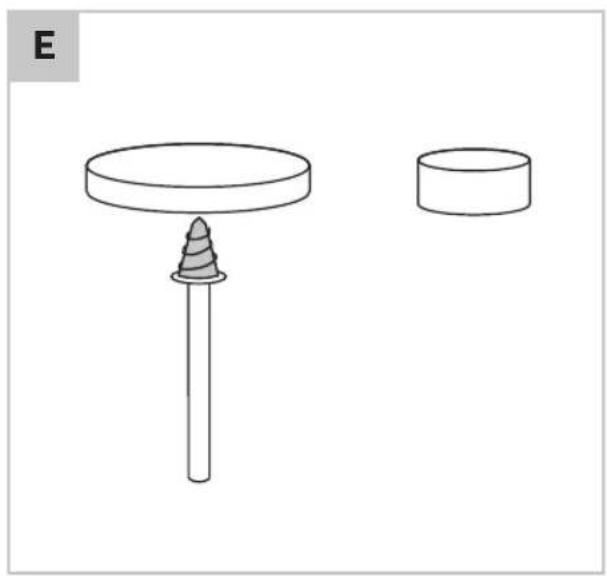
natural_image
Simple line drawing of a pendulum with a base and a cylindrical object, labeled 'E' in the top-left corner (no text or symbols on the diagram itself)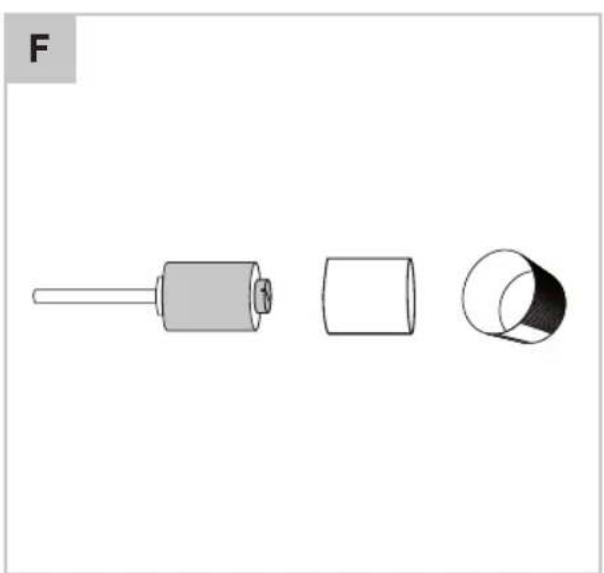
natural_image
Diagram showing three types of mechanical components: a cylindrical tool, a hollow cylinder, and a toroidal cap (no text or symbols)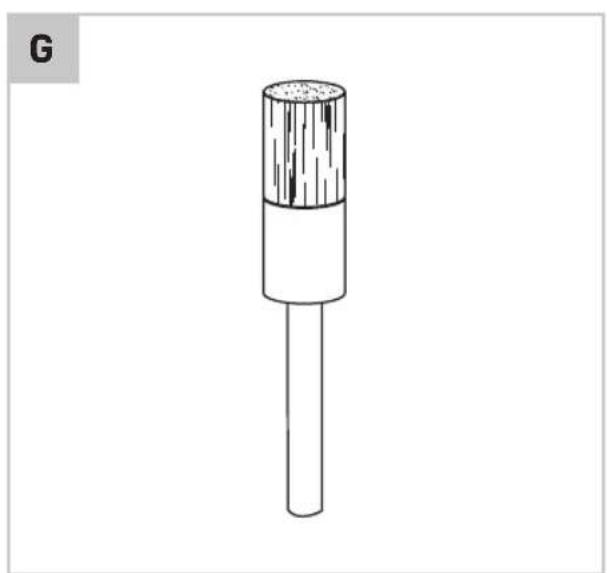
natural_image
Line drawing of a cylindrical object with textured top and shaft, labeled 'G' in top-left corner (no other text or symbols)H
natural_image
Five different types of dental or surgical tools shown in line drawings, including a pointed tool with a circular head and a triangular tip (no text or labels)|
natural_image
Technical illustration of a mechanical assembly with three circular components and a cylindrical shaft (no text or symbols)1. SAFETY INSTRUCTIONS
Read the enclosed safety warnings, the additional safety warnings and the instructions. Failure to follow the safety warnings and the instructions may result in electric shock, fire and/or serious injury. Save the safety warnings and the instructions for future reference.
The following symbols are used in the user manual or on the product:

Denotes risk of personal injury, loss of life or damage to the tool in case of nonobservance of the instructions in this manual.

Risk of electric shock

Variable speed control

Indoor use only

ear and eye protection

Wear a dust mask

Do not press the spindle lock button while the motor is running.

Class II machine - Double insulation - You don't need any earthed plug.

Max temperature 40°C

Do not throw the battery into fire

not throw the battery into water

Do not dispose of the product in unsuitable containers.

Separate collection for Li-ion battery.

The product is in accordance with the applicable safety standards in the European directives.
GENERAL POWER TOOL SAFETY WARNINGS

WARNING! Read all safety warnings and all instructions. Failure to follow the warnings and instructions may result in electric shock, fire and/or serious injury.
Save all warnings and instructions for future reference.
The term “power tool” in the warnings refers to your mains-operated (corded) power tool or battery-operated (cordless) power tool.
1) Work area safety
a) Keep the work area clean and well lit. Cluttered or dark areas invite accidents.
b) Do not operate power tools in explosive atmospheres, such as in the presence of flammable liquids, gases or dust. Power tools create sparks which may ignite the dust or fumes.
c) Keep children and bystanders away while operating a power tool. Distractions can cause you to lose control.
2) Electrical safety
a) Power tool plugs must match the outlet. Never modify the plug in any way. Do not use any adapter plugs with earthed (grounded) power tools. Unmodified plugs and matching outlets will reduce risk of electric shock.
b) Avoid body contact with earthed or grounded surfaces, such as pipes, radiators, ranges and refrigerators. There is an increased risk of electric shock if your body is earthed or grounded.
c) Do not expose power tools to rain or wet conditions. Water entering a power tool will increase the risk of electric shock.
d) Do not abuse the cord. Never use the cord for carrying, pulling or unplugging the power tool. Keep cord away from heat, oil, sharp edges or moving parts. Damaged or entangled cords increase the risk of electric shock.
e) When operating a power tool outdoors, use an extension cord suitable for outdoor use. Use of a cord suitable for outdoor use reduces the risk of electric shock.
f) If operating a power tool in a damp location is unavoidable, use a residual current device (RCD) protected supply. Use of an RCD reduces the risk of electric shock.
3) Personal safety
a) Stay alert, watch what you are doing and use common sense when operating a power tool. Do not use a power tool while you are tired or under the influence of drugs, alcohol or medication.
A moment of inattention while operating power tools may result in serious personal injury.
b) Use personal protective equipment. Always wear eye protection. Protective equipment such as dust mask, non-skid safety shoes, hard hat, or hearing protection used for appropriate conditions will reduce personal injuries.
c) Prevent unintentional starting. Ensure the switch is in the off-position before connecting to power source and/or battery pack, picking up or carrying the tool. Carrying power tools with your finger on the switch or energising power tools that have the switch on invites accidents.
d) Remove any adjusting key or wrench before turning the power tool on. A wrench or a key left attached to a rotating part of the power tool may result in personal injury.
e) Do not overreach. Keep proper footing and balance at all times. This enables better control of the power tool in unexpected situations.
f) Dress properly. Do not wear loose clothing or jewellery. Keep your hair, clothing and gloves away from moving parts. Loose clothes, jewellery or long hair can be caught in moving parts.
g) If devices are provided for the connection of dust extraction and collection facilities, ensure these are connected and properly used. Use of dust collection can reduce dust related hazards.
h) Do not let familiarity gained from frequent use of tools allow you to become complacent and ignore tool safety principles. A careless action can cause severe injury within a fraction of a second.
4) Power tool use and care
a) Do not force the power tool. Use the correct power tool for your application. The correct power tool will do the job better and safer at the rate for which it was designed.
b) Do not use the power tool if the switch does not turn it on and off. Any power tool that cannot be controlled with the switch is dangerous and must be repaired.
c) Disconnect the plug from the power source and/or the battery pack from the power tool before making any adjustments, changing accessories, or storing power tools. Such preventive safety
measures reduce the risk of starting the power tool accidentally.
d) Store idle power tools out of the reach of children and do not allow persons unfamiliar with the power tool or these instructions to operate the power tool. Power tools are dangerous in the hands of untrained users.
e) Maintain power tools. Check for misalignment or binding of moving parts, breakage of parts and any other condition that may affect the power tool's operation. If damaged, have the power tool repaired before use. Many accidents are caused by poorly maintained power tools.
f) Keep cutting tools sharp and clean. Properly maintained cutting tools with sharp cutting edges are less likely to bind and are easier to control.
g) Use the power tool, accessories and tool bits etc. in accordance with these instructions, taking into account the working conditions and the work to be performed. Use of the power tool for operations different from those intended could result in a hazardous situation.
h) Keep handles and grasping surfaces dry, clean and free from oil and grease. Slippery handles and grasping surfaces do not allow for safe handling and control of the tool in unexpected situations.
5) Battery tool use and care
a) Recharge only with the charger specified by the manufacturer. A charger that is suitable for one type of battery pack may create a risk of fire when used with another battery pack.
b) Use power tools only with specifically designated battery packs. Use of any other battery packs may create a risk of injury and fire.
c) When battery pack is not in use, keep it away from other metal objects, like paper clips, coins, keys, nails, screws or other small metal objects that can make a connection from one terminal to another. Shorting the battery terminals together may cause burns or a fire.
d) Under abusive conditions, liquid may be ejected from the battery; avoid contact. If contact accidentally occurs, flush with water. If liquid contacts eyes, additionally seek medical help. Liquid ejected from the battery may cause irritation or burns.
e) Do not use a battery pack or tool that is damaged or modified. Damaged or modified batteries may exhibit unpredictable behaviour resulting in fire, explosion or risk of injury.
f) Do not expose a battery pack or tool to fire or excessive temperature. Exposure to fire or temperature above 130 °C may cause explosion. NOTE The temperature „130 °C“ can be replaced by the temperature „265 °F“.
g) Follow all charging instructions and do not charge the battery pack or tool outside the temperature range specified in the instructions. Charging improperly or at temperatures outside the specified range may damage the battery and increase the risk of fire.
6) Service
a) Have your power tool serviced by a qualified repair person using only identical replacement parts. This will ensure that the safety of the power tool is maintained.
b) Never service damaged battery packs. Service of battery packs should only be performed by the manufacturer or authorized service providers.
SPECIFIC SAFETY INSTRUCTIONS
a) This power tool is intended to function as a grinder, sander, wire brush, polisher, carving or cut-off tool. Read all safety warnings, instructions, illustrations and specifications provided with this power tool. Failure to follow all instructions listed below may result in electric shock, fire and/or serious injury.
c) Do not use accessories which are not specifically designed and recommended by the tool manufacturer. Just because the accessory can be attached to your power tool, it does not assure safe operation.
d) The rated speed of the grinding accessories must be at least equal to the maximum speed marked on the power tool. Grinding accessories running faster than their rated speed can break and fly apart.
e) The outside diameter and the thickness of your accessory must be within the capacity rating of your power tool. Incorrectly sized accessories cannot be adequately controlled.
f) The arbour size of wheels, sanding drums or any other accessory must properly fit the spindle or collet of the power tool. Accessories that do not match the mounting hardware of the power tool will run out of balance, vibrate excessively and can lead to loss of control of the power tool.
g) Mandrel mounted wheels, sanding drums, cutters or other accessories must be fully inserted into the collet or chuck. If the mandrel is insuf-
ficiently held and/or the overhang of the wheel is too long, the mounted wheel may become loose and be ejected at high velocity.
h) Do not use a damaged accessory. Before each use inspect the accessory such as abrasive wheels for chips and cracks, sanding drum for cracks, tear or excess wear, wire brush for loose or cracked wires. If power tool or accessory is dropped, inspect for damage or install an undamaged accessory. After inspecting and installing an accessory, position yourself and bystanders away from the plane of the rotating accessory and run the power tool at maximum no-load speed for one minute. Damaged accessories will normally break apart during this test time.
i) Wear personal protective equipment. Depending on application, use face shield, safety goggles or safety glasses. As appropriate, wear dust mask, hearing protectors, gloves and workshop apron capable of stopping small abrasive or workpiece fragments. The eye protection must be capable of stopping flying debris generated by various operations. The dust mask or respirator must be capable of filtrating particles generated by your operation. Prolonged exposure to high intensity noise may cause hearing loss.
j) Keep bystanders a safe distance away from work area. Anyone entering the work area must wear personal protective equipment. Fragments of work piece or of a broken accessory may fly away and cause injury beyond immediate area of operation.
k) Hold power tool by insulated gripping surfaces only, when performing an operation where the cutting accessory may contact hidden wiring. Cutting accessory contacting a "live" wire may make exposed metal parts of the power tool "live" and could give the operator an electric shock.
I) Always hold the tool firmly in your hand(s) during the start-up. The reaction torque of the motor, as it accelerates to full speed, can cause the tool to twist.
m) Use clamps to support workpiece whenever practical. Never hold a small workpiece in one hand and the tool in the other hand while in use. Clamping a small workpiece allows you to use your hand(s) to control the tool. Round material such as dowel rods, pipes or tubing have a tendency to roll while being cut, and may cause the bit to bind or jump toward you.
n) Position the cord clear of the spinning acces-
sory. If you lose control, the cord may be cut or snagged and your hand or arm may be pulled into the spinning accessory.
o) Never lay the power tool down until the accessory has come to a complete stop. The spinning accessory may grab the surface and pull the power tool out of your control.
p) After changing the bits or making any adjustments, make sure the collet nut, chuck or any other adjustment devices are securely tightened. Loose adjustment devices can unexpectedly shift, causing loss of control, loose rotating components will be violently thrown.
q) Do not run the power tool while carrying it at your side. Accidental contact with the spinning accessory could snag your clothing, pulling the accessory into your body.
r) Regularly clean the power tool's air vents. The motor's fan will draw the dust inside the housing and excessive accumulation of powdered metal may cause electrical hazards.
s) Do not operate the power tool near flammable materials. Sparks could ignite these materials.
t) Do not use accessories that require liquid coolants. Using water or other liquid coolants may result in electrocution or shock.
Kickback and related warnings
Kickback is a sudden reaction to a pinched or snagged rotating wheel, sanding band, brush or any other accessory. Pinching or snagging causes rapid stalling of the rotating accessory which in turn causes the uncontrolled power tool to be forced in the direction opposite of the accessory's rotation.
For example, if an abrasive wheel is snagged or pinched by the workpiece, the edge of the wheel that is entering into the pinch point can dig into the surface of the material causing the wheel to climb out or kick out. The wheel may either jump toward or away from the operator, depending on direction of the wheel's movement at the point of pinching. Abrasive wheels may also break under these conditions.
Kickback is the result of power tool misuse and/or incorrect operating procedures or conditions and can be avoided by taking proper precautions as given below.
a) Maintain a firm grip on the power tool and position your body and arm to allow you to resist kickback forces. The operator can control kickback forces, if proper precautions are taken.
b) Use special care when working corners, sharp edges etc. Avoid bouncing and snagging the
accessory. Corners, sharp edges or bouncing have a tendency to snag the rotating accessory and cause loss of control or kickback.
c) Do not attach a toothed saw blade. Such blades create frequent kickback and loss of control.
d) Always feed the bit into the material in the same direction as the cutting edge is exiting from the material (which is the same direction as the chips are thrown). Feeding the tool in the wrong direction causes the cutting edge of the bit to climb out of the work and pull the tool in the direction of this feed.
e) When using rotary files, cut-off wheels, high-speed cutters or tungsten carbide cutters, always have the work securely clamped. These wheels will grab if they become slightly canted in the groove, and can kickback. When a cut-off wheel grabs, the wheel itself usually breaks. When a rotary file, high-speed cutter or tungsten carbide cutter grabs, it may jump from the groove and you could lose control of the tool.
ADDITIONAL SAFETY INSTRUCTIONS FOR GRINDING AND CUTTING-OFF OPERATIONS Safety warnings specific for grinding and abrasive cutting-off operations:
a) Use only wheel types that are recommended for your power tool and only for recommended applications. For example: do not grind with the side of a cut-off wheel. Abrasive cut-off wheels are intended for peripheral grinding, side forces applied to these wheels may cause them to shatter.
b) For threaded abrasive cones and plugs use only undamaged wheel mandrels with an unrelieved shoulder flange that are of correct size and length. Proper mandrels will reduce the possibility of breakage.
c) Do not "jam" a cut-off wheel or apply excessive pressure. Do not attempt to make an excessive depth of cut. Overstressing the wheel increases the loading and susceptibility to twisting or snagging of the wheel in the cut and the possibility of kickback or wheel breakage.
d) Do not position your hand in line with and behind the rotating wheel. When the wheel, at the point of operation, is moving away from your hand, the possible kickback may propel the spinning wheel and the power tool directly at you.
e) When wheel is pinched, snagged or when interrupting a cut for any reason, switch off the power
tool and hold the power tool motionless until the wheel comes to a complete stop. Never attempt to remove the cut-off wheel from the cut while the wheel is in motion otherwise kickback may occur. Investigate and take corrective action to eliminate the cause of wheel pinching or snagging.
f) Do not restart the cutting operation in the workpiece. Let the wheel reach full speed and carefully re-enter the cut. The wheel may bind, walk up or kickback if the power tool is restarted in the workpiece.
g) Support panels or any oversized workpiece to minimize the risk of wheel pinching and kick-back. Large workpieces tend to sag under their own weight. Supports must be placed under the workpiece near the line of cut and near the edge of the workpiece on both sides of the wheel.
h) Use extra caution when making a "pocket cut" into existing walls or other blind areas. The protruding wheel may cut gas or water pipes, electrical wiring or objects that can cause kickback.
ADDITIONAL SAFETY INSTRUCTIONS FOR WIRE BRUSHING OPERATIONS
Safety warnings specific for wire brushing operations:
a) Be aware that wire bristles are thrown by the brush even during ordinary operation. Do not overstress the wires by applying excessive load to the brush. The wire bristles can easily penetrate light clothing and/or skin.
b) Allow brushes to run at operating speed for at least one minute before using them. During this time no one is to stand in front or in line with the brush. Loose bristles or wires will be discharged during the run-in time.
c) Direct the discharge of the spinning wire brush away from you. Small particles and tiny wire fragments may be discharged at high velocity during the use of these brushes and may become imbedded in your skin.
FOR THE CHARGER
Intended use
Charge only rechargeable battery packs. Other types of batteries may burst causing personal injury and damage.
a) The appliance is not to be used by persons (including children) with reduced physical, sensory or mental capabilities, or lack of experience and knowledge, unless they have been given supervision or instruction
b) Children being supervised not to play with the appliance
c) Do not recharging non-rechargeable batteries!
d) During charging, batteries must be placed in the well ventilated area!
e) Integrated batteries may only be removed for disposal by qualified personnel. Opening the housing shell can destroy the power tool.
To remove the battery from the power tool, press the On/Off switch (5) until the battery is fully discharged. Unscrew the screws on the housing and remove the housing shell in order to remove the battery. To prevent a short circuit, disconnect the connectors on the battery one at a time and then isolate the poles. Even when fully discharged, the battery still contains a residual capacity, which can be released in case of a short circuit.
Electrical safety
When using electric machines always observe the safety regulations applicable in your country to reduce the risk of fire, electric shock and personal injury. Read the following safety instructions.

Always check that the power supply corresponds to the voltage on the rating plate.

Your machine is double insulated, therefore no earthwire is required.
2. MACHINE INFORMATION
Intended use
This power tool is intended to function as a grinder, sander, wire brush, polisher, carving or cut-off tool. This combitool is great for editing of materials like wood, plastic, stone, shell aluminium, brass and steel. Always use the proper accessories and speed setting.
TECHNICAL SPECIFICATIONS
| Model No. CT502DC | |
| Rechargeable Battery 8V Li-ion | 900mAh |
| Charger CT802AA | |
| Input of charger | 100-240V~50/60Hz 0.2A |
| Output of charger 9.0V d.c. 0.5A | |
| Battery charging time 2-3hours | |
| Maximum disc diameter 035 mm | |
| No load speed 5.000-25.000/min | |
| Capacity of spring chuck 3.2 mm | |
| Weight 0.26 kg | |
| Lpa (Sound pressure level) 76+3 dB(A) | |
| Lwa (Sound power level) 87+3 dB(A) | |
| Vibration 2.35+1.5 m/s | 2 |
Vibration level
The vibration emission level stated in this instruction manual has been measured in accordance with a standardised test given in EN 60745; it may be used to compare one tool with another and as a preliminary assessment of exposure to vibration when using the tool for the applications mentioned.
- using the tool for different applications, or with different or poorly maintained accessories, may significantly increase the exposure level.
- the times when the tool is switched off or when it is running but not actually doing the job, may significantly reduce the exposure level.
Protect yourself against the effects of vibration by maintaining the tool and its accessories, keeping your hands warm, and organizing your work patterns.
DESCRIPTION
The numbers in the following text refer to the pictures on page 2-4.
- Collet chuck
- LED work light
- Spindle lock
4A. Speed adjustment button "+"
4B. Speed adjustment button “-” - On/off button
- Speed indication lights
- Charger indication light
- Chuck spanner
3. ASSEMBLY

Always make sure the machine is turned off before mounting an accessory.

Warning! Change accessories by inserting an accessory into the collet (or chuck) as far possible to minimize run out and unbalance.
Assembly of accessories (Fig. B)
Press down the spindle lock (3) and hold it down. Using the chuck spanner (8) you can undo the collet chuck (1). Put the accessory in its place. Hold down the spindle lock when you fasten the collet chuck with the chuck spanner.

Do not press the spindle lock button while the motor is running.
4. OPERATION
Switch on the machine by pressing the on/off button (5).
With the speed adjustment button "+" (4A) or "-" (4B) you can regulate the speed of the Combitool. Do not put the machine down when the motor is still running. Do not place the machine on a dusty surface. Dust particles may enter the mechanism.

Too high a load at a low speed of the Combitool can burn out the engine.
The battery must be charged before first use.
Charging the device (with the charger)
- Plug the charger plug into an electrical outlet and wait for a while. The charger indication light (7) will lighten up and show the charging status.
| LED Charger status | |
| Red Battery charging in progress | |
| Green | Battery charging finished, battery fully charged |
- After the battery is fully charged remove the charger plug from the outlet and remove the small plug from the device.
Holding and guiding the tool (Fig. C)
- For precision work (engraving): pencil grip (C1)
- For rough work (grinding): paring knife hand grip (C2)
- When you need to keep the tool parallel to the work surface (e.g. using a cut-off wheel): 2 hand golf grip (C3)
Optimal use of the combi tool and its accessories (Fig. A)
For optimal use of the accessories use the correct speed. You can refer to the overview "Recommended
speed setting" below to determine the correct speed, based on the material being worked on and the type of accessory being used. This overview enables you to select both correct accessory and the optimum speed.
The 5 speeds indication lights (6) are equal to the numbers 1, 2, 3, 4 and 5 in the overview "Recommended speed setting".
Ultimately, the best way to determine the correct speed for work on any material is to practice on a piece of scrap.
RECOMMENDED SPEED SETTING
Grinding stones (Fig. D)
| Material Speed setting | |
| Stone, shell 1-3 | |
| Steel 3-5 | |
| Aluminium, brass 2-4 | |
| Plastic 1-3 | |
Felt wheels and tip (Fig. E)
The felt wheels or tip should be screwed on the mandrel.
| Material Speed setting | |
| Steel 3-5 | |
| Aluminium, brass 2-4 | |
| Plastic 3-5 | |
Sanding bands and disc (sanding disc not included) (Fig. F)
| Material Speed setting | |
| Wood 4-5 | |
| Steel 1-3 | |
| Aluminium, brass 2-4 | |
| Plastic 1-3 | |
Bristol brush (Fig. G)
| Material Speed setting | |
| Stone, shell 2-4 | |
| Aluminium, brass 2-4 | |
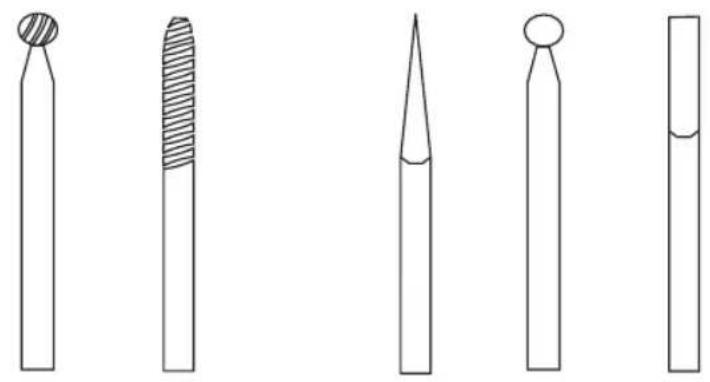
High speed cutter, Diamond wheel point and Drill (Fig. H)
| Material Speed setting | |
| Stone, shell 5 | |
| Steel 2-4 | |
| Aluminium, brass 4-5 | |
| Plastic 1-3 | |
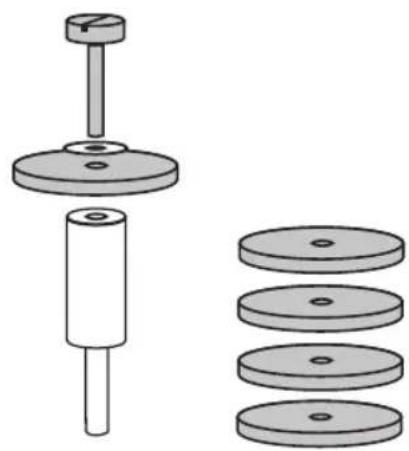
Abrasive disc (Fig. I)
| Material Speed setting | |
| Steel 3-5 | |
| Aluminium, brass 2-4 | |
| Plastic 1-3 | |
5. MAINTENANCE

Make sure that the machine is not live when carrying out maintenance work on the motor.
Keep the ventilation slots of the machine clean to prevent overheating of the engine. Regularly clean the machine housing with a soft cloth, preferably after each use. Keep the ventilation slots free from dust and dirt. If the dirt does not come off use a soft cloth moistened with soapy water. Never use solvents such as petrol, alcohol, ammonia water, etc. These solvents may damage the plastic parts. Please clean the tool immediately after use.
ENVIRONMENT

Damaged and/or disposed of electrical or electronic devices must be dropped off at recycling stations intended for that purpose.
Only for EC countries
Do not dispose of power tools into domestic waste. According to the European Guideline 2012/19/EU for Waste Electrical and Electronic Equipment and its implementation into national right, power tools that are no longer usable must be collected separately and disposed of in an environmentally friendly way.
WARRANTY
VONROC products are developed to the highest quality standards and are guaranteed free of defects in both materials and workmanship for the period lawfully stipulated starting from the date of original purchase. Should the product develop any failure during this period due to defective material and/or workmanship then contact VONROC directly.
The following circumstances are excluded from this guarantee:
- Repairs and or alterations have been made or attempted to the machine by unauthorized service centers;
- Normal wear and tear;
- The tool has been abused, misused or improperly maintained;
- Non-original spare parts have been used.
This constitutes the sole warranty made by company either expressed or implied. There are no other warranties expressed or implied which extend beyond the face hereof, herein, including the implied warranties of merchantability and fitness for a particular purpose. In no event shall VONROC be liable for any incidental or consequential damages. The dealers remedies shall be limited to repair or replacement of nonconforming units or parts.
The product and the user manual are subject to change. Specifications can be changed without further notice.
The felt wheels or tip should be screwed on the mandrel.
2. INFORMATIONS RELATIVES LA MACHINE
Utilisation prevue
DECLARATION OF CONFORMITY CT502DC - ROTARY MULTI TOOL
(EN) We declare under our sole responsibility that this product is in conformity with directive 2011/65/EU of the European parliament and of the council of 8 June on the restriction of the use of certain hazardous substances in electrical and electronic equipment is in conformity and accordance with the following standards and regulations:
(DE) Der Hersteller erklärt eigenverantwortlich, dass dieses Produkt der Direktive 2011/65/EU des Europäischen Parlaments und des Rats vom 8. Juni 2011 über die Einschränkung der Anwendung von bestimmten gefährlichen Stoffen in elektrischen und elektronischen Geräten entspricht. den folgenden Standards und Vorschriften entspricht:
(NL) Wij verklaren onder onze volledige verantwoordelijkheid dat dit product voldoet aan de conform Richtlijn 2011/65/EU van het Europees Parlement en de Raad van 8 juni 2011 betreffende beperking van het gebruik van bepaalde gevaarlijke stoffen in elektrische en elektronische apparatuur en in overeenstemming is met de volgende standaarden en reguleringen:
(FR) Nous déclarons sous notre seule responsabilité que ce produit est conforme aux standards et directives suivants: est conforme à la Directive 2011/65/EU du Parlement Européen et du Conseil du 8 juin 2011 concernant la limitation d'usage de certaines substances dangereuses dans l'équipement électrique et électronique.
(ES) Declaramos bajo nuestra exclusiva responsabilidad que este producto cumple con las siguientes normas y estándares de funcionamiento: se encuentra conforme con la Directiva 2011/65/UE del Parlamento Europeo y del Consejo de 8 de junio de 2011 sobre la restricción del uso de determinadas sustancias peligrosas en los equipos eléctricos y electrónicos.
(IT) Dichiariamo, sotto la nostra responsabilità, che questo prodotto è conforme alle normative e ai regolamenti seguenti: è conforme alla Direttiva 2011/65/UE del Parlamento Europeo e del Consiglio dell'8 giugno 2011 sulla limitazione dell'uso di determinate sostanze pericolose nelle apparecchiature elettriche ed elettroniche.
(SV) Vi försäkrar under vårt eget ansvar att denna produkt överensstämmer med Europaparlamentets och rådets direktiv 2011/65/EU av den 8 juni om begränsning av användningen av vissa farliga ämnen i elektrisk och elektronisk utrustning och är i överensstämmelse och enlighet med följande standarder och föreskrifter: