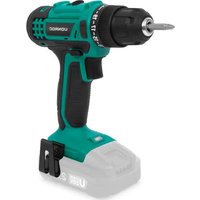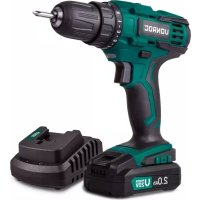
S_CD501DC - Drill Vonroc - Free user manual and instructions
Find the device manual for free S_CD501DC Vonroc in PDF.



| Brand | Vonroc |
| Model | S_CD501DC |
| Product type | Cordless drill driver |
| Rated voltage | 20 V |
| Chuck capacity | 13 mm |
| Torque settings | 21 + drill mode |
| No-load speed | Position 1: 0-400 rpm, Position 2: 0-1500 rpm |
| Weight (without battery) | 1.15 kg |
| Battery type | Lithium-Ion 20 V |
| Compatible battery capacities | 2 Ah (CD801AA) or 4 Ah (CD803AA) |
| Compatible charger | CD802AA, input 220-240 V, 50 Hz |
| Charging time battery 2 Ah | 60 minutes |
| Charging time battery 4 Ah | 120 minutes |
| Sound pressure level (LpA) | 89.9 dB(A), K=3 dB(A) |
| Sound power level (LWA) | 99.9 dB(A), K=3 dB(A) |
| Vibration (screwdriving without impact) | 0.700 m/s², K=1.5 m/s² |
| Vibration (drilling in metal) | 1.746 m/s², K=1.5 m/s² |
| Intended use | Screwing/unscrewing, drilling in wood, metal and plastic |
| Power supply | Battery (cordless) |
| Maintenance and cleaning | Clean with a soft cloth, do not use aggressive products |
| Warranty | Legal against defects in parts and workmanship |
| Standards | Compliant with European directives |
Frequently Asked Questions - S_CD501DC Vonroc
User questions about S_CD501DC Vonroc
0 question about this device. Answer the ones you know or ask your own.
Ask a new question about this device
Download the instructions for your Drill in PDF format for free! Find your manual S_CD501DC - Vonroc and take your electronic device back in hand. On this page are published all the documents necessary for the use of your device. S_CD501DC by Vonroc.
USER MANUAL S_CD501DC Vonroc
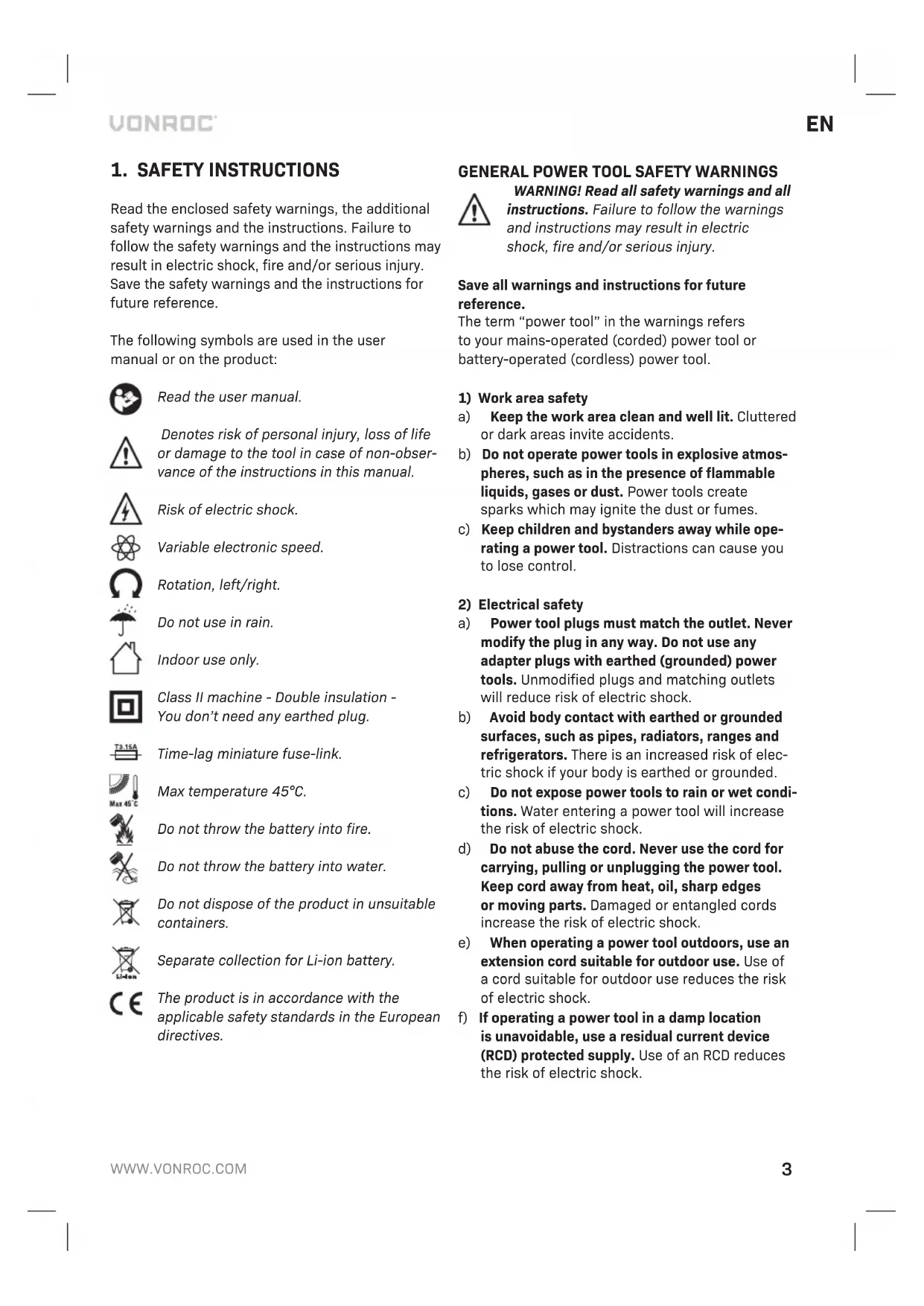
1. SAFETY INSTRUCTIONS
Read the enclosed safety warnings, the additional safety warnings and the instructions. Failure to follow the safety warnings and the instructions may result in electric shock, fire and/or serious injury. Save the safety warnings and the instructions for future reference.
The following symbols are used in the user manual or on the product:

Read the user manual.

Denotes risk of personal injury, loss of life or damage to the tool in case of non-observation of the instructions in this manual.

Risk of electric shock.

Variable electronic speed.

Rotation, left/right.

Do not use in rain.

Indoor use only.

Class II machine - Double insulation - You don't need any earthed plug.

Time-lag miniature fuse-link.

Max temperature 45^

Do not throw the battery into fire.

Do not throw the battery into water.

Do not dispose of the product in unsuitable containers.

Separate collection for Li-ion battery.

The product is in accordance with the applicable safety standards in the European directives.
GENERAL POWER TOOL SAFETY WARNINGS

WARNING! Read all safety warnings and all instructions. Failure to follow the warnings and instructions may result in electric shock, fire and/or serious injury.
Save all warnings and instructions for future reference.
The term "power tool" in the warnings refers to your mains-operated (corded) power tool or battery-operated (cordless) power tool.
1) Work area safety
a) Keep the work area clean and well lit. Cluttered or dark areas invite accidents.
b) Do not operate power tools in explosive atmospheres, such as in the presence of flammable liquids, gases or dust. Power tools create sparks which may ignite the dust or fumes.
c) Keep children and bystanders away while operating a power tool. Distractions can cause you to lose control.
2) Electrical safety
a) Power tool plugs must match the outlet. Never modify the plug in any way. Do not use any adapter plugs with earthed (grounded) power tools. Unmodified plugs and matching outlets will reduce risk of electric shock.
b) Avoid body contact with earthed or grounded surfaces, such as pipes, radiators, ranges and refrigerators. There is an increased risk of electric shock if your body is earthed or grounded.
c) Do not expose power tools to rain or wet conditions. Water entering a power tool will increase the risk of electric shock.
d) Do not abuse the cord. Never use the cord for carrying, pulling or unplugging the power tool. Keep cord away from heat, oil, sharp edges or moving parts. Damaged or entangled cords increase the risk of electric shock.
e) When operating a power tool outdoors, use an extension cord suitable for outdoor use. Use of a cord suitable for outdoor use reduces the risk of electric shock.
f) If operating a power tool in a damp location is unavoidable, use a residual current device (RCD) protected supply. Use of an RCD reduces the risk of electric shock.
3) Personal safety
a) Stay alert, watch what you are doing and use common sense when operating a power tool. Do not use a power tool while you are tired or under the influence of drugs, alcohol or medication. A moment of inattention while operating power tools may result in serious personal injury.
b) Use personal protective equipment. Always wear eye protection. Protective equipment such as dust mask, non-skid safety shoes, hard hat, or hearing protection used for appropriate conditions will reduce personal injuries.
c) Prevent unintentional starting. Ensure the switch is in the off-position before connecting to power source and/or battery pack, picking up or carrying the tool. Carrying power tools with your finger on the switch or energising power tools that have the switch on invites accidents.
d) Remove any adjusting key or wrench before turning the power tool on. A wrench or a key left attached to a rotating part of the power tool may result in personal injury.
e) Do not overreach. Keep proper footing and balance at all times. This enables better control of the power tool in unexpected situations.
f) Dress properly. Do not wear loose clothing or jewellery. Keep your hair, clothing and gloves away from moving parts. Loose clothes, jewellery or long hair can be caught in moving parts.
g) If devices are provided for the connection of dust extraction and collection facilities, ensure these are connected and properly used. Use of dust collection can reduce dust related hazards.
h) Do not let familiarity gained from frequent use of tools allow you to become complacent and ignore tool safety principles. A careless action can cause severe injury within a fraction of a second.
4) Power tool use and care
a) Do not force the power tool. Use the correct power tool for your application. The correct power tool will do the job better and safer at the rate for which it was designed.
b) Do not use the power tool if the switch does not turn it on and off. Any power tool that cannot be controlled with the switch is dangerous and must be repaired.
c) Disconnect the plug from the power source and/or the battery pack from the power tool before making any adjustments, changing accessories, or storing power tools. Such preventive safety
measures reduce the risk of starting the power tool accidentally.
d) Store idle power tools out of the reach of children and do not allow persons unfamiliar with the power tool or these instructions to operate the power tool. Power tools are dangerous in the hands of untrained users.
e) Maintain power tools. Check for misalignment or binding of moving parts, breakage of parts and any other condition that may affect the power tool's operation. If damaged, have the power tool repaired before use. Many accidents are caused by poorly maintained power tools.
f) Keep cutting tools sharp and clean. Properly maintained cutting tools with sharp cutting edges are less likely to bind and are easier to control.
g) Use the power tool, accessories and tool bits etc. in accordance with these instructions, taking into account the working conditions and the work to be performed. Use of the power tool for operations different from those intended could result in a hazardous situation.
h) Keep handles and grasping surfaces dry, clean and free from oil and grease. Slippery handles and grasping surfaces do not allow for safe handling and control of the tool in unexpected situations.
5) Battery tool use and care
a) Recharge only with the charger specified by the manufacturer. A charger that is suitable for one type of battery pack may create a risk of fire when used with another battery pack.
b) Use power tools only with specifically designated battery packs. Use of any other battery packs may create a risk of injury and fire.
c) When battery pack is not in use, keep it away from other metal objects, like paper clips, coins, keys, nails, screws or other small metal objects that can make a connection from one terminal to another. Shorting the battery terminals together may cause burns or a fire.
d) Under abusive conditions, liquid may be ejected from the battery; avoid contact. If contact accidentally occurs, flush with water. If liquid contacts eyes, additionally seek medical help. Liquid ejected from the battery may cause irritation or burns.
e) Do not use a battery pack or tool that is damaged or modified. Damaged or modified batteries may exhibit unpredictable behaviour resulting in fire, explosion or risk of injury.
f) Do not expose a battery pack or tool to fire or excessive temperature. Exposure to fire or temperature above 130^ may cause explosion. NOTE The temperature, 130^ can be replaced by the temperature, 265^ .
g) Follow all charging instructions and do not charge the battery pack or tool outside the temperature range specified in the instructions. Charging improperly or at temperatures outside the specified range may damage the battery and increase the risk of fire.
6) Service
a) Have your power tool serviced by a qualified repair person using only identical replacement parts. This will ensure that the safety of the power tool is maintained.
b) Never service damaged battery packs. Service of battery packs should only be performed by the manufacturer or authorized service providers.
ADDITIONAL SAFETY WARNINGS FOR DRILLS AND SCREW DRIVERS
Drill safety warnings
a) Wear ear protectors when impact drilling. Exposure to noise can cause hearing loss.
b) Hold the power tool by insulated gripping surfaces, when performing an operation where the cutting accessory may contact hidden wiring. Cutting accessory contacting a "live" wire may make exposed metal parts of the power tool "live" and could give the operator an electric shock.
c) Brace the tool properly before use. This tool produces a high output torque and without properly bracing the tool during operation, loss of control may occur resulting in personal injury.
SAFETY INSTRUCTIONS WHEN USING LONG DRILL BITS
a) Never operate at higher speed than the maximum speed rating of the drill bit. At higher speeds, the bit is likely to bend if allowed to rotate freely without contacting the workpiece, resulting in personal injury.
b) Always start drilling at low speed and with the bit tip in contact with the workpiece. At higher speeds, the bit is likely to bend if allowed to rotate freely without contacting the workpiece, resulting in personal injury.
c) Apply pressure only in direct line with the bit and do not apply excessive pressure. Bits can
bend causing breakage or loss of control, resulting in personal injury.
SAFETYWARNINGSFORBATTERY
a) Do not open the battery. Danger of short-circuiting.
b) Protect the battery against heat, e. g., against continuous intense sunlight, fire, water, and moisture. Danger of explosion.
c) In case of damage and improper use of the battery, vapours may be emitted. Ventilate the area and seek medical help in case of complaints. The vapours can irritate the respiratory system.
d) Use the battery only in conjunction with your Vonroc product. This measure alone protects the battery against dangerous overload.
e) The battery can be damaged by pointed objects such as nails or screwdrivers or by force applied externally. An internal short circuit can occur and the battery can burn, smoke, explode or overheat.
SAFETYWARNINGSFORCHARGER
Intended use
Charge only CD801AA and CD803AA type rechargeable Battery packs with the charger. Other types of batteries may burst causing personal injury and damage.
a) The appliance is not to be used by persons (including children) with reduced physical, sensory or mental capabilities, or lack of experience and knowledge, unless they have been given supervision or instruction.
b) Children being supervised not to play with the appliance.
c) Do not recharging non-rechargeable batteries!
d) During charging, batteries must be placed in the well ventilated area!
Electrical safety
Always check that the voltage of the power supply corresponds to the voltage on the rating plate.
- Do not use the machine if the mains cable or the mains plug is damaged.
- Only use extension cables that are suitable for the power rating of the machine with a minimum thickness of 1.5mm^2 . If you use a extension cable reel, always fully unroll the cable.
2. MACHINE INFORMATION
Intended use
This cordless drill is intended for driving in and loosening screws as well as for drilling in wood, metal and plastic.
TECHNICAL SPECIFICATIONS

This manual has been drawn up for different sets / article numbers. Check the corresponding article number in below specifications table for the correct composition and contents of your set.
| Model No. | Batteries included | Chargers included |
| CD501DC | - | - |
| S_CD501DC | CD801AA CD802AA | |
| S2_CD501DC | 2 x CD801AA CD802AA | |
| S3_CD501DC | CD803AA CD802AA |
| Machine information | |
| Voltage 20V | --- |
| Chuck capacity 13 mm | |
| Torque settings 21+ Drill mode | |
| No load speed | |
| Position 1: | 0-400 /min |
| Position 2: | 0-1500 /min |
| Weight 1.15 kg | |
| Sound pressure level \(L_{PA}\) | 89.9 dB(A), K=3dB(A) |
| Sound power level \(L_{WA}\) | 99.9 dB(A), K=3dB(A) |
| Hand-arm vibration \(a_h\) (screwdriving without impact) | 0.700 m/s2K=1.5 m/s2 |
| Hand-arm vibration \(a_{h,D}\) (Drilling into metal) | 1.746 m/s2K=1.5 m/s2 |
| Model No. CD801AA | |
| Battery Type Lithium-ion | |
| Voltage 20V | --- |
| Capacity 2.0 Ah | |
| Recommended charger | CD802AA |
| Weight | 0.3 kg |
| Model No. CD802AA | |
| Charger input | 220-240V, 50Hz 0.4A |
| Charger output | 21V---2.5A |
| Charging time 2Ah battery | 60 minutes |
| Charging time 4Ah battery | 120 minutes |
| Recommended batteries | CD801AA, CD803AA |
| Weight | 0.36 kg |
| Model No. CD803AA | |
| Battery Type | Lithium-Ion |
| Voltage 20V | --- |
| Capacity 4.0 Ah | |
| Recommended charger | CD802AA |
| Weight | 0.65 kg |
Only use the following batteries of the VONROC VPOWER 20V battery platform. Using any other batte
ries could cause serious injury or damage the tool. CD801AA 20V,2Ah Lithium-Ion CD803AA 20V,4Ah Lithium-Ion
The following charger of the can be used to charge these batteries. CD802AA Quick charger
The batteries of the VONROC VPOWER 20V battery platform are interchangeable with all the VONROC VPOWER 20V battery platform tools.
Vibration level
The vibration emission level stated in this instruction manual has been measured in accordance with a standardized test given in EN 62841; it may be used to compare one tool with another and as a preliminary assessment of exposure to vibration when using the tool for the applications mentioned.
- Using the tool for different applications, or with different or poorly maintained accessories, may significantly increase the exposure level.
- The times when the tool is switched off or when it is running but not actually doing the job, may significantly reduce the exposure level.
Protect yourself against the effects of vibration by maintaining the tool and its accessories, keeping your hands warm, and organizing your work patterns.
DESCRIPTION
The numbers in the text refer to the diagrams on page 2.
- Machine
- Battery
- Battery unlock button
- Work light
- On / off switch
- Torque adjustment ring
- Chuck
- Gear selection switch
- Direction switch
10.Belt hook - Battery LED indicators button
- Battery LED indicators
- Charger
- Charger LED indicators
3. ASSEMBLY

Before any work on the power tool, remove the battery.

The battery must be charged before first use.
Inserting the battery into the machine (Fig. B)
Ensure that the exterior of the battery is clean and dry before connecting to the charger or machine.
- Insert the battery (2) into the base of the machine as shown in Fig. B.
- Push the battery further forward until it clicks into place.
Removing the battery from the machine (Fig. B)
- Push the battery unlock button (3)
- Pull the battery out of the machine like shown in Fig.B.
Checking the battery charging status (Fig. C)
- To check the battery charge status, push the button (11) on battery shortly.
The battery has 3 lights indicating the charge level, the more lights that burn, the more charge the battery has left. - When the lights are not burning it means the battery is empty and must be charged immediately.
Charging the battery with the charger (Fig. C)
- Take the battery (2) from the machine.
- Turn the battery (2) to upside down position and slide it onto the charger (13) as shown in Fig. C.
- Push the battery until it is fully pushed into the slot.
- Plug the charger plug into an electrical outlet and wait for a while. The LED indicators on the charger (14) will lighten up and show the charger status.
The charger has 2 LED indicators (14) which indicate the status of the charging process:
| Red LED Status | Green LED status | Charger status |
| Off Off No power | ||
| Off On | Standby mode: - No battery is inserted or, - Battery inserted but charging has finished | |
| On Off | Battery charging in progress |
Fully charging the 2Ah battery may take up to 60 minutes.
- Fully charging the 4Ah battery may take up to 120 minutes.
After the battery is fully charged remove the charger plug from the outlet and remove the battery from the charger.

When the machine is not being used over a longer period of time it is best to store the battery in charged condition.
Fitting and removing drills or screwdriver bits (Fig. A)
The drill chuck (7) is suitable for drills and screwdriver bits with round shaft as well as hexagonal shaft.
- Hold the machine firmly with one hand.
- Open the drill chuck (7) by rotating the chuck with your other hand in clockwise direction until it is opened far enough for the bit to slide in.
- Insert the shaft of the drill or screwdriver bit.
- Tighten the drill chuck again by firmly rotating the chuck (7) counterclockwise.
- Check if the bit is centered well by shortly activating the machine's on/off switch.
4. OPERATION
Adjusting the gears (Fig.A)
Never switch gears when the motor is running, this will damage your machine.

Never put switch in the middle between both positions, this will damage your machine.
The machine has 2 drill speeds, which can be adjusted by sliding the gear switch (8) forward or backwards. The number on the gear switch (8) shows which position is chosen.
- Position 1: For slow drilling, large drilling diameter or screw driving. The machine has high power at a low speed.
- Position 2: For fast drilling or small drilling diameter.
Adjusting the direction of rotation (Fig. A)
- Set the direction switch (9) to position in order to drive screws or to use it for drilling.
- Set the direction switch (9) to position in order to remove screws.
Switching the machine on and off (Fig. A)
The on/off switch (5) is used for activating the machine and adjusting rotation speed.
- Pressing the on/off switch (5) will activate the machine, the further the switch is being pushed, the faster the drill will turn.
Releasing the on/off switch (5) will stop the machine. - Move the direction reversing switch (9) to the middle position to lock the movement of the on/off switch.
Adjusting the torque (Fig. A)
The machine has 21 different torque settings and a special drill mode to set the power being transmitted to the chuck. By rotating the torque adjustment ring (6), screws can be driven to a predetermined depth, which is ideal for repetitive work. The higher the number, the more torque will be transmitted.
- Select a low setting for small screws or soft work material.
- Select a high setting for large screws, hard work materials and when removing screws.
- You should preferably choose a setting as low as possible when driving screws. Select a higher setting if the motor slips before the
screw is fully tightened.
- For drilling, turn the torque adjustment ring (6) to the setting for drilling fully turning it counterclockwise.

Ensure that the direction switch (9) is always set to during drilling.

The machine is equipped with electronic overload protection function. When the machine gets overloaded it will shut down automatically. When this happens, please wait for a few seconds to let the overload protection reset itself.
5. MAINTENANCE

Before cleaning and maintenance, always switch off the machine and remove the battery pack from the machine.
Clean the machine casings regularly with a soft cloth, preferably after each use. Make sure that the ventilation openings are free of dust and dirt. Remove very persistent dirt using a soft cloth moistened with soapsuds. Do not use any solvents such as gasoline, alcohol, ammonia, etc. Chemicals such as these will damage the synthetic components.
ENVIRONMENT

Faulty and/or discarded electrical or electronic apparatus have to be collected at the appropriate recycling locations.
Only for EC countries
Do not dispose of power tools into domestic waste. According to the European Guideline 2012/19/ EC for Waste Electrical and Electronic Equipment and its implementation into national right, power tools that are no longer usable must be collected separately and disposed of in an environmentally friendly way.
WARRANTY
VONROC products are developed to the highest quality standards and are guaranteed free of defects in both materials and workmanship for the period lawfully stipulated starting from the date of original purchase. Should the product develop any
failure during this period due to defective material and/or workmanship then contact VONROC directly.
The following circumstances are excluded from this guarantee:
- Repairs and or alterations have been made or attempted to the machine by unauthorized service centers;
Normal wear and tear;
The tool has been abused, misused or improperly maintained; - Non-original spare parts have been used.
This constitutes the sole warranty made by company either expressed or implied. There are no other warranties expressed or implied which extend beyond the face thereof, herein, including the implied warranties of merchantability and fitness for a particular purpose. In no event shall VONROC be liable for any incidental or consequential damages. The dealers remedies shall be limited to repair or replacement of nonconforming units or parts.
The product and the user manual are subject to change. Specifications can be changed without further notice.
VEILIGHEIDSVOORSCHRIFTEN VOOR DE ACCU
CD803AA 20V,4Ah Lithium-Ion
CD803AA 20V,4Ah Lithium-Ion
Endast for EU-lander
Ajustar as velocidades (Fig. A)
CD801AA 20 V, 2 Ah-s lithium-ion
CD803AA 20 V, 4 Ah-s litium-ion
CD803AA 20V,4Ah Lityum-Iyon
DECLARATION OF CONFORMITY
CD501DC / S_CD501DC / S2_CD501DC / S3_CD501DC - CORDLESS DRILL
(EN) We declare under our sole responsibility that this product is in conformity with directive 2011/65/EU of the European parliament and of the council of 8 June on the restriction of the use of certain hazardous substances in electrical and electronic equipment is in conformity and accordance with the following standards and regulations:
(DE) Der Hersteller erklart eigenverantwortlich, dass these Produkt der Direktive 2011/65/EU des Europäischen Parlaments und des Rats vom 8. Juni 2011 über die Einschränkung der Anwendung von bestimmten gefährlichen Stoffen in elektrischen und elektronischen Geräten entspricht. den folgenden Standards und Vorschriften entspricht:
(NL) Wij verklaren onder once volledige verantwoordelijkheid dat dit product voldoet aan de conform Richtlijn 2011/65/EU van het Europees Parlement en de Raad van 8 Juni 2011 betreffende beperking van het gebruik van bepaalde gevaarlijke stoffen in elektrische en elektronische apparatusu en in overeenstemming is met de volgende standarden en reguleringen:
(FR) Nous déclarons sous notre seule responsabilité que ce produit est conforme aux standards et directives suivants: est conforme à la Directive 2011/65/EU du Parlement Européen et du Conseil du 8 juin 2011 concernant la limitation d'usage de certaines substances dangereuses dans l'équipement électrique etlectronique.
(ES) Declaramos bajo nuestra exclusiva responsabilidad que este producto cumple con las siguientes normas y estandares de configuracion: se encuesta conforme con la Directiva 2011/65/UE del Parlamento Europeo y del Consejo de 8 de junio de 2011 sobre la restricción del uso de determinadas sustancias peligrosas en los equipos electricos y electrónicos.
(IT) Dichiariamo, sotto la nostra responsabilità, che questo prodotto è conforme alle normative e ai regolamenti seguenti: è conforme alla Direttiva 2011/65/UE del Parlamento Europeo e del Consiglio dell'8 giugno 2011 sulla limitazione dell'uso di determinate sostanze pericolose nelle apparecchiature elettriche ed elettroniche.
(SV) Vi försakrar under värteget ansvar attenna produit overensstämmer med Europaparlamentets och rädets direktiv 2011/65/EU av den 8 Juni om begränsning av användningen av vissa farlga amnen i elektrisk och elektronisk utrustning och ar i overensstammelse och enlighemed foljande standarder och foreskrifter:
(DA) Vi erklærer under eget ansvar, at dette produit er i overensstemmelse med Europa-Parlamentets og Rådets direktiv 2011/65/EU af 8. Juni om begraensning af brugen af visse farlige stoffer i elektrisk og elektronisk udstyr og overholder og er i overensstemmelse med falgende standarder og regler:
(PL) Deklarujemy na wíasna odpowiedzialnosć, ze ten produkt spełnia wymogi zawarte w nastepujycych normach i przypeisach: jest zgodny z Dyrektywa 2011/65/UE Parlamentu Europejskiego i Rady z大纲 8 czerwca 2011 r. w sprawie agraniczenia stosowania niedtórch niebepezćznychsubstancji w spręcść elektrycznym i elektronicznym.
(R0) Declarãm sub responsabilitatea exclusiva cã acest produs estein conformitate cu Direcita 2011/65/UE a Parliamentului sia Consiliului European din 8 iunie privind restric tionareautilizarii anumitor substante periculoase in echipamenteleelectricise si electronice sinn conformitate cu urmatoareledstandarde sigrumentari:
(PT) Declaramos, sob)nossa exclusiva responsabilitadede,que este
produto está em conformidade com a direcva 2011/65/UE do
Parlamento Europeu e com a do consulho de 8 de Junho sobre
a restricao dautilização de determinadas substancias
perigosas em equipamento eletrico e electrico está em
conformidade e de acordo com as seguintes normas
e regulamenteacoes:
(HU) Kizárolagos felelosségunk tudatāban kijelentjuk, hogy ez a termek megfelel az Europai Parliamentnek és a Tanácsnak az egyes veszelyes anyagok elektromos és elektronikus berendezesekben való alkalmazásanak korlátozásárol szóló 2011/65/EU irányelvenek (2011. június 8.), valamint a követkežo szabványoknak és jegszabályoknak:
(CS) Prohlasujeme na svou vyhradni odpovednost, ze tento vyrobek splnju pozadavky smernice 2011/65/EU Evropske rady a parlementu ze dne 8. cervna, ktera se tyká omezeni používani urcitych nebezpečnych látek v elektrickych a elektronickych zařizenich, a splnju tekacechny pozadavky nasledujicích norem a predpisû:
(TR) Tek sorumlusuBizolmak uzere bu urunun Avrupa Parlamento sunun 2011/65/EU ve 8 Haziran 2011 tarihlik konseyin elektrikli ve elektronik ekipmanlarda belirlenmis tehlikeli malzeme kullanimin n kisitlanmasi hakkindaki talimatlari ile birlikte asagda belirtilen standart ve yonergelere uygun ve uyumlu oldugunu bylan erideriz:
CD501DC:
EN 55014-1, EN 55014-2, EN 62841-1, EN 62841-2-1, EN62233, 2006/42/EC, 2011/65/EU, 2012/19/EC, 2014/30/EU
S_CD501DC / S2_CD501DC / S3_CD501DC:
EN 55014-1, EN 55014-2, EN 61000-3-2, EN 61000-3-3, EN 62233, EN 62841-1, EN 62841-2-1,
EN 60335-1, EN 60335-2-29, 2006/42/EC, 2011/65/EU, 2012/19/EU, 2014/35/EU, 2014/30/EU
Zwolle, 01-05-2022 H.G.FRosberg
CEO
VONROC - Lingenstraat 6 - 8028 PM Zwolle - The Netherlands
1
1
一
一
1
1
一
一

VONROC
BUILD YOUR FUTURE
2022 VONROC
WWW.VONROC.COM
2205-11