Tirelait électrique - Breast pump TIGEX - Free user manual and instructions
Find the device manual for free Tirelait électrique TIGEX in PDF.



User questions about Tirelait électrique TIGEX
0 question about this device. Answer the ones you know or ask your own.
Ask a new question about this device
Download the instructions for your Breast pump in PDF format for free! Find your manual Tirelait électrique - TIGEX and take your electronic device back in hand. On this page are published all the documents necessary for the use of your device. Tirelait électrique by TIGEX.
USER MANUAL Tirelait électrique TIGEX
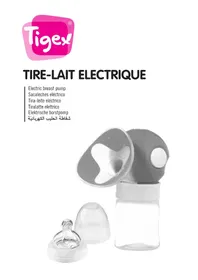
Electric breast pump
Sacalecheselectrico
REMARQUE: Piles non incluses
Thank you for choosing a TIGEX product!
A specialist in pregnancy and breast-feeding, Tigex has designed a complete range of handy and practical products that combine comfort and effectiveness. Designed with and for all mothers, Tigex products offer the best in innovation to help you cope with this period free from worries. So that breast-feeding is a pleasure and a privilege. We have designed the comfort electric breast pump so that you can express your milk effectively and comfortably.
The small nodes on the breast shield stimulate milk production by massaging the areola and its extra wide opening surrounds the breast completely so as not to loose suction. Finally, suction is adjustable to adapt to your physiology and extract more milk without discomfort. For added comfort, its ergonomic shield has a soft texture and a wide opening for the nipple to avoid rubbing.
Using it is extremely simple.
A single control button lets you start then adjust the pump. The number of parts has been reduced as much as possible to make it easy to assemble. Its small size and its ability to operate with batteries or from the mains give active mothers maximum flexibility when travelling. It is supplied with a feeding bottle with a screw-on lid to prevent your milk leaking out and a anti-colic (regulates air intake, reducing the risk of colic) teat so that you can use the bottle to feed your baby without having to transfer your breast milk.
We hope that the comfort electric breast pump will give you as much satisfaction as it has for many mothers who have tested and used it.
Before using it, please take a few moments to read all these instructions.
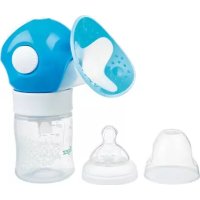
Description of the breast pump (cf diagram A)
1-Motor unit
2-Battery compartment
3-Mains connection
4-Start and suction regulator button
5 - Anti-reflux valve
6- Soft-textured breast shield
7-Connecting ring
8-Lip valve
9 - Wide opening bottle
10 - Cap
11-1st age ventilated teat with a wide base Multiflow
12 - Screw ring
13 - Mains adapter
In which circumstances should you use your breast pump?
To create a supply of breast milk for when you are away or out, for when you return to work or in order to allow baby's father to take a turn at feeding. Breast milk expressed using a breast pump may be directly collected, stored, frozen and fed in the bottle supplied (cf section on handling breast milk).
How should you clean and sterilise your breast pump? (cf diagram E)
Warning! Never wash or sterilise the motor unit 1 and the mains adapter 13. These parts don't come into contact with your milk and water or steam could damage them. If need be use a soft cloth.
Before first use and after each use, you should dismantle your breast pump and clean it, then sterilise all the parts that come into contact with your milk. Milk residues may damage the material and lead to the formation of bacteria.
In order to clean them, rinse the parts under running water or use a dishwasher (a dishwasher is however not recommended for cleaning teats). As the valves are particularly fragile, make sure you do not use objects that may damage them. Then sterilise the parts in a steriliser (electric or microwave) or boil them for five minutes (in sufficient water to ensure they are not damaged). It is preferable not to sterilise these parts directly in a microwave since this risks damaging the material.
Important! Leave the sterilised parts to dry and cool properly before using them again in order to avoid mould or burns.
How should you prepare and assemble your breast pump? (cf diagram B)
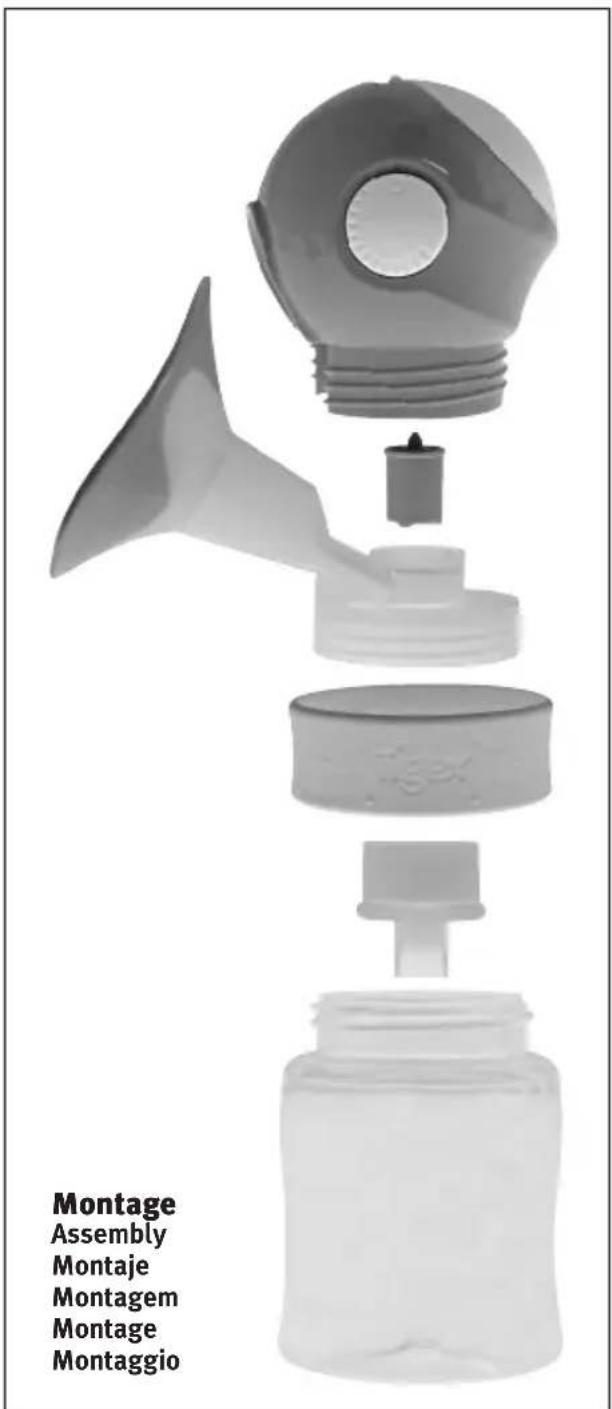
- Insert the anti-reflux valve 5 into the breast shield 6 with the knob pointing upwards.
- Place the motor unit 1 on the breast shield 6.
- Screw the connecting ring 7 from underneath on the motor unit 1.
- Place the lip valve 8 in the breast shield 6 from underneath.
- Attach the bottle 9 to the assembled motor unit 1, screwing them together.
- Power supply: Open the battery compartment by the catch lock.
For mains operation, plug the power supply lead into the socket located just under the compartment, then connect the mains adapter to a power outlet. Only the mains adapter provided should be used.
For battery operation you need 3 AAA / LRo3 1.5V type batteries. Please insert the batteries in accordance with the + and - symbols shown inside compartment. Operation with rechargeable batteries is not recommended since the breast pump will not achieve full operation with the lower voltage of rechargeable batteries.
Close the compartment: slide the two "feet" of the lid into the corresponding hole at the bottom and close the lid firmly until a definite "click" is heard.
Comment: the device must not be used without the battery compartment cover being in place.
How to use your breast pump (cf diagram C)
Using a breast pump is a habit that needs to be acquired and you may need to try several times. Don't be discouraged if you cannot manage it first time. If after a few minutes you are still not successful, try again later. Whatever happens, using a breast pump should never be painful.
Before using the pump, wash your hands carefully, wash and sterilise your breast pump and assemble it in accordance with the instructions in the previous section.
- Place the breast shield 6 on your breast so that the nipple is in the centre. Make sure there is no space between the breast shield and your skin to permit good suction. Always keep the breast pump upright if possible.
Comment: when the breast pump is not upright or you drop it, it cuts out automatically.
-
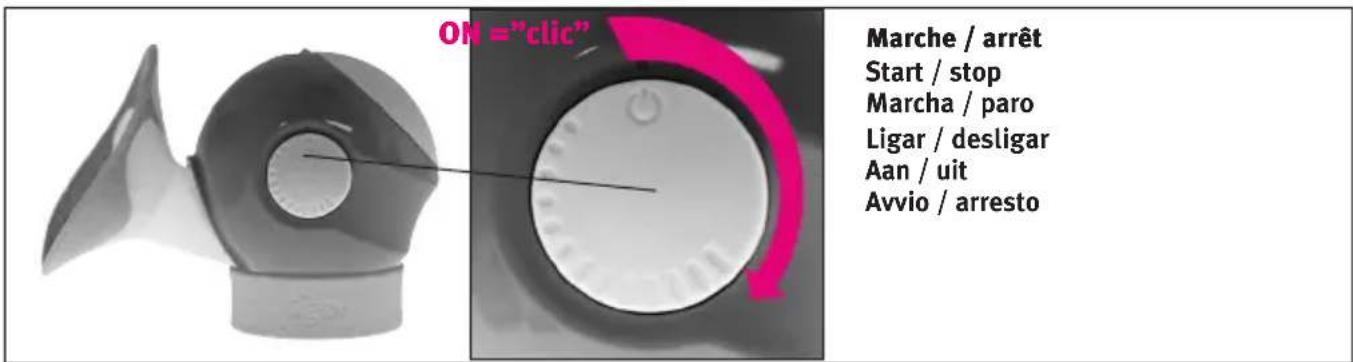
Switch the breast pump on. Slowly turn the start and suction regulator button 4 clockwise until you hear a "click". The breast pump automatically adopts an effective suction rhythm: slow and intensive.
-
Then adjust the suction by turning the suction regulator button until optimum power is obtained.
If suction is insufficient, turn the suction regulator button clockwise. If suction becomes painful or uncomfortable, reduce its strength by turning the suction regulator button in the opposite direction.
-
To stop pumping, turn the suction regulator button anti-clockwise until once more you hear a "click".
-
Cautiously unscrew the bottle 9 from the connecting ring 7 and the motor unit. Make sure the bottle remains upright.
Be sure to follow the handling advice for the milk given below.
To use the milk you have expressed, screw the ring 12 with a teat 11 onto the bottle.
Advice for expressing your milk
During breast-feeding, baby's contact with your breast stimulates milk flow via a reflex action. In order to succeed in using your breast pump the principle is to trigger this same reflex and thus stimulate milk flow.
- Choose a quiet spot where you can express your milk in a perfectly relaxed manner.
- Adopt a seated position that is comfortable and relaxed. Some mothers find that leaning forward slightly helps.
- The best thing is to be able to see your baby. If this is not possible, use a photo of your baby or take an item of clothing carrying your baby's scent with you.
- Before starting the breast pump you can place a warm compress on your breast for a few minutes (for example Tigex's soothing compresses) to relax the breast tissue making milk flow easier. You could also express your milk after a hot shower or bath.
- You can also make milk flow easier by gently stimulating your nipple (by tickling it or gently pulling down on it) or by massaging yourself to express the first few drops of milk manually. To do this you could use the following technique: massage your breast in small circles starting from the edge of the breast and working towards the nipple then caress your breast from the outside towards the nipple and finally lean forward and shake your breasts to encourage ejection of the milk by gravity (cf diagram D).
How to store and feed expressed milk
Warning! Only keep milk expressed using a sterilised breast pump. Be sure to note the date and time the milk was collected on the container. Always start by using the oldest milk.
Milk conservation:
- 4 hours at room temperature (20 - 25^)
- 48 hours in the refrigerator at a temperature lower than or equal to 4^ . Never keep milk in the refrigerator door because temperature changes are greater there.
- 4 months in the freezer at a temperature lower than -19^
Please note: if you wish to freeze your milk, do so immediately. Do not freeze milk that has already been kept in the refrigerator. If you are not at home when you express your milk, keep and transport it in a cooler or insulated bag with a refrigeration pack to comply with refrigeration practice.
Thawing and reheating milk
Milk may be thawed by placing it in the refrigerator and using it within 24 hours. It must never be refrozen. It can also be reheated in a bain-marie in a saucepan, in a bottle warmer or under the hot tap. Never use a microwave oven: it reduces the milk's nutritional quality and there is a strong risk of burning.
Milk taken out of the refrigerator must be used within an hour if left at room temperature and within half an hour if it has been reheated.
Please note: your milk may look different after storing. Before feeding your baby, shake the milk gently to ensure the fat content is thoroughly mixed and that the heat is spread uniformly. Then check the temperature of the milk by pouring a few drops onto the inside of your forearm.
Source: ANSES data, July 2005. Data valid for milk kept at home and for children born at term and in good health.
Frequently asked questions:
- Is using a breast pump painful?
Whatever happens, using a breast pump should never be painful. Do not set the suction power at too high a level, this will not generate larger quantities of milk. If using the breast pump is painful, reduce the suction or consult a breastfeeding professional.
- I can't manage to express my milk
Using a breast pump is a habit that needs to be acquired and you may need to try several times. Don't be discouraged if you cannot manage it first time. If after a few minutes you are still not successful, try again later. Our advice section will also help you prepare yourself in the best possible way.
- How long does it take to express my milk?
Times can be extremely variable depending on your physiology. Allow approximately 10 to 15 minutes for a 150ml bottle.
- How often should I express my milk?
When you temporarily stop breastfeeding your child or when it is impossible to do so but you want to maintain your milk production, you must keep to the natural feeding rhythm. Therefore, express your milk at least 4 to 5 times per day. In all other circumstances you can express your milk in a totally individual manner and according to your needs.
- When I pump milk from one breast I lose a lot of milk from the other breast, what should I do?
This is normal because when you use a breast pump you stimulate the milk let down reflex for both breasts at the same time. Tigex advises you to use protective breastfeeding shells. Placed on the other breast when using a breast pump, they enable you to collect then keep milk that is expressed. Make sure you sterilise them properly before using them and transfer the milk collected immediately.
- Which breast should I use for pumping milk?
As for breastfeeding, milk may be expressed alternately from both breasts. Change breast when milk flow is less or reduces. Suction must be long enough to make sure you collect hindmilk which is the most nourishing for baby.
- When should I pump my milk?
In order to pump your milk so as to create a reserve, it is better to wait until lactation is well established, after 4 to 5 weeks approximately. Preferably express your milk 30 to 60 minutes after feeding and at least one hour before the next feed to be sure you have enough milk for baby at feeding time. Never express your milk just before a feed if you are still offering the breast.
- My breast pump is not working
Check that the batteries are installed and operating correctly or that the mains adapter is plugged in properly.
You should be aware that the breast pump stops automatically if it is at too much of an angle, in order to prevent milk from not flowing into the bottle: reposition the breast pump vertically.
You should also be aware that if the bottle is too full and the milk covers the lip valve this can block the operation of the breast pump: use an empty bottle.
Also check that the lip valve is positioned correctly and that it is not torn or has a hole in it: if this is the case, contact our customer service for a replacement.
Meaning of the symbols used on the device:
| In the motor unit (battery compartment) | |
| Symbol | Meaning |
| ·When inserting batteries, check for correct pole alignment | |
| ·Do not dispose of batteries or the pump with household waste | |
| ·Refer to the operating instructions | |
| ·Refer to accompanying documents | |
| LOT | ·Serial number |
| On the motor unit | |
| CE | · Com p l i e s with all the requirement of applicable EC directives |
| III | · Electrically protected device, Protection Class III |
| A | · Refer to accompanying documents |
| --- | · Direct current 4,5V, max. 0,5 A |
The symbol of a means that the product must be disposed of at a separate collection point within the European Union. This applies to the product as well as to all the accessories marked with this symbol. Products displaying this symbol cannot be disposed off in normal household waste but must be taken to a collection point for recycling electric and electronic equipment.
The batteries must not be disposed of with household waste: users are subject to a legal obligation to dispose of all batteries at a collection point.
Important safety instructions
-
This device is not suitable for use by people (including children) with impaired physical, sensory or mental capacities, or people who do not have the experience or knowledge of how to do so, except where they are under the supervision of a person who is responsible for their safety or have received prior instructions concerning the use of the device.
-
Attention should be paid to children to make sure they do not play with the device.
-
The breast pump only operates with the mains adaptor supplied. Please make sure that the voltage of the electrical socket is compatible with that of your mains supply.
-
cleaning and maintenance of the product by the user should not be carried out by unattended children
-
When this device's mains supply cable is damaged it must not be repaired but the complete mains adaptor must be replaced in order to avoid all danger.
-
Only use the comfort electric breast pump for its intended purpose as described in these instructions.
-
Never immerse the pump in water; there is a risk of electrocution and if water penetrates the device it could damage the motor.
-
Note that the manufacturer accepts no liability and gives no guarantee where accessories other than those recommended
in these instructions are used or where repairs are carried out not exclusively using original spare parts. This also applies to repairs carried out by unqualified persons.
-
In case of any malfunction, the device must only be repaired by the manufacturer. Where this is not adhered to, the guarantee becomes void.
-
If the breastmilk is intended for a premature baby, please follow your doctor's advice carefully.
-
Never open the motor cover – this will render the guarantee void.
-
When the batteries are worn out or when the device has not been used for some time, the batteries must be removed. Using discharged batteries could damage the device.
-
Do not expose the device to direct sunlight because UV radiation and overheating may damage its plastic materials.
-
Keep small parts out of the reach of children: risk of swallowing.
-
This device complies with the EMC standards that apply. However, interference with other electrical devices may occur. As a consequence, keep a certain distance from other devices during operation.
-
The teat and bottle supplied comply with EN 14350.
Technical details Power supply:
- Mains operation using the mains adapter supplied: Input
100 - 240 V~/50 Hz, output 4.5 V DC.
800 mA, hollow connector: internal polarity +, external -
-
Battery operation: 3 AAA 1.5V type batteries
-
This product must be linked only to a Security Extra low voltage of 4.5Vdc as indicated on the device
Operational temperature range: 8^ to 40^ / for storage and transport: -10^ to 60^
ATTENTION:
Batteries should be installed by adult only.
Non-rechargeable batteries are not to be recharged.
Exhausted or dead batteries are to be removed from the swing; do not dispose of in fire.
Remove batteries from product before extended storage.
Do not short circuit the supply terminals. Batteries may explode or leak if misused.
NOTE: BATTERIES NOT INCLUDED!
Suction power: variable between 200 and 290 mbar
Humidity and pressure range for operation, storage and transport: 10^ to 90^
Precautions for use bottles and teats
Care and Cleaning :
- Sterilize prior to first use: Place the feeding bottles, teats and accessories in boiling water for 5 minutes and allow to cool before use. This is to ensure hygiene.
- Clean before each use. Carefully clean all parts with hot soapy water, or use top rack of dishwasher.
- For teats: Do not use dishwasher to clean.
-
If you wish, sterilize feeding bottles, teats and accessories each time you use them.
-
The feeding bottle can be hot or cold sterilized (steam and microwave sterilization). It is suitable for all standard sterilizers and bottle warmers.
- Inspect before each use and pull the feeding teat in all directions. Throw away at the first signs of damage or weakness. Replace feeding bottles and teats at the first signs of damage or weakness. Do not pierce holes in teat.
- Do not leave a feeding teat in direct sunlight or heat, or leave in disinfectant ("sterilising solution") for longer than recommended, as this may weaken the teat.
For the hygiene and safety of your child: Warning!
Always use this product with adult supervision.
- Never use feeding teats as a soother.
- Continuous and prolonged sucking of fluids will cause tooth decay.
- Always check food temperature before feeding.
- It is not advisable to warm feeding bottles in a microwave oven. If you do so, leave the bottle open and remove the teat and any accessory.
- Shake the bottle well. Heating in a microwave oven may produce localized high temperatures.
- The long-term use of microwave or bottle warmer can damage bottles and teats.
- Do not allow baby to take a bottle to bed or self-feed for long periods. Accidents have occurred when babies have been left alone with drinking equipment due to the baby falling or if the product becomes disassembled.
- Keep all components not in use out of the reach of children.
- The wide-based teat Tigex has to be used with wide-based bottles Tigex INTUTION or MULTIFLOW.
Guarantee
The power lead and connector are excluded from the guarantee.
2-year guarantee
Send this warranty voucher with your purchase receipt, your name and address on plain paper, and the defective product to your retailer or to :
ALLEGRE PUERICULTURE
Intuition Tigex 2018 2019
:
:40
50/240-100 1
-2yj+2yjdzjzj:800mA.c4.5
1.5.AAA 3
290,200 1
10 10 10 10 10 10 10 10 10 10 10 10 10 10 10 10
60
90 10:
2
1234567890
y 1
y y
yssd 1
p 24 24
a 1
y
y
021 021 021
E M C jaiy jaiy jaiy jaiy jaiy jaiy 12
1 1
EN14350 jaojiaaiaiyai
Ae aee
jia:di#taa#
2 2
1
y
aaiy j kay d 1 y gnnn aegge gaae
m = 311
Jnll Jnnn 1
Jnnn nnnn nn nnnn nn nnnn nn nnnn nn nnnn nn nnnn nn nnnn nn nnnn nn nnnn nn nnnn nn nnnn nn nnnn nn nnnn nn nnnn nn nnnn nn nnnn nn nnnn nn nnnn nn nnnn nn nnnn nn nnnn nn nnnn nn nnnn nn nnnn nn nnnn nn nnnn
1
A
Guide de prise en main
instant guide, guía de uso, guía de consulta rápida, gebruikshandleiding, instruzioni d'uso.
Battery or mains operation
Funcionamento con pilas o red electrica