EasyManual
Inspire 100AZ - Telescope CELESTRON - Free user manual and instructions
Find the device manual for free Inspire 100AZ CELESTRON in PDF.


User questions about Inspire 100AZ CELESTRON
0 question about this device. Answer the ones you know or ask your own.
Ask a new question about this device
Download the instructions for your Telescope in PDF format for free! Find your manual Inspire 100AZ - CELESTRON and take your electronic device back in hand. On this page are published all the documents necessary for the use of your device. Inspire 100AZ by CELESTRON.
USER MANUAL Inspire 100AZ CELESTRON
We recommend saving your telescope box so it can be used to store the telescope when it is not in use. Unpack the box carefully as some parts are small. Use the parts list below to verify that all parts and accessories are present.
PARTS LIST
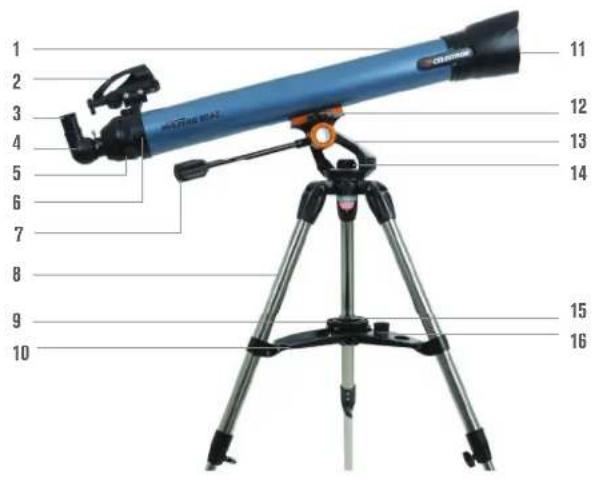
- Telescope Tube
- StarPointer Pro Finderscope
- 20 mm Eyeopic
-
First Image Diagonal
-
Focus Knob
-
Focus Micrometer
- Panning Handle/Altitude Clutch Knob
8.Tripod - Accessory Tray Lock Knob
- Folding Accessory Tray
- Lens Gap/Smartphone Adaptor
- Tube Mounting Bolt
- Altazimuth Mount
- Removable Flashlight
- Accessory Tray Tension Knob
- 10 mm Eyepiece

SOLAR WARNING
Nevr look directly at the Sun with the naked eye or with a telescope unless you have the proper solar filter. Permanent and irreversible eye damage may result.
Never use your telescope to project an image of the Sun onto any surface. Internal heat build-up can damage the telescope and any accessories attached to it.
Never use an eyepiece soler filter or a Herschel wedge. Internal heat build-up inside the telescope can cause these devices to crack or break, allowing unfiltered sunlight to pass through to the eye.
Do not leave the telescope unsupervised, especially when children or adults unfamiliar with the correct operating procedures of your telescope are present.
ASSEMBLING YOUR TELESCOPE
THE MOUNT
The Inspire mount and tripod come fully assembled, so setting it up is easy.
- Remove the tripod and mount from the box.
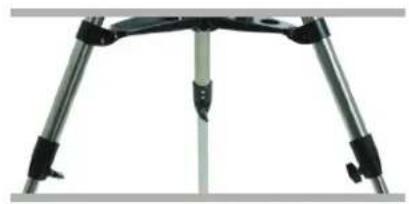
- Loosen the hand knobs at the bottom of each leg and extend the inner section of the leg to the desired length. Tighten the knobs to secure the legs, being careful not to over tighten.
- Stand the tripod upright and pull the tripod legs apart until the folding accessory tray snaps into place.
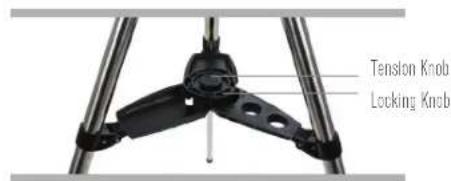
- Line up the tabs on the spring-loaded accessory tray locking knob with the notches in the accessory tray and press downward. Turn the locking knob clockwise about 20 degrees to fully lock the tray in place.
- Turn the accessory tray tension knob clockwise until it stops. Do not over tighten.
NOTE: When closing the tripod at the end of the observing session, be sure to first loosen the tension knob all the way, then loosen the locking knob by turning it counterclockwise until the spring pops the locking knob upward. Grab the knob and lift upward and the tripod will fold up.
THE TELESCOPE TUBE
To attach the telescope tube to your tripod and mount:
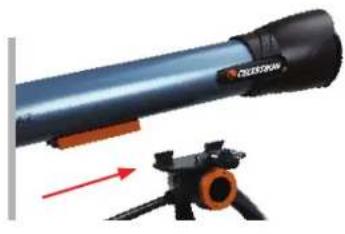
- Loosen the two tube mounting bolts on the side of the dovetail saddle on top of the mount.
- Locate the dovetail bar on the bottom of the telescope tube and slide it into the saddle. The eyepiece end of the telescope tube should point in the same direction as the panning handle on the mount.
- When the dovetail is centered in the saddle, tighten the two tube mounting bolts, starting with the larger one first. Finish by tightening the smaller one.
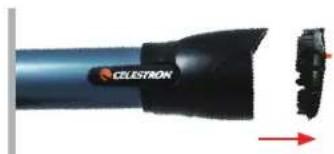
- Remove the lens cap when you are ready to observe by simply pulling it off the lens shade.
THE ERECT DIAGONAL
The Inspire telescopes come with a 90^ erect image diagonal. This accessory uses a prism to bend the light at a 90^ angle, providing a more comfortable viewing position. It also gives you a 100% correctly oriented image allowing you to easily use this telescope for daytime terrestrial observing.
To install the erect image diagonal:
- Remove the caps from both sides of the diagonal.
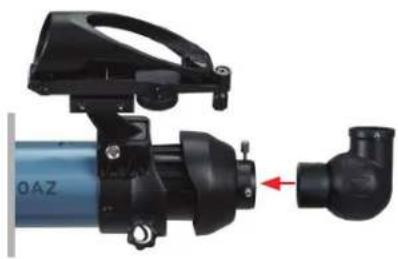
- Loosen the setscrews on the back of the telescope focuser and pull out the small dust cap.
- Insert the smaller tube on the diagonal into the back of the focuser and secure it by tightening the setscrews.
THE EYEPIECES
Your Inspire telescope comes with two eyepieces, a low power (20 mm eyepiece) and a higher power eyepiece (10 mm eyepiece). Whenever you set up your telescope, always start with the 20 mm eyepiece. Once you have your target centered in the 20 mm eyepiece, you can switch to your higher power 10 mm eyepiece to increase magnification and get a more detailed view.
To install an eyepiece:
- Loosen the setscrews on the open end of the erect image diagonal.
- Insert the silver barrel of the 20mm eyepiece into the diagonal.
- Tighten the setscrews to secure the eyepiece.
- To see the sharpest image possible, you need to adjust the telescope's focus. Look through the eyepiece and slowly turn the focusing knobs until you see the sharpest image possible.
NOTE: You should always adjust focus whenever you change eyepieces or if another person views through the telescope as the focus may be different for each individual.
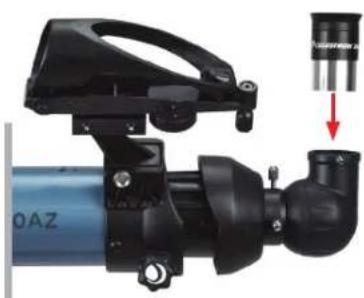
THE STARPOINTER PRO FINDERSCOPE
Your Inspire telescope comes with a StarPointer Pro Finderscope that you will use as a sighting tool when aiming the telescope at a target.
To install the fi nderscope:
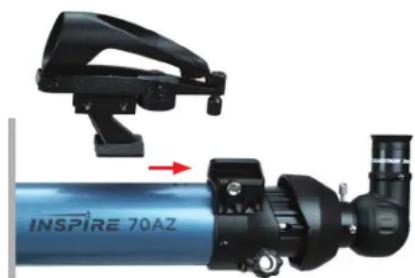
- Slide the fi nderscope bracket into the dovetail slot on the telescope on the top of the focuser. The large window on the fi nder should be facing the front of the telescope.
- Secure the bracket by tightening the setscrew on the dovetail slot.
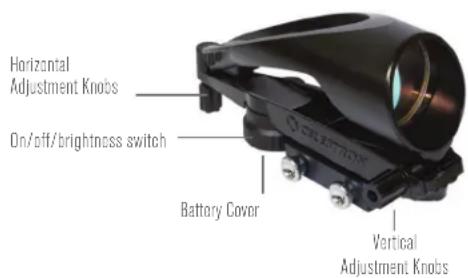
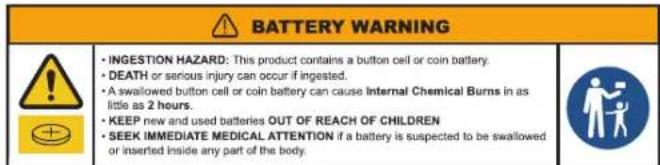
The StarPointer Pro uses a CR-2032 button battery. To change the battery, turn the StarPointer over. The battery compartment is located in the center of the on/off/brightness switch. Use a coin in the slot on the cover to unscrew the cap counter-clockwise until the cap comes off. Insert the new battery with the Positive (+) side facing upward and screw the cover back on. If your StarPointer Pro does not immediately turn on, open the battery compartment to remove the small plastic disk that lies between the battery and the battery cover. This is used to prevent the battery from accidentally discharging during shipment.
If you are going to store your telescope for a long period of time, it is best to remove the battery to prevent accidental corrosion.
THE FLASHLIGHT
The Inspire mount comes with a built-in red LED flashlight located in the central hub of the mount's left and right axis. To remove it from the mount, simply grab the top and pull straight up.
To install the single AA battery:
- Unthread the red lens at the end of the fl ashlight.
- Slide the flashlight out of its protective cover.
- Unthread the cap on the back of the flashlight to expose the battery compartment.
- Insert the AA battery into the flashlight, positive (+) side fi rst and replace the compartment cap.
- Slip the fl ashlight back into its protective housing and thread the red lens to lock it in place.
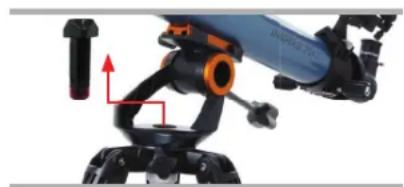

To turn on the flashlight, simply depress the rubber covered button on the back.
The flashlight was designed to be stored in the mount and can actually be used in this position. Turn on the light and it will provide a diffused red glow onto your accessory tray, making it easy to identify your eyepieces and fi Iters in the dark.
NOTE: Don't forget to turn off the flashlight when it is not in use. If you are going to store your telescope for a long period of time, it is best to remove the battery to prevent accidental corrosion.
THE FOCUS MICROMETER
Your Inspire telescope tubes come with a focus micrometer that allows you to repeatedly dial in focus for objects at different distances quickly and easily before you even move the scope to the target. The window on the side of the focuser allows you to see a numbered scale displaying a number from 0 to 10. The 0 on the scale represents the closest point at which you can achieve focus using the standard eyepieces and diagonal. The 10 represents infinity focus. While astronomical objects will generally be at infinity focus, you may wish to use the telescope to view terrestrial objects, such as bird nests or other targets at fixed distances. Once you have focused in a terrestrial target, make a note of the number shown on the scale. The next time you observe that same target from the same observing location, you can quickly dial the focuser to that same number and the image should be in focus when you view through the eyepiece.
MOVING THE TELESCOPE
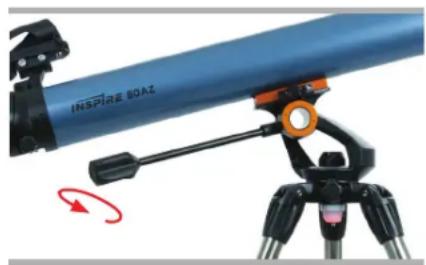
The Inspire altazimuth mount is simple to use. To move the scope left and right, loosen the azimuth tension knob at the base of the mount between two of the tripod legs. Grab the knob at the end of the panning handle and move the scope to the desired location. You can adjust the tension of the left and right motion by adjusting the azimuth tension knob.
To move the scope up and down, loosen the altitude clutch by turning the knob at the end of the panning handle counter-clockwise. Move the handle up or down as required and turn the knob clockwise to lock the scope on target.
ALIGNING THE STARPOINTER PRO FINDERSCOPE
The StarPointer Pro finderscope helps you aim your telescope by looking through its round glass window and covering your target with the red reticle projected in the window. The first time you assemble your telescope, you will need to align the finderscope with the main optics of the telescope. Although this step can be done at night, it is significantly easier during the day. Once you have completed the finderscope alignment, you should not have to repeat this step unless the finderscope is bumped or the telescope is dropped.
- Take the telescope outside during the day. Using your naked eye, find an easily recognizable object, such as a streetlight, car license plate, or tall tree. The object should be as far away as possible, but at least a quarter mile away.
- Remove the main dust cover from the telescope and make sure your 20mm eyepiece is installed.
- Move the telescope left and right or up and down so that it is roughly pointing toward the object you chose in step 1.
- Look through the telescope's eyepiece and manually move the telescope until the object you chose lies in the center of the view. If the image is blurry, gently turn the focus knobs until it comes into sharp focus.
- Once the object is centered in your 20 mm eyepiece, turn on the finderscope by turning the on/off/brightness switch knob on the bottom of the unit as far as it will go.
- With your head positioned about a foot behind the finder, look through the round window and locate the red reticle. It will probably be close to, but not on top of, the object you see when you are looking through the 20 mm eyepiece.
- Without moving the telescope, use the two adjustment knobs on the side and underneath the finderscope. One controls the left-right motion of the reticle, while the other controls the up-down motion. Adjust both until the reticle appears over the same object you are observing in the 20mm eyepiece.
Now choose some other distant targets to practice aiming your telescope. Look through the StarPointer Pro finderscope window and place the red reticle over the target you are trying to view and verify that it appears in the eyepiece of the scope.
With your finderscope aligned, your telescope is fully assembled and you are ready to observe!
NOTE: Be sure to turn off the StarPointer Pro finderscope when not in use to conserve battery power.
YOUR FIRST ASTRONOMICAL OBSERVING SESSION
THE MOON
Now you are ready to take your telescope out at night and do some real observing!
Let's start with the Moon. The Moon takes about one month go through a complete phase cycle, from new Moon to full Moon and back again. Try observing it at different points during this cycle.
While you can observe the Moon any time it is visible in the sky, the best time to view it is from two days after a New Moon up to a few days before a Full Moon. During this period, you will be able to see the most detail in craters and lunar mountain ranges. Consult a calendar or moon phase app to find out when the next new Moon will be.
- With a clear view of the Moon, set up your telescope with the 20 mm eyepiece.
- Turn on the finderscope and look through it to find the red reticle.
- Move the telescope until you can see the Moon through the finderscope's window and the reticle is centered on the Moon.
- Look through the 20 mm eyepiece. Gently turn the focus knob to adjust the sharpness of the image.
CONGRATULATIONS! YOU HAVE NOW OBSERVED YOUR FIRST CELESTIAL OBJECT!
To get a closer view of the Moon, replace the 20 mm eyepiece with the 10 mm eyepiece. It will give you more magnification, making the Moon appear much larger. You may need to adjust the focus knobs when you change eyepieces to ensure you are getting the sharpest image.
You can view many other celestial objects, such as planets, star clusters and nebulae using this same basic technique.
IMAGING WITH YOUR SMARTPHONE
Now that you have observed with your telescope, the next step is taking a picture of what you are seeing. The Inspire telescopes have a smartphone adapter built right into the lens cap. To use this feature:
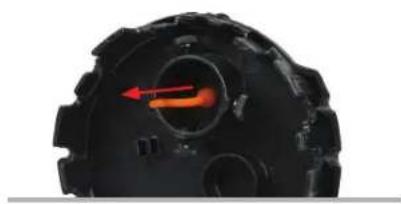
- Start by pulling the orange plug out of the camera opening in the lens cap. You can do this by pulling on the orange rubber lanyard located on the inside of the lens cap. The plug should pop right out. The plug and lanyard can be stowed out of the way by pressing the lanyard into the retaining clip located on the back of the lens cap next to the eyepiece holder.
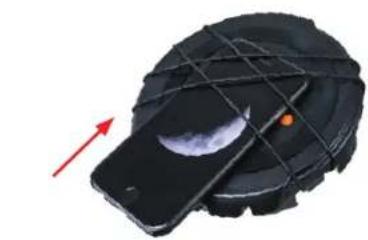
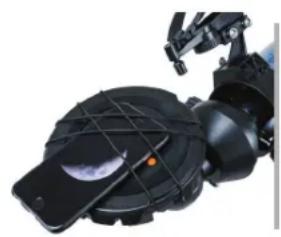
- Turn the cap so that the outside of the cap is facing upward. Lift the bungee straps and slide your smartphone between the straps and the lens cap so that the camera is looking through the camera opening. The straps should give plenty of tension to hold the device against the cap and the black silicon ring will give enough friction to prevent the phone from sliding around.
HINT: Depending on the design of your smartphone, the camera may be in the middle of the device or in one corner. You may want to change the angle of the bungee straps to better secure the phone. There are eight different anchor points to choose from around the edge of the lens cap. Simply reposition them to different anchor points to achieve the best results. - Turn the cap over and make sure your camera lens is centered in the opening in the lens cap. The better you have this centered, the easier it will be to take images through the telescope.
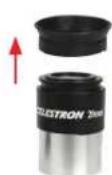
- Take the 20mm eyepiece and remove the rubber eyecup by pulling it straight off the eyepiece body. There is an eyecup retainer built-in to the inside of the lens cap so you don't lose it. Just stretch the eyecup around the round retainer and slide the eyecup all the way to the bottom.
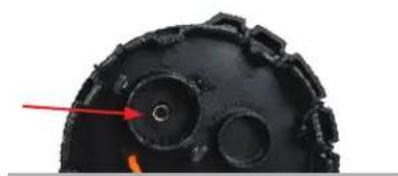
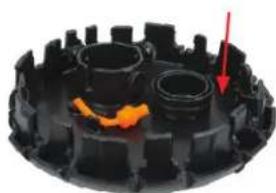
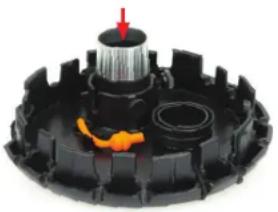
- Loosen the set screws located on the eyepiece holder on the inside of the lens cap. Place the black portion of the eyepiece into the eyepiece holder and tighten the screws to secure the eyepiece in place.
- Now take the lens cap with the phone and eyepiece attached and insert the chrome barrel of the eyepiece into the diagonal on the back of the telescope's fuser. Secure it in place by tightening the set screws on the diagonal.
- Activate your camera app on your smartphone and adjust the focus, just as you would the eyepiece, this time using the image that appears on your screen.
NOTE: Make sure you turn the phone's fash off.
- When the image appears sharp snap your image.
It is best to try this in the daytime first, then, once everything is setup correctly, take it outside and try shooting the Moon. Once you have practiced and are comfortable using the 20mm eyepiece, try using the camera adapter with the 10mm eyepiece for higher magnifi cation.
IMAGING TIPS AND TRICKS
Camera Controls
The standard camera apps that come preinstalled with your smartphone offer very rudimentary controls and are designed to automatically adjust focus and exposure. This is not a problem for everyday photography such as landscapes or portraits, but can be a problem for imaging a planet or the Moon where you have a very bright object against a very black sky. The phone's camera tries to compensate for the imbalance of lighting by brightening up the dark areas, but this causes the bright areas to overexpose and blow-out the details. If your camera app settings do not allow you to manually select the focus point or have an option to disable the autofocus or auto-exposure, you may want to consider using a different camera app. You can find lots of aftermarket apps for iOS and Android that offer a greater amount of control for your camera. Many of these are free.
Vibration
To help eliminate any vibration induced when you touch the camera to snap the image, try using a shutter delay. Some apps offer a 2, 5, or 10 second delay before snapping the image. This will give the vibrations a chance to dissipate before actually taking the images.
Subjects to Shoot
Using this method, you should be able to take images of daytime terrestrial objects and nighttime astronomical images of the Moon and bright planets (Venus, Mars, Jupiter and Saturn). Unfortunately, smartphone camera sensors are not designed to work well in very low light, so it will not be possible to capture faint astronomical objects such as galaxies or nebulae in this manner.
Magnification
When looking at the Moon or planets with a stationary telescope, you will notice that the object appears to drift across the field of view. This is actually caused by the Earth's rotation. If you were looking visually through your 20mm eyepiece, a planet would take approximately 3.0 minutes to drift across the entire eyepiece's field of view. If you are using the 10mm eyepiece, it would only take 1.5 minutes. The smartphone does not use the entire eyepiece's field of view and only uses the center of it, making the motion appear even faster. When centering an astronomical object in the phone's field of view, try leading the target. Try to point the scope ahead of the planet so that it is just entering the field of view. This will maximize the amount of time it takes to drift across the entire field, allowing you more time to take images before needing to re-aim the telescope. The 10mm will have a narrower field of view and will need to be adjusted more often as a result. Working with the 20mm eyepiece will be easier at the start. Once you are comfortable with it, try stepping up to the 10mm eyepiece.
BONUS SOFTWARE
Your purchase includes software for your computer. You don't need to download this software to use your telescope, but it can enhance your experience.

Starry Night
Celestron Starry Night Astronomy Software
Celestron Starry Night, the premier astronomy software on the market, takes you on a guided tour of our Solar System's past, present, and future. It can help you learn about the night sky and plan your next observing session. Use Starry Night to model exactly how the night sky will appear from your backyard, a neighboring town, or anywhere on Earth.
MINIMUM SYSTEM REQUIREMENTS
Windows:
- Windows 7 or higher
- 500MHz or higher processor
128 MB RAM - 850 MB hard disk space
- 32 MB OpenGL-capable graphics card
- Monitor with 1024x768 pixel resolution (recommended)
Mac:
Universal binary (PPC/Intel-compatible)
- OS X 10.4 or higher (10.5 or higher for Elementary)
- G3 450 MHz or higher processor
128 MB RAM
- 850 MB hard disk space
32 MB OpenGL-capable graphics card
Monitor with 1024x768 pixel resolution (recommended)
SAFETY INSTRUCTIONS
- There is a risk of explosion if the battery is replaced with an incorrect type.
- The included battery is not rechargeable.
- Only use the battery as originally intended to avoid a short circuit. Connecting the conductive material directly to the battery's positive and negative sides will cause a short circuit.
- Do not use a damaged battery.
- Do not store the battery in an extremely cold or hot environment. Doing so can reduce battery life.
- Remove batteries if drained or if product is to be left unused for a long time.
- When replacing the battery, refer to the instruction manual and ensure the positive and negative sides are oriented correctly.
- Do not put the battery in fire.
- Dispose of the battery according to local regulations.
FCC NOTICE: This device complies with Part 15 of the FCC Rules. Operation is subject to the following two conditions: (1) This device may not cause harmful interference, and (2) this device must accept any interference received, including interference that may cause undesired operation.

celestron.com/pages/warranty


SOLAR WARNING: Never attempt to view the sun through any telescope.
NEED ASSISTANCE? Contact Celestron Technical Support
celestron.com/pages/technical-support
Product design and specific cations are subject to change without prior notifi cation. This product is designed and intended for use by those 14 years of age and older.

CELESTRON
©2024 Celestron. Celestron and Symbol are trademarks of Celestron, LLC.
All rights reserved. Celestron.com
US: Celestron, 2835 Columbia Street, Torrance, CA 90503 USA
UK: Celestron Global Ltd., Unit 2 Transigo, Gables Way, Thatcham RG19 4JZ, United Kingdom
Made in China 09-24

PAP Carta
Separate waste collection. Check your local municipal guidelines.
PHOTOGRAPHIE AVEC VOTRE SMARTPHONE
Separate waste collection. Check your local municipal guidelines.