
Star 200 - Scooter LML - Free user manual and instructions
Find the device manual for free Star 200 LML in PDF.


| Product type | 4-stroke scooter |
| Brand | LML |
| Model | Star 200 (Star 4-stroke / Star Deluxe) |
| Engine | Horizontal single-cylinder 4-stroke, 200 cc, bore 65.5 mm x stroke 59.3 mm, compression ratio 9:1, max power 8.58 kW at 6250 rpm, max torque 14.3 Nm at 4500 rpm |
| Cooling | Forced air by centrifugal fan |
| Ignition | Electronic CDI (capacitor discharge ignition) |
| Transmission | Constant-mesh 4-speed gearbox, multi-disc oil-bath clutch |
| Starting | Kick and electric (with button and 12V 9Ah battery) |
| Fuel | 87 octane or higher gasoline, tank 5.5 L (including 1 L reserve) |
| Dimensions (L x W x H) | 1760 x 695 x (seat height 820) mm |
| Wheelbase | 1245 mm |
| Ground clearance | 160 mm |
| Curb weight (90% tank) | 122 kg |
| Maximum permissible load | 270 kg |
| Front brakes | Hydraulic disc (optional) or mechanical drum |
| Rear brakes | Mechanical drum with expandable shoes |
| Tires | 3.50 x 10 (89 x 251 mm), interchangeable |
| Tire pressure (solo) | Front 1.7 bar, rear 2.1 bar |
| Tire pressure (duo) | Rear 2.5 bar |
| Lighting | Front halogen headlight 12V 35/35W, position lights, brake light, turn signals 12V 10W |
| Battery | 12V 9 Ah (on models with automatic ignition) |
| Maximum speed | Approximately 100 km/h |
| Main features | Lockable storage compartment, bag hook, flip-up seat, center stand, rearview mirrors, fuel level indicator, horn |
| Maintenance and cleaning | Engine oil change every 3000 km, air filter cleaning every 6000 km, monthly battery check, low-pressure water cleaning |
| Safety | Steering lock, front and rear brakes, horn, turn signals with audible indicator, clutch cut-off switch |
| General information | Manual available in French, 158 pages, user and maintenance guide |
Frequently Asked Questions - Star 200 LML
User questions about Star 200 LML
0 question about this device. Answer the ones you know or ask your own.
Ask a new question about this device
Download the instructions for your Scooter in PDF format for free! Find your manual Star 200 - LML and take your electronic device back in hand. On this page are published all the documents necessary for the use of your device. Star 200 by LML.
USER MANUAL Star 200 LML
Redefining mobility worldwide.
Date of Registration:
Registration No.:
STAR DLX ENGLISH 12-5-2010
Thank you for having chosen the STAR 4 Stroke as your new scooter.
The STAR scooter is manufactured by LML Limited - one of the motorcycle manufacturing company in rapid expansion in India. A company that endeavours to redefine mobility everyday, the worldwide by exceeding customer expectations.
After years of studying the customer's needs, the company finally created the STAR 4 Stroke that promises an incomparable ride.
It is equipped with a powerful 200cc four stroke engine that unleashes a phenomenal power.
Apart from offering an excellent performance and a comfortable ride, the STAR will make everybody envious thanks to its breathtaking design and its original colours that nobody can ignore.
This owner's manual has been specially designed to help you understand your scooter better. It is important to read this manual to obtain the best performance from your STAR. It will also help you to maintain it in the best condition.
After reading this manual climb on board your new STAR and discover international class mobility.
CONTENTS
DESCRIPTION
PAGE
How to obtain the maximum performance
from your LML STAR 4 Stroke scooter 3
Vehicle Identification 6
Parts & Specifications 7
General specifications 9
Specifications Auto start 13
Auto start Circuit Diagram 14
Technical Specifications 15
Control Functions 18
Locking System 18
Switches 21
Clutch 22
Gear 23
Brakes 24
Fuel supply 24
DESCRIPTION NO.
PAGE
Operating the vehicle 26
Running-in Instructions 29
Care and Maintenance 30
Cowls 30
Changing the tyres 31
Engine oil 33
Spark plug cleaning 34
Battery 34
Air Cleaner 37
Cleaning &Polishing 38
Maintenance while not in use 38
Recommended Lubricants
Maintenance by LML authorised Technical
Assistance Centre 40
Exhaust Emission Control 45
Wiring Circuit Diagram 46
Secondary Air Supply System 47
Front Disc Brake 48
2
STAR DLX ENGLISH 12-5-2010
Maximise the performance of your STAR 4S
HOW TO OBTAIN THE BEST PERFORMANCE FROM YOUR STAR 4 STROKE
Given below are some important features of your scooter and some useful tips on how to maximize the benefits it offers.
- LML's fuel saver engine: This engine gives the best fuel consumption at a driving speed of 35-45 kms/hr after running in of 1000 kms.
The distance in kilometres can therefore vary on the basis of the road conditions, the intensity of traffic and driving habits and conditions, as well as the respect for the periodical maintenance intervals.
Tips to stretch each litre of petrol even longer.
1.1 Change gears as per the required speed.
Try to maintain the speed of 35-45 kms/hr to give you the best mileage.
1.2 Use clutch, brakes and full throttle only as and when required.
1.3 Maintain the air pressure in the front tyre at 1.7 bar and 2.1 bar in the rear tyre with only the driver on board or 2.5 bar with passenger.
- Safety devices of the STAR 4 STROKE: The safety features inbuilt in your scooter take away the worries from your driving. It is a perfectly balanced scooter and its state of the art braking system enables you to come to an instant halt without skidding regardless of the speed at which you are driving.
A powerful DC horn and indicators with a buzzer enable you to negotiate busy and noisy traffic conditions. In addition, the head light retains its intensity even at low speed that makes for safer night driving.
Some tips for even safer driving.
2.1. Always use a helmet while driving.
2.2. Make yourself familiar with the driving signs and regulations.
2.3. Drive at a speed at which you are in complete control of the scooter.
2.4. Never drive in neutral gear especially when going downhill or on a wet or slippery road.
2.5. Use horn and indicators whenever required.
STAR DLX ENGLISH 12-5-2010
Maximise the performance of your STAR 4S
3. The sensation of engine power of the STAR
4 STROKE: The engine power of your scooter is not only the highest among all scooters but also compares to some of the most popular motorbikes in the same cubic capacity. You can now surge ahead of other vehicles, either from a stop position or while negotiating busy traffic.
Some tips on how to keep power under control
3.1. Accelerate only to the extent you are in complete control of the scooter.
3.2. Use its maximum power only when you need to.
4. An enjoyable ride that only the STAR 4
STROKE knows how to give: Your scooter has been designed so as to enable you to sit in a correct posture to avoid strain. Its comfortable and long seat, double acting suspension and strong shock absorbers better withstand uneven road conditions to give you driving pleasure, unmatched by any scooter.
Some tips on how to enhance your driving pleasure.
4.1. Maintain the correct posture.
4.2. Sit in a relaxed and natural manner, not stiffly.
4.3. Reduce speed on uneven and bumpy roads.
Vehicle Identification
VEHICLE IDENTIFICATION
The vehicle is identified by a number on the chassis and another number on the engine.
The chassis identification number is stamped inside the glove compartment on upper chassis as shown in (Fig. 1).
The engine number is stamped on the crank case (Fig. 2).
Every STAR 4 STROKE has a spare set of keys. An identification number is punched on metallic tag, which is provided alongwith the key ring (Fig. 3).
Please keep your duplicate key carefully along with the metallic tag.
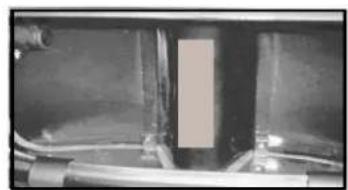
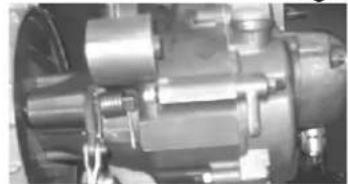
Fig.1
Fig.2
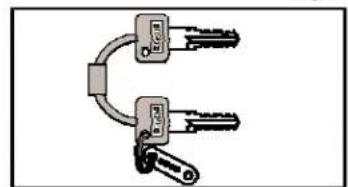
Fig. 3
6
STAR DLX ENGLISH 12-5-2010
Parts & Specifications
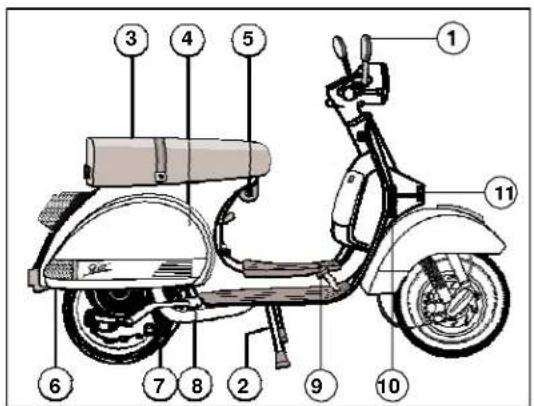
Fig. 4
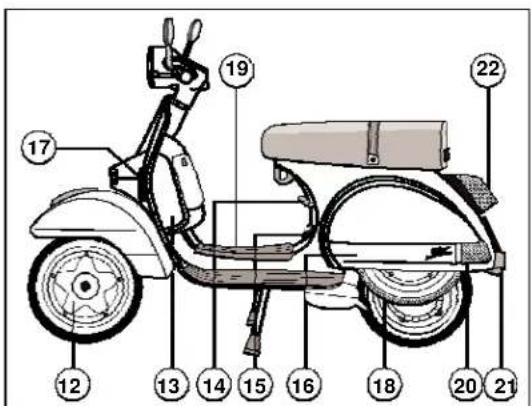
Fig. 5
- Rearview mirror
- Central stand
- Seat
- RH side cowl
- Hook for bag
-
Rear turn indicator (RH side)
-
Silencer
- Kick starter
-
Rear brake pedal
10 Front direction indicator (left side)
(right side) 11. Leg
12.5 spoke wheel hub -
Glove compartment
- Fuel cock lever
- Choke control knob
- LH side cowl
- Front direction indicator (left side)
-
Spare wheel
-
Driver's foot platform
- Rear turn indicator
(LH side) - Rear mudguard
- Tail light
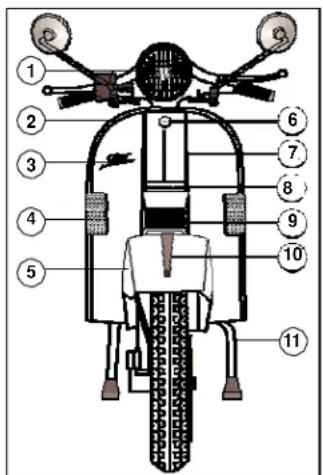
Fig.6
- Head light
- Fairing edge trimming
- STAR nameplate
- Front turn indicator
- Front mudguard
- LML symbol
- Fork cover
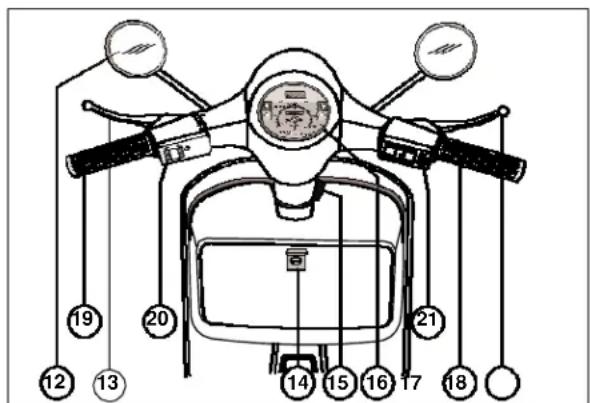
Fig. 7
- LML nameplate
- Grill
10.Crest - Central stand
- Rear view mirror
- Clutch lever
-
Glove compartment lock
-
Ignition-cum-steering lock
- Instrument panel
- Accelerator twistgrip
- Front brake lever
- Gearchange twistgrip
- Indicator switch
- Light switch - starter and horn buttons
STAR DLX ENGLISH 12-5-2010
Parts & Specifications
GENERAL SPECIFICATIONS
1. ENGINE
1.1 Engine: 4 stroke, horizontal single cylinder
1.2 Ignition: Via an electronic starter device (CDI) that feeds the live HT coil that generates the spark.
1.3 Lubrication: Wet sump forced pressure splash through a pump.
1.4 Clutch: Multiplate, oil bath type. The unit is cable operated by a lever located on the left hand side of the handlebar and is adjustable.
1.5 Gear Box: Four speed forward drive with constant mesh gears immersed in oil bath are operated by the twist grip on the left hand side of the handlebar which functions in conjunction with the clutch control lever.
1.6 Cooling: Forced air provided by a centrifugal fan.
1.7 Mechanical starter: With kick starter pedal located on the right hand side of scooter. Push button only in auto start model.
1.8 Electric starter: Pull in the clutch lever and press the starter button.
Parts & Specifications
2. FUEL
2.1 Fuel supply: Gravity fed from fuel tank to carburettor. Carburettor is a side draft carburettor and is having a vertical moving throttle slide.
2.2 Fuel Gauge: In built with the speedometer indicates the quantity of petrol in the petrol tank by virtue of a float unit located inside the tank.
2.3 Throttle Control: Accelerator controlled by the twistgrip on the right side of the handlebars.
3. CHASSIS
3.1 Chassis: Pressed steel sheet and strong tubular structure. A pressed steel sheet shell covers the tubular structure.
3.2 Handlebar: Light alloy casting with headlamp, instrument panel and indicator lights. All transmission cables are concealed therein.
3.3 Steering column and suspension: The steering column is pivoted on the front wheel swinging hub. Front and rear suspensions are provided with helical spring & hydraulic dampers.
3.4 Rear view mirror: Stylish moulded rear view mirrors on both sides of handlebar.
3.5 Security Lock: On the steering column and operated by a key.
3.6 Glove Compartment: A sleek & spacious glove compartment for keeping personal belongings, secured with a lock.
3.7 Seat: Tipup seat with a safety lock.
STAR DLX ENGLISH 12-5-2010
Parts & Specifications
4. WHEELS
4.1 Wheels: Interchangeable and manufactured from pressed sheet steel with 3.50 × 10 tyres.
4.2 Rear brake: drum brake with expanding brakeshoes activated by a foot pedal on the right side of the foot platform.
4.3 Front brake: disc brake activated by a manual lever positioned on the right side of the handlebars.
5. TOOL KIT
Tool kit in a pouch containing
Box Spanner with lever
Double sided screw driver
2 Double ended spanners
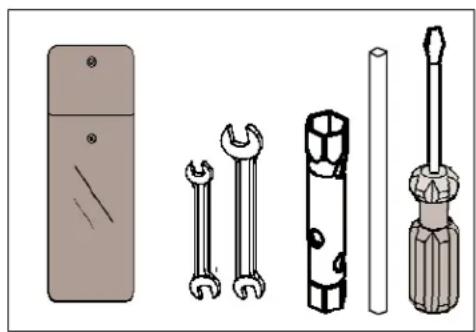
Fig. 8
Parts & Specifications
- ENGINE OIL: Quantity of Engine oil in the crank case is 1200ml . This is for lubrication and cooling of the Engine.
Always maintain Oil level as per the marks provided on the level gauge / dipstick as shown in the figure for details of checking see page no.33.
Note: ATake care that Engine Oil level is always maintained between the upper and lower level mark on the oil level gauge / dipstick. Running engine with insufficient oil may cause serious engine damage.
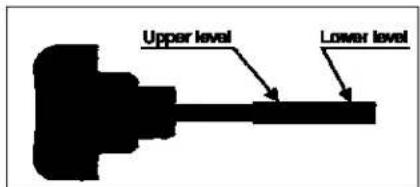
Fig.9
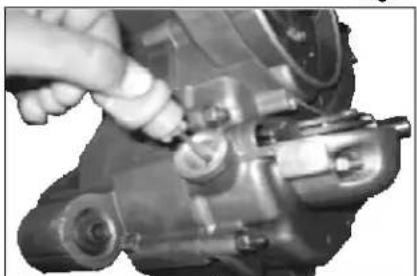
Fig. 10
STAR DLX ENGLISH 12-5-2010
SPECIFICATIONS - AUTO START
The STAR 4 STROKE has an automatic starter operated by a button underneath the light switch on the right of the handlebars (Fig. 11) as well as an optional method of kick starting the engine by using the kickstart pedal. For the Electric Starter, Push the START Button until the engine starts but not more than 10 seconds at a time. The auto start circuit is operated by a 12 volt 9 Ah battery.
A PRD relay (prevention of restarting device) is provided to avoid use of the self starter when the engine is running.
A declutch switch has been provided to prevent starting of scooter when the clutch is engaged.
An 8 Amp fuse (on spare wheel bracket, Fig. 12 & 13) is provided to avoid any damage due to short circuiting in auto start system.
A powerful 12 volt-96 watt magneto charges the battery through a regulator with a built in charger.
Parts & Specifications
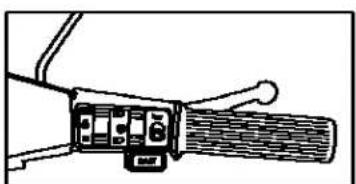
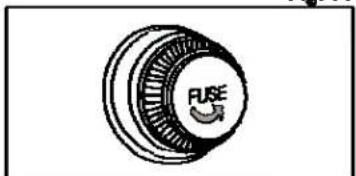
Fig.11
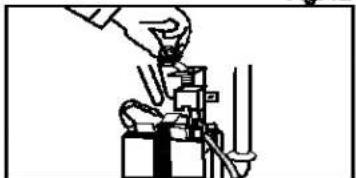
Fig. 12
Fig.13
Parts & Specifications
'AUTO START' CIRCUIT DIAGRAM
STAR DLX ENGLISH 12-5-2010
Technical Specifications
TECHNICAL SPECIFICATIONS
Dimensions
Overall length 1760 mm
Overall width 695 mm
Wheel base 1245 mm
Maximum road clearance 160 mm
Seat height 820 mm
Weights
Vehicle kerb weight (with 90% fuel) 122 kgs
Maximum technically permissible mass 270 kgs
Engine Single cylinder, four stroke, forced air cooled with
Single over head cam, two valves.
Secondary air system
Displacement
Bore
Stroke
200
65.5
59.3 mm
CC
mm
Compression ratio
ldling speed
Maximum output/Power
9:1
1200± 100 rpm
8.58± 0.25 Kw
at 6250 rpm
Maximum torque
Ignition system
pump type
Oil filtration system
Cooling system
Air filtration
14.3 Nm at 4500 rpm
Capacitor Discharge Ignition (CDI) Electronic. Oil
Trochoidal
By strainer and paper element filter
Forced air cool
By polyurethane element
Technical Specifications
Fuel Petrol 87 Octane and above
Fuel tank capacity 5.5 Liters (inclusive of 1 liter in reserve)
Fuel cock Three way tap:
Carburettor MIKCARB PB20-side draft
Spark Plug RG4HC - Champion
Open (ON), Close (OFF), Reserve (RES)
UHR3CC-MICO-BOSCH
C8EH9-NGK
Spark plug gap 0.7 0.8mm
Starting Kick Start Push Button for Auto start
Clutch Multiplate, oil bath.
Transmission 4 Speed constant mesh
Overall Gear Ratio
1st Gear 16.47 : 1
2nd Gear 10.30:1
3rd Gear 7:32:1
4th Gear 5.42:1
Chassis Semi monocoque structure having pressed steel sheet in
front and tubular frame in rear. Covered by sheet metal shell assembly.
Steering column and suspension The steering column is pivoted at the front Wheel swinging hub
Front and rear suspension Front and rear suspension with hydraulic dampers and helical
.
Brakes
Front brake
Rear brake
Tyres
Front and rear tyres
Drum brake, mechanical expanding shoe type.
Disc brake (Optional)
Drum brake, mechanical expanding shoe type
89x251mm (3.50x10), 4 ply rating, interchangeable
16
STAR DLX ENGLISH 12-5-2010
Technical Specifications
Tyre pressure
1.2 kg/cm2 (17 psi)
Front wheel 1.8 kg/cm2 (25 psi)
Rear wheel 2.5kg / cm^2 (35 psi) con passeggero
Controls
Steering
Handle bar
Accelerator Twist grip type on right hand side of the handle bar
Gears By hand on left hand side of the handle bar
Clutch Lever operated on left hand side of the handle bar
Front brake Lever operated by right hand
Rear brake Pedal operated by right foot
Electricals
Generator system
12 Volt 96 Watt.
Head lamp
12 Volt 35/35 Watt - Halogen bulb
Parking lamp
12 Volt 5 Watt
Tail light bulb
12 Volt 5 Watt
Stop light bulb
12 Volt 21 Watt
Speedolight bulb
12 Volt 1.2 Watt x 2
Turn signal light bulb
12 Volt 10 Watt
Tell tale lamp
12 Volt 1.2 Watt x 6
Horn
12 Volt DC Horn
Battery
12 Volt 9 Ah (for auto start model)
Fuse
8 Amp (for auto start model)
Maximum speed
100 kms/hr
Control Functions
CONTROL FUNCTIONS
1. LOCKING SYSTEM
The STAR 4 STROKE has a single key to block the steering, lock the glovebox and the seat as well as start the ignition.
1.1 Steering lock-cum ignition switch.
Locking the Handlebar: First turn the handlebar to the extreme left and then turn the key anticlockwise to lock position. Pull out the key after locking (Fig.14).
Un-locking the Handlebar: Insert the key in ignition switch and turn it clockwise to unlock the handlebar. To switch on the ignition turn the key further clockwise to "ON" position (Fig. 15).
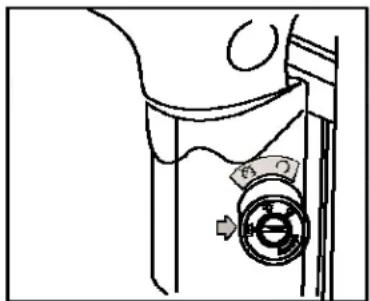
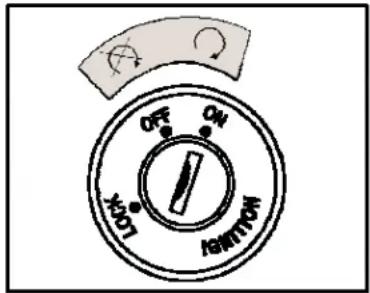
Fig. 14
Fig. 15
18
STAR DLX ENGLISH 12-5-2010
Control Functions
1.2 Glove compartment lock: To open the lock, insert the key into the lock and rotate anticlockwise till the end and then press the lock downwards. For closing, press the lid, turn the key clockwise and then take out the key (Fig. 16 & 17).
1.3 Seat Lock (Dual Seat): Insert the key, rotate it clockwise till the end then take it out.
Push the lock with thumb (Fig. 18) and lift the saddle from the back (Fig. 19). Place the saddle in its normal position & press it down. To lock the saddle, follow the above procedure in reverse order.
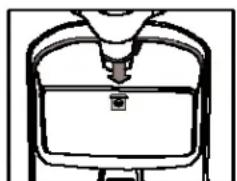
Fig. 16
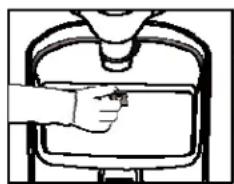
Fig.17
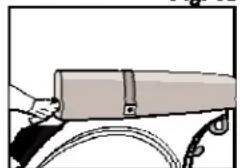
Fig. 18
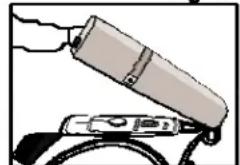
Fig.19
INSTRUMENT PANEL
An elegantly designed instrument panel which contains the following:
- Fuel Gauge
- Fuel level indicator needle
- Head light high beam indicator
- LH turn signal indicator
- Speed indicator needle
- Odometer
- RH Turn signal indicator
- Head light low beam indicator
- Stop light indicator
- Neutral light indicator
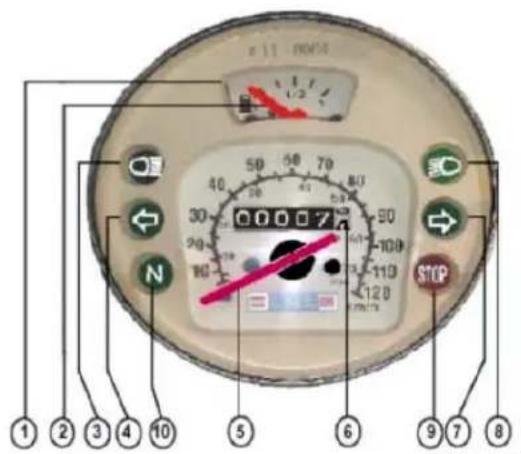
Fig. 20
STAR DLX ENGLISH 12-5-2010
Control Functions
- CONTROL SWITCHES: Control switches are located on the right and left hand sides of the handlebar.
2.1 Right hand side of the handlebar (Fig. 21).
2.1.1 Headlight
- Press top end of (1) to activate the headlight and bottom end to switch on the parking light.
- Press top end of (2) for high beam or bottom end of (2) for low beam. Headlight high & low beam positions are indicated on the instrument panel.
2.1.2 Instrument Panel lights and tail lights. To switch on, press bottom or top end of (1).
2.1.3 Stop Light - Becomes operative when foot brake pedal or hand brake lever is pressed.
2.1.4 Horn-Press button (3)
2.1.5 For Auto start model only: Press push button switch (4) for auto start only after pressing clutch lever and disengaging clutch.
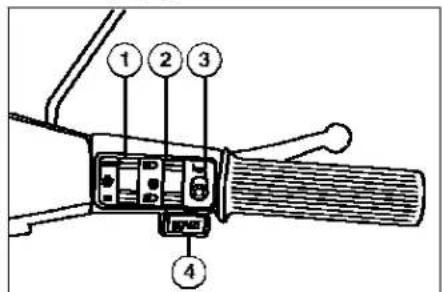
Fig. 21
Control Functions
2.2 Left hand side of the handlebar (Fig. 22).
2.2.1 Turn indicator switch: Press left hand end of switch for turning left and right hand end for turning right.
Left & right turn indicators are shown on the instrument panel.
3. CLUTCH AND GEAR CHANGE CONTROLS:
Located on the left hand side of the handlebar, consisting of clutch lever for engaging the clutch and the gear twist for changing gears.
3.1 Clutch lever: Press the clutch lever towards the handlebar to disengage the clutch. (Fig. 23).
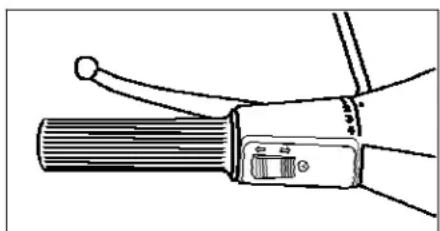
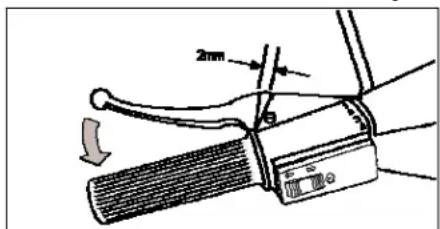
Fig. 22
Fig. 23
STAR DLX ENGLISH 12-5-2010
3.2 Twist grip for gear change: There are 5 positions, one for neutral and the other four for driving at different speeds as given below;
Gear Speed band as position given below
1 Upto 10 Kms/hour
0 Neutral
2 10-20
3 20-35
4 35 kms/hour & above
kms/hour
To change gear, press clutch lever and turn the twist grip. (Fig. 24) to the required position.
- ACCELERATOR CONTROL: Located on the right hand side of the handlebar. It is a twist grip. For increasing acceleration rotate the twist grip towards yourself. Do the reverse for decreasing acceleration (Fig. 25).
Control Functions
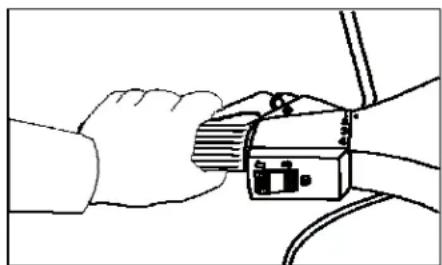
Fig. 24
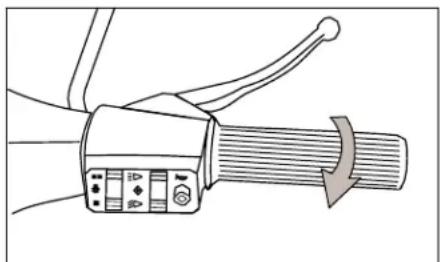
Fig. 25
Control Functions
- BRAKES: There are two brakes one operated by foot and the other operated by hand. Both brakes should be applied simultaneously for most effective braking.
5.1 Foot Brake: Operates on the rear wheel. Press down brake pedal to apply the brake. The distance in which the scooter can be brought to a halt will depend on the speed at which the vehicle is travelling and the user's driving habits. (Fig. 26).
5.2 Hand Brake: Operates on the front wheel. Press hand brake lever towards the twist grip (Fig. 27).
6. FUEL SUPPLY
6.1 The fuel tank is located under the seat (Fig. 28) and is accessible only when the seat is unlocked and lifted. For filling in petrol unscrew the cap and close it after refuelling.
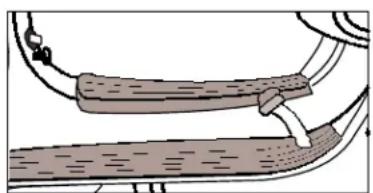
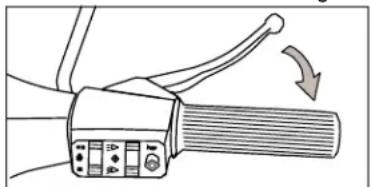
Fig. 26
Fig. 27
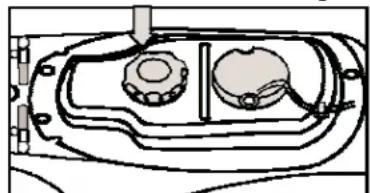
Fig. 28
24
STAR DLX ENGLISH 12-5-2010
Control Functions
6.2 Control of flow of petrol (Fig. 29):
There is a fuel tap under the seat that has three positions: (ON) for a regular flow of fuel, (OFF) to stop the flow of fuel from the tank to the engine and (RES) that must be activated when on reserve.
If the vehicle stops on account of lack of petrol, then turn the cock lever to (RES) i.e. "RESERVE" position. There is one litre of petrol kept in reserve in your tank for any emergency.
There is a fuel gauge in the instrument panel for indicating the quantity of fuel in the tank.
6.3 Choke control knob (Fig. 30): Located below the fuel cock. To be used for starting the engine when it is cold. Pull the choke knob outwards for operation. Pull out the choke control knob to operate it. It must be pushed back in when the engine has warmed up.
Caution: If the choke control knob is pulled out and remains out, this would cause an excessive level of fuel in the carburettor that would cause irregular running and elevated fuel consumption.
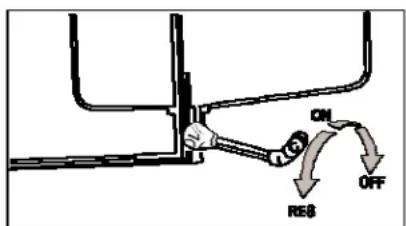
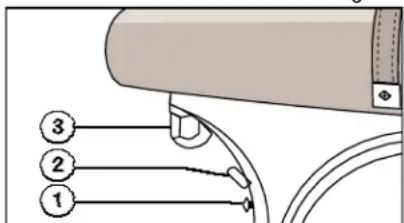
Fig. 29
Fig. 30
- Choke control knob, 2. Fuel Cock lever,
-
Hook for Bag
-
HOOK FOR BAG: There is a hook for hanging a bag under the seat.
Warning: Before driving your scooter make yourself thoroughly familiar with all operating controls and their functions.
1. BEFORE STARTING THE ENGINE:
1.1 Check if tyres are properly inflated.
1.2 Check for correct play in the clutch lever (Fig. 23) and make sure that it operates properly.
1.3 Check that the brake pedal play is correctly adjusted.
1.4 Check that the accelerator control functions correctly and the play is within normal limits.
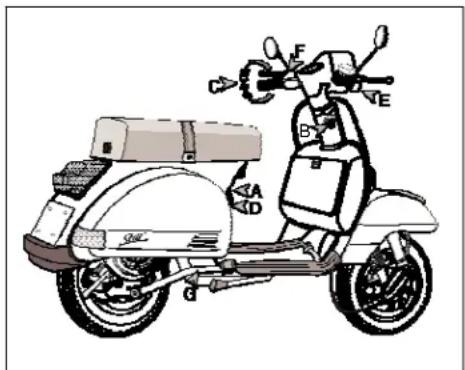
Fig. 31
A-Open fuel cock
B - Switch 'ON' ignition
C - Put gear in neutral position
D - Pull out the choke control knob (only when the engine is cold)
E - Position the accelerator control at minimum.
F-De-clutch
G - Kick starter pedal
STAR DLX ENGLISH 12-5-2010
Operating the vehicle
2. STARTING THE ENGINE (Fig. 31).
2.1 Turn fuel cock lever to "ON" position.
2.2 Turn 'ON' the ignition switch.
2.3 Put gear control in neutral position.
2.4 Pull out the the choke control knob only when the engine is cold.
2.5 Bring the throttle to idling position.
2.6 If you are starting the engine for the first time in the day, press the clutch lever and, keeping it pressed, kick the starter lever a couple of times.
2.7 Operate the kick pedal by pushing it down with a kick for starting the engine. To start the engine using the electric starter, press the clutch lever and then press the starter button.
2.8 When the engine is running normally, press the choke knob back to its normal position.
Caution:
i. Do not use electric starter for more than 5 seconds at a time. Release the push button start switch for approximately ten seconds before pressing it again. If the engine fails to start after repeated attempts hold the throttle 1/8-1/4 open and push the button start switch.
ii. Before using the electric starter button, ensure that the clutch lever has been pressed.
3.DRIVING THE SCOOTER:
3.1 Remove the vehicle from stand, by pushing it forward.
3.2 Seat yourself on the scooter with feet on the ground and hands on the handle bar.
3.3 With the engine running at idling speed, press the clutch lever with the left hand and rotate the gear twist grip to 1st gear position.
3.4 Put the scooter in movement by gradually releasing the clutch and simultaneously turning the accelerator twistgrip.
Operating the vehicle
3.5 To change gear, rotate the accelerator twistgrip back to zero, press the clutch lever and turn the gearchange twistgrip control and position it on the next upper or lower gear.
3.6 Use indicator switch button for turning and use horn whenever required.
4. APPLICATION OF BRAKES:
4.1 Turn the accelerator twistgrip back to zero.
4.2 Press the clutch lever and change the gear to the neutral position.
4.3 Use foot pedal brake and hand brake simultaneously for the most efficient braking.
STAR DLX ENGLISH 12-5-2010
Runningin-in-Instructions
ENGINE RUNNING-IN
Operation: The most important period in the life of your scooter is its first 1000 kms. The engine is brand new and different moving parts of the engine need to be set to their correct operating tolerances. This ensures a longer life for your vehicle. It is therefore necessary to take some precautions so as not to overload the engine.
- Keep to the following speed limits
1stGear 0to10kms/hr.
2nd Gear : 10 to 20 kms/hr.
3rd Gear : 20 to 35 kms/hr.
4th Gear : 35 kms/hr and above.
-
Avoid running the scooter on full accelerator (throttle) for long periods. Vary the speed from time to time.
-
Do not drive with half (partially engaged) clutch. This will not only damage the clutch but will also cause overheating of the engine.
- Allow a cooling off period of 5-10 minutes after each hour of use.
- Ensure oil level in engine to recommended level, by checking the level with the help of dipstick.
CARE AND MAINTENANCE
1. REMOVAL AND REFITTING OF COWLS:
The right hand side cowl is to be removed for checking of oil level and spark plug. The left hand side cowl is to be removed for taking out or refitting the spare wheel.
The levers for opening the cowls are placed under the seat. To remove the cowls:
1.1 Lift the seat as explained on page 19.
1.2 Turn the cowl opening levers outwards (Fig.32).
1.3 Hold the body fairing with both hands and remove the cover in an upwards and backwards movement and remove it (Fig. 33 & 34).
1.4 Pull out the cowl by disengaging its rear end. (Fig. 35).
1.5 Refit the cowl, by following above procedure in reverse
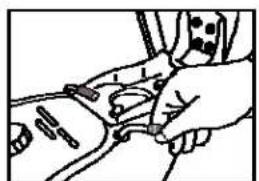
Fig. 32
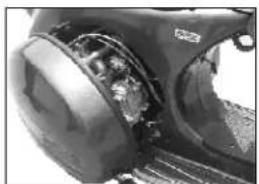
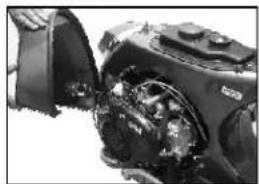
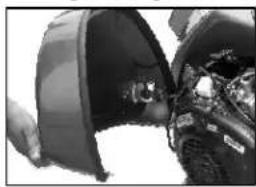
Fig. 33 Fig. 34
Fig. 35
30
STAR DLX ENGLISH 12-5-2010
2.CHANGING THE TYRES:
2.1 Removing and refixing the sparewheel
2.1.1 Remove the left hand side cowl as mentioned above.
2.1.2 The wheel is fixed by three nuts. Unscrew the nuts using the box spanner from the tool kit, remove the three elastic washers and remove the wheel (Fig.36).
2.1.3 For fixing the spare wheel follow the above procedure in reverse order.
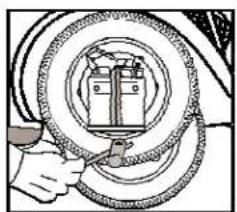
Fig. 36
Care and Maintenance
2.2 Changing of Front Wheel
2.3 Changing of Rear Wheel:
2.2.1 Put the vehicle on its central stand.
2.2.2 Remove the five nuts that fix the wheel to the wheel hub using the box spanner from the tool kit (Fig. 37). While loosening the nuts, hold the wheel with one hand.
2.2.3 Remove the spring washers and take out the wheel from the brake drum.
2.2.4 For refitting, follow the above procedure in reverse order.
2.3.1 Put the vehicle on its central stand.
2.3.2 Remove side cowls as explained on page 30.
2.3.3 Remove the battery. Follow the instructions given on page 35 for removal and installation of battery.
Care and Maintenance
2.3.4 Bring the fuel knob to "close" position. Start the engine to exhaust petrol in the carburettor as well as in the fuel line. The engine will stop automatically when the fuel is exhausted.
2.3.5 Remove the spare wheel as explained on page 31.
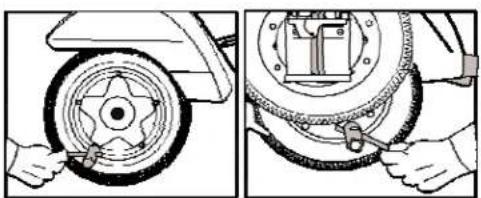
Fig. 37 Fig. 38
2.3.6 Lay the scooter gently on ground on its right hand side with the handle bar sleeve touching the ground at right angle.
2.3.7 Bring the vehicle in first gear and hold the wheel with one hand. Remove the five nuts securing the wheel to the brake drum by using the box spanner (Fig. 38).
2.3.8 Remove the spring washers and take out the wheel from the brake drum.
2.3.9 For refitting, follow the above procedure in reverse order.
Precaution:
- Tighten all wheel securing nuts alternately and progressively. Recheck if all nuts are tightened properly.
- Get the tyre pressure checked to the recommended level at the nearest service station.
STAR DLX ENGLISH 12-5-2010
Care and Maintenance
2.4 Tyre Rotation:
All three wheels of the STAR 4 STROKE are interchangeable. However, the air pressure in the tyre will depend on whether it is fitted in the front or rear position. To ensure even tyre tread wear, it is necessary to rotate the tyres and change the face of the tyre (in relation to the wheel rim) after every 6000km . Follow the sequence for tyre rotation as explained in fig. 39.
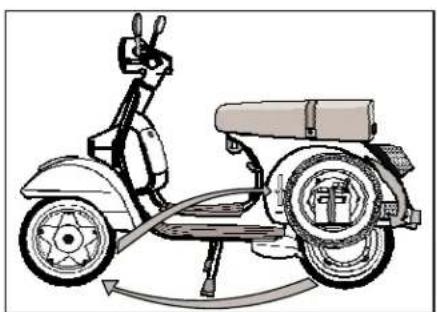
Fig. 39
- CHECKING ENGINE OIL LEVEL AND CLEANING SPARK PLUG
3.1 Park the vehicle on level surface.
3.1.1 Remove the right hand side cowl as directed on page 30.
3.2 Checking oil level:
3.2.1 For checking the oil level, unscrew dispstick as shown in fig.40.
3.2.2 Clean dipstick by a dry cloth.
3.2.3 Immerse the oil level rod without screwing it in.
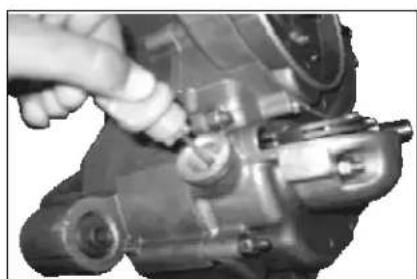
Fig. 40
Care and Maintenance
3.2.4 Take out dip stick and check the level of oil, as shown in fig. 9. Oil level should be above lower level make and below upper level mark.
3.2.5 If level is less add Engine Oil to maintain correct level.
3.2.6 Reflex the dipstick.
3.2.7 Wipe off any excess oil which may have been spilled.
3.2.8 Refit the cowl.
3.3 Spark plug cleaning:
3.3.1 Remove the right hand cowl.
3.3.2 Disconnect the HT lead cable (Fig. 42).
3.3.3 Wipe & clean the area around the spark plug.
3.3.4 Using the box spanner, unscrew the spark plug (Fig. 43).
3.3.5 Clean out any excessive carbon deposit.
3.3.6 Reflex the spark plug back to its position.
3.3.7 Refit the cowl.
If you have a feeler gauge you can check the gap between the electrodes in the spark plug. This gap should be 0.7 - 0.8mm (fig.41). To adjust the gap again, it is better to go to an authorised LML assistance centre.
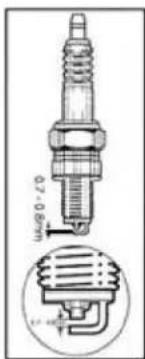
Fig. 41
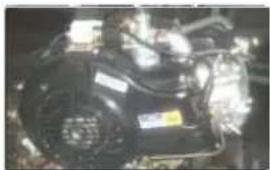
Fig. 42
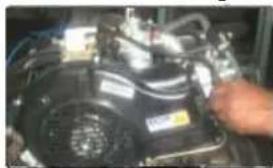
Fig. 43
4. BATTERY CHECKING
Battery requires regular and thorough maintenance as advised below:
4.1.1 The level of electrolyte must always be in between the upper and lower levels marked on the battery. Normally a constant level in the specified range is maintained for about two months or approximately 2000 kms (Fig. 44).
STAR DLX ENGLISH 12-5-2010
Care and Maintenance
4.1.2 The level of electrolyte should be checked once in a month. In case of a normal decrease (0,5cm) put in distilled water only so as to reach the upper level indicated on the battery. If there is a marked drop in the electrolyte level (1 cm or more) have the battery checked at an authorised LML assistance centre.
Caution:
- Battery should be removed if the vehicle is to be washed lying on its side.
- Use only 8 Amp fuse to prevent serious damage to the wiring harness & battery. Ignition switch should be in "off" position while replacing fus
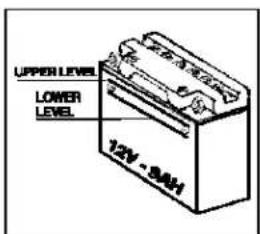
Fig. 44
4.2 Removal and refitting the battery
4.2.1 Turn the ignition key to "off" position.
4.2.2 Remove the left hand side cowl as explained on page 30.
4.2.3 Remove the screw securing ground cable (black) connected to the negative (-) battery terminal by using the end of the screw driver from your tool kit. (Fig. 45)
4.2.4 Similarly follow the procedure for removing the red cable connected to the positive (+) battery terminal.
4.2.5 Remove the battery and the acid discharge tube.
4.2.6 Detach the fastener belt and take out the battery.
Precaution:
Keep the battery and bleeder tube away from the vehicle to avoid any damage to the painted surface of the scooter due to leakage or spillage of battery electrolyte.
4.3 Installation:
4.3.1 Clean the battery box.
Care and Maintenance
4.3.2 Clean the battery thoroughly from the outside.
4.3.3 Put the battery in the battery box.
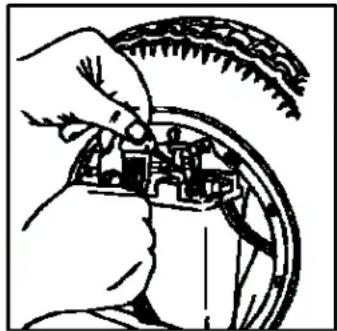
4.3.4 Connect the fastener belt first to the lower hook, then hold the battery firmly with one hand, stretch the belt and fasten it in the upper hook. Recheck if the battery is fastened firmly (Fig. 46).
4.3.5 Reflex battery bleeder tube and ensure that it is routed properly through its clamp.
4.3.6 Fix the "Positive" (+) terminal first and then the "Negative" (-) terminal.
4.3.7 Make sure the battery cable does not touch any metallic surface during fitment.
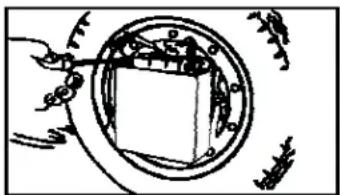
Fig. 45 Fig. 46
4.3.8 Apply grease around the terminals to prevent corrosion.
4.3.9 Ensure, Protection cap provided on battery harness is fixed properly on positive (+) terminal of battery.
Caution:
Always ensure that the bleeder tube is not clogged, crimped or bent. The tube must be of an adequate length. Replace the bleeder tube in case it is not of correct length or it is clogged, or bent.
Care and Maintenance
STAR DLX ENGLISH 12-5-2010
4.4 Storage of battery while not in use
4.4.1 Keep the battery fully charged.
4.4.2 Maintain electrolyte level at MAX./ "UPPERLEVEL"
4.4.3 Take battery out of the vehicle and store it in a dry, cool place and at a constant temperature.
4.4.4 Keep battery away from rain, dew, high moisture and direct sunlight.
4.4.5 The battery should be charged once a month when the vehicle is not in use.
- For initial charging, the battery must be charged at least for 7 hours.
Always go to the authorised LML assistance centre for battery maintenance and charging the battery.
5.AIR CLEANER:
Air cleaner is fitted below the fuel tank and requires cleaning during each periodical service (Fig. 47 & 48) and more frequently when riding in dusty area's.
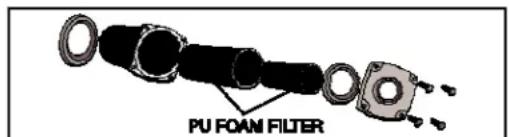
Fig. 47
Clean the air filter element (PUF) in kerosene and the squeeze dry (do not twist or wring). Dip in 20W40 Engine oil and again squeeze, before fitting into Air filter Body. Do not use compressed air.
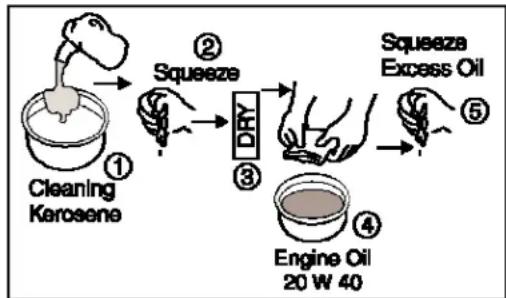
Fig. 48
Care and Maintenance
6. CLEANING & POLISHING:
Frequent and thorough cleaning of your scooter will further enhance its appearance and extend its life.
6.1 The scooter should be cleaned at ambient temperature i.e., not immediately after use or in hot sun.
6.2 Use a low pressure water hose for cleaning the vehicle.
6.3 Wipe it, clean and dry with soft cloth.
6.4 Do not use detergents or powders which are likely to leave scratches on the surface.
6.5 For polishing, use normal car polish and rub with soft cloth.
7. CARE OF YOUR VEHICLE WHEN NOT IN USE FOR LONG PERIODS
If you are not going to use your vehicle for more than two months then you should store it properly as per the following advices.
7.1 With the help of a pipe, syphon out the petrol from the fuel tank.
7.2 Start the engine for some time and exhaust the petrol in the carburettor.
7.3 Remove the spark plug as explained on page 34 and put a few drops of Engine Oil in the spark plug hole. Press the kick lever a couple of times. Refix the spark plug.
7.4 Clean the vehicle thoroughly and apply antirust grease on all unpainted metallic parts.
7.5 Raise the wheels off the ground by placing wooden planks and deflate the tyres so that they do not touch the floor.
7.6 Cover the scooter.
STAR DLX ENGLISH 12-5-2010
Recommended Lubricants
LML
TABLELLA LUBRIFICANTI - TABLE OF LUBRICANTS - TABLEAU DES LUBRIFANTS - SCHMIERIMTTELABELLE - TABLELA LUBRICANTES
| APPLICATIONS APPLICATIONS APPLICATIONS ANWENDUNGEN USOS | CONSIGLIATO RECOMMENDES RECOMMANDE ENPFOHLEN RECOMENDADO |
| OLIO MOTORE MOTOR OIL HUILE MOTEUR MOTOROL ACETTE MOTOR | 10-40 |
| LIQUIDO FRENI BRAKE FLUIDS CIRCUIT FREIDS BREMSBEDIENUNG SISTEMA DE MANDO FRENOS | DOT 4 |
PERIODICAL MAINTENANCE TO BE CARRIED OUT BY AN AUTHORISED LML ASSISTANCE CENTRE
Preventive Maintenance:
To obtain the best performance from your STAR 4 STROKE it is important to carry out periodical maintenance on your vehicle. The following table gives the suggested action for different items of maintenance and their periodicity.
Code of suggested action is:
| NR. | Item | Check or maintenance jobs | 0 Km Pre-delivery | 500 Km | 3000 Km | 6000 Km | 9000 Km | 12000 Km | 15000 Km | 18000 Km | 21000 Km | 24000 Km | 27000 Km | 30000 Km |
| 1. | Engine Oil | Filling | R | |||||||||||
| Replacement | S | Check level every 1000 Km and top up if required. Replace every 3000 Km or every 1 year. | ||||||||||||
| 2. | Engine Oil Filter | Replacement | S | Replace every 3000 Km or every 1 year. | ||||||||||
| 3. | Engine Oil Filter Screen | Clean | P | P | P | P | P | P | P | P | P | P | P | |
STAR DLX ENGLISH 12-5-2010
Maintenance by Authorised Service Dealer
| NR. | Item | Check or maintenance jobs | 0 Km Pre-delivery | 500 Km | 3000 Km | 6000 Km | 9000 Km | 12000 Km | 15000 Km | 18000 Km | 21000 Km | 24000 Km | 27000 Km | 30000 Km |
| 4 | Spark Plug | Check/ Replacement | C | C | C | C | S | C | C | C | S | C | C | |
| 5 | Air Filter and its elements | Clean/Lubricant | P | P | P | S | P | P | P | S | P | P | ||
| 6 | Fuel Circuit Pipes | Check/ Replacement | C | C | C | C | C | S | C | C | C | S | C | C |
| 7 | Fuel Filter | Check/ Replacement | C | C | S | C | S | C | S | C | S | C | S | |
| 8 | Check Emission Level | Check/ Adjust | C | C | C | C | C | C | C | C | C | C | C | |
| 9 | Valves Clearance | Check/ Adjust | C | C | C | C | C | C | ||||||
| 10 | Nut Fixing Head Cylinder | Check/ Tightened | C | C | C | C | C | C | C | C | C | C | C | C |
Maintenance by Authorised Service Dealer
| NR. | Item | Check or maintenance jobs | 0 Km Pre-delivery | 500 Km | 3000 Km | 6000 Km | 9000 Km | 12000 Km | 15000 Km | 18000 Km | 21000 Km | 24000 Km | 27000 Km | 30000 Km |
| 11 | Chain & Chain Tensioner | Check/ Replacement | C | C | S | C | C | |||||||
| 12 | Chain Guide | Check/ Replacement | C | C | C | C | C | |||||||
| 13 | Electrical System | Check | C | C | C | C | C | C | C | C | C | C | C | C |
| 14 | Battery | Check | C | C | C | C | C | C | C | C | C | C | C | C |
| 15 | Front Brake System | Check/ Replacement | C | C | C | C | C | C | C | C | C | C | C | C |
| Replace brake oil every 12000 Km or every 2 years | ||||||||||||||
| 16 | Rear Brake System | Check/Adjust Replacement | C | C | C | C | C | C | C | C | C | C | C | C |
| 17 | Clutch Lever Play | Check/Adjust | C | C | C | C | C | C | C | C | C | C | C | C |
STAR DLX ENGLISH 12-5-2010
Maintenance by Authorised Service Dealer
| NR. | Item | Check or maintenance jobs | 0 Km Pre-delivery | 500 Km | 3000 Km | 6000 Km | 9000 Km | 12000 Km | 15000 Km | 18000 Km | 21000 Km | 24000 Km | 27000 Km | 30000 Km |
| 18 | Accelerator Command | Check/Adjust | C | C | C | C | C | C | C | C | C | C | C | C |
| 19 | Steering Column Rings | Check/Adjust | C | C | C | C | C | C | C | C | C | C | C | C |
| 20 | Security Tightened Nuts, Bolts and Screw | Check/Tightened | C | C | C | C | C | C | C | C | C | C | C | C |
| 21 | Central Stand | Check | C | C | C | C | C | C | C | C | C | C | C | C |
| 22 | Oil Pump Functioning | Check | C | C | C | C | C | C | C | C | C | C | C | C |
| 23 | Clean Crank Case Breather Tube | Check/ Clean | C | C | C | C | C | C | C | C | C | C | C | C |
Maintenance by Authorised Service Dealer
| NR. | Item | Check or maintenance jobs | 0 Km Pre-delivery | 500 Km | 3000 Km | 6000 Km | 9000 Km | 12000 Km | 15000 Km | 18000 Km | 21000 Km | 24000 Km | 27000 Km | 30000 Km |
| 24 | Rear/Front Damper | Check | C | C | C | C | C | C | C | C | C | C | C | C |
| 25 | Wheels/Tires | Check/Replacement | C | C | C | C | C | C | C | C | C | C | C | C |
| Tyre rotation every 6000 Km | ||||||||||||||
C:Check/Adjust
P: Clean/Lubricate
S : Replacement
R:Filling
STAR DLX ENGLISH 12-5-2010
Exhaust Emission Control
EXHAUST EMISSION CONTROL
In accordance with the Central Motor Vehicle Rules, LML range of scooters manufactured by LML Limited meet emission standards prior to despatch from factory.
Normally simple carburettor adjustment will help to control CO level in exhaust gases. However, it is necessary to check Carbon Monoxide (CO) level in exhaust gases.
Following are some tips to control CO level in exhaust gases:
- Use only recommended spark plug.
-
Clean the air filter and replace if required.
-
Clean and adjust carburettor properly. Adjust the air mixture screw to 12 to 112 threads anticlockwise from fully to closed position and thereafter set idling screw 1000 to 1300 RPM.
- Check the compression pressure and ensure that it is within limits. Check ignition timing and reset as recommended.
- Check and adjust spark plug gap.
STAR DLX ENGLISH 12-5-2010
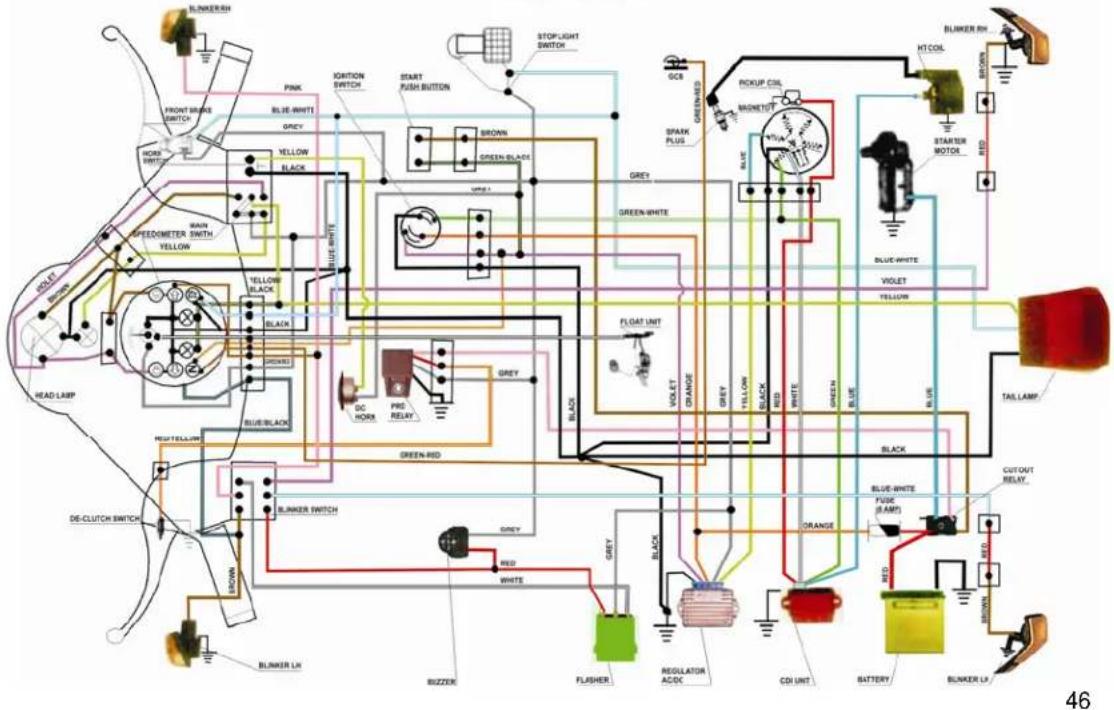
WIRING DIAGRAM AUTO START
Care and Maintenance
STAR DLX ENGLISH 12-5-2010
SECONDARY AIR SUPPLY SYSTEM
Secondary air supply system
Removal/Installation
(A) Remove hex bolts (Fig. 49) of mounting bracket secondary air system.
(B) Disconnect tube to Air cleaner box (X), intake manifold (Y) by removal of spring clips.
(C) Disconnect tube (Z) to Cyl. head by removal of hose clamp.
(D) For cleaning, blow air through pipe X.Y.Z.
(E) Check tubes for leakage replace if necessary.
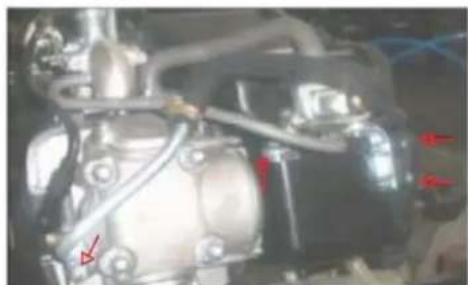
Fig. 49
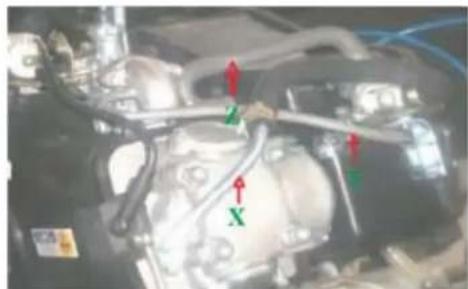
Fig. 50
Care and Maintenance
FRONT DISC BRAKE
STAR Deluxe scooters are also produced with Disc brake in front wheel (Fig. 51).
The disc brake functions on hydraulic system. Maintaining correct level of brake fluid in the 'master Cylinder Assy.' is very essential for proper functioning of brake.
Check the level of brake fluid in the Master Cylinder located on the RH side of the handle bar (Fig. 52), which should never be lower than the 'MIN.' mark on the transparent level indicator provided in Master Cylinder.
If the fluid level is found low, approach the nearest authorised Service Station for topping up.
Under normal climatic conditions, it is advisable to change the brake fluid every 20,000 Kms. or every 2 years.
Precautions:
Level of fluid in the Master Cylinder must never be lower than the MIN' mark.
Use recommended brake fluid (Fiat Tutela DOT 3 or DOT 4/Mobil Super Heavy Duty brake fluid). Brake fluid is highly corrosive. Avoid contact with painted parts.
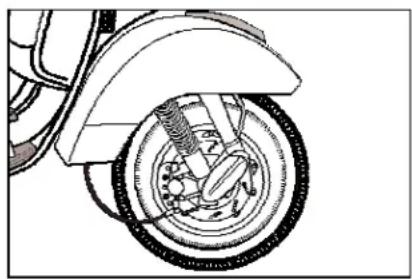
Fig. 51
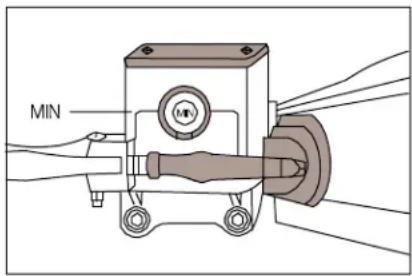
Fig. 52
STAR DLX ENGLISH 12-5-2010
The descriptions and illustrations in this booklet are not to be taken as binding on the manufacturer. The essential features of the model described and illustrated herein remain unaltered, LML Limited, reserves the right to carry out at any moment, without being obliged to bring this booklet uptodate, modifications to the machine, its parts, or accessories, that the company deems to be convenient for improvement purposes or of what may be required for manufacturing or commercial purposes.
MANUEL D'UTILISATION ET D'ENTRETIEN
- PRÉSEN TATION DE STAR DELUXE 4T
FONCTIONNEMENT DE STAR DELUXE 4 T
SOINS ET ENTRETIEN DE STAR DELUXE 4 T
INFORMATIONS IMPORTANTES
Identification du motorcycle
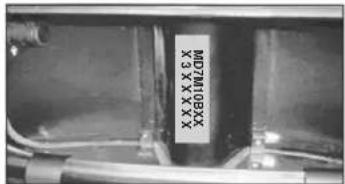
Fig. 1
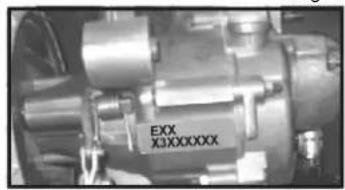
Fig. 2
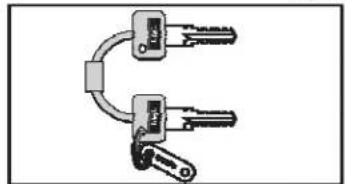
Fig. 3
6
STAR DLX FRANÇAIS 12-5-2010
Specifications techniques
Specifications techniques
Specifications techniques
Pression pneus
Roue avant
Roue arrière
Commandes
Direction
Accéléateur
Boite de vitesses
Embrayage
Minimum regime 1200± 100t /
Maximum vermogen 8,58± 0,25 Kw
65,5
mm
Maximum koppel
mm
Elektronische
Type oliepomp
C-10, Panki Industrial Estate, Site II, Kanpur - 208022, INDIA.
:91-512-2691381,6660300 91-512-2691391,6660301 lmknp@lml-india.com