ManualGo.com
Ecofire Giorgia 9 aria - Pan Palazzetti - Free user manual and instructions
Find the device manual for free Ecofire Giorgia 9 aria Palazzetti in PDF.



| Features | Details |
|---|---|
| Stove type | Pellet stove |
| Nominal power | 9 kW |
| Efficiency | 90% |
| Tank capacity | 25 kg |
| Dimensions (L x D x H) | 600 x 600 x 1,200 mm |
| Weight | 150 kg |
| Fuel type | Wood pellets |
| CO2 emission | 0.03% |
| Temperature control | Built-in thermostat |
| Usage | Supplementary or main heating in homes |
| Cleaning | Regular cleaning of the firebox and ashtray |
| Maintenance | Annual check by a professional recommended |
| Safety | Overheat safety system |
| Warranty | 2 years |
| Certifications | CE, Flamme Verte |
| Additional information | Compatible with home automation systems |
Frequently Asked Questions - Ecofire Giorgia 9 aria Palazzetti
Download the instructions for your Pan in PDF format for free! Find your manual Ecofire Giorgia 9 aria - Palazzetti and take your electronic device back in hand. On this page are published all the documents necessary for the use of your device. Ecofire Giorgia 9 aria by Palazzetti.
USER MANUAL Ecofire Giorgia 9 aria Palazzetti
This manual is an integral part of the product. Read the instructions carefully before installing, servicing or operating the product.
OGNI ACCENSIONE OGNI SETTIMANA
1.3 PURPOSE AND CONTENT OF THE MANUAL
1.7 MAIN STANDARDS TO BE RESPECTED
4 HANDLING AND TRANSPORTATION
5.6 CIRCULATION OF DUCTED AIR
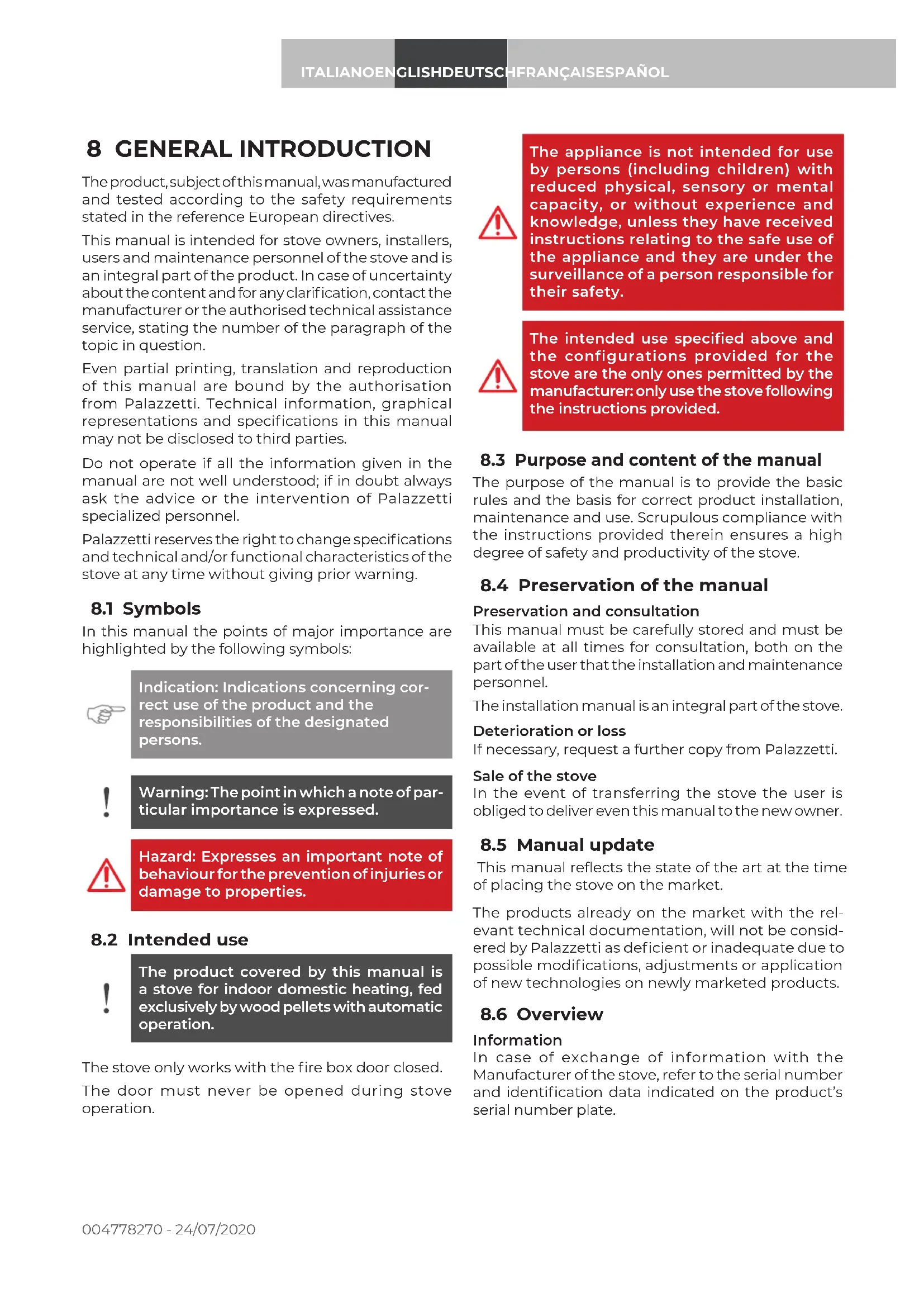
ITALIANO ENGLISH DEUTSCH FRANÇAIS ESPAÑOL The appliance is not intended for use by persons (including children) with reduced physical, sensory or mental capacity, or without experience and knowledge, unless they have received instructions relating to the safe use of the appliance and they are under the surveillance of a person responsible for their safety. The intended use specified above and the configurations provided for the stove are the only ones permitted by the manufacturer: only use the stove following the instructions provided.
8.3 Purpose and content of the manual
The purpose of the manual is to provide the basic rules and the basis for correct product installation, maintenance and use. Scrupulous compliance with the instructions provided therein ensures a high degree of safety and productivity of the stove.
8.4 Preservation of the manual
Preservation and consultation This manual must be carefully stored and must be available at all times for consultation, both on the part of the user that the installation and maintenance personnel. The installation manual is an integral part of the stove. Deterioration or loss If necessary, request a further copy from Palazzetti. Sale of the stove In the event of transferring the stove the user is obliged to deliver even this manual to the new owner.
This manual reflects the state of the art at the time of placing the stove on the market. The products already on the market with the rel- evant technical documentation, will not be consid- ered by Palazzetti as deficient or inadequate due to possible modifications, adjustments or application of new technologies on newly marketed products.
Information In case of exchange of information with the Manufacturer of the stove, refer to the serial number and identification data indicated on the product’s serial number plate. 8 GENERAL INTRODUCTION The product, subject of this manual, was manufactured and tested according to the safety requirements stated in the reference European directives. This manual is intended for stove owners, installers, users and maintenance personnel of the stove and is an integral part of the product. In case of uncertainty about the content and for any clarification, contact the manufacturer or the authorised technical assistance service, stating the number of the paragraph of the topic in question. Even partial printing, translation and reproduction of this manual are bound by the authorisation from Palazzetti. Technical information, graphical representations and specifications in this manual may not be disclosed to third parties. Do not operate if all the information given in the manual are not well understood; if in doubt always ask the advice or the intervention of Palazzetti specialized personnel. Palazzetti reserves the right to change specifications and technical and/or functional characteristics of the stove at any time without giving prior warning.
In this manual the points of major importance are highlighted by the following symbols: Indication: Indications concerning cor- rect use of the product and the responsibilities of the designated persons.
Warning: The point in which a note of par-
ticular importance is expressed. Hazard: Expresses an important note of behaviour for the prevention of injuries or damage to properties.
The product covered by this manual is a stove for indoor domestic heating, fed exclusively by wood pellets with automatic operation. The stove only works with the fire box door closed. The door must never be opened during stove operation.004778270 - 24/07/2020
Extraordinary maintenance Extraordinary maintenance operations must be performed by qualified personnel authorised to intervene on the model of stove to which this manual refers. Responsibility for the works of installation PALAZZETTI cannot be held responsible for the works carried out for the installation of the stove, this is, and remains, the responsibility of the installer, which is in charge of the execution of the inspections relating to the flue and air intake and also to the correctness of the installation solutions proposed. Furthermore, all the safety regulations provided for by the specific legislation in force in the state where the same is installed must be observed. Use Use of the stove is also subject, in addition to the provisions contained in this manual, to compliance with all the safety standards required by the specific legislation in force in the state where it is installed.
8.7 Main standards to be respected
Directive 2014/35/EU: “Electrical equipment designed for use within certain voltage limits’. Directive 2014/30/EU: “The approximation of the laws of the Member States relating to electromagnetic compatibility”. Directive 89/391/EEC: “Implementation of measures to encourage improvements in the safety and health of workers at work”. Regulation EU 305/2011: “Establishes harmonised conditions for the marketing of construction products and repeals Directive 89/106/EEC”. Directive 199/34/EC: “Concerning the rapprochement of the laws, regulations and administrative provisions of the member states with regard to liability for damage caused by defective products”. Directive 2014/53/EU: “On radio equipment and telecommunications terminal equipment and the mutual recognition of their conformity”. Standard EN 14785:2006: Concerning “Domestic heating appliances supplied with wood pellets - Requirements and test methods”.
The user, in order to be able to take advantage of the legal warranty, referred to in EEC Directive 1999/44/ EC, must scrupulously observe the prescriptions contained in this manual and in particular must:
- always work within the limits of use of the stove;
- always carry out a constant and diligent maintenance;
- authorise use of the stove by persons of proven capacity, aptitude and who are adequately trained for the purpose;
- use original spare parts specific for the stove model. It is also necessary to provide:
- a receipt with the date of purchase;
- a certificate of conformity of the installation issued by the installer. Failure to comply with the requirements contained in this manual will imply the immediate cancellation of the warranty.
8.9 Responsibility of the manufacturer
With the delivery of this manual, PALAZZETTI declines all responsibility, both civil and criminal, direct or indirect, due to:
- installation non-complying with the existing regulations in the country and with the safety directives;
- partial or total non-compliance with the instructions contained in this manual;
- installation by unqualified and non-trained personnel;
- use not in compliance with the safety directives;
- modifications and repairs not authorised by the manufacturer on the stove;
- the use of spare parts that are not original or which are not specific to the stove model;
- lack of maintenance;
8.10 Characteristics of the user
The user of the stove must be an adult and responsible person having the technical knowledge needed for routine maintenance of the stove components. Make sure that children do not approach the stove while it is in operation with the intention of playing with it.
8.11 Technical Support
Palazzetti provides a dense network of specialist technical assistance centres, trained and prepared directly at the company. The head office and our sales network are at your disposal to direct you to the nearest authorised service centre.004778270 - 24/07/2020 23 ITALIANO ENGLISH DEUTSCH FRANÇAIS ESPAÑOL
Use only genuine spare parts. Do not wait until the components are worn by use before proceeding to their replacement. Replace a worn component before its breaking favours the prevention of accidents arising from accidents caused by the sudden breakage of components which may cause serious damages to persons and objects. Perform periodic maintenance checks as indicated in the “Maintenance” chapter.
8.13 Identification plate
The serial number plate on the stove shows all the characteristic data relating to the product, including the manufacturer’s data, the serial number and the marking .
8.14 Delivery of the stove
The stove is delivered perfectly packed with cardboard or heat-shrinkable sheet and secured to a wooden platform that allows it to be moved using forklift trucks and/or other means. Inside of the stove there is the following material:
- equipment for opening of the fire box door (only for the relevant models). 9 SAFETY WARNING
9.1 Warnings for the installer
Observe the prescriptions contained in this manual. The instructions for assembly and disas- sembly of the appliance are reserved for specialist technicians only. It is always recommended that users contact our after-sale service to request qualified technicians. In the case other technicians are involved, it is recommended to verify their actual abilities. The responsibility of the works carried out in the area where the stove will be installed falls, and remains, on the user; the latter is also entrusted with the execution of the inspections related to the installation solutions proposed. The user must comply with all local, national and European safety regulations. The appliance must be installed on floors with adequate load bearing capacity. Verify that the chimney flue and air inlet predispositions conform to the type of installation. Do not carry out flying electrical connections with provisional or not isolated cables. Check that the earthing of the electrical system is efficient. The person in charge of the installation, before starting assembling or disassembling of the stove, must comply with the safety precautions required by law and in particular: A) do not operate in adverse conditions; B) must operate in perfect psychophysical conditions and must check that the personal protective equipment, are intact and functioning perfectly; C) must wear safety gloves; D) must wear safety shoes; E) must use electrical insulated tools; F) must ensure that the area affected by the phases of assembly and disassembly is free from obstacles.
9.2 Warnings for the maintenance
- Observe the prescriptions contained in this manual.
- Always use individual safety devices and other means of protection.
- Before starting any maintenance op- eration, make sure that the stove has cooled down if it has been used.
- If even one of the safety devices is found to be out-of-adjustment or not functioning, the stove should be considered as not functioning.
- Remove the power supply before working on electrical and electronic parts and connectors.004778270 - 24/07/2020
9.3 Warnings for the user
Prepare the location where the stove will be installed according to local, national and European regulations. The stove, being a heating product, has particularly warm external surfaces. For this reason, maximum caution is recommended during operation and in particular:
- do not touch the smoke outlet;
- do not perform any type of cleaning;
- do not offload the ashes;
- do not open the glass door;
- do not open the ash drawer (where provided). The appliance can be used by children from 8 years old and by persons with reduced physical, sensory or mental capacity, or without experience or necessary knowledge, provided they are under surveillance or after the same have received instructions relating to the safe use of the appliance and to the understanding of the hazards related to it. Children should not play with the appliance. Cleaning and maintenance must be performed by the user and cannot be carried out by children without supervision. Non-specialized user must be protected from the access to any party that may expose him/her to dangers. This person must therefore not be allowed to intervene on internal parts at risk (electrical or mechanical), even if the disconnection of the electrical supply is required. Observe the prescriptions contained in this manual. Respect the instructions and warnings highlighted by the plates displayed on the stove. The plates are accident-prevention devices, therefore they must always be perfectly legible. If these are damaged and unreadable, it is mandatory to replace them, requesting the original spare parts from the Manufacturer. Use only the fuel complying with the indications given on the chapter relating to the fuel characteristics. Follow the routine and extraordinary maintenance schedule carefully. Do not use the stove without first performing the daily inspection as prescribed in the section “Maintenance” of this manual. Do not use the stove in case of abnormal operation, suspicion of breakage or unusual noises. Do not throw water on the stove in operation or with the intention of extinguishing the fire in the burn pot. Do not switch off the stove by disconnecting the mains electrical connection. Do not lean on the open door as it could compromise the stability of the appliance. Do not use the stove as a support or anchor of any kind. Do not clean the stove until the structure and the ashes are completely cooled down. Only touch the door when the stove is cool. In the event of a chimney fire, switch off the stove with the indicated shutdown procedure. In the event of stove malfunction due to non-optimal flue draft, clean it following the procedure described. The flue must be cleaned as described in the paragraph. Do not touch the painted parts during operation to avoid damage to the paintwork. In case of condominium installation, ask the administrator for preliminary approval. 10 FUEL CHARACTERISTICS
10.1 Fuel characteristics
Pellets (Fig. 3.1) are a compound consisting of various types of wood pressed with mechanical processes in compliance with environmental protection standards. It is the only fuel envisaged for this type of stove. The efficiency and thermal potential of the stove may vary depending on the type and quality of the pellets used. The characteristics of the pellet must comply with what is described in the UNI EN 14961-2 standards; category A1 and A2. The stove is equipped with a pellet containment tank of the capacity indicated in the table of characteristic data in the annexed Product Booklet. The loading compartment is positioned in the upper part. It must always be openable in order to load the pellets and must remain closed during stove operation. For reasons of operating temperature control, traditional wood operation is not possible. Fig. 3.1004778270 - 24/07/2020 25 ITALIANO ENGLISH DEUTSCH FRANÇAIS ESPAÑOL It is forbidden to use the stove as a waste incinerator.
10.2 Storing pellets
The pellet must be stored in a dry and not excessively cold environment. We recommend preserving several bags of pellets in the room in which the stove is used or in an adjacent room provided that the temperature and humidity are acceptable. Wet and/or cold pellets (5°C) reduce the thermal potential of the fuel resulting in the need for more cleaning maintenance of the burn pot (unburned material) and of the firebox. Pay particular attention to the storage and handling of pellet bags. Their crushing and the formation of sawdust must be avoided. If sawdust is introduced into the stove’s tank, this could cause the pellet loading system to become blocked. The use of poor-quality pellets can compromise the normal operation of the pellet stove and result in forfeiture of the warranty. 11 HANDLING AND TRANSPORTATION The stove is delivered complete with all the parts provided. Pay attention to the tendency to unbalance the stove. The centre of gravity of the stove is moved towards the front. Bear in mind the above also when moving the stove on the transportation support. During lifting, avoid jerking or abrupt movements. Make sure the forklift truck has a capacity greater than the weight of the stove to be lifted. The full responsibility of the lifting of loads lies on the person handling the lifting equipment. Make sure that children do not play with the packaging components (e.g. films and polystyrene). Danger of suffocation!
11.1 Removal from the transport pallet
To remove the stove from the transport pallet, follow the instructions in the annexed “Product Booklet”. 12 INSTALLATION
12.1 General considerations
In the following paragraphs there are some guidelines to follow in order to obtain the maximum performance of the product purchased. The following instructions are nevertheless subject to compliance with any laws and national, regional and municipal regulations in force in the country where the product is installed. Installation must be performed by qualified personnel in compliance with the EN 10683 standard.
12.2 Safety Precautions
The responsibility of the works carried out in the area where the stove will be installed falls, and remains, on the user; the latter is also entrusted with the execution of the inspections related to the installation solutions proposed. The user must comply with all local, national and European safety regulations. The appliance must be installed on floors with adequate load bearing capacity. The stove removal and installation instructions must only be performed by specialist technicians. It is always recommended that users contact our after- sale service to request qualified technicians. In the case other technicians are involved, it is recommended to verify their actual abilities. The person in charge of the installation, before starting assembling or disassembling of the stove, must comply with the safety precautions required by law and in particular: A) must not operate in adverse conditions; B) must operate in perfect psychophysical conditions and must check that the personal protection equipment is intact and functioning perfectly; C )must wear safety gloves; D) must wear safety shoes; E) must use electrical insulated tools; F) must ensure that the area affected by the phases of assembly and disassembly is free from obstacles.004778270 - 24/07/2020
12.3 Place of installation of the stove
In the product handbook annexed are indicated the minimum distances with respect to the combustible materials and articles expressed in cm that must be respected while positioning the stove. Protect all structures which could ignite if exposed to excessive heat. Floors consisting of flammable material such as for example: wood, parquet, linoleum, laminate or covered with carpets, must be protected by a flame retardant base under the stove, of a sufficient size. This base can be, for example, in steel, pressed slate, glass or stone and must cover the floor in the area below the stove and the flue connecting pipe and must protrude at least 50 cm in front. The manufacturer declines all responsibility for any variations in the characteristics of the material constituting the floor under the protection. Any wooden elements (e.g. beams) or combustible materials located near the stove must be protected with fireproof material. Flammable walls or elements must be kept at a distance of at least 80 cm from the stove. Provide a technical space accessible for maintenance. Remember to respect the minimum distance from flammable materials (x) shown on the identification plate of the pipes used to make the chimney Fig. 5.3). Pi = Flammable wall Pp = Floor protection
The stove, during its operation, draws a quantity of air from the environment in which it is placed (with the exception of the products of the hermetic series that can take it directly from the outside); this air must be reintegrated through an air intake outside the room itself (Fig. 5.4a - PA = Air Intake). If the rear wall of the stove is an external wall, create a hole for suction of the combustion air at a height of approximately 20-30 cm from the ground, respecting the dimensional indications provided in the product technical sheet at the end of the manual. A non-closable permanent aeration grid must be placed external; in areas that are particularly windy and exposed to weathering, provide rain and wind protection. Make sure the air intake is positioned so that it is not accidentally obstructed. If it is impossible to create the external air intake in the rear wall of the stove (non-perimeter wall) a hole must be created in an external wall of the room where004778270 - 24/07/2020 27
min 1,5 m MAX 2 - 3 m C > 3 - 5% ITALIANO ENGLISH DEUTSCH FRANÇAIS ESPAÑOL Fig. 5.4b Fig. 5.5a Fig. 5.5b the stove is positioned. If it is not possible to create the external air intake in the room, an external hole can be created in an adjacent room provided it communicates permanently with a transit grille. (Fig. 5.4b - C = Container, G = Grille, S = Damper) The UNI 10683 standard prohibits the taking of combustion air from garages, combustible material warehouses or activities with the risk of fire. If there are other heating appliances in the room, the combustion air intakes must guarantee the necessary volume of air for correct operation of all the devices. In the event that one or more extraction fans (suction hoods) are present and functioning in the room where the stove is located, combustion malfunctions due to the lack of combustion air could occur.
12.5 Fume evacuation
The stove operates with the negative pressure in the combustion chamber and so, it is essential to ensure that the fume outlet is leak-proof. The stove must be connected to its own exclusive fume discharge system which can adequately disperse the combustion products into the atmosphere. The components that make up the smoke evacuation system must be declared suitable for the specific operating conditions and provided with CE marking. It is mandatory to create a first vertical section measuring at least 1.5 meters to guarantee correct expulsion of the fumes. It is advisable to make a maximum of 3 changes of direction, in addition to that resulting from the rear connection of the stove to the fireplace, using 45-90° bends or T-fittings (Fig. 5.5a). Always use a T-fitting with an inspection cap at each horizontal and vertical variation of the flue gas exhaust path. On the first T, at the outlet of the stove's fume exhaust, it is necessary to connect a pipe at the bottom for the evacuation of any condensation that may form in the flue (Fig. 5.5b). The horizontal sections must have a maximum length of 2-3 m with an upward slope of 3-5% (Fig. 5.5a).004778270 - 24/07/2020
Fig. 5.5.1a Fig. 5.5.1b Anchor the pipes with suitable collars to the wall. The fume exhaust connection must not be connected:
- to a fireplace used by other generators (boilers, stoves, fireplaces, etc.);
- to air extraction systems (hoods, vents, etc.) even if “intubated”. It is forbidden to install shut-off and draft valves. The exhaust of the combustion products must be provided on the roof.
12.5.1 Roof exhaust with traditional fireplace
The flue for flue gas discharge must be carried out in compliance with the UNI 10683- EN 1856-1-2- EN 1857- EN 1443- EN 13384-1-3- EN 12391-1 standards both regarding the dimensions and the materials used in its construction. Ramshackle flues, made of unsuitable material (fibre cement, galvanised steel, etc. with rough, porous inner surfaces) are illegal and prevent the stove from working correctly. The discharge of fumes through a traditional fireplace (Fig. 5.5.1a) can take place provided that the chimney is maintained; If the chimney has a larger section, it must be “intubated” with a suitably insulated steel pipe (with diameter suitable for the route) (Fig. 5.5.1b). Make sure that the connection to the brickwork chimney is properly sealed. In case of the passage of pipes through wooden roofs or walls, it is advisable to use dedicated certified and commercially available crossing kits. A) Windproof cowl B) Seal C) Inspect
12.6 Circulation of ducted air
The stove is designed for ductable rear hot air connection. In order to connect the stove to the ducted heating system, a 80 mm diameter pipe (T) on one side and the air distribution vent (G) on the other must be connected to the rear fan (V). Secure with 80 mm diameter hose clamp (Fig. 5.6a-b). When the stove is used to heat two or more adjacent rooms, it is essential to encourage recirculation of the ambient air to uniform the temperature in the various rooms. For air ducting, preferably use smooth, internally insulated pipes.004778270 - 24/07/2020
12.7 Installation of the refractory walls kit
The kit consists of two supports (one left A and one right B), one left refractory wall C, a bottom one D and a right refractory wall E. For the insertion of the kit inside the combustion chamber, proceed as follows:
- Open the door and remove the burn pot F (Fig. 5.7.1) and the mounting bracket G by ac ting on the two screws H (Fig. 5.7.2);
- Insert the two supports A and B ensuring that the two blades present in the rear part of the supports are inserted into the suitable slots I inside the combustion chamber (Fig. 5.7.3 - Fig. 5.7.4);004778270 - 24/07/2020 31
- Position the left refractory wall C inside the combustion chamber by inserting the bottom of the wall itself into the slot formed on the support A (Fig. 5.7.5 - Fig. 5.7.6)
- Bring together the bottom wall D and the right wall E by aligning the slots (Fig. 5.7.7) and insert them together inside the combustion chamber ensuring that:004778270 - 24/07/2020
Fig. 5.7.8 Fig. 5.7.9 Fig. 5.7.11Fig. 5.7.10 - the bottom wall D fits in the lateral profile of the left wall C and that sits in abutment on the burn pot holder (Fig. 5.7.8 - Fig. 5.7.9) - the lower part of the right wall E is inserted into the housing support B (Fig. 5.7.8 - Fig. 5.7.9);
- Re-install the mounting bracket G by acting on the two screws H (Fig. 5.7.10) and reposition the burn pot F (Fig. 5.7.11).
The stove must be levelled using a spirit level and by adjusting the feet (where included) (Fig. 5.8). A B = Spirit Level
12.9 Connection to the systems
12.9.1 Electrical connection
Just connect the stove to the electrical system using the plug provided. The electrical connection (plug) must be easily accessible even after installing the stove. If the power cable is damaged, it must be replaced by the technical assistance ser- vice or by a qualified technician in order to prevent any risk.
The system must be earthed and fitted with a circuit breaker in accordance with the laws in force (Fig. 5.9). The flue gas exhaust duct must have its own earth connection.
12.9.2 Connection to a room thermostat
It is possible to connect the stove to an external thermostat or chronothermostat that turns the stove on and off. For the connection, refer to the wiring diagram in the technical specifications.
12.10 Fuel optimisation
Excellent fuel depends on different factors (type of installation, operating and maintenance conditions, type of pellets, etc.) When first switched on, the stove combustion can be optimised. Generally speaking, if at the end of combustion, there is a lot of residue in the burn pot, you should change the combustion configuration (by increasing the value) until you find the best solution. Refer to the “Fuel optimisation” paragraph of the use and maintenance manual.004778270 - 24/07/2020
13 MAINTENANCE (To be performed by a qualified technical support centre)
Maintenance operations must be performed by an enabled technical assistance centre. Before performing any maintenance operation, take the following precautions: - make sure that all the parts of the stove are cold; - make sure that the ashes are completely extinguished; - use the personal protection equipment provided for by Directive 89/391/EEC; - make sure that the general line switch is turned off; - make sure that the power supply cannot be accidentally reactivated; remove the plug from the wall socket; - always use appropriate equipment for maintenance; - once the maintenance or the repair operations are completed, before re-commissioning the stove, install again all the protections and restart all the safety devices.
13.1.1 Maintenance of the smoke system
To be performed at least once a year, or every 40 tons of burned pellets. If there are horizontal sections, it is necessary to check and remove any ash and soot deposits before they block the passage of the fumes. In the event of failure or inadequate cleaning, the stove may have functional problems such as: - bad combustion; - blackening of the glass; - blockage of the burn pot with accumulation of ash and pellets; - deposit of ash and excessive deposits on the exchanger with consequent poor performance.
13.1.2 Stove maintenance
It must be carried out at least once a year, or each time the stove indicates that maintenance is required. During the maintenance operation, the technician must: - clean the fume transit area thoroughly and completely; - check the condition and tightness of all the seals; - check the condition of all internal components and make sure they are clean; - make sure the smoke outlet connection is sealed and clean; - remove any deposits of pellet residues in the tank; - make sure that the stove is working properly; - reset any warnings or alarms (the manual reset thermostats are on the rear of the stove near the power cable).004778270 - 24/07/2020 35 ITALIANO ENGLISH DEUTSCH FRANÇAIS ESPAÑOL
YEAR (a) Burn pot X Ash drawer/compartment X Glass X Fan grille X Boiler X Resistance sleeve X Fume manifold X Door seals and burn pot* X Smoke exhaust duct* X Fans* X
To be performed by a qualified technical support centre. (a) At least once a year or every 40 quintals of burnt pellets.
14 DEMOLITION AND DISPOSAL
The responsibility for the demolition and disposal of the stove is the exclusive responsibility of the owner who must act in compliance with the laws on safety, respect and protection of the environment, in force in the country where the fireplace is installed. Decommissioning and disposal can be entrusted to a third party, provided to always use companies authorised for recovery and elimination of the materials in question. INDICATION: always and in any case respect the regulations in force in the country where the fireplace is installed for the disposal of materials and possibly for the disposal report. All disassembly operations for the demolition must take place when the fireplace is off and the power supply disconnected:
- remove the entire electric system;
- separate the accumulators in the electronic cards;
- the demolition of the stove’s structure is to be carried out by authorised companies. Dumping of the stove in accessible areas poses a serious risk for persons and animals:
- Any liability for damage to people and animals always falls on the owner.
- At the time of demolition, the CE marking, this manual and any other documents relating to this fireplace should be destroyed.004778270 - 24/07/2020 37 ITALIANO ENGLISH DEUTSCH FRANÇAIS ESPAÑOL INHALT 1 ALLGEMEINES