ManualGo.com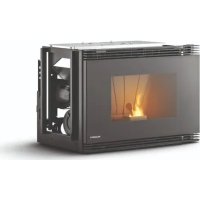
INSERTO A78 - Pan Palazzetti - Free user manual and instructions
Find the device manual for free INSERTO A78 Palazzetti in PDF.



Frequently Asked Questions - INSERTO A78 Palazzetti
Download the instructions for your Pan in PDF format for free! Find your manual INSERTO A78 - Palazzetti and take your electronic device back in hand. On this page are published all the documents necessary for the use of your device. INSERTO A78 by Palazzetti.
USER MANUAL INSERTO A78 Palazzetti
INSTALLATION, USE AND MAINTENANCE MANUAL
Dear Customer, We’d like to thank you for having purchased one of our products and congratulate you on your choice. To make sure you get the most out of your product, please carefully follow the instructions provided in this manual.
8 PRIMA ACCENSIONE 33
NOTE: Phase protection, added by customer. Do not change polarity! 004725238 - 12/07/2021~220÷240 VacPE L Nexaust
OGNI ACCENSIONE OGNI SETTIMANA
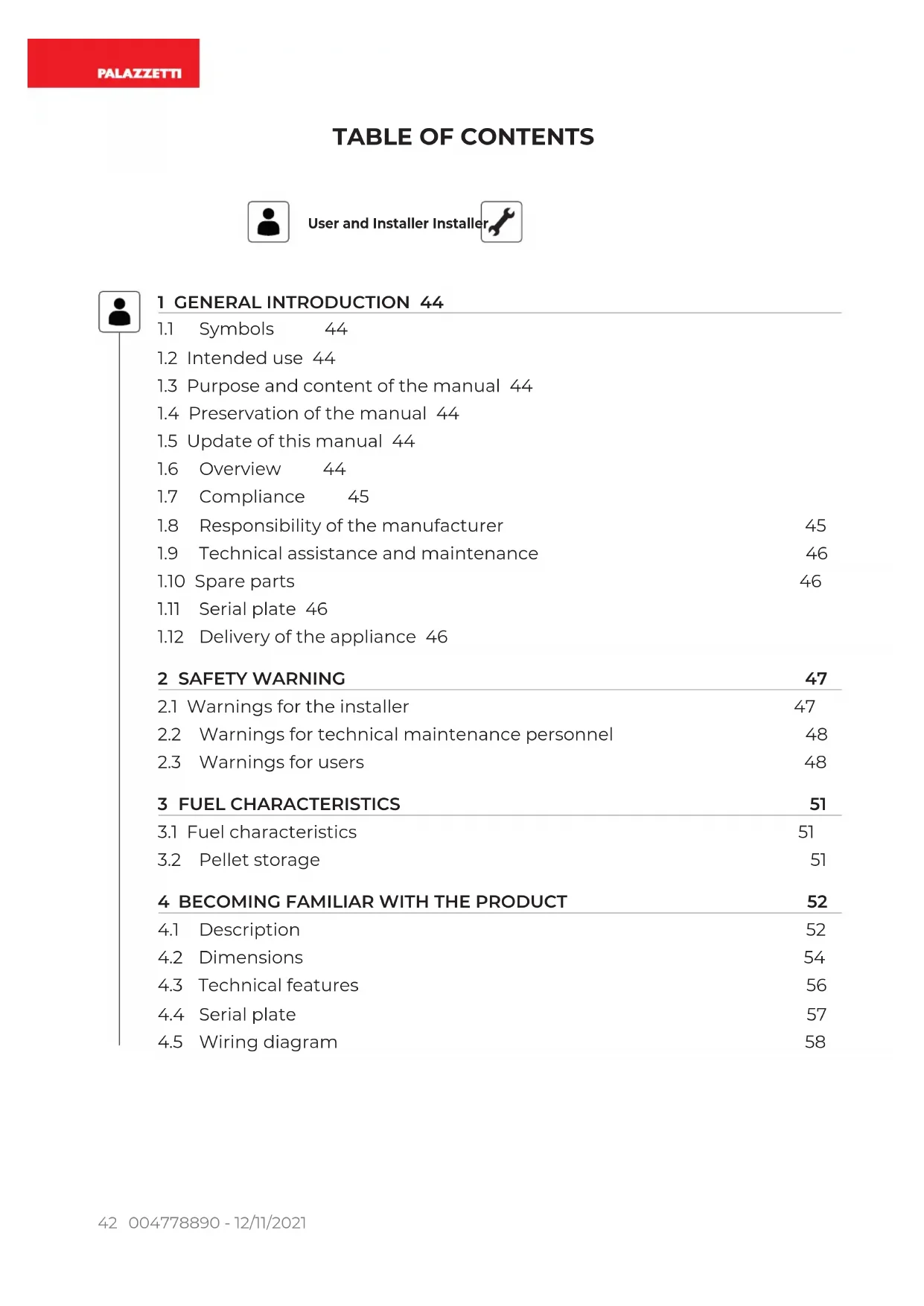
1.3 Purpose and content of the manual 44
1.4 Preservation of the manual 44
1.5 Update of this manual 44
1.8 Responsibility of the manufacturer 45
1.9 Technical assistance and maintenance 46
1.12 Delivery of the appliance 46
2.1 Warnings for the installer 47
2.2 Warnings for technical maintenance personnel 48
4.3 Technical features 56
5.1 Removal of the transport pallet 59
5.2 Transportation 60
6 PREPARATION OF THE INSTALLATION SITE 61
6.1 General considerations 61
6.2 Safety Precautions 61
6.3 Place of installation 61
6.6 Roof exhaust with traditional fireplace 65
7.1 General considerations 67
7.2 Installation configurations 67
7.5 Hot air delivery connection 69
7.6 Creating technical holes on the cladding 71
7.7 Electrical connection 71
9.1 Ordinary maintenance cleaning program 75
9.2 Ordinary cleaning 76
1 GENERAL INTRODUCTION Palazzetti heating appliances are manufactured and tested in accordance with the safety re- quirements set forth in the reference European directives. Even partial printing, translation and reproduc- tion of this manual are bound by the authori- sation from Palazzetti. Technical information, graphical representations and specifications in this manual may not be disclosed to third parties. Do not operate if not all the information provided in the manual has been thoroughly understood; if in doubt always request the advice or interven- tion of Palazzetti specialised personnel. Palazzetti reserves the right to change specifi- cations and technical and/or functional charac- teristics of the product at any time without prior notice.
In this manual the points of major importance are highlighted by the following symbols: INDICATION: Indications concerning the correct use of the appliance and the responsibilities of those in charge. ATTENTION: The point in which a note of particular importance is expressed. HAZARD: Expresses an important note of behaviour for the prevention of inju- ries or damage to property.
The appliance, which is the subject of this manual, is an indoor domestic heating insert, powered exclusively by wood pellets with automatic loading. The appliance must only work with the fire box door closed. The intended use indicated is valid only for ap- pliances in full structural, mechanical and engi- neering efficiency.
1.3 Purpose and content of the
manual The purpose of this manual is to provide the fundamental and basic regulations for correct installation of the appliance. Strict observance of that which is described herein guarantees a higher level of appliance safety and productivity.
1.4 Preservation of the manual
Preservation and consultation The manual must be kept carefully and must always be available for consultation, both by the user and by the assembly and maintenance staff. The installation manual is an integral part of the appliance. Deterioration or loss If needed, request an additional copy from Palazzetti. Sale of the appliance In the event of transferring the appliance the user is obliged to deliver even this manual to the new owner.
1.5 Update of this manual
This manual reflects the latest developments at the time the appliance was placed on the market. The products already on the market with the rel- evant technical documentation, will not be con- sidered by Palazzetti as deficient or inadequate due to possible modifications, adjustments or application of new technologies on newly mar- keted products.
The instructions in this manual apply as general rules; it is still necessary to comply with all the rules laid down by the local, national and Euro- pean legislation in force in the country where the appliance is installed. Information In the event that you need to contact the Man- ufacturer of the appliance, refer to the serial number and the identification data indicated on the identification plate. In case of problems, contact the dealer or a qual- ified technician authorised by the manufacturer; in case of repair, request the use of original spare parts. Periodically check and clean the flue gas duct (connected to the chimney flue).004778890 - 12/11/2021 45
ITALIANO ENGLISH FRANÇAIS
The pellet insert is not a cooking appliance. Store this instruction manual, which is an inte- gral part of the appliance, for its entire service life. If the appliance is sold or transferred to another user, always make sure it is accompanied by the product booklet. In case of loss, contact the manufacturer or au- thorised retailer to receive another copy. Maintenance Maintenance operations must be carried out by qualified personnel authorised to work on the appliance to which this manual refers. Responsibility for the works of installation Responsibility for the works carried out for the in- stallation of the appliance cannot be considered to be taken on by Palazzetti; it is and remains the responsibility of the installer, who is responsible for carrying out the checks relating to the flue, the air intake and how right the proposed instal- lation solutions are.
1.8 Responsibility of the
manufacturer With the delivery of this manual, Pala- zzetti declines all responsibility, both civil and criminal, direct or indirect, due to:
- installation that does not comply with stand- ards in force in the country and with safety directives;
- partial or total non-compliance with the in- structions contained in this manual;
- installation by unqualified and/or untrained personnel;
- use not in compliance with the safety direc- tives;
- modifications and/or repairs carried out on the appliance that are not authorised by the man- ufacturer;;
- lack of maintenance;
- exceptional events.46 004778890 - 12/11/2021
1.9 Technical assistance and
maintenance Palazzetti has a dense network of service centres with specialised, trained and skilled technicians. The headquarters and our sales network is at your disposal to direct you to the nearest authorised service centre.
Use only original spare parts. Do not wait until the components are worn by use before proceeding to their replacement. Replace a worn component before its breaking favours the prevention of accidents arising from accidents caused by the sudden breakage of components which may cause serious damages to persons and objects.
The serial identification plate (A) is positioned on the side (Fig. 1) and shows all the characteristic data relating to the appliance, including details of the Manufacturer, the Serial number and brand .
Fig. 1 The Serial number must always be indicated for any type of request regarding the appliance.
1.12 Delivery of the appliance
The appliance is delivered perfectly packaged and fixed to a wooden platform which allows handling it using fork lift trucks and/or other means. The following material accompanies the appliance:
- manual for use, installation and main- tenance;
- remote control (only for the relevant models);
- cold handle (only for the relevant models).004778890 - 12/11/2021 47
2.1 Warnings for the installer
Observe the prescriptions contained in this manual. The instructions for assembly and disassembly of the appli- ance are reserved for specialist technicians only. The installation, use and maintenance of the product must be in accordance with the manufacturer’s instructions and in compliance with the regulations. Failure to comply with the instructions and any incorrect operations may give rise to hazardous situations, damage to property, animals, health problems or malfunctioning. Installation, electrical connection, oper- ational testing and maintenance must be carried out exclusively by authorised and qualified personnel. The cover must be produced so that it prevents the user from accessing live or hazardous parts. The installation and maintenance of the product must be carried out exclusively by qualified personnel with suitable knowledge of the product itself. Use only original spare parts recommend- ed by the manufacturer. Responsibility for the works carried out in the location of the appliance is, and remains, with the user; the latter is also responsible for carrying out the checks relating to the proposed installation solutions. The installer must comply with all local, national and European safety regulations. The appliance must be installed on floors with adequate load bearing capacity. Check that the chimney flue and air inlet set-ups conform to the type of installation. Do not carry out on-the-fly electrical connections with temporary or uninsu- lated cables. Check that the earthing of the electri- cal system is efficient. Before starting the assembly or dis- assembly phases of the appliance, the installer must observe the safety precautions required by law and the following indications in particular:
- do not operate in adverse conditions;
- they must operate in perfect psy- chophysical conditions and must check that the personal protective equipment is intact and functioning perfectly;
- they must wear gloves and safety shoes;
- they must use tools with electrical insulation;
- they must make sure that the area used during assembly/dismantling is free from obstacles. The product must only be installed in rooms that are not at risk of fire and equipped with all the necessary servic- es including air and electrical supplies and flue gas exhausts. Evaluate the static conditions of the surface bearing the weight of the prod- uct and provide suitable insulation if it is composed of flammable materials (e.g. wood, carpet, plastic). Live electrical parts: power the prod- uct only once it has been completely assembled.48 004778890 - 12/11/2021
2.2 Warnings for technical
maintenance personnel Maintenance operations must be car- ried out only by authorised and quali- fied personnel. Observe the prescriptions contained in this manual. Always use personal protective equip- ment and other means of protection. Before starting any maintenance work ensure that the appliance, if it has been used, has cooled down. Even if only one of the safety devices is not working, the appliance is to be considered not working. Disconnect the appliance from the mains before carrying out any mainte- nance operations. Disconnect the appliance from the electrical mains before working on electrical and electronic parts, connec- tors and moving parts (pellet loading systems, automatic burn pot cleaning systems, etc.).
2.3 Warnings for users
The appliance can only be commis- sioned when the installation has been completed including the cover. To ensure correct use of the product and electronic appliances connected thereto and to prevent accidents, it is important to always follow the instruc- tions provided in this manual. The appliance has particularly hot external surfaces (door, handle, glass, flue gas outlet pipes, etc.). Contact with these parts must therefore be avoided unless wearing suitable protective clothing or equipment, such as heat resistant gloves or in the presence of “cold handle” operating systems. For this reason, maximum caution is recommended during operation and in particular: Do not touch and do not get close to the glass of the firebox door, it may cause burns, do not stare at the flame for a long time. Do not hang laundry directly over the appliance for drying: fire hazard.
- do not touch the flue gas outlet;
- do not perform any type of cleaning;
- do not remove the ashes;
- do not open the firebox door;
- do not open the ash drawer (where provided). The appliance cannot be used by chil- dren under the age of 8 and by people with reduced physical, sensory or mental abilities, or without experience or the necessary knowledge, unless they are under supervision or after they004778890 - 12/11/2021 49
ITALIANO ENGLISH FRANÇAIS
have received instructions relating to the safe use of the appliance and to understanding the inherent dangers. Children must not play with the ap- pliance. Cleaning for which the user is responsible must not be carried out by unsupervised children. Before performing any type of opera- tion, the user or whoever is operating the product must have read and fully understood the contents of this instal- lation and use manual. Errors or bad settings may cause hazardous condi- tions and/or irregular operation. Unskilled users must be protected from access to any part that could expose them to danger. Therefore, they must not be allowed to intervene on internal parts at risk (electrical or mechanical), even if the disconnection of the power supply is required. Respect the instructions and warnings highlighted on the sign plates dis- played on the appliance. The sign plates are accident prevention devices, therefore they must always be perfectly legible. If these are damaged and unreadable, it is mandatory to replace them, requesting the original spare parts from the Manufacturer. Follow the routine and extraordinary maintenance schedule carefully. Do not use the appliance without having first carried out daily cleaning. Do not use the appliance if operation is abnormal, you suspect a breakage or if there are unusual noises. In case of failure or malfunction, turn the appliance off and immediately con- tact your specialised technician. Do not throw water on the appliance in operation or to extinguish the fire in the burn pot. Do not switch the appliance off by disconnecting the mains electrical connection. Do not lean on open doors, this could compromise the stability of the appliance. Do not use the appliance as an anchor support of any kind. It is prohibited to use the product as a ladder or support structure. Do not clean the appliance until the structure and ashes have completely cooled. Only touch the door when the appli- ance is cold. In case of flue gas leaks in the room or explosions detrimental to the device, turn it off, ventilate the room and im- mediately contact your installer/service technician. In case of fire in the chimney flue, turn the appliance off, disconnect it from the power supply and do not open the door. Then call the competent authorities. In case of failure of the ignition system, do not ignite the appliance with flam- mable materials. In electrically powered devices, if un- burned gas/fumes accumulate inside the fire box, do not disconnect the electrical power supply and move as far away from the appliance as possible. In case of malfunction of the appliance due to a poor flue draught, clean the flue in accordance with the procedure described in section “9.3.5 Maintenance of the flue” on page 79. Do not touch the painted parts during operation to avoid damage to the paintwork. All responsibility for improper use of the product is fully borne by the user, who relieves the manufacturer of any civil and criminal liability.50 004778890 - 12/11/2021 It is prohibited to operate the appliance with the door open. It is prohibited to use the appliance if the door glass or gaskets are damaged. Any type of unauthorised handling or replacement with non-original spare parts shall place the safety of the opera- tor at risk and relieve the manufacturer of any civil and criminal liability. It is prohibited to manually load pellets into the burn pot; this type of incorrect behaviour may generate an abnormal amount of unburned gas, giving rise to the risk of explosion inside the chamber. Unburned pellet deposits in the burn pot after a failed ignition must be re- moved before making a new ignition attempt. If the burn pot is not cleaned and regu- larly serviced, malfunctions and explo- sions may occur inside the appliance. Be sure to remove all traces of material and deposits from the holes of the burn pot and to clean them each time the ash is emptied or after each failed ignition attempt. Make sure the burn pot holes don’t decrease in size as this may have a negative effect on the safe operation of the appliance. Do not wash the product with water. Water may infiltrate the unit and damage the electrical insulation, caus- ing electric shocks. Do not sit/stand in front of the product in operation for long periods. Incorrect use of the product or incor- rect maintenance works may create a serious risk of explosion in the combus- tion chamber. Only use the fuel recommended by the manufacturer. The product must never be used as an incinerator. It is prohibited to use benzene, lamp fuel, kerosene, liquid firelighter for wood, ethyl alcohol or similar liquids to light or rekindle a flame in this ap- pliance. Keep these liquids at a due distance from the appliance during operation. It is prohibited to insert other types of fuels in the tank other than wood pellets. Some tips to avoid corrosion phenomena:
- carry out routine cleaning operations to avoid the build-up of ash deposits;
- feed the appliance only with fuel having the characteristics described in the section "Fuel characteristics";
- Do not use solvents, acids, aggressive detergents or products to directly clean the glass or other components of the product;
- avoid leaving the product in unfavour- able ambient conditions (humidity, airborne salinity, storms, etc.);
- if the appliance is not used for long periods (e.g. during the summer), disconnect the combustion air inlet pipe and place dessicant bags in the combustion chamber to absorb the humidity in the air, making sure to remove them when the product is re-ignited.004778890 - 12/11/2021 51
3.1 Fuel characteristics
The pellet (Fig. 2) is a compound made from various types of wood pressed together with mechanical procedures in compliance with envi- ronment protection regulations, and it is the only fuel required for this type of appliance. Fig. 2 The efficiency and thermal potential of the appli- ance may vary according to the type and quality of the pellets used. We recommend the use of class A1 pellets (ISO 17225-2 standard, ENplus A1, DIN Plus or NC 444 category "High Performance NF Pellets Biofuel Quality"). Use pellets with standard length be- tween 3 and 40 mm. Using poor quality pellets or pellets that do not comply with the manufac- turer’s indications may compromise the normal operation of the appliance, cause damage (including aesthetic damage) to the product and result in the warranty being voided. It is prohibited to use the appliance as an incinerator to burn rubbish. The appliance has a pellet hopper with the capac- ity indicated in section “4.3 Technical features” on page 56. The loading compartment is positioned at the top, it must always be open for loading of the pel- lets and must remain closed while the appliance is operating.
Pellets must be kept in a dry place, not too cold and the bags must be kept sealed. It is advisable to keep a number of bags of pellets in the room where the appliance is being used or in an adjacent room provided it is at the correct temperature and humidity and at a safe distance (at least one meter) away from heat sources. Wet and/or cold pellets (5 °C) reduce the ther- mal potential of the fuel resulting in the need for more cleaning maintenance of the burn pot (unburned material) and of the fire box. Pay particular attention to the stor- age and handling of pellet bags. Their crushing and the formation of sawdust must be avoided. If sawdust is placed in the appliance tank it could cause the pellet loading system to block.52 004778890 - 12/11/2021
INSERT AC78 (DUCTED)
4.3 Technical features
Feeding tank capacity kg 110 Weight kg 23 Electrical data A78/AC78 Voltage V 230 Frequency Hz 50 Max power absorbed during operation W 91 Power absorbed at electric ignition W 350004778890 - 12/11/2021 57
Fig. 7 F Fuel PImax Max. thermal power input PImin Min. thermal power input Pmax Rated thermal power Pmin Reduced thermal power EFFmax Efficiency at rated power EFFmin Efficiency at reduced power COmax CO emissions at rated power (13%O
COmin CO emissions at reduced power (13%O
Dust Dust at rated power (13%O
Tf Flue gas temperature X1/X2/Y Minimum distance from flammable materials V Voltage f Frequency Wmin Max power absorbed during operation Wmax Max power absorbed during ignition58 004778890 - 12/11/2021
NOTE: Phase protection, added by customer. Do not change polarity! 004725238 - 12/07/2021~220÷240 VacPE L Nexaust REDBLUEBLACK BLUEBROWN UI /
- Pull the machine outwards until reaching the guides end of the run. Fig. 10
- Unscrew the six guide fixing bolts located on the bottom of the machine.
- Disconnect the display cable connector, with its relative mass, from the board and the power cable.
- Cut the cable ties that group the cables and prevent the machine from being pulled out. 5 HANDLING AND TRANSPORTATION The appliance is delivered complete with all the parts required. Pay attention to the tendency for the appliance to become unbalanced. The centre of gravity of the appliance is carried towards the front. Bear in mind the above also when moving the appliance on the transport stand. It is advisable to unpack the appliance only when it has arrived at the installation site. The product must be handled and un- packed using suitable means. Make sure that children do not play with the pack- aging components (e.g. films and polystyrene): Danger of suffocation! During moving, lifting, and unpacking of the appliance the following is absolutely necessary:
- always keep it upright;
- never tip it over into a horizontal position;
- never tilt it on the front to avoid breaking the glass of the fire box door.
5.1 Removal of the transport pallet
Disposal can be entrusted to a third party, provid- ed only companies authorised for the recovery and elimination of the materials in question are used. Always follow the regulations in force in the country in which the appliance is being used for disposal of materials and possibly for the disposal report.
5.1.1 Insertion A78 (front)
To remove the appliance from the transport pallet:
- Release the door by using the cold handle pro- vided.
- Open the door with the handle.
- Turn the pin anticlockwise using the key pro- vided and release the catch.60 004778890 - 12/11/2021 Fig. 11
- Lift the machine and remove it from the guides. Fig. 12
- Remove the pallet fixing screws from the base and remove the pallet. Fig. 13
5.1.2 Insertion AC78 (ducted)
To remove the appliance from the transport pallet:
- Remove the pallet fixing screws from the base and remove the pallet. Fig. 14
Make sure that the lifting carriage has a payload higher than the weight of the appliance to be lifted. The full responsi- bility of the lifting of loads lies with the person handling the lifting equipment. Ensure wood or timber floors are prop- erly protected in order to prevent the weight of the appliance from damag- ing them during movement. During lifting, avoid jerking or abrupt movements.004778890 - 12/11/2021 61
6.1 General considerations
The following paragraphs contain some guide- lines to be followed to obtain the maximum efficiency of the product purchased and to ensure safe operation. The following indications are however subject to compliance with any possible national, regional and municipal laws and regulations in force in the country where the appliance is installed. In Italy, installation must be performed by quali- fied personnel in compliance with the EN 10683 standard.
6.2 Safety Precautions
The operations for assembly and disassembly of the appliance are reserved for specialist techni- cians only. It is recommended to be sure of their qualifica- tions and their actual capacity. For Italy, these technicians must be in possession of the letter "C" qualifica- tion issued by the chamber of com- merce based on the Ministerial Decree. 37/08.
6.3 Place of installation
For the minimum distances that must be re- spected when positioning the appliance with respect to flammable materials and objects, refer to the instructions in Fig. 15.
Fig. 15 Model X1 X2 Y1 Y2 Z A78/AC78 800 200 200 200 750 mm Floors made of flammable material such as wood, parquet, linoleum, laminate or floors covered with carpets must be protected by a fireproof base under the appliance that also protects the front during cleaning from any falling burning residues. The manufacturer declines all responsibility for any variations in the characteristics of the mate- rial constituting the floor under the protection. Set up an accessible technical space for any maintenance work. Remember to respect the minimum distance from flammable materials (X), shown on the identification plate of the pipes used to make the chimney (Fig. 16). Pi = Flammable wall Pp = Floor protection
Fig. 16 Set up the electricity supply line to arrive near the appliance for the connection of the power cable.62 004778890 - 12/11/2021
The appliance must have the right flow of com- bustion air to guarantee proper combustion. There must be an outside air intake (Fig. 17 - PA) to guarantee the flow of combustion air to the appliance and/or recirculation of the ambient air.
Fig. 17 The external air intake must be correctly sized and protected by an insect-proof grate; it must also be positioned in such a way as not to be ac- cidentally obstructed. A non-closable permanent protection grille must be placed externally; in areas that are particularly windy and exposed to weathering, install a rain and wind protection. Make sure the air intake is positioned so that it is not accidentally obstructed. If the rear wall of the appliance is an external wall, make a hole to extract the combustion air 20-30 cm from the ground, observing the size indica- tions indicated in “External air intake” of section “4.3 Technical features” on page 56. If it is not possible to make an external air intake in the room, it is possible to make the external hole in an adjacent room as long as it perma- nently connects via passage grille (Fig. 18 - C = Container, G = Grille, S = Damper).
The image is purely indicative. Fig. 18 If there are other heating or extraction appliances installation area, fuel mal- functions may occur due to the lack of combustion air. The combustion air intakes must therefore be sized correctly, in order to ensure the necessary supply of air for the correct operation of all devices. It is prohibited to withdraw combustion air from a garage, warehouse containing combustible materials or rooms at risk of fire. If there is an insert A78 (front), the combustion air must be taken from outside the cladding to avoid fuel mal- functions due to the lack of air caused by the room fan.004778890 - 12/11/2021 63
ITALIANO ENGLISH FRANÇAIS
The following configurations are possible de- pending on the local regulations in force:
- Fig. 19: external air intake (C) ducted as far as the firebox (D). Lower grille (A) supplied for the recirculation of ambient air on the cladding.
The image is purely indicative. Fig. 19
- Fig. 20: air intake (F) on the cladding, ducted as far as the firebox (D). Lower grille (A) provided in the cladding and external air intake (B) for the recirculation of ambient air.
The image is purely indicative. Fig. 20 For AC78 only (ducted)
- Fig. 21: lower grille (A) provided in the cladding and external air intake (B) for the recirculation of ambient air to be created inside or outside the cladding.
The image is purely indicative. Fig. 21
- Fig. 22: make sure that the corrugated pipe provided is connected to the air intake pipe, se- curing it with the clamp and bending it slightly downwards to prevent any vibrations.
The image is purely indicative. Fig. 2264 004778890 - 12/11/2021
6.4.2 Combustion air inlet pipe
Insertion A78 (front) Max 4 m Ø 60 mm Fig. 23 Insertion AC78 (ducted) Max 4 m Ø 60 mm Fig. 24 It is possible to use a rear combustion air pipe to the machine with a pipe diameter of 80 mm, max length 4 m. equivalent for external direct connection.
The appliance works with the combustion cham- ber at negative pressure. It is therefore essential to make sure that the flue gas evacuation is airtight (this is the responsibility of the installer). The appliance must be connected to its own flue gas duct, not shared, and which is suitable for ensuring adequate dispersion of the combustion products into the atmosphere, in accordance with the regulations in force in the country of installation. The components making up the flue gas ducting system must be declared suitable for the specific operating con- ditions and provided with CE marking. It is mandatory to create a first vertical section measuring at least 1.5 meters to guarantee correct expulsion of the flue gases. It is advisable to make a maximum of 3 direction changes, in addition to that resulting from the rear connection of the appliance to the chimney, using 45 - 90 ° bends or Tee fittings (Fig. 25). Always use a T-pipe fitting with an inspection cap (1) at each horizontal and vertical change of the flue gas route (Fig. 25). The horizontal sections must have a maximum length of 2-3 m with an upward slope of 3-5% (Fig. 25). Anchor the pipes with suitable collars to the wall. The flue gas fitting MUST NOT BE connected:
- to a chimney used by other generators (boilers, stoves, fireplaces, etc. ...);
- to air extraction systems (hoods, vents etc. ...) even if "ducted". It is forbidden to install shut-off and draught valves.004778890 - 12/11/2021 65
6.6 Roof exhaust with traditional
fireplace The flue for flue gas discharge must be carried out by qualified personnel in compliance with the UNI 10683 - EN 1856-1-2 - EN 1857 - EN 1443 - EN 13384-1-3 - EN 12391-1 standards both regard- ing the dimensions and the materials used in its construction. The evacuation of flue gases via a traditional chimney (Fig. 26) can be done as long as you are sure of the state of maintenance of the chimney. In the case of an old chimney, it is advisable to renew it using ducting. The flue gas exhaust must be on the roof.
If the chimney has a larger section, it must be “intubated” with a suitably in- sulated steel pipe (with diameter suita- ble for the route) (Fig. 27). Make sure that the connection to the brickwork chimney is properly sealed. In case of pipes that pass through wooden roofs or walls, it is recommend- ed to use special certified ducting kits commonly available on the market.66 004778890 - 12/11/2021
7.1 General considerations
In the following paragraphs some indications are provided to be respected in order to obtain the maximum performance from the purchased product. The following indications are how- ever subject to compliance with any possible national, regional and mu- nicipal laws and regulations in force in the country where the appliance is installed.
7.2 Installation configurations
It is possible to install the appliance:
- with front air distribution
- channelled onto the top of a fireplace with or without optional frame.
7.2.1 Generator installation on top of a
fireplace (A78 only) In the event of installation in structures with marble cladding or other materials, the insert has sliding guides to assist with extracting the equipment for attaching to the fixing surface and for carrying out inspections and checks on the mechanical and electrical components.
- Once the pallet has been removed (refer to par- agraph: “HANDLING AND TRANSPORTATION”) proceed as follows:
- Rest the base on the floor of the chimney (1), trace and make 6 holes (Ø 6) for fixing (2) - use the base itself as a template - then drill the holes with a 6-mm bit.
- Insert the 6-mm anchor plugs is in the holes and secure the base with the screws (3). Ø 6mm x 6 Ø 6mm x 6
- Re-assemble the fixing bolts removed previ- ously. Fig. 30
- Re-connect the display cable connector, with its relative mass, to the board and the power cable.
- Push the machine to the end position of the guides, paying attention to any interference caused by the cables. Then group these cables together through the application of a tie. Fig. 31
- Open the door, insert the Allen key (1) in the stop release seat; turn the locking lever clock- wise to position (2) to lock the guides. Fig. 32
7.2.2 Installation of generator with stand
(A78/AC78) In the event of installation in structures with marble cladding or other materials, the insert has sliding guides to assist with extracting the equipment for attaching to the fixing surface and for carrying out inspections and checks on the mechanical and electrical components. The stand is supplied in model AC78 while it is optional in model A78.
- Once the pallet has been removed (refer to par- agraph: “HANDLING AND TRANSPORTATION”) proceed as follows:
- Adjust the height of the stove by turning the bolts (A) on the stand uprights.
- Level the frame by screwing or unscrewing the gooseneck feet (B).
- The lower edge of the stove must be at least 1 cm above the marble top of the cladding.
- Drill 4 Ø 8 holes for securing of the frame to the ground. Use the frame itself as a template.
- Secure the feet (B) of the base with sturdy Ø 8 mm steel expansion plugs (C).68 004778890 - 12/11/2021 > = 1 cm
1) For correct installation, all the joints of the
flue gas ducting between the fireplace and the flue must be sealed.
2) Lining in eco-friendly ceramic fibre or rock
wool with external aluminium foil.
3) Rear external air intake, ensure a minimum
distance of 5 cm between cladding and com- bustion air intake pipe.
4) Provide an opening of a suitable size for clean-
ing and servicing the room fan (for model AC78 only).
5) The lining must be made of fireproof material.
6) Min distance. 1 cm between cladding and
7) Protect any wooden parts with fireproof
8) Counter-hood and fireproof load-bearing
supplied with the kit for installation.
10) UNI standards require the installation of a
heat recovery grille as close as possible to the ceiling.
The sensor must be installed near the side or front suction holes of the cladding base. Glue the probe wire in correspondence with the air intakes Fig. 35004778890 - 12/11/2021 69
During the dry installation run, the air intake position should be marked both on the external wall and the cladding. For model AC78 only Standard solution (40÷60 m
- The room fan must take in the air from outside the cladding, through an appropriate duct, as shown in Fig. 36. Where:
1) Room air intake to the heating circuit fan, lo-
cated on the side of the cladding with protec- tion grille or grooves.
2) Fresh air intake to the heating circuit fan with
7.5 Hot air delivery connection
7.5.1 Hood liner fitting for heating in a single
- Take the flexible pipe at the ends and stretch it, accompanying it with a twisting motion. Fig. 37
- Cut it to the desired length (no more than 200 cm) and mount the vents in the desired points.
- Fasten the tube (1) to the collars (2) with the clamps (3).
- Insulate the pipes with insulating material.
Fig. 38 The vents are fixed on the hood or on a wall at a height of at least 1.8 ÷ 2.0 m from the floor in order to prevent that the outgoing hot air invests people. The ducts should not be longer than 7÷8 m.
7.5.2 Channelled pipelines fitting for heating
in multiple rooms To heat several rooms, it is possible to create metal pipelines for air distribution according to the following diagram:
- flexible aluminium hose - maximum length 7÷8 m per duct;
- smooth metal pipe or canalisation - length up to 12 m on a single pipe; of 8÷9 m on double duct. Install a vent in the same room as the fireplace and the second in another room of the house. It is possible to connect the hot air delivery with a flexible pipe up to the mouth of the distribution channels. The air distribution ducts must have an internal section of 20x20 cm and be made of smooth gal- vanised sheet metal and insulated with 30 mm thick insulating material to avoid noise and heat70 004778890 - 12/11/2021 dispersion. When the fireplace is used to heat two or more adjacent rooms, it is essential to promote the recirculation of ambient air to even out the temperature in the different rooms, therefore provide the doors with grilles or keep them ajar. Double duct Fig. 39 Single duct Fig. 40
7.6 Creating technical holes on the
cladding The cladding must only be done by qualified personnel. Technical holes must be made on the cladding and on the hood for:
3) the heat exhaust ventilation in the hood;
4) the ventilation of the cladding on the base;
5) pellet loading opening.
The holes must comply with the measurements indicated in the figure:
7.7 Electrical connection
Simply connect the appliance to the electrical system using the supplied plug (Fig. 42). The electrical connection (plug) must be easily accessible after appliance installation as well. If the power supply cable is damaged it must be replaced by the technical assistance service or a qualified techni- cian in order to prevent any risk.004778890 - 12/11/2021 71
ITALIANO ENGLISH FRANÇAIS
Fig. 42 The system must be equipped with an earth connection and a differential switch in compliance with the laws in force. The flue gas evacuation duct must be equipped with its own earth connection.
7.7.1 Installation of the control panel
The control panel of the appliance can be applied to the wall. Fig. 43 Do not install the recessed box on hot areas of the hood. Arrange the passage of the cable be- tween the panel and the electronic board, so that it is not damaged by the high temperature during normal oper- ation of the appliance. Connect the cable between the terminals of the electronic board and the control panel before closing the boxes.
7.7.2 Connection to the room thermostat
The appliance can be connected to an external thermostat or chronothermostat that switches it on and off. For the connection, refer to the wiring diagram in the technical specifications.72 004778890 - 12/11/2021 8 FIRST IGNITION The first ignition must be carried out by the installer.
The pellets must be loaded from a door which must be provided in the hood of the cladding and connected to the appliance through the appropriate accessories (optional), carefully fol- lowing the assembly instructions. Do not use the extraction system of the appliance as a means to load the pellet hopper. The use of non-original accessories is not recommended. Pellets falling outside the hopper may damage the operation of the appliance and cause fires. The pipe for pellet loading (optional) must act exclusively as a ramp to fill the hopper of the appliance and not as an extension of the hopper itself; avoid loading more pellets than the hopper can hold.
During the first ignition of the appli- ance, make sure the rooms are prop- erly ventilated as unpleasant odours or fumes may be generated due to the evaporation or drying of certain mate- rials used. This phenomenon will grad- ually disappear. Connect the appliance to the mains, operate the power switch on the back of the appliance by turning it to "I". Fig. 47 If the connection is correct, the appliance emits a series of intermittent noises and the display lights up. See the display manual.74 004778890 - 12/11/2021 9 MAINTENANCE Maintenance operations must be performed by an authorised technical assistance centre. Before performing any maintenance operation, take the following precautions:
- Ensure that all appliance parts are cold.
- Make sure that the ashes are completely extinguished.
- Use personal protective equipment provided for by Directive 89/391/EEC.
- Make sure that the general line switch is turned off.
- Make sure that the power supply cannot be accidentally reactivated. Remove the plug from the wall socket.
- Always use appropriate equipment for maintenance.
- Once maintenance or repair operations have been completed, before putting the appliance back into service, reinstall all the safety guards and reactivate all the safety devices.
9.1 Ordinary maintenance cleaning program
9.1.1 Ordinary cleaning (User)
1 YEAR (*) Door and burn pot seals X Flue gas T-pipe X Smoke collector
Auger X Smoke system X Door block springs X (*) At least once a year or every 4000 kg of pellets burned.004778890 - 12/11/2021 75
ITALIANO ENGLISH FRANÇAIS
9.2 Ordinary cleaning
9.2.1 Cleaning the inside of the firebox
Daily or before each ignition, it is necessary to check that the burn pot is clean to ensure the free flow of combustion air from the holes of the burn pot itself. Vacuum the ash accumulated in the burn pot (Fig. 48). ATTENTION: remove the ash from the combustion chamber because the salts present cause corrosion of the metal. In addition, the ash could block the pas- sage of air, varying the development of the flame which, if it approaches the glass, would increase corrosion. After cleaning the burn pot, remove it from its seat and clean the compartment that contains it including the resistor (Fig. 48). Fig. 48 Clean the entire area indicated in Fig. 49. Using an ash vacuum can simplify the cleaning operations Fig. 49
9.2.2 Cleaning the glass
It is carried out with a damp cloth or with damp- ened paper that is wiped over the ash. Rub until the glass is clean. Do not clean the glass while the appliance is operating and do not use abrasive sponges. ATTENTION: do not use solvents, acids, soaps, liquid detergents or aggressive products. Fig. 50
9.2.3 Cleaning the smoke collector
It is necessary to clean the part to ensure the correct smoke flow to the outside.
- Remove the burn pot.
- Grasp the bottom wall by the handles and pull it out by pushing it upwards and then turning the bottom part outwards (Fig. 51). Fig. 5176 004778890 - 12/11/2021
- Remove the ash in the area indicated in (Fig. 52). Fig. 52
9.3 Ordinary maintenance
- Check the condition and tightness of all the seals.
- Check the condition of all internal components and make sure they are clean.
- Make sure the flue gas outlet con- nection is sealed and clean.
This should be carried out once a year or whenev- er necessary, following the steps indicated below:
- Release the door by using the cold handle pro- vided.
- Open the door with the handle. Fig. 53
- Remove the burn pot.
- Grip the bottom wall by the handles.
- Remove the bottom wall by pushing it upwards and then, turning the lower part outwards. Fig. 54004778890 - 12/11/2021 77
ITALIANO ENGLISH FRANÇAIS
- Remove the screws (A) and extract the side panels.
- Vacuum the residual ash. Fig. 56
9.3.2 Flue gas T-pipe maintenance
The flue gas T-pipe must be cleaned by removing the appliance from its seat and vacuuming the residues contained inside the T-pipe with an ash vacuum cleaner.
- Turn the pin anticlockwise using the key pro- vided and release the catch Fig. 57
- Pull the appliance out until it reaches the end of the guides.
- Use an ash vacuum cleaner to remove debris inside the T-pipe. Fig. 58
- Check that the door locking mechanism is working correctly and lubricate it.78 004778890 - 12/11/2021 Fig. 59
Once the operation at “9.2.3 Cleaning the smoke collector
” on page 75, regularly carried out by the user, is correctly done it’s necessary to clean the smoke collector.
- Remove the cap and its gasket.
- Clean the entire area indicated in (Fig. 60).
In case the feed pipe that takes the pellets from the hopper to the combustion chamber gets clogged, proceed as follows:
- Remove the inspection plate catch (A).
- Remove the inspection plate (B).
- Proceed in reverse order to paragraph “9.3.2 Flue gas T-pipe maintenance” on page 77 to reset the appliance.004778890 - 12/11/2021 79
This should be carried out once a year or when- ever necessary. Fig. 63 If there are horizontal sections, it is necessary to check and remove any deposits of ash and soot before they obstruct the passage of fumes. In the event of failure to clean or inadequate cleaning the appliance may have operating problems including:
- Blockage of the burn pot with accumulation of ash and pellets.
- Deposit of ash and excessive deposits on the exchanger with consequent poor performance. Once the maintenance operations are completed:
- Re-fit all the components in reverse order.
- Reset any warnings or alarms (the manual re- set thermostats are on the rear of the appliance near the power cable).
- Check the correct operation of the appliance.80 004778890 - 12/11/2021 10 DEMOLITION AND DISPOSAL The demolition and disposal of the appliance are the sole liability and responsibility of the owner who must act in compliance with the laws in force in their country regarding safety, respect and protection of the environment. Disposal can be entrusted to a third party, provid- ed only companies authorised for the recovery and elimination of the materials in question are used. Always follow the regulations in force in the Country where the appliance is in operation for the disposal of ma- terials and possibly for the disposal notification. All disassembly operations for demo- lition must take place with the appli- ance stopped and without the power supply.
- Remove all the electrical equipment.
- Separate the accumulators on the electronics boards.
- Scrap the structure of the appliance using au- thorised companies. Leaving the appliance in accessible areas is a serious danger to people and animals. The differentiated disposal of the product makes it possible to avoid potentially negative conse- quences on the environment and health, and also allows recycling of the materials making up the product in order to achieve significant energy and resource savings. Any liability for damage to people and animals always falls on the owner. Upon demolition, the EC marking, this manual and other documents relating to this appliance must be destroyed. The crossed-out wheelie bin symbol that appears on the label of the appliance indicates that, at the end of its useful life, the product must be disposed of separately from other waste. Pursuant to art.13 of Italian Legislative Decree no. 151 of 25 July 2005 implementing the Direc- tive 2002/96/EC of 23 February 2003 on Waste Electrical and Electronic Equipment relating to the measures and procedures designed to prevent the production of waste electrical and electronic equipment, called WEEE, promoting the reuse, recycling and other forms of recovery so as to reduce the quantity to be disposed of and improving the intervention of the parties involved in the life cycle of such products.004778890 - 12/11/2021 81
NOTE: Phase protection, added by customer. Do not change polarity! 004725238 - 12/07/2021~220÷240 VacPE L Nexaust