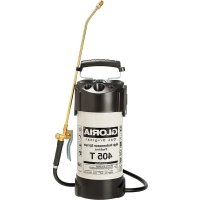
Profiline 405T - Pressure washer GLORIA - Free user manual and instructions
Find the device manual for free Profiline 405T GLORIA in PDF.



| Product Type | High-pressure cleaner (backpack sprayer) |
| Tank Capacity | 5 L |
| Total System Content | 8 L |
| Maximum Operating Pressure | 6 bars |
| Operating Temperature | 0 °C to +50 °C |
| Empty Weight | 4.4 kg |
| Tank Material | Steel with interior coating |
| Pump Material | Brass |
| Nozzle Type | Flat jet 80° |
| Maximum Discharge Flow Rate | 1 L/min |
| Recoil Force | < 5 N |
| Safety Valve | Yes, with pressure gauge indicating up to 6.6 bars |
| Built-in Pressure Reducer | Yes |
| Lance Holder | Yes |
| Oil Resistance | Yes |
| Integrated Filter (mesh) | 0.9 mm |
| Power Supply | Manual (pump) or compressor (optional depending on model) |
| Recommended Maintenance | Clean and drain after each use, lubricate seals, frost protection |
| Expected Service Life | Maximum 10 years (depending on usage conditions) |
| Warranty | See manufacturer's conditions |
Frequently Asked Questions - Profiline 405T GLORIA
User questions about Profiline 405T GLORIA
0 question about this device. Answer the ones you know or ask your own.
Ask a new question about this device
Download the instructions for your Pressure washer in PDF format for free! Find your manual Profiline 405T - GLORIA and take your electronic device back in hand. On this page are published all the documents necessary for the use of your device. Profiline 405T by GLORIA.
USER MANUAL Profiline 405T GLORIA
| High Pressure Spray Units | 405 T | 405 TKS | 410 T | 410 TI | 410 TRK | 410 TKS | 505 T | 510 T | 510 TRK |
| Max. capacity in litres | 5 | 5 | 10 | 10 | 10 | 10 | 5 | 10 | 10 |
| Total tank capacity in litres | 8 | 8 | 13.7 | 13.7 | 13.7 | 13.7 | 8 | 13.7 | 13.7 |
| Max. operating pressure 6 bar | x | x | x | x | x | x | x | x | x |
| Max. operating temperature | |||||||||
| 0°C to +50°C | x | x | x | x | x | x | x | x | x |
| Full pressure change 0 bar to 6 bar | max. 5000 load cycles | ||||||||
| Empty weight (kg) | 4.4 | 4.5 | 5.6 | 5.6 | 7.0 | 5.7 | 4.35 | 5.5 | 7.0 |
| Transport cart | - | - | - | - | x | - | - | - | x |
| Compressor connection | - | x | - | - | x | x | - | - | x |
| Spray tube holder | x | x | x | x | x | x | x | x | x |
| Pressure relief valve | x | x | x | x | x | x | x | x | x |
| Backrest | - | - | x | x | x | x | - | x | x |
| Safety features | Safety valve with pressure relief valve, manometer | ||||||||
| Nozzle: standard | |||||||||
| Fan jet / 80° | x | x | x | x | x | x | x | x | x |
| Max. spray capacity | 1l/min. | 1l/min. | 1l/min. | 1l/min. | 2.23l/min. | 2.23l/min. | 1l/min. | 1l/min. | |
| Recoil at the nozzle | less than 5N | ||||||||
| Unit is oil-tight | x | x | x | - | x | x | x | x | x |
| Tank material: | |||||||||
| - steel, coated internally | x | x | x | x | x | x | - | - | - |
| - stainless steel | - | - | - | - | - | - | x | x | x |
| Pump material | brass | brass | brass | brass | brass | brass | brass | brass | brass |
| Mesh size of filter in quick-connecting valve | 0.9 mm | 0.9 mm | 0.9 mm | 0.9 mm | 0.9 mm | 0.9 mm | 0.9 mm | 0.9 mm | 0.9 mm |
| Residue when emptied horizontally | none | none | none | none | none | none | none | none | none |
Special accessories to be asked for at special trade.
Table of Contents
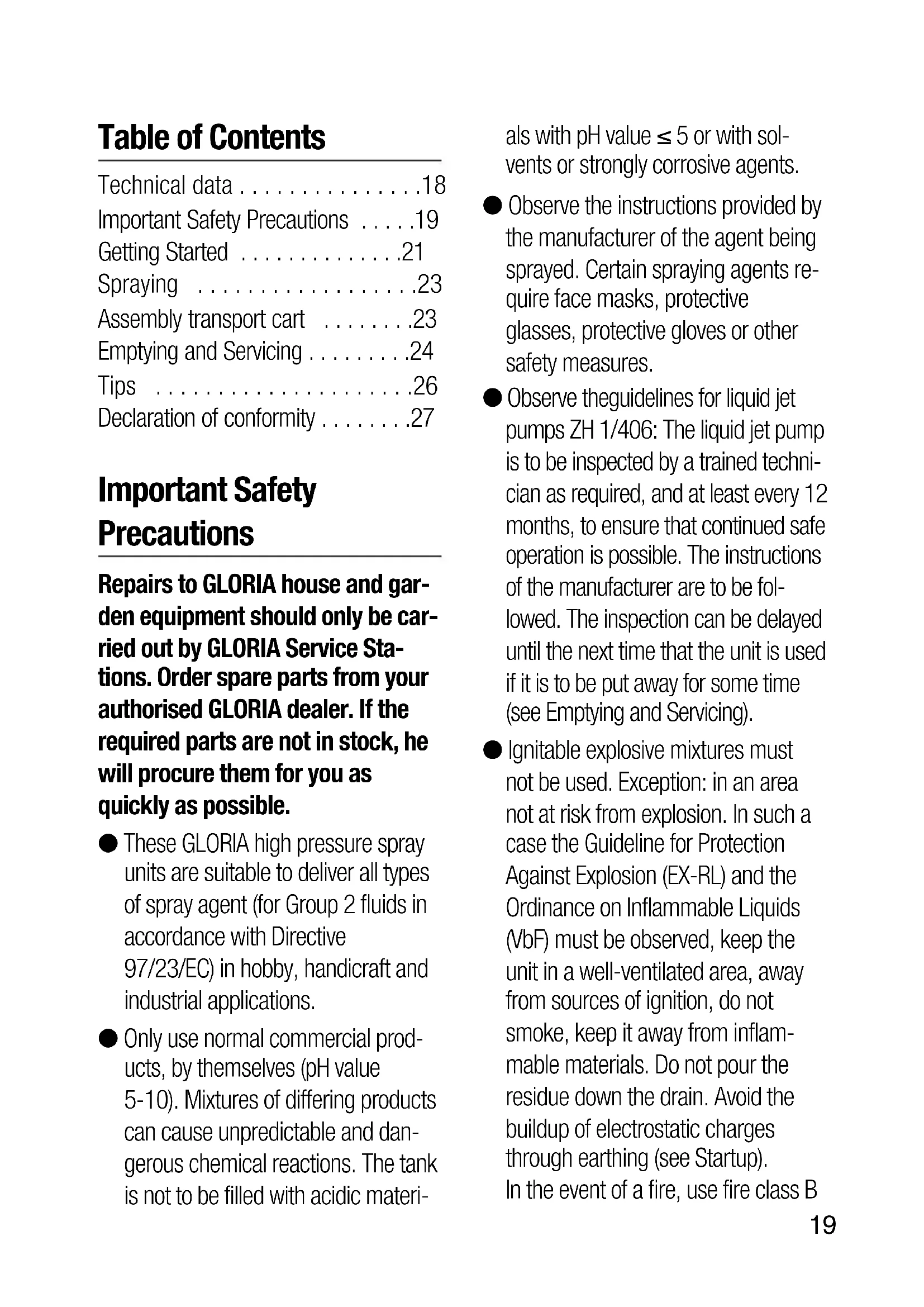
Technical data 18
Important Safety Precautions 19
Getting Started 21
Spraying 23
Assembly transport cart 23
Emptying and Servicing. 24
Tips 26
Declaration of conformity .27
Important Safety Precautions
Repairs to GLORIA house and garden equipment should only be carried out by GLORIA Service Stations. Order spare parts from your authorised GLORIA dealer. If the required parts are not in stock, he will procure them for you as quickly as possible.
These GLORIA high pressure spray units are suitable to deliver all types of spray agent (for Group 2 fluids in accordance with Directive 97/23/EC) in hobby, handicraft and industrial applications.
- Only use normal commercial products, by themselves (pH value 5-10). Mixtures of differing products can cause unpredictable and dangerous chemical reactions. The tank is not to be filled with acidic materi
als with pH value ≤ 5 or with solvents or strongly corrosive agents.
- Observe the instructions provided by the manufacturer of the agent being sprayed. Certain spraying agents require face masks, protective glasses, protective gloves or other safety measures.
- Observe the guidelines for liquid jet pumps ZH 1/406: The liquid jet pump is to be inspected by a trained technician as required, and at least every 12 months, to ensure that continued safe operation is possible. The instructions of the manufacturer are to be followed. The inspection can be delayed until the next time that the unit is used if it is to be put away for some time (see Emptying and Servicing).
- Ignitable explosive mixtures must not be used. Exception: in an area not at risk from explosion. In such a case the Guideline for Protection Against Explosion (EX-RL) and the Ordinance on Inflammable Liquids (VbF) must be observed, keep the unit in a well-ventilated area, away from sources of ignition, do not smoke, keep it away from inflammable materials. Do not pour the residue down the drain. Avoid the buildup of electrostatic charges through earthing (see Startup). In the event of a fire, use fire class B
extinguishing agents (powder, foam, CO_2 or lightwater), but not water.
- Check the functioning of the unit each time before startup, and make a special check of the hose connection and the screw connectors. Check the material for tears, brittleness and corrosion.
- The safety valve must be checked each time before startup! Insert the pump and screw it up tight. Operate the pump until the pressure gauge shows no further increase (the safety valve blows off the excess pressure). The maximum pressure shown on the pressure gauge must never exceed 6.6 bar.
- Spraying agents that are environmentally harmful should be use up as far as possible on the object of the spraying, any unavoidable residues should be put in a suitable holding container and sent for special disposal. Observe the German Water Protection Law (WHG) for liquids that are harmful to the groundwater. Observe the German Ordinance on the Storage of Liquids that are Harmful to the Groundwater (VLwF) when storing liquids; also observe the German Working Materials Ordinance, Technical Instruction Air (TA-Luft).
-
Do not leave the filled tank in strong sunshine. Do not exceed operating temperatures of 50^ .
-
Store the unit in a place out of the reach of children.
- Do not leave a ready-filled unit unattended at the place where it is being used.
- Do not leave the unit under pressure unnecessarily for longer periods of time.
- Do not try to clear blocked nozzles by blowing into them with your mouth.
- When unscrewing the spray tubes, keep the end pointed away from you.
- No persons should be in the area of the spray mist during the spraying operation.
- Do not store the unit in barns or stables where cattle are kept as the ammonia vapours may cause cracks to form in the brass parts; do not fill tank with solutions containing nitrogen or phosphate.
- Thoroughly clean out the tank immediately after use, and then dry it well (see Emptying and Servicing). Do not store spraying agent in the tank.
- As a precautionary measure, we recommend that the high pressure spray unit be subjected to a particularly thorough inspection every five years, preferably by the manufacturer. Repairs to the tank are not permitted.
Caution!
Please note that under product liability law we are not liable for damage resulting from the use of our product if such damage was caused by improper repair or if original GLORIA replacement parts were not used to replace defective or worn-out parts and the repair was not carried out by our Customer Service or by an authorized service technician. This also applies to accessories.
The service life of the unit must be determined by the operator based on a risk assessment, taking into account the operating conditions. Due to possible material fatigue, we recommend that a service life of 10 years is not exceeded.
Getting Started

5 litre units
Fitting the carrying straps
Fig.

- Fitting the shoulder pads
Fig. 2
- Fitting the carrying straps
Fitting the spraying lance
Fig. 3
- Screw spray tube and spraying lance to the quick closure valve. Implement a quick pressure test with water.
Fitting the spray tube
Fig. 4
- Lay tank on its side and screw the spray tube onto the tank.
10 litre units
Fitting the carrying straps
Fig. 12
Fitting the top carrying strap
Fig. 13
Fitting the bottom carrying strap
Fig. 14
Adjusting the carrying straps
The carrying straps are adjusted by pulling on the strap ends after the unit has been positioned on the back. The carrying straps can be lengthened by pulling on the adjusters.
Fitting the spraying lance
Fig. 15
- Screw spray tube and spraying lance to the quick closure valve. Implement a quick pressure test with water.
Fitting the spray tube
Fig. 16
- Lay tank on its side and screw the spray tube onto the tank.
5/10 litre units
Check safety valve
Fig. / 6
17
- Check the safety valve each time before you use the unit! Insert the pump and screw it in. Operate the pump until the pressure gauge shows no further increase in pressure (the safety valve blows off the excess pressure).
Caution! Fig. a
Some types of unit are equipped with a connection for an air compressor.
The following must be observed in such a case.
- Compressor boost pressure or compressed air supply secured onto max. 6 bar.
- Ensure the pump is in the locked position before pressurizing.
- Do not exceed the maximum filling level.
- The non-return valve in the compressor connection must not be removed to depressurize the tank.
Fill tank

Caution! Operate the pressure relief valve (red button) until the unit is no longer under pressure.
- Remove the pump by turning it to the left. To do this, first release the piston rod, turn it 180^ and transfer the screw force via the back of the locking pins on the pump housing.

Caution! Beforefilling the spraying unit, observe any legally-required information concerning special dangers (R clauses /GefStoffV) and safety advice
(S clauses / GefStoffV) applied to the containers. Additional markings are required, as per the Ordinance on Inflammable Liquids, for ignitable, explosive substances (easily ignitable 'F' and highly ignitable F + ^ ). Take suitable measures to ensure that there is no risk of fire when filling or spraying (Safety point no.5).
Fig. 11
Flame anti-blowback protection with earthing connection (Fig. 11) is provided (see GLORIA special accessory Art. No. 726035.0000) and the unit is to be earthed: use a standard commercially-available earthing cable. The end of the cable is to be firmly attached to the earthing terminal.
- Attach pump to filling hopper.
5 litre units - Fig. 10
10 litre units - Fig. 18
- Fill tank. Caution! Observe the maximum filling level (see Technical Data) and the correct dosing and concentration according to the instructions provided by the manufacturer of the agent being sprayed.
Note: Filling strainer!
Use the supplied filling strainer for filling the tank. The filling strainer should be used for pre-filtration, especially when spraying agents are
used, particularly when powder-based concentrates are used.
5 litre units - Fig. 5
10 litre units - Fig. 19
- Insert the pump and screw into position.
- Operate the pump until an operating pressure of 6 bar (red line on manometer) in the tank has been reached.
Spraying
- To start the spraying process push the operating lever on the quick close valve down. Releasing the operating lever will stop the spraying process immediately.
- The optimum spray pressure for the best distribution of the liquid being sprayed is 2-6 bar.
Assembly transport cart*
Mounting the axle
Fig. 24
-
Insert transport cart axle in case part. The axle noses must be aligned with the notches on the case part so that the axle can be inserted.
-
Once the axle noses are inserted, the axle must be rotated through 90^ .
- Now push the axle through to the stop on the opposite side.
- Rotate the axle again through 90^ .
- Now push the axle so far that the noses on the left and right sides sit in the notches of the case part.
Mounting the wheels
Fig. 25
- Push the wheels onto the axle on the left and right sides. Place a snap-on fastener on the axle end and push it onto the axle using a plastic hammer. The wheels must be able to turn freely.
Note! Snap-on fasteners can only be removed by destroying them.
Mounting the handle
Fig. 26
- Attach the upper curved rod and screw together with the straight rod piece to form a complete handle.
Fig. 27
- Position the handle on the pin of the case part.
Attention! The handle must point backwards as illustrated.
- Now push the handle down to the stop on the pin, the detents must engage in both holes.
Position and mount the spraying unit
Fig. 28
- Position the spraying unit as illustrated.
-
Screw spraying unit to handle.
-
Available as an accessory or included in the scope of delivery in units 410 TRK and 510 TRK.
Emptying and Servicing
-
Operate the pressure relief valve (red button) until the unit is no longer under pressure.
-
Open the pump carefully, at first only a few turns to the left, to allow any compressed air still in the tank to escape. Only then should the pump be unscrewed completely and removed from the tank.
- Clean the unit thoroughly with water after each use, rinsing out several times, and leave open to dry, if possible hanging up with the opening pointing down.
- Store the unit in a depressurised condition.
- Filter tube: unscrew the quick-connection valve at the handle. Caution! Ensure the unit has been depressurized first.
The service life of the unit will be greatly extended by occasionally applying resin and acid-free grease to the sealing ring between the pump and the tank and to the inner O ring. -
Protect the unit against frost.
It is forbidden to make changes to the tank (welding, brazing, etc.).
To obtain optimum cleaning of the spray unit and to ensure that spray compound residues are neutralised, we recommend the use of GLORIA Special Activated Charcoal, Art. No. 263.0000. -
Important note! Undue strain caused by the mode of operation (including transport to site where used and storage when not in use), environmental influences (at the site where used and where stored when not in use), insufficient maintenance and care may lead to premature wear and tear of the unit. For this reason, always check the unit before use to make sure that it is in a safe and operable condition, at least, however, for outwardly recognisable signs of damage. To ensure continued safe operation of the unit, a technician, preferably from the manufacturer's service department, should inspect the unit in the event of defects affecting safe operation, in particular, but at a minimum every 12 months.
The national regulations applicable at the place of use regarding safety at work and the national regulations applicable to the company must be complied with.
We reserve the right to make technical changes!
Tips
Tube fastening when in park position
5 litre units - Fig. 7
10 litre units - Fig. 20
To keep the tubes close to the unit, they can be clipped onto the pump handle at the top.
Storage compartment
5 litre units - Fig. 8
10 litre units - Fig. 21
- Small or accessory components (e.g. spare seals or nozzles) can be kept in the storage compartment.
Clipping in the carrying straps (10 litre units only)
Fig. 22
- To protect the carrying straps against moisture or dirt or to avoid danger of tripping over loose carrying straps, they can be clipped onto the rear of the unit.
Carrying or park position
5 litre units - Fig. 9
10 litre units - Fig. 23
10 litre units with transport cart - Fig. 29
- The spray lance should be positioned as shown in the spray lance holder when the unit is being transported or is not in use.
CE-statement of conformity for a module within the meaning of Art. 3, section 2 of the directive on pressurized equipment 97/23/EG
confirms that high performance spray units
Item No. certificate- No. (Module A1)
405...., 406...., 407....}
505...,506...
410...,411...,412...,413...,414...}07202 1403 Z 0003/7/D001
415...,416...}
510...,512...,513...}
comply with the directive on pressurized equipment 97/23/EG and the recognized rules of technology.
The procedure for the statement of conformity for the module and for the tank os based on module A1 (Appendix III) of directive 97/23/EC. Notified body, TÜV NORD Systems GmbH & Co. KG.
Witten, 01.02.2010
Hans-Georg Wellerdiek · (Design Manager)
Compartment de rangement
Appareils 5 litres - Fig. 8
Appareils 10 litres - Fig. 21
405..., 406..., 407...}
505...,506...
410...,411...,412...,413...,414...}07202 1403 Z 0003/7/D001
415...,416...}
510...,512...,513...}
405..., 406..., 407...}
505...,506...
410...,411...,412...,413...,414...}07202 1403 Z 0003/7/D001
415...,416...}
510...,512...,513...}
405..., 406..., 407...}
505...,506...
410...,411...,412...,413...,414...}07202 1403 Z 0003/7/D001
415...,416...}
510...,512...,513...}
405..., 406..., 407...}
505...,506...}
410...,411...,412...,413...,414...} 07202 1403 Z 0003/7/D001
415...,416...}
510...,512...,513...}
oupwovu v nV oynia npi nioKw 97/23/EOK Kai Touc avaywpiouc kavovc Tc TExvooyiac Kaowc Kai u.
Gloria Service Center
www.gloriagarten.de