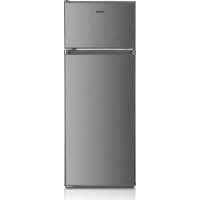
North Pole 220 RE22S.027A - Fridge Haeger - Free user manual and instructions
Find the device manual for free North Pole 220 RE22S.027A Haeger in PDF.



| Brand | Haeger |
| Model | North Pole 220 RE22S.027A |
| Product type | Combined refrigerator with freezer |
| Dimensions (W x D x H) | 545 x 555 x 1430 mm |
| Net / Gross weight | 38 kg / 42 kg |
| Power supply | 220-240 V ~ 50 Hz, protection class I |
| Rated power | 100 W (current 0.75 A) |
| Total net capacity | 206 L (refrigerator 169 L, freezer 37 L) |
| Freezer classification | 4 stars (****) |
| Freezing capacity | 2.4 kg / 24 h |
| Temperature rise time | 13.5 h |
| Climate class | N, ST (+16 °C to +38 °C) |
| Noise | 40 dB (A) - class C |
| Energy class | F |
| Annual energy consumption | 215 kWh/year |
| Refrigerant | R600a (isobutane, flammable) - 47 g |
| Gas insulation | Cyclopentane (C5H10) |
| Interior lighting | Incandescent lamp 10 W or LED 1.5 W (depending on version) |
| Refrigerator defrost | Automatic |
| Freezer defrost | Manual (when frost thickness exceeds 2 cm) |
| Reversible door opening | Possible (instructions in the manual) |
| Warranty | 2 years (according to EU legislation) |
Frequently Asked Questions - North Pole 220 RE22S.027A Haeger
User questions about North Pole 220 RE22S.027A Haeger
0 question about this device. Answer the ones you know or ask your own.
Ask a new question about this device
Download the instructions for your Fridge in PDF format for free! Find your manual North Pole 220 RE22S.027A - Haeger and take your electronic device back in hand. On this page are published all the documents necessary for the use of your device. North Pole 220 RE22S.027A by Haeger.
USER MANUAL North Pole 220 RE22S.027A Haeger
RE-22W.026A (White) * RE-22S.027A (silver)


Download Multi-language file

This appliance is intended to be used in household and similar applications such as staff kitchen areas in shop, offices and other working environments; farm houses and by guests in hotels, motels and other residential environments; bed and breakfast type environments; catering and similar non-retail applications.
If the supply cord is damaged, it must be replaced by the manufacturer, its service agent or similarly qualified persons in order to avoid a hazard.
Do not store explosive substances such as aerosol cans with a flammable propellant in this appliance. The appliance has to be unplugged after use and before carrying out user maintenance on the appliance.
Warning: Keep ventilation openings, in the appliance enclosure or in the built-in structure, clear of obstruction.
Warning: Do not use mechanical devices or other means to accelerate the defrosting process, other than those recommended by the manufacturer.
Warning: Do not damage the refrigerator circuit.
Warning: Do not use electrical appliances inside the food storage compartments of the appliance, unless they are of the type recommended by the manufacturer.
Warning: Please dispose the refrigerator according to local regulations because it uses flammable blowing gas and refrigerator.
Warning: When positioning the appliance, ensure the supply cord is not trapped or damaged.
Warning: Do not locate multiple portable socket-outlets or portable power supplies at the rear of the appliance.
Do not use extension cord or ungrounded (two prong) adapters.
Danger: Risk of child entrapment. Before you throw away your old refrigerator or freezer:
- Take off the doors.
- Leave the shelves in place so that children may not easily climb inside.
The refrigerator must be disconnected from the source of electrical supply before attempting the installation of accessory.
Refrigerant and cyclopentane foaming material used for refrigerator are flammable. Therefore, when the refrigerator is scrapped, it shall be kept away from
any fire source and be recovered by a special recovering company with corresponding qualification other than be disposed by combustion, so as to prevent damage to the environment or any other harm.
This appliance can be used by children aged from 8 years and above and people with impaired physical, sensory or mental abilities or with a lack of experience and knowledge provided that they are supervised or have received instruction in the safe use of this device, and about the resulting hazards. Cleaning and user maintenance shall not be made by children without supervision. Children aged from 3 to 8 years are allowed to load and unload appliance.
Children should be supervised to ensure that they do not play with the appliance.
Children below the age of 3 must be kept away from the appliance unless they are under continuous adult supervision.
To avoid contamination of food, please respect the following instructions:
- Opening the door for long periods can cause a significant increase of the temperature in the compartments of the appliance.
- Clean regularly surfaces that can come in contact with food and accessible drainage systems.
- Store raw meat and fish in suitable containers in the refrigerator, so that it is not in contact with or drip onto other food.
- Two -** star frozen-food compartments are suitable for storing pre-frozen food, storing or making ice cream and making ice cubes.
- One - , two - - and three-star - - compartments are not suitable for the freezing of fresh food.
- If the refrigerating appliance is left empty for long periods, switch off, defrost, clean, dry, and leave the door open to prevent mould developing within the appliance.

Warning: Risk of fire / flammable materials
English
Dear costumer
Thank you for having chosen a HæGER product.
The HæGER products have been produced to think about the welfare of the consumer privileging the most raised standards of quality, functionality and assign. We are sure you will be happy with this appliance.
Your new appliance is designed exclusively for domestic use.
To ensure best use of your appliance, carefully read the instructions handbook which contains a description of the appliance and advice on storing and preserving food.
Keep this handbook for future reference and pass them on to whoever might acquire the appliance at a future date.
Before using the appliance
- After unpacking, make sure that the appliance is undamaged and that the door closes properly. Any damage must be reported to your dealer within 24 hours after delivery of the appliance.
- Wait at least two hours before switching the appliance on in order to ensure the refrigerant circuit is fully efficient.
- Installation of the appliance and electrical connections must be carried out by a qualified electrician, in accordance with the manufacturer's instructions and local safety regulations
- Clean the inside of the appliance before using it.
Special Instructions
If this appliance is to replace an old refrigerator with a lock, break or remove the lock as safety measure before storing it, to protect children while playing might lock them inside.
Old refrigerators and freezers contain insulation gases and refrigerant, which must be disposed of properly. Please ensure that the refrigeration tubing is not damaged.
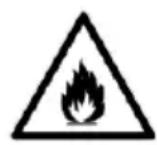
Warning: This refrigerator contains isobutane (R600a); this refrigerant gas is CFC-free but combustible. When transporting, installing, cleaning and repairing the refrigerator, take care not to damage any parts of the refrigeration circuit to prevent the risk of gas leaks. In case of damage, do not
use naked lights and ventilate the room containing the appliance appropriately.
Safety Precautions
The manufacturer declines all responsibility in case of failure to comply with the following precautions:
-
Never put a damaged appliance into operation, if in doubt, contact your dealer.
-
The appliance must be installed and connected to the electrical mains in full compliance with the instructions provided in the handbook. The electrical connection conditions must be as specified on the nameplate. The appliance's electrical safety is only guaranteed if the household electrical system is earthed in accordance with the relevant regulations.
- Make sure that all repairs and servicing are only carried out by a qualified technician. Always disconnect the appliance from the electrical mains in case of breakdown and maintenance, when changing light-bulbs or during cleaning. Never defrost using electrical devices or steam cleaners. Never remove frost or ice with sharp items, as this may cause irreparable damage to the walls of the refrigerator.
- Never attempt to move the refrigerator by pulling on the door or the handle.
- High-alcohol drinks must only be stored sealed and vertical. Never store liquids in cans or glass containers in the freezer compartment, especially if they contain added carbon dioxide. Never store products containing gases, flammable propellants or explosive substances in the freezer. There is always explosion hazard!
- The use of electrical appliances (such as ice-cream makers or whisks) inside the appliance is forbidden.
- To ensure the refrigerator operates correctly, never obstruct or cover the air ducts in any way.
- Never touch frozen products taken straight from the freezer or put them in your mouth. There is burn hazard due to the very low temperatures.
- Never eat or drink foods which look or smell strange.
- This appliance can be used by children aged from 8 years and above and persons with reduced physical, sensory or mental capabilities or lack of experience and knowledge if they have been given supervision or instruction concerning use of the appliance in a safe way and understand the hazards involved. Children shall not play with the appliance. Cleaning and user maintenance shall not be made by children unless they are older 8 years and supervised.
- In case of electricity blackout, open the door(s) as little as possible. Once partly or completely thawed, frozen foods must not be re-frozen.
Intended use
The appliance is specifically constructed for domestic use and is therefore suitable for the refrigeration and storage of fresh and frozen foods and the production of ice-cubes. The appliance has not been designed or manufactured for professional use. The manufacturer declines all responsibility for damage deriving from improper use of the appliance. The refrigerator has undergone the necessary tests on the tightness of the refrigeration circuit and complies with the safety regulations for electrical appliances.

Warming: The manufacturer declines all responsibility for injury or damage caused by failure to comply with the above regulations or deriving from tampering with even just one part of the appliance and the use of non-original spare parts.
Installation and connection
Choosing the site
- Always place the refrigerator in a dry place with satisfactory ventilation. Never expose it to direct sunlight or install it outdoors. Depending on its climate class (stated on the nameplate inside the refrigerator compartment), the appliance can be used in different temperature conditions:
| Class | Ambient temperature |
| SN (Subnormal) | from +10 °C to +32 °C |
| N (Normal) | from +16 °C to +32 °C |
| ST (Subtropical) | from +16 °C to +38 °C |
| T (Tropical) | from +16 °C to +43 °C |
- Never place the refrigerator close to heat sources. If this is unavoidable, a suitable insulating panel must be used to allow the appliance to function properly. Otherwise, place the appliance at least 3cm from electric or gas cookers and at least 30cm from combustion or radiation heating systems.
- To allow proper cooling of the condenser, the refrigerator must not be placed too close to the wall. If the refrigerator is installed underneath a wall cupboard, the distance between the two must be at least 5cm .
- Take care not to scratch or damage the floor when installing the appliance on parquet or linoleum. If necessary, when positioning slide the refrigerator over pieces of wood or a mat to the point decided for connection to the electrical mains.
Positioning and levelling the appliance (Fig.2 & 3 & Section A)
Place the fridge on a stable and level floor. In case the floor is not perfectly level, use the two adjustable feet on the front part of the fridge. To ensure major stability, easier movement and a correct positioning of the product, two additional wheels are present at the rear. In any case we recommend moving the fridge very carefully in order to avoid floor damage (especially in case of wooden floor).
Electrical connection
Before switching the refrigerator on for the first time, leave it vertical for at least two hours. Then connect the appliance's power supply plug to a mains socket with earth contact, installed in accordance with electrical safety regulations. The rated voltage and frequency are stated on the nameplate. The appliance must be connected to the electrical mains and earthed in compliance with the relevant regulations and requirements. The appliance is able to withstand short fluctuations in voltage of no more than 15% less or 10% more than the rated voltage stated on the nameplate. If the power supply lead has to be replaced, this operation must only be carried out by a qualified technician. The socket must be accessible after the appliance has been placed.
Product Description (Fig.1)
| 1. Freezer shelf | 2. Thermostat + light |
| 3. Glass shelf | 4. Cover for vegetable box |
| 5. Vegetable box | 6. Adjustable feet |
| 7. Door rack | 8. Bottle balcony |
Shelves (Glass rack) (Section B)
Each refrigerator comes complete with several shelves which can be set at different heights by placing them on the runners provided. Each shelf has a safety fitting to prevent it from being pulled completely out or accidentally removed. To remove it from the appliance, lift it at the back and extract it. Then change the position of the shelf or shelves as you require. For easy removal of all internal accessories, the door has to be opened completely.
Refrigerator compartment defrosting water drain (Section C)
The rear of the refrigerator compartment, underneath the refrigerating plate, has a channel and a hole for collecting the defrosting water. To ensure the refrigerator can function properly, take care never to block this hole. It is best to check and clean it fairly regularly using a piece of stiff wire.
Fruit and vegetable box
This container is at the bottom of the refrigerator compartment, which is fitted with a glass shelf to cover fresh foods that require constant humidity for optimum storage.
Door shelves and containers
The inside of the door is fitted with special shelves and boxes to take eggs, butter, dairy products, tubes, preserves and other small packages. The bottom of the door has a shelf to take vertical bottles.
All door shelves and boxes can be removed for cleaning. To remove the shelves, tap upward with your hand first, on one side of the insertion zone and then on the other side. Do not place excessively heavy bottles on the bottle shelf. Place bottles on the shelf gently when loading them. When removing bottles do not pull them in a diagonal direction as this may over-strain the retainer rod.
Inside lighting
When the refrigerator door is opened, the light comes on; it remains on until the door is completely closed again. The light comes on even if the refrigerator thermostat is set on "0" (stop), meaning that the refrigerator is switched off.
Arranging foods inside the refrigerator compartment
-
Arrange the foods on the various shelves, taking care that they have an airtight wrapping or cover. This precaution will:
-
conserve foods' fragrance, moisture and freshness;
-
prevent the cross-contamination of foods with different aromas and tastes;
-
prevent the humidity level inside the refrigerator becoming too high because of the normal breathing of food (especially fresh fruit and vegetables). In some operating conditions (rise in ambient temperature and humidity, more frequent opening of the door) this might cause condensation to form on the shelves.
- Use only containers approved for food storage. Always allow hot foods and drinks to cool to room temperature before placing them inside the refrigerator.
- Never store explosive substances in the appliance and only store high-alcohol drinks firmly sealed and vertical.
Setting and selecting the operating temperature
- The knob in the top right-hand corner of the refrigerator is used to set the operating temperature both in the refrigerator and in the freezer.
- When the knob is turned to 0 ("stop"), the appliance is switched off.
- The operating settings are from 1 to 7. 1 is warmest setting and 7 is coldest setting.
- The appliance may not operate at the correct temperature if it is in a particularly hot or if you open the door often.
- Recommended setting for fridge compartment:
Summer: 2-4 Normal: 4 Winter: 4-6


Important: Changes in weather conditions (temperature and humidity) and the frequency with which the doors of the two separate compartments are opened may affect the refrigerator's operating temperatures.
Setting and selecting the freezer operating temperature
24 hours before freezing a large quantity of fresh foods turn the thermostat to 7 setting. After the 24 hours have passed, insert the fresh foods and turn the thermostat knob to the setting of your choice.
Freezing foods
- For proper storage and freezing, fruit and vegetables should be packed in portions of not more than 1kg and meat and fish up to a max. of 2kg . Small packages of food freeze more quickly, giving better conservation of their nutrients and flavour, even after thawing and preparation.
- Use only freezer bags, aluminium film, food-approved polyethylene film and freezer containers. Do not use paper bags, non-food approved cellophane bags, shopping bags or used freezer bags.
- Pack foods in airtight packs and try to expel all the air. If using bags, close the packs with the elastic bands or plastic-coated wire strips provided.
-
Always cool hot foods to room temperature before placing them in the freezer and do not allow frozen foods to touch fresh foods for freezing.
-
Always mark packs with the date of freezing, quantity and type of food and make sure that foods are fresh and in good condition.
Storing frozen foods
- When purchasing frozen foods, always take care that the pack is not damaged, that the product is not past its sell-by date and that the thermometer of the freezer in which the products are displayed for sale does not show a temperature above -18^ . Also note the temperature advice, storage period and modes of consumption stated by the producer.
- Purchased foods should also be protected using suitable insulated containers during transportation to eliminate the risk of thawing. An increase in temperature might reduce their storage life and adversely affect their quality.
- Do not purchase frozen foods which are carrying too much frost; they might already have been thawed.
Thawing frozen foods
- Partially thawed foods should be eaten as soon as possible. Low temperatures preserve foods, but they do not destroy the micro-organisms which are activated after thawing, which may cause the stored foods to deteriorate. If thawed foods smell and look normal, they can be cooked and if required re-frozen once they have cooled.
- Depending on their type and intended use, frozen foods can be thawed correctly at room temperature, in the refrigerator, in an electric oven (conventional or fan), or in a microwave oven using the relevant function.
Making ice-cubes
Fill the tray provided 2/3 full of water or any other liquid you wish to freeze. Place it in the freezer compartment, making sure that its bottom is dry so that it will not stick to the shelf of the compartment. To detach the ice-cubes, twist the tray slightly or place it under running water for a few seconds.
Maintenance and Cleaning
Defrosting the refrigerator compartment
The refrigerator compartment has automatic defrosting. During normal operation of the refrigerator, frost forms on its back wall when the compressor is working and dissolves when it is not in operation. When the compressor is not working, the frost which has built up on the back-wall melts and the water flows into the opening provided in the bottom of the body of the refrigerator. From here, it flows into the tray on the compressor, where it evaporates.
Warning: the amount of ice which forms on the back wall may vary with changes in weather conditions (temperature and humidity), the frequency with which the door is opened, the appliance's operating temperatures and the quantity of fresh foods stored inside (especially fruit and vegetables).
Defrosting the freezer
The freezer compartment must be defrosted manually. When the thickness of frost or ice on the shelves exceeds 2cm , the freezer should be defrosted. A few hours before defrosting, use the knob provided to set the thermostat on 7 to further lower the temperature of the frozen foods. Then turn the knob to the 0 (stop) setting and disconnect the plug from the electrical mains. Remove the frozen foods from the freezer compartment and protect them from thawing while cleaning.
Cleaning the refrigerator
-
Before cleaning, disconnect the plug from the electrical mains. Clean the outside using only water and a gentle liquid detergent or an ordinary detergent for washable surfaces (such as a window-cleaning product). Never use products containing abrasives or substances which may attack the lacquered or painted parts, acids or chemical solvents. Use a sponge or a soft cloth.
-
Do not use steam cleaners to clean the inside;
-
Remove the shelves and accessories, taking care not to apply excessive force when removing. Never wash removable plastic parts in the dishwasher; use only warm water and washing-up liquid or water and vinegar. Take care not to wet the electrical lighting components with water or detergents.
-
Clean the gaskets with warm water and then dry.
-
To allow the refrigerator to operate at full efficiency, periodically also clean the condenser on the rear with a brush or a vacuum cleaner.
-
Also make a periodic check on the tray above the compressor and clean it if necessary.
Switching off the refrigerator
If the refrigerator is to be out of use for some time, turn the thermostat knob to 0 (stop). Then empty the compartments, disconnect the appliance from the electrical mains, and once it has defrosted dry any residual moisture which has collected. Leave the door ajar to prevent the humidity and trapped air from creating unpleasant smells.
Replacing the refrigerator lamp (Section D) (^*)
Before changing the lamp, make sure that the light has not stopped working simply because the part inside the lamp socket has become loose. In all cases, whether you wish to check that the socket is connected correctly or change the lamp, for safety reasons the plug must be removed from the power socket.
- Unplug the appliance to make sure the appliance is disconnected from main power supply.
- Remove the screw of the lamp cover and pull the lamp cover out.
- Remove the old lamp and fit the new lamp according to the opposite direction then replace the lamp cover and screw.
- Plug in the appliance and regulate the knob to right position.
(*) Note: If your model is LED type, to replace the lamp, please contact qualified technician.
Reverse the door (E)
Tool required: Phillips screwdriver, flathead screwdriver, and an adjustable wrench or spanner.
- Ensure the unit is unplugged and empty.
- To take the door off, it is necessary to tilt the unit backwards. You should rest the unit on something solid so that it will not slip during the door reversing process.
All parts removed must be saved to do the reinstallation of the door. - Do not lay the unit flat as this may damage the coolant system.
It's better that 2 people handle the unit during assembly.
Follow the images on section E - Reverting door
- Carefully remove the top hinge cover with a flat screw driver.
- Unscrew the top hinge with a Philips screw driver.
- Remove the hole cover with a flat screw driver.
- Move the core cover from left side to right side. And then lift the upper door and place it on a padded surface to prevent it from scratching.
- Unscrew the middle hinge and then lift the bottom door and put it on a soft pad to avoid scratch.
- Move two middle hole covers from left to right.
- Lie down the rear of cabinet on a soft pad. And unscrew the bottom hinge and levelling foot.
- Unscrew and remove the bottom hinge pin, turn the bracket over and replace it.
- Install the hinge at left side and foot base at right side. Then screw two levelling feet with their original parts.
- Move two middle hole covers from left to right.
- Stand up the unit and put the door on the bottom hinge. Make sure the bottom hinge core is inserted in the door hole. Then move the hinge hole cover of bottom door from left side to right side.
- Install the middle hinge.
- Install the upper door with the upper hinge.
- Clap in the hinge cover and hole cover on the top of unit.
- Detach the Fridge and the Freezer door gaskets and then attach them after rotating.
Practical advice for saving energy
- Install the refrigerator in a cool, well-ventilated place, protected against direct sunlight and well away from heat sources.
- Do not place hot foods in the refrigerator or freezer sections. Wait for foods and drinks to cool to room temperature before placing them on the shelves;
-
Open the door(s) as infrequently and for as short a time as possible to prevent the compartments from warming up too much;
-
Clean the condenser (rear of the refrigerator) periodically to prevent the appliance from losing efficiency;
If the refrigerator is to be out of use for a long period, it is best to empty it and switch it off; - Thaw frozen foods in the body of the refrigerator to exploit the cold stored in the frozen foods, which will be transferred to the refrigerator if this procedure is used.
Operating noise
- The refrigerator and freezer are cooled by means of a compression system. To maintain the pre-set temperature inside the refrigerator and freezer sections, the compressor comes into operation in response to the level of cooling required and may operate continuously if necessary. When the compressor starts up a humming sound will be heard, tending to drop in volume after a few minutes.
-
Another normal refrigerator operating noise is a gurgling due to the coolant flowing through the pipes in the circuit. This noise is perfectly normal and does not mean that the appliance is malfunctioning. If it is over-loud, there may be other causes. In this case, check that:
-
the refrigerator is properly levelled on the floor and does not vibrate when the compressor is in operation: adjust the feet provided as appropriate;
- The drawers, shelves and door boxes are correctly fitted and securely in place: fit correctly;
- Bottles and containers on the various shelves are stable and not touching: the vibration due to operation of the compressor may generate some noise;
- Do not place kitchen units or other appliances so that they are touching the refrigerator.
Troubleshooting Guide
Temperature inside the compartments is not low enough.
- Is food preventing the doors from closing properly?
Is the thermostat setting correct? - Are the air circulation vents blocked?
Temperature inside the refrigerator compartment is too low.
Is the thermostat setting correct?
The appliance is excessively noisy.
- Has the appliance been installed correctly?
- Are the pipes at the back touching or vibrating?
It is normal to hear the noise of the refrigerant liquid in circulation.
The appliance is not working?
Is there a power failure?
- Is the plug properly inserted in the socket?
- Has the fuse blown?
Is the power cord damaged?
Water collects at the bottom of the refrigerator compartment.
Is the thermostat setting correct?
Is the defrost water drain blocked?

This product is a household fridge. According to the national regulation, household fridge can only be suitable to store food, and can't be used to store other items such as blood, drug, and biological product and so on.
Technical data
| Reference | RE-22W.026A / RE-22S.027A |
| Supply Voltage / Protection class | 220-240 V~ 50Hz / I |
| Rated current / Rated Power | 0.75A / 100W |
| Maximum rated lamp wattage (*) | 10W incandescent or 1.5W for LED lamp |
| Refrigerant/Amount | R600a / 47g |
| Insulation blowing gas | C5H10 |
| Energy Class (1) | F |
| Energy consumption E16 (2) | 0.327kWh/24h |
| Energy consumption E32 (2) | 0.777kWh/24h |
| Annual Energy consumption (2) | 215kWh/annum |
| Total storage volume | 206 L |
| Refrigerator | 169 L |
| Freezer | 37 L |
| Star rating | * * * * |
| Freezing capacity | 2.4kg/24h |
| Temperature rise time | 13.5h |
| Defrost type | Manual |
| Climate Class (Ambient range) | N, ST (+16 °C a +38 °C) |
| Noise [dB (A) re 1pW] | 40 dB / Class C |
| Net weight / Gross weight | 38kg/42kg |
| Dimensions (W x D x H) | 545mm x 555mm x 1430mm |
| (1) Energy class: A......G (A= economical...G=less economical) | |
| (2) The real energy consumption depends on conditions and appliance location. | |
(^*) This product contains a light source of energy efficiency class G.
Declaration of Conformity
This appliance is intended for storing food and is manufactured in conformity with European Directives and European regulation (EC) 1935/2004.
This product has been designed, manufactured and marked in compliance with:

- the safety objectives of Low voltage Directive 2014/35/EU;
- the protection requirements of EMC Directive 2014/30/EU;
-
Plastic materials and articles intended to come into contact with food - Commission Regulation (EU) 10/2011;
-
Commission Delegated Regulation (EU) 2019/2016 & Commission Regulation (EU) 2019/2019.
The electrical safety of the appliance is guaranteed only if it is connected to an efficient and approved earthing system.
Disposal - Environment policy
Packing

The packaging material is entirely recyclable and marked with the recycling symbol. Follow local regulations for scrapping. Keep the packaging materials (plastic bags, polystyrene parts, etc.) out of reach of children, as they are potentially dangerous.
Disposal
The appliance is manufactured using recyclable material.
This appliance is marked according to the European directive 2012/19/EU on Waste Electrical and Electronic Equipment (WEEE).
By ensuring this product is disposed of correctly, you will help prevent potential negative consequences for the environment and human health, which could otherwise be caused by inappropriate waste handling of this product.

This symbol on the product, or on the documents accompanying the product, indicates that this appliance may not be treated as household waste. Instead, it shall be handed over to the applicable collection point for the recycling of electrical and electronic equipment.
Before disposal, make the appliance unusable by cutting off the power cable and removing the doors and shelves so that children cannot easily climb inside the appliance.
Disposal must be carried out in accordance with local environmental regulations for waste disposal. Deliver the appliance immediately to an authorized dump; do not leave it unattended even for a few days, since it is potentially dangerous for children.
For more detailed information about treatment, recovery and recycling of this product, please contact your local city office, your household waste disposal service or the shop where you purchased the product.
Warranty Declaration
Warranty Terms and Conditions
- The product is guaranteed for the period stipulated by the legislation where it is placed on the market, starting from the date of purchase, against manufacturing defects and/or workmanship. The lack of conformity manifested in this period is presumed to exist at the date of purchase. After this period, it is for the customer to prove that the lack of conformity already existed at the time of delivery.
- If, during the warranty period, the product is defective in normal use, the buyer should contact the selling establishment and send the appliance to the place indicated by the seller.
- The warranty is only valid upon presentation of the invoice proving the purchase and the completed warranty certificate (indicating the date of purchase, the name of the dealer, the
reference of the model, and it is also recommended to indicate the serial number and lot number).
- The importer/seller reserves the right to refuse warranty assistance in the event that such information has been deleted or altered after the original purchase of the product.
- The responsibility of the importer/seller includes in particular the costs of repairing and/or replacing the unit covered by the warranty with the reservation of the right to replace it with an equivalent product, in cases where it is not possible to repair it.
- The warranty does not apply to problems that are not directly related to defects in material, design or workmanship.
- This product is an appliance and is intended for home use only. The warranty will be void if the product is used for professional purposes.
- The warranty does not cover damage caused by misuse, improper installation, spillage, external factors, or intentional damage.
- The warranty does not cover damage resulting from falls, use of excessive force, blows, exposure to extreme environmental conditions or deterioration caused by the normal use of plastic parts or keyboards, as well as the use of batteries other than those specified in this manual.
- The warranty does not cover installation and programming by the dealer. In particular, no claim for installation and free programming by the reseller may be accepted.
- The warranty does not cover deficiencies that insignificantly impair the operation of the appliance. Other costs, such as installation, transportation and travel of the technician are expressly excluded from the warranty.
- The applicability of the warranty presupposes that the appliance is sent to the seller or place indicated by him, complete and in well-protected packaging (if possible, in its original packaging) and accompanied by its sheet or warranty card duly filled out and proof of purchase.
- If after verification, it is found that there are no reasons for the claim, or that the product is not defective, the inherent costs will be imputed to the customer, and the dealer is authorized to charge those costs to the customer.
- The warranty will be void when it shows signs that an unauthorized person has attempted to carry out repairs, modifications or replacement of parts on the appliance.
- Repairs carried out after the end of the warranty period are subject to costs.
- This warranty does not affect your legal rights that you may have as a consumer under applicable national law governing the purchase of products where the product is sold.
- Warranty Period:
European Union countries - European Directives (EU) 2019/771 and (EU) 2019/770 apply on certain aspects of contracts for the purchase and sale of movable property and transposed into the national laws of their countries.
Other countries - national legislation on consumer rights in their country applies. In the case of no official legislation, the guarantee shall be applied at the discretion of the importer placing the product on the market or the seller establishment.
ADVERTÉNCIA
Siga as imagens na�� E - Porta reversivel
Parque Industrial do Arneiro Tel: +351 21 949 83 02 (after sales support)
2660-456 S. Julião do Tojal Fax: +351 21 949 83 25
PORTUGAL e-mail: assistencia@haegergroup.com
https://www.haegergroup.com e-mail: commercial@haegergroup.com
2304RE22x026A_27A-EU