
YT82844 - Battery charger Yato - Free user manual and instructions
Find the device manual for free YT82844 Yato in PDF.



| Brand | Yato |
| Model | YT82844 |
| Product type | Battery charger |
| Weight | 0.67 kg |
| Input voltage | 220-240 V AC |
| Frequency | 50 / 60 Hz |
| Rated power | 60 W |
| Output voltage | 21 V DC |
| Output current | 2.4 A |
| Compatible battery type | Li-Ion 18 V |
| Battery capacity | 4 Ah (72 Wh) |
| Charging time | 2 hours |
| Charge indicator | Red LED (charging), green LED (fully charged) |
| Power supply | Mains |
| Maintenance and cleaning | Clean the terminals with a soft, dry cloth |
| Safety | Do not use outdoors, protect from water, unplug before cleaning |
| Recommended storage temperature | 0 to 30 °C |
| Storage humidity | 50% RH |
| Estimated lifespan | Approximately 500 charge/discharge cycles |
| Extended storage | Charge to 70% capacity, recharge once a year |
| General information | Manual available in multiple languages at notice-facile.com |
Frequently Asked Questions - YT82844 Yato
User questions about YT82844 Yato
0 question about this device. Answer the ones you know or ask your own.
Ask a new question about this device
Download the instructions for your Battery charger in PDF format for free! Find your manual YT82844 - Yato and take your electronic device back in hand. On this page are published all the documents necessary for the use of your device. YT82844 by Yato.
USER MANUAL YT82844 Yato
I N S T R U K C J A O B S Ł U G I
PL GB D RUS UA LT LV CZ SK H RO E F I NL GR
natural_image
Three-panel photo showing hands using a battery pack and charging device, no visible text or symbols
Read the operating instruction
I N S T R U K C J A O B S Ł U G I
OGÓLNE WARUNKI BEZPIECZEŃSTWA
PL
I N S T R U K C J A O B S Ł U G I
PL
I N S T R U K C J A O B S Ł U G I
GENERAL SAFETY CONDITIONS
GB
NOTE! Get acquainted with all the instructions below. Failure to observe them may lead to an electric shock, fire or injuries. The notion of electric tool used in the instructions applies to all the tools which are powered with electric current, both wire tools and wireless ones.
OBSERVE THE FOLLOWING INSTRUCTIONS
Safety precautions while using the electric tool
Before the battery is installed, make sure the switch is off. Installation of the battery when the switch is on may lead to accidents. Use solely the charger recommended by the manufacturer. Using a charger designed for another type of battery may be a cause of fire. The electric tool must be operated exclusively with the battery indicated by the manufacturer. Using another battery may be a cause of fire or injuries. When the battery is not used, it must be stored away from such metal objects as paper clips, coins, nails, screws or other small metal elements, which might short-circuit the terminals. Short-circuited terminals of the battery may cause burns or fire. Under adverse circumstances liquid may leak from the battery; avoid any contact. In case of accidental contact with the liquid, rinse it with water. In case of eye contact, seek medical. The liquid leaking from the battery may cause irritation or burns.
Repairs
Have the tool repaired solely by authorised workshops, where original spare parts are used. This will ensure the adequate safety of operation of the electric tool.
PREPARATION FOR WORK
ATTENTION! All the operations mentioned in this point must be realised with the power supply off.
- the battery must be disconnected from the tool!
Safety recommendations for battery loading
Attention! Before loading may start make sure the body of the charger, the cable and the plug are not broken or damaged. It is prohibited to use a damaged loading dock and charger! For the purpose of loading batteries only the charging dock and the charger provided may be used. Using another charger may be a cause of fire or damage the tool. Batteries may be charged only in a dry room, protected from unauthorised persons, particularly children. Do not use the charging dock and the charger without permanent supervision of an adult! If it is necessary to leave the room where loading is taking place, it is required to disconnect the charger from the mains, removing the charger from the mains socket. In case when smoke comes out of the charger, or a strange smell is emitted, etc., it is required to immediately remove the plug of the charger from the mains socket!
The drill and automatic return screwdriver is provided with an unloaded battery, so before work may commence, it is required to charge it following the procedure below, using the charger and charging dock provided. Li-ION batteries do not show the so called "memory effect", so it is allowed to charge them at any moment. However, it is recommended to discharge them during normal work, and then load them to their full capacity. If due to the nature of the task it is not possible to do so each time, then it is required to do it at least from time to time. Under no circumstances is it allowed to discharge the batteries short-circuiting the electrodes, since this would cause irreversible damage! It is also prohibited to check the load of the batteries, short-circuiting the electrodes for sparking.

Storage of the battery
In order to prolong the life of the battery, it is required to provide adequate storage conditions. The batteries can go through approximately 500 „loading - discharging" cycles. The battery must be stored between 0 and 30°C, at the relative humidity of 50%. In order to store the battery for a prolonged period, it is required to charge it to approximately 70% of its capacity. In case of prolonged storage, it is required to recharge the battery once a year. Do not permit excessive discharging of the battery, since this would reduce its life and may cause irreversible damage.
During storage, the battery will be gradually unloading due to leakage conductance. The process of automatic unloading depends on the temperature of storage, since the higher the temperature, the fastest the process. In case of incorrect storage of batteries, there is a danger of electrolyte leakage. In case of leakage, it is required to protect the leakage with neutralizing agent. In case of contact of electrolyte with the eyes, it is required to rinse the eyes abundantly, and then immediately seek medical assistance. It is prohibited to use a tool with a damaged battery.
In case the battery is completely worn out, it is required to deposit it at a special point dedicated to disposal of such waste.
Transport of the batteries
Lithium-ion batteries are in accordance with legal regulations treated as dangerous waste. The user of the tool may transport the tool with the battery or only batteries by land. Then no additional conditions must be complied with. In transport is realised by third parties (for example dispatch through courier service), then it is required to proceed in accordance with regulations for transport of dangerous materials. Before shipment, contact an authorised person.
It is prohibited to transport damaged batteries. During transport the battery must be removed from the tool, and the exposed contacts protected, e.g. with insulating tape. Protect the batteries so that they do not move inside the package during transport. It is also required comply with the national regulations for transport of dangerous materials.
Charging the battery
Attention! Before charging you should disconnect the charger from the mains by unplugging the power supply plug from the mains. In addition, you should clean the battery and its terminals of dirt and dust with a soft, dry cloth.
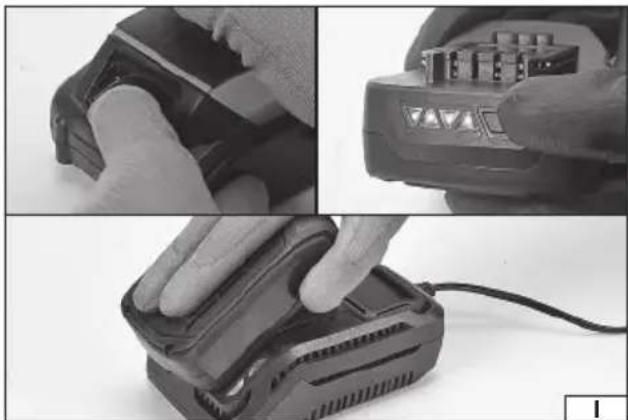
The battery has a built-in charge indicator. When you press the button, LEDs will light up (I), the more LEDs will light up, the more fully the battery pack is charged. If the button is pressed and the LEDs are off it means that the battery is discharged.
Disconnect the battery from the tool.
Push the battery in the charger socket (I).
Plug the charger into a mains socket.
When the red LED lights up, it means the loading process.
When charging is complete, the red LED goes off, and green LED lights up, indicating a full charge of the battery.
Unplug the charger from the mains outlet.
Remove the battery from the charging station, by pressing the battery latch button.
Attention! If, when the charger is connected to the power supply, the green LED is on, this indicates a fully charged battery. In this case, the charger does not start charging.
Correct disposal of this product: This marking shown on the product and its literature indicates this kind of product mustn't be disposed with household wastes at the end of its working life in order to prevent possible harm to the environment or human health. Therefore the customers is invited to supply to the correct disposal, differentiating this product from other types of refusals and recycle it in responsible way, in order to re-use this components. The customer therefore is invited to contact the local supplier office for the relative information to the differentiated collection and the recycling of this type of product.
B E D I E N U N G S A N L E I T U N G
D
B E D I E N U N G S A N L E I T U N G
ОБЩИЕ ПРАВИЛА БЕЗОПАСНОСТИ
RUS
K E Z E L É S I U T A S Í T Á S
H
K E Z E L É S I U T A S Í T Á S
H
K E Z E L É S I U T A S Í T Á S
CONDITII GENERALE DE SECURITATE
RO
I N S T R U K C J A O B S Ł U G I
F
I N S T R U K C J A O B S Ł U G I
I N S T R U K C J A O B S Ł U G I
I N S T R U K C J A O B S Ł U G I
ALGEMENE VEILIGHEIDSVOORSCHRIFTEN
NL
I N S T R U K C J A O B S Ł U G I
NL
Transport van accu's
I N S T R U K C J A O B S Ł U G I
I N S T R U K C J A O B S Ł U G I
GR
I N S T R U K C J A O B S Ł U G I
- OGÓLNE WARUNKI BEZPIECZEŃSTWA
- PL
- GENERAL SAFETY CONDITIONS
- GB
- OBSERVE THE FOLLOWING INSTRUCTIONS
- Safety precautions while using the electric tool
- Repairs
- PREPARATION FOR WORK
- Safety recommendations for battery loading
- Storage of the battery
- Transport of the batteries
- Charging the battery
- D
- ОБЩИЕ ПРАВИЛА БЕЗОПАСНОСТИ
- RUS
- H
- CONDITII GENERALE DE SECURITATE
- RO
- F
- ALGEMENE VEILIGHEIDSVOORSCHRIFTEN
- NL
- Transport van accu's
- GR
Brand : Yato
Model : YT82844
Category : Battery charger