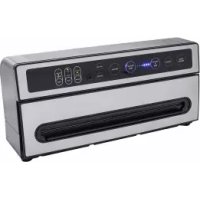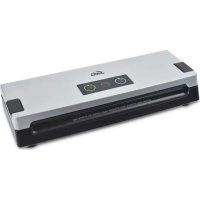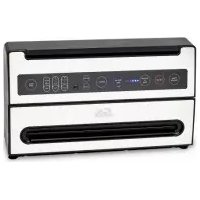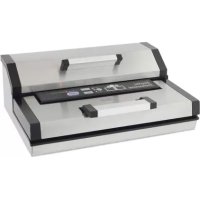
Vac Professional 572 - Vacuum packaging machines Solis - Free user manual and instructions
Find the device manual for free Vac Professional 572 Solis in PDF.


| Technical Features | Professional vacuum packaging machine |
|---|---|
| Dimensions | Compact dimensions suitable for workspaces |
| Weight | Lightweight for easy handling |
| Power | Optimal power for efficient packaging |
| Operating Type | Automatic operation with manual options |
| Usage | Ideal for professionals in catering and food industry |
| Maintenance | Easy cleaning and regular maintenance |
| Safety | Equipped with safety systems to prevent overheating |
| Included Accessories | Option to include vacuum film rolls |
| Warranty | Manufacturer warranty for peace of mind |
| General Information | Designed for intensive use with increased durability |
Frequently Asked Questions - Vac Professional 572 Solis
User questions about Vac Professional 572 Solis
0 question about this device. Answer the ones you know or ask your own.
Ask a new question about this device
Download the instructions for your Vacuum packaging machines in PDF format for free! Find your manual Vac Professional 572 - Solis and take your electronic device back in hand. On this page are published all the documents necessary for the use of your device. Vac Professional 572 by Solis.
USER MANUAL Vac Professional 572 Solis
Solis of Switzerland AG
B. Touche Vacuum & Seal / Cancel
C. Touche Pulse Vacuum
8. CONDITIONNEMENT SOUS VIDE D'UN RECIPIENT SOLIS AVEC COUVERCLE
I'APPArEil nE SoUdE PAS IE SACHEt SoUS VidE
Solis of Switzerland SA
Solis-Haus · CH-8152 Glattbrugg-Zurich · Suisse
Telephone +41 44 874 64 54 • Telefon +41 44 874 64 99
info@solis.ch · www.solis.ch · www.solis.com
ACCESSoirES :
B. Tasto Vacuum & Seal/Cancel
C. Tasto Pulse Vacuum
I'AriA non É CoMPIEtAMEntE ASpirAtA dAI SACCHEtto
Solis of Switzerland SA
Solis-Haus · CH-8152 Glattbrugg-Zurigo · Svizzera
Telefono +41 44 874 64 54 • Fax +41 44 874 64 99
info@solis.ch · www.solis.ch · www.solis.com
ACCESSori:
APPLiAnCE dEsCription
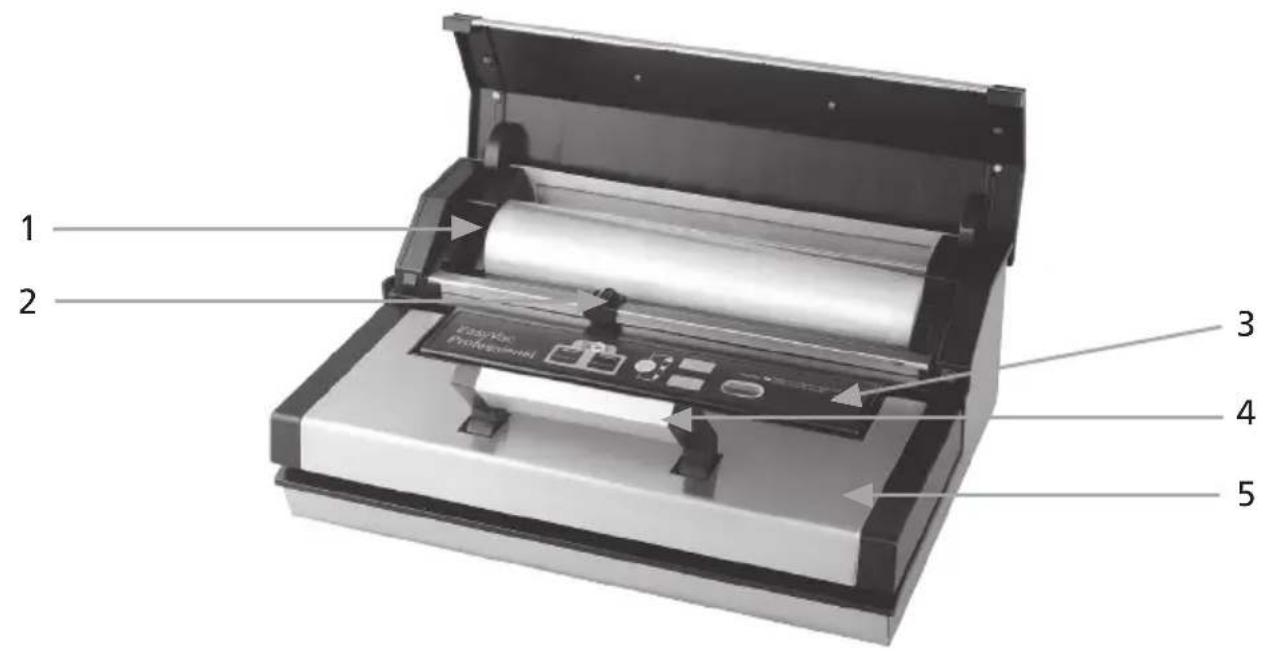
- Bagging foil chamber with cover For loading and storing the foil reel before it is cut and sealed to a bag.
- Cutting bar with blade handle For easily cutting the foil.
- Control panel with function buttons You can find extensive descriptions of the buttons and their respective functions on pages 100/101.
- Cover handle Pushing down and locking the bar into place will close the appliance cover. With that, the appliance is ready. Pushing the bar upwards will unlock the cover.
- Appliance cover
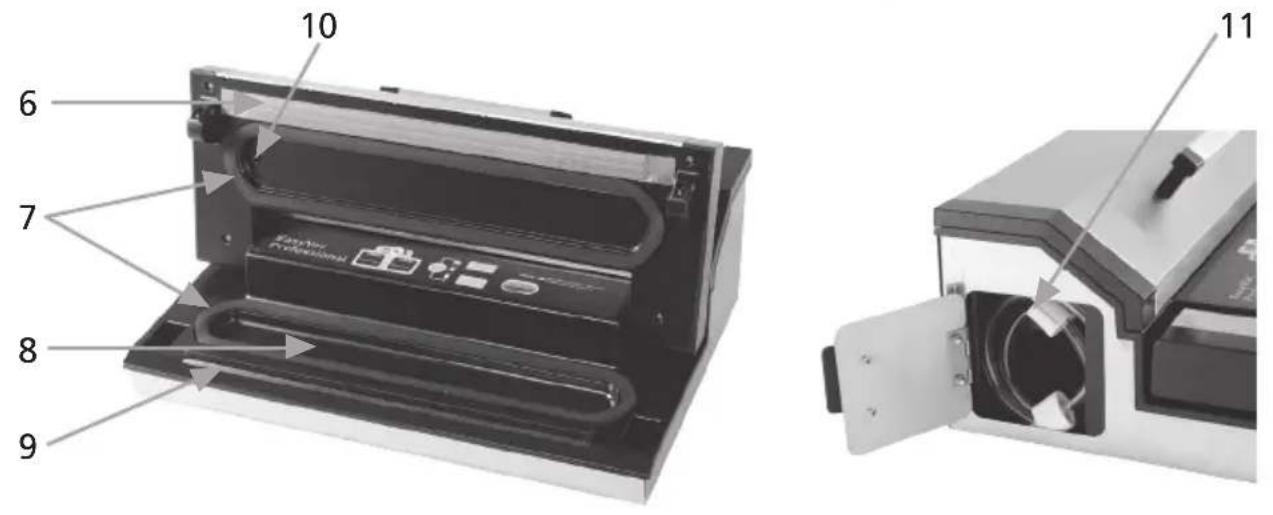
- Sealing bar The edge of the bag is placed on the sealing bar, which will seal the edge of bag with two welds.
- Upper and lower sealing ring The sealing rings will seal the edge of the bag airtightly and allow for evacuation of the air.
- Vacuum chamber The open end of the bag is placed here to allow for evacuation of the air. Possible liquids or foods from the bag are collected here.
-
Rubber contact seal The counterpart to the sealing bar. Ensures even contact of the bag to the sealing bar for optimal sealing.
-
Air vent The inserted bag should never cover this opening, as it might impair operation of the motor pump.
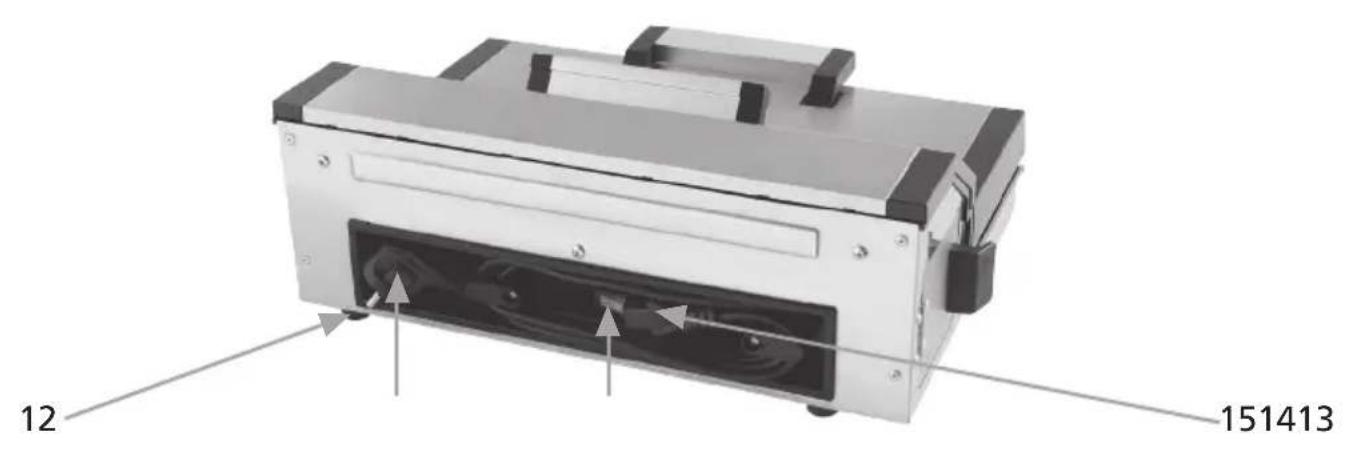
- Air extraction hose in hose compartment For evacuating containers and marinating.
- Non-slip rubber feet Four rubber feet ensure secure position during operation.
on BACK SidE:
- Power cable with plug in cable compartment
- ON/OFF toggle switch
- Connection plug socket (concealed by power plug)
Control PAnEI
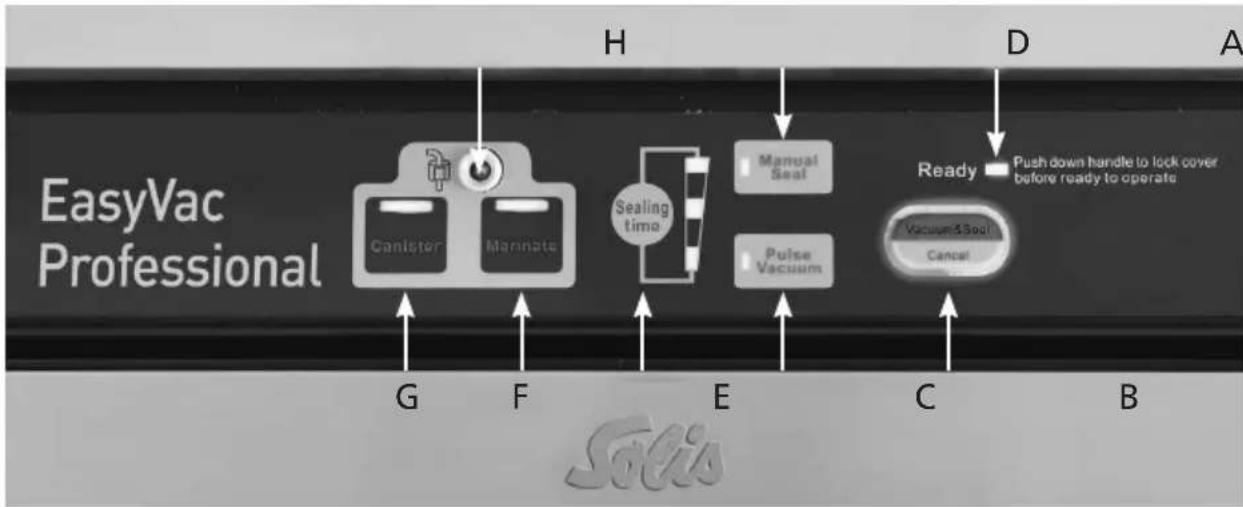
The control panel with function buttons
For easy supervision, the control light will illuminate next to or in the buttons, depending on which function has been set by pressing the button.
A. Function light Ready
The Ready light will illuminate red when the appliance is turned on, locked with the cover handle and operational. Should the light flash, please wait for it to illuminate constantly.
B. Vacuum & Seal / Cancel button
Automatic vacuuming and sealing
The button with the blue control light has two functions:
- Pressing it while the appliance is in standby mode will start the vacuuming process and automatically seal the bag after completion (Vacuum & Seal function).
- Pressing the button during operation will immediately stop the vacuuming resp. sealing process (Cancel function).
C. Pulse Vacuum button
Manual vacuuming without automatic sealing
Pressing this button in standby mode will evacuate the bag, the red control light will illuminate. Releasing the button will stop the vacuuming process. This allows you to control the vacuuming process, f.e. with pressure sensitive foods. As soon as enough air has been extracted, press the Manual Seal button to seal the bag.
D. Manual Seal button
Manually sealing
This button with the red control light has two functions: Firstly, it will seal evacuated foil bags. Secondly, it can be used to create a bag from a length of foil, meaning to seal the end of a bag.
In any case, the Manual Seal button has to be used following the Pulse Vacuum button to seal the evacuated bag.
CAUTION: Even if you have selected the Vacuum & Seal function, you can use the Manual Seal button at any time to stop the vacuuming process, meaning the motor pump, and seal the bag immediately. This is helpful when noticing that sensitive foods might take damage from the negative pressure. Always wait for the red control light in the Manual Seal button to go off. This indicates that the sealing process has been completed.
E. Sealing time button
Setting appropriate sealing times for different foods
Each touch of the button will change sealing time. You can select from three settings, depending on the foods you wish to seal:

Highest setting for a long sealing time: for moist bags containing foods with high moisture content, like f.e. fish or red meats.
Medium setting for a medium sealing time: for slightly moist bags containing foods with a low moisture content.
Low setting for a short sealing time: for dry bags and dry foods. This is the basic setting.
F. Marinate button
Button with a red control light for quickly marinating fish, meat and poultry in the square 1.0 | or 2.8 | SOLIS container.
G. Canister button
Button with a red control light for vacuuming a SOLIS container using the included air extraction hose.
H. Air extraction opening
The air extraction hose is inserted into this opening to evacuate or marinate using SOLIS containers.
iMPortAnt SAfEtY PrEAUTIONS
Please read through this user manual thoroughly before using your vacuum sealer, so that you become familiar with your appliance and can use it safely. We thoroughly recommend that you keep these instructions and, if you pass the appliance on, that you also hand these instructions to the new owner.
For your own safety, please observe the following safety measures when using electrical appliances:
- To avoid electric shocks, neither the vacuum sealer nor the power cord and power plug resp. the connection plug must come into contact with water or other liquids. Water can enter the housing and damage the appliance! Should the appliance or the power cord and power plug resp. the connection plug come into contact with liquid, immediately pull the plug with dry rubber gloves.
- Before using the appliance, check that the voltage stated on the appliance matches your mains voltage.
- Do not leave the power cable hanging over table edges so that it can be pulled. Make sure that it does not come into contact with hot surfaces, such as hot-plates or a radiator, or that they come into contact with the appliance.
- Keep the appliance away from hot gas, hot ovens and other heat-emitting appliances or heat sources. Never use the appliance on a hot or wet surface. Never place the appliance near moisture, heat and naked flames. Keep the appliance away from moving parts or appliances.
- Never carry the appliance by the power cable and do not place it on the power cable. Never pull the power cord to pull the plug from the socket! Never pinch or bend the power cord and protect it from sharp or pointed things.
- We recommend that you do not use an extension cable with this appliance. Do not place the appliance directly underneath a power socket.
- Before you insert or remove the plug from the socket, please always check that the cover is not locked shut.
- Place the appliance while in function on a stable, level and dry surface, like a table. Do not use the appliance outdoors.
- Unplug the appliance when it is not in use or unattended, and before cleaning. We recommend the use of a residual current device (RCD safety switch) to ensure additional protection during the use of electrical appliances. It is advisable to use a safety switch with a rated residual operating current of 30mA maximum. For professional advice consult an electrician.
-
Do not make any changes to the appliance, the cord, the power plug, the connection plug and the accessories.
-
Incorrect use may cause injury!
- Never take hold of an appliance that has fallen into water. Always take the plug out of the power socket before removing the appliance from the water. Do not use the appliance again until you have had it's ability to function safely checked by SOLIS or a SOLIS approved service centre.
- Never place the vacuum sealer in a place where it could fall into water (e.g. next to a sink).
- Never place the appliance or parts of it like the cord, the power plug and the connection plug in water and do not let water come into contact with any of these parts.
- Place the appliance so that it is never exposed to direct sunlight.
- Never put sharp or pointed objects and tools into the appliance openings. The appliance may become damaged - danger of electric shock!
- Do not shake or relocate the appliance while it is in operation.
- Only use the appliance as described in this manual. Only use the included accessories resp. original SOLIS accessories, as using wrong accessories might cause damage to the appliance.
- The appliance is only suitable for domestic and semi-professional use.
- Check your vacuum sealer before each use.
- To avoid electric shocks, do not use the appliance when the cord, the connection plug or power plug are damaged or when the appliance shows any kind of disturbance, has been dropped or is damaged in any other way. Never attempt repairs yourself, but take your appliance to SOLIS or a SOLIS approved service centre in order to get it inspected or mechanically and electrically repaired.
- People with limited physical, sensory or mental capacities (including children) are not permitted to use the vacuum sealer, except when supervised by a person responsible for their safety or are instructed by this person, exactly how to use the appliance.
- Children must be supervised, so that they do not play with the appliance. Keep the appliance in a safe place away from children.
- CAUTION: the sealing bar gets very hot during operation! Do not touch the sealing bar during or shortly after use.
-
The appliance is not designed for constant use. Leave the appliance to cool for one minute, before vacuuming the next bag or container.
-
The appliance and the sealing bar are fitted with overheating protection. To prevent overheating of the sealing bar, no more than 30 bags in a row may be sealed using the function Manual Seal.
- Before using, always check that your hands are clean and dry.
- Avoid sucking in liquids to keep them out of the vacuum chamber. If any liquid collects there, it must be wiped up immediately.
- Use exclusively SOLIS vacuum bags or containers that were designed for this appliance. The SOLIS container must be undamaged and free of cracks. Only use the appliance for vacuuming and sealing, never use for any other purpose.
- This appliance does not require the use of oils or lubricants.

firSt USE
CAUTION: Before activation, make sure that the appliance, the containers and the foils and bags are absolutely clean so that no foods will be dirtied.
1. APPLIANCE INSTALLATION
Place the appliance on a suitably large, horizontal, clean and dry work surface. Note that you also need space for the food filled bags to be vacuumed.
2. PLugging in AND TURNING ON THE APPLIANCE
Plug the connection plug into the socket on the back side of the appliance and plug the power plug into a suitable outlet. Use the ON/OFF switch on the back side of the appliance to turn it on. The toggle switch should be set to "1". The Sealing time control light will illuminate in the lowest position.
3. SETTING SEALING TIME
On your SOLIS EasyVac Professional, you can match sealing time to the foods you want to seal. Each touch of the button will change the setting, the corresponding control light will illuminate. For consistently producing perfect welds, you can use the Sealing time function to choose between 3 sealing processes.

Highest setting for a long sealing time for wet bags containing moist foods or foods with a high moisture content, like f.e. red meats or fish.
Medium setting for a medium sealing time for slightly moist bags containing foods with a lower moisture content.
Low setting for a short sealing time for dry foods like f.e. biscuits, rice or coffee (basic setting).
4. TIPS FOR THE USE OF VACUUM BAGS
There are SOLIS vacuum bags in different sizes or vacuum bag film with which you can set the bag size. Always choose a bag size appropriate for the food. Please note that the bag should be at least 8 cm bigger than the food you wish to shrink-wrap and add another 2 cm for the welds.
NOTE: Should you use ready made vacuum bags, you can proceed directly to point 6 of these instructions.
5. SEALING A BAG FROM BAGGING FOIL
-
Open the cover of the bagging foil chamber and lift the cutting bar (2). The blade lever should either be to the far right or to the far left of the cutting bar. Should the blade lever be positioned in the middle of the bar, cutting the foil will not work properly (see ill. A). Place the foil reel in the foil chamber (1) (see ill. A) and unroll enough foil for whatever size you wish the bag to have.
-
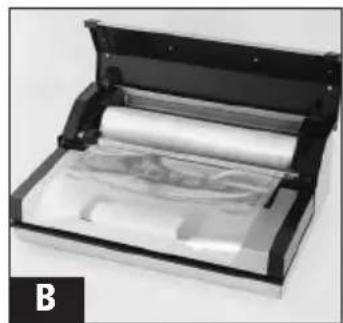
Push the cutting bar (2) back down, the foil now is beneath it (see ill. B).
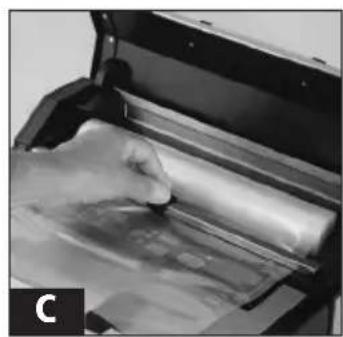
- In one go, pull the blade lever from one end of the bar to the other, the foil will be cut quickly and evenly (see ill. C). You can now seal one of the bag's ends.
- Close the cover of the foil chamber and open the appliance cover.
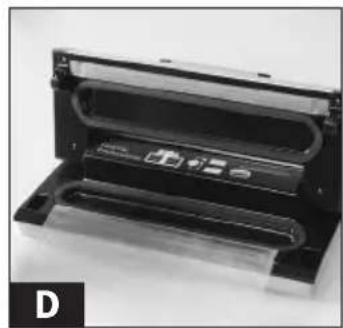
- Place one of the open bag ends on the rubber contact seal (9) and ensure that the bag end does not reach into the vacuum chamber (see ill. D).
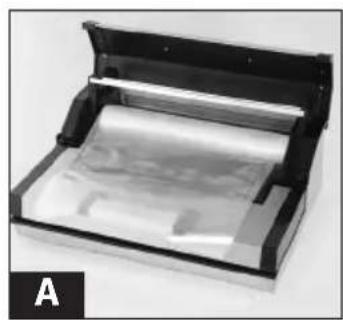
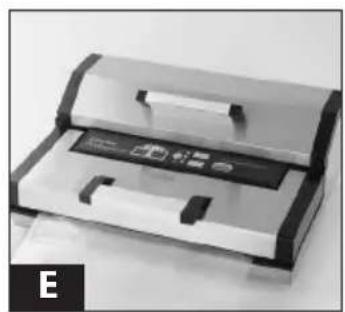
- Close the appliance cover and push down the handle all the way. The cover is now locked into place (see ill. E). The Ready function light will illuminate.
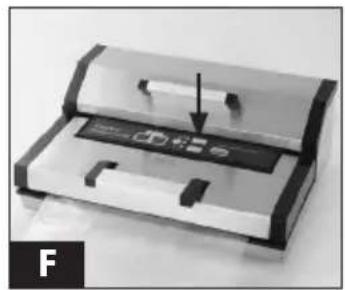
- Press the Manual Seal button (D) to start the sealing process (see. ill F). The red control light will illuminate and go off to indicate that the sealing process has been completed.
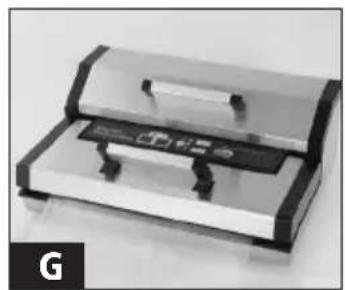
- Pull up the cover handle (4) to open the appliance cover (see ill. G).
- Pull up the cover handle and remove the bag.
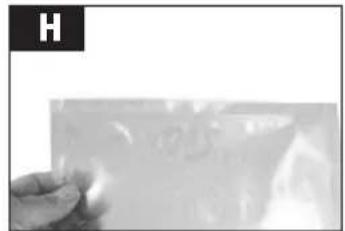
- Check if all welds are even and without creases (see ill. H). Should this not be the case, repeat the process.
6. AUTOMATIC VACUUMING AND SEALING OF A BAG: THE VACUUM & SEAL (B) FUNCTION
- Open the cover.
- Place the food into the bag. Please only use the original SOLIS bags or vacuum film, so as not to damage the appliance and to give best results.
- Clean the end of the bag, inside and out, and stroke it flat. The end must be clean, dry and uncreased.
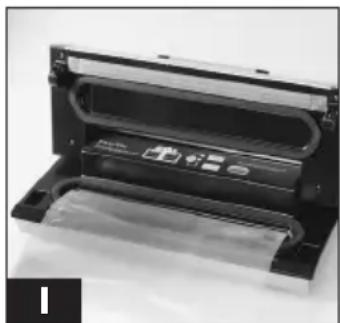
- Place the open bag end in the vacuum chamber (8) (see ill. I). Ensure that the air vent (10) is not covered by the bag.
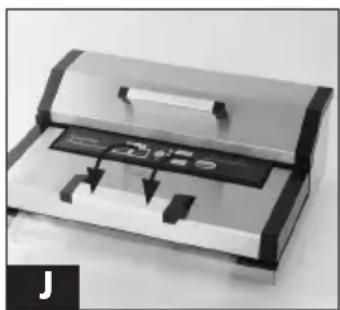
- Close the appliance cover and push the handle down all the way; the Ready control light will illuminate. The cover is locked in place and the appliance is ready for operation (see ill. J).
-
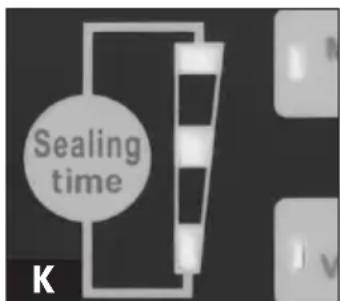
Use the control lights to check the Sealing time function. Choose a sealing time suitable to the foods so that the bag is welded correspondingly: low for dry foods, medium for slightly moist foods and high for very moist foods. The corresponding control light will illuminate (see ill. K).
-
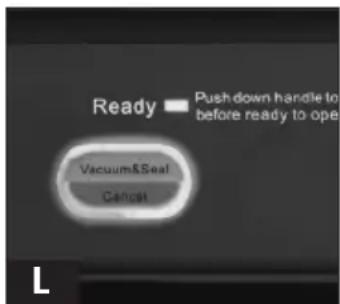
Press the Vacuum & Seal button (B). Your appliance will automatically evacuate and seal the bag, the blue button surround will illuminate. As soon as the evacuation process has been completed, the Manual Seal button (D) will illuminate red to indicate that the bag is currently being sealed. Please wait for the control lights Vacuum & Seal and Manual Seal to go off, then the process is completed (see ill. L).
CAUTION: During automatic evacuation, your vacuum sealer will create very high negative pressures. Closely observe whether the foods in the bag can bear this pressure. If you notice the pressure getting too high, press the Manual Seal (D) button to stop the motor pump and the evacuation and immediately start the sealing process.
- You can now lift the handle, open the cover and remove the bag.
- Please re-check if the new welds are even and without creases (see ill. H). If this is not the case, repeat the process.
7. MANUAL VACUUMING AND SEALING OF A BAG: THE PULSE VACUUM (C) AND MANUAL SEAL (D) FUNCTIONS
The appliance will create rather high vacuum-pressures in the bag. Should you wish to seal pressure-sensitive foods like f.e. pastries, we recommend evacuating the bag with the Pulse Vacuum function and then manually sealing it with the Manual Seal function. This will make monitoring the degree of vacuum and preventing damage to the foods even easier for you. Proceed as described in article 6, up to ill. K.
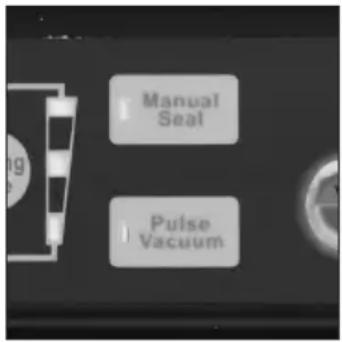
- Press and hold the Pulse Vacuum button (C). Observe the vacuum in the bag during evacuation.
- As soon as enough vacuum has been created, release the Pulse Vacuum button and press the Manual Seal button (D). The appliance will stop the motor pump and begin sealing the bag. The welds will be applied according to the last setting (low, medium, high). Wait for the red control light by the Manual Seal button (D) to go off and indicate the completion of the sealing process.
Good to know:
- To ensure optimal performance, the appliance should be left to cool for one minute, before you insert the next bag. Wipe away any leaked fluids in the vacuum chamber after each use.
- If you do not observe the one minute cool-down time of the appliance and try to use it again immediately, the appliance will switch off automatically to prevent overheating of the heating element.
- Our appliance works with SOLIS vacuum bags or -films, please do not use other bags to achieve optimum results and to prevent damage to the appliance.
For item numbers and descriptions, please refer to the enclosed order form. You can find accessories for your vacuum-appliance in good stores or you get them from SOLIS AG.
Telephone: 0848 804 884, telefax: 0848 804 890
email: info@solis-onlineshop.ch or www.solis-onlineshop.ch
(Delivery only available within Switzerland).
- Use scissors to open a vacuum sealed bag and take out the food.
8. VACUUMING SOLIS CONTAINERS WITH LIDS
CAUTION: Please exclusively use containers from SOLIS with this appliance. Only these containers are designed for the vacuum that the SOLIS EasyVac Professional creates.
For item numbers and descriptions, please refer to the enclosed order form. You can find accessories for your vacuum-appliance in good stores or you get them from SOLIS AG.
Telephone: 0848 804 884, fax: 0848 804 890, email: info@solis-onlineshop.ch or www.solis-onlineshop.ch (Delivery only available within Switzerland).
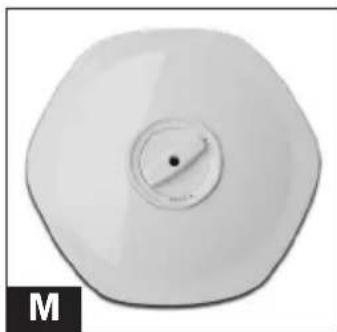
A. Vacuuming SOLIS containers with twist-knob on the lid (fig. M)
-
Wash the container in water and clean the lid with a damp cloth; dry all completely.
-
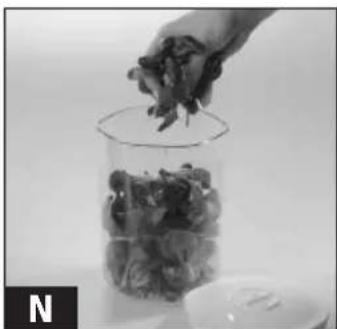
Place the food into the container and leave at least 3cm room between the food and the top edge of the container (see fig. N). Clean the top edge of the container again and the underside of the lid and the seal of the container lid, then place the container lid on the container. Turn the control dial on the lid to the "SEAL" position (see fig. M).
-
Close the appliance cover and cover handle (see ill. J, page 108).
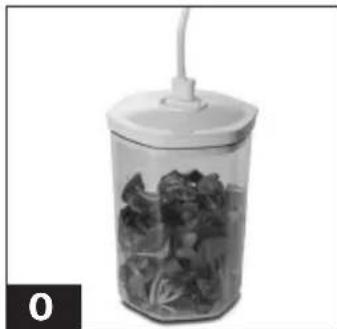
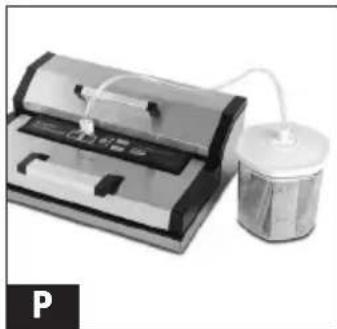
Take the air extraction hose (11) and insert the end of it into the air extraction opening (H) of the appliance and the other end into the opening of the twist-knob on the lid (see fig. O + P ).
-
Press the Canister (G) button, the vacuum process begins. To make sure that no air can enter between the container and the lid, press down on the lid with your hand during vacuuming. The appliance switches off automatically once the required vacuum has been reached.
-
Carefully pull the air extraction hose from the container lid once the evacuation process has been completed. To check if the container has been evacuated you can give the lid a slight pull - it should not move.
-
To open the lid of the container, turn the control dial to the "OPEN" position. You will hear a slight hissing sound as the air enters the container again. This hiss guarantees that there was an air vacuum in the container.
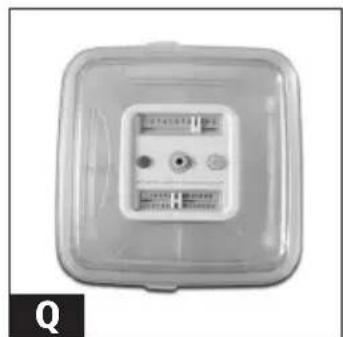
B. Vacuuming SOLIS containers without twist-knob on the lid (fig. Q)
The multi-functional SOLIS containers are ideal for storing dry foods, powdered foods, and fresh, dry or pureed fruit and vegetables. Due to it's transparent design, the contents can be easily seen and the practical date-indicator gives an indication of the shelf-life of the contents.
- Wash the container in water and clean the lid with a damp cloth; dry all completely.
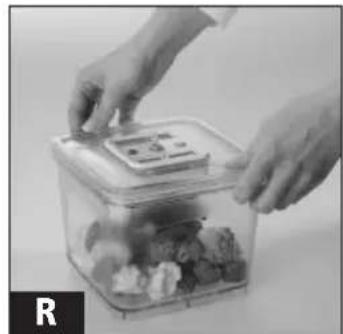
- Place the food into the container, leaving at least 3 cm between the food and the top edge of the container. Clean the upper edge of the container again, along with the underside of the lid with the seal and place the lid on the container (see fig. R).
- Close the appliance cover and cover handle (see ill. J, page 108).
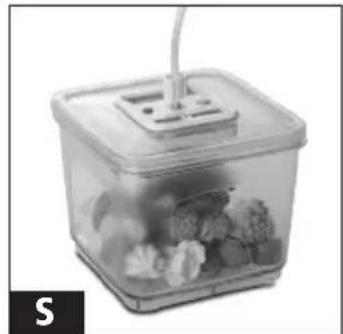
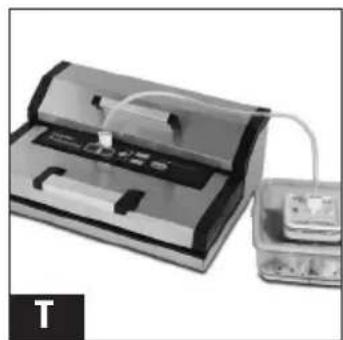
Take the air extraction hose (11) and plug it into the air extraction opening (H) of the appliance and the other end into the opening on the container lid (see fig. S+T). - Press the Canister (G) button, the vacuum process begins. To ensure that no air can enter between the lid and the container, press down on the lid of the container with your hand. The appliance switches off automatically once the required vacuum has been reached.
- Carefully pull the air extraction hose from the container lid once the evacuation process has been completed. To check if the container has been evacuated you can give the lid a slight pull - it should not move.
- To open the lid of the container, press the button right beside the air extraction opening, so that the vacuum pressure is released. You will hear a slight hissing sound as the air passes back into the container. This hiss guarantees that there was an air vacuum in the appliance.
NOTE: The SOLIS containers are not microwave-able. Furthermore, no liquids should be frozen in a SOLIS container – the containers might burst, as the liquids will expand during freezing.
9. QUICK MARINATING USING THE MARINATE-FUNCTION
Quick marinating using the marinate-function is best suited with meat or fish, to spice and allow it to tenderise. Thanks to the SOLIS EasyVac Professional marinate-function, you can quickly marinate meat or fish effectively, in just a few minutes, since the vacuum allows the marinade to penetrate deeper into the food. The vacuum function maintains a vacuum for several minutes, then releases air, allowing the food to 'rest' for several seconds. This process will be repeated several times - you will see how well the fish or meat absorbs the marinade. The whole marinating process takes only a few minutes.
- Prick the meat/poultry/fish a few times with a fork. Place the meat/fish in the square SOLIS container (1.0 or 2.8 L). Cover the meat/ fish with the marinade and leave at least 3cm distance between the food and the upper edge of the container. Close the container with the correct lid (see fig. U).
- Close the appliance cover and cover handle (see ill. J, page 108).
- Take the air-extraction hose (11). Insert one end of the hose into the air-extraction opening (H) on the appliance and insert the other end into the opening on the lid of the container (see fig. V).
- Press the Marinate button (F). The marinating process will begin and take a few minutes, the control light illuminates during that time. The appliance switches off automatically once the last marinating cycle has completed, then the indicator light goes out.
- Remove the air extraction hose, first from the container, then from the appliance.
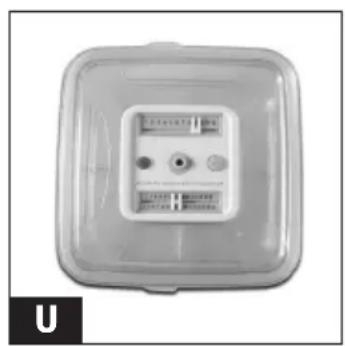
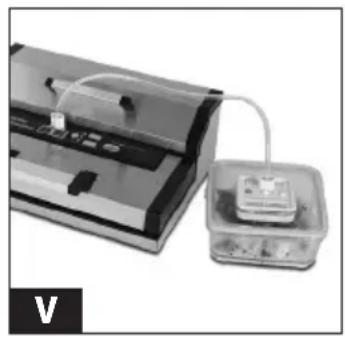
If you wish to end the marinating process early, simply press the Cancel button (B). If you wish to start the marinating process again, simply press the Marinate button (F) once more and the marinating process will start again.
NOTE: Always ensure that the seal of the lid and the edge of the containers are completely clean and dry.
Do not press any other buttons during the marinating process to avoid interruption or disruption of the marination.
At the beginning of the process, you can slightly push down on the lid so that no air can get into the container.
CLEAning VACUUM ContAinErS
- The containers without the lids can be hand washed in warm, soapy water.
- ATTENTION: Do not immerse the lids of the containers into water and don't put them into a dishwasher. The inner cap underside of the container lid can be removed and washed. Clean the lids themselves only with a damp cloth. Allow them to dry thoroughly and re-insert the cap on the underside of the lid.
- Allow all accessories to dry completely, before storage or use.
- We recommend, to keep the rubber seals elastic, to rub them from time to time with a few drops of cooking oil.
tiPS for oPtiMAL VACUUMing
- Do not overfill the bag. Always leave enough empty space at the end of the bag so that it can be placed in the vacuum chamber without problem and without wrinkles or creases.
- The open bag end should not be wet, since wet bags can not be sealed. If the foods contain moisture or the bag is wet on the inside, you should choose the highest Sealing time setting to prolong sealing time and improve the final result.
- Clean the open bag end and pull it straight, before you seal it. Make sure that there is no food residue on the end of the bag and that there are no creases in the end of the bag. The sealed seam must be completely smooth, otherwise it will not be airtight.
- Never leave too much air in the bag. Press on the bag a little to get most of the air out before vacuuming. Too much air in the bag means more work for the vacuum pump, which could overload the motor. The consequence could be that not all of the air is vacuumed out of the bag.
- Please do not vacuum foods with sharp edges, such as e.g. fish bones and mussels. The sharp edges can cut through the film so that it is no longer airtight. To vacuum such foods we recommend using a container instead of a plastic bag. Alternatively you can cover the sharp edges and ends with folded kitchen paper so that it cannot damage the bag or poke holes in it.
- You should wait for a minute after every vacuum programme before you vacuum the next bag, so that the appliance can cool down.
- If the necessary vacuum pressure has not been reached after one minute, the appliance will switch off automatically. If this happens, please check if the bag/container is not airtight or whether the end of the bag is not clean and straight in the vacuum chamber or whether there is another possible reason.
- Always check whether the ring seals on the vacuum chamber are dirty or have deformations or cracks. If the former is the case, clean and dry the ring seals, if the latter is the case, replace the seals with new ones.
- During the vacuum programme, small quantities of liquids, crumbs or food particles can be accidentally sucked into the vacuum chamber, clogging up the vacuum pump and damaging your appliance. To avoid this, we recommend first freezing juicy or moist foods, before you vacuum them in the bag, or place folded kitchen paper to form a barrier. For powdery or finely ground foods the following applies: do not overfill the bag and place a coffee filter in the bag before vacuuming the bag.
- In gereral fruits should be pre-frozen and vegetables blanched before vacuuming in order to achieve best results.
-
Delicate foods such as pastries or berries should be vacuumed in SOLIS containers. Alternatively, freeze the food 24 hours before vacuuming in a bag.
-
Fluids must always be cooled before vacuuming. Hot liquids foam or form bubbles and increase in volume if they are vacuumed. NOTE: Use only our SOLIS-containers for vacuuming.
- Keep perishable foods in the freezer or fridge. Vacuum packing extends the life of food, but does not turn it into a "preserve", i.e. a stable product at ambient temperature.
- Fill a bag 2/3 full with water, seal the end of the bag (do no vacuum!) and lay the bag in the freezer. You can use the ice for cooling drinks but also for sporting injuries.
- Many foods are already vacuum packed when bought, such as cheese or ready meals. With our vacuuming-appliance, you can vacuum them again (in SOLIS bags!), if the packaging has been opened, so that it stays fresh and retains it's full flavour. However, these foods should still only be consumed up until the date printed on the original packaging.
- Cereals such as flour, rice and cake mixes stay fresh longer if they are vacuum packed. Nuts and spices hold their flavour better and will not go rancid. Ideal for long journeys.
- Freshly washed salads can be vacuumed in a SOLIS container and kept in the refrigerator for up to a week – so there is always fresh and crispy salad to hand at meal times. If you line the container with a paper towel it will absorb excess moisture.
- Powdered or small grain foods can be vacuumed in SOLIS containers, if kitchen paper is placed on top of the food as a barrier so that the powder or grains can not get into the suction pump or inside the air extraction hose.
- Foods with sharp edges and points, such as bones or dry pasta should be wrapped in kitchen paper so that they can no longer damage the bag or cause punctures.
- You can also vacuum pack more than just food. Camping products such as matches, first aid bandages or clothing stay clean and dry when vacuum packed. Vacuum packed silverware doesn't tarnish, a vacuum packed candle is always advisable.
- The main use of the vacuum sealer is to conveniently keep many foods fresh for longer without losing their flavour. In general you could say that vacuum packing quadruples the shelf life of foods in comparison to traditional storage methods. Once you have enjoyed the advantages of this appliance, it will soon become indispensable to you and you will have to throw much less food away and thereby save money.
- Sensible ideas:
a) Cook larger portions in advance and vacuum into individual portions on meals.
b) Vacuum packing is excellent for keeping pre-prepared foods for pick nicks, camping expeditions and barbecues, fresh.
c) Vacuum packing reduces freezer burn.
d) Vacuum pack meat, fish, poultry and seafood before you put them in the fridge or freeze them.
e) Also keeps dried fruits, beans, nuts and cereals fresh for longer.
- Vacuum packing enables you to live health consciously, or pre-cooking meals specifically with suitable ingredients if you suffer from allergies; you can weigh ingredients exactly if you want to diet and have to work in an office, or if you would like to take vacuumed home-made meals in, without any hassle.
- You can also use vacuum packing for valuable objects: photographs, important documents, stamp collections, credit cards, comics, screws, nails, medicine, plasters - everything is perfectly preserved and protected from dirt and moisture when it's vacuum packed.
NOTE:
After vacuuming, please store with the cover open, never with the cover locked shut, otherwise the seals will deform and affect the function of the appliance.
VACUUMing for frEEzEr StorAGE
- Always use the freshest possible foods.
- Delicate products such as meat, fish, berries etc. should be pre-frozen so that they are not crushed during vacuuming.
Foods can be frozen for up to 24 hours without freezer burn occurring - this fact is something we will make use of. Ideally food should be split into portions before freezing. As soon as they are frozen (after about 24 hours) vacuum them in SOLIS vacuum bags and return them to the freezer. - If you wish to vacuum pack soups, stews or other liquid dishes, then they must be pre-frozen, until they have a solid consistency. Ideally, this should be done in a SOLIS vacuum bag. Liquids should not be frozen in a SOLIS container, as they might break as the liquids will expand during freezing. After evacuation, the food can be put back into the freezer.
- The same method applies for products with high fluid content. The infiltration of fluid into the vacuum system can cause damage to the appliance. This is not covered by the guarantee.
- If you wish to vacuum and freeze foods without pre-freezing them, the length of the bag should be 5cm longer than would normally be required since food expands when frozen.
- Fresh vegetables should be cleaned or peeled and before freezing they should be blanched in boiling water (or if necessary a microwave oven can be used). This ensures that the vegetables remain fresh. After allowing the food to cool, it can be split into suitable portions and frozen in SOLIS vacuum bags.
- If you wish to vacuum and freeze meat or fish without pre-freezing them then we recommend that you line the SOLIS vacuum bag or container with kitchen roll so that the kitchen roll will catch any escaped moisture.
dEfroSting frozEn Solis VACUUM BAGS
Defrosting meat, fish, fruit, vegetables and other delicate foods:
These foods should be defrosted slowly in bag or container in the refrigerator.
Defrosting bread, soups and stews: these foods can be defrosted at room temperature. If this is the case you should cut open the bag to allow the steam to escape.
Always consume food immediately after defrosting and do not re-freeze.
WHY do VACUUM PACKEd foodS IAST lonGER?
- Chemical reactions in food with air, ambient temperature and dampness, enzym-reactions, the formation of micro-organisms or contamination by insects can spoil food.
- The main reason why food nutrients lose their firmness and flavour is the oxygen in the air. The formation of micro-organisms is usually caused by air, because this removes the moisture of the foods, on the other hand, it also transports ambient moisture back into the food if they are not hermetically sealed. Frozen foods get in the freezer air, often the freezer burn.
- The vacuum-system removes up to 90% of air from the packaging. Since air is approximately 21% oxygen, it means that only 2 - 3% of the oxygen remains in the packaging. However in an oxygen content of less than 5% , most micro-organisms cannot multiply.
- In general, microorganisms can be divided into three categories: mould, yeasts and bacteria, they are present everywhere, but can only cause damage in certain conditions.
- In an environment with little air or moisture, mould cannot develop. In moisture, sugar and warmth, yeast can spread with or without air, cooling slows the growth of yeast and freezing stops it altogether.
- Bacteria can spread with or without air. One of the most dangerous bacteriums is Clostridium botulinum which can, under certain conditions, spread without air - it only needs a temperature of between 4^ and 46^ . It spreads in food without acid, in environments with little acid and in temperatures that are above 4^ for long periods of time.
- Frozen, dried or acid rich foods or foods with a high salt or sugar content, cannot contain the bacterium Botulinum.
The following foods can be lightly infected with Botulinum:
- Foods without acid e.g. meat, seafood, poultry, fish, eggs, mushrooms and olives in brine
- Foods with little acid like most vegetable
-
Foods with moderate acid content such as tomatoes, onions, chilli-peppers, figs and cucumbers.
-
To store the above at-risk foods, you should keep them in the refrigerator for short term storage or in the freezer, for long term storage, and after heating they need to be eaten straight away.
-
Some enzymes in foods can change the colour, texture and flavour of foods, which depends on storage time, storage temperature and oxygen. To prevent this enzyme reaction, vegetable should be blanched or steam cooked for a short time, or cooked in the microwave. Foods with a high acid content such as most fruits, must not be blanched. In this case, vacuum packing is enough to slow or inhibit the enzyme reaction.
-
Some dry foods, such as flour and cereals, contain insect larvae. If the food isn't vacuum packed, these can hatch during storage, making the food inedible. To prevent this these foods should be vacuumed.
- Generally, foods should be stored at low temperatures since most micro-organisms can also spread without air.
- If the temperature in your fridge is above 4^ then this can, most of all during long-term storage, support the growth of dangerous micro-organisms. Therefore the temperature setting in your fridge should be max. 4^ or less.
- If the temperature in your freezer is 0^ or less, it is ideal for storing food, but remember: freezing does not kill micro-organisms, it only slows their growth.
- The shelf life of vacuum packed dried foods is also longer, the cooler the storage temperature is: For every 10^ cooler the storage temperature, the shelf life extends by 3-4 times.
fUrthereIPS for SUCCESSFUL VACUUMing:
- Always wash your hands before preparing and vacuuming, equally the materials and appliance which you use, should be absolutely clean.
- As soon as the foods have been vacuumed, put them in the fridge or freezer, do not leave them to sit at room temperature. Make sure that the temperature in the refrigerator does not increase.
- Vacuum packing extends the shelf life of dried foods, foods with high fat content quickly become rancid in warm temperatures and oxygen. Vacuum packing extends the shelf life of nuts, coconuts or cereals. Store these in a cool dark place.
- Vacuum packing does not extend the shelf life of fruit and vegetables such as apples, bananas, potatoes and root vegetables, unless they are peeled first!
- Cabbage vegetables such as broccoli, cauliflower or cabbage give off gas when vacuum packed fresh for refrigeration. To preserve them, they must be first blanched, then frozen before packing.
WHAT YoU SHoUld AIsO KnoW:
The following food safety instructions are based on scientific findings and experience and are important for your health and optimal storage of foods:
- As soon as you thaw, or remove foods from the fridge, consume them immediately.
- Canned or ready vacuum packed foods can be vacuum packed again after opening. Follow the instructions, storing foods in a cool place once opened and treating vacuumed foods just as carefully as fresh foods. Take note of the use by date printed on the original packaging.
- Never defrost foods in warm water of with the help of other heat sources, regardless of whether they are vacuum packed or not.
- Do not consume highly perishable foods that have been stored for hours at room temperature. This is especially dangerous if they are in a thick sauce, if they are vacuum packed, or if they are kept in a low oxygen environment.
- Distribute vacuum bags evenly in the freezer so that they freeze as quickly as possible.
CIAInG And CAre
To clean your vacuum-appliance, please proceed as follows:
- Always pull the power plug from the socket and the connection plug from the appliance jack.
- Never submerge the appliance in water or hold it under running water.
- Do not use aggressive cleaning agents, solvents or abrasive materials for cleaning with appliance, these could damage the surfaces.
- Wipe clean the appliance including the sealing rings, the sealing bar and the vacuum chamber with a mild detergent and a soft, moist cloth.
- Leave the appliance to completely air dry, before storing or using the appliance.
- The appliance must not be oilied.
NOTE: The seals around the vacuum chamber should also be completely dry. If you take them out for a thorough clean then put them back in place, then they must be put back in exactly the same position so that no air can enter the vacuum chamber.
PoWEr-CABIE StorAGE
If the appliance is not in use, the power cable should be rolled up and placed in the cable compartment on the back side of the appliance. Never wrap the cord around the appliance!
Storing tHE APPLiAnCE
- CAUTION: Before storing, always check that the cover of the appliance is not locked shut! Otherwise the seals will become no longer airtight.
Store the appliance in a flat dark place, out of reach of children, at best in it's original packaging. The vacuum sealer must rest on it's base and not lie on it's side since this could cause damage to the appliance which would not be covered by warranty.
The appliance cover has to stay open and the handle must not be locked into place. Moreover, nothing should be placed on top of the appliance so that there is no pressure on the seals. Seals are consumables and are not covered by warranty.
ProBIEMS And PoSSiBIE CAUSES
tHE APPIAnCE doESn't Work
- Check if the power plug and the connection plug are properly plugged into the power socket resp. the appliance jack.
- Check if the ON/OFF switch on the back side of the appliance is in the „l“-position.
- Check whether the power cable is damaged. If this is the case, bring the appliance to SOLIS or a SOLIS approved service centre to get the cable replaced.
- Check whether the socket is working by connecting another electrical device.
- Check that the end of the bag is correctly in the vacuum chamber. The bag must not cover the air vent.
- The vacuum sealer switches off automatically if it overheats. Let it cool down first before starting to use it again.
THE APPLiAnCE iS not SEALING An EMPTY BAG
Check that the end of the bag is lying correctly on the contact rubber, as is described in section 5 (Page 106).
tHE Air is not CoMPIEtEIY SUCKEd oUt of tHE BAG
- So that the bag gets completely sealed, the open end of the bag must lie completely in the vacuum chamber without any wrinkles. The bag must not cover the air vent.
- Check that the sealing bar and the seals around the vacuum chamber are free from dirt and in the correct position. Also, the seals must not be broken or porous. Clean the seals and the sealing bar.
- Check whether the bag has a hole in it. To do this, seal the bag with some air in it and submerge it in water. If bubbles rise from it, it is leaking, use another bag.
- Use bags and films from SOLIS exclusively!
- Possibly the bag is not tightly welded because crumbs, fat or liquids are in the welds or because the bag end was not even and without creases. Open the bag, clean the end of the bag inside and out and the sealing bar and make sure that the end of the bag is lying completely flat in the vacuum chamber.
THE APPLiAnCE doES not SEAL AftEr VACUUMing
- In the appliance there is a vacuum pressure sensor. If the pressure is not high enough, the sealing pressure will not automatically start. Check the sealing bar and the seals for contamination and clean if necessary. Also check that they are in the correct position and start the appliance again.
- Check whether the seals are broken or twisted. Put them back in place or replace them with new ones - SOLIS or your nearest SOLIS-service station can help you further.
- Check whether the bag has a hole in it. To do this, seal the bag with some air in it and submerge it in water. If bubbles rise from it, it is leaking, use another bag.
- Possibly the bag is not tightly sealed because crumbs, fat or liquids are in the welds or because the bag end was not even and without creases. Open the bag, clean the end of the bag inside and out and the sealing bar and make sure that the end of the bag is lying completely flat in the vacuum chamber.
Air GoES BACK into tHE BAG AftEr it HAS BEEn SEAIEd
- Possibly the bag is not tightly welded because crumbs, fat or liquids are in the welds or because the bag end was not even and without creases. Open the bag, clean the end of the bag inside and out and the sealing bar and make sure that the end of the bag is lying completely flat in the vacuum chamber.
- Some foods produce natural gasses or ferment, such as e.g. fresh fruit and vegetables. If you suspect this to be the case, open the bag and check the food. If it is fermenting, throw the bag away. Temperature fluctuations in refrigerators can also spoil vacuum packed foods. If in doubt, always throw the food away.
- Check if the bag has a hole which has let air in. Sharp edges of foods should be covered or "padded" with folded kitchen paper, so that the edges cannot cause holes.
THE BAG Boils or doES not SEAL ProPERLY
Should the sealing bar or the rubber contact seal overheat, the bag can melt. In this case, open the cover, unplug the appliance and let both of the mentioned parts cool down for a couple of minutes.
the ContAinEr Will not VACUUM
- Check whether the air extraction hose is securely attached to the lid of the container and the air-extraction opening on the appliance.
- Press down on the lid or the hose connection at the beginning of the vacuum process to ensure that the container is airtight.
- If the container or the adaptor is visibly damaged, change the container or adaptor. Make sure that the container lid is tight all around.
- If fluid leaks from the container during vacuuming, the container and it's contents should first be cooled in the fridge.
- Check if the appliance cover is closed and locked.
- Check the function buttons on the appliance.
- Check that the edge of the container and the lid are completely dry and that there is 3cm distance between the food and the top edge of the container. If none of these suggestions apply, please contact SOLIS or a SOLIS approved service station.
the HEXAGonAI ContAinEr iS not MAintAining A VACUUM
- Check that control dial is at the "SEAL" position, before, during and after vacuuming.
- Check that the rubber seal is sitting correctly and is undamaged.
tHE SQUARE ContAinEr iS not MAintAining A VACUUM
Check that the rubber seal is sitting correctly and is undamaged.

TECHniCAL inforMation
Model no. VS5300, type 572
Product Vacuum sealer
Voltage / frequency 220-240V~50Hz
Power 180 Watt
(50 Watt pump / 130 Watt sealing unit)
Dimensions ca. 42.5 × 16 × 28.5 cm
Weight ca. 4.65kg
StorAGEtimes
| Storage type Food | Tempera-ture | Normal storage time | Storage time with vacuum packing in SOLIS containers or bags | |
| Refrigerator | raw, red meat 5±2°C 2-3 days | 8-9 days | ||
| raw, white meat 5±2°C 2-3 days | 6-9 days | |||
| Game meat 5±2°C 2-3 days | 5-7 days | |||
| Salami, sliced 5±2°C 4-6 days | 20-25 days | |||
| Soft cheese 5±2°C 5-7 days | 14-20 days | |||
| Hard cheese 5±2°C 15-20 days | 25-60 days | |||
| Fresh fish Seafood | 5±2°C 1-3 days | 4-5 days | ||
| Cooked meat 5±2°C 3-5 days | 10-14 days | |||
| Vegetables 5±2°C 1-3 days | 7-10 days | |||
| Fruit 5±2°C 5-7 days | 20 days | |||
| Eggs | 5±2°C 10-15 days | 30-50 days | ||
| Freezer | Meat | -18±2°C | 3-5 months | >1 year |
| Fish | -18±2°C | 3-4 months | >1 year | |
| Seafood | -18±2°C | 3-5 months | >1 year | |
| Room-temperature | Bread 25±2 | °C 1–2 days 6–8 days | ||
| Sponge 25±2 | °C 4–6 months > 1 year | |||
| Flour 25±2 | °C 4–5 months > 1 year | |||
| Pasta/Rice 25±2 | °C 5–6 months > 1 year | |||
| Peanuts Pulses | 25±2 °C 3–6 months > 1 year | |||
| Medical supplies | 25±2 °C 3–6 months > 1 year | |||
| Tea 25±2 | °C 5–6 months > 1 year | |||
| Coffee, ground | 25±2 °C 2–3 months > 1 year | |||
Information for correct disposal of the product in accordance with the European Directive 2002/96/EC
At the end of its working life this equipment must not be disposed of as an household waste. It must be taken to special local community waste collection centres or to a dealer providing this service. Disposing of electrical and electronic equipment separately avoids possible negative effects on the environment and human health deriving from an inappropriate disposal and enables its components to be recovered and recycled to obtain significant savings in energy and resources. In order to underline the duty to dispose of this equipment separately, the product is marked with a crossed-out dustbin.
Solis of Switzerland Ltd reserves the right to carry out technical and visual changes and modifications to improve the product at any time.

SOLIS HELpline:
044 874 64 14
(Only for customers in Switzerland)
This item stands out due to its long-life cycle and reliability. Despite this though, if a malfunction ever occurs, simply give us a call. Often a breakdown can be easily and quickly remedied with the right tip or technique without having to straight away send off the device for repair. We will give you all the advice and practical support you require.
Keep the original packaging in a safe place so that you may use it in the event that transportation or shipping of the product becomes necessary.
Solis of Switzerland Ltd
Solis-House · CH-8152 Glattbrugg-Zurich · Switzerland
Phone +41 44 874 64 54 Fax +41 44 874 64 99
info@solis.ch · www.solis.ch · www.solis.com
ACCESSories:
| Item-No | tem | ||
| 922.52 | Vacuum films | ||
| 922.51 | 2 rolls 15 x 600 cm | ||
| 922.50 | 2 rolls 20 x 600 cm | ||
| 2 rolls 30 x 600 cm | |||
| 922.61 | Vacuum bags | ||
| 922.64 | 50 bags 20 x 30 cm | ||
| 50 bags 30 x 40 cm | |||
| 922.79 | Square container | ||
| 2 piece set | |||
| 1'000 ml/2'800 ml | |||
| 922.78 | Hexagonal container | ||
| 3 piece set | |||
| 700 ml/1'400 ml/2'000 ml | |||
*food safe
You can purchase accessories for your vacuum appliance in good stores or from SOLIS AG
Phone: 0848 804 884, Fax: 0848 804 890, email: info@solis-onlineshop.ch
or www.solis-onlineshop.ch (shipping only within Switzerland).
ProdUCtBESCHriJVinG
- Luchtafzuigslang in slangcompartment
B. Knop Vacuum & Seal/Cancel
Automatisch vacumenen en sealen
C. Knop Pulse Vacuum
Handmatig vacumenen zonder automatisch sealen
E. Knop Sealing time
HET APPArAAt WErKt niEt
(50 Watt pomp/130 Watt seal-unit)
Afmetingen ca. 42,5× 16× 28,5 cm
Gewicht ca. 4,65 kg
HoUdBAArHEid
Solis of Switzerland AG
Solis-Haus · CH-8152 Glattbrugg-Zurich · Zitserland
Telefoo +41 44 874 64 54 Fax +41 44 874 64 99
info@solis.ch · www.solis.ch · www.solis.com
toEBEHorEn:
| Art.-Nr. | Articlel | |
| 922.52 | Vacuümfolie 2 roller 15 x 600 cm | 只* |
| 922.51 | 2 roller 20 x 600 cm | |
| 922.50 | 2 roller 30 x 600 cm | |
| 922.61 | Vacuümzakken 50 zakken 20 x 30 cm | 只* |
| 922.64 | 50 zakken 30 x 40 cm | |
| 922.79 | Vierkante voorraadbus Set van 2: 1'000 ml / 2'800 ml | 只* |
| 922.78 | Zeshoekige voorraadbus Set van 3: 700 ml / 1'400 ml / 2'000 ml | 只* |