RPRS01A - Saw Tacklife - Free user manual and instructions

Find the device manual for free RPRS01A Tacklife in PDF.

📄 56 pages English EN 💬 AI Question 10 questions ⚙️ Specs
Notice Tacklife RPRS01A - page 3
Product type Saw
Power 1500 W
Blade length 400 mm
No-load speed 0-2800 rpm
Cutting depth 90 mm
Weight 4.5 kg
Compatible materials Wood, plastic, light metal
Safety system Overload protection, safety switch
Included accessories Saw blade, service key, cutting guide
Recommended use Cutting various materials for DIY and construction
Maintenance Regular cleaning, blade inspection, lubrication of moving parts
Warranty 2 years

Frequently Asked Questions - RPRS01A Tacklife

How can I replace the blade of the Tacklife RPRS01A saw?
To replace the blade, unscrew the blade bolt with the provided key, remove the used blade, and install the new blade making sure to align the teeth properly. Screw the bolt back firmly.
What is the maximum cutting depth of the Tacklife RPRS01A saw?
The maximum cutting depth of the Tacklife RPRS01A saw is 65 mm in wood.
The saw does not start, what should I do?
Check that the saw is properly plugged in and that the power cable is not damaged. Also ensure that the safety lock is disengaged.
How do I adjust the cutting angle of the saw?
To adjust the cutting angle, unscrew the angle adjustment knob, position the saw at the desired angle, and tighten the knob.
Can I use the Tacklife RPRS01A saw to cut materials other than wood?
This saw is mainly designed for wood. For materials like metal or plastic, make sure to use the appropriate blade.
What is the warranty for the Tacklife RPRS01A saw?
The Tacklife RPRS01A saw is generally covered by a 24-month warranty from the date of purchase.
How do I clean and maintain my Tacklife RPRS01A saw?
After each use, unplug the saw and clean it with a dry cloth. Regularly check the condition of the blade and replace it if necessary.
Is the Tacklife RPRS01A saw suitable for beginners?
Yes, the Tacklife RPRS01A saw is designed to be easy to use, making it suitable for beginners with clear instructions.
What accessories are included with the Tacklife RPRS01A saw?
The saw generally comes with a saw blade, a blade changing key, and a user manual.
Where can I find spare parts for the Tacklife RPRS01A saw?
Spare parts can be ordered directly from the Tacklife website or from authorized dealers.

Download the instructions for your Saw in PDF format for free! Find your manual RPRS01A - Tacklife and take your electronic device back in hand. On this page are published all the documents necessary for the use of your device. RPRS01A by Tacklife.

USER MANUAL RPRS01A Tacklife

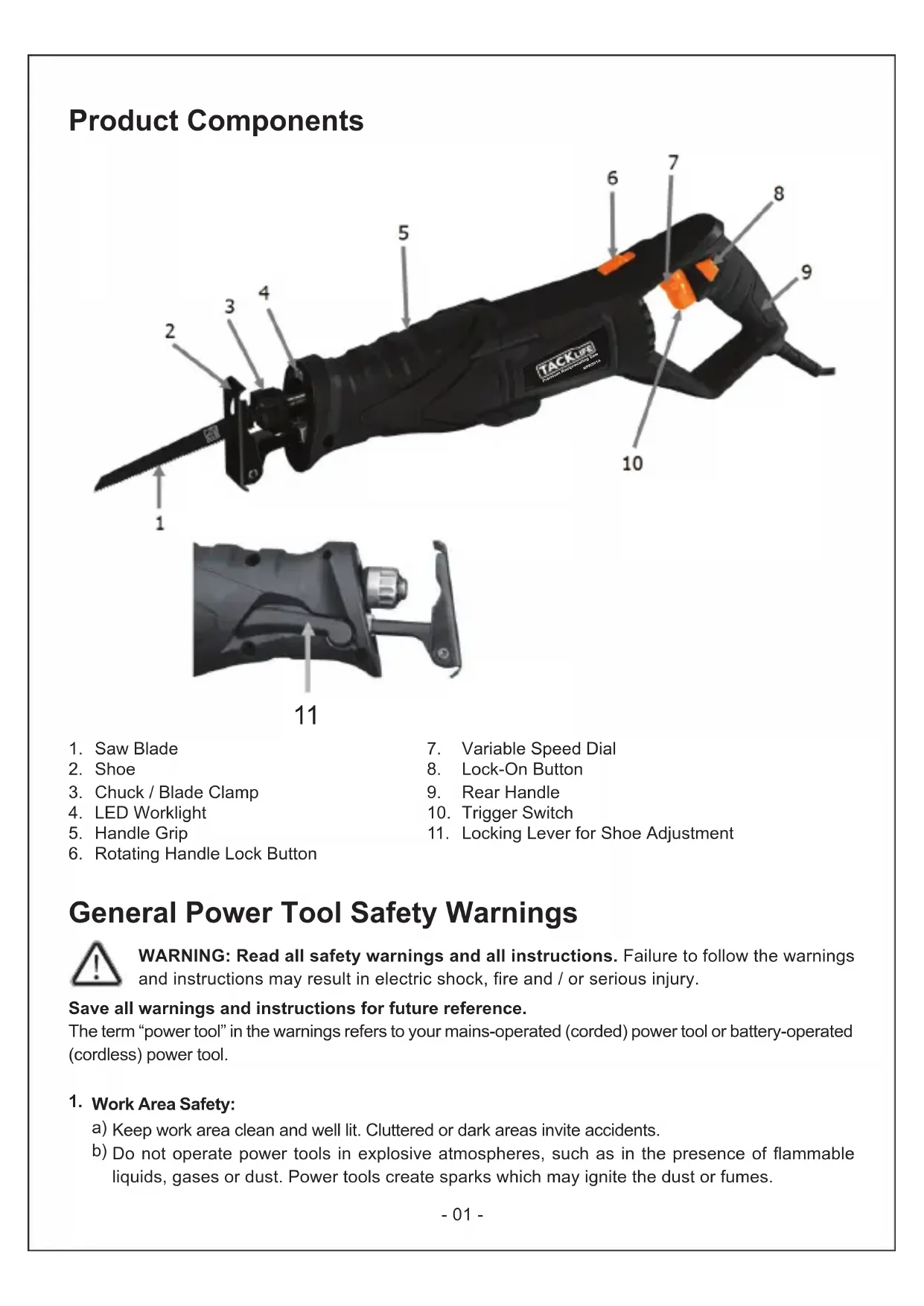
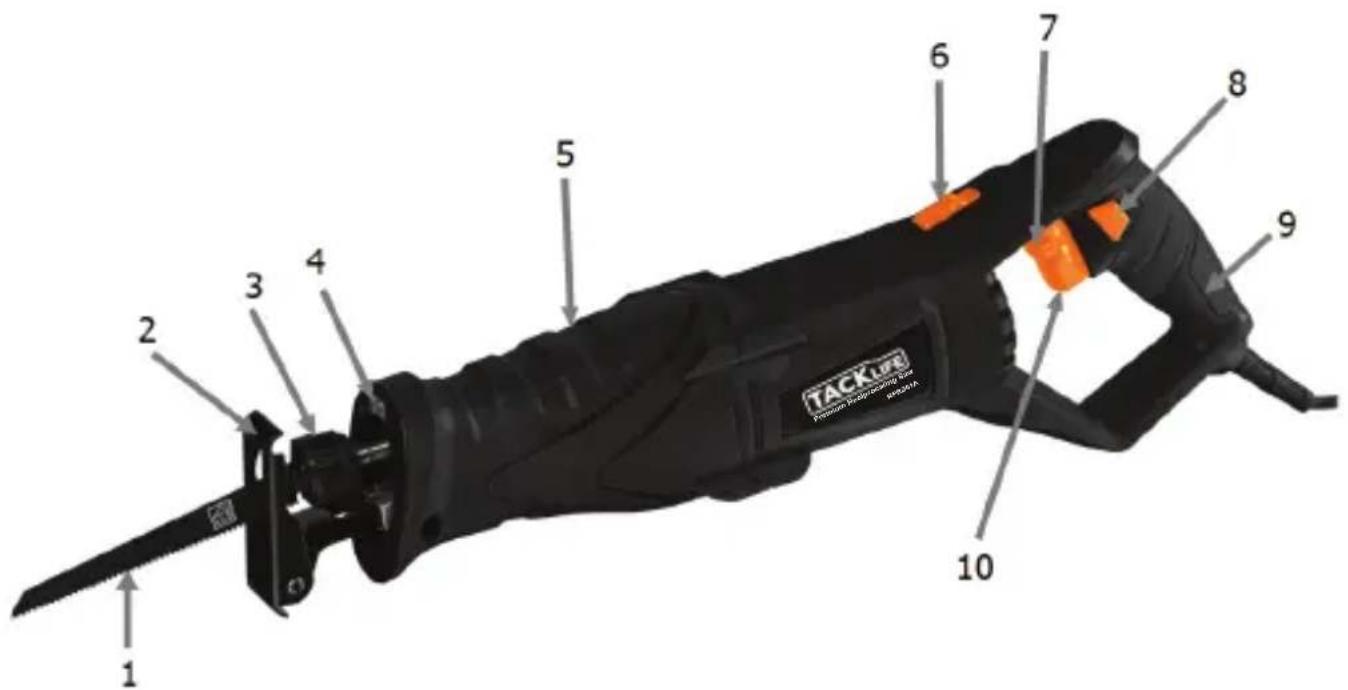
01~08 09~17 18~26 27~35 36~44 45~53 ContentsProduct Components General Power Tool Safety Warnings Save all warnings and instructions for future reference. The term “power tool” in the warnings refers to your mains-operated (corded) power tool or battery-operated (cordless) power tool.

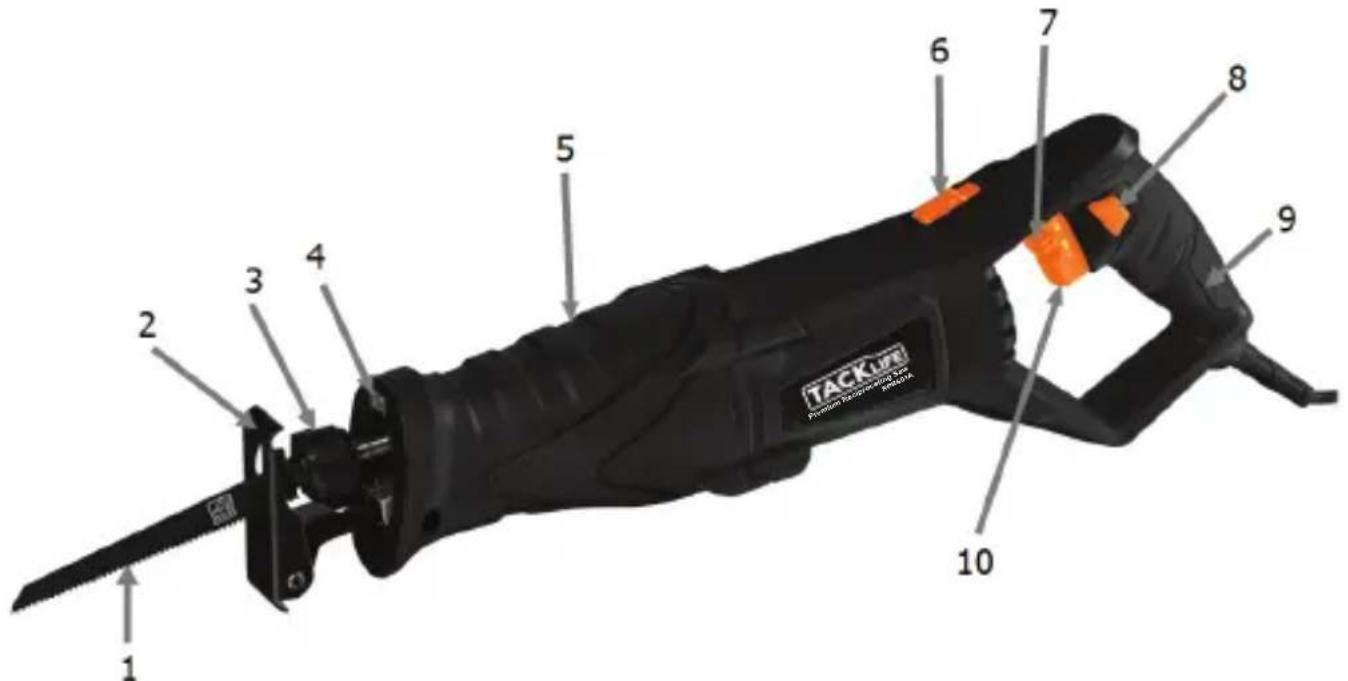
Variable Speed Dial Lock-On Button Rear Handle Trigger Switch Locking Lever for Shoe Adjustment

WARNING: Read all safety warnings and all instructions. Failure to follow the warnings

and instructions may result in electric shock, fire and / or serious injury.

Power Tool Use and Care:

Keep work area clean and well lit. Cluttered or dark areas invite accidents. Do not operate power tools in explosive atmospheres, such as in the presence of flammable liquids, gases or dust. Power tools create sparks which may ignite the dust or fumes. Keep children and bystanders away while operating a power tool. Distractions can cause you to lose control. Power tool plugs must match the outlet. Never modify the plug in any way. Do not use any adapter plugs with earthed (grounded) power tools. Unmodified plugs and matching outlets will reduce the risk of electric shock. Avoid body contact with earthed or grounded surfaces, such as pipes, radiators, ranges and refrigerators. There is an increased risk of electric shock if your body is earthed or grounded. Do not expose power tools to rain or wet conditions. Water entering a power tool will increase the risk of electric shock. Do not abuse the cord. Never use the cord for carrying, pulling or unplugging the power tool. Keep cord away from heat, oil, sharp edges or moving parts. Damaged or entangled cords increase the risk of electric shock. When operating a power tool outdoors, use an extension cord suitable for outdoor use. Use of a cord suitable for outdoor use reduces the risk of electric shock. If operating a power tool in a damp location is unavoidable, use a residual current device (RCD) protected supply. Use of an RCD reduces the risk of electric shock. Stay alert, watch what you are doing and use common sense when operating a power tool. Do not use a power tool while you are tired or under the influence of drugs, alcohol or medication. A moment of inattention while operating power tools may result in serious personal injury. Use personal protective equipment. Always wear eye protection. Protective equipment such as a dust mask, non-skid safety shoes, hard hat, or hearing protection used for appropriate conditions require will reduce personal injuries. Prevent unintentional starting. Ensure the switch is in the off-position before connecting to power source and/or battery pack, picking up or carrying the tool. Carrying power tools with your finger on the switch or energising power tools that have the switch on invites accidents. Remove any adjusting key or wrench before turning the power tool on. A wrench or a key left attached to a rotating part of the power tool may result in personal injury. Do not overreach. Keep proper footing and balance at all times. This enables better control of the power tool in unexpected situations. Dress properly. Do not wear loose clothing or jewellery. Keep your hair, clothing and gloves away from moving parts. Loose clothes, jewellery or long hair can be caught in moving parts. If devices are provided for the connection of dust extraction and collection facilities, ensure these are connected and properly used. Use of dust collection can reduce dust-related hazards. Do not force the power tool. Use the correct power tool for your application. The correct power tool will do the job better and safer at the rate for which it was designed. Do not use the power tool if the switch does not turn it on and off. Any power tool that cannot be controlled with the switch is dangerous and must be repaired. Disconnect the plug from the power source and / or the battery pack from the power tool before making any adjustments, changing accessories, or storing power tools. Such preventive safety measures reduce the risk of starting the power tool accidentally. Store idle power tools out of the reach of children and do not allow persons unfamiliar with the power tool or these instructions to operate the power tool. Power tools are dangerous in the hands of untrained users. Maintain power tools. Check for misalignment or sticking of moving parts, breakage of parts and any other condition that may affect the power tool’s operation. If damaged, have the power tool repaired before use. Many accidents are caused by poorly maintained power tools. Keep cutting tools sharp and clean. Properly maintained cutting tools with sharp cutting edges are less likely to bind and are easier to control. Use the power tool, accessories and tool bits etc. in accordance with these instructions, taking into account the working conditions and the work to be performed. Use of the power tool for operations different from those intended could result in a hazardous situation. Have your power tool serviced by a qualified repair person using only identical replacement parts. This will ensure that the safety of the power tool is maintained.

Hold power tool by insulated gripping surfaces, when performing an operation where the cutting accessory may contact hidden wiring or its own cord. Cutting accessory contacting a “live” wire may make exposed metal parts of the power tool “live” and could give the operator an electric shock. It is recommended that the tool always be supplied via a residual current device with a rated residual current of 30 mA or less. If the replacement of the supply cord is necessary, this has to be done by the manufacturer or a qualified agent in order to avoid a safety hazard. Wear protective eye goggles and a protective mask when working with materials which produce large amounts of chips or dust. Wear a protective mask when sawing other fibrous materials. Lock the shoe adjustment lever in place before turning the tool on. Secure your workpiece with clamps. Always lead the power cable away from the machine towards the rear. Only move machine towards the workpiece when switched on. Always hold machine with both hands and ensure that you have a safe footing while working. Always remove the plug from the mains socket before carrying out any work on the machine. Incorrect handling may damage the machine. Therefore always comply with these instructions. Use only sharp saw blades which are in perfect condition; replace cracked, distorted or blunt saw blades immediately. Machine should only be switched on with blade installed and shoe adjustment lever locked in place. Select tools and stroke rate according to material. Take care to maintain a constant read rate. Do not attempt to stop the saw blade with lateral pressure after switching off. Only use genuine accessories. Always use the correct supply voltage. The voltage specifications on the rating plate must correspond with the mains voltage. Do not start the saw with the blade touching any surface. The blade action will bounce the tool and may cause body injury. Allow the tool to come to a complete stop before putting it down. A running tool will jerk when the blade tip contacts any surface. Do not let anyone under the age of 18 years operate this saw. Always stand to one side when operating the saw and allow the blade to come to rest naturally. When cutting round wood, use clamps to prevent the work piece from turning on both sides of the blade. Never use your hands to remove sawdust, chips or waste close to the blade. Rags, cloths, cord, string and the like should never be left around the work area. Avoid cutting nails. Inspect the work piece and remove all nails and other foreign objects before sawing. Do not attempt to free a jammed blade before first switching off the machine. Do not slow or stop a blade with a piece of wood or other objects. The warnings, precautions, and instructions discussed in this user manual cannot cover all possible conditions and situations that may occur. It must be understood by the operator that common sense and caution are factors which cannot be built into this product, but must be supplied by the operator. Anyone using vibration tools regularly or for an extended period should first be examined by a doctor and then have regular medical check-ups to ensure medical problems are not being caused or worsened from use. Pregnant woman or people or have impaired blood circulation to the hand, past hand injuries, nervous system disorders, diabetes, or Raynaud’s Disease should not use this tool. If you feel any symptoms related to vibration (such as tingling, numbness, and white or blue fingers), seek medical advice as soon as possible. Do not smoke during use. Nicotine reduces the blood supply to the hands and fingers, increasing the risk of vibration-related injury. Wear suitable gloves to reduce the vibration effects on the user. Use tools with the lowest vibration when there is a choice. Include vibration-free periods each day of work. Grip tool as lightly as possible (while still keeping safe control of it). Let the tool do the work. To reduce vibration, maintain the tool as explained in this manual. If any abnormal vibration occurs, stop use immediately.

Safety Instructions for Reciprocating Saw When using electric tools, basic safety precautions should always be followed to reduce the risk of fire, electric shock and personal injury. Read all these instructions before attempting to operate this product and save these instructions. The machine must not be damp and must not be operated in a wet environment. Always inspect the cable and plug before using machine. Only have damage repaired by a qualified professional. Only insert the plug into the mains socket when the machine is switched off. Wear protective gloves and sturdy footwear.

Vibration Safety This tool vibrates during use. Repeated or long-term exposure to vibration may cause temporary or permanent physical injury, particularly to the hands, arms and shoulders. To reduce the risk of vibration-related injury:

Pre-Operation Changing / Fitting a Saw Blade

Rear Handle Adjustment

LED Worklight Operation Switching ON & OFF Note: The trigger switch of this reciprocating saw features variable speed control. Switching ON:

Continuous Operation:

Operation (Cont.) General Cutting

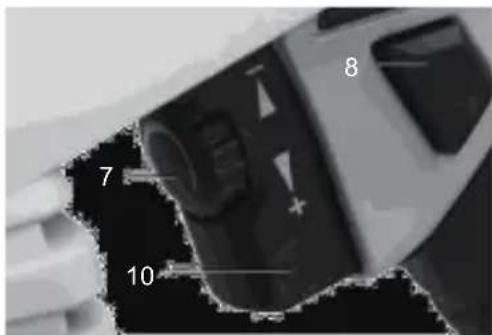
To turn ON: Press the Lock-On Button (8) after the Trigger Switch (10) is fully pressed (Fig.6), then remove your finger off the Trigger Switch (10) – the reciprocating saw will be under continuous running status. To turn OFF: Fully press the Trigger Switch (10) and the Lock-On Button (8) will spring up back to its original position, then remove your finger off the Trigger Switch (10). Install the Blade and adjust the Shoe for the job. Press and release the Trigger to ensure that the Lock-On Button is off. Plug the power cord into a mains power outlet. Make sure the Blade is clear of any foreign material and the power cord or extension cord are out of the path of the Blade. Ensure that the material to be cut is held firmly. Small work pieces should be securely clamped in a vice or clamped to the work bench. Mark out a cutting line. To begin sawing, grip the saw firmly with both hands and away from you. Rest the front of the Shoe on your workpiece with the blade above the workpiece. Switch on the tool and wait until the saw has reached its full speed before touching the work material. Guide the saw blade into the workpiece. For continuous cutting, press the Lock-On Button (8) after the Trigger Switch (10) is fully pressed , then remove your finger off the Trigger Switch (10). Allow the saw to come to a complete stop before setting it down. To prevent accidents, turn off the saw and disconnect the plug from the mains power supply after use. Clean and store the tool indoors out of children’s reach. Install a metal cutting blade (included). Coat the cutting surface with cutting oil to prevent the blade from overheating. Follow the general cutting procedures found on page 15.

IMPORTANT: Do not start the saw if the blade is in contact with anything before operation.

Metal Cutting Metals such as sheet steel, pipe, steel rods, aluminium, brass and copper can be cut with your saw. Be careful not to bend or twist the blade and do not force the cutting action. We recommend that you use cutting oil to lubricate the cutting surface when sawing soft metals and steel. It keeps the blade cooler and prolongs blade life. When cutting conduit pipe or angle iron, clamp the work in a vice if possible and cut close to the vice. To cut thin sheet metal, sandwich the sheet between hardboard or plywood and clamp layers to prevent vibration and the tearing of the metal.

Maintenance, Cleaning, Storage

This machine has been designed to operate over a long period of time with a minimum of maintenance. Continuous satisfactory operation depends upon proper machine care and regular cleaning. If the supply cord is damaged, it must be replaced by the manufacturer or a qualified electrician in order to avoid a hazard. General Inspection

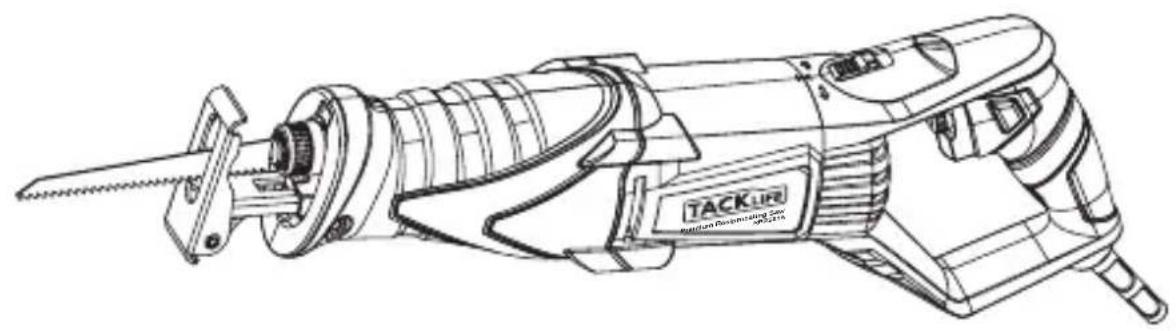
Storage:8 Store the reciprocating saw in a safe, clean, and dry location out of the reach of children. Save this instruction manual for future reference. Technical Specifications Manual Version 1.0, Issue Date: 08/2015 Disposal Instructions Keep the ventilation slots of the tool unclogged and clean at all times to prevent overheating of the engine. Regularly clean the tool’s air vents with compressed dry air. Regularly clean the machine housing using a soft cloth, preferably after each use. If the dirt does not come off, use a soft cloth moistened with soapy water. Never use solvents such as petrol, alcohol, ammonia water, etc. These solvents may damage the plastic parts. Regularly inspect all mounting screws and ensure that they are properly tightened. Regularly clean the air vents of the tool. Wipe clean with a dry cloth. Do not use solvents, water or chemicals to clean your power tool. Do not immerse any part of the grinder in liquids. Keep the motor ventilation slots clean. Keep all working controls free of dust. Premium Reciprocating Saw RPRS01AProduct Components General Power Tool Safety Warnings Save all warnings and instructions for future reference. The term “power tool” in the warnings refers to your mains-operated (corded) power tool or battery-operated (cordless) power tool.

Power Tool Use and Care:

Keep work area clean and well lit. Cluttered or dark areas invite accidents. Do not operate power tools in explosive atmospheres, such as in the presence of flammable liquids, gases or dust. Power tools create sparks which may ignite the dust or fumes. Keep children and bystanders away while operating a power tool. Distractions can cause you to lose control. Power tool plugs must match the outlet. Never modify the plug in any way. Do not use any adapter plugs with earthed (grounded) power tools. Unmodified plugs and matching outlets will reduce the risk of electric shock. Avoid body contact with earthed or grounded surfaces, such as pipes, radiators, ranges and refrigerators. There is an increased risk of electric shock if your body is earthed or grounded. Do not expose power tools to rain or wet conditions. Water entering a power tool will increase the risk of electric shock. Do not abuse the cord. Never use the cord for carrying, pulling or unplugging the power tool. Keep cord away from heat, oil, sharp edges or moving parts. Damaged or entangled cords increase the risk of electric shock. When operating a power tool outdoors, use an extension cord suitable for outdoor use. Use of a cord suitable for outdoor use reduces the risk of electric shock. If operating a power tool in a damp location is unavoidable, use a residual current device (RCD) protected supply. Use of an RCD reduces the risk of electric shock. Stay alert, watch what you are doing and use common sense when operating a power tool. Do not use a power tool while you are tired or under the influence of drugs, alcohol or medication. A moment of inattention while operating power tools may result in serious personal injury. Use personal protective equipment. Always wear eye protection. Protective equipment such as a dust mask, non-skid safety shoes, hard hat, or hearing protection used for appropriate conditions require will reduce personal injuries. Prevent unintentional starting. Ensure the switch is in the off-position before connecting to power source and/or battery pack, picking up or carrying the tool. Carrying power tools with your finger on the switch or energising power tools that have the switch on invites accidents. Remove any adjusting key or wrench before turning the power tool on. A wrench or a key left attached to a rotating part of the power tool may result in personal injury. Do not overreach. Keep proper footing and balance at all times. This enables better control of the power tool in unexpected situations. Dress properly. Do not wear loose clothing or jewellery. Keep your hair, clothing and gloves away from moving parts. Loose clothes, jewellery or long hair can be caught in moving parts. If devices are provided for the connection of dust extraction and collection facilities, ensure these are connected and properly used. Use of dust collection can reduce dust-related hazards. Do not force the power tool. Use the correct power tool for your application. The correct power tool will do the job better and safer at the rate for which it was designed. Do not use the power tool if the switch does not turn it on and off. Any power tool that cannot be controlled with the switch is dangerous and must be repaired. Disconnect the plug from the power source and / or the battery pack from the power tool before making any adjustments, changing accessories, or storing power tools. Such preventive safety measures reduce the risk of starting the power tool accidentally. Store idle power tools out of the reach of children and do not allow persons unfamiliar with the power tool or these instructions to operate the power tool. Power tools are dangerous in the hands of untrained users. Maintain power tools. Check for misalignment or sticking of moving parts, breakage of parts and any other condition that may affect the power tool’s operation. If damaged, have the power tool repaired before use. Many accidents are caused by poorly maintained power tools. Keep cutting tools sharp and clean. Properly maintained cutting tools with sharp cutting edges are less likely to bind and are easier to control. Use the power tool, accessories and tool bits etc. in accordance with these instructions, taking into account the working conditions and the work to be performed. Use of the power tool for operations different from those intended could result in a hazardous situation. Have your power tool serviced by a qualified repair person using only identical replacement parts. This will ensure that the safety of the power tool is maintained.

Hold power tool by insulated gripping surfaces, when performing an operation where the cutting accessory may contact hidden wiring or its own cord. Cutting accessory contacting a “live” wire may make exposed metal parts of the power tool “live” and could give the operator an electric shock. It is recommended that the tool always be supplied via a residual current device with a rated residual current of 30 mA or less. If the replacement of the supply cord is necessary, this has to be done by the manufacturer or a qualified agent in order to avoid a safety hazard. Wear protective eye goggles and a protective mask when working with materials which produce large amounts of chips or dust. Wear a protective mask when sawing other fibrous materials. Lock the shoe adjustment lever in place before turning the tool on. Secure your workpiece with clamps. Always lead the power cable away from the machine towards the rear. Only move machine towards the workpiece when switched on. Always hold machine with both hands and ensure that you have a safe footing while working. Always remove the plug from the mains socket before carrying out any work on the machine. Incorrect handling may damage the machine. Therefore always comply with these instructions. Use only sharp saw blades which are in perfect condition; replace cracked, distorted or blunt saw blades immediately. Machine should only be switched on with blade installed and shoe adjustment lever locked in place. Select tools and stroke rate according to material. Take care to maintain a constant read rate. Do not attempt to stop the saw blade with lateral pressure after switching off. Only use genuine accessories. Always use the correct supply voltage. The voltage specifications on the rating plate must correspond with the mains voltage. Do not start the saw with the blade touching any surface. The blade action will bounce the tool and may cause body injury. Allow the tool to come to a complete stop before putting it down. A running tool will jerk when the blade tip contacts any surface. Do not let anyone under the age of 18 years operate this saw. Always stand to one side when operating the saw and allow the blade to come to rest naturally. When cutting round wood, use clamps to prevent the work piece from turning on both sides of the blade. Never use your hands to remove sawdust, chips or waste close to the blade. Rags, cloths, cord, string and the like should never be left around the work area. Avoid cutting nails. Inspect the work piece and remove all nails and other foreign objects before sawing. Do not attempt to free a jammed blade before first switching off the machine. Do not slow or stop a blade with a piece of wood or other objects. The warnings, precautions, and instructions discussed in this user manual cannot cover all possible conditions and situations that may occur. It must be understood by the operator that common sense and caution are factors which cannot be built into this product, but must be supplied by the operator. Anyone using vibration tools regularly or for an extended period should first be examined by a doctor and then have regular medical check-ups to ensure medical problems are not being caused or worsened from use. Pregnant woman or people or have impaired blood circulation to the hand, past hand injuries, nervous system disorders, diabetes, or Raynaud’s Disease should not use this tool. If you feel any symptoms related to vibration (such as tingling, numbness, and white or blue fingers), seek medical advice as soon as possible. Do not smoke during use. Nicotine reduces the blood supply to the hands and fingers, increasing the risk of vibration-related injury. Wear suitable gloves to reduce the vibration effects on the user. Use tools with the lowest vibration when there is a choice. Include vibration-free periods each day of work. Grip tool as lightly as possible (while still keeping safe control of it). Let the tool do the work. To reduce vibration, maintain the tool as explained in this manual. If any abnormal vibration occurs, stop use immediately.

Safety Instructions for Reciprocating Saw When using electric tools, basic safety precautions should always be followed to reduce the risk of fire, electric shock and personal injury. Read all these instructions before attempting to operate this product and save these instructions. The machine must not be damp and must not be operated in a wet environment. Always inspect the cable and plug before using machine. Only have damage repaired by a qualified professional. Only insert the plug into the mains socket when the machine is switched off. Wear protective gloves and sturdy footwear.

Vibration Safety This tool vibrates during use. Repeated or long-term exposure to vibration may cause temporary or permanent physical injury, particularly to the hands, arms and shoulders. To reduce the risk of vibration-related injury:

Pre-Operation Changing / Fitting a Saw Blade

Rear Handle Adjustment

LED Worklight Operation Switching ON & OFF Note: The trigger switch of this reciprocating saw features variable speed control. Switching ON:

Continuous Operation:

Operation (Cont.) General Cutting

To turn ON: Press the Lock-On Button (8) after the Trigger Switch (10) is fully pressed (Fig.6), then remove your finger off the Trigger Switch (10) – the reciprocating saw will be under continuous running status. To turn OFF: Fully press the Trigger Switch (10) and the Lock-On Button (8) will spring up back to its original position, then remove your finger off the Trigger Switch (10). Install the Blade and adjust the Shoe for the job. Press and release the Trigger to ensure that the Lock-On Button is off. Plug the power cord into a mains power outlet. Make sure the Blade is clear of any foreign material and the power cord or extension cord are out of the path of the Blade. Ensure that the material to be cut is held firmly. Small work pieces should be securely clamped in a vice or clamped to the work bench. Mark out a cutting line. To begin sawing, grip the saw firmly with both hands and away from you. Rest the front of the Shoe on your workpiece with the blade above the workpiece. Switch on the tool and wait until the saw has reached its full speed before touching the work material. Guide the saw blade into the workpiece. For continuous cutting, press the Lock-On Button (8) after the Trigger Switch (10) is fully pressed , then remove your finger off the Trigger Switch (10). Allow the saw to come to a complete stop before setting it down. To prevent accidents, turn off the saw and disconnect the plug from the mains power supply after use. Clean and store the tool indoors out of children’s reach. Install a metal cutting blade (included). Coat the cutting surface with cutting oil to prevent the blade from overheating. Follow the general cutting procedures found on page 15.

IMPORTANT: Do not start the saw if the blade is in contact with anything before operation.

Metal Cutting Metals such as sheet steel, pipe, steel rods, aluminium, brass and copper can be cut with your saw. Be careful not to bend or twist the blade and do not force the cutting action. We recommend that you use cutting oil to lubricate the cutting surface when sawing soft metals and steel. It keeps the blade cooler and prolongs blade life. When cutting conduit pipe or angle iron, clamp the work in a vice if possible and cut close to the vice. To cut thin sheet metal, sandwich the sheet between hardboard or plywood and clamp layers to prevent vibration and the tearing of the metal.

Maintenance, Cleaning, Storage

This machine has been designed to operate over a long period of time with a minimum of maintenance. Continuous satisfactory operation depends upon proper machine care and regular cleaning. If the supply cord is damaged, it must be replaced by the manufacturer or a qualified electrician in order to avoid a hazard. General Inspection

Storage:8 Store the reciprocating saw in a safe, clean, and dry location out of the reach of children. Save this instruction manual for future reference. Technical Specifications Manual Version 1.0, Issue Date: 08/2015 Disposal Instructions Keep the ventilation slots of the tool unclogged and clean at all times to prevent overheating of the engine. Regularly clean the tool’s air vents with compressed dry air. Regularly clean the machine housing using a soft cloth, preferably after each use. If the dirt does not come off, use a soft cloth moistened with soapy water. Never use solvents such as petrol, alcohol, ammonia water, etc. These solvents may damage the plastic parts. Regularly inspect all mounting screws and ensure that they are properly tightened. Regularly clean the air vents of the tool. Wipe clean with a dry cloth. Do not use solvents, water or chemicals to clean your power tool. Do not immerse any part of the grinder in liquids. Keep the motor ventilation slots clean. Keep all working controls free of dust.Product Components General Power Tool Safety Warnings Save all warnings and instructions for future reference. The term “power tool” in the warnings refers to your mains-operated (corded) power tool or battery-operated (cordless) power tool.

WARNING! Do not saw materials containing asbestos!!!

Power Tool Use and Care:

Keep work area clean and well lit. Cluttered or dark areas invite accidents. Do not operate power tools in explosive atmospheres, such as in the presence of flammable liquids, gases or dust. Power tools create sparks which may ignite the dust or fumes. Keep children and bystanders away while operating a power tool. Distractions can cause you to lose control. Power tool plugs must match the outlet. Never modify the plug in any way. Do not use any adapter plugs with earthed (grounded) power tools. Unmodified plugs and matching outlets will reduce the risk of electric shock. Avoid body contact with earthed or grounded surfaces, such as pipes, radiators, ranges and refrigerators. There is an increased risk of electric shock if your body is earthed or grounded. Do not expose power tools to rain or wet conditions. Water entering a power tool will increase the risk of electric shock. Do not abuse the cord. Never use the cord for carrying, pulling or unplugging the power tool. Keep cord away from heat, oil, sharp edges or moving parts. Damaged or entangled cords increase the risk of electric shock. When operating a power tool outdoors, use an extension cord suitable for outdoor use. Use of a cord suitable for outdoor use reduces the risk of electric shock. If operating a power tool in a damp location is unavoidable, use a residual current device (RCD) protected supply. Use of an RCD reduces the risk of electric shock. Stay alert, watch what you are doing and use common sense when operating a power tool. Do not use a power tool while you are tired or under the influence of drugs, alcohol or medication. A moment of inattention while operating power tools may result in serious personal injury. Use personal protective equipment. Always wear eye protection. Protective equipment such as a dust mask, non-skid safety shoes, hard hat, or hearing protection used for appropriate conditions require will reduce personal injuries. Prevent unintentional starting. Ensure the switch is in the off-position before connecting to power source and/or battery pack, picking up or carrying the tool. Carrying power tools with your finger on the switch or energising power tools that have the switch on invites accidents. Remove any adjusting key or wrench before turning the power tool on. A wrench or a key left attached to a rotating part of the power tool may result in personal injury. Do not overreach. Keep proper footing and balance at all times. This enables better control of the power tool in unexpected situations. Dress properly. Do not wear loose clothing or jewellery. Keep your hair, clothing and gloves away from moving parts. Loose clothes, jewellery or long hair can be caught in moving parts. If devices are provided for the connection of dust extraction and collection facilities, ensure these are connected and properly used. Use of dust collection can reduce dust-related hazards. Do not force the power tool. Use the correct power tool for your application. The correct power tool will do the job better and safer at the rate for which it was designed. Do not use the power tool if the switch does not turn it on and off. Any power tool that cannot be controlled with the switch is dangerous and must be repaired. Disconnect the plug from the power source and / or the battery pack from the power tool before making any adjustments, changing accessories, or storing power tools. Such preventive safety measures reduce the risk of starting the power tool accidentally. Store idle power tools out of the reach of children and do not allow persons unfamiliar with the power tool or these instructions to operate the power tool. Power tools are dangerous in the hands of untrained users. Maintain power tools. Check for misalignment or sticking of moving parts, breakage of parts and any other condition that may affect the power tool’s operation. If damaged, have the power tool repaired before use. Many accidents are caused by poorly maintained power tools. Keep cutting tools sharp and clean. Properly maintained cutting tools with sharp cutting edges are less likely to bind and are easier to control. Use the power tool, accessories and tool bits etc. in accordance with these instructions, taking into account the working conditions and the work to be performed. Use of the power tool for operations different from those intended could result in a hazardous situation. Have your power tool serviced by a qualified repair person using only identical replacement parts. This will ensure that the safety of the power tool is maintained.

Hold power tool by insulated gripping surfaces, when performing an operation where the cutting accessory may contact hidden wiring or its own cord. Cutting accessory contacting a “live” wire may make exposed metal parts of the power tool “live” and could give the operator an electric shock. It is recommended that the tool always be supplied via a residual current device with a rated residual current of 30 mA or less. If the replacement of the supply cord is necessary, this has to be done by the manufacturer or a qualified agent in order to avoid a safety hazard. Wear protective eye goggles and a protective mask when working with materials which produce large amounts of chips or dust. Wear a protective mask when sawing other fibrous materials. Lock the shoe adjustment lever in place before turning the tool on. Secure your workpiece with clamps. Always lead the power cable away from the machine towards the rear. Only move machine towards the workpiece when switched on. Always hold machine with both hands and ensure that you have a safe footing while working. Always remove the plug from the mains socket before carrying out any work on the machine. Incorrect handling may damage the machine. Therefore always comply with these instructions. Use only sharp saw blades which are in perfect condition; replace cracked, distorted or blunt saw blades immediately. Machine should only be switched on with blade installed and shoe adjustment lever locked in place. Select tools and stroke rate according to material. Take care to maintain a constant read rate. Do not attempt to stop the saw blade with lateral pressure after switching off. Only use genuine accessories. Always use the correct supply voltage. The voltage specifications on the rating plate must correspond with the mains voltage. Do not start the saw with the blade touching any surface. The blade action will bounce the tool and may cause body injury. Allow the tool to come to a complete stop before putting it down. A running tool will jerk when the blade tip contacts any surface. Do not let anyone under the age of 18 years operate this saw. Always stand to one side when operating the saw and allow the blade to come to rest naturally. When cutting round wood, use clamps to prevent the work piece from turning on both sides of the blade. Never use your hands to remove sawdust, chips or waste close to the blade. Rags, cloths, cord, string and the like should never be left around the work area. Avoid cutting nails. Inspect the work piece and remove all nails and other foreign objects before sawing. Do not attempt to free a jammed blade before first switching off the machine. Do not slow or stop a blade with a piece of wood or other objects. The warnings, precautions, and instructions discussed in this user manual cannot cover all possible conditions and situations that may occur. It must be understood by the operator that common sense and caution are factors which cannot be built into this product, but must be supplied by the operator. Anyone using vibration tools regularly or for an extended period should first be examined by a doctor and then have regular medical check-ups to ensure medical problems are not being caused or worsened from use. Pregnant woman or people or have impaired blood circulation to the hand, past hand injuries, nervous system disorders, diabetes, or Raynaud’s Disease should not use this tool. If you feel any symptoms related to vibration (such as tingling, numbness, and white or blue fingers), seek medical advice as soon as possible. Do not smoke during use. Nicotine reduces the blood supply to the hands and fingers, increasing the risk of vibration-related injury. Wear suitable gloves to reduce the vibration effects on the user. Use tools with the lowest vibration when there is a choice. Include vibration-free periods each day of work. Grip tool as lightly as possible (while still keeping safe control of it). Let the tool do the work. To reduce vibration, maintain the tool as explained in this manual. If any abnormal vibration occurs, stop use immediately.

Safety Instructions for Reciprocating Saw When using electric tools, basic safety precautions should always be followed to reduce the risk of fire, electric shock and personal injury. Read all these instructions before attempting to operate this product and save these instructions. The machine must not be damp and must not be operated in a wet environment. Always inspect the cable and plug before using machine. Only have damage repaired by a qualified professional. Only insert the plug into the mains socket when the machine is switched off. Wear protective gloves and sturdy footwear.

Vibration Safety This tool vibrates during use. Repeated or long-term exposure to vibration may cause temporary or permanent physical injury, particularly to the hands, arms and shoulders. To reduce the risk of vibration-related injury:

Pre-Operation Changing / Fitting a Saw Blade

Rear Handle Adjustment

LED Worklight Operation Switching ON & OFF Note: The trigger switch of this reciprocating saw features variable speed control. Switching ON:

Continuous Operation:

Operation (Cont.) General Cutting

To turn ON: Press the Lock-On Button (8) after the Trigger Switch (10) is fully pressed (Fig.6), then remove your finger off the Trigger Switch (10) – the reciprocating saw will be under continuous running status. To turn OFF: Fully press the Trigger Switch (10) and the Lock-On Button (8) will spring up back to its original position, then remove your finger off the Trigger Switch (10). Install the Blade and adjust the Shoe for the job. Press and release the Trigger to ensure that the Lock-On Button is off. Plug the power cord into a mains power outlet. Make sure the Blade is clear of any foreign material and the power cord or extension cord are out of the path of the Blade. Ensure that the material to be cut is held firmly. Small work pieces should be securely clamped in a vice or clamped to the work bench. Mark out a cutting line. To begin sawing, grip the saw firmly with both hands and away from you. Rest the front of the Shoe on your workpiece with the blade above the workpiece. Switch on the tool and wait until the saw has reached its full speed before touching the work material. Guide the saw blade into the workpiece. For continuous cutting, press the Lock-On Button (8) after the Trigger Switch (10) is fully pressed , then remove your finger off the Trigger Switch (10). Allow the saw to come to a complete stop before setting it down. To prevent accidents, turn off the saw and disconnect the plug from the mains power supply after use. Clean and store the tool indoors out of children’s reach. Install a metal cutting blade (included). Coat the cutting surface with cutting oil to prevent the blade from overheating. Follow the general cutting procedures found on page 15.

IMPORTANT: Do not start the saw if the blade is in contact with anything before operation.

Metal Cutting Metals such as sheet steel, pipe, steel rods, aluminium, brass and copper can be cut with your saw. Be careful not to bend or twist the blade and do not force the cutting action. We recommend that you use cutting oil to lubricate the cutting surface when sawing soft metals and steel. It keeps the blade cooler and prolongs blade life. When cutting conduit pipe or angle iron, clamp the work in a vice if possible and cut close to the vice. To cut thin sheet metal, sandwich the sheet between hardboard or plywood and clamp layers to prevent vibration and the tearing of the metal.

Maintenance, Cleaning, Storage

This machine has been designed to operate over a long period of time with a minimum of maintenance. Continuous satisfactory operation depends upon proper machine care and regular cleaning. If the supply cord is damaged, it must be replaced by the manufacturer or a qualified electrician in order to avoid a hazard. General Inspection

Storage:8 Store the reciprocating saw in a safe, clean, and dry location out of the reach of children. Save this instruction manual for future reference. Technical Specifications Manual Version 1.0, Issue Date: 08/2015 Disposal Instructions Keep the ventilation slots of the tool unclogged and clean at all times to prevent overheating of the engine. Regularly clean the tool’s air vents with compressed dry air. Regularly clean the machine housing using a soft cloth, preferably after each use. If the dirt does not come off, use a soft cloth moistened with soapy water. Never use solvents such as petrol, alcohol, ammonia water, etc. These solvents may damage the plastic parts. Regularly inspect all mounting screws and ensure that they are properly tightened. Regularly clean the air vents of the tool. Wipe clean with a dry cloth. Do not use solvents, water or chemicals to clean your power tool. Do not immerse any part of the grinder in liquids. Keep the motor ventilation slots clean. Keep all working controls free of dust.Product Components General Power Tool Safety Warnings Save all warnings and instructions for future reference. The term “power tool” in the warnings refers to your mains-operated (corded) power tool or battery-operated (cordless) power tool.

Ensure the machine is unplugged from the mains power outlet before changing and fitting a blade.

Power Tool Use and Care:

Hold power tool by insulated gripping surfaces, when performing an operation where the cutting accessory may contact hidden wiring or its own cord. Cutting accessory contacting a “live” wire may make exposed metal parts of the power tool “live” and could give the operator an electric shock. It is recommended that the tool always be supplied via a residual current device with a rated residual current of 30 mA or less. If the replacement of the supply cord is necessary, this has to be done by the manufacturer or a qualified agent in order to avoid a safety hazard. Wear protective eye goggles and a protective mask when working with materials which produce large amounts of chips or dust. Wear a protective mask when sawing other fibrous materials. Lock the shoe adjustment lever in place before turning the tool on. Secure your workpiece with clamps. Always lead the power cable away from the machine towards the rear. Only move machine towards the workpiece when switched on. Always hold machine with both hands and ensure that you have a safe footing while working. Always remove the plug from the mains socket before carrying out any work on the machine. Incorrect handling may damage the machine. Therefore always comply with these instructions. Use only sharp saw blades which are in perfect condition; replace cracked, distorted or blunt saw blades immediately. Machine should only be switched on with blade installed and shoe adjustment lever locked in place. Select tools and stroke rate according to material. Take care to maintain a constant read rate. Do not attempt to stop the saw blade with lateral pressure after switching off. Only use genuine accessories. Always use the correct supply voltage. The voltage specifications on the rating plate must correspond with the mains voltage. Do not start the saw with the blade touching any surface. The blade action will bounce the tool and may cause body injury. Allow the tool to come to a complete stop before putting it down. A running tool will jerk when the blade tip contacts any surface. Do not let anyone under the age of 18 years operate this saw. Always stand to one side when operating the saw and allow the blade to come to rest naturally. When cutting round wood, use clamps to prevent the work piece from turning on both sides of the blade. Never use your hands to remove sawdust, chips or waste close to the blade. Rags, cloths, cord, string and the like should never be left around the work area. Avoid cutting nails. Inspect the work piece and remove all nails and other foreign objects before sawing. Do not attempt to free a jammed blade before first switching off the machine. Do not slow or stop a blade with a piece of wood or other objects. The warnings, precautions, and instructions discussed in this user manual cannot cover all possible conditions and situations that may occur. It must be understood by the operator that common sense and caution are factors which cannot be built into this product, but must be supplied by the operator. Anyone using vibration tools regularly or for an extended period should first be examined by a doctor and then have regular medical check-ups to ensure medical problems are not being caused or worsened from use. Pregnant woman or people or have impaired blood circulation to the hand, past hand injuries, nervous system disorders, diabetes, or Raynaud’s Disease should not use this tool. If you feel any symptoms related to vibration (such as tingling, numbness, and white or blue fingers), seek medical advice as soon as possible. Do not smoke during use. Nicotine reduces the blood supply to the hands and fingers, increasing the risk of vibration-related injury. Wear suitable gloves to reduce the vibration effects on the user. Use tools with the lowest vibration when there is a choice. Include vibration-free periods each day of work. Grip tool as lightly as possible (while still keeping safe control of it). Let the tool do the work. To reduce vibration, maintain the tool as explained in this manual. If any abnormal vibration occurs, stop use immediately.

Safety Instructions for Reciprocating Saw When using electric tools, basic safety precautions should always be followed to reduce the risk of fire, electric shock and personal injury. Read all these instructions before attempting to operate this product and save these instructions. The machine must not be damp and must not be operated in a wet environment. Always inspect the cable and plug before using machine. Only have damage repaired by a qualified professional. Only insert the plug into the mains socket when the machine is switched off. Wear protective gloves and sturdy footwear.

Vibration Safety This tool vibrates during use. Repeated or long-term exposure to vibration may cause temporary or permanent physical injury, particularly to the hands, arms and shoulders. To reduce the risk of vibration-related injury:

Pre-Operation Changing / Fitting a Saw Blade

Rear Handle Adjustment

LED Worklight Operation Switching ON & OFF Note: The trigger switch of this reciprocating saw features variable speed control. Switching ON:

Continuous Operation:

Operation (Cont.) General Cutting

To turn ON: Press the Lock-On Button (8) after the Trigger Switch (10) is fully pressed (Fig.6), then remove your finger off the Trigger Switch (10) – the reciprocating saw will be under continuous running status. To turn OFF: Fully press the Trigger Switch (10) and the Lock-On Button (8) will spring up back to its original position, then remove your finger off the Trigger Switch (10). Install the Blade and adjust the Shoe for the job. Press and release the Trigger to ensure that the Lock-On Button is off. Plug the power cord into a mains power outlet. Make sure the Blade is clear of any foreign material and the power cord or extension cord are out of the path of the Blade. Ensure that the material to be cut is held firmly. Small work pieces should be securely clamped in a vice or clamped to the work bench. Mark out a cutting line. To begin sawing, grip the saw firmly with both hands and away from you. Rest the front of the Shoe on your workpiece with the blade above the workpiece. Switch on the tool and wait until the saw has reached its full speed before touching the work material. Guide the saw blade into the workpiece. For continuous cutting, press the Lock-On Button (8) after the Trigger Switch (10) is fully pressed , then remove your finger off the Trigger Switch (10). Allow the saw to come to a complete stop before setting it down. To prevent accidents, turn off the saw and disconnect the plug from the mains power supply after use. Clean and store the tool indoors out of children’s reach. Install a metal cutting blade (included). Coat the cutting surface with cutting oil to prevent the blade from overheating. Follow the general cutting procedures found on page 15.

IMPORTANT: Do not start the saw if the blade is in contact with anything before operation.

Metal Cutting Metals such as sheet steel, pipe, steel rods, aluminium, brass and copper can be cut with your saw. Be careful not to bend or twist the blade and do not force the cutting action. We recommend that you use cutting oil to lubricate the cutting surface when sawing soft metals and steel. It keeps the blade cooler and prolongs blade life. When cutting conduit pipe or angle iron, clamp the work in a vice if possible and cut close to the vice. To cut thin sheet metal, sandwich the sheet between hardboard or plywood and clamp layers to prevent vibration and the tearing of the metal.

Maintenance, Cleaning, Storage

This machine has been designed to operate over a long period of time with a minimum of maintenance. Continuous satisfactory operation depends upon proper machine care and regular cleaning. If the supply cord is damaged, it must be replaced by the manufacturer or a qualified electrician in order to avoid a hazard. General Inspection

Storage:8 Store the reciprocating saw in a safe, clean, and dry location out of the reach of children. Save this instruction manual for future reference. Technical Specifications Manual Version 1.0, Issue Date: 08/2015 Disposal Instructions Keep the ventilation slots of the tool unclogged and clean at all times to prevent overheating of the engine. Regularly clean the tool’s air vents with compressed dry air. Regularly clean the machine housing using a soft cloth, preferably after each use. If the dirt does not come off, use a soft cloth moistened with soapy water. Never use solvents such as petrol, alcohol, ammonia water, etc. These solvents may damage the plastic parts. Regularly inspect all mounting screws and ensure that they are properly tightened. Regularly clean the air vents of the tool. Wipe clean with a dry cloth. Do not use solvents, water or chemicals to clean your power tool. Do not immerse any part of the grinder in liquids. Keep the motor ventilation slots clean. Keep all working controls free of dust.Product Components General Power Tool Safety Warnings Save all warnings and instructions for future reference. The term “power tool” in the warnings refers to your mains-operated (corded) power tool or battery-operated (cordless) power tool.

Power Tool Use and Care:

Hold power tool by insulated gripping surfaces, when performing an operation where the cutting accessory may contact hidden wiring or its own cord. Cutting accessory contacting a “live” wire may make exposed metal parts of the power tool “live” and could give the operator an electric shock. It is recommended that the tool always be supplied via a residual current device with a rated residual current of 30 mA or less. If the replacement of the supply cord is necessary, this has to be done by the manufacturer or a qualified agent in order to avoid a safety hazard. Wear protective eye goggles and a protective mask when working with materials which produce large amounts of chips or dust. Wear a protective mask when sawing other fibrous materials. Lock the shoe adjustment lever in place before turning the tool on. Secure your workpiece with clamps. Always lead the power cable away from the machine towards the rear. Only move machine towards the workpiece when switched on. Always hold machine with both hands and ensure that you have a safe footing while working. Always remove the plug from the mains socket before carrying out any work on the machine. Incorrect handling may damage the machine. Therefore always comply with these instructions. Use only sharp saw blades which are in perfect condition; replace cracked, distorted or blunt saw blades immediately. Machine should only be switched on with blade installed and shoe adjustment lever locked in place. Select tools and stroke rate according to material. Take care to maintain a constant read rate. Do not attempt to stop the saw blade with lateral pressure after switching off. Only use genuine accessories. Always use the correct supply voltage. The voltage specifications on the rating plate must correspond with the mains voltage. Do not start the saw with the blade touching any surface. The blade action will bounce the tool and may cause body injury. Allow the tool to come to a complete stop before putting it down. A running tool will jerk when the blade tip contacts any surface. Do not let anyone under the age of 18 years operate this saw. Always stand to one side when operating the saw and allow the blade to come to rest naturally. When cutting round wood, use clamps to prevent the work piece from turning on both sides of the blade. Never use your hands to remove sawdust, chips or waste close to the blade. Rags, cloths, cord, string and the like should never be left around the work area. Avoid cutting nails. Inspect the work piece and remove all nails and other foreign objects before sawing. Do not attempt to free a jammed blade before first switching off the machine. Do not slow or stop a blade with a piece of wood or other objects. The warnings, precautions, and instructions discussed in this user manual cannot cover all possible conditions and situations that may occur. It must be understood by the operator that common sense and caution are factors which cannot be built into this product, but must be supplied by the operator. Anyone using vibration tools regularly or for an extended period should first be examined by a doctor and then have regular medical check-ups to ensure medical problems are not being caused or worsened from use. Pregnant woman or people or have impaired blood circulation to the hand, past hand injuries, nervous system disorders, diabetes, or Raynaud’s Disease should not use this tool. If you feel any symptoms related to vibration (such as tingling, numbness, and white or blue fingers), seek medical advice as soon as possible. Do not smoke during use. Nicotine reduces the blood supply to the hands and fingers, increasing the risk of vibration-related injury. Wear suitable gloves to reduce the vibration effects on the user. Use tools with the lowest vibration when there is a choice. Include vibration-free periods each day of work. Grip tool as lightly as possible (while still keeping safe control of it). Let the tool do the work. To reduce vibration, maintain the tool as explained in this manual. If any abnormal vibration occurs, stop use immediately.

Safety Instructions for Reciprocating Saw When using electric tools, basic safety precautions should always be followed to reduce the risk of fire, electric shock and personal injury. Read all these instructions before attempting to operate this product and save these instructions. The machine must not be damp and must not be operated in a wet environment. Always inspect the cable and plug before using machine. Only have damage repaired by a qualified professional. Only insert the plug into the mains socket when the machine is switched off. Wear protective gloves and sturdy footwear.

Vibration Safety This tool vibrates during use. Repeated or long-term exposure to vibration may cause temporary or permanent physical injury, particularly to the hands, arms and shoulders. To reduce the risk of vibration-related injury:

Pre-Operation Changing / Fitting a Saw Blade

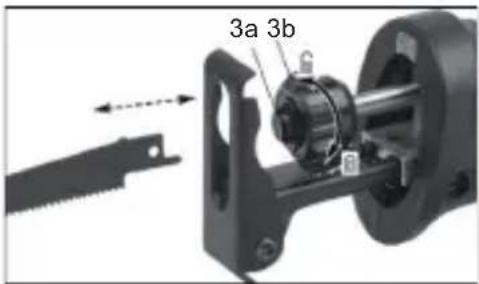
Always ensure that the saw is switched off and unplugged from the mains power supply before making any adjustments. Before plugging in the power cord, always pull on the blade to make sure it is securely locked in the blade clamp. Failure to do so may result in serious injury. WARNING! Do not operate the reciprocating saw if the adjustable shoe is not installed and fitted correctly.

Fig. 23a 3bFig. 1 The rear handle of this tool can be rotated around the main body of the motor and locked at three different angles (-90°, 0°, +90°) so that you can operate the tool in the 6most comfortable position.

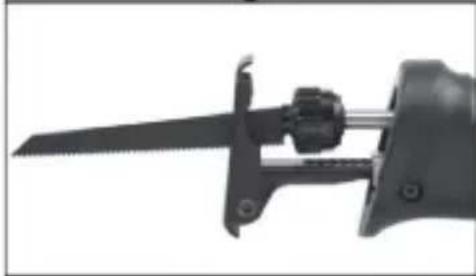
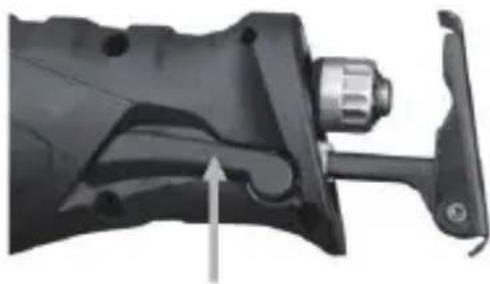
Fig. 3Open the Blade Clamp (3b) by rotating it in an anti–clockwise direction entirely (Fig.1). This will retract the pin and allow the saw blade to be inserted. Insert the saw blade into the Chuck (3a) to the deepest position and release the Blade Clamp (3b) to lock the blade in position. Carefully pull on the blade to ensure it is securely fastened. Pull the Locking Lever for Shoe Adjustment (11) downwards (Fig.2). Adjust the shoe (2) to the desired position. Secure the shoe (2) in place by raising the Locking Lever for Shoe Adjustment (11) to the original position. Push back the Rotating Handle Lock Button (6) to unlock the rear handle (Fig.3). Turn the rear handle to desired angle and release the Rotating Handle Lock Button (6) to lock into desired position. Turn the rear handle left or right so that it locks at the nearest preset position with a light click. The rear handle can only be adjusted to -90°, 0°, 90° angles.

Rear Handle Adjustment

When the power cord is plugged into the mains power outlet, LED Worklight (4) will shine. This LED Worklight can assist in better vision when working in darker areas. The LED Worklight (4) will turn off when the power cord is disconnected from the mains power supply. LED Worklight Operation Switching ON & OFF Note: The trigger switch of this reciprocating saw features variable speed control. Switching ON:

Continuous Operation:

Operation (Cont.) General Cutting

Plug the cord set into the mains power outlet. Once you have adjusted the speed of the saw blade, fully press the trigger switch (10) to operate the machine. Fully release the trigger switch (10). To turn ON: Press the Lock-On Button (8) after the Trigger Switch (10) is fully pressed (Fig.6), then remove your finger off the Trigger Switch (10) – the reciprocating saw will be under continuous running status. To turn OFF: Fully press the Trigger Switch (10) and the Lock-On Button (8) will spring up back to its original position, then remove your finger off the Trigger Switch (10). Install the Blade and adjust the Shoe for the job. Press and release the Trigger to ensure that the Lock-On Button is off. Plug the power cord into a mains power outlet. Make sure the Blade is clear of any foreign material and the power cord or extension cord are out of the path of the Blade. Ensure that the material to be cut is held firmly. Small work pieces should be securely clamped in a vice or clamped to the work bench. Mark out a cutting line. To begin sawing, grip the saw firmly with both hands and away from you. Rest the front of the Shoe on your workpiece with the blade above the workpiece. Switch on the tool and wait until the saw has reached its full speed before touching the work material. Guide the saw blade into the workpiece. For continuous cutting, press the Lock-On Button (8) after the Trigger Switch (10) is fully pressed , then remove your finger off the Trigger Switch (10). Allow the saw to come to a complete stop before setting it down. To prevent accidents, turn off the saw and disconnect the plug from the mains power supply after use. Clean and store the tool indoors out of children’s reach. Install a metal cutting blade (included). Coat the cutting surface with cutting oil to prevent the blade from overheating. Follow the general cutting procedures found on page 15.

IMPORTANT: Do not start the saw if the blade is in contact with anything before operation.

Metal Cutting Metals such as sheet steel, pipe, steel rods, aluminium, brass and copper can be cut with your saw. Be careful not to bend or twist the blade and do not force the cutting action. We recommend that you use cutting oil to lubricate the cutting surface when sawing soft metals and steel. It keeps the blade cooler and prolongs blade life. When cutting conduit pipe or angle iron, clamp the work in a vice if possible and cut close to the vice. To cut thin sheet metal, sandwich the sheet between hardboard or plywood and clamp layers to prevent vibration and the tearing of the metal.

Maintenance, Cleaning, Storage

This machine has been designed to operate over a long period of time with a minimum of maintenance. Continuous satisfactory operation depends upon proper machine care and regular cleaning. If the supply cord is damaged, it must be replaced by the manufacturer or a qualified electrician in order to avoid a hazard. General Inspection

Storage:8 Store the reciprocating saw in a safe, clean, and dry location out of the reach of children. Save this instruction manual for future reference. Technical Specifications Manual Version 1.0, Issue Date: 08/2015 Disposal Instructions Keep the ventilation slots of the tool unclogged and clean at all times to prevent overheating of the engine. Regularly clean the tool’s air vents with compressed dry air. Regularly clean the machine housing using a soft cloth, preferably after each use. If the dirt does not come off, use a soft cloth moistened with soapy water. Never use solvents such as petrol, alcohol, ammonia water, etc. These solvents may damage the plastic parts. Regularly inspect all mounting screws and ensure that they are properly tightened. Regularly clean the air vents of the tool. Wipe clean with a dry cloth. Do not use solvents, water or chemicals to clean your power tool. Do not immerse any part of the grinder in liquids. Keep the motor ventilation slots clean. Keep all working controls free of dust. Ensure the machine is unplugged from the mains power outlet before changing and fitting a blade.Fig. 6

Product Components General Power Tool Safety Warnings Save all warnings and instructions for future reference. The term “power tool” in the warnings refers to your mains-operated (corded) power tool or battery-operated (cordless) power tool.

Power Tool Use and Care:

Hold power tool by insulated gripping surfaces, when performing an operation where the cutting accessory may contact hidden wiring or its own cord. Cutting accessory contacting a “live” wire may make exposed metal parts of the power tool “live” and could give the operator an electric shock. It is recommended that the tool always be supplied via a residual current device with a rated residual current of 30 mA or less. If the replacement of the supply cord is necessary, this has to be done by the manufacturer or a qualified agent in order to avoid a safety hazard. Wear protective eye goggles and a protective mask when working with materials which produce large amounts of chips or dust. Wear a protective mask when sawing other fibrous materials. Lock the shoe adjustment lever in place before turning the tool on. Secure your workpiece with clamps. Always lead the power cable away from the machine towards the rear. Only move machine towards the workpiece when switched on. Always hold machine with both hands and ensure that you have a safe footing while working. Always remove the plug from the mains socket before carrying out any work on the machine. Incorrect handling may damage the machine. Therefore always comply with these instructions. Use only sharp saw blades which are in perfect condition; replace cracked, distorted or blunt saw blades immediately. Machine should only be switched on with blade installed and shoe adjustment lever locked in place. Select tools and stroke rate according to material. Take care to maintain a constant read rate. Do not attempt to stop the saw blade with lateral pressure after switching off. Only use genuine accessories. Always use the correct supply voltage. The voltage specifications on the rating plate must correspond with the mains voltage. Do not start the saw with the blade touching any surface. The blade action will bounce the tool and may cause body injury. Allow the tool to come to a complete stop before putting it down. A running tool will jerk when the blade tip contacts any surface. Do not let anyone under the age of 18 years operate this saw. Always stand to one side when operating the saw and allow the blade to come to rest naturally. When cutting round wood, use clamps to prevent the work piece from turning on both sides of the blade. Never use your hands to remove sawdust, chips or waste close to the blade. Rags, cloths, cord, string and the like should never be left around the work area. Avoid cutting nails. Inspect the work piece and remove all nails and other foreign objects before sawing. Do not attempt to free a jammed blade before first switching off the machine. Do not slow or stop a blade with a piece of wood or other objects. The warnings, precautions, and instructions discussed in this user manual cannot cover all possible conditions and situations that may occur. It must be understood by the operator that common sense and caution are factors which cannot be built into this product, but must be supplied by the operator. Anyone using vibration tools regularly or for an extended period should first be examined by a doctor and then have regular medical check-ups to ensure medical problems are not being caused or worsened from use. Pregnant woman or people or have impaired blood circulation to the hand, past hand injuries, nervous system disorders, diabetes, or Raynaud’s Disease should not use this tool. If you feel any symptoms related to vibration (such as tingling, numbness, and white or blue fingers), seek medical advice as soon as possible. Do not smoke during use. Nicotine reduces the blood supply to the hands and fingers, increasing the risk of vibration-related injury. Wear suitable gloves to reduce the vibration effects on the user. Use tools with the lowest vibration when there is a choice. Include vibration-free periods each day of work. Grip tool as lightly as possible (while still keeping safe control of it). Let the tool do the work. To reduce vibration, maintain the tool as explained in this manual. If any abnormal vibration occurs, stop use immediately.

Safety Instructions for Reciprocating Saw When using electric tools, basic safety precautions should always be followed to reduce the risk of fire, electric shock and personal injury. Read all these instructions before attempting to operate this product and save these instructions. The machine must not be damp and must not be operated in a wet environment. Always inspect the cable and plug before using machine. Only have damage repaired by a qualified professional. Only insert the plug into the mains socket when the machine is switched off. Wear protective gloves and sturdy footwear.

Vibration Safety This tool vibrates during use. Repeated or long-term exposure to vibration may cause temporary or permanent physical injury, particularly to the hands, arms and shoulders. To reduce the risk of vibration-related injury:

Pre-Operation Changing / Fitting a Saw Blade

CAUTION! Do not stare directly into the beam of the LED light doing so may damage your eyes. Make sure that the saw blade does not rest on or touch any objects when the machine is switched on. Before using the reciprocating saw, make sure the saw blade and shoe are secured. The rear handle of this tool can be rotated around the main body of the motor and locked at three different angles (-90°, 0°, +90°) so that you can operate the tool in the 6most comfortable position. Fig. 4 Open the Blade Clamp (3b) by rotating it in an anti–clockwise direction entirely (Fig.1). This will retract the pin and allow the saw blade to be inserted. Insert the saw blade into the Chuck (3a) to the deepest position and release the Blade Clamp (3b) to lock the blade in position. Carefully pull on the blade to ensure it is securely fastened. Pull the Locking Lever for Shoe Adjustment (11) downwards (Fig.2). Adjust the shoe (2) to the desired position. Secure the shoe (2) in place by raising the Locking Lever for Shoe Adjustment (11) to the original position. Push back the Rotating Handle Lock Button (6) to unlock the rear handle (Fig.3). Turn the rear handle to desired angle and release the Rotating Handle Lock Button (6) to lock into desired position. Turn the rear handle left or right so that it locks at the nearest preset position with a light click. The rear handle can only be adjusted to -90°, 0°, 90° angles.
Rear Handle Adjustment

When the power cord is plugged into the mains power outlet, LED Worklight (4) will shine. This LED Worklight can assist in better vision when working in darker areas. The LED Worklight (4) will turn off when the power cord is disconnected from the mains power supply. LED Worklight Operation Switching ON & OFF Note: The trigger switch of this reciprocating saw features variable speed control. Switching ON:

Continuous Operation:

Operation (Cont.) General Cutting

Plug the cord set into the mains power outlet. Once you have adjusted the speed of the saw blade, fully press the trigger switch (10) to operate the machine. Fully release the trigger switch (10). To turn ON: Press the Lock-On Button (8) after the Trigger Switch (10) is fully pressed (Fig.6), then remove your finger off the Trigger Switch (10) – the reciprocating saw will be under continuous running status. To turn OFF: Fully press the Trigger Switch (10) and the Lock-On Button (8) will spring up back to its original position, then remove your finger off the Trigger Switch (10). Install the Blade and adjust the Shoe for the job. Press and release the Trigger to ensure that the Lock-On Button is off. Plug the power cord into a mains power outlet. Make sure the Blade is clear of any foreign material and the power cord or extension cord are out of the path of the Blade. Ensure that the material to be cut is held firmly. Small work pieces should be securely clamped in a vice or clamped to the work bench. Mark out a cutting line. To begin sawing, grip the saw firmly with both hands and away from you. Rest the front of the Shoe on your workpiece with the blade above the workpiece. Switch on the tool and wait until the saw has reached its full speed before touching the work material. Guide the saw blade into the workpiece. For continuous cutting, press the Lock-On Button (8) after the Trigger Switch (10) is fully pressed , then remove your finger off the Trigger Switch (10). Allow the saw to come to a complete stop before setting it down. To prevent accidents, turn off the saw and disconnect the plug from the mains power supply after use. Clean and store the tool indoors out of children’s reach. Install a metal cutting blade (included). Coat the cutting surface with cutting oil to prevent the blade from overheating. Follow the general cutting procedures found on page 15.

IMPORTANT: Do not start the saw if the blade is in contact with anything before operation.

Metal Cutting Metals such as sheet steel, pipe, steel rods, aluminium, brass and copper can be cut with your saw. Be careful not to bend or twist the blade and do not force the cutting action. We recommend that you use cutting oil to lubricate the cutting surface when sawing soft metals and steel. It keeps the blade cooler and prolongs blade life. When cutting conduit pipe or angle iron, clamp the work in a vice if possible and cut close to the vice. To cut thin sheet metal, sandwich the sheet between hardboard or plywood and clamp layers to prevent vibration and the tearing of the metal.

Maintenance, Cleaning, Storage

This machine has been designed to operate over a long period of time with a minimum of maintenance. Continuous satisfactory operation depends upon proper machine care and regular cleaning. If the supply cord is damaged, it must be replaced by the manufacturer or a qualified electrician in order to avoid a hazard. General Inspection

Storage:8 Store the reciprocating saw in a safe, clean, and dry location out of the reach of children. Save this instruction manual for future reference. Technical Specifications Manual Version 1.0, Issue Date: 08/2015 Disposal Instructions Keep the ventilation slots of the tool unclogged and clean at all times to prevent overheating of the engine. Regularly clean the tool’s air vents with compressed dry air. Regularly clean the machine housing using a soft cloth, preferably after each use. If the dirt does not come off, use a soft cloth moistened with soapy water. Never use solvents such as petrol, alcohol, ammonia water, etc. These solvents may damage the plastic parts. Regularly inspect all mounting screws and ensure that they are properly tightened. Regularly clean the air vents of the tool. Wipe clean with a dry cloth. Do not use solvents, water or chemicals to clean your power tool. Do not immerse any part of the grinder in liquids. Keep the motor ventilation slots clean. Keep all working controls free of dust.WARNING! Ensure the machine is switched off and unplugged from the mains power supply before attempting to carry out maintenance procedures. Product Components General Power Tool Safety Warnings Save all warnings and instructions for future reference. The term “power tool” in the warnings refers to your mains-operated (corded) power tool or battery-operated (cordless) power tool.

Power Tool Use and Care:

Hold power tool by insulated gripping surfaces, when performing an operation where the cutting accessory may contact hidden wiring or its own cord. Cutting accessory contacting a “live” wire may make exposed metal parts of the power tool “live” and could give the operator an electric shock. It is recommended that the tool always be supplied via a residual current device with a rated residual current of 30 mA or less. If the replacement of the supply cord is necessary, this has to be done by the manufacturer or a qualified agent in order to avoid a safety hazard. Wear protective eye goggles and a protective mask when working with materials which produce large amounts of chips or dust. Wear a protective mask when sawing other fibrous materials. Lock the shoe adjustment lever in place before turning the tool on. Secure your workpiece with clamps. Always lead the power cable away from the machine towards the rear. Only move machine towards the workpiece when switched on. Always hold machine with both hands and ensure that you have a safe footing while working. Always remove the plug from the mains socket before carrying out any work on the machine. Incorrect handling may damage the machine. Therefore always comply with these instructions. Use only sharp saw blades which are in perfect condition; replace cracked, distorted or blunt saw blades immediately. Machine should only be switched on with blade installed and shoe adjustment lever locked in place. Select tools and stroke rate according to material. Take care to maintain a constant read rate. Do not attempt to stop the saw blade with lateral pressure after switching off. Only use genuine accessories. Always use the correct supply voltage. The voltage specifications on the rating plate must correspond with the mains voltage. Do not start the saw with the blade touching any surface. The blade action will bounce the tool and may cause body injury. Allow the tool to come to a complete stop before putting it down. A running tool will jerk when the blade tip contacts any surface. Do not let anyone under the age of 18 years operate this saw. Always stand to one side when operating the saw and allow the blade to come to rest naturally. When cutting round wood, use clamps to prevent the work piece from turning on both sides of the blade. Never use your hands to remove sawdust, chips or waste close to the blade. Rags, cloths, cord, string and the like should never be left around the work area. Avoid cutting nails. Inspect the work piece and remove all nails and other foreign objects before sawing. Do not attempt to free a jammed blade before first switching off the machine. Do not slow or stop a blade with a piece of wood or other objects. The warnings, precautions, and instructions discussed in this user manual cannot cover all possible conditions and situations that may occur. It must be understood by the operator that common sense and caution are factors which cannot be built into this product, but must be supplied by the operator. Anyone using vibration tools regularly or for an extended period should first be examined by a doctor and then have regular medical check-ups to ensure medical problems are not being caused or worsened from use. Pregnant woman or people or have impaired blood circulation to the hand, past hand injuries, nervous system disorders, diabetes, or Raynaud’s Disease should not use this tool. If you feel any symptoms related to vibration (such as tingling, numbness, and white or blue fingers), seek medical advice as soon as possible. Do not smoke during use. Nicotine reduces the blood supply to the hands and fingers, increasing the risk of vibration-related injury. Wear suitable gloves to reduce the vibration effects on the user. Use tools with the lowest vibration when there is a choice. Include vibration-free periods each day of work. Grip tool as lightly as possible (while still keeping safe control of it). Let the tool do the work. To reduce vibration, maintain the tool as explained in this manual. If any abnormal vibration occurs, stop use immediately.

Safety Instructions for Reciprocating Saw When using electric tools, basic safety precautions should always be followed to reduce the risk of fire, electric shock and personal injury. Read all these instructions before attempting to operate this product and save these instructions. The machine must not be damp and must not be operated in a wet environment. Always inspect the cable and plug before using machine. Only have damage repaired by a qualified professional. Only insert the plug into the mains socket when the machine is switched off. Wear protective gloves and sturdy footwear.

Vibration Safety This tool vibrates during use. Repeated or long-term exposure to vibration may cause temporary or permanent physical injury, particularly to the hands, arms and shoulders. To reduce the risk of vibration-related injury:

Pre-Operation Changing / Fitting a Saw Blade

CAUTION! Clamp the work firmly and cut close to the clamping point to minimise vibration. WARNING! Keep the Shoe pressed firmly against the workpiece while cutting to prevent tool kickback. NOTE! Use only enough pressure to keep the saw cutting. Do not force the cutting; allow the blade and the saw to do the work. Make sure the saw blade does not touch the work piece until the saw reaches its maximum speed. Failure to do so would cause loss of control and result in serious injury. Use of excessive pressure that causes bending or twisting of the blade may cause the blade to break.


Rear Handle Adjustment

LED Worklight Operation Switching ON & OFF Note: The trigger switch of this reciprocating saw features variable speed control. Switching ON:

Continuous Operation:

Operation (Cont.) General Cutting

To turn ON: Press the Lock-On Button (8) after the Trigger Switch (10) is fully pressed (Fig.6), then remove your finger off the Trigger Switch (10) – the reciprocating saw will be under continuous running status. To turn OFF: Fully press the Trigger Switch (10) and the Lock-On Button (8) will spring up back to its original position, then remove your finger off the Trigger Switch (10). Install the Blade and adjust the Shoe for the job. Press and release the Trigger to ensure that the Lock-On Button is off. Plug the power cord into a mains power outlet. Make sure the Blade is clear of any foreign material and the power cord or extension cord are out of the path of the Blade. Ensure that the material to be cut is held firmly. Small work pieces should be securely clamped in a vice or clamped to the work bench. Mark out a cutting line. To begin sawing, grip the saw firmly with both hands and away from you. Rest the front of the Shoe on your workpiece with the blade above the workpiece. Switch on the tool and wait until the saw has reached its full speed before touching the work material. Guide the saw blade into the workpiece. For continuous cutting, press the Lock-On Button (8) after the Trigger Switch (10) is fully pressed , then remove your finger off the Trigger Switch (10). Allow the saw to come to a complete stop before setting it down. To prevent accidents, turn off the saw and disconnect the plug from the mains power supply after use. Clean and store the tool indoors out of children’s reach. Install a metal cutting blade (included). Coat the cutting surface with cutting oil to prevent the blade from overheating. Follow the general cutting procedures found on page 15.

IMPORTANT: Do not start the saw if the blade is in contact with anything before operation.

Metal Cutting Metals such as sheet steel, pipe, steel rods, aluminium, brass and copper can be cut with your saw. Be careful not to bend or twist the blade and do not force the cutting action. We recommend that you use cutting oil to lubricate the cutting surface when sawing soft metals and steel. It keeps the blade cooler and prolongs blade life. When cutting conduit pipe or angle iron, clamp the work in a vice if possible and cut close to the vice. To cut thin sheet metal, sandwich the sheet between hardboard or plywood and clamp layers to prevent vibration and the tearing of the metal.

Maintenance, Cleaning, Storage

This machine has been designed to operate over a long period of time with a minimum of maintenance. Continuous satisfactory operation depends upon proper machine care and regular cleaning. If the supply cord is damaged, it must be replaced by the manufacturer or a qualified electrician in order to avoid a hazard. General Inspection

Storage:8 Store the reciprocating saw in a safe, clean, and dry location out of the reach of children. Save this instruction manual for future reference. Technical Specifications Manual Version 1.0, Issue Date: 08/2015 Disposal Instructions Keep the ventilation slots of the tool unclogged and clean at all times to prevent overheating of the engine. Regularly clean the tool’s air vents with compressed dry air. Regularly clean the machine housing using a soft cloth, preferably after each use. If the dirt does not come off, use a soft cloth moistened with soapy water. Never use solvents such as petrol, alcohol, ammonia water, etc. These solvents may damage the plastic parts. Regularly inspect all mounting screws and ensure that they are properly tightened. Regularly clean the air vents of the tool. Wipe clean with a dry cloth. Do not use solvents, water or chemicals to clean your power tool. Do not immerse any part of the grinder in liquids. Keep the motor ventilation slots clean. Keep all working controls free of dust.Product Components General Power Tool Safety Warnings Save all warnings and instructions for future reference. The term “power tool” in the warnings refers to your mains-operated (corded) power tool or battery-operated (cordless) power tool.

Power Tool Use and Care:

Hold power tool by insulated gripping surfaces, when performing an operation where the cutting accessory may contact hidden wiring or its own cord. Cutting accessory contacting a “live” wire may make exposed metal parts of the power tool “live” and could give the operator an electric shock. It is recommended that the tool always be supplied via a residual current device with a rated residual current of 30 mA or less. If the replacement of the supply cord is necessary, this has to be done by the manufacturer or a qualified agent in order to avoid a safety hazard. Wear protective eye goggles and a protective mask when working with materials which produce large amounts of chips or dust. Wear a protective mask when sawing other fibrous materials. Lock the shoe adjustment lever in place before turning the tool on. Secure your workpiece with clamps. Always lead the power cable away from the machine towards the rear. Only move machine towards the workpiece when switched on. Always hold machine with both hands and ensure that you have a safe footing while working. Always remove the plug from the mains socket before carrying out any work on the machine. Incorrect handling may damage the machine. Therefore always comply with these instructions. Use only sharp saw blades which are in perfect condition; replace cracked, distorted or blunt saw blades immediately. Machine should only be switched on with blade installed and shoe adjustment lever locked in place. Select tools and stroke rate according to material. Take care to maintain a constant read rate. Do not attempt to stop the saw blade with lateral pressure after switching off. Only use genuine accessories. Always use the correct supply voltage. The voltage specifications on the rating plate must correspond with the mains voltage. Do not start the saw with the blade touching any surface. The blade action will bounce the tool and may cause body injury. Allow the tool to come to a complete stop before putting it down. A running tool will jerk when the blade tip contacts any surface. Do not let anyone under the age of 18 years operate this saw. Always stand to one side when operating the saw and allow the blade to come to rest naturally. When cutting round wood, use clamps to prevent the work piece from turning on both sides of the blade. Never use your hands to remove sawdust, chips or waste close to the blade. Rags, cloths, cord, string and the like should never be left around the work area. Avoid cutting nails. Inspect the work piece and remove all nails and other foreign objects before sawing. Do not attempt to free a jammed blade before first switching off the machine. Do not slow or stop a blade with a piece of wood or other objects. The warnings, precautions, and instructions discussed in this user manual cannot cover all possible conditions and situations that may occur. It must be understood by the operator that common sense and caution are factors which cannot be built into this product, but must be supplied by the operator. Anyone using vibration tools regularly or for an extended period should first be examined by a doctor and then have regular medical check-ups to ensure medical problems are not being caused or worsened from use. Pregnant woman or people or have impaired blood circulation to the hand, past hand injuries, nervous system disorders, diabetes, or Raynaud’s Disease should not use this tool. If you feel any symptoms related to vibration (such as tingling, numbness, and white or blue fingers), seek medical advice as soon as possible. Do not smoke during use. Nicotine reduces the blood supply to the hands and fingers, increasing the risk of vibration-related injury. Wear suitable gloves to reduce the vibration effects on the user. Use tools with the lowest vibration when there is a choice. Include vibration-free periods each day of work. Grip tool as lightly as possible (while still keeping safe control of it). Let the tool do the work. To reduce vibration, maintain the tool as explained in this manual. If any abnormal vibration occurs, stop use immediately.

Safety Instructions for Reciprocating Saw When using electric tools, basic safety precautions should always be followed to reduce the risk of fire, electric shock and personal injury. Read all these instructions before attempting to operate this product and save these instructions. The machine must not be damp and must not be operated in a wet environment. Always inspect the cable and plug before using machine. Only have damage repaired by a qualified professional. Only insert the plug into the mains socket when the machine is switched off. Wear protective gloves and sturdy footwear.

Vibration Safety This tool vibrates during use. Repeated or long-term exposure to vibration may cause temporary or permanent physical injury, particularly to the hands, arms and shoulders. To reduce the risk of vibration-related injury:

Pre-Operation Changing / Fitting a Saw Blade

Tools that are no longer usable should not be disposed of with household waste but in an environmentally friendly way. Please recycle where facilities exist in your area. Check with your local council authority for recycling advice. Recycling packaging reduces the need for landfill and raw materials. Reuse of recycled material decreases pollution in the environment. Please recycle packaging where facilities exist. Check with your local council authority for recycling advice. Model No.: Mains Voltage: Wattage: No Load Speed: Cutting Depth of Wood Cutting Depth of Metal Blades Included: PRS01A 230V/50Hz 120V/60Hz(7A) 850W 0 – 2,800/min 115mm 6mm 1 x Blade for Wood 1 x Blade for Metal

Rear Handle Adjustment

LED Worklight Operation Switching ON & OFF Note: The trigger switch of this reciprocating saw features variable speed control. Switching ON:

Continuous Operation:

Operation (Cont.) General Cutting

To turn ON: Press the Lock-On Button (8) after the Trigger Switch (10) is fully pressed (Fig.6), then remove your finger off the Trigger Switch (10) – the reciprocating saw will be under continuous running status. To turn OFF: Fully press the Trigger Switch (10) and the Lock-On Button (8) will spring up back to its original position, then remove your finger off the Trigger Switch (10). Install the Blade and adjust the Shoe for the job. Press and release the Trigger to ensure that the Lock-On Button is off. Plug the power cord into a mains power outlet. Make sure the Blade is clear of any foreign material and the power cord or extension cord are out of the path of the Blade. Ensure that the material to be cut is held firmly. Small work pieces should be securely clamped in a vice or clamped to the work bench. Mark out a cutting line. To begin sawing, grip the saw firmly with both hands and away from you. Rest the front of the Shoe on your workpiece with the blade above the workpiece. Switch on the tool and wait until the saw has reached its full speed before touching the work material. Guide the saw blade into the workpiece. For continuous cutting, press the Lock-On Button (8) after the Trigger Switch (10) is fully pressed , then remove your finger off the Trigger Switch (10). Allow the saw to come to a complete stop before setting it down. To prevent accidents, turn off the saw and disconnect the plug from the mains power supply after use. Clean and store the tool indoors out of children’s reach. Install a metal cutting blade (included). Coat the cutting surface with cutting oil to prevent the blade from overheating. Follow the general cutting procedures found on page 15.

IMPORTANT: Do not start the saw if the blade is in contact with anything before operation.

Metal Cutting Metals such as sheet steel, pipe, steel rods, aluminium, brass and copper can be cut with your saw. Be careful not to bend or twist the blade and do not force the cutting action. We recommend that you use cutting oil to lubricate the cutting surface when sawing soft metals and steel. It keeps the blade cooler and prolongs blade life. When cutting conduit pipe or angle iron, clamp the work in a vice if possible and cut close to the vice. To cut thin sheet metal, sandwich the sheet between hardboard or plywood and clamp layers to prevent vibration and the tearing of the metal.

Maintenance, Cleaning, Storage

This machine has been designed to operate over a long period of time with a minimum of maintenance. Continuous satisfactory operation depends upon proper machine care and regular cleaning. If the supply cord is damaged, it must be replaced by the manufacturer or a qualified electrician in order to avoid a hazard. General Inspection

Manual assistant
Powered by ChatGPT
Waiting for your message
Product information

Brand : Tacklife

Model : RPRS01A

Category : Saw