MP237IX - Refrigerator SABA - Free user manual and instructions
Find the device manual for free MP237IX SABA in PDF.


| Product type | Refrigerator |
| Brand and model | SABA MP237IX |
| Energy efficiency class | A+ |
| Annual energy consumption | 128 kWh/year |
| Useful refrigerator volume | 241 L |
| Defrosting | Automatic |
| Dimensions (W x D x H) | 566 x 545 x 1427 mm |
| Net weight | 44 kg |
| Power supply | 220-240 V ~ 50 Hz, 80 W, 0.5 A |
| Refrigerant | R600a (isobutane) / 32 g |
| Light bulb | 240 V, 10 W max, E14 socket |
| Climate class | N/ST (ambient temperature from +16°C to +38°C) |
| Installation type | Freestanding (not built-in) |
| Thermostat adjustment | Positions 1 to 7, stop (STOP) possible |
| Coldest zone indicator | Yes, with "OK" display |
| Door opening direction reversal | Possible (instructions provided) |
| Cleaning | Warm water and baking soda (5 ml/50 cl) |
| Child safety | Use by children >8 under supervision |
| Included accessories | Egg tray, cleaning hook, manual |
| Noise level | 40 dB(A) |
Frequently Asked Questions - MP237IX SABA
User questions about MP237IX SABA
0 question about this device. Answer the ones you know or ask your own.
Ask a new question about this device
Download the instructions for your Refrigerator in PDF format for free! Find your manual MP237IX - SABA and take your electronic device back in hand. On this page are published all the documents necessary for the use of your device. MP237IX by SABA.
USER MANUAL MP237IX SABA
SABA
MP237IX
natural_image
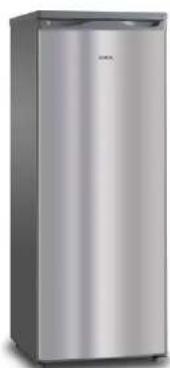
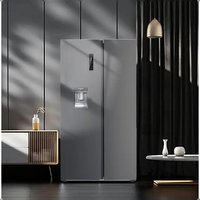
Exterior view of a modern stainless steel refrigerator (no visible text or symbols)
CONFORAMA France SA
natural_image
Technical line drawing of a mechanical component with an inset showing a magnified view of a curved section (no text or symbols)BRUIT DE L'APPAREIL
Thank you for choosing SABA quality. This product has been developed by our team of professional and according to European regulations. In order to get the most out of your new appliance, we recommend that you read this instruction manual carefully and keep it for future reference.
TABLE OF CONTENTS
Safety instructions 24
Technical information....27
Description of the device 28
Installation....29
Use 30
Reverse door 36
Maintenance 38
Cleaning....40
Troubleshooting....41
Accessories 42
Disposal....42
Disposal of old electrical appliances ....43
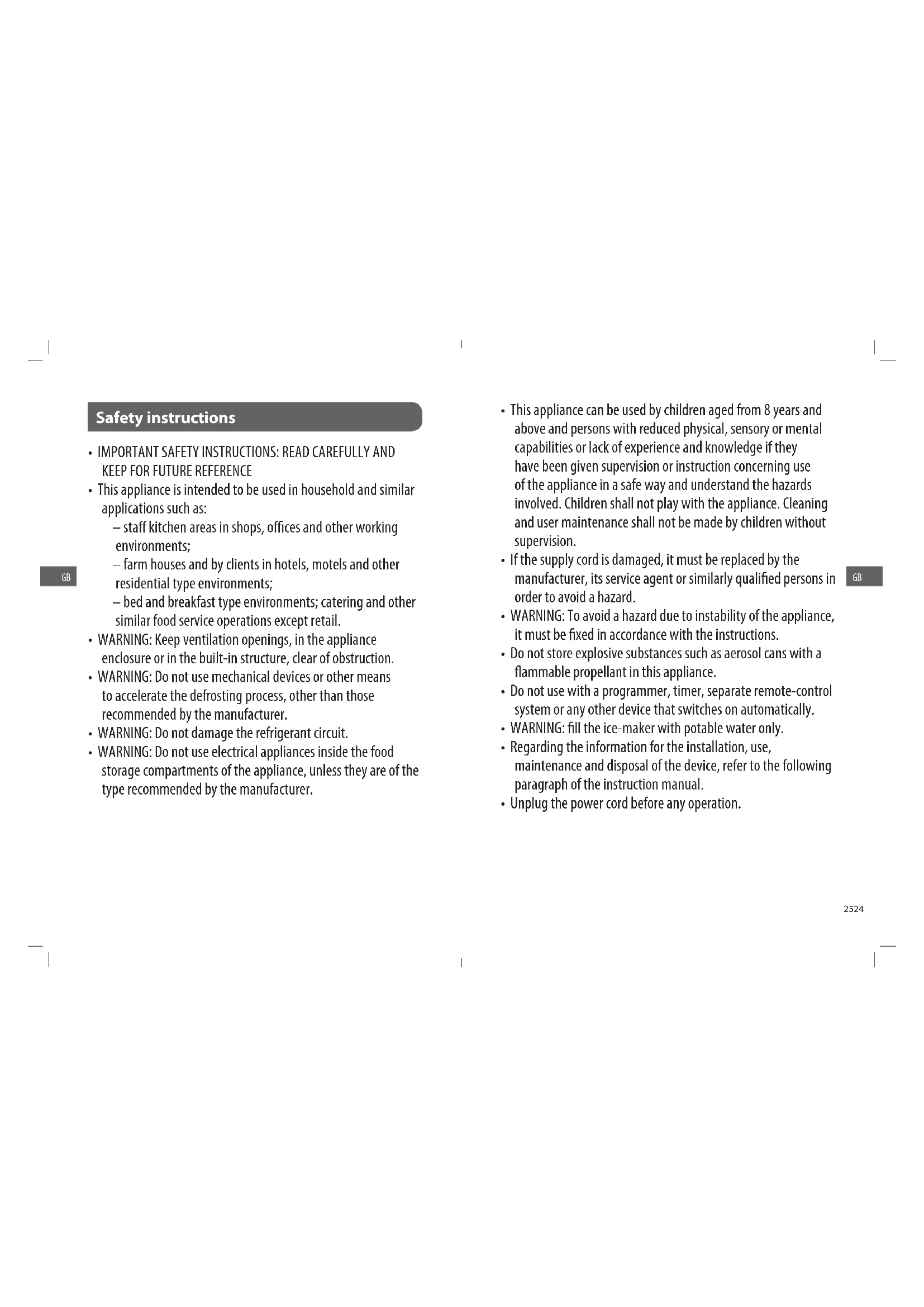
Safety instructions
- IMPORTANT SAFETY INSTRUCTIONS: READ CAREFULLY AND KEEP FOR FUTURE REFERENCE
- This appliance is intended to be used in household and similar applications such as:
– staff kitchen areas in shops, offices and other working environments;
– farm houses and by clients in hotels, motels and other residential type environments;
- bed and breakfast type environments; catering and other similar food service operations except retail.
- WARNING: Keep ventilation openings, in the appliance enclosure or in the built-in structure, clear of obstruction.
- WARNING: Do not use mechanical devices or other means to accelerate the defrosting process, other than those recommended by the manufacturer.
- WARNING: Do not damage the refrigerant circuit.
-
WARNING: Do not use electrical appliances inside the food storage compartments of the appliance, unless they are of the type recommended by the manufacturer.
-
This appliance can be used by children aged from 8 years and above and persons with reduced physical, sensory or mental capabilities or lack of experience and knowledge if they have been given supervision or instruction concerning use of the appliance in a safe way and understand the hazards involved. Children shall not play with the appliance. Cleaning and user maintenance shall not be made by children without supervision.
- If the supply cord is damaged, it must be replaced by the manufacturer, its service agent or similarly qualified persons in order to avoid a hazard.
- WARNING: To avoid a hazard due to instability of the appliance, it must be fixed in accordance with the instructions.
- Do not store explosive substances such as aerosol cans with a flammable propellant in this appliance.
- Do not use with a programmer, timer, separate remote-control system or any other device that switches on automatically.
- WARNING: fill the ice-maker with potable water only.
- Regarding the information for the installation, use, maintenance and disposal of the device, refer to the following paragraph of the instruction manual.
-
Unplug the power cord before any operation.
-
Old appliances may contain CFCs which destroy the ozone layer. Please contact your nearest waste disposal centre for more details on the correct disposal procedures.
- The appliance must be installed on the ground, on a flat, horizontal surface making sure the vents are not obstructed.
- Never attempt to replace or repair any appliance part or component yourself. Request help from a professional, qualified person if needed.
- Always handle the appliance with care in order to avoid damaging it.
- For the replacement method of light bulb, refer to
.
Caution: Risk of fire
Technical information
| Brand SABA MP237IX | |
| Category of household refrigerating appliance | catalogue 1 |
| Energy class A+ | |
| Annual energy consumption (1) | 128 kWh/an |
| Storage volume Refrigerator : 241L | |
| Defrost Refrigerator: automatic | |
| Climate class + Ambient range | N/ST(+16°C to +38°C) |
| Noise 40 dB (A) re 1 pW | |
| Rated voltage and frequency / Input power | 220V-240V / 50Hz~ 80W-0.5A |
| Lamp | 240V / 50Hz - 10W max Type E14 |
| Refrigerant/Amount R600a / 32g | |
| Product dimension (W x D x H) | 566 x 545 x 1427 (mm) |
| Net weight 44 kg | |
| Type of installation Free Standing | |
(1) Calculation on the basis of results for 24 hours under standard test conditions. The actual energy consumption will depend on use and the location of the device.
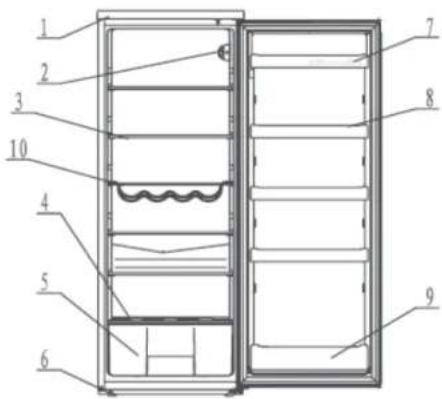
Description of the device
-
Upper Cover
-
Adjustablefoot
-
Thermostat
-
Egg Tray
-
Refrigerator Shelf
-
Pocket Rack
-
Salad Crisper Cover
-
Bottle Rack
-
Salad Crisper
-
Wine shelf
NOTE: The appliance design is subject to change without prior notice.
Installation
- Position the appliance and allow it to stand for two to three hours before it is turned on for the first time to allow the system to settle. Do not position next to any heat source e.g. cooker, boiler or in direct sunlight etc.
- Allow at least 10cm of space at the top and 10 cm of space on both sides of the appliance and between the back of the appliance and the wall for adequate air circulation. The appliance is not designed for recessed installation ("building in").
• Install on a good firm level surface, and any unevenness of the floor should be corrected prior to installation, slight unevenness can be overcome by adjusting the front feet.
NOTE: If the appliance is positioned on a carpet, soft floor covering you should readjust the front feet once the appliance has had time to settle.
Use
- This appliance is designed to operate in ambient temperature between 16^ and 38^ . If these temperatures are exceeded, i.e. colder or warmer, the appliance will not operate correctly. If the ambient temperatures are exceeded for long periods, the temperature in the freezer section will rise above -18^ and food spoilage may occur.
- Remove all packaging materials from the appliance. Wash the inside of the cabinet with lukewarm water and bicarbonate of soda (5ml to 0.5 liter of water). Dry the appliance thoroughly.
- When you use the freezer for the first time or after defrosting, set the thermostat control to the maximum position for at least 2 hours before introducing food to be stored, and then readjust to the normal position.
SETTING THE THERMOSTAT KNOB
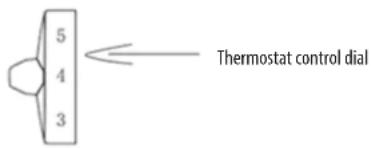
The refrigerator is controlled with a thermostat knob located inside the fridge, towards the upper right-hand corner. Turn the knob from the STOP (OFF) position towards the higher numbers for colder temperatures. The knob can be adjusted from setting 1 to 7.
Higher settings on the knob (higher numbers) mean lower temperatures (colder) in all compartments of the appliance.
Changes of the ambient temperature affect temperature in the interior of the appliance so choose a correct setting of the temperature control knob, depending on your ambient conditions.
In the STOP (OFF) position the appliance does not operate (the cooling system is switched off), but power supply is not interrupted.
Set the thermostat knob to a normal position to achieve -18^ in the freezer compartment. We suggest to set the selector to "4.5" position in normal use.
Please Note:
If the appliance is switched off you must wait at least 5 minutes before restarting the appliance or re-inserting the plug into the wall outlet. This is to allow the protection device in the compressor to reset.
If the compressor fails to start correctly, remove the plug and wait for 5 minutes before you try again then the compressor should restart normally.
GB
The storage temperature may be affected by:
– The room temperature
— How often the door is opened
- How much food is stored
– Position of the appliance
When you set the correct temperature, all these factors mentioned above shall be taken into account.
TEMPERATURE INDICATE
In order to help you get the correct adjustment of your device, it is equipped with a temperature gauge placed in the coldest area. For the proper storage of food in your refrigerator and in particular in the coldest area, make sure that "OK" appears in the temperature indicator.

The symbol on the left side indicates the location of the coldest area of your refrigerator. It defines the height of this area.
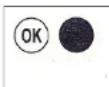
If "OK" is not displayed, the average temperature in this area will be very high. You ought to adjust the thermostat to a colder setting.
For every modification of your thermostat, you are supposed to wait for the stabilization of the temperature inside the unit before proceeding, if necessary, to a new setting. Do change the position of the thermostat gradually and wait at least 12 hours before re-checking.
NOTE: after charging the device for fresh food or after repeated or prolonged door openings, it is normal that the inscription "OK" does not appear in the temperature indicator.
Wait at least 12 hours before readjusting the thermostat.
STORING FRESH FOOD AND LIQUID STORAGE
Do not allow raw meat to come into contact with cooked foods. For safety, only store raw meat in the fridge compartment for two or three days. Fruit and vegetables should be thoroughly cleaned and placed in the crisper. Milk and other liquids should be sealed with lids and placed in the bottle shelf in the door.
NOTE: The ambient temperature of the freshly stored food and how often the door is opened affect the temperature in the refrigerator. If required, change the temperature setting.
ENERGY-SAVING TIPS
Install the fridge or freezer in a cool place out of direct sunlight and away from cookers, heaters, dishwashers or any hot air emitting items.
Do not set the fridge and freezer temperatures lower than necessary. Set the internal temperature within the correct range e.g. adjust the thermostat at middle position for 4^ C in the fridge compartment and -18^ C in the freezer respectively.
Let pre-cooked foods cool down before placing them in the fridge or freezer. This will prevent the internal temperature of the fridge from rising.
Keep your fridge full, but not over crowded, this helps reduce "cold" air loss. Meanwhile, avoid overloading the fridge or freezer. Try to leave about 20% free space for air circulation.
To prevent cold air escaping, limit the frequency of opening door. When retuning from shopping, sort foods to be kept in your fridge before opening the door. Only open the door to put food in or take it out.
Make sure the door seal is clean and in good condition. It should hold a piece of paper tightly in place when shut.
Defrost regularly or when ice is more than 5mm thick. Thick ice covering the inner sides significantly increases energy use.
The combination of the drawers, baskets and shelves shown in the device description is optimal for efficient energy savings. Changing the combination proposition could alter the efficiency.
Reverse door
Follow the following stages to reverse the door from its initial position.
DEPOSIT DOORS
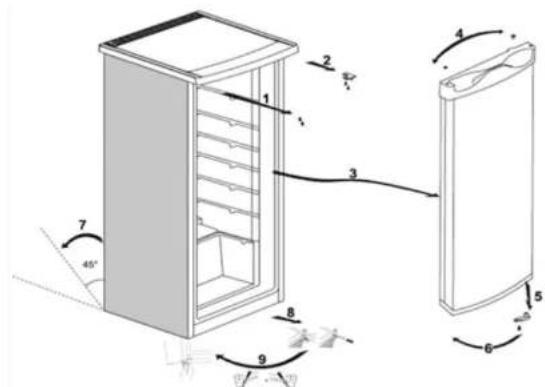
- Remove the left screw under top cover.
- Remove the right screw and upper hinge.
- Take the door away.
- Take the door sleeve to another side.
- Remove the door stopper.
- Fix the door stopper to another side.
- Incline the cabinet to 45°.
- Take the lower hinge away.
- Fix the lower hinge to another side.
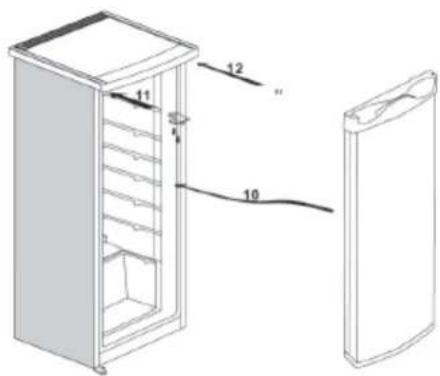
- Put the door on the lower hinge.
- Fix the screw and upper hinge back the top cover.
- Fix the screw to the top cover.
Maintenance
FRIDGE DEFROSTING
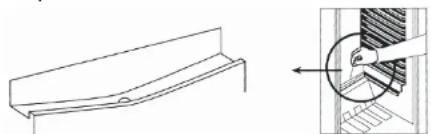
The fridge defrosting process is carried out automatically every time the compressor stops.
The defrost water is automatically routed to the drain port and into a tray placed on the top of the compressor to the rear of the appliance from which it evaporates.
Make sure the drain port on the fridge at the rear of the appliance is kept clear.
natural_image
Technical line drawing of a mechanical component with an inset showing a magnified view of a cylindrical feature (no text or symbols)NOISE FROM YOUR APPLIANCE
You may notice some rather unusual noises. The noises are caused by circulation of refrigerant in the cooling system. It has become more pronounced since the introduction of CFC free gases. This is not a fault and will not affect the performance of your fridge.
PROLONGED OFF PERIODS
If the appliance is not in use for a long period of time, proceed as follows:
- Disconnect from the mains supply.
- Clean and dry the inside (see 'Cleaning and maintenance').
- Leave the door open to prevent any unpleasant smells from building up while the appliance is not in use.
NOTES FOR USE
Do clean and defrost your appliance regularly.
Do check contents of the compartments every so often.
Do store commercially prepared food in accordance with the instructions given on the packets.
Do choose high quality fresh food and be sure it is thoroughly clean before freezing it.
Do wrap all food in food quality polythene bags or air tight containers and make sure any air is excluded.
Do Not store poisonous or any dangerous substances in your freezer. It is designed for the freezing of edible foodstuffs only.
Do Not consume food which has been frozen for an excessive length of time.
Do Not leave the door open for long periods, as this will make the appliance more costly to run and cause excessive ice formation.
Do Not use sharp objects such as knives to remove the ice from the appliance. Only use a plastic scraper.
Do Not put hot food into the appliance. Let it cool down to room temperature.
Do Not put liquid-filled bottles or sealed cans containing carbonated liquids into the freezer as they may burst.
Do Not give children ice-cream and water ices direct from the freezer as the low temperature may cause 'freezer burns' on the lips.
Do Not try to keep frozen food which has thawed; it should be eaten within 24 hours or cooked and re-frozen.
CHANGING THE LIGHT BULB
- Set the thermostat knob to the off position (0/OFF) then unplug the appliance.
- Remove the food.
- Push upward to remove the light shield.
- Unscrew the bulb and screw a new bulb of the same shape same power (240V-10W E14 base).
- Attach the light shield to the appliance with the screw.
Cleaning
- Unplug the appliance.
- Remove all substances.
- Clean the inside and outside walls with a clean sponge or soft cloth using warm water or 1 teaspoon of bicarbonate of soda to 1.2 liters of water.
- Rinse well and wipe dry with a clean soft cloth.
If the appliance is not to be used for a long period of time then it is recommended to remove all the food stuff, clean the inside of the appliance and leave the door open to allow the air to circulate thus avoiding unpleasant odors.
Troubleshooting
Before calling for service please check the following.
THE APPLIANCE IS NOT WORKING.
Check the plug is inserted correctly into the mains socket.
Check there is power to the mains socket by plugging another appliance in, if the other appliance do not work either, check the fuse in the plug.
THE APPLIANCE IS NOISY WHEN OPERATING.
Check the appliance is level and it is not in contact with another appliance or kitchen furniture.
THE APPLIANCE DOES NOT COOL SUFFICIENTLY.
If the door has been opened too often or it has been left open for a while it will take time for the appliance to reach its set temperature.
Check the airflow over the rear of the appliance has not been reduced due to insufficient clearance.
Check if a large quantity of fresh food has been introduced.
Accessories
- Energy label
- FR/ENG manual
- Egg tray
- Cleaning hook for drain hole
Disposal
GB
The refrigerating gas contained in the circuit of this appliance is isobutane (R600a); it causes a low level of pollution but is inflammable. Please contact your local disposal department for advice on the correct method of disposal.
Disposal of old electrical appliances

The European directive 2012/19/EU on Waste Electrical and Electronic Equipment (WEEE), requires that old household electrical appliances must not be disposed of in the normal unsorted municipal waste stream. Old appliances must be elected separately in order to optimize the recovery and cling of the materials they contain, and reduce the impact on an health and the environment.
The crossed out “wheeled bin” symbol on the product reminds you of your obligation, that when you dispose of the appliance, it must be separately collected.
Consumers should contact their local authority or retailer for information concerning the correct disposal of their old appliance.
CE
GB
- SABA
- BRUIT DE L'APPAREIL
- TABLE OF CONTENTS
- Safety instructions
- Description of the device
- Installation
- Use
- SETTING THE THERMOSTAT KNOB
- Please Note:
- TEMPERATURE INDICATE
- STORING FRESH FOOD AND LIQUID STORAGE
- ENERGY-SAVING TIPS
- Reverse door
- Maintenance
- FRIDGE DEFROSTING
- NOISE FROM YOUR APPLIANCE
- PROLONGED OFF PERIODS
- NOTES FOR USE
- CHANGING THE LIGHT BULB
- Cleaning
- Troubleshooting
- THE APPLIANCE IS NOT WORKING.
- THE APPLIANCE IS NOISY WHEN OPERATING.
- THE APPLIANCE DOES NOT COOL SUFFICIENTLY.
- Accessories
- Disposal
- Disposal of old electrical appliances
Brand : SABA
Model : MP237IX
Category : Refrigerator