
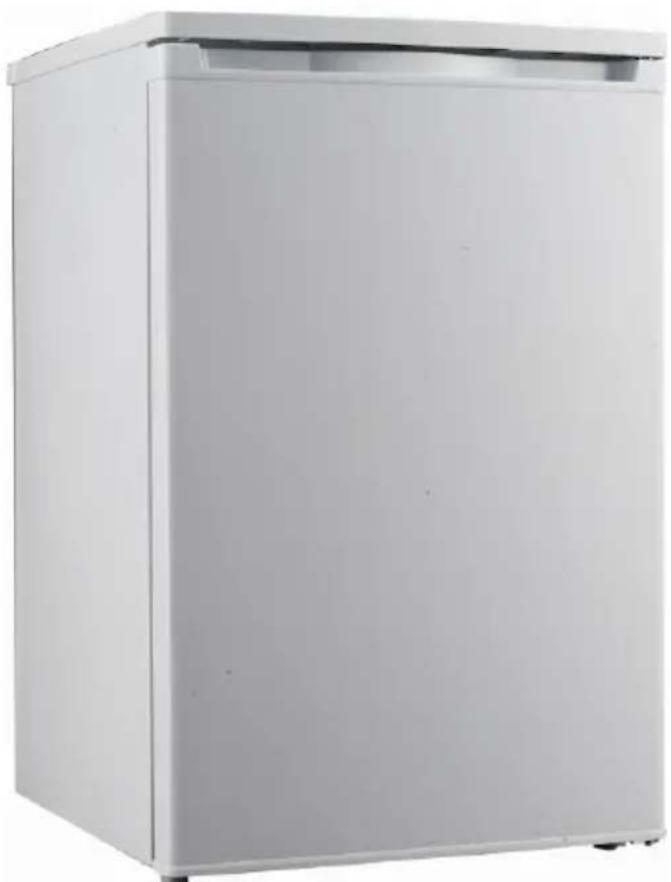
HFK136AAB - Freezer HAIER - Free user manual and instructions
Find the device manual for free HFK136AAB HAIER in PDF.
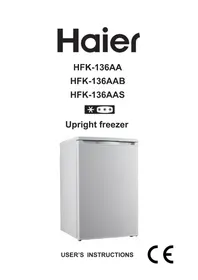



| Product Type | Freezer |
| Brand | Haier |
| Model | HFK136AAB |
| Total Net Volume | 80 L |
| Freezer Volume | 80 L |
| Freezing Capacity | 4 kg/24 h |
| Climate Class | ST |
| Energy Class | A+ |
| Energy Consumption | 172 kWh/year |
| Rated Voltage | 220-240 V~ |
| Rated Frequency | 50 Hz |
| Rated Current | 0.6 A |
| Rated Power | 65 W |
| Refrigerant | R600a (37 g) |
| Insulation | Cyclopentane |
| Shock Protection | Class I |
| Adjustable Feet | Yes |
| Door Reversibility | Yes |
| Defrosting | Manual (once a month recommended) |
| Thermostat | Adjustable (Min/Max) |
| Number of Drawers | 1 |
| Door Type | Top lid |
Frequently Asked Questions - HFK136AAB HAIER
User questions about HFK136AAB HAIER
0 question about this device. Answer the ones you know or ask your own.
Ask a new question about this device
Download the instructions for your Freezer in PDF format for free! Find your manual HFK136AAB - HAIER and take your electronic device back in hand. On this page are published all the documents necessary for the use of your device. HFK136AAB by HAIER.
USER MANUAL HFK136AAB HAIER
Important safety instructions -1- Structure illustration -4- Transport and handling -4- Installation -4- Test -5- Temperature control -5- Storage of food -5- Defrosting -6- General instructions for care and maintenance -6- Door reverse -7- Troubleshooting -8- Technical specifications -10-
IMPORTANT SAFETY INSTRUCTIONS
- This appliance can be used by children aged from 8 years and above and persons with reduced physical, sensory or mental capabilities or lack of experience and knowledge if they have been given supervision or instruction concerning use of the appliance in a safe way and understand the hazards involved. Children shall not play with the appliance. Cleaning and user maintenance shall not be made by children without supervision.
- This appliance is intended to be used in household and similar applications such as:
- Staff kitchen areas in shops, offices and other working environments
- Farm houses and by clients in hotels, motels and other residential type environments
- Bed and breakfast type environments
- Catering and similar non-retail applications
- Warning: Do not use mechanical devices or other means to accelerate the defrosting process, other than those recommended by the manufacturer.
- Warning: Except the items recommended by manufacturer, DO NOT use any electric appliance in the units.
- Warning: Never try to use this appliance for applications or in a way which is not described in the instruction, otherwise severe hazards may occur.
- Warning: If the supply cord is damaged, or if the appliance has malfunctions or it has been damaged in any manner, please return the appliance to the manufacturer, its authorized service agent or similarly qualified persons for examination, repair or adjustment in order to avoid a hazard.
- WARNING: Keep ventilation openings, in the appliance enclosure or in the built-in structure, clear of obstruction.
- WARNING: Do not damage the refrigerant circuit.
- WARNING: Do not use electrical appliances inside the food storage compartments of the appliance, unless they are of the type recommended by the manufacturer.
- Do not use the appliance in a dusty environment or in an explosive and inflammable atmosphere (inflammable gases, vapors, vapors from organic solvents, etc.)
- Do not store explosive substances such as aerosol cans with a flammable propellant in this appliance.
- Do not pour water directly onto the freezer, which may cause declining of insulation and corrosiveness.
- Insert the plug into a single grounded socket. Make sure to place the plug all the way into socket when connecting your appliance.
- To prevent possible harm to the environment or human health from uncontrolled waste disposal, recycle it responsibly to promote the sustainable reuse of material resources. And the disposal should only be done through public collection points.
- Appliance should be placed on a horizontal floor and keep the ventilation freely. Don't try to replace or repair any components by yourself, ask the service agency for help if necessary.
- Always handle the appliance carefully to avoid any damage.
- Caution: Do not connect the grounding wire to a water or gas pipe.
- Strictly do not store strong bases, strong acids, organic solvents, or corrosive goods together with food.
- Please refer to the "Trouble Shooting" section when the unit encounters problems. Do not attempt to solve the problem yourself; please contact a certified technician only.
- For information regarding the installation, operation, maintenance, and disposal of the device, refer to the following parts of the manual.
CE
This device was tested according to all relevant current CE guidelines, such as electromagnetic compatibility and low voltage directives, and was manufactured in accordance with the latest safety regulations.
STRUCTURE ILLUSTRATION
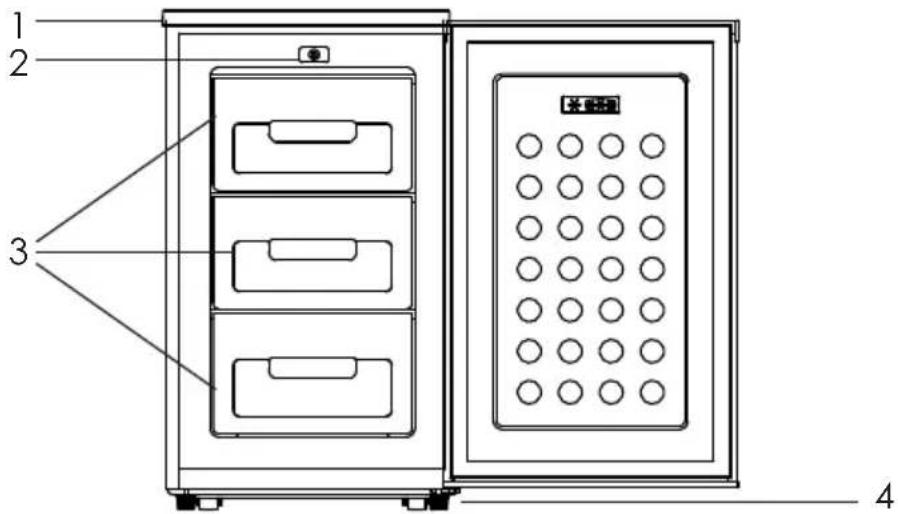
- Top cover
- Thermostat device
- Freezer drawer
- Adjustable feet
TRANSPORT AND HANDLING
When transporting, hold the base and lift the appliance carefully at an angle of less than 45 degrees. Never use the door handle as a support. Never place it upside down or horizontally. Push the appliance on its base and move it using its roller feet.
INSTALLATION
To fix stably, the appliance must be placed on a flat and solid surface. It should not be laid on any soft material.
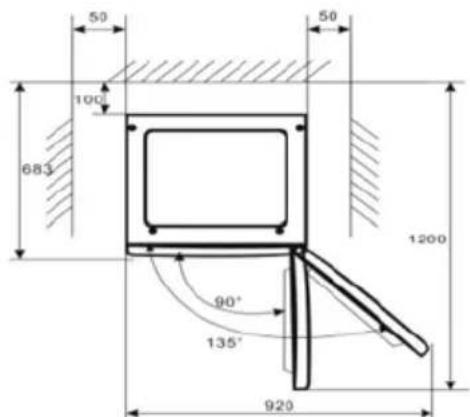
Choose a well-ventilated place. A space of at least 5 cm must be left at the sides and 10 cm at the back of the appliance. The cabinet spacers supplied with the appliance must be installed to protect and control distance from the wall.
Choose a location where there is no heat source. Keep the appliance away from direct sunlight or other appliance producing heat.
Choose a dry and well-ventilated place where there is no corrosive air.
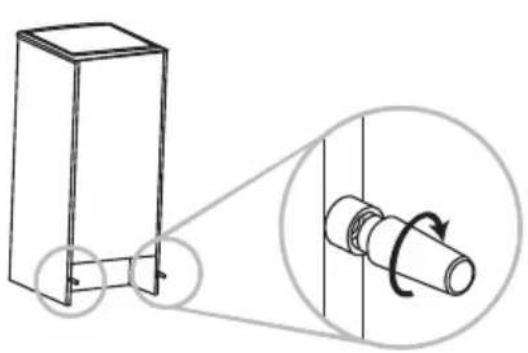
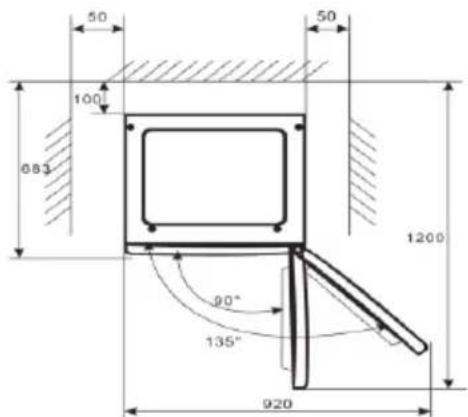
Clean the parts of the appliance with lukewarm water on a soft cloth or with a neutral detergent and with clear water, then wipe them dry.
Notes: Electric parts of the appliance can only be wiped by dry cloth.
Turn the thermostat knob on the "MED" position and turn on electricity. The compressor begins to work.
Close the door and wait 30 minutes. If the temperature in the freezer compartment decreased obviously, it shows that the freezing system works well. When the freezer operates for a period of time, the temperature controller will automatically set the temperature on conditions that the door is not too often opened.
If the above steps are successful, the trial operations are finished. The freezer works normally.
TEMPERATURE CONTROL
The temperature in the freezer compartment is controlled by the temperature controller installed upper of the body.
Turn the thermostat knob to regulate the temperature.
The markings on control regulator indicated the "Min, Max" for the different temperature grades. The temperature decreases with position MIN being the warmest and position MAX being the coldest.
Set the control to the middle position for normal use, but you may set the control to other positions of you find the middle is too cold or too warm.
Notice that the product is set for operation at a specific ambient range between 16 and 38°C. The appliance may not work properly if it is left for a long period at a temperature above or below the indicated range.
The indoor temperatures are influenced by the following factors:
- Ambient temperature, frequency of door opening, amount of stored foods.
- Installation of the appliance.
STORAGE OF FOOD
How to Use the Freezer Compartment?
- Put fresh food, such as fish or meat, into the freezer to preserve their taste and nutrients.
- Wrapped food has to be frozen in aluminum sheet, cellophane sheet, or in airtight plastic boxes.
- Do not put fresh food directly in contact with food already frozen. If you buy frozen food, bring it home and place it in the freezer as quickly as possible.
- Never re-freeze a defrosted product.
- Do not store liquids in bottles or cans (besides high percentage spirits), especially carbonated beverages, in the freezer, as these will burst during freezing.
- The storage time for the respective food (especially for commercially frozen food) recommended by the food manufacturers should not be exceeded. Only take the required amount of food out of the freezer.
- During defrost, maintenance, and care, the temperature of frozen food could rise and the storage time could be shorter.
Placement of Food
- Please do not accumulate too much food in the freezer because it would cause a loss of cold.
- Food has to be wrapped separately in aluminum foil, cellophane, or airtight plastic boxes.
- Hot food cannot be put in the freezer until it has reached ambient temperature, or it will increase electrical consumption.
- Never place vegetables and fruits in the freezer compartment because they will be unfit for consumption once defrosted.
DEFROSTING
When the freezer works for a long time, the inner surface will be covered with a layer of frost. This may increase electricity consumption and decrease the cooling effect. You should defrost your freezer once a month.
When defrosting, cut off the power, open the door, and move frozen foods to a cool place. Use a plastic spatula to remove the frost. Then remove the loosened frost and wipe the inside of your freezer with a damp, dry cloth.
Note: Never use metal tools to defrost your freezer because they could damage it.
GENERAL INSTRUCTIONS FOR CARE AND MAINTENANCE
The appliance should be cleaned once a month. Before cleaning, the electric plug must be removed from the power supply.
Wipe the inside and outside of the appliance with a wet soft cloth.
If it is too dirty, clean with a soft cloth and neutral detergent, then remove moisture with a dry cloth.
If you leave the appliance idle for a long time, proceed as follows:
- Disconnect the appliance from the electric power supply.
- Remove all food.
- Clean and dry the inside as instructed in the direction given above for cleaning.
- Leave the doors open to prevent any unpleasant smells while the appliance is not used.
Cleaning
When cleaning the appliance the electric plug must be removed from the power supply. Use water or a non-abrasive detergent on a soft cloth and remove the moisture with a dry soft cloth. Remember to clear the defrost drain at the back just above the glass cover.
DOOR REVERSE
This freezer has been built with the door hinges on the right. If you want to change the opening direction, please follow the instruction below:
Figure 1: Represents position of components prior to door reversal. Figure 2: Represents position of components after door reversal.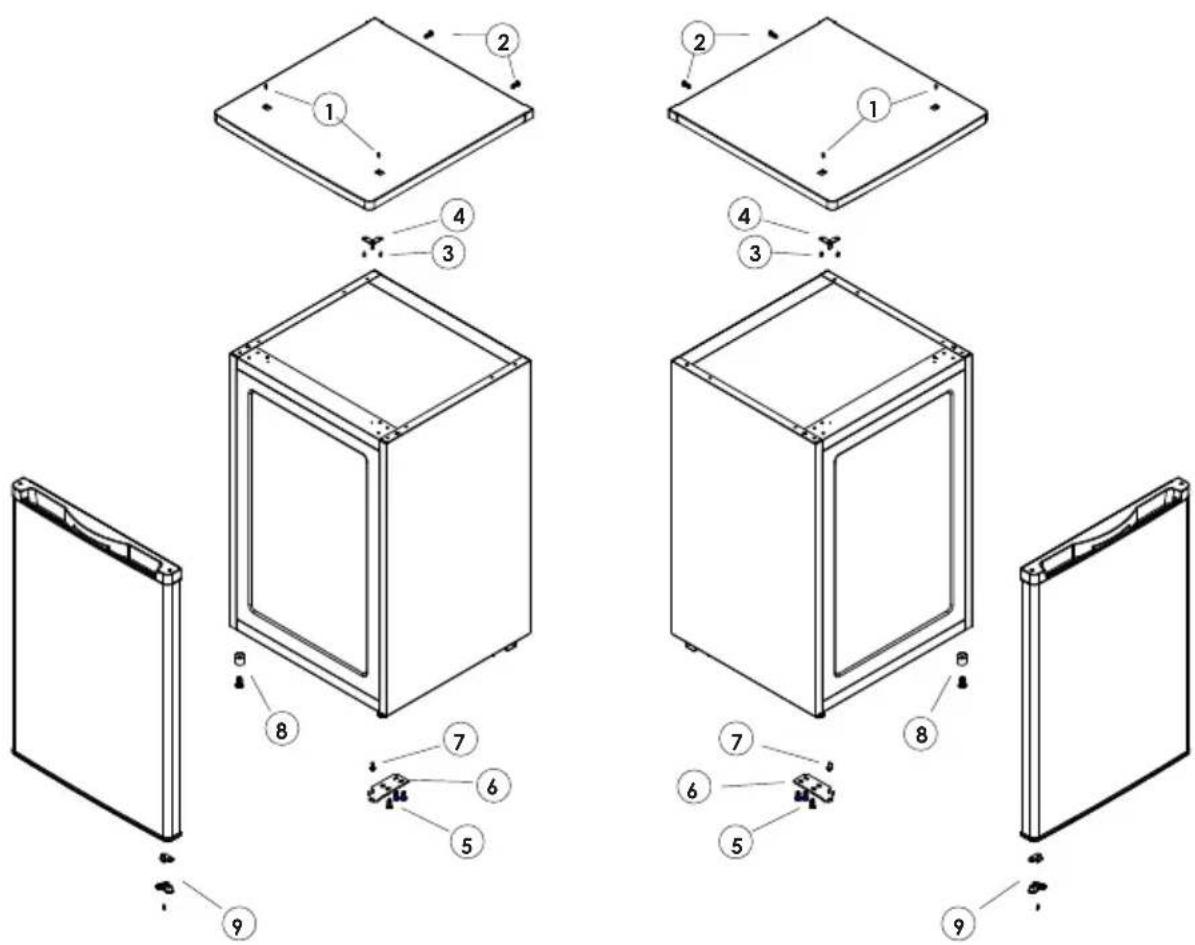
- Remove the four screws (1) (2) and take away the top.
- Remove the two screws (3) that hold the upper hinge (4) and take away the upper hinge (4).
- Lift the door and place it on a padded surface to prevent scratching it.
- Remove the three screws (5) that hold the lower hinge (6) and make sure to remove the lower hinge (6).
- Remove the adjustable leg (8) and transfer it to right side.
- Remove the bolt-pin (7) and reverse the direction of the lower hinge (6). Install the lower hinge (6) on the left side with three screws (7).
- Insert the bolt-pin (7) into the lower hinge (5).
- Remove the hinge pin (9) that is at the bottom of the door. On the other side of the door, insert the replacement hinge pin that is supplied with the appliance.
- Set the door in its place and make sure the door seats on the lower hinge (6).
- Fix the upper hinge (4) with the two screws (3) and the top with four screws (1) (2).
TROUBLESHOOTING
If your device shows symptoms other than those described above, please call the after-sales service of the shop or a retailer.
| Symptom Cause Solution | ||
| The appliance does not work | There is no power supply | Check the plug connecting it others appliance, or verify that the appliance is connected to the plug |
| The fuse doesn't work Replace the fuse | ||
| The appliance makes a lot of noise | The appliance is too close to the wall, or is not stable, or the accessories inside the freezer are placed in wrong position | Stabilize the base of the freezer by adjusting the position of feet, take away the device of the wall, place correctly the accessories inside the freezer |
| The appliance doesn't cool enough | The door is too often opened or was left opened for a long time | Close the door and do not open it too much frequently |
| The appliendosefakeway the device the wall | be of the wall to favor the ventilation | |
| The freezer is too full Remove food | of the device | |
| The temperature is badly, adjusted | Turn the knurl of regulation of temperature on "3" or more | |
| Symptom Cause Solution | ||
| There are smells in the appliance | Food made obsolete inside the freezer | |
| The inside of the device at need to be cleaned | ||
The following symptoms are not breakdowns:
- The noise of the cooling liquid circulating in the pipes can be heard; it is normal.
- The humidity on the outside surface of the device during wet seasons is not a problem with the device; you just need to wipe it with a dry soft cloth.
- The compressor and the condenser can become warmer during periods of strong heat.
- The frame of the door is a bit hot; it means that the condenser is working to evacuate the humidity from the air.
In the event of a power cut, food should remain safely cold for about 16 hours. Follow these tips during a prolonged power interruption, especially in summer:
- Open the door/drawer as few times as possible.
- Do not put additional food into the appliance during a power interruption.
- If prior notice of a power interruption is given and the interruption duration is longer than 16 hours, make some ice and put it in a container in the top of the freezer compartment.
- An inspection of the goods is required immediately after the interruption.
- As temperature in the freezer will rise during a power interruption or other failure, the storage period and edible quality of food will be reduced. Any food that defrosts should be either consumed, or cooked and refrozen (where suitable) soon afterwards in order to prevent health risks.
TECHNICAL SPECIFICATIONS
| Reference: | HFK-136AA;HFK-136AAB;HFK-136AAS |
| Rated voltage: | 220-240V~ |
| Rated power: | 65W |
| Rated frequency: | 50Hz |
| Rated current: | 0.6A |
| Refrigerant: | R600a(37g) |
| Total net volume: | 80L |
| Storage volume refrigerator: | 0L |
| Storage volume freezer: | 80L |
| Climate tape: | ST |
| Freezing capacity: | 4kg/24h |
| Energy consumption: | 172kWh/year |
| Protection against electrical shock: | I |
| Foam: | CYCLOPENTANE |
| Energy class: | A+ |
We decline liability for any damage or accident derived from any use of this product which is not in conformity with the instructions contained in this booklet.
DISPOSAL
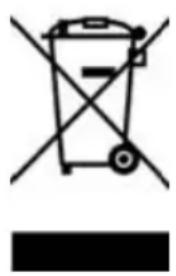
Help protect the environment and human health. Put the packaging in applicable containers to recycle it. Help to recycle waste of electrical and electronic appliances. Do not dispose appliances marked with this symbol with the household waste. Return the product to your local recycling facility or contact your municipal office.

WARNING!
Risk of injury or suffocation!
Refrigerants and gases must be disposed of professionally. Ensure that the tubing of the refrigerant circuit is not damaged before being properly disposed of. Disconnect the appliance from the mains supply. Cut off the mains cable and dispose of it. Remove the trays and drawers as well as the door catch and seals, to prevent children and pets to get closed in the appliance.
Haier
HFK-136AA
HFK-136AAB
HFK-136AAS
Chest freezer
INSTRUCTIONS
TABLE OF CONTENTS
Technical specifications - 10 -
IMPORTANT SAFETY INSTRUCTIONS
Temperature regulator - 5 -
Troubleshooting - 7 -
Troubleshooting - 8 -
Technical specifications - 10 -
IMPORTANT SAFETY INFORMATION
- This appliance can be used by children aged from 8 years and above and persons with reduced physical, sensory or mental capabilities or lack of experience and knowledge if they have been given supervision or instruction concerning use of the appliance in a safe way and understand the hazards involved. Children shall not play with the appliance. Cleaning and user maintenance shall not be made by children without supervision.
- This appliance is intended to be used in household and similar applications such as:
- Staff kitchen areas in shops, offices and other working environments
- Farm houses and by clients in hotels, motels and other residential type environments
- Various types of this device with a snack
- Retailing and detailed use differ from trade use
- Warning: Do not use mechanical devices or other means to accelerate the defrosting process, other than those recommended by the manufacturer.
- Warning: Do not use electrical appliances inside the food storage compartments of the device, unless they are of the type recommended by the manufacturer.
- Warning: Never attempt to use this device for purposes or in ways not described in the instructions, as serious dangers may arise.
- Warning: If the power cord is damaged, or if the device has malfunctions or is damaged in any way, please return the device to the manufacturer, its authorized service agent, or a qualified person for inspection, repair, or adjustment to avoid danger.
- Warning: Do not block the ventilation openings of the device or the built-in enclosure.
- Warning: Do not damage the cooling circuit.
- Warning: Do not use electrical appliances inside the food storage compartments of the device, unless they are of the type recommended by the manufacturer.
- Do not use the device in a confined space or in an explosive or flammable atmosphere (flammable gases, vapors, vapors from organic solvents, etc.)
- Do not store explosives or substances such as aerosol cans with flammable propellant in this device.
- Avoid directing water directly onto the freezer, as this may cause damage and lead to corrosion.
- Place the sensor in the contact slot. Make sure the sensor is fully inserted into the contact when connecting the device.
- To prevent possible harm to the environment or human health from uncontrolled waste disposal, recycle responsibly to ensure sustainable multiple use of material resources. Disposal must be done only at designated collection points.
- The device must be placed on a horizontal surface and must have free ventilation. Do not attempt to replace or repair components yourself; contact authorized service if necessary.
- Handle the device carefully to avoid any damage.
- Warning: Do not connect the grounding wire to water or gas pipes.
- Store the appliance away from heat sources, flammable liquids, corrosive substances, and food.
- Please refer to the section "Troubleshooting" if you have any problems with the device. Do not attempt to fix the problem yourself; please consult only with certified technicians.
- For information on installation, operation, maintenance, and disposal of the device, please refer to the following sections of this manual.

This device is designed in accordance with all relevant safety regulations, such as the directives on electromagnetic compatibility and low voltage, and is manufactured in compliance with the latest safety requirements.
STRUCTURE ILLUSTRATION
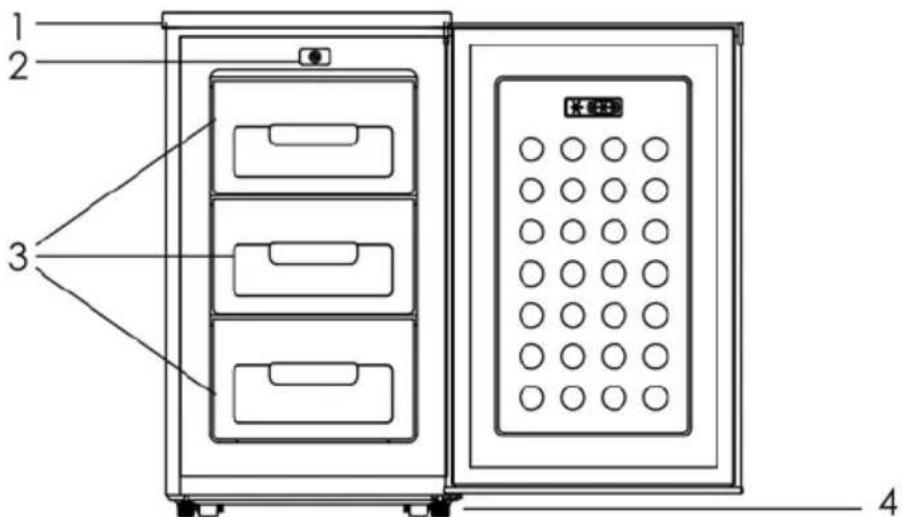
- Water tank
- Thermostat and freezer compartment
TRANSPORT AND INSTALLATION
When transporting, secure the base and lift the appliance carefully at an angle of at least 45 degrees. Never use the door as a support. Never place it with the door facing down or horizontally. Place the appliance on the base and adjust it using the adjustable feet.
INSTALLATION
To be correctly secured, the appliance must be placed on a flat and firm surface. It must not be placed on any soft material.
Choose a well-ventilated location. A space of at least 5 cm must be left from the back of the appliance. The cabinet limiters, installed with the appliance, must be mounted to protect and control the distance from the wall.
Choose a location where there is a heat source. Keep the appliance away from direct sunlight or other heat-producing appliances.
Choose a dry and well-ventilated location with corrosive-free air.
TEST
Clean the appliance with lukewarm water and a soft cloth or with a neutral detergent and clean water. Then rinse and dry.
Warning: The electrical parts of the appliance must not be cleaned with a dry cloth.
Set the thermostat knob to the "MED" position and turn on the electricity. The compressor should start working.
Close the doors and wait for 30 minutes. If the temperature inside the freezer is noticeably lower, this indicates that the freezing system works well. When the freezer operates for a certain period of time, the temperature regulator automatically adjusts the temperature, unless the doors are opened too often.
If the above-described steps are successful, the test operations are complete. The freezer works normally.
TEMPERATURE CONTROL
The temperature of the freezer compartment is controlled by a temperature controller mounted on the upper part of the appliance.
Close the thermostat knob to adjust the temperature.
The markings on the controller indicate "Min, Max" for different temperature levels. The temperature is lowered from the MIN position, when it is the warmest, and the MAX position, when it is the coldest.
The controller is set to a middle position for normal use, but you should set the controller to another position to find the middle position between the coldest and the warmest.
Note that the product is set to operate within a certain range of ambient temperature between 16 and 38°C. The device may not work correctly if left for a long period at temperatures outside this range.
The temperature inside the device is affected by the following factors:
Ambient temperature - frequency of opening the door - size of the stored food - installation of the device
STORAGE OF FOOD
How to use the freezer?
Store fresh or frozen products such as fish or meat in the freezer to preserve their taste and nutritional substances. - Packaged food should be frozen in aluminum or plastic containers, or in hermetically sealed plastic boxes. Do not place fresh food directly in contact with food that is already frozen. - If you buy frozen food, take it home and place it in the freezer as soon as possible. Never refreeze a product that has already been thawed.
Do not store liquids in bottles or boxes (except for high-alcohol spirits or drinks), especially carbonated drinks in the freezer, as they may burst during freezing. The storage time for the corresponding food (especially for ready-made frozen food) recommended by the manufacturer should not be exceeded. Take out only the necessary amount of food from the freezer. - During thawing or reheating, the temperature of the frozen food may rise and the storage time may be shorter.
Distribution of food
- Do not overload the freezer with too much food, as this will lead to loss of taste.
- Packaged food should be frozen in aluminum or plastic containers, or in hermetically sealed plastic boxes.
- The appliance cannot be placed in the freezer until it reaches the ambient temperature, otherwise the electricity consumption will increase.
- Never place hot foods or drinks in the freezer, as they will increase the energy consumption.
DEFROSTING
When the freezer has been working for a long time, the inner surface of the freezer will be covered with a layer of frost. This can increase the energy consumption and reduce the cooling effect. Therefore, the freezer should be defrosted regularly.
When defrosting, unplug the appliance, open the door and remove the food from the cold storage area. Use a plastic spatula to remove the frost. Then wipe the inside of the freezer with a damp cloth.
Warning: Never use metal instruments to defrost the freezer, as this can damage it.
CLEANING AND MAINTENANCE
The appliance should be cleaned regularly. Before cleaning, the electrical plug must be removed from the power supply.
Wipe the inside and outside of the appliance with a damp cloth.
If it is very dirty, use a cloth with a neutral detergent and then remove the moisture with a dry cloth.
If the appliance is not used for a long period of time, proceed as follows:
- Disconnect the appliance from the power supply.
- Remove all food. Clean and dry the inside as indicated in the cleaning instructions above. Leave the door open to prevent any unpleasant odors, until the appliance is completely dry.
Cleaning.
When cleaning the appliance, the electrical plug must be removed from the power supply.
Apply the drug onto the dry skin of the wart. Do not forget to wash your hands after application, exactly as directed.
OPENING OF THE DOORS
- IMPORTANT SAFETY INSTRUCTIONS
- CE
- STRUCTURE ILLUSTRATION
- TRANSPORT AND HANDLING
- INSTALLATION
- TEMPERATURE CONTROL
- STORAGE OF FOOD
- PLACEMENT OF FOOD
- DEFROSTING
- GENERAL INSTRUCTIONS FOR CARE AND MAINTENANCE
- CLEANING
- DOOR REVERSE
- TROUBLESHOOTING
- TECHNICAL SPECIFICATIONS
- DISPOSAL
- WARNING
- RISK OF INJURY OR SUFFOCATION
- HAIER
- CHEST FREEZER
- TABLE OF CONTENTS
- IMPORTANT SAFETY INFORMATION
- TRANSPORT AND INSTALLATION
- TEST
- DISTRIBUTION OF FOOD
- CLEANING AND MAINTENANCE
- OPENING OF THE DOORS
Brand : HAIER
Model : HFK136AAB
Category : Freezer