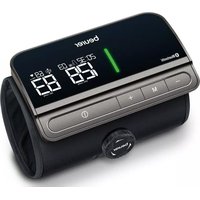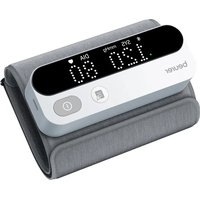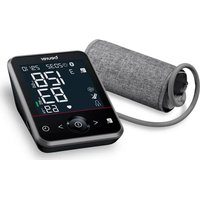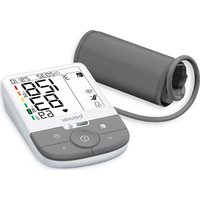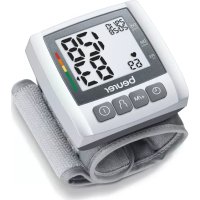
BC 30 - Blood pressure monitor BEURER - Free user manual and instructions
Find the device manual for free BC 30 BEURER in PDF.



Frequently Asked Questions - BC 30 BEURER
User questions about BC 30 BEURER
0 question about this device. Answer the ones you know or ask your own.
Ask a new question about this device
Download the instructions for your Blood pressure monitor in PDF format for free! Find your manual BC 30 - BEURER and take your electronic device back in hand. On this page are published all the documents necessary for the use of your device. BC 30 by BEURER.
USER MANUAL BC 30 BEURER
Manufactured for / Manufacturado para /
Fabriqué pour :
Beurer North America LP
900 N Federal Highway, Suite 300
Hallandale Beach, FL 33009
www.beurer.com
BC 30
ENGLISH Wrist blood pressure monitor Instruction manual 2
READ THIS MANUAL COMPLETELY AND CAREFULLY BEFORE USING THIS PRODUCT
Keep this manual in a safe location for future reference
- Getting to know your instrument....8
- Important information....9
- Package Contents...... 10
- Parts and Controls .... 11
- Getting started.... 12
5.1 Inserting/Replacing batteries.... 12
5.2 Cuff Size 12
5.3 Setting the date and time 12 - Measuring blood pressure.... 13
6.1 Positioning cuff.... 15
6.2 Correct posture 16
6.3 General Notes....16
6.4 Taking Measurement.... 17
6.5 Saving, displaying and deleting measurements 17 - Evaluating results....18
7.1 Irregular heartbeat symbol.... 19
7.2 WHO Classification 19 - Care, maintenance and storing the instrument.....20
- Error messages/troubleshooting 22
- Technical Specifications....22
- FCC Statement 23
- Glossary 24
- Warranty 24
IMPORTANT SAFETY NOTES
Signs and symbols
The following signs appear in the Safety Section (pages 4, 6, 7) and in this manual on pages 12, 13, 14, 15, 18, 19, 20, 23. READ THIS ENTIRE MANUAL, THE SAFETY SECTION AND ALL INSTRUCTIONS AND WARNINGS COMPLETELY AND CAREFULLY BEFORE USING THIS PRODUCT FOLLOW ALL SAFETY INSTRUCTIONS AND WARNINGS TO AVOID HAZARDOUS SITUATIONS AND TO MAKE CORRECT USE OF THIS PRODUCT.

WARNING WARNING indicates a hazardous situation which, if not avoided, could result in death or serious injury.

CAUTION CAUTION indicates a hazardous situation which, if not avoided, may result in minor or moderate injury.
NOTICE
NOTICE addresses practices not related to personal injury, such as product and/or property damage.

WARNING:
- Consult your physician or pharmacist before starting to measure your blood pressure.
- Read and understand all instructions and warnings before using this device.
- Like any oscillometric blood pressure measurement devices, certain medical conditions can affect the measurement accuracy, among others:
– disorder of the cardiac rhythm - very low blood pressure
- patients in shock
– patients with very low blood perfusion - diabetes
- vessel anomalies
- people with electrical implants, such as a cardiac pacemaker
- women who are pregnant.
Due to their condition the oscillometric measurement method can produce incorrect readings. This represents a risk for your health, since values may be interpreted incorrectly. Always consult your physician to determine what will be suitable for you. - This product does not and is not intended to provide a medical diagnosis. Measurements results are for reference only. Self-diagnosis and treatment, e.g. regarding medication, using measured results represent a risk for
your health. Always consult with a licensed physician for determination of appropriate medication and dosage thereof. Follow the instructions of your physician or licensed healthcare provider. If you have or suspect that you have a medical problem, promptly consult your physician. If you have an emergency please call 911 immediately.
- Only a physician or a trained health care professional who is familiar with your medical history is able to accurately interpret your blood pressure measurements. Consult your physician before starting blood pressure monitoring.
- This product is not intended to serve as a substitute for the advice of a physician or medical professional. This product is not intended to substitute for regular medical checkups. Contact your physician for specific information about your blood pressure.
- Please note that technically related measuring tolerances are possible. Please see section "10. Technical Specifications" for details.

WARNING:
- Any cuff related blood pressure measurement in high repetition rates, can lead to severe measurement side effects, e.g.
– any nerve compression with temporary arm/hand paralysis
- the release of an arterial or venous thrombus, which can cause a life threatening situation.
Please contact your physician about the specific risks of cuff pressure in your specific case.
- The 'irregular heartbeat' function does not replace a cardiac examination, but may help to detect potential pulse irregularities at an early stage. Always consult your physician to determine what will be suitable for you.
- The 'irregular heartbeat' function is not designed for diagnosing or treating an arrhythmic disorder. Arrhythmia can only be ascertained by a licensed physician.
- The WHO chart is not intended to replace a medical diagnosis. This chart is only a reference for different classifications of blood pressure.
- If you notice abnormal or suspicious variations in blood pressure measurements, consult your physician immediately.
- Women who underwent a breast or axillar lymph node removal operation should consult a physician or licensed healthcare provider before starting blood pressure measurements.
- Prior to use, you have to ensure that the blood pressure monitor is free of damage. If in doubt, do not use the unit and contact customer service at 1-800-536-0366.
- This device is intended only for personal, non-commercial, adult use in measuring blood pressure and pulse rate. Do not use the product for any other purpose. This
product is not intended for use in a hospital, physician's office, or any other health care facility.
- The unit must be used in accordance to the specified ambient conditions, otherwise the accuracy of readings might be affected. See section “8. Care, maintenance and storing the instrument” and section “10. Technical Specifications” for details.
- Do not wrap the cuff around body parts other than your wrist. Misuse represents a risk to your health.
- Please do not share the cuff with other persons, to avoid cross infection.
- Use this monitor only on humans.
- This product is not intended for use by or on children, toddlers and infants or on persons who cannot express their consent, e.g. persons with mental disorders or the like. Consult your physician for alternative methods of measuring a child's blood pressure.
- This product is not a toy. Keep it out of reach of children, toddlers, and infants.
- Keep the product out of the reach of pets.
- Packaging materials are a deadly hazard for children and can cause suffocation. Remove all packaging materials immediately and keep them away from children at all times.
- This product contains small parts that may present a choking hazard to children. Keep the unit and all parts out of reach of children. NEVER LEAVE CHILDREN OR
THOSE WHO REQUIRE CLOSE SUPERVISION UNATTENDED WITH THIS DEVICE.
- Keep this product away from children and those who require close supervision, e.g. people with mental disorders. NEVER LEAVE CHILDREN OR THOSE WHO REQUIRE CLOSE SUPERVISION UNATTENDED WITH THIS DEVICE.
- People with disabilities, activity limitations, or who are physically frail, should be assisted by another person when using this unit.
- Proper cuff size is important for accurate measurements. Only use the device on adults who have the correct wrist circumference for this instrument. See section "10. Technical Specifications" for suitable wrist circumferences.
- Do not use any cuffs, tubes, parts and accessories other than those explicitly recommended by the manufacturer for use with this product. Parts and accessories not approved for use with the device may cause damage to your health and to the product.
-
Electromagnetic interference: Avoid strong electrical or electromagnetic fields in the direct vicinity of the device (e.g. mobile telephones, microwave ovens) while it is in operation, as inaccurate measurements may result. To prevent such interference, use the unit at a sufficient distance from such devices or turn the devices off.
-
Do not measure your blood pressure while operating a vehicle or in any situation which requires your full attention.
- The device should not be used when your arm has been wounded/injured or when a catheter has been inserted. Such use may result in injury.
- Remove any kind of wrist jewelry or the like before taking a measurement. This could cause bruises.
- Do not place the wrist cuff over heavy clothing (e.g. a jacket or sweater sleeve) as the blood pressure monitor will not be able to take a proper measurement and there is an elevated danger of acquiring hematoma or skin marks during the course of the measurement.
- In case the cuff does not stop inflating, interrupt the measurement by pressing the start/stop button and open the cuff at once.
- Do not disassemble the unit, it may result in injuries.
- When applying the wrist cuff, make sure there are no wrinkles in the cuff. This could cause bruises.
- Blood pressure measurements can lead to temporary marks on the skin at the site of the cuff placement. This is especially the case in high repetition rates, in hypertonic patients and in patients with weak pulses. In rare cases a mark may persist for a couple of days. Please

CAUTION:
contact your physician about these specific risks of cuff pressure in your specific case.
- For hygienic reasons the cuff is intended only for the use by one person.
- Prolonged over-inflation (cuff pressure exceeds 300 mmHg or maintained above 15mmHg for longer than 3 minutes) of the bladder may cause ecchymoma of your wrist.
NOTICE:
- The blood pressure monitor is made up of precision electronic components. Accuracy of readings and the instrument's service life depend on careful handling. Protect the unit against hard knocks (e.g. dropping the unit), moisture, water, dirt, dust, chemicals, extreme hot or cold temperatures, major temperature fluctuations, direct exposure to sunlight and heat sources which are too close (e.g. stoves, heating radiators). This may damage the unit. The device must be stored in the specified ambient conditions. Please see section "8. Care, maintenance and storing the instrument" and section "10. Technical Specifications" for details.
- Do not use any aggressive solvents, cleaning agents, detergents or any other strong chemicals to clean the device.
- Never immerse and or spill water or any other liquid onto the monitor or any components, otherwise liquid will enter it and cause damage.
- Do not wash the unit in a washing machine, dish washer or tumble dryer.
- Observe the local regulations for material disposal. Dispose of the device, components and optional accessories according to applicable local regulations. Unlawful disposal may cause environmental pollution.
- Never attempt to repair, open and/or disassemble the unit (including wrist cuff) or adjust it yourself. This may damage the unit and impair the functions. If you need to have the unit repaired, please contact our customer service. Please see warranty for service contact. Before submitting any complaint, first check the batteries and replace them if necessary.
- Changes or modifications to the device will nullify the user warranty.
- Do not press the buttons with excessive force or with pointed objects.
Battery Handling Safety Precautions
- Use only the size and type of batteries specified.
- Be sure to follow the correct polarity when installing the batteries. Reversed batteries may cause damage to the device.
- Do not mix different types of batteries together (e.g. Alkaline and Carbon-zinc or rechargeable batteries) or old
batteries with fresh ones. Always replace batteries as a simultaneous set.
- If the batteries in the device are depleted or the device will not be used for a long period of time, remove the batteries to prevent damage or injury from possible battery leakage.
- Do not try to recharge batteries not intended to be re-charged; they can overheat and rupture (follow battery manufacturer's directions).
- Do not dispose of batteries in fire, batteries may explode or leak.
- Clean the battery contacts and also those of the device prior to battery installation.
- Remove discharged batteries from the product and dispose/recycle in compliance with all applicable laws.
- Keep batteries away from children and pets. Batteries may be harmful if swallowed. Should a child or pet swallow a battery, seek medical assistance immediately.
SAVE THESE INSTRUCTIONS FOR FUTURE REFERENCE
If the instruction manual is damaged or if you no longer have the instruction manual in your possession, please contact customer service at 1-800-536-0366 or at info@beurer.com
Dear Customer,
Congratulations on your purchase of this Beurer Wrist blood Pressure Monitor.
Please read and understand these instructions completely and carefully before using this product and keep them for later reference. Be sure to make them accessible to other users and observe the information they contain.
1. Getting to know your instrument
The wrist blood pressure monitor is used for non-invasive measurement and monitoring of adults' arterial blood pressure. This allows you to quickly and easily measure your blood pressure and to display the last recorded measurement. The values determined are classified and graphically evaluated according to WHO guidelines.
Blood pressure measurements determined by this monitor are equivalent to those obtained by a trained observer using the cuff/stethoscope auscultation method, within the limits prescribed by the American National Standards Institute, electronic or automated sphygmomanometers.
The performance should be checked every 5 years or after repair. Please contact customer service.
2. Important information

Signs and symbols
The following symbols are used in these instructions for use, on the packaging and on the type plate for the device and accessories:
 | Caution |
 | Follow instructions for use |
 | Type BF applied part (cuff only) |
 | Direct current |
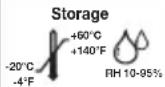 | Permissible storage temperature and humidity |
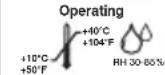 | Permissible operating temperature and humidity |
 | Keep dry |
 | Serial number |

Advice on use
- In order to ensure comparable values, always measure your blood pressure at the same time of day.
- Before every measurement, relax for about five minutes.
- If you want to perform several measurements on the same person, wait five minutes between each measurement.
- Do not take a measurement within 30 minutes after eating, drinking, smoking or exercising.
- Repeat the measurement if you are unsure of the measured value.
- The measurements taken by you are for your information only – they are not a substitute for a medical examination! Discuss the measurements with your doctor, and never base any medical decisions on them (e.g. medicines and their administration).
- Do not use the blood pressure monitor on newborns, pregnant women or patients with preeclampsia.
- Cardiovascular diseases may lead to incorrect measurements or have a detrimental effect on measurement accuracy. The same also applies to very low blood pressure, diabetes, circulatory disorders and arrhythmias as well as chills or shaking.
- The blood pressure monitor must not be used in connection with a high-frequency surgical unit.
-
Only use the device on people who have the specified wrist measurement for the device.
-
Please note that when inflating, the functions of the limb in question may be impaired.
- During the blood pressure measurement, blood circulation must not be stopped for an unnecessarily long time. If the device malfunctions, remove the cuff from the wrist.
- Avoid any mechanical restriction, compression or bending of the cuff line.
- Do not allow sustained pressure in the cuff or frequent measurements. The resulting restriction of the blood flow may cause injury.
- Ensure that the cuff is not placed on a wrist in which the arteries or veins are undergoing medical treatment, e.g. intravascular access or therapy, or an arteriovenous (AV) shunt.
- Do not use the cuff on people who have undergone a mastectomy.
- Do not place the cuff over wounds as this may cause further injury.
- As soon as the batteries are empty the blood pressure monitor loses the date and time.
- To conserve the batteries, the monitor switches off automatically if no buttons are pressed for two minutes.
- The device is only intended for the purpose described in these instructions for use. The manufacturer is not liable for damage resulting from improper or careless use.
3. Package Contents
• Wrist Blood Pressure Monitor Model BC 30
- Wrist cuff 5.3 in – 7.6 in (13.5 – 19.5 cm)
- Instruction manual
- Storage case
- Quick start guide
• 2 x AAA alkaline batteries
4. Parts and Controls
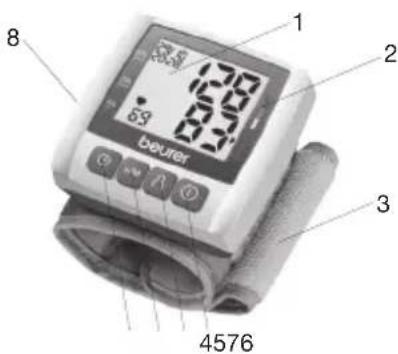
text_image
8 1 2 3 beurer 4576- LCD Display
- WHO indicator
- Wrist cuff
- START/STOP Button①
- User Select Button
- Memory Button
- Date/Time Set Button ⏱
- Battery Compartment (on rear)
Information on the display:
- Time and date
- Systolic pressure
- Classification of measurements
- Diastolic pressure
-
Cardiac arrhythmia symbol
-
Calculated pulse value
-
Pulse symbol ♥
-
Pump up, release air (arrow)
-
User memory
-
Unit in mmHg
- Average value of the last three measurements AVG
- Battery level indicator
- Memory space number
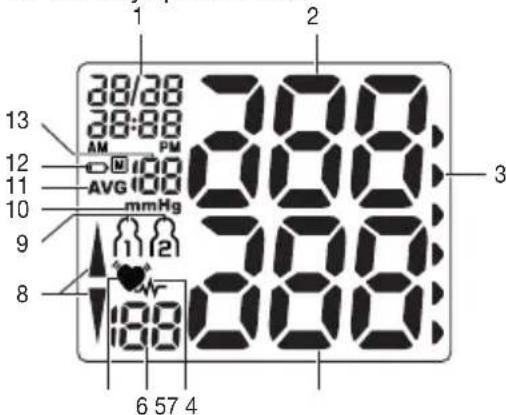
text_image
1 2 3 13 38/88 38:88 AM PM 12 D N I O AVG I O 10 mm Hg 9 11 2 8 188 6 57 4For product information, questions or customer service call toll free 1-800-536-0366 or email: info@beurer.com
5. Getting started

WARNING:
- This product does not and is not intended to provide a medical diagnosis. Measurements results are for reference only. Self-diagnosis and treatment, e.g. regarding medication, using measured results represent a risk for your health. Always consult with a licensed physician for determination of appropriate medication and dosage thereof. Follow the instructions of your physician or licensed healthcare provider. If you have or suspect that you have a medical problem, promptly consult your physician. If you have an emergency please call 911 immediately.
- Only a physician or a trained health care professional who is familiar with your medical history is able to accurately interpret your blood pressure measurements. Consult your physician before starting blood pressure monitoring.
NOTE:
To conserve the batteries, the monitor switches off automatically if you do not press any buttons for two minutes.
5.1 Inserting/Replacing batteries
- Remove the battery compartment cover on the left side of the device.
- Insert or replace with only two
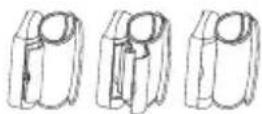
AAA 1.5 V alkaline batteries. Make absolutely sure that you insert them with the correct polarity (+/-) as indicated (see the diagram inside the battery compartment). Do not use other types of batteries.
- Replace the battery cover carefully. If the battery change icon is continuously illuminated, measurement is no longer possible and you must replace all the batteries.
5.2 Cuff Size

WARNING:
- Proper cuff size is important for accurate measurements. Only use the device on adults who have the right wrist circumference for this instrument.
5.3 Setting the date and time
It is essential to set the date and time. Otherwise, you will not be able to save your measured values correctly with a date and time and to access them again later.
To set the date and time, proceed as follows:
-
After inserting the batteries:
-
Following the display check, during which all segments appear, the year flashes on the display.
- Using the + / M button, you can increase the basic values to be set. Set the year and confirm the entry using the C button.
- Now set the month using the + / M button. Confirm using the button.
- Set the day/hour/minute and confirm each using the ⏰ button.
- To switch off, press the START/STOP button.
- At any time:
- Press the Button to display the date/time and current user memory.
- Press and hold the button again for about 3 seconds to reach Date and time mode.
- Set as described above.
6. Measuring blood pressure

WARNING:
- People with disabilities, activity limitations, or who are physically frail, should be assisted by another person when using this unit.
- Consult your physician or pharmacist before starting to measure your blood pressure.
-
Read and understand all instructions and warnings before using this device.
-
Like any oscillometric blood pressure measurement devices, certain medical conditions can affect the measurement accuracy, among others:
– disorder of the cardiac rhythm - very low blood pressure
- patients in shock
– patients with very low blood perfusion - diabetes
- vessel anomalies
- people with electrical implants, such as a cardiac pacemaker
-
women who are pregnant.
-
Due to their condition the oscillometric measurement method can produce incorrect readings. This represents a risk for your health, since values may be interpreted incorrectly. Always consult your physician to determine what will be suitable for you.
- This product is not intended to serve as a substitute for the advice of a physician or medical professional. This product is not intended to substitute for regular medical checkups. Contact your physician for specific information about your blood pressure.
- Women who underwent a breast or axillar lymph node removal operation should consult a physician or licensed healthcare provider before starting blood pressure measurements.
Prior to use, you have to ensure that the blood pressure monitor is free of damage. If in doubt, do not use the unit and contact customer service at 1-800-536-0366.

WARNING:
- This device is intended only for personal, non-commercial, adult use in measuring blood pressure and pulse rate. Do not use the product for any other purpose. This product is not intended for use in a hospital, physician's office, or any other health care facility.
- The unit must be used in accordance to the specified ambient conditions, otherwise the accuracy of readings might be affected. See section “8. Care, maintenance and storing the instrument” and section “10. Technical Specifications” for details.
- Do not wrap the cuff around body parts other than your wrist. Misuse represents a risk to your health.
- Use this monitor only on humans.
- This product is not intended for use by or on children, toddlers and infants or on persons who cannot express their consent, e.g. persons with mental disorders or the like. Consult your physician for alternative methods of measuring a child's blood pressure.
-
People with disabilities, activity limitations, or who are physically frail, should be assisted by another person when using this unit.
-
Proper cuff size is important for accurate measurements.
- Only use the instrument on adult persons whose upper arm has the right wrist circumference for the instrument. See section "10. Technical Specifications" for suitable arm circumferences.
- Do not use any cuffs, tubes, parts and accessories other than those explicitly recommended by the manufacturer for use with this product. Parts and accessories not approved for use with the device may cause damage to your health and to the product.
- Electromagnetic interference: Avoid strong electrical or electromagnetic fields in the direct vicinity of the device (e.g. mobile telephones, microwave ovens) while it is in operation, as inaccurate measurements may result. To prevent such interference, use the unit at a sufficient distance from such devices or turn the devices off.
- Do not measure your blood pressure while operating a vehicle or in any situation which requires your full attention.
-
Any cuff-related blood pressure measurement in high repetition rates, can lead to severe measurement side effects, e.g.
– any nerv compression with temporary arm/hand paralysis
– the release of an arterial or venous thrombus, which can cause a life threatening situation. -
Please contact your physician about the specific risks of cuff pressure in your specific case.
- The device should not be used when your arm has been wounded/injured or when a catheter has been inserted. Such use may result in injury.
- Remove any kind of wrist jewelry or the like before taking a measurement. This could cause bruises.
- Do not place the wrist cuff over heavy clothing (e.g. a jacket or sweater sleeve) as the blood pressure monitor will not be able to take a proper measurement and there is an elevated danger of acquiring hematoma or skin marks during the course of the measurement.
- In case the cuff does not stop inflating, interrupt the measurement by pressing the start/stop button and open the cuff at once.
- When applying the arm cuff, make sure there are no wrinkles in the cuff. This could cause bruises.
- Do not exert any kind of pressure on the tube during measurement, e.g. laying your arms or any other object on the tube. This could cause incorrect measurements.
- Blood pressure measurements can lead to temporary marks on the skin at the site of the cuff placement. This is especially the case in high repetition rates, in hypertonic patients and in patients with weak pulses. In rare cases a mark may persist for a couple of days. Please

CAUTION:
contact your physician about these specific risks of cuff pressure in your specific case.
- For hygienic reasons the cuff is intended only for the use by one person.
- It is recommended that the cuff be cleaned after every 200th use.
- It is recommended that the cuff be disinfected twice a week using a cloth that is lightly moistened with ethyl alcohol (75 – 90 %); then allowed to air dry.
6.1 Positioning cuff
NOTE:
Always properly position the wrist cuff on the wrist at heart level, according to the following instructions.
Fit the cuff round your bare left wrist. Do not place the wrist cuff over heavy clothing (e.g. a jacket or sweater sleeve) as the blood pressure monitor will not be able to take a proper measurement. Blood circulation in the arm should not be restricted by tight clothing or other objects.
- Remove any clothing or jewelry from your left lower arm. Ensure that blood circulation in the arm is not restricted by tight clothing or similar items.
- Place the unit on the inside of your wrist with your palm facing upwards.
- Fasten the cuff with the hook-and-loop strip so that the upper edge of the device is positioned approx. 0.4 in (1 cm) below the bottom of your hand. The cuff must
be fitted snugly around your wrist, but must not constrict blood flow.
Blood pressure can vary between the right and left arm, which may mean that the measured blood pressure values are different. Always perform the measurement on the same wrist. If the values between the two arms are significantly different, please consult your doctor to determine which wrist should be used for the measurement.
6.2 Correct posture
Patient position in normal use, including
1) comfortably seated
2) legs uncrossed
3) feet flat on the floor
4) back and arm supported
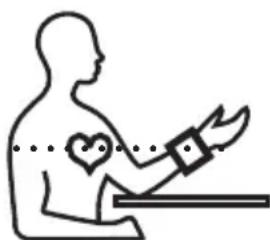
5) middle of the cuff at the level of the right atrium of the heart
- Rest at least for 5 minutes before each measurement. Otherwise there may be erroneous results.
- You can perform the measurement either sitting or lying down. Always make sure that the cuff is on a level with your heart.
- In order not to distort the result, it is important to keep still during the measurement and not talk. The most precise measurement results are obtained if you strive for a relaxed measurement situation. You may close your eyes
natural_image
Silhouette of a person sitting at a desk with a heart symbol on her arm and a wristband, no text or symbols present.and breathe calmly during the measurement and don't cross your legs.
- Please note that any muscle movement during inflation or deflation can cause measurement error.
6.3 General Notes
- For reliable monitoring and reference of blood pressure, keeping long-term records is recommended.
- To minimize measurement variations due to physical activity, rest at least 5 minutes before measuring your blood pressure (or 15 minutes after strenuous activity). You should not be physically tired or exhausted while taking measurement.
- In order to obtain a resting condition blood pressure, avoid eating, drinking alcohol and caffeinated beverages, smoking, exercising, and bathing for at least 30 minutes before taking a measurement.
• Stress raises blood pressure. - Perform measurements in a quiet and relaxed environment at room temperature.
- Always wait at least 5 minutes between measurements to allow the blood circulation in your arm to return to normal. You may need to increase the wait time depending on your individual physiological characteristics. Because of normal physiologic changes and the many external factors influencing blood pressure, it is unusual to obtain identical blood pressure measurements, even when taken a few minutes apart. Speak with your physician to deter-
mine what is affecting your blood pressure and which variation may be seen as normal in your case.
- The accuracy of any blood pressure measurement with this device can be affected by a multitude of causes. Some can be avoided some have to be accepted at the time of measurement. Speak with your physician about possible causes affecting your blood pressure.
- Do not inflate the cuff unless wrapped around wrist.
- If no button is pressed for approx. two minutes the automatic shutoff function shuts off the unit in order to preserve the batteries.
- Do not touch the unit, cuff and/or press any buttons when measurement is in progress, except for stopping the measurement. Doing so may cause incorrect readings.
6.4 Taking Measurement
- As described above, attach the cuff and adopt the posture in which you want to perform the measurement.
-
Select the user memory 📄 or 🐃 Start the measurement by holding the ⏻ button. Following the display check, during which all numbers appear, the cuff inflates automatically. Whilst the cuff is pumping up, the device already calculates measurements for estimating the necessary pump pressure. If this pressure is insufficient, the device automatically pumps more pressure.
-
Then the pressure in the cuff is slowly released and the pulse is detected.
- When the measurement has been taken, the remaining air pressure dissipates very quickly. The pulse, the systolic and diastolic blood pressure are displayed.
- Measuring can be cancelled at any time by pressing ①.
- The symbol Appears if the measurement could not be performed properly. Take note of the chapter on error messages/trouble-shooting in these instructions for use and repeat the measurement.
- The device switches off automatically after 2 minutes.
Wait at least 5 minutes before taking another measurement!
6.5 Saving, displaying and deleting measurements Saving
Every successful measurement is stored along with its date and time. If there are more than 60 measurements stored for one user, the oldest measurement is deleted. Press the Date/Time Set Button ( ) and then the User Select Button ( ) to select the desired user memory. Confirm your selection with the button +/M.
You have 2 memories with 60 memory spaces each to store the measurements of 2 different people separately or to separate measurements taken in the morning and at night.
Deleting Stored Values:
To delete individual measurements, you must first select them. Press and hold the Memory Button (+/M) until "L" appears in the display. Confirm deletion by pressing the User Selection Button (P); "L" and "B" will appear in the display.
To delete measurements from a user memory, you must first select them. Press the memory button + / M and the average value of the last 3 saved measurements is displayed. Then press and hold the memory button + / M again until appears in the display. Confirm the deletion with the User Select Button (“L” and “G” appear on the display).
NOTE:
This monitor will re-inflate automatically if the system detects that your body requires more pressure for measurement. As soon as a heart beat is detected, the heart symbol is displayed.
- When the measurement is completed the cuff will deflate entirely. Heart rate, systolic and diastolic blood pressure are displayed.
- You can interrupt measurement at any time by pressing the start/stop button Ⓙ
- Eappears if it has not been possible to perform the measurement properly. Observe the section on error messages/troubleshooting and repeat the measurement.
- The test result is saved automatically.
- To switch off and release the pressure, press the start/stop button again. If you forget to switch off the device, it switches off automatically after approx. two minutes.
Wait at least 5 minutes before taking another measurement.
7. Evaluating results

WARNING:
- This product does not and is not intended to provide a medical diagnosis. Measurements results are for reference only. Self-diagnosis and treatment, e.g. regarding medication, using measured results represent a risk for your health. Always consult with a licensed physician for determination of appropriate medication and dosage thereof. Follow the instructions of your physician or licensed healthcare provider. If you have or suspect that you have a medical problem, promptly consult your physician. If you have an emergency please call 911 immediately.
-
Only a physician or a trained health care professional who is familiar with your medical history is able to accurately interpret your blood pressure measurements. Consult your physician before starting blood pressure monitoring.
-
Please note that technically related measuring tolerances are possible. Please see section "10. Technical Specifications" for details.
- If you notice abnormal or suspicious variations in blood pressure measurements, consult your physician immediately.
NOTE:
A single measurement does not provide an accurate indication of your true blood pressure. You need to take and record several readings over a period of time. Try to measure your blood pressure at the same time each day for consistency.
7.1 Irregular heartbeat symbol

WARNING:
- The 'irregular heartbeat' function does not replace a cardiac examination, but may help to detect potential pulse irregularities at an early stage. Always consult your physician to determine what will be suitable for you.
- The 'irregular heartbeat' function is not designed for diagnosing or treating an arrhythmic disorder. Arrhythmia can only be ascertained by a licensed physician.
This symbol indicates that certain heartbeat/pulse irregularities were detected during the measurement.
NOTE:
- Talking, moving, shaking or an irregular pulse during the measurement can result in the appearance of this symbol.
- Repeat the measurement if the icon is displayed after the measurement. Please note that you should rest at least 5 minutes between measurements and not talk or move during the measurement. If the icon continues to be displayed in subsequent readings, we recommend you to consult your physician in order to determine if it is cause for concern. Do not try to interpret readings or attempt to treat any condition yourself. Always follow the guidance of a health professional. If you have an emergency call 911 immediately.
7.2 WHO Classification

WARNING:
- The WHO chart is not intended to replace a medical diagnosis. This chart is only a reference for different classifications of blood pressure.
According to WHO Guidelines/Definitions and the latest findings, the test results of adults can be classified and evaluated according to the following chart:
| Blood pressure value category | Systole (in mmHg) | Diastole (in mmHg) | Action |
| Setting 3: severe hypertension | ≥ 180 ≥ 110 | seek medical attention | |
| Setting 2: moderate hypertension | 160–179 | 100–109 | seek medical attention |
| Setting 1: mild hypertension | 140–159 | 90–99 | regular monitoring by doctor |
| High normal 130– | 13985–89 | regular monitoring by doctor | |
| Normal 120–129 | 80–84 self-monitoring | ||
| Optimal <120<80 | self-monitoring | ||
Source: WHO, 1999 (World Health Organization)
NOTE:
This standard, however, is a general guideline as an individual's blood pressure varies among different people, age groups, etc. Please consult your physician for proper diagnosis.
The bar graph in the display and the scale on the unit indicate the range of the blood pressure which has been recorded.
NOTE:
If the values for systolic and diastolic pressure are in two different WHO ranges (e.g. systolic in the high-normal range and diastolic pressure in the normal range) the graphic WHO classification on the unit indicates the higher range (high-normal in the example described).
8. Care, maintenance and storing the instrument

WARNING:
- Do not use any cuffs, parts and accessories other than those explicitly recommended by the manufacturer for use with this product. Parts and accessories not approved for use with the device may cause damage to your health and to the product.

CAUTION:
- Do not disassemble the unit, it may result in injuries.
NOTICE:
- The blood pressure monitor is made up of precision electronic components. Accuracy of readings and the instrument's service life depend on careful handling. Protect the unit against hard knocks (e.g. dropping the unit), moisture, water, dirt, dust, chemicals, extreme hot
or cold temperatures, major temperature fluctuations, direct exposure to sunlight and heat sources which are too close (e.g. stoves, heating radiators). This may damage the unit. The device must be stored in the specified ambient conditions. Please see section "8. Care, maintenance and storing the instrument" and section "10. Technical Specifications" for details.
- Do not use any aggressive solvents, cleaning agents, detergents or any other strong chemicals to clean the device.
- Never immerse and or spill water or any other liquid onto the monitor or any components, otherwise liquid will enter it and cause damage.
- Do not wash the unit in a washing machine, dish washer or tumble dryer.
- Observe the local regulations for material disposal. Dispose of the device, components and optional accessories according to applicable local regulations. Unlawful disposal may cause environmental pollution.
- Batteries can contain toxins that are harmful to the environment. Always dispose of batteries in accordance with applicable local regulations.
- Never attempt to repair, open and/or disassemble the unit (including arm cuff and optional accessory) or adjust it yourself. This may damage the unit and impair the functions. If you need to have the unit repaired, please contact our customer service. Please see warranty for
service contact. Before submitting any complaint, first check the batteries and replace them if necessary.
- Changes or modifications to the device will nullify the user warranty.
- Do not drop or insert any object into any opening or hose. This may damage the unit.
- Do not press the buttons with excessive force or with pointed objects.
- The monitor can maintain the safety and performance characteristics for a minimum of 10.000 measurements or 3 years.
NOTE:
- Further documents which include information for the calibration of the device can be asked at the service address.
- The device can be tested in case of supposed inaccuracy every five years. Please contact the nearest service address.
To keep your digital blood pressure monitor in the best condition and protect the unit from damage follow the directions listed below:
- Clean your device and cuff carefully only with a slightly moistened soft cloth and dry it immediately with a soft dry cloth. Do not press.
-
When storing the device, make sure that no heavy objects are placed on top of it.
-
If the unit is stored near freezing, allow it to acclimate to room temperature before use.
• Always store the unit in its storage case after use. - This unit may not meet its performance specifications if stored or used outside of the temperature and humidity ranges (see section "10. Technical Specifications").
- Use the unit consistent with the instruction provided in this manual.
9. Errormessages/troubleshooting
In the event of errors, the error message Eappears on the display.
Error messages may appear in the following cases:
- it was not possible to record the pulse: E
- you move or speak during the measurement: 2
- the cuff is fastened too tightly or loosely: E3
- errors occur during the measurement: E4
- the pump pressure is higher than 300 mmHg: E5
- the batteries are almost empty ☐E6
In such cases, repeat the measurement. Ensure that you do not move or speak.
If necessary, reinsert or replace the batteries.
NOTE:
If the unit still does not work, contact customer service at 1-800-536-0366.
10. Technical Specifications
Model no. BC 30
| Type BC 30/1 | |
| Measurement method | Oscillometric, non-invasive blood pressure measurement on the wrist |
| Measurement range | Cuff pressure 0-300 mmHg,systolic 50-250 mmHg,diastolic 30-200 mmHg,pulse 40-180 beats /minute |
| Display accuracy | Systolic ± 3 mmHg,diastolic ± 3 mmHg,pulse ± 5 % of the value shown |
| Measurement inaccuracy | Max. permissible standard deviation according to clinical testing:systolic 8 mmHg /diastolic 8 mmHg |
| Memory 2x 60 memory spaces | |
| Dimensions | 2.75 in (L) x 2.8 in (W) x 1.1 in (H)(70 mm L x 72 mm W x 27.5 mm H) |
| Weight | Approximately 3.7 oz (105 g)(without battery) |
| Cuff size | 5.3 in - 7.6 in (13.5 – 19.5 cm) |
| Permissible operating conditions | +50 °F to +104 °F (+10 °C to +40 °C), 30-85% relative air humidity (non-condensing) |
| Permissible storage conditions | -4 °F to +140 °F (-20 °C to +60 °C)10-95% relative air humidity,700-1050 hPa ambient pressure |
| Power supply 2 AAA size Alkaline batteries | |
| Battery life For approx. 300 measurements, depending on the blood pressure level and/or pump pressure | |
| Accessories Instruction for use, 2 x AAA batteries, storage case | |
| Classification Internal supply, IPX0, no AP or APG, continuous operation, type BF applied part | |
| Key to symbols | WARNING! Read the safety information and all instructions to avoid serious injury.applied part Type BF |
| Auto-shut-off approx. two minutes after last button operation | |
These specifications are subject to change without notice for purpose of improvement.
- This unit is in line with European Standard EN60601-1-2 and is subject to particular precautions with regard to electromagnetic compatibility (EMC). Please note that portable and mobile HF communication systems may interfere with this instrument. For more details, please contact customer service at the address indicated.
- The instrument is in line with the EU Medical Products Directive 93/42/EEC, the German medical products act and EEC standards EN1060-1 (non-invasive Blood Pressure Monitors, Part 1: general requirements) and EN1060-3 (non-invasive Blood Pressure Monitors, Part 3: Supplementary Requirements for Electromechanical Blood Pressure Measurement Systems).
11. FCC Statement
Changes or modifications to the product not expressly approved by the party responsible for compliance could void the user's authority to operate the equipment.
NOTE:
This equipment has been tested and found to comply with the limits for a Class B digital device, pursuant to Part 15 of the FCC Rules. These limits are designed to provide reasonable protection against harmful interference in a residential installation. This equipment generates, uses and can radiate radio frequency energy and, if not installed and used in accordance with the instructions, may cause harm-
ful interference to radio communications. However, there is no guarantee that interference will not occur in a particular installation. If this equipment does cause harmful interference to radio or television reception, which can be determined by turning the equipment off and on, the user is encouraged to try to correct the interference by one or more of the following measures:
– Reorient or relocate the receiving antenna.
- Increase the separation between the equipment and receiver.
- Connect the equipment into an outlet on a circuit different from that to which the receiver is connected.
- Consult the dealer or an experienced radio/TV technician for help.
12. Glossary
Blood pressure – The pressure exerted by circulating blood on the walls of blood vessels; constitutes one of the principal vital signs.
Arterial blood pressure is constantly fluctuating during the course of the cardiac cycle. The highest pressure in the cycle is called the systolic blood pressure, and represents the pressure in the artery when the heart is beating. The lowest pressure is the diastolic blood pressure, and represents the pressure in the artery when the heart is at rest. Both the systolic and the diastolic pressure are necessary for a physician to evaluate the status of a patient's blood pressure. Many factors such as physical activity, anxiety, stress, eating, smoking, medication or the time of day, can influence your blood pressure. Blood pressure is typically low in the mornings and increases from the afternoon to the evening. It is on average lower in the summer and higher in the winter.
Electromagnetic Disturbance – An interruption of the physical field produced by electrically charged objects; affects the behavior of charged objects in the vicinity of the field.
mmHg – Millimeter of mercury, the standard unit of measure used for blood pressure measurements.
Oscillometric Methodology – A method of pressure measurement using an electronic pressure sensor.
Pulse Rate – The frequency of the heartbeat, measured in beats per minute.
World Health Organization (WHO) – A specialized agency of the United Nations (UN) that acts as a coordinating authority on international public health.
13. Warranty
Limited Lifetime Warranty For Original Purchaser
Your Wrist Beurer Blood Pressure Monitor, Model BC 30, excluding batteries and any optional accessory, is warranted to be free from defects in materials and workmanship for the life of the product under normal conditions of intended use and service. The cuff is warranted to be free from defects
in materials and workmanship appearing within two years from date of purchase when the monitor is used in accordance with the instructions provided with the unit. This warranty extends only to the original retail purchaser and does not extend to retailers or subsequent owners.
We will, at our option, repair or replace the Beurer Blood Pressure Monitor, Model BC 30, without additional charge, for any part or parts covered by these written warranties. No refunds will be given. Repair or replacement is our only responsibility and your only remedy under this written warranty. If replacement parts for defective materials are not available, Beurer reserves the right to make product substitutions in lieu of repair or replacement.
For warranty service contact our customer service department at 1-800-536-0366 or at info@beurer.com to provide a description of the problem. If the problem is deemed to be within the scope of the limited lifetime warranty, you will be asked to mail the product at your costs in its original package with proof of purchase, your name, address and phone number. If the problem is not deemed to be within the scope of the limited lifetime warranty, we will provide a quotation for repair, respectively, replacement and return shipping fees.
This warranty does not cover damage caused by misuse or abuse; accident; the attachment of unauthorized accessories; alteration to the product; improper installation; misapplication; lack of reasonable care with respect to the product; unauthorized repairs or modifications; improper use of electrical/power supply; old worn batteries; normal wear; loss of power; dropped product; malfunction or damage of an operating part as a result of failure to comply with instructions for use or to provide manufacturer's recommended maintenance; transit damage; theft; neglect; vandalism; or environmental conditions; loss of use during the period the product is at a repair facility or otherwise awaiting parts or repair; or any other conditions whatsoever that are beyond the control of Beurer. This warranty is void if the product is ever used in a commercial or business environment. The maximum liability of Beurer under this warranty is limited to the purchase price actually paid by the customer for the product covered by the warranty, as confirmed by proof of purchase, regardless of the amount of any other direct or indirect damage suffered by the customer.
This warranty is effective only if the product is purchased and operated in the country in which the product is purchased. A product that requires modifications or adoption to enable it to operate in any other country than the country for which it was designed, manufactured, approved and/or authorized, or repair of products damaged by these modifications is not covered under this warranty.
THE WARRANTY PROVIDED HEREIN SHALL BE THE SOLE AND EXCLUSIVE WARRANTY. ANY IMPLIED
WARRANTIES, OBLIGATIONS, OR LIABILITIES, INCLUDING BUT NOT LIMITED TO THE IMPLIED WARRANTY OF MERCHANTABILITY AND FITNESS FOR A PARTICULAR PURPOSE, ARE LIMITED IN DURATION TO THE DURATION OF THIS APPLICABLE WRITTEN WARRANTY. Some states do not allow limitations on how long an implied warranty lasts, so the above limitations may not apply to you.
IN NO EVENT SHALL BEURER BE LIABLE FOR ANY SPECIAL, INCIDENTAL, INDIRECT OR CONSEQUENTIAL DAMAGES FOR BREACH OF THIS OR ANY OTHER WARRANTY, EXPRESS, IMPLIED OR ANY OTHER THEORY OF LIABILITY, WHATSOEVER. Some states do not allow the exclusion or limitation of special, incidental, or consequential damages, so the above limitation may not apply to you.
Beurer does not authorize anyone, including, but not limited to, retailers, the subsequent consumer purchaser of the product from a retailer or remote purchaser, to obligate Beurer in any way beyond the terms set forth herein.
This warranty does not extend to the purchase of opened, used, repaired, repackaged and/or resealed products, including but not limited to sale of such products on Internet auction sites and/or products by surplus or bulk resellers. Any and all warranties or guarantees shall immediately cease and terminate in connection with any products or parts thereof which are repaired, replaced, altered, or modified, without the prior explicitly written consent of Beurer.
This warranty gives you specific legal rights, and you may also have other rights which may vary from state to state.
For more information regarding our product line in the USA, please visit: www.beurer.com.
If you have questions regarding the operation of your monitor call the Beurer Blood Pressure Help Line:
1-800-536-0366
or send an email to: info@beurer.com
Manufactured for:
Beurer North America, LP
900 N Federal Hwy, Ste 300
Hallandale Beach, Fl 33009 USA
Made in China.
ESPAÑOL
Contenido
natural_image
Silhouette of a person sitting at a desk with hands placed on the table, no text or symbols present6.3 Notas generales
Beurer North America, LP
900 N Federal Hwy, Ste 300
natural_image
Silhouette of a person sitting with hands placed on a bench, wearing a wristband (no text or symbols)Beurer North America, LP
900 N Federal Hwy, Ste 300
Hallandale Beach, Fl 33009 USA
Fabriqué en Chine.
Electromagnetic Compatibility Information
Table 1 For all me equipment and me systems
| Guidance and manufacture's declaration – electromagnetic emissions | ||
| BC 30/1 is intended for use in the electromagnetic environment specified below. The customer or the user of BC 30/1 should assure that it is used in such an environment. | ||
| Emissions test Compliance Electromagnetic environment – guidance | ||
| RF emissions CISPR 11 Group 1 | BC 30/1 uses RF energy only for its internal function. Therefore, its RF emissions are very low and are not likely to cause any interference in nearby electronic equipment. | |
| RF emissions CISPR 11 Class B | BC 30/1 is suitable for use in all establishments, including domestic establishments and those directly connected to the public low-voltage power supply network that supplies buildings used for domestic purposes. | |
| Harmonic emissions IEC 61000-3-2 Not applicable | ||
| Voltage fluctuations/flicker emissions IEC 61000-3-3 | Not applicable | |
Table 2
For all me equipment and me systems
Guidance and manufacturer's declaration – electromagnetic immunity
| Guidance and manufacturer's declaration – electromagnetic immunity | |||
| BC 30/1 is intended for use in the electromagnetic environment specified below. The customer or the user of BC 30/1 should assure that it is used in such an environment. | |||
| Immunity test IEC 60601 test | level Compliance level Electromagnetic environment – guidance | ||
| Electrostatic discharge (ESD)IEC 61000-4-2 | ± 6 kV contact± 8 kV air | ± 6 kV contact± 8 kV air | Floors should be wood, concrete or ceramic tile. If floors are covered with synthetic material, the relative humidity should be at least 30 %. |
| Electrical fast transient/burstIEC 61000-4-4 | ± 2 kV for power supply lines± 1 kV input/output lines | ± 2 kV for power supply lines± 1 kV input/output lines | Mains power quality should be that of a typical commercial or hospital environment. |
| Surge IEC 61000-4-5 | ± 1 kV differential mode± 2 kV common mode | ± 1 kV differential mode± 2 kV common mode | Mains power quality should be that of a typical commercial or hospital environment. |
| Voltage dips, short interruptions and voltage variations on power supply input lines IEC 61000-4-11 | <5 % U_T (>95 % dip in U )for 0,5 cycle40 % U_T (60 % dip in U )for 5 cycles70 % U_T (30 % dip in U )for 25 cycles<5 % U_T (>95 % dip in U )for 5 sec | <5 % U_T (>95 % dip in U )for 0,5 cycle40 % U_T (60 % dip in U )for 5 cycles70 % U_T (30 % dip in U )for 25 cycles<5 % U_T (>95 % dip in U )for 5 sec | Mains power quality should be that of a typical commercial or hospital environment. If the user of BC 30/1 requires continued operation during power mains interruptions, it is recommended that BC 30/1 is be powered from an uninterruptible power supply or a battery. |
| Power frequency (50/ 60 Hz)magnetic field IEC 61000-4-8 | 3 A/m 3 A/m | Power frequency magnetic fields should be at levels characteristic of a typical location in a typical commercial or hospital environment. | |
| NOTE: U_I is the a.c. mains voltage prior to application of the test level. | |||
Table 3 For all me equipment and me systems that are not life-supporting Guidance and manufacturer's declaration – electromagnetic immunity
| Guidance and manufacturer's declaration – electromagnetic immunity | |||
| BC 30/1 is intended for use in the electromagnetic environment specified below. The customer or the user of BC 30/1 should assure that it is used in such an environment. | |||
| Immunity test | IEC 60601 test level | Compliance level | Electromagnetic environment – guidance |
| Conducted RF IEC 61000-4-6 | 3 V rms 150 kHz to 80 MHz | 3V | Portable and mobile RF communications equipment should be used no closer to any part of BC 30/1, including cables, than the recommended separation distance calculated from the equation applicable to the frequency of the transmitter.Recommended separation distance: d = 1,2 d = 1,2 80 MHz to 800 MHz |
| Radiated RF IEC 61000-4-3 | 3 V / m 80 MHz to 2,5 GHz | 3V/m | d = 2,3 800 MHz to 2,5 GHzWhere P is the maximum output power rating of the transmitter in watts (W) according to the transmitter manufacturer and d is the recommended separation distance in metres (m).Field strengths from fixed RF transmitters, as determined by an electromagnetic site survey, ^a should be less than the compliance level in each frequency range. ^b Interference may occur in the vicinity of equipment marked with the following symbol: [IMAGE] |
| NOTE 1 At 80 MHz and 800 MHz, the higher frequency range applies.NOTE 2 These guidelines may not apply in all situations. Electromagnetic propagation is affected by absorption and reflection from structures, objects and people. | |||
^a Field strength from fixed transmitters, such as base stations for radio (cellular/cordless) telephones and land mobile radios, amateur radio, AM and FM radios broadcast and TV broadcast cannot be predicted theoretically with accuracy. To assess the electromagnetic environment due to fixed RF transmitters, an electromagnetic site survey should be considered. If the measured field strength in the location in which BC 30/1 is used exceeds the applicable RF compliance level above, BC 30/1 should be observed to verify normal operation. If abnormal performance is observed, additional measures may be necessary, such as reorienting or relocating BC 30/1.
^b Over the frequency range 150 kHz to 80 MHz, field strengths should be less than 3 V/m.
Table 4
For all me equipment and me systems that are not life-supporting
Recommended separation distances between portable and mobile RF communications equipment and BC 30/1
| Recommended separation distances between portable and mobile RF communications equipment and BC 30/1 | |||
| BC 30/1 is intended for use in an electromagnetic environment in which radiated RF disturbances are controlled. The customer or the user of BC 30/1 can help prevent electromagnetic interference by maintaining a minimum distance between portable and mobile RF communications equipment (transmitters) and BC 30/1 as recommended below, according to the maximum output power of the communications equipment. | |||
| Rated maximum output power of transmitter(W) | Separation distance according to frequency of transmitter(m) | ||
| 150 kHz to 80 MHz d = 1,2 | 80 MHz to 800 MHz d = 1,2 | 800 MHz to 2,5 GHz d = 2,3 | |
| 0,01 0,12 0,12 0,23 | |||
| 0,1 0,38 0,38 0,73 | |||
| 1 1,2 1,2 2,3 | |||
| 10 3,8 3,8 7,3 | |||
| 100 12 12 23 | |||
| For transmitters rated at a maximum output power not listed above, the recommended separation distance d in meters (m) can be estimated using the equation applicable to the frequency of the transmitter, where P is the maximum output power rating of the transmitter in watts (W) according to the transmitter manufacturer.NOTE 1 At 80 MHz and 800 MHz, the separation distance for the higher frequency range applies.NOTE 2 These guidelines may not apply in all situations. Electromagnetic propagation is affected by absorption and reflection from structures, objects and people. | |||