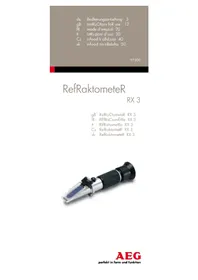
RX 3 - Measuring instrument AEG - Free user manual and instructions
Find the device manual for free RX 3 AEG in PDF.



| Product type | Refractometer |
| Brand | AEG |
| Model | RX 3 |
| Dimensions (approx.) | 150 x 40 x 40 mm |
| Weight (approx.) | 200 g |
| Power supply | None (optical) |
| Main functions | Measurement of antifreeze protection, windshield washer fluid, and electrolyte concentration |
| Measurement scales | A (electrolytes), B (antifreeze), C (windshield washer fluid) |
| Measurement range (antifreeze) | -50 °C to 0 °C |
| Accuracy (antifreeze) | ±5 °C |
| Measurement range (windshield washer) | -40 °C to 0 °C |
| Accuracy (windshield washer) | ±5 °C |
| Measurement range (electrolytes) | 1.10 to 1.40 kg/l |
| Accuracy (electrolytes) | ±0.01 kg/l |
| Package contents | Refractometer, storage case, pipette, adjustment tool, cleaning cloth, demineralized water |
| Prism material | Optical glass |
| Operating temperature | +20 °C (calibration) |
| Care and cleaning | Clean with a soft damp cloth; do not use aggressive cleaners |
| Safety | Wear gloves and safety glasses when handling electrolytes; keep out of reach of children |
| Repairability | Contact a specialized retailer in case of problems |
| Warranty | Manufacturer's standard |
Frequently Asked Questions - RX 3 AEG
User questions about RX 3 AEG
0 question about this device. Answer the ones you know or ask your own.
Ask a new question about this device
Download the instructions for your Measuring instrument in PDF format for free! Find your manual RX 3 - AEG and take your electronic device back in hand. On this page are published all the documents necessary for the use of your device. RX 3 by AEG.
USER MANUAL RX 3 AEG
FR REfRaCtomEtRe RX 3
It RIfRattometRo RX 3
Cz RefRaktometR RX 3
sk RefRaktometeR RX 3

INHALTSVERZEICHNIS
Observe warning and safety notices!

Caution: Keep out of reach of children!
Caution: Acid-burn risk!
INTRODUCTION

Please read this User Manual carefully before your initial use and become familiar with the functions of the
refractometer. Keep this User Manual in a safe place for future reference and include the User Manual when passing on the refractometer to third parties.
SPECIFIED USE
The refractometer determines the content of anti-freeze mixtures and its resulting freezing point in liquids. In addition, the acid density of battery acid can be measured which determines the battery state of charge (SOC). There is a certain level of risk, if the refractometer is used for anything other than the intended purposes. The manufacturer is not liable for damages caused by the use of this product when used for anything other than the intended purposes.
SCOPE OF DELIVERY
When unpacking the product and before your initial use, please check that all parts within the scope of delivery are included. Please exchange damaged or defective parts immediately and do not use them.
Refractometer
Storage Box
Pipette
Calibration Tools
Cleaning Cloth
Distilled Water
TECHNICAL MANUAL

- Prism Cover
4.Ocular - Prism Surface
- Adjustment Ring
- Calibration Screw

- Cleaning Clotch
- Storage Box
- Calibration Tools
- Pipette
- Distilled Water
- Refractometer

A: Meas. scale for determining battery acid density
B: Anti-freeze scale
C: Measuring scale for windscreen washer fluid
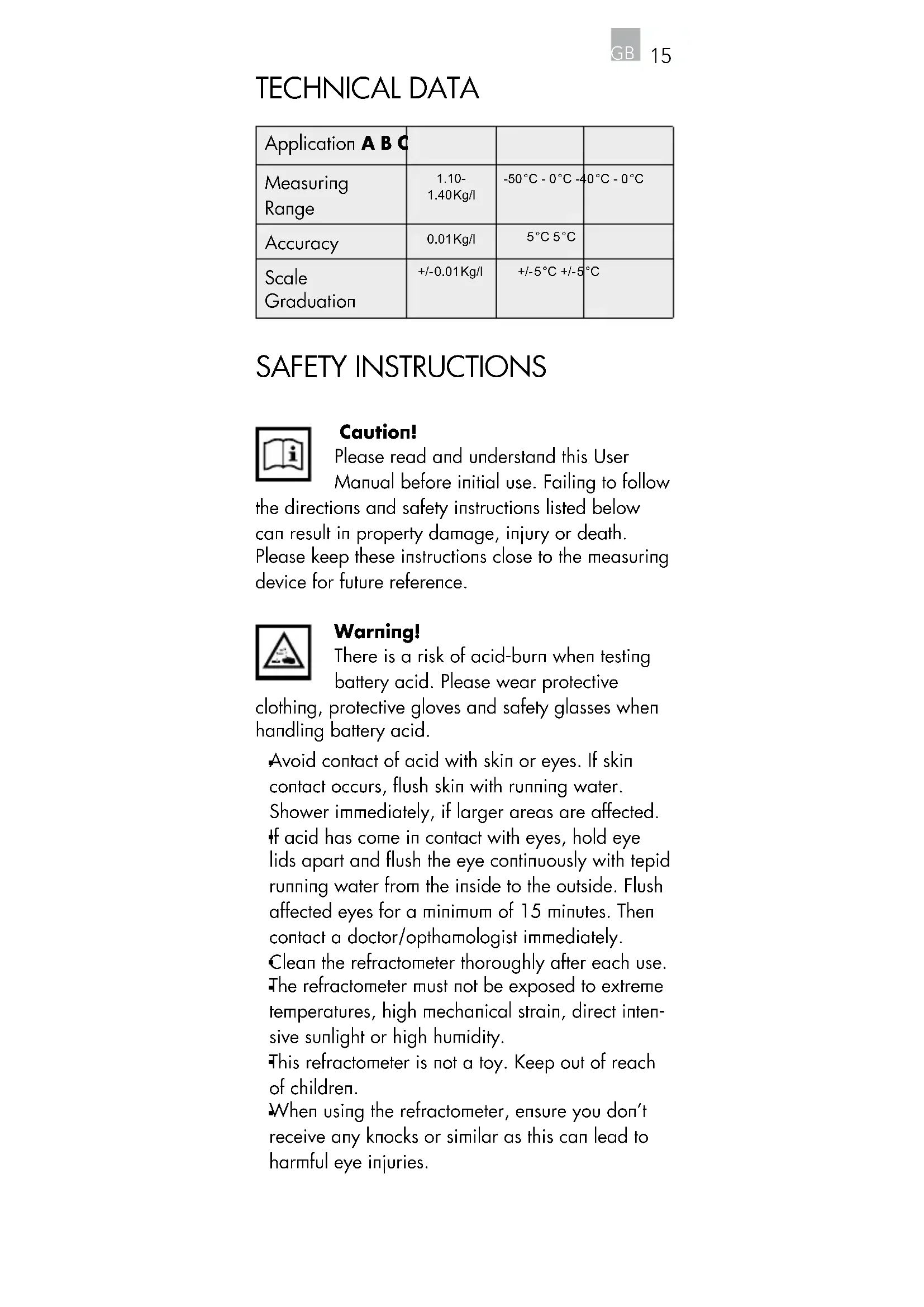
TECHNICAL DATA
| Application ABC | |||
| Measuring Range | 1.10-1.40Kg/l | -50°C - 0°C | -40°C - 0°C |
| Accuracy | 0.01Kg/l | 5°C 5°C | |
| Scale Graduation | +/-0.01Kg/l | +/-5°C +/-5°C | |
SAFETY INSTRUCTIONS

Caution!
Please read and understand this User Manual before initial use. Failing to follow
the directions and safety instructions listed below can result in property damage, injury or death.
Please keep these instructions close to the measuring device for future reference.

Warning!
There is a risk of acid-burn when testing battery acid. Please wear protective
clothing, protective gloves and safety glasses when handling battery acid.
Avoid contact of acid with skin or eyes. If skin contact occurs, flush skin with running water.
Shower immediately, if larger areas are affected.
If acid has come in contact with eyes, hold eye lids apart and flush the eye continuously with tepid running water from the inside to the outside. Flush affected eyes for a minimum of 15 minutes. Then contact a doctor/opthamologist immediately.
Clean the refractometer thoroughly after each use.
The refractometer must not be exposed to extreme temperatures, high mechanical strain, direct intensive sunlight or high humidity.
This refractometer is not a toy. Keep out of reach of children.
When using the refractometer, ensure you don't receive any knocks or similar as this can lead to harmful eye injuries.
The rubber eyecup can cause skin irritations if in contact with skin for longer periods of time. In this event, please contact your doctor.
If possible, do not touch lenses with your fingers!

Warning!
Never leave children unsupervised with the packing material as this can cause
suffocation.
This device is not intended for use by persons (including children) with reduced physical, sensory or mental abilities or who lack experience and / or knowledge, unless they are supervised by a person who is responsible for their safety or unless they receive instructions from this person on how the equipment is to be used. Children must be supervised in order to ensure that they do not play with the device.
Do not leave packaging material around carelessly as this can become a dangerous toy for children. Packaging could contain a small white bag with pellets. Do not open this bag. It is intended to keep the device dry during transport.
BEFORE INITIAL USE
Remove protective film (if included) from prism surface [2] and ensure the rubber eyecup is in the correct position.
The refractometer can quickly and precisely determine the content of anti-freeze agents in the coolant circuit and windscreen washer system in your vehicle. In addition, it has the option to determine the acid density of the battery acid in your vehicle battery. The measuring device must be adjusted to establish correct measurements.
Zero Point Adjustment
- Fold the prism cover [1] up.
-
Apply a few drops of distilled water [8] to the prism surface [2].
-
Repress the prism cover [1]. The liquid quantity should be measured in such a way that most of the prism surface is moistened.
- Look through the ocular [4] and point the refractometer including its prism surface [2] towards a bright light source if possible.
- Looking through the ocular [4], you will see a light and dark field. Its boundary lines indicate the refractive index on the scale also visible in the ocular [4].
- By using the calibration tools [7], the scale can be adjusted and the measuring device calibrated by turning the calibration screw [3] behind the prism surface [2] (underneath the rubber cap). The light-dark-border line must coincide with the waterline. The room temperature should be at +20^

Caution!
The scales are set at an ambient air temperature of +20^
Measuring Process for Antifreeze Protection-Check
- Lift the prism cover [1] and apply a few drops of cooling solution to be measured to the prism surface [2] using the included pipette [10]. Distribute the liquid evenly by pressing the prism cover [1].
- Close the prism cover [1] and look at the measuring scale through the ocular [4]. Point the refractometer including its prism surface [2] towards a bright light source if possible.
- Turn the adjustment ring [5] on the ocular [4] to set the focus of the vision.
- The border line on the measuring scale moves depending on the anti-freeze agent concentration. This light-dark-border directly shows the freezing point of the anti-freeze mix in ^ C on the anti-freeze-scale [B]. The values show the measured value for Propylene (G13) and the measured value for Ethylene* (G11 / G12). The Propylene scale must also be used if you are not familiar with the poured-in anti-freeze protection or if it is a mixture of both. This is the only way sufficient anti-freeze protection of the cooling
solution is guaranteed.
- The measuring result will not be affected by the temperature of the cooling solution.
-
After measuring has occurred, clean the included pipette [10] and the refractometer thoroughly.
-
In Europe, Propylene is primarily used as an anti-freeze agent.
** Outside of Europe, Ethylene is primarily used as an anti-freeze agent.
Measuring Process for Windscreen Washer Fluid-Check
- The measuring process is identical to the one used for the anti-freeze-check.
- For the windscreen washer fluid-check [C], the measured value can be read in ^ C on the measuring scale and indicates a guideline value, as the composition of individual anti-freeze agents varies.
- After measuring has occurred, clean the included pipette [10] and the refractometer thoroughly.
Measuring Process for Determining Battery Acid Density
- Instead of the anti-freeze solution, apply a little battery acid to the prism surface [2] by using the pipette [10].
- Take readings for the acid density in g/cm^3 ( kg/l ) by using the light-dark-border on the measuring scale for determining [A] -/+ the battery acid density.
- The scale [A] is divided into three areas to determine the battery state of charge (SOC).
RECHARGE = replace/recharge 1.20g / cm^3
Battery State of Charge (SOC)
50%
FAIR = acceptable
(1.20 to 1.25g/cm^3 ); Battery
State of Charge (SOC) 75%
GOOD = good (>1.25g/cm^3) ; Battery
State of Charge (SOC) 100%

Caution!
After all measurements have been completed, remove liquids from the prism surface
[2] and prism cover [1] with an absorbent cloth.
Then, thoroughly clean the prism and prism cover with a damp cloth and wipe both parts with a soft, dry cloth.
CLEANING AND MAINTENANCE
Clean the refractometer with a soft, damp cloth.
Do not use any aggressive and abrasive cleaning products. The refractometer is maintenance-free.
SERVICE
Should you have any questions regarding commissioning or operating in spite of studying these operating instructions, or if a problem should occur against all expectations, please get in contact with your specialist supplier.
DISPOSAL
The packaging is made from environmentally friendly materials which can be disposed of at your local recycle centre.
Images may slightly deviate from the actual product.
Subject to change in the interest of technical advances. Decorations not included.
TABLE DES MATIÈRES
EXPLICATION DES SYMBOLES 20
INTRODUCTION 21
UTILISATION CONFORME 21
CONTENU DE L'EMBALLAGE 21
DESCRIPTION DE L'APPAREIL 22
CARACTERISTIQUES TECHNIQUES 23
CONSIGNES DE SECURITE. 23
AVANT LA PREMIÈRE UTILISATION 24
MANIPULATION/MESURE 25
Réglagedu point zéro 25
www.aeg-automotive.com
AEG is a registered trademark used under license from
- INHALTSVERZEICHNIS
- INTRODUCTION
- SPECIFIED USE
- SCOPE OF DELIVERY
- TECHNICAL MANUAL
- TECHNICAL DATA
- SAFETY INSTRUCTIONS
- Caution!
- Warning!
- BEFORE INITIAL USE
- Zero Point Adjustment
- Measuring Process for Antifreeze Protection-Check
- Measuring Process for Windscreen Washer Fluid-Check
- Measuring Process for Determining Battery Acid Density
- CLEANING AND MAINTENANCE
- SERVICE
- DISPOSAL
- TABLE DES MATIÈRES
Brand : AEG
Model : RX 3
Category : Measuring instrument