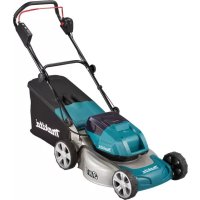
DLM460Z - Lawn mower MAKITA - Free user manual and instructions
Find the device manual for free DLM460Z MAKITA in PDF.


| Brand | Makita |
| Model | DLM460Z |
| Product Type | Cordless Lawn Mower |
| Cutting Width | 460 mm |
| No-load Speed | 2 500 min⁻¹ |
| Maximum Speed | 3 300 min⁻¹ |
| Dimensions in Use (L x W x H) | 1 319 – 1 518 x 532 x 879 – 1 138 mm |
| Dimensions in Storage (L x W x H) | 1 004 – 1 125 x 532 x 533 – 713 mm |
| Rated Voltage | 36 V DC |
| Net Weight | 25.4 – 27.6 kg |
| Protection Rating | IPX4 |
| Measured Sound Power Level | 93 dB(A) |
| Guaranteed Sound Power Level | 96 dB(A) |
| Sound Pressure Level | 84 dB(A) |
| Vibration Emission | ≤ 2.5 m/s² (uncertainty K=1.5 m/s²) |
| Cutting Height Adjustment Range | 20 – 75 mm |
| Compatible Batteries | BL1815N, BL1820B, BL1830B, BL1840B, BL1850B, BL1860B |
| Compatible Chargers | DC18RC, DC18RD, DC18RE, DC18SD, DC18SE, DC18SF, DC18SH, DC18WC |
| Electronic Functions | Soft start, constant speed control, eco mode |
| Safety | Safety key, motor stop when lever released, overload and overheat protection |
| Maintenance | Clean after each use, check tightening of fasteners, replace blade if worn |
| Included Accessories | Grass bag, mulching accessory, blade wrench |
Frequently Asked Questions - DLM460Z MAKITA
User questions about DLM460Z MAKITA
0 question about this device. Answer the ones you know or ask your own.
Ask a new question about this device
Download the instructions for your Lawn mower in PDF format for free! Find your manual DLM460Z - MAKITA and take your electronic device back in hand. On this page are published all the documents necessary for the use of your device. DLM460Z by MAKITA.
USER MANUAL DLM460Z MAKITA
| SPECIFICATIONS | ||
| Model: DLM460 | ||
| Mowing width (blade diameter) 460 mm | ||
| No load speed 2,500 min | -1 | |
| Maximum speed 3,300 min | -1 | |
| Part number of replacement mower blade 1910N1-8 | ||
| Dimensions(L x W x H) | during operation L: 1,319 mm to 1,518 mmW: 532 mmH: 879 mm to 1,138 mm | |
| when stored(without grass basket) | L: 1,004 mm to 1,125 mmW: 532 mmH: 533 mm to 713 mm | |
| Rated voltage D.C. 36 V | ||
| Net weight 25.4 - 27.6 kg | ||
| Protection degree IPX4 | ||
- Due to our continuing program of research and development, the specifications herein are subject to change without notice.
- Specifications may differ from country to country.
The weight may differ depending on the attachment(s), including the battery cartridge. The lightest and heaviest combinations, according to EPTA-Procedure 01/2014, are shown in the table.
Applicable battery cartridge and charger
| Battery cartridge BL1815N / BL1820B / BL1830B / BL1840B / BL | 850B / BL1860B |
| Charger DC18RC / DC18RD / DC18RE / DC18SD / DC18SE / DC1 | 8SF / DC18SH / DC18WC |
Some of the battery cartridges and chargers listed above may not be available depending on your region of residence.
| WARNING: Only use the battery cartridges and chargers listed above. Use of any other battery cartridges and chargers may cause injury and/or fire. |
| WARNING: Do not use a corded power supply such as battery adapter or portable power pack with this machine. The cable of such power supply may hinder the operation and result in personal injury. |
| Symbols | Remove the lock key before inspecting, adjusting, cleaning, servicing, leaving and storing the mower. |
| The followings show the symbols which may be used for the equipment. Be sure that you understand their meaning before use. | Warning; Disconnect battery before maintenance. |
| Take particular care and attention. | Guaranteed sound power level according to EU Outdoor Noise Directive. |
| Read instruction manual. | Sound power level according to Australia NSW Noise Control Regulation. |
| Danger; be aware of thrown objects. |
Due to the presence of hazardous components in the equipment, waste electrical and electronic equipment, accumulators and batteries may have a negative impact on the environment and human health. Do not dispose of electrical and electronic appliances or batteries with household waste!
In accordance with the European Directive on waste electrical and electronic equipment and on accumulators and batteries and waste accumulators and batteries, as well as their adaptation to national law, waste electrical equipment, batteries and accumulators should be stored separately and delivered to a separate collection point for municipal waste, operating in accordance with the regulations on environmental protection.
This is indicated by the symbol of the crossed-out wheeled bin placed on the equipment.
Intended use
The machine is intended for lawn mowing.
Noise
The typical A-weighted noise level determined according to EN IEC 62841-4-3:
| Model Measured sound | und power level \( \left( {\mathrm{L}}_{\mathrm{{WA}}}\right) \) : (dB(A)) | Guaranteed sound power level \( \left( {\mathrm{L}}_{\mathrm{{WA}}}\right) \) : (dB(A)) |
| DLM460 93 96 |
| Model Sound press | ure level (LpA) : (dB(A)) | Uncertainty for sound pressure level (K) : (dB(A)) |
| DLM460 84 3 |
NOTE: The declared noise emission value(s) has been measured in accordance with a standard test method and may be used for comparing one tool with another.
NOTE: The declared noise emission value(s) may also be used in a preliminary assessment of exposure.

WARNING: Wear ear protection.
WARNING: The noise emission during actual use of the power tool can differ from the declared value(s) depending on the ways in which the tool is used especially what kind of workpiece is processed.
WARNING: Be sure to identify safety measures to protect the operator that are based on an estimation of exposure in the actual conditions of use (taking account of all parts of the operating cycle such as the times when the tool is switched off and when it is running idle in addition to the trigger time).
Vibration
The vibration total value (tri-axial vector sum) determined according to EN IEC 62841-4-3:
Model DLM460
Vibration emission (a_h):2.5m / s^2 or less Uncertainty (K):1.5m / s^2
NOTE: The declared vibration total value(s) has been measured in accordance with a standard test method and may be used for comparing one tool with another.
NOTE: The declared vibration total value(s) may also be used in a preliminary assessment of exposure.
WARNING: The vibration emission during actual use of the power tool can differ from the declared value(s) depending on the ways in which the tool is used especially what kind of workpiece is processed.
WARNING: Be sure to identify safety measures to protect the operator that are based on an estimation of exposure in the actual conditions of use (taking account of all parts of the operating cycle such as the times when the tool is switched off and when it is running idle in addition to the trigger time).
Declarations of Conformity
For European countries only
The Declarations of conformity are included in Annex A to this instruction manual.
SAFETYWARNINGS
General power tool safety warnings
WARNING Read all safety warnings, instructions, illustrations and specifications provided with this power tool. Failure to follow all instructions listed below may result in electric shock, fire and/or serious injury.
Save all warnings and instructions for future reference.
The term "power tool" in the warnings refers to your mains-operated (corded) power tool or battery-operated (cordless) power tool.
Cordless lawnmower safety warnings
- Do not use the lawnmower in bad weather conditions, especially when there is a risk of lightning. This decreases the risk of being struck by lightning.
- Thoroughly inspect the area for wildlife where the lawnmower is to be used. Wildlife may be injured by the lawnmower during operation.
-
Thoroughly inspect the area where the lawnmower is to be used and remove all stones, sticks, wires, bones, and other foreign objects. Thrown objects can cause personal injury.
-
Before using the lawnmower, always visually inspect to see that the blade and the blade assembly are not worn or damaged. Worn or damaged parts increase the risk of injury.
- Check the grass catcher frequently for wear or deterioration. A worn or damaged grass catcher may increase the risk of personal injury.
- Keep guards in place. Guards must be in working order and be properly mounted. A guard that is loose, damaged, or is not functioning correctly may result in personal injury.
- Keep all cooling air inlets clear of debris.
Blocked air inlets and debris may result in overheating or risk of fire. - While operating the lawnmower, always wear non-slip and protective footwear. Do not operate the lawnmower when barefoot or wearing open sandals. This reduces the chance of injury to the feet from contact with the moving blade.
- While operating the lawnmower, always wear long trousers. Exposed skin increases the likelihood of injury from thrown objects.
- Do not operate the lawnmower in wet grass. Walk, never run. This reduces the risk of slipping and falling which may result in personal injury.
- Do not operate the lawnmower on excessively steep slopes. This reduces the risk of loss of control, slipping and falling which may result in personal injury.
- When working on slopes, always be sure of your footing, always work across the face of slopes, never up or down and exercise extreme caution when changing direction. This reduces the risk of loss of control, slipping and falling which may result in personal injury.
- Use extreme caution when reversing or pulling the lawnmower towards you. Always be aware of your surroundings. This reduces the risk of tripping during operation.
- Do not touch blades and other hazardous moving parts while they are still in motion. This reduces the risk of injury from moving parts.
- When clearing jammed material or cleaning the lawnmower, make sure all power switches are off and the battery pack is disconnected. Unexpected operation of the lawnmower may result in serious personal injury.
Additional safety warnings
Training
- Read the instructions carefully. Be familiar with the controls and the proper use of the mower.
- Never allow children or people unfamiliar with these instructions to use the mower. Local regulations can restrict the age of the operator.
- Never operate the mower while people, especially children, or pets are nearby.
- Keep in mind that the operator or user is responsible for accidents or hazards occurring to other people or their property.
Preparation
- Be sure the area is clear of other people before mowing. Stop mower if anyone enters the area.
- Do not insert the lock key into mower until it is ready to be used.
- Watch for holes, ruts, bumps, rocks, or other hidden objects. Uneven terrain could cause a slip and fall accident. Tall grass can hide obstacles.
-
Do not insert or remove the lock key in the rain. Operation
-
Stop the mower and remove the lock key, and make sure that all moving parts have come to a complete stop
whenever you leave the mower;
- before clearing blockages or unclogging chute;
- before checking, cleaning or working on the mower.
-
If the mower strikes a foreign object, follow these steps:
-
Stop the mower, release the switch lever and wait until the blade comes to a complete stop.
- Remove the lock key and the battery cartridge.
- Thoroughly inspect the mower for any damage.
-
Replace the blade if it is damaged in any way. Repair any damage before restarting and continuing to operate the mower.
-
If the mower starts to vibrate abnormally or you notice anything unusual, follow these steps immediately:
-
Stop the mower, release the switch lever and wait until the blade comes to a complete stop.
- Remove the lock key and the battery cartridge.
- Inspect for damage and replace or repair any damaged parts.
-
Check for and tighten any loose parts.
-
Never operate the mower with defective guards or shields, or without safety devices, for example deflectors and/or grass basket, in place.
-
Operate the mower only in daylight or in good artificial light.
- Switch on the mower carefully according to instructions and with feet well away from the blade(s).
- Take care against injury to feet and hands from the mower blades.
- Stop the blade(s) if the mower has to be tilted for transportation when crossing surfaces other than grass, and when transporting the mower to and from the area to be used.
-
Do not tilt the mower when switching on the motor, except if the mower has to be tilted for starting. In this case, do not tilt it more than absolutely necessary and lift only the part, which is away from the operator. Always ensure that both hands are in the operating position before returning the mower to the ground.
-
Do not put hands or feet near or under rotating parts. Keep clear of the discharge opening at all times.
- Always keep a firm hold on the handle.
- Don't grasp the exposed cutting blades or cutting edges when picking up or holding the mower.
- Keep hands and feet away from rotating blades. Caution - Blades coast after the mower is switched off.
- Never attempt to make cutting height adjustments while mower is running if the mower has cutting height adjustment feature.
- Release switch lever and wait for blade rotation to stop before crossing driveways, walks, roads, and any gravel-covered areas. Also remove the lock key if you leave the mower, reach to pick up or remove something out of your way, or for any other reason that may distract you from what you are doing.
- Do not start the mower when standing in front of the discharge opening.
- Never direct discharged material toward anyone. Avoid discharging material against a wall or obstruction. Material may ricochet back toward the operator. Stop the blade when crossing gravel surfaces.
- Do not pull the mower backwards unless absolutely necessary. When you are compelled to back the mower from a fence or other similar obstruction, look down and behind before and while moving backwards.
- Shut the motor off and wait until the blade comes to a complete stop before removing the grass catcher. Beware that the blades coast after turn off.
- When you use the machine on muddy ground, wet slope, or slippery place, pay attention to your footing.
- Avoid working in poor environment where increased user fatigue is expected.
- Do not use the machine in bad weather where visibility is limited. Failure to do so may cause fall or incorrect operation due to low visibility.
- Do not submerge the machine into a puddle.
- When wet leaves or dirt adhere to the suction mouth (ventilation window) due to rain, remove them.
- Do not use the machine in the snow.
- If the cut-off grass is wet, it is likely to be clogged inside of the machine. Check the condition of the machine regularly, and remove the adhered grass as necessary.
- When operating the machine, pay attention to piping and wiring.
Maintenance and storage
- Inspect and maintain the mower regularly.
- Keep all nuts, bolts, and screws tight to be sure the equipment is in safe working condition.
-
Check the grass basket frequently for wear or deterioration. For storage, always make sure the grass basket is empty. Replace a worn grass basket with a new factory replacement for safety.
-
Use only the manufacturer genuine blades specified in this manual.
-
Be careful during adjustment of the mower to prevent entrapment of the fingers between moving blades and fixed parts of the mower.
-
Check the blade mounting bolt at frequent intervals for proper tightness.
- Always allow the mower to cool down before storing.
- When servicing the blades be aware that, even though the power source is switched off, the blades can still be moved.
- Never remove or tamper with safety devices. Check their proper operation regularly. Never do anything to interfere with the intended function of a safety device or to reduce the protection provided by a safety device.
- Do not leave the machine unattended outdoors in the rain.
- Do not wash the machine with high pressure water.
- When washing the machine, be sure to remove the battery and lock key and close the battery cover, and pour water toward the bottom of the machine to which the blade is attached.
- When storing the machine, avoid direct sunlight and rain, and store it in a place where it does not get hot or humid.
- Perform inspection or maintenance in a place where rain can be avoided.
- After using the machine, remove the adhered dirt and dry the machine completely before storing. Depending on the season or the area, there is a risk of malfunction due to freezing.
Electrical and battery safety
- Do not open or mutilate the battery(ies). Released electrolyte is corrosive and may cause damage to the eyes or skin. It may be toxic if swallowed.
- Do not charge battery in rain, or in wet locations.
- Do not charge the battery outdoors.
- Do not handle charger, including charger plug, and charger terminals with wet hands.
- Do not replace the battery in the rain.
- Do not wet the terminal of battery with liquid such as water, or submerge the battery. Do not leave the battery in the rain, nor charge, use, or store the battery in a damp or wet place. If the terminal gets wet or liquid enters inside of battery, the battery may be short circuited and there is a risk of overheat, fire, or explosion.
- After removing the battery from the machine or charger, be sure to attach the battery cover to the battery and store it in a dry place.
- Do not replace the battery with wet hands.
- Avoid dangerous environment. Don't use the machine in dump or wet locations or expose it to rain. Water entering the machine will increase the risk of electric shock.
- If the battery cartridge gets wet, drain the water inside and then wipe it with a dry cloth. Dry the battery cartridge completely in a dry place before use.
SAVE THESE INSTRUCTIONS.
WARNING: DO NOT let comfort or familiarity with product (gained from repeated use) replace strict adherence to safety rules for the subject product. MISUSE or failure to follow the safety rules stated in this instruction manual may cause serious personal injury.
Important safety instructions for battery cartridge
- Before using battery cartridge, read all instructions and cautionary markings on (1) battery charger, (2) battery, and (3) product using battery.
- Do not disassemble or tamper with the battery cartridge. It may result in a fire, excessive heat, or explosion.
- If operating time has become excessively shorter, stop operating immediately. It may result in a risk of overheating, possible burns and even an explosion.
- If electrolyte gets into your eyes, rinse them out with clear water and seek medical attention right away. It may result in loss of your eyesight.
- Do not short the battery cartridge:
(1) Do not touch the terminals with any conductive material.
(2) Avoid storing battery cartridge in a container with other metal objects such as nails, coins, etc.
(3) Do not expose battery cartridge to water or rain.
A battery short can cause a large current flow, overheating, possible burns and even a breakdown.
- Do not store and use the tool and battery cartridge in locations where the temperature may reach or exceed 50^ (122°F).
- Do not incinerate the battery cartridge even if it is severely damaged or is completely worn out. The battery cartridge can explode in a fire.
-
Do not nail, cut, crush, throw, drop the battery cartridge, or hit against a hard object to the battery cartridge. Such conduct may result in a fire, excessive heat, or explosion.
-
Do not use a damaged battery.
- The contained lithium-ion batteries are subject to the Dangerous Goods Legislation requirements.
For commercial transports e.g. by third parties, forwarding agents, special requirement on packaging and labeling must be observed.
For preparation of the item being shipped, consulting an expert for hazardous material is required.
Please also observe possibly more detailed national regulations.
Tape or mask off open contacts and pack up the battery in such a manner that it cannot move around in the packaging.
-
When disposing the battery cartridge, remove it from the tool and dispose of it in a safe place. Follow your local regulations relating to disposal of battery.
-
Use the batteries only with the products specified by Makita. Installing the batteries to non-compliant products may result in a fire, excessive heat, explosion, or leak of electrolyte.
- If the tool is not used for a long period of time, the battery must be removed from the tool.
- During and after use, the battery cartridge may take on heat which can cause burns or low temperature burns. Pay attention to the handling of hot battery cartridges.
- Do not touch the terminal of the tool immediately after use as it may get hot enough to cause burns.
- Do not allow chips, dust, or soil stuck into the terminals, holes, and grooves of the battery cartridge. It may cause heating, catching fire, burst and malfunction of the tool or battery cartridge, resulting in burns or personal injury.
-
Unless the tool supports the use near high-voltage electrical power lines, do not use the battery cartridge near high-voltage electrical power lines. It may result in a malfunction or breakdown of the tool or battery cartridge.
-
Keep the battery away from children.
SAVE THESE INSTRUCTIONS.
CAUTION: Only use genuine Makita batteries. Use of non-genuine Makita batteries, or batteries that have been altered, may result in the battery bursting causing fires, personal injury and damage. It will also void the Makita warranty for the Makita tool and charger.
Tips for maintaining maximum battery life
- Charge the battery cartridge before completely discharged. Always stop tool operation and charge the battery cartridge when you notice less tool power.
- Never recharge a fully charged battery cartridge. Overcharging shortens the battery service life.
- Charge the battery cartridge with room temperature at 10^ - 40^ (50°F - 104°F). Let a hot battery cartridge cool down before charging it.
- When not using the battery cartridge, remove it from the tool or the charger.
- Charge the battery cartridge if you do not use it for a long period (more than six months).
ASSEMBLY
WARNING: Always be sure that the lock key and battery cartridge are removed before carrying out any work on the mower. Failure to remove the lock key and the battery cartridge may result in serious personal injury from accidental start-up.
WARNING: Never start the mower unless it is completely assembled. Operation of the machine in a partially assembled state may result in serious personal injury from accidental start-up.
Installing the handle
NOTICE: When installing handles, position the cords so that they are not caught by anything between the handles. If the cord is damaged, the mower switch may not work.
- Attach the lower handle so that the holes in the handle fit in the protrusions on the mower body. Insert the bolts from inside, then attach washer A from outside, and then tighten the thumb nuts.
Fig.1: 1. Lower handle 2. Washer A 3. Thumb nut 4. Protrusion 5. Hole 6. Bolt - Align the hole in the lower handle with the hole in the upper handle, then insert the bolts from inside, then attach washer B from outside, and then tighten the thumb nuts.
Fig.2: 1. Upper handle 2. Hole 3. Washer B 4.Thumb nut 5. Lower handle 6.Bolt
CAUTION: Hold the upper handle firmly so that it does not drop off your hand. Otherwise, the handle may fall and cause an injury.
- Attach holder A and holder B to the handle.
Position the cords as shown in the figure.
Fig.3: 1. Cord 2. Holder A 3. Holder B
NOTE: When attaching holder A, be sure to fix the cord with the holder as shown in the figure.
Removing the mulching attachment
- Open the rear cover.
Fig.4: 1. Rear cover - Remove the mulching attachment while holding down the lever.
Fig.5: 1. Lever 2. Mulching attachment
Assembling the grass basket
- Pick up the upper clip of the grass basket.
Fig.6: 1. Upper clip - Insert the frame into the grass basket as far as it will go while holding the handle of the frame.
Fig.7: 1. Handle
NOTICE: Do not insert the handle into the grass basket. Be sure to insert the frame along the stitch of the grass basket.
- Make sure that there is no sagging on the corners of the grass basket.
Fig.8 -
Open the upper clip, and attach it to the frame.
Fig.9 -
Attach all the other clips as shown in the figure. Make sure that all the clips are securely attached to the frame.
Fig.10: 1. Clip
Fig.11
Installing the grass basket
-
Open the rear cover.
Fig.12: 1. Rear cover -
Hook the grass basket on the rod of the mower body as shown in the figure.
Fig.13: 1. Rod 2. Guard 3. Grass basket
NOTICE: Make sure that the guard on the grass basket is facing downward. Otherwise, the grass basket may not catch all of cut-off grass.
Attaching the mulching attachment
-
Open the rear cover, and then remove the grass basket.
Fig.14: 1. Rear cover 2. Grass basket -
Attach the mulching attachment while holding down the lever, and then release the lever to lock the mulching attachment.
Fig.15: 1. Lever 2. Mulching attachment
FUNCTIONAL DESCRIPTION
Installing or removing battery cartridge
CAUTION: Always switch off the tool before installing or removing of the battery cartridge.
CAUTION: Hold the machine and the battery cartridge firmly when installing or removing battery cartridge. Failure to hold the tool and the battery cartridge firmly may cause them to slip off your hands and result in damage to the tool and battery cartridge and a personal injury.
CAUTION: Make sure that you lock the battery cover before use. Otherwise, mud, dirt, or water may cause damage to the product or the battery cartridge.
CAUTION: Always install the battery cartridge fully until the red indicator cannot be seen. If not, it may accidentally fall out of the tool, causing injury to you or someone around you.
CAUTION: Do not install the battery cartridge forcibly. If the cartridge does not slide in easily, it is not being inserted correctly.
NOTE: The tool does not work with only one battery cartridge.
To install the battery cartridge;
- Pull up the locking lever, and then open the battery cover.
Fig.16: 1. Battery cover 2. Locking lever
2. Align the tongue on the battery cartridge with the slot on the mower then slide the cartridge until it locks in place with a little click.
Fig.17: 1. Battery cartridge
- Insert the lock key in the place shown in the figure as far as it will go.
Fig.18: 1. Lock key - Close the battery cover and push it until it is latched with the locking lever.
To remove the battery cartridge from the mower;
- Pull up the battery cover locking lever and open the battery cover.
- Pull out the battery cartridge from the mower while sliding the button on the front of the cartridge.
- Pull out the lock key.
- Close the battery cover.
Tool / battery protection system
The tool is equipped with a tool/battery protection system. This system automatically cuts off power to the motor to extend tool and battery life. The tool will automatically stop during operation if the tool or battery is placed under one of the following conditions:
Overload protection
When the battery is operated in a manner that causes it to draw an abnormally high current, the tool automatically stops and the main power lamp blinks in green. In this situation, turn the tool off and stop the application that caused the tool to become overloaded. Then turn the tool on to restart.
Overheat protection
When the tool or battery is overheated, the tool stops automatically and the main power lamp lights up in red. In this case, let the tool and battery cool before turning the tool on again.
Overdischarge protection
When the battery capacity is not enough, the tool stops automatically and the main power lamp blinks in red. In this case, remove the battery from the tool and charge the battery cartridges or change the battery cartridges to fully charged ones.
Indicating the remaining battery capacity
Only for battery cartridges with the indicator
Press the check button on the battery cartridge to indicate the remaining battery capacity. The indicator lamps light up for a few seconds.
Fig.19: 1. Indicator lamps 2. Check button
| Indicator lamps Remaining | capacity | ||
| Lighted Off | Blinking | ||
| 75% to 100% | |||
| 50% to 75% | |||
| 25% to 50% | |||
| 0% to 25% | |||
| Charge the battery. | |||
| The battery may have malfunctioned. | |||
NOTE: Depending on the conditions of use and the ambient temperature, the indication may differ slightly from the actual capacity.
NOTE: The first (far left) indicator lamp will blink when the battery protection system works.
Control panel
The control panel has the main power switch, the mode switching button, and the indicator of remaining battery capacity.
Fig.20: 1. Battery indicator 2. Mode switching lamp 3. Main power lamp 4. Check button 5. Mode switching button 6. Main power switch
Main power switch
WARNING: Always turn off the main power switch when not in use.
To turn on the machine, press the main power switch. The main power lamp lights up in green. To turn off the machine, press the main power switch again.
NOTE: If the main power lamp lights up in red or blinks in red or green, refer to the instructions for tool/battery protection system.
NOTE: This machine employs the auto power-off function. To avoid unintentional start up, the main power switch will automatically shut down when the switch lever is not pulled for a certain period after the main power switch is turned on.
Mode switching button
You can switch the operating mode by pressing the mode switching button. When the machine is turned on, the machine starts up in the normal mode. When you press the mode switching button, the machine shifts to the energy-saving mode and the mode switching lamp lights up in green. In the energy-saving mode, you can decrease the noise at mowing. When you press the mode switching button again, the machine returns to the normal mode.
Indicating the remaining battery capacity
Press the check button to indicate the remaining battery capacities. The battery indicators correspond to each battery.
| Battery indicator status | Remaining battery capacity | |
| On Off | □ | |
| 50% - 100% | ||
| 20% - 50% | ||
| 0% - 20% | ||
Switch action
WARNING: Before installing the battery cartridge, always check to see that the switch lever actuates properly and returns to the original position when released. Operating a machine with a switch that does not actuate properly can lead to loss of control and serious personal injury.
NOTE: The mower does not start without pressing the switch button even the switch lever is pulled.
NOTE: Mower may not start due to the overload when you try to mow long or dense grass at a time. Increase the mowing height in this case.
This mower is equipped with the interlock switch and handle switch. If you notice anything unusual with either of these switches, stop operation immediately and have them checked by your nearest Makita Authorized Service Center.
- Install the battery cartridges. Insert the lock key into the interlock switch and then close the battery cover.
- Press the main power switch.
- Press the switch button and hold it.
- Grab the upper handle and pull the switch lever.
Fig.21: 1. Switch button 2. Upper handle 3. Switch lever
NOTE: If the lock key is not inserted, the power lamp blinks in green when you pull the switch lever.
- Release the switch button as soon as the motor starts running. The mower will continue to run until you release the switch lever.
- Release the switch lever to stop the motor.
Adjusting the mowing height
WARNING: Never put your hand or leg under the mower body when adjusting the mowing height.
WARNING: Always make sure that the lever fits in the groove properly before operation.
The mowing height can be adjusted in the range of between 20mm and 75mm .
Remove the lock key, and then pull the mowing height adjusting lever outward of the mower body and move it to your desired mowing height.
Fig.22: 1. Mowing height adjusting lever
Hold the front grip with one hand, and then move the mowing height adjusting lever with the other hand.
Fig.23: 1. Mowing height adjusting lever 2. Front grip
NOTE: The mowing height figures should be used just as a guideline. Depending on the conditions of the lawn or the ground, the actual lawn height may become slightly different from the set height.
NOTE: Try a test mowing of grass in a less conspicuous place to get your desired height.
Grass level indicator
Country specific
Grass level indicator shows the volume of mowed grass. When the grass basket is not full, the indicator floats while the blades are running.
Fig.24: 1. Grass level indicator
When the grass basket is almost full, the indicator does not float while the blades are running. In this case, stop the operation immediately and empty the basket.
Fig.25: 1. Grass level indicator
NOTE: This indicator is a rough guide. Depending on the conditions of inside of the basket, this indicator may not work properly.
Adjusting the handle height
CAUTION: Before removing the bolts, hold the upper handle firmly. Otherwise, the handle may fall and cause an injury.
The handle height can be adjusted in three levels.
- Loosen the thumb nuts of the lower handle, and then remove the bolts, washer, and thumb nuts.
Fig.26: 1. Thumb nut 2. Washer 3. Bolt - Adjust the handle height.
- Insert the bolts from inside, then attach washers from outside, and then tighten the thumb nuts.
Using mulching attachment
The mulching attachment allows you to return the cut grass to the ground without gathering the cut grass in the grass basket. When you operate the machine with the mulching attachment, be sure to remove the grass basket.
NOTICE: When using the machine with the mulching attachment, make sure that the total length of grass after cutting is 30mm or more, and the cut length is 15mm or less.
Fig.27: (1) 30mm or more (2) 15mm or less
Electronic function
The machine is equipped with the electronic functions for easy operation.
- Constant speed control
Electronic speed control for obtaining constant speed. Possible to get fine finish, because the rotating speed is kept constant even under load condition.
- Soft start
The soft-start function minimizes start-up shock, and makes the machine start smoothly.
OPERATION
Mowing
WARNING: Before mowing, clear away sticks and stones from mowing area. Furthermore, clear away any weeds from mowing area in advance.
WARNING: Always wear the safety goggles or safety glasses with side shields when operating the mower.
CAUTION: If the cut grass or foreign object blocks up inside of the mower body, be sure to remove the lock key and battery cartridge and wear gloves before removing the grass or foreign object.
NOTICE: Use this machine for mowing lawn only. Do not mow weeds with this machine.
Fig.28
Firmly hold the handle with both hands when mowing.
The mowing speed guideline is approximately 1 meter per 4 seconds.
Fig.29
The center lines of the front wheels are guidelines to mowing width. Using the center lines as guidelines, mow in strips. Overlap by one half to one third the previous strip to mow the lawn evenly.
Fig.30: 1. Mowing width 2. Overlapping area
3. Center line
Change the mowing direction each time to prevent the grass grain pattern from forming in just one direction.
Fig.31
Periodically check the grass basket for mowed grass. Empty the grass before it becomes full. Before every periodical check, be sure to stop the mower then remove the lock key and the battery cartridge.
NOTE: Using the mower with the grass basket full prevents smooth blade rotation and places an extra load on the motor, which may cause breakdown.
Mowing a long-grass lawn
Do not try to cut long grass all at once. Instead, mow the lawn in steps. Leave a day or two between mowings until the lawn becomes evenly short.
Fig.32
NOTE: Mowing long grass to a short length all at once may cause the grass to die. The cut grass may also block up inside of the mower body.
Emptying the grass basket
WARNING: To reduce a risk of accident, regularly check the grass basket for any damage or weakened strength. Replace the grass basket if necessary.
- Release the switch lever.
- Remove the lock key.
-
Open the rear cover and take out the grass basket by holding the handle.
Fig.33: 1. Rear cover 2. Handle 3. Grass basket -
Empty the grass basket.
MAINTENANCE
WARNING: Always be sure that the lock key and battery cartridge are removed from the mower before storing or carrying the mower or attempting to perform inspection or maintenance.
WARNING: Always remove the lock key when the mower is not in use. Store the lock key in a safe place out of reach of children.
WARNING: Wear gloves when performing inspection or maintenance.
WARNING: Always wear the safety goggles or safety glasses with side shields when performing inspection or maintenance.
NOTICE: Never use gasoline, benzine, thinner, alcohol or the like. Discoloration, deformation or cracks may result.
To maintain product SAFETY and RELIABILITY, repairs, any other maintenance or adjustment should be performed by Makita Authorized or Factory Service Centers, always using Makita replacement parts.
Maintenance
- Remove the lock key and battery cartridges, and then close the battery cover.
- Put the mower on its side and clean grass clippings accumulated on the underside of mower deck.
- Pour water toward the bottom of the machine to which the blade is attached.
NOTICE: Do not wash the machine with high pressure water.
- Check all nuts, bolts, knobs, screws, fasteners etc. for tightness.
- Inspect moving parts for damage, breakage, and wear. Damaged or missing parts should be repaired or replaced.
- Store the mower in a safe place out of the reach of children.
Carrying the mower
When carrying the mower, hold the front grip and lower handle with two people as shown in the figure.
Fig.34: 1. Lower handle 2. Front grip
Storing
Store mower indoors in a cool, dry and locked place. Don't store the mower and charger in locations where the temperature may reach or exceed 40^ (104^) .
- Open the rear cover and take out the grass basket by holding the handle.
Fig.35: 1. Rear cover 2. Handle 3. Grass basket - Loosen the thumb nuts and fold the upper handle.
Fig.36: 1. Upper handle 2. Thumb nut
Removing or installing the mower blade
WARNING: Always remove the lock key and battery cartridge when removing or installing the blade. Failure to remove the lock key and battery cartridge may cause a serious injury.
WARNING: The blade coasts for a few seconds after releasing the switch. Do not start any operation until the blade comes to a complete stop.
WARNING: Always wear gloves when handling the blade.
NOTICE: When removing or installing the mower blade, use the box wrench included in the machine package.
Removing the mower blade
- Put the mower on its side so that the mowing height adjusting lever comes to the upper side.
- To lock the blade, insert a lumber or similar into the mower.
- Turn the bolt counterclockwise with the wrench.
Fig.37: 1. Mower blade 2. Wrench 3. Lumber
4. Remove the bolt, washer, mower blade in order.
Fig.38: 1. Mower blade 2. Washer 3. Bolt
Installing the mower blade
To install the mower blade, take the removal procedure in reverse.
WARNING: Install the mower blade carefully. It has a top/bottom facing. Place the blade so that the rotational direction arrow faces outward.
WARNING: Tighten the bolt clockwise firmly to secure the blade.
WARNING: Make sure that the mower blade and all the fixing parts are installed correctly and tightened securely.
WARNING: When you replace the blades, always follow the instructions provided in this manual.
NOTICE: When tightening the bolt to install the mower blade, apply 19 - 29 N·m as tightening torque (the values are just for a reference).
TROUBLESHOOTING
Before asking for repairs, conduct your own inspection first. If you find a problem that is not explained in the manual, do not attempt to dismantle the tool. Instead, ask Makita Authorized Service Centers, always using Makita replacement parts for repairs.
| State of abnormality Probable cause | (malfunction) Remedy | |
| Mower does not start. | Two battery cartridges are not installed. | Install the charged battery cartridges. |
| Battery problem (under voltage) Recharge | Charge the battery cartridge. If recharging is not effective, replace battery cartridge. | |
| The lock key is not inserted. Insert the | ock key. | |
| Motor stops running after a little use. | Battery's charge level is low. | Recharge the battery cartridge. If recharging is not effective, replace battery cartridge. |
| Cutting height is too low. Increase the cutting height. | ||
| Motor does not reach maximum RPM. | Battery cartridge is installed improperly. | Install the battery cartridge as described in this manual. |
| Battery power is dropping. Recharge the | battery cartridge. If recharging is not effective, replace battery cartridge. | |
| The drive system does not work correctly. | Ask your local authorized service center for repair. | |
| Mower blade does not rotate:stop the mower immediately! | Foreign object such as a branch is jammed near the blade. | Remove the foreign object. |
| The drive system does not work correctly. | Ask your local authorized service center for repair. | |
| Abnormal vibration:stop the mower immediately! | Blade is imbalanced, excessively or unevenly worn. | Replace the blade. |
OPTIONAL ACCESSORIES
CAUTION: These accessories or attachments are recommended for use with your Makita tool specified in this manual. The use of any other accessories or attachments might present a risk of injury to persons. Only use accessory or attachment for its stated purpose.
If you need any assistance for more details regarding these accessories, ask your local Makita Service Center.
- Mower blade
- Makita genuine battery and charger
NOTE: Some items in the list may be included in the tool package as standard accessories. They may differ from country to country.
SPECIFICATIONS
ACCESSIONS EN OPTION
AVVISO: Whenever you intend to use the machine, please use the following instructions.
AVVISO: Whenever you intend to use the machine, please use the following instructions.
AVVISO: Whenever you intend to use the machine, please use the following instructions.
Fig.27: (1) Almeno 30~mm (2) 15mm o meno
WAARSCHUWING: Draag gehoorbescheming.
VEILIGHEIDSWAARSCHUWINGEN
OPTIONELE ACCESSOIRES
Móvo yia xwpe ts Eupwnns
Oi Anwosie Scmuoppwocn Tepiaaavovtai oTo Iapaptnma A oTo npov EYxepidio odnyiwv.
IPOEIAOIOIHSEIEAΦAΛEIA
Evikc pOeioToiOnoeic aOaaleiaq yia to nEKTpiKO epyaeeio
A PPOEIOHOIH H aIaIae 6e Tc TPOEI-
doioinoeic aoPaaieiac, odnyie, EIKOVoypapnoeic
kai npoiaypapec Tou npexovtaI e auto to nK
ktpikoepyaleio. H mTnpon oawv twv onyiw Tou
avaypaovtai katwetpw mtopevi kataanxi e nAE
kptotnla, tupKayia n/kai obaapo tpaumatioo.
ΦuαTe oεc TIG PPOEIOIOn-σεic kai TIG OByiεγia μελIoVTIKn TapaTouπn.
Ttpoeiooioaeic, o opoc «nAekptiko epyaaleio» avapeetai oe nAekptiko epyaaleio tou tropoooteiata aTo Tny Kupia Tapoxn nAekptikou pEuMatoc (e nAekptiko kaawio) n eAekptiko epyaaleio Tou tropoooteiata ato mTatapia (xwpi nAekptikko kawio).
PpOeIodOtioInoEic aOpaAeiaC YIA Tn unXavn YkaZov μE μTatapia
- Mny xpnoiopoioite n mnxavyn kaoov oke Kaipikeo uvohke, iiaitepa otav utapxei Kivduvo yia eupavion kepauvwv.Autoeiwv ToV Kivduvo va xTuTnOtei aTIO KEpuvo.
- Eπεωρησε Πολύ καλά για ζωα τήν περioxί Οτου θα χροσιμοποιθείη μnxavn ykaζόv. Ta ζωα μπορείν ατραμαιστούν από τήν μnxavn ykaζόv κατά τη διαρκεία τής λειούργίας.
- Eπθεωρησe Πολu καλa Σην περioxn σιου n μnxavn ykaζov πpokεitai va xροσιμοποɪnθεi κai αφαipεσe Ελες Σις πετρες, ξύλα, σύρμata, kokkαλα κai αλλα Εεva ανικίμενα. Ta εκτοδευ-óμεva ανικίμενα μπορειva προκαλέσουν προσωτικό τραματιομό.
- Pniv xpnoiopoioeTe tn unxavyn kacov, va leyxete navta ontikc oTn laa ka n diataa n aumuv devival qapvec n kateotpaupeves Ta qapveva n kateotpaueva eapntmuata auvaouv tokivduvo tpaumaiou.
- Na eLeyxete Ouxva To oukykpatnpa YkaZov yia Oopa n UTOBaaOiOn.Evac aOpauEvoc n KATE- Otpaumevoc oukykpatnpac ypaaiDiou mTIOpei va auIgnoi Tov kivduo TPOoWNIKO Tpaumatiou.
- Diatnpeite Ta TPOoTateutika Otn θeon touc. Ta TPOoTateutikα TpeTεi va βpiokovtai oε λei-Toupyikn kataoTaN KAI va exouv TPOoaptnθe iωστa. Ev a TPOoTateutiko Tou εivai xλapó, KATEOTpaμévo n δev λeIToupyei ωστa μTopoεi va exεi ως αποτελσμα TPOoWTIKO Tpaμatioμo.
- Na biatnpieke kaopce oc iesioobouc tou aepa uqns. O paayevoi eiooai epa kai ta opauaata mtopei va exouv w cntotelaa tnv utepeapavon n tov kivduvo qwiac.
- Katá Tn λειούργia Tns μnxavns ykaçov, va φopate πávta αντioλoθntikα kai πpootateutiká utrobniata. Mny xεipizcote Tn μnxavnykaçov fustolutoi n μe avoiktá σavtalia. Autó μeiwvei Tnv TIIaovotnTa Tpaupatioou Ota TIObia λoyw TNS επaφns μe Tnv KIVOUμevn λáua.
- Evw leitoupyite tn mnxavyn ykaov, va opate Tavta paKpu TavteLovi.To kTeOeVdo depua auXavei Tnv TIIaovTnTa Tpaumatou ou aTo avTKeI- MEVA TTO TETAYOTAI.
- Mny aeitoupyeite tn mnxavyn ykaov oepymuev ykaov. Na nepnatae, va mny tpexete TOT. Etoi eiwetai o kivduvo yia oioonkai TTOW, ta oioia mtopouv va exouv wc aTOTEA- Oua TPOoWNIKO Tpaumatioo.
- Mn xeiipizote tn mnxavyn kaoov oe utepo- Aiká meyalec kioeic. ETOI eiwetai o kivouoc yia aTwla eEyxou, oioonkai TTwa, ta otioia mTropov va exouv w c anotelaeopua TpooW-TIKO Tpaupatuo.
-
Otav epyazeote uTo kIion, va eioTe naVt aiyoupoi yia to Tatma oac, va epyaeote navta kata nlatoc tsnpoouns tnc kianc, note poc ta ravw n katw, kai va npoexyete iiaitepa otav aalazete kateuuvon. Etoi meivetai o kivduvoC iaatwlae elvexou, oiothon kai TTwn, ta otioia mtopoovva exouv w c atotelaeqa TPOOWTIKO Tpaumatio.
-
Na eioTE iiaitepa TPOOeKTIKOI oTAV KIVEIOTE TPOCS TA TIOW n Tpaoate TN uNXavn Ykaosv TPOCS TO MEPOC OAC. Na eioaote TAVTA TPOEeKTIKOI E TOV TEPiBaaovTa Xwpo. Etoi eivve-Tai O KIVUOC VA OKOVtayete KA tN diapkeia Tng LEIToupyiaC.
- Mny ayyiTe TIC auec kai ta aaaa eTnikivuva KIVOUeVA Egaptnmuata Evw Bpiokovtaa kou n oKivnon. Etoi eWvTaO KIVUOC TpaupatI Oou aTO Ta KIVOUeVA Egaptnmuata.
- Otav kaθαριετe μπλοκαρισμενο uλικό n kaθa-piζετe tη μnxavγκαζόν, va βεβαιωνεοτε ΟΤόλοι oι διακόπτες λειούργιας είαι σβηοτοι καιŋ kaετα μπατapiwexει απούνδεθει. H απρομενη λειούργia tnc μnxavnγκαζόν μπορει va exει χς αποτέλεσμα σοβαρο προωπικό τραματισό.
PpOoTeEs PPOEIOToiNoeIs aOpaAeias
Ektaifou
- Aiaaote Tc obnyie c npoeKTiKa. Egoikeiwtheta ie ta xeiipotnpia kai tn oawton xpnoTnns nxaavns ykaqov.
- Mny apnve Tne Tnaiia n atoua Tou dev yywpiizouv autc ts onyiec va xpnoiotoi ouv tn mnxav ykaov. Mnpoei va utapxei Tepiopioos nAikias yto xeipiotn baoeit Totikwv kavoviow.
- Mn xepiEeTe Tn mynxavn ykaov otav aaaa atoqa, eikac n katoikidia, piokoVTai oKovTivn aTIOOtaon.
- Na θμασε οτι Μεχριστης ἡ χροστης εΙναι utεύθυνος γία atuxήματα έκιδύνους του φιστανται αλλα ατομα έη Ειδιοκτησία τους.
Ppoetoiia
- Beβaiωθeite oτι Πην περioxh δεν utápxouv àλλα atομα πριν εκενίνησετε va koupeuεte to ykaζov. Σβόne τι μnxavn ykaζov av ειοδλθει κατοioς Πην περioxh.
- Mny Eioayayete To kAeiDi aooPaiionG OTn unxavn ykaov muXpi va eivai etoium yia xpnoi.
- PooexeYia TpuTec, auakia, Eoykwuata, TETpec n aaaa KpuopaavtkeiEva.To avooi- ooppo edaoos mTOpEi va Tpokaaei atuxnua oiothenkai TTwong. To yAo ypaodi mtopei va kpuei eptodia.
- Mny toTnToTeTe n aPaipeite To KLeiδi aOpaIaI- ons stn Bpoxh.
Aeroupyia
Eik.25:1.EvOeIg nOaOu ng ypaoiou
NAPATHPHSH: Autn n EvdEIGN eivai evac Tpoxepooc odnyoc. Avaloya TIC ouvTheKcS OTO eoWTEpiKO Tou kaalaiou, autn n EvdEIGN mTOpei va n aeitoupye i owoTa.
Póμiσn Tou χouc λαβns
A PPOOXH: Pniv aqaipeoet Ta moulaovia, KpatnoTe kala tny avw laB. diaqopetiká, n laBn mtopei va TEOEi kai va Tpokknei TpaumatiooC.
To uoos laa nus mtoepei va puthetai oE tria enineea.
- Xaapwote ta naiia avtixepa tnc katw kai eT a apapeoTe Ta moulovia, tn poeA ka ta naiadia avtixepa.
Eik.26: 1. Iαειμάδι αντίχειρα 2. Pοδέλα
3. MTiouAovi
2. Puθμiστε Φ ὄνος της λαβής.
3. Eioayayete ta moulovia aTo TnV eowtepiKn ,eTa ouvdeoteTic poedae cAto TnV eWTEPIKn kai opiTe Ta naiia avixepa.
XpnoTou PPOOaPTnmuTOc a oK u n
To npoaptnma Eaopokaluyns oac eTTIpeTc va eTIOTpeyETe TO KOpEvo ykaov OTO Eaoc xwpiCva paZe-psiTe TO KOpEvo ykaov MEOA OTO KAaAlpYi pOaoaptnma Edaopokaluyns, BepaiWte va apiapeoTe to kalaOYPaaioiou.
EIADONOIHs:OTav xnpoiouoieTe to unxa-vnuae TPOaPTna Eaokaluyns,Beaiw-0te otTO uvoIko nKoc Tou ypaoiou eTaNV KOTn Eivai 30 mm n meyalutepo, kAI TO nKoc KOTnEivai 15 mm n mikpotepo.