
Portuguese Grande Complication 3774 - Wristwatch IWC - Free user manual and instructions
Find the device manual for free Portuguese Grande Complication 3774 IWC in PDF.


| Product Type | Luxury mechanical wristwatch |
| Brand | IWC |
| Model | Portuguese Grande Complication 3774 |
| Movement | Automatic mechanical movement, 75 synthetic jewels |
| Power Reserve | Approximately 44 hours |
| Water Resistance | 3 bar (30 meters) |
| Crystal | Arched-edge sapphire, hardness 9 on Mohs scale |
| Main Functions | Hours, minutes, seconds; moon phase; perpetual calendar (date, day, month, 4-digit year); chronograph (seconds, minutes, hours); minute repeater |
| Date Display | Aperture display, quick correction via crown |
| Moon Phase Display | Automatic via calendar, off by one day after 122 years |
| Chronograph | Central seconds hand, 30-minute counter at 12 o'clock, 12-hour counter at 6 o'clock |
| Minute Repeater | Chimes hours (low tone), quarters (dual modulated tone), minutes (high tone) |
| Crown | 3 positions: 0 (winding), 1 (quick calendar correction), 2 (time setting) |
| Push buttons | Start/stop (chronograph) and reset to zero |
| Slider | To activate the minute repeater (push all the way) |
| Service | Overhaul every 5 years, annual water resistance check |
| Safety | Do not move hands backward or correct calendar between 8 PM and 2 AM |
| After-sales Service | Authorized IWC dealer or IWC Schaffhausen after-sales service |
| Warranty | Manufacturer's warranty, void if opened by unauthorized persons |
Frequently Asked Questions - Portuguese Grande Complication 3774 IWC
User questions about Portuguese Grande Complication 3774 IWC
0 question about this device. Answer the ones you know or ask your own.
Ask a new question about this device
Download the instructions for your Wristwatch in PDF format for free! Find your manual Portuguese Grande Complication 3774 - IWC and take your electronic device back in hand. On this page are published all the documents necessary for the use of your device. Portuguese Grande Complication 3774 by IWC.
USER MANUAL Portuguese Grande Complication 3774 IWC
17 Operating instructions
English
29 Mode d'emploi
Français
43 Istruzioni d'uso
Italiano
Welcome to the small circle of individuals who, if we are to be absolutely precise, demand slightly more of a watch than absolute precision. Appreciation of a watch is more than mere appreciation of the correct time. It is enthusiasm for an ingenious idea. For the interplay between precision and imagination. Between time and timelessness. Between boundaries and infinity. Between laws to which the entire world is subject, and taste, which cannot be dictated to anyone. That is why, since 1868, we have been devoting rather more of our time to watches that must not only run with absolute precision but which also, with every passing second, exert a fascination with the great achievements of master craftsmanship: a fascination with new inventions of a technical, material or formal nature, even if they are concealed in minute details that are perhaps not even visible. You are now the owner of a beautiful new example of this IWC tradition. We would like to congratulate you on your choice and send you our best wishes for the time you will spend with your watch, which perhaps cannot be described with any greater accuracy than it is here.
IWC Management
The technical refinements of the Portuguese Grande Complication
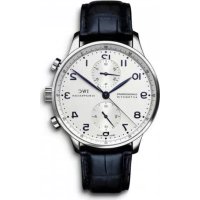
Your IWC watch shows you the time in hours, minutes and seconds, as well as the moon phase, the date, the day, the month and the year in four digits. You can use the integrated chronograph to measure any period of time in seconds, minutes and hours. Stop times can be added together. The strike train of the Portuguese Grande Complication chimes the time – in hours, quarters and minutes. The Portuguese Grande Complication from IWC is a mechanical masterpiece. The mechanical movement with automatic winding has 75 jewels (synthetic rubies) and a power reserve of approximately 44 hours when fully wound. Your Portuguese Grande Complication is protected by an arched-edge sapphire glass of hardness grade 9 on Mohs' scale. Your watch is water-resistant 3 bar. In addition to the uniqueness of its functions, it is the display's legibility and the ease with which it can be used that distinguishes this watch from all other complicated timepieces. To ensure that this extraordinary watch continues to perform faultlessly in the future, it is essential to observe a few important operating instructions.
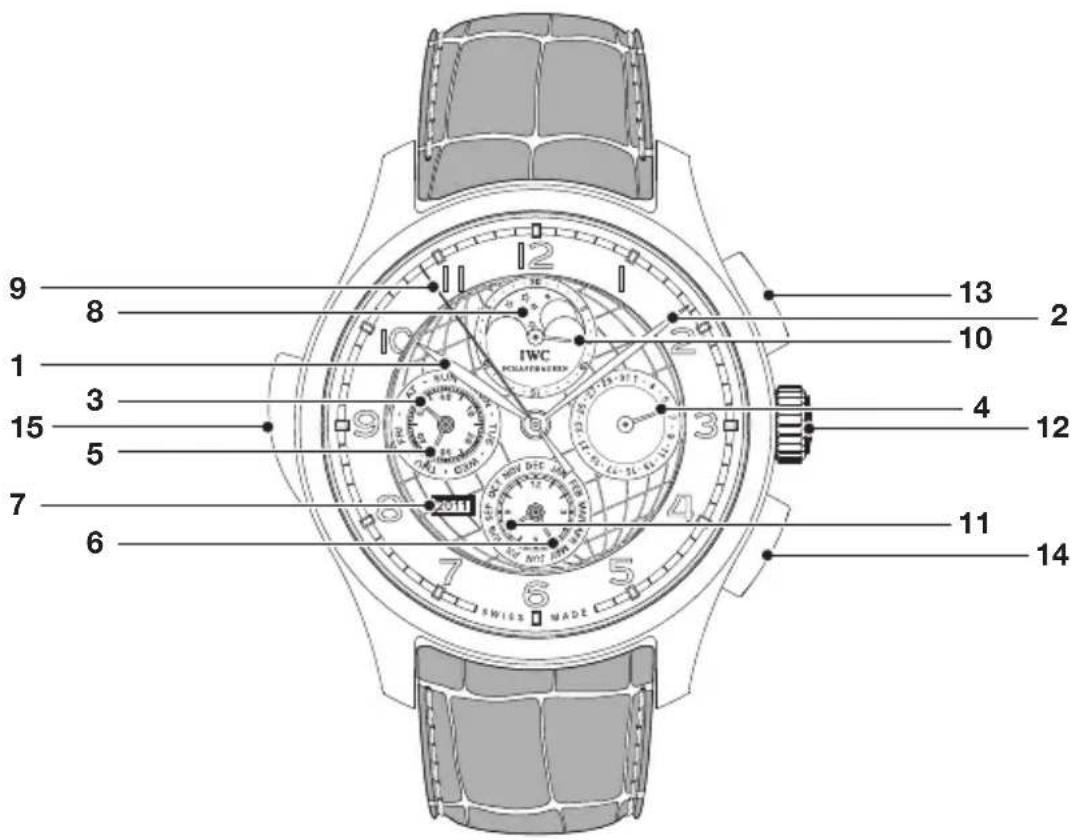
1 Hour hand
9 Chronograph seconds hand
2 Minute hand
10 Minute counter
3 Seconds hand
11 Hour counter
4 Date display
12 Crown
5 Day display
13 Start/stop button
6 Month display
14 Reset button
7 Year display
15 Repeating slide
8 Moon phase display
Functions of the crown
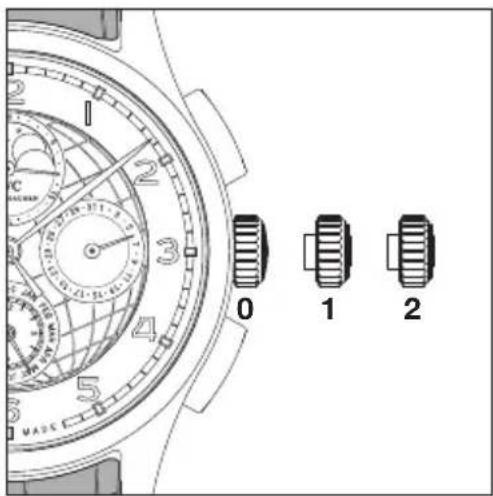
0 Normal position
1 Quick-setting the calendar
2 Time setting
Normal position
With the crown in the normal position (0), you can also wind the automatic movement by hand. A few revolutions of the crown are enough to start the movement. However, it is better to wind the watch by turning the crown through approximately 20 revolutions as this will ensure maximum accuracy. The crown must always be in position 0 when you are wearing your watch.
Quick-setting the calendar
Pull out the crown to position 1. In this position, you can use the rapid-advance function to move the calendar forwards one step at a time by turning the crown slowly to the right. The calendar must not be adjusted between 8 p.m. and 2 a.m.
Please note:
You must not move the calendar beyond the correct date. The complicated movement is mechanically programmed and cannot be moved back in time without making a professional adjustment to the movement. However, if you do move the date forwards beyond the correct date, you have two options: You can either pull out the crown to position 2 to stop the movement until the calendar setting matches the correct date once again. This makes sense if the date has been set only a few days ahead. Or, you must take your watch to your watchmaker, who will be able to adjust the movement to reset the calendar. This is recommended in the event of larger maladjustments.
Time setting
Pull out the crown to position 2. This will stop the movement and the small seconds hand at 9. To set the time accurately to the second, it is best to stop the movement as the seconds hand passes 60. Now move the minute hand a few minute strokes beyond the time to be set. Then position the minute hand by moving it gently backwards until it is exactly above the correct minute stroke. This ensures that the minute hand begins to move immediately when you restart the movement. To start the seconds hand, push in the crown to position 0. Moving the hands forwards past midnight causes the calendar to switch to the following day. When advancing the calendar, you can follow and observe the automatic switching sequence. Please pay attention to the following to avoid maladjustment and possible damage to the mechanism:
- Under no circumstances must the hands be turned back between 8 p.m. and 2 a.m.
- The hands must never be turned anticlockwise beyond 2 a.m.
If it becomes necessary to reset the hands backwards (for example at the end of daylight saving time, if the movement is running fast or when setting the watch to the time of another time zone), you must first turn back the hands by approximately 30 minutes more than required and then set them to the correct time by turning them forwards. Please read also the section "Crossing time zones and the Date Line with the Portuguese Grande Complication". If you fail to do this, the repeating mechanism will need approximately 15 minutes before it chimes in full synchronization with the movement. There will be no defect as a result.
Setting your watch correctly
To set your watch correctly, proceed as follows:
- Wind the movement (approximately 20 revolutions of the crown).
- Pull out the crown to position 2 and turn the hands forwards to approximately 4.40 a.m. This ensures that the calendar mechanism is not in the middle of the automatic switching phase and means you can see the calendar displays easily.
- Push the crown to position 0 and pull it back to position 1.
- Slowly turn the crown to the right. The calendar now advances in steps. Set the display to yesterday's date, keeping an eye on the month and the year.
- Pull out the crown to position 2. This will stop the movement. To set the time accurately to the second, it is best to stop the movement as the seconds hand passes 60.
- Turn the hands forwards until the date display changes to today's date. The hands will now be positioned between 12 midnight and 1 a.m.
- Now turn the hands forwards to the current time. If you are setting the watch in the afternoon, you must turn the hands past 12 (noon) again. Now move the minute hand a few minute strokes beyond the time to be set. Then position the minute hand by moving it gently backwards until it is
exactly above the correct minute stroke. This ensures that the minute hand begins to move immediately when you restart the movement.
- Push the crown back to position 0 to start the movement.
The entire calendar is now automatically set correctly. There is no need for you to know the current phase of the moon or whether you are in a leap year. You do not even need to set the day of the week. This simplified setting is very convenient, particularly if you have not worn your IWC watch for a few days.
Moon phase display
The moon phase display is automatically set by the calendar so that it is always correct. The transmission ratio is so precise that the display deviates by only a single day after 122 years.
Reading the chronograph
Chronograph seconds hand: The scale for the central chronograph seconds hand runs around the edge of the dial.
Minute counter: The 30-minute scale with a slow jumping hand is situated on the subdial at 12 o'clock. This hand makes two complete revolutions in one hour.
Hour counter: The 12-hour scale with short lines for the 30-minute indication with a continuous hand is situated on the subdial at 6 o'clock.
Using the chronograph
Start: To start the chronograph, press the start/stop button.
Stop: To stop the chronograph, press the start/stop button again.
Reset: Press the reset button. This will reset all the chronograph hands to zero.
Aggregate time recording: You can add stop times together by pressing the start/stop button again after the first measurement instead of the reset button.
Operating the minute repeater
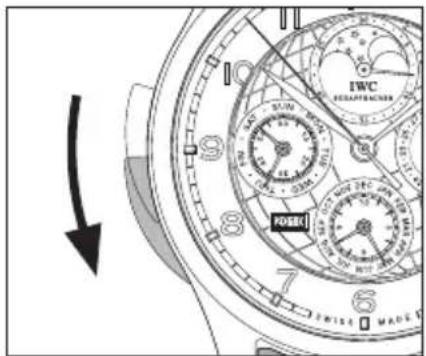
The repeating slide is operated as shown in the illustration. You must always fully depress the slide, otherwise the repeater will not be activated. This all-or-nothing principle ensures that the watch does not chime the time incorrectly. You can then allow the slide to return to its original position.
Please note:
- Do not use the crown to make any adjustments while the minute repeater is running, as this could cause damage.
- You must wait until the mechanism has finished chiming the time before operating the repeating slide again. Failure to do so may damage the repeating mechanism. To be absolutely certain, we recommend that you wait approximately 30 seconds.
Acoustic announcement of the time
After activating the repeater, the time is read mechanically and is announced acoustically by a finely-tuned strike train. This time announcement exact to the minute is made by three different audible signals:
- The hour chime is indicated by a low-pitched tone. 12 is indicated with twelve hour chimes, 1 with a single chime, 2 with two chimes and so on.
- The quarter chime is indicated by a dual tone. There is no quarter chime in the first quarter of an hour, a single dual-tone chime is sounded in the second quarter, two dual-tone chimes in the third quarter and so on.
- The minute chime is a higher-pitched tone. Each minute after a full quarter is indicated by a single chime. The maximum possible number of minute chimes is therefore 14.
Examples:
04.18 4 hour chimes, 1 quarter chime, 3 minute chimes
10.45 10 hour chimes, 3 quarter chimes, 0 minute chimes
12.14 12 hour chimes, 0 quarter chimes, 14 minute chimes
Crossing time zones and the International Date Line with the Portuguese Grande Complication
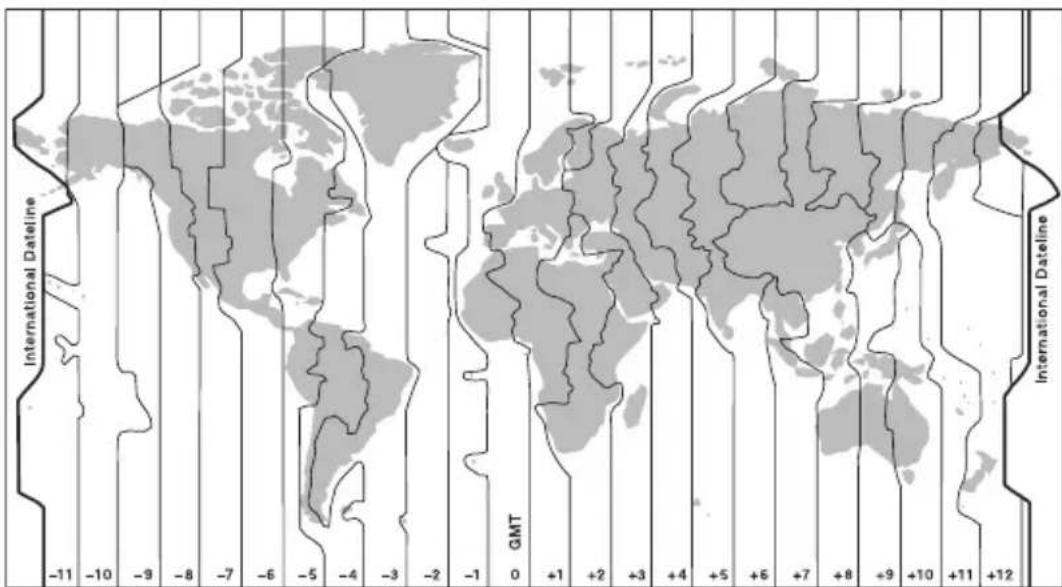
Setting when crossing time zones:
- When crossing time zones in an easterly direction, you should simply set the time forwards to the new local time.
- When crossing time zones in a westerly direction, you can set the hands of your watch back to the actual time of day. When doing this, however, you must not move back into the calendar's automatic switching phase, i.e. beyond 2 a.m. If this situation occurs when you are travelling west, you should set the local time of your destination before 8 p.m. You must not turn the hands back between 8 p.m. and 2 a.m.
Setting when crossing the International Date Line:
- When crossing the International Date Line in a westerly direction (you enter the next day, regardless of the time of day), simply turn the time forwards to the new local time, and the date change will take place automatically.
-
When crossing the International Date Line in an easterly direction (you enter the previous day, regardless of the time of day), you must likewise set your watch forwards to the new local time. However, your watch will now indicate the wrong date (one day too many). This incorrect date indication can be corrected by resetting the hands twice, by 12 hours on each occasion:
-
Setting the watch back by 12 hours during the afternoon between 2 p.m. and 8 p.m. will prevent the calendar from advancing at midnight.
- Setting the watch back another 12 hours the following morning between 2 a.m. and 11 a.m. will synchronize the date display with the local date.
Water-resistance
The water-resistance of IwC watches is stated in bar and not in metres. Metres, which are often used elsewhere in the watch industry to indicate water-resistance, cannot be equated with dive depth because of the test procedures that are frequently used. Water-resistance shown in metres provides no indication as to actual use of the watch in the presence of moisture and wetness, and in or under water. Recommendations for use in connection with the water-resistance of your watch can be found on the Internet at www.iwc.com/water-resistance. Your authorized IwC Official Agent will also be pleased to provide you with information.
To ensure that your watch continues to function perfectly, you should have it checked by an IWC service centre at least once a year. Your watch should also be tested after exposure to unusually harsh conditions. If the tests are not carried out as stipulated, or if the watch is opened by unauthorized persons, IWC will accept no warranty or liability claims.
Recommendation: Your authorized IwC Official Agent must carry out a water-resistance test whenever your IwC watch is opened and serviced.
Servicing your Portuguese Grande Complication
Although the parts in this watch are all manufactured from top-quality materials, a number of components are subject to natural wear and tear. It is particularly important to ensure that the points at which wear occurs are always well lubricated and that oil contaminated by metal abrasion is regularly removed. For this reason, we recommend that you have your watch serviced approximately every five years. Please contact an authorized IwC Official Agent or send your watch directly to the IwC Customer Service Department in Schaffhausen.
Branch of Richemont International SA
Baumgartenstrasse 15
CH-8201 Schaffhausen
Switzerland
Phone +41 (0)52 635 65 65
Fax +41 (0)52 635 65 01
info@iwc.com
www.iwc.com
Copyright 2011
IWC Schaffhausen, Branch of Richemont International SA
Printed in Switzerland


- THE TECHNICAL REFINEMENTS OF THE PORTUGUESE GRANDE COMPLICATION
- FUNCTIONS OF THE CROWN
- NORMAL POSITION
- QUICK-SETTING THE CALENDAR
- PLEASE NOTE
- TIME SETTING
- SETTING YOUR WATCH CORRECTLY
- MOON PHASE DISPLAY
- READING THE CHRONOGRAPH
- USING THE CHRONOGRAPH
- OPERATING THE MINUTE REPEATER
- ACOUSTIC ANNOUNCEMENT OF THE TIME
- EXAMPLES
- CROSSING TIME ZONES AND THE INTERNATIONAL DATE LINE WITH THE PORTUGUESE GRANDE COMPLICATION
- SETTING WHEN CROSSING TIME ZONES
- SETTING WHEN CROSSING THE INTERNATIONAL DATE LINE
- WATER-RESISTANCE
- SERVICING YOUR PORTUGUESE GRANDE COMPLICATION
Brand : IWC
Model : Portuguese Grande Complication 3774
Category : Wristwatch