
Novecento 3546 - Wristwatch IWC - Free user manual and instructions
Find the device manual for free Novecento 3546 IWC in PDF.


| Brand | IWC |
| Model | Novecento 3546 |
| Product Type | Automatic Mechanical Watch |
| Case Material | 950 Platinum or 18ct Gold |
| Crystal | Sapphire (hardness 9) |
| Water Resistance | 30 meters (3 bar) |
| Movement | Automatic, rhodium-plated, Côtes de Genève decoration |
| Jewels | 47 |
| Rotor | 21 ct. gold |
| Power Reserve | Approx. 42 hours (fully wound) |
| Functions | Hours, minutes, perpetual calendar (day, date, month, year), moon phase |
| Calendar | Mechanical perpetual, automatically adjusts for month lengths and leap years until 2100 |
| Crown | Screw-down, three positions (winding, calendar setting, time setting) |
| Setting Procedure | All calendar adjustments via crown; no extra pushers |
| Service Interval | Every 5 years |
| Winding | Manual winding via crown (approx. 30 turns for full wind) |
| Dimensions | Not specified |
| Weight | Not specified |
| Manufacturing Year | As of December 1994 |
Frequently Asked Questions - Novecento 3546 IWC
User questions about Novecento 3546 IWC
0 question about this device. Answer the ones you know or ask your own.
Ask a new question about this device
Download the instructions for your Wristwatch in PDF format for free! Find your manual Novecento 3546 - IWC and take your electronic device back in hand. On this page are published all the documents necessary for the use of your device. Novecento 3546 by IWC.
USER MANUAL Novecento 3546 IWC
Important Operating Instructions
Dear Customer
Congratulations on your purchase of an IWC watch with perpetual calendar and phases-of-the-moon display. A unique set of functions and easy handling set your new watch apart from all other timepieces in its class. You set time, perpetual calendar and lunar-phase display with just a few, slow turns of the crown. To do justice to your sophisticated new watch, please
• do not adjust the calendar between 8 pm and 2 am, the switching cycle of the automatic calendar movement
- do not adjust the calendar beyond the actual date – the complex, fixed mechanical calendar program cannot be reversed (see Instruction Manual)
- avoid disrupting or possibly damaging the movement do not rotate the hands counter-clockwise past the 2 am start of the calendar switching cycle
• never set your watch back between 8 pm and 2 am
- start the movement by winding the mainspring with about 60 turns of the crown. A running-time of approx. 44 hours and best accuracy results.
Before you set your perpetual calendar watch, please read your Instruction Manual carefully.
As the owner of an IWC watch you can look forward to many years of enjoyment.
Avis important
Cher client
Operating Instructions for the Novecento from IWC.
Operating Instructions for the Novecento from IWC.
Welcome to a select group of people to be precise, individuals who expect more from a watch than the precise time.
The pleasure your watch gives you is more than the pleasure of having the correct time on your wrist. It is the admiration you feel for an ingenious creation. For the subtle combination of precision engineering and inspired design. Of time and timelessness. Of the finite and the infinite. Of physical laws to which we are all subject. And taste, for which there are no hard-and-fast rules. This is the reason why, for over 125 years now, we have believed in spending slightly more time than usual to manufacture watches of an unusual calibre. Timepieces that not only perform faultlessly but also radiate the brilliance of perfect craftsmanship that is reflected in a technical development, a new material or an extraordinary feat of design. Occasionally it manifests itself in a minute detail that is not even visible. You are now the owner of a brand-new piece of IWC's continuing tradition. We congratulate you on your good fortune and hope the times you spend with your watch are happy ones. For a closer description of your new companion, read on.
The qualities of the Novecento.
The fact that this watch exists at all is due in large part to the determination of IWC's watchmakers to create a timepiece that would last for ever. This is the reason why the Novecento comes with a genuine perpetual calendar. It tells you the time in hours and minutes, has a moon phase display, shows you the day, date and month, and knows whether the month has 28, 29, 30 or 31 days. To round it off, it even has a two-digit year display. All of these features are purely automatic. And purely mechanical.
The automatic movement is rhodium-plated, decorated with "Côtes de Genève" stripes and has 47 jewels and a 21 ct. gold rotor. Fully wound, the movement has a power reserve of ca. 42 hours. The watch's case and clasp are made either of 950 platinum or 18 ct. gold. The glass is made of sapphire (hardness coefficient 9) and the watch is water resistant to a depth of 30 metres (3 bar).
While our technicians were developing the calendar work, one of the questions that arose was whether it could be set easily by nonspecialists.
As ever, when a difficult problem needs solving, IWC decided to develop something completely new rather than simply draw on existing technology. As a result, Novecento owners no longer need to master a complicated set of procedures for setting the calendar. Everything can be adjusted via the crown. Which does away with the need for extra push-pieces and neatly circumvents the problems of reduced water resistance which they might involve. At this stage we should perhaps mention that you will need to visit a watchmaker on Monday, March 1, 2100 for a slight adjustment of the date and moon phase displays. For in that year, owing to the vagaries of the Gregorian calendar, February has only 28 days. And, after 122 years, the moon phase display will be just one day out.
The automatic Novecento, with its perpetual calendar and moon phase display, is a tiny mechanical masterpiece. The unique combination of features is matched only by the simplicity with which they can be operated. To ensure that the watch goes on providing trouble-free service for many years to come, please be sure to follow these instructions for use.
The functions of the Novecento.
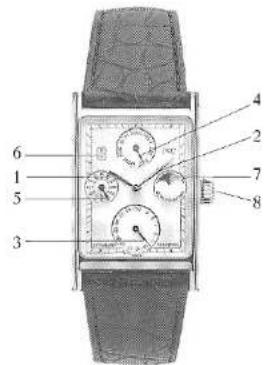
The functions of the crown.

X = normal position (screwed in)
0 - winding position
1 = for setting calendar
("fast forwards")
2 = setting the time
1 Hour hand
2 Minute hand
3 Date hand
4 Day hand
5 Month hand
6 Year display
7 Moon phase display
8 Crown
Securing and releasing the crown.
In its normal position (X) the crown is secured and the case is protected against water penetrating from outside. In this position it is also impossible to change the date or calendar unintentionally. To release the crown, turn it anticlockwise and it will move automatically to the winding position (0). To secure the crown again, push it back into position X while turning clockwise.
Winding the movement.
With the crown in position 0, you can wind the automatic movement by hand. Starting the movement requires no more than a few turns of the crown. Approximately 30 turns should wind the movement completely. This immediately gives maximum timekeeping accuracy and a reserve of about 42 hours, even after the watch has been taken off.
Setting the calendar.
Pull the crown out to position 1. In this position the calendar can be easily advanced by turning the crown anticlockwise. However, the calendar must not be set between 8 pm and 1 am.
Please note: Do not advance the calendar beyond the actual date. The highly complex movement is mechanically programmed and can only be set back by a master watchmaker. If, by chance, you do set the calendar beyond the actual date, you have two options:
- Pull the crown out to position 2 and leave the watch until the calendar corresponds to the correct date and leave the watch until the calendar corresponds to the correct date. This is the most sensible course of action if the calendar is only out by a few days.
- The alternative is to entrust your watch to an official IWC agent, who will reset the calendar by turning back the movement. This is the best thing to do if the calendar has been set forward by several months.
Setting the time.
To set the time, pull out the crown to position 2. When the hands are turned forward past 1 am the calendar will advance by one day. When you change the calendar in this way, you can observe the automatic switching process from beginning to end and understand fully how it works. To avoid wrongly setting or damaging the mechanism, pay special attention to the following:
- Under no circumstances must the hands be turned back between 11 pm and 1 am.
- You must never turn the hands back (anticlockwise) past 1 am from any other position.
Important.
During normal use, the crown must be properly screwed in.
Water-resistance.
The water-resistance of your watch was tested at our factory under a pressure of 3 bar (30 m). Whenever the case is opened, your watchmaker should check the watch again for water resistance. To ensure that your watch is always water-resistant, we recommend that you have it checked by an official IWC agent once a year
A step-by-step guide to setting the watch.
Proceed as follows:
- Release the crown by turning it anticlockwise.
- Wind the movement completely (approximately 30 turns of the crown).
- Pull the crown out to position 2 and set the hands to approximately 4.40. This ensures that the calendar mechanism is not in the middle of a switching phase an gives you an unimpeded view of the calendar displays.
- Push the crown back into position 0 and the pull it out to position 1.
- Slowly turn the crown backwards (anticlockwise). The calendar will advance a day at a time. Set it to yesterday's date, ensuring that the month and year display are also correct.
– Pull the crown out to position 2.
- Advance the hands until the date display shows today's date. The hands will now be between 12 midnight and 1 am.
- Now turn the hands forward to the exact time; if it is afternoon the hands must be turned past 12 o'clock noon.
- Now press the crown into position X and secure it by turning clockwise.
The entire calendar is set automatically. There is no need for you to know whether you are in a leap year or what phase the moon is in. Even the day of the week requires no setting. The fact that the Novecento is so simple to adjust is particularly useful when you do not wear the watch for a couple of days.
Crossing time zones and the International Date Line with with the Novecento.
Setting the watch when crossing time zones.
- If you travel east into a new time zone, simply put the time forward to the new local time.
- If you travel west into a new time zone, you can put the hands of your watch back to the actual time of day. In doing so, you must not turn the hands back into the calendar switching phase, i.e. beyond 1 am. If this situation does arise when you are travelling westwards, you must set your watch to local time at your destination before 11 pm. Under no circumstances must you put the hands back between 11 pm and 1 am.

Setting the watch when crossing the International Date Line.
- When crossing the date line in a westerly direction (you move to the next day no matter what the time is), simply put your watch forwards to the new local time and the date will change automatically.
- When crossing the date line in an easterly direction (you move to the previous day, no matter what the time is) you must also put the watch forward to the new local time. However, the date now shown by your Novecento will be one day ahead. To correct this error, you can turn the hands back in two stages by twelve hours each time:
- The first stage is to put back the watch by 12 hours between 1 pm and 11 pm. This prevents the calendar from advancing at midnight.
- You then put back the watch by another 12 hours the following morning between 1 am and 11 am. This synchronizes the date display with the local date.
Service and maintenance of your Novecento.
All the components in your watch have been manufactured from first-rate materials. Nevertheless, wear and tear is inevitable in a mechanical movement. It is essential that moving parts are lubricated and that the movement is cleaned to remove oil contaminated with minute particles of metal. We therefore recommend that you have your watch serviced every five years. For details, contact an official IWC agent.
As of December 1994. Specifications subject to change without notice.



- Important Operating Instructions
- Dear Customer
- Avis important
- Cher client
- The qualities of the Novecento.
- Winding the movement.
- Setting the calendar.
- Setting the time.
- Important.
- Water-resistance.
- Setting the watch when crossing time zones.
- Setting the watch when crossing the International Date Line.
- Service and maintenance of your Novecento.
Brand : IWC
Model : Novecento 3546
Category : Wristwatch