Ingenieur Chronograph Silberpfeil 3785 - Wristwatch IWC - Free user manual and instructions
Find the device manual for free Ingenieur Chronograph Silberpfeil 3785 IWC in PDF.


| Brand | IWC |
| Model | Ingenieur Chronograph Silberpfeil 3785 |
| Product Type | Automatic winding chronograph wristwatch |
| Movement | Automatic mechanical with engraved oscillating weight |
| Power reserve | Approximately 68 hours after full winding |
| Water resistance | 12 bar |
| Crystal | Sapphire, hardness 9 on the Mohs scale |
| Functions | Hours, minutes, seconds, date, chronograph (seconds, minutes, hours), tachymeter, flyback, cumulative timing |
| Crown | Screwed-in, positions: normal (X), winding (0), date setting (1), time setting (2) |
| Bracelet | Metal with fine adjustment (up to 6 mm) and removable links |
| Luminosity | Luminescent dial and hands for reading in the dark |
| Power supply | Automatic winding by wrist movement or manual winding via crown |
| Maintenance | Overhaul recommended every 5 years; annual water resistance check |
| Cleaning | Avoid contact with water, greases, solvents, and cosmetics; clean metal bracelet with a soft cloth |
| Safety | Screwed-in crown to prevent infiltration and unintentional adjustments |
| Spare parts and repairability | Contact an authorized IWC dealer or IWC after-sales service in Schaffhausen |
| General information | Made in Switzerland; subject to technical modifications (December 2012) |
Frequently Asked Questions - Ingenieur Chronograph Silberpfeil 3785 IWC
User questions about Ingenieur Chronograph Silberpfeil 3785 IWC
0 question about this device. Answer the ones you know or ask your own.
Ask a new question about this device
Download the instructions for your Wristwatch in PDF format for free! Find your manual Ingenieur Chronograph Silberpfeil 3785 - IWC and take your electronic device back in hand. On this page are published all the documents necessary for the use of your device. Ingenieur Chronograph Silberpfeil 3785 by IWC.
USER MANUAL Ingenieur Chronograph Silberpfeil 3785 IWC
MANUAL DE INSTRUÇÕES

- 5 -
BEDIENUNGSANLEITUNG
Deutsch
-19-
OPERATING INSTRUCTIONS
English
-33-
MODE D'EMPLOI
Français
-47-
ISTRUZIONI D'USO
Italiano
-61-
MANUAL DE INSTRUÇÕES
Português
—Welcome to the small circle of individuals who, if we are to be
absolutely precise, demand slightly more of a watch than absolute precision. Appreciation of a watch is more than mere appreciation of the correct time. It is enthusiasm for an ingenious idea. For the interplay between precision and imagination. Between time and timelessness. Between boundaries and infinity. Between laws to which the entire world is subject, and taste, which cannot be dictated to anyone. That is why, since 1868, we have been devoting rather more of our time to watches that must not only run with absolute precision but which also, with every passing second, exert a fascination with the great achievements of master craftsmanship: a fascination with new inventions of a technical, material or formal nature, even if they are concealed in minute details that are perhaps not even visible. You are now the owner of a beautiful new example of this IWC tradition. We would like to congratulate you on your choice and send you our best wishes for the time you will spend with your watch, which perhaps cannot be described with any greater accuracy than it is here.
IWC MANAGEMENT
THE TECHNICAL REFINEMENTS OF THE INGENIEUR CHRONOGRAPH
Your IWC watch shows you the time in hours, minutes and seconds, together with the date. You can use the integrated chronograph to measure any period of time in seconds, minutes and hours. Stop times can be added together. The mechanical movement with automatic winding has a power reserve of approximately 68 hours when fully wound. The engraved rotor winds the watch in both directions of rotation via the IWC double-pawl winding system. Your Ingenieur Chronograph is protected by a sapphire glass of hardness grade 9 on Mohs' scale. Your watch is water-resistant 12 bar. To ensure that this extraordinary watch continues to perform faultlessly in the future, it is essential to observe a few important operating instructions.
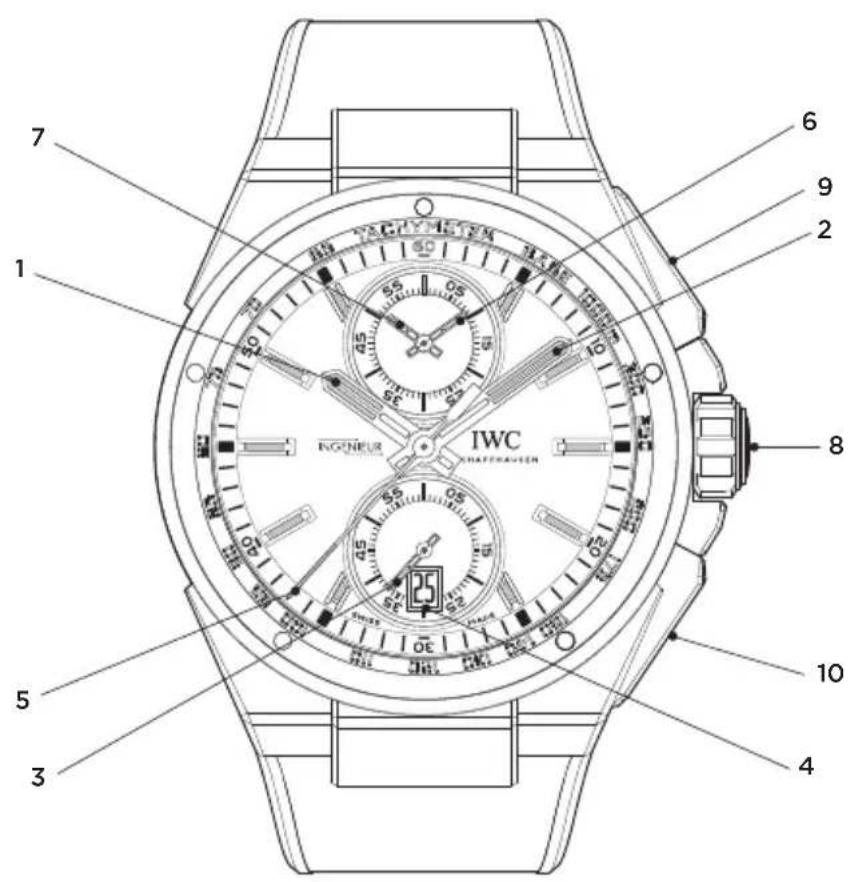
1 Hour hand
2 Minute hand
3 Small seconds hand
4 Date display
5 Chronograph seconds hand
Minute counter 6
Hour counter 7
Screw-in crown 8
Start/stop button 9
Reset/flyback button 10
FUNCTIONS OF THE CROWN
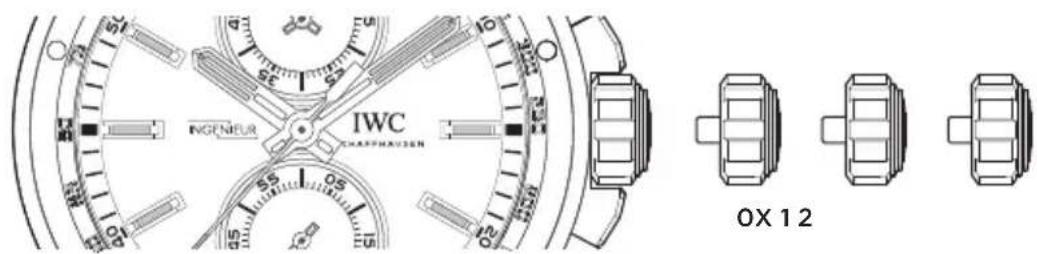
x - Normal position (screwed in)
o - Winding position
1 - Date setting
2 - Time setting
NORMAL POSITION
This watch has a screw-in crown. Screwing the crown in to its normal position (X) prevents the inadvertent adjustment of the time or date and also acts as a double seal to prevent water from seeping into the case. To release the crown, unscrew it by turning it to the left, where it automatically assumes position 0, the winding position. By depressing the crown in position X and turning it to the right at the same time, it is screwed down firmly again and secured.
WINDING POSITION
With the crown in the winding position (0), you can also wind the automatic movement by hand. A few revolutions of the crown are enough to start the movement. However, it is better to wind the watch by turning the crown through approximately 20 revolutions as this will ensure maximum accuracy. The crown must always be in position X when you are wearing your watch.
DATE SETTING
If a month has fewer than 31 days, you will need to set the date manually to the first day of the following month. Release the screw-in crown and pull it out to position 1. You can now set the date by turning the crown to the right (direct advance). You should not use the rapid-advance function between 8 p.m. and 2 a.m. because the movement automatically advances the date during this period
TIME SETTING
Pull out the crown to position 2. This will stop the movement. To set the time accurately to the second, it is best to stop the movement as the seconds hand passes 60. You can now set the time by turning the crown and positioning the minute hand exactly above the minute stroke. To start the seconds hand, push in the crown to position 0. When setting the time, please be aware of the date change, which always takes place at 12 midnight. If this change has already taken place at 12 noon, you must move the hands forwards by 12 hours.
Important: Although the watch is water-resistant in positions 0, 1 and 2, the crown should always be screwed in again for normal use (position X).
SETTING YOUR WATCH CORRECTLY
To set your watch correctly, proceed as follows:
- Release the crown by turning it to the left.
- Wind the movement (approximately 20 revolutions of the crown).
- Pull out the crown to position 1.
- Turn the crown to the right to advance the date display in steps. Set the display to yesterday's date.
- Pull out the crown to position 2. This will stop the movement. To set the time accurately to the second, it is best to stop the movement as the seconds hand passes 60.
- Turn the hands forwards until the date display changes to today's date. The hands will now be positioned between 12 midnight and 1 a.m.
- Now turn the hands forwards to the correct time. If you are setting the watch in the afternoon, you must turn the hands past 12 (noon) again.
- Push the crown back to position 0 to start the movement.
- Now push the crown to position X and secure it by simultaneously turning it to the right.
Important: Although the watch is water-resistant in positions 0, 1 and 2, the crown should always be screwed in again for normal use (position X).
READING THE TIME IN THE DARK
Both the dial and the hour and minute hands of your watch have luminescent elements that allow you to read the time effortlessly, even in total darkness.
READING THE CHRONOGRAPH
Chronograph seconds hand: The scale for the central chronograph seconds hand runs around the edge of the dial.
Minute and hour counters: The subdial at 12 o'clock has two hands, which run continuously and show the elapsed time on a 12-hour and a 60-minute scale. The hour and minute counters can be read like a standard analogue time display. In other words, one revolution of the minute counter is equal to 60 minutes, and one revolution of the hour counter is equal to 12 hours.
USING THE CHRONOGRAPH
Start: To start the chronograph, press the start/stop button.
Flyback: You can start recording a new time immediately, even when the chronograph is running. Simply depress the reset/flyback button fully, as far as it will go. All three chronograph hands are reset to zero, and a new measurement is started as soon as the button is released.
Stop: To stop the running chronograph, press the start/stop button.
Reset: Depress the reset/flyback button fully, as far as it will go. This will reset all the chronograph hands to zero.
Aggregate time recording: You can add stop times together by pressing the start/stop button again after the first measurement instead of the reset/flyback button.
CALCULATING SPEED
When you complete a calibrated distance of one kilometre, you can read your average speed directly on the tachymeter scale. Activate the chronograph as you pass your starting point and stop it at the end of the measured distance. You can now read the average speed in kilometers per hour from the position of the chronograph seconds hand on the tachymeter scale. Please note that any period over one minute in length is invalid.
Example: It takes 40 seconds to drive one kilometre, so your average speed is exactly 90 kilometres per hour.
ADJUSTING AND SETTING THE METAL BRACELET
The metal bracelet has been designed so that you can comfortably adjust it to the size of your wrist. You can make this adjustment yourself by removing or adding individual bracelet links. Furthermore, for your personal convenience, this bracelet has an innovative fine-adjustment system, permitting you to extend or reduce the length of the bracelet quite simply by up to 6 millimetres, depending on your needs. To increase the length of bracelet, press the button with the IWC logo and pull the bracelet slightly apart. To shorten it, push it together in the area of the clasp; here the button does not need to be pressed.
TAKING THE BRACELET APART
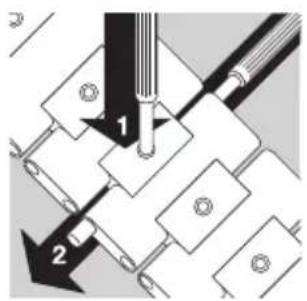
Open the folding clasp by pressing the buttons on the side. Lay the bracelet with the outside on a firm base. To avoid scratching the bracelet and base, place a cloth underneath the bracelet. Using the special tool provided, you can now push down the securing pin at the desired point of separation (1) and, at the same time, slide the hinged link with the help of the second tool about 3 millimetres sideways (2).
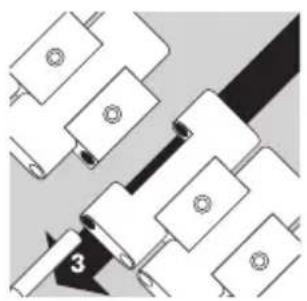
Pull the protruding hinged link out of the bracelet (3). The bracelet is now separated.
DETERMINING HOW MANY LINKS TO REMOVE
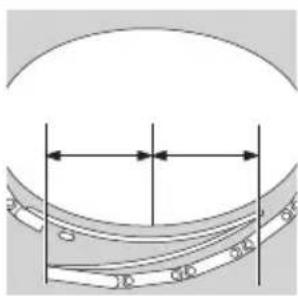
Place the watch with the folding clasp closed around your wrist and use the overlap to estimate the number of surplus bracelet links that you can now remove as described below. If you need to take out several links, we recommend removing the same number of links from each side of the bracelet, if possible, to ensure that the clasp can be worn more or less in the centre of the wrist.
Please observe the following recommendation: Generally the size of your wrist will increase during the course of the day, depending on temperature and physical exertion. Before you remove individual bracelet links, depending on the time of day you should have the fine-adjustment system on the clasp closed (in the morning) or open (in the evening).
REMOVING INDIVIDUAL LINKS AND ATTACHING THE BRACELET
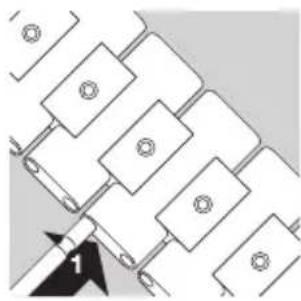
Repeat steps 1 to 3 at the distance from the first point of separation you have just determined. Remove the unnecessary links and reassemble the shortened bracelet. Slide the hinged link into the bracelet sideways (1).
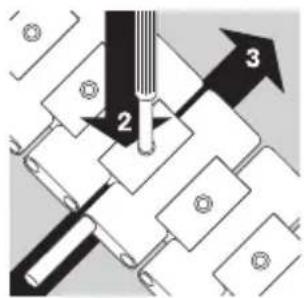
Using the special tool provided, you can now push down the fixing bolt (2) and, at the same time, slide the hinged link back into the bracelet until it lies flush (3).
The fixing bolt must be aligned with the upper edge of the securing link. It is important that you check that the hinged link is sitting correctly.
Keep the surplus links and separating tool in a safe place for use in any adjustment at another time.
WATER-RESISTANCE
The water-resistance of IWC watches is stated in bar and not in metres. Metres, which are often used elsewhere in the watch industry to indicate water-resistance, cannot be equated with dive depth because of the test procedures that are frequently used. Water-resistance shown in metres provides no indication as to actual use of the watch in the presence of moisture and wetness, and in or under water. Recommendations for use in connection with the water-resistance of your watch can be found on the Internet at www.iwc.com/water-resistance. Your authorized IWC Official Agent will also be pleased to provide you with information.
To ensure that your watch continues to function perfectly, you should have it checked by an IWC service centre at least once a year. Your watch should also be tested after exposure to unusually harsh conditions. If the tests are not carried out as stipulated, or if the watch is opened by unauthorized persons, IWC will accept no warranty or liability claims.
Recommendation: Your authorized IWC Official Agent must carry out a water-resistance test whenever your IWC watch is opened and serviced.
NOTE
Leather is a natural and permeable material. Make sure, therefore, that the high-quality leather strap does not come into contact with water, oily substances, solvents, cleaning agents or cosmetic products. This way you can prevent discoloration and premature ageing of the material.
SERVICING YOUR INGENIEUR CHRONOGRAPH
Although the parts in this watch are all manufactured from top-quality materials, a number of components are subject to natural wear and tear. It is particularly important to ensure that the points at which wear occurs are always well lubricated and that oil contaminated by metal abrasion is regularly removed. For this reason, we recommend that you have your watch serviced approximately every five years. Please contact an authorized IWC Official Agent or send your watch directly to the IWC Customer Service Department in Schaffhausen.
Effective from December 2012.
Technical specifications subject to change.
Poussoir start-stop 9
Remova agora o pino articulado que sobressai da bracelet (3). Agora a bracelet está separada.
Branch of Richemont International SA
Baumgartenstrasse 15
CH-8201 Schaffhausen
Switzerland
Phone +41 (0)52 635 65 65
Fax +41 (0)52 635 65 01
info@iwc.com
www.iwc.com
© Copyright 2012
IWC Schaffhausen, Branch of Richemont International SA
Printed in Switzerland

FSC www.fsc.org
MIX
From responsible sources
FSC® C016687






- BEDIENUNGSANLEITUNG
- OPERATING INSTRUCTIONS
- MODE D'EMPLOI
- ISTRUZIONI D'USO
- MANUAL DE INSTRUÇÕES
- THE TECHNICAL REFINEMENTS OF THE INGENIEUR CHRONOGRAPH
- FUNCTIONS OF THE CROWN
- NORMAL POSITION
- WINDING POSITION
- DATE SETTING
- TIME SETTING
- SETTING YOUR WATCH CORRECTLY
- READING THE TIME IN THE DARK
- READING THE CHRONOGRAPH
- USING THE CHRONOGRAPH
- CALCULATING SPEED
- ADJUSTING AND SETTING THE METAL BRACELET
- TAKING THE BRACELET APART
- DETERMINING HOW MANY LINKS TO REMOVE
- REMOVING INDIVIDUAL LINKS AND ATTACHING THE BRACELET
- WATER-RESISTANCE
- NOTE
- SERVICING YOUR INGENIEUR CHRONOGRAPH
Brand : IWC
Model : Ingenieur Chronograph Silberpfeil 3785
Category : Wristwatch