Aquatimer Perpetual Calendar 3794 - Wristwatch IWC - Free user manual and instructions
Find the device manual for free Aquatimer Perpetual Calendar 3794 IWC in PDF.


| Product Type | Wristwatch |
| Brand | IWC |
| Model | Aquatimer Perpetual Calendar 3794 |
| Movement | Automatic mechanical (IWC double pawl) |
| Power reserve | Approximately 68 hours |
| Water resistance | 10 bar |
| Crystal | Sapphire, hardness 9 Mohs |
| Display | Analog (hours, minutes, seconds) + digital (date, month, leap years) |
| Chronograph | Flyback, 12-hour counter, 60-minute counter, central seconds hand |
| Dive bezel | Internal rotating, unidirectional, luminous markers |
| Crown | Screw-down, 3 positions (winding, calendar setting, time setting) |
| Strap | Interchangeable without tools (IWC patented system) |
| Case material | Fine steel, bronze, gold, platinum, titanium, ceramic, or carbon (depending on version) |
| Luminosity | Luminous elements on dial, hands, and internal bezel |
| Maintenance | Rinse with fresh water after diving; service every 5 years; annual water resistance check |
| Safety | Avoid strong magnetic fields; screw-down crown for water resistance |
| Warranty | Subject to IWC conditions; unauthorized opening voids warranty |
Frequently Asked Questions - Aquatimer Perpetual Calendar 3794 IWC
User questions about Aquatimer Perpetual Calendar 3794 IWC
0 question about this device. Answer the ones you know or ask your own.
Ask a new question about this device
Download the instructions for your Wristwatch in PDF format for free! Find your manual Aquatimer Perpetual Calendar 3794 - IWC and take your electronic device back in hand. On this page are published all the documents necessary for the use of your device. Aquatimer Perpetual Calendar 3794 by IWC.
USER MANUAL Aquatimer Perpetual Calendar 3794 IWC
MANUAL DE INSTRUÇÕES
IWC
SCHAFFHAUSEN
www.inc.com
IWC
SCHAFFHAUSEN

bar
| Category | Value | |---|---| | Category 1 | 0 | | Category 2 | 0 | | Category 3 | 0 | | Category 4 | 0 | | Category 5 | 0 | | Category 6 | 0 | | Category 7 | 0 | | Category 8 | 0 | | Category 9 | 0 | | Category 10 | 0 | | Category 11 | 0 | | Category 12 | 0 | | Category 13 | 0 | | Category 14 | 0 | | Category 15 | 0 | | Category 16 | 0 | | Category 17 | 0 | | Category 18 | 0 | | Category 19 | 0 | | Category 20 | 0 | | Category 21 | 0 | | Category 22 | 0 | | Category 23 | 0 | | Category 24 | 0 | | Category 25 | 0 | | Category 26 | 0 | | Category 27 | 0 | | Category 28 | 0 | | Category 29 | 0 | | Category 30 | 0 | | Category 31 | 0 | | Category 32 | 0 | | Category 33 | 0 | | Category 34 | 0 | | Category 35 | 0 | | Category 36 | 0 | | Category 37 | 0 | | Category 38 | 0 | | Category 39 | 0 | | Category 40 | 0 | | Category 41 | 0 | | Category 42 | 0 | | Category 43 | 0 | | Category 44 | 0 | | Category 45 | 0 | | Category 46 | 0 | | Category 47 | 0 | | Category 48 | 0 | | Category 49 | 0 | | Category 50 | 0 | | Category 51 | 0 | | Category 52 | 0 | | Category 53 | 0 | | Category 54 | 0 | | Category 55 | 0 | | Category 56 | 0 | | Category 57 | 0 | | Category 58 | 0 | | Category 59 | 0 | | Category 60 | 0 | | Category 61 | 0 | | Category 62 | 0 | | Category 63 | 0 | | Category 64 | 0 | | Category 65 | 0 | | Category 66 | 0 | | Category 67 | 0 | | Category 68 | 0 | | Category 69 | 0 | | Category 70 | 0 | | Category 71 | 0 | | Category 72 | 0 | | Category 73 | 0 | | Category 74 | 0 | | Category 75 | 0 | | Category 76 | 0 | | Category 77 | 0 | | Category 78 | 0 | | Category 79 | 0 | | Category 80 | 0 | | Category 81 | 0 | | Category 82 | 0 | | Category 83 | 0 | | Category 84 | 0 | | Category 85 | 0 | | Category 86 | 0 | | Category 87 | 0 | | Category 88 | 0 | | Category 89 | 0 | | Category 90 | 0 | | Category 91 | 0 | | Category 92 | 0 | | Category 93 | 0 | | Category 94 | 0 | | Category 95 | 0 | | Category 96 | 0 | | Category 97 | 0 | | Category 98 | 0 | | Category 99 | 0 | | Total (Total) | -11.5%
bar
| Category | Value | |---|---| | Category 1 | 100 | | Category 2 | 100 | | Category 3 | 100 | | Category 4 | 100 | | Category 5 | 100 | | Category 6 | 100 | | Category 7 | 100 | | Category 8 | 100 | | Category 9 | 100 | | Category 10 | 100 | | Category 11 | 100 | | Category 12 | 100 | | Category 13 | 100 | | Category 14 | 100 | | Category 15 | 100 | | Category 16 | 100 | | Category 17 | 100 | | Category 18 | 100 | | Category 19 | 100 | | Category 20 | 100 | | Category 21 | 100 | | Category 22 | 100 | | Category 23 | 100 | | Category 24 | 100 | | Category 25 | 100 | | Category 26 | 100 | | Category 27 | 100 | | Category 28 | 100 | | Category 29 | 100 | | Category 30 | 100 | | Category 31 | 100 | | Category 32 | 100 | | Category 33 | 100 | | Category 34 | 100 | | Category 35 | 100 | | Category 36 | 100 | | Category 37 | 100 | | Category 38 | 100 | | Category 39 | 100 | | Category 40 | 100 | | Category 41 | 100 | | Category 42 | 100 | | Category 43 | 100 | | Category 44 | 100 | | Category 45 | 100 | | Category 46 | 100 | | Category 47 | 100 | | Category 48 | 100 | | Category 49 | 100 | | Category 50 | 100 | | Category 51 | 100 | | Category 52 | 100 | | Category 53 | 100 | | Category 54 | 100 | | Category 55 | 100 | | Category 56 | 100 | | Category 57 | 100 | | Category 58 | 100 | | Category 59 | 100 | | Category 60 | 100 | | Category 61 | 100 | | Category 62 | 100 | | Category 63 | 100 | | Category 64 | 100 | | Category 65 | 100 | | Category 66 | 100 | | Category 67 | 100 | | Category 68 | 100 | | Category 69 | 100 | | Category 70 | 100 | | Category 71 | 100 | | Category 72 | 100 | | Category 73 | 100 | | Category 74 | 100 | | Category 75 | 100 | | Category 76 | 100 | | Category 77 | 100 | | Category 78 | 100 | | Category 79 | 100 | | Category 80 | 100 | | Category 81 | 100 | | Category 82 | 100 | | Category 83 | 100 | | Category 84 | 100 | | Category 85 | 100 | | Category 86 | 100 | | Category 87 | 100 | | Category 88 | 100 | | Category 89 | 100 | | Category 90 | 100 | | Category 91 | 100 | | Category 92 | 100 | | Category 93 | 100 | | Category 94 | 100 | | Category 95 | 100 | | Category 96 | 100 | | Category 97 | 100 | | Category 98 | 100 | | Category 99 | 100 | | Total (Total) |- 5 -
BEDIENUNGSANLEITUNG
Deutsch
-21-
OPERATING INSTRUCTIONS
English
-37-
MODE D'EMPLOI
Français
-53-
ISTRUZIONI D'USO
Italiano
-71-
MANUAL DE INSTRUÇÕES
Português
—Welcome to the small circle of individuals who, if we are to be
absolutely precise, demand slightly more of a watch than absolute precision. Appreciation of a watch is more than mere appreciation of the correct time. It is enthusiasm for an ingenious idea. For the interplay between precision and imagination. Between time and timelessness. Between boundaries and infinity. Between laws to which the entire world is subject, and taste, which cannot be dictated to anyone. That is why, since 1868, we have been devoting rather more of our time to watches that must not only run with absolute precision but which also, with every passing second, exert a fascination with the great achievements of master craftsmanship: a fascination with new inventions of a technical, material or formal nature, even if they are concealed in minute details that are perhaps not even visible. You are now the owner of a beautiful new example of this IWC tradition. We would like to congratulate you on your choice and send you our best wishes for the time you will spend with your watch, which perhaps cannot be described with any greater accuracy than it is here.
IWC MANAGEMENT
THE TECHNICAL REFINEMENTS OF THE AQUATIMER PERPETUAL CALENDAR DIGITAL DATE-MONTH
Your IWC watch shows you the time in hours, minutes and seconds with hands, the date and the month in a large digital display as well as the leap year. You can use the integrated flyback chronograph to measure any period of time up to 12 hours in seconds, minutes and hours. Stop times can be added together. The dive time is read off on the internal rotating bezel, which for safety reasons can only be turned anticlockwise. The mechanical movement with automatic winding has a power reserve of approximately 68 hours when fully wound. The rotor winds the watch in both directions of rotation via the IWC double-pawl winding system. Your watch is water-resistant 10 bar and protected by a sapphire glass of hardness grade 9 on Mohs' scale. In addition to the uniqueness of its functions, it is the display's legibility and the ease with which it can be used that distinguishes this watch from other complicated timepieces. To ensure that this extraordinary watch continues to perform faultlessly in the future, it is essential to observe a few important operating instructions.
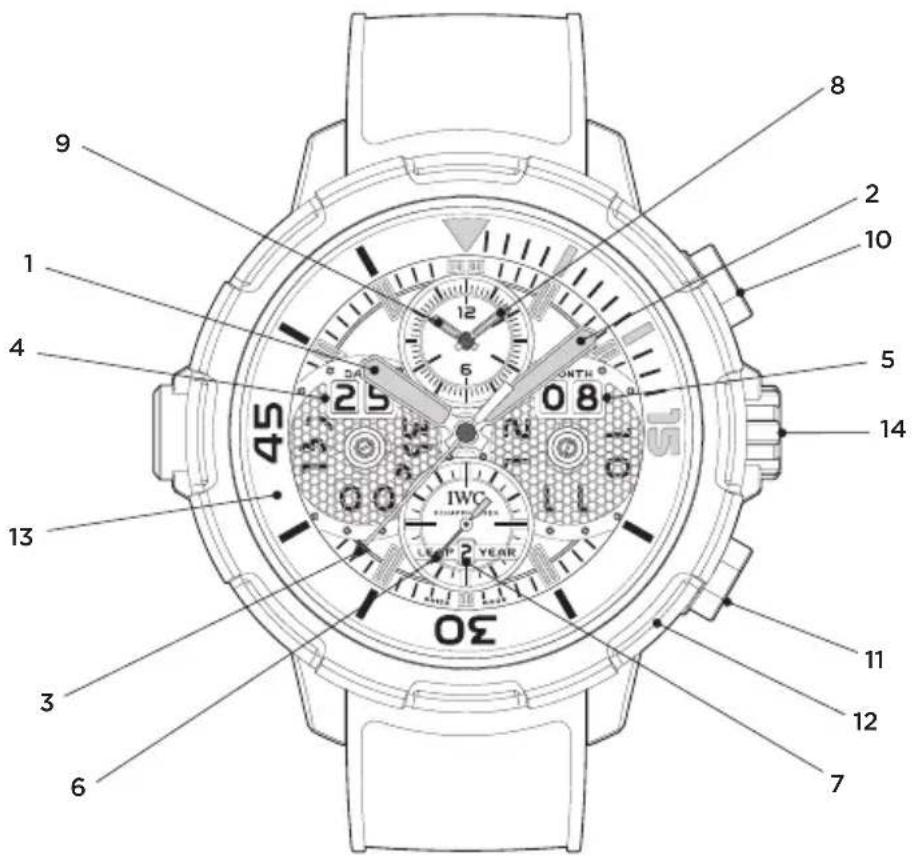
1 Hour hand
2 Minute hand
3 Chronograph seconds hand
4 Date display
5 Month display
6 Small seconds hand
7 Leap year display
Minute counter 8
Hour counter 9
Start/stop push-button 10
Reset/flyback push-button 11
External rotating bezel 12
Internal rotating bezel 13
Screw-in crown 14
FUNCTIONS OF THE CROWN
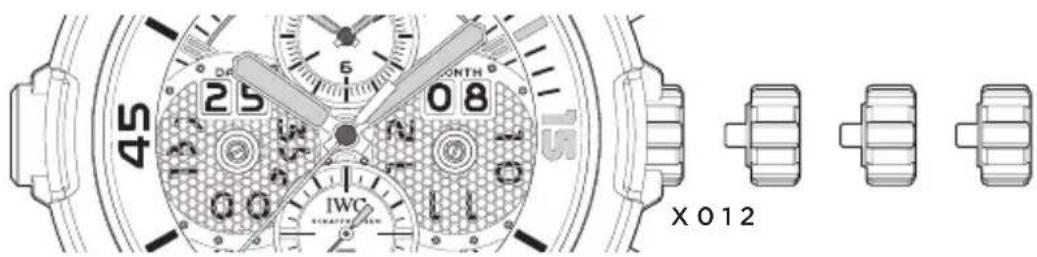
x - Normal position (screwed in)
o - Winding position
1 - Setting the calendar
2 - Time setting
NORMAL POSITION
This watch has a screw-in crown. Screwing the crown in to its normal position (X) prevents the inadvertent adjustment of the time or date and also acts as a double seal to prevent water from seeping into the case. To release the crown, unscrew it by turning it to the left, where it automatically assumes position 0, the winding position. By depressing the crown in position X and turning it to the right at the same time, it is screwed down firmly again and secured.
WINDING POSITION
With the crown in the winding position (0), you can also wind the automatic movement by hand. A few revolutions of the crown are enough to start the movement. However, it is better to wind the watch by turning the crown through approximately 20 revolutions as this will ensure maximum accuracy.
SETTING THE CALENDAR
Release the screw-in crown and pull it out to position 1. In this position, you can use the direct-advance function to move the calendar forwards one step at a time by turning the crown slowly to the right. The calendar must not be adjusted between 8 p.m. and 2 a.m.
The leap year display has four positions: “1”, “2”, “3” and “L”. “L” stands for “leap year”. If the current year is a leap year (i.e. the year is divisible by 4, for example 2012, 2016, etc.), you must adjust the calendar so that the leap year display shows “L”. “1” corresponds to the first year after a leap year, “2” to the second and “3” to the third. Once set correctly, the perpetual calendar will automatically show the correct date at all times. You need do nothing until 1 March 2100, when you must manually move the calendar forwards by one day. Although 2100 is divisible by 4, it is not a leap year according to the Gregorian calendar.
Please note:
- If the crown is turned too quickly, the display discs might not be positioned correctly in the display window. Generally, such a default is automatically corrected by the movement when the calendar advances within the following 24 hours. Should this not be the case, the movement needs to be reset by an IWC watchmaker.
- You must not move the calendar beyond the correct date. The complicated movement is mechanically programmed and cannot be moved back in time without making a professional adjustment to the movement. However, if you do move the date forwards beyond the correct date, you have two options: You can either pull out the crown to position 2 to stop the movement until the calendar setting once again matches the correct date. This makes sense if the date has been set only a few days ahead. Or, you can slowly advance the calendar by 4 years until you reach the correct date. Alternatively, you can entrust this operation to your watchmaker.
TIME SETTING
Pull out the crown to position 2. This will stop the movement. To set the time accurately to the second, it is best to stop the movement as the seconds hand passes 60. You can now set the time by turning the crown and positioning the minute hand exactly above the minute stroke. Moving the hands forwards past midnight causes the calendar to switch to the following day. When advancing the calendar, you can follow and observe the automatic switching sequence.
In order to avoid incorrect adjustment of the mechanism, you should not move the hands back between 8 p.m. and 2 a.m. This is because the calendar is disconnected from the movement when the hands are turned back and will not move backwards. To start the seconds hand, push in the crown to position 0.
Important: Although the watch is water-resistant in positions 0, 1 and 2, the crown should always be screwed in again for normal use (position X).
SETTING YOUR WATCH CORRECTLY
To set your watch correctly, proceed as follows:
- Release the crown by turning it to the left.
- Wind the movement (approximately 20 revolutions of the crown).
- Pull out the crown to position 1.
- Turn the crown to the right to advance the date display in steps. Set the display to yesterday's date.
- Pull out the crown to position 2. This will stop the movement. To set the time accurately to the second, it is best to stop the movement as the seconds hand passes 60.
-
Turn the hands forwards until the date display changes to today's date. The hands will now be positioned between 12 midnight and 1 a.m.
-
Now turn the hands forwards to the correct time. If you are setting the watch in the afternoon, you must turn the hands past 12 (noon) again.
- Push the crown back to position 0 to start the movement.
- Now push the crown to position X and secure it by simultaneously turning it to the right.
Important: Although the watch is water-resistant in positions 0, 1 and 2, the crown should always be screwed in again for normal use (position X).
READING THE TIME IN THE DARK
The dial, the hour, minute and seconds hands, as well as the markings on the internal rotating bezel of your watch have luminescent elements that allow you to read the time effortlessly even in total darkness. The two luminescent elements at 12 o'clock serve as a reference point.
READING THE CHRONOGRAPH
Chronograph seconds hand: The scale for the central chronograph seconds hand runs around the edge of the dial.
Minute and hour counters: The subdial at 12 o'clock has two hands, which run continuously and show the elapsed time on a 12-hour and a 60-minute scale. The hour and minute counters can be read like a standard analogue time display. In other words, one revolution of the minute counter is equal to 60 minutes, and one revolution of the hour counter is equal to 12 hours.
USING THE CHRONOGRAPH
Start: To start the chronograph, press the start/stop push-button.
Flyback: You can start recording a new time immediately, even when the chronograph is running. Simply depress the reset/flyback push-button fully as far as it will go. All three chronograph hands are reset to zero, and a new measurement is started as soon as the push-button is released.
Stop: To stop the running chronograph, press the start/stop push-button.
Reset: Depress the reset/flyback push-button fully as far as it will go. This will reset all the chronograph hands to zero.
Aggregate time recording: You can add stop times together by pressing the start/stop push-button again after the first measurement instead of the reset/flyback push-button.
CROSSING TIME ZONES AND THE INTERNATIONAL DATE LINE WITH THE AQUATIMER PERPETUAL CALENDAR DIGITAL DATE-MONTH
Setting when crossing time zones:
- When crossing time zones in an easterly direction, you should simply set the time forwards to the new local time.
- When crossing time zones in a westerly direction, you can set the hands of your watch back to the actual time of day. When doing this, however, you must not move back into the calendar's automatic switching phase, i.e. beyond 2 a.m. If this situation occurs when you are travelling west, you should set the local time of your destination before 8 p.m. You must not turn the hands back between 8 p.m. and 2 a.m. This is because the calendar does not move backwards by one day when
the hands are turned back beyond midnight, but remains on the same day. If you go past the end of the calendar's switching phase (i.e. beyond 2 a.m.) when turning the hands back, you run the risk of the calendar advancing by one day for a second time and thus indicating one day too many.
Setting when crossing the International Date Line:
- When crossing the International Date Line in a westerly direction (you enter the next day, regardless of the time of day), simply turn the time forwards to the new local time, and the date change will take place automatically.
- When crossing the International Date Line in an easterly direction (you enter the previous day, regardless of the time of day), you must likewise set your watch forwards to the new local time. However, your watch will now indicate the wrong date (one day too many). This incorrect date indication can be corrected by resetting the hands twice, by 12 hours on each occasion:
- Setting the watch back by 12 hours during the afternoon between 2 p.m. and 8 p.m. will prevent the calendar from advancing at midnight.
- Setting the watch back by another 12 hours the following morning between 2 a.m. and 11 a.m. will synchronize the date display with the local date.
MARKING THE START OF A DIVE
The triangle on the internal rotating bezel can be aligned with the minute hand by turning the external rotating bezel. The desired point in time (for example the time of entering the water at the start of the dive) can be set in this way. You can read off the elapsed time (for example the duration of the dive) on the internal rotating bezel. For safety reasons, the internal rotating bezel can only be rotated in an anticlockwise direction. The rotating bezel is indexed audibly and perceptibly in one-minute steps, and it is also legible in the dark thanks to the luminescent markings.
If you are planning to use the watch to time dives, you should be a certified open water diver and have the water-resistance of your watch checked regularly by an IWC service centre.
CHANGING BETWEEN DIFFERENT TYPES OF BRACELET OR STRAP
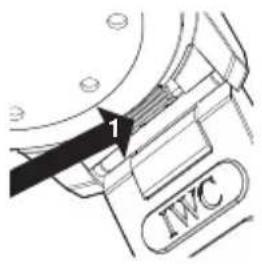
Your Aquatimer Perpetual Calendar Digital Date-Month comes with a patented IWC bracelet quick-change system that enables you to change the bracelet or strap quickly and simply, without the use of tools. To remove the bracelet or strap, use your thumbnail to firmly push the retaining lever (1) located on the underside of the horns outwards.
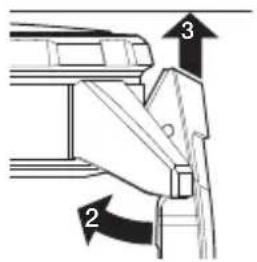
Tilt the bracelet or strap inwards (2) and move it upwards away from the case (3).
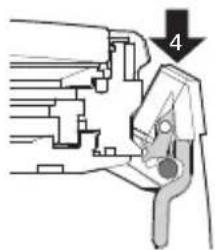
To attach the bracelet or strap, hook the notch of the horns from above into the spring pin of the case (4).
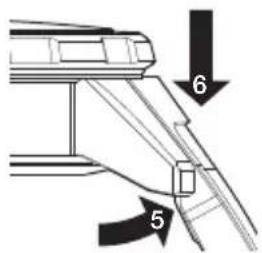
Now return the bracelet or strap to its original position (5) while sim ultaneously pressing it down into the horns to snap it into place (6).
Once you have heard and felt that the bracelet or strap has clicked into place, you can be sure that the bracelet or strap is safely secured.
When using the rubber strap, please be aware that the strap with the buckle should be attached to the 12 o'clock position on the case.
Please ensure that you observe these instructions when changing between different types of strap.
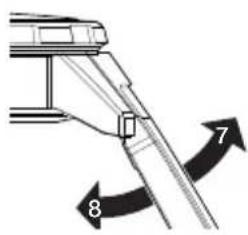
After changing the strap, please ensure that it is securely attached by pulling both sides up (7) and down (8) firmly.
INFORMATION ABOUT MAGNETIC FIELDS
As a result of the ever greater prevalence in recent years of very strong magnets made from rare-earth alloys (for example neodymium-iron-boron) – these are found in objects such as loudspeakers, jewellery and fasteners on mobile-phone cases and handbags – mechanical watches are increasingly likely to come into contact with such magnets and be magnetized. This can lead to the watch rate being permanently affected, a problem that can only be resolved by a process of demagnetization carried out by a specialist. We recommend that you keep your watch away from such magnets.
Watches with a soft-iron inner case provide a higher level of protection against magnetic fields and far exceed the requirements of DIN standard 8309. Nevertheless, it is still possible for the watch movement to be magnetized in the close proximity of very strong magnets. We therefore recommend that watches with a soft-iron inner case also be kept away from direct contact with strong magnets.
Should there be a sudden change in the precision of your timepiece, please contact an authorized IWC Official Agent to have your watch checked for magnetism.
WATER-RESISTANCE
The water-resistance of IWC watches is stated in bar and not in metres. Metres, which are often used elsewhere in the watch industry to indicate water-resistance, cannot be equated with dive depth because of the test procedures that are frequently used. Water-resistance shown in metres provides no indication as to actual use of the watch in the presence of moisture and wetness, and in or under water. Recommendations for use in connection with the water-resistance of your watch can be found on the Internet at www.iwc.com/water-resistance. Your authorized IWC Official Agent will also be pleased to provide you with information.
To ensure that your watch continues to function perfectly, you should have it checked by an IWC service centre at least once a year. Your watch should also be tested after exposure to unusually harsh conditions. If the tests are not carried out as stipulated, or if the watch is opened by unauthorized persons, IWC will accept no warranty or liability claims.
Recommendation: Your authorized IWC Official Agent must carry out a water-resistance test whenever your IWC watch is opened and serviced.
CLEANING THE WATCH AFTER DIVING
After diving – and especially after diving in seawater – you should rinse your watch under running tap water. This will prevent salt incrustation on the case, bracelet or strap and clasp or buckle. You should also clean the wet area of the SafeDive system by rinsing water through the holes on the protective bow on the left-hand side of the case.
NOTE
If your watch has a strap made of leather, textile or rubber with a leather or textile inlay, make sure that the high-quality strap does not come into contact with water, oily substances, solvents, cleaning agents or cosmetic products. This way you can prevent discoloration and premature ageing of the material.
SERVICING YOUR AQUATIMER PERPETUAL CALENDAR DIGITAL DATE-MONTH
Although the parts in this watch are all manufactured from top-quality materials, a number of components are subject to natural wear and tear. It is particularly important to ensure that the points at which wear occurs are always well lubricated and that oil contaminated by metal abrasion is regularly removed. For this reason, we recommend that you have your watch serviced approximately every 5 years. Please contact an authorized IWC Official Agent or send your watch directly to the IWC Customer Service Department in Schaffhausen.
CASE MATERIALS
| CASE MATERIAL | SCRATCH-RESISTANCE | BREAKING STRENGTH | WEIGHT |
| STAINLESS STEEL | low ● ● ● ● ● high low | ● ● ● ● ● high low | ● ● ● ● ● high |
| BRONZE | low ● ● ● ● ● high low | ● ● ● ● ● high low | ● ● ● ● ● high |
| RED GOLD/WHITE GOLD | low ● ● ● ● ● high low | ● ● ● ● ● high low | ● ● ● ● ● high |
| PLATINUM | low ● ● ● ● ● high low | ● ● ● ● ● high low | ● ● ● ● ● high |
| TITANIUM | low ● ● ● ● ● high low | ● ● ● ● ● high low | ● ● ● ● ● high |
| TITANIUM ALUMINIDE | low ● ● ● ● ● high low | ● ● ● ● ● high low | ● ● ● ● ● high |
| CE RAMIC(ZIRCONIUM OXIDE) | low ● ● ● ● ● high low | ● ● ● ● ● high low | ● ● ● ● ● high |
| CARBON | low ● ● ● ● ● high low | ● ● ● ● ● high low | ● ● ● ● ● high |
FURTHER INFORMATION AT WWW.IWC.COM/CASE-MATERIALS
Effective from August 2014.
Technical specifications subject to change.
Poussoir start-stop 10
natural_image
Mechanical assembly diagram showing a valve or connector with a numbered arrow indicating part 4 (no text or symbols present)PARA MAIS INFORMAÇÕES, CONSULTE WWW.IWC.COM/CASE-MATERIALS
Branch of Richemont International SA
Baumgartenstrasse 15
CH-8201 Schaffhausen
Switzerland
Phone +41 (0)52 635 65 65
Fax +41 (0)52 635 65 01
info@iwc.com
www.iwc.com
© Copyright 2014
IWC Schaffhausen, Branch of Richemont International SA
Printed in Switzerland

FSC www.fsc.org
MIX
Paper from responsible sources
FSC® C016687

bar
| Category | Value | |---|---| | Category 1 | 100 | | Category 2 | 100 | | Category 3 | 100 | | Category 4 | 100 | | Category 5 | 100 | | Category 6 | 100 | | Category 7 | 100 | | Category 8 | 100 | | Category 9 | 100 | | Category 10 | 100 | | Category 11 | 100 | | Category 12 | 100 | | Category 13 | 100 | | Category 14 | 100 | | Category 15 | 100 | | Category 16 | 100 | | Category 17 | 100 | | Category 18 | 100 | | Category 19 | 100 | | Category 20 | 100 | | Category 21 | 100 | | Category 22 | 100 | | Category 23 | 100 | | Category 24 | 100 | | Category 25 | 100 | | Category 26 | 100 | | Category 27 | 100 | | Category 28 | 100 | | Category 29 | 100 | | Category 30 | 100 | | Category 31 | 100 | | Category 32 | 100 | | Category 33 | 100 | | Category 34 | 100 | | Category 35 | 100 | | Category 36 | 100 | | Category 37 | 100 | | Category 38 | 100 | | Category 39 | 100 | | Category 40 | 100 | | Category 41 | 100 | | Category 42 | 100 | | Category 43 | 100 | | Category 44 | 100 | | Category 45 | 100 | | Category 46 | 100 | | Category 47 | 100 | | Category 48 | 100 | | Category 49 | 100 | | Category 50 | 100 | | Category 51 | 100 | | Category 52 | 100 | | Category 53 | 100 | | Category 54 | 100 | | Category 55 | 100 | | Category 56 | 100 | | Category 57 | 100 | | Category 58 | 100 | | Category 59 | 100 | | Category 60 | 100 | | Category 61 | 100 | | Category 62 | 100 | | Category 63 | 100 | | Category 64 | 100 | | Category 65 | 100 | | Category 66 | 100 | | Category 67 | 100 | | Category 68 | 100 | | Category 69 | 100 | | Category 70 | 100 | | Category 71 | 100 | | Category 72 | 100 | | Category 73 | 100 | | Category 74 | 100 | | Category 75 | 100 | | Category 76 | 100 | | Category 77 | 100 | | Category 78 | 100 | | Category 79 | 100 | | Category 80 | 100 | | Category 81 | 100 | | Category 82 | 100 | | Category 83 | 100 | | Category 84 | 100 | | Category 85 | 100 | | Category 86 | 100 | | Category 87 | 100 | | Category 88 | 100 | | Category 89 | 100 | | Category 90 | 100 | | Category 91 | 100 | | Category 92 | 100 | | Category 93 | 100 | | Category 94 | 100 | | Category 95 | 100 | | Category 96 | 100 | | Category 97 | 100 | | Category 98 | 100 | | Category 99 | 100 | | Total (Total) |



- BEDIENUNGSANLEITUNG
- OPERATING INSTRUCTIONS
- MODE D'EMPLOI
- ISTRUZIONI D'USO
- MANUAL DE INSTRUÇÕES
- THE TECHNICAL REFINEMENTS OF THE AQUATIMER PERPETUAL CALENDAR DIGITAL DATE-MONTH
- FUNCTIONS OF THE CROWN
- NORMAL POSITION
- WINDING POSITION
- SETTING THE CALENDAR
- Please note:
- TIME SETTING
- SETTING YOUR WATCH CORRECTLY
- READING THE TIME IN THE DARK
- READING THE CHRONOGRAPH
- USING THE CHRONOGRAPH
- CROSSING TIME ZONES AND THE INTERNATIONAL DATE LINE WITH THE AQUATIMER PERPETUAL CALENDAR DIGITAL DATE-MONTH
- Setting when crossing time zones:
- Setting when crossing the International Date Line:
- MARKING THE START OF A DIVE
- CHANGING BETWEEN DIFFERENT TYPES OF BRACELET OR STRAP
- INFORMATION ABOUT MAGNETIC FIELDS
- WATER-RESISTANCE
- CLEANING THE WATCH AFTER DIVING
- NOTE
- SERVICING YOUR AQUATIMER PERPETUAL CALENDAR DIGITAL DATE-MONTH
Brand : IWC
Model : Aquatimer Perpetual Calendar 3794
Category : Wristwatch