12160 - Grinder Brüder Mannesmann - Free user manual and instructions
Find the device manual for free 12160 Brüder Mannesmann in PDF.



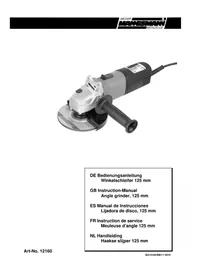
| Product Type | Angle Grinder 125 mm |
| Brand | Brüder Mannesmann |
| Model | 12160 |
| Voltage | 230 V / 50 Hz |
| Power | 900 W |
| No-load Speed | 11000 min⁻¹ |
| Disc Diameter | 125 mm |
| Spindle Thread | M14 |
| Sound Pressure Level (LPA) | 89 dB(A) (uncertainty K=3 dB) |
| Sound Power Level (LWA) | 100 dB(A) (uncertainty K=3 dB) |
| Vibration | 4.42 m/s² (uncertainty K=1.5 m/s²) |
| Protection Class | II |
| Weight (approx.) | 1.8 kg |
| Additional Handle | Yes |
| Spindle Lock | Yes |
| Protection Guard | Included (for grinding) |
| Usage | Grinding and cutting (with appropriate guard) |
| Maintenance | Clean with a dry cloth, avoid liquids |
| Warranty | 2 years |
Frequently Asked Questions - 12160 Brüder Mannesmann
User questions about 12160 Brüder Mannesmann
0 question about this device. Answer the ones you know or ask your own.
Ask a new question about this device
Download the instructions for your Grinder in PDF format for free! Find your manual 12160 - Brüder Mannesmann and take your electronic device back in hand. On this page are published all the documents necessary for the use of your device. 12160 by Brüder Mannesmann.
USER MANUAL 12160 Brüder Mannesmann
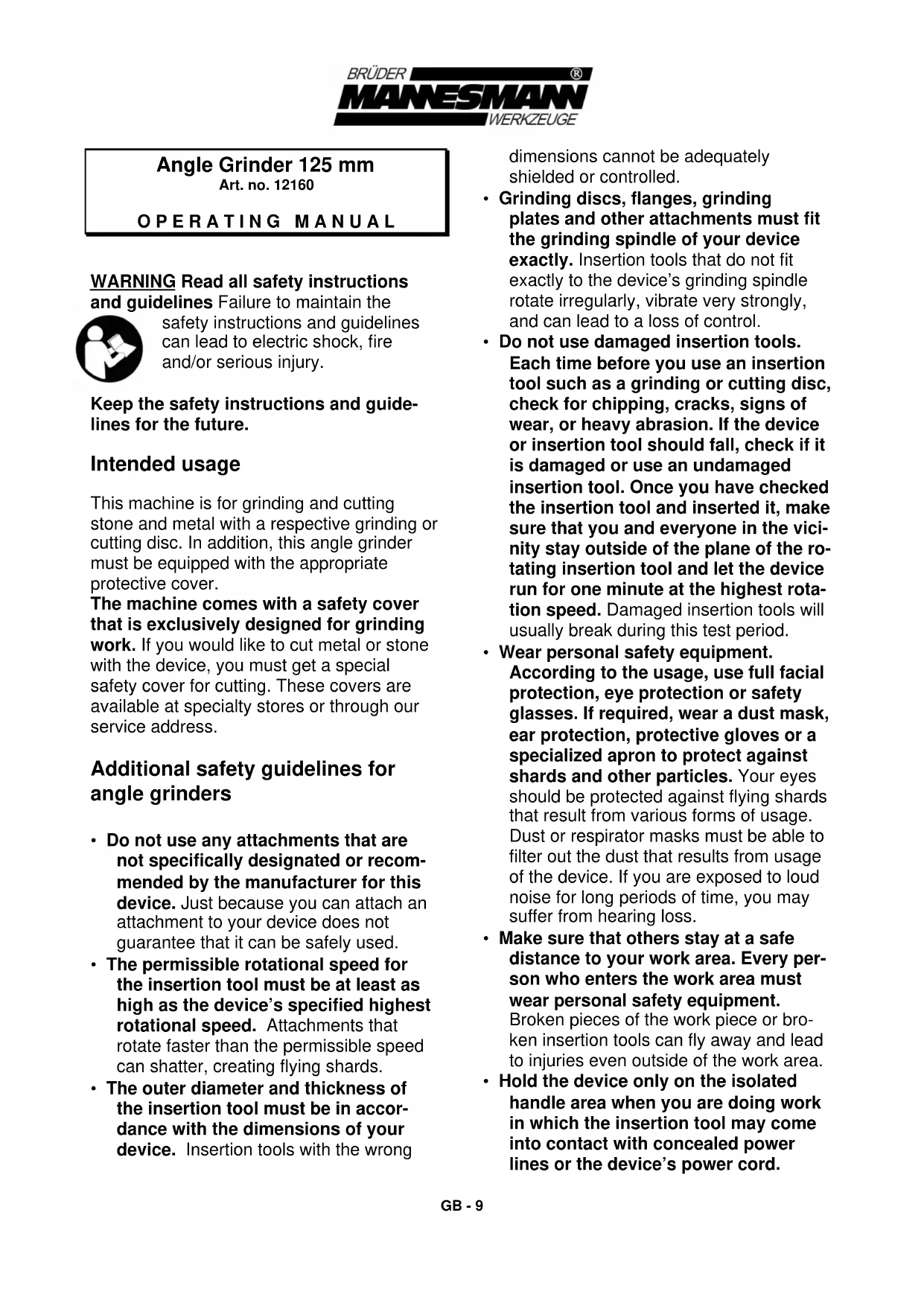
WARNING Read all safety instructions and guidelines Failure to maintain the

safety instructions and guidelines can lead to electric shock, fire and/or serious injury.
Keep the safety instructions and guidelines for the future.
Intended usage
This machine is for grinding and cutting stone and metal with a respective grinding or cutting disc. In addition, this angle grinder must be equipped with the appropriate protective cover.
The machine comes with a safety cover that is exclusively designed for grinding work. If you would like to cut metal or stone with the device, you must get a special safety cover for cutting. These covers are available at specialty stores or through our service address.
Additional safety guidelines for angle grinders
- Do not use any attachments that are not specifically designated or recommended by the manufacturer for this device. Just because you can attach an attachment to your device does not guarantee that it can be safely used.
- The permissible rotational speed for the insertion tool must be at least as high as the device's specified highest rotational speed. Attachments that rotate faster than the permissible speed can shatter, creating flying shards.
- The outer diameter and thickness of the insertion tool must be in accordance with the dimensions of your device. Insertion tools with the wrong
dimensions cannot be adequately shielded or controlled.
- Grinding discs, flanges, grinding plates and other attachments must fit the grinding spindle of your device exactly. Insertion tools that do not fit exactly to the device's grinding spindle rotate irregularly, vibrate very strongly, and can lead to a loss of control.
- Do not use damaged insertion tools. Each time before you use an insertion tool such as a grinding or cutting disc, check for chipping, cracks, signs of wear, or heavy abrasion. If the device or insertion tool should fall, check if it is damaged or use an undamaged insertion tool. Once you have checked the insertion tool and inserted it, make sure that you and everyone in the vicinity stay outside of the plane of the rotating insertion tool and let the device run for one minute at the highest rotation speed. Damaged insertion tools will usually break during this test period.
- Wear personal safety equipment. According to the usage, use full facial protection, eye protection or safety glasses. If required, wear a dust mask, ear protection, protective gloves or a specialized apron to protect against shards and other particles. Your eyes should be protected against flying shards that result from various forms of usage. Dust or respirator masks must be able to filter out the dust that results from usage of the device. If you are exposed to loud noise for long periods of time, you may suffer from hearing loss.
Make sure that others stay at a safe distance to your work area. Every person who enters the work area must wear personal safety equipment. Broken pieces of the work piece or broken insertion tools can fly away and lead to injuries even outside of the work area. - Hold the device only on the isolated handle area when you are doing work in which the insertion tool may come into contact with concealed power lines or the device's power cord.
Contact with a live power line can electrically charge the device's metallic parts and lead to electric shock.
- Keep the power cord away from rotating insertion tools. If you lose control of the device, the power cord may be cut or caught and your hand or arm may come into contact with the rotating insertion tool.
- Never put the device down before the insertion tool has completely stopped moving. The rotating insertion tool may come into contact with the material holder, which can lead to a loss of control.
- Make sure the machine is not on while you are carrying it. If your clothing accidentally comes into contact with the rotating insertion tool, it may be caught and pull the insertion tool toward your body.
- Clean the device's ventilation slots regularly. The motor fan pulls dust into the housing, and a heavy build-up of metal dust can lead to electrical dangers.
- Do not use the device in the vicinity of flammable materials. Sparks may ignite such materials.
- Do not use any insertion tools that require a liquid cooling agent. Using water or other liquid cooling agents can lead to electric shock.
Machine kickback and appropriate safety measures
Machine kickback is a sudden reaction resulting from a caught or blocked insertion tool, such as a grinding or cutting disc, that is in rotation. Catching or blocking leads to an abrupt stoppage of the rotating insertion tool. This will cause you to lose control of the insertion tool as it accelerates against the rotational direction at the blocked point. If, for instance, a grinding disc gets caught or blocked in the work piece, the edge of the grinding disc that is grinding into the work piece can break off or cause a kickback. The grinding disc will then move toward or away from the operator, according to the disc's rotational direction at the blocked
point. This may also cause the grinding disc to break.
A kickback is the result of an improper or erroneous use of the device. It can be prevented by applying safety measures, as described in the following.
- Hold the device tightly and place your body and arms in a position that allows you absorb the force of a kickback. Always use the auxiliary handle, if one is provided, in order to have the highest possible degree of control over the force of kickbacks or reaction torque at high rotational speeds. With proper safety measures, the operator can control the force of kickbacks and torque.
- Never put your hands in the vicinity of rotating insertion tools. If a kickback occurs, the insertion tool may come into contact with your hand.
- Avoid putting your body in the area where the device might be moved in the case of a kickback. A kickback causes the device to be forced in the direction opposite to the movement of the grinding disc against the block point.
Exercise special care when working on corners and sharp edges. Where applicable, prevent the insertion tool from recoiling and jamming. At corners, sharp edges or when recoiling, rotating insertion tools have a tendency to jam. This causes a loss of control or a machine kickback. - Do not use chain- or toothed saw blades. Such insertion tools often cause kickback or loss of control over the device.
Special safety guidelines for grinding and cutting
-
Use only grinding tools that are approved for your device and protective covers intended for these grinding tools. Grinding tools that are not intended for the device cannot be adequately shielded and are unsafe.
-
The protective cover must be fastened securely to the device and adjusted so that a maximum degree of safety can be provided, i.e. the smallest possible part of the grinding tool should be left open to the operator. The protective cover is meant to protect the operator from shards and accidental contact with the grinding tool.
- Grinding tools are only to be used for the recommended usages. For example: Never grind with the lateral surface of a cutting disc. Cutting discs are intended for material removal with the edge of the disc. Lateral application of force to the grinding tool can break it.
- Always use undamaged clamping flanges of the proper size and form for the grinding disc you choose. Proper flanges support the grinding disc and reduce the danger of disc breakage. Flanges for cutting discs may be different from flanges for other grinding discs.
- Do not use grinding discs from larger electrical devices. Grinding discs for larger devices are not designed for the higher rotational speeds of smaller devices and may break.
Further safety guidelines for cutting discs
- Avoid a blockage of the cutting disc or high contact pressure. Do not do any cuts that are excessively deep. Overstressing the cutting disc increases the strain and the likelihood of canting or blocking and the possibility of a machine kickback or a breakage of the tool.
- Stay out of the area in front of or behind the rotating cutting disc. If you are moving the cutting disc away from yourself into the work piece, a kickback could cause the rotating disc to be forced directly toward you.
- If the cutting disc jams, or if you stop working, turn the device off and hold it until the disc stops moving completely. Never try to pull a still-rotating cutting disc out of the cut, as this may
result in a machine kickback.
Determine and correct the cause for the machine becoming jammed.
- Never turn the device back on while it is inside the work piece. Allow the cutting disc to reach its full rotational speed before you begin your cut.
Otherwise the disc may become caught, jump out of the work piece or cause a kickback. - Support slabs or large work pieces to avoid the risk of kickback resulting from a jammed cutting disc. Large work pieces can bend under their own weight. The work piece must be supported on both sides of the disc; in the area of the cut as well as on the edge.
Exercise special care when doing "plunge cuts" into existing walls or other areas that are not visible. In such cuts, the cutting disc may cut into gas or water pipes, electrical lines or other objects and cause a machine kickback.
Discription
- Spindle lock
- Grinding disc (not included)
- Support handle
- Main switch
- Power cord
Technical dates
Voltage 230 V~ / 50Hz
Rated Power 900 W
Idle speed 11000 min
Disc diameter 125 mm
Spindle thread M14
Sound pressure level (LPA) 89 dB(A)
(uncertainty K = 3 dB)
Sound power level (LWA) 100 dB(A)
(uncertainty K = 3 dB)
Vibration 4,42 m/sec²
(uncertainty K = 1,5 m/s²)
Protection class / II
Be sure to wear safety goggles, dust mask and ear-protection during use!



- The vibration emission level given in this information sheet has been measured in accordance with a standardised test given in EN 60745 and may be used to compare one tool with another.
- The given vibration emission level may be used for the initial estimation of the real exposure.
- The vibration emission level will vary because of the ways in which a power tool can be used and may increase above the level given in this information sheet.
Try to keep the exposure as low as possible. To reduce the vibration emission level the user should wear working-gloves and use the machine for limited time. - All parts of working cycles have to be considered (including the time the power tool is switched off, and the time, when the power tool is running under no-load condition).
The strength of the tightening flange corresponds to the specifications of standard EN 10025 for steel FE 430 B, or a material with a similar strength.
The tensile strength of the protective hood is 270-450 N/mm, and the minimum breaking elongation is 28% (length of test bar: 50 mm).
Replacement of Abrasive Discs
- Disconnect the mains plug before replacing the abrasive disc.
- Keep the locking button (1) pressed and loosen the tightening nut with the enclosed spanner.
-
Remove the tightening nut and the abrasive disc from the tightening shaft.
-
When inserting a new abrasive disk makes sure that it is seated correctly on the tightening flange.
- Re-tighten the tightening nut, making sure that the abrasive disc is not damaged in this process.
- Before commencing work, try the machine and check to make sure that the disc is rotating correctly.
Operation
- Always wear safety-goggles during your work.
- Hold the angle grinder with both of your hands on the provided handles.
- First push the main-switch (4) in direction of the disc.
- Do not touch the material to be cut or grinded, before the angle grinder reaches ist maximum speed.
- Start your job only after the maximum speed has been reached.
- Release of the main-switch (4) by pressing the end will stop the machine.
- ATTENTION: Disc will run out slowly!
- Pull down the angle grinder only after the disc has come to a complete stop.
Maintenance and cleaning
- The angle grinder does not require any special maintenance.
- Disconnect the machine from the power-supply, before doing any cleaning jobs.
- Keep the housing clean by using a dry cloth or brush.
- Do not use any cleaning agents, as they might attack the material of the housing.
- Let no liquids enter the inside of the machine.
2 years warranty
The warranty period for this tool starts at the date of purchase. Please provide your purchase bill as proof.
This warranty includes:
- repair of operational failures
- replacement of faulty parts
- qualified service and installation
provided that the failure does not result of wrong handling. Please do not hesitate to contact us for any further queries:
Spare parts, disused power tools and environmental protection
- Only use original replacement parts and accessories.
If your electrical appliance is used so intensely that it must be replaced, or you have no more use for it, you are obligated to dispose of the appliance at a recycling center. - Contact your municipal waste collection service or your local authorities to find out where you can recycle your power tool.
- Power tools contain valuable raw materials that can be recycled. You will contribute to recycling valuable raw materials by handing your tool in at a municipal waste collection site.
- Power tools also contain substances that may be harmful to the environment and humans if disposed of improperly.
The symbol with the crossed-out dustbin means that you must take this tool to a waste collection facility for the separate collection of electrical and electronic equipment.
Lijadora de disco 115 mm
Núm. art. 1216-EWS