
Montana 110 - Saw GARLAND - Free user manual and instructions
Find the device manual for free Montana 110 GARLAND in PDF.


| Product type | Petrol chainsaw |
| Brand | Garland |
| Model | Montana 110 |
| Engine | 2-stroke, 25.4 cc, 0.8 kW |
| Guide bar length | 10" (25.4 cm) |
| Effective cutting length | 26 cm |
| Chain pitch | 3/8" |
| Chain gauge | 0.050" |
| Dry weight | 3.3 kg |
| Fuel tank capacity | 230 cc |
| Chain oil tank capacity | 160 cc |
| Fuel type | Unleaded 95 petrol + 2-stroke oil mixture (40:1) |
| Main functions | Pruning, felling and wood cutting |
| Safety | Automatic chain brake, front hand guard, safety trigger |
| Routine maintenance | Air filter cleaning, chain sharpening, guide bar lubrication |
| Spare parts available | Guide bar, chain, filters, spark plug, carburettor |
| Guaranteed sound level | 111 dB(A) |
| Front handle vibration | 7.095 m/s² (K=1.5) |
| Rear handle vibration | 7.085 m/s² (K=1.5) |
| Warranty | 2 years |
Frequently Asked Questions - Montana 110 GARLAND
User questions about Montana 110 GARLAND
0 question about this device. Answer the ones you know or ask your own.
Ask a new question about this device
Download the instructions for your Saw in PDF format for free! Find your manual Montana 110 - GARLAND and take your electronic device back in hand. On this page are published all the documents necessary for the use of your device. Montana 110 by GARLAND.
USER MANUAL Montana 110 GARLAND
natural_image
Black and white photo of a Garland 10-inch chain saw (no text or symbols on the instrument body)
EN Instruction manual
natural_image
Illustration showing a person sitting at a desk and another person standing with arms raised, no text or symbols present.natural_image
Illustration of mechanical tools including chains, a gear, and screwdriver (no text or symbols)natural_image
Illustration of a stylized bag with decorative patterns and a curved arrow indicating rotation (no text or symbols)natural_image
Diagram of a car's front and side view with no visible text or symbols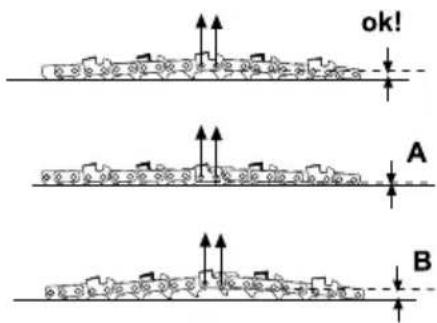
text_image
ok! A B
natural_image
Illustration of a stylized backpack with decorative patterns and a curved arrow (no text or symbols)natural_image
Illustration of a person using a saw to cut a tree stump with an arrow indicating the process (no text or symbols present)natural_image
Illustration of a hand using a tool to adjust or install a mechanical component (no text or symbols visible)natural_image
Line drawing of a chain saw with motion arrow indicating speed (no text or symbols)text_image
Technical diagram of a mechanical device with numbered components and directional arrows indicating motion or assembly.natural_image
Black and white illustration of a person interacting with a dog-like object (no text or symbols)text_image
Diagram showing two cylindrical objects with labeled parts and directional arrows indicating movement or forcetext_image
Diagram showing two cylindrical objects with labeled parts and directional arrows indicating movement or force7.5. CORTE DE LAS RAMAS DE UN ÁRBOL ABATIDO
natural_image
Line drawing of a person wearing a harness and holding a medical device (no text or symbols)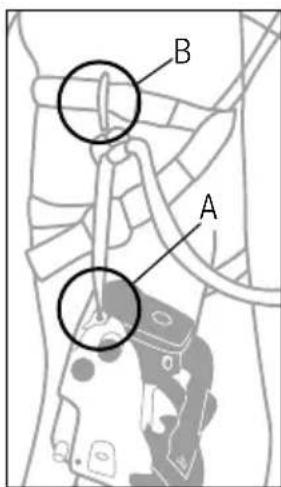
text_image
B Anatural_image
Anatomical line drawing of a human hip joint with attached medical devices (no text or labels)natural_image
Line drawing of a person wearing a harness and safety harness, holding a rope (no text or symbols)natural_image
Anatomical line drawing of a male reproductive system, showing ovary and larval structures (no labels or text)natural_image
Technical illustration of a mechanical component with two labeled parts (1 and 2), no visible text or symbols beyond labels.natural_image
Pure mechanical diagram showing a grid structure with arrows indicating motion (no text or symbols)natural_image
Abstract black-and-white illustration of a stylized human figure with circular elements and a central figure, no text or symbols present.natural_image
Illustration of a stylized animal head with abstract patterns and a labeled number 2 (no text or symbols present)text_image
Diagram showing a hand holding a ruler with labeled parts 1 and 2, indicating measurement or labeling.- Introduction 34
- Security measures 35
- Warning symbols 41
- Machine symbols 41
- Machine description 42
- Start up instructions 44
- Using the machine 48
- Maintenance and service 54
- Trouble shooting 58
- Transport 60
-
Storage 60
Declaration of conformity 62 -
Recycling or disposal of your machine 60
-
Warranty conditions 61
TRANSLATION OF THE ORIGINAL INSTRUCTIONS
Ref.:GMSMONTANA110M1214V1
DATE OF PUBLICATION: 11/12/2014
DATE OF REVISION: 11/12/2014
1. INTRODUCTION
Thank you for choosing this Garland machine. We are confident that you will appreciate the quality and performance of this machine, which will facilitate your task for a long period of time. Remember that this machine has the most extensive and expert technical assistance network which you can consult for the maintenance, troubleshooting and purchase of spare parts or accessories.
! SECURITY FIRST.
Warning! This chainsaw is a special product, specifically designed for the pruning of trees. This chainsaw can only be
used by a qualified operator who follows a security integration system on the carefully designed job. Only use this chainsaw for the pruning of trees under these specific conditions. Please read the instruction manual carefully.
Warning! The operators that work with this chainsaw in the pruning of trees at height with a rope and harness must never work alone. There must always be a qualified second worker on the ground in case of emergency.
Warning! The operators that work with this chainsaw in the pruning of trees must receive training on safe climbing, safe positioning techniques, and be equipped with harnesses, ropes, carabiners, fastening straps, and other equipment to ensure that they are kept in safe work positions for both operators and chainsaw.

Warning! Read all safety warnings and all instructions. The failure to observe all warnings and instructions below can result in
fire and/or serious injury. Before using this machine, carefully read the information in this manual on correct setup and safe techniques.
⚠️Save all warnings and instructions for future reference. If sold in the future, remember to give this manual to the new owner.
⚠️Use this chainsaw for sawing wood only. Any other use could be dangerous and is at your own risk.
Do not use this chainsaw for unintended purposes. For example: do not use the chainsaw for cutting plastic materials, bricks or non-wood building materials. The use of this chainsaw for operations other than those expected may result in dangerous circumstances.
The manufacturer is not responsible for damages caused by improper or incorrect use of this tool.
2. SECURITY MEASURES
To avoid the mishandling of this machine, please read all instructions in this manual before using for the first time. All information included in this manual is important for your personal safety and the people, animals, and things surrounding you. If you have any questions regarding the information contained in this manual ask a professional or go to the point of sale where you purchased this machine to resolve it.
2.1. USERS
Warning! This chainsaw is a special product, specifically designed for the pruning of trees. This chainsaw may only be used
by a qualified operator who follows a safety integration system in the carefully designed job. Only use this chainsaw for the pruning of trees under these specific conditions. Please carefully read the instruction manual.
⚠ Warning! Do not allow underage persons to use this machine.
Warning! Do not allow unqualified persons and or those without a carefully designed safety integration system to use this machine.
⚠ Warning! Do not allow persons who do not understand this instruction manual to use this machine.
Before using this machine, familiarize yourself with it ensuring that you perfectly know where the controls and safety devices are, and the manner in which it must be used. If you are an inexperienced user we recommend you practice doing a simple job and, if possible, in the company of an experienced person.
Warning! Only lend this machine to persons who are familiar with this type of machine and know how to use it. Always lend the machine along with the user instruction manual so the new user can carefully read it and understand it.
This machine is dangerous in the hands of untrained users.
2.2. PERSONAL SAFETY
Stay alert, watch what you are doing and use common sense when operating this machine.
Do not use this machine when you are tired or under the influence of drugs, alcohol or medication.
A moment of inattention while operating this machine can cause serious personal harm.
Remove all keys or hand tools from the machine and work area before starting the machine. A wrench or key left near the machine may be touched by a moving part of the machine and project itself causing damage to a person.
Whenever you are atop a tree, start this machine with the chain brake activated.
Never fill fuel or oil, or perform maintenance or checking while up in a tree. The operator on the ground is the person responsible for checking and filling the chainsaw's fuel and oil.
Do not exceed yourself. Keep both feet firmly in place on the ground and maintain balance at all times. Always keep appropriate foot support and operate the chainsaw only when it is of standing on fixed, secure and level surface. Slippery or unstable surfaces such as ladders may cause a loss of balance or control of the chainsaw.
Keep all parts of the body away from the saw when the chainsaw is operating. Before starting the chainsaw, make sure that the saw of the chain is not in contact with any object. A moment of carelessness while operating chainsaws may cause your clothes or other part of the body to tangle with the saws of the chain or that you be cut by the tool chain.
Always hold the chainsaw with your right hand on the rear handle and your left hand on the front handle. Holding the chainsaw with inverted hands increases the risk of bodily harm and should never be done.
When cutting a limb that is under tension, be alert to the risk of elastic return. When tension in the wood fibers is released, the branch, under a spring effect may strike the operator and/or send the chainsaw out of control.
Use extreme caution when cutting brush and young shrubs. Fine materials can pinch the saw's chains and be thrown towards you, or cause you to lose balance under the effect of traction.
If you are an inexperienced user, we recommend minimum practice by cutting logs on a saw horse or cradle of sawing to exercise.
When transporting, hold the chainsaw by the front handle with the machine off, the chain and sword covered by the lid and a distance from any body parts. When transporting or storing the chainsaw, always cover the sword with the lid. Proper handling of the chainsaw will reduce the likelihood of accidental contact with the moving saw chain.
Store idle tools out of the reach of children.
2.2.1. WORK CLOTHING
Dress properly. Do not wear loose clothing or jewelry. Keep your hair, clothing and gloves away from moving parts. Loose clothing, jewelry or long hair can be caught in moving parts.

You must wear proper ear, eye, and head protection gear.
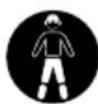
Use proper protection for the feet, legs, hands, and arms.
⚠ The noise caused by this machine can cause hearing damage. Use auditory protection.
If you regularly work with this machine, visit your doctor frequently to check your hearing ability.
⚠ Warning! When working with auditory protection, you must pay more attention to visual signs as the auditory senses will be weaker.
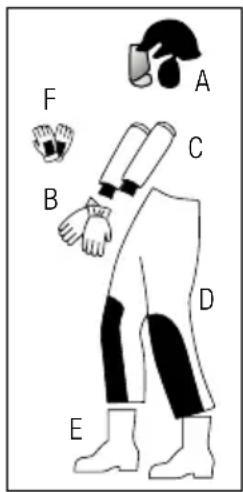
The use of supplemental protective equipment for head, hands, arms, legs and feet is mandatory, and is composed of:
text_image
A F C B D EA: Forestry helmet with mask protection and hearing protection that meets EN-397, EN-352, EN-1731 standards.
B: Safety gloves with anti-cut and longer wrist protection which meet EN-381 standards.
C: Arm cuffs with anti-cut forearm protection that meets the standard EN-381.
D: Pants or anti-cut chest guard that meets the EN-381 standard.
E: Boots with anti-cut protection for work in height pruning according to the ISO17249 standard.
F. Climbing gloves. More comfortable gloves that we will only use when we are not cutting with the chainsaw with ascent and descent jobs.
The use of all these materials will reduce the risk of injury caused by the projected debris or accidental contact with the saw chain.
Additionally you should also take with you:
- Safety harness for climbing and working at heights according to the standard EN 341, EN-361-365, the sling chainsaw, carabineers, ropes and tapes (in the case of pruning height).
- Tools
- Signage tape for the work area.
- Mobile phone (to use in case of emergency).
2.2.2. VIBRATIONS
Prolonged use of this machine exposes user to vibrations It can lead to the “white fingers” disease (Raynaud’s Phenomenon). This disease reduces the hand’s sense of touch and the ability to adjust the temperature, creating a lack of sensibility in the fingers and a burning sensation. This disease can cause nerve and circulation problems, and even necrosis in the hands.
A high level of vibration and long periods of exposure are factors that contribute to the “white fingers” disease. In order to reduce the risk of the “white fingers” disease, it is necessary to take into account these recommendations:
• Always wear gloves.
• Make sure to always have warm hands.
• Make sure that the chain is always sharpened.
• Take frequent breaks.
• Always firmly hold the machine by the handles.
If you detect any “white fingers” disease symptoms immediately consult your doctor.
2.3. SAFETY IN THE WORK AREA
Keep the work area clean and work with good lighting. Cluttered and dark areas cause accidents.
Do not operate this machine in explosive atmospheres as well as in the presence of flammable liquids, gases and dust.
Keep children and onlookers away while operating this machine. Distractions can cause loss of control. Stay watchful to make sure children, people, or animals stay out of your work area.
2.4. SAFETY IN THE USE OF FUELS

IMPORTANT: The fuel used for the chainsaw is highly flammable. If the fuel
or the machine ignite, smother the fire with a dry powder fire extinguisher. Always avoid eye contact with gasoline or oil.
If gasoline or oil comes in contact with your eyes, rinse immediately with clean water. If your eye still feels irritated later on, immediately consult with a doctor.

Do not smoke while handling Fuel or fill deposits, nor bring any flame or hot object toward the fuel.
When you are refilling the fuel, make sure you have turned the machine off and make sure that the engine is cold. Never refuel with the motor running or hot. In the event of a fuel leak be sure to remove these leaks completely before restarting.
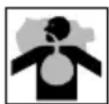
Do not refuel in enclosed spaces, in poorly ventilated areas or near flames.
Always store fuel in approved containers that comply with the European standard.
2.5. CARE AND USE OF THIS MACHINE
Use to cut wood only. Do not use the chainsaw for any other purposes. For example: do not use chainsaw for cutting plastic materials, bricks or non-wood building materials. The use of the chainsaw for operations other than those designed may result in dangerous situations.
Carefully follow the operating instructions contained in this manual. Failure to follow the instructions
contained in this manual may cause a dangerous situation.
Use this machine, accessories, tools, etc. in accordance with these instructions and as planned, taking into account the work conditions and work yet to develop. The use of this machine any other use apart from the designed applications may cause a dangerous situation.
The manufacturer shall not be responsible for damage caused by improper or incorrect use of this machine.
Do not force this machine. Use this machine for the correct application. Using the machine for the type of work to be done will allow you to work better and more safely.
Do not use this machine if the switch does not change between “open” and “closed”. Any machine that cannot be controlled with the switch is dangerous and must be repaired.
Keep proper maintenance of this machine. Check that the moving parts are not misaligned or locked, broken parts or other conditions that may affect the operation of this machine.
If this machine is damaged, repair fully before use. Many accidents are caused by poorly maintained machines.
Keep cutting instruments clean and sharp. Maintaining the cutting tools correctly with sharp cutting edges is less likely to bind and is easier to control.
Keep the machine's handles dry and clean. Greasy or oily handles are slippery and cause loss of control of the machine.
Turn off the machine and disconnect the spark plug before making any adjustments, changing accessories, or storing the machine. Such preventive safety measures reduce the risk of the machine starting accidentally.
Follow the instructions concerning oiling, tension and chain accessories rearrangement.
2.6. FORCES OF UNFORESEEN REACTION WHILE WORKING WITH THE CHAINSAW
2.6.1. BOUNCE
⚠️ May cause a rebound of the chainsaw if any object is touched by the chain in the area of the end of the rod while turned on.
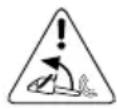
The contact of the chain with the tip of the rod may cause an unforeseen reaction force that can push the tip of the rod
upwards, generating a movement in chainsaw rotation that can cause the chain rod to hit the user. This reaction can result in loss of control of the machine and cause severe personal injury.
2.6.2. FORWARD PULL
A “forward pull” can occur when the chain suddenly stops when it becomes entangled in the cutting in a foreign body that is in the area of the wood or because it is not being cut properly. The chain, when stopped, pushes the chainsaw forward if the chainsaw is not properly subject against the branch or the tree using the claw, produces an unexpected hitch which can cause the user to lose control of the saw, make it fall forward, and produce severe bodily harm.
To avoid this “forward pull”, start the cutting with full gas power and keep the machine at maximum revolutions during cutting, while supporting the claw of the saw against the wood to be cut.
2.6.3. RECOIL
Pinching the chain of the saw on the top of the sword may push the sword rapidly back toward the operator. The chain, when stopped, pushes backwards (reverses) the chainsaw that if the chainsaw is not correctly clamped against the branch or the tree using the claw, produces an unexpected push that can cause the user to lose control of the chainsaw, make you fall backwards and cause severe personal injury.
Either of these reactions may cause a loss of control of the saw that is likely to lead to a serious bodily accident. Do not rely exclusively on the safety devices built into your saw. As a user of the chainsaw, you should take measures to eliminate the risk of accident or injury in his court.
These reaction forces result from misuse of the tool and/or procedures or incorrect operating conditions and can be avoided by taking proper precautions specified below:
- Firmly grasp the chainsaw handles with both hands.
• Always be aware of where the tip of the chain rod is. - Ensure that the tip of the rod does not touch anything.
- Do not cut branches with the tip of the rod.
- Make sure that there are no nails or pieces of metal in the cutting area and pay special attention to nails or pieces of iron that may be in or around the cutting area. Also be careful when cutting hardwoods where chain can engage causing the chain to hang and produce the rebound.
- Do not ever cut if you have to raise your arms and the chainsaw is at shoulder height.
- Begin the cut with full gas power and keep the machine at maximum revolutions during cutting.
• Cut a single branch or piece of wood at a time. -
Be extremely prudent when the chain of the saw enters an already-begun cutting area.
-
Do not make cuts with the saw until you are not familiar with the technique of cutting.
- Do not make cuts in branches or pieces of wood that can shift during cutting or that can close the cut while this is being done.
- Keep the chain in good condition.
- Work only if the chain is well sharpened and properly tensioned.
• Never in the cutting plane of the chainsaw.
2.6.4. FALL AT THE END OF THE CUT
The operator may fall once the cutting has finished. While cutting the trunk, the operator is in a stable position without supporting all the weight of the chainsaw or exerting a little pressure on it to facilitate cutting; at the moment he finishes cutting the trunk, this stable position can be lost by having to bear 100% of the weight of the chainsaw and stop the extra pressure (if applicable), thus falling forward which can cause a loss of control of the chainsaw and likely lead to serious bodily harm.
To prevent falling once you have finished cutting, put pressure on the chainsaw before you finish cutting. The operator must begin to take more weight from the chainsaw so that, by the time the cut is finished, virtually all of the chainsaw's weight is supported by the operator.
2.6.5. STRESS-RELATED INJURIES
Injury may occur by stress on the muscles and tendons of the fingers, hands, arms and shoulders that can cause pain, swelling, loss of sensitivity and weakness in the areas mentioned.
In order to reduce the risk of injury by stress, it is recommended that you:
- Avoid excessive bending of the wrists while working. Try to keep your wrists straight and, when
you want to grab something, do it with the whole hand and not only with the thumb and index finger.
• Take breaks to rest your hands.
- Reduce speed and strength when performing repetitive motions.
- Begin with warm-up exercises and stretching of the hands and arms before starting work, and stretch at the end of the task.
- Visit your health care provider if you notice that you have lost some sensitivity in the fingers, hands, wrists or arms.
2.7. SERVICE
Please have your machine periodically checked by a qualified repair service which uses only identical replacement parts. This will ensure that the safety of this machine is maintained and consistent.
3. WARNING SYMBOLS
The warning labels indicate required information for the use of the machine.

This icon indicates instructions which must be followed to prevent accidents that could result in serious bodily harm or death.
natural_image
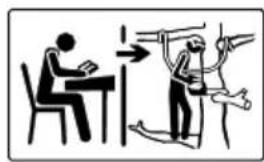
Illustration showing a person at a desk and another person standing on a rope, with no visible text or symbols.Warning! This chainsaw is a special product, specifically designed for the pruning of trees. This chainsaw may be used only by a qualified
operator who follows a safety integration system for the carefully planned job, only use this chainsaw for the pruning of trees under these specific conditions. For the rest of operations, this chainsaw is designed to be used with two hands in the same way as with a conventional saw. Please read the instruction manual carefully.


It is necessary to carefully read this user instruction manual before using the machine.

You must wear adequate protection for the ears, eyes, and head.

Use adequate protection for the feet, legs, hands, and forearms.

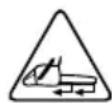
Risk of the chainsaw bouncing.

Warning and Caution.

Hot Surface! Burn risk.
4. MACHINE SYMBOLS
In order to guarantee safe and proper use and maintenance of the machine, the following symbols appear on the machine.

Fuel tank. It is located in the fuel tank cap. MIXTURE of oil 2 times and gasoline.
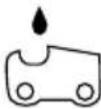
The chain's oil tank. Located in the chain's oil tank cap.
Start to switch positions that are found on the right side of the machine:
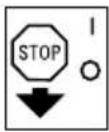
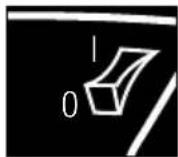
"O" = Off (The machine does not work) "I" = On (The machine is ready for use)
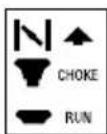
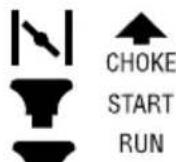
Air positions: Pull the air button to close off air flow. Push the air button to open the air flow. Found on the lateral right of the machine.

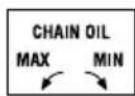
Adjustment of the chain's oil flow.
Carburetor adjustment screws:

“H” = High speed adjustment screw.

“L”= Low speed adjustment screw.

“T” = Idle adjustment screw.
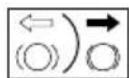
Positions of the White Arrow chain brake = brake not activated (normal operating position) Black Arrow = brake on.

Installation direction of the cutting chain indicator.
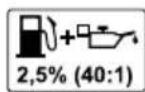
Never use only gasoline or poor quality gasoline! Mix unleaded gasoline 95° and a synthetic oil for 2-stroke motors at 2.5% (40:1).
5. MACHINE DESCRIPTION
5.1. CONDITIONS OF USE
Use this chainsaw for sawing wood only. Any other use could be dangerous and is at your own risk. Do not use this chainsaw for purposes not intended. For example: do not use chainsaw for cutting plastic materials, bricks or non-wood building materials. The use of this chainsaw for operations other than those designed may result in dangerous situations. The manufacturer is not responsible for damages caused by improper or incorrect use of this tool.
5.2. DETAILED DESCRIPTION OF THE PRODUCT
- Rear handle
- Safety trigger
- Throttle trigger
- Front handle
- Front guard and chain brake
- Rod
- Exhaust pipe
- Chain catcher
- Start switch
- Anchor or attachment point
-
Cutting chain
-
Air filter cover
- Air
- Fuel tank
- Chain oil tank
- Choke Rod
- Starter handle
- Chain tensioner screw
- Chain cover nut
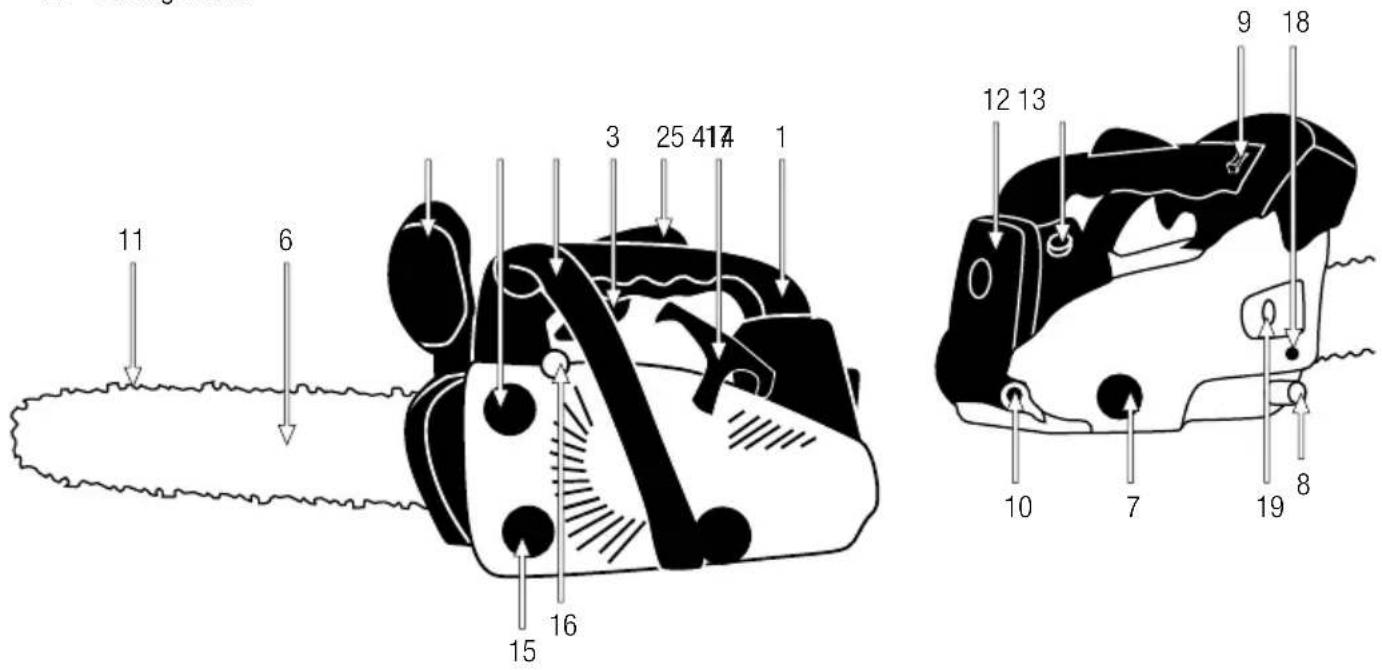
text_image
11 6 3 25 414 1 15 16 12 13 9 18 10 7 19 8The diagrams and pictograms herewith enclosed in this manual are a guide but not necessarily an exact copy of the actual machine.
5.3. TECHNICAL CHARACTERISTICS
| Description Gasoline chainsaw | |
| Brand Garland | |
| Model Montana 110 | |
| Type of Engine 2 stroke | |
| Displacement (cm3) 25,4 | |
| Maximum power (kW) (ISO 7293) 0,8 | |
| Revs at idle speed (min-1) 3.500 | |
| Maximum revs of the engine (min-1) 12.500 | |
| Fuel used Gasoline 40: Oil 1= 2,5% | |
| Specific consumption of the machine at maximum power (g/kWh) 750 | |
| Carburetor type Diaphragm | |
| Type of chain lubrication Automatic | |
| Fuel tank capacity (cm3) 230 | |
| Chain oil tank capacity (cm3) | 160 |
| Rod length (“) | 10” |
| Usable cutting length (cm) | 26 |
| Chain pitch 3/8” low profile | |
| Chain thickness | 0,050” |
| Rod type | Sprocket tip |
| Average sound power level LwA dB(A) (ISO 22868) | 109,67 |
| Guaranteed sound power level LwA dB(A) (ISO 22868) K=3 | 111 |
| Average sound pressure level LpA dB(A) (ISO 22868) | 103,45 |
| Vibration level of the front handle (m/s2) (ISO 22867) K=1.5 | 7,095 |
| Vibration level of the rear handle (m/s2) (ISO 22867) K=1.5 | 7,085 |
| Dry weight (kg) | 3,3 |
The technical characteristics can be changed without prior warning.
6. START UP INSTRUCTIONS
6.1. LIST OF MATERIALS
This machine includes the following items that you will find inside the box:
- Engine.
- Chain protector.
- Rod.
- Chain.
- Spark plug wrench.
- Screwdriver
- Instruction manual.
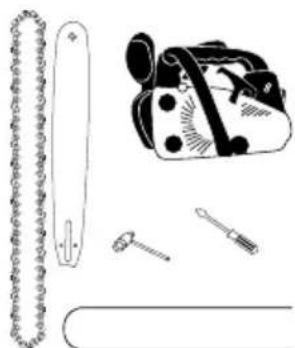
natural_image
Illustration of a chain-linking gear with tools and a separate bar (no text or symbols)Due to the quality controls carried out at the factory, it is unlikely that your tool will have any defective or missing part.
If you find any damaged or missing parts, do not use the machine until the defect has been repaired or all the missing pieces replaced. Using the machine without all of its parts or with defective parts can cause severe personal injury.
6.2. INSTALLATION OF THE ROD AND CHAIN
The chain of the chainsaw has very sharp teeth. Always wear protective gloves to avoid accidentally cutting yourself.
- Check that the chain brake is not activated by pulling the chain brake lever back.
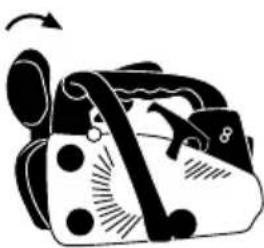
natural_image
Illustration of a stylized object resembling a shoe or bag with decorative patterns and a curved arrow (no text or symbols)- Unscrew nut (1) and remove the cover of the chain (2).
text_image
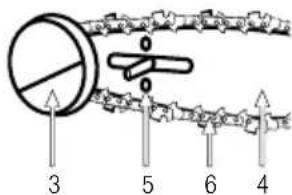
ne 2- Place the chain (6) on the sprocket (3) while adjusting the chain (7) around the rod (4) and
mount rod (4) on the machine. Adjust the chain tension by matching the pivot (5) into the hole in the rod.
text_image
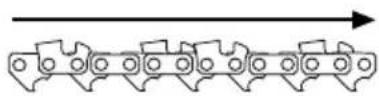
3 5 6 4⚠️ Pay attention to the correct position of the chain. The correct position of the chain is the following:
-
Place the chain cover (2) placing firstly the two back clips and tighten lightly the nut with your fingers (1).
-
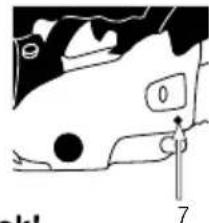
Regulate the chain tension using the tensing screw (7) so that when you pull the chain in the center of the
rod it can boost but not to get out of the guide rod and returns to its position within the guide once you let go.
text_image
0 7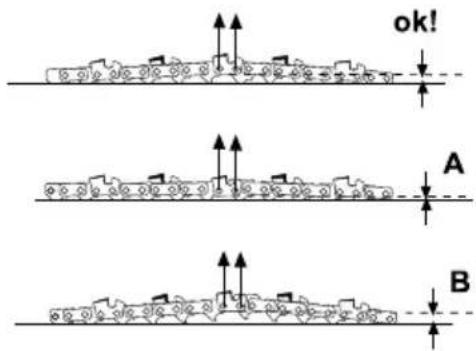
text_image
ok! A BExample (A) corresponds to a chain stretched too tightly.
Example (B) corresponds to a chain that is too loose.
- Tighten the nut (1) (12-15 Nm).
Check that the chain slides along the rod, keeping proper tension at all times whenever you move your hand. If it is necessary, repeat the tensioning procedure until the chain is correctly installed.
⚠️ New chains have a certain expansion when first used. Check and adjust the chain tension regularly.
6.3. CHECK POINTS BEFORE COMMISSIONING
Check the machine and look for loose parts (screws, nuts, shells, etc.) and damage. Tighten, repair, or replace the parts you found in poor condition.
Make sure that there are no leaks or loss of fuel.
Do not use the machine if it is damaged or improperly adjusted.
6.3.1. CHECK OF THE SAFETY BRAKE
If it bounces, the tip of the chain rod rises sharply, the chainsaw changes angle quickly so that the user does not give time to change the position of the arm that collides against the security guard and activates the emergency brake.
The emergency brake can be activated at any time by pushing forward security guard.
To remove the emergency brake, pull the guard backward until you hear a "click".
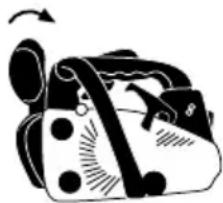
natural_image
Illustration of a stylized bag with decorative patterns and a curved arrow (no text or symbols)Be sure to check the emergency brake every time you use the chainsaw.
-
Turn off the engine.
-
Activate the emergency brake by pushing the safety guard until you hear a "click".
- Hold the chainsaw horizontally at about 40 cm from the piece of wood, remove your hand from
the front handle and leave the chainsaw turn with the right hand until the end of the rod comes in contact with the wood.
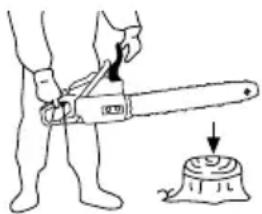
natural_image
Illustration of a person using a saw to cut a tree stump (no text or symbols present)If the brake works properly, the chain should not move in the moment in which it comes in contact with the wood. In the event that the brake is not acting properly, you must take chainsaw in for a service revision.
Do not start the chainsaw if the emergency brake is activated. If the chain is blocked by the brake, the clutch will heat up and may be damaged.
6.3.2. BLEND OF GASOLINE AND OIL
Use unleaded gasoline 95 octane and 100% synthetic two stroke oil.
Engine fuel: mix synthetic oil and gasoline
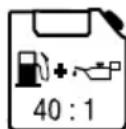
(Gasolina40: oil 1 = 2.5%). Mix gasoline and oil in a CE-approved container.
Do not use fuel that it has been stored for more than 2 months. A fuel that has been stored for too long will make the starting of the machine more difficult and result in unsatisfactory engine performance. If the fuel has been in the tank of the machine for more than two months, empty the machine of the old fuel and replace it with one in perfect condition.
Refueling of the machine:
- Choose a suitable area to perform this operation.
- Shake the container that has the already prepared mixture of gasoline and oil.
- Remove the fuel tank cap and fill with the gasoline and oil mixture.
- Tightly close the cap of the fuel tank and remove all fuel which may have spilled on the outside with a dry cloth.
WARNING:
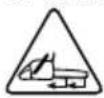
Stop the motor before refueling.
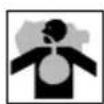
Do not ever perform this operation in a closed or unventilated area.
Separate yourself at least 3 metres from the refueling area before starting the machine.
Do not remove the cap of the fuel tank while the engine is running.
6.3.3 CHAIN OIL
Use only special chainsaw oil. Do not use other oil that is not for chainsaw chains since it will damage the machine oil pump.
Insert the chain oil in the chain oil tank. This oil tank can be recognized by the corresponding icon (indicated in Chapter 5 "Symbols on the machine").
6.4. START UP
Before starting the machine, make sure that the moving parts of the machine are not in contact with any object.
6.4.1. COLD-STARTING THE ENGINE
- Set the switch in the start position "I".
-
Press the "primer" choke several times (from 7 to 10) to ensure that the fuel has reached the carburetor.
-
Pull the air lever CHOKE
-
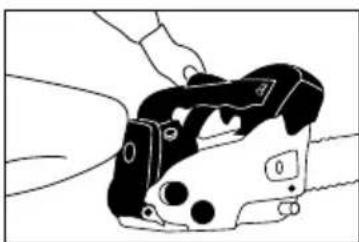
Place the machine on the floor in a stable and horizontal position.
-
Firmly hold the front handle with your left hand and hold the rear of the saw with your right knee.
natural_image
Line drawing of a hand holding a black mechanical device with circular components, no text or symbols present-
Pull the starter cord until the motor starts or makes an explosion.
-
Push in the air level (normal working position RUN).
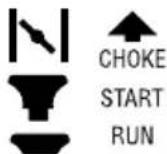
-
If the tool has not started, pull the starting rope again (6) until it starts.
-
Leave the engine to warm up for a few minutes before using the machine
6.4.2 STARTING WITH A WARM ENGINE
In the event that the machine is hot:
- Set the switch to position (l).
- Make sure the choke/air level is stuck RUN.
- Place the machine on the ground on a horizontal and stable location.
- Firmly hold the front handle with your left hand and hold the rear of the saw with your right knee
- Pull the Start cord until the engine starts.
If after a few attempts the machine does not start follow the steps of starting with a cold engine.
6.4.3. STARTING THE CHAINSAW IN THE TREE
Only for starting in the tree with an already hot machine. The operator shall:
- Press the brake chain (brake on).
- Turn the switch to position (I).
- Place chainsaw with the chain to the right or left of the body.
A. If the chainsaw is positioned on the left side:
I. Hold the chainsaw with the left hand on the front handle.
II. Hold the starter with the right hand handle.
III. Sharply push the chainsaw away from the body while the right hand holding the Starter handle.
V. If after several attempts the chainsaw will not start, hand the chainsaw to the operator on the ground for checking.
B. If the chainsaw is positioned on the right side:
I. Hold the chainsaw with the hand right over the front handle.
II. Hold the starter rope with the left hand
III. Sharply push the chainsaw away from the body while the left hand holds the starter handle.
IV. If after several attempts the chainsaw will not start, give the chainsaw to the operator on the ground for checking.
6.4.4 TURNING OFF THE ENGINE
Stop using speed and allow the engine to remain idle for half a minute.
Stop the engine by turning the switch to the "O" position.
6.5. CHECKING POINTS AFTER START UP
It is important to pay attention to the possible individual parts and the temperature of the machine. If you detect any anomaly in the machine immediately stop and check it carefully. In case of any malfunction or problem take the machine for a service repair. Under no condition should you continue to use the machine if the operation does not seem appropriate.
Do not use the machine if it is damaged or improperly adjusted.
6.5.1. CHECKING THE CLUTCH
After having booted the machine, the chain should not move if the engine is at idle. If the chain rotates idle the engine idle will be necessary to adjust, so turn the carburetor "T" screw until the chain stops.
⚠️ If the motor is stalled before the chain stops, take your chainsaw to service technician for adjustment.
The adjustment of the "H" and "L" screws should only be performed by the authorized service technician.
6.5.2. CHECK OF THE AUTOMATIC CHAIN LUBRICATION
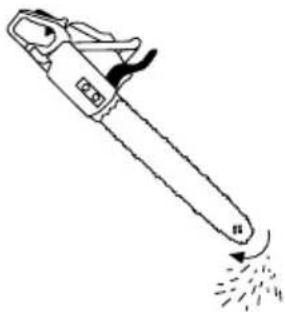
natural_image
Line drawing of a chainocorder with motion arrow indicating impact (no text or symbols)After starting the engine, speed up the chainsaw until the chain turns at an average speed and check if the chains saw greases the chain, this will be easily seen when you place the chainsaw as in the figure, oil will come out.
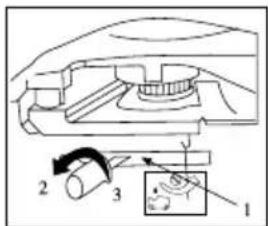
text_image
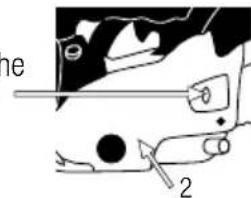
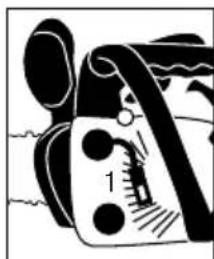
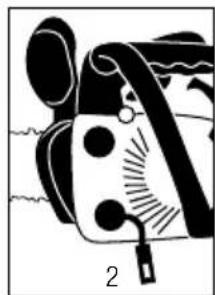
Technical diagram showing a mechanical assembly with labeled parts 1, 2, and 3, including a directional arrow indicating motion.You can adjust the oil flow with the adjusting screw (1) oil that is below the chainsaw next to the clutch.
To regulate oil flow turn the screw clockwise "MAX" If you want to increase it, or turn the screw 'MIN' to decrease it. The indications "MAX" and "MIN" are at the bottom of the machine. Be sure to fill the chain oil tank whenever refilling fuel.
6.5.3. CHECK OF PROTECTION AGAINST BOUNCING
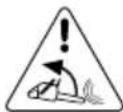
Bouncing of the machine is the greatest risk of this machine.
This machine has an automatic brake to stop the rotation of the chain where a rebound occurs during use.
6.5.4. CHECK OF THE SECURITY BRAKE
Accelerate the chainsaw to its maximum revs and push the safety brake lever forward. The chain should stop immediately with the engine at full power.
If the chain not is for or takes to stop take the machine for service. Check the emergency brake whenever you start using the machine.
7. USING THE MACHINE
⚠️ Use this machine only for the designated purposes. Using this chainsaw for any other use is dangerous and can cause bodily harm and/or damage to the machine.
Do not approach the chain when the motor is running.
Do not trust only in the security measures of this machine.
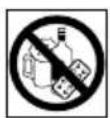
Do not use this machine if you are fatigued, ill, or are under the influence of medication, drugs, or alcohol.
Fatigue and the lack of rest can cause accidents or damage. Limit continued use of this machine to 10 minute time intervals and rest for 10-20 minutes to rest between each session.
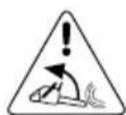
Always hold the chainsaw with the two hands and keep subject handles while the engine is on unless you are performing
a pruning height with rope and harness. If you firmly hold the machine by the handles will reduce the risk of rebound and will increase its control over the machine.
Remember to always use the machine with clean hands and without any fuel or oil.
Pay special attention if you use this machine in the rain or after raining, as the soil will be slippery and you may slip.
If you slip or fall, stop accelerating and move the switch to the position "O" (shutdown).
Clean the work area and remove all obstacles that may cause accidents.
Do not let anyone entering the perimeter of work. This perimeter of work must be 15 meters and is a danger zone.
Do not use this machine at night, with fog or low visibility which does not allow you to see clearly the working area.
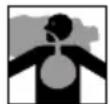
Do not start the machine in a room or enclosure. The exhaust fumes from the fuel and chain oil contain carbon monoxide and harmful chemicals. In the case of a concentration of gases produced by insufficient ventilation, remove from workspace all the that prevents the flow of clean air to improve ventilation and do not return to work in the area unless you have properly ventilated the area and are sure that the ventilation is sufficient as to not happen again this concentration.
Never leave this machine unattended.
Be careful when cutting thin branches or shrubs. Thin branches can become entangled in the chain and be fired suddenly hitting you and making you lose balance.
If you cut a limb that is under tension be alert for possible rebound of the branch when you make the cut.
Check the state of the tree to avoid dry branches may fall to hitting you while you cut.
While you cut do not let the tip of the saw touch a trunk or obstacle.
Cut at all times with the chainsaw to maximum regime.
Always keep a well sharpened chain. Sharpen it as described in this manual.

Be careful not to touch the hot parts of the machine while the engine is running or after use, for example the exhaust, spark plug or high voltage cables.
Always readjust the machine on a stable and flat surface.
Do not use accessories for this machine except those recommended and approved by our company as such use could cause severe damage to the user, people close to the machine, and the machine itself.
Never drop the machine and never attempt to stop the chain by bringing it closer to wood or obstacle.
7.1. HOLDING THE MACHINE AND GUIDANCE
natural_image
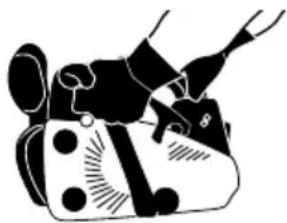
Silhouette of a person using a handheld device to lift a vehicle (no text or symbols visible)While working, always hold the chainsaw with both hands firmly on the handles. Hold the back with your right hand and the front handle with your left
hand whether you are right-handed or left-handed.
Warning!: In order to reduce the risk of loss of control and possible damage (even fatal) to the user or people near, never use the chainsaw with one hand (except in some cases in which perform pruning of trees with rope and harness) or make cuts that have to raise the chainsaw above shoulder height.
7.2. CUTTING WITH THE CHAINSAW
It is recommended that you practice with small branches in a position that makes it easy to acquire experience before tackling more complicated cuts.
Always follow the safety rules given in this manual.
Use this machine only for cutting wood. It is forbidden to cut any material.
Do not use the machine to move objects.
Use the machine gently while cutting. Only use a slight downward pressure while maintaining the machine at full power. The own weight of the machine will be enough to make the cut.
If the chain blocks, do not attempt to pull the chainsaw while it is running. Stop the chainsaw by setting the switch to "O" and use a wedge to release the chainsaw.
7.3. FELLING A TREE
Felling a tree is dangerous because of the risk of the tree or any of its branches falling on the user.
Before tackling the task, follow these steps:
- Decide the direction the tree will fall (A). Note the inclination of the tree, the length of its branches and remember that they may change direction in the fall.
- Make sure there are no other trees, branches or obstacles that may hit the tree as it falls.
- Check which will be the final position of the tree to be cut.
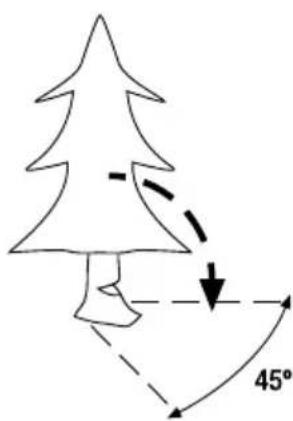
text_image
45°-
Clear the area around the drop zone, make sure that you can work in a stable position and set an easy getaway that allows you to run away in case the tree does not fall in the expected direction. The safety distance must be at least twice the height of the tree.
-
Perform an initial limbing. Start with the lower branches that may make it difficult to work. Remember that you should not cut branches that over shoulder height.
- To guide the fall of the tree make a cut Guide (B). To make this guiding cut, cut at a 60 degree angle up to the width of the tree ( 14 d) quarter by the side of the direction in which want tree to fall (E) and then a cut of 35^ that reaches until the end of the cutting 60^ so that you get a discharge at 90^ as shown in the following figure.
Recommendation: Before moving on to the next stage, fill in fuel and oil deposits of the saw to avoid the machine stopping unexpectedly in the following operations:
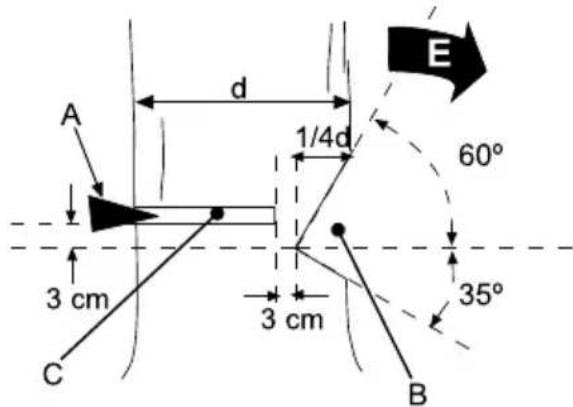
text_image
A 3 cm C d 1/4d 3 cm B E 60° 35°- Start a horizontal cut (C) on the opposite side, 3 cm above the inside of the cutting angle Guide (B).
- When you have cut a 14 of the tree's diameter, stop cutting and insert a wedge at the beginning of the cut to prevent axle tilt in the opposite desired direction, the cut is closed and the chainsaw rod is pinched.
-
Continue cutting (C) until you reach about 3 cm of the cutting Guide. We will never cut to the guide cut in order to leave a bit of wood that will take the role of a hinge and will lead to the fall of the tree in the right direction.
-
The tree will fall in the "E" direction.
If the tree does not fall, force the fall by introducing more wedge into the tree.
In the moment that the tree begins to fall, move away in a sideways and backwards direction with regard to the direction of the fall of the tree until it is at a safe distance (distance greater than the height of the tree being cut).
It is essential to move away from the tree falling because at moment the tree starts to hit the ground, free flying branches (or parts of them) are split backwards and sideways and hit or cut the user.
When you are going to bring a tree down always notify all persons who are around before starting and again just before the end of the horizontal cut and the tree starts to fall.
Always be sure to be in a stable position and never lean against the tree that is about to fall.
If you work on a slope stay at the top to prevent the falling of the tree rolling toward you and hitting you.

Follow all of the "safety and precaution rules" to prevent possible bouncing of the chainsaw.
7.4. CUTTING A TRUNK PLACED ON THE GROUND
When a trunk is fully supported on the ground, cut the first half of the trunk from above, then turn it halfway around and cut the rest.
If the trunk is supported at the sides (see next diagram) you must make a cut through the top half (1) and then cut the rest from the bottom (2).
By doing it this way, you will avoid the internal tension of the trunk closing the cut, thus blocking the chainsaw's chain and rod.
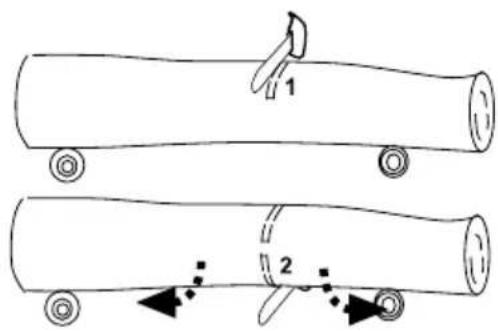
text_image
Diagram showing two cylindrical objects with labeled parts and directional arrows indicating movement or forceIf you are going to make a cut in a log supported on one end (diagram below) you shall proceed in reverse. First cut the half of the trunk from below (1) and then finish the cut from the top (2).
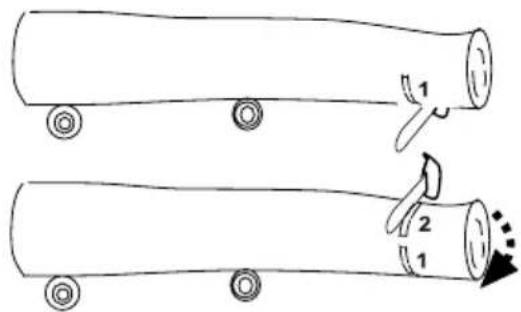
text_image
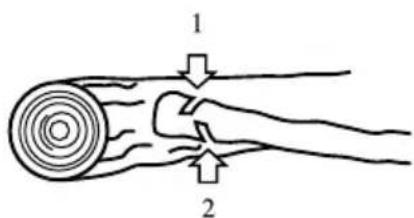
Diagram showing two cylindrical objects with labeled parts and directional arrows indicating movement or force7.5. CUTTING THE BRANCHES OF A FELLED TREE
It is important to verify that the branches are not folded and/or tensed. If the branch to be cut is folded or tensed, it could fly out at you when being cut.
text_image
1 2To cut a branch, in this case, cut the branch a 14 of the total of the branch on the side in which the branch
is subject to compression, and then cut the rest of the branch from the side that is subjected to traction (follows). In this way it will prevent branch tension to close cutting and block the chainsaw rod and chain.
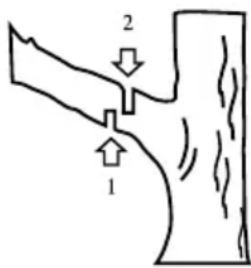
7.6. CUTTING A TREE BRANCH
To cut a branch from a tree which does not touch the ground, always start with a quarter the diameter of the branch cut from below (1) and then cut the rest from above (2).
text_image
2 1This way you will facilitate the opening of cutting and splitting the branch without damaging the tree.
7.7. PRUNING TREES AT A HEIGHT
7.7.1. GENERAL REQUIREMENTS
The operators that work with this chainsaw to prune of trees in height should do so with a rope, harness, and never work alone. There must always be a qualified second worker on the ground in the event of an emergency and rescue procedures. Between the two people always there must be visual and verbal contact.
The operators that work with this chainsaw in the pruning of trees should receive training concerning safe climbing, safe positioning techniques and be equipped with harnesses, ropes, carabineers, fastening straps and other equipment to ensure that they are kept in safe work positions for both operators and chainsaw.
In the working area there must be an additional set of climbing equipment to facilitate the rescue and help the operator in case of emergency.
7.7.2. PREPARING THE SAW FOR USE ON THE TREE
The operator on the ground is the person responsible for checking, refilling fuel and oil, starting, heating the chainsaw and then switching it off before handing it to the operator who is in the tree.
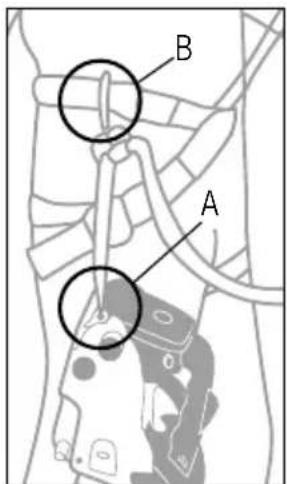
Once the chainsaw is heated, the operator on the ground will switch off the chainsaw, hook a chainsaw sling such as the one seen below in point A in the anchor point of the saw, using a locking carabiner and will then hook a rope to point C to hoist the chainsaw by a second carabiner.
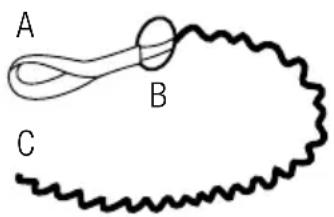
text_image
A B CThe operator, from a stable and secure position in the tree, will hoist the chainsaw by pulling the cord. Once the operator has the chainsaw, he will hook the harness through the ring (B) and verify that the chainsaw is firmly attached to the harness.
It will then release the rope used to hoist the machine and hook the end (C) to his safety harness.
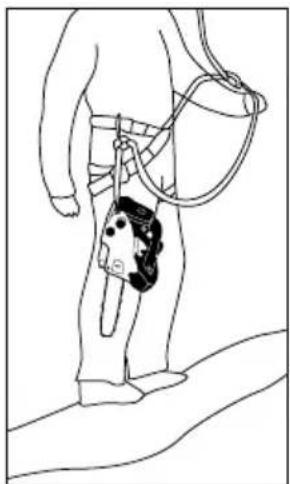
Secure the chainsaw only to recommended attachment points of the harness. These can be in the Centre (front and back) or to edges. Wherever possible, the saw in the rear focal point will engage to move the chainsaw away from the lines of ascent and so that the weight of this applies centrally below the operator's spine.
natural_image
Line drawing of a person wearing a harness and holding a device (no text or symbols)When moving the chainsaw from one attachment point to another, the operator must ensure that the chainsaw is securely tightened at the new position before loosening it from the previous attachment point.
text_image
B A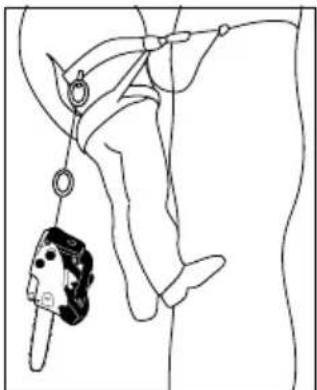
natural_image
Anatomical line drawing of a human hip joint with medical devices and a catheter (no text or labels)7.7.3. USE OF THE CHAINSAW IN THE TREE
Most of the accidents in the pruning height occur because the operator fails to take a safe position allowing him to use the saw with both hands. Using the chainsaw with one hand involves:
- That the chainsaw is not firmly seized in event of a kickback.
- That is more difficult to handle the chainsaw so it is more likely that it comes into contact with the ascent lines, security and attachment cords, and the body of the operator (particularly with the left hand and arm).
- Increases the loss of control due to an unsafe working position that results in the contact of the moving chainsaw with the branch to be cut.
As a general rule you should get a firm footing in order to use the machine with both hands. In order to do so, the operator should seek a safe position in which to work with the chainsaw at hip level (when cutting horizontal sections) or at the solar plexus level (when cutting vertical sections).
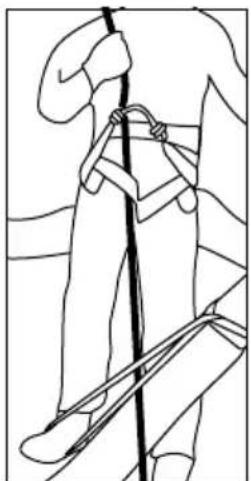
If the operator is working near vertical stems where there are small lateral forces in the working position, then a good positioning of the feet is enough to get a firm footing. However, as the operator moves away from the vertical stem he will need to step to eliminate or counteract the lateral forces, thus modifying the main ascent route through an additional anchor or through the use of an adjustable safety cord hooked from an additional anchor point.
natural_image
Line drawing of a person wearing safety harness and rope, holding a pole (no text or symbols)The operator can also get a good positioning of the feet in the working position by means of a temporary abutment formed from a sling without end.
7.7.3.4. USING THE CHAINSAW WITH ONE HAND
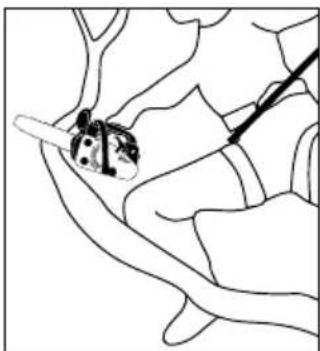
Only when it is impossible for the operator to cut from a stable position using both hands, you can maintain a working position by leaning on one hand. Use the saw with the fully outstretched arm and make sure the arm is
natural_image
Anatomical line drawing of a human head and neck region with a surgical instrument inserted (no text or labels)at a right angle to the line of the body so you can cut with one hand.
The operator should never:
- Cut with the tip of the rod (risk of Kickback).
- Hold a section of wood while performing the cut of that same section.
- Try to grab sections that will fall.
7.7.3.5. RELEASE OF A JAMMED CHAINSAW
If the saw gets stuck during the cutting process, the operator must:
- Switch off the chainsaw.
- Hold the chainsaw in the place where it is stuck with a rope that will hook to a separate line of the branch where the stuck chainsaw, or to the same branch but to the part of the inner branch to cut (the part of the branch between the incision and the main trunk).
-
Pull the saw out of the incision while the cut is opened by pushing the branch.
-
If you are unable to release the chainsaw by pulling it, make a cut 30 cm away from the cut in which the chainsaw is trapped on the outside of the branch (the part of the branch that will no longer be in the tree when the cut is made) in order to free some weight in the cut and that the cut opens. Never perform this cut on the inside of the branch since chainsaw could fall with the cut piece of branch, thus endangering the operator, the operator on the ground, the chainsaw and rest of team.
8. MAINTENANCE AND SERVICE
It is necessary to always turn off the engine and check that the cutting tool is stopped before cleaning, transporting, or modifying the cutting tool. Before performing any maintenance or repair on the machine make sure that the engine has stopped and remove the spark plug pipe.
⚠ WARNING! Do not modify the machine or cutters. Improper use of these elements can cause serious personal damage or death.
Keep the machine clean, especially the area of the fuel tank and areas close to the air filter.
Do not ever attempt to perform adjustments on the machine if it is running. Perform all machine maintenance with it on a cleared, flat surface.
Use only suitable replacement for this machine in order to obtain a proper performance of the machine. This replacement can be found in the official distributors of the machine. The use of other spare parts can cause risks, damage to the user, people around and the machine.
Do not adjust the carburetor. If necessary, take your machine in for service. Carburetor adjustment is complicated, and only the technical maintenance service must do them.
⚠️ Incorrectly setting the carburetor may cause damage to the engine and will be cause for cancellation of the warranty.
Removing the security devices, improper maintenance, or replacing the rod or chain with non-original spare parts can cause injury.
8.1. MAINTENANCE AND CARE AFTER USING THE MACHINE
Perform the following maintenance operations and care when you have finished working with the machine to ensure the smooth running of this machine in the future.
8.1.1. EXIT OF THE CHAIN OIL
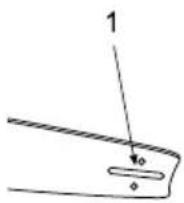
Remove the rod and check that the lubrication (1) hole is not blocked.
8.1.2. SHARPENING THE CHAIN'S CUTTING TEETH
⚠ WARNING! An improperly sharpened chain increases the risk of rebound of the chainsaw, the vibrations increasing the risk of accident!.
In order to make sure the chainsaw cuts correctly and safely, maintain sharp cutting teeth.
In addition, the cutting teeth should be sharpened if:
- You have to use more effort than usual to cut.
- The cutting path is not straight.
- Vibrations increase.
- Fuel consumption increases.
- When cutting, sawdust occurs instead of wood chips.
⚠ Be sure to wear safety gloves when you are sharpening the chain.
Make sure the saw of the chainsaw is secured when you sharpen the chain.
⚠️ Make sure that the motor is off when sharpening the chain.
Use a special chain file suitable for your chainsaws' chains.
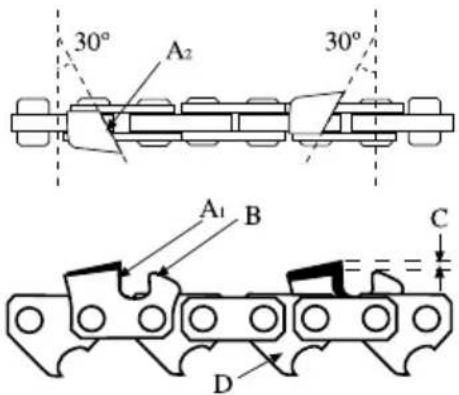
Position the file on the cutting edge of the tooth cut between paragraphs (A) and (B) and push forward while maintaining a 30^ angle.
text_image
30° A₂ 30° A₁ B C DPerform sharpening of all teeth on one side always honing with outward movements and keeping the 30^ angle. When you finish, change sides and perform the same operation.
Check the safety height (C), this height has to be 0, 6mm approximately. An overly high height (C) will cause the chain to "bite" requiring too much effort for the motor and a small height will not allow the chain to cut.
Check the length of the cutting teeth. All teeth must be kept the same length. If necessary, file the lengths of teeth until they are all identical.
8.2. PERIODIC MAINTENANCE
⚠ Perform regular inspections of the machine in order to ensure effective operation of the machine.
For a complete service check, we recommend taking the machine to your service technician.
Keep the machine clean, especially the areas close to the fuel tank and the air filter area.
Before carrying out maintenance or repairs on the machine make sure that the machine is off and the spark plug pipe disconnected.
Always use the right replacement parts in order to obtain proper performance of the product and avoid damage and risks to machine and user. Replacement parts should be purchased at the service dealer. The use of non-official spare parts may cause risk of accident, injury to the user and breaking of the machine.
Perform the following maintenance at the frequency indicated in the following table:
| Operation | Each 2 fuel tank refills | Each 10 fuel tank refills | Once a year |
| Air filter • | |||
| Fuel filter • | |||
| Oil filter • | |||
| Spark plug • | |||
| Cilinder fins • | |||
| Chain rod • |
8.2.1. AIR FILTER
The dirt in the air cleaner will cause a reduction in the performance of the machine. Check and clean this element. If you notice damage or alterations to the filter, replace it with a new one.
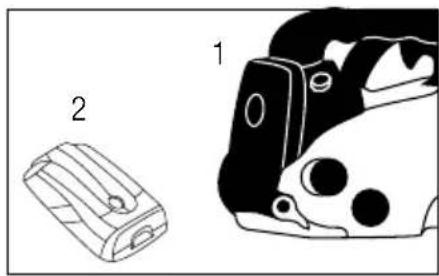
To clean the filter, remove the protective cap (1) and remove the filter (2).
natural_image
Technical illustration of a battery pack and its internal components (no text or symbols)Dust from the outside of the filter can be cleaned by shaking it against a hard surface.
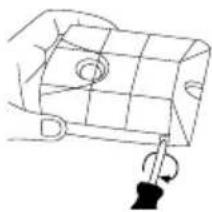
To clean the dirt that is on the inside of the filter, separate the two parts of the filter using a screwdriver as shown in figure.
natural_image
Simple line drawing of a mechanical component with a handle and circular features (no text or symbols)8.2.2. FUEL FILTER
The fuel tank is equipped with a filter (1). It is located at the end of the fuel suction pipe and can be removed with the help of a wire hook.
natural_image
Abstract black-and-white illustration of a stylized animal face with no text or symbolsPeriodically check the fuel filter. Do not allow dirt in the fuel tank to avoid that the filter getting dirty. A dirty filter will produce difficulties in starting the engine and operation anomalies or stopping of the machine.
Check the fuel. If you see dirt, replace it.
If the inside of the fuel tank is dirty you can clean it with petrol.
8.2.3. OIL FILTER
The oil tank is equipped with a filter (2). This can be found in the end of the oil suction pipe and can be removed with the help of a hook-shaped wire. Periodically
natural_image
Illustration of a stylized frog head with visible legs, antennae, and body structure (no text or symbols)check the oil filter. Do not allow there to be any dirt in the oil tank to avoid the filter being dirty.
A dirty filter can block the passage of lubricating oil and will result in excessive wear of the chain and the chainsaw rod.
Check the oil. If you see dirt, replace it.
If the inside of the oil tank is dirty you can clean it with petrol.
8.2.4 CHECKING THE SPARK PLUG
To access the spark plug, you will need to remove the air filter cover. The spark plug is located under the air filter (1).
When it comes to starting a machine, the most common problems are produced by a dirty spark plug or one in poor condition. Clean and check the spark plug regularly.
Check that the electrode gap is correct (0.6 - 0.7 mm).
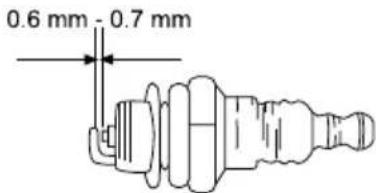
text_image
0.6 mm - 0.7 mm8.2.5. CLEANING THE CYLINDER FINS
The cylinder fins are responsible for the cooling of the engine due to its contact with the air. These fins must be clean and without any material including those that limit the flow of air.
A few dirty fins will make the motor to overheat and can be dangerous. Check the condition of the cylinder fins regularly.
8.2.6. MAINTANENCE OF THE ROD'S CHAIN
Reverse the chainsaw rod whenever you filled the fuel tank 10 times to prevent it from wearing only on one side.
The rod's guide must always maintain its profile. Make sure that the thickness is the same all along the length of the rod. Replace the rod if necessary.
Check that cracks and the level of play of the bearing there are no. If you notice that the clearance is important, any damage or cracks replace it.
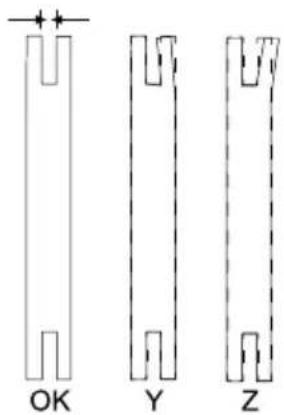
text_image
OK Y ZWhen you remove the rod, also take a moment to remove the any possible wood and sawdust remains in the guide's hole and lubrication area.
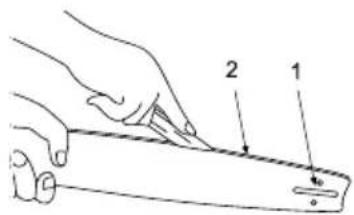
text_image
Diagram showing a hand holding a ruler with labeled parts 1 and 2, indicating measurement or labeling.9. TROUBLE SHOOTING
If the engine does not start, check the engine compression and whether the spark plug gives sparks. Depending on the symptoms, we provide you with a series of probable causes and the solutions:
| Compression pressure is normal | The spark from the spark plug is normal | Probable cause | Corrective action |
| Yes | Yes | There is no fuel in the tank | Put fuel in the tank |
| Fuel filter obstructed, lack of fuel | Clean the fuel filter | ||
| There is water in the fuel | Replace the fuel | ||
| The fuel is unsuitable octane | Use petrol with the suitable octane | ||
| The carburetor is dirty | Take the tool to the customer service | ||
| Yes | NO | Switch is OFF | Poner el interruptor en “I” |
| The spark plug is dirty | Clean the spark plug | ||
| The ignition coil is not connected | Connect it | ||
| Lack of compression pressure | SI | Weakness from the spark plug | Tighten it |
| Worn out piston, junk ring and cylinder | Take the tool to the customer service | ||
| The cylinder is scratched | Take the tool to the customer service | ||
| The engine stops | The engine has seized up | Take the tool to the customer service |
If the engine does not work well (lack of power, low revolutions, unstable idling, etc.) we provide a series of symptoms, the probable cause and the solution:
| Symptom | Probable cause | Corrective action |
| The engine makes a rattling noise | Worn out piston, junk ring, cylinder | Take the tool to the customer service |
| Worn out piston pin, piston | Take the tool to the customer service | |
| Holgura de cigüeñal | Take the tool to the customer service | |
| The clutch is loose | Take the tool to the customer service | |
| The engine overheats | Excess of continuous use | Avoid using the machine during prolonged periods of times, at high speed or with a heavy load |
| Dirty exhaust | Take the tool to the customer service | |
| The fuel is unsuitable | Use petrol with the suitable octane | |
| The engine takes time to increase the revolutions | The carburetor is dirty | Take the tool to the customer service |
| The air filter is dirty | Clean the filter | |
| Fuel filter obstructed, lack of fuel | Clean the filter | |
| The engine stops and cannot be left idling | The throttle regulating screw is badly adjusted | Take the tool to the customer service |
10. TRANSPORT
It is necessary to always turn off the engine when transporting the machine between different working areas.
Once the machine is turned off, wait 5 minutes to allow it to cool before transporting it. Always transport the machine with the engine switched off and the protection of the installed roof.
To transport the chainsaw, hold the front handle with the machine off, chain and sword covered with lid and making sure it is not touching any part of the body.
Handling the chainsaw properly will reduce the likelihood unintentional contact with the chain of the chainsaw.
If you are transporting the chainsaw in vehicles, secure it firmly to prevent it from slipping or tipping over.
11. STORAGE
Once the machine is off, wait 5 minutes for it to cool down before storing the machine.
The machine's exhaust pipe will remain hot after turning the engine off. Do not ever store the machine in places near flammable materials (dried grass or wood...), gas or fuels.
Be sure to store the machine in a place not accessible to children.
Always put the chain guard and rod guard when storing the machine.
If you plan to store the machine in a closed place, first empty the fuel and oil deposits since fumes could come into contact with a flame or hot body and ignite.
If you are storing the machine for a long period of time empty the fuel and oil tanks, clean all parts of the machine and store the machine in a safe and dry place. Make sure that the engine is cool before storing the machine.
The machine's exhaust pipe will remain hot after turning the engine off. Do not ever store the machine in places near flammable materials (dried grass or wood...), gas or fuels.
12. RECYCLING OR DISPOSAL OF YOUR MACHINE
Protect the Environment. Recycle used oil by this machine and take it to a recycling or follow local recommendations. Do not empty into drains, soil, rivers, lakes or seas.
Dispose of your machine in an ecological manner. We should not get rid of the machine with our domestic rubbish. Its

plastic and metal components can be reclassified and can be recycled
13. WARRANTY CONDITIONS
13.1. WARRANTY PERIOD
- According to the following described terms (1999/44 CE) the warranty period is 2 years from the purchase date, and it will cover faulty pieces owing to an incorrect manufacture.
13.2. EXCLUSIONS
Garland warranty will not cover:
- Pieces worn out due to wear and tear.
- Bad use, negligence, lack of maintenance.
- Failures that turn out because of an incorrect use of the product, Garland will not be responsible if the replaced parts of the machine are not from Garland and if the machine has been modified in any way.
13.3. TERRITORY
- Garland warranty covers the country.
13.4. IN CASE OF INCIDENCE
- The warranty should be correctly filled in with all the information requested, and the invoice or the purchase ticket should be attached.
WARNING!
TO GUARANTEE THE CORRECT FUNCTIONING OF THE MACHINE AND MAXIMUM SECURITY, WE ASK YOU TO READ THE INSTRUCTION MANUAL FULLY AND CAREFULLY PRIOR TO USING THE MACHINE.
DECLARATION OF CONFORMITY (CE)
Who has signed below, Lisardo Carballal, authorised by Productos McLand S.L., with the following address C/ La Fragua 22, 28932, Móstoles, España, declares that the products brand Garland models Montana 110 (YD25) with serial number of year 2014 on (the year of manufacture is clearly indicated on the tool identification plate, followed the serial number) and whose function is “A powered machine appropriate to clear lawns, paths, ways, streets, etc. of leaves and other material by means of a high velocity air flow.”, comply with all the requirements stated by the Directive 2006/42/EC of the European Parliament and of the Council of 17 May 2006 on machinery, and amending Directive 95/16/EC.
These tools also comply with the requirements of the following community directives:
- Directive 2004/108/EC of the European Parliament and of the Council of 15 December 2004 on the approximation of the laws of the Member States relating to electromagnetic compatibility and repealing Directive 89/336/EEC.
- Directive 2000/14/EC of the European Parliament and of the Council of 8 May 2000 on the approximation of the laws of the Member States relating to the noise emission in the environment by equipment for use outdoors.
The examinations of the European Community Directives have been carried out by the following notified bodies whose Certificate numbers figure below:
- 2006/42/EC, , Certificate number: BM 50230858
- TÜV Rheiland
- Harmonized Standard: EN ISO 11681-1:2008
| Power (kW) ISO 7293 0,8 | |
| A-weighted sound power level LwA (dB(A)) ISO 22868 109.67 | |
| Guaranteed sound power level dB(A) (k= 1.37) 111 |
Lisardo Carballal
Product Manager
Móstoles 11-12-2014
NOTES
TABLE DE MATIERES
natural_image
Illustration showing a person at a desk and another person standing on a bench with arms extended (no text or symbols)6. INDICATIONS POUR LA MISE EN SERVICE
6.1. DESASEMBLAGE ET LISTE DE MATERIELS
natural_image
Illustration of a chain-linking gear with tools and a separate bar (no text or symbols)text_image
Diagram illustrating a shoe being opened with a tool, showing step 1 and step 2 of the process.natural_image
Diagram of a car's front and side view with labeled parts (no readable text or symbols)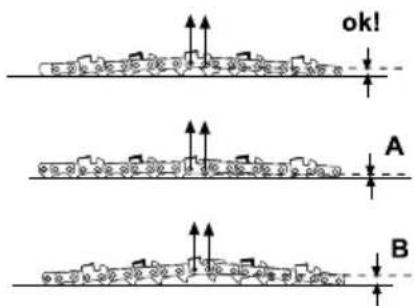
text_image
ok! A Bnatural_image
Illustration of a hand holding a bag with a circular arrow indicating rotation (no text or symbols)natural_image
Illustration of a person using a saw to cut a tree stump with an arrow indicating the process (no text or symbols present)natural_image
Line drawing of a hand using a tool to adjust or install a mechanical component (no text or symbols present)natural_image
Line drawing of a chain saw with motion arrows indicating speed (no text or symbols)text_image
Diagram of a mechanical device with labeled parts 1, 2, and 3, showing a knob and adjustment mechanism.natural_image
Illustration of a hand gripping a small object with no visible text or symbolstext_image
Diagram showing two cylindrical objects with labeled parts and directional arrows indicating movement or forcetext_image
Diagram showing two cylindrical objects with labeled parts and directional arrows indicating movement or force7.5. COUPE DES BRANCHES D'UN ARBRE ABATTU
natural_image
Line drawing of a person wearing a harness and holding a medical device (no text or symbols)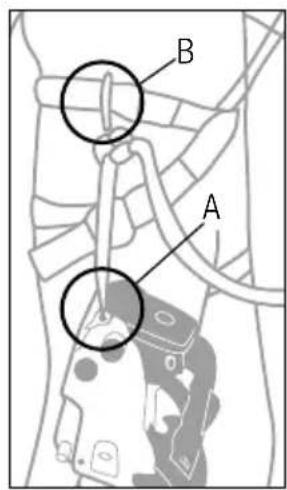
text_image
B Anatural_image
Line drawing of a human torso with attached medical devices (no text or symbols)natural_image
Line drawing of a person wearing a harness and safety harness, holding a rope (no text or symbols)natural_image
Anatomical line drawing of a human upper body with a small insect, likely an insect, showing no text or labels.natural_image
Technical illustration of a battery pack and its internal components (no text or symbols)natural_image
Simple line drawing of a mechanical component with a handle and circular features (no text or symbols)natural_image
Abstract black-and-white illustration of a stylized object with circular elements and a central figure, no text or symbols present.natural_image
Illustration of a stylized object resembling a device or tool with no visible text or symbolstext_image
Diagram showing a hand holding a tool with labeled parts 1 and 2, likely illustrating a precision or measurement procedure.9. RESOLUTION DES PANNES
natural_image
Illustration showing a person sitting at a desk and another person standing with arms crossed, no text or symbols present.natural_image
Illustration of mechanical tools including chains, screwdrivers, and a gear (no text or symbols)natural_image
Illustration of a bag with decorative patterns and a curved arrow indicating rotation (no text or symbols)natural_image
Illustration of a stylized bag with decorative patterns and a curved arrow (no text or symbols)natural_image
Illustration of a person using a power saw to lift a tree stump (no text or symbols)natural_image
Line drawing of a mechanical device with hands operating it (no text or symbols)natural_image
Line drawing of a chain-linker with motion arrow indicating speed (no text or symbols)text_image
Technical diagram of a mechanical device with labeled parts and directional arrows indicating motion or assembly.natural_image
Illustration of a hand pressing down on a mechanical device (no text or symbols visible)7.2. TAGLIO
text_image
Diagram showing two cylindrical objects with labeled parts and directional arrows indicating movement or forcetext_image
Diagram showing two cylindrical objects with labeled parts and directional arrows indicating motion or movement.7.5. TAGLIO DEI RAMI DI UN ALBERO ABBATTUTO
text_image
One non-toothed 1 2natural_image
Line drawing of a human body with an attached medical device (no text or symbols)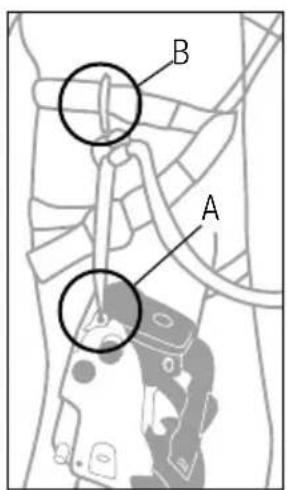
text_image
B Anatural_image
Anatomical line drawing of a human hip joint with a medical device attached (no text or labels)7.7.3. UTILIZZO DELLA MOTOSEGA SU DI UN ALBERO
natural_image
Line drawing of a person wearing a harness and safety harness, holding a rope (no text or symbols)natural_image
Anatomical line drawing of a human head and neck region with a small insect, no text or labels present.natural_image
Technical illustration of a mechanical component with two labeled parts (1 and 2), no visible text or symbols beyond labels.natural_image
Hand holding a 3D grid object with a screwdriver inserted, no visible text or symbolsnatural_image
Abstract black-and-white illustration of a stylized object with circular elements and a central figure, no text or symbols present.natural_image
Illustration of a stylized hat with decorative elements and a label '2' (no text or symbols on the hat itself)text_image
Diagram showing a hand holding a ruler with labeled parts 1 and 2, indicating measurement or alignment.natural_image
Illustration showing a person sitting at a desk and another person standing with arms crossed, no text or symbols present.natural_image
Illustration of various household items including a handbag, a shoe, and tools (no text or symbols)text_image
Diagram illustrating a sewing process with labeled steps 1 and 2, showing fabric or material deformation.natural_image
Diagram of a car's front and side view showing the number 0 and number 7, with no readable text or symbols.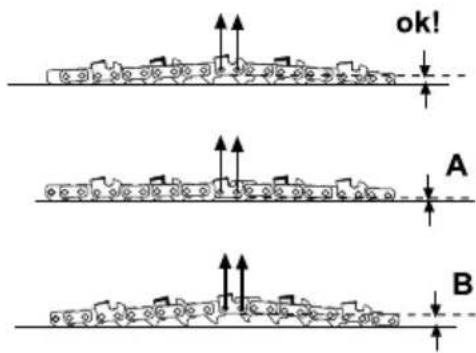
text_image
ok! A Bnatural_image
Illustration of a person using a chainsaw to cut tree stump with arrows indicating force (no text or symbols)natural_image
Line drawing of a hand holding a device with black and white components, no text or symbols presentnatural_image
Line drawing of a chainocenter with motion arrow indicating impact (no text or symbols)text_image
Technical diagram of a mechanical device with numbered components and directional arrows indicating motion or assembly.natural_image
Illustration of a hand holding a small object with patterned legs, possibly a dog or abstract shape (no text or symbols)text_image
Diagram showing two cylindrical objects with labeled parts, including a hand holding a tool and directional arrows indicating movement or force.text_image
Diagram showing two cylindrical objects with labeled parts and directional arrows indicating movement or force.7.5. CORTE DOS RAMOS DE UMA ÁRVORE CAÍDA
natural_image
Line drawing of a human figure wearing a harness and holding a device (no text or symbols)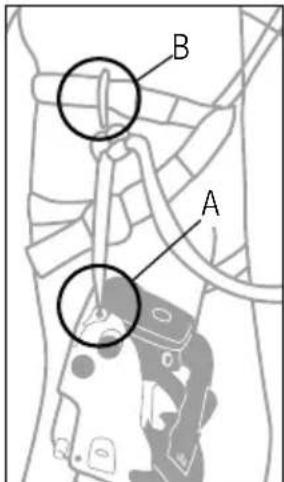
text_image
B Anatural_image
Line drawing of a human leg with attached medical device (no text or symbols)7.7.3. USO DA MOTOSERRA SOBRE A ÁRVORE
natural_image
Line drawing of a person climbing a rope using a harness (no text or symbols)natural_image
Anatomical line drawing of a human head and neck region, showing internal structures without any text or labels.natural_image
Technical illustration of a battery pack and its internal components (no text or symbols)natural_image
Simple line drawing of a hand holding a grid object with a screwdriver inserted (no text or symbols)natural_image
Abstract black-and-white illustration of a stylized figure inside a curved shape, with no visible text or symbols.natural_image
Illustration of a stylized animal head with abstract patterns and a numbered label (2), no readable text or symbols present.text_image
Diagram showing a hand holding a tool with labeled parts 1 and 2, likely illustrating a measurement or labeling process.Is this your first toll of this type?
SEE YOUR SERVICE MANUAL
FOR FULL WARRANTY DETAILS
PARA INFORMAÇÕES DETALHADAS SOBRE GARANTIAS
É FAVOR CONSULTAR O MANUAL QUE ACOMPANHA A MÁQUINA
LIRE LA NOTICE POUR LES DÉTAILS
SUR LA GARANTIE
TIPO DE MÁQUINA
TYPE OF MACHINE
TYPO DE MAQUINA
TYPE DE MACHINE
MODELO
MODEL
MODELO
MODÈLE
FECHA DE COMPRA
DATE OF PURCHASE
DATA DE COMPRA
DATE D'ACHAT
DISTRIBUIDOR
DEALER
REVENDEDOR
DISTRIBUTEUR