63070 K - Cooker AEG-ELECTROLUX - Free user manual and instructions
Find the device manual for free 63070 K AEG-ELECTROLUX in PDF.


Frequently Asked Questions - 63070 K AEG-ELECTROLUX
User questions about 63070 K AEG-ELECTROLUX
0 question about this device. Answer the ones you know or ask your own.
Ask a new question about this device
Download the instructions for your Cooker in PDF format for free! Find your manual 63070 K - AEG-ELECTROLUX and take your electronic device back in hand. On this page are published all the documents necessary for the use of your device. 63070 K by AEG-ELECTROLUX.
USER MANUAL 63070 K AEG-ELECTROLUX
Ceramic glass induction
hob
Table de cuisson
vetroceramique a
induction
Glaskeramische
inductie-kookplaat
Thank you for choosing one of our high-quality products.
To ensure optimal and regular performance of your appliance please read this instruction manual carefully. It will enable you to navigate all processes perfectly and most efficiently.
To refer to this manual any time you need to, we recommend you to keep it in a safe place. And please pass it to any future owner of the appliance.
We wish you much joy with your new appliance.
Contents
Operating Instructions 3
Safety instructions 3
Description of the Appliance 4
Cooking surface layout 4
Control panel layout 5
Operating the appliance 6
Setting the heat setting 6
Switching the power function on and off 6
Using the child safety device 7
Automatic cut-out 7
Tips on Cooking and Frying 8
| Cookware for induction cooking zones 8 | |
| Tips on energy saving 9 | |
| Examples of cooking applications | 9 |
| Cleaning and Care | 10 |
| What to do if ... | 11 |
| Disposal | 13 |
| Installation Instructions | 14 |
| Service | 15 |
| Assembly | 48 |
| Rating Plate | 51 |
The following symbols are used in this user information:

Warning! This must be read! Important advice for the safety of persons and information on avoiding damage to the appliance

General information and advice

Information on environmental protection

Dangerous voltage
Operating Instructions
!Safety instructions
Please comply with these instructions. If you do not, any damage resulting is not covered by the warranty.
Correct use
- This appliance is not intended for use by children or other persons whose physical, sensory or mental capabilities or lack of experience and knowledge prevents them from using the appliance safely without supervision or instruction by a responsible person to ensure that they can use the appliance safely.
- Do not leave the appliance unattended during operation.
- This appliance should be used only for normal domestic cooking and frying of food.
- The appliance must not be used as a work surface or as a storage surface.
- Additions or modifications to the appliance are not permitted.
- Do not place or store flammable liquids, highly inflammable materials or fusible objects (e.g. plastic film, plastic, aluminium) on or near the appliance.
Children's safety
- Small children must be kept away from the appliance.
- Only let bigger children work on the appliance under supervision.
- To avoid small children and pets unintentionally switching the appliance on, we recommend activation of the child safety device.
General safety
- The appliance may only be installed and connected by trained, registered service engineers.
- Built-in appliances may only be used after they have built in to suitable built-in units and work surfaces that meet standards.
- In the event of faults with the appliance or damage to the glass ceramic (cracks, scratches or splits), the appliance must be switched off and disconnected from the electrical supply, to prevent the possibility of an electric shock.
- Repairs to the appliance must only be carried out by trained registered service engineers.
Safety during use
- Remove stickers and film from the glass ceramic.
- There is the risk of burns from the appliance if used carelessly.
- Cables from electrical appliances must not touch the hot surface of the appliance or hot cookware.
Overheated fats and oils can ignite very quickly. Warning! Fire hazard! - Switch the cooking zones off after each use.
-
Users with implanted pacemakers should keep their upper body at least 30~cm from induction cooking zones that are switched on.
-
Risk of burns! Do not place objects made of metal, such as knives, forks, spoons and saucepan lids on the cooking surface, as they can get hot.
Safety when cleaning
- For cleaning, the appliance must be switched off and cooled down.
- For safety reasons, the cleaning of the appliance with steam jet or high-pressure cleaning equipment is not permitted.
How to avoid damage to the appliance
- The glass ceramic can be damaged by objects falling onto it.
The edge of the glass ceramic can be damaged by being knocked by the cookware. - Cookware made of cast iron, cast aluminium or with damaged bottoms can scratch the glass ceramic if pushed across the surface.
- Objects that melt and things that boil over can burn onto the glass ceramic and should be removed straightaway.
- Do not use the cooking zones with empty cookware or without cookware.
- To avoid damaging cookware and glass ceramics, do not allow saucepans or frying pans to boil dry.
- The ventilation gap of 5mm between the worktop and front of the unit underneath it must not be covered.
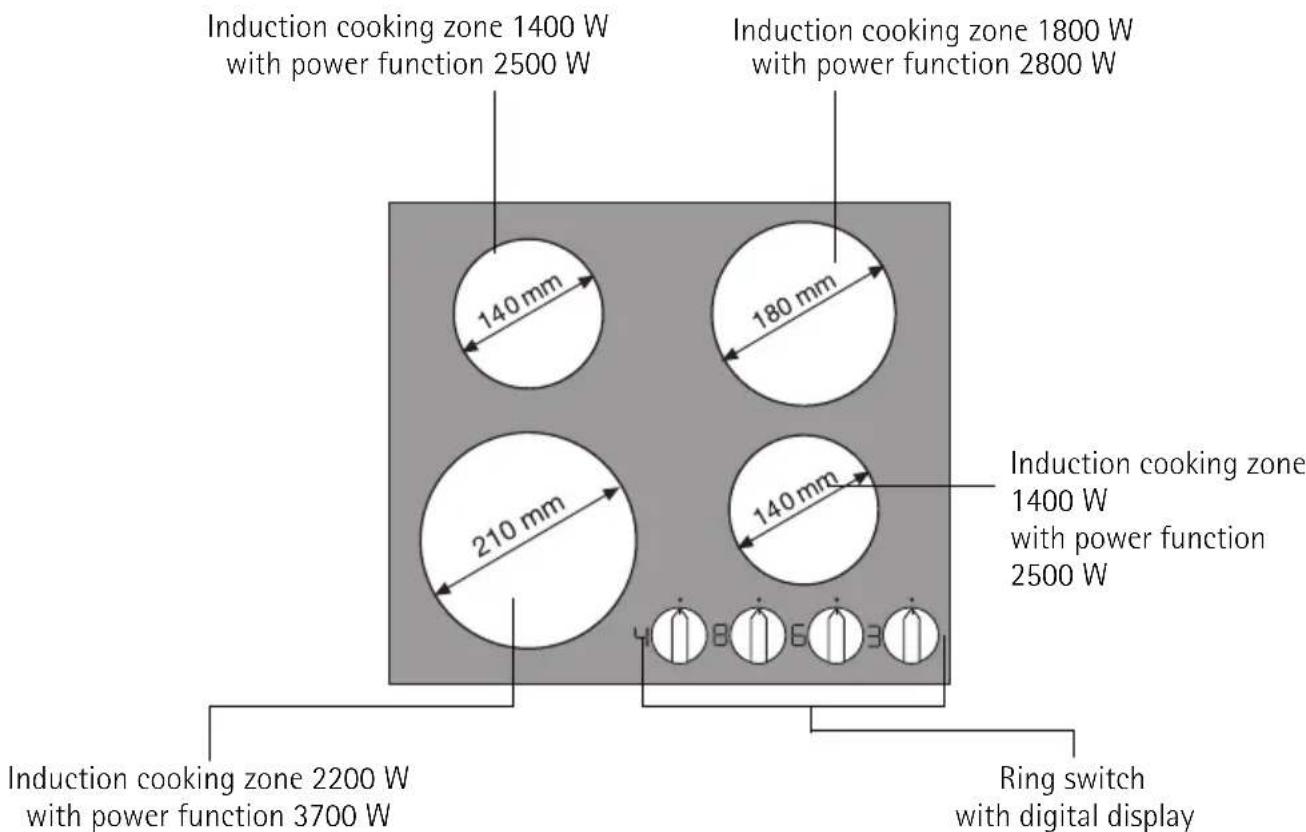
Description of the Appliance Cooking surface layout
Control panel layout
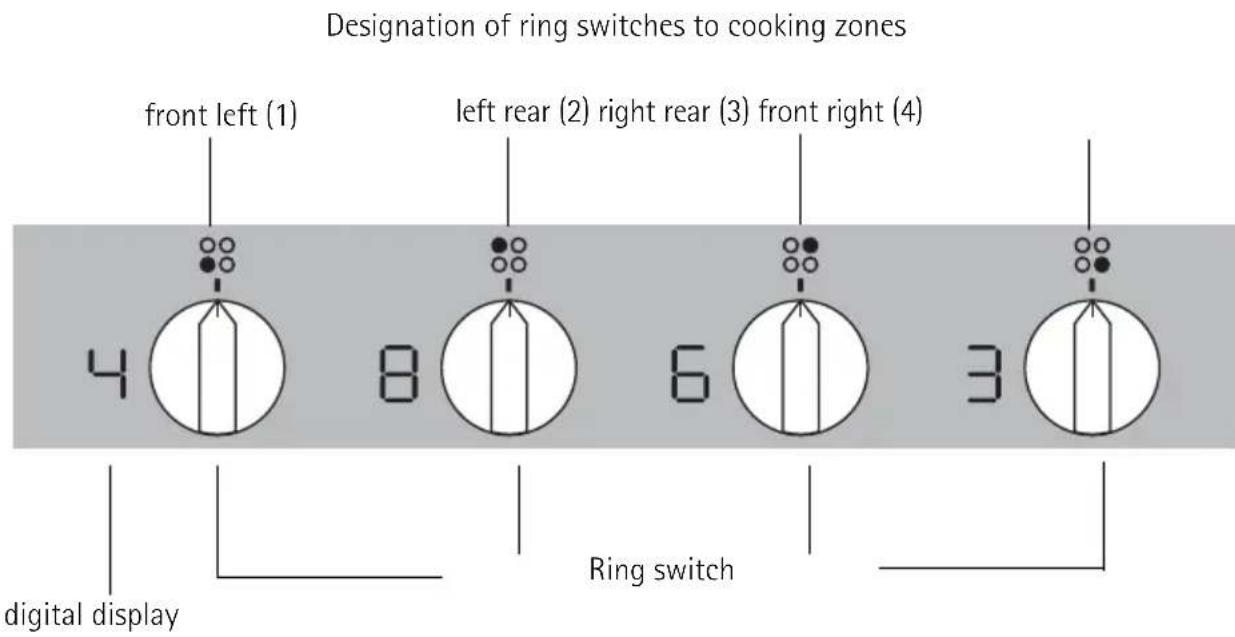
Displays
| Display Description | |
| Cooking zone is switched off | |
| - Heat settings Heat setting is set | |
| Fault Malfunction has occurred | |
| Pan detection Cookware is unsuitable or too small or no cookware has been placed on the cooking zone | |
| Residual heat Cooking zone is still hot | |
| Child safety device Child safety device is engaged | |
| Power Power function is switched on | |
| Automatic switch off Switch off is active. |
Residual heat indicator

Warning! Risk of burns from residual heat. After being switched off, the cooking zones need some time to cool down. Look at the residual heat indicator H

Residual heat can be used for melting and keeping food warm.
The induction cooking zones create the heat required for cooking directly in the base of the cookware. The glass ceramic is merely heated by the residual heat of the cookware.
The cooling fan switches itself on and off depending upon the temperature of the electronics.
Operating the appliance
Use the induction cooking zones with suitable cookware.
Setting the heat setting
| Ring switch Fan level | ||
| To increase turn to the right to | 1 9 | |
| To decrease turn to the left to | 9 1 | |
| To switch off turn to zero / | 0 H | |
Switching the power function on and off
The power function makes more power available to the induction cooking zones, e.g. to bring a large quantity of water to the boil quickly.
| Ring switch Display | ||
| To switch on | Briefly turn to the right past the stop position | |
| To switch off | turn to the left |
The power function remains activated for differing periods of time:
| Cooking zone diameter [mm] | Power time [min] |
| 210 | 10 |
| 180 | 10 |
| 140 | 4 |
Power Management
The cooking zones of the cooking surface have a maximum power.
The maximum power is reached when the heat setting 9 has been set for all cooking zones.
Two cooking zones generate a pair (see figure) and therefore, the power management shares the maximum available power between these cooking zones.
When the power function is selected for one cooking zone, the power management makes the additional power for this cooking zone available by reducing the power of the corresponding other cooking zone.
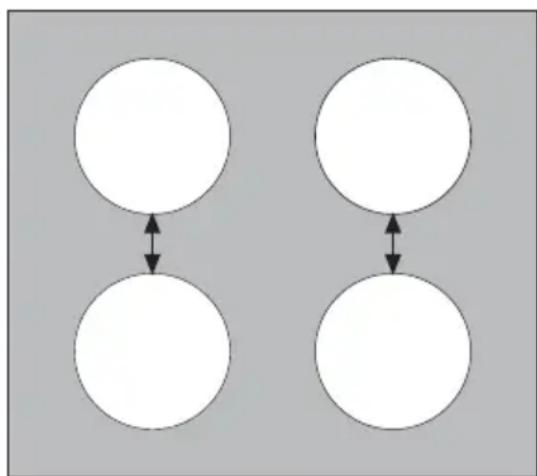
Example: the heat setting 9 is selected on one cooking zone. The power function is switched on for the corresponding cooking zone. The power function is carried out but the heat setting 9 of one of the cooking zones and the power function for the other cooking zone of the pair exceed the maximum power for both
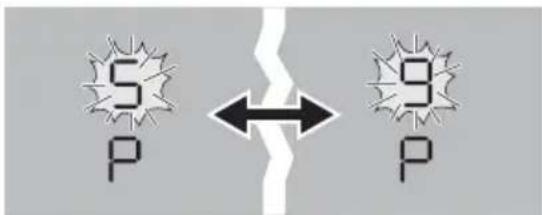
at the same time. For this purpose, the power management reduces the power of the cooking zone that switched on first from 9 to example 5 and the display of this cooking zone changes between 9 and 5 and then stays at the current possible maximum 5. (If the display changes between 9 and 5 or 9 and 3 or another value depends on the type of appliance and the size of the cooking zone.)
Using the child safety device
The child safety device prevents unintentional use of the appliance.
| Ring switch | ||
| To switch on Simultaneously | eously briefly turns ring switches 1 and 3 to the left away from the zero setting | L appears in all 4 displays when an attempt is made to switch on a heat setting. |
| To switch off | Repeat the action | The child safety device is switched off again. Each heat setting can be switched on as normal for each element. |
Automatic cut-out
Induction cooking zones
- When overheating occurs (e.g. if a pot has boiled dry) the cooking zone automatically switches itself off. is shown. Before being used again, the cooking zone must be set to 0.
- If unsuitable implements are used, F lights up for two minutes in the display of the cooking zone. Following this is displayed. If the setting of the ring switch is changed while F is lit, - appears in the display. Before being used again, the cooking zone must be set to D
- If one of the cooking zones is not switched off after a certain time, or if the heat setting is not modified, the relevant cooking zone switches off automatically. is displayed. Before being used again, the cooking zone must be set to
| Heat setting Switches off after | |
| 1 - 2 6 hours | |
| 3 - 4 5 hours | |
| 5 4 hours | |
| 6 - 9 1.5 hours | |
Tips on Cooking and Frying
Information on acrylamides
According to the latest scientific knowledge, intensive browning of food, especially in products containing starch, can constitute a health risk due to acrylamides. Therefore we recommend cooking at the lowest possible temperatures and not browning foods too much.
Cookware for induction cooking zones
Cookware material
| Cookware material suitable | |
| Cast iron + | |
| Steel, enamelled steel + | |
| Stainless steel +* | |
| Multi-layer pan bottom +* | |
| Aluminium, copper, brass - | |
| Glass, ceramic, porcelain - |

- Cookware for induction cooking zones is labelled as suitable by the manufacturer.
Suitability test
Cookware is suitable for induction cooking, if ...
- ... a little water on an induction cooking zone set to heat setting 9 is heated very quickly.
... a magnet sticks to the bottom of the cookware.
Cookware base
The bottom of the cookware should be as thick and flat as possible.
Pan size
Up to a certain limit, induction cooking zones adapt themselves to the size of the bottom of the cookware automatically. However, depending on the cooking zone size, the magnetic part of the bottom of the cookware must have a minimum diameter.
| Diameter of cooking zone [mm] | Minimum diameter of dish base [mm] |
| 210 180 | |
| 180 | 145 |
| 140 | 120 |
The cookware must be placed centrally on the cooking zone.
Tips on energy saving

Place cookware on the cooking zone before it is switched on.
If possible, always place a lid on the cookware.
Examples of cooking applications
The information in the table is for guidance only.
| Heat setting | Cooking-process | suitable for | Cooking time | Hints |
| 0 Off position | ||||
| 1 | Keeping food warm | To keep cooked foods warm as necessary Cover | ||
| 1-2 | Melting | Hollandaise sauce, to melt butter, chocolate, gelatine | 5-25 mins. Stir occasionally | |
| Solidifying | Fluffy omelettes, baked eggs | 10-40 mins. | Cook with lid on | |
| 2-3 | Simmer-ing on low heat | To simmer rice and milk-based dishes To heat up ready meals | 25-50 mins. | Add minimum twice as much liquid as rice, stir milk dishes some times |
| 3-4 | Steaming Braising | To steam vegetables, fish to braise meat | 20-45 mins. | With vegetables add only some liquid (some table-spoons) |
| 4-5 Boiling | To steam potatoes 20-60 mins. | Use only some liquid, e.g.: max. 1/4 l water for 750 g potatoes | ||
| To cook larger quantities of food, stews and soups | 60-150 mins. | 3 l liquid maximum plus ingredients | ||
| 6-7 | Gentle Frying | To fry escalopes, veal cordon bleu, cutlets, rissoles, sausages, liver, roux, eggs, pancakes, doughnuts | Steady frying | Turn occasionally |
| 7-8 | Heavy Frying | Hash browns, loin steaks, steaks, Flädle (pancakes for garnishing soup) | 5-15 mins. per pan | Turn occasionally |
| 9 | Boiling Searing Deep frying | To boil large quantities of water, to cook pasta, to sear meat (goulash, pot roast), deep frying chips | ||
The power function is suitable for heating large quantities of liquid.
Cleaning and Care

Take care! Risk of burns from residual heat.

Warning! Sharp objects and abrasive cleaning materials will damage the appliance.
Clean with water and washing up liquid.

Warning! Residues from cleaning agents will damage the appliance. Remove residues with water and washing up liquid.
Cleaning the appliance after each use
- Wipe the appliance with a damp cloth and a little washing up liquid.
- Rub the appliance dry using a clean cloth.
Removing deposits
- Place a scraper on the glass ceramic surface at an angle.
- Remove residues by sliding the blade over the surface.
- Wipe the appliance with a damp cloth and a little washing up liquid.
- Rub the appliance dry using a clean cloth.
| Type of dirt | Remove | ||
| immediately | when the appliance has cooled down | using | |
| sugar, food containing sugar yes --- | a scraper* | ||
| plastics, tin foil yes --- | |||
| limescale and water rings --- yes | cleaner for glass ceramic or stainless steel* | ||
| fat splashes --- yes | |||
| shiny metallic discolouration --- yes | |||
*Scrapers and cleaners for glass ceramic and stainless steel can be purchased in specialized shops

Remove stubborn residues with a cleaner for glass ceramic or stainless steel.

Scratches or dark stains on the glass ceramic that cannot be removed do not however affect the functioning of the appliance.
What to do if ...
| Problem Possible cause | Use Remedy | |
| The cooking zones are not functioning | The desired heat setting is not set | Set heat setting |
| The fuse in the house's electrical wiring (fuse box) has been tripped. | Check the fuses. If the fuses trip repeatedly, please call an authorised electrician. | |
| The child safety device is switched on. L is lit | Switching off the child safey device (see section "Child safety device" in the hob user manual) | |
| The residual heat indicator is not displaying anything | The cooking zone was only on for a short time and is there-fore not hot | If the cooking zone is supposed to be hot, call the Customer Service Department. |
| Display is switching between two heat settings | Power management is reducing the power of this cooking zone | See the section "Switching the power function on and off" |
| F lights up Unsuitable cookware | Use suitable cookware | |
| No cookware on the cooking zone | Place cookware on the cooking zone | |
| The diameter of the bottom of the cookware is too small for the cooking zone | Move onto a smaller cooking zone | |
| Use suitable cookware | ||
| -lights up Cooking zone on for more than two minutes without cookware | Switch off cooking zone, place cookware on cooking zone, switch on cooking zone | |
| Automatic switch-off has been triggered | Switch off the cooking zone. Switch the cooking zone on again | |
| E and number are displayed | Electronics fault | Disconnect the appliance from the electrical supply for a few minutes (Take the fuse out of the house's wiring system) If after switching on again, E is displayed again, call the customer service department |
If you are unable to remedy the problem by following the above suggestions, please contact your local Service Force Centre.

Warning! Repairs to the appliance are only to be carried out by qualified service engineers. Considerable danger to the user may result from improper repairs.

If the appliance has been operated incorrectly, the engineer's visit will be chargeable, even during the warranty period.
Operating noises
Depending on the material and the processing of the base, the following noises may occur when using induction cooking zones.
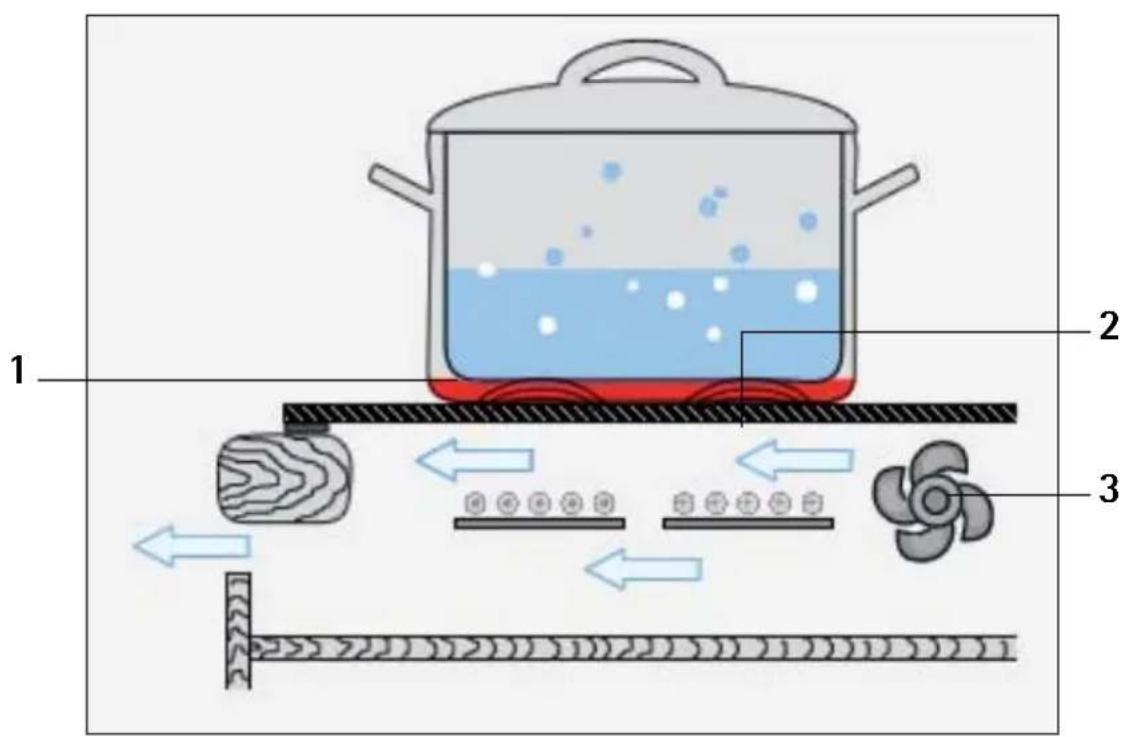
- Cracking noise (1) when using cookware made of different materials (Sandwich construction)
- Whistling (1) when using an individual cooking zone or several cooking zones with high powers when the cookware is made of different materials (Sandwich construction)
Humming (2) can occur at high power levels
-Clicking (2) during electric switching processes - Hissing, buzzing (3)
The device is fitted with a fan for cooling the electrics. A whiring noise can be heard when operating the fan which may deviate depending on the performance and may continue for a while after the appliance is switched off.
The noises described are normal and do not refer to any defects.
Disposal

Packaging material
The packaging materials are environmentally friendly and can be recycled. The plastic components are identified by markings, e.g. >PE< , >PS< , etc. Please dispose of the packaging materials in the appropriate container at the community waste disposal facilities.

Old appliance
The symbol on the product or on its packaging indicates that this product may not be treated as household waste. Instead it shall be handed over to the applicable collection point for the recycling of electrical and electronic equipment. By ensuring this product is disposed of correctly, you will help prevent potential negative consequences for the environment and human health, which could otherwise be caused by inappropriate waste handling of this product. For more detailed information about recycling of this product, please contact your local city office, your household waste disposal service or the shop where you purchased the product.
Installation Instructions
!Safety instructions
Warning! This must be read!
The laws, ordinances, directives and standards in force in the country of use are to be followed (safety regulations, proper recycling in accordance with the regulations, etc.) Installation may only be carried out by a qualified electrician.
The minimum distances to other appliances and units are to be observed.
Anti-shock protection must be provided by the installation, for example drawers may only be installed with a protective floor directly underneath the appliance.
The cut surfaces of the worktop are to be protected against moisture using a suitable sealant.
The sealant seals the appliance to the work top with no gap.
Do not use silicon sealant between the appliance and the work top.
When building in, protect the underside of the appliance from steam and moisture, e.g. from a dishwasher or oven.
Avoid installing the appliance next to doors and under windows. Otherwise hot cookware may be knocked off the rings when doors and windows are opened.
Risk of injury from electrical current.
The electrical mains terminal is live.
Make electrical mains terminal free of voltage.
- Follow connection schematic.
- Observe electrical safety rules.
- Ensure anti-shock protection by installing correctly.
- The appliance must be connected to the electrical supply by a qualified electrician.
Risk of injury from electrical current.
- Loose and inappropriate plug and socket connections can make the terminal overheat.
- Have the clamping connections correctly installed by a qualified electrician.
- Use strain relief clamp on cable.
- In the event of single-phase or two-phase connection, the appropriate mains cable of type H05BB-F Tmax 90^ (or higher) or an equivalent type must be used.
- If this appliance's mains cable is damaged, it must be replaced by a special cable (type H05BB-F Tmax 90^ ; or higher) or an equivalent type. The latter is available from the Customer Care Department.
A device must be provided in the electrical installation which allows the appliance to be disconnected from the mains at all poles with a contact opening width of at least 3mm . Suitable isolation devices include line protecting cut-outs, fuses (screw type fuses are to be removed from the holder), earth leakage trips and contactors.
Service
In the event of technical faults, please first check whether you can remedy the problem yourself with the help of the operating instructions (section "What to do if...").
If you were not able to remedy the problem yourself, please contact the Customer Care Department or one of our service partners.
In order to be able to assist you quickly, we require the following information:
-three digit letter-number combination for glass ceramic
-Model description
-Product number (PNC)
-Serial number (S No.)
(for numbers see rating plate)
-Type of fault
-Any error messages displayed by the appliance
So that you have the necessary reference num-
bers from your appliance at hand, we recommend that you write them in here:
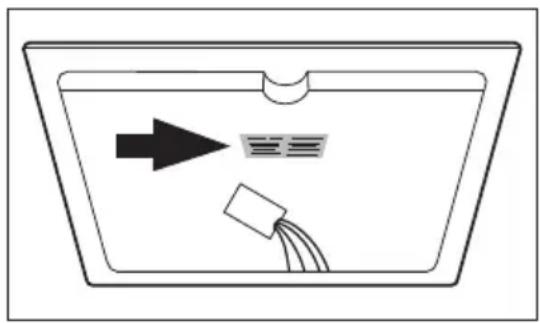
Model description:
PNC:
S No:
www.aeg-electrolux.co.uk