B4028FHDLED - Television BRANDT - Free user manual and instructions
Find the device manual for free B4028FHDLED BRANDT in PDF.



| Product type | LED TV |
| Brand and model | Brandt B4028FHDLED |
| Screen size | 40 inches (102 cm) |
| Resolution | 1920 x 1080 pixels (Full HD) |
| TV system | PAL B/G/I/D/K, SECAM B/G/D/K/L |
| Mains voltage | 100-240 V ~ 50/60 Hz |
| Power consumption (max) | 70 W |
| Standby power consumption | < 0.50 W |
| Audio power | 2 x 8 W |
| Connectivity | 3 x HDMI, 1 x VGA (PC), 1 x YPbPr, 1 x SCART, 1 x USB, 1 x coaxial output, 1 x headphone jack, 1 x CI, 1 x RF input |
| Main functions | PVR (USB recording), teletext, EPG, parental control, picture and sound modes, sleep timer |
| USB playback formats | Photo (JPEG, BMP, PNG), music (MP3), video (TS, MPEG2, H.264), text (TXT) |
| Wall mount | VESA standard 200 x 100 mm, screws M6 x 8 mm |
| Care and cleaning | Unplug before cleaning; use a soft slightly damp cloth; do not use solvents |
| Safety | Do not expose to moisture, do not block ventilation, do not repair yourself, use batteries correctly |
| Repairability | Entrust any repair to a qualified professional |
Frequently Asked Questions - B4028FHDLED BRANDT
User questions about B4028FHDLED BRANDT
0 question about this device. Answer the ones you know or ask your own.
Ask a new question about this device
Download the instructions for your Television in PDF format for free! Find your manual B4028FHDLED - BRANDT and take your electronic device back in hand. On this page are published all the documents necessary for the use of your device. B4028FHDLED by BRANDT.
USER MANUAL B4028FHDLED BRANDT
Safety and warnings. 2-3
Introduction. 4
Base Stand Assembly Instruction. 5
Installation. 6-9
Remote Control. 10-11
Operation. 12-21
Trouble Shooting. 22-25
Important Disposal Instructions. 26
Product fiche 27
Safety Information
Safe use and care of your television
We have designed and made this television to meet European Safety Standards, but as with any electronic equipment you must take care, to stay safe and get the best results. Here is some good advice to help you do this.
Read these instructions carefully before you try to use the television.
Protect the mains lead. You must ensure the mains lead cannot be walked on, crushed, chafed, cut or trapped.
Switch off the mains power or pull out the mains plug when you leave the television unattended, unless the function of the television requires a continuous power supply.
Do not continue to use your television if you have spilt liquids in it, if it is damaged in any way or if it does not work normally. Immediately unplug the television and get expert advice.
Avoid harsh conditions such as wet or damp places, high humidity, strong vibration, extremely high or low temperatures, strong sunlight and places that are very dusty.
Never fit makeshift stands or legs to the television.
Never push objects into holes and ventilation slots.
To prevent electric shock do not remove any cover.
Do not touch the LED display as it gets warm when in use, this is normal and is not a fault.
If anything goes wrong do not try to fix it yourself, get a qualified service agent to look at it.
Pull out the mains plug and disconnect the aerial lead during thunder storms.
Cleaning
Disconnect the mains supply and use only a lightly dampened soft cloth. Do not use chemical solvents or strong detergents as these may damage the cabinet or screen.
Never allow water droplets to remain on the screen as moisture can cause permanent.
Greasy marks must only be removed with a commercial cleaner specifically recommended for LED screens.
Mains Supply
This television is designed to operate from a 100-240 Volts 50 / 60Hz AC mains supply. Other power sources may damage it. Check that the rating plate (on the back cover of the television) states 100-240V AC before you plug it in for the first time.
The manufacturer accepts NO liability for damage or injury caused by using the product with the wrong mains voltage.

Dangerous voltage constituting a risk of electric shock is present inside this equipment.

This mark is applied to show the equipment conforms to European safety and electromagnetic compatibility standards.

HIGH-DEFINITION MULTIMEDIA INTERFACE
Safety Information (cont)
Eye Fatigue
When using this product as a computer monitor, health and safety experts recommend short frequent breaks rather than occasional longer breaks. For example a 5-10 minute break after an hour of continuous screen work is considered to be better than a 15 min break every 2 hours.
Do not use the monitor against a bright background or where sunlight or other bright light sources will shine directly onto the screen.
Headphones

To prevent possible hearing damage, do not listen at high volume levels for long periods.
Battery handling and usage
Only adults should handle batteries. Do not allow a child to use this remote control unless the battery cover is securely attached to the remote control.
The battery type used in the remote control is 2 × 1.5V AAA size batteries (not included) which are accessible and can be replaced.
Remove the battery cover located at the bottom of the remote control to remove the batteries.
DISPOSAL
As a responsible retailer we care about the environment.
As such we urge you to follow the correct disposal procedure for the product, packaging materials and if applicable, accessories and batteries.
This will help conserve natural resources and ensure that the material
that protects health and the environment.
You must follow laws and regulations about disposal. Waste electrical products and batteries must be disposed of separately from household waste when the product reaches the end of its life.
Contact the store where you bought the product and your local authority to learn about disposal and recycling.
The batteries must be disposed of at your local recycling point.
WARNING:
This appliance is intended for domestic household use only and should not be used for any other purpose or on any other application, such as for non-domestic use or use in a commercial environment.
If the supply cord is damaged it must be replaced by the manufacturer, its service agent or similarly qualified persons in order to avoid a hazard.
This apparatus shall not be exposed to dripping or splashing.
No objects filled with liquids, such as vases, shall be placed on the apparatus.
No naked flame sources, such as lighted candles should be placed on the apparatus.
The ventilation should not be impeded by covering the ventilation openings, with items such as newspapers, tablecloths, curtains etc.
WARNING: To prevent injury, this apparatus must be securely attached to the floor/wall in accordance with the installation instructions.
This apparatus is not suitable for use in a tropical climate.
Ventilation
Allow at least a 10 cm gap all around the product.
To protect the environment, use local recycling facilities for battery disposal.
Where the MAINS plug or an appliance coupler is used as the disconnect device, the disconnect device shall remain readily operable.
Thank you very much for purchasing this TV. To enjoy your product from the very beginning, read this manual carefully and keep it handy for easy reference.
CAUTION
Never tamper with any components inside the TV, or any other adjustment controls not mentioned in this manual. All LED-TVs are high voltage instruments. When you clean up dust or water drops on the LED PANEL or CABINET, the power cord should be pulled out from the receptacle, then wipe the TV with a dry soft cloth. During thunder and lighting, unplug the power cord and antenna cord to prevent damage to your TV. All repairs to this TV should only be performed by qualified TV service personnel.
INSTALLATION
*Locate the TV in the room where light does not strike the screen directly.
*Total darkness or a reflection on the picture screen can cause eyestrain. Soft and indirect lighting is recommended for comfortable viewing.
*Allow enough space between the TV and the wall to permit ventilation.
*Avoid excessively warm locations to prevent possible damage to the cabinet or premature component failure.
*Do not cover the ventilation openings when using the TV.
Main features
① Used as Television, display terminal, PC display;
② High luminance, wide viewing Angle;
③ HDMI interface and SCART Interface;
④ NICAM;
Main parameter
| Panel | 40" |
| TV System | PAL-B/G、I、D/K SECAM-B/G、D/K、L |
| Video Signal System | PAL/SECAM |
| Resolution | 1920x1080 |
| Input Power Voltage | AC 100-240V 50/60Hz |
| Power consumption | 70W |
| Audio Output Power(THD≤7%) | 2x W8 |
| Signal Input/Output | Analog RGB(PC)x1 High-Definition Multimedia Interface(HDMI) x3 Video Input x1 Audio Input x2 USB Input x1 Y、Cb (Pb)、Cr (Pr)x1 SCART X1 Headphone x1 Coaxial x 1 CI x 1 RF x1 |
| Horizontal definition (TV line) | CompositeVideo input >=350 Y Cb(Pb) Cr(Pr) >=400 |
Base Stand Assembly Instruction
How to attach the stand
NOTE:
- Unplug the AC cord.
- Before performing work spread cushioning over the base area to lay the TV on.
- Do not support the TV by the screen as sharp objects and too much pressure may cause damage.
- Be sure to follow the instructions. Incorrect installation of the stand may result in the TV falling over.
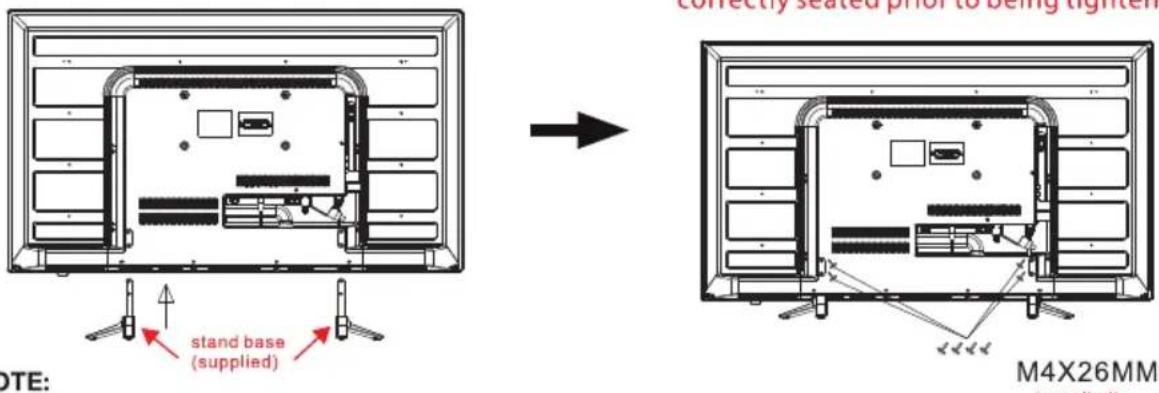
1) Place the TV on its front onto a table.
2) Align the stand's base (supplied) as seen here.
It will fit in only one direction. Make sure the locating pegs fit in the locating holes.
3) Carefully hold the base plate in position and secure it with screws.
-
On each desk stand, identify the longer leg of the stand, and slide the rectangular section of the desk stands into the TV so that the longer leg is facing towards the front of the TV.
-
Insert the long screws into the holes in the rear of the TV that line up with the holes in the rectangular section of the metal desk stands, and tighten the screws firmly. You may need to slightly jiggle the metal base stands around in their holes to allow the screws to be correctly seated prior to being tightened.
NOTE:
To detach the stand, perform these steps in reverse order.
Dismantling the stand
For wall mounting, the stand must be dismantled. To do this, remove screws (above drawing) from the back. Fit a VESA (200 × 100mm) wall mounting kit. The screw thread length must not exceed 12mm into the TV.
Notes when mounting the TV on a wall
Remove the stand as one piece by reversing the fixing procedure described above.
You can refit the screws to the stand for safe keeping, but tighten them only slightly.
VESA screw size 4xM6x8mm
Protect the screen and lay the TV flat on its face, on a stable table, with the stand foot clear of the table edge.
To ensure a safe installation, please observe the following when hanging the television on a wall:
Warning: This operation requires two people.
Check that the wall can support the weight of the television set and a VESA-standard wall mount assembly (not supplied).
Be sure to use only screws suitable for the material of the wall.
In case of any doubt please contact a qualified installer.
Beware of electrical cables, gas and water pipes in the wall.
Follow the instructions provided with the wall mount.
The set must be installed on a vertical wall.
Make sure that cables are placed so that there is no danger of tripping over them or damaging them.
Front panel

KEY BOARD
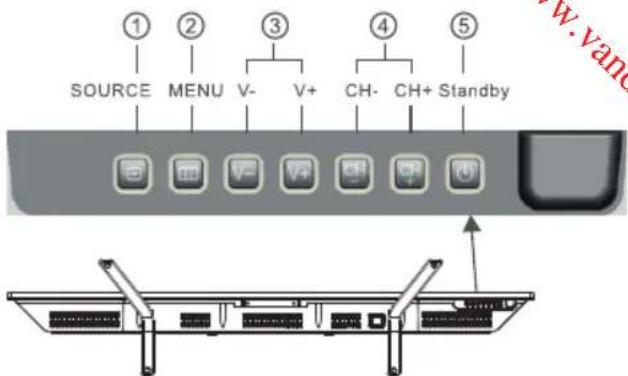
1: Remote Control Sensor.
2:Power Indicator LED:
RED STANDBY.
3: Buttons
- SOURCE: Displays the input source menu; press repeatedly to move down the menu or press "CH+" or "CH-" to select the required source.
- MENU: Display main MENU.
- V+/V-: Adjust sound level. In MENU mode, press "V+ " or "V- " to adjust the item that you selected 4. CH+/CH-: In TV mode, press "CH+" or "CH-" to change the channel up and down. In MENU mode, press "CH+" or "CH-" to select items. In standby mode, press "CH+" or "CH-" to turn on the TV.
- STANDBY: Press this button to turn the unit ON from STANDBY mode. Press it again to turn the set back to STANDBY.
REAR AV Connections

All the terminals are(from left to right): AC POWER INPUT,VIDEO,YPbPr INPUT,AUDIO INPUT, COAXIAL OUTPUT,HDMI3,SCART.
Note:VIDEO and YPbPr share one audio channel.
If the picture is ahead of sound, this lip sync problem can be solved with your home theatre system. Please change the settings as appropriate.
REAR AV Connections(SIDE)

All the terminals are(from left to right):
USB, HDMI2, HDMI1(ARC), HEADPHONE, CI, PC AUDIO, VGA, RF.
Note: 1. When HDMI 1, 2 and 3 ports get DVI signal, the audio signal receives from the PC Audio channel.
2.Insert the plug of the earphone into the earphone jack on the unit HEADPHONE. The speakers are now muted.
HDMI ARC (Audio Return Channel)
The ARC function allows you to send audio signal from your ARC-compliant TV to ARC-compliant audio devices (e.g. home theatre) without the need to connect any audio cable. (ex. Coaxial, Optical digital audio cable, or analog Audio cable)
To enjoy the ARC function:
- Make sure your ARC-compliant audio devices are connected by an HDMI 1.4 cable to the HDMI 1(ARC) port of your ARC-compliant TV. And open the ARC function of ARC-compliant audio devices.
- Adjust TV: press MENU go to OPTION, set HDMI CEC and HDMI ARC both ON.
- Then, just use your TV remote control to adjust the volume output (VOL +/- and MUTE) of the connected audio device.
Note: If the ARC-compliant audio devices do not support sound that TV outputs, such as Dolby Digital, or Dolby Digital Plus, then ARC function will not work and there may be no sound from ARC-compliant audio devices, in this case, please set SPDIF MODE to PCM.
PC
STEPS:
Be sure both the TV and computer are set to
Power off.
- Connect VGA and audio cable.
- Connect the power cord
3.Power on the TV, switch to PC mode.
4.Power on the PC.
This sequence is very important.
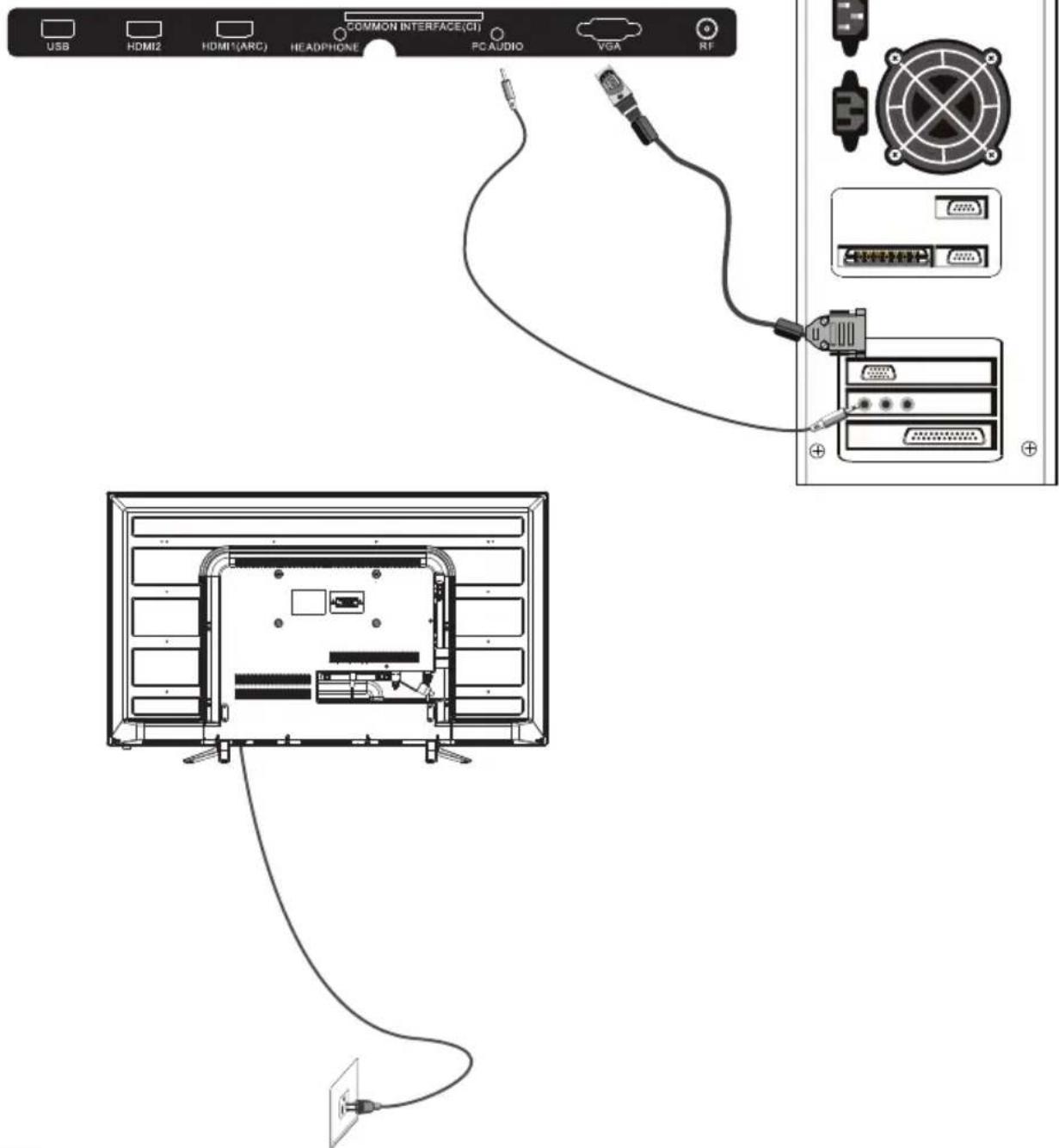
PC
PRESET MODE
| RESOLUTION | V. Freq. (Hz) | H. Freq. (kHz) | |
| 1 | 800*600 | 60 | 37.88 |
| 2 | 640*480 | 60 | 31.47 |
| 3 | 1024*768 | 60 | 48.36 |
| 4 | 1280*1024 | 60 | 63.98 |
| 5 | 1366*768 | 60 | 47.7 |
| 6 | 1920*1080 | 60 | 66.64 |
NOTE:
PC V. Freq. (Hz) not more than 60Hz
ANTENNA
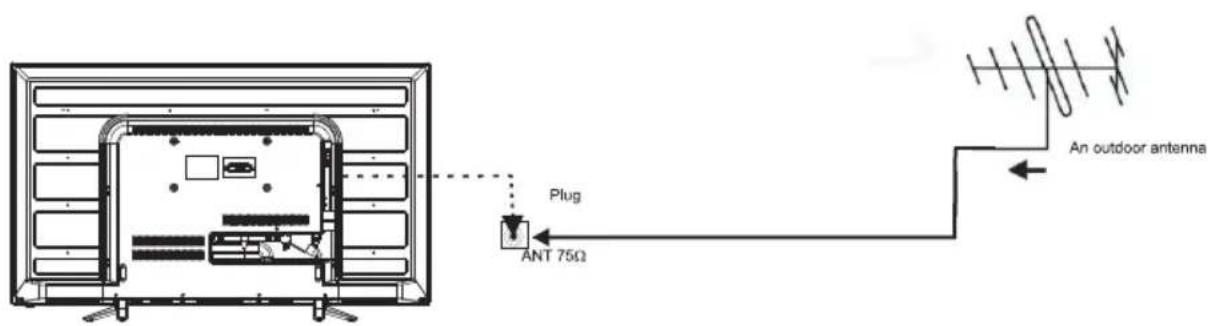
Note:
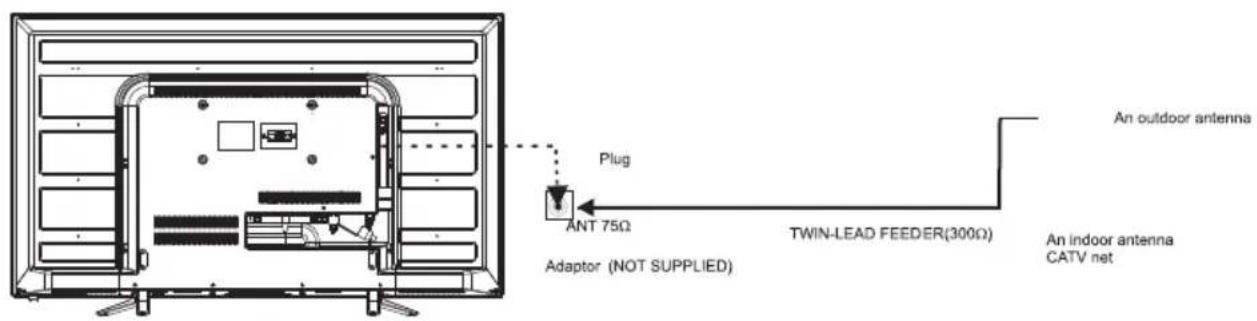
Aerial connections: IEC(female).
Input impedance: 75Ω unbalanced.
AV EQUIPMENT
This TV provides one group of AV, one group of YPbPr and one SCART for convenient connection to VCR,DVD or other video equipment. Please refer to the owners manual of the equipment to be connected as well.
You can use the input terminals on TV set rear as follows.
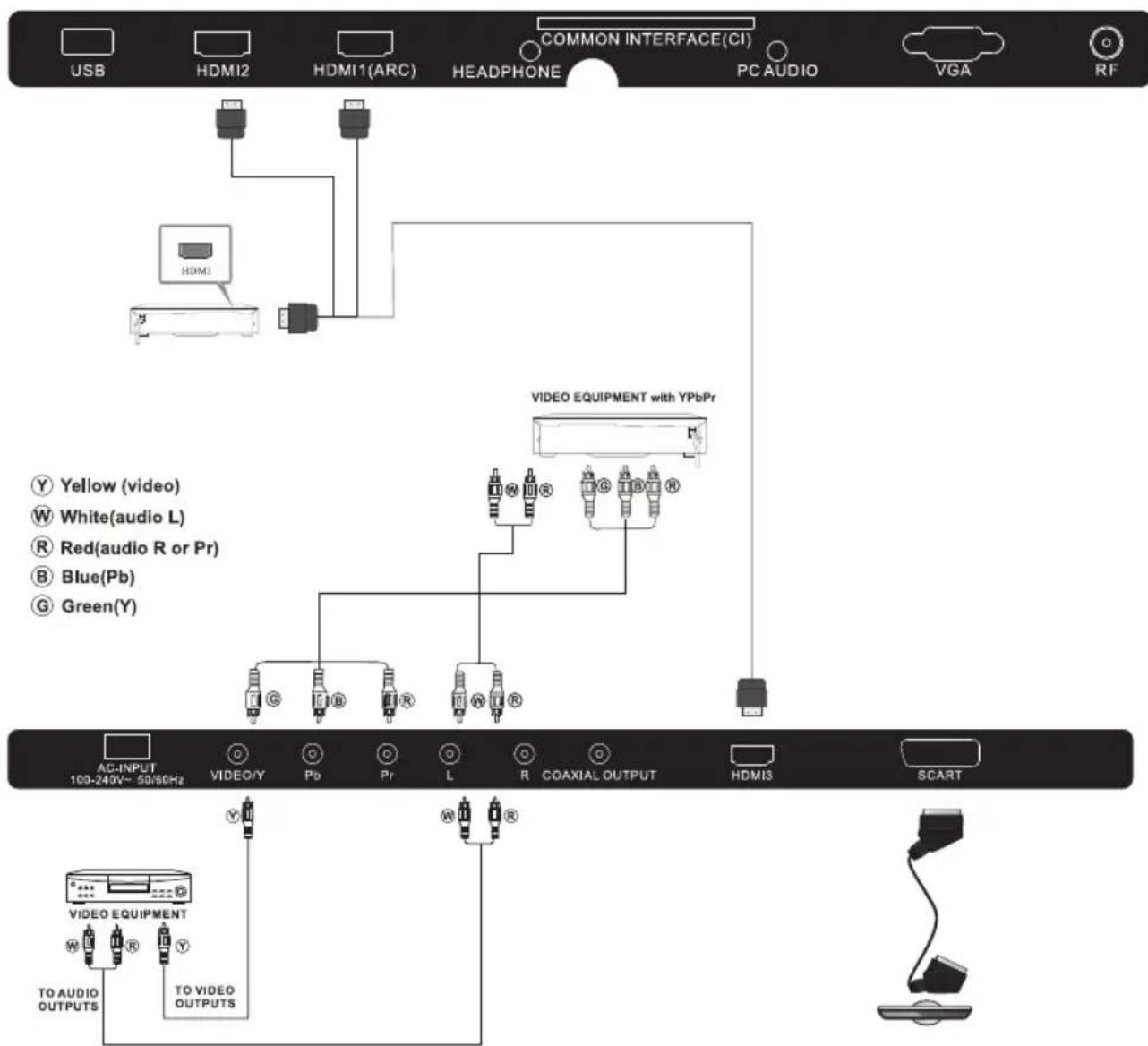
It can be connected to the following appliances: VCR, multi disc player, DVD, camcorder, video game or stereo system, etc....
YPbPr can support these video formats: 480i,576i,480p,576p,720p,1080i.
REMOTE CONTROL
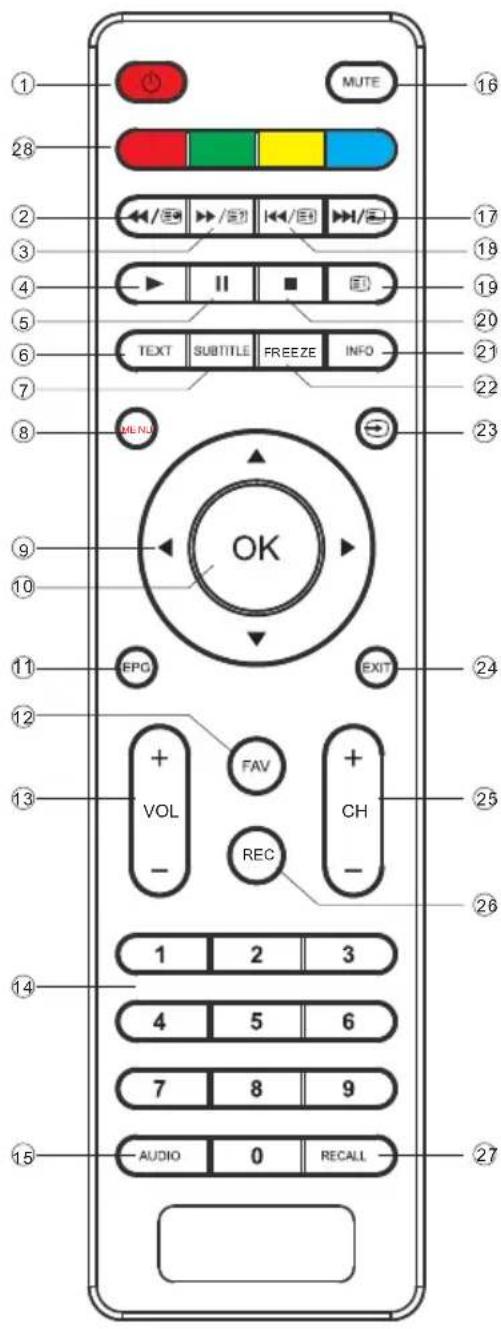
1:POWER:To set the TV to standby or power on.
2: In USB mode, used as reverse key, in teletext mode used as subpage key.
3: In USB mode, used as forword key, in teletext mode used as reveal key.
4: Press in USB Mode to begin or continue playback.
5: II: Press in USB Playback Mode to pause playback.
6:TEXT:To enter or TELETEXT.
7: SUBTITLE: To turn on subtitles press the subtitle button in DTV mode.
8:MBNplays the main on-screen menu.
9:CURSOR: To move within the menu.
10:OK: Confirms selection.
11:EPG: To display information about the program being viewed and what's on next in DTV mode.
12:FAV: To access your favourite channels list in TV or DTV mode.
13:VOL+/-: To adjust sound level.
14:NUMERIC KEY: For direct access to channels.
15:AUDIO: To select the available audio language of TV programs.
16:MUTE: To disable or enable the sound output.
17:In USB mode, used as next key, in teletext mode used as list key.In DTV mode it lists TV and Radio channels.
18: In USB mode, used as previous key, in teletext mode used as hold key.
19:In teletext mode used as indexINDEX short cut button in EPG display
20: Press to stop play in USB mode.
21:INFO: To display the program information of the show you are watching, press the info button.
22:FREEZE: Press to freeze the picture you are watching.
23: : Press to display and select the available video sources.
24:EXIT: To return to the previous menu or exit menu.
25:CH+/CH-: To access the next or previous channels.
26:REC: Press to record the TV program you are watching in DTV Mode.
27:RECALL: DTV Mode: RECALL: Jumps to last channel viewed.
28. TELETEXT: red, green yellow and blue buttons.
TELETEXT
Teletext is an information system broadcast by certain channels which can be like a newspaper. It also offers access to subtitles for viewers with hearing problems or who are not familiar with the transmission language (cable networks, satellite channels, etc.)
read
| Press: | You will obtain : |
| TEXT(BUTION 8) | This is used to enter or exit teletext mode. The summary appears with a list of items that can be accessed. Each item has a corresponding 3 digit page number. If the channel selected does not broadcast teletext, the number 100 will be displayed and the screen will remain blank (in this case, exit teletext and select another channel). |
| SELECTING A PAGE▲▼○○○○○○○ | Enter the number of the page required using the 0 to 9 up/down.Example: page 120, enter 120. The number is displayed top left, the counter turns and then the page is displayed. Repeat this operation to view another page. If the counter continues to search, this means that the page is not transmitted. Select another number. |
| DIRECT ACCESS TO THE ITEMS | Coloured areas are displayed at the bottom of the screen. The 4 coloured keys are used to access the items or corresponding pages. The coloured areas flash when the item or the page is not yet available. |
To find button numbers, refer to the remote control description on pages 10-111.
Installation Guide

1). Press the buttons to navigate the menu and change the settings. Press the OK button to confirm.
Select your desired language to be displayed on the menu.
NOTE: Once option highlighted 3 second on the Source choices, it automatically confirmed without pressing OK button.

2).Press the buttons to select Home Mode or shop Mode,press the OK button to confirm.
HOME or SHOP modes
- Home Mode is an energy-saving Mode. Home Mode is recommended for normal viewing setting and is set as default by the manufacturer.
- Shop Mode is an option for retailers for Advertising or product presentation. Shop Mode has a brighter image than Home Mode.
3). Press the buttons to select DVB-T/DVB-C and then press the OK button to confirm.
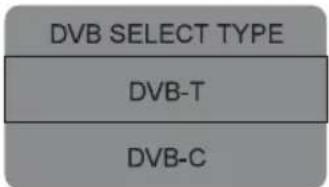
a.If you select DVB-T, the next step is to select the Tune Type and country, then press the OK button to start tuning.
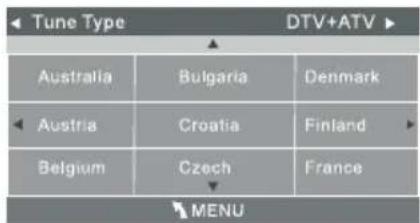
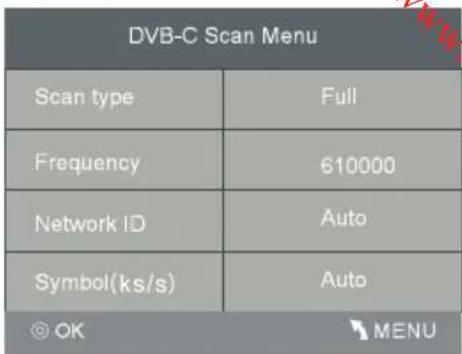
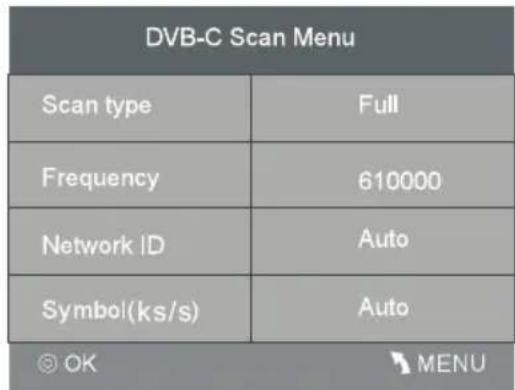
b.If you select DVB-C, the next step is to configure the DVB-C system (scan type /Frequency/Network ID/Symbol (ks / s) then press OK button to get into the tune type and country select menu. This step is the same as DVB-T, select the tune type (DTV/ATV). Choose the right country, press OK button to start tu
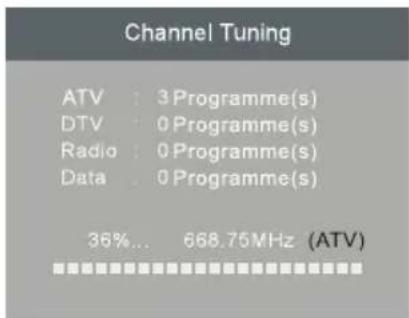
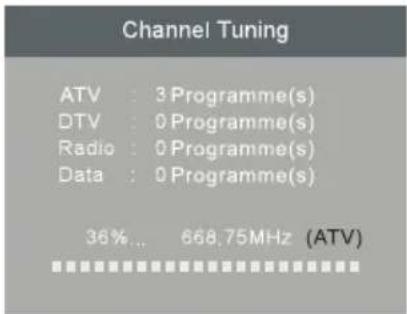
4). Channel tuning will commence. This operation may take up to several minutes. The display will show the progress of the tuning and the number of channels found.
5). If you want to skip the ATV tuning, press the MENU button to interrupt the tuning half way. A pop-up screen will be displayed, press the button to select YES to confirm. You will then go straight to DTV tuning. You may repeat the above step if you also want to skip the DTV tuning.
6). After tuning is complete, the channels are arranged in a preset order. If you wish to skip channels, modify the preset order or delete channels, select Programme Edit under the Channel menu.
1.CHANNEL MENU
1.1 Auto Tuning (DVB-T)
1). Press the MENU button and then press the buttons to select the CHANNEL menu.
2). Press the buttons to select Auto Tuning and then press the OK button.
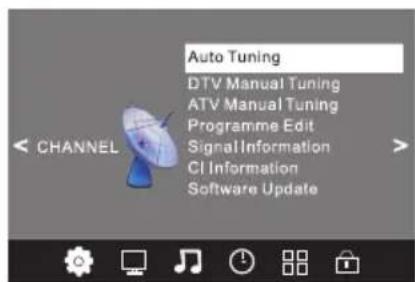
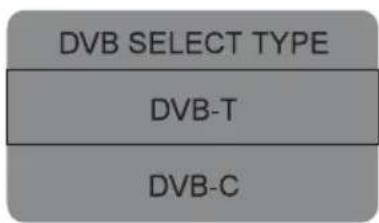
3). Press the buttons to select DVB-T/DVB-C. Select DVB-T and then press the OK button to confirm.
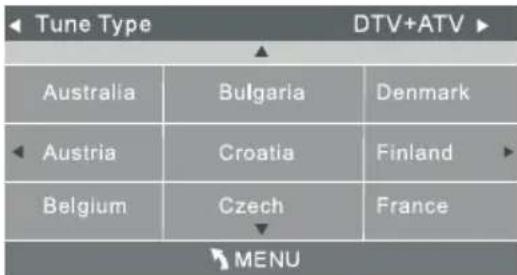
4). In the Tune Type menu, press the buttons to select ATV / DTV / DTV + ATV. Press the button and then press the buttons to select the country where you will operate the TV. Press the OK button to confirm.
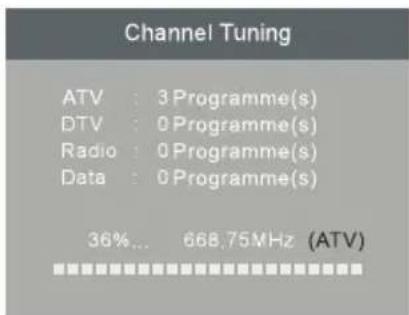
5). Channel tuning will commence. This operation may take up to several minutes. The display will show the progress of the tuning and the number of channels found.
6). If you want to skip the ATV tuning, press the MENU button to interrupt the tuning half way. A pop-up screen will be displayed, press the button to select YES to confirm. You will then go straight to DTV tuning. You may repeat the above step if you also want to skip the DTV tuning.
7). After tuning is complete, the channels are arranged in a preset order. If you wish to skip channels, modify the preset order or delete channels, select Programme Edit under the Channel menu.
1.2 Auto Tuning (DVB-C)
1). Press the MENU button and then press the 〈〉 buttons to select the CHANNEL menu.
2). Press the buttons to select Auto Tuning and then press the OK button.
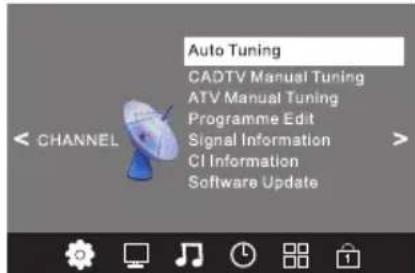
3). Press the▼▲ buttons to select DVB-T/DVB-C. Select DVB-C and then press the OK button to confirm.
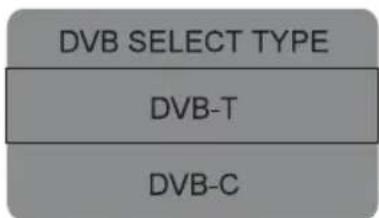
4). Press buttons to select Scan type/Symbol(Ks/S) press the OK button to confirm.
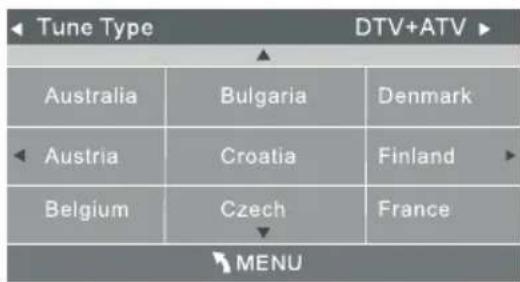
5). In the Tune Type menu, press the buttons to select ATV / DTV / DTV + ATV. Press the button and then press the buttons to select the country where you will operate the TV. Press the OK button to confirm.
6). Channel tuning will commence. This operation may take up to several minutes. The display will show the progress of the tuning and the number of channels found.
7). If you want to skip the ATV tuning, press the MENU button to interrupt the tuning half way. A pop-up screen will be displayed, press the button to select YES to confirm. You will then go straight to DTV tuning. You may repeat the above step if you also want to skip the DTV tuning.
8). After tuning is complete, the channels are arranged in a preset order. If you wish to skip channels, modify the preset order, rename or delete channels, select Programme Edit under the Channel menu.
NOTE:
All the channels including ATV, DTV and Radio can be tuned in one go, if the Tune Type is DTV+ATV.
All the stored channels will disappear after auto tuning.
2.1 DTV Manual Tuning (DVB-T)
1). Press the MENU button and then press the buttons to select the CHANNEL menu.
2). Press the▼▲ buttons to select DTV Manual Tuning and then press the OK button.

3). The DTV Manual Tuning screen will pop up. Press the buttons to select the desired VHF or UHF channel and then press the OK button to commence the search of that channel. When the signal has been tuned, the picture and signal strength will be displayed on the screen.
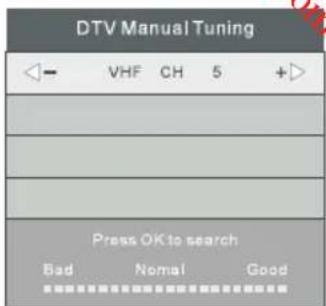
Note: if you don't press any button, the DTV Manual Tuning menu will disappear.
4). Press the MENU button to return back to the main menu.
5). Press the EXIT button to exit the menu.
2.2 DTV Manual Tuning (DVB-C)
1). Press the MENU button and then press the buttons to select the CHANNEL menu.
2). Press the buttons to select DVB-C Manual Tuning and then press the OK button.
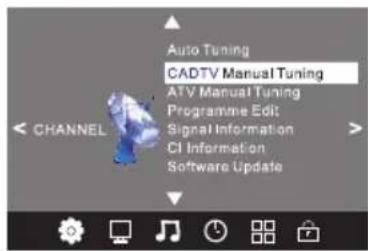
Note: If DVB-C Manual Tuning is not listed in the Channel menu, you should first select Auto Tuning, and then DVB-C.
3). The DVB-C Manual Tuning screen will pop up. Press the▼▲ buttons to select Frequency, Symbol (ks/s), QAM Type, enter the appropriate setting and then press the OK button to commence the search of that channel. When the signal has been tuned, the picture and signal strength will be displayed on the screen.
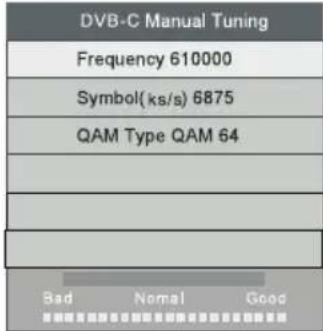
Note: if you don't press any button, the DVB-C Manual Tuning menu will disappear.
4). Press the MENU button to return back to the main menu.
5). Press the EXIT button to exit the menu.
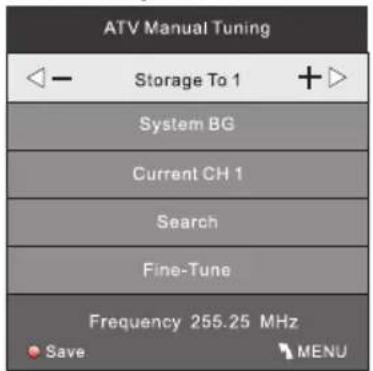
3.1 ATV Manual tuning :
Press Source button on the remote control and select ATV to search the analog TV channels and fine tune the channels, then store the channels you selected.
NOTE:
Press red button to store the channels after manual tuning.
4.1 Programme edit:
You can Delete, Rename, Move, Skip, programmes or set them as favourite.

Delete
Press red button, to delete the highlighted programme.

Rename:
Only ATV programmes can be renamed.
Move the cursor to the desired programme, press green button to rename the programme.
Press to choose the character. Press to move the cursor.
Press MENU button to exit edit, Press EXIT to exit the menu.
Note: ATV programmes name only can be 5 characters long.

Move
Use the Arrow Buttons to select the channel you wish to move. Then press the Yellow Button to select Move function. Once active, use the Arrow Buttons to move and then press OK to confirm.

Skip
Press to choose the programme, press blue button to skip this programme. The will show on the right side of the programme. To cancel the skip, choose the skipped programme and press blue button again. The will disappear.

Favourite
Press to choose the programme, press FAV button, it will show on the right side of the programme. To cancel the FAV setting, choose the favourite programme and press FAV button again.
will disappear
Once your favourite group is created, you can press the FAV key to quickly access your favourite channel.
5.1 Signal information
This menu includes information on channels, networks, modulation, quality and strength.
5.2 CI information: (optional)
This menu can display the CI card's information
5.3 Software update
This menu enables you to upgrade your software via USB, only if the manufacturer asks you to and provides you the appropriate file. Follow the on-screen prompts.
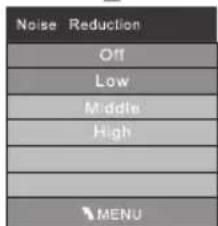
2.PICTURE MENU
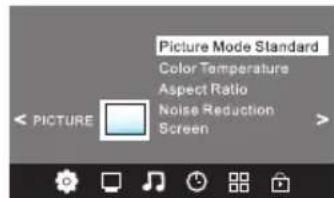
The second item of the MENU is PICTURE MENU. You can adjust picture effect here, such as contrast, brightness, etc.
Press to move, press OK to adjust.

NOTE:
1).Tint is available in NTSC system only.
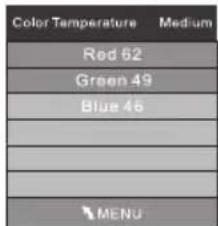
2). There are four colour temperature modes that can be selected: Medium, Warm, Cool, User.
3).Screen is available in PC mode only. You can adjust Horizontal position, vertical position, size and phase.
3.SOUND MENU
The third item of the MENU is the SOUND MENU. You can adjust the sound effect here such as treble, bass, balance etc.
Press to move, press OK to adjust.

Note:
Auto volume: only available when the input signal volume is too large or distortion.
Surround sound can be set on or off. AD switch is audiodescription functionality. SPDIF mode is the digital output sound feature.
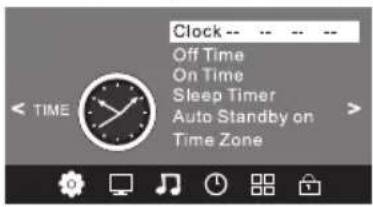
4.TIME MENU
The fourth item of the menu is the TIME MENU. You can adjust the clock, power on/off time, sleep time etc Press to move, press OK to adjust.
NOTE:
- When auto standby is on, if without signal and without action for 18 minutes, TV automatically turns to standby mode, if with signal but without action for 4 hours, TV automatically turns to standby mode. When auto standby is off, TV will always be on.
- In DTV mode, the current time depends on the broadcast station. Hence, to avoid the confusion of EPG and PVR settings, the clock function cannot be set manually.
5.OPTION MENU
The fifth item of the MENU is the OPTION MENU. You can adjust the Menu language, Audio language, Subtitle language etc.

PVR Setup
Personal Video Recording (PVR) settings (In DTV Mode only)
The PVR function allows this unit to record live digital TV (DTV) programmes, allowing for viewing on demand at any time. This function supports DTV programme recording, Time shift and playback as described below. PVR will only record when there is an external USB drive connected to the unit with sufficient memory space available. Recording can be done both manually on demand and also using Scheduled Recording.
IMPORTANT!
All USB media must be formatted in FAT32 file system or Hi Speed FS. If media, including portable HDD, are formatted in NTFS, no recording can be done on this media. All USB media must comply with USB 2.0 specifications. Maximum USB media size that can be accepted is up to 1 terabyte (1TB)
WARNING:
Ensure that no valuable information is currently stored on the disk, as the formatting process means that ALL DATA will be ERASED from the memory drive connected to the USB port.
Check & Format Media
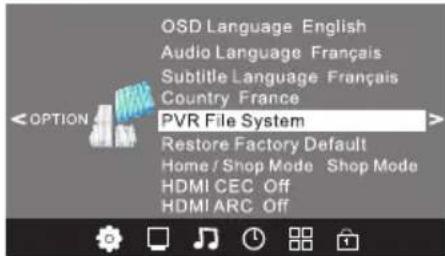
- Insert MEDIA into the USB connection on the rear panel of the TV.
- Press MENU button on the front panel to display the main menu.
- Press buttons to select the OPTION menu,then press OK buttons for the submenu.
- Press / buttons to select PVR File System and press OK to enter.
NOTE: NOT all USB devices, such as phones, MP3 players, cameras, and the like, are compatible with recording files.
- On the remote control press button to select Check PVR File System and press OK to start check.
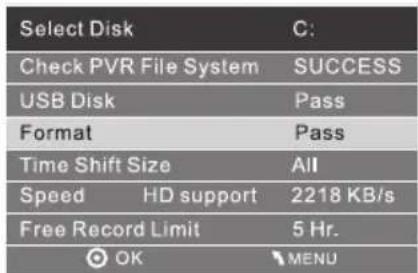
NOTE:If a compatible USB drive is attached, 'SUCCEED' will be displayed & no further action is required. Press MENU repeatedly to EXIT.
- If the USB device is found to be incompatible with your television, an additional screen will be displayed informing you that you must format your device.
Use the / to select file system. Choose the file system type:"FAT32" is best for High Speed USB storage devices.
"High Speed FS" is best for Low Speed USB storage devices.

| File System Size | |
| PVR File System Type | FAT32 |
| PVR File System Size | All |
| SD 208 Mins | |
| HD 59 Mins | |
| OK | MENU |
| File System Size | |
| PVR File System Type | Hi Speed FS |
| PVR File System Size | 4GB |
| SD 112 Mins | |
| HD 32 Mins | |
| OK | MENU |
NOTE:
1 After formatting into "FAT32" file system, you will still be able to store and share other media files on the same USB storage device.
2 Storage devices formatted in "High Speed FS" system can only be used to record video on this TV and cannot store other media files.
PVR File System Size (only if Hi Speed FS is selected)
Press the / buttons on the remote control to select PVR File System Size. Press / buttons on the remote control to select recording time from 1GB to Maximum size of USB Disk.
Note:
-
This applies only to manual (instant) recording.
-
Recording will stop once it reaches the maximum set time.
NOTE: Formatting will erase all data on the USB Drive.
Time Shift Size
After the USB storage device is formatted into FAT32 or Hi Speed FS file system, Time Shift size cannot be altered. During 'Check PVR File System' the display will show that the whole storage device space will be used for Time Shift recording, but scheduled & Manual Recording will still take priority on disk. NOTE: To change Time Shift Size disk must be formatted again.
- If disk requires formatting press OK on the remote control to start. Formatting will change the file system to FAT32 or Hi Speed FS depending on selection. This may take some time depending on the size of the USB Media connected.
NOTE:
Formating will erase all data on the USB Drive.
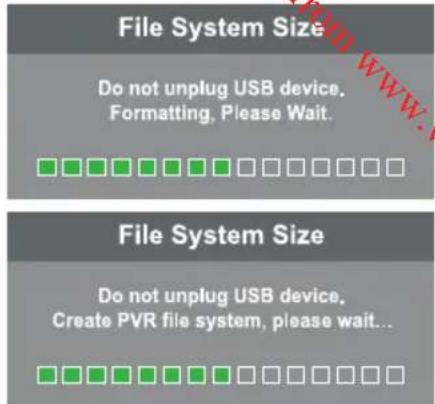
- When formatting is complete.
Press MENU button repeatedly to EXIT.
| Select Disk | C: |
| Check PVR File System Start | |
| USB Disk | |
| Format | |
| Time Shift Size | |
| Speed | |
| Free Record Limit 6 Hr. | |
| OK | MENU |
NOTE:
Restore factory default will clear all the programmes and password.
Recorded file will be saved with the TS file extension e.g. DateSHOWName.ts.
TS file extension stands for Transport Stream. It is a communications protocol for audio, video, and data which is specified in MPEG2 Part 1, Systems (ISO/IECstandard 13818-1). It is also known as ITU-T Rec.H.222.0.
Please refer to your instruction manual for recording details.
6.LOCK MENU
The sixth item of the menu is the LOCK MENU. You can lock system, set password, block programmes and set parental guidance. Once you set the lock system on, you can not search the channels.
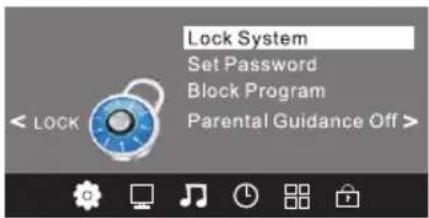
NOTE:
The default password is 6666.
If you change the password, be sure to remember the new password! If you forget the new password, enter the master password "9527".
Block program: Press to choose the programme, press green button to block the programme. If you want to unblock the programme, enter the main menu, input the password, then press green button again. Parental guidance: Press to choose rating.
7.USB
Press the source button and then select USB item to enter the USB menu.

Please make sure that the USB device is plugged in the slot. You can select between four media types: Photo, Music, Movie or Text.
Select the media type by pressing , press OK button to enter the disk selection menu.

Press the to select the right disk and press OK to display media files and folder list or choose Return to go back to the media type selection menu.

Select the media file by pressing or , then the preview frame will pop up. Press the button to play the media file in full screen. You can also select several files and add them to your playlist: press OK to tick or untick the related box, and then press the button to play the files. When the media file (photo, movie, music or text type) is playing, press the OK or Info button to display the control bar, as below:
Photo1.

Photo2.
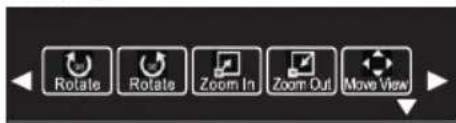
The control bar also contains the other below hidden info icon. Use the navigation keys Right Left to access other icons:
Music1:

Music2.
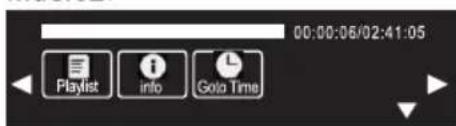
Movie1

Movie3
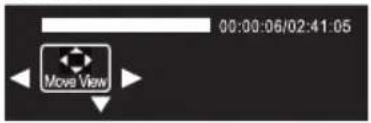
Movie2.

Text

Press to select the function icon, press OK button to confirm your selection.
Press or EXIT button to exit the control bar.
Info icons of the Control bar :
PHOTO
| Play/Pause | Play or pause the playback, press OK key again to resume playback when in PAUSE. |
| Prev. | Skip to Previous photo. |
| Next | Skip to Next photo. |
| Stop | Stop photo. |
| Repeat AI | Repeat all files, tracks etc.. |
| Music | In Photo and TEXT mode, play music. |
| Playlist | Display the multimedia files which will be played and marked on previous main page showing all available files on the USB key. Each file has red mark when you select and confirm with OK key. |
| Info | Select this icon and press OK key to display the INFO menu. |
| Rotate | Turn left 90°. |
| Rotate | Turn right 90°. |
| Zoom In | To zoom in the picture. Press OK key after selecting Zoom in to adjust as you wish. |
| Zoom Out | To zoom out of the picture. Press OK key after selecting Zoom out to adjust as you wish. |
| Move View | To move the picture view UP, DOWN, LEFT, RIGHT. To be able to move the picture view, you first have to zoom in the picture. |
Movie
| Play/Pause | Play or pause the playback, press OK key again to resume playback when in PAUSE. |
| FB | Fast Backward. |
| FF | Fast Forward. |
| Prev. | Skip to Previous track. |
| Next | Skip to Next track. |
| Stop | To stop movie. |
| RepeatAll | To Repeat all files, tracks etc.. |
| SetA | To set repeat from A to B. During playback, select A-B and press OK to repeat a certain content from start point A to ending point B. |
| Preset | Display the multimedia files which will be played and marked on previous main page showing all available files on the USB key. Each file has red mark when you select and confirm with OK key. |
| Info | Select this icon and press OK key to display the INFO menu. |
MUSIC
| Play/Pause | Play or pause the playback, press OK key again to resume playback when in PAUSE. |
| FB | Fast Backward. |
| FF | Fast Forward. |
| Prev. | Skip to Previous music. |
| Next | Skip to Next music. |
| Stop | To stop music. |
| RepeatAI | To Repeat all files, tracks etc.. |
| Mute | Mute the sound. |
| Playlist | Display the multimedia files which will be played and marked on previous main page showing all available files on the USB key. Each file has red mark when you select and confirm with OK key. |
| Info | Select this icon and press OK key to display the INFO menu. |
| Gold Time | Select this icon and press OK to confirm. This function allows you to input the go to time to reach precise time play in the file. |
Movie
| Slow Forward | When playing select this icon and press OK key to select slow speed playing. Each press on OK key will skip successively to slow speed play x 2, x 4, x 8 x 16 and resume normal speed play. |
| Step Forward | During playback select this icon and press OK key to step forward, frame by frame. Each press on OK key you will skip forward to the next frame. To resume normal play, press Play key. |
| Goto Time | Select this icon and press OK to confirm. This function allows you to input the go to time to reach precise time play in the file. |
| Zoom In | To zoom in the picture. Press OK key after selecting Zoom in to adjust as you wish. |
| Zoom Out | To zoom out the picture. Press OK key after selecting Zoom out to adjust as you wish. |
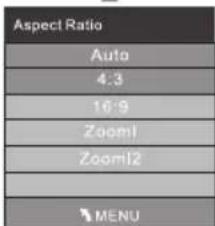
| Aspect Ratio | Display the available ratio screen per each press on OK key: following aspect ratio will be displayed successfully: 4:3, AUTO, 16:9. |
| Move View | To move the movie view UP, DOWN, LEFT, RIGHT. To be able to move the movie view, you first have to zoom in the picture. |
Text
| Prev page | Skip to previous page . |
| Next page | Skip to next page . |
| Prev. | Skip to Previous text file. |
| Next | Skip to Next text file. |
| Stop | Stop text. |
| Music | In Photo and TEXT mode, play music. |
| Playlist | Display the multimedia files which will be played and marked on previous main page showing all available files on the USB key. Each file has red mark when you select and confirm with OK key. |
| Info | Select this icon and press OK key to display the INFO menu. |
NOTE:
You can adjust the audio track, subtitle, or programme in the Info menu while playing the video file.
Choose the Info icon and press OK to display the Info menu (as follows).
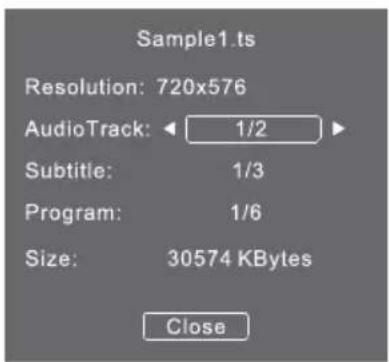
USB playback is supported for the following photo file formats:
-JPEG (files with the extension". jpg")
-BMP (files with the extension".bmp")
-PNG (files with the extension".png")
USB playback is supported for the following music file formats:
-MP3 (files with the extension".mp3")
USB playback is supported for the following text file formats:
-TXT (files with the extension".txt")
USB playback is supported for the following movie file formats:
-TS (MPEG 2 & H. 264)
8.EPG Menu(Electronic Programme Guide).
The EPG menu is used to look at what is being broadcasted on DTV or Radio channel in the day. To access the EPG menu, press the EPG button, the following menu will be displayed:
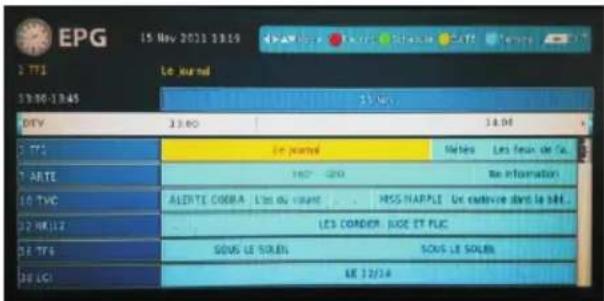
1. INFO
Use to choose the programmes, Press INFO key, you can display the highlighted programme's information.
2. Record
Press the red key, it can set the programme to be recorded.
3.Green
Press the green key, it can list all the scheduled reminders press to choose the reminder, press red key to delete the line.
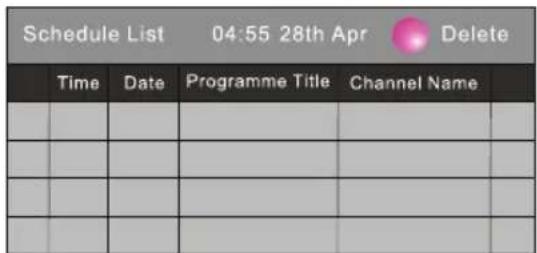
4. Date
Press the yellow key to choose date item, then use left/right key to change date.
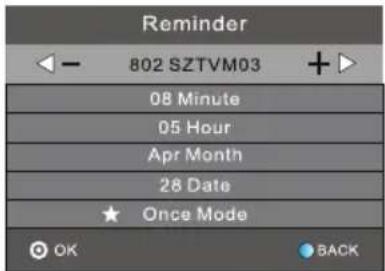
5. Remind
Press the blue key to choose one programme and set up one reminder time, the TV screen will skip to the chosen programme in the reminder time automatically.
9. Recording a programme
Record the programme:
To record the programme you are currently watching, press the REC button: a red recording icon will appear on the top left corner of the screen. To get more information, press the REC button again.
To stop recording, press the button.
Play the recording:
The programme recorded will be saved on the USB device. You can play it in USB mode.
10. Time shift recording
Press button while watching a broadcast to activate time shift mode. In time shift mode, the programme is paused and simultaneously recorded to the connected USB disk.
Press button again to resume the paused programme from where you stopped. Press the button to stop time shift recording and return to the live broadcast.
Press button to play the recording. If you press button again, point A will be determined; if you press once more, point B will be determined and the recording will repeatedly play between A and B until you press button to deactivate this setting.
Notes:
During time shift, the following icon will be displayed on the top left corner of the screen: When the time shift size is full, the playback begins automatically.
TV Troubleshooter
A check through the guide below could save you the trouble of returning your purchase or waiting for a service engineer. If you require assistance with operating this product you can phone our help line.
| Analogue TV & general | Sound | |
| Symptoms | Possible causes | What to do |
| No sound | The volume is set to minimum. The mute is switched on. | Turn the volume up. Press the mute button to release 'mute'. |
| Crackling noises or distorted sound. | Interference from cars, fluorescent lights, video recorder, a radio broadcast, personal computer or other equipment. | Turn off one piece of equipment at a time to see if the interference clears. See also what to do for picture interference. |
| Stereo switching to mono. Aweak signal or a mono broadcast. Check the signal and your aerial system. | ||
| No stereo sound from equipment connected to the scart (AV) socket. | A mono scart lead is being used to connect the television. The signal being viewed is connected through the aerial socket. | Check that the scart lead is stereo. Check the video recorder is connected to the television through an AV (scart) lead, then switch the television to AV mode. |
| Analogue TV & general | Picture | |
| Symptoms | Possible causes | What to do |
| Grainy (snowy) picture | CI disconnected. Your video recorder could be faulty. Transmitter trouble. The outside aerial has moved, or is damaged. | If you have a video recorder try plugging the aerial directly into the television. If the fault clears, the video recorder is probably faulty. Have your aerial system checked. |
| Extra outlines on objects in the picture (ghosts). | The aerial is receiving reflected signals from hills or buildings. Faulty aerial system. | Try to tune in a better signal from the same television station. Get your aerial system checked. |
| Picture interference like spots or streaks. | Weak aerial signal. Interference from electrical equipment such as power tools and motors. Settings for the digital video equipment output do not match the monitors VGA or DVI input specifications. | Try to tune in a better signal from the same television station. Get your aerial system checked. Move the interfering equipment further away or if possible, turn it off. Change the refresh rate or resolution settings on the digital equipment, if possible. |
| Picture is the wrong size or the source device (computer, DVD player, set top box and so on) will not let you set up the pixel resolution the display can reproduce. | Source device has not read the set-up data from the display. Connecting cable does not have all the necessary connections. | Avoid old cables and adapter devices. Use only modern cables. Re-start the source device after connecting and powering up the display. Change the graphics adapter in your computer. Check compatible video resolutions given in these instructions. |
| Picture looks squashed or stretched even though the aspect ratio controls are set correctly (for example 4:3 or 16:9). | Equipment feeding the display is set to the wrong aspect ratio. | On the equipment feeding the TV choose the correct output aspect ratio such as 4:3 or 16:9 to match the TV. On digital equipment you might choose 1280 x 960 pixels to match 4:3 screens or 1280 x 768 pixels to match screens.16:9 |
| Picture interference like wavy lines or patterns. Sound or colour interference may also be present. | Some other equipment is using the same frequency. Poor quality cable in the path between the TV and the TV aerial. Your aerial system is receiving an unwanted signal on the same frequency. | Put other equipment on stand-by to see if the interference stops: change the output frequency of the equipment that is causing interference(see its instructions). Get higher quality cable. Get your aerial system checked. |
| No picture. Brightness and contrast levels are set to minimum. | Increase the brightness and contrast settings. | |
| Jumbled teletext characters | Poor quality signal | As for 'Snowy picture' and 'Ghosts' |
| When RGB input is used there is a distorted picture or no picture. | Synchronisation signal is missing. | Press the AV button to select the AV input which receives the synchronisation signal. |
| Analogue TV & general Sound | ||
| Symptoms Possible causes | What to do | |
| Television seems 'dead' - no lights come on and nothing works. | Mains supply missing. Main power switch is off. | Make sure it is not a general power cut. |
| The stand-by light is on but the buttons don't seem to work. | Blown fuse or circuit breaker. Try the front panel STANDBY/ON button: if TV comes on then check "The remote does not function". | Check the power switches on the television and at the power outlet. Check the fuse or circuit breaker at your main fuse box. Look for a possible cause of failure before you replace or re-set it. Disconnect power supply, wait five minutes and try front panel STANDBY/ON. If still no good, disconnect power supply and assume the unit is faulty. |
| Local function buttons do not work. Stuck on stand-by. | Micro-controller confused by electrical disturbance. | Switch off mains power and wait 10 minutes before trying again. (Leave the TV unplugged and call a service engineer if this does not work.) |
| Analogue TV & general | Remote | |
| Wrong functions or short range. | Batteries run down. Obstacle in the way. | Insert new batteries Remove any objects and aim from straight in front of the remote sensor with a clear line of sight. |
Digital Terrestrial TV Troubleshooter
| Symptoms Possible causes | What to do | |
| Picture blocking or freezing. Sound breaking up. | Weak signal or wrong type of aerial. | Try re-tuning.Aerial may not be suitable for digital TV broadcasts.You may be in a place which does not get a good digital TV signal.Get an aerial rigger to check the aerial system. |
| Some channels are missing. | Not receiving one or more digital multiplex frequencies. | |
| Any or all of the above faults. | Interference or other problem caused by passing aerial signal through other equipment. | Try connecting the aerial directly to the digital TV receiver and then re-tuning.If some equipment has a radio frequency modulator, switch it off or change the frequency of it and re-tune the analogue TV. (Please see other equipments instructions for how to do this.) |
Multiplex
DVB-T (Digital Video Broadcasting - Terrestrial) is broadcast in groups of channels on one common frequency. This arrangement is known as a Multiplex.
There are several multiplexes in the DVB-T system, each carrying a group of channels.
If the signal level on a particular multiplex frequency is poor you may lose the whole group of channels on that multiplex.
Computer Monitor TV and HDMI Troubleshooter
| Sound | ||
| Symptoms Possible causes | Possible solutions | |
| No sound | HDMI input is being fed through a conversion connector from equipment with a DVI output. | Connect sound output from the DVI equipment to an external amplifier. |
| Picture | ||
| Symptoms | Possible causes Possible solutions | |
| No picture. On-screen message indicates video input is not compatible. | Settings for the digital video equipment feeding the TV do not match the TV input requirements. | Change the refresh rate or resolution settings of the computer graphics adaptor or other digital equipment. |
| Computer feeding the TV does not offer you suitable settings to match the TV requirements. | Computer has not exchanged information with the television. In older computers, the graphics adaptor might be obsolete. | Re-start the computer while the television is still connected to the power supply, then try again. In exceptional cases, you may need to go into the computer graphics adaptor settings and clear the check box for Show only settings this monitor can support. For Microsoft Windows this can be found by right-clicking on the Desktop and following Properties - Display Properties - Settings - advanced tab Monitor tab. The availability of this function and the method of adjustment varies with computer operating system. Upgrade your graphics adaptor. |
| Picture is not clear. Picture is in the wrong position. | Television needs to be set up for the computer analogue RGB input (also known as VGA - or - sub). Some input resolutions produce a clearer picture than others. | For computer analogue RGB input (also known as VGA-or D-sub-, activate the automatic set-up function. The phase, frequency, vertical and horizontal position controls might also need slight adjustment. Check information in the computer monitor section of these instructions and try a different resolution setting. |
| Picture looks squashed or stretched. | the wrong aspect ratio. Equipment feeding the TV is set to | For a TV with a computer monitor function fed from the computer analogue RGB connector (also known as VGA or D-sub, set up the computer graphics adaptor resolution to have the same aspect ratio as the TV screen. (Aspect ratio means the ratio of width to height, which in this case is measured in pixels.) |
Important Disposal Instructions
As a responsible retailer we care about the environment.
As such we urge you to follow the correct disposal procedure for the product, packaging materials and if applicable, accessories and batteries. This will help conserve natural resources and ensure that the materials are recycled in a manner that protects health and the environment.
You must follow laws and regulations about disposal. Waste electrical products and batteries must be disposed of separately from household waste when the product reaches the end of its life.
Contact the store where you bought the product and your local authority to learn about disposal and recycling.
The batteries must be disposed of at your local recycling point. See the operating instructions to find out how to remove the batteries for disposal.

Product fiche
(Model: B4028FHD LED)
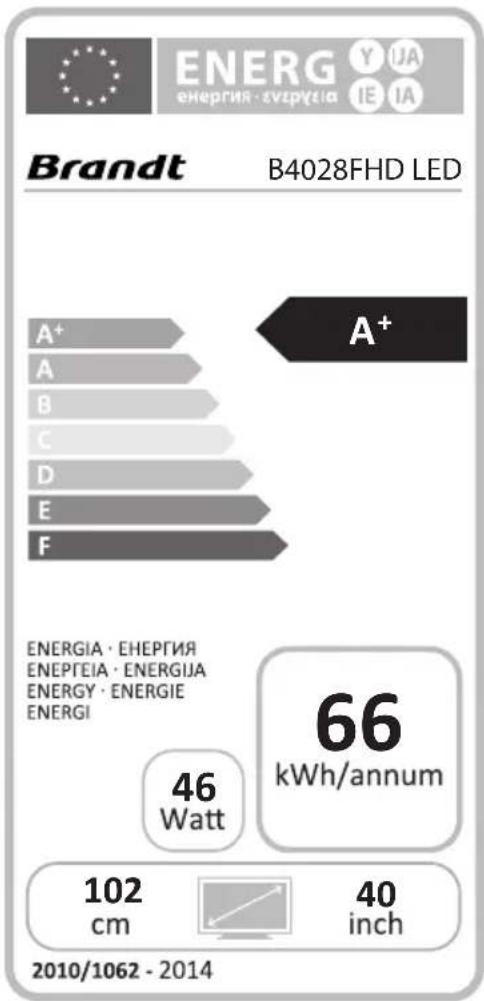
| Standby power consumption (approx.) | < 0.50W |
| Screen resolution | 1920x1080 pixels |
We apologise for any inconvenience caused by minor inconsistencies in these instructions, which may occur as a result of product improvement and development.
Index
USB, HDMI2, HDMI1(ARC), CASQUE, CI, PC AUDIO, VGA, RF.
Remarque
Loosen the screws Insert the feeder in wires Tighten the screws
Remarque:
| File System Size | |
| PVR File System Type | Hi Speed FS |
| PVR File System Size | 4GB |
| SD 112 Mins | |
| HD 32 Mins | |
| OK | MENU |
REMARQUE:
USB, HDMI2, HDMI1(ARC), HEADPHONE, CI, PC AUDIO, VGA, RF.
Loosen the screws Insert the feeder in WiRs Tighten the screws
Opmerking:
Downloaded from www.vandenbore.be

- Safety Information
- Cleaning
- Mains Supply
- CAUTION
- INSTALLATION
- Main features
- Main parameter
- Base Stand Assembly Instruction
- How to attach the stand
- NOTE:
- Dismantling the stand
- Notes when mounting the TV on a wall
- Front panel
- KEY BOARD
- REAR AV Connections
- REAR AV Connections(SIDE)
- HDMI ARC (Audio Return Channel)
- To enjoy the ARC function:
- PC
- STEPS:
- ANTENNA
- AV EQUIPMENT
- REMOTE CONTROL
- TELETEXT
- Installation Guide
- HOME or SHOP modes
- 1.CHANNEL MENU
- Auto Tuning (DVB-T)
- Auto Tuning (DVB-C)
- DTV Manual Tuning (DVB-T)
- DTV Manual Tuning (DVB-C)
- ATV Manual tuning :
- Programme edit:
- Delete
- Rename:
- Move
- Skip
- Favourite
- will disappear
- Signal information
- CI information: (optional)
- Software update
- 2.PICTURE MENU
- 3.SOUND MENU
- 4.TIME MENU
- 5.OPTION MENU
- PVR Setup
- IMPORTANT!
- WARNING:
- Check & Format Media
- Time Shift Size
- 6.LOCK MENU
- 7.USB
- Photo1.
- Photo2.
- Music1:
- Music2.
- Movie1
- Movie3
- Movie2.
- Text
- Info icons of the Control bar :
- PHOTO
- Movie
- MUSIC
- 8.EPG Menu(Electronic Programme Guide).
- INFO
- Record
- 3.Green
- Date
- Remind
- Recording a programme
- Record the programme:
- Play the recording:
- Time shift recording
- Notes:
- TV Troubleshooter
- Digital Terrestrial TV Troubleshooter
- Multiplex
- Important Disposal Instructions
- Product fiche
- Index
- REMARQUE:
Brand : BRANDT
Model : B4028FHDLED
Category : Television