110.44422 - Washing machine KENMORE - Free user manual and instructions
Find the device manual for free 110.44422 KENMORE in PDF.


User questions about 110.44422 KENMORE
0 question about this device. Answer the ones you know or ask your own.
Ask a new question about this device
Download the instructions for your Washing machine in PDF format for free! Find your manual 110.44422 - KENMORE and take your electronic device back in hand. On this page are published all the documents necessary for the use of your device. 110.44422 by KENMORE.
USER MANUAL 110.44422 KENMORE
Toronto, Ontario, Canada M5B 2C3
www.sears.ca

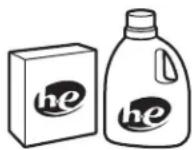
Designed to use only HE High Efficiency detergents.
USING YOUR WASHER 16
WASHER MAINTENANCE 19
TROUBLESHOOTING 21
PROTECTION AGREEMENTS 26
WARRANTY 26
ASSISTANCE OR SERVICE. Back Cover
WASHER SAFETY
Your safety and the safety of others are very important.
We have provided many important safety messages in this manual and on your appliance. Always read and obey all safety messages.

This is the safety alert symbol.
This symbol alerts you to potential hazards that can kill or hurt you and others.
All safety messages will follow the safety alert symbol and either the word "DANGER" or
"WARNING." These words mean:
DANGER
WARNING
You can be killed or seriously injured if you don't immediately follow instructions.
You can be killed or seriously injured if you don't follow instructions.
All safety messages will tell you what the potential hazard is, tell you how to reduce the chance of injury, and tell you what can happen if the instructions are not followed.
IMPORTANT SAFETY INSTRUCTIONS
WARNING: To reduce the risk of fire, electric shock, or injury to persons when using the washer, follow basic precautions, including the following:
Read all instructions before using the washer.
- Do not wash articles that have been previously cleaned in, washed in, soaked in, or spotted with gasoline, dry-cleaning solvents, other flammable, or explosive substances as they give off vapors that could ignite or explode.
- Do not add gasoline, dry-cleaning solvents, or other flammable, or explosive substances to the wash water. These substances give off vapors that could ignite or explode.
Under certain conditions, hydrogen gas may be produced in a hot water system that has not been used for 2 weeks or more. HYDROGEN GAS IS EXPLOSIVE. If the hot water system has not been used for such a period, before using the washing machine, turn on all hot water faucets and let the water flow from each for several minutes. This will release any accumulated hydrogen gas. As the gas is flammable, do not smoke or use an open flame during this time. SAVE THIS
- Do not allow children to play on or in the washer. Close supervision of children is necessary when the washer is used near children.
Before the washer is removed from service or discarded, remove the door or lid. - Do not reach into the washer if the drum, tub or agitator is moving.
- Do not install or store the washer where it will be exposed to the weather.
Do not tamper with controls. - Do not repair or replace any part of the washer or attempt any servicing unless specifically recommended in this manual or in published user-repair instructions that you understand and have the skills to carry out.
See "Electrical Requirements" located in the installation instructions for grounding instructions.
SAVE THESE INSTRUCTIONS
State of California Proposition 65Warnings:
WARNING: This product contains one or more chemicals known to the State of California to cause cancer.
WARNING: This product contains one or more chemicals known to the State of California to cause birth defects or other reproductive harm.
INSTALLATION REQUIREMENTS
Tools and Parts
Gather the required tools and parts before starting installation. The parts supplied are in the washer basket.
Portable Installation
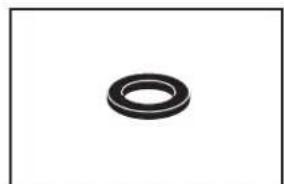
Parts supplied:
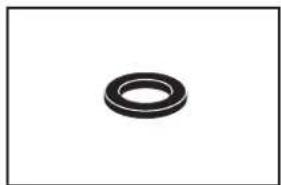
Flat washers for faucet adapter and fill hoses
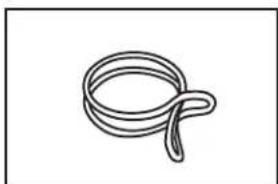
Silver, double-wire hose clamp (for bottom of drain hose)
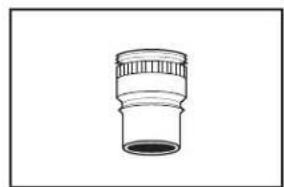
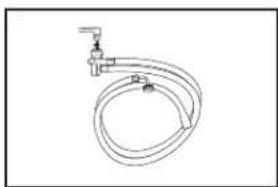
Faucet adapter Fill-and-drain hose
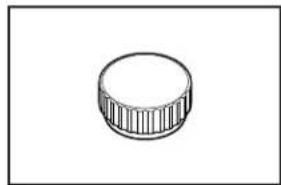
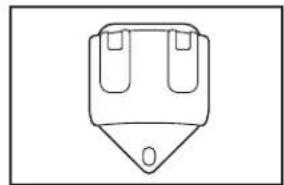
Hose bracket Valve cap
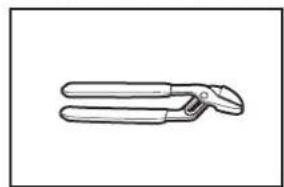
Tools needed for installation:
Pliers that open to 1 ‰ '' (3.95 cm)
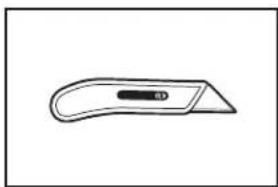
Utility knife
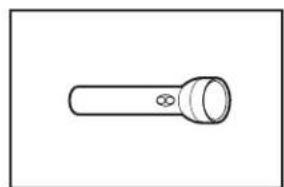
Flashlight (optional)
Permanent Installation
Parts needed (not provided with washer):
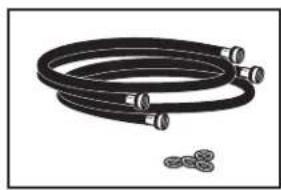
Inlet hoses with flat washers
NOTE: Replace inlet hoses after 5 years of use to reduce the risk of hose failure. Record hose installation or replacement dates for future reference.
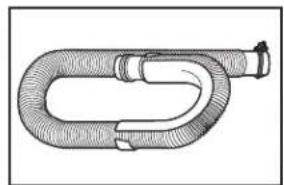
Parts supplied:
Drain hose with clamp
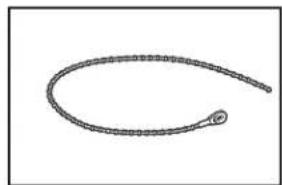
Cable tie
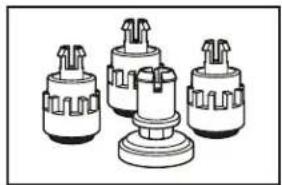
Leveling feet
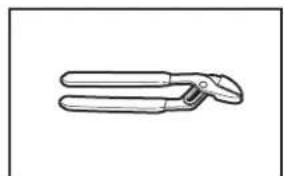
Tools needed for installation
Pliers that open to 1 ‰ '' (3.95 cm)
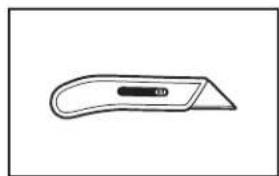
Utility knife
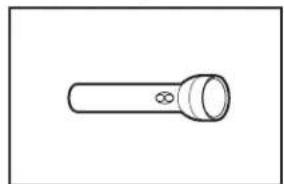
Flashlight (optional) Adjustable
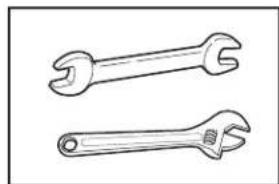
wrench % " (14 mm)
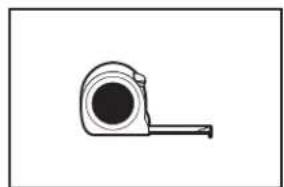
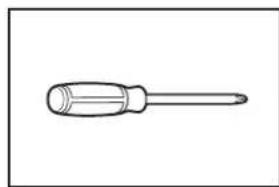
Measuring tape Phillips screwdriver
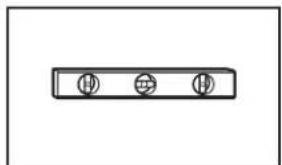
Level
Alternate Parts
Your installation may require additional parts. For information on ordering, please refer to the back cover of this manual.
| If You Have: You Will Need to | Buy: |
| Laundry tub or standpipe taller than 72" (183 cm) | Sump pump system(if not already available) |
| 1" (2.5 cm) diameter standpipe | 2" (5 cm) diameter to 1" (2.5 cm) diameter standpipe adapter,Part Number 3363920 |
| Overhead sewer Standard 20 g | al. (76 L)39" (990 mm) tall drain tub or utility sink, sump pump, and connectors (available from local plumbing suppliers) |
| Floor drain Siphon break, Part Number 285320; additional drain hose, Part Number 3357090 and connector kit,Part Number 285442 | |
| Water faucets beyond reach of fill hoses | 2 longer water fill hoses:6 ft (1.8 m)Part Number 7631410 ft (3.0 m)Part Number 350008 |
| Drain hose too short Drain hose | Part Number388423 and hose kit,Part Number 285442 |
| Drain hose that is too long Hose kit, Part Number 285442 | |
| Lint clogged drain Drain protector,Part Number 367031 | |
Location Requirements
Selecting the proper location for your washer improves performance and minimizes noise and possible washer "walk." Your washer can be installed in a basement, laundry room, closet, or recessed area. See "Drain System."
Washer Dimensions
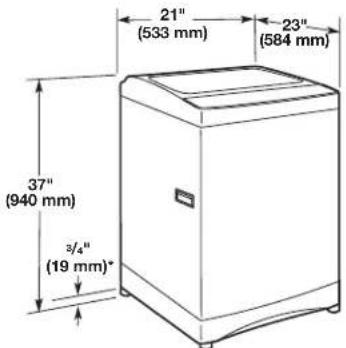
*Minimum measurement with leveling feet installed.
IMPORTANT: Do not install or store the washer where it will be exposed to the weather.
Proper installation is your responsibility.
You will need:
A water heater set to deliver 120^ (49^) water to the washer.
A grounded electrical outlet located within 5 ft (1.5 m) of where the power cord is attached to the back of the washer. See "Electrical Requirements."
Hot and cold water faucets located within 312 ft (1.1 m) of the hot and cold water fill valves, and water pressure of 5-100 psi (34.5-690 kPa).
A level floor with a maximum slope of 34 (1.9 cm) under entire washer. Installing the washer on carpeting is not recommended.
A sturdy floor to support the washer weight (washer, water, and load) of 225 lbs (102 kg).
Do not store or operate your washer in temperatures at or below 32^ (0^) . Some water can remain in the washer and can cause damage in low temperatures. See "Washer Care" for winterizing information.
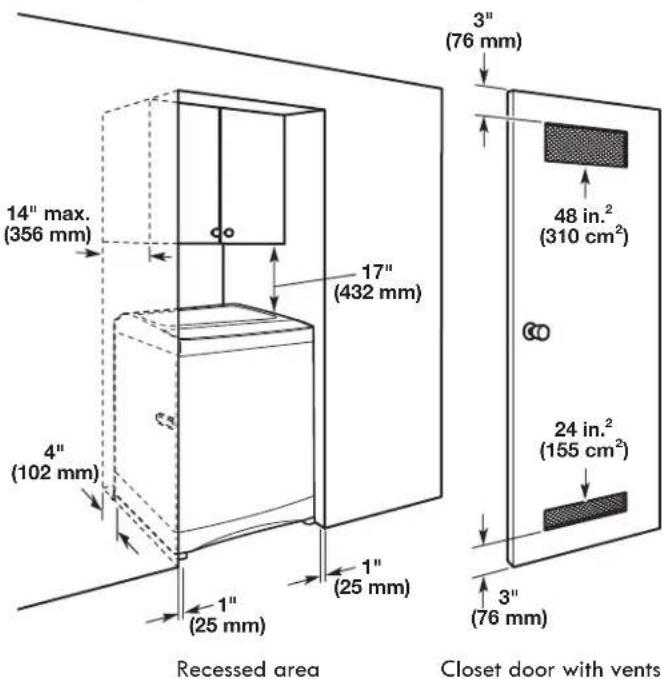
Recessed area or closet installation
The dimensions shown are for the recommended spacing allowed, except the closet door ventilation openings. The dimensions shown for the closet door ventilation openings are the minimum required.
Additional spacing should be considered for ease of installation and servicing.
Additional clearances may be required for wall, door, and floor moldings.
Additional spacing of 1^ (2.5 cm) on all sides of the washer is recommended to reduce noise transfer.
If a closet door is installed, the minimum air openings in the top and bottom of the door are required. Louvered doors with air openings in the top and bottom are acceptable.
Companion appliance spacing should also be considered.
Washer Only
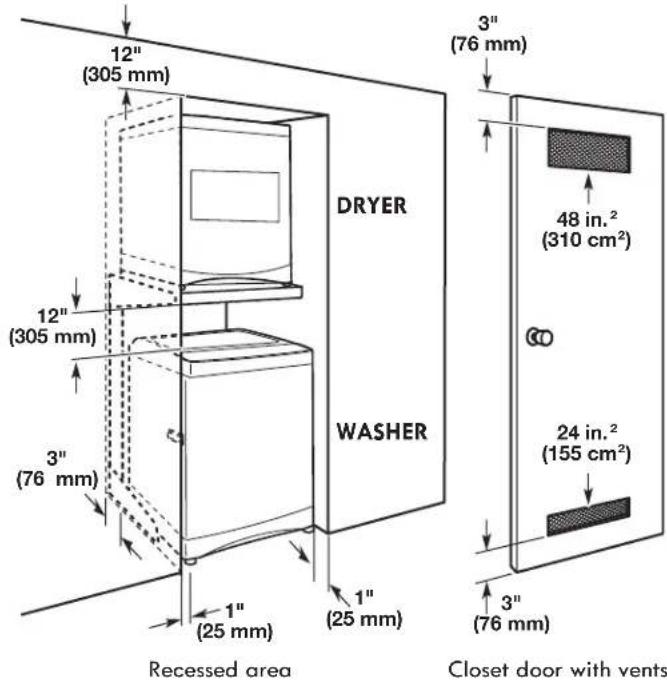
Stacked
Electrical Requirements
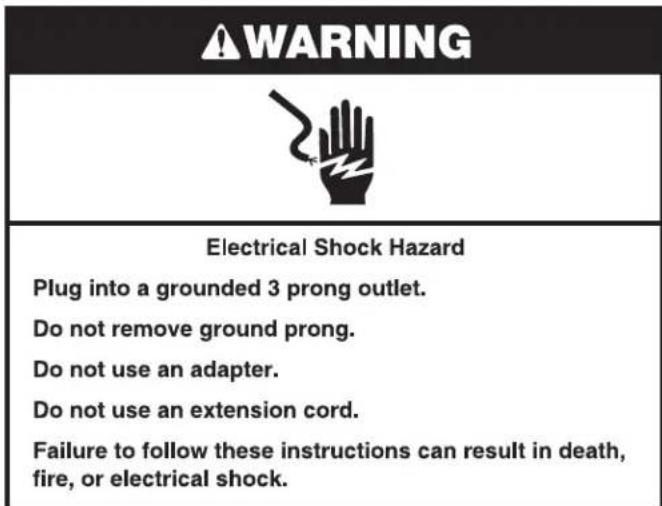
WARNING

Electrical Shock Hazard
Plug into a grounded 3 prong outlet.
Do not remove ground prong.
Do not use an adapter.
Do not use an extension cord.
Failure to follow these instructions can result in death, fire, or electrical shock.
A 120-volt, 60 Hz., AC-only, 15- or 20-amp, fused electrical supply is required. A time-delay fuse or circuit breaker is recommended. It is recommended that a separate circuit serving only this appliance be provided.
This washer is equipped with a power supply cord having a 3 prong grounding plug.
To minimize possible shock hazard, the cord must be plugged into a mating, 3 prong, grounding-type outlet, grounded in accordance with local codes and ordinances. If a mating outlet is not available, it is the personal responsibility and obligation of the customer to have the properly grounded outlet installed by a qualified electrician.
If codes permit and a separate ground wire is used, it is recommended that a qualified electrician determine that the ground path is adequate.
Do not ground to a gas pipe.
Check with a qualified electrician if you are not sure the washer is properly grounded.
Do not have a fuse in the neutral or ground circuit.
GROUNDING INSTRUCTIONS
For a grounded, cord-connected washer:
This washer must be grounded. In the event of a malfunction or breakdown, grounding will reduce the risk of electrical shock by providing a path of least resistance for electric current. This washer is equipped with a cord having an equipment-grounding conductor and a grounding plug. The plug must be plugged into an appropriate outlet that is properly installed and grounded in accordance with all local codes and ordinances.
WARNING: Improper connection of the equipment-grounding conductor can result in a risk of electric shock. Check with a qualified electrician or serviceman if you are in doubt as to whether the appliance is properly grounded.
Do not modify the plug provided with the appliance - if it will not fit the outlet, have a proper outlet installed by a qualified electrician.
For a permanently connected washer:
This washer must be connected to a grounded metal, permanent wiring system, or an equipment grounding conductor must be run with the circuit conductors and connected to the equipment-grounding terminal or lead on the appliance.
Remove Shipping Material
Before you install your washer, remove all shipping material.
WARNING
Excessive Weight Hazard
Use two or more people to move and install washer. Failure to do so can result in back or other injury.
To avoid damaging floor, use a large flat piece of cardboard from the washer carton. Place cardboard under entire back of the washer.
Firmly grasp the body of the washer and gently lay it on the corner posts.
Remove plastic foam packaging from underneath the washer. Stand the washer up.
Remove tape from washer lid. Open washer lid and remove foam shipping piece, parts bag, and hoses from washer basket. Close the lid.
Drain System
The washer can be installed using the standpipe drain system (floor or wall), the laundry tub drain system, or the floor drain system. Select the drain hose installation method you need. See "Tools and Parts."
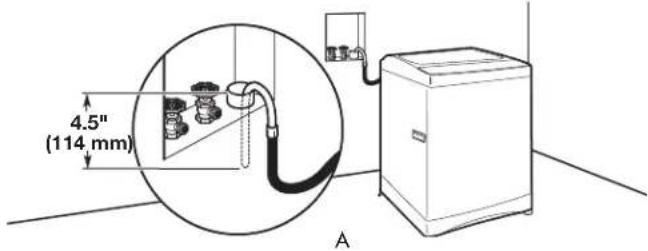
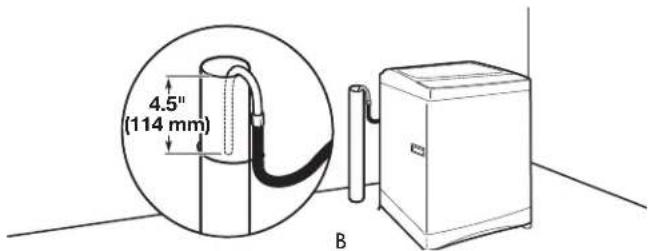
Standpipe drain system - wall or floor (views A & B)
The standpipe drain requires a minimum diameter standpipe of 2^ (50 mm). The minimum carry-away capacity (for permanent installations) can be no less than 17 gal. (64.5 L) per minute.
The top of the standpipe must be at least 39'' (990 mm) high and no higher than 72'' (183 cm) from the bottom of the washer.
Laundry tub drain system (view C)
The laundry tub requires a minimum carry-away capacity of 17 gal. (64.5 L) per minute (for permanent installations).
The top of the laundry tub must be at least 39'' (990 mm) above the floor and no higher than 72'' (183 cm) from the bottom of the washer.
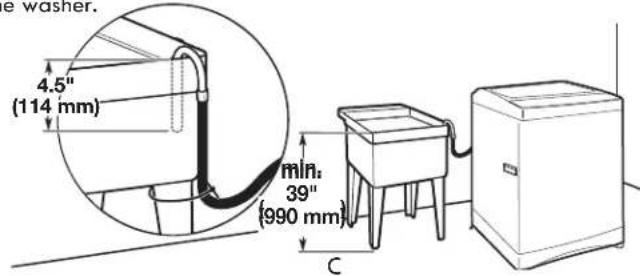
PERMANENT INSTALLATION INSTRUCTIONS
WARNING
Excessive Weight Hazard
Use two or more people to move and install washer.
Failure to do so can result in back or other injury.
To avoid damage to the floor, set the washer onto cardboard before moving across floor.
Move the washer to within approximately 3 ft (900 mm) of the final location.
Connect Drain Hose
1. Attach drain hose to drain port
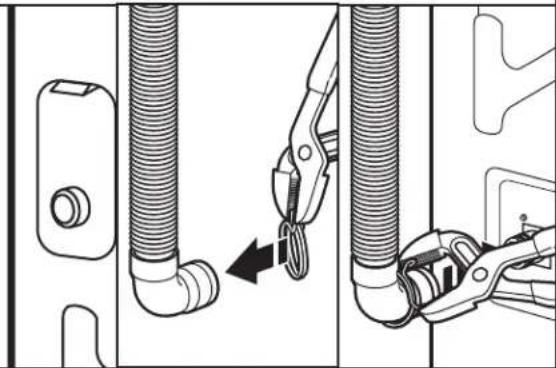
If clamp is not already in place on elbow end of drain hose, slide it over end as shown. Squeeze clamp with pliers and slide black elbow end of drain hose onto black drain port and secure with clamp.
For a laundry tub or standpipe drain, go to step 2.
For a floor drain, remove the preinstalled drain hose form as shown in Step 3.
Install Drain Hose
2. Place drain hose in standpipe
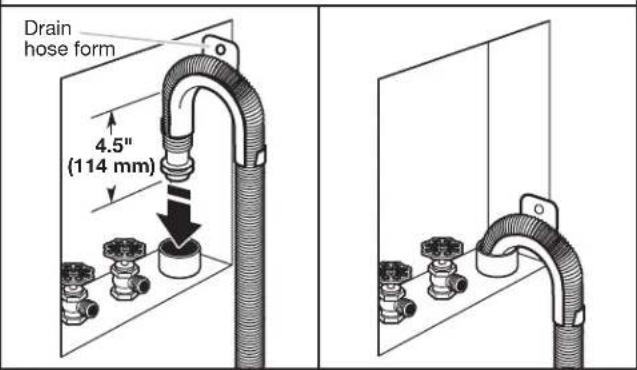
Place hose into standpipe (shown in picture) or over side of laundry tub.
IMPORTANT: 4.5'' (114 mm) of drain hose should be inside standpipe; do not force excess hose into standpipe or lay on bottom of laundry tub. Drain hose form must be used.
Connect Inlet Hoses
The washer must be connected to the water faucets using new inlet hoses (not provided). Do not use old hoses.
3. Insert new flat washers into inlet hoses

Coupling Washer
Insert new flat washers (not provided) into each end of the inlet hoses. Firmly seat the washers in the couplings.
4. Connect inlet hoses to water faucets
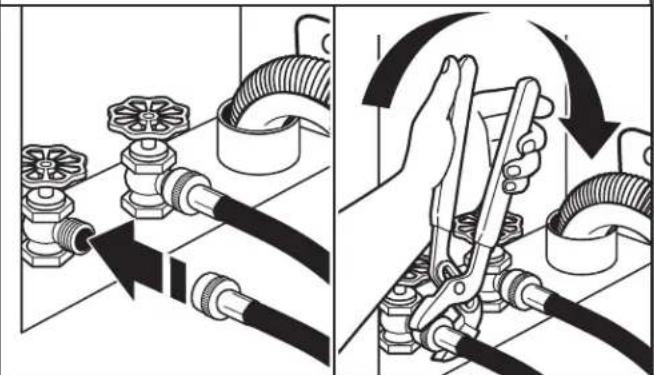
Check that the washer basket is empty.
Attach hose to hot water faucet. Screw on coupling by hand until it is seated on washer. Use pliers to tighten couplings an additional 2/3 turn. Repeat this step with second hose for cold water faucet.
IMPORTANT: Do not overtighten or use tape or sealants on valve when attaching to faucets or washer. Damage can result.
5. Clear water lines
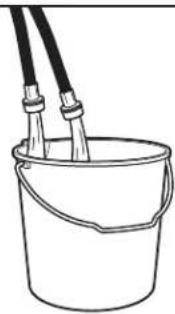
Run water for a few seconds through hoses into a laundry tub, drainpipe, or bucket to avoid clogs. Water should run until clear. Make note of which hose is connected to hot water to help in attaching hoses to washer correctly.
6. Connect inlet hoses to washer
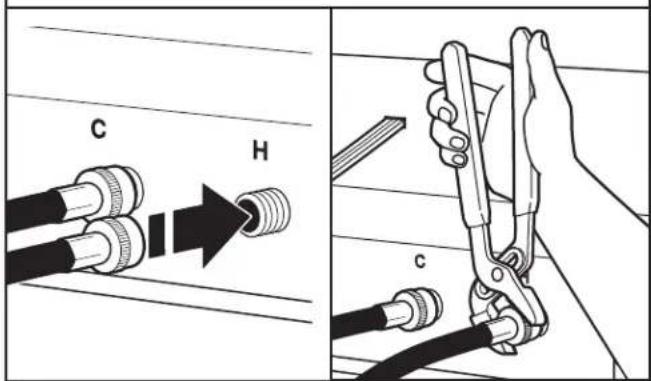
Remove inlet cap and attach hot water hose to hot water (right) inlet valve. Screw coupling by hand until it is snug. Use pliers to tighten couplings an additional 2/3 turn. Repeat with cold water (left) inlet valve.
IMPORTANT: To reduce risk of hose failure, replace the hoses every 5 years. Record hose installation or replacement dates for future reference.
Periodically inspect and replace hoses if bulges, kinks, cuts, wear, or leaks are found.
7. Check for leaks
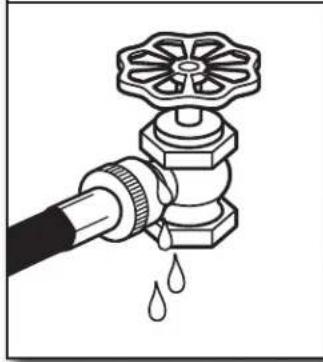
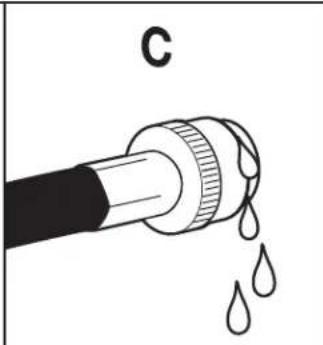
Turn on water faucets to check for leaks. A small amount of water may enter washer. It will drain later.
If you connect only one water hose, you must cap (supplied) off the remaining water inlet port.
Secure Drain Hose
8. Secure drain hose to laundry tub, standpipe or wall
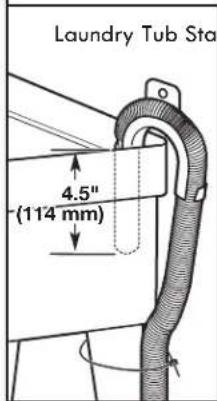
ndpipe Wall
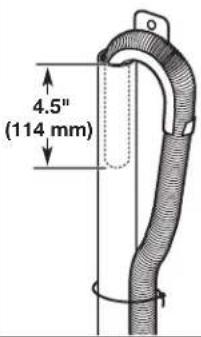
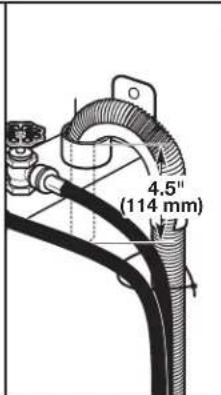
Secure drain hose to laundry tub leg, drain standpipe, or inlet hoses for wall standpipe with cable tie (provided).
- Do not force excess drain hose back into the rear of the washer.
To avoid siphoning, do not seal or put more than 412 (114 mm) of the drain hose into drainpipe or standpipe.
Install Leveling Feet - Optional (for permanent installation only)
IMPORTANT: Installation of the leveling feet is permanent. Once the leveling feet are installed into the base of the washer, they cannot be removed and the washer wheels will no longer be able to roll.
WARNING
Excessive Weight Hazard
Use two or more people to move and install washer.
Failure to do so can result in back or other injury.
9. Install leveling feet
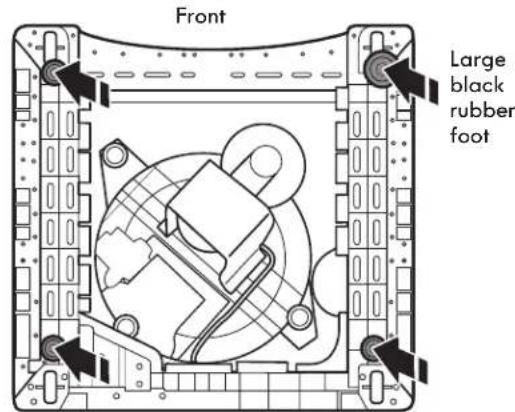
Lay washer on its back. Push in to snap the large black rubber foot into the right front corner of the washer base. Repeat to install the remaining leveling feet on the other 3 corners.
Level the Washer
IMPORTANT: Level washer properly to reduce excess noise and vibration.
For Permanent Installations:
10. Check levelness of washer
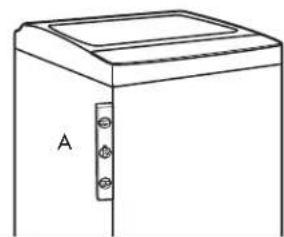
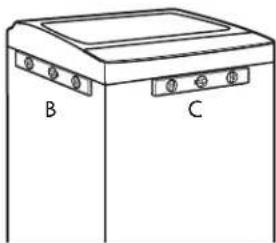
Move the washer to its final location. Place a level even with top edges of washer (B). Use side seam as a guide to check levelness of sides (A). Check levelness of front using lid, as shown (C). Rock washer back and forth to make sure all 4 feet make solid contact with floor.
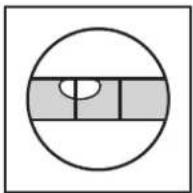
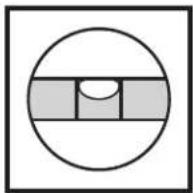
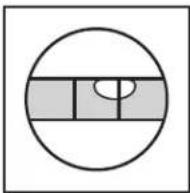
Not Level LEVEL Not Level
11. Adjust leveling foot
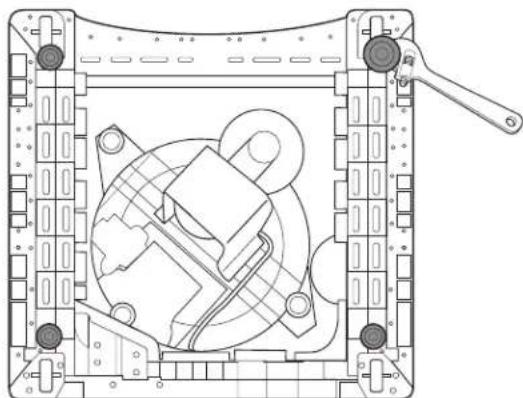
If the washer is not level, lay washer on its back to adjust the large black rubber leveling foot. If the washer is against a wall, move the washer out slightly before laying on its back.
Use a crescent wrench to adjust the large black rubber leveling foot up or down as necessary.
NOTE: The 3 smaller leveling feet are not adjustable.
For Portable Installations:
Check the levelness of the floor. If floor is not level, move washer to a level floor area.
WARNING

Electrical Shock Hazard
Plug into a grounded 3 prong outlet.
Do not remove ground prong.
Do not use an adapter.
Do not use an extension cord.
Failure to follow these instructions can result in death, fire, or electrical shock.
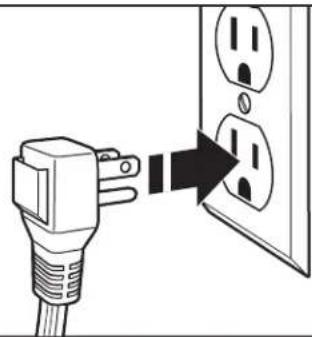
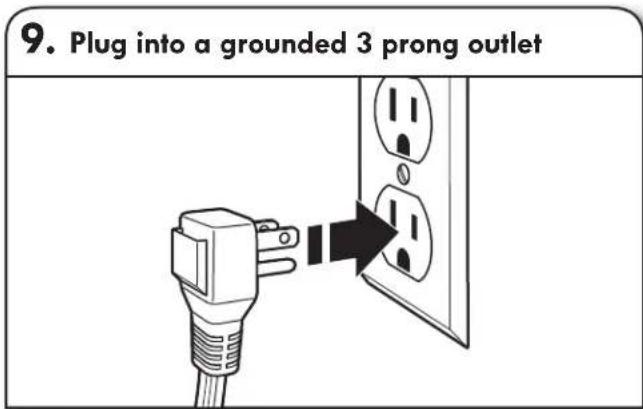
12. Plug into a grounded 3 prong outlet
Complete Installation Checklist
Check electrical requirements. Be sure you have correct electrical supply and recommended grounding method.
Check that all parts are now installed. If there is an extra part, go back through steps to see what was skipped.
Check that you have all of your tools.
Check that shipping materials were completely removed from washer.
Check that water faucets are on.
Check for leaks around faucets and inlet hoses.
Remove protective film from console and any tape remaining on washer.
Check that washer is plugged into a grounded 3 prong outlet.
Dispos of/recycle all packaging materials.
Read "Washer Maintenance."
To test and clean your washer, measure 12 of normal recommended amount of powdered or liquid detergent and pour it into washer basket or detergent dispenser (on some models). Close lid. Select any cycle. Start washer and allow to complete full cycle.
PORTABLE INSTALLATION INSTRUCTIONS
Drain System
The washer must drain into a sink or laundry tub with a carry-away capacity of 17 gal. (64.5 L) per minute (for portable installations). The top of the tub must be at least 27^ (686 mm) above floor and no higher than 48^ (121.9 cm) from the bottom of the washer.
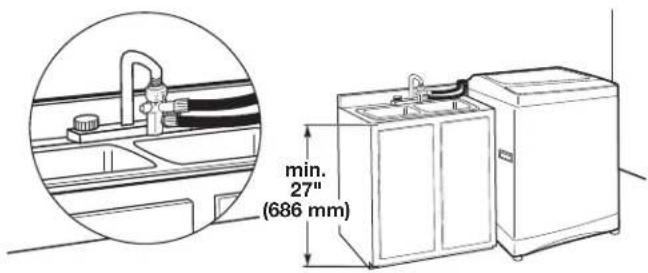
1. Attach hose bracket
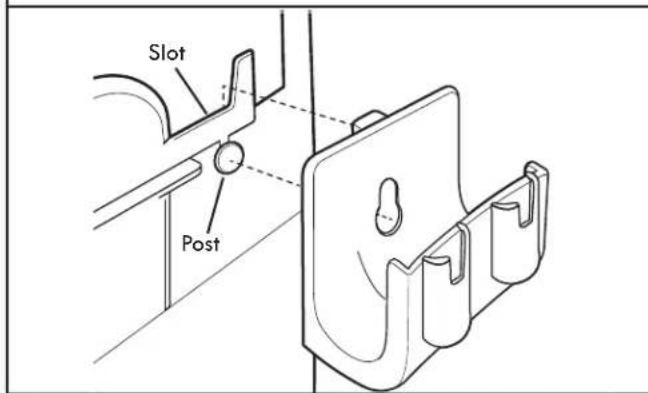
Place the hose bracket over the post on the back of the washer and position the tab so it will insert into the slot. Push down to lock into place.
Connect Fill-And-Drain Hose
Proper connection of the fill-and-drain hose will protect your floors from damage due to water leakage.
2. Insert new flat washer into inlet hose
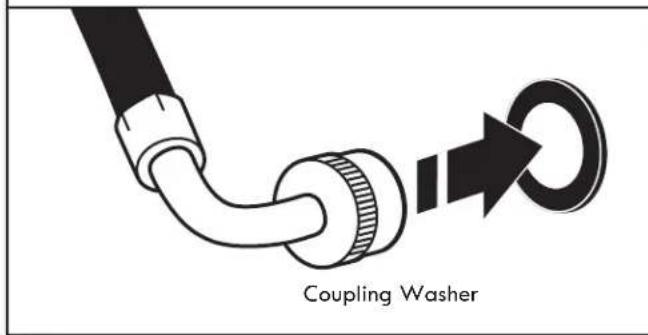
Insert new flat washer (supplied) into the end of the inlet hose. Firmly seat the washer in the coupling.
3. Connect fill hose
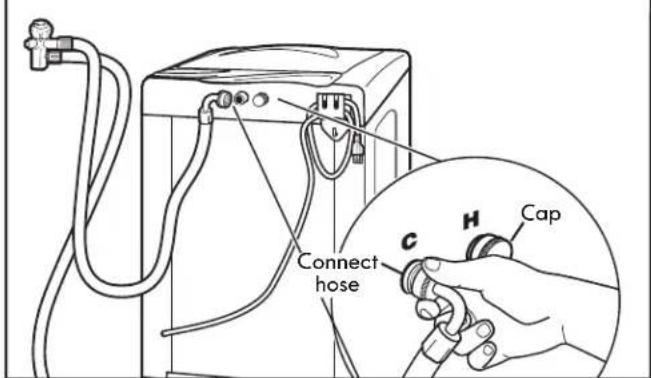
Attach the fill hose to the cold water (left) inlet valve. Tighten coupling by hand. Use pliers to make an additional 2/3 turn.
NOTE: Do not overtighten. Damage to the valves can result. Hot water (right) inlet valve is capped. Leave this valve capped.
4. Connect drain hose
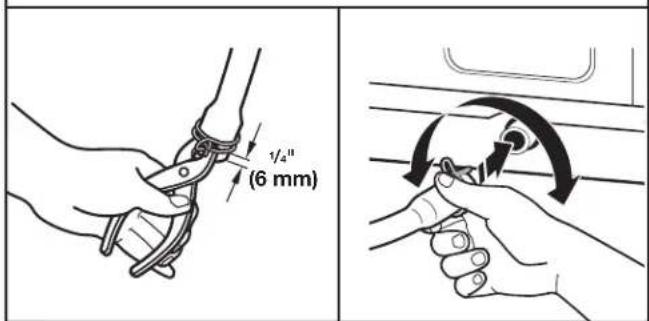
To keep the fill-and-drain hose from leaking, it must be installed according to the following instructions.
IMPORTANT: To ensure proper installation, this procedure must be followed exactly.
Remove permanent installation drain hose. Wet inside end of the drain hose with tap water.
IMPORTANT: Do not use any lubricant other than water.
Squeeze ears of double-wire clamp with pliers to open. Place clamp over the straight end of the drain hose 14 (6 mm) from the end. Twist hose back and forth while pushing down onto drain connector at the bottom of the washer. Continue until hose contacts the cabinet.
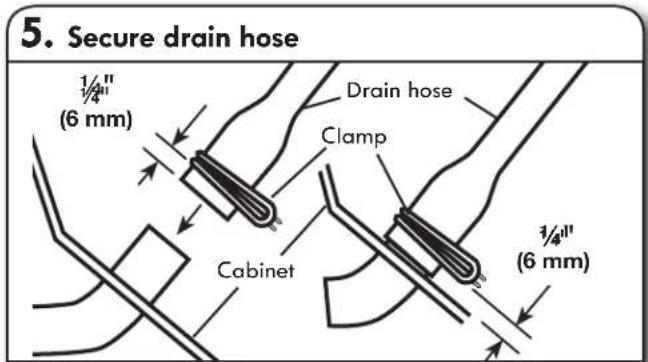
Place clamp over area marked "CLAMP." Release clamp.
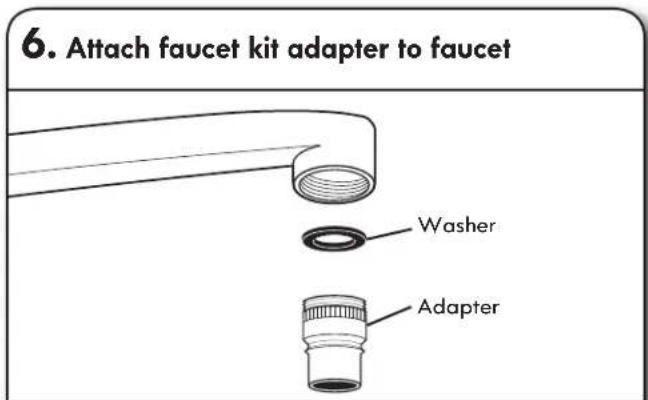
Proper connection of your faucet adapter kit will allow hot and cold water to enter your washer properly. It also helps avoid water damage due to leaks.
Attach the faucet adapter kit from the parts bag to your faucet. A standard faucet adapter and washer are supplied. Customized adapters are available from traditional plumbing supply sources.
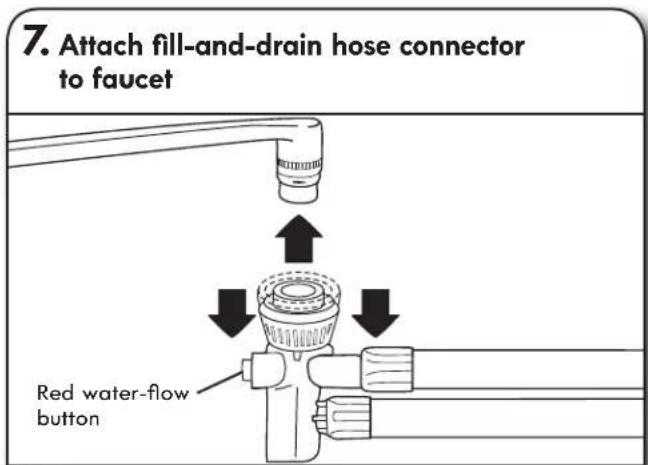
Roll washer to sink area. It rolls and operates on wheels. The wheels do not roll from side to side. Be sure your washer is on a level floor to help avoid movement during spin.
Attach fill-and-drain hose connector to a single-spout hot/cold water faucet. Move the locking collar down while lifting the connector until it snaps into place.
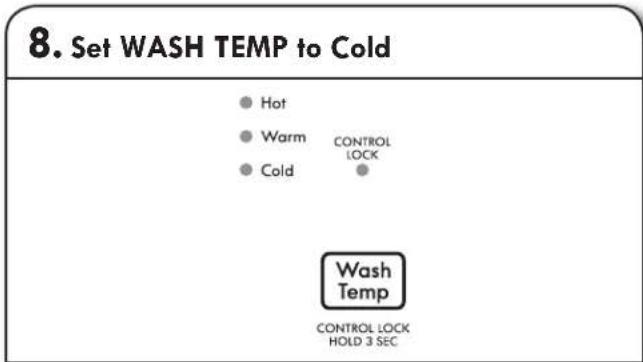
Set the temperature setting on your washer to Cold. Set the water temperature for the Wash cycle by adjusting the Hot and Cold water faucets. The Hot and Warm settings are inactive with Portable Installation.
To test the water, press the red water-flow button on the hose connector. Water will be released when the button is pressed, allowing you to sample the temperature.
NOTE: If desired, you can change the water temperature for the Rinse cycle by adjusting the Hot and Cold water faucets. Keep the temperature setting on your washer set at Cold.
Disconnect Washer
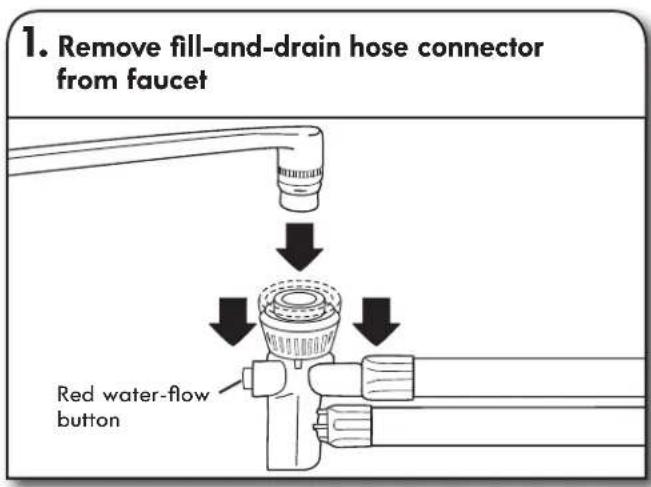
Turn off water faucets and unplug the power cord. Press the red water-flow button to release water pressure in the hose. Pull the locking collar down to remove the connector from the faucet.
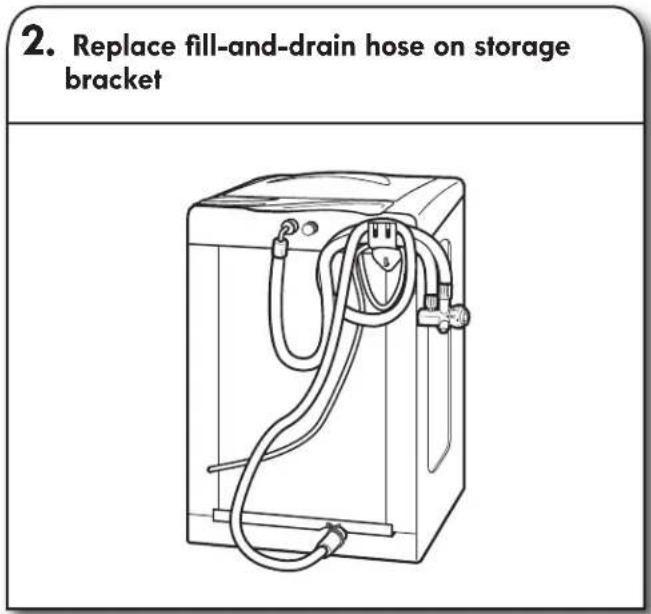
Pour water out of the fill-and-drain hose connector. Place fill-and-drain hose on the plastic holder in the back of the washer.
Complete Installation Checklist
Check electrical requirements. Be sure you have correct electrical supply and recommended grounding method.
Check that all parts are now installed. If there is an extra part, go back through steps to see what was skipped.
Check that you have all of your tools.
Check that shipping materials were completely removed from washer.
Check that water faucets are on.
Check for leaks around faucets and inlet hoses.
NOTE: If the washer is attached to a faucet equipped with a spray hose, the constant water pressure may cause the spray hose to leak. To avoid possible failure, the spray hose should be disconnected or replaced with a high-pressure hose.
Remove protective film from console and any tape remaining on washer.
Check that washer is plugged into a grounded 3 prong outlet.
Dispos of/recycle all packaging materials.
Read "Washer Maintenance."
To test and clean your washer, measure 12 of normal recommended amount of powdered or liquid detergent and pour it into washer basket or detergent dispenser (on some models). Close lid. Select any cycle. Start washer and allow to complete full cycle.
CONTROL PANEL AND FEATURES
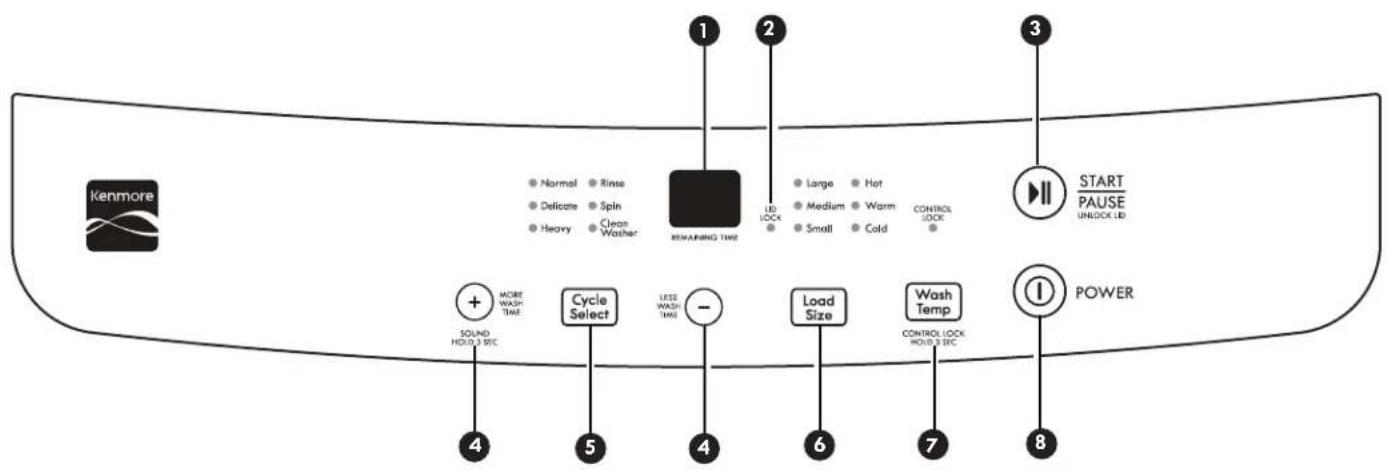
1 LED TIME/STATUS DISPLAY
The Estimated Time Remaining display shows the time required for the cycle to complete. Factors such as load size and water pressure may affect the time shown in the display. Tightly packed loads, unbalanced loads, or excessive suds may cause the washer to adjust the cycle time as well.
LID LOCK LIGHT
The Lid Lock indicator lights up when the lid is locked and cannot be opened. If you need to open the lid, touch and hold START/PAUSE. The lid will unlock once the washer movement has stopped. This may take several minutes if the load was spinning at high speed. Press START/PAUSE again to restart the cycle.
3 START/PAUSE
After selecting a wash cycle, press START/PAUSE to start the cycle. Press once to pause a cycle. The flashing lights indicate the selected cycle and the current process.
CYCLE TIME (+ or -)
Press " ^+ " or "-to adjust the duration of a wash cycle.
Press "+" or "-" to adjust the duration of a spin cycle.
LED display will show the time remaining for the cycle to complete.
If an out-of-range adjustment is made, a buzzer will sound.
End-of-Cycle Signal
Press and hold the plus (+) button for 3 seconds to enable or disable the end-of-cycle signal.
5 CYCLE SELECT
Press CYCLE SELECT to select a wash cycle. Choose from Normal, Delicate, Heavy, Rinse, Spin, or Clean Washer. NOTE: The washer will remember the last cycle used, with a default load size of Medium.
6 LOAD SIZE
Press to select the water level based on the amount of garments to wash.
When the Medium water level is selected with the Normal or Heavy cycle, the machine will sense the size of the load and adjust if required.
WASH TEMP
Select a wash temperature based on the type of fabric and soils being washed. For best results and following the garment label instructions, use the warmest wash water safe for your fabric.
For Portable Installations: If desired, you can change the water temperature for the Rinse cycle by adjusting the Hot and Cold water faucets. Keep the temperature setting on your washer set at Cold.
CONTROL LOCK
Press and hold WASH TEMP for 4 seconds to lock the controls. Press and hold for 4 seconds to unlock. You may still press POWER to turn the washer off.
3 POWER
Press POWER to turn the washer on or off. Press once while a cycle is running to stop the washer.
Dispensers
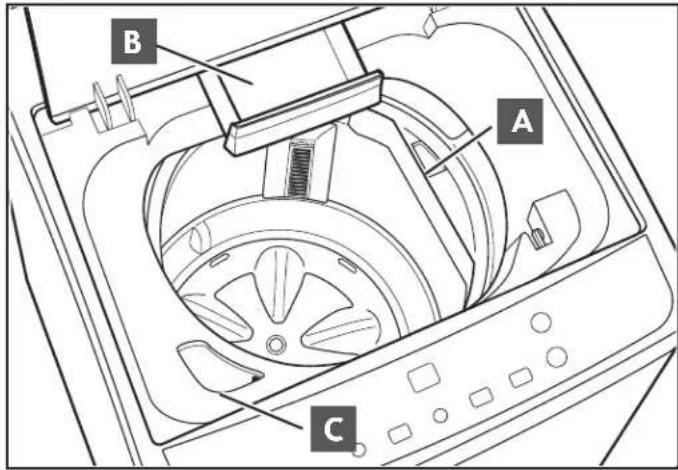

Liquid fabric softener dispenser
Pour measured liquid fabric softener into the liquid fabric softener dispenser if desired. It will dispense automatically at the optimum time.
Use only liquid fabric softener in this dispenser.
NOTE: The fabric softener dispenser rotates around the wash basket and may not be in the same spot each time.

High Efficiency (HE) powdered detergent dispenser
Add only powdered HE detergent product to this dispenser for your main wash cycle.

Use only High Efficiency (HE) detergent.
NOTES:
Follow the manufacturer's instructions to determine the amount of detergent to use.
Add liquid HE detergent or single-dose packets to the basket prior to adding laundry.

Liquid chlorine bleach dispenser
This dispenser holds up to 3/4 cup (180 mL) liquid chlorine bleach. The bleach will be automatically diluted and dispensed at the optimum time during the Wash cycle. This dispenser cannot dilute powdered bleach.
NOTE: Fill dispenser with only liquid bleach.
Choosing the Right Detergent
Use only High Efficiency detergents. The package will be marked "HE" or "High Efficiency." Low-water washing creates excessive sudcing with a non-HE detergent. Using non-HE detergent will likely result in longer cycle times and reduced rinsing performance. It may also result in component failure and, over time, buildup of mold or mildew. HE detergents should be low-sudsing and quick-dispersing to produce the right amount of suds for the best performance. They should hold soil in suspension so it is not re-deposited onto clean clothes. Not all detergents labeled as High Efficiency are identical in formulation and their ability to reduce suds. For example, natural, organic, or homemade HE detergents may generate a high level of suds. Follow the manufacturer's instructions to determine the amount of detergent to use.
Cycle Guide
Normal Rinse
Delicate Spin
Heavy Clean Washer

This section describes the available wash cycles and will help you make the best cycle selections for your wash loads. Each cycle is designed for different types of fabric and soil levels. Always read and follow fabric care labels instructions to avoid damage to your items.
Normal
Use this cycle for normally soiled cottons and linens. Wash combines medium-speed agitation and high-speed spin to shorten drying time.
Delicate
Use this cycle for lingerie and loosely knit items. Wash combines low-speed agitation for gentle soil removal and high-speed spin to shorten drying time.
Heavy
Use this cycle for sturdy or heavily soiled loads. Wash combines high-speed agitation and high-speed spin for maximum soil removal.
Rinse
Use this cycle for additional rinsing of the washer load or hand-washed items.
Spin
Use this cycle to remove excess water from the washer load or hand-washed items.
Clean Washer
Use this cycle every 30 washes to keep the inside of your washer fresh and clean. This cycle uses a higher water level. Use with washer cleaner tablet or liquid chlorine bleach to thoroughly clean the inside of your washer. This cycle should not be interrupted.
IMPORTANT: Do not place garments or other items in the washer during the Clean Washer cycle. Use this cycle with an empty washtub.
End-of-Cycle Signal
The End-of-Cycle signal may be turned on and off by pressing and holding the Cycle "+" button for 3 seconds.

USING YOUR WASHER
WARNING

Fire Hazard
Never place items in the washer that are dampened with gasoline or other flammable fluids.
No washer can completely remove oil.
Do not dry anything that has ever had any type of oil on it (including cooking oils).
Doing so can result in death, explosion, or fire.
WARNING
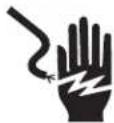
Electrical Shock Hazard
Plug into a grounded 3 prong outlet.
Do not remove ground prong.
Do not use an adapter.
Do not use an extension cord.
Failure to follow these instructions can result in death, fire, or electrical shock.
1. Sort and prepare your laundry
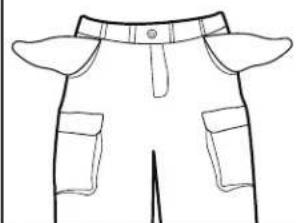
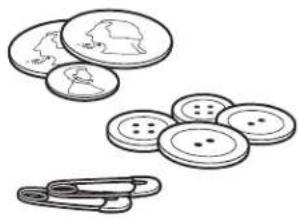
Empty pockets. Loose change, buttons, or any small object can pass under the washplate and become trapped, causing unexpected sounds.
- Sort items by recommended cycle, water temperature, and colorfastness.
Separate heavily soiled items from lightly soiled.
Separate delicate items from sturdy fabrics.
Do not dry items if stains remain after washing; heat can set stains into fabric.
Treat stains promptly.
Close zippers, fasten hooks, tie strings, and sashes. Remove non-washable trim and ornaments.
Mend rips and tears to avoid further damage to items during washing.
Helpful Tips:
For best performance, use HE liquid detergent when washing bulky items.
Use mesh bags to help avoid tangling when washing delicate or small items.
Turn knits inside out to avoid pilling. Separate lint-takers from lint-givers. Synthetics, knits, and corduroy fabrics will pick up lint from towels, rugs, and chenille fabrics.
NOTE: Always read and follow fabric care labels instructions to avoid damage to your items.
2. Add laundry products
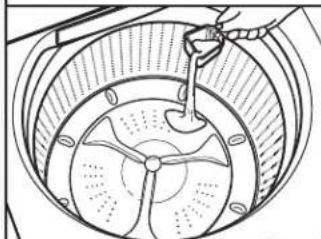
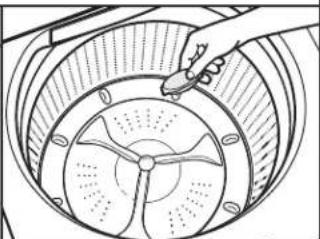
IMPORTANT: If you are using the Compact Dryer Stack Stand (Part Number 49971), pull the washer forward before lifting the washer lid. Do not permanently install the washer in the Compact Dryer Stack Stand - doing so will prevent you from raising the washer lid.
If you are using liquid laundry detergent, single-dose laundry packets, color-safe bleach, Oxi-type boosters, or fabric softener crystals, add to the wash basket prior to adding laundry.
NOTE: Always follow manufacturer's instructions.
3. Load laundry into washer
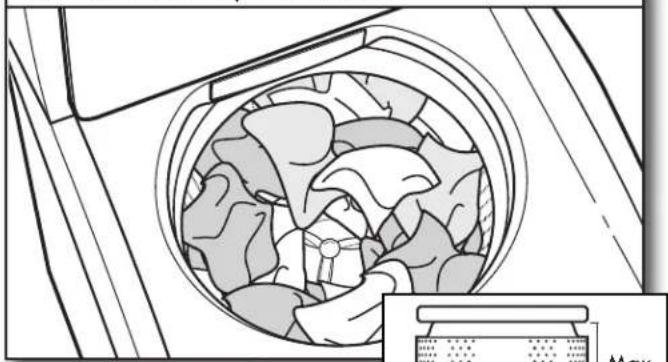
For best performance, load items in loose heaps evenly around the washplate. Try mixing different-sized items to reduce tangling.
IMPORTANT: Items need to move
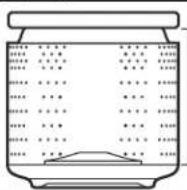
Max load level
freely for best cleaning and to reduce wrinkling and tangling.
NOTE: The maximum volume is about 1.52 cubic ft. (4.4 lb max. load size per cubic ft.).
Using Laundry Product Dispensers
NOTE: Do not add liquid laundry detergent, single-dose laundry packets, color-safe bleach, Oxi-type boosters, or fabric softener crystals to dispensers. They will not dispense correctly. Add to the basket prior to adding laundry.
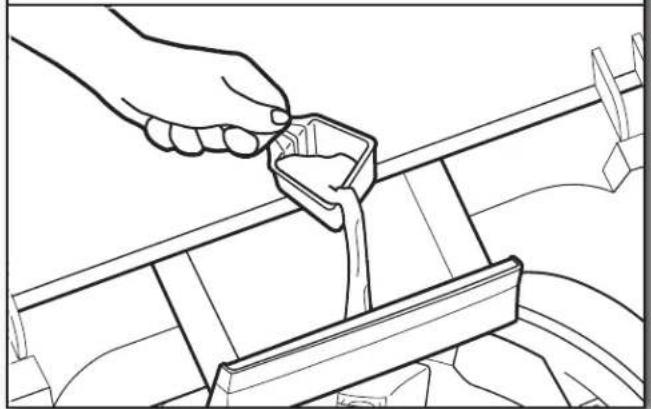
4. Add powdered HE detergent
IMPORTANT: Use only High Efficiency detergents. The package will be marked "HE" or "High Efficiency." Low-water washing creates excessive sudcing with a non-HE detergent. Using non-HE detergent will likely result in longer cycle times and reduced rinsing performance. It may also result in component failure and, over time, buildup of mold or mildew. HE detergents should be low-sudsing and quick-dispersing to produce the right amount of suds for the best performance. They should hold soil in suspension so it is not re-deposited onto clean clothes. Not all detergents labeled as High Efficiency are identical in formulation and their ability to reduce suds. For example, natural, organic, or homemade HE detergents may generate a high level of suds. Follow the manufacturer's instructions to determine the amount of detergent to use.
NOTES:
Use only powdered HE detergent in the detergent dispenser. Add liquid HE detergent or single-dose packets to the basket prior to adding laundry.
See "Washer Maintenance" for information on recommended method of cleaning washer dispensers.
5. Add liquid chlorine bleach to dispenser
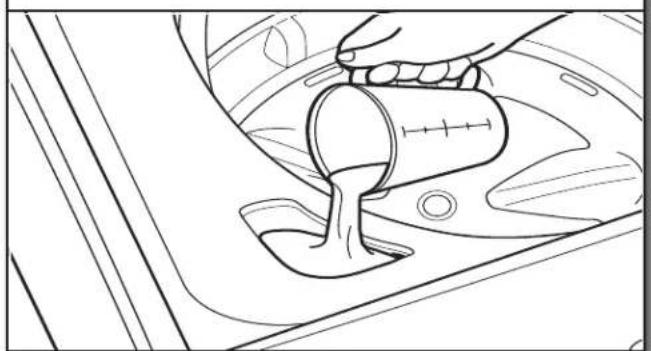
Bleach will be dispensed automatically during the wash part of the cycle. Do not overfill, dilute, or use more than 1 cup (250~mL) .Do not use color-safe bleach or Oxi products in the same cycle with liquid chlorine bleach.
6. Add liquid fabric softener
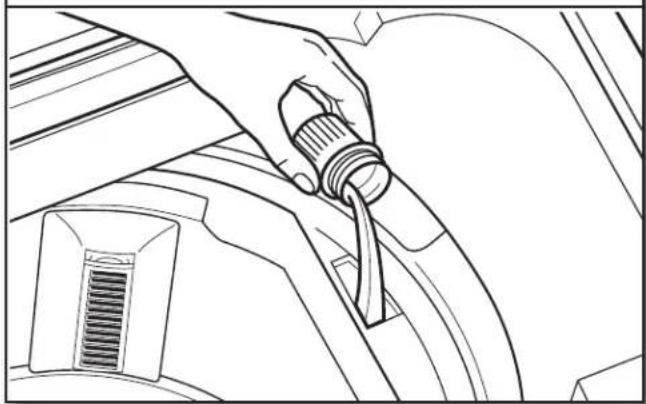
Pour a measured amount of liquid fabric softener into dispenser; always follow manufacturer's directions for correct amount of fabric softener based on your load size. Fabric softener is added during rinse.
IMPORTANT: Do not overfill or dilute. Overfilling dispenser will cause fabric softener to immediately dispense into washer. It is normal for a small amount of water to remain in the dispenser at the end of a cycle.
NOTE: The fabric softener dispenser rotates around the wash basket and may not be in the same spot each time.
7. Touch POWER to turn on washer

POWER
Close the washer lid. Washer will not fill, agitate, or spin with the lid open. Make sure the dispenser drawer is closed completely, then touch POWER to turn on the washer.
8. Select load size
Large
Medium
Small
Load
Size
Press the Load Size button to select the correct setting for your wash load and the type of fabric being washed. Choose a water level that allows the load to move freely for best fabric care.
When Medium is selected with the Normal or Heavy cycles, the washer will sense the size of the load and adjust the amount of water required.
You may change the load size setting while the washer is filling. If you change from Large to Medium but the water has filled past Medium, you will get Medium with the next fill.
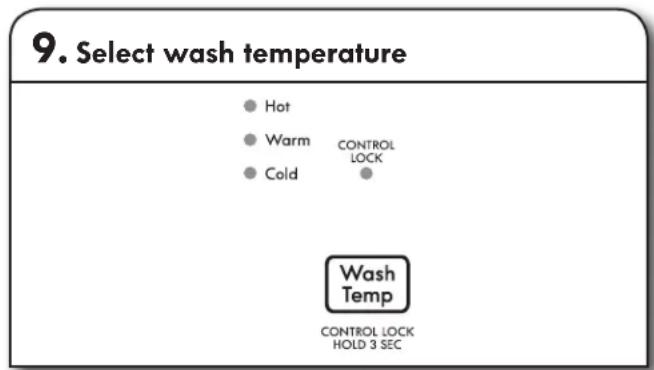
Set the water temperature for the type of fabric and soils being washed. Use the warmest wash water safe for fabric. Follow garment label instructions.
For Portable Installations
Open the faucets connected to the water supply hoses.
Wash and Rinse water temperatures are set at your faucet. The Temperature control does not set the temperature.
Adjust the Hot and Cold water faucets to desired wash temperature. Keep the temperature control set at Cold.
NOTE: The Cold setting allows water from the faucet to enter the washer, but does not control the incoming water temperature.
For a rinse temperature that is different from the wash temperature, you must adjust the water temperature at the faucet after the washer has completed its initial fill.
To test the water temperature, press the red water-flow button on the hose connector. Water will be released when the button is pressed, allowing you to sample the temperature.
For Permanent Installations
The Rinse and Spin cycles default to a cold rinse, all other cycles default to a warm rinse. Press the Wash Temp button to choose a different wash temperature.
Selecting Water Temperatures
NOTE: Always read and follow fabric care label instructions to avoid damage to your items.
| Water Temperature Suggested Fabrics | |
| Hot Whites and | pastels Durable items Heavy soils |
| Warm Bright colors | Moderate to light soils |
| Cold Colors that | bleed or fade Light soils |
NOTE: In wash water temperatures colder than 60^ (15.6^) detergents do not dissolve well. Soils can be difficult to remove. Some fabrics can retain wear wrinkles and have increased pilling (the formation of small lint-like balls on the surface of garments).
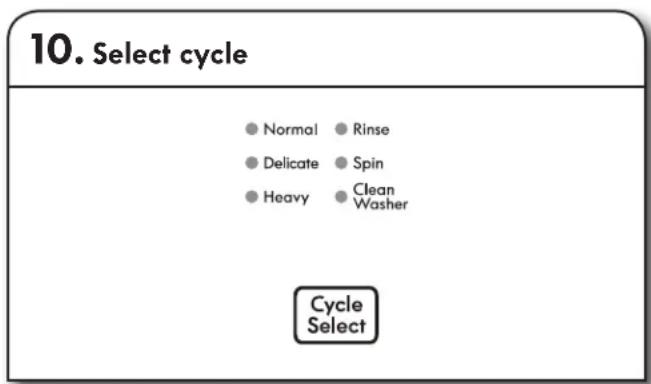
Press the Cycle Select button to select your wash cycle. See "Cycle Guide" for details on cycle features.
Press START/PAUSE to start the wash cycle. When the cycle has finished, the end-of-cycle signal will sound (if set). Promptly remove items when cycle is done to avoid odor, reduce wrinkling, and avoid rusting of metal hooks, zippers, and snaps.
Unlocking the lid to add items
If you need to open the lid to add 1 or 2 missed items:
Press START/PAUSE to pause washer; the lid will unlock once the washer movement has stopped. This may take several minutes if the load was spinning at a high speed. Then close lid and press START/PAUSE again to restart the cycle.
To stop or restart your washer:
To stop the washer at any time, press START/PAUSE and the cycle will pause.
To restart the washepress START/PAUSEand the cycle will resume.
WASHER MAINTENANCE
Water inlet hoses
Replace inlet hoses after 5 years of use to reduce the risk of hose failure. Periodically inspect and replace inlet hoses if bulges, kinks, cuts, wear, or leaks are found.
When replacing your inlet hoses, mark the date of replacement on the label with a permanent marker.
Washer care
Recommendations to Help Keep Your Washer Clean and Performing at Its Best
- Always use High Efficiency (HE) detergents and follow the HE detergent manufacturer's instructions regarding the amount of HE detergent to use. Never use more than the recommended amount because that may increase the rate at which detergent and soil residue accumulate inside your washer which, in turn, may result in undesirable odor.
- Use warm and hot wash water settings sometimes (not exclusively cold water washes) because they do a better job of controlling the rate at which soils and detergent accumulate.
- Always leave the washer lid open between uses to help dry out the washer and prevent the buildup of odor-causing residue.
Cleaning Your Top Loading Washer
Read these instructions completely before beginning the routine cleaning processes recommended below. This Clean Washer cycle should be performed, at a minimum, once per month or every 30 wash cycles, whichever occurs sooner, to control the rate at which soils and detergent may otherwise accumulate in your washer.
Cleaning the Inside of the Washer
To keep your washer odor-free, follow the usage instructions provided above and use this recommended monthly cleaning procedure:
Clean Washer Cycle
This washer has a special cycle that uses higher water volumes in combination with a Washer Cleaner or liquid chlorine bleach to clean the inside of the washer.
Begin procedure
- Washer Cleaner Cycle Procedure (Recommended for Best Performance):
a. Open the washer lid and remove any clothing or items.
b. Place a Washer Cleaner tablet in the bottom of the washer basket.
c. Do not place a Washer Cleaner tablet in the detergent dispenser.
d. Do not add any detergent or other chemical to the washer when following this procedure.
e. Close the washer lid.
f. Select the Clean Washer cycle.
g. Press START/PAUSE to begin the cycle. The Clean Washer Cycle Operation is described below.
NOTE: For best results, do not interrupt cycle. If cycle must be interrupted, press POWER. (For models with no Power/Cancel button, press and hold START/PAUSE for 3 seconds). After the Clean Washer cycle has stopped, run a Rinse cycle to rinse cleaner from washer.
Washer care (cont.)
2. Chlorine Bleach Procedure (Alternative):
a. Open the washer lid and remove any clothing or items.
b. Add 1 cup (236~mL) of liquid chlorine bleach to the bleach compartment.
NOTE: Use of more liquid chlorine bleach than is recommended above could cause washer damage over time.
c. Close the washer lid.
d. Do not add any detergent or other chemical to the washer when following this procedure.
e. Select the Clean Washer cycle.
f. Press START/PAUSE to begin the cycle. The Clean Washer Cycle Operation is described below.
NOTE: For best results, do not interrupt cycle. If cycle must be interrupted, press POWER. (For models with no Power button, press and hold START/PAUSE for 3 seconds). After the Clean Washer cycle has stopped, run a Rinse cycle to rinse cleaner from washer.
Description of Clean Washer Cycle Operation:
- This cycle will fill to a water level higher than in normal wash cycles to provide rinsing at a level above the water line for normal wash cycle.
- During this cycle, there will be some agitation and spinning to increase the removal of soils.
After this cycle is complete, leave the lid open to allow for better ventilation and drying of the washer interior.
Cleaning the Dispensers
After a period of using your washer, you may find some residue buildup in the washer's dispensers. To remove residue from the dispensers, wipe them with a damp cloth and towel dry. Do not attempt to remove the dispensers or trim for cleaning. The dispensers and trim are not removable. If your model has a dispenser drawer, however, remove the drawer and clean it before or after you run the Clean Washer cycle. Use an all-purpose surface cleaner, if needed.
Cleaning the Outside of the Washer
Use a soft, damp cloth or sponge to wipe away any spills. Use only mild soaps or cleaners when cleaning external washer surfaces.
IMPORTANT: To avoid damaging the washer's finish, do not use abrasive products.
Washer care (cont.)
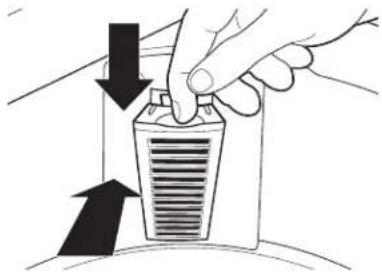
Cleaning The Lint Filter
Clean filter after every load.
- Press down, then out to remove the lint filter.
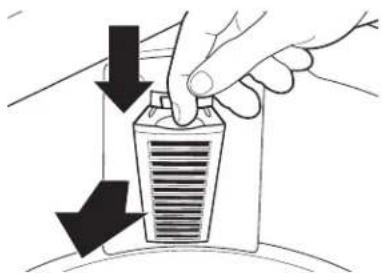
- Open the lint filter and clean with water.
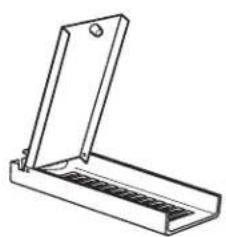
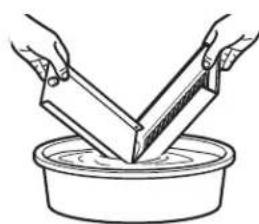
- Insert the lint filter bottom first, then press down and in to replace the filter.
Transporting your washer
- Shut off both water faucets. Disconnect and drain water inlet hoses.
- If washer will be moved during freezing weather, follow WINTER STORAGE CARE directions before moving.
- Disconnect drain hose from drain system and from back of washer.
- Unplug power cord.
- Place inlet hoses and drain hose inside washer drum.
- Bundle power cord with a rubber band or cable tie to keep it from hanging onto the ground.
Non-use and vacation care
Operate your washer only when you are home. If moving, or not using your washer for a period of time, follow these steps:
- Unplug or disconnect power to washer.
- Turn off water supply to washer to avoid flooding due to water pressure surges.
- Clean the dispensers. See "Cleaning the Dispensers."
Winter storage care
IMPORTANT: To avoid damage, install and store washer where it will not freeze. Because some water may stay in hoses, freezing can damage washer. If storing or moving during freezing weather, winterize your washer.
To winterize washer:
- Shut off both water faucets; disconnect and drain water inlet hoses.
- Put 1 qt. (1 L) of R.V.-type antifreeze in washer drum and run washer on Normal cycle for about 2 minutes to mix antifreeze and remaining water.
- Unplug washer or disconnect power.
WARNING

Electrical Shock Hazard
Plug into a grounded 3 prong outlet.
Do not remove ground prong.
Do not use an adapter.
Do not use an extension cord.
Failure to follow these instructions can result in death, fire, or electrical shock.
Reinstalling/using washer again
To reinstall washer after non-use, vacation, winter storage, or moving:
- Refer to Installation Instructions to locate, level, and connect washer.
- Before using again, run washer through the following recommended procedure:
To use washer again:
- Flush water pipes and hoses. Reconnect water inlet hoses. Turn on both water faucets.
- Plug in washer or reconnect power.
- Run washer through Heavy cycle to clean washer and remove antifreeze, if used. Use only HE detergent. Use half the manufacturer's recommended amount for a medium-size load.
TROUBLESHOOTING
| First try the solutions suggested here for assistance and to possibly avoid a service call. | ||
| If you experience Possible Causes Solution | ||
| Vibration or Off-Balance | ||
| Vibration, rocking, or "walking" | Feet may not be in contact with the floor and locked. | Front and rear feet or wheels must be in firm contact with floor and washer must be level to operate properly. |
| Washer may not be level. Check floor | or flexing or sagging. If flooring is uneven, a 3/4"(19 mm) piece of plywood under your washer will reduce sound. | |
| See "Level the Washer" in the Installation Instructions. | ||
| Vibration during spinning or washer stopped | Load could be unbalanced. Load items | in loose heaps evenly around the washplate. Adding wet items to washer or adding more water to basket could unbalance washer. |
| Avoid washing single items. Balance a single item such as a rug or jeans jacket with a few extra items. Redistribute the load, close the lid, and press START/PAUSE. | ||
| Item or load not suitable for selected cycle. See "Cycle Guide" and "Using Your Washer." | ||
| Noises | ||
| Clicking or metallic noises | Objects may be caught in washer drain system. | Empty pockets before washing. Loose items such as coins could fall between basket and tub or may block pump. It may be necessary to call for service to remove items. |
| It is normal to hear metal items on clothing such as metal snaps, buckles, or zippers touch against the stainless steel basket. | ||
| Gurgling or humming Washer | may be draining water. It is normal | to hear the pump making a continuous humming sound with periodic gurgling or surging as final amounts of water are removed during the spin/drain cycles. |
| Humming Load sensing | may be occurring. You may hear the hum of the sensing spins after you have started the washer. This is normal. | |
| Whirring | Basket may be slowing down. | You may hear the whirring sound of the basket slowing down. This is normal. |
| Water Leaks | ||
| Check the following for proper installation: | Washer not level. Water may splash off | basket if washer is not level. |
| Fill hoses not attached tightly. Tighten f | II-hose connection. | |
| Fill hose washers. Make sure fill hose f | t washers are properly seated. | |
| Drain hose connection. | Properly secure drain hose to drainpipe or laundry tub. | |
| Do not place tape over drain opening. | ||
| Check household plumbing for leaks or clogged sink or drain. | Water can back up out of a clogged sink or drainpipe. Check all household plumbing for leaks (laundry tubs, drain pipe, water pipes, and faucets). | |
| Washer not loaded as recommended. | An unbalanced load can cause basket to be out of alignment and cause water to splash off tub. See "Using Your Washer" for loading instructions. | |
| Washer not performing as expected | ||
| Not enough water in washer | Load not completely covered in water. | This is normal operation for an HE low-water washer. The load will not be completely underwater. The washer senses load sizes and adds correct amount of water for optimal cleaning. IMPORTANT: Do not add more water to washer. Adding water lifts the items off the washplate, resulting in less effective cleaning. |
| Run Clean Washer cycle to optimize the water level and wash performance. | ||
TROUBLESHOOTING
| First try the solutions suggested here for assistance and to possibly avoid a service call. | ||
| If you experience Possible Causes Solution | ||
| Washer not performing as expected (cont.) | ||
| Washer won't run or fill;washer stops working | Check for proper water supply. Hose(s) | must be attached and have water flowing to inlet valve. |
| Water faucet(s) must be turned on. | ||
| Check that inlet valve screens have not become clogged. | ||
| Check for any kinks in inlet hoses, which can restrict water flow. | ||
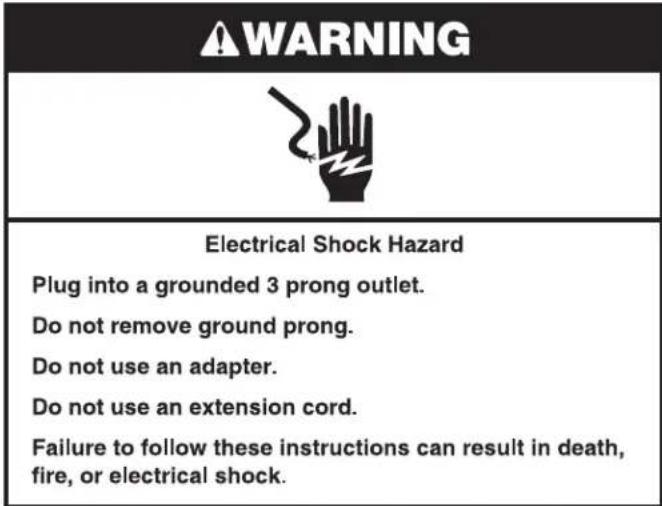
| Washer won't run or fill, washer stops working (cont.) | Check for proper electrical supply. Plug | power cord into a grounded 3 prong outlet. |
| Do not use an extension cord. | ||
| Ensure there is power to outlet. | ||
| Reset a tripped circuit breaker. Replace any blown fuses. NOTE: If problems continue, contact an electrician. | ||
| Normal washer operation. Lid must be closed for washer to run. | ||
| Washer will pause during certain phases of cycle. Do not interrupt cycle. | ||
| Washer may be stopped to reduce suds. | ||
| Washer may be tightly packed. Remove several items; rearrange load evenly around the washplate. Close lid; press START/PAUSE. | ||
| Add only 1 or 2 additional items after washer has started. | ||
| Do not add more water to the washer. | ||
| Not using HE detergent or using too much HE detergent. | Only use HE detergent. Suds from regular detergents can slow or stop the washer. Always measure detergent and follow detergent directions based on your load requirements. | |
| To remove suds, cancel cycle. Select RINSE, then SPIN. Do not add more detergent. | ||
| Washer not draining/ spinning, loads are still wet | Small items may have been caught in pump or between basket and tub, which can slow draining. | Empty pockets and use garment bags for small items. |
| Using cycles with a lower spin speed. | Cycles with lower spin speeds remove less water than cycles with high spin speeds. Use the recommended cycle/speed spin for your item. | |
| Washer may be tightly packed or unbalanced. | Tightly packed loads may not allow the washer to spin correctly, leaving the load wetter than normal. Evenly arrange the wet load for balanced spinning. Select SPIN to remove excess water. See "Using Your Washer" for loading recommendations. | |
TROUBLESHOOTING
| First try the solutions suggested here for assistance and to possibly avoid a service call. | ||
| If you experience Possible Causes Solution | ||
| Washer not performing as expected (cont.) | ||
| Washer not draining/spinning, loads are still wet (cont.) | Load off-balanced. See "Vibration or Off-Balance" in "Troubleshooting" section for more information. | |
| Check plumbing for correct drain hose installation. Drain hose extends into standpipe farther than 4.5" (114 mm). | Check drain hose for proper installation. Use drain hose form and securely attach to drainpipe or tub. Do not tape over drain opening. Lower drain hose if the end is higher than 72" (183 cm) above the floor. Remove any clogs from drain hose. | |
| Not using HE detergent or using too much HE detergent. | Suds from regular detergent or using too much detergent can slow or stop draining or spinning. Use only HE detergent. Always measure and follow detergent directions for your load. To remove extra suds, select RINSE. Do not add detergent. | |
| Incorrect or wrong wash or rinse temperatures | Check for proper water supply. For per- manent installations, make sure that hot and cold inlet hoses are not reversed. For portable installations, adjust water temperature at faucet. | |
| For permanent installations, both hoses must be attached to both washer and faucet and have both hot and cold water flowing to inlet valve. | ||
| Check that inlet valve screens are not clogged. | ||
| Remove any kinks in hoses. | ||
| Load not rinsed Check for | proper water supply. For permanent insta- tiations, make sure hot and cold inlet hoses are not reversed. | |
| Hoses must be attached and have water flowing to the inlet valves or faucet. | ||
| For permanent installations, both hot and cold water faucets must be on. For portable installations, sink faucet must be on. | ||
| Inlet valve screens on washer may be clogged. | ||
| Remove any kinks in the inlet hose. | ||
| Not using HE detergent or using too much HE detergent. | The suds from regular detergent can cause the washer to operate incorrectly. | |
| Use only HE detergent. Be sure to measure correctly. | ||
| Always measure detergent and follow detergent directions based on load size and soil level. | ||
| Washer may be tightly packed. The wa- sher is less efficient at rinsing when load is tightly packed. | ||
| Load items in loose heaps evenly around the washplate. | ||
| Use cycle designed for the fabrics being washed. | ||
| Add only 1 or 2 additional items after washer has started. | ||
| Sand, pet hair, lint, etc., on load after washing | Heavy sand, pet hair, lint, and detergent or bleach residues may require additional rinsing. | Run an additional Rinse cycle. |
| Load is tangling | Washer not loaded as recommended. | Load items in loose heaps evenly around the washplate. |
| Reduce tangling by mixing types of load items. Use the recommended cycle for the type of items being washed. | ||
| Wash action and/or spin speed too fast for load. | Select a cycle with a slower wash action and slower spin speed. Note that items will be wetter than when using a higher speed spin. | |
| Not cleaning or removing stains | Wash load not completely covered in water. | Washer senses load size and adds correct amount of water. This is normal and necessary for clothes to move. |
| Added more water to washer. Do not add | add more water to washer. Adding water lifts the items off the washplate, resulting in less effective cleaning. | |
| Washer not loaded as recommended. | load items in loose heaps evenly around the washplate. | |
| Add only 1 or 2 additional items after washer has started. | ||
TROUBLESHOOTING
| First try the solutions suggested here for assistance and to possibly avoid a service call. | ||
| If you experience Possible Causes Solution | ||
| Washer not performing as expected (cont.) | ||
| Not cleaning or removing stains (cont.) | Not using HE detergent or using too much HE detergent. | The suds from regular detergent can keep washer from operating correctly. |
| Use only HE detergent. Be sure to measure correctly. | ||
| Always measure detergent and follow detergent directions based on load size and soil level. | ||
| Not using correct cycle for fabric type. | Use a higher soil level cycle option and warmer wash temperature to improve cleaning. | |
| Use Heavy cycle for tough cleaning. | ||
| See the "Cycle Guide" to match your load with the best cycle. | ||
| Not using dispensers. Use dispensers to | avoid chlorine bleach and fabric softener staining. | |
| Load dispensers before starting a cycle. | ||
| Avoid overfilling. | ||
| Do not add products directly onto load. | ||
| Not washing like colors together. | Wash like colors together and remove promptly after the cycle is complete to avoid dye transfer. | |
| Odors Monthly maintenance | not done as recommended. | Run the Clean Washer cycle after every 30 washes. See "Washer Care." |
| Unload washer as soon as cycle is complete. | ||
| Not using HE detergent or using too much HE detergent. | Use only HE detergent. Be sure to measure correctly. | |
| Always follow the detergent directions. | ||
| See "Washer Care" section. | ||
| Fabric damage Sharp item | were in pockets during wash cycle. | Empty pockets, zip zippers, and snap or hook fasteners before washing to avoid snags and tears. |
| Strings and straps could have tangled. | Tie all strings and straps before starting wash load. | |
| Items may have been damaged before washing. | Mend rips and broken threads in seams before washing. | |
| Fabric damage can occur if the load is tightly packed. | Load items in loose heaps evenly around washplate. | |
| Load items should move freely during wash to avoid damage. | ||
| Use cycle designed for the fabrics being washed. | ||
| Add only 1 or 2 additional items after washer has started. | ||
| Garment care instructions may not have been followed. | Always read and follow garment manufacturer's care label instructions. See the "Cycle Guide" to match your load with the best cycle. | |
| Liquid chlorine bleach may have been added incorrectly. | Do not pour liquid chlorine bleach directly onto load. Wipe up bleach spills. | |
| Undiluted bleach will damage fabrics. Do not use more than recommended by manufacturer. | ||
| Do not place load items on top of bleach dispenser when loading and unloading washer. | ||
TROUBLESHOOTING
| First try the solutions suggested here for assistance and to possibly avoid a service call. | ||
| If you experience Possible Causes Solution | ||
| Washer not performing as expected (cont.) | ||
| Incorrect dispenser operation | Clogged dispensers or laundry products dispensing too soon. | Do not overfill dispenser. Overfilling causes immediate dispensing. |
| Load dispensers before starting a cycle. | ||
| It is normal for small amounts of water to remain in dispenser at the end of the cycle. | ||
| Fabric softener thickens as it gets older. If there is an increase of fabric softener in the dispenser after a cycle, check the age of the fabric softener and replace if needed. | ||
| Homes with low water pressure may result in residual powder in the dispenser. To avoid, select a warmer wash temperature if possible, depending on your load. Do not use single-dose laundry packets in the dispenser. They may not dissolve properly and clog the dispenser. | ||
| Liquid chlorine bleach not used in dispenser. | Use only liquid chlorine bleach in the bleach dispenser. | |
| Powdered detergent not dissolving completely in load | Using too much HE detergent. Follow the manufacturer's instructions to determine the amount of detergent to use. | |
| Water temperature is very cold. Select | a warmer wash temperature. | |
| Try adding the detergent to the basket prior to adding laundry, rather than using the detergent dispenser. | ||
| Single-dose laundry packet not dissolving | Adding laundry packet incorrectly. Be sure laundry packet is added to washer basket before adding clothes. Follow the manufacturer's instructions to avoid damage to your items. | |
| Error Code Appears in Display | ||
| E1-Water inlet alarm Water level not reached after 20 minutes. | Check that the water faucets are not closed. | |
| Check that the water pressure in the house is over 3 psi (20kPa). | ||
| Clean the inlet hose filter screens. | ||
| Check that the drain hose is not below 39" (990 mm) from the floor. | ||
| E2-Draining alarm Washer is still detecting water after draining for 8 minutes. | Check that the drain hose is not more than 72" (183 cm) from the floor. | |
| Remove any clogs from the drain hose. | ||
| E3-Unbalanced alarm Washer may be tightly packed or clothes are not evenly distributed. | Remove several items, rearrange load evenly around the washplate, and restart the spin cycle. | |
| E4-Open lid alarm Operating the lid during the Spin cycle. Close the lid. | the lid. | |
| EA or EC-Other errors Other Call for technical assistance. (See the back cover.) | ||
PROTECTION AGREEMENTS
Master Protection Agreements
Congratulations on making a smart purchase. Your new Kenmore® product is designed and manufactured for years of dependable operation.
But like all products, it may require preventive maintenance or repair from time to time. That's when having a Master Protection Agreement can save you money and aggravation.
The Master Protection Agreement also helps extend the life of your new product. Here's what the Agreement* includes:
Parts and labor needed to help keep products operating properly under normal use, not just defects. Our coverage goes well beyond the product warranty. No deductibles, no functional failure excluded from coverage—real protection.
Expert service by a force of more than 10,000 authorized Sears service technicians, which means someone you can trust will be working on your product.
Unlimited service calls and nationwide service, as often as you want us, whenever you want us.
Replacement of your covered product if four or more product failures occur within twelve months.
Product replacement if your covered product can't be fixed.
Annual Preventive Maintenance Check at your request - no extra charge.
Fast help by phone - we call it Rapid Resolution - phone support from a Sears representative on all products. Think of us as a "talking owner's manual."
Power surge protection against electrical damage due to power fluctuations.
Rental reimbursement if repair of your covered product takes longer than promised.
25% discount off the regular price of any non-covered repair service and related installed parts.
Once you purchase the Agreement, a simple phone call is all that it takes for you to schedule service. You can call anytime day or night, or schedule a service appointment online.
The Master Protection Agreement is a risk free purchase. If you cancel for any reason during the product warranty period, we will provide a full refund. Or, a prorated refund anytime after the product warranty period expires. Purchase your Master Protection Agreement today! Some limitations and exclusions apply. For prices and additional information in the U.S.A., call 1-800-827-6655. *Coverage in Canada varies on some items. For full details, call Sears Canada at 1-800-361-6665.
Sears Installation Service
For Sears professional installation of home appliances, garage door openers, water heaters, and other major home items, in the U.S.A. call 1-844-553-6667 or in Canada call 1-800-469-4663.
KENMORE APPLIANCE WARRANTY
KENMORE LIMITED WARRANTY
FOR ONE YEAR from the date of sale this appliance is warranted against defects in material or workmanship when it is correctly installed, operated, and maintained according to all supplied instructions.
WITH PROOF OF SALE, a defective appliance will receive free repair or replacement at option of seller.
For warranty coverage details to obtain free repair or replacement, visit the web page: www.kenmore.com/warranty.
This warranty applies for only 90 DAYS from the sale date in the United States, and is void in Canada, if this appliance is ever used for other than private household purposes.
This warranty covers ONLY defects in material and workmanship, and will NOT pay for:
-
Expendable items that can wear out from normal use, including but not limited to filters, belts, bags, or screw-in base light bulbs.
-
A service technician to clean or maintain this appliance, or to instruct the user in correct appliance installation, operation, and maintenance.
-
Service calls to correct appliance installation not performed by Sears authorized service agents, or to repair problems with house fuses, circuit breakers, house wiring, and plumbing or gas supply systems resulting from such installation.
-
Damage to or failure of this appliance resulting from installation not performed by Sears authorized service agents, including installation that was not in accord with electrical, gas, or plumbing codes.
-
Damage to or failure of this appliance, including discoloration or surface rust, if it is not correctly operated and maintained according to all supplied instructions.
-
Damage to or failure of this appliance, including discoloration or surface rust, resulting from accident, alteration, abuse, misuse or use for other than its intended purpose.
-
Damage to or failure of this appliance, including discoloration or surface rust, caused by the use of detergents, cleaners, chemicals, or utensils other than those recommended in all instructions supplied with the product.
- Damage to or failure of parts or systems resulting from unauthorized modifications made to this appliance.
- Service to an appliance if the model and serial plate is missing, altered, or cannot easily be determined to have the appropriate certification logo.
DISCLAIMER OF IMPLIED WARRANTY; LIMITATION OF REMEDIES
Customer's sole and exclusive remedy under this limited warranty shall be product repair or replacement as provided herein. Implied warranties, including warranties of merchantability or fitness for a particular purpose, are limited to one year or the shortest period allowed by law. Seller shall not be liable for incidental or consequential damages. Some states and provinces do not allow the exclusion or limitation of incidental or consequential damages, or limitation on the duration of implied warranties of merchantability or fitness, so these exclusions or limitations may not apply to you.
This warranty applies only while this appliance is used in the United States or Canada*.
This warranty gives you specific legal rights, and you may also have other rights which vary from state to state.
- In-home repair service is not available in all Canadian geographical areas, nor will this warranty cover user or servicer travel and transportation expenses if this product is located in a remote area (as defined by Sears Canada Inc.) where an authorized servicer is not available.
Sears Brands Management Corporation Hoffman Estates, IL 60179
Sears Canada Inc. Toronto, Ontario, Canada M5B 2C3
Indices
Toronto, Ontario, Canada M5B 2C3
10/2015
TABLE DES MATIÈRES
SECURITE DE LA LAVEUSE 53
EXIGENCES D'INSTALLATION 55
INSTRUCTIONS D'INSTALLATION PERMANENTE 59
INSTRUCTIONS POUR L'INSTALLATION PORTATIVE .... 63
TABLEAU DE COMMANDE ET CARACTERISTIQUES....67
UTILISATION DE LA LAVEUSE 69
ENTRETIEN DE LA LAVEUSE 72
DEPANNAGE 75
CONTRATS DE PROTECTION 81
GARANTIE 81
ASSISTANCE OU SERVICE COUVERTURE ARRIERE
SECURITE DE LA LAVEUSE
Installation portative
Pièces fournies :
Toronto, Ontario, Canada M5B 2C3
10/2015
NOTES
NOTES
Kenmore
For Sears Home Services in-home repair of all Kenmore major appliances.
For the replacement parts, accessories and Use & Care Guides that you need to do-it-yourself.
For professional installation of major home appliances and items like air conditioners and water heaters.
1-844-55356367667
www.kenmore.com
In Canadah-800869469634663
www.sears.ca
Call anytime for the location of your nearest
SearsParts & Repair Service CenterParts & Repair Service Ce
1-80084884222 (U.S.A.)
1-8008469469634663da)
To purchase a protection agreement on a serviceable product :
1-80088278655 (U.S.A.)
1-800866-6665 (Canada)