VH916J - Dishwasher BRANDT - Free user manual and instructions
Find the device manual for free VH916J BRANDT in PDF.



User questions about VH916J BRANDT
0 question about this device. Answer the ones you know or ask your own.
Ask a new question about this device
Download the instructions for your Dishwasher in PDF format for free! Find your manual VH916J - BRANDT and take your electronic device back in hand. On this page are published all the documents necessary for the use of your device. VH916J by BRANDT.
USER MANUAL VH916J BRANDT
FR GUIDE D'INSTALLATION
EN INSTALLATIONS MANUAL
DA INSTALLATIONER MANUEL
NL GEBRUIKERSHANDLEIDING
PT GUIA DE INSTALLACION
Lave-vaisselle
Dishwasher
Opvaskemaskinen
Vaatwasser
DIMENSIONS D'ENCASTREMENT
1/SAFETYINSTRUCTIONS
- Important warnings 15
2 / INSTALLING YOUR DISHWASHER
- Dimensions for building in appliances 16
List of parts supplied 16 - Connecting to the water supply 17
Draining away the waste water 18
Electricla connection 19 - Insertion into the niche 20
- Levelling by adjusting the feet 20
Fitting the door panel (Cladding with a single panel) 21
Fitting the door panel (Cladding with two elements) 22 - Appliances built-in under o hob 23
Fixing in the niche 23
Sound-proofing seals 23
Balancing the door (left and right) 23
Refitting the plinth 24
Table for cutting away the plinth 24

Important:
When building in appliances, please use the attached installation diagram.

Important:
Please read this installations manual carefully in order to comply with the instructions for installing and fitting your machine.

NB:
This installations manual covers various models. There may be some slight differences between your appliance and the descriptions shown.
- IMPORTANT WARNINGS

Important:
After unpacking your appliance, make sure that it has not suffered any damage during transport. Never connect up a damaged appliance. If your appliance is damaged, please contact your dealer.

Danger:
If your appliance operates incorrectly, disconnect it (pull out the plug) or switch off the circuit concerned and close the water supply tap. Contact our After-Sales Service.

Important:
All the necessary electrical and plumbing work for installing the appliance must respectively be carried out by a qualified electrician and plumber.
- Once you have installed your appliance, ensure that it is not resting on the power cable or the water supply or drain hoses.
- The appliance must be kept disconnected from the mains supply throughout the whole installation process.
- Check that your appliance's Earth circuit complies with the prevailing regulations.
- The electrical connection details on the manufacturer's plate on your machine must match those for the mains power supply.

Important:
For safety's sake, do not leave your dishwasher's door fully open after use. If your dishwasher is being installed on a carpeted floor, ensure that the feet are set to leave an air space under the appliance.
DIMENSIONS FOR BUILDING IN APPLIANCES
You can insert your appliance under an existing worktop provided that the relevant niche corresponds to the dimensions on the sketch below (Fig. 01).

Fig. 1
LIST OF PARTS SUPPLIED
| P1 | 3 | Cups for front feet |
| P2 | 1 | Self-adhesive anti-condensation plate |
| P3 | 1 | Foam sound-proofing seal |
| P4 | 1 | Wrench for adjusting the front feet |
| P5 | 2 | Sound-proofing seals + self-adhesive fixing strips (if necessary) |
| P6 | 2 | Lower panel positioning screws |
| P7 | 2 | L=75 Panel fixing screws |
| P8 | 6 | L=40 Panel fixing screws |
| P9 | 2 | Screws for fixing the appliance to the unit |
| P10 | 1 | Drain connection collar |
| P11 | 1 | sounddamping seal |
- CONNECTING TO THE WATER SUPPLY
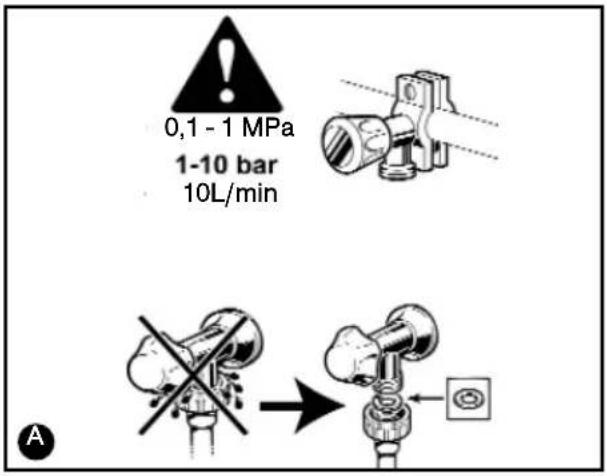
This dishwasher can be supplied with cold water or hot water up to a maximum of 60^ . When supplying with hot water, check that your original hose allows such connection (red marking on the hose). However, we recommend that you connect to the cold water supply. Your appliance is fitted with a supply hose 1.50m long.
Connect the hose to a tap with a threaded end, diameter 20/27 (3/4" BSP).
Check that the water pressure does not exceed the values below:
Flow rate: 10 L/min (1 L/min minimum)
Pressure: 1 to 10 bars (0.1 - 1 MPa)
If the water pressure is too high, please fit a pressure regulator. Please contact your local Water Authority for advice on the water pressure in your region.

Warning:
If you use a self-piercing tap, check here is sufficient water flow.
Check that the hose seal is present and that the connection is tight
Do not re-use any previously used hoses for making the connection.
Avoid any kinks or constrictions in the hose, which could prevent the water from passing or slow down its flow, particularly when building in the appliance under the worktop If the appliance is connected to new pipes or pipes that have not been used for a certain length of time, let the water run for a few minutes before connecting the water hose to avoid and deposits of sand or rust that could block the water hose's filter.

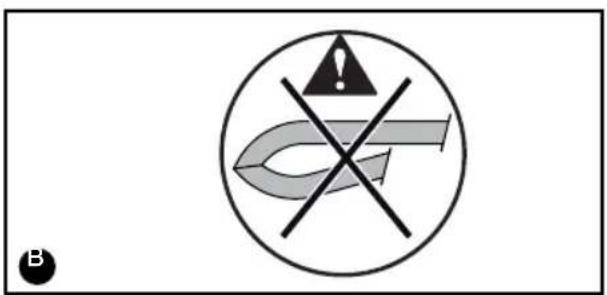
Danger:

The symbol indicates that
the hose is fitted with an electrical device for cutting off the water supply (depending on the model). Do not leave this hose in water and do not cut it.

NB:
Any connection to a water conduit necessarily involves the risk of a leak occurring, whatever the precautions taken. Therefore, always close the water tap when you are not using your machine.
- DRAINING AWAY THE WASTE WATER: FIG. 2
You can connect the end of the drain hose to:
-A ventilated U-bend or
-A sink U-bend
When connecting to a U-bend, you must remove the flapper from the U-bend. Then fully install the rubber end. If necessary, add a tightening collar
If necessary, you can increase the hose's length (up to 3m maximum). In this case, check that the appliance drains correctly. The hose must rest on the floor and only rise vertically close to the drainage system.
For appliances installed in vertical units, the drainage system must not rise higher than the top of the appliance.

NB:
Ensure that the drain hose is held in place with a tie to avoid any potential flooding.
The drain connection must be 0.40m (minimum) to 0.90m (maximum) above the floor.

Important:
When fitting the hose, pull on it gray so as not to kink it.
Avoid any kinks or constrictions in the hose, which could prevent the water from passing or slow down its flow.
Make sure that you adhere to the maximum dimensions for the fitting of the drainage tube in the siphon pipe

- ELECTRICAL CONNECTION
The appliance must be at a standstill when connecting to the electricity supply circuit.
Before connecting your appliance, ensure that:
- The mains voltage indicated on the manufacturer's plate on your machine matches the voltage supplied by your installation.
- Your meter and the fuses can support the current intensity for your dishwasher. A fuse of at least 10A is required.
If you must connect your appliance to a different voltage from that indicated on your machine, connect an appropriate transformer.

NB:
Use the services of a qualified electri
cian to make the modifications and ensure that your electrical installation complies with the regulations.
This appliance must necessarily be connected directly to an earthed plug and socket.
In all cases, it must be connected in accordance with the prevailing regulations in the country concerned and any additional regulations from the local electricity utility.

Warning:
The plug and socket must be accessible even after your appliance has been installed.
The appliance must not be connected via an extension lead, a multiple socket or an electric time delay programmer
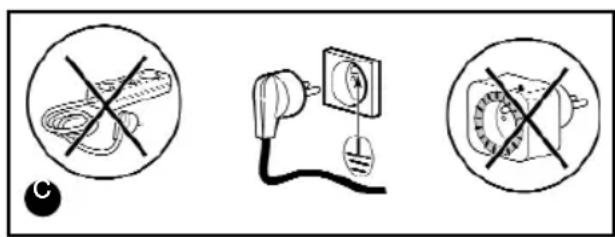
We cannot be held responsible in the event of an accident or an incident caused by the lack of or by a defective Earthing system.
Your dishwasher complies with European Directives 73/23/EEC (Low Voltage Directive) and 89/336/EEC (Electromagnetic Compatibility) as modified by Directive 93/68/EEC.
- Replacing the power cable

Danger:
For your safety's sake, this operation must only be performed by the manufacturer's After-Sales Department or by someone with similar qualifications in order to avoid any risks.
- Appliances delivered without a plug

Danger:
The wires in your appliance's power cable are coloured as follows:
- Green & Yellow Earth
- Blue Neutral
- Brown Live
If the cable's colours do not match your plug, proceed as follows:
The wire coloured green and yellow must be connected to the connector in your plug marked with the letter E, the symbol or coloured green and yellow.
The blue-coloured wire must be connected to the connector marked with the letter N or coloured black.
The brown-coloured wire must be connected to the connector marked with the letter L or coloured red.
- INSERTION INTO THE NICHE
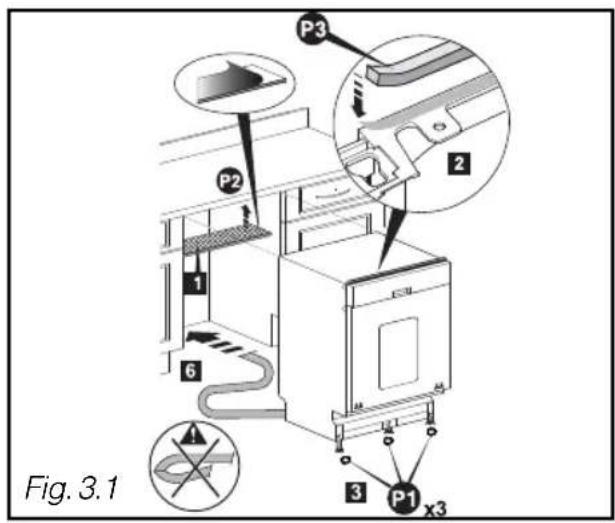
- Glue on the anti-condensation plate (Fig. 3.1)
- Glue on the foam sound-proofing seal (Fig. 3.1)
- Clip the three cups 🍷nder the feet to make the dishwasher easier to slide (Fig. 3.1).
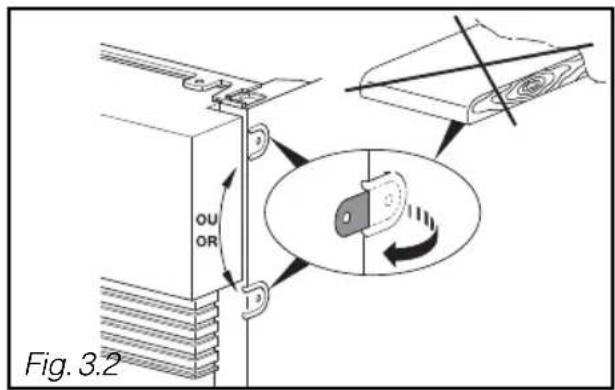
If the worktop is in marble or a similar material, you must fix your dishwasher using the side screws; before inserting it into the niche, you must therefore unfold a flange on each side of the side panels (Fig. 3.2).
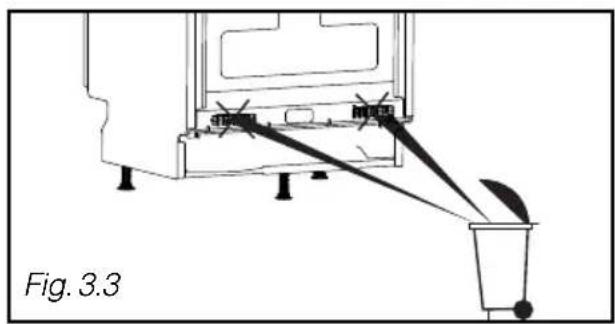
- Remove the hose brackets (Fig. 3.3)
- Slide the appliance into the niche, TAKING SPECIAL CARE NOT TO KINK THE HOSES.
LEVELLING BY ADJUSTING THE FEET
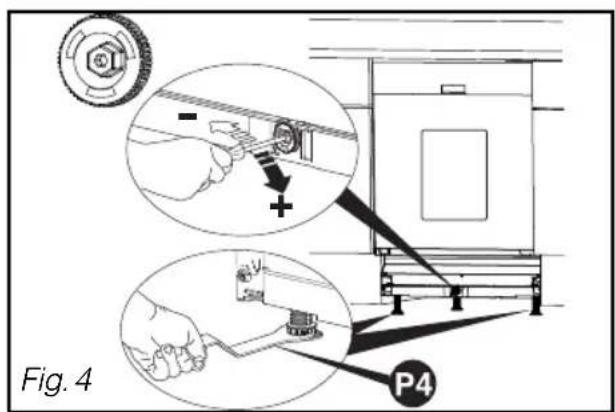
The front feet are adjustable. Use the wrench provided to adjust them, if necessary. The central foot can be adjusted using the red wheel (screwdriver with No. 8 plug, No. 8 pipe wrench or T20 Torx screwdriver).
The appliance must be correctly levelled so that the door closes and seals perfectly (Fig. 4). Ensure that the dishwasher's door closes correctly, without catching or rubbing against the sides.
FITTING THE DOOR PANEL (Cladding with a single panel)
- Measure the distance between the floor and the bottom of the door panel on the adjacent unit (Dimension B, Fig. 5.1)
- Measure the distance between the floor and the marking on the bottom of the door panel (Dimension A)
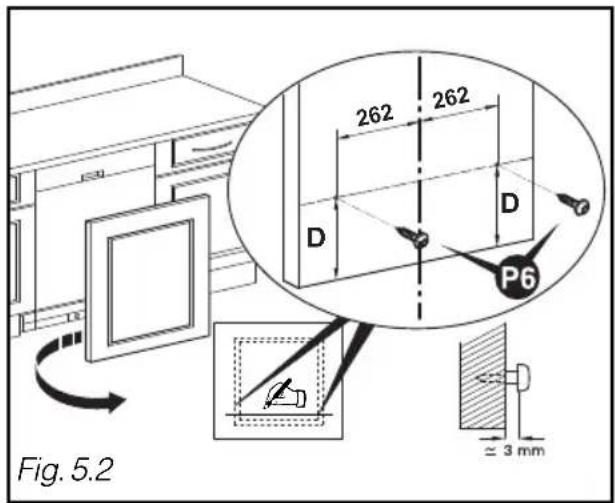
- Calculate Dimension D = A - B , and draw a line for Dimension D on the back of the panel at the bottom (Fig. 5.2)
- Set the positions for the two screws at 262mm from the wood panel's axis and insert two screws (Fig. 5.2)
- Position your door panel by engaging the 2 screws in the holes in the dishwasher's door (Fig. 6.1)
- If there is a problem with screwing, offset the screw 22 mm.
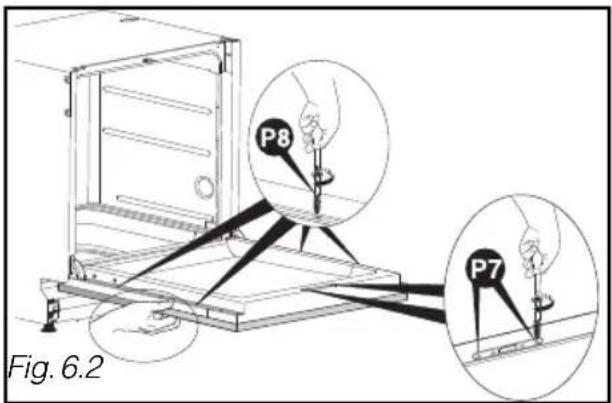
- Place the wood panel flat against the door (Fig. 6.2).
- Open the dishwasher's door while holding the panel flat up against the door. Centre the wood panel at the sides with respect to the control panel, if necessary. Insert the 2 screws the 4 screws (Fig P82).

Warning :
If the wood panel is very hard, ensure that you make a hole in advance before screwing the panel on.

NB:
If your appliance is supplied with a sound insulation sheet, glue this on before installing the door panel.


FITTING THE DOOR PANEL (Cladding with 2 elements)


- To fit the first section, please refer to the previous chapter "FITTING THE DOOR PANEL (Cladding with a single panel) (Figs. 5.1 et 5.2).
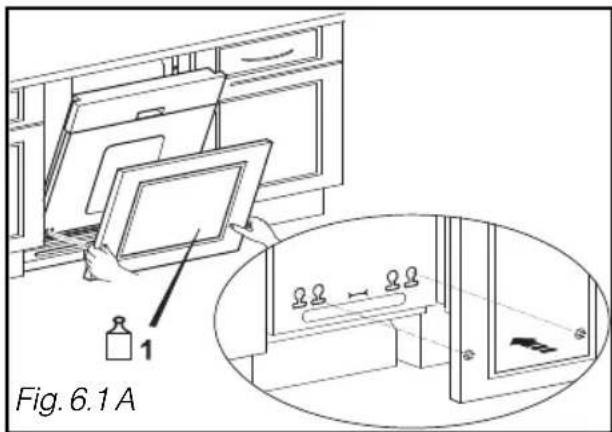
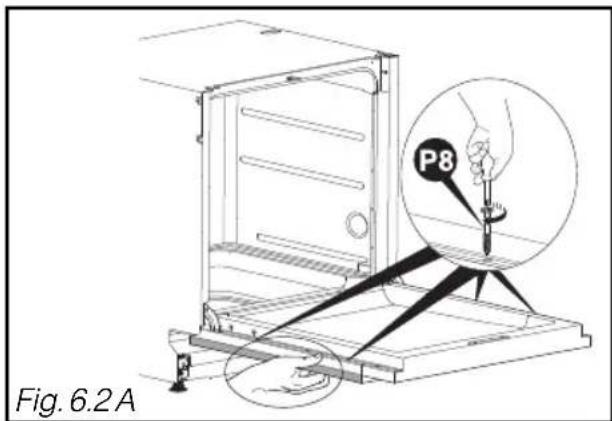
- Position your door panel by engaging the 2 screws in the holes in the dishwasher's door (Fig. 6.2 A)
- If there is any difficulty screwing, move the screw 22 mm.
- Place the wood panel flat against the door (Fig. 6.2 A).
- Open the dishwasher's door while holding the panel flat up against the door. Centre the wood panel at the sides with respect to the control panel, if necessary. Insert the 4 screws (g. 6.2 A).
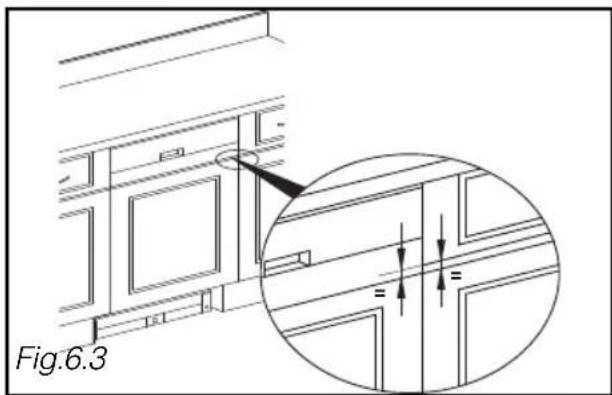
- Measure the distance between the drawer and the door panel on the adjacent unit (Fig. 6.3).
- Place the false drawer front taking into account the distance just measured (using a wedge with a good thickness).
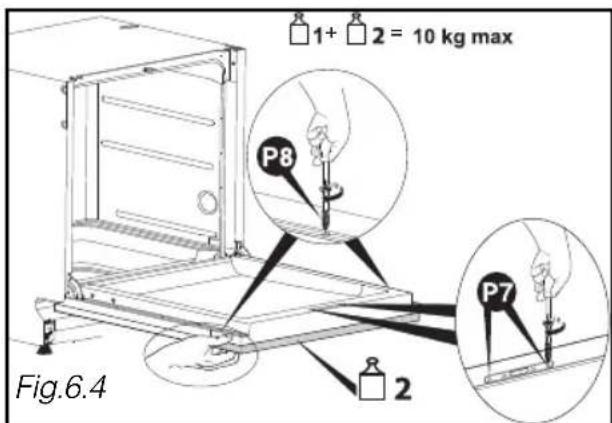
- Open the dishwasher's door while holding the false drawer front up against the door. Centre the wood panel at the sides with respect to the door panel. Insert the 2 screws
and the 2 screws
.6.4).

Warning :
If the wood panel is very hard, ensure that you make an initial hole before screwing it on.

Warning :
Then total weight of the door panel and the false drawer front must not exceed 10kg maximum.
APPLIANCES BUILT-IN UNDER A HOB

Danger:
If your worktop has a hob fitted above your dishwasher, you must fit thermal insulation on top of your dishwasher. You can obtain an insulation kit from your dealer. Remember to leave a space between the gas pipe and the top of your dishwasher.
- FIXING IN THE NICHE
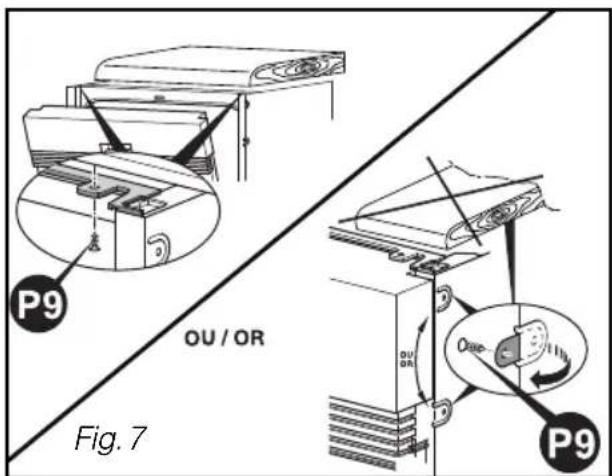
Fasten the dishwasher under the worktop with the screws (see Fig. 7) or using the flanges you have unfolded (Fig. 3.2).

Warning:
The screw provided is intended for a panel at least 16mm thick. If the panel is less than 16mm thick, change the screw or shorten it.
- SOUND-PROOFING SEALS
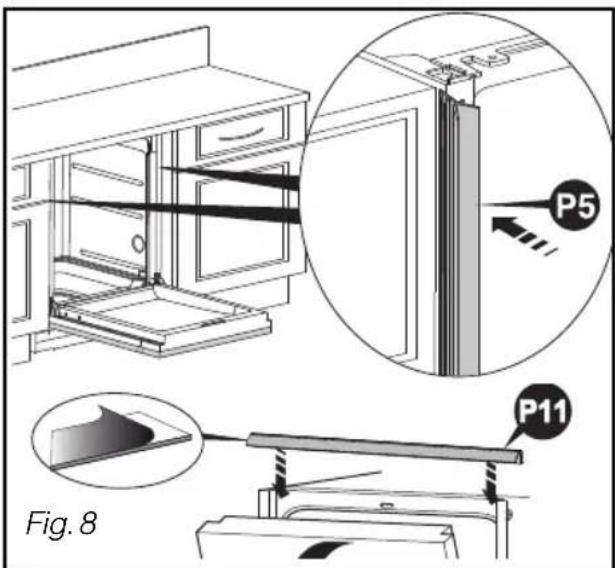
To improve the built-in appliance's soundproofing, fit the sound-proofing seals (depending on the model). (P F 8)
If the recess is bigger, stick on seal P5ng the adhesives provided.
If the appliance is laterally secured, a cut must be made in the seals'els to allow the retaining brackets to be passed through (nipper).
BALANCING THE DOOR (LEFT AND RIGHT)
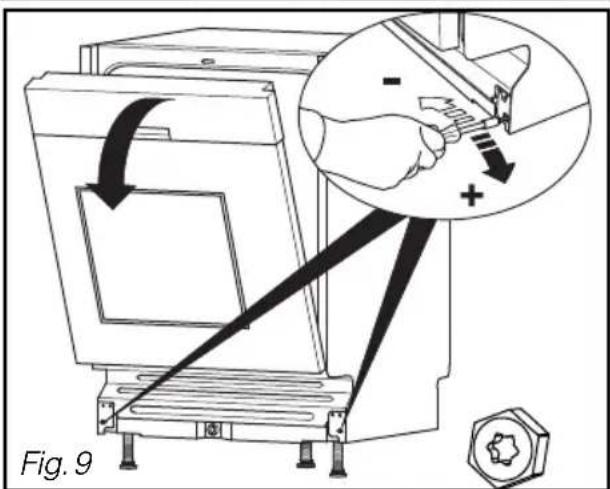
Adjust the tension on the springs, if necessary, to compensate for the weight of the cladding panel. Adjust them identically on the right and the left (Fig. 9).
The door is correctly balanced when it dopes not fall heavily on opening and it remains horizontal in the open position.
- REFITTING THE PLINTH
Refit the plinth, cutting it away if necessary according to Dimension P (see table and Fig. 10.1)
Calculate dimension P (Table on last page):
- Take Dimension B from Fig. 6.1 and measure the gap J between the floor and the bottom of the dishwasher. Calculate B-J.
- Measure the plinth depth E (Fig. 10.1) between the unit's plinth and front of the unit. Take the value for P from the table provided by E and B - J (e.g. if E = 100 and B - J = 140 , then P = 23 ).
- Cut away the plinth across a width of 600mm to the depth for the value for P.
If there will be a specific plinth for the dishwasher, you must obtain a separate fixing kit (32X3252) from the After-Sales Department. In this case, the plinth height is H = B - P (Fig. 10.2).
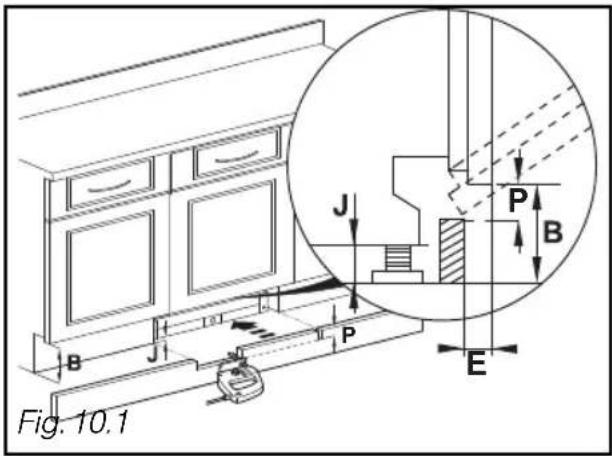

TABLE FOR CUTTING AWAY THE PLINTH
| Cut-away depth P = | |||||||||||||
| B.J.E | 10 | 15 | 20 | 25 | 30-75 | 80 | 85 | 90 | 95 | 100 | 105 | 110 | 115 |
| 170 | 46 | 49 | 51 | 52 | 54 | 52 | 50 | 47 | 44 | 41 | 36 | 30 | 23 |
| 165 | 42 | 45 | 47 | 48 | 50 | 48 | 46 | 43 | 40 | 37 | 32 | 27 | 20 |
| 160 | 39 | 41 | 43 | 45 | 46 | 44 | 42 | 40 | 37 | 33 | 29 | 24 | 17 |
| 155 | 35 | 38 | 40 | 41 | 43 | 40 | 39 | 36 | 34 | 30 | 26 | 21 | 15 |
| 150 | 32 | 35 | 37 | 38 | 40 | 37 | 36 | 34 | 31 | 28 | 24 | 19 | 13 |
| 145 | 30 | 32 | 34 | 36 | 37 | 35 | 33 | 31 | 29 | 25 | 22 | 17 | 12 |
| 140 | 28 | 30 | 32 | 33 | 35 | 32 | 31 | 29 | 26 | 23 | 20 | 16 | 11 |
| 135 | 26 | 28 | 30 | 31 | 32 | 30 | 29 | 27 | 24 | 22 | 18 | 14 | 10 |
| 130 | 24 | 26 | 28 | 29 | 30 | 28 | 27 | 25 | 23 | 20 | 17 | 13 | 9 |
| 125 | 23 | 24 | 26 | 27 | 29 | 27 | 25 | 23 | 21 | 19 | 16 | 12 | 8 |
| 120 | 21 | 23 | 25 | 26 | 27 | 25 | 24 | 22 | 20 | 18 | 15 | 11 | 8 |
| 115 | 20 | 22 | 23 | 24 | 26 | 24 | 22 | 21 | 19 | 17 | 14 | 11 | 7 |
| 110 | 19 | 21 | 22 | 23 | 24 | 22 | 21 | 20 | 18 | 16 | 13 | 10 | 7 |
| 105 | 18 | 20 | 21 | 22 | 23 | 21 | 20 | 19 | 17 | 15 | 12 | 10 | 6 |
| 100 | 17 | 19 | 20 | 21 | 22 | 20 | 19 | 18 | 16 | 14 | 12 | 9 | 6 |
| 95 | 16 | 18 | 19 | 20 | 21 | 19 | 18 | 17 | 15 | 13 | 11 | 9 | 6 |
| 90 | 16 | 17 | 18 | 19 | 20 | 18 | 17 | 16 | 15 | 13 | 11 | 8 | 6 |
| 85 | 15 | 16 | 17 | 18 | 19 | 18 | 17 | 15 | 14 | 12 | 10 | 8 | 5 |
| 80 | 14 | 15 | 17 | 17 | 18 | 17 | 16 | 15 | 13 | 12 | 10 | 8 | 5 |
1/SIKKERHEDREGLER
Vigtige advarsler 26