F 602 N - Heating Jøtul - Free user manual and instructions
Find the device manual for free F 602 N Jøtul in PDF.



| Brand | Jøtul |
| Model | F 602 N |
| Product type | Wood and coal stove |
| Main material | Cast iron and vermiculite |
| Recommended fuel | Dry wood (moisture content ~20%): birch, beech, oak; Coal: hard coal, briquettes (EN 13240 standard) |
| Approximate dimensions | Height: 70 cm, Width: 50 cm, Depth: 40 cm |
| Approximate weight | 100 kg |
| Nominal power | Approximately 6-9 kW |
| Energy efficiency | High in intermittent combustion |
| CO emissions | Low under normal use |
| Air inlets | Upper and lower (adjustable) |
| Self-cleaning glass function | Air wash system (air flows along the glass) |
| Intermittent/continuous combustion | Intermittent recommended, continuous possible (overnight burn 8h) |
| Glass cleaning | Damp newspaper + ashes or special glass cleaner |
| Ash removal | Removable ash pan; always leave a layer of ashes at the bottom |
| Recommended chimney sweeping | Annual (flues and chimney) |
| Interior cleaning | Wire brush for soot deposits |
| Seal maintenance | Check and replace if worn (ceramic glue recommended) |
| Safety instructions | Room ventilation, distance from flammable objects, do not use mechanical ventilation, risk of overheating, chimney fire |
| Warranty | Not specified (consult dealer) |
| Standards | Complies with local regulations; ISO 9001 quality system |
Frequently Asked Questions - F 602 N Jøtul
User questions about F 602 N Jøtul
0 question about this device. Answer the ones you know or ask your own.
Ask a new question about this device
Download the instructions for your Heating in PDF format for free! Find your manual F 602 N - Jøtul and take your electronic device back in hand. On this page are published all the documents necessary for the use of your device. F 602 N by Jøtul.
USER MANUAL F 602 N Jøtul
8.3 Advarsel mod overfying
Installation manual with technical data
1.0 Relationship to the authorities
2.0 Technical data
3.0 Installation
4.o Service
5.o Optional Equipment
General use and maintenance manual
6.o Safety precautions 22
7.0 Choice of fuel 23
8.o Use 24
9.o Maintenance 25
10.o Operational problems - troubleshooting.....26
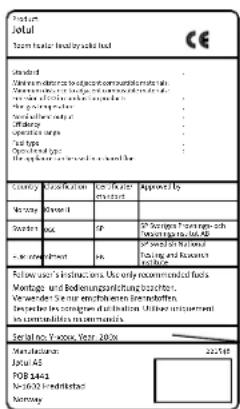
On all our products there is a label indicating the serial number and year. Write this number in the place indicated in the installation instructions.
Always quote this serial number when contacting your retailer or Jøtul.
Serial no.
6.o Safety precautions
Before using a fireplace, ensure that the installation complies with laws and regulations.
Any modifications to the product or its installation performed by the distributor, installer or consumer may result in the product and safety features do not function as intended. The same applies to the installation of accessories or optional extras not supplied by us. This may also be the case if parts that are essential to the functioning and safety of the fireplace have been disassembled or removed.
In all these cases, the manufacturer is not responsible or liable for the product and the warranty shall become null and void.
6.1 Fire preventive measures
Any use of a fireplace may represent some danger. Therefore, respect the following instructions:
- Ensure that furniture and other flammable materials do not get too close to the fireplace.
- Let the fire die. Never put it out with water.
- The fireplace gets warm when used and may cause burns if touched.
- Only remove the ashes when the fireplace is cold. Ash may contain embers and should therefore be kept in a noncombustible container.
- Ash must be properly disposed of outdoors, or emptied where it does not entail a fire hazard.
6.2 Air supply
Warning! Please ensure that there is adequate air supply from the outdoors to the room in which the fireplace is to be installed.
An inadequate air supply could cause smoke gas to escape into the room. This is very dangerous! Symptoms of this include smoky smell, drowsiness, nausea and feeling ill.
Ensure that air vents in the room where the fireplace is located are not blocked.
Avoid using mechanical fan vents in a room with a fireplace. This may cause negative pressure and draw poisonous gasses into the room.
Certain products are designed to be able to feed outdoor air directly to the fireplace. This ensures that the fireplace receives combustion air when the fireplace's door is closed, independently of the property's ventilation system. (See installation manual for each product).
7.o Choice of fuel
Always use the specified fuel. (Fuel type is described in «2.0 Technical data» in the installation manual for each product). This will give you optimal results. Use of other fuels may damage to the product.
7.1 Jøtul's definition of quality firewood
By good quality firewood we mean logs of, for example, birch, beech and oak.
Good quality wood should be dried so that the water content is approx. 20% .
To achieve this the wood should be chopped at the latest in late winter or early spring. It should be cut and stacked so that air circulates around it. The stacks must be protected so as to avoid absorbing excessive rainwater. The logs should be taken indoors in autumn for use during the winter season.
The amount of energy obtainable from 1kg of wood varies very little. On the other hand the specific weight of the different kinds of wood varies considerably. As an example, a certain volume of fir will provide less kWh than the same volume of oak, which has a higher specific weight.
The amount of energy produced by 1kg quality wood is about 3,8kWh . 1kg of completely dry wood (0%) moisture produces approximately 5kWh , while wood with a moisture level of 60% produces only around 1,5kWh/kg .
Consequences of using damp wood may include:
- Appearance of soot/tar on the glass, in the fireplace and in the chimney.
-Fireplace will give less heat. - Risk of chimney fire as a consequence of accumulation of soot in the fireplace, flue pipe and chimney.
- The wood is difficult to light and the fire can die.
Be especially careful never to lay a fire using any of the following materials:
Household waste, plastic bags, etc.
- Painted or impregnated wood (highly toxic).
- Chipboard or laminated boards.
Driftwood (seawater).
This may harm the product and pollute the atmosphere.
N.B. Never use combustible liquids such as petrol, kerosene, alcohol or similar to start the fire. This may cause harm to both yourself and the product.
7.2 Jøtul's definition of quality coal
By good quality coal we mean mineral coal according to the specifications in EN 13240, table B.2. (Briquetted fuel for closed appliances.) For example use: Phurnacite.
7.3 Fuel size and amount
Jotul's products are developed to have excellent combustion. An important factor for good combustion is that the fuel is the correct size. The size and amount of fuel should be as described in 2.o Technical data" in the installation manual for each product.
7.4 Intermittent/continuous combustion
Intermittent combustion
Most of Jøtul's products are designed for intermittent combustion. (See installation manual «2.0 Technical data» for each product).
Intermittent combustion in this context means normal use of the fireplace, i.e. fuel is added as soon as the fuel has burnt down to a suitable amount of embers.
Continuous combustion
Some products are suitable for continuous combustion. (See installation manual «2.o Technical data» for each product). Continuous combustion in this context means that a fireplace can burn overnight without having to relight the fire.
ENGLISH
8.o Use
Burn plates
Jotul products have two kinds of burn plates:
Cast iron
- Vermiculite (yellow)
NBI Take care not to be too heavy-handed when putting fuel into the fireplace as the vermiculite plates can become damaged.
Air vents
In general a product has two vents: the air vent and the ignition vent.
The air vent controls combustion air and the ignition vent feeds air directly to the fire during the ignition phase.
8.1 Initial lighting
Light the fire as described under «8.2/8.3 Daily use».
- Maintain the fire for a couple of hours and ventilate any smoke and smell from the product.
- Repeat this a couple of times.
Note! Odours when using the fireplace for the first time
Painted products: The fireplace may emit an irritating gas when used for the first time, and it may smell a little. The gas is not toxic, but the room should be thoroughly ventilated. Let the fire burn with a high draught until all traces of the gas have disappeared and no smoke or smells can be detected.
Enamelled products: Condensation may form on the surface of the fireplace the first few times it is used. This must be wiped off to prevent permanent stains forming when the surface heats up.
8.2 Daily use - burning wood
Initial lighting
- Open the vent(s) completely.
- Place two medium sized logs in the fireplace, one on each side of the base.
- Crumple some newspaper (or birch bark) between these and add some kindling wood in a criss-cross pattern, and place a medium sized log on top and light the newspaper. Gradually increase the size of the fire.
- For products without ignition vents the door can be left slightly open until the wood catches fire. Close the door and ignition vent (if available) when the firewood has ignited and the fire is burning well. (Use a glove, for example, when the handle is warm.)
- Then regulate the rate of combustion to the desired level of heating by adjusting the air vent.
Nominal heat output is obtained by opening the air vent a certain amount. (See installation manual «2.0 Technical data».)
Adding firewood
- Each load should burn down to embers before new firewood is added.
- Open the door slightly and allow the negative pressure to level out prior to opening the door completely.
- Add the wood and make sure that the air vent is fully open for a few minutes until the wood has caught fire.
- Close the air vent once the wood has properly ignited and is burning well.
8.3 Daily use - burning coal in briquettes
If the product is approved for burning coal in briquette form (see «2.0 Technical data» in the installation manual), the product must have air through the fire grate.
Initial lighting
- Open the vents completely.
- Place two medium sized logs in the fireplace, one on each side of the base.
- Crumple some newspaper (or birch bark) between these and add some kindling wood in a criss-cross pattern on top.
- Add coal on the top, and light the newspaper.
- Leave the door slightly open until the kindling wood catch fire.
- Close the door once the fire is stable and slowly reduce the air vent opening to reduce the burn rate. (Use a glove, for example, when the handle is warm.)
- When the logs have burned down to embers, the coal is to be added.
- Then regulate the rate of combustion to the desired level of heating by adjusting the ash door air vent.
Adding coal
When more fuel is needed, remember to rake the existing embers to ensure ash is deposited into the ash pan.
- Add more coal, but do not fill above the edge of the ash retainer.
- Open the ash door vent to allow the fire to achieve the required temperature.
- Once this is achieved, regulate the air vents as before.
Thermometer
When burning coal we recommend the use of a oven thermometer. The thermometer is available from all well equipped dealers and shall be placed on the top of the fireplace.
Persistent overheating of the fireplace (temperatures of 280^ or more) will hasten the need for replacement parts that are excluded from the warranty.
8.4 Danger of overheating
The fireplace must never be used in a manner that causes overheating
Overheating occurs when there is too much fuel and/or air so that too much heat is developed. A sure sign of overheating is when parts of the fireplace glow red. In which case, immediately reduce the air vent opening.
Upon suspicion of excessive/poor draught in the chimney, seek professional help. (See also «3.0 Installation» (Chimney and flue pipe) in the installation manual for information.)
In case of chimney fire:
- Close all hatches and vents.
- Keep the firebox door closed.
- Check the loft and cellar for smoke.
- Call the fire service.
- Before use after a fire an expert must check the fireplace and the chimney in order to ensure that it is fully functional.
8.5 From winter to spring
During a transitional period with sudden fluctuations in temperature, or under difficult wind conditions, disturbances in the chimney draught may occur so that the smoke gasses are not drawn out.
One should then use smaller logs and have a larger opening in the air vents so that the wood burns better and faster. This gives a higher flue gas temperature and the draft in the chimney is maintained.
To prevent too much ash from accumulating remove it more often than usual. See «9.2 Ash removal».
9.o Maintenance
9.1 Cleaning the glass
The product is equipped with an air wash for the glass. Air is sucked in through the air vent on the top of the product and down along the inside of the glass.
However, some soot will always stick to the glass, but the quantity will depend on the local draught conditions and adjustment of the air vent. Most of the soot layer will normally be burned off when the air vent is opened all the way and a fire is burning briskly in the fireplace.
Good advice! For normal cleaning, moisten a paper towel with warm water and add some ash from the burn chamber. Rub it over the glass and then clean the glass with clean water. Dry well. If it is necessary to clean the glass more thoroughly we recommend using a glass cleaner (follow the instructions on the bottle).
9.2 Ash removal
If the fireplace has an ash pan
- Shake or scrape the ash down into the ash pan.
- Carefully lift the ash pan out and empty it into a non-combustible container.
- Make sure the ash house is completely empty before replacing the ash pan.
If the fireplace does not have an ash pan
- Use a scoop or similar to remove the ash through the door.
- Always leave some ash as a protective layer on the bottom of the fireplace.
Important! Only remove ash when the fireplace is cold.
9.3 Cleaning and soot removal
Soot deposits may build up on the internal surfaces of the fireplace during use. Soot is a good insulator and will therefore reduce the fireplace's heat output. If soot deposits accumulate when using the product, they can be easily removed by using a soot remover.
In order to prevent a water and tar layer from forming in the fireplace you should regularly allow the fire to burn hot in order to remove the layer. An annual internal cleaning is necessary to get the best heating effect from the product. It is a good idea to do this in connection with the sweeping of the chimney and flue pipes.
9.4 Sweeping of flue pipes to the chimney
On certain free-standing fireplaces the top plate can be lifted off and the pipe swept through the top.
Otherwise, flue pipes must be swept through the flue pipe sweeping hatch or through the product's door opening. Normally, the baffle must be removed. (See separate section «4.o Service» in the product's installation manual.)
ENGLISH
9.5 Inspection of the fireplace
Jotul recommends that you personally inspect your fireplace carefully after sweeping/cleaning. Check all visible surfaces for cracks. Also check that all joints are sealed and that the gaskets are in the correct position. Any gaskets showing signs of wear or deformation must be replaced.
Thoroughly clean the gasket grooves, apply ceramic glue (available from your local Jotul dealer), and press the gasket well into place. The joint will dry quickly.
9.6 Exterior maintenance
Painted products may change colour after several years usage. The surface should be cleaned and brushed free of any loose particles before new paint is applied.
Enamelled products must only be cleaned with a clean, dry cloth. Do not use water and soap. Any stains can be removed with a cleaning fluid (oven cleaner etc.).
10.o Operational problems -troubleshooting
Poor draught
- Check the length of the chimney and that it complies with national laws and regulations. (See also «2.0 Technical data» and «3.0 Installation» (Chimney and flue pipe) in the installation manual for information.)
- Make sure that the minimum cross section on the chimney is according to «2.0 Technical data» in the installation manual.
- Make sure that there is not anything preventing the smoke gasses from escaping: branches, trees, etc.
- Upon suspicion of excessive/poor draught in the chimney, seek professional help for measurement and adjustment.
The fire extinguishes after a while
- Make sure that the firewood is sufficiently dry.
Find out whether there is negative pressure in the house, close mechanical fans and open a window close to the fireplace. - Check that the air vent is open.
- Check that the flue outlet is not clogged by soot.
Unusual amount of soot accumulates on the glass
Some soot will always stick to the glass, but the quantity depends on:
- Moisture in the fuel.
- The local draught conditions.
Air vent opening.
Most of the soot will normally burn off when the air vent is opened all the way and a fire is burning briskly in the fireplace. (See «9.1 Cleaning the glass - good advice».)
3MaInpoBaHHbIe npOdyKbI MoXHO YnCTHTb TOnbKO YnCTToC cyxOy TkaHbIO.He NcNoJIb3yIteMbIIO BVdy.
10.0 Причнны НемпраВноTeиВ ЗкплyaТаци, устараHeHne НелоладOK
Tnoxa T
IpoBepbTe,HTO6bI DnHnHa DbIMoxOda COOTBETCTBOBaNAtpe6oBaHnM,yKa3aHHbIM B DeiCTByUOxN 3aKOHax HOpMaTHNBHO-tpaOBbIX AKTAX BaWei cTpaHb.I B n.2.0 «TexHueckne daHHbIe NII.3.0 «YctanOBka(DbIMOXODNbIMxOHNbIyPbI)INCHpyKUNIO yCTAHOBKe CoedePKITcDOONHNTeNBHAR INHOpMaunno DaHHOMy BONPOcy.
- Y6eIntecb, yTo6bl MNHmAbJbHaN NIOuaJaB ceeyHn DbIMOXOda COOTBeTCTBOBaNa yKa3aHHo B n. 2.0 «TexHnueckne daHHbe» INHCTpyKuIN No yCTaHOBke.
- Y6eIntecb, yTO HHTO He MeUaET BbIXOy DbIMa (BETB, DepeBbI N.T.D.).
- Pn noD03peHn Ha BO3HKnHOBeHne n36bIToOH/cna6oT TaRn B dbIMoxOe o6paTntec 3a NOMOuIO K CneuaNtCTy drr ee n3mepeHn n perynipOBKn.
Orohb rachet
- Y6eHntecb, yTo IpoBa DoCTaTOUHO cyxne.
- Поверп Te nomeше На налчne OTPиateNBHOrOдавнЯ, Вькночte MexaHueckne BeHTNJIaTOpbl NOTKpoIte 6nIXaMWeE K KaMHy OKHO.
- PioBepbTe, yTO6bI OTBepCTne IINr noaun BTOpHnHO BO3dyxa 6blno OTKpbIto.
- PpOBepbTe, TTo6bI bIbIXoD dbIMoxOda He 6bI3a6nt caxeJ.
Heobiyhoe KOJnueCTBO caKn co6npaetcHa cTeKJIe
Hemhoro caxn Bcerda 6ydt cobnpatbca Ha cTeke, Ho ee KOJIuueCTBO 3aBNCIT OT CNeDyUOuxΦakTopoB:
BlaXHOCTb TOnnBa,
MECTHbIEYCIOBnTn
CTeENb OTKpbITnO OTBepCTnA DnApoaH BTOpHOro BO3dyxa.
Bolbwa qactb caqn OTropu, ecnn noHocbO OKpbItb OTBepCTne IJN NOaHy B03dyxa INHTehCnBHO nPoToNTb KaMH. CM. TaKke n. 9.1 «OvncTkca cTeKna - none3hbl COBeT»
CESKY
Mohlo by DOJIT K POSKOZENI VYROBKA ZNECISTENI ATMOSFERY.
Jøtul pursue a policy of constant product development. Products supplied may therefore differ in specification, colour and type of accessories from those illustrated and described in the brochure.
Jøtul AS has a quality system that conforms to NS-EN ISO 9001 for product development, manufacturing, and distribution of stoves and fireplaces. This policy gives our customers quality and safety piece of mind as a result of Jøtul's vast experience dating back to when the company first started in 1853.