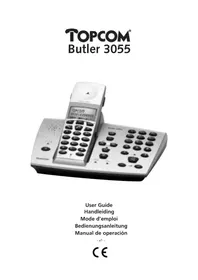
Butler 3055 - Phone TOPCOM - Free user manual and instructions
Find the device manual for free Butler 3055 TOPCOM in PDF.


User questions about Butler 3055 TOPCOM
0 question about this device. Answer the ones you know or ask your own.
Ask a new question about this device
Download the instructions for your Phone in PDF format for free! Find your manual Butler 3055 - TOPCOM and take your electronic device back in hand. On this page are published all the documents necessary for the use of your device. Butler 3055 by TOPCOM.
USER MANUAL Butler 3055 TOPCOM
To use 'Caller ID' (display caller), this service has to be activated on your phone line. Normally you need a separate subscription from your telephone company to activate this function.
If you don't have the Caller ID function on your phone line, the incoming telephone numbers will NOT be shown on the display of your telephone.
!! Important !!
GBThe features described in this manual are published with reservation to modifications.
- O nly use the charger plug supplied. Do not use other chargers, as this may damage the battery cells.
- O nly insert rechargeable batteries of the same type. Never use ordinary, non-rechargeable batteries. Insert rechargeable batteries so they connect to the right poles (indicated in the battery compartment of the handset).
- Do not touch the charger and plug contacts with sharp or metal objects.
- The operation of some medical devices may be affected.
- The handset may cause an unpleasant buzzing sound in hearing aids.
- Do not place the basic unit in a damp room or at a distance of less than 1.5m away from a water source. Keep water away from the handset.
- Do not use the telephone in environments where there is a risk of explosions.
- Dispose of the batteries and maintain the telephone in an environment-friendly manner.
- As this telephone cannot be used in case of a power cut, you should use a mains-independent telephone for emergency calls, e.g., a mobile phone.
Cleaning
Clean the telephone with a slightly damp cloth or with an anti-static cloth. Never use cleaning agents or abrasive solvents.
1 INSTALLATION 7
2 KEYS/LED 8
3 D ISPLAY (LCD) 10
4.2.3 Redialling the last number dialled 11
4.2.4 Redial one of the last 5 numbers dialled 11
4.2.5 Calling a programmed number from the Phone Book 12
4.2.6 An internal call: calling another handset 12
4.3 Receiving a Call 12
4.3.1 Receiving an external call 12
4.3.2 Receiving an internal call 12
4.3.3 Receiving an external call during an internal call 13
4.4 Activate/deactivate handsfree function 13
4.5. Headset connection 13
4.6 Transferring a call to another handset 13
4.7 Out of Range Warning 13
4.8 Setting the speaker volume 13
4.9 Call Duration Indicator on the Display 14
4.10 Turning off the microphone (mute) 1
4.11 Pause key 14
4.12 Conference call (two internal DECT handsets and one external caller) 14
4.13 Locating a misplaced handset (paging) 14
4.14 Using the alphanumeric handset keypad0 15
4.15 The Phone Book 15
4.15.1 Adding a number and a name to the Phone Book 15
4.15.2 Looking up a number in the Phone Book 16
4.15.3 Changing a name or number in the Phone Book 16
4.15.4 删除name and number from the Phone Book 16
4.16 Switch the handset on/off 17
4.16.1 Switch the handset off 17
4.16.2 Switch the handset on 17
4.17 Setting the ring volume level on the handset 17
4.17.1 Setting the ring volume for external calls (0-9) 17
4.17.2 Setting the ringer volume for internal calls (1-9) 17
4.18 Setting the ringer melody on the handset 18
4.18.1 Setting a ringer melody for external calls (1-9) 18
4.18.2 Setting a ringer melody for internal calls (1-9) 18
4.19 Setting the ring volume level of the base 18
4.20 Locking the key pad 18
4.21Turning key click on/off 19
4.22 The R key (flash) 19
4.23 Changing the PIN code 19
4.24 Subscribing a handset to a Butler 1000, 1010, 1210, 2405, 2410, 2450, 2455, 30xx base unit 20
4.25 Subscribing Butler 3055 handset on another base (other brand/model) 21
4.26 Subscribing a TOPCOM Butler 300 DECT GAP Headset 21
4.27 Removing subscription of a handset to a base unit 21
TOPCOM
Butler 3055
4.28 Selecting a base unit 22
4.28.1 Automatic selection 22
4.28.2 Manual selection 22
4.29 Barring outgoing calls 23
4.30 Direct Call 23
4.30.1 To program the Direct Call number 23
4.30.2 Turn the Direct Call function ON/OFF 23
4.31 Default settings (reset) of the parameters 24
4.32 Complete Reinitialisation of the telephone 24
4.33 Setting the handset dialling mode 25
5 CALLER ID/CLIP 25
5.1.Setting the date and time 26
5.2 The Call List
5.3 Calling a number from the Call List
5.4 Storing a number from the Call List in the Phone Book
5.5 Deleting numbers from the Call List
5.5.1 删除one number
5.5.2 Delete all numbers
6 VOICE MAIL INDICATOR
7 BASE TELEPHONE OPERATION
7.1 Making a call
7.2 Adjusting the speaker volume
7.3 Setting the dial mode for the base
7.4 Transfer a call from base to handset
7.5 Setting the base flash time
8 ANSWERING MACHINE
8.1. LED Display
8.2 Base Key Functions
8.3 Outgoing Messages
8.3.1 Recording outgoing messages (OGM 1 or OGM 2)
8.3.2 Playback the Outgoing Message
8.3.3 Select outgoing message
8.3.4 Erasing the Outgoing Message
8.4 Turning Answering Machine On/Off
8.5 Setting Number of Rings
8.6 Checking Number of Rings
8.7 Setting Day and Time
8.8 Checking Day/Time
8.9 Programming the VIP Code
8.9.1 Changing the VIP Code
8.9.2 Checking the VIP Code
8.10 Operation 32
8.11 Recording a Memo
8.12 Playback of Incoming Messages and Memos
8.13 Erasing Messages
8.13.1 Erasing Messages One at a Time during Playback
8.13.2 Erase all messages
8.14 Memory Full
8.15 Remote Operation
8.16 Turning Answering Machine On Remotely
9 TROUBLE SHOOTING
10 TOPCOM WARRANTY
11 TECHNICAL CHARACTERISTICS
26
26
27
27
27
27
27
27
27
27
28
28
28
28
28
29
29
29
29
30
30
30
30^
30
31
31
31
31
32
32
32
32
32
33
3.
34
35
36
37
1 INSTALLATION
Before you use the telephone for the first time, you must first make sure the battery is charged for 20 hours. If you do not do this, the telephone will not work optimally.
For installation, do the following:
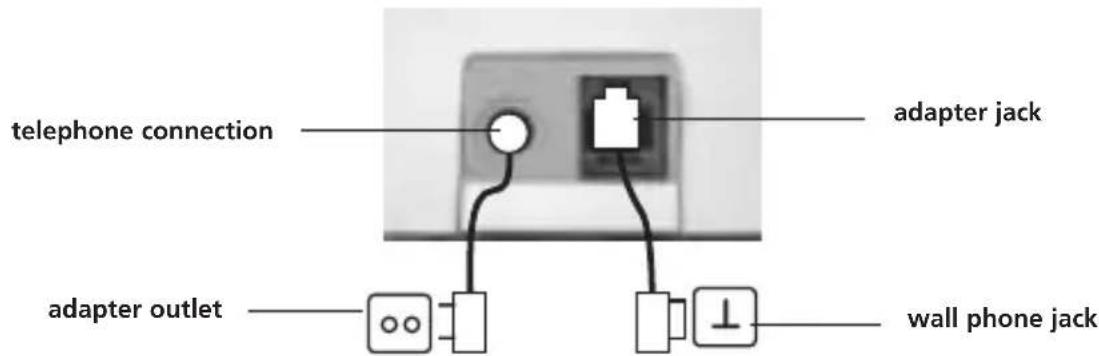
- Plug one end of the adaptor into the outlet and the other end into the adapter jack on the bottom of the telephone.
- Connect one end of the telephone cord with the wall phone jack and the other end to the bottom of the telephone.
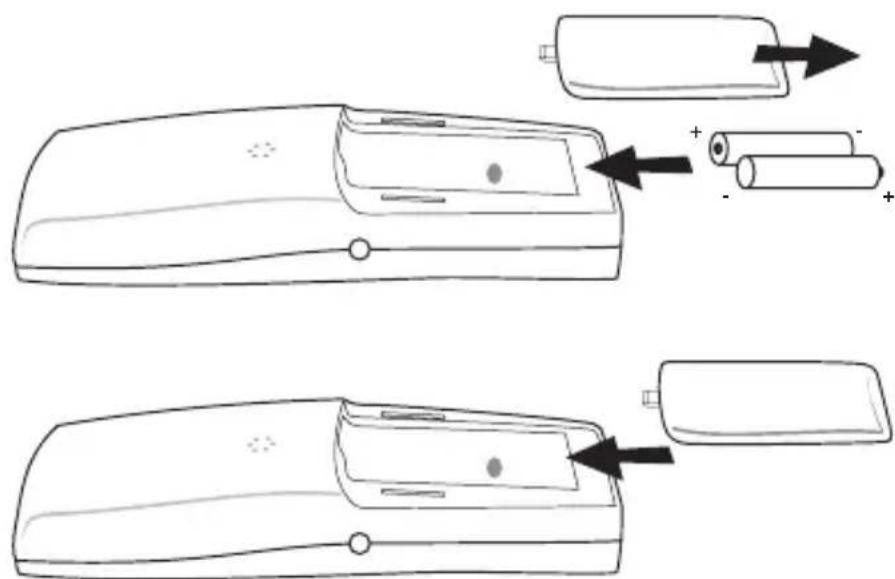
- O pen the battery compartment (see below).
- Insert the batteries respecting the (+ and -) polarity.
- Close the battery compartment.
- Leave the handset on the base unit for 20 hours. The Line/Charge indicator (CED) on the base unit will light up.
Battery indicator:
- battery is fully charged.
The battery is half drained (50%) - The battery is low. When the battery is low, you will hear warning signals and the battery symbol on the display will blink.
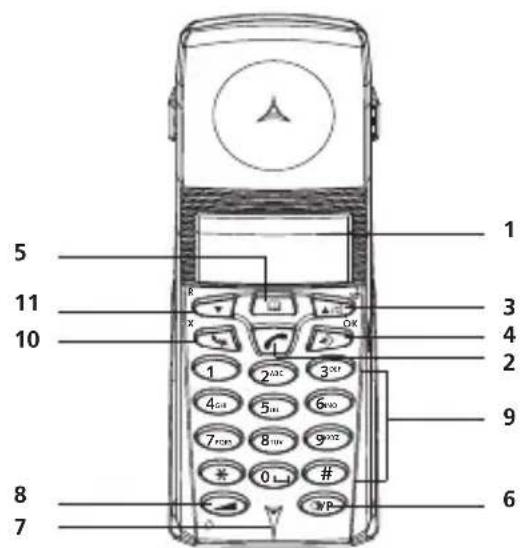
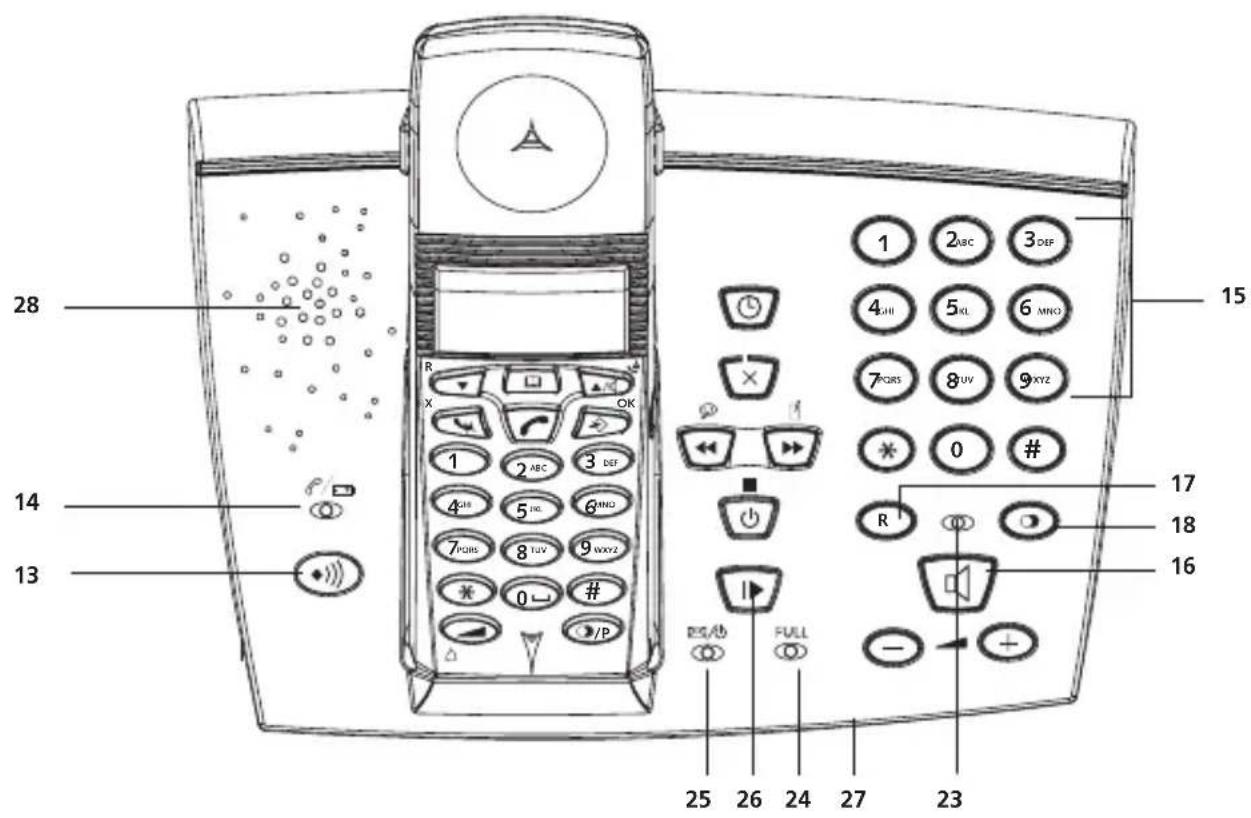
2 K EYS/LED
HANDSETBASE
1 Display
2 Line key
3 Up/Handsfree key
4 Programming key
5 Phonebook key
6 Redial/Pause key /B
7 Microphone
8 Volume/Ringer key
9 Alphanumeric keys
10 Delete/Mute key
11 Down/Flash key
12 Headset connection
13 Paging key
14 Line/Charge indicator (EB)
15 Base telephone dialling keys
16 Line/Handsfree base telephone key
17 Flash key R
18 Redial key
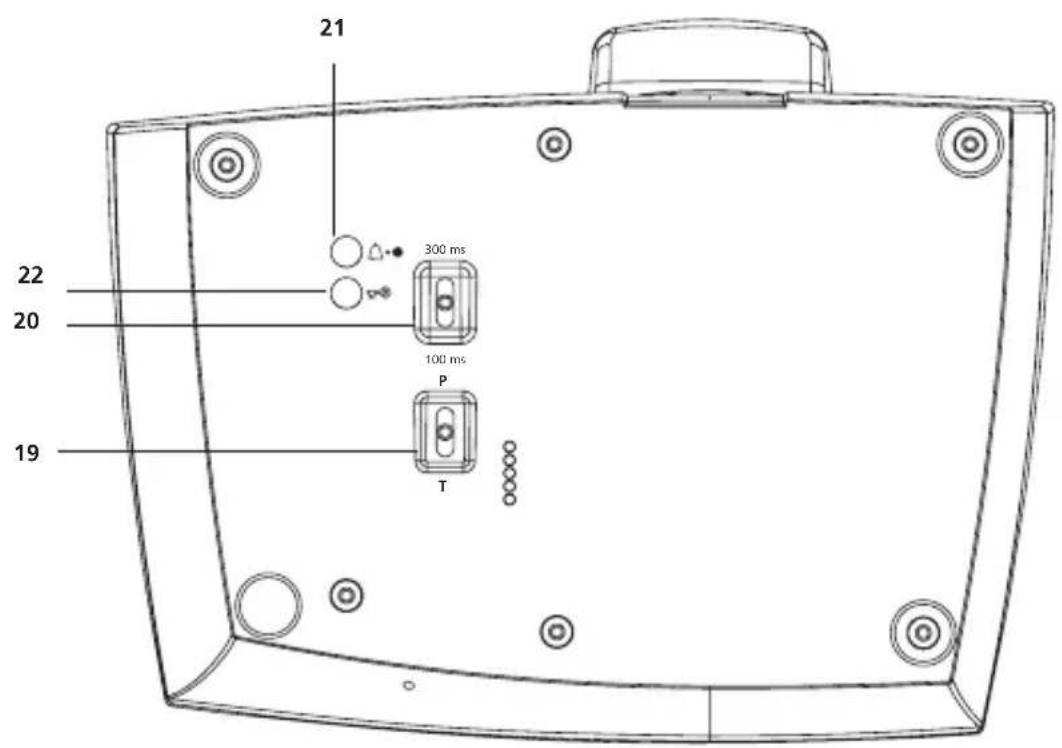
19 Tone/pulse switch
20 Flash time switch
21 Numbers of rings setting key
22 VIP code key
23 OFF-hook base telephone LED
24 Memory full LED
25 Messages/answering ON-OFF LED
26 Answering machine key
27 Microphone
28 Speaker

3 DISPLAY (LCD)
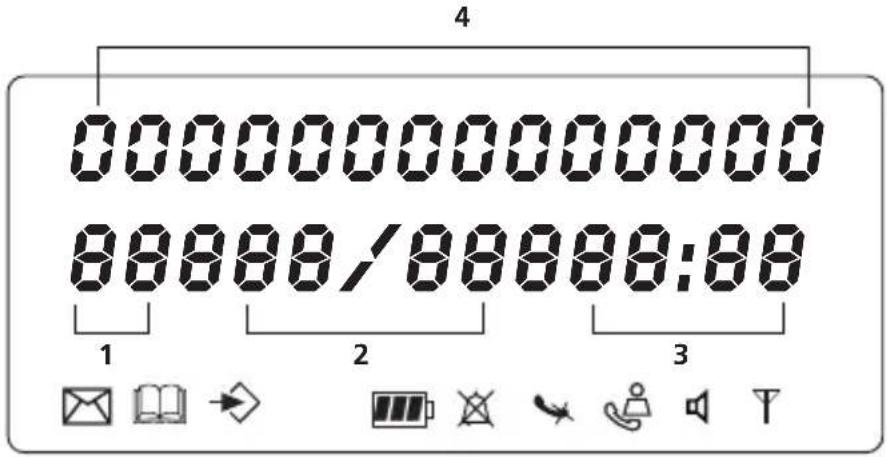
1 Number of calls received.
2 Date (day/month) of calls received.
3 Time (hour:minutes) of calls received.
4 Call information.
5 Symbol display ():T
- this symbol means that the handset is located within the range of the base unit.
- when this symbol starts blinking, this means you are beyond the range of the base unit. Move closer to the base unit so that the connection between the base unit and the handset can be restored.
6 Symbol display ( )
- this symbol means that the telephone has received calls that are automatically stored in the Call List.
7 Symbol display ():
- this symbol means that the mute function is activated, the microphone is turned off during a conversation.
8 Symbol display ():
- this symbol appears on the display when you make or receive a call.
9 Symbol display ():
- this symbol means that the ringer is turned off. When you receive a call, the telephone does not ring. The telephone will ring when you receive an internal call.
10 Symbol display ( )
- this symbol is the battery indicator.
11 Symbol display ():
- this symbol means you are in the menu.
12 Symbol display ( )
- this symbol appears when you browse the numbers in the Phone Book.
13 Symbol display ( ):
- this symbol appears when you have received a voice mail message (see chapter 6).
14 Symbol display ( ):
- this symbol means that the handsfree function is activated. You can now talk without having to pick up the handset.
- Blinks when base telephone is active. You can't take the line with the handset as long as base telephone is active!
4 HANDSET OPERATION
4.1 Setting the language
The telephone has 5 display languages: see display languages table on packaging!!
To set the language, do the following:
- Press the Programming key.
- Press the Up or Down key repeatedly until 'SETTING' appears on the display
- Press the Programming key.
- Press the Up or Down key repeatedly until 'LANGUE' appears on the display.
- Press the Programming key.
- The language set appears on the display.
- Press the Up or Down key repeatedly to select the language you would like to use.
- Once the desired language appears on the display, press the Programming key to confirm your selection or repeatedly press the Mute/Delete key to leave the menu.
4.2 Making Calls
!! When making external calls through the handset, base telephone operation is not possible!!!
4.2.1 External Call
- Press the Line key
- The Line/Charge indicator (LED) on the base unit will blink. 'EXT' and the Call symbol appear on the display.
- You will hear the dial tone. Dial the telephone number you wish to call.
- The number appears on the display and is dialled.
After finishing your call, press the Line key to hang up.
4.2.2 Number preparation
- Dial the telephone number you wish to call. You can correct the number by pressing the Delete/Mute key
- Press the Line key
- The Line/Charge indicator (LED) on the base unit will blink. 'EXT' and the Call symbol appear on the display.
- The telephone number is dialled automatically.
After finishing your call, press the Line key to hang up.
4.2.3 Redialling the last number dialled
- Press the Line key
- The Line/Charge indicator (LED) on the base unit will blink. 'EXT' and the Call symbol appear on the display.
- You will hear the dial tone.
- Press the Redial key The number you last called is dialled automatically.
4.2.4 Redial one of the last 5 numbers dialled
-
Press the Redial key . The number you last called appears on the display. If you would like to dial one of the last 5 numbers dialled, press the Redial key a few times until the desired number appears on the display.
-
Press the Line key
- The number shown on the display is dialled automatically.
After finishing your call, press the Line key to hang up.
4.2.5 Calling a programmed number from the Phone Book
The telephone has a Phone Book in which you can program the telephone number with name. If you would like to call a number from the Phone Book:
- Press the Phone Book key The first number of the Phone Book appears on the display.
- Press the Up or Down key repeatedly to select the telephone number you wish to call.
- Press the Line key
- The number shown on the display, is dialled automatically.
- After finishing your call, press the Line key to hang up.
4.2.6 An internal call: calling another handset
This function only works if multiple handsets are subscribed to the base unit !
- Press the Programming key.
- Press the Up or Down key repeatedly until 'INTERCOM' appears on the display.
Press the Programming key - 'INT' appears on the display
- Dial the number of the handset you would like to call.
After finishing your call, press the Line key to hang up.
4.3 Receiving a Call
4.3.1 Receiving an external call
- All subscribed handsets will ring when you receive a call.
- The Call symbol links on the display.
- The telephone number of the caller appears on the display if you have Caller ID service (CLIP). Consult your telephone company. The name of the caller also appears on the display if: - the name is programmed into the Phone Book - the network sends the name together with the telephone number (FSK CID system only).
- Press the Line key to accept the external call.
- During the call 'EXT' and the symbol appear on the display. The call timer starts running.
- After finishing your call, press the Line key to hang up or put the handset back on the base unit.
4.3.2 Receiving an internal call
This function only works if multiple handsets are subscribed to the base unit!
The handset rings.
- 'INT' and the number of the handset calling, appear on the display. The Call symbol blinks on the display.
- Press the Line key to accept the internal call.
- During the call, 'INT', the handset number of the caller and the symbol appear on the display. The call timer starts running.
- After finishing your call, press the Line key to hang up.
4.3.3 Receiving an external call during an internal call
If you receive an external call during an internal call, you will hear a call waiting tone (double beep) on both handsets being used for an internal call.
- Press the Line key twice to accept the external call.
- After finishing your call, press the Line key to hang up.
4.4 Activate/deactivate handsfree function
This function allows you to communicate without having to pick up the handset. When you are talking, press the Up/Handsfree key to activate the handsfree function.
Press the same button to deactivate the handsfree function.
Note : When you are calling in handsfree mode and you want to change the volume, press the Volume button
Attention !! When you use the handsfree function for a long time, the batteries will be empty quickly !
4.5. Headset connection
You can connect a headset with a 3 pole jack plug of 2,5mm on the right side of the handset. When the headset is connected, you can only hear and talk through the headset. The headset microphone can still be muted by the Mute key. The handsfree speaker can still be activated by pressing the handsfree key
4.6 Transferring a call to another handset
- You have an external caller on the line.
- Press the Programming key
- 'INTERCOM' appears on the display.
- Press the Programming key.
- The external call is now on hold.
- 'INT' appears on the display.
Dial the number of the handset to which you would like to transfer the call. - If the handset dialled is answered, you can have an internal conversation. Press the Line key and the external call is transferred.
- If the handset dialled is not answered, press the Down key to speak to the external caller again.
4.7 Out of Range Warning
If the handset is out of range of the base unit, a warning signal will sound.
- 'SEARCHING' appears on the display and the symbol glinks on the display.
- Move closer to the base unit.
- As soon as you are back within range of the base unit, a signal sounds and the symbol T stops blinking.
4.8 Setting the speaker volume
Use the Volume/Ringer key to set the volume of the speaker (handset). You can select from 5 levels. The telephone is set to level '3' by default.
During a call, you can change the volume:
- Press the Volume/Ringer key
- The volume level currently set appears on the display.
- Use the number keys to set the desired level (1-5).
- Press the Volume/Ringer key / to confirm your selection.
Note: You have 8 seconds to set the desired volume; if you do not, the telephone returns to standby mode and the volume remains unchanged.
4.9 Call Duration Indicator on the Display
As soon as you press the Line key the call duration appears on the display (minutes-seconds).
E.g. " 01-20 " for 1 minute and 20 seconds.
The call duration remains visible on the display for 5 seconds after each call.
4.10 Turning off the microphone (mute)
It is possible to turn off the microphone during a call by pressing the Delete/Mute key. Now you can speak freely without the caller being able to hear you.
- You are on the phone. The Line/Charge indicator (LE) on the base unit will blink and the Call symbol appears on the display.
- Press the Delete/Mute key to turn off the microphone.
The symbol appears on the display ( - W hen you want to resume the conversation, press the Delete/Mute key again.
- The symbol 'X' disappears from the display ( ). The person on the other end of the line can hear you again.
4.11 Pause key
If you dial a telephone number and you would like to add a pause to this number, press the Pause key at the desired place in the number.
When you call this number, this pause (3 seconds) is automatically included.
4.12 Conference call (two internal DECT handsets and one external caller)
You can have a telephone conversation with one internal and one external caller at the same time.
W hile on the line with an external caller, press the Programming key.
- 'INTERCOM' appears on the display.
- Press the Programming key
- The external call is now on hold.
- 'INT' appears on the display.
- Dial the number of the handset you would like to include in the call.
- O nce the handset dialled is answered, keep the '#' key pressed for 3 seconds.
- 'CONFERENCE' appears on the display.
- Now you are connected to one external and one internal caller (conference call).
4.13 Locating a misplaced handset (paging)
If you cannot find the handset, briefly press the Paging key on the base unit. All handsets subscribed with the base unit will sound a signal so you can locate the misplaced handset. To stop the signal, briefly press the Line key on any handset.
4.14 Using the alphanumeric handset keypad
Use the alphanumeric keypad to type text. To select a letter, press the corresponding key. E.g. if you press the alphanumeric key '5', the first character (j) appears on the display. Press it repeatedly to select other characters from this key.
Press the '2' key twice to select the letter 'B'. If you would like to select both 'A' and 'B' after each other, first press the '2' key once to select 'A', wait 2 seconds until the cursor moves to the next position and then press the '2' key twice to select 'B'. You can delete characters mistakenly typed by using the Delete key. The character in front of the cursor will be deleted. You can move the cursor by pressing the Up and Down keys
Available characters
Press the right keys to get the following characters:
Keys First Second Third Fourth Fifth
| press press press press press | ||||||
| 1 | + | - | / | 1 | ||
| 2 | A | B | C | 2 | ||
| 3 | D | E | F | 3 | ||
| 4 | G | H | I | 4 | ||
| 5 | J | K | L | 5 | ||
| 6 | M | N | O | 6 | ||
| 7 | P | Q | R | S | 7 | |
| 8 | T | U | V | 8 | ||
| 9 | W | X | Y | Z | 9 | |
| 0 | SPACE | 0 | ||||
4.15 The Phone Book
4.15.1 Adding a number and a name to the Phone Book
- Press the Programming key.
- Press the Up or Down key repeatedly until 'PHONE BOOK' appears on the display.
- Press the Programming key.
- 'SEARCH' appears on the display.
- Press the Up or Down key repeatedly until 'ADD NEW' appears on the display.
- Press the Programming key.
- NAME' appears on the display.
- Enter the name. Use the alphanumeric keys.
- Press the Programming key.
- Enter the telephone number. Use the alphanumeric keys.
- Press the Programming key.
- You will hear a long beep. The name and the number are stored in the Phone Book.
4.15.2 Looking up a number in the Phone Book
- Press the Programming key
- Press the Up or Down key repeatedly until 'PHONE BOOK' appears on the display.
- Press the Programming key
- SEARCH' appears on the display.
- Press the Programming key
- Enter the first letters of the desired name.
- Press the Programming key
The first name, corresponding with these letters appears on the display. - Press the Up or Down key to browse for other numbers in the Phone Book.
- Once the desired number appears on the display, the number will be automatically dialled once the Line key is pressed.
4.15.3 Changing a name or number in the Phone Book
- Press the Programming key
- Press the Up or Down key repeatedly until 'PHONE BOOK' appears on the display.
- Press the Programming key
- 'SEARCH' appears on the display.
- Press the Up or Down key repeatedly until 'EDIT' appears on the display.
- Press the Programming key
- The first number in the Phone Book appears on the display.
- Press the Up or Down key until the desired number appears on the display.
- Press the Programming key to change the selected number programmed into the memory.
- Press the Delete key to delete each letter of the name and use the alphanumeric keypad to enter the correct name.
- Press the Programming key
- Press the Delete key to delete each digit of the number and use the alphanumeric keypad to enter the correct number.
- Press the Programming key to save the changes made.
4.15.4 Deleting name and number from the Phone Book
- Press the Programming key
- Press the Up or Down key repeatedly until 'PHONE BOOK' appears on the display.
- Press the Programming key
- 'SEARCH' appears on the display.
- Press the Up or Down key repeatedly until 'DELETE' appears on the display.
- Press the Programming key
- The first number in the Phone Book appears on the display.
- Press the Up or Down key until the number you want to delete appears on the display.
- Press the Delete key
- 'DELETE?' appears on the display.
- P ress the Programming key to confirm that you want to delete it.
4.16 Switch the handset on/off
4.16.1 Switch the handset off
The handset is turned on.
- Press the Programming key.
- Press the Up or Down key repeatedly until 'POWER OFF?' appears on the display.
- Press the Programming key. The telephone turns itself off. You cannot dial any more numbers, nor receive any calls.
Note : If you would like to leave the menu without turning off the handset, press the Delete/Mute key
4.16.2 Switch the handset on
The handset is turned off.
- Press the Programming key. The telephone turns itself on.
4.17 Setting the ring volume level on the handset
You can change the ring volume of an incoming call. You have 10 levels. You can set the ring volume of internal and external calls separately so you can hear a difference.
If you select level '0', the symbol appears on the display and you no longer hear the phone ring when an external call is received (you still hear it ring for internal calls).
Level '9' is the highest level. The telephone is set to level '5' by default.
4.17.1 Setting the ring volume for external calls (0-9)
- Press the Programming key.
- Press the Up or Down key repeatedly until 'RING SEL' appears on the display.
- Press the Programming key.
- 'EXTERNAL' appears on the display.
- Press the Programming key.
- Press the Up or Down key repeatedly until 'VOLUME' appears on the display.
- Press the Programming key.
- The current volume level used appears on the display.
- Enter a number between 0 and 9 to select the desired ringer volume. Use the number keypad to do this.
- Press the Programming key to confirm your selection.
4.17.2 Setting the ringer volume for internal calls (1-9)
- Press the Programming key.
- Press the Up or Down key repeatedly until 'RING SEL' appears on the display.
- Press the Programming key.
- 'EXTERNAL' appears on the display.
- Press the Up or Down key repeatedly until 'INTERNAL' appears on the display.
- Press the Programming key.
- Press the Up or Down key repeatedly until 'VOLUME' appears on the display.
- Press the Programming key.
- The current volume level appears on the display.
- Enter a number between 1 and 9 to select the desired ringer volume. Use the number keypad to do this.
- Press the Programming key to confirm your selection.
4.18 Setting the ringer melody on the handset
You can change the ringer melody for an incoming call. You have 9 ringer melodies to choose from (1-9). By default, the ringer melody is set to '5'.
4.18.1 Setting a ringer melody for external calls (1-9)
- Press the Programming key
- Press the Up or Down key repeatedly until 'RING SEL' appears on the display.
- Press the Programming key
- 'EXTERNAL' appears on the display.
- Press the Programming key
MELODIES' appears on the display. - Press the Programming key
- The currently set ringer melody appears on the display.
- Enter a number between 1 and 9 to select he desired ringer melody. Use the number keypad to do this.
- Press the Programming key to confirm your selection.
4.18.2 Setting a ringer melody for internal calls (1-9)
- Press the Programming key
- Press the Up or Down key repeatedly until 'RING SEL' appears on the display.
- Press the Programming key
- 'EXTERNAL' appears on the display.
- Press the Up or Down key repeatedly until 'INTERNAL' appears on the display.
- Press the Programming key.
MELODIES' appears on the display. - Press the Programming key.
- The currently set ringer melody appears on the display.
- Enter a number between 1 and 9 to select the desired ringer melody. Use the number keypad for this.
- Press the Programming key to confirm your selection.
4.19 Setting the ring volume level of the base
You can change the ring volume and melody of the Butler 3055 base.
W hen base is ringing
- Press volume key on base to increase or decrease ring volume
4.20 Locking the key pad
If you lock the alphanumeric keypad, it is impossible to dial a telephone number.
Only the Programming key can still be used. 'KEY LOCKED' will be displayed on the display.
- Press the Programming key
- Press the Up or Down key repeatedly until 'KEY SETUP' appears on the display.
- Press the Programming key
- KEY LOCK' appears on the display.
- Press the Programming key
-
The current status of the keypad appears on the display:
-
'LOCK': the keypad is locked
-
'UNLOCK': the keypad is not locked
-
Press the Up or Down key to make your selection.
- Press the Programming key to confirm your selection.
4.21 Turning key click on/off
You can set the telephone to make a sound whenever you press a key.
- Press the Programming key.
- Press the Up or Down key repeatedly until 'KEY SETUP' appears on the display.
- Press the Programming key.
- Press the Up or Down key repeatedly until 'KEY CLICK' appears on the display.
- Press the Programming key.
-
The current status appears on the display:
-
'CLICK ON': turn on key click
-
'CLICK OFF': turn off key click
-
Press the Up or Down key to make your selection.
- Press the Programming key to confirm your selection.
4.22 The R key (flash)
Press the Flash key 'R' to use certain services such as "call waiting" (if your telephone company offers this feature); or to transfer calls if you use a telephone exchange (PABX). The Flash key 'R' is a brief interruption of the line. You can set the flash time to 100ms or 300ms. This is set to 100ms by default! However, if your system requires a longer flash time, do the following:
- Press the Programming key.
- Press the Up or Down key repeatedly until 'SETTING' appears on the display
- Press the Programming key.
- Press the Up or Down key repeatedly until 'RECALL' appears on the display.
- Press the Programming key.
- Press the Up or Down key repeatedly to select the flash time: - SHORT = 100ms
- LONG = 300ms
- Press the Programming key to confirm your selection.
Caution: The flash time set on the handset is independent from the base.
To set the base flash time, please refer to §7.5.
4.23 Changing the PIN code
Certain functions are only available if you know the PIN code of the telephone. The PIN code has 4 digits. The default PIN code setting is '0000'. If you would like to change the default PIN code and set your own secret code, do the following:
- Press the Programming key.
- Press the Up or Down key repeatedly until 'SETTING' appears on the display.
- Press the Programming key.
- Press the Up or Down key repeatedly until 'PIN CODE' appears on the display.
- Press the Programming key.
- ' OLD CODE' appears on the display.
- Enter the old PIN code. Use the number keys.
- Press the Programming key.
TOPCOM Butler 3055
- 'NEW CODE' appears on the display.
- Enter the new PIN code in. Use the number keys.
- Press the Programming key
- 'AGAIN' appears on the display.
- Enter the new PIN code again. Use the number keys.
- Press the Programming key
- You hear a confirmation tone. The new PIN code has been set.
Caution: Do not forget your personal PIN code. If you do, you have to restore the default settings (reset - see section 4.32).
4.24 Subscribing a handset to a Butler 1000, 1010, 1210, 2405, 2410, 2450, 2455, 30xx base unit
In order to be able to make and receive telephone calls, a new handset has to be subscribed to the base unit. You can subscribe 5 handsets to one base unit. By default, each handset is subscribed as handset 1 on the base unit upon delivery (base unit 1).
!!! You only need to subscribe the handset if: !!!
- the handset subscription has been removed from the base unit (e.g. for reinitialisation)
- you want to subscribe a different handset to this base unit.
The underlined procedure is only applicable to a Butler 1000, 1010, 1210, 2405, 2410, 2450, 2455, 30xx handset and base unit!!
Keep the Paging key on the base unit pressed for 10 seconds until the Line/Charge indicator on the base unit begins to blink rapidly. The Line/Charge indicator will blink rapidly for one minute. During this minute, the base unit is in subscribing mode and you must do the following to subscribe the handset:
- Press the Programming key
- Press the Up or Down key repeatedly until 'BASE SUB' appears on the display.
- Press the Programming key
- 'BASE _' appears on the display.
- Enter a number of the base unit you would like to subscribe the handset to (1-4). Use the number keypad.
Note: Each handset can be subscribed to 4 different DECT base units. Each base unit is assigned a number from 1 to 4 in the handset. When you subscribe a new handset, you can assign a base unit number. It is best to use '1'.
- 'SEARCHING' and the symbol appears on the display.
- The RFPI code (each base unit has a unique RFPI code) appears on the display and a signal sounds when the handset has found the base unit.
- Press the Programming key
PIN appears on the display. - Enter the 4-digit PIN code of the base unit in (default PIN code is '0000'). Use the number keypad.
- Press the Programming key
- The handset is subscribed to the base unit.
4.25 Subscribing Butler 3055 handset on another base (other brand/model)
Put the base in subscription mode (see manual of the base). If the base is in subscribing mode, you have to do the following to subscribe the handset:
- Press the Programming key.
- Press the Up or Down key repeatedly until 'BASE SUB' appears on the display.
- Press the Programming key.
- 'BASE _' appears on the display.
- Enter a number for the base unit to which you would like to subscribe the handset (1-4). Use the number keypad.
- 'SEARCHING' and the symbol appear on the display.
- The RFPI code (each base unit has a unique RFPI code) appears on the display and a signal sounds once the base unit is found by the handset.
- Press the Programming key.
- PIN' appears on the display.
- Enter the 4-digit PIN code of the base unit (default PIN code is '0000'). Use the number keypad
- Press the Programming key.
- The handset is subscribed to the base unit.
4.26 Subscribing a TOPCOM Butler 300 DECT GAP Headset
Make sure that the base pin-code is set to '0000'! See 4.23 for changing the base pin-code. Press the Paging key on the base unit for 10 seconds until the Line/charge indicator on the base unit starts to blink quickly. The line/charge indicator will blink quickly for one minute. During this minute, the base unit is in subscribing mode and you must do the following to subscribe the headset:
- Turn ON the headset by pressing the ON/OFF button until you hear two beep tones. At the same time the red and green LED will lit ones.
- Remove the rubber cover of the power socket so that the hole of the power socket is free. Pull out the rubber cover from the headset so that the registration key hole is free also.
-
Press the headset registration key. The red LED will flash rapidly.
-
If after a few seconds the green LED flashes slowly, the registration is successful.
- If the red LED flashes slowly, the registration is failed. Repeat above procedure and make sure that the base pin-code is set to '0000'!
4.27 Removing subscription of a handset to a base unit
It is possible to cancel subscription of a handset to a base unit. You would do this if a handset is damaged and has to be replaced by a new one.
Caution: You can only cancel subscription of another handset, not the handset you are using to do the cancellation procedure.
- Press the Programming key
- Press the Up or Down key repeatedly until 'SETTING' appears on the display.
- Press the Programming key
TOPCOM
Butler 3055
- Press the Up or Down key repeatedly until 'REMOVE HS' appears on the display.
- Press the Programming key
PIN appears on the display. - Enter your 4-digit PIN code in (default PIN code is '0000'). Use the number keypad.
- Press the Programming key
- 'REMOVE HS' appears on the display.
- Dial the number of the handset you want to remove (1 -5). Use the number keypad.
- Press the Programming key
- 'REMOVE HS' appears on the display and the handset is removed
- N OT SUB' appears on the handset removed.
4.28 Selecting a base unit
If your handset is subscribed to several base unit stations (max. 4), you must select a base unit because the handset can only communicate with one base unit at a time. There are two possibilities:
4.28.1 Automatic selection
If you set the handset to 'automatic selection', the handset will automatically choose the closest base unit in standby.
- Press the Programming key
- Press the Up or Down key repeatedly until 'SETTING' appears on the display.
- Press the Programming key
- Press the Up or Down key repeatedly until 'BASE SEL' appears on the display.
Press the Programming key - Press the Up or Down key repeatedly until 'AUTO' appears on the display.
Press the Programming key. - 'SEARCHING' and the symbol appear on the display.
- A signal sounds once the handset has found a base unit.
4.28.2 Manual selection
If you set the handset to 'manual selection', the handset will only choose the base unit you have set.
- Press the Programming key.
- Press the Up or Down key repeatedly until 'SETTING' appears on the display.
- Press the Programming key.
- Press the Up or Down key repeatedly until 'BASE SEL' appears on the display.
Press the Programming key. - Press the Up or Down key repeatedly until 'MANUAL' appears on the display.
- Press the Programming key.
- 'BASE -' appears on the display.
- Enter the number of the base unit you want to select (1-4). Use the number keypad.
- Press the Programming key.
- 'SEARCHING' and the symbol appear on the display.
- A signal sounds once the selected base unit has been found.
TOPCOM
Butler 3055
Notes:
- Before you can select a base unit, the base unit must be subscribed to the handset first.
- If 'NOT SUB' appears on the display, this means the selected base unit does not exist or the handset has not been subscribed.
4.29 Barring outgoing calls
You can program the handsets to bar calls to certain telephone numbers so that for instance '00' international numbers cannot be called. Up to 5 numbers (of max. 5 digits) can be barred. To do this, do the following:
- Press the Programming key.
- Press the Up or Down key repeatedly until 'SETTING' appears on the display.
- Press the Programming key.
- Press the Up or Down key repeatedly until 'BARRING' appears on the display.
- Press the Programming key.
PIN appears on the display. - Enter your PIN code
- Press the Programming key.
- 'BAR NUM' appears on the display. You are in memory "1.
- Press the Up or Down key to select one of the 5 memories.
- Enter the number (max. 5 digits) to be barred, e.g. 01486.
- Press the Programming key.
- 'HS _ _ _ _' (= number on the handset (1-5)) '01486' (= the barred numbers) appear on the display.
- Enter the numbers of the handsets from which the barred numbers cannot be called.
- e.g. Press the number key 2, 3 and 5. On the display, this will appear: HS _2 3_5 01486. These handsets can no longer dial numbers beginning with '01486'.
- Press the Programming key to confirm your selection. Repeat the same procedure described above if you would like to bar other numbers (max. 5)!
4.30 Direct Call
By setting a Direct Call number, the phone will automatically take the line and dial out this number. This function is useful to use the phone as a emergency phone.
4.30.1 To program the Direct Call number
- Press the Programming key
- Press the up or down key until 'DIRECT' appears on the display
- Press the Programming key
- If necessary, delete the existing number by pressing the Delete-key a few times
- Enter the direct number
- Press the Programming key
4.30.2 Turn the Direct Call function ON/OFF
To turn it ON:
- Press the Programming key
- Press the up or down key until 'DIRECT' appears on the display
TOPCOM Butler 3055
- Press the mute-key for 2s
DIRECT ON' appears on the display
To turn if OFF:
- Quick press the Programming key twice
4.31 Default settings (reset) of the parameters
You can reset the standard (default) settings in the telephone. You need the PIN code to do this.
The default settings are:
Keypad: not locked
Key clicks: active
Speaker volume: level 3
Ringer melody: 1
Ringer volume : 5
Selection base unit: automatic
Flash time: 100ms
To restore the default settings, do the following:
- Press the Programming key
- Press the Up or Down key repeatedly until 'SETTING' appears on the display.
- Press the Programming key.
- Press the Up or Down key repeatedly until 'RESET' appears on the display.
- Press the Programming key.
PIN' appears on the display. - Enter your PIN code.
- Press the Programming key
4.32 Complete Reinitialisation of the telephone
This function allows you to completely reinitialise the telephone without requiring your PIN code. This will delete all Phone Book memory entries, all handsets will be removed, all default settings will be restored and the default PIN code will be restored to '0000'.
Do the following:
- Disconnect the battery in the telephone.
- Keep the ' key pressed and reconnect the battery until the handset rings continually and the display lights up. Release the ' button and press the Programming key.
- The handset finds the base unit and a signal sounds.
- Briefly press the ^ key.
- 'RESET?' appears on the display.
- Press the Programming key to confirm your selection of disconnect the battery to discontinue the procedure.
- 'RESETTING' appears on the display and a long beep tone sounds.
- 'NOT SUB' appears on the display. The handset is completely reinitialised.
Afterwards, you must resubscribe all handsets as described in point 4.24! However you no longer need to set the base unit to subscription mode, because this now happens automatically!
4.33 Setting the handset dialling mode
There are two types of dialling modes:
-DTMF/Tone dialling (the most common)
- Pulse dialling (for older installations)
To change the mode of numeration:
- Press the programming key
- Press the Up or Down key repeatedly until 'SETTING' appears on the display.
- Press the Programming key
- Press the Up or Down key repeatedly until 'DIAL MODE' appears on the display.
- Press the Programming key
- Select 'TONE' or 'PULSE' by means of the UP and Down key
- Press the Programming key to confirm
Note: The handset dialling mode is independent from the base (See 7.3)!! To change the dialling mode of the base telephone you have to use the T/P switch at the bottom of the base.
5 CALLER ID/CLIP
(This service only works when you have a Caller ID/Clip subscription. Contact your telephone company).
When you receive a call, the telephone number of the caller, the date and time appears on the handset display. The telephone can receive calls in both FSK and DTMF. If the name is programmed in the Phone Book, the name in the Phone Book is displayed!
The telephone can store 30 calls in a Call List that can be reviewed later. The telephone never stores the same call twice. When the memory is full, the new calls automatically replace the oldest calls in the memory. The symbol on the display blinks if the call is not read or not answered. If the Call List is empty and you press the Up key three beep tones will sound.
You can view the information of an incoming call as follows:
- Press the Up key The name (if sent by the network or present in the Phone Book memory) of the caller, the sequence number of the call in the Call List, the date and time of the call appear on the display.
- Press the Down key. The telephone number of the caller appears on the display.
5.1. Setting the date and time
When you receive an incoming call and the date and time are not sent together with the telephone number, this means that the date and the time will not be shown on the display. By setting the date and time, they will be shown on the display, together with the telephone number, every time a call comes in!
- Press the Programming key
- Press the Up or Down key a few times until 'SETTING' appears on the display.
- Press the Programming key
- 'DATE/TIME' appears on the display.
- Press the Programming key again.
- W hen 'YEAR' appears on the display, enter the 2 last numbers of the year (00=2000, 01=2001, ...) and press the Programming key # confirm.
- W hen 'MONTH' appears on the display, enter the month (01=January, 02=February, ...) and press the Programming key to confirm.
- W hen 'DAY' appears on the display, enter the day of the month and press the Programming key to confirm.
- W hen 'HOUR' appears on the display, enter the current hour (in 24h format) and press the Programming key to confirm.
- W hen 'MINUTES' appears on the display, enter the minutes and press the Programming key to confirm. The date and time are now set!
5.2 The Call List
The calls received are stored in the Call List (max. 30 numbers).
- Briefly press the Up key to view the most recent call.
- The name of the most recent caller appears on the display. If no name is available, 'NO NAME' appears on the display.
- If it is a private number, 'UNAVAL' appears on the display.
The date and time the call was received are linked to each call. - Briefly press the Down key to view the telephone number of the call.
- Briefly press the Down key to browse other numbers on the list.
Notes:
If neither the Up or Down key is pressed for 15 seconds, the telephone will return to standby mode.
After a call is received, the number of the caller remains on the display for 15 seconds after the last ring.
- Caller ID is not available while you are on the line.
5.3 Calling a number from the Call List
- Press the Up key to go to the Call List
- Press the Up key to look up the desired call. Press the Down key to view the telephone number.
- Once the number is on the display, press the Line key and the number is dialled automatically. (The symbols and 'EXT' appear on the display and the call timer starts.)
5.4 Storing a number from the Call List in the Phone Book
- Press the Up key to go to the Call List.
- Press the Up key to look up the desired number.
- Press the Phone Book key twice.
- 'STORE' appears on the display.
- The number is stored in the Phone Book. If the call was displayed without a name (NO NAME), you can add a name to this number in the Phone Book afterwards
- The telephone returns to standby-modus.
5.5 Deleting numbers from the Call List
5.5.1 Deleting one number
- Press the Up key to go to the Call List.
- Press the Up key to find the call you would like to delete.
- O nce this call appears on the display, press the Delete key.
- 'DELETE?' appears on the display.
- Press the Programming key to confirm your selection or the Delete key to cancel.
- The call is deleted and the next call appears on the display.
5.5.2 Delete all numbers
- Press the Up key to go to the Call List.
- Keep the Delete key pressed until 'DELETE ALL' appears on the display.
- Press the Programming key to confirm your selection or the Delete key to cancel.
- All calls are deleted.
6 VOICE MAIL INDICATOR
This function only works if you have the voice mail or phone mail service and if the network sends this indication along with the caller ID (CLIP) information!
When you receive a new message in your voice mail system, the 'icon will appear on the display. Once you have listened to your messages, the 'icon will disappear.
7 BASE TELEPHONE OPERATION
You can also make a telephone call by using the base station handsfree speakerphone.
7.1 Making a call
- Press the Handsfree base dialling key to take the line
- Press the numeric keys on the base to form a telephone number
- Press again the Handsfree base dialling key to end the telephone conversation
7.2 Adjusting the speaker volume
Press the +^ or - key during base handsfree conversation to adjust the speaker volume. If the speaker volume is too loud there is the possibility that the speaker starts to oscillate (flute tone). To avoid this, please lower the speaker volume.
TOPCOM Butler 3055
Caution: The handsfree communication is half duplex which means that if the person on the other side of the line starts to speak, the microphone is muted, so the person can't hear you at that time. Please try to avoid speaking to each other at the same time.
Note: The handsfree speaker volume is different from the answering machine volume!!
7.3 Setting the dial mode for the base
You can set the base dialling mode in Pulse(P) or Tone/DTMF(T) by the switch at the bottom of the base.
Caution: The base dialling mode is independent from the handset.
To set the handset dial mode please look at 4.34
7.4 Transfer a call from base to handset
During base handsfree conversation you can transfer the call to any registered handset by pressing the paging key. The line indicator LED will start to blink.
- You can take over the line by any registered handset when pressing the line-key
- O r press the paging key again if you don't want to transfer the call
Note: The handsets will not ring during transfer!!
7.5 Setting the base flash time
You can set the base flash time by the switch at the bottom of the base. You can set it in 100ms or 300ms.
Caution: The base flash time is different from the handset flash time. To set the handset flash time, please refer to § 4.22.
8 ANSWERING MACHINE
The Butler 3055 has a built-in digital answering machine with a recording capacity of 11 min. The answering machine can be operated remotely and features the possibility of recording two outgoing messages (OGM 1 and OGM 2) (maximum of 2 min).
There are 2 possibilities:
- W ith OGM 1, the caller has the possibility to leave a message
- W ith OGM 2, only the outgoing message is given without the caller having the opportunity to leave a message
The max. recording time for each incoming message = 2min
An internal voice will state various information, such as day and time of the call, as well as settings such as VIP code, ringer tones .. The language of the internal voice is stated on the packaging!
8.1. LED Display
The new message LED will flash if new messages have been received; the number of flashes between each long pause indicates how many new calls have been recorded. If the answering machine is switched off, the On-Off LED does not light.
MEMORY FULL-LED is turned on when the internal memory is full and no new messages can be recorded.
8.2 Base Key Functions
Note: - The & keys are at the bottom of the base
| Key Stand | d-by mode During message Press key briefly press key for 2 seconds play-back | |
| 1 May | GM Record OGM Go to previous message | |
| 2 | Playback messages None | Pause |
| 3 | None Record memo Skip message | |
| 4 | Set volume None Set volume speech +ringing | |
| 5 | Select OGM | Switch On-Off |
| 6 | Play VIP-code Set VIP-code None | |
| 7 | Current number of ring tones | Set numbers of ring tones |
| 8 | Playback Time Set date/time None | |
| 9 | None | Delete all messages |
8.3 Outgoing Messages
Two outgoing messages of 2 minutes can be recorded (OGM1 and OGM2).
- Outgoing message 1 for the answering function and possibility for callers to leave a message.
- Outgoing message 2 for the answering function without allowing callers to leave a messages on the machine.
8.3.1 Recording outgoing messages (OGM 1 or OGM 2)
Press the 已 / -key to select the OGM.
A voice will playback the recorded OGM
- Press the 12-key for two seconds
- Record the outgoing message after the beep
- Press the Stop -key to stop recording.
Note: The recording cannot exceed 2 minutes. If no outgoing message is recorded, the prerecorded outgoing message is used.
8.3.2 Playback the Outgoing Message
To check the outgoing message now set:
- Press the key.
Note: To stop playing the welcome note briefly press the Stop -key.
8.3.3 Select outgoing message
- Press the key switch between the 2 outgoing messages.
- The internal voice will confirm the set outgoing message.
Notes:
It is only possible to select an outgoing message if the answering machine is turned on.
If the memory is full, only outgoing message 2 can be selected (only answering without recording messages)
8.3.4 Erasing the Outgoing Message
If you erase the outgoing message, the default message will be played 'Please call later'. Erase the outgoing message as follows:
- Select the desired outgoing message by pressing the key.
- Press the key to play the outgoing message.
- Keep the key pressed down when the OGM is played back.
8.4 Turning Answering Machine On/Off
If the answering machine is on, the LED will light up and the machine will automatically pick up the line after a number of rings (see 'Setting Number of Rings').
- Press the key for 2 secs to switch on the answering machine. A voice confirms the setting and says which outgoing message is active (OGM 1 or OGM 2).
- Press the key for another 2 secs to switch off the answering machine. A voice confirms the setting.
Note: Even if the answering machine is off, the machine will automatically pick up after 10 rings in order to enable remote activation (see 8.15 Remote operation)
8.5 Setting Number of Rings
The number of rings after which the answering machine will answer calls can be set from 2 - 9 and TS (Toll saver). The standard setting is 3 rings. In Toll saver mode, the machine will answer after 5 rings if there are no new messages, and after 2 rings if there are new messages. If there are no new messages and you call your machine to check your messages remotely (see 8.15 Remote operation), you can hang up after the 2nd ring. You do not need to pay connection fees and you know that you do not have any new messages.
- Briefly press the key. A voice will state the current number of rings.
- Press the key for 2 secs to set the number of ringing tones.
- Press the key to change the current number of rings.
- Confirm the setting by pressing the key. The current ring setting is confirmed by the internal voice.
Notes:
- If you do not press any keys for 3 seconds, the machine will revert back to the answering machine menu without changing the settings.
- If there is a loss of power in the base, the number of rings will revert to 3.
8.6 Checking Number of Rings
- Press the key briefly.
- The internal voice will state the number of rings set.
8.7 Setting Day and Time
The day and time setting of the answering machine is independent of the telephone component. The day and time of each call is registered and announced during play-back. The format of the hour depends on the language of the internal voice. e.g. English is in 12-hour format and German is in 24-hour format.
Programming the day and time:
- Keep the -key pressed down for 2 secs.
- The internal voice will ask you to set the day.
- Press a few times on key to set the day. The internal voice states the current settings.
- Press the key to confirm the day.
- The internal voice will ask you to set the hour.
- Press a few times on key to set the hour.
- Press the key to confirm the hour.
- The internal voice will ask you to set the minutes.
- Press a few times on key to set the minutes.
- Press the key to confirm the minutes.
The complete day and time setting is then repeated for confirmation.
Notes:
- If you do not press any keys for 8 seconds, the previous day/time setting is saved and the machine automatically exits the day/time setting mode.
- When you use the machine for the first time and have not yet set the day/time, no day/time registration of incoming messages is recorded.
- If there is a loss of power to the base, the day/time must be re-entered.
8.8 Checking Day/Time
- Press the key to announce the day/time. The internal voice will say the current day/time setting.
8.9 Programming the VIP Code
The VIP code is a 3-digit code used to operate the machine remotely (see Remote Operation). The VIP code is set to '321' by default.
Note: If there is a loss of power to the base, the VIP code will revert to '321'.
8.9.1 Changing the VIP Code
- Keep the -key pressed down for 2 secs to change the VIP code.
- The internal voice asks you to set the VIP code and says the first number.
- Press a few times on or keys to set the first number of the VIP code.
- Press the de key to confirm the first number. The internal voice says the current set 2nd digit of the VIP code.
- Press a few times on or keys to set the second digit of the VIP code.
-
Press the key to confirm the second number. The internal voice says the current set 3rd digit of the VIP code.
-
Press a few times on or keys to set the third digit of the VIP code.
- Press the key to confirm the VIP code. You will hear a long beep. The internal voice says the new VIP code for confirmation.
Note: If you do not press any keys for 8 seconds, the previous VIP code is saved and the machine automatically exits the VIP setting mode.
8.9.2 Checking the VIP Code
- Press the key to play the VIP code. The internal voice says the current VIP code.
8.10 Operation
If a call is received and the answering machine is turned on, the answering machine will automatically pick up the line after the set number of rings. If
- outgoing message 1 has been selected, it will be played. After the outgoing message, a beep will be heard and the caller can leave a message (of a max. 3 minutes).
- O utgoing message 2 has been selected, it will be played. After the beep, the line will automatically be disconnected. The caller does not have the possibility to leave a message.
Note: If, during pick-up, nothing is said for 8 seconds, the line will be automatically disconnected.
8.11 Recording a Memo
With the Butler 3055, you can record memos. These memos are considered an incoming message that can be picked up later by the user. The max. recording time for a memo is 2 minutes.
- Press the key for 2 seconds. After the beep, say your memo.
- Press the Stop -key to stop recording.
8.12Playback of Incoming Messages and Memos
- Press the key to play the messages and memos.
- An internal message tells you how many messages there are (total) and how many new (unheard) messages.
- The messages are played one at a time. If there are new messages, only the new messages (those that have not been heard) are played.
- For each message, the internal voice says the day and time the message was recorded
-
During playback, you can:
-
go to the beginning of the current message by pressing the key once
- go to the previous message by pressing the key twice.
- stop playback by pressing the Stop key .
- interrupt playback by pressing the Pause key. Press the Pause key again to restart playback.
- go to the next message by pressing the key.
8.13 Erasing Messages
8.13.1 Erasing Messages One at a Time during Playback
Start message playback as explained above.
W hen the message to be erased starts playing, press the delete key for 2 secs
- During erase the internal voice will tell you that the message is being erased.
- The machine will start playing the next message.
8.13.2 Erase all messages
One can also erase all heard messages at one time. This erases only the messages that have already been heard. New messages are not erased.
- Press the delete key for 2 secs.
- The internal voice confirms that the messages have been erased by saying how many new (unheard) messages there are.
8.14 Memory Full
If the memory is full, MEMORY FULL-LED will flash. If the answering machine is turned on and a call comes in, the machine will automatically play OGM 2 (answering machine function without recorded caller message).
When listening to the messages, the internal voice will say that the memory is full and then play back the messages.
- Erase all the messages after listening to them.
The memory is free again.
8.15 Remote Operation
The answering machine can only be operated remotely using a tough-tone phone (DTMF tone selection system).
- Call your machine.
- The answering machine picks up the line, you hear the outgoing message and a beep.
After the beep, slowly dial the VIP code (default 321). - You will hear two short beeps for confirmation.
- Enter the next codes to use the desired function:
a) Listening to Messages
- Press '2' (listen to messages). The answer machine will play the messages.
During playback, you have the following options:
- Press '2' to stop playback.
- Press '2' to restart playback.
- Press '3' to go to the next message.
- Press '1 1' to go to the previous message.
- Press '1' to repeat the current message.
- Press '6' to stop playback.
- Press '7' to erase the current message.
b) Erasing All Old Messages
After listening to all messages, press '0' to erase all messages.
c) Playing Outgoing Message
- Press '4' to play the current outgoing message.
d) Recording Outgoing Message
- Press '9' to select OGM 1 or OGM 2.
- Press '5' to start recording
- A beep will indicate that you can start recording.
TOPCOM
Butler 3055
- Say your message.
- Press '6' to stop recording.
Note: Recording will be automatically interrupted after 2 minutes.
e) Turning Answering Machine On/Off
- Press the '9' key to switch on the answering machine.
- Press the '8' key to turn off the answering machine.
f) Ending Remote Operation
If you want to end remote operation, press '6'.
8.16 Turning Answering Machine On Remotely
If the answering machine is switched off, you can turn it on remotely.
- Call your machine.
- The machine will pick up automatically after 10 rings and play outgoing message 2.
- Dial the VIP code (default 321) slowly during the message plays.
- Press the '9' key.
- The internal voice will say that the answering machine has been turned on.
- Press '6' to stop operation.
9 TROUBLE SHOOTING
Symptom Possible cause Solution
| No display Batteries uncharged Check the position of the batteries Recharge the batteries | ||
| Handset turned OFF Turn ON the handset | ||
| No tone Telephone cord badly Check the telephone connected cord connection | ||
| The line is occupied Wait until the other handset by another handset hangs up | ||
| The icon Handset out of range Bring the handset closer to Y flashes the base | ||
| The base has no power Check the mains connection supply to the base | ||
| The handset is not Register the handset to the registered to the base base | ||
| Base or handset do not ring zero or low | The ringing volume is Adjust the ringing volume | |
| Tone is good, but there is no wrong communication | The dialling mode is (pulse/tone) | Adjust the dialling mode |
| Telephone does not react to pressing the keys | Manipulation error | Remove the batteries and but them back in place |
| Keypad lock ON Turn OFF the Keypad Lock | ||
| Flash (R) Key does Wrong Flash time Change the flash time not work | ||
10 TOPCOM WARRANTY
- This equipment comes with a 24-month warranty. The warranty will be honoured on presentation of the original bill or receipt, provided the date of purchase and the unit type are indicated.
- During the time of the warranty Topcom will repair free of charge any defects caused by material or manufacturing faults. Topcom will at its own discretion fulfil its warranty obligations by either repairing or exchanging the faulty equipment.
- Any warranty claims will be invalidated as a result of intervention by the buyer or unqualified third parties.
- Damage caused by inexpert treatment or operation, and damage resulting from the use of non-original parts or accessories not recommended by Topcom is not covered by the warranty.
- The warranty does not cover damage caused by outside factors, such as lightning, water and fire, nor does it apply if the unit numbers on the equipment have been changed, removed or rendered illegible.
Note: Please do not forget to enclose your receipt if you return the equipment
11 TECHNICAL CHARACTERISTICS
- Standard:
DECT ( Digital Enhanced Cordless Telecommunications )
GAP ( Generic Access Profile )
Frequency range: 1880 MHz to 1900 MHz
Number of channels: 120 duplex channels
- Modulation: GESK
- Speech coding: 32 kbit/s
- E mission power: 10mW (average power per channel )
- Range: 300 m in open space /50 m maximum inhouse
- Base power supply: 220 V/50 Hz for the base
- Handset Batteries: 2 rechargeable batteries AAA, NiMh 600mAh
- Handset autonomy: 100 hours in standby
- Talk time: 8 hours
- Charging time: 6-8 hours
Normal conditions of use: +5^ to +45^
Dialling mode: Pulse / Tone
DECT (Digital Enhanced Cordless
Telecommunications)
GAP (Generic Access Profile)
- Frequentieband: 1880 MHz tot 1900 MHz
| 1 | + | - | / | 1 | |
| 2 | A | B | C | 2 | |
| 3 | D | E | F | 3 | |
| 4 | G | H | I | 4 | |
| 5 | J | K | L | 5 | |
| 6 | M | N | O | 6 | |
| 7 | P | Q | R | S | 7 |
| 8 | T | U | V | 8 | |
| 9 | W | X | Y | Z | 9 |
| 0 | ESPACE | 0 |
4.15 Le Répertoire
DECT (Digital Enhanced Cordless
Telecommunications)
GAP (Generic Access Profile)
14 Symbol Display ( ):
DECT (Digital Enhanced Cordless Telecommunications)
GAP (Generic Access Profile)
it's nice t@lking to you
www.topcom.net