LB 12 TX - Washing machine Ariston Thermo - Free user manual and instructions
Find the device manual for free LB 12 TX Ariston Thermo in PDF.



| Product type | Integrated washing machine |
| Brand | Ariston Thermo |
| Model | LB 12 TX |
| Dimensions (W x H x D) | 59,8 x 82 x 53,7 cm |
| Laundry capacity | 1 to 5 kg |
| Electrical supply | 220-230 V / 50 Hz |
| Maximum absorbed power | 2300 W |
| Maximum spin speed | 1150 rpm |
| Number of programs | 18 |
| Required water pressure | 0,05 – 1 MPa (0,5 – 10 bar) |
| Special functions | Full tank stop, Spin reduction, Wash at 90°C, Extra Economy, Programmed start (up to 12 h) |
| Washing system | Dual action: immersion + water shower |
| Automatic consumption adjustment | Yes, according to load |
| Safety | Locked door with indicator light, protection against accidental openings |
| Routine maintenance | Clean the detergent drawer under running water, annual inspection of the water inlet hose |
| Drain pump | Self-cleaning, with accessible pre-chamber from below |
| Installation | Requires removing transport screws, leveling, cold water connection 3/4", drainage at least 60 cm above floor |
| Panel (door) | Max thickness 18 mm, reversible hinges, mounting with provided template |
Frequently Asked Questions - LB 12 TX Ariston Thermo
User questions about LB 12 TX Ariston Thermo
0 question about this device. Answer the ones you know or ask your own.
Ask a new question about this device
Download the instructions for your Washing machine in PDF format for free! Find your manual LB 12 TX - Ariston Thermo and take your electronic device back in hand. On this page are published all the documents necessary for the use of your device. LB 12 TX by Ariston Thermo.
USER MANUAL LB 12 TX Ariston Thermo
Installation and use
GB Integrated washer 13
Instructions for installation and use
Thank you for choosing an Ariston product. This washer is reliable and easy to use. We suggest you read your owner's manual carefully. This will help you become familiar with your washer and its functions in order to obtain years of trouble free performance.
Controlled consumption
The machine automatically adjusts the amount of water used in the wash to the size of the load, giving optimum use of water, energy and detergent.
Double-action wash
Clothes are soaked in water and detergent, water then "rains" steadily through the clothes.
Saves while it washes
The double action wash penetrates so deeply that at just 60^ you obtain the same results you would normally obtain at 90^ with a traditional washer.
Safety, a good habit to get into
CAUTION
Please read the instructions in this handbook carefully, as they contain important information about safe installation, operating and servicing.
This washer is manufactured in compliance with international safety regulations designed to safeguard the consumer.
- This appliance is designed to be used indoors and under no circumstances should it be installed outside.
- This appliance should only be used in a domestic environment by a responsible person to wash household laundry according to the instructions.
- Under no circumstances should children be allowed to operate or tamper with this product.
- Beware, this appliance is heavy, do not attempt to move it, unless you are able to do so.
- Before the introduction of a new wash load into the machine, please ensure all previous items have been removed.
- For electrical safety do not attempt to operate this machine with wet hands or feet.
- Do not operate this appliance connected to an extension lead. If a longer supply cable is required this must be replaced with one of the same specifications in compliance with the current electrical regulations. This operation should be carried out by a qualified person.
- After putting in the detergent, ensure the soap drawer is fully closed before operating the appliance. Only automatic detergent should be used, or too many suds will be produced and damage may occur to internal parts.
-
Do not pull the supply cable to disconnect the plug from the wall socket.
-
Beware that during the wash cycle the door glass can become hot. Children should not be left unsupervised whilst the appliance is in operation. During operation the door is locked at all times. On each stop position the door will release after an approximate 3 minute time delay. Do not attempt to open the door before this time otherwise damage may occur to the door release mechanism.
To maintain the EFFICIENCY and SAFETY of this appliance, we recommend:
- call only the Service Centers authorized by the manufacturer
- always use original Spare Parts
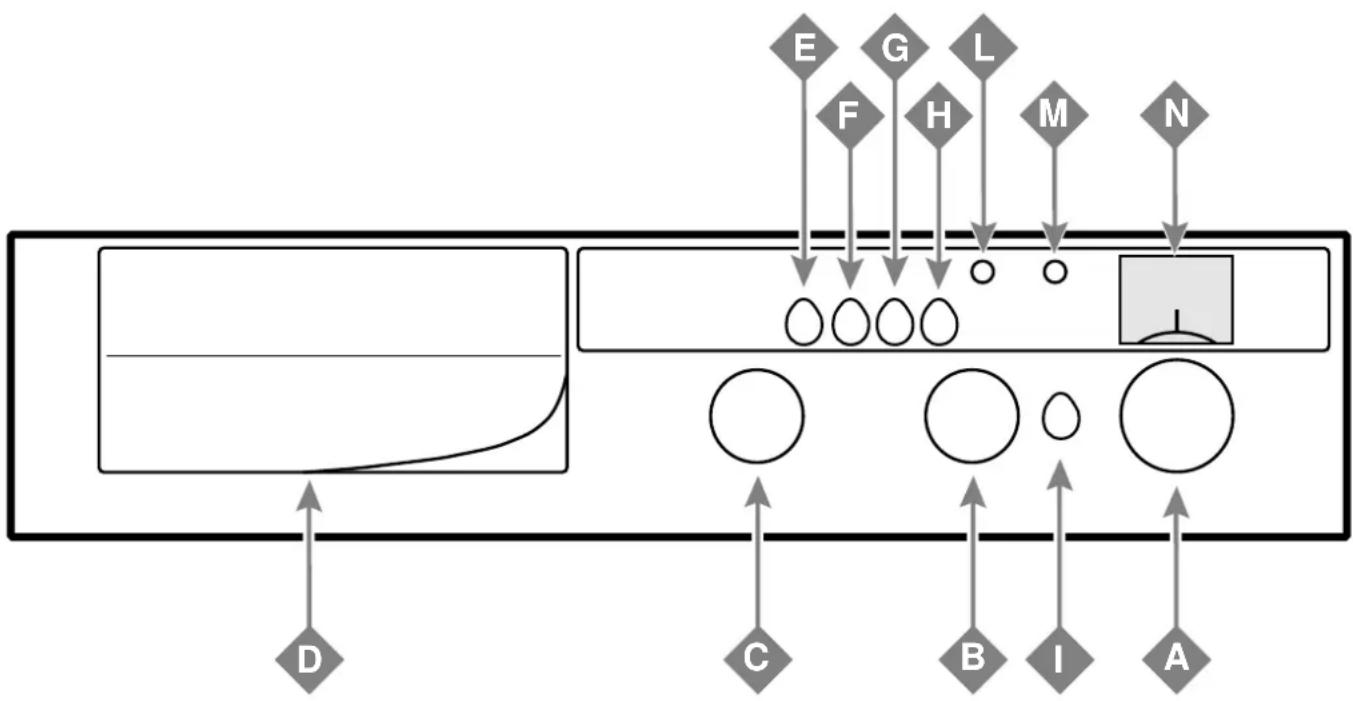
The dials are flush with the facia of the machine To pull them out, press the middle of the dial in gently.
A. Programme selector
Use this dial to select one of the 18 wash programmes available for all your laundry requirements (see programme table on page 17). The programme selected is displayed in window N.
Remember that this dial should be turned in a clockwise direction and only when the machine is off.
B. Temperature selector
Use this dial to set the wash temperature shown in the programme table (page 17). You may reduce the recommended wash temperature of the programme you have selected or run a cold wash (symbol ※ ).
C. Knob for delaying the start of the cycle
This knob allows you to delay the start of the washing machine. The start of the cycle can be delayed up to a maximum of 12 hours. To use this feature, you must set the button I to the ON setting (position I).
D. Detergent dispenser
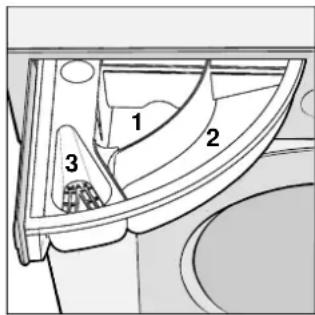
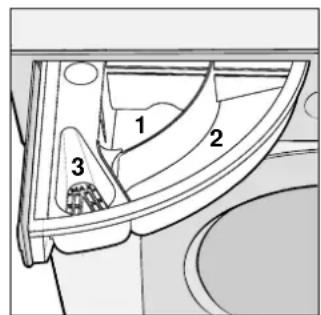
The detergent dispenser has three compartments marked
1, 2 and 3:
1 prewash detergent
2 wash detergent
3 fabric softener.
E. Rinse Hold button
This function interrupts the cycle so that the laundry is left soaking in water before the spin cycle. This function is extremely useful because it stops delicate or synthetic fabrics from creasing (for example when one has to wait several hours before removing the laundry load).
It should be used only with the programmes for synthetic fabrics and woollens.
IMPORTANT: Before opening the door, drain away the water by setting knob A on "drain", the number 18 must appear on the window N. To carry out the spin cycle, simply press E.
F. Slow spin button
Use this button to reduce the spinning speed from 1200 to 600 rpm for the cotton and linen programmes and from 850 to 600 rpm for the synthetic fabrics programmes.
G. Button for the cycle at 90^
The strongest standard cycle is at 60^ . To start the wash cycle at 90^ , you must turn knob A to the 60^ setting and then press this button. This feature can only be used with wash cycles 1 and 2 for washing very strong materials, like cotton, linen and hemp and should be used when the clothes are very dirty.
H. Extra Economy button
Reduces water consumption during the rinse cycles. We recommend that you use this function only with small laundry loads, dosing the detergent proportionally.
I. ON-OFF button
This button turns your appliance ON/OFF. Press button I to turn on the washer and depress button I to turn off the washer.
L. Door Lock indicator light
This shows that the door is locked.
Wait at least three minutes after the light turns off (about 3 minutes after the end of the wash programme) before opening the door.
M. ON/OFF Indicator light
When this is lit, the machine is on.
N. Programme display
The programmes selected with dial A appear on this display; while the programme is running the various stages of the programme are displayed.
Using your washer
Preparing your laundry....
Divide your laundry by fabric and colour fastness. Wash white and coloured items separately.
Remember to empty pockets, removing especially those small items like coins, paper, pins and badges that might jam the pump. Fasten or remove loose buttons and fasten zippers. Turn shirts inside out for better results.
Check wash labels
Garments and laundry generally have wash instruction labels (which tell you if they shloud be dry-cleaned, hand washed or machine washed) showing the wash temperature, how to iron etc.
Important: fabrics should only be machine washed if their labels show the appropriate symbol (see table 1 page16).
Alternate small and large items when loading your washer
This washer has an electronic load balancing control: before carrying out the spin cycle, this device ensures that the laundry is arranged as evenly as possible in the drum, according to the type of fabric and the way it was initially loaded. This will minimize vibration and noise even during the fastest spin cycle. For best results however, we recommend you alternate small and large items when you load your washer remember to spread them out; never wash large loads of terry cloth items.
Detergents and fabric softener
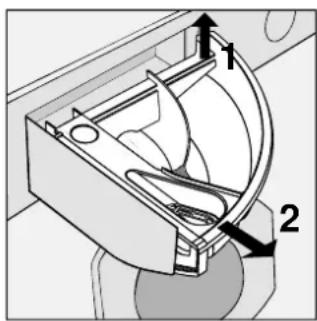
Open detergent dispenser D by pulling it outwards. Fill with detergent and conditioner using the quantities indicated by the manufacturer on the packet according to the load you are washing, the water hardness and how soiled your laundry is. As you become more familiar with your washer, you will regulate the quantities according to your own personal experience.
Compartment 1
Prewash cycle detergent (powder)
Compartment 2
Wash cycle detergent (powder or liquid)
Compartment 3
Fabric softner
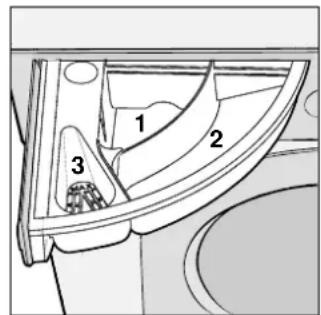
Never fill compartment 3 above the grid.
Use compartment 2 for liquid detergent, filling the compartment just before you start the washer. Remember that liquid detergent is ideal for wash cycles with temperatures up to 60^ and for the programmes with no prewash cycle. Dispensers for liquid and powder detergents which are placed inside the drum of the washer, are sold on the market.
To improve the effectiveness of the washing cycle, we recommend that you insert a detergent dispenser in the drum before loading the laundry.
Do not use hand washing detergents since these produce very heavy suds. When using cold wash cycles, remember to reduce the detergent dosage.
1. Understanding the labels
| Wash | Strong action Delicate action | 95 60 40 30 Not washable in water |
| Wash at 95°C Wash at 60°C Wash at 40°C Wash at 30°C Hand wash | ||
| Bleaching | a Bleaching only Do not bleach in cold water | |
| Ironing | Hot iron at max 200°C Medium hot ironing at max 150°C Iron at max 100°C Not Ironable | |
| Dry cleaning | A Dry clean with any solvent Dry clean only with, perchloride, benzine av., pure alcohol, R111 and R113 F Dry clean with av. benzine, pure alcohol and R113 Do not dry clean | |
| Drying | High Temperat. Low Temperat. | Machine dryable Dry not machine dry Spread to dry Hang to dry without spin drying Dry on clothes hanger |
Starting up your washer
Run the first wash without laundry using programme 2 at 90^
Load your laundry in the washer, add the detergent and fabric softener (see pages 15) and remember to:
- shut the door properly
- plug the washer in at the mains
- turn on the water supply
- check that button I is not pressed in (position O)
Selecting the programme
For help on selecting the cycles, consult the table on page 17. Turn the knob A until the number of the desired cycle is displayed in the window N. Set the temperature on dial B and, if necessary, press function button (E, F, G, H); set ON/OFF button I to position I (ON).
At the end of the wash cycle...
Wait for indicator light L to turn off (about three minutes), switch off the washer by setting the ON/OFF button I to O (OFF); you can now open the door. Once you have removed your clean laundry from the washer, remember to leave the door open or at least ajar (this will prevent the formation of an unpleasant odour) and shut off the water supply.
Selecting the programmes
The description of the wash programme by type of fabric is shown on the detergent dispenser.
| Type of Fabric & How Dirty Cycle | Knob | Temp. Knob | 90°C buton | Pre-wash Detergent | Wash Detergent | Softener Description of Wash Cycle |
| HEAVY FABRICS | ||||||
| Extremely dirty whites (sheets, tablecloths, etc.) | 1 | MAX | ◆ | ◆ | ◆ | ◆ Warm prewash, wash at 90°C, rinses, intermediate and final spins. |
| Very dirty whites (sheets, tablecloths, etc.) | 2 | MAX | ◆ | ◆ | ◆ Wash at 90°C, rinses, intermediate and final spins. | |
| Very dirty heavy whites and colours | 2 | 6 | 0 | ○ | C | ◆ |
| Very dirty heavy whites and colours. | 2 | 4 | 0 | ○ | C | ◆ |
| Fairly dirty heavy whites and colours (coloured underwear, house coats, etc.) | 3 | 6 | 0 | ○ | C | ◆ |
| Whites and delicate colours that are not very dirty. | 3 | 4 | 0 | ○ | C | ◆ |
| Whites and delicate colours that are not very dirty (shirts, T-shirts, etc.) | 4 | 4 | 0 | ○ | C | ◆ |
| Rinses | 5 | ◆ | ||||
| Softener | 6 | ◆ | ||||
| Spin | 7 | Drain and final spin. | ||||
| SYNTHETICS | ||||||
| Very dirty heavy synthetic colours (underwear for infants, etc.). | 8 | 6 | 0 | ○ | C | ◆ |
| Very dirty synthetic colours. | 8 | 5 | 0 | ○ | C | ◆ |
| Very dirty, delicate synthetic colours. | 8 | 4 | 0 | ○ | C | ◆ |
| Fairly dirty delicate synthetic colours. | 9 | 5 | 0 | ○ | C | ◆ |
| Not very dirty delicate synthetic colours (all types of underwear). | 10 | 40°C | ◆ | ◆ Wash at 60°C, rinses, wrinkle-guard or delicate spin. | ||
| Rinses | 11 | ◆ | ||||
| Softener | 12 | ◆ | ||||
| Spin | 13 | Drain and delicate spin. | ||||
| DELICATES | ||||||
| Wool (machine washable) | 14 | 40°C | ◆ | ◆ Wash at 40°C, rinses, wrinkle-guard or delicate spin. | ||
| Rinses | 15 | ◆ | ||||
| Softener | 16 | ◆ | ||||
| Spin | 17 | Drain and delicate spin. | ||||
| Drain | 18 | Drain without spin. | ||||
Washing tips
Stain removal
The most common stains will disappear during the wash. If they are particularly stubborn, soak the garment in water and rub a little detergent onto the stain before putting it in the washer.
Greasy marks (especially old ones) need treating with a stain-remover. Be careful not to mark the fabric with remover.
Pre-treatment for awkward stains
-
Ink: ball point/felt tip; Put a few drops of nail varnish remover or surgical spirit onto a piece of cotton wool and dab the stain. Wash at 90^ (NB. This is only suitable for colourfast cottons)
-
Tar and oil; Scrape off any thick tar or oil on the surface.
- Soften the remainder with margarine or butter and wipe away with a clean cloth. Treat any residual stain with turpentine, then wash according to the fabric
- Wax; Scrape off, then put the stained garment between two pieces of blotting paper and press with a hot iron. Dab the stain immediately with cotton wool dipped in turpentine - Chewing gum; Apply nail varnish remover to the gum, then remove it carefully
- Lipstick; Pretreat with a liquid detergent using the dosing ball, rub vigorously and rinse before washing
- Grass; Soak in a warm washing solution using a biological washing product, then wash according to the fabric. Alternatively, saturate the stain with white methylated spirit. Rinse and wash normally
- Paint: Water based latex, acrylic and school paints, emulsion paints; Treat stains while still wet. Rinse thoroughly under running water to flush out the paint, then wash according to the fabric.
Oil based paint/varnish; Sponge with white spirit or paint brush cleaner before washing in the normal way.
Do not exceed the recommended weights shown in the table
For best washing results, do not exceed the recommended weights shown in the table; the weights shown refer to dry laundry.
| Maximum dry laundry load | How heavy is your laundry? |
| heavy fabrics | 1 sheet 400-500 g |
| maximum 5 kg | 1 pillow case 150-200 g |
| delicate fabrics | 1 table cloth 400-500 g |
| maximum 2 kg | 1 bathrobe 900-1200 g |
| pure new wool | 1 bathroom towel150-250 g |
| maximum 1 kg | |
| mixed loads | |
| maximum 2,5 kg |
What not to wash in your appliance?
- Torn, frayed or unhemmed items; in order to wash items of this kind, wrap them in a linen bag to prevent them from tearing during the wash.
- Dark coloured items with white items. Dark items should be washed separately.
Curtains
Curtains tend to crease badly. Try this washing hint to prevent creases: fold the curtains carefully and place in a pillow case or loose mesh bag; wash separately ensuring that the weight is no more than a half wash load.
Quilts, tennis shoes and wind-cheaters
Contrary to common belief, goose or duck down quilts and wind-cheaters, can in fact be machine washed, provided the instructions shown on the label are followed carefully. Remember however to load no more than 2 - 3kg of laundry and to repeat the rinse cycle once or twice following with a gentle spin. In the case of tennis shoes, wipe off mud and then machine wash with denims or heavy fabrics (but not white fabrics).
Energy saving hints
- Try to wash complete laundry loads: this saves unnecessary consumption of water and energy.
- Select the right programme for your laundry: this will obviously depend on the type of fabric and how soiled your laundry is; we recommend the use of programmes without prewash which will save you time, water and energy. The prewash cycle should in fact be used only for heavily soiled, cotton fabrics.
- Set the right temperature: use temperatures above 60^ only for very stubborn dirt but remember that modern detergents are very efficient even at low temperatures.
- Use the correct quantities of detergent: do not use too much detergent; remember that not only will this make rinsing more difficult but also pollutes the enviroment.
-
Use the economy buttons: when washing small laundry loads use the Economy button if available on your washer and reduce the detergent quantity.
-
Your washer features automatic consumption control, this means that you can wash laundry loads from 1 - 5 kg with considerable savings. Your washer will use just the right amount of water and electricity. All you need to do is dose the detergent.
- Fabric softeners: always use a softener; not only do these perfume and soften your laundry, they also make it easy to iron, saving you time.
General maintenance
After every wash
Leave the door open and wipe the door gasket dry after each wash so that damp or odours do not form.
Remove the plug
Before cleaning or servicing always remove the plug from the socket. This is for safety reasons.
No solvents or abrasive substance
You do not need solvents or abrasive substances to clean the outside of the washer and the rubber parts. Just use a cloth, warm water and soap.
Detergent dispenser drawer
This can be removed and cleaned. Just pull it towards you, as shown in the diagram, and leave it under running water for a few minutes.
Unplug the machine when you go away
It's best to unplug the machine when you go away, turn off the water supply and leave the machine door open or ajar. The drum and rubber door lining will dry and no unpleasant odours will form inside.
When moving house
When you move, all you need to do is secure the inside of the machine with the transit screws (supplied with the packaging of the machine) so that it will not be damaged.
Cleaning and special servicing
Hose
Check the hose once a year. It should be replaced if any signs of splitting or damage can be seen. The machine is under a lot of strain while operating and this may cause a cracked hose to split open suddenly.
Inspecting the drain pump
Your washer is equipped with a self-cleaning pump, and, therefore, does not require maintenance or cleaning. However, certain types of objects might find their way into the pump (e.g. buttons, coins, etc.). Since they are too large to be expelled through the drain pipe, they will be trapped in the "antechamber" of the pump, which is accessible from the front of the pump itself. To gain access to this compartment, simply remove the finishing strip on the base of the cabinet (Fig. 1), remove the Z screw (Fig. 2) with a screwdriver and take off the cover of the pump. Then carefully inspect the interior.
Caution: Before removing the cover, make sure that the wash cycle has finished completely. Then, turn off the machine by, switching the ON/OFF button I to the O setting. It is normal for a small quantity of water to escape after the cover has been removed. When you replace the cover, make sure that it is closed tightly.
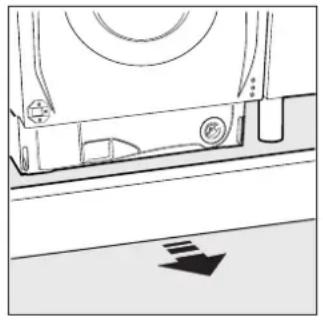
Fig. 1
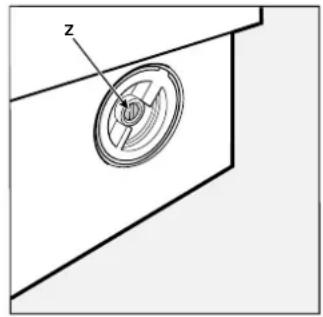
Fig. 2
Removing limescale
Water contains increasing amounts of limescale because of pollution. If you live in a hard water area in addition to using water-softener in each wash, it is a good idea to put the machine through a cycle without laundry or detergent, just using limescale remover.
Trouble shooting
If the machine does not seem to be working properly before calling the service engineer there are a number of things you can check. Perhaps you have forgotten to push in a button or you are not using the machine properly.
Machine won't start
Make sure:
the appliance is plugged to the mains socket; you have electricity in your home, the door is firmly shut, the ON/OFF button I is on I, the programming cycle knob, in washer which have one, is on O, the programme is properly set and the mains water tap is open.
Machine won't fill
Make sure:
the water tap is open and connected correctly to the hose; the water mains has not been cut off and that water pressure is sufficient; also check the hose for kinks.
Water is pumping in and out all the time
Make sure:
there are no kinks in the drain pipe and that it is at least at a height greater than 60~cm ; the pipe mouth is not below water level and that the wall drain has no air outlet. If the problems continue even after you have checked these points, shut the water tap and turn off your machine.
Problems with pumping out water or spinning
Make sure:
the programme selected has a draining cycle; the non creasing "hydropstop" button, on washer which have one, has not been pressed accidentally; the drainage pump is not jammed; the drain pipe is bent; the drainage piping is plugged; any drainage pipe extensions are properly connected and do not prevent water flow.
Lots of vibration during the spin
Make sure:
the internal oscillating unit was released correctly at the time of installation (see installation instructions); the washer is levelled correctly or too tightly fitted between furniture units and the wall.
Your washer is leaking.
Make sure:
the ring nut of the supply pipe is firmly tightened; the detergent dispenser is not plugged and the drainage pipe is firmly fixed.
Excessive formation of suds.
Make sure:
the type of detergent you have used - is it suitable for an automat i washer - have you used too much detergent?
If despite all this your washer is still not running properly, call your local Authorized Service Centre providing the following information:
-fault
-model code (Mod. ....)
$$ \text {a n d s e r i a l n u m b e r (S / N \dots .)} $$
indicated on the plate located on the bottom part of the machine.
Never use the services of an unauthorised servicing technician and insist on the use of original spare parts.
Installation
Transit packing
After removing the packing, check the appliance for damage. If you have any doubts do not use the washer and call a qualified technician. Keep the packaging components (plastic bags, polyester foam, nails etc.) out of the reach of children since they could be dangerous. The interior of the washer, has an oscillating unit which is fixed on the back by 3 screws during transport (figure 3). Before starting up the washer, release the unit, by unscrewing the 3 screws. Seal the screw holes with the plastic plugs supplied with the appliance.
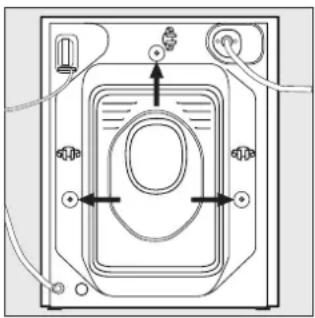
Fig. 3
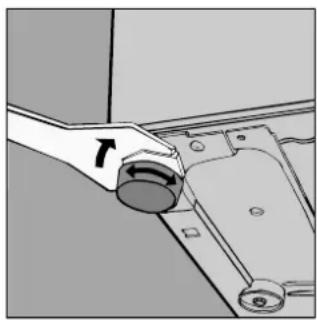
Fig. 4
Levelling
The machine must be level in order to operate properly, To level the machine, simply regulate the adjustable feet (fig. 4); the angle of inclination (measured on the top of the machine) must not exceed 2 degrees. If the washer is installed on a carpeted floor, check that there is sufficient ventilation space between the floor and the bottom of the machine.
Water supply
Make sure that the water pressure is between the maximum and minimum values indicated on the data plate located on the back of the washer. Connect the inlet hose to a cold water tap with a 3/4 gas threaded opening, and fit the filter and the rubber gasket supplied with the washer. Check that it is tightly screwed to the tap (see fig. 5). If the water piping is new or has not been udes for a long time, before making the connection, let the water run until it is clear and free from impurities. This step is necessary to ensure that the incoming water does not clog and possibly damage the washer. Connect the other end of the pipe to the appliance, at the top on the right, by the water connection (see fig. 6).
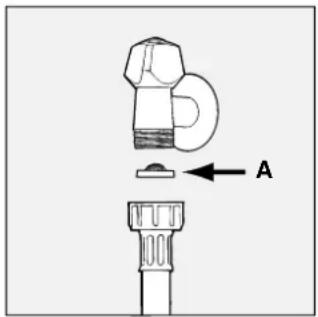
Fig. 5
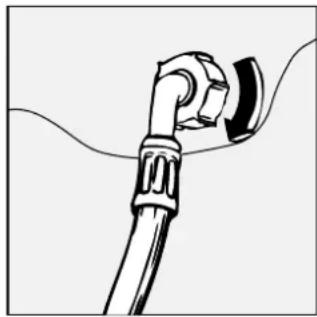
Fig. 6
Connecting the drain pipe
Connect the drain hose to a drain (with a minimum inner diameter of 4cm ), avoiding excessive crimping or the formation of elbows. It is important that the hose be positioned at a height greater than 60~cm .If this is not the case, the hose must be fastened to the hook located on the top part of the back of the machine (fig. 7).
If a drain pipe coming from the wall is used to connect the hose, have a qualified plumber/technician check to make sure that it functions properly. If your home is on the top of an apartment building or condominium, the drain may be subject to a siphoning effect which results in the machine filling and draining continuously. To eliminate this inconvenience, special valves are available on the market which can be fitted to the drain hose.
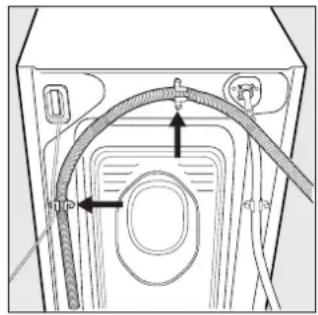
Fig. 7
Electrical connection
Before connecting the appliance to the mains, check the following:
1) your mains socket must support then maximum power load of the appliance, which is shown on the data plate; in addition the socket must comply with legal regulations;
2) the supply voltage must correspond to the values shown on the data plate;
3) the socket must be suitable for the plug of the appliance; replace the socket or the plug but do not use an adapter;
4) home electrical systems must be earthed, in compliance with ministerial directives. Should the electric system of your home not comply with these directives, the manufacturer declines any liability for any possible consequences.
Mounting the wooden panel onto the door and inserting the machine into cabinets:
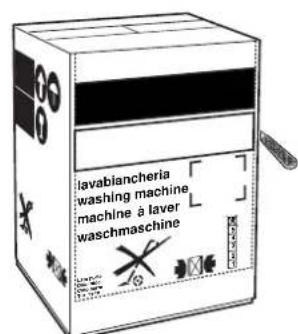
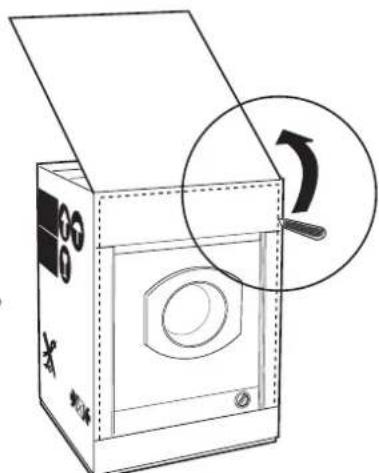
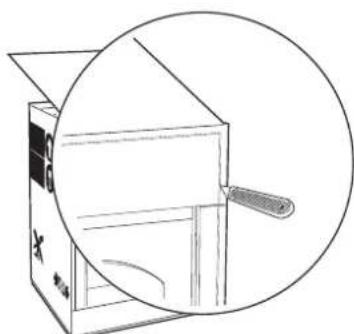
In the case where the machine must be shipped for final installation after the wooden panel has been mounted, we suggest leaving it in its original packaging. The packaging was designed to make it possible to mount the wooden panel onto the machine without removing it completely (see figures below).
The wooden panel that covers the face of the machine must not be less than 18mm in thickness and can be hinged on either the right or left. For the sake of practicality when using the machine, we recommend that the panel be hinged on the same side as the door for the machine itself - the left.
A
B
C
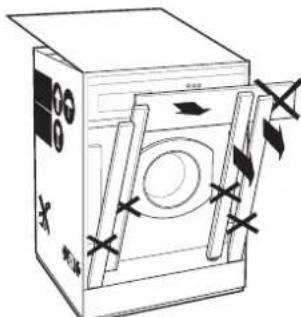
D

E
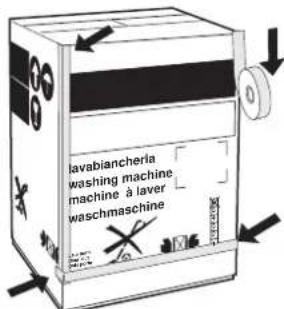
F
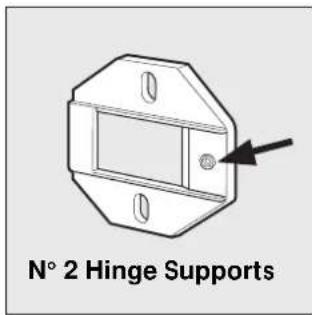
Door Mounting Accessories (Fig. 8-9-10-11-12-13)
Fig. 8
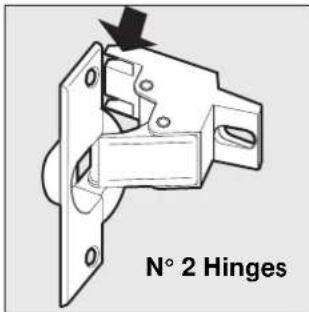
Fig. 9
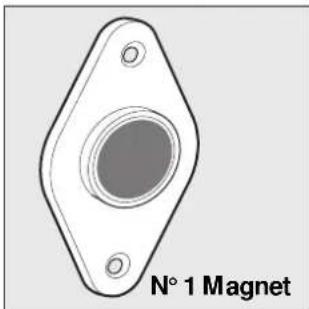
Fig. 10
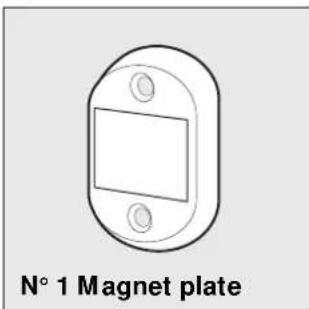
Fig. 11
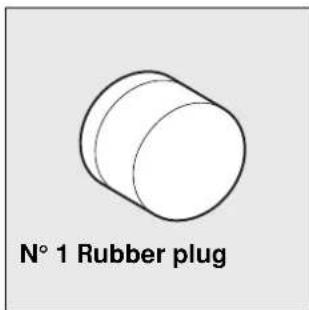
Fig. 12
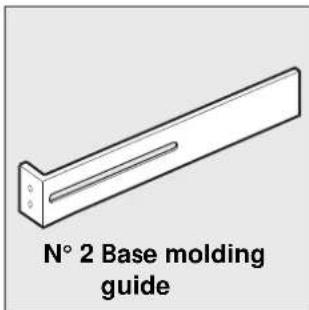
Fig. 13
No. 6 type A self-threading screws, l = 13 mm
No. 2 type F self-threading screws, l = 9 mm
No. 2 type B metric, countersunk screws, I = 25 ; for fastening the magnet plate to the cabinet
No. 4 type C metric screws, l = 15 mm; for mounting the hinge supports to the cabinet
No. 4 type D metric screws, I = 7 ~mm ; for mounting the hinges on the supports
Mounting the Parts onto the Face of the Machine
- Mount the hinge supports onto the face of the machine, positioning the hole indicated by the arrow in Fig. 8 towards the inside of the face and using the type C screws.
- Mount the magnetic plate on the opposite side, at the top, using the two type B screws.
Using the Drilling Template
- Place the top edge of the drilling template so that it is flush with the top edge of the panel, making sure that it is positioned correctly and centered in the horizontal direction (use the dotted lines on the edges to line the template up). Mark the points on the panel for the four holes.
- Use an appropriately sized router to mill the holes for the two hinges, the rubber plug and the magnet.
Mounding the Parts onto the Wooden Panel (Door)
- Insert the hinges into the holes (the movable part of the hinge must be positioned facing away from the panel) and fasten them with the 4 type A screws.
- Insert the magnet into the top hole on the opposite side of the hinges and fasten it with the two type B screws.
- Insert the rubber plug into the bottom hole.
The panel is now ready to be mounted onto the machine.
Mounting the Panel into the machine
Insert the nib of the hinge (indicated by the arrow in fig. 9) into the hole for the hinge and push the panel towards the front of the machine. Fasten the two hinges with the type D screws.
Inserting the machine into the Cabinet
- Push the machine into the opening, aligning it with the cabinets (fig. 14).
- Regulate the adjustable feet to raise the machine to the appropriate height.
To adjust the position of the wooden panel in both the vertical and horizontal directions, use the C and D screws, as shown in fig. 15.
- If the machine is installed at the end of a set of modular cabinets, mount either one or both of the guides for the base molding (as shown in fig. 16) with the type F screws. Adjust them for depth based on the position of the base molding, and, if necessary, fasten the base to the guides.
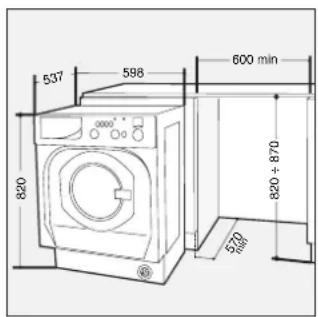
Fig. 14 Fig. 15
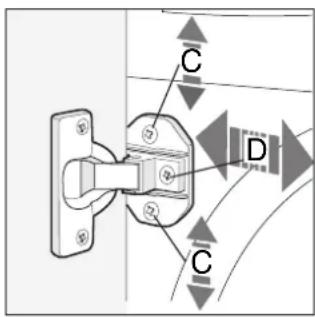
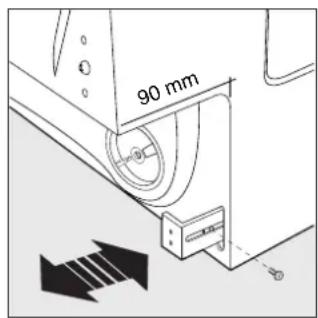
Fig. 16
Technical characteristics
| model | LB 12 TX |
| dimensions | width cm 59,8 height cm 82 depth cm 53,7 |
| capacity | 1 - 5 Kg |
| electrical connections | voltage 220/230 Volt 50 Hz maximum absorbed power 2300 W |
| water connections | maximum pressure 1 MPa (10 bar) minimum pressure 0,05 MPa (0,5 bar) drum capacity 42 litres |
| spinning speed | up to 1150 rpm |
| CE | This appliance conforms with the following E.E.C. directives:- 73/23/EEC of 19/02/73 (Low Voltage) and subsequent modifications- 89/336/EEC of 03/05/89 (Electromagnetic Compatibility) and subsequent modifications |
Control programs in compliance with IEC regulation 456:
Cotton program:
Turn knob A to the "program 2" setting;
Turn knob B to the "60°C" setting;
Press Extra economy button.
Margherita
Compartment 1 Voorwasmiddel (poeder)
Compartment 2 Hoofdwasmiddel (poeder of vloeiba Compartment 3 Toevoegsels (wasverzachter, g etc.)
Verifique as etiquetas
1. Como ler as etiquetas
Como tirar as nóodos
- Controlled consumption
- Double-action wash
- Saves while it washes
- Safety, a good habit to get into
- CAUTION
- Programme selector
- Temperature selector
- Knob for delaying the start of the cycle
- Detergent dispenser
- Rinse Hold button
- Slow spin button
- Button for the cycle at 90°C
- Extra Economy button
- ON-OFF button
- Door Lock indicator light
- ON/OFF Indicator light
- Programme display
- Using your washer
- Preparing your laundry....
- Check wash labels
- Alternate small and large items when loading your washer
- Detergents and fabric softener
- Compartment 1
- Compartment 2
- Compartment 3
- Understanding the labels
- Starting up your washer
- Run the first wash without laundry using programme 2 at 90°C
- Selecting the programme
- At the end of the wash cycle...
- Selecting the programmes
- Washing tips
- Stain removal
- Pre-treatment for awkward stains
- Do not exceed the recommended weights shown in the table
- What not to wash in your appliance?
- Curtains
- Quilts, tennis shoes and wind-cheaters
- Energy saving hints
- General maintenance
- After every wash
- Remove the plug
- No solvents or abrasive substance
- Detergent dispenser drawer
- Unplug the machine when you go away
- When moving house
- Cleaning and special servicing
- Hose
- Inspecting the drain pump
- Removing limescale
- Trouble shooting
- Machine won't start
- Make sure:
- Machine won't fill
- Water is pumping in and out all the time
- Problems with pumping out water or spinning
- Lots of vibration during the spin
- Your washer is leaking.
- Excessive formation of suds.
- -fault
- Installation
- Transit packing
- Levelling
- Water supply
- Connecting the drain pipe
- Electrical connection
- Mounting the wooden panel onto the door and inserting the machine into cabinets:
- Mounting the Parts onto the Face of the Machine
- Using the Drilling Template
- Mounding the Parts onto the Wooden Panel (Door)
- Mounting the Panel into the machine
- Inserting the machine into the Cabinet
- Technical characteristics
- Control programs in compliance with IEC regulation 456:
- Margherita
- Verifique as etiquetas
- Como ler as etiquetas
- Como tirar as nóodos
Brand : Ariston Thermo
Model : LB 12 TX
Category : Washing machine