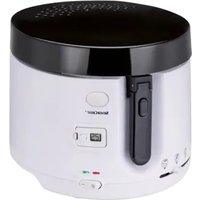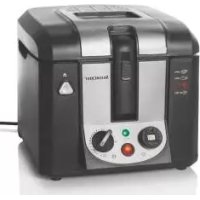
SKF 2800 A1 - Deep fryer SILVERCREST - Free user manual and instructions
Find the device manual for free SKF 2800 A1 SILVERCREST in PDF.



User questions about SKF 2800 A1 SILVERCREST
0 question about this device. Answer the ones you know or ask your own.
Ask a new question about this device
Download the instructions for your Deep fryer in PDF format for free! Find your manual SKF 2800 A1 - SILVERCREST and take your electronic device back in hand. On this page are published all the documents necessary for the use of your device. SKF 2800 A1 by SILVERCREST.
USER MANUAL SKF 2800 A1 SILVERCREST
natural_image
Silver Crest brand toaster with digital display and control knobs, no visible text or symbols on the device itself.KALTZONEN-FRITTEUSE SKF 2800 A1
DE AT CH
KALTZONEN-FRITTEUSE
Bedienungsanleitung
IT CH
FRIGGITRICE A ZONE FREDDE
Operating instructions
FR CH
FRITEUSE À ZONE FROIDE
Mode d'emploi
NL
KOUDEZONE FRITEUSE
Gebruiksaanwijzing
IAN 87713
DE AT CH
FR IT NL GB


Be sure to note the fold-out page.
SKF 2800 A1_13_V1.7_DE_FR_IT_NL_GB




text_image
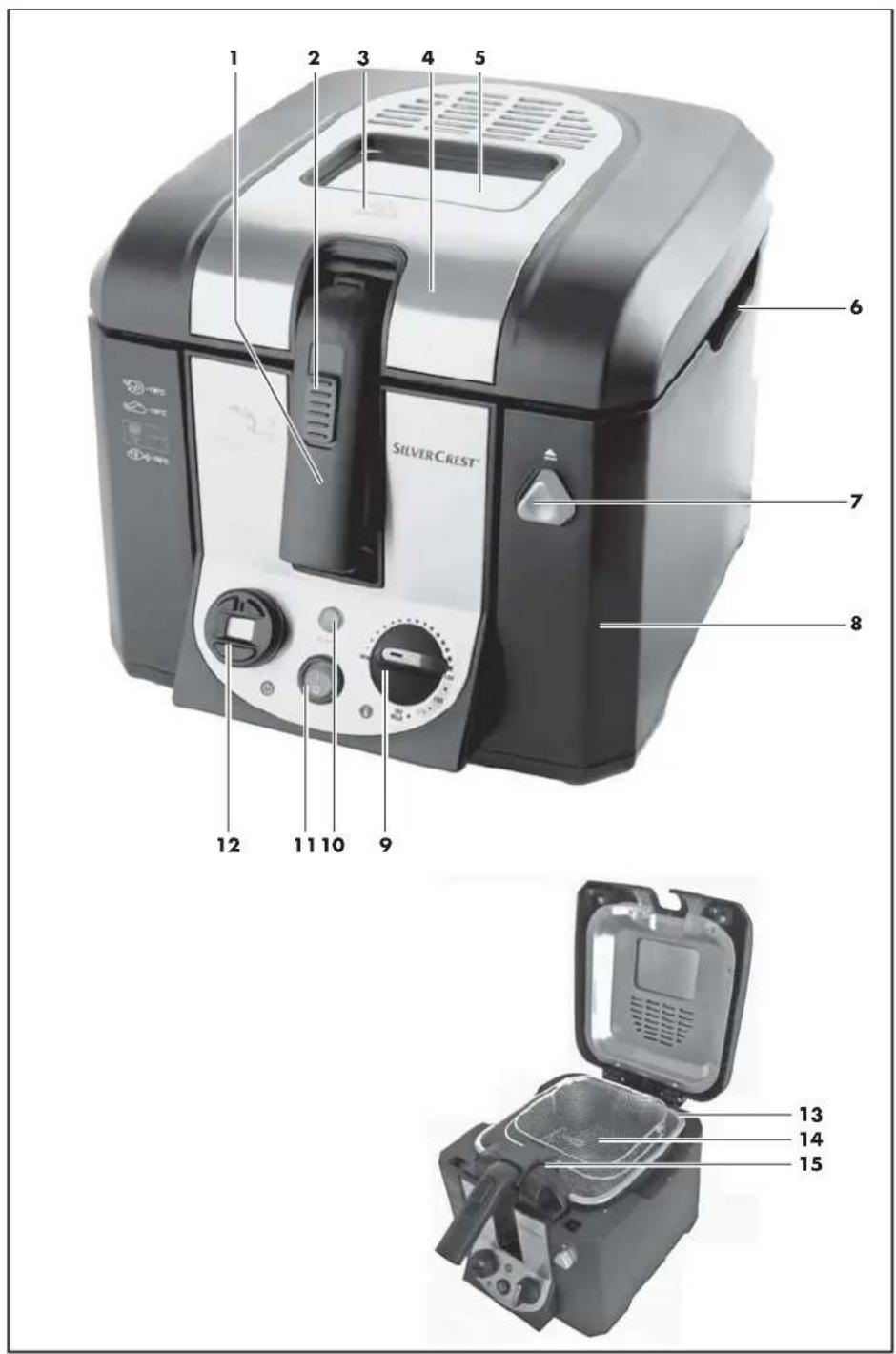
1 2 3 4 5 6 7 8 SILVERCREST® 12 11 10 9 13 14 15

natural_image
Close-up of a transparent rectangular object resting on a diamond-patterned metal lattice surface (no text or symbols visible)natural_image
Close-up of a mechanical component with a labeled section A (no readable text or symbols)10. Diverse Tipps
natural_image
Three geometric diagrams with crosshair targets and a central circular pattern (no text or symbols)
natural_image
Pure geometric crosshair symbol with concentric circles and a central gear-like shape (no text or labels)natural_image
Close-up of a transparent plastic object placed on a chain-link fence (no text or symbols visible)natural_image
Close-up of a mechanical component with labeled section A (no readable text or symbols)natural_image
Three geometric diagrams with crosshair and circular shapes, no text or symbols present
natural_image
Pure geometric diagram with crosshair and circular target-like shapes (no text or symbols)natural_image
Three geometric diagrams with crosshair and circular shapes, no text or symbols present
natural_image
Pure geometric crosshair symbol with concentric circles and a central circle, no text or labels present
natural_image
Close-up of a transparent rectangular object resting on a chain-link fence (no text or symbols visible)natural_image
Close-up of a mechanical component with labeled section A (no readable text or symbols)natural_image
Close-up of a transparent rectangular object resting on a chain-link fence (no text or symbols visible)natural_image
Close-up of a mechanical component with labeled section A (no readable text or symbols)- Product description 60
- Names of parts (see fold-out page)....61
- Technical data....61
- Safety information 62
- Before using for the first time.... 65
- Before frying 65
- Operating the appliance 66
- After frying....68
- Cleaning....69
- Various tips 70
- Disposal....70
- HOYER Handel GmbH Warranty....71
Congratulations on the purchase of your new product.
You have selected a high-quality product. The operating instructions are a constituent part of this product. They contain important information about safety, use and disposal.
Familiarize yourself with all the operating and safety instructions before using the product. Use the product only as described and for the stated spheres of application.
If you pass the product on to a third party, always pass on all the documentation as well.
1. Product description
1.1 Intended use
The SilverCrest SKF 2800 A1 Deep-Fat Fryer has been solely constructed for preparing foodstuffs such as potato chips, vegetables, chicken wings or similar items. It is not suitable for any other purpose.
This appliance should only be used in dry rooms. It must not be used out in the open or in humid rooms.
This product is intended for use in private households and is not suitable for commercial purposes.
The appliance is likewise suitable for:
- use in staff kitchens in shops, offices and other commercial areas,
• use in agricultural settings, - customers in hotels, motels and other accommodations,
• bed-and-breakfast establishments.
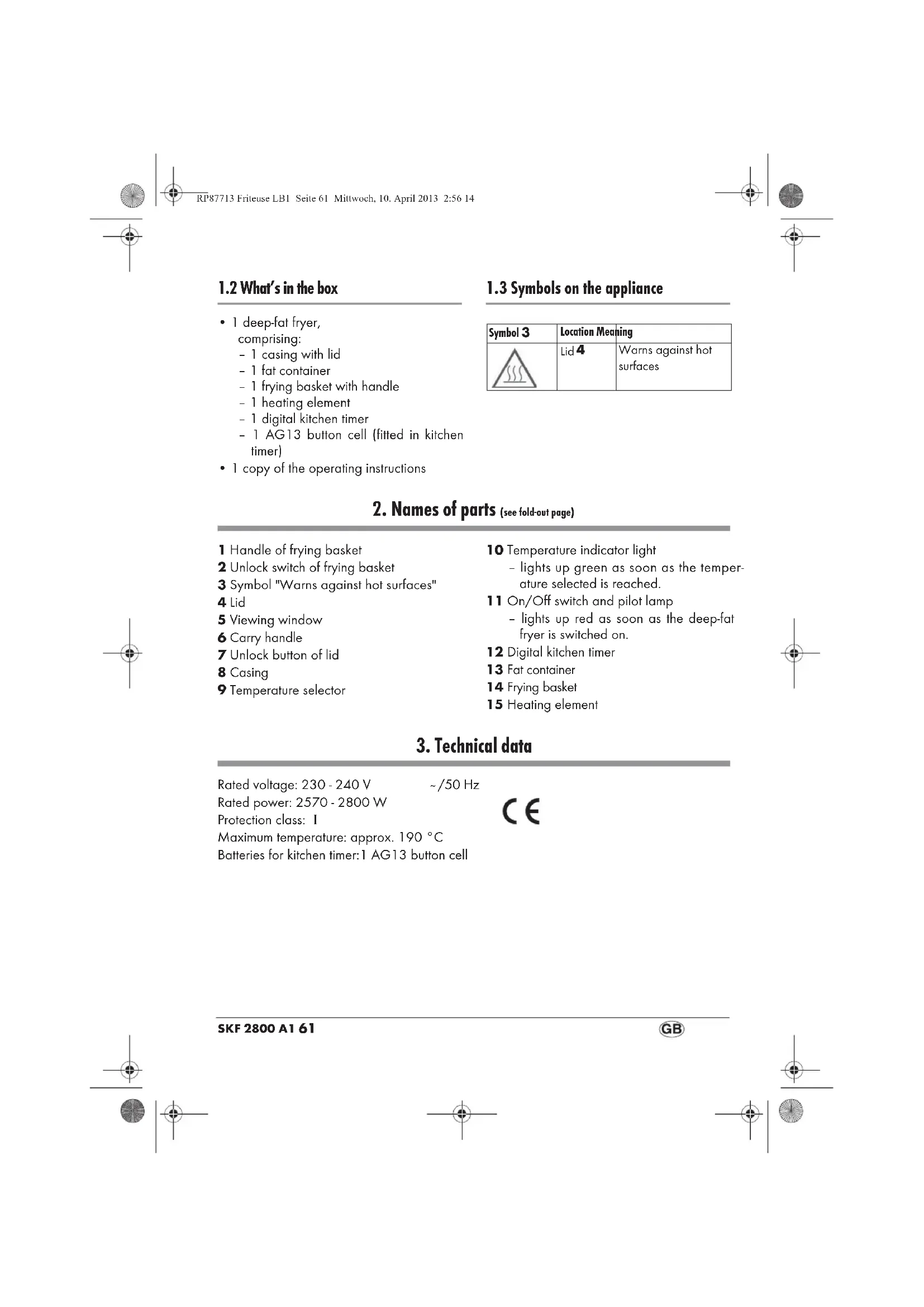
1.2 What's in the box
• 1 deep-fat fryer, comprising:
- 1 casing with lid
- 1 fat container
- 1 frying basket with handle
- 1 heating element
- 1 digital kitchen timer
- 1 AG13 button cell (fitted in kitchen timer)
• 1 copy of the operating instructions
1.3 Symbols on the appliance
| Symbol 3 | Location Meaning | |
 | Lid 4 | Warns against hot surfaces |
2. Names of parts (see fold-out page)
1 Handle of frying basket
2 Unlock switch of frying basket
3 Symbol "Warns against hot surfaces"
4 Lid
5 Viewing window
6 Carry handle
7 Unlock button of lid
8 Casing
9 Temperature selector
10 Temperature indicator light
- lights up green as soon as the temperature selected is reached.
11 On/Off switch and pilot lamp
- lights up red as soon as the deep-fat fryer is switched on.
12 Digital kitchen timer
13 Fat container
14 Frying basket
15 Heating element
3. Technical data
Rated voltage: 230 - 240 V \~/50 Hz
Rated power: 2570 - 2800 W
Protection class: I
Maximum temperature: approx. 190 °C
Batteries for kitchen timer:1 AG13 button cell
CE
SKF 2800 A1 61
GB




4. Safety information
4.1 Explanation of terms
The following keywords are used in these user instructions:

Warning!
High risk: ignoring this warning could result in a risk to life and limb.
Caution!
Medium risk: ignoring this warning may result in damage.
Note:
Low risk: points to be noted when handling the appliance.
4.2 Special informations for this appliance

Warning! To avoid injury, please observe the following information.
• This appliance can be used by children aged from 8 years and above and persons with reduced physical, sensory or mental capabilities or lack of experience and knowledge if they have been given supervision or instruction concerning use of the appliance in a safe way and understand the hazards involved. Children shall not play with the appliance.
- Cleaning and user maintenance shall not be made by children unless they are older than 8 and supervised.
- Keep the appliance and its cord out of reach of children less than 8 years.
• The surfaces of the appliance can get hot. When the appliance is running, only hold it by its handles.
• Always remove the plug from the mains socket before starting to clean the appliance. - Never immerse the appliance in water, and protect it from splashes and water droplets.
- Before cleaning, allow the appliance to cool down to avoid the risk of burns.
Caution! To avoid material damage, please observe the following conditions.
- Never use abrasive, corrosive or caustic cleaning materials. These could damage the appliance as well as the non-stick coating.
• The appliance must not be operated with an external time switch or separate remote control system, such as a wireless remote control socket.
4.3 General information
- Please read these user instructions carefully before use. They are a constituent part of the appliance and must be kept to hand at all times.
- Use the appliance only for the purpose described (see "1.1 Intended use" on page 60).
- To prevent damage, check that the mains voltage required (see type plate on the appliance) is compatible with your mains voltage as the appliance could be damaged if used with the wrong mains voltage.
- Please note that any claim under the warranty or for liability will be invalid if accessories are used that are not recommended in these user instructions, or if original spare parts are not used for repairs. This also applies to repairs undertaken by unqualified persons. You will find the service address in "Service Centre" on page 72.
- If the appliance should develop a fault during the warranty period, it may only be repaired by our Service Centre. Otherwise all claims under warranty are null and void.
- Never leave this appliance unattended while it is in use.
- Ensure that it is not possible for anyone to trip over or to get caught up in or step on the mains lead.
- The appliance should only be set up on a firm, dry, level, inflammable surface to prevent it from tipping over or sliding.
4.4 Protection against electric shock

Warning! The following safety information is intended to protect you against electric shock.
- The appliance must not under any circumstances be used if it is damaged. Have the device repaired in such cases by a qualified specialist. You will find the service address in "Service Centre" on page 72.
-
If the mains cable for this appliance is damaged, it must be replaced by the manufacturer or a person with similar qualifications in order to avoid a hazard.
• Water or other liquids must never be allowed to enter the appliance. For this reason: -
never use it outdoors
- never immerse it in liquids
- never place liquid-filled objects, e.g. pans, on the appliance
- never use in very humid environments. If liquid should enter the appliance, unplug the mains plug immediately and have the appliance repaired by a qualified technician. You will find the service address in "Service Centre" on page 72.
• The appliance must be connected up to a mains socket with earthing contact.
- Avoid using extension cables. An extension cable may only be used under very specific conditions:
- the extension cable must be suitable for the current rating of the appliance;
- the extension cable must be routed across surfaces or the floor (not allowed to hang in mid air); ensure the cable is out of the reach of children and does not pose a tripping hazard;

- never use a damaged extension cable;
-
do not connect any other appliances to the mains socket as this could overload the mains supply (do not use multi-sockets).
-
Do not touch the appliance, the mains cable or the mains plug with wet hands.
• Always unplug the mains cable by pulling out the plug. Never pull on the cable to remove the plug. - Never carry the appliance by the mains cable.
- Ensure that the mains cable is not kinked, twisted or crushed.
- Fully unwind the mains cable during use to avoid overheating and scorching.
- Keep the mains cable away from hot surfaces, such as cooker hotplates.
- If you are not going to use the appliance for a while, remove the plug from the wall socket. This is the only way to ensure that the machine is completely free of current.
4.5 Protection against the danger of fire

Warning! As the appliance operates at high temperatures, follow the safety instructions below to prevent a fire starting.
- Keep flammable objects (e.g. curtains, paper, etc.) away from the appliance when it is in use.
- Maintain a distance of at least 50 cm from other objects to prevent them from catching fire.
- Only switch on the deep-fat fryer if it contains sufficient oil or liquid fat.
- The filling level of the fryer with oil or fat must always be between the two markings on the inside of the fat container 13
(lower marking MIN = minimum, upper marking MAX = maximum).
- The appliance must never be placed immediately beneath a wall socket as the heat it generates could damage the electrical installation.
- Never leave the appliance running unattended. Damage is almost always indicated by intensive odours. In this case, disconnect the power supply immediately and have the appliance examined. You will find the service address in "Service Centre" on page 72.
4.6 For the safety of your child

Warning! Children are often unaware of danger and are injured as a result. Please note therefore:
- Only allow children to use this device under the supervision of an adult.
- Ensure the machine is always kept out of the reach of children.
- Ensure that a child cannot pull down or tip the appliance onto himself or herself.
- Ensure that the packing foil does not become a deadly trap for a child. Packing film is not a toy.
4.7 Protection against scalds and burns

Warning! As the appliance operates at high temperatures, please observe the following safety information so that you do not burn or scald yourself.
- All parts must be completely dry before you pour oil or liquid fat into the deep-fat fryer. Otherwise the heated fat could spit badly.
- You should ideally use frying oil or liquid frying fat.



- If you use solid frying fat, you should first melt the blocks of fat slowly in a normal pan in order to avoid overheating and the fat spitting. Then pour the melted fat carefully into the deep-fat fryer before switching the fryer on.
- You must only use oils or fats that do not foam and that are suitable for frying. Please refer to the packaging or label for further information.
- Hot steam is released during the frying process. Maintain an adequate distance from the steam.
- The fat may start spitting when melted again if it is too cold! Avoid this by making some holes with a fork in the re-solidified fat. Be careful not to damage the heating element 15 while doing so.
- If you wish to move the appliance, switch it off, pull out the plug and wait until the appliance has cooled down.
4.8 Handling batteries

Warning!
To prevent a risk of explosion, normal batteries must not be charged, heated or disposed of by burning.
- Never try to open the batteries.
To prevent injury if battery acid has leaked out, avoid contact with the skin, eyes and mucous membranes. In the event of contact with the acid, rinse the affected areas immediately with plenty of clean water and contact a doctor at once.
Caution! To avoid damaging the appliance and to ensure it functions correctly, please note:
- Only use type AG13 batteries.
5. Before using for the first time
-
Please clean the individual parts of the deep-fat fryer thoroughly (see "9. Cleaning" on page 69).
-
Then carefully dry the individual parts.
6. Before frying
- Place the deep-fat fryer on a level and stable surface.
- Unwind the mains cable completely.
Caution! Make sure that the cable does not come into contact with the hot parts of the fryer so that it is not damaged.
- Press the unlock button 7 to release the lid. The lid 4 will open.
-
Move up the handle of the frying basket 1 until it audibly engages.
-
Remove the frying basket 14.
6.1 Add the oil or fat
You should either use liquid frying oil or solid frying fat.
You should melt solid frying fat in a frying pan or saucepan before adding it to the fryer.
Note: Never mix different types of fat or oil!




- Add oil or melted fat up to the upper "MAX" marking of the fat container 13 in the dry and empty fryer.
Note: If you only want to fry small quantities, a bit less oil or fat may well be enough. However the items to be fried must always be completely covered and the fat or oil must reach at least as far as the lower "MIN" marking of the fat container 13.
- Insert the plug in a socket.
6.2 Melt existing fat
If the fryer already contains solidified fat from an earlier frying session, it must be melted in the fryer. Do this very carefully so that the melting fat does not start to spit or the fryer does not overheat.
- Insert the plug in a socket.
Caution! Make sure that you don't damage the heating element 15 with the fork.
-
Use a fork to prick a few holes in the fat so that any steam formed can escape more easily.
-
Close the lid 4.
-
Use the On/Off switch 11 to switch the deep-fat fryer on. The red pilot lamp lights up.
-
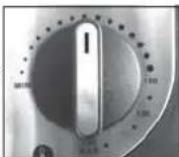
Turn the temperature selector 9 so it points upwards and is positioned around halfway between "130" and "MIN".
-
Let the fat melt.
-
Wait until the temperature indicator light 10 goes out or until the fat has completely melted.
7. Operating the appliance
7.1 Frying
- Move up the handle of the frying basket 1 until it audibly engages. This raises the basket 14 out of the oil.
Note: If there is solidified fat in the fryer, first proceed as described in "6.2 Melt existing fat" on page 66.
-
Use the On/Off switch 11 to switch the deep-fat fryer on.
-
Set the temperature selector 9 to the desired frying temperature.
Note: When on MAX the frying temperature is approx. 190 °C.
Refer to the pack of what you are frying for the correct frying temperature.
The temperature indicator light 10 goes out. The oil or fat is now heated to the desired temperature. The temperature indicator light 10 lights up green as soon as the oil or fat has reached the set temperature. To keep the oil or fat at the right temperature, the thermostat automatically switches the heating on and off. You can see this by the temperature indicator light 10 regularly going on and off.
Note: We recommend that you heat the oil for at least 10 to 15 minutes before you start frying. Close the lid 4.
Note: You can leave the frying basket 14 in the fryer during heating.
- Press the unlock button 7 to release the lid. The lid 4 will open.

Warning! When frying frozen items, pay attention to Tip 2 (see "10. Various tips" on page 70) to prevent the fat spitting.
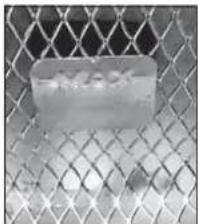
Caution! Please do not fill the frying basket 14 over the "MAX" mark. Take note of the food producer's information regarding the optimal quantity for frying. The items to be fried must always be with oil or fat.
natural_image
Close-up of a rectangular object resting on a chain-link fence (no visible text or symbols)- Remove the frying basket 14 from the deep-fat fryer and place the items to be fried in it.
- Carefully replace the frying basket 14 in the fryer. But do not yet move down the handle of the frying basket 1.
- Close the lid 4.
You can see the frying process through the viewing window 5 in the lid 4 at any time.
- Lower the frying basket 14 into the hot oil by pushing down the unlock switch of the basket 2 and then moving down the handle 1 of the basket.
7.2 Frying times
| Food Temp. | (approx.) | Time (min.) |
| Prawns, peeled, frozen 130 °C 5-8 | ||
| Chicken legs | 150 °C | 15-25 |
| Chicken wings | 150 °C | 8-18 |
| Chicken breast fillet | 150 °C | 8-18 |
| Potato chips (fresh) | 170 °C | 10-15 |
| Potato chips (frozen) | as stated by manufacturer | |
| Pork schnitzel, breaded | 150 °C | 15-25 |
| Fillet of fish (frozen) | 190 °C | 8-15 |
The times given in the above table are guide values applicable to a quantity of 250-300 g. Frying times may differ with other quantities and depending on the type of food.
7.3 Thermal cutout
In the event of overheating, the deep-fat fryer switches off automatically, e.g. if there is no or insufficient oil or fat in the fryer. This can also happen if there is solidified fat in the fryer that is melted too quickly. If the thermal cut-out switches off the appliance, proceed as follows:
-
Let the oil or fat cool down.
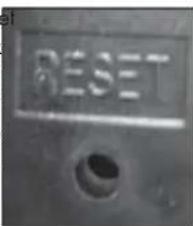
-
Press the Res switch on the back of the heating element using a pen. The appliance is now ready for frying again.
text_image
RESET7.4 Using kitchen timer
The heating element 15 includes a digital kitchen timer 12.
Although it has no switching function, it allows you to keep an eye on the frying time.
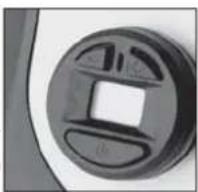
- Select the desired number of minutes using the two buttons at the top.
- Start the kitchen timer by pressing the button at the bottom.
The Minutes display flashes a few times, and the time starts running. - As soon as the time selected expires, a signal is heard.
- You can stop the signal by pressing the button at the bottom.
The kitchen timer is powered by one type AG13 button cell. To replace:
-
Pull the kitchen timer out.
-
Open the battery compartment at the back.
-
Remove the old button cell.
-
Pull the kitchen timer out.
- Open the battery compartment at the back.
- Remove the old button cell.
Note: Please observe the instructions for disposal (see "11.4 Disposable/rechargeable batteries" on page 71).
- Insert new batteries.
Note: Ensure the correct polarity (+/-) when inserting the batteries. The correct polarity is marked on the battery compartment. The positive pole of the battery must point upwards.
-
Close the battery compartment.
-
Insert the kitchen timer 12 in the heating element 15.
8. After frying
- Move up the handle of the frying basket 1 until it audibly engages. This raises the basket 14 out of the oil.
- Press the unlock button 7 to release the lid. The lid 4 will open.
- Remove the frying basket 14.
- Tip the fried items into a bowl, sieve, etc.
- Turn the temperature selector 9 to the lowest level "MIN".
- Use the On/Off switch 11 to switch the deep-fat fryer off.
- Remove the mains plug after every use.

Warning! So that you do not burn yourself, leave the hot oil or fat to cool down before you pour it away!
- Pull out the heating element 15 upwards.
- Remove the fat container 13 from the casing 8.
- Pour away the oil or fat (see "9. Cleaning" on page 69).
- If you wish to discard the oil or fat, please take note of "11.3 Oil" on page 71.
8.1 Re-use the oil or fat
Frying oil and fat age and develop unhealthy substances. Please note therefore:
- Pour the oil or the still liquid fat through a filter (e.g. tea towel) to filter out food remains.
- The best place to store oil is in an oil bottle in the fridge.
- Fat can be poured back into the cleaned fryer, allowed to solidify and stored together with the fryer at room temperature.
9. Cleaning
9.1 Cleaning the appliance
To ensure your product gives you lasting service, you should clean it regularly.

Warning! To avoid the danger of an electric shock:
-
Remove the mains plug before each clean.
• The heating element 15 and the casing 8 must not under any circumstances be cleaned under running water. -
Press the unlock button 7 to release the lid. The lid 4 will open.
-
Remove the frying basket 14.
- Pull out the heating element 15 upwards. Store the heating element 15 in a secure, dry place.
- Remove the fat container 13 from the casing 8.
- Clean the frying basket 14 and the fat container 13 in hot water with a little mild detergent or in a dishwasher.
- Then rinse them with clean water and dry them off carefully. Never use caustic or abrasive cleaning agents or cleaning materials such as scouring solution or steel wool.
- You can use a soft, damp cloth to clean the casing 8 and the heating element 15.
With stubborn dirt you can also use a little mild detergent and wipe over again with clean water.
- Replace the fat container 13, heating element 15 and the frying basket 14 in the casing 8.
- Close the lid 4.
- Roll the mains cable up at the rear of the casing 8.
Note You can easily transport the deep-fat fryer using the carry handles 6 on the sides.
9.2 Remove lid and clean
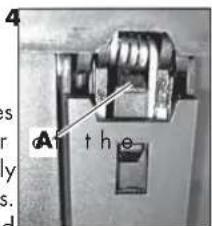
The lid 4 of the deep-fat fryer can be removed:
- Open the lid about halfway.
text_image
A h-
Little lugs A can be found on the hinges at the rear appliance directly under the springs. Press these lugs and pull the lid up slightly
-
Take off the lid.
- Clean the lid 4 with a little mild detergent in hot water.
- Then rinse with clean water and allow to dry off.
- Insert the lid back into its locators in the casing 8.
Make sure that the hinges engage.
10. Various tips
Tip 1: How to avoid the excess formation of acrylamide
Acrylamide is a chemical substance that is formed whenever foods containing starch or a certain protein compound at prepared at temperatures over 100 °C.
- Wherever possible, you should avoid excess browning, high temperatures for baking or frying or fierce frying.
- You should not eat burnt food at all.
- When deep-frying, you should avoid temperatures of over 170 °C.
- Make sure that the colour of the fried items is "golden yellow" rather than brown or dark. Browning may develop very quickly. Use the viewing window to observe the browning level of the fried items.
Tip 2: How to fry frozen items perfectly every time
Caution!
- Preferably, thaw out frozen food at room temperature before frying. Remove as much ice and water as possible before placing the items in the fryer. Add the food as slowly and carefully as possible to the fryer because frozen food can abruptly and quickly cause the hot oil or fat to bubble.
-
Frozen food (-16 to -18°C) greatly cools down oil or fat, therefore it fries more slowly and may absorb too much oil or fat. You can prevent this as follows:
Never fry large quantities at the same time. -
Heat the oil for at least 15 minutes prior to frying.
-
Set the temperature control device 10 to the temperature stated on the pack of the frozen food.
Tip 3: How to get rid of undesired aftertastes
Some foodstuffs, such as fish, leach liquid during frying. It collects in the frying oil or fat and thus impairs the smell and taste of the fried food.
To have neutral tasting oil or fat again, proceed as follows:
- Heat the oil or fat to 160^ C.
- Place two thin slices of bread or a few sprigs of parsley in the stainless steel fryer.
- Wait until the oil or fat no longer bubbles.
- Remove the bread or the parsley with a slotted spoon. The oil or fat has a neutral taste again.
11. Disposal
11.1 Appliance
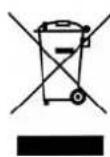
The symbol with the crossed-out rubbish bin on wheels means that within the European Union, the product must be disposed of to a sorted rubbish
collection. This applies to the product and all accessories which are marked with this symbol. Marked products must not be disposed of via the regular domestic waste but must be handed in to a recycling centre for electrical or electronic devices. Recycling helps to reduce the use of raw materials and
70 GB
natural_image
Pure geometric crosshair symbol with concentric circles and a central gear-like shape (no text or labels)to relieve the environment. You can obtain information about disposal and the location of your nearest recycling centre from your local waste management service, for example, or Yellow Pages.
11.2 Packaging
If you wish to discard the packaging, please observe the applicable environmental regulations in your country.
11.3 Oil
Dispose of used oil by pouring it back into the original packaging and sealing it firmly. Leave solid fat to solidify, then wrap it in paper.
Dispose of oil or fat residues in the refuse bin or according to the relevant respective national regulations.
11.4 Disposable/rechargeable batteries

Batteries must not be disposed of with domestic waste. Spent batteries must be disposed of properly.
Special containers are provided for this purpose at shops selling batteries or at municipal collection points. Batteries and rechargeable batteries bearing the following letters contain harmful substances such as: Cd (cadmium), Hg (mercury), Pb (lead).
You have a warranty on this product which is valid for 3 years from the date of purchase. In the event of this product being defective, you have statutory rights against the seller of the product. These statutory rights are not limited by our warranty as set out below.
Warranty conditions
The warranty period begins with the date of purchase. Please keep the original till receipt in a safe place. This is required as your proof of purchase.
If a defect in materials or workmanship occurs within three years of the date your product was purchased, we will repair or replace the product at our discretion at no charge to you. This service under warranty assumes that the defective product and the
proof of purchase (till receipt) are submitted within the three-year period and that a brief description in writing is provided of what the defect is and when it occurred.
If the defect is covered by our warranty, the repaired product or a new one will be sent back to you. There is no new warranty period following repair or replacement of the product.
Warranty period and statutory claims relating to defects
The warranty period is not extended when a service is provided under warranty. This also applies to replaced and repaired parts. Any damage or defects present at purchase must be reported immediately the product is unpacked. Repairs incurred once the warranty period has expired are chargeable.
Scope of warranty
The product has been carefully manufactured in accordance with strict quality guidelines and was thoroughly checked before being delivered.
The warranty applies to defective materials or workmanship. This was extend to product parts exposed to normal wear and tear (and which can therefore be considered wear parts) or to damage to fragile parts such as switches, batteries or parts made of glass.
This warranty is void if the product is damaged or if it is not used or maintained properly. All the information in the operating instructions should be observed precisely to ensure that the product is used properly.
It is essential to avoid intended uses and actions which are discouraged or warned against in the operating instructions.
The product is intended for only private use and not for commercial purposes.
The warranty is void in the event of misuse, incorrect treatment, use of force or interference by anyone other than our authorized service centre.
Warranty process
Please follow the instructions below to ensure that your claim is processed quickly.
• In case of any enquiry, please keep the article number (for this product: IAN 87713) and the till receipt as proof of purchase.
- The article number can be found on the rating plate, as an engraving, on the cover sheet of your instructions (bottom left) or as a label on the back or underside of your appliance.
- If malfunctions or any other defects should occur, in the first instance contact
the Service Centre mentioned below by telephone or e-mail.
- Once a product has been recorded as defective, you can then send it Freepost to the service address you are given, enclosing the proof of purchase (till receipt) and quoting what the defect is and when it is occurred.
You can download these instructions and many other manuals, product videos and software from www.lidl-service.com.

Service Centre
GB Service Great Britain
Tel.: 0871 5000 720 (£ 0.10/Min.)
E-Mail: hoyer@lidl.co.uk
IR Service Ireland
Tel.: 1890 930 034
(0,08 EUR/Min., (peak))
(0,06 EUR/Min., (off peak))
E-Mail: hoyer@lidl.ie
CY Service Cyprus
Tel.: 8009 4409
E-Mail: hoyer@lidl.com.cy
MT Service Malta
Tel.: 80062230
E-Mail: hoyer@lidl.com.mt
IAN: 87713
72 GB


Please note that the address below is not a service address. In the first instance, contact the service centre mentioned above.
HOYER Handel GmbH
Kühnehöfe 5
D-22761 Hamburg
Germany
SKF 2800 A1 73
GB




natural_image
Pure color palette bar with no text or symbols, showing grayscale gradient and a color swatch (no text or symbols)HOYER HANDEL GMBH
Kühnehöfe 5
D-22761 Hamburg