EXP 4 C - Coffee machine TEAM - Free user manual and instructions
Find the device manual for free EXP 4 C TEAM in PDF.

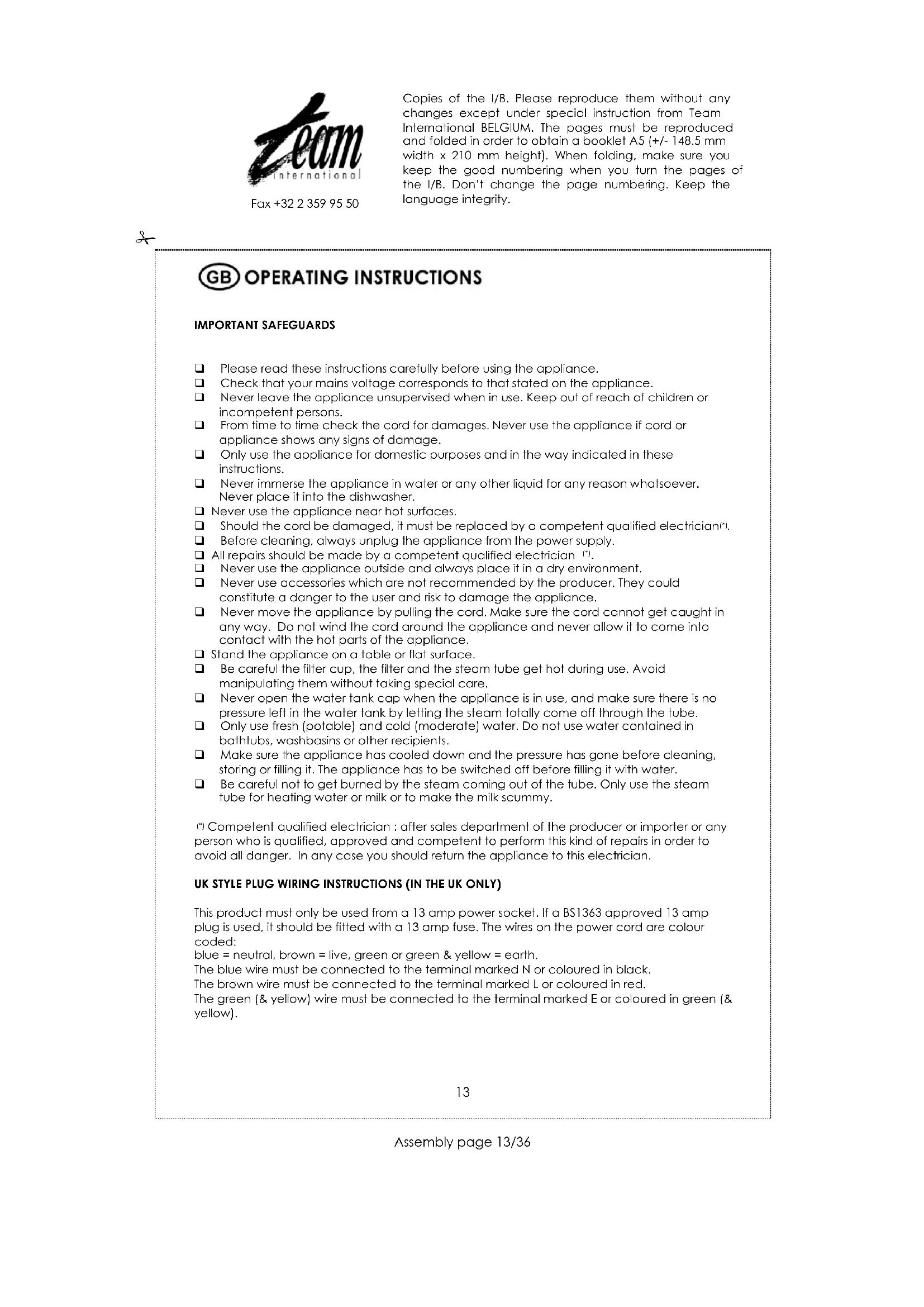


| Product type | Combined espresso and drip coffee machine |
| Brand | Team |
| Model | EXP 4 C |
| Power supply | 220-240 V ~ 50/60 Hz (estimated) |
| Power | Approximately 1000 W (estimated) |
| Espresso tank capacity | Approximately 1 L (max 5 cups) |
| Drip coffee maker tank capacity | Not specified, approximately 1.2 L (estimated) |
| Espresso pressure | 15 bars (common estimate) |
| Main functions | Espresso, cappuccino, steam, drip coffee maker |
| Included accessories | Filter holder, metal filter, steam nozzle, espresso carafe, coffee carafe |
| Materials | Plastic body, glass tank, metal nozzles |
| Safety | Safety valve, automatic anti-overheat shut-off, anti-drip system |
| Maintenance | Cleaning of removable parts with soapy water, regular descaling |
| Descaling | Liquid descaler recommended (no vinegar) |
| Spare parts | Carafe, filter, filter holder, steam nozzle, gasket (available) |
| Repairability | Repair by qualified service only |
Frequently Asked Questions - EXP 4 C TEAM
User questions about EXP 4 C TEAM
0 question about this device. Answer the ones you know or ask your own.
Ask a new question about this device
Download the instructions for your Coffee machine in PDF format for free! Find your manual EXP 4 C - TEAM and take your electronic device back in hand. On this page are published all the documents necessary for the use of your device. EXP 4 C by TEAM.
USER MANUAL EXP 4 C TEAM
Generated by Unregistered Batch DOC TO PDF Converter 2011.3.804.1511, please register!
Copies of the I/B. Please reproduce them without any changes except under special instruction from Team International BELGIUM. The pages must be reproduced and folded in order to obtain a booklet A5 (+/- 148.5 mm width x 210 mm height). When folding, make sure you keep the good numbering when you turn the pages of the I/B. Don't change the page numbering. Keep the language integrity.

Please read these instructions carefully before using the appliance.
Check that your mains voltage corresponds to that stated on the appliance.
Never leave the appliance unsupervised when in use. Keep out of reach of children or incompetent persons.
From time to time check the cord for damages. Never use the appliance if cord or appliance shows any signs of damage.
Only use the appliance for domestic purposes and in the way indicated in these instructions.
Never immerse the appliance in water or any other liquid for any reason whatsoever. Never place it into the dishwasher.
Never use the appliance near hot surfaces.
Should the cord be damaged, it must be replaced by a competent qualified electrician.
Before cleaning, always unplug the appliance from the power supply.
All repairs should be made by a competent qualified electrician (1).
Never use the appliance outside and always place it in a dry environment.
Never use accessories which are not recommended by the producer. They could constitute a danger to the user and risk to damage the appliance.
Never move the appliance by pulling the cord. Make sure the cord cannot get caught in any way. Do not wind the cord around the appliance and never allow it to come into contact with the hot parts of the appliance.
Stand the appliance on a table or flat surface.
Be careful the filter cup, the filter and the steam tube get hot during use. Avoid manipulating them without taking special care.
Never open the water tank cap when the appliance is in use, and make sure there is no pressure left in the water tank by letting the steam totally come off through the tube.
Only use fresh (potable) and cold (moderate) water. Do not use water contained in bathtubs, washbasins or other recipients.
Make sure the appliance has cooled down and the pressure has gone before cleaning, storing or filling it. The appliance has to be switched off before filling it with water.
- Be careful not to get burned by the steam coming out of the tube. Only use the steam tube for heating water or milk or to make the milk scummy.
Competent qualified electrician : after sales department of the producer or importer or any person who is qualified, approved and competent to perform this kind of repairs in order to avoid all danger. In any case you should return the appliance to this electrician.
UK STYLE PLUG WIRING INSTRUCTIONS (IN THE UK ONLY)
This product must only be used from a 13 amp power socket. If a BS1363 approved 13 amp plug is used, it should be fitted with a 13 amp fuse. The wires on the power cord are colour coded:
blue = neutral, brown = live, green or green & yellow = earth.
The blue wire must be connected to the terminal marked N or coloured in black.
The brown wire must be connected to the terminal marked L or coloured in red.
The green (& yellow) wire must be connected to the terminal marked E or coloured in green (& yellow).
PREPARING THE MACHINE
We recommend to get used to all functions of your appliance before using it for the first time. Do not plug it in. Insert the metal filter (g) in the filter holder (f) and position the filter holder. Remove and replace the cap of the water tank (a) of the espresso machine. Activate the ON/OFF switch (b) and the steam control knob (c). Try all the accessories of the coffee maker. Wash the accessories thoroughly in hot soapy water, rinse and dry them carefully.
SPECIAL SAFEGUARDS CONCERNING STEAM UNDER PRESSURE IN THE ESPRESSO MAKER
Never open the cap of the water tank and never remove the filter holder during the functioning of the appliance or as long as there is steam under pressure in the tank.
To check if the appliance is still under pressure, read the following instructions:
- Make sure that the espresso switch (b) in on the OFF position.
- Unplug the appliance from the power supply.
- Hold a container with cold water under the steam pipe (d) and introduce the pipe in the water.
- Once the steam pipe (d) is immersed in water, put the steam control knob (c) in position. Continue this until no more steam comes out of the pipe.
- Put the steam control knob (c) in OFF position.
- You can now remove the cap (a) of the tank and the filter holder (f).
- If there is still water in the tank, remove the glass carafe (i) and the grid of the drip tray (j), then turn the appliance upside down over a sink in order to empty the remaining water.
These safeguards are to be respected not only when the appliance is on but also during the 10-15 minutes following the stopping of the appliance.
SPECIAL SAFEGUARDS CONCERNING THE COFFEE AND ESPRESSO CARAFES
In order not to break the carafes:
- Do not wait that all the liquid has evaporated from the carafes.
- Don't heat the carafes when they are empty.
- Change your carafes if they are damaged.
If they are chipped or cracked, they could break or let glass particles enter the liquid. - Do not place the hot carafes on a cold or wet surface.
- Do not use the carafes if the handles are cracked or broken.
- Do not use metal sponges to clean the carafes, they could scratch and weaken the glass.
- Do not place the carafes on or near an electric or gas stove, in a oven or in a microwave oven.
- Avoid shocks.
ESPRESSO MODE
The espresso is a strong coffee, with a characteristic taste, extremely rich in aroma. Therefore, the water that arrives in the filter with a high temperature is pushed very fast through the coffee mass by a strong pressure. It extracts the nectar from the grinding and draws the essential aromas from the coffee. That's why the espresso is usually served in small "espresso" cups.
Use preferably a special espresso coffee with suitable roasting and grinding. Remember that the espresso needs a finer grinding than the filter coffee.
BEFORE THE FIRST USE
When you use your appliance for the first time we recommend in order to wash the inner side of the appliance circuit, you have to operate it three times as described in the section "HOW TO PREPARE AN ESPRESSO" (WITHOUT COFFEE IN THE FILTER HOLDER).
HOW TO PREPARE AN ESPRESSO
- Insert the plug in the power supply. Make sure that the ON/OFF switch (b) is on the OFF position.
- Insert the filter (g) into the filter holder (f) (Fig.1). On the filters there are two marks (2 and 4 cups). Fill with ground espresso coffee until the desired level (Fig. 2).
- Gently tamp the coffee into coffee filter and remove the excess coffee from the edge of filter holder (f). This will ensure the good positioning of the filter holder in its support (e). Do not tamp to hard. To avoid a blocking or an overflow, do not overfill the level "4" in the filter (g).
- Caution: Check that the filter locking flap is as far as possible from the filter. Position the filter holder (f) in the support of the filter holder (f). Turn firmly to the right until it blocks (Fig. 3). The filter holder (f) should be the most on the right of the closing zone as possible. If the filter holder (f) does not fit in the closing zone and at least in the middle of the appliance, do not operate your appliance, remove the filter holder (f) and position it again as described here above until the filter holder is in the closing zone. This will avoid that the filter holder (f) comes out of its housing as the pressure rises when the coffee is flowing through the filter.
- Unscrew the cap of the tank (a) anticlockwise (Fig. 4).
- Fill the carafe (i) with cold tap water until the desired level (2 or 4 cups) and pour in the Espresso tank (Fig. 5).
Measure indication
On the carafe they are 3 marks:
Mark 2
Mark 4
Mark (steam)
The mark 2 corresponds to 2 espresso cups.
The mark 4 corresponds to 4 espresso cups.
The mark corresponds to 2 espresso cups + the necessary water quantity to produce steam for the preparation of cappuccino.
Do not overfill the equivalent of 5 cups, which is the maximum level represented by the metal strip around the carafe.
Attention: Do not fill the espresso tank when the switch (b) is in the ON position. Your appliance must be on when you fill the tank.
- Place the cap of the tank (a) on the appliance and turn it clockwise until it locks completely (Fig. 6).
-
Then place the lid on the carafe (i) in such a way that the opening of the carafe lid faces the spout of the filter holder (f) (Fig. 7).
-
Place the carafe underneath the filter holder (f). Check if the spout of the filter holder faces the opening of the carafe lid (Fig. 8). Caution: Make sure that the grid of the drip tray (j) is placed.
- You are now ready to prepare espressos. Press the espresso switch (b) (Fig. 9) and turn the steam control knob to the position. The pilot light (k) comes on.
- After about 2 minutes the water reaches the good temperature and flows through the coffee grinding in the carafe.
- When the coffee production is completed, press the ON/OFF switch (b). The pilot light goes off indicating that the appliance is turned off.
- Before removing the filter holder (f), make sure there is no more pressure in the tank (as described in the section SAFEGUARDS CONCERNING STEAM UNDER PRESSURE).
Caution
Be careful when you remove the filter holder (f) because the metal parts could be still hot. To remove the filter holder, turn it to the left and go over the closing zone until the filter holder comes out of the appliance (Fig. 10).
Attention: Make sure that the tank is empty and that there is no more steam under pressure. Remove the filter holder (f). Place the filter locking flap (so that the filter doesn't fall) and empty the coffee grinding from the filter (g) (Fig.11).
HOW TO PREPARE A CAPPUCCINO
- To make cappuccino, the first step is making espresso. So fill the carafe (i) with the necessary water quantity to obtain the desired espresso quantity and add more water in order to froth the milk (see section Measure indication).
- Fill the half or the third of a small container with fresh full-cream milk.
- To make an espresso coffee, put the switch (b) on the ON position and turn the steam control knob (c) to the position.
- When the espresso is ready, put the steam control knob (c) in OFF position.
- To froth the milk, turn the steam pipe (d) to the outside of the appliance, place the container with the milk under the pipe (Fig. 12), plunge the steam pipe (d) in the milk and put the steam control knob (c) in position (Fig. 13) for approximately 45-60 seconds depending on how much froth you need and what type of milk you are using. To obtain a smooth froth immerse the steam pipe (d) at about 3cm in the milk. Lift and lower the container but without immersing the pipe more than 3cm in it. Do not bring the milk to the boil.
- Once the froth is obtained, shut off steam by putting the steam control knob (c) in OFF position.
- Pour the espresso coffee in the breakfast cups and forth on the espresso with a spoon.
STEAM FUNCTION
If you want to froth milk only, fill the espresso carafe with water until the mark This quantity allows you to obtain steam for around one minute.
- Pour the water in the water tank and put the switch (b) in ON position.
- Position a cup underneath the steam pipe (d) to collect the possible water drips and put the control knob (c) in position.
- Then proceed as indicated for the steps 5 and 6 of the preparation of a cappuccino and when you obtain the desired milk froth, put the steam control knob in OFF position and switch off the appliance.
CLEANING
Before cleaning the appliance, switch it off, remove the plug from the wall socket and wait until it cools down. The filter, the filter holder, the carafe and its lid, the grid of the drip tray can be washed in hot soapy water. Do not put them in the dish washer. Wipe the body of the appliance with a damp cloth. Never immerse the body of the appliance in water or any other liquid. Clean the support of the filter holder (e) with a damp cloth too in order to eliminate the coffee residues. If there is still water in the tank, let the appliance cool down, remove the tank cap (a), remove the different parts and empty the tank by turning the appliance on a sink in order to empty the remaining water.
Cleaning of the steam pipe
Wash the steam pipe (d) after each use especially when it has been immersed in milk. If you do not wash it, the inner side of the pipe can get blocked up and it will be difficult to remove the milk residues around it. In case of obstruction of the pipe, use a needle to remove the milk residues. Just after having lathered up the milk, wipe the body of the pipe with a damp cloth, then keep the cloth against the opening of the steam outlet and put the steam control knob (c) in position; let the steam escape for one or two seconds in order to throw out the milk residues and then close the knob.
ATTENTION: PAY ATTENTION NOT TO GET BURNED WITH THE STEAM AND THE METAL PART OF THE PIPE (WHICH MAY BE HOT).
Cleaning of the drip tray
In order to clean the drip tray (j) remove the grid (Fig.14).
Caution: Never try to open or to disassemble the body of the appliance.
Descalating the espresso maker
The espresso machine has to be descaled regularly. The frequency depends on the water hardness and of the use frequency.
Before descending the appliance, the filter grid of the support MUST be removed (fig. 15).
- Remove the scale and the coffee residues from the filter grid and from the support of the filter holder (e). It is recommended to use only liquid descaling agent that can be found in shops and in the proportions indicated on the packing paper by the producer.
- Fill the espresso carafe (i) with the descending solution until the level "4" and then pour the solution in the espresso tank. Place a container under the support of the filter holder (e) and another one under the steam pipe (d) (Caution: do not use the filter holder (f) during the descending).
- Press the ON/OFF switch (b) and turn the steam control knob (c) in the position. Wait until steam comes out the opening of the pipe (d).
- After approximately 30 seconds, stop the hot water flow by putting the steam control knob (c) in OFF position and let the descending solution flow through the support of the filter holder in the container.
- When the solution has finished flowing, switch off the appliance and let it cool down.
- Repeat this operation a second time.
Then proceed in the same way but this time only with fresh water to rinse the inner side of the circuit. For a good rinsing, the equivalent of two espresso tanks has to pass through the circuit. Switch off the appliance and remove the plug from the power supply. Let it cool down, put the filter grid back in the support of the filter holder and screw it tight.
Caution: Never use vinegar like descending agent.
PROBLEMS AND CAUSES OF THE NON FUNCTIONING OF THE ESPRESSO
| PROBLEMS | CAUSES |
| Water overflows through the filter holder | -The filter holder is not well positioned.-The filter holder is not enough blocked.-The seal is dirty and needs to be cleaned.-The seal is not elastic anymore and needs to be replaced.-Coffee powder is remaining on the edge of the filter holder. |
| Coffee doesn't flow | -No coffee in the water tank.-No coffee in the filter of the filter holder.-The coffee grinding in the filter of the filter holder is too fine or the coffee is too tamped. |
| Steam doesn't comes out of the steam pipe | -Not or not enough water in the espresso tank-The steam pipe is blocked (see CLEANING section) |
| Not enough milk froth | -The steam pipe is blocked (see CLEANING section)-Not enough water in the tank to obtain 45 to 60 seconds steam-The milk is too hot.-Do not use stainless steel container.-The milk is not fresh or skimmed. |
CAUTION: ALWAYS REMOVE THE CARAFE (O) BEFORE OPENING OR CLOSING THE FILTER HOLDER
INITIAL OPERATION
For a perfect taste, carry out 2 or 3 boil processes with fresh water (without coffee). Once all the water has passed through, switch off the appliance and let it cool down during 5 minutes. Then repeat the process with fresh water.
PREPARATION OF COFFEE
- Open the swing filter holder (n) (Fig.1)
- Insert a filter in the filter holder (Fig. II) and fill it with the desired amount of coffee (Fig. III). Close the swing filter holder making sure it is closed tight. (Fig. IV)
- Open the lid of the water tank (I) and pour the desired amount of water (Fig. V)
- Do not forget to close the lid of the water tank (I) before switching on the appliance
- Put the switch (m) of the coffee maker in ON position (fig VI). The pilot light (q) will come on.
- When you remove the carafe (o) from the appliance, an anti-drip valve will automatically operate to stop any drops of coffee from dripping onto the hotplate (p). Putting back the carafe automatically opens the anti-drip valve and allows remaining coffee to flow trough into the carafe.
Wait until the brewing process is finished and the filter has run empty.
CLEANING
Always unplug the appliance before cleaning it. Clean the swing filter, the carafe and its lid in hot soapy water. Do not put those parts in the dishwasher.
- Never use abrasive products.
- Never immerse the appliance in water. To clean it only use a soft damp cloth.
- Do not use cloth to wash the inside of the water tank, this could let threads or cloth rests in it. Rinse it regularly with clear water.
DESCALING
- Descalging the coffee maker prolongs its life span. For descending only use products especially made for this purpose.
- Put the carafe in the dish washer.
Caution: Never use vinegar to descale this appliance.