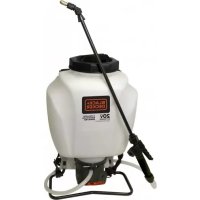
63980 - Paint spray Chapin - Free user manual and instructions
Find the device manual for free 63980 Chapin in PDF.


User questions about 63980 Chapin
0 question about this device. Answer the ones you know or ask your own.
Ask a new question about this device
Download the instructions for your Paint spray in PDF format for free! Find your manual 63980 - Chapin and take your electronic device back in hand. On this page are published all the documents necessary for the use of your device. 63980 by Chapin.
USER MANUAL 63980 Chapin
Carefully Read These Instructions Before Use
WARNING: Improper use or failure to follow instructions can result in explosive failure causing serious eye or other injury. For safe use of this product you must read and follow all instructions. Do not leave a pressurized sprayer in the hot sun. Heat can cause pressure build-up resulting in possible explosion. Do not store or leave solution in tank after use. Always wear goggles, gloves, long sleeve shirt, long pants and full foot protection when spraying. Do not attempt to modify this sprayer. Replace parts only with manufacturer's original parts. Never spray flammable, caustic, acidic, chlorine, bleach or other corrosive solutions or heat, pressure, or gas producing chemicals. Always read and follow chemical manufacturer's instructions before use with this sprayer as some chemicals may be hazardous when used with this sprayer.
WARNING: Handling the brass parts of this product will expose you to lead, a chemical known to the State of California to cause birth defects and other reproductive harm.
Wash hands after handling.
CAUTION
- PRE-USE CHECK: Before each use check tightness of hose nut to be sure hose is securely attached to the shut-off assembly. Insure that all nozzle and wand connections are tight.
- Do Not exceed a tank solution temperature of 120^oF / 49^oC .
NOTE: The tank and hose may have residual water in it due to quality testing performed on the sprayer.
WARNING
This sprayer is designed to operate with a Black & Decker 20V Lithium Ion battery ONLY. Any other batteries could cause serious harm or injury to the operator and serious damage to the sprayer.
IMPORTANT SAFETY INSTRUCTION FOR BATTERY PACKS
WARNING: For safe operation, read this manual before using the charger.
The battery pack is not fully charged out of the carton. Before using the battery pack and charger, read the safety instructions below. Then follow charging procedures outlined.
READ ALL INSTRUCTIONS
- Do not incinerate the battery pack even if it is severely damaged or is completely worn out. The battery pack can explode in a fire. Toxic fumes and materials are created when battery packs are burned.
- Do Not charge or use battery in explosive atmospheres, such as in the presence of flammable liquids, gases or dust. Inserting or removing the battery from the charger may ignite the dust or fumes.
- If battery contents come into contact with the skin, immediately wash area with mild soap and water. If battery liquid gets into the eye, rinse water over the open eye for 15 minutes or until irritation ceases. If medical attention is needed, the battery electrolyte for Lithium-lon batteries is composed of a mixture of liquid organic carbonates and lithium salts.
- Contents of opened battery cells may cause respiratory irritation. Provide fresh air. If symptoms persist, seek medical attention.
WARNING: Burn hazard. Battery liquid may be flammable if exposed to spark or flame.
- Charge the battery packs only in Black & Decker chargers.
DO NOT splash or immerse in water or other liquids. This may cause premature cell failure. - Do not store or use the tool and battery pack in locations where the temperature may reach or exceed 105^ ( 40^ ) (such as outside sheds or metal buildings in summer).
WARNING: Never attempt to open the battery pack for any reason. If battery pack case is cracked or damaged, do not insert into charger. Do not crush, drop or damage battery pack. Do not use a battery pack or charger that has received a sharp blow, been dropped, run over or damaged in any way (i.e., pierced with a nail, hit with a hammer, stepped on). Damaged battery packs should be returned to service center for recycling.
WARNING: Fire hazard. Do not store or carry battery so that metal objects can contact exposed battery terminals. For example, do not place battery in aprons, pockets, tool boxes, product kit boxes, drawers, etc., with loose nails, screws, keys, etc.
Transporting batteries can possibly cause fires if the battery terminals inadvertently come in contact with conductive materials such as keys, coins, hand tools and the like. The US
Department of transportation Hazardous Material Regulations (HMR) actually prohibit transporting batteries in commerce or on airplanes (i.e., packed in suitcases and carry-on luggage) UNLESS they are properly protected from short circuits. So when transporting individual batteries, make sure that the battery terminals are protected and well insulated from materials that could contact them and cause a short circuit. NOTE: Lithium-lon batteries should not be put in checked baggage.
STORAGE RECOMMENDATIONS
- The best storage place is one that is cool and dry away from direct sunlight and excess heat or cold.
- Long storage will not harm the battery pack or charger.
CHARGING PROCEDURE
Black & Decker chargers are designed to charge
Black & Decker battery packs in 3.5-4 hours depending
on the pack being charged.
- Plug the charger into an appropriate outlet before inserting the battery pack.
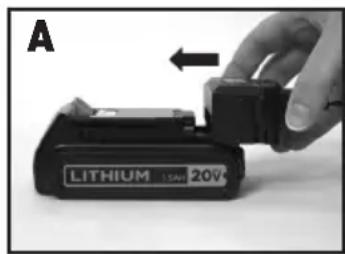
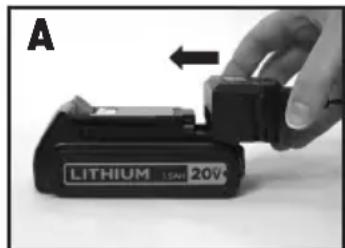
- Insert the battery pack into the charger as shown in figure A.
- The green LED will flash indicating that the battery is being charged.
- The completion of charge is indicated by the green LED remaining on continuously. The pack is fully charged and may be used at this time or left on the charger.
Recharge discharged batteries as soon as possible after use or battery life may be greatly diminished. For longest battery life, do not discharge batteries fully. It is recommended that the batteries be recharged after each use.
LEAVING THE BATTERY IN THE CHARGER
The charger and battery pack can be left connected with the green LED glowing indefinitely. The charger will keep the battery pack fresh and fully charged.
IMPORTANT CHARGING NOTES
- Longest life and best performance can be obtained if the battery pack is charged when the air temperature is between 65^ and 75^ (18^ - 24^) . DO NOT charge the battery pack in an air temperature below +40^ (+4.5^) , or above +105^ (+40.5^) . This is important and will prevent serious damage to the battery pack.
- The charger and battery pack may become warm to touch while charging. This is a normal condition, and does not indicate a problem. To facilitate the cooling of the battery pack after use, avoid placing the charger or battery pack in a warm environment such as in a metal shed, or an uninsulated trailer.
- If the battery pack does not charge properly:
a. Check current at receptacle by plugging in a lamp or other appliance.
b. Check to see if receptacle is connected to a light switch which turns power off when you turn out the lights.
c. Move charger and battery pack to a location where the surrounding air temperature is approximately 65^ and 75^ (18^ - 24^) .
d. If charging problems persist, take the tool, battery pack and charger to your local service center. - The battery pack should be recharged when it fails to produce sufficient power on jobs which were easily done previously. DO NOT CONTINUE to use under these conditions. Follow the charging procedure. You may also charge a partially used pack whenever you desire with no adverse effect on the battery pack.
- Foreign materials of a conductive nature such as, but not limited to, steel wool, aluminum foil, or any buildup of metallic particles should be kept away from charger cavities. Always unplug the charger from the power supply when there is no battery pack in the cavity. Unplug charger before attempting to clean.
- Do not freeze or immerse charger in water or any other liquid.
WARNING: Shock hazard. Do not allow any liquid to get inside charger. Never attempt to open the battery pack for any reason. If the plastic housing of the battery pack breaks or cracks, return to a service center for recycling.
INSTALLING AND REMOVING THE BATTERY PACK FROM THE SPRAYER
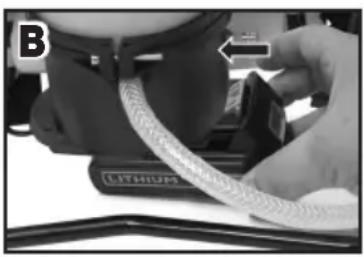
WARNING: Make sure switch is in the off position. TO INSTALL BATTERY PACK: Insert battery pack into tool until an audible click is heard (Figure B). Make sure battery pack is fully seated and latched into position.
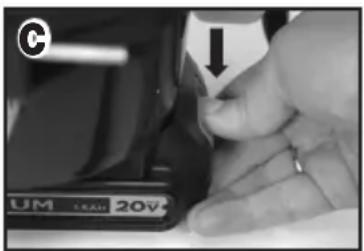
TO REMOVE THE BATTERY PACK: Depress the battery release button as shown in Figure C and pull battery pack out of tool.
- Pull by plug rather than cord when disconnecting charger. This will reduce risk of damage to electric plug and cord.
- Make sure that cord is located so that it will not be stepped on, tripped over, or otherwise subjected to damage or stress.
- Do not use an extension cord unless it is absolutely necessary. Use of improper extension cord could result in risk of fire, electric shock, or electrocution.
- An extension cord must have adequate wire size (AWG or American Wire Gauge) for safety. The smaller the gauge number of the wire, the greater the capacity of the cable, that is 16 gauge has more capacity than 18 gauge. When using more than one extension to make up the total length, be sure each individual extension contains at least the minimum wire size.
- Do not operate charger with damaged cord or plug - have them replaced immediately.
- Do not operate charger if it has received a sharp blow, been dropped, or otherwise damaged in any way. Take it to an authorized service center.
- Do not disassemble charger; take it to an authorized service center when service or repair is required. Incorrect reassembly may result in a risk of electric shock electrocution or fire.
- Disconnect the charger from the outlet before attempting any cleaning. This will reduce the risk of electric shock. Removing the battery pack will not reduce the risk.
- NEVER attempt to connect 2 chargers together.
- The charger is designed to operate on standard household electrical power (120Volts). Do not attempt to use it on any other voltage.
SAVE THESE INSTRUCTIONS
Symbols
The label on your tool may include the following symbols.
V. volt
Hz. hertz
min.minutes.
direct current
Class I Construction (grounded)
Class II Construction (double insulated)
Read instruction manual before use
Use proper eye protection
A. amperes
W... .watts
...alternating current
no no load speed
earthing terminal
... safety alert symbol
.../min or rpm.revolutions or reciprocation per minute
Use proper
respiratory protection
O. Use proper hearing protection
IMPORTANT SAFETY INSTRUCTIONS FOR BATTERY CHARGERS
SAVE THESE INSTRUCTIONS: This manual contains important safety instructions for battery chargers.
- Before using charger, read all instructions and cautionary markings on charger, battery pack, and product using battery pack.
WARNING: Shock hazard. Do not allow any liquid to get inside charger.
CAUTION: Burn hazard. To reduce the risk of injury, charge only designated Black & Decker batteries. Other types of batteries my burst causing personal injury and damage.
CAUTION: Under certain conditions, with the charger plugged into the power supply, the charger can be shorted by foreign material. Foreign materials of a conductive nature such as, but not limited to, steel wool, aluminum foil, or any build up of metallic particles should be kept away from charger cavities. Always unplug the charger from the power supply when there is no battery pack in the cavity. Unplug charger before attempting to clean.
WARNING: DO NOT attempt to charge the battery pack with any chargers other than the ones in this manual. The charger and battery pack are specifically designed to work together.
- These chargers are not intended for any uses other than charging designated Black & Decker rechargeable batteries. Any other uses may result in risk of fire, electric shock or electrocution.
- Do not expose charger to rain or snow.
APPLICATIONS & USE FOR YOUR SPRAYER
Avoid using a sprayer for general cleaning purposes if plant protection or herbicide chemicals have already been used in the sprayer. If a sprayer has been used for plant protection or as an herbicide, clean the sprayer completely (see cleaning section) before using.
Plant Food: Use different spray patterns for optimum foliage feeding or for fungicide and pesticide application.
Herbicides: Reduce weeds and unwanted plants but avoid using the same sprayer for plant feeding or protection without thoroughly cleaning (see cleaning section) the sprayer first.
General Household Use: Apply detergents, cleaning solutions, warm water (do not exceed 120^ / 49^ ) or nontoxic household cleaning chemicals for carpets, floors, walls, glass, counter tops and ceilings. DO NOT use sprayer that has been used with herbicides, pesticides or other toxic chemicals for household applications.
General Outdoor Use: Use the sprayer for cleaning windows or with a detergent for general purpose cleaning.
SPRAYER COMPONENTS & USE INFORMATION
NOZZLE ASSEMBLY
Figure 1-2
Unscrew the nozzle cap (1) from the nozzle body (3) with retaining nut (2) fastened tightly to the elbow (5). Unscrew the retaining nut (2). Push the nozzle body (3) with the nozzle gasket (4) out of the retaining nut (2). To reinstall the nozzle, reverse the above instructions.
Unscrew the retaining nut from the elbow and push the fan nozzle tip and gasket out of the retaining nut. To reinstall the nozzle, reverse the above instructions.
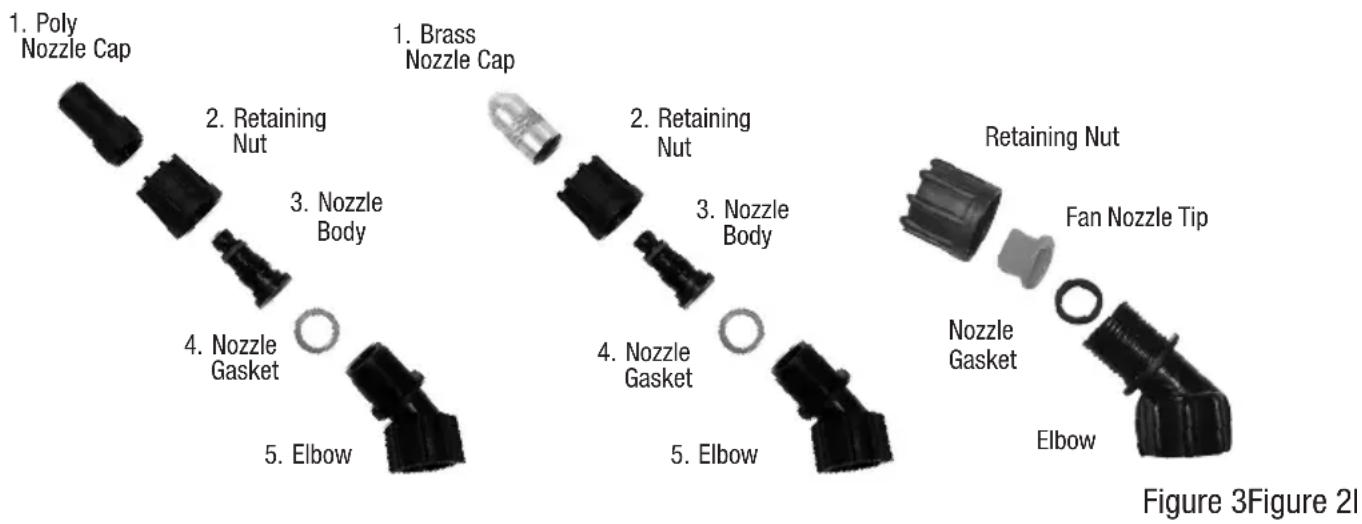
Figure 3
SPRAYER COMPONENTS & USE INFORMATION, Continued
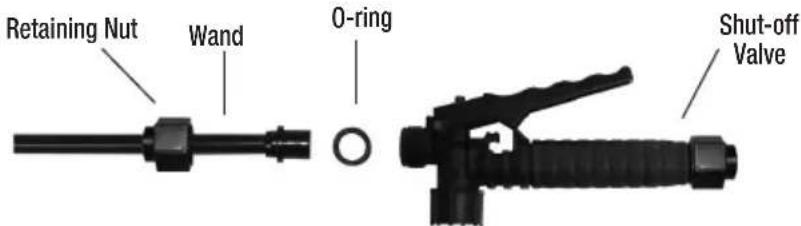
WAND ASSEMBLY
- Make sure the o-ring is installed on the end of the wand. Insert the wand into shut-off valve.
- Turn and tighten the retaining nut clock-wise onto the shut-off valve.
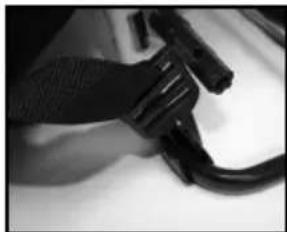
INSTALLING THE SHOULDER STRAP
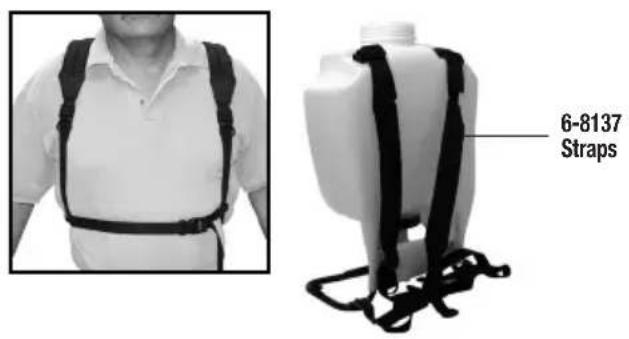
The top of the shoulder straps are attached to the tank. Attach the lower end of the straps by clipping the strap hooks to the metal frame between where the frame exits the tank and curves around.
3 STAGE FILTERING SYSTEM
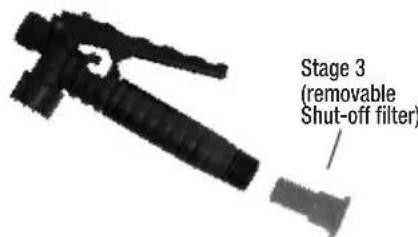
This backpack sprayer is equipped with a 3 stage filtering system (see figure 1). Stage 1 is a filter basket incorporated into the tank opening where fluid is added. Stage 2 filter is located at the inlet of the pressure cylinder. Stage 2 is a removable In-Tank filter. Stage 3 is a removable filter incorporated into the shut-off assembly. Periodic cleaning of these filters is recommended to insure consistent fluid flow through the sprayer. This will also reduce sprayer component wear.
The stage 3 filter is a removable filter incorporated into the inlet side of the shut-off valve (see section "disassembling and repairing the shut-off valve"). Make sure pressure is released before detaching the hose from the shut-off. It is best to have no or minimal fluid in the pressure cylinder before removing and reinstalling the stage 3 shut-off filter as fluid can leak from the hose.
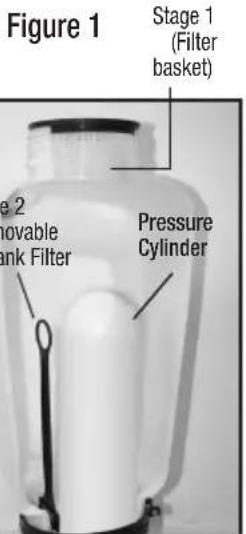
Figure 2 Stage 2 (removable In-Tank filter)

Guide edge facing away from pressure cylinder
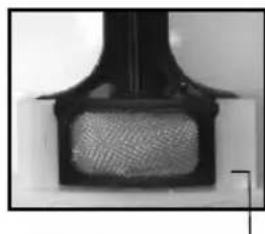
Guide edge on pressure cylinder
SPRAYER COMPONENTS & USE INFORMATION, Continued
FILLING THE SPRAYER
Make sure the filter basket is in place to keep debris from entering the tank.
Determine the amount of mixture needed for your application. Add the proper amount of water to the tank. Add the proper amount of chemical to the tank (check the chemical label for proper ratio of chemical). Stir mixture in tank with a clean utensil (like a paint stirrer). The tank will hold the 4-gallon (15.1L) capacity plus the chemical.
It is not necessary to completely fill the sprayer tank with each use. You can fill the tank with only the amount needed for each application.
Always follow the manufacturer's instructions included on their product label.
- Plug in charged battery
- Turn switch to on position
- Spray liquid back into tank to prime pump
- Close shut-off. Pump should stop running.
- Replace cap & begin spraying.
POWDER-BASED CHEMICALS
Powder-based chemicals (powder mixed with liquids to make the spraying agent) are usually abrasive and can cause wear. When you use a powder-based chemical in your sprayer, make sure it is thoroughly dissolved in the liquid solution. Thoroughly clean and flush the sprayer with water to extend the life of the sprayers parts.
When finished spraying turn switch to off position.
Remove and re-charge battery.
Note: Unit is equipped with a battery protection circuit. If sprayer abruptly stops after spraying for an extended period of time, the battery may require charging.
CLEANING
- Always empty the sprayer and clean the tank thoroughly after each use.
Other Cleaning Hints:
- Improper spray distribution usually means the nozzle is clogged, remove the nozzle and clean it.
- Soap can be added to the water to clean the tank.
- Do not use strong cleaning agents or abrasives.
- If you use a chemical agent to clean the tank follow the manufacturer's recommendations for the disposal of the waste water.
- Follow the chemical manufacturers instructions for clean up.
STORING / MAINTAINING YOUR SPRAYER
The Battery Should be removed prior to storage.
- The sprayer should be stored out of direct sunlight in a cool dry space.
- Before freezing weather make sure to drain all liquid in the tank, pump, hose, shut-off valve, wand and nozzle, to avoid liquid expansion and cracking in the sprayer components (See "Cleaning" section). Lock the shut-off valve in the "open" position.
- When service is required call your nearest dealer and always insist on original manufactured replacement parts.
- Inspect the hose, wand, tank and shut-off valve for wear, damage or leaks on a regular basis and repair defects promptly.
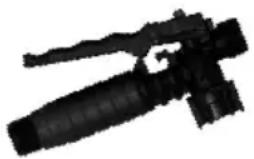
Figure 1
1) Assembled shut-off valve (Figure 1).
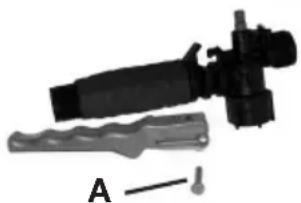
Figure 2
2) Remove the retaining pin (A) (Figure 2) place the notched end of the retaining pin on a hard surface and push down. Remove the retaining pin and slide the handle off the valve.

Figure 3
3) Remove the retaining nut (o-ring attached), spring, and valve stem (B) (Figure 3). Replace worn parts. Lubricate the O-rings and reassemble by reversing the steps above. Place the handle groove in the slotted area of the valve stem and make sure the locking clip is positioned in the neutral position (see "Helpful Spraying Information" section). Insert the retaining pin. Push down on the handle a few times to distribute the lubricant evenly. Check filter (C) in end of shut-off valve for debris. Remove filter and flush with water to clean out.
Symptom
Possible Reason
Correction
Unit runs but does not spray Pump is not primed Activate shut-off handle until liquid sprays out. Release handle and pump will shut-off.
Unit will not start Battery pack not installed properly Check battery pack installation Battery pack not charged Check battery pack charging requirements
Battery pack will not charge Battery pack not inserted into charger Insert battery pack into charger until green LED appears
Charger not plugged in Plug charger into a working outlet. Refer to "Important Charging Notes" for more details
Surrounding air temperature too hot or too cold Move charger and battery pack to a surrounding air temperature of above 40 degrees F (4.5^) or below 105 degrees F (+40.5^)
Unit shuts off abruptly Battery pack has reached its maximum thermal limit. Allow battery pack to cool down.
Out of charge. (To maximize the life of the battery Place on charger and allow to charge.
pack it is designed to shutoff abruptly when the
charge is depleted.)
Shut-off leaks Connections loose Tighten connection
Worn or damaged shut-off Rebuild or replace the shut-off valve
Wand assembly leaks Connections loose Tighten connection
Damaged or worn o-ring/gasket Replace o-ring/gasket
Nozzle assembly leaks Connections loose Tighten connection Damaged or worn o-ring/gasket Replace o-ring/gasket
Leak between pump assembly Pump clamp loose Tighten clamp and tank O-ring worn or damaged Replace pressure chamber o-ring
Hose leaking at tank outlet Hose clamp loose Tighten clamp
Hose leaking at shut-off Connection loose Tighten retainin
Replace o-ring/gasket
The RBRC^TM Seal
The RBRC^TM (Rechargeable Battery Recycling Corporation) Seal on the lithium-ion battery (or battery pack) indicates that the costs to recycle the battery (or battery pack) at the end of its useful life have already been paid by Black & Decker. In some areas, it is illegal to place spent lithium-ion batteries in the trash or municipal solid waste stream and the RBRC program provides an environmentally conscious alternative.
RBRC in cooperation with Black & Decker and other battery users, has been established programs in the United States and Canada to facilitate the collection of spent lithium-ion batteries. Help protect our environment and conserve natural resources by returning the tool to an authorized Black & Decker service center for recycling. You may also contact your local recycling center for information on where to drop off the spent battery, or call 1-800-8-BATTERY.
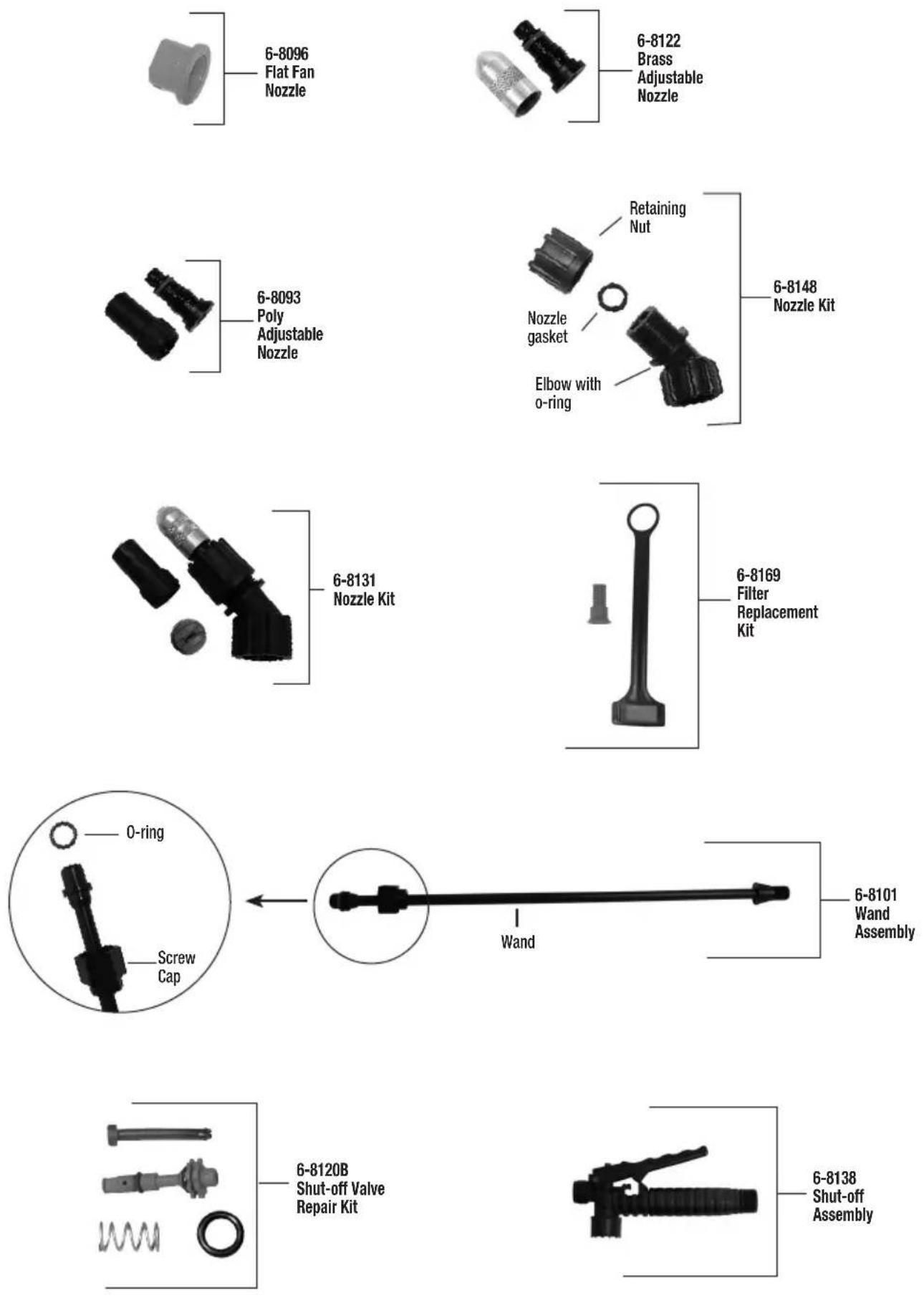
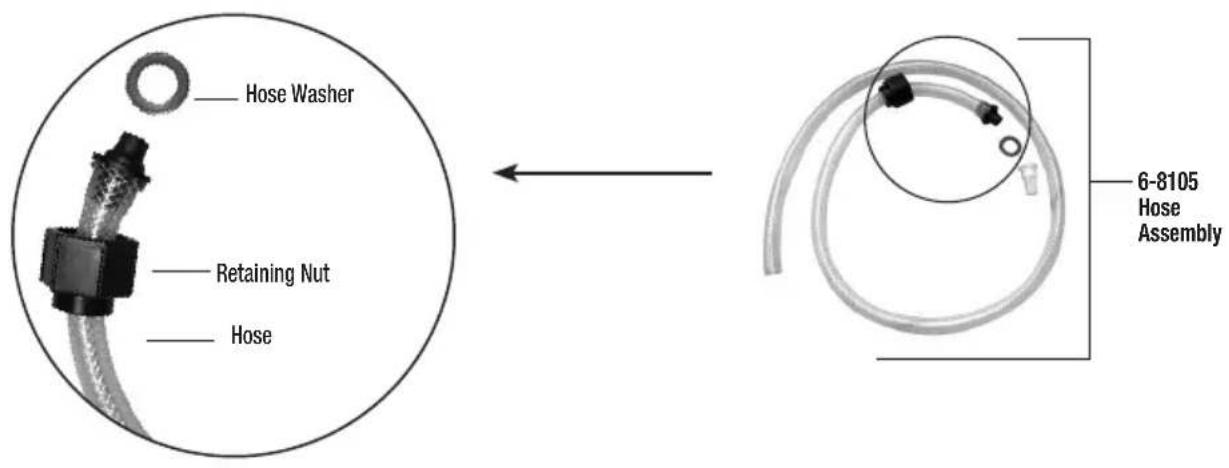
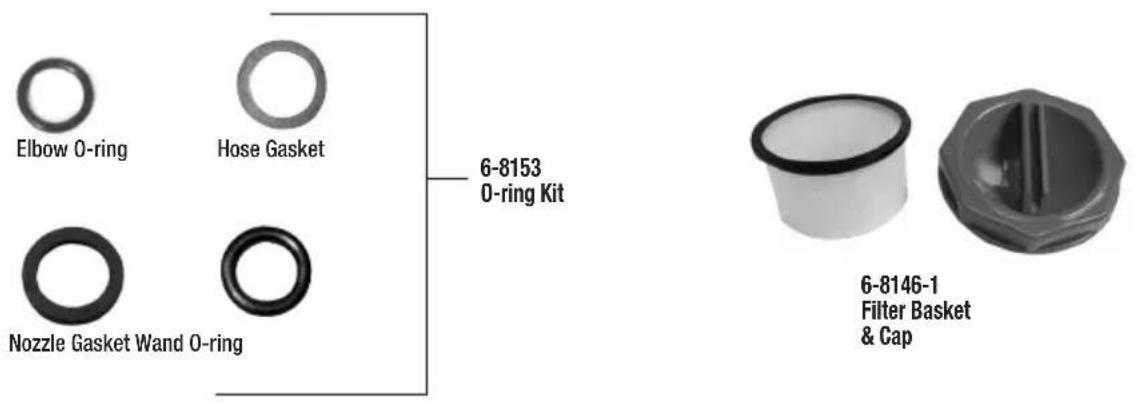
REplacement PARTS ORDER INFORMATION
REplacement PARTS ORDER INFORMATION
Congratulations!
You have just purchased a quality Chapin product.
Register Your Sprayer Online@ www.chapinfg.com/warranty.asp
RECOMMANDATIONS D'ENTREPOSAGE