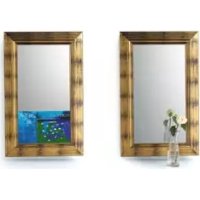
23HM8801 - TV PHILIPS - Free user manual and instructions
Find the device manual for free 23HM8801 PHILIPS in PDF.


| Product type | LCD TV |
| Brand | Philips |
| Model | 23HM8801 |
| Screen diagonal | 23 inches (approx. 58 cm) |
| Screen format | 16:9 / 4:3 (switchable) |
| Power supply | AC-DC adapter, 220-240 V, 50 Hz |
| Power consumption in standby | Less than 1 W |
| Optimal PC resolution | 1024 x 768, 60 Hz |
| Compatible PC resolutions | Up to 1280 x 1024, 75 Hz |
| Number of programs | Up to 99 (TV and radio) |
| SCART socket | 1 or 2 (EXT1 with RGB, EXT2 with S-VHS) |
| Additional inputs | VGA (PC), PC audio, TV and FM antenna, headphones, AV (SCART) |
| Main functions | PIP, teletext, FM radio, PC monitor mode, EasyLink, timer, child lock, multiple screen formats |
| Care and cleaning | Soft, lint-free cloth, without alcohol or solvent |
| Safety | Do not expose to water, heat, do not obstruct ventilation grilles |
| Spare parts and repairability | Do not repair yourself, contact customer service |
| Included accessories | Remote control, AC-DC adapter, antenna cable, radio antenna wire, batteries (R6) |
Frequently Asked Questions - 23HM8801 PHILIPS
User questions about 23HM8801 PHILIPS
0 question about this device. Answer the ones you know or ask your own.
Ask a new question about this device
Download the instructions for your TV in PDF format for free! Find your manual 23HM8801 - PHILIPS and take your electronic device back in hand. On this page are published all the documents necessary for the use of your device. 23HM8801 by PHILIPS.
USER MANUAL 23HM8801 PHILIPS
natural_image
Illustration of a remote control device with a battery and two buttons inserted (no text or symbols)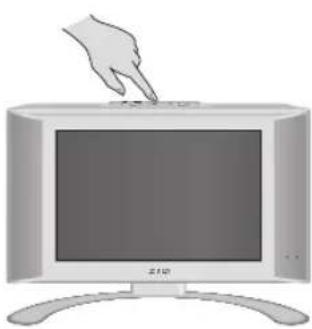
natural_image
Illustration of a hand pointing at a screen with a small button, no text or symbols presentnatural_image
Three-step diagram showing a square with circles and an oval inside, each followed by a dashed-line box (no text or symbols)flowchart
graph TD
    A["Initial State"] --> B["Step 1: Circular Shape with Circle at top"]
    B --> C["Step 2: Solid Circle with Circles at bottom"]
    C --> D["Step 3: Solid Circle with Circles at center"]
    D --> E["Step 4: Solid Circle with Circles at bottom"]
    E --> F["Step 5: Solid Circle with Circles at center"]
    F --> G["Final Step"]
Magnétoscope
natural_image
Diagram showing a USB port connected to a printer (no text or symbols present)natural_image
Illustration of a portable audio jack connected to a pair of headphones (no text or symbols visible)Amplificateur
Ordinateur
Teletext-toetsen (p. 11)
of VCR / DVD (p.13)
natural_image
Three-step diagram showing a circular component being cut into an oval, with no text or symbols present.flowchart
graph TD
    A["Initial State"] --> B["Step 1: Circular Circle with Dots"]
    B --> C["Step 2: Solid Circle with Dots"]
    C --> D["Step 3: Solid Circle with Dots"]
    D --> E["Step 4: Solid Circle with Dots"]
    E --> F["Step 5: Solid Circle with Dots"]
    F --> G["Final Step"]
4:3
videorecorder programmering,
Videorecorder
Videorecorder (of DVD recorder)
natural_image
Illustration of a portable audio jack connected to a pair of headphones (no text or symbols visible)Versterker
Computer
natural_image
3D illustration of a remote control device with two buttons and a partially open lid (no text or symbols)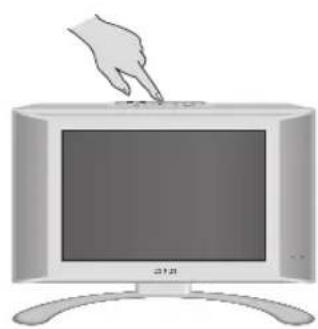
natural_image
Illustration of a hand pointing at a screen on a silver TV (no text or symbols visible)natural_image
Three-step diagram showing a square with circles and an oval, each before and after transformation (no text or symbols)Videorecorder
Videorecorder (oder DVD-Recorder)
natural_image
Diagram showing a USB port connected to a printer (no text or symbols present)Kopfhörer
natural_image
Illustration of a portable audio jack connected to a pair of headphones (no text or symbols visible)Verstärker
Computer
natural_image
3D illustration of a remote control device with a battery and two connected components (no text or symbols)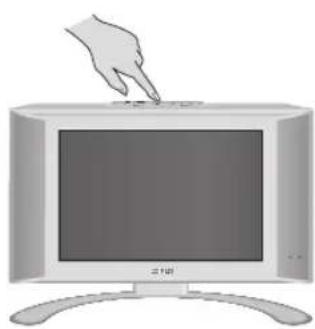
natural_image
Illustration of a hand pointing at the top of a flat-screen TV (no text or symbols visible)natural_image
Three schematic diagrams showing progressive assembly of circular components within rectangular blocks, with no text or symbols present.Videoregistratore
natural_image
Diagram showing a computer interface with an RJ58 port and a printer (no text or symbols present)natural_image
Illustration of a portable audio jack connected to an ear headphones (no text or symbols present)Amplificatore
Computer
natural_image
3D illustration of a remote control device with two buttons and a display screen (no text or symbols)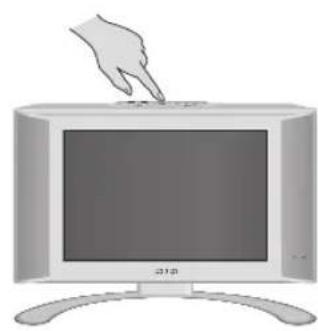
natural_image
Illustration of a hand pointing at a screen on a 21st TV (no text or symbols visible)Συσκευή Βίντεο
natural_image
Diagram showing a USB port connected to a printer (no text or symbols present)natural_image
Illustration of a portable audio jack connected to an ear headphones (no text or symbols present)Ενισχυτής
Thank you for purchasing this television set.
This handbook has been designed to help you install and operate your TV set.
We would strongly recommend that you read it thoroughly.
We hope our technology meets entirely with your satisfaction.
Table of Contents
Installation
Presentation of the LCD Television 4
The remote control keys ....3
Installing your television set 4
Quick installation ....5
Sorting programmes 5
Choosing a language and country 6
Automatic tuning 6
EasyLink function 6
Manual tuning 7
Programme name 7
Operation
Using the radio 8
Using in PC monitor mode ....8
Adjusting the picture 9
Adjusting the sound 9
Feature settings 9
Timer function 10
Locking the set 10
Teletext 11
16:9 Formats 12
Video recorder or DVD keys 13
Glossary 13
Peripherals
Video recorder 14
Other equipment 14
To select connected equipment 14
Video camera, video games ....15
Headphones 15
Amplifier....15
Computer 15
Tips 16

Cleaning the set
Only use a clean, soft and lint-free cloth to clean the screen and the casing of your set. Do not use alcohol-based or solvent-based products.
Presentation of the LCD Television
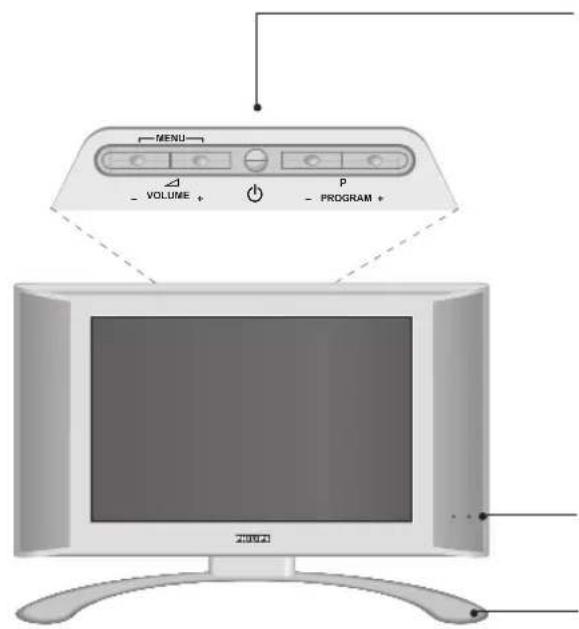
Television keys:
• ⏻: to switch the TV on or off.
• VOLUME - + (-△+): to adjust sound level.
• PROGRAM - + (- P +): to select programmes.
- MENU: to access or close menus, simultaneously press the - and + keys. The - + keys can be used to select an adjustment and the - + keys to make that adjustment.
Note: when the CHILD LOCK function is activated the -Δ+ and -P + keys are unavailable (refer to FEATURES menu on page 10).
On-light and infrared sensors.
Adjustable stand.
The stand can be removed and replaced with a wall mounting kit available as an option (ask your dealer).
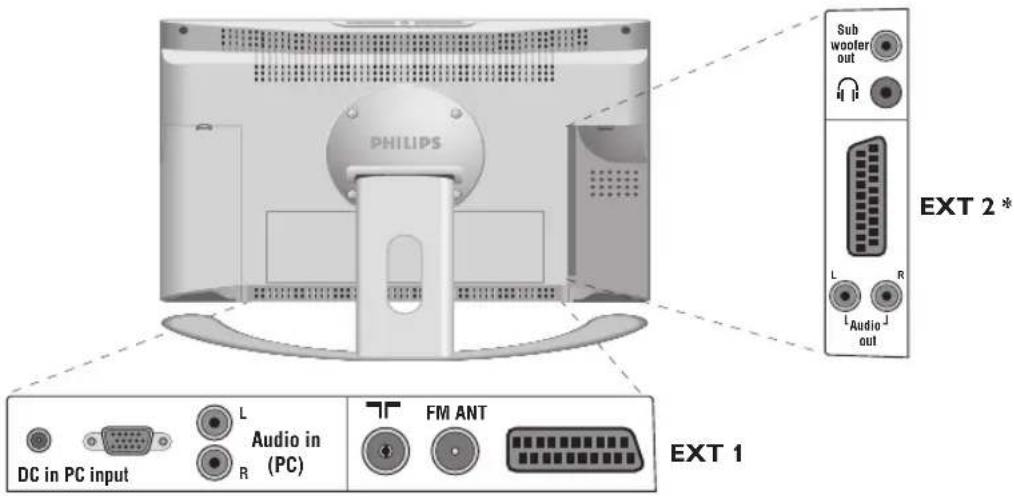
Rear of set :
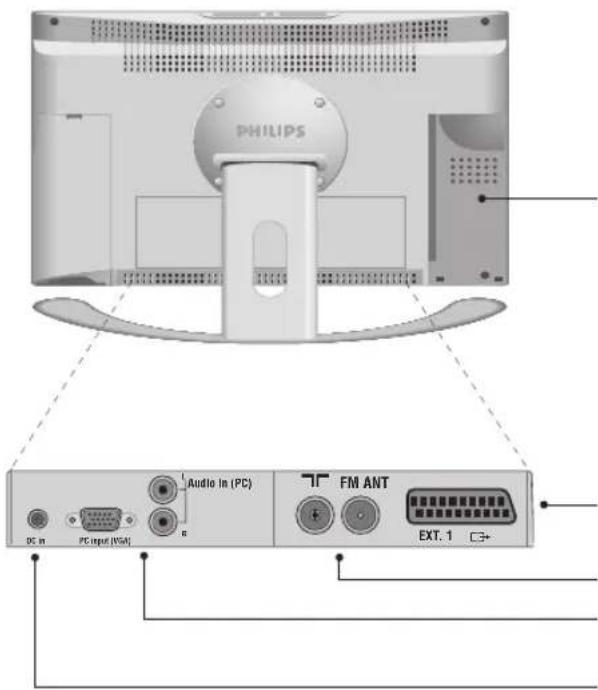
The main connections are made at the bottom of the television.
Removable panels to left* and right access the supplementary connection sockets.
* The large screen sizes do not have a left panel. For more details on connections see page 14.
EXT1 socket
TV and radio aerial sockets
VGA and audio input for connecting a computer.
DC supply socket
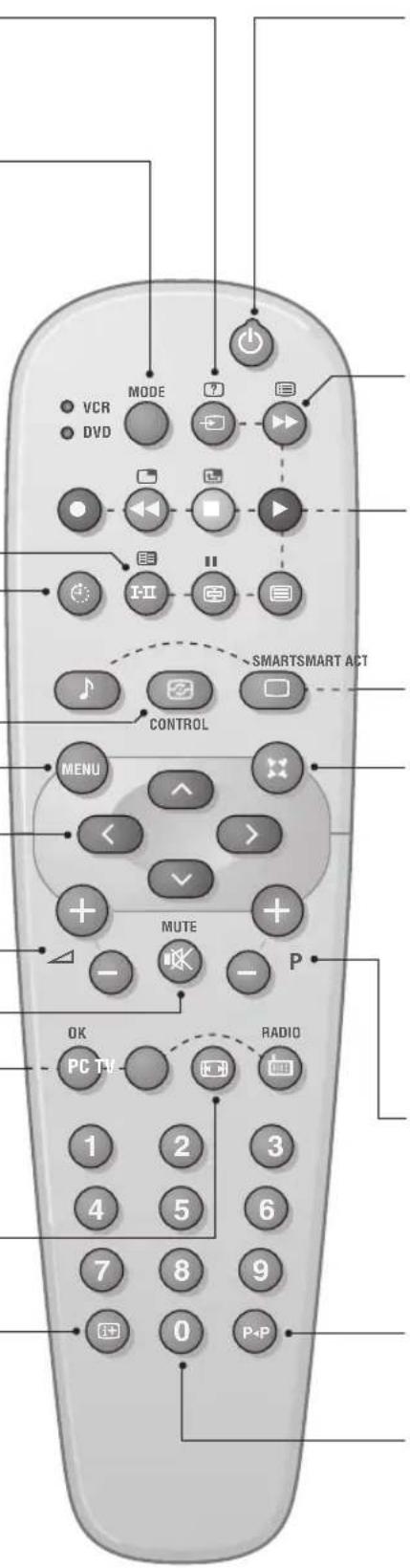
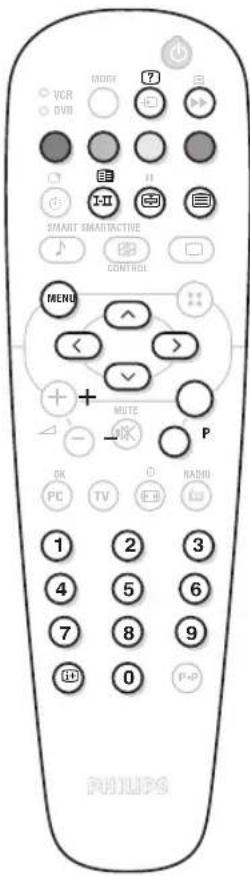
Remote control keys
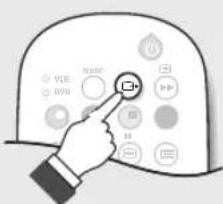
Select peripherals (p.14)
Press several times to select the required EXT connector.
Mode selector (p. 13)
To activate the remote control in TV, VCR (video recorder) or DVD mode.
Sound mode
Used to force programmes in STEREO and NICAM STEREO to MONO or, for bilingual programmes, to choose between DUAL I or DUAL II.
When the sound mode is switched to MONO, the indication is displayed in red.
Sleeptimer
To select the length of time before the set automatically switches to standby (from 0 to 240 minutes)
Active control
Optimizes the quality of the picture according to the quality of reception.
Menu
To call up or exit the menus.
Cursor
These 4 keys are used to move around the menus.
Volume
To adjust the sound level
Mute
To mute or restore the sound.
PC / TV / Radio
Press one of these keys to switch the television between PC, TV or radio mode (p. 8).
16:9 formats (p. 12)
Screen information
To display / remove the programme number, the name (if it exists), the time, the sound mode and the time remaining on the timer. Hold down for 5 seconds to permanently display the programme number on the screen. The volume level and the smart control adjustments are then displayed each time they are used.
Standby
To set the TV to standby mode. To switch the TV set on again, press ⏻, P ⊖ + or Ⓞ ⑨.
List of programmes
To display/clear the list of programmes. Use the keys ⬇ to select a programme and the key ⭕ to display it. The symbol 🔒 is displayed alongside all programmes which are locked (p.10) or ⚙ if they are not locked.
Teletext keys (p. 11)
or VCR / DVD (p.13)
PIP on/off (p. 8)
Move PIP (p. 8)
Smart picture and sound
Used to access a series of predefined picture and sound settings.
The PERSONAL position relates to settings selected from the menus.
Surround sound
To activate/deactivate the surround sound effect. In stereo, this gives the impression that the speakers are further apart. For models equipped with Virtual Dolby Surround*, you can obtain Dolby Surround Pro Logic sound quality. In mono,a stereo spatial effect is simulated.
* Manufactured under license from Dolby Laboratories Licensing Corporation. "Dolby""Pro Logic" and the double-D symbol □□ are trademarks of Dolby Laboratories Licensing Corporation.
Selecting TV programmes
To move up or down a programme. The number, (the name) and the sound mode are displayed for a few seconds. For some TV programmes the title of the programme appears at the bottom of the screen.
Previous programme
To access the previously viewed programme.
Numerical keys
For direct access to programmes. For a 2 digit programme number, the 2^nd digit must be entered before the dash disappears.
Installing your television set
natural_image
3D illustration of a remote control device with two buttons and a display screen, showing no text or symbols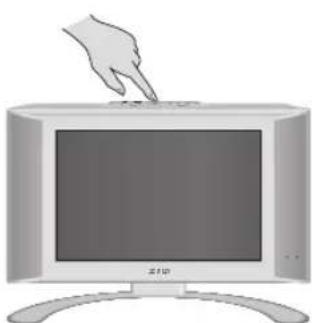
natural_image
Illustration of a hand pointing at the top of a flat-screen TV (no text or symbols visible)& Positioning the television set
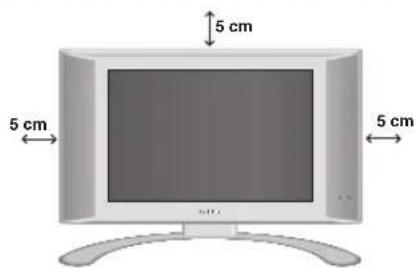
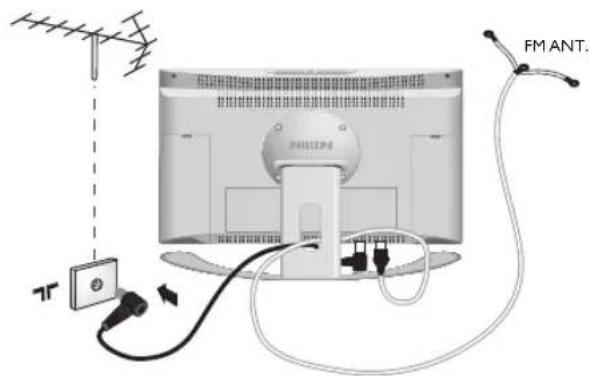
Place your TV on a solid stable surface. To avoid danger do not expose the TV to water, or a heat source (e.g. lamp, candle, radiator). Do not obstruct the ventilation grid at the rear.
- Use the aerial connection lead supplied and connect the : socket situated at the bottom of the TV to your aerial socket.
- Insert the radio aerial lead supplied into the FM ANT socket located at the bottom of the TV.
- Arrange the leads by passing them through the television stand.
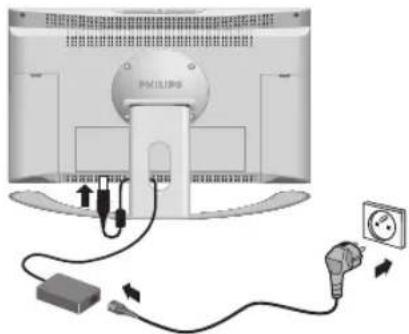
“ Power supply connections
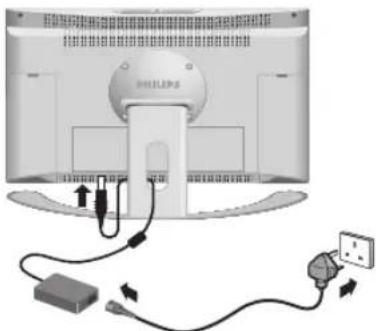
The TV works with a DC supply (the voltage is indicated on the label). Only use the AC-DC adaptor supplied with the TV.
- Connect the DC plug of the adaptor to the TV DC socket. Leave a space round the adaptor for ventilation.
- Insert the adaptor power lead and insert the mains plug into the wall socket.
For connecting other appliances see page p.14.
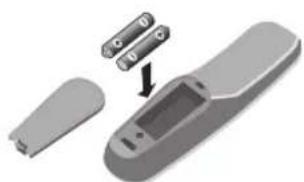
Remote control
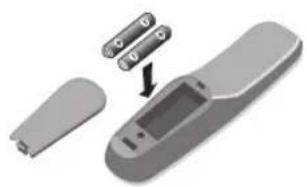
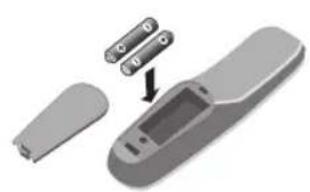
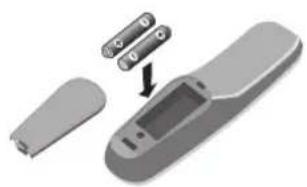
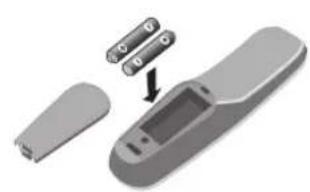
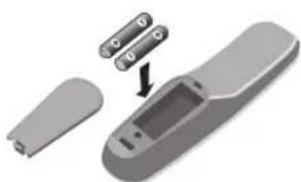
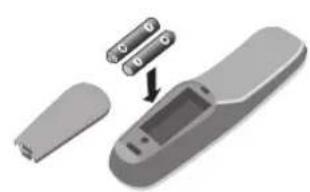
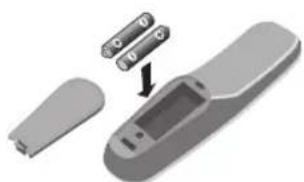
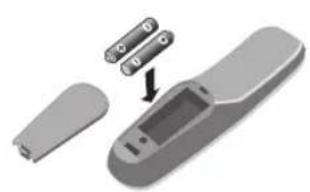
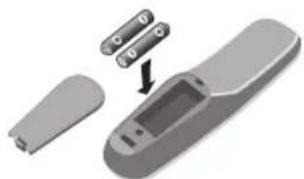
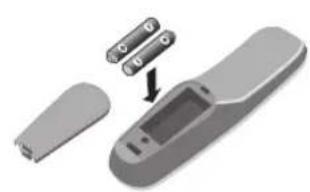
Insert the two R6-type batteries supplied, making sure they are the right way round.
The batteries supplied with the appliance do not contain mercury or nickel cadmium so as to protect the environment. Please do not discard your used batteries, but use the recycling methods available (consult your distributor).
( Switching on
To switch on the set, press the on/off key. A green indicator comes on and the screen lights up. Go straight to the Quick Installation chapter on page 5. If the TV remains in standby mode(red indicator), press the P # key on the remote control.
The indicator will flash when you use the remote control.
Quick installation
The first time you switch on the television, a menu appears on the screen. This menu asks you to choose the language of the menus:
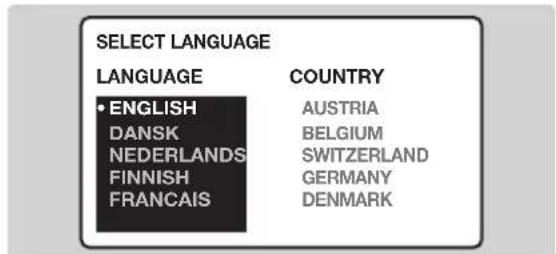
If the menu does not appear, hold down the △ - and △ + keys on the set for 8 seconds to bring it up.
① Use the ⬆ keys on the remote control to choose your language then confirm with >.
② Then select your country using the ^▼ keys and confirm with >.
If your country does not appear in the list, select “...”
3 Tuning starts automatically.
The operation takes several minutes.
A display shows the search status and the number of programmes found. When it has finished the menu disappears.
To exit or interrupt the search, press the MENU key.
If no programmes are found, refer to the chapter entitled Tips on p. 16.
4 If the transmitter or the cable network broadcasts the automatic sort signal, the programmes will be correctly numbered.
⑤ If not, the programmes found will be numbered in descending order starting at 99, 98, 97, etc. Use the SORT menu to renumber them.
Some transmitters or cable networks broadcast their own sort parameters (region, language, etc.). Where this is the case, make your choice using the ▲▼ keys and confirm with ▶.
See also: EasyLink function, page 6.
Sorting programmes
① Press the Ⓜ key. The main menu is displayed.
② Select INSTALL (☑), then press >. The INSTALL menu appears.
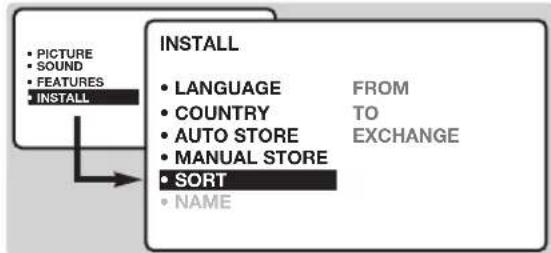
flowchart
graph TD
    A["INSTALL"] --> B["INSTALL"]
    B --> C["• LANGUAGE FROM"]
    B --> D["• COUNTRY TO EXCHANGE"]
    B --> E["• AUTO STORE"]
    B --> F["• MANUAL STORE"]
    B --> G["• SORT"]
    B --> H["• NAME"]
③ Using the ⬇ key, select SORT then press ⬇. The SORT menu appears. The FROM option is activated.
Note: this menu works as follows:
- Change "FROM" (enter the current programme number),
• "TO" (enter the new number), - EXCHANGE numbers" (the operation is carried out).
4 Select the programme you wish to renumber using ◀▶ keys or ① to ⑨.
Example: to renumber programme 78 as 2 press ⑦ ⑧.
5 Select TO (using ⬇ key) and enter the new number with ⏻ keys or Ⓞ to Ⓢ (for the example given, enter ②).
6 Select EXCHANGE ( √ key) and press ⚠. The message EXCHANGED appears, the exchange takes place. In our example, programme 78 is renumbered as 2 (and programme 2 as 78).
⑦ Select the option FROM ( ⬆ key) and repeat stages ④ to ⑥ as many times as there are programmes to renumber.
See also: EasyLink function, page 6.
⑧ To exit from the menus, press ⓘ.
Choosing a language and country
① Press the Ⓜ key to display the main menu.
② Select INSTALL (☑), then press >.
The INSTALL menu appears.
The LANGUAGE option is activated.
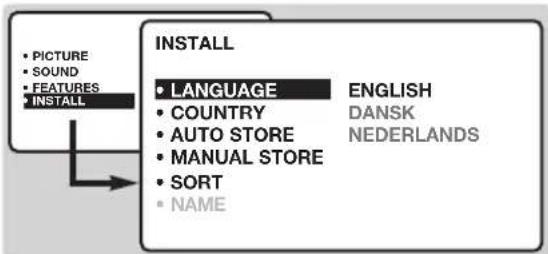
flowchart
graph TD
    A["INSTALL"] --> B["ENGLISH"]
    A --> C["LANGUAGE"]
    A --> D["COUNTRY"]
    A --> E["AUTO STORE"]
    A --> F["MANUAL STORE"]
    A --> G["SORT"]
    A --> H["NAME"]
    style A fill:#f9f,stroke:#333
    style B fill:#ccf,stroke:#333
    style C fill:#cfc,stroke:#333
    style D fill:#fcc,stroke:#333
    style E fill:#cff,stroke:#333
    style F fill:#ffc,stroke:#333
    style G fill:#cfc,stroke:#333
    style H fill:#fcc,stroke:#333
③ Press ➤ to go into the LANGUAGE menu.
4 Select your language with the ^▼ keys.
The menus will appear in the chosen language.
⑤ Press ◀ to exit the LANGUAGE menu.
6 Select the option COUNTRY and press ➤.
⑦ Select your country with ⬆ keys.
If your country does not appear in the list, select OTHER.
8 Press ◀ to exit the COUNTRY menu.
9 To exit from the menus, press 📊. See also: EasyLink function below.
Automatic tuning
This menu allows you to automatically search for all the programmes available in your region (or on your cable network).
① First carry out operations ① to ⑧ above, then:
2 Press ▼ once to select AUTO STORE then press ▶.The search begins.
After several minutes, the INSTALL menu reappears automatically.
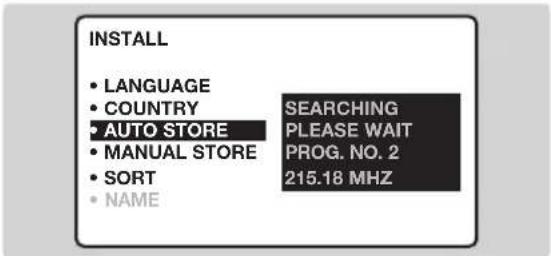
③ If the transmitter or the cable network broadcasts the automatic sort signal, the programmes will be correctly numbered.
4 If not, the programmes found will be numbered in descending order starting at 99, 98, 97, etc.
Use the SORT menu to renumber them.
Some transmitters or cable networks broadcast their own sort parameters (region, language, etc.). Where this is the case, make your choice using the ⏰ keys and confirm with >.
To exit or interrupt the search, press the Ⓜ key. If no picture is found, refer to the chapter entitled Tips on p. 16.
See also: EasyLink function below.
5 To exit from the menus, press ⓘ.
EasyLink function
(only available on certain versions)
If the set is connected (by the EXT2 socket) to a video equipped with the EasyLink function, the language, country and channels found are automatically transmitted to the video recorder at the time of installation.
A message is displayed on-screen during loading. The list of video recorder channels is then the same as those of the set.
The EASY LINK setting in the OPTIONS menu must be set to ON (default setting), see page 9.
Manual tuning
This menu allows you to store the programmes one by one.
① Press MENU.
② Select INSTALL (☑), then press >. The INSTALL menu appears.
3 Select MANUAL STORE ( √ ) then press >. The menu appears :
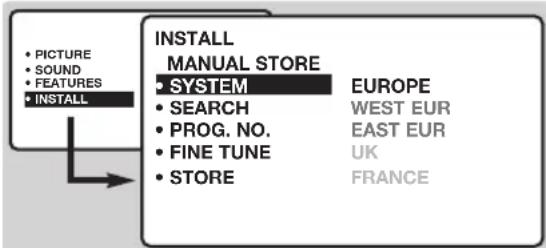
4 Press ⬤ to go to the SYSTEM menu. Use ⬇ to choose EUROPE (automatic detection*) or manual detection with WEST EUR (standard BG reception), EAST EUR (standard DK reception), UK (standard I reception) or FRANCE (standard LL'). Then press ⬾ to exit from the menu.
* Except for France (standard LL'): select the option FRANCE.
5 Select SEARCH and press ⬤.
The search begins. As soon as a programme is found, the search will stop. If you know the frequency of the programme required, enter its number directly using the ① ⑨ keys and go to step ⑦.
If no programme is found, refer to the Tips chapter on page 16).
⑥ If reception is un-satisfactory, select FINE TUNE and hold down ◀ or ▶ key.
⑦ Select PROG. NO (programme number) and use the ◀ > or ① to ⑨ keys to enter the desired number.
8 Select STORE and press ⬤. The message STORED appears. The programme is stored. See also: EasyLink function, page 6.
⑨ Repeat steps ⑤ to ⑧ for each programme to be stored.
To exit: press the ⓘ+ key.
Programme name
You may, if you wish, give a name to the first 40 programmes (from 1 to 40).
① Press MENU.
② Select INSTALL (☑), then press >. The INSTALL menu appears.
3 Press ☑ 5 times to select NAME (concealed at the bottom of the screen), then press >. The menu appears :
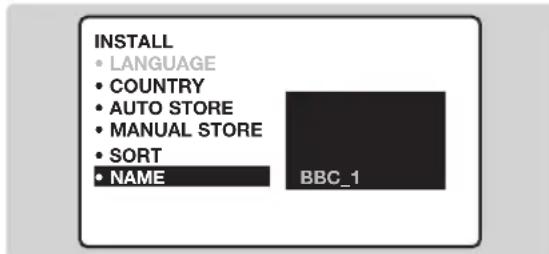
4 Select the programme you wish to name using the keys 0 9 or - P +.
Note: at the time of installation, the programmes are automatically named when the identification signal is transmitted.
⑤ Use the keys ◀◀▶ to move within the name display area (5 characters).
6 Use keys ⬇️ to choose the characters.
7 Press MENU when the name has been entered. The programme name is stored.
See also: EasyLink function, page 6.
⑧ Repeat steps ④ to ⑦ for each programme to be named.
⑨ To exit from the menus, press ⓘ.
Using the radio
Choosing radio mode
Press the Ⓜ key on the remote control to switch the TV to radio mode. Press the TV key to return to TV mode. In radio mode the number and name of the station (if available), its frequency and the sound mode are indicated on the screen.
To enter the name of the stations use the NAME menu. (p. 7)
Selecting programmes
Use the ①⑨ or -P + keys to select the FM stations (from 1 to 40).
List of radio stations
Press the ☐ key to display / hide the list of radio stations. Then use the cursor to select a station.
Using the radio menus
Use the Ⓜ key to access the specific radio settings.
Searching radio stations
If you have used the quick installation all the available FM stations will be stored. To start a new search use the INSTALL menu :AUTO STORE (for a complete search) or MANUAL STORE (for a station by station search). The SORT and NAME menus let you classify or name the radio stations. These menus work in exactly the same way as the TV menus.
Screen saver
In the FEATURES menu you can activate / close the screen saver. The time, the frequency of the station and its name (if available) move across the screen.
Using in PC monitor mode
PC Mode
Your TV can be used as a computer monitor. The PIP function lets you display a superimposed image to watch the TV channels at the same time.
You must first of all connect the computer and adjust the resolution (see p.15).
Choosing PC mode
Press the PC key on the remote control to switch the TV to PC mode. Press the TV key to return to TV mode.
If there is no PC signal for more than five seconds, the TV automatically goes into standby mode.
Using PIP
While in PC mode you can call up a window for TV channels.
1 Press the ☐ key to display the PIP screen. The television image is reproduced in a small superimposed window.
② Press the ☐ key again to reduce the size of the window then make it disappear.
③ Use the ⬆ key if you want to hide the window. You can also shift it progressively by using the cursor.
4 Use the ①⑨ or ⊖ P ⊕ keys to change the programmes of the PIP screen or the ➕ key if you want to display a picture from an appliance connected to the TV (e.g. video recorder, DVD).
Using the PC menus
Press the Ⓜ MENU key to access the specific settings of the PC monitor mode. Use the cursor to adjust them (the settings are automatically saved):
- AUDIO SELECTION : to choose the sound reproduced on the TV (PC or TV/Radio). For example, you can listen to the radio while you use the computer.
Note: you must choose TV or radio mode before going into PC mode. You cannot listen to the radio when the PIP screen is displayed.
- BRIGHTNESS / CONTRAST : to adjust the brightness and contrast.
- ADJUST COLOUR : to adjust the colours (cold, normal or warm).
• VIDEO NOISE : eliminates the horizontal (PHASE) and vertical (CLOCK) interfering lines.
- ADJUST POSITION : to adjust the horizontal and vertical placing of the image.
- AUTO ADJUST : position is set automatically.
- PIP CONTROLS : to adjust the size and position of the PIP screen.
- MODE SELECT : to come back to TV or radio mode.
- RESET TO FACTORY SETTING to return to the factory settings (default settings).
• VIEW FORMAT: to choose between large screen or the original format of the PC screens.
Adjusting the picture
① Press Ⓜ then >.
The PICTURE menu appears :
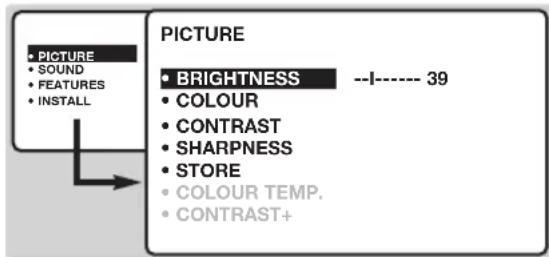
② Use ⬆ keys to select a setting and ◀ keys to adjust.
Note: the menu is a scroll-down menu. Keep the key ⬇ held down to access the settings hidden at the bottom of the screen.
③ Once the necessary adjustments have been made, select the option STORE and press ➤ to store them.
④ To exit from the menus, press ⓘ.
Description of the settings:
- BRIGHTNESS: alters the brightness of the image.
• COLOUR: alters the colour intensity. - CONTRAST: alters the variation between light and dark tones.
- SHARPNESS: alters the crispness of the image.
- STORE: stores the picture settings.
• COLOUR TEMP.: adjusts the colour temperature of the picture. Three options are available here: COOL (blue white), NORMAL (balanced) or WARM (red white). - CONTRAST + :To activate / de-activate the automatic contrast adjustment system (the dark areas are made darker whilst maintaining the detail).
Adjusting the sound
① Press Ⓜ, select the SOUND option (√) and press >. The SOUND menu appears :
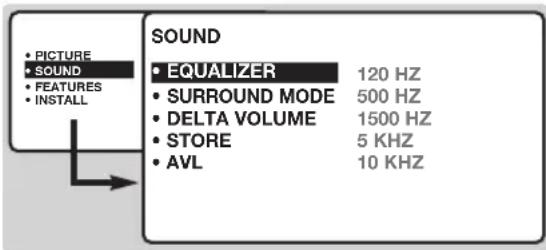
② Use ⬆▼ keys to select a setting and keys ◀> to adjust.
③ Once the necessary adjustments have been made, select the option STORE and press ➤ to store them.
④ To exit from the menus, press ⓘ.
Description of the settings:
- EQUALIZER: to adjust the sound tone (from bass: 120 Hz to treble: 10 kHz).
• BALANCE: to balance the sound between the left and right speakers. - DELTAVOLUME(volume difference): allows you to compensate for the volume differences between the different programmes or the EXT sockets. This setting is available for programmes 1 - 40 and the EXT sockets. Use the P keys to compare the level of different programmes.
- STORE: stores the sound settings.
- AVL: automatic volume control used to avoid sudden increases in volume, particularly when changing programmes or during advertisements
Feature settings
1 Press Ⓜ, select FEATURES (▽) and press ▶. You can adjust:
2 TIMER, PARENTAL. CONT. and CHILD LOCK : see next page
③ MODE SELECT.: to switch the TV in radio, TV or PC mode.
4 EASYLINK (only available on certain versions): If the set is connected (by the EXT2 socket) to
a video equipped with the EasyLink function, the language, country and channels found are automatically transmitted to the video recorder at the time of installation. If your video recorder is not equipped with this function, set to OFF.
⑤ To quit the menus, press ⓘ+
Timer function
This menu allows you to use your TV as an alarm clock.
① Press MENU.
② Select FEATURES (☑) and press > twice. The TIMER menu appears :
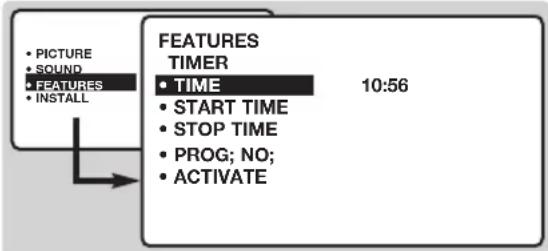
flowchart
graph TD
    A["FEATURES TIMER"] --> B["10:56"]
    C["PICTURE"] --> D["SOUND"]
    E["FEATURES"] --> F["INSTALL"]
    G["START TIME"] --> H["STOP TIME"]
    I["PROG; NO; ACTIVATE"] --> J["10:56"]
③ Press > to enter and exit the sub-menus and use keys ^▼ to adjust:
4 TIME: enter current time.
Note: the time is updated automatically each time the set is switched on using teletext information taken from programme 1. If programme 1 does not have teletext, the update will not take place.
5 START TIME enter the start time.
6 STOP TIME: enter the stop time.
7 PROG. NO: enter the number of the programme for the wake-up alarm. For models equipped with a radio, you can select an FM station by using the <> keys (the 0⑨ keys are only used to select TV programs).
⑧ ACTIVATE: y ou can set the alarm to be activated:
- ONCE ONLY for a one-off alarm,
• DAILY for a daily alarm or - STOP to cancel.
9 Press ⏻ to set the TV to standby. It will automatically switch on at the time programmed. If you leave the TV switched on, it will only change programme at the time indicated.
The combination of the CHILD LOCK and TIMER functions may be used to limit the length of time your television is in use, for example, by your children.
Locking the set
You can bar access to certain programmes or completely lock the set by locking the keys.
Locking programmes
① Press MENU.
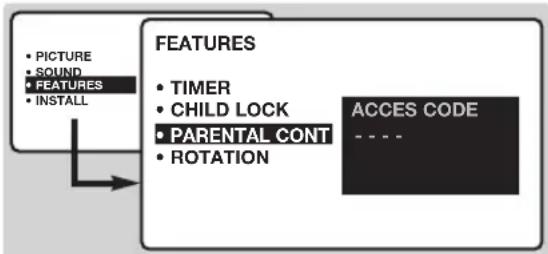
flowchart
graph TD
    A["• PICTURE\n• SOUND\n• FEATURES\n• INSTALL"] --> B["FEATURES"]
    B --> C["• TIMER\n• CHILD LOCK\n• PARENTAL CONT\n• ROTATION"]
    C --> D["ACCESS CODE\n----"]
② Select ( √) and press >.
③ Select PARENTAL. CONT. (☑) and press >.
④ Enter your confidential access code. The first time, enter the code 0711 then confirm by re-entering 0711. The menu appears.
⑤ Press ➞ to go into the menu.
6 Use keys ⬆ to select the required programme and confirm with >.The symbol 🔒 is displayed alongside the programmes or sockets that have been locked.
⑦ Press ⓘ to exit.
To watch a programme which has been locked you will now need to enter the confidential
code; otherwise the screen will remain blank. The INSTALL menu access is also locked. Caution: in the case of encrypted programmes which use an external decoder, it is necessary to lock the corresponding EXT socket.
To unlock all programmes
Repeat stages ① to ④ above, then select CLEAR ALL and press >.
To change the confidential code
Repeat stages ① to ④ above, then:
5 Select CHANGE CODE and enter your own 4-digit number.
6 Confirm by entering it again.
Your new code will be stored.
⑦ Press ⓘ to exit from the menus.
If you have forgotten your confidential code, enter the universal code 0711 twice.
Locking the keys
① Press Ⓜ, select FEATURES (▽) and press ▶.
② Select CHILD LOCK (▽) and press ▶ to set the lock to ON.
③ Switch off the set and put the remote control out of sight. The set cannot be used (it can only be switched on using the remote control).
④ To cancel: switch CHILD LOCK to OFF.
Teletext
Teletext is an information system broadcast by certain channels which can be consulted like a newspaper. It also offers access to subtitles for viewers with hearing problems or who are not familiar with the transmission language (cable networks, satellite channels, etc.).
Press :
| [SHSW] | Teletext on/off | This is used to call teletext, change to transparent mode and then exit. The summary appears with a list of items that can be accessed. Each item has a corresponding 3 digit page number. If the channel selected does not broadcast teletext, the indication 100 will be displayed and the screen will remain blank (in this case, exit teletext and select another channel). |
 | Selecting a page | Enter the number of the page required using the 0 to 9 or ⊖ P + keys. Example: page 120, enter 1 2 0. The number is displayed top left, the counter turns and then the page is displayed. Repeat this operation to view another page.If the counter continues to search, this means that the page is not transmitted. Select another number. |
| [ASCC] | Direct access to the items | Coloured areas are displayed at the bottom of the screen. The 4 coloured keys are used to access the items or corresponding pages.The coloured areas flash when the item or the page is not yet available. |
| Contents | This returns you to the contents page (usually page 100). | |
 | Direct selection of sub-pages | Certain pages contain sub-pages (for example, page 120 contains sub-pages 1/3, 2/3 and 3/3). If this is the case, the page number is displayed in green, preceded by the symbol ▶, ◀ or ◀ ▶. Use the keys < > to directly access the sub-pages of your choice. |
| [DOBC] | Enlarge a page | This allows you to display the top or bottom part of the page and then return to normal size. |
| [WEC2] | Double page teletext(only available on certain versions) | To activate or deactivate the double page teletext display mode. The active page is displayed on the left and the following page is displayed on the right. Press53 if you want to hold a page (i.e. the contents page). The active page is then displayed on the right. To return to normal mode, press1-III. |
| [6ADO] | Hidden information | To display or hide the concealed information (games solutions). |
 | Favourite pages | Instead of the standard coloured areas displayed at the bottom of the screen, you can store 4 favourite pages on the first 40 channels which can then be accessed using the coloured keys (red, green, yellow, blue). Once set, these favourite pages will become the default every time tetetext is selected. |
| [TX6K] | ||
| [XXX] |
① Press the Ⓜ MENU key to change to favourite pages mode.
② Display the teletext page that you want to store.
3 Press Ⓐ+ then the coloured key of your choice. The page is stored.
④ Repeat steps ② and ③ for the other coloured keys.
5 Now when you consult teletext, your favourite pages will appear in colour at the bottom of the screen. To temporarily retrieve the standard items, press (MENU). To clear everything, and return the standard items as the default, press (⊕) for 5 seconds.
16:9 Formats
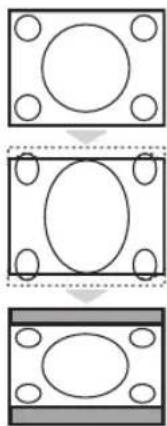
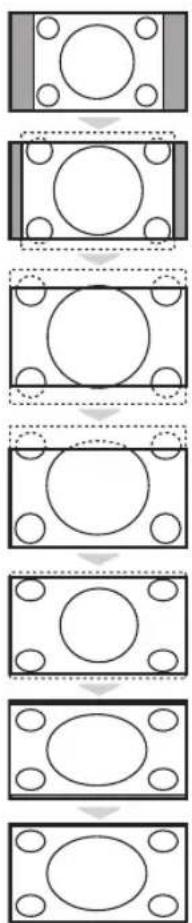
The pictures you receive may be transmitted in 16:9 format (wide screen) or 4:3 format (conventional screen). 4:3 pictures sometimes have a black band at the top and bottom of the screen (letterbox format). This function allows you to optimise the picture display on screen.
If your television is equipped with a 4:3 screen.
natural_image
Three-step diagram showing a circular component being folded into a rectangular frame, with no text or symbols present.Press the Ⓗ key (or ∧∨) to select the different modes:
4:3
The picture is reproduced in 4:3 format.
EXPAND 4:3
The picture is enlarged vertically. This mode is used to cancell the black bands when watching a programme in letterbox format.
COMPRESS 16:9
The picture is compressed vertically into 16:9 format.
If your television is equipped with a 16:9 screen.
flowchart
graph TD
    A["Top-Down Top-Down"] --> B["Step 1: Circular Circle with Circles"]
    B --> C["Step 2: Square with Circles"]
    C --> D["Step 3: Square with Circles"]
    D --> E["Step 4: Square with Circles"]
    E --> F["Step 5: Square with Circles"]
    F --> G["Step 6: Square with Circles"]
    G --> H["Step 7: Square with Circles"]
    H --> I["Step 8: Square with Circles"]
Press the Ⓗ key (or ◀) to select the different modes:
This TV set is also equipped with automatic switching which will select the correct-screen format, provided the specific signals are transmitted with the programmes.
4:3
The picture is reproduced in 4:3 format and a black band is displayed on either side of the picture.
ZOOM 14:9
The picture is enlarged to 14:9 format, a thin black band remains on both sides of the picture.
ZOOM 16:9
The picture is enlarged to 16:9 format. This mode is recommended when displaying pictures which have black bands at the top and bottom (letterbox format).
SUBTITLE ZOOM
This mode is used to display 4:3 pictures using the full surface of the screen leaving the sub-titles visible.
SUPER WIDE
This mode is used to display 4:3 pictures using the full surface of the screen by enlarging the sides of the picture.
WIDE SCREEN
This mode restores the correct proportions of images transmitted in 16:9. Note: If you display a 4:3 picture in this mode, it will be enlarged horizontally.
FULL SCREEN
This mode displays images in full screen.
Video recorder or DVD keys
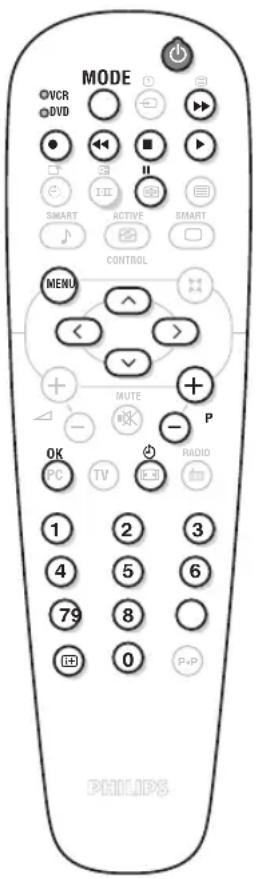
Most of the audio and video equipment from our range of products can be operated with the remote control of the TV.
The remote control is compatible with all video recorders using the RC5 standard and all DVDs using the RC6 standard.
① Press the MODE key to select the required mode : VCR (video recorder) or DVD. The remote control indicator lights up to display the selected mode. It switches off automatically after 20 seconds if left idle. The remote control automatically returns to TV mode.
② The following keys are operational, depending on the equipment :
standby,
● recording,
◀◀ fast rewind,
stop,
▶ play,
▶ fast forward,
II pause
VCR timer,
DVD : subtitling language
MENU menu,
cursor navigation and adjustments,
OK validation,
①⑨ digit keys,
- P programme selection,
I-Ⅱ audio selection.
i+ OSD menu,
Glossary
EasyLink: Digital link between the set and the video recorder which allows a direct transfer of certain information such as channel setting or programming.
PIP (Picture in Picture): Superimposed window that displays a small picture in the main picture. In PC mode you can display an image from the TV or other appliance (e.g. DVD or video recorder) in a small window.
RGB signals : These are the three video signals, Red Green Blue, which make up the picture. Using these signals improves picture quality.
S-VHS signals : These are 2 separate Y/C video signals from the S-VHS and Hi-8 recording standards. The luminance signals Y (black and white) and chrominance signals C (colour) are recorded separately on the tape. This provides better picture quality than with standard video (VHS and 8 mm) where the Y/C signals are combined to provide only one video signal.
NICAM sound : Process by which digital sound can be transmitted.
System : Television pictures are not broadcast in the same way in all countries. There are different standards: BG, DK, I, and L L'.The SYSTEM setting (p. 6) is used to select these different standards. This is not to be confused with PAL or SECAM colour coding. Pal is used in the majority of European countries, Secam in France, the CIS and the majority of African countries. The United States and Japan use a different system called NTSC.The inputs EXT1 and EXT2 are used to read NTSC coded recordings.
16:9 : Refers to the ratio between the length and height of the screen. Wide screen televisions have a ration of 16/9, conventional screen TV sets have a ration of 4/3.
Connecting peripheral equipment
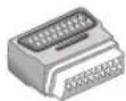
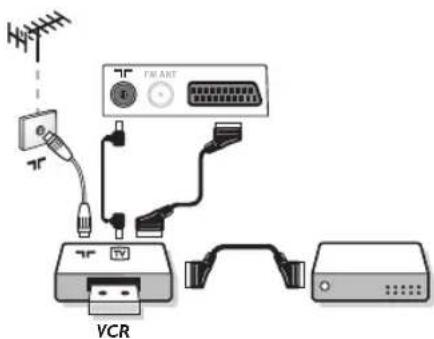
Depending on the version the TV is equipped with one or two EXT1 and EXT2 sockets. A special adaptor is supplied to connect to EXT1 and can route the leads to the back.
The EXT1 socket has audio, CVBS/RGB inputs and audio, CVBS outputs.
The EXT2 socket (if available) has audio, CVBS/S-VHS inputs and audio, CVBS outputs.
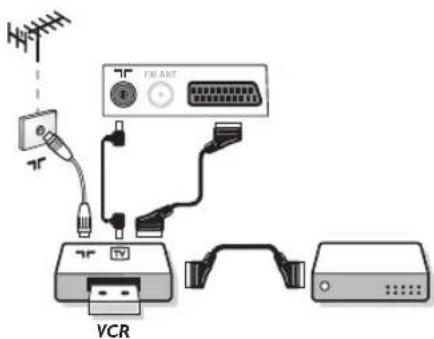
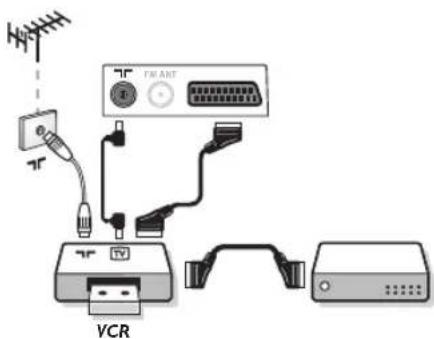
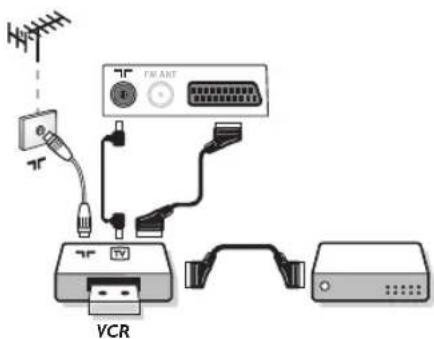
Video recorder
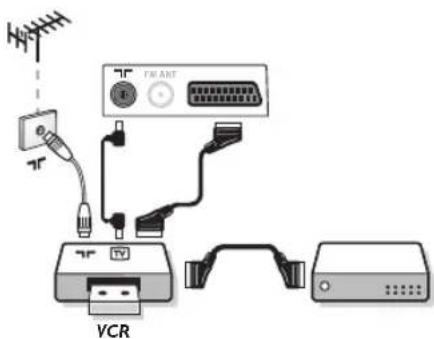
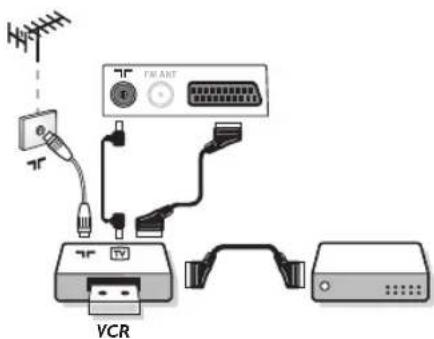
Video recorder (or DVD recorder)
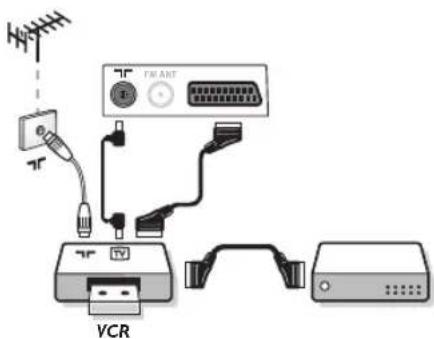
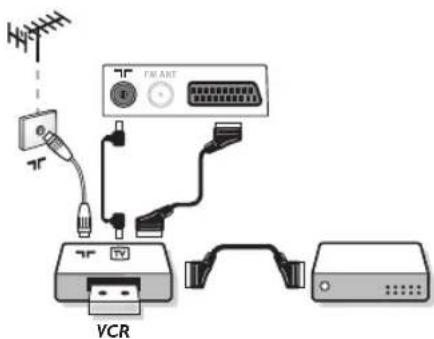
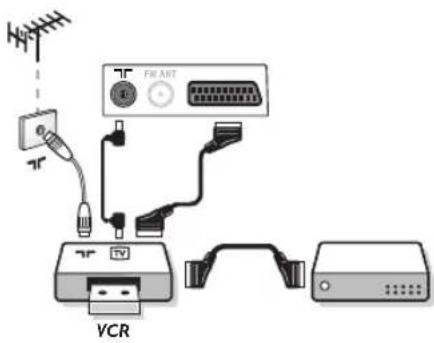
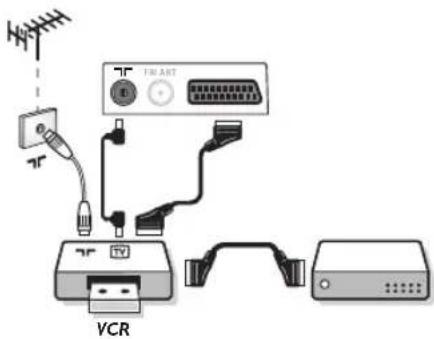
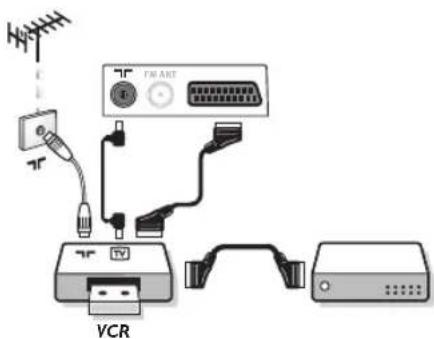
Carry out the connections shown opposite, using a good quality euroconnector cable. If your video recorder has the Easylink function, use the EXT2 socket.
If your video recorder does not have a euroconnector socket, the only connection possible is via the aerial cable. You will therefore need to tune in your video recorder's test signal and assign it programme number 0 (refer to manual store, p. 6).
To reproduce the video recorder picture, press ①.
Video recorder with decoder
Connect the decoder to the second euroconnector socket of the video recorder. You will then be able to record scrambled transmissions.
Other equipment
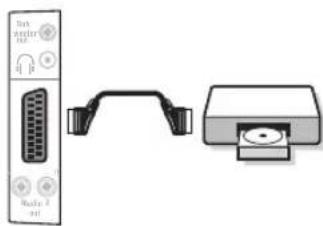
natural_image
Diagram showing a computer interface with an Ethernet port connected to a printer (no text or symbols present)Satellite receiver, decoder, DVD, games, etc.
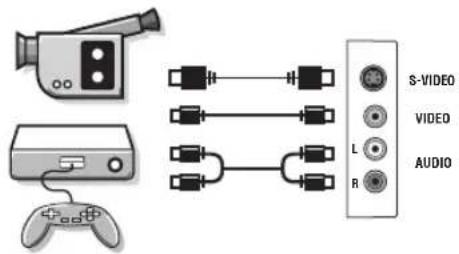
For TV sets with 2 SCART connectors, preferably connect the equipment delivering RGB signals (digital decoders, DVD players, games consoles, etc.) to EXT1 and the equipment delivering S-VHS signals (S-VHS and Hi-8 VCRs) to EXT2.
To select connected equipment
Press the ⏻ key to select EXT1 and on the versions with 2 scarts, EXT2, S-VHS2 (S-VHS signals from the EXT2 socket) and EXT3.
Most equipment (decoder, video recorder) carries out the switching itself.
Camcorder, video games
Headphones
natural_image
Illustration of a portable audio jack connected to an ear headphones (no text or symbols present)Amplifier
Computer
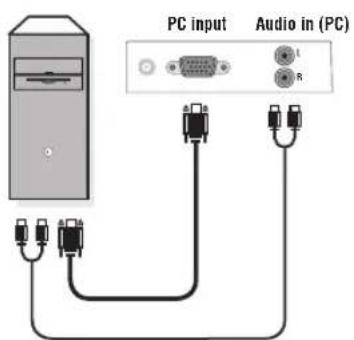
The AV and S-VIDEO connections are located under the left panel or, for large screen sizes, under the right panel. Make the connections as shown opposite. With the ⏻ key, select EXT3.
For a monophonic device, connect the audio signal to the AUDIO L input. The sound automatically comes out of the left and right speakers of the set.
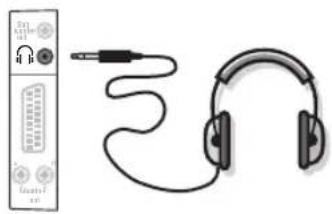
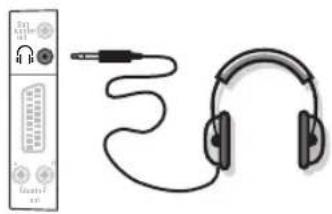
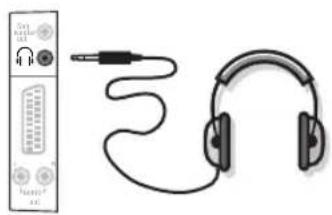
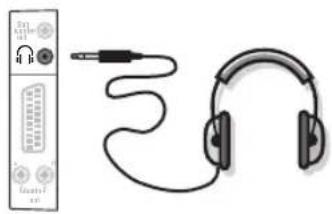
When headphones are connected, the sound on the TV set will be cut. The ⏻ P ⭕ keys are used to adjust the volume level.
The headphone impedance must be between 32 and 600 Ohms.
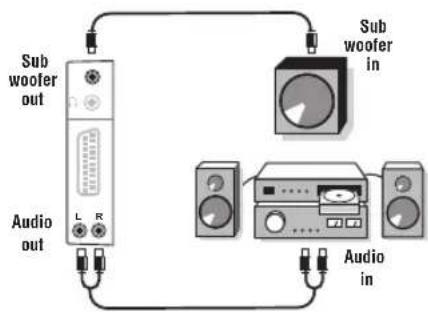
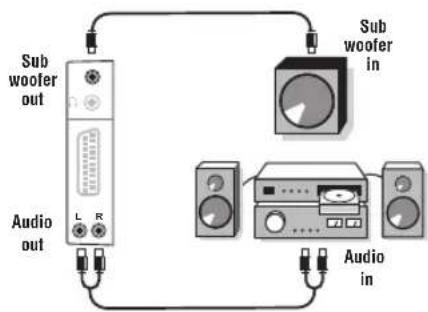
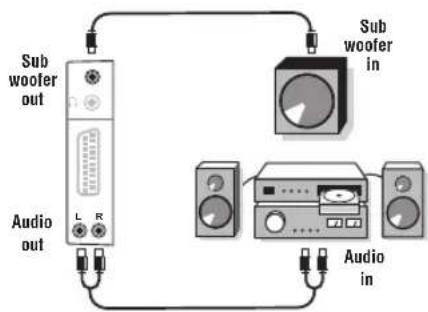
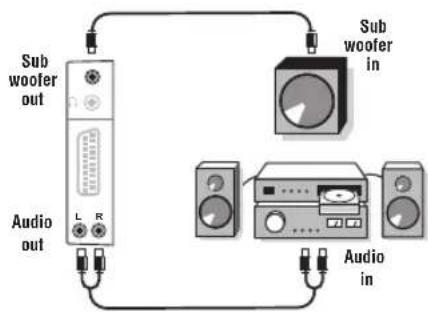
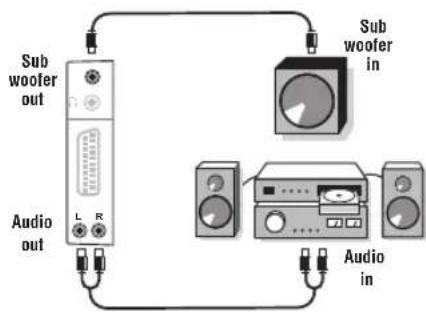
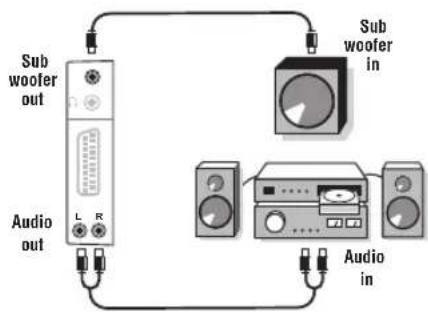
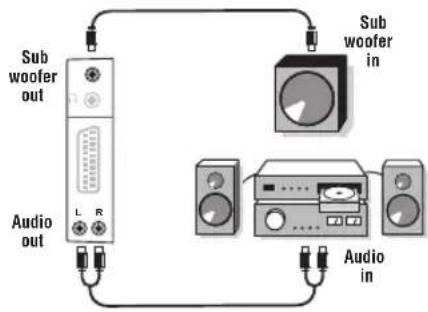
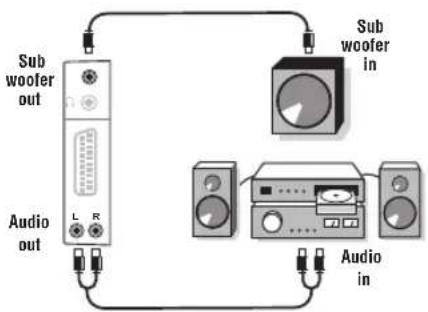
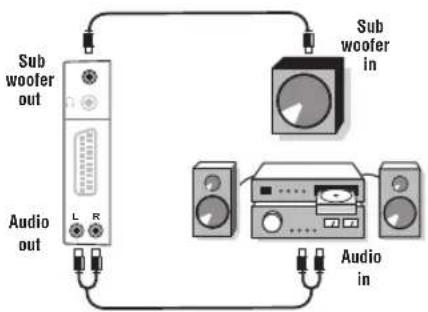
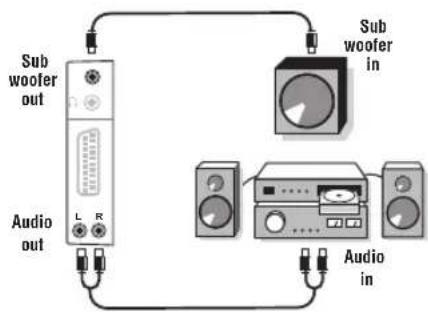
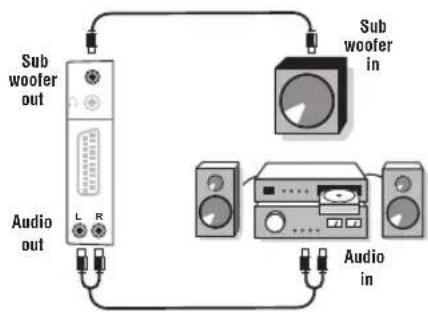
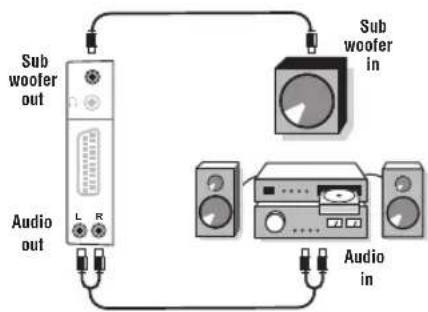
To connect a Hi-fi unit use an audio connection cord and connect the L and R Audio out of the TV to an Audio in L and R from the Hi-fi unit. If you have an active speaker connect the Subwoofer out of the TV to the Subwoofer in of the speaker.
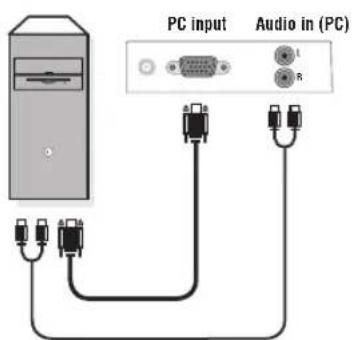
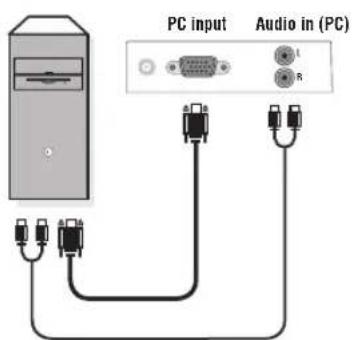
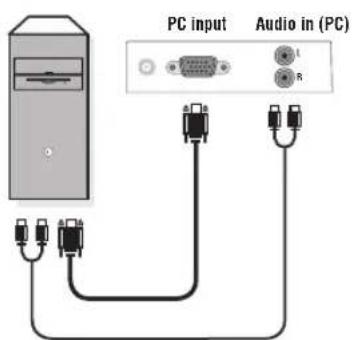
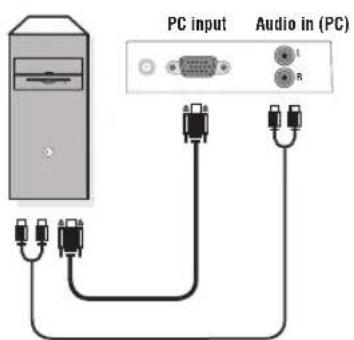
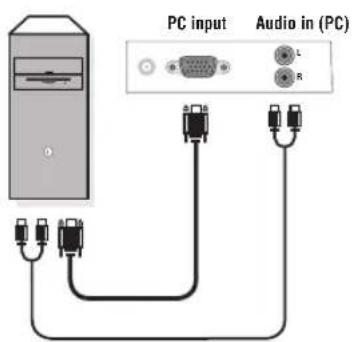
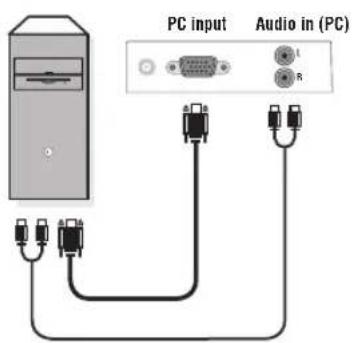
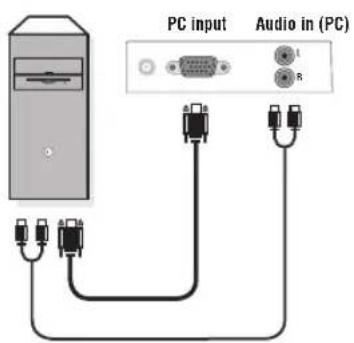
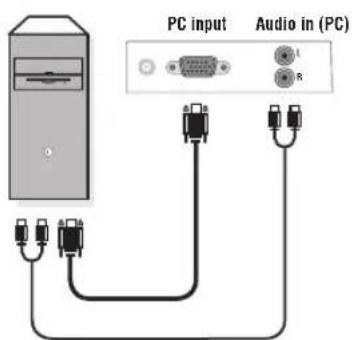
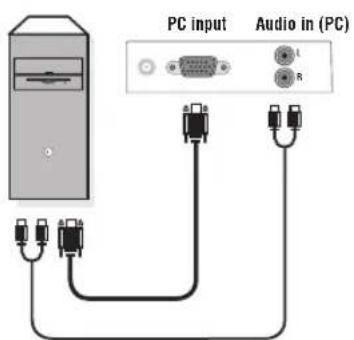
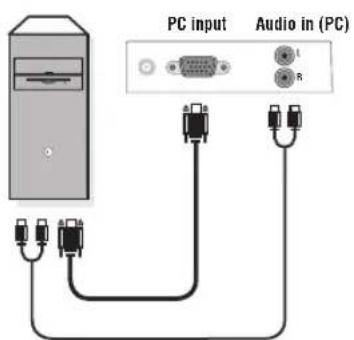
Connect the monitor output of your computer to the PC input (VGA) of the TV. Connect the sound output Audio out L and R of the computer to the input Audio in (PC) L and R of the TV.
For more information on using PC mode see page 8.
Configure the computer on 1024 x 768, 60 Hz for optimum resolution.
Attention: if you use another resolution, the PIP function may not work. In this case a warning message is displayed on the screen.
Here is the list of the different display resolutions available on your TV:
640 × 350, 70 Hz 720 × 400, 70 Hz 1024 × 768, 60 Hz
640 × 350, 85 Hz 720 × 400, 85 Hz 1024 × 768, 70 Hz
640 × 480, 60 Hz 800 × 600, 56 Hz 1024 × 768, 75 Hz
640 × 480, 67 Hz 800 × 600, 60 Hz 1024 × 768, 85 Hz
640 × 480, 72 Hz 800 × 600, 72 Hz 1152 × 864, 75 Hz
640 × 480, 75 Hz 800 × 600, 75 Hz 1280 × 960, 60 Hz
640 × 480, 85 Hz 800 × 600, 85 Hz 1280 × 1024, 60 Hz
832 × 624, 75 Hz 1280 × 1024, 75 Hz
Tips
| Poor reception | The proximity of mountains or high buildings may be responsible for ghost pictures, echoing or shadows. In this case, try manually adjusting your picture: see "fine tuning" (p.7) or modify the orientation of the outside aerial. Does your antenna enable you to receive broadcasts in this frequency range (UHF or VHF band)? |
| No picture | Have you connected the aerial socket properly? Have you chosen the right system? (p. 7). Poorly connected euroconnector cables or aerial sockets are often the cause of picture or sound problems (sometimes the connectors can become half disconnected if the TV set is moved or turned). Check all connections. |
| Peripheral equipment gives a black and white picture | You have not selected the right socket with the ☐ key: S-VHS2 instead of EXT2. To play a video cassette, check that it has been recorded under the same standard (PAL, SECAM, NTSC) which can be replayed by the video recorder. |
| No sound | If on certain channels you receive a picture but no sound, this means that you do not have the correct TV system. Modify the SYSTEM setting (p. 7). The amplifier connected to the TV does not deliver any sound? Check that you have not confused the audio output with the audio input. |
| PC and PIP modes don't work? | Check that you have configured the computer on a compatible display resolution (see p. 15). You can't get the radio sound in PC mode? When PIP is active the sound is forced to TV. You must de-activate PIP, go into radio mode and then come back to PC mode. |
| Remote control | The TV set does not react to the remote control; the indicator on the set no longer flashes when you use the remote control? Replace the batteries. |
| Standby | When you switch the TV set on it remains in standby mode and the indication LOCKED is displayed when you use the keys on the TV set? The CHILD LOCK function is switched on (p. 10). If the set receives no signal for 15 mins, it automatically goes into standby mode. To save power, your set is fitted with components that give it a very low power consumption when in standby mode (less than 1 W). |
| Cleaning the set | Only use a clean, soft and lint-free cloth to clean the screen and the casing of your set. Do not use alcohol-based or solvent-based products. |
| Recycling | The materials used in your set are either reusable or can be recycled. To minimise environmental waste, specialist companies collect used appliances and dismantle them after retrieving any materials that can be used again (ask your dealer for further details). |
| Still no results? | Disconnect the mains plug of the TV for 30 seconds then reconnect it. If your TV set breaks down, never attempt to repair it yourself: contact your dealer's after-sales service. |
Indledning
natural_image
3D illustration of a remote control device with two batteries and a display (no text or symbols)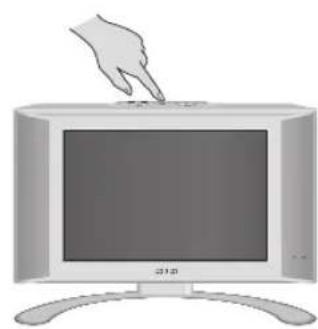
natural_image
Illustration of a hand pointing at the top of a 210-inch TV (no text or symbols on screen)natural_image
Three-step diagram showing a square with circles and a central oval, each followed by a dashed-line transformation (no text or symbols)Videobåndoptager
Hovedtelefoner
natural_image
Illustration of a portable audio jack connected to a pair of headphones (no text or symbols visible)Forstærker
Computer
natural_image
Illustration of a remote control device with a partially open lid and two connected buttons (no text or symbols)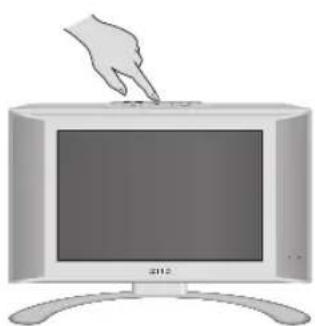
natural_image
Illustration of a hand pointing at the top of a 2012 CRT television (no text or symbols on screen)natural_image
Three-step diagram showing a circular component with four corner holes, each before and after transformation (no text or symbols)flowchart
graph TD
    A["Initial State"] --> B["Step 1: Circular Shape with Circle at top"]
    B --> C["Step 2: Solid Circle with Circles at bottom"]
    C --> D["Step 3: Solid Circle with Circles at center"]
    D --> E["Step 4: Solid Circle with Circles at bottom"]
    E --> F["Step 5: Solid Circle with Circles at center"]
    F --> G["Final Step"]
◀ rask tilbakespoling,
■ stopp,
▶ avspilling,
▶▶ rask fremspoling,
II pause
VCR timer,
DVD : tekstespråk
MENU hente frem meny,
Videospiller
natural_image
Diagram showing a USB port connected to a printer (no text or symbols present)Satellittmottaker, dekoder, DVD, spill osv.
Hodetelefon
natural_image
Illustration of a CD-ROM connected to an audio headset (no text or symbols present)Forsterker
Datamaskin
natural_image
3D illustration of a remote control device with two batteries inserted (no text or symbols)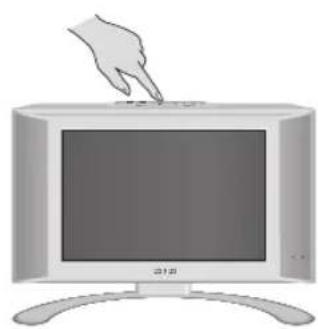
natural_image
Illustration of a hand pointing at a screen on a 21st TV (no text or symbols visible)① TV:ns placering
natural_image
Three-step diagram showing a circular component being folded into a square, with dashed lines indicating transformation (no text or symbols)flowchart
graph TD
    A["Initial State"] --> B["Step 1: Circular Shape with Circle at center"]
    B --> C["Step 2: Solid Circle with Circles at center"]
    C --> D["Step 3: Solid Circle with Circles at center"]
    D --> E["Step 4: Solid Circle with Circles at center"]
    E --> F["Step 5: Solid Circle with Circles at center"]
    F --> G["Final Step"]
Videobandspelare

Videobandspelare (eller DVD-Recorder)
natural_image
Diagram showing a USB port connected to a printer (no text or symbols present)Satellitmottagare, dekoder, DVD, spel, o.s.v.
Hörlurar

natural_image
Illustration of a CD-ROM connected to an audio jack and headphones (no text or symbols)Förstärkare
Dator
natural_image
3D illustration of a remote control device with a partially open lid and a close-up of its internal components (no text or symbols visible)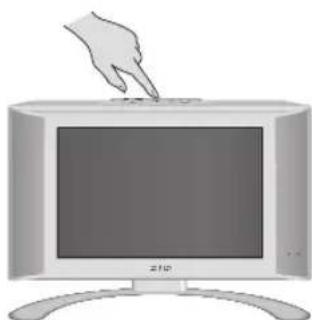
natural_image
Illustration of a hand pointing at a screen with a blank screen, no text or symbols present.natural_image
Three-step diagram showing progressive alignment of a circle on a rectangular base, with no text or symbols present.Kuvanauhuri
Videonauhuri (tai tallentava DVD)
natural_image
Diagram showing a device with an Ethernet port connected to a printer (no text or symbols present)natural_image
Illustration of a portable audio jack connected to an ear headphones (no text or symbols present)Vahvistin
Tietokone
natural_image
3D illustration of a remote control device with two batteries and a partially open case (no text or symbols)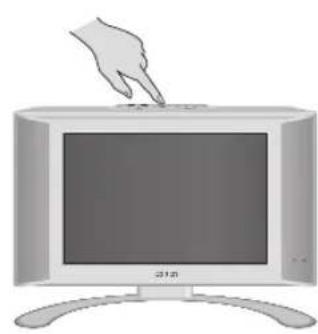
natural_image
Illustration of a hand pointing at a screen on a 2018 TV (no text or symbols on the screen)natural_image
Three-step diagram showing progressive alignment of a circle with surrounding holes, no text or symbols present.Vídeo
Vídeo (o DVD grabable)
natural_image
Diagram showing a USB drive connected to a printer (no text or symbols present)natural_image
Illustration of a portable audio jack connected to a pair of headphones (no text or symbols visible)Amplificador
Ordenador
Teclas teletexto (p. 11)
ou VCR/DVD (p. 13)
Chamada do PIP (p. 8)
Deslocamento do PIP (p. 8)
natural_image
Illustration of a remote control device with a digital display and two connected ports (no text or symbols)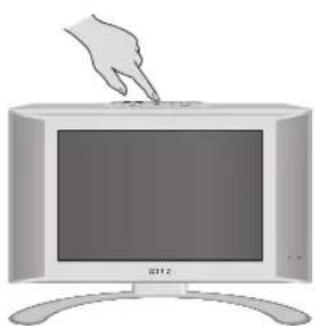
natural_image
Illustration of a hand pointing at a screen with a small screen, no text or symbols present.Chamada do teletexto
Obtém :
natural_image
Three-step diagram showing progressive alignment of a circle with surrounding dots, no text or symbols present.Gravador de vídeo
natural_image
Diagram showing a USB drive connected to a printer (no text or symbols present)natural_image
Illustration of a portable audio jack connected to an ear headphones (no text or symbols present)Amplificador
Computador
- Amplificateur
- Ordinateur
- Teletext-toetsen (p. 11)
- Videorecorder (of DVD recorder)
- Versterker
- Computer
- Videorecorder (oder DVD-Recorder)
- Kopfhörer
- Verstärker
- Amplificatore
- Ενισχυτής
- Table of Contents
- Installation
- Operation
- Peripherals
- Cleaning the set
- Presentation of the LCD Television
- Television keys:
- Adjustable stand.
- EXT1 socket
- Remote control keys
- Select peripherals (p.14)
- Mode selector (p. 13)
- Sound mode
- Sleeptimer
- Active control
- Menu
- Cursor
- Volume
- Mute
- PC / TV / Radio
- 16:9 formats (p. 12)
- Screen information
- Standby
- List of programmes
- Teletext keys (p. 11)
- Smart picture and sound
- Surround sound
- Selecting TV programmes
- Previous programme
- Numerical keys
- Installing your television set
- & Positioning the television set
- “ Power supply connections
- Remote control
- ( Switching on
- Quick installation
- Sorting programmes
- Choosing a language and country
- Automatic tuning
- EasyLink function
- Manual tuning
- Programme name
- Using the radio
- Choosing radio mode
- Selecting programmes
- List of radio stations
- Using the radio menus
- Searching radio stations
- Screen saver
- Using in PC monitor mode
- PC Mode
- Choosing PC mode
- Using PIP
- Using the PC menus
- Adjusting the picture
- Description of the settings:
- Adjusting the sound
- Feature settings
- Timer function
- Locking the set
- Locking programmes
- To unlock all programmes
- To change the confidential code
- Locking the keys
- Teletext
- 16:9 Formats
- If your television is equipped with a 4:3 screen.
- If your television is equipped with a 16:9 screen.
- Video recorder or DVD keys
- Glossary
- Connecting peripheral equipment
- Video recorder (or DVD recorder)
- Video recorder with decoder
- To select connected equipment
- Camcorder, video games
- Headphones
- Amplifier
- Tips
- Indledning
- Hovedtelefoner
- Forstærker
- Satellittmottaker, dekoder, DVD, spill osv.
- Hodetelefon
- Forsterker
- Datamaskin
- ① TV:ns placering
- Videobandspelare
- Videobandspelare (eller DVD-Recorder)
- Hörlurar
- Förstärkare
- Dator
- Videonauhuri (tai tallentava DVD)
- Vahvistin
- Tietokone
- Vídeo (o DVD grabable)
- Amplificador
- Ordenador
- Teclas teletexto (p. 11)
- Obtém :
- Computador
Brand : PHILIPS
Model : 23HM8801
Category : TV