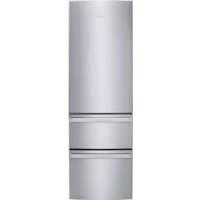
USER MANUAL FCB 3401 NS 2D XS FRANKE
Identification and serial No. Plate 2

- SPECIFICATIONS OF THE APPLIANCE 3
Technical data. 3
Operative conditions. 4
Description of the appliance 4

4.SAFETY. 5
Precautions 51
Safety data sheet for R600 a gas 7
Disposal and interruption. 7

- INSTALLATION 8
port and unpacking 8
Positioning 8
Installation of handles 8
Cleaning before use 9
Electrical connection 9

- USE 10
Description of the functions of the refrigerator and freezer - AFL MODEL. 10
Description of the functions of the refrigerator and freezer - AFD MODEL. 12
Advice on the preservation of foods: refrigerator/freezer. 13

- ROUTINE MAINTENANCE 17
ing the appliance 17

- EXTRAORDINARY MAINTENANCE 18
Door reversibility 18

- TROUBLESHOOTING 20
1. PRESENTATION
Congratulations!
You have purchased a high quality appliance, which will meet your expectations reliably and safely and will provide you top level performance for a long time.
It is simple and immediate to use, but we advise you to read this handbook carefully and keep it in a place accessible for future consultation.
The Manufacturer also ensures you an efficient and speedy after-sales technical assistance service.

2.AFTER-SALES SERVICE
Guarantee conditions
The appliances have a 24 months guarantee from the date of purchase, confirmed by a tax receipt or other tax-wise compulsory document.
After the end of the guarantee period, assistance will be provided by the Manufacturer's Authorised Assistance Centres, debiting you the repaired or replaced parts, labour and transport costs.
The guarantee specifies free-of-charge replacement or repair of all faulty parts.
Damage cased by the following is not covered by the guarantee:
- user's negligence or carelessness during use or transport;
- damage to things, persons and animals due to improper use or incorrect installation of the appliance;
- Installation on systems not complying with current legal regulations;
- replacements and/or repairs carried out by the user but not specified and authorised by this handbook;
use of non original spare parts not authorised by the Manufacturer.
Identification and serial No. Plate
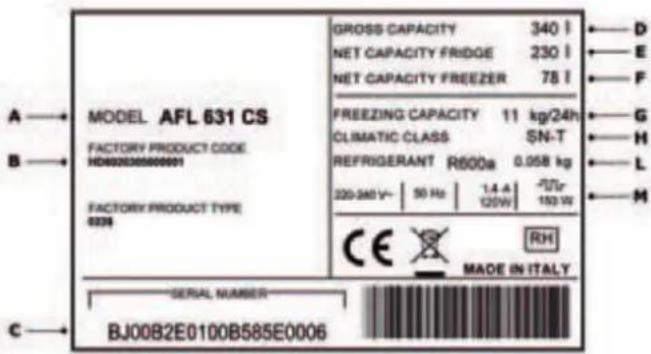
If the appliance is faulty or does not operate, consult the "Troubleshooting" chap. at the back of this handbook. If the problem is not resolved, call the Assistance Centre, specifying the data on the Identification and serial No. plate: it is located inside the refrigeration compartment glued low down on the left side (see paragraph "Description of the appliance").

The identification and Serial No. Plate provides important information about the appliance and must not be tampered with or removed.
Reading examples:
A: Model
B: Product code
C: Serial number
D: Gross capacity
E: Net capacity of refrigerator compartment
F: Net capacity of freezer
G: Freezing capacity (in kilograms of foods frozen in 24 hours)
H: Climate class
L: Type and quantity of refrigerant
M: Electrical characteristics
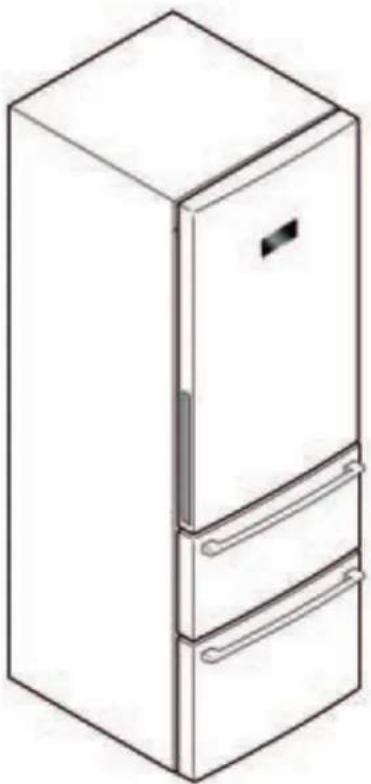

3. SPECIFICATIONS OF THE APPLIANCE
Table 1 - Technical data
| Model | AFLAFD | |
| 1 Basic specifications |
| Energy class A+ A+ | | | |
| Climatic class SN /T SN /T | | | |
| Volts/frequency V/Hz 220-240 ~/ 50 220-240 ~/ 50 | | | |
| Type of refrigerant (R134a / R600a) R600a R600a | | | |
| Temperature maintenance time in case of blackout h | 16 | 16 | |
| 2 Essential specifications |
| Number of compressors | n° | 1 | 1 |
| Defrosting of refrigerator/freezer (M = Manual / A = Automatic) | | A / A | A / A |
| Control system (E = Elettronic / M = Mechanical) | | E | E |
| NO FROST (Refrigerator/Freezer) | | yes/yes | yes/yes |
| Ventilated (Refrigerator only) | | yes | yes |
| 3 Temperature and refrigeration capacity |
| Refrigerator temperature setting interval | °C 2 + 8 | 2 + 8 | |
| Meat box temperature | °C | -2 ÷ 3 | -2 ÷ 3 |
| Vegetables box temperature | °C | 0 ÷ 10 | 0 ÷ 10 |
| Freezer temperature setting interval | °C | -16 ÷ -24 | -16 ÷ -24 |
| Refrigerator net volume | I | 230 | 230 |
| Freezer net volume | I | 78 | 78 |
| Maximum capacity of freezer drawer | kg | 30 | 30 |
| 4 Control panel |
| Commands and temperature indications | | internal | external |
| Type of display | | LED | LED |
| Super cooling (Refrigerator) | | yes | yes |
| Super freezing (Freezer) | | yes | yes |
| Over-temperature alarm | | yes | yes |
| Adjustable thermostat | | yes | yes |
| Indicator lights | | yellow/green | yellow/green |
| 5 Dimensions of appliance |
| Dimensions (height x width x depth) | cm | 186,5 x 59,5 x 64 | 186,5 x 59,5 x 64 |
| Depth with door open | cm | 120 | 120 |
| 6 Accessories |
| Ice maker (M = Manual / A = Automatic) | | M | M |
| Internal light | | yes | yes |
| Power cable length | cm | 200 | 200 |
| Type of plug | | Schuko | Schuko |
| 7 Dimensions, packing and weight |
| Packing dimensions (height x width x depth) | cm | 193,3 x 64 x 73 | 193,3 x 64 x 73 |
| Net weight | kg | 91 | 91 |
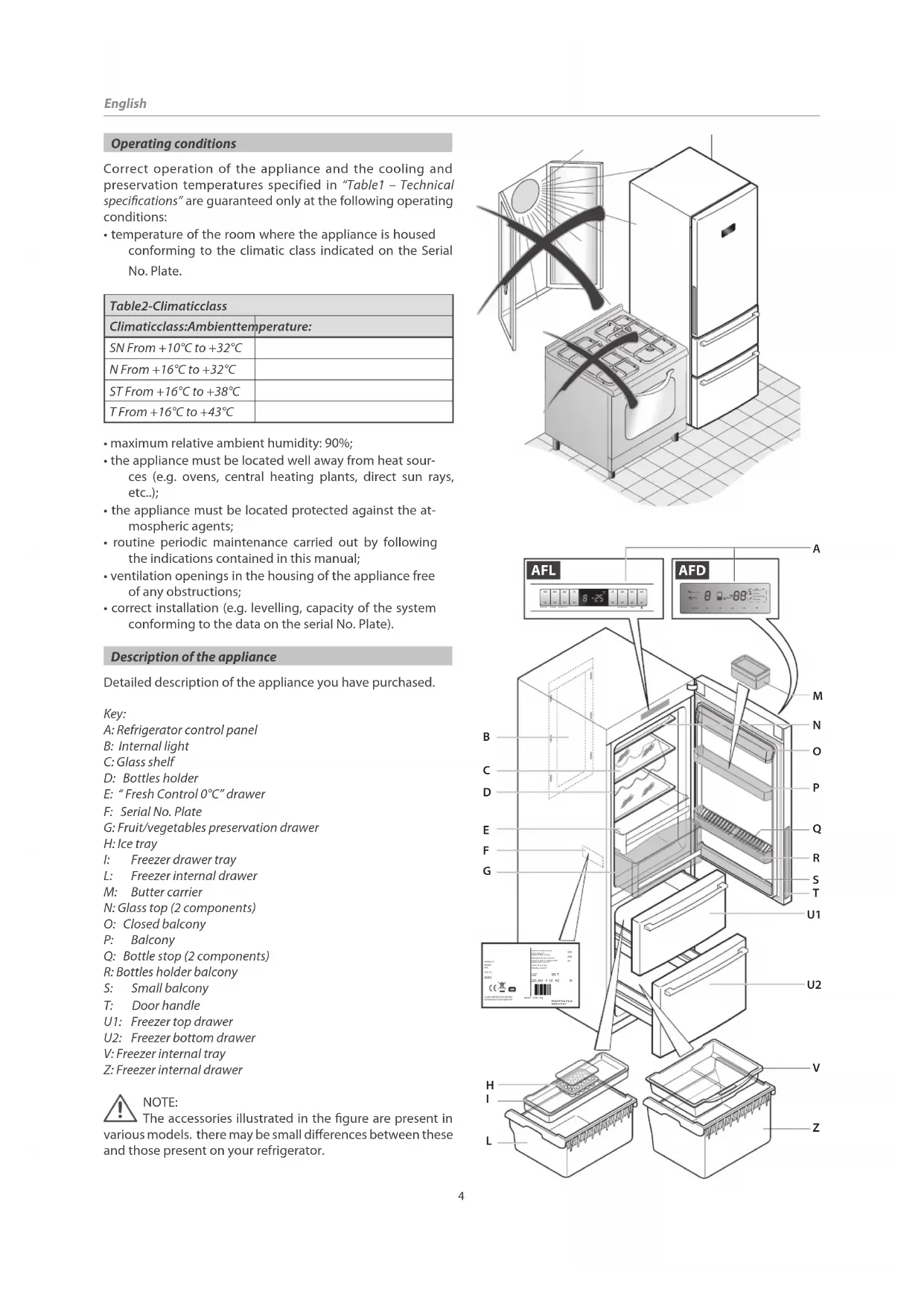
Operating conditions
Correct operation of the appliance and the cooling and preservation temperatures specified in "Table1 - Technical specifications" are guaranteed only at the following operating conditions:
temperature of the room where the appliance is housed conforming to the climatic class indicated on the Serial No. Plate.
| Table2-Climaticclass |
| Climaticclass:Ambienttemperature: |
| SN From +10°C to +32°C | |
| N From +16°C to +32°C | |
| ST From +16°C to +38°C | |
| T From +16°C to +43°C | |
maximum relative ambient humidity: 90%
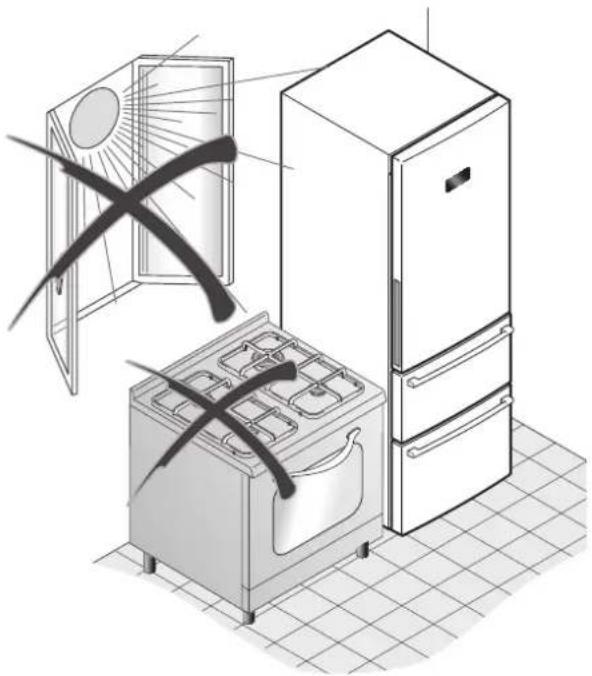
- the appliance must be located well away from heat sources (e.g. ovens, central heating plants, direct sun rays, etc...);
- the appliance must be located protected against the atmospheric agents;
routine periodic maintenance carried out by following the indications contained in this manual;
- ventilation openings in the housing of the appliance free of any obstructions;
- correct installation (e.g. levelling, capacity of the system conforming to the data on the serial No. Plate).
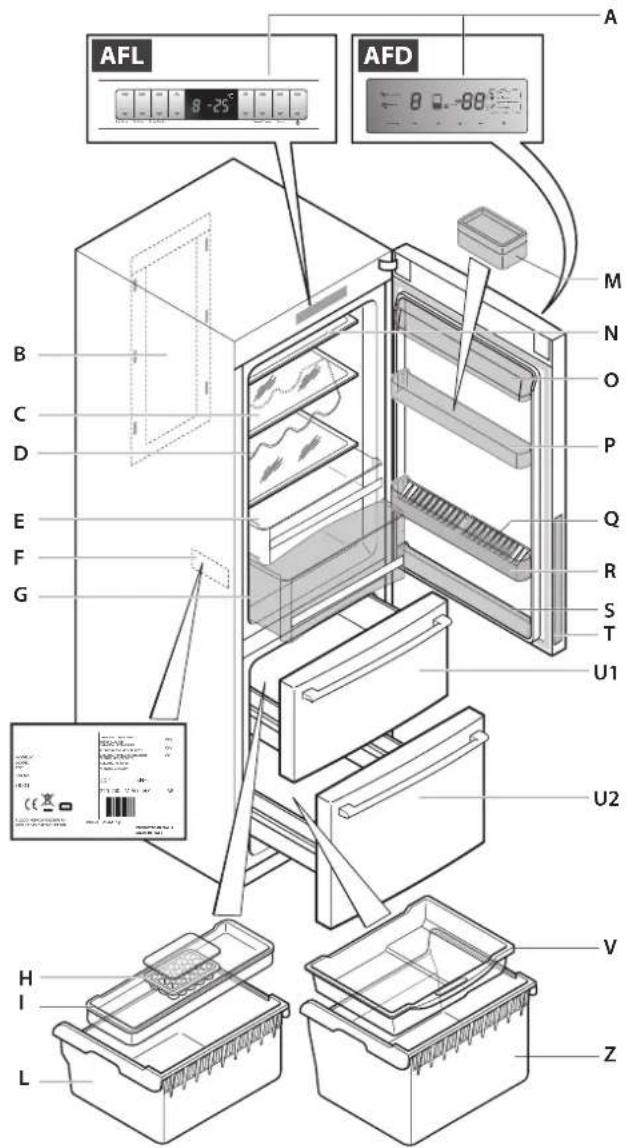
Description of the appliance
Detailed description of the appliance you have purchased.
Key:
A: Refrigerator control panel
B: Internal light
C: Glass shelf
D:Bottles holder
E: "Fresh Control 0^ " drawer
F: Serial No. Plate
G: Fruit/vegetables preservation drawer
H: Ice tray
I: Freezer drawer tray
L: Freezer internal drawer
M:Butter carrier
N: Glass top (2 components)
O: Closed balcony
P: Balcony
Q: Bottle stop (2 components)
R:Bottles holder balcony
S: Small balcony
T: Door handle
U1: Freezer top drawer
U2: Freezer bottom drawer
V: Freezer internal tray
Z: Freezer internal drawer

NOTE:
The accessories illustrated in the figure are present in
various models. there may be small differences between these and those present on your refrigerator.
4.SAFETY
Safety precautions
Symbols:

General advice to optimise operation of the appliance

General danger

Hot surfaces
- This handbook must be stored together with the appliance for any future consultation. In the event of sale or transfer to another person, make sure that the handbook is provided together with the appliance, thus enabling the new user to know its operation and the relevant warnings.
These warnings have been drafted for your safety: therefore, please read them carefully before installing and using the appliance.
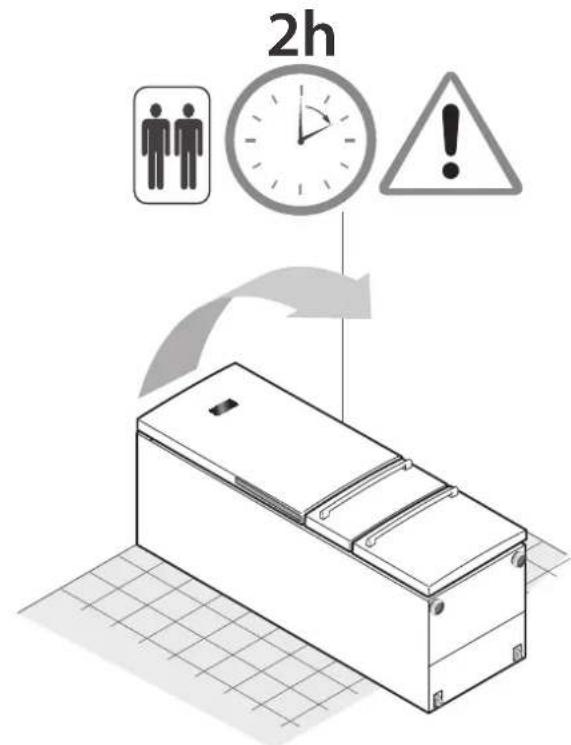
- If the appliance is in a horizontal position during transport. The oil in the compressor may flow out into the refrigerating circuit. We therefore advise you to leave the appliance in a vertical position for 2 hours before start-up, to enable oil to flow into the compressor.
After unpacking the appliance, check it carefully and install it following the instructions in the relevant chapter: if you notice any faults, turn OFF the appliance and follow the procedure indicated in chap. "After-sales assistance".
- Before you attempt any routine or extraordinary maintenance operation, disconnect electrical power to the appliance - when you do this, do not on any account pull the plug by its cable. Also check if the cable is damaged. If it is, contact a Service Centre. If the appliance has been moved, when repositioned, make sure that the power cable is not crushed or is not obstructing.
#
IMPORTANT: the appliances are provided with
refrigerant gas, ISOBLITHANE (R600a). The appliance
a
The transported and moved, taking maximum care to the
that it is not excessively struck or shaken. Failure to
are the above rule, could put the appliance out of
Dopant to the confication inits with wihls
- Damage to the refrigerating circuit, with possible
Low of refrigerating gas, could create risks of explosion in
I by external sparks or flames. Do not, on any account,
our appliance if it appears to be damaged . In case of
an apparatus in which people are being guided in case of
age, contact the Service Centre, ventilate the room
the appliance is located, and avoid flames or jobs on
pliance.
- Before you connect the appliance to the electrical mains.
make sure that the capacity of the system is adequate.
with respect to the data on the serial number plate. Any
with respect to the data on the serial number plate. Any
modification which may be necessary to the domestic
electrical system, in order to install the appliance, must be
carried out by qualified personnel.
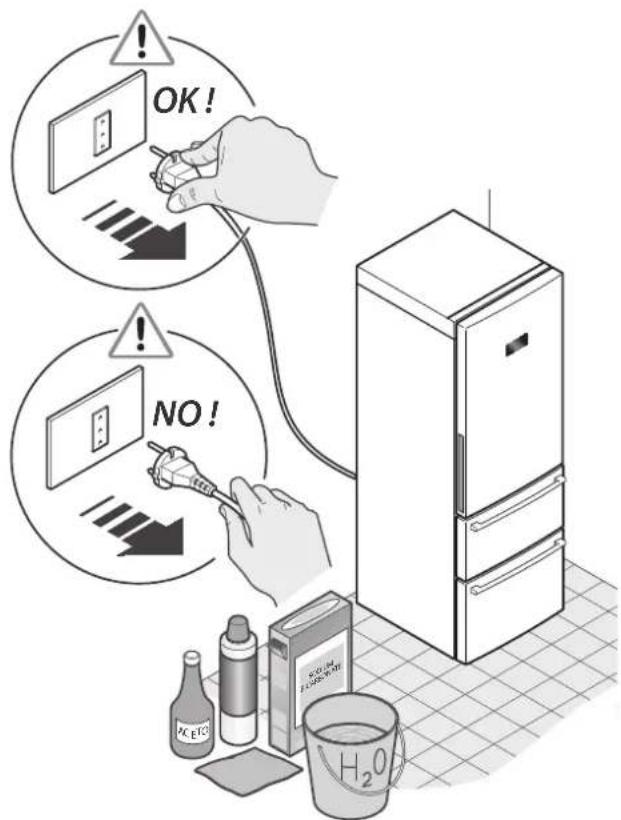
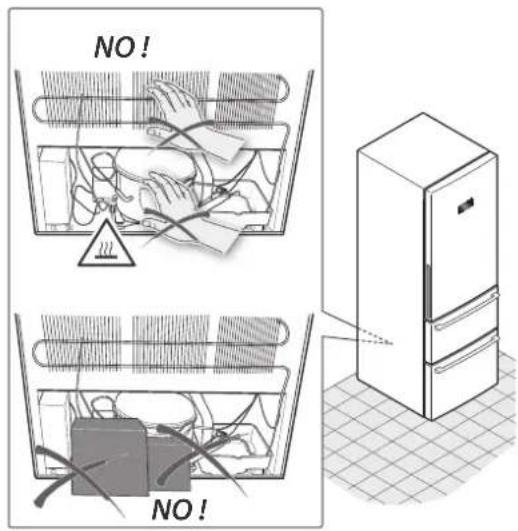
If the appliance is moved from its usual position, take
into account that even after you have unplugged, the components on the rear of the appliance may remain very hot for some time.
The appliance is not built for insertion in an embedding structure. Insufficient ventilation will certainly lead to poor operation and will damage the appliance.
IMPORTANT: during normal operation and routine maintenance, do not on any account:
- use electric appliances inside the compartments for preserving food frozen by the appliance;
- use mechanical or other devices to accelerate the defrosting process, other than those recommended by the Manufacturer;
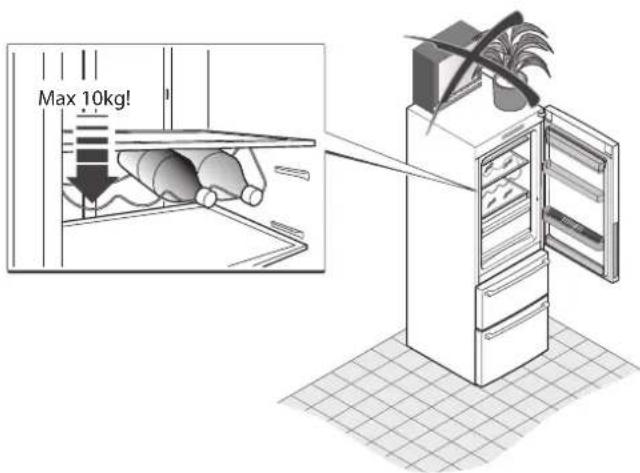
- lay fragile, heavy or unstable objects on the appliance.
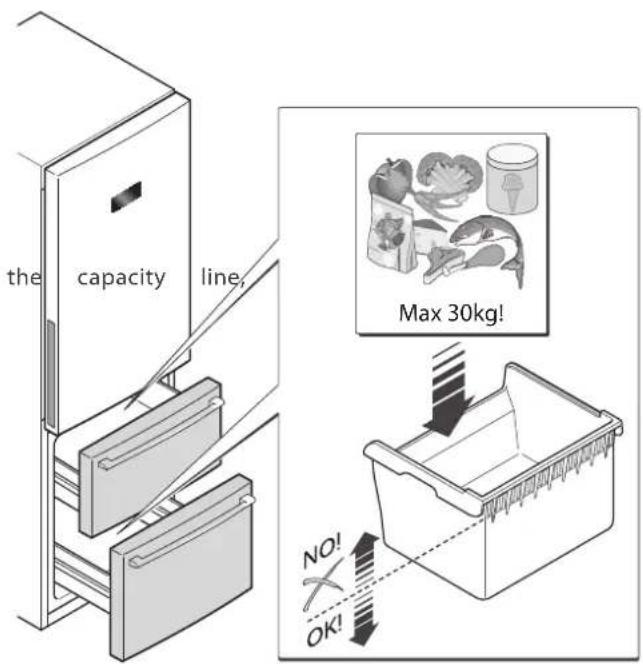
IMPORTANT: The maximum capacity of every freezer drawer is 30Kg
IMPORTANT:Bottles holder maximum load:10Kg.
- Temperature inside the refrigerator and freezer could rise or fall slightly; these appliances are therefore unsuitable for preserving products (e.g. medicines) for which a stable temperature must be guaranteed.
IMPORTANT: this appliance was designed solely for domestic use, for preserving and/or freezing foods. Therefore, make sure that children do not approach the refrigerator with the intention of playing there, do not sit on the drawers and do not hang on the doors its appliance.
IMPORTANT:Do notputsubstances with an explosion risk,contaminants or volatile substances in the appliance.
IMPORTANT: Never put carbonated beverages or bottles of water in the low temperature compartment (freeze) - they may explode. Furthermore, we strongly advise you not to put hot liquids or foods inside the appliance and not to fill receptacles up to their brim. For all other preservation advice, consult chap. "Use."
- do not exceed this capacity limit;
- do not exceed the defined level of indicated in the figure.
Safety data sheet for R600a gas
Measures in the event of accidental leakage
Allow the material to evaporate providing that adequate ventilation is provided.
Behaviour of gas
The gas is highly inflammable; therefore, absolutely avoid contact with naked flames and hot surfaces. Gas R600a is heavier than air, and therefore, high concentrations could form close to the floor where general ventilation is poor.
First aid
Inhalation
Take the exposed person from the polluted area and carry him to a warm, well ventilated place.
Long exposure can cause the onset of asphyxia and possible loss of consciousness. If necessary, practice artificial respiration, and, in the most serious cases, administer oxygen, under close medical supervision.
It is unlikely that occasional contact with the skin is dangerous by cutaneous absorption. If this happens: thoroughly wash the affected zone.
Liquid splashes and atomised liquid can cause freezing burns: Wash the affected part with plenty of water and call in a doctor to treat any burns.
Wash with plenty of water, with eye lids well open, and call in a specialised doctor as soon as possible.

In any event, we advise you to consult your own doctor following contact with or inhalation of R600a gas.
Disposal and interruption
m = 311 ;
Under the provisions of art.13 of Law Decree of 25 July 2005, No.151 "Implementation of Directives 2002/95 CE, 2002/96/CE and 2003/108/CE, concerning the reduction in the use of dangerous substances in electric and electronic appliances, and the disposal of waste":
The symbol of the crossed rubbish bin affixed to the appliance or to its package indicates that, at the end of its useful life, the product must be collected separately from other waste. Therefore, the user shall transfer the appliance, when it has reached the end of its life, to centres for differentiated collection of electronic and electro-technical waste, or redelivery it to the seller when the user buys a new appliance of equivalent type, one for one.
Make sure that the old appliance is transported to the collection point for its disposal without any damage to the cooling circuit. You will therefore be sure of preventing uncontrolled outflow of refrigerant. The refrigerant data are shown on the appliance's data plate.
The cycloisopenthane, a substance not harmful to ozone, is used as an expander for the insulating foam.
Adequate differentiated collection, prior to sending the out-of-service appliance for environmentally compatible recycling, treatment and disposal, contributes to avoiding possible negative effects on the environment and health, and favours the use and/or recycling of the materials the appliance is composed of.
Abusive disposal of the product by the user, entails the application of the sanctions under current legal regulations.
For more detailed information about the available collection systems, contact your local waste disposal service. We thank you for your contribution to the protection of the environment.

We advise you to cut the power cable before taking the appliance to the collection centres.

Make the closing of the door unfit for use (by removing the seals), or better still, remove the door in order, for example, to prevent a child risking to stay shut inside while playing.

5. INSTALLATION
Transport and unpacking
If the appliance is in a horizontal position during transport. The oil in the compressor may flow out into the refrigerating circuit. We therefore advise you to leave the appliance in a vertical position for 2 hours before start-up, to enable oil to flow into the compressor.
Remove the external packing, remove the protective film, where present, from the surfaces of the appliance, clean the outside of the appliance with specific products. Do not use scrapers or abrasive fabrics which could damage the surfaces beyond repair.
Carefully remove all sheets and adhesive tape from the appliance and door and any parts in polystyrene.
Take out the documents and existing accessories from inside the appliance.

The packing material is recyclable and is marked with the recycling symbol.

For disposal, follow the local regulations. Packing material (plastic bags, parts in polystyrene, etc...) must kept out of reach of children as it is a potential source of danger.
Control the appliance carefully: if you notice any faults, do not install the appliance and follow the procedure indicated in chap. "After-sales assistance".
Positioning
The place chosen for positioning must satisfy the indications supplied in parag. "Operating conditions", and must have a stable floor of sufficient capacity for the appliance's weight.
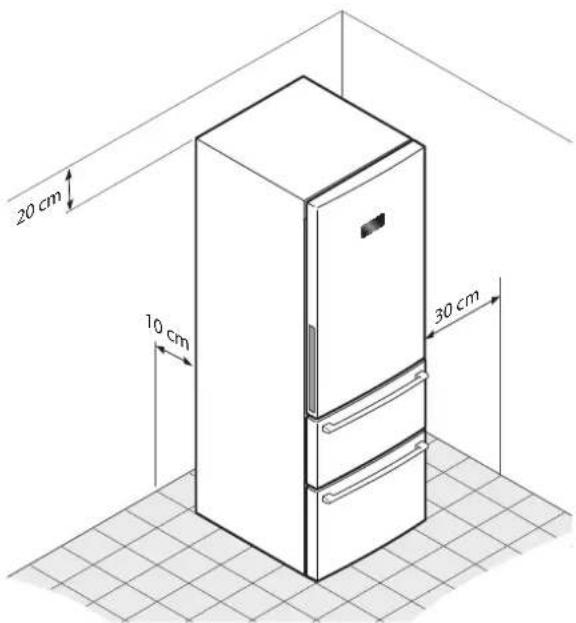
Furthermore, you must take into account the distances to be respected for correct operation of the appliance and for its dimensions:
1) top part (at least 20~cm )
2) back part (at least 10cm )
3) wall on door opening side (at least 30~cm ).
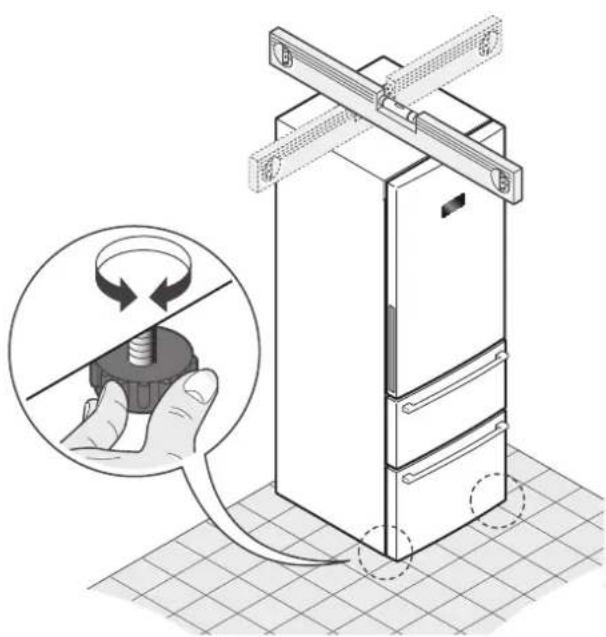
Level the appliance with its feet: keep the appliance slightly above the floor to encourage good air circulation on the condenser. In these conditions, you will obtain excellent operation of the refrigerant circuit.
Installation of handles
The handles of the freezer drawers are supplied disassembled: to assemble them, refer to the figure at the side.
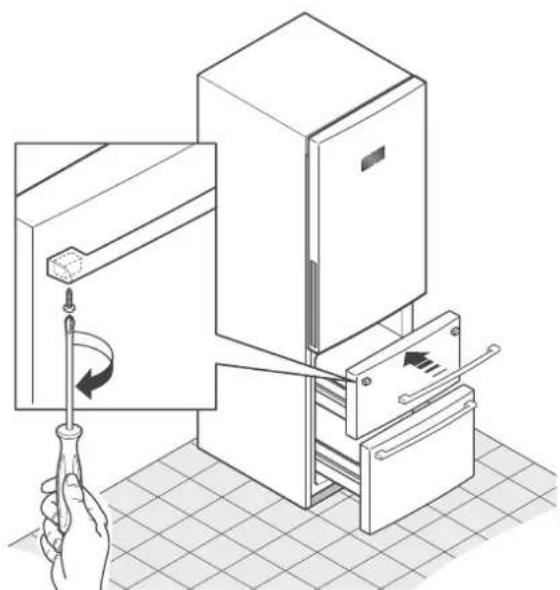
Cleaning before use
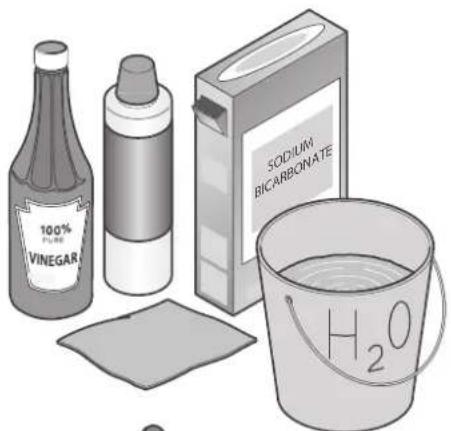
Make sure that you have removed, from the appliance, all the adhesive strips which restrain the accessories, clean all internal parts with lukewarm water and neutral soap, vinegar or sodium bicarbonate, in order to remove the characteristic odour of new parts, then dry carefully.
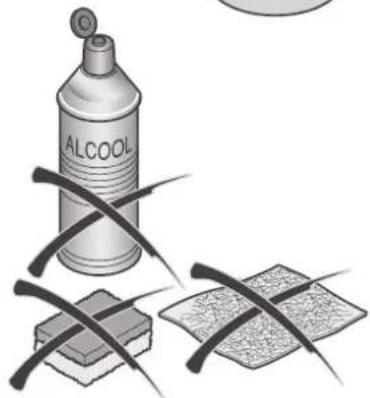
Do not use detergents and/or abrasives containing soda, or solvents which could damage the finishes.
Electrical connection
Before you insert the plug in the power socket, make sure that:
- you hands are not wet or humid;
- voltage and frequency on the serial number plate match those of the domestic power supply (a swing of -6% to +6% is permitted for nominal voltage; for operation at different voltages, use a transformer of adequate power);
- the cable and plug are not damaged or crushed by heavy objects:
- the power cable is not too tight: extensions to reach the socket are not permitted.

IMPORTANT: do not connect the appliance to rectifiers (e.g. sun plants) or by an extension lead.

IMPORTANT: the appliance must be connected to an efficient earth plate.
To this end, if the power socket of the domestic system is not connected to earth, connect the appliance to a separate efficient earth system, in compliance with current legal regulations, consulting a specialised technician.
The Manufacturer declines all and any responsibility if this accident prevention regulation is not respected.
This appliance conforms to the following EU directives:
B.T. 73/23/EEC
93/68/EEC

6. USE
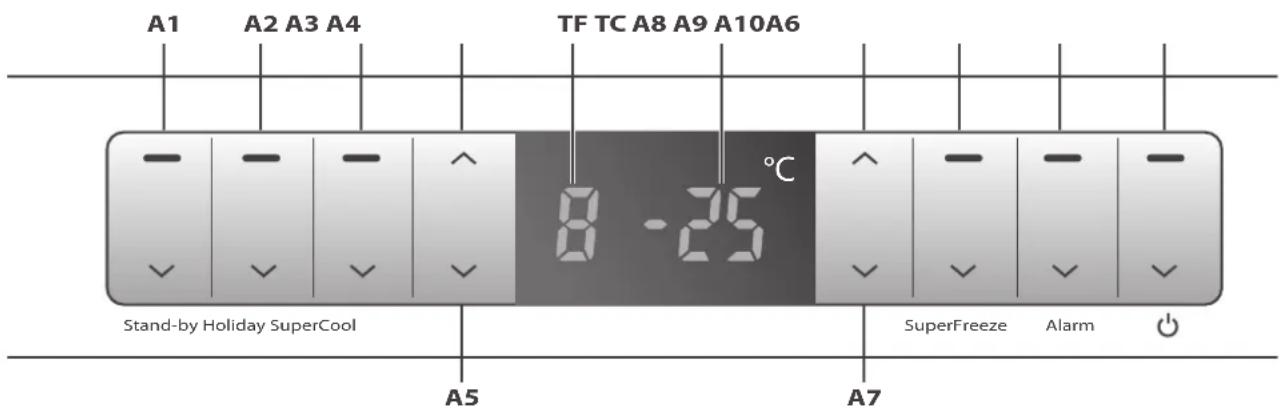
Description of the functions of the refrigerator and freezer - MODEL AFL
Key:
A1: Stand-by
A2: Holiday function push button
A3: Super Cool push button
A4: Refrigerator temperature increase push button
A5: Refrigerator temperature reduction push button
A6: Freezer temperature increase push button
A7: Freezer temperature reduction push button
A8: Super Freeze push button
A9: Alarm silencing push button
A10:Power ON push button
TF: Refrigerator temperature
TC: Freezer temperature
Initial power supply
When the refrigerator is powered up, indicator (A10) lights up. The temperature of the compartments is shown on the display as "--"due to the high temperatures inside. An alarm buzzer is sounded. Press key (A9) and the buzzer stop, whereas indicator (A9) stays lighted. The display shows. When the temperature has dropped to a given level, the temperatures of the refrigerator and freezer on the display respectfully indicate "5" and "-18" according to the settings predefined in the factory.
Setting temperature in the refrigerator compartment
Press key (A4) or (A5) to set the refrigerator temperature: the relevant indicator light fl ashes, enabling you to set the temperature from 2^ to 8^ . The setting will be confirmed automatically 5 seconds after the operation has ended, or by pressing any key.
Setting the temperature of the Cooler compartment
Press key (A6) or (A7) to set the cooler temperature: the relevant indicator light flashes, enabling you to set the temperature from -16^ to -24^ . The setting will be confirmed automatically 5 seconds after the operation has ended, or by pressing any key.
Super Cool
To activate this function, press Super Cool key (A3): In this way the relevant indicator light also lights up. This function will be automatically disabled when the temperature drops to minimum level. This function can be disabled by pressing key (A3) again.
In this mode, the temperature in the refrigerator compartment and the Holiday function cannot be set.
Super freeze
To activate this function, press Super Freeze key (A8): In this way the relevant indicator light also lights up. This function will be automatically disabled after 24 hours. This function can be disabled by pressing key (A8) again.
In this mode, the temperature in the Cooler compartment cannot be set.
Holiday Function
To activate this function, press key (A2). In the Holiday mode, the refrigerator works at a temperature of over +10^ (after you have activated this function, we advise you to remove perishable foods from the refrigerator compartment and close its door). The temperature of the refrigerator compartment is indicated by - . Press key (A2) again - the relevant indicator goes OFF and the refrigerator will change over to normal control status.
In this mode you can set both the Super Freeze function and the Super Cool function. In the latter case, the Holiday function is automatically disabled.
Control of display
The display screen goes OFF automatically 1 min. after the end of the operation. It can be enabled again by opening the door or pressing any key (an alarm does not turn ON the screen).
Open door alarm
When the refrigerator door stays open for more than 3min a buzzer is sounded: 3 beeps every 30 seconds. The buzzer can be disabled by closing the door, or pressing any key. If the door stays open the display is re-lighted and the alarm indicator (A9) is shown.
Excessive temperature alarm
When the temperature in the freezer compartment rises over a given level, the indicator light of push button (A9) flashes and a buzzer is sounded: 1 beep per second. The buzzer stops when the temperature in the freezer compartment reaches the defined level, or by pressing any key. The indicator (A9) stays lighted until the set temperature is reached inside the compartments.
Turning OFF the refrigerator compartment
If you press key (A1) for 3 seconds, indicators (TF) and (A1) go OFF, the refrigerator compartment will be disabled, whereas the freezer compartment operates normally. To re-enable the refrigerator compartment, press key (A1) again for 3 seconds: the relevant indicator lights up, and the icon indicating the temperature of the refrigerator compartment will be reset.
Turning OFF the appliance
If you press key (A10) for 3 seconds, the relevant indicator goes OFF, the display screen also goes OFF, and the refrigerator stops operating but will continue to be powered by the electrical system. To re-enable the appliance, press key (A10) once again for 3 seconds. The relevant indicator lights up, the display screen lights up and the refrigerator resumes operating normally.
Note: if the Holiday or Super Cool functions, and the Super Freeze function were active before the appliance was turned OFF, they are re-activated at power-up.
Error indication
When "E" or "F" is displayed due to a malfunction, the refrigerator can still guarantee preservation of foods.
Please contact the Service Centre as soon as possible.
Description of the functions of refrigerator and freezer - MODEL AFD
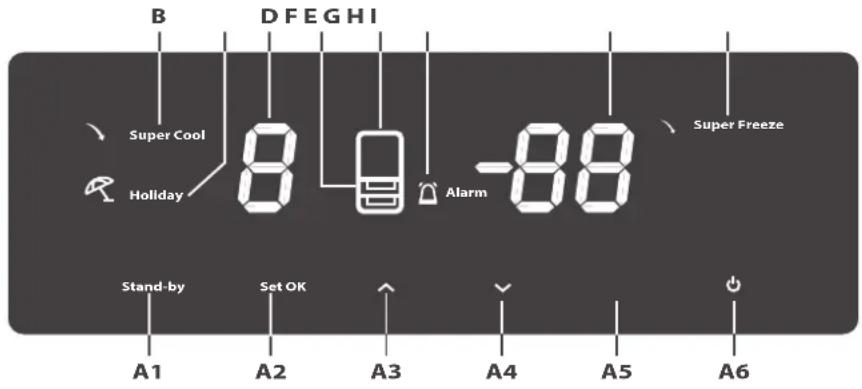
C
Key:
A1: Stand-by
A2: Set push button (Functions Menu)
A3: Temperature increase push button
A4: Temperature reduction push button
A5: OK push button - confirms set values
A6: ON/OFF switch
B: Super Cool indicator light
C: Holiday function indicator light
D: Refrigerator temperature
E: Refrigerator compartment indicator light
F:Cooler indicator light
G: Alarm indicator light
H: Freezer temperature
I: Super Freeze indicator light
Initial power supply
When the refrigerator is powered for the first time, indicator (G) lights up. The temperature of the refrigerator and freezer compartments is respectively shown as "--" and "--" on the display, due to the high temperature inside. An alarm buzzer is then generated. If you press key (A5) the buzzer stops, whereas the indicator (G) stays lighted until the temperatures predefin ed in the factory are reached. The display reduces its brightness one minute before the end of the last operation.
Setting the temperature in the Refrigerator compartment
Press key (A2) repeatedly until indicators (D) and (E) begin to flash simultaneously; press keys (A3) and (A4)
to set the temperature from a minimum value of 2^ up to a maximum of 8^ .
Press push button (A5) to confirm the set temperature: indicators (D) And (E) will stop flashing.
Setting the temperature in the Cooler compartment
Press key (A2) repeatedly until indicators (H) and (F) begin to flash simultaneously; press keys (A3) and (A4)
to set the temperature from a minimum value of -24^ up to a maximum of -16^ .
Press push button (A5) to confirm the set temperature: indicators (H) and (F) will stop flashing
Super Cool
Press key (A2) repeatedly until indicator (B) begins to fl ash; press push button (A5) to confirm activation of the Super Cool function.
Indicator (B) will stop fl ashing and will remain lighted. This function will be automatically disabled when temperature drops below minimum level. This function can be disabled by repeating the activation procedure
In this mode, the temperature in the refrigerator compartment and the Holiday function cannot be set.
Super Freeze
Press push button (A2) repeatedly until indicator (I) begins to flash; press push button (A5) to confirm activation of the Super-Freeze function.
Indicator (I) will stop flashing and will remain lighted. This function will be automatically disabled after 24 hours.
This function can be disabled by repeating the activation sequence.
In this mode, the temperature in the cooler compartment cannot be set.
Holiday function
Repeatedly press push button (A2) until indicator (l) begins to flash; press push button (A5) to confirm activation of the Holiday function. Indicator (C) stops flashing and remains lighted. In Holiday mode the refrigerator operates at a temperature of over +10^ (we advise you to remove perishable foods from the refrigerator compartment and close its door after activating this function). The temperature of the refrigerator compartment is indicated with - . To disable the function, repeat the activation procedure.
In this mode you can set both the Super Freeze function and the Super Cool function. In the latter case, the Holiday function is automatically disabled.
Display Control
The display screen automatically reduces brightness one minute after the end of the operation. Brightness is resumed by opening the door or pressing any key. In the case of an alarm, only the buzzer is activated, and the brightness of the display is not modified.
Open door alarm
When the refrigerator door stays open for more than 3 min., indicator (G) fl ashes and a buzzer is sounded: 3 beeps every 30 seconds. If the door is closed, the alarm stops and indicator (G) goes OFF. To exclude the buzzer only, press push button (A5).
Excessive temperature alarm
When the temperature in the freezer compartment rises over a given level, indicator (G) lights up and a buzzer is sounded (1 beep per second). The buzzer stops when the temperature in the freezer compartment reaches the defi red level. Indicator (G) stays lighted until the set temperature is reached inside the compartments. To exclude the buzzer only, press push button A5).
Disabling the refrigerator compartment
If you press key (A1) and hold it down for 3 seconds: the refrigerator compartment will be disabled, whereas the freezer compartment will operate normally. On the display, indicator (D) will go OFF and indicator (E) will darken. To re-enable the refrigerator compartment, press key (A1) for 3 seconds: indicator (D) will reappear and indicator (E) returns to normal brightness.
NOTE: if the Holiday or Super Cool functions were active before the appliance was turned OFF, they are re-activated at the new power-up.
Disabling the appliance
If you push button (A6) for 3 seconds, the display screen goes OFF, and the refrigerator stops operating but will continue to be powered by the electrical system. To re-enable the appliance, press key (A6) once again and hold it down for 3 seconds
Note: if the Holiday or Super Cool functions, and the Super Freeze function were active before the appliance was turned OFF, they are re-activated at power-up.
Error indication
When "E" or "F" is displayed due to a malfunction, the refrigerator can still guarantee preservation of foods.
Please contact the Service Centre as soon as possible.
Advice on the preservation of foods: REFRIGERATOR
Description of functions
Super Freeze: we advise you to use this function when you put the fresh foods you have bought during shopping, in the refrigerator compartment.
This method favours faster cooling of foods.
Holiday function: this function is recommended when, for short periods (e.g. a holiday), you do not wish to disable the refrigerator but make it work at reduced consumption. With this mode, the freezer compartment operates normally and the refrigerator compartment operates at temperatures of over +10^ . In view of the temperature, remove from the refrigerator all perishable foods which require lower temperatures for excellent preservation, and keep the refrigerator door closed.
Advice on cooling foods
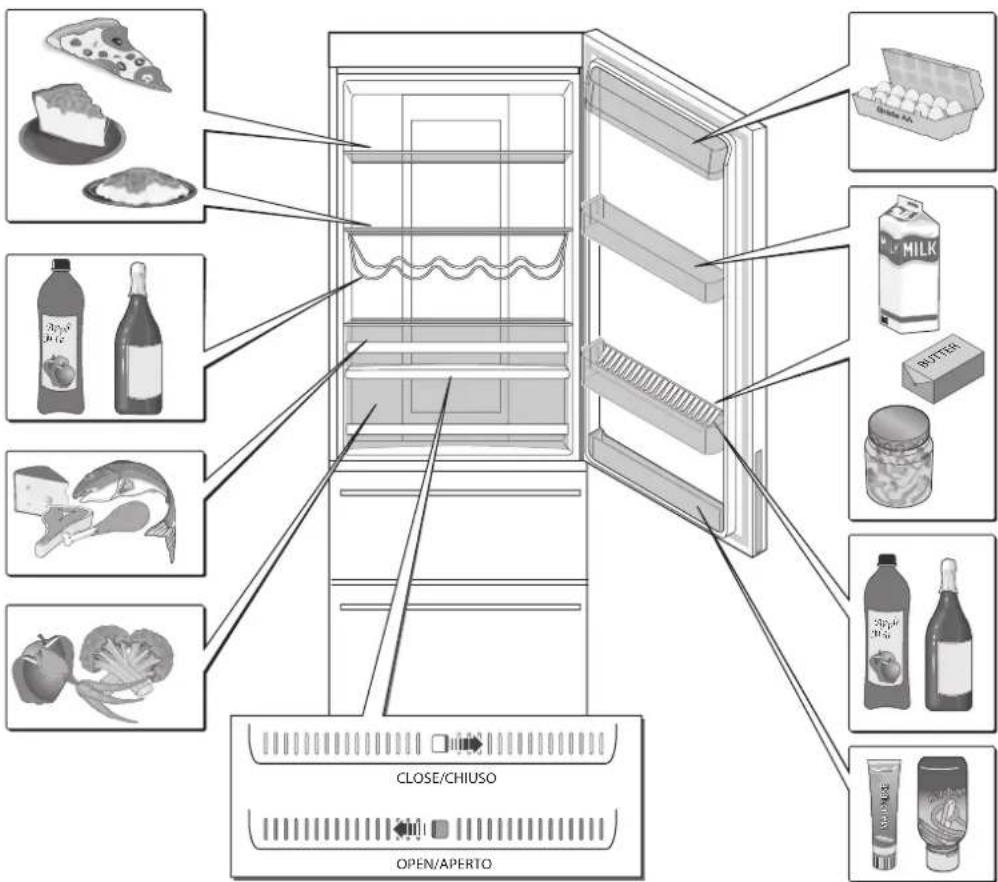
Ambients with different temperatures can be created by circulating air in the cooling compartment. These ambients are particularly suitable for preserving various foods. It is therefore important to position the foods to allow air to freely circulate around them.
The coldest zones (e.g. suitable for preserving dressed and other meats are just above the vegetables drawer. Instead the less cool zones are situated at the top, toward the outside and in the doors (ideal for preserving butter and cheeses to spread).
Ventilation inside the vegetables drawer is provided by a series of slits which can be closed at the user's discretion.
Advice on how to best use the refrigerator compartment:
- do not put in hot foods or evaporating hot liquids;
- always replace in closed containers, or in appropriate packages, liquids and all foods which issue or which can easily absorb odours and flavours;
- do not put food oil in fl exible containers in the refrigerator door: cracks could form in the plastic;
-
never obstruct the ventilation holes or grids on the bottom wall of the refrigerator and freezer compartment;
-
do not put in the appliance explosive materials or spray cylinders containing inflammable propellants such as butane, propane pentane, etc...and put back high proof alcohol only in upright position and in properly shut containers. Gasses or liquids that accidentally issue from cylinders can be recognised by reading the indications of their content, and are sometimes marked with a fl ame symbol.
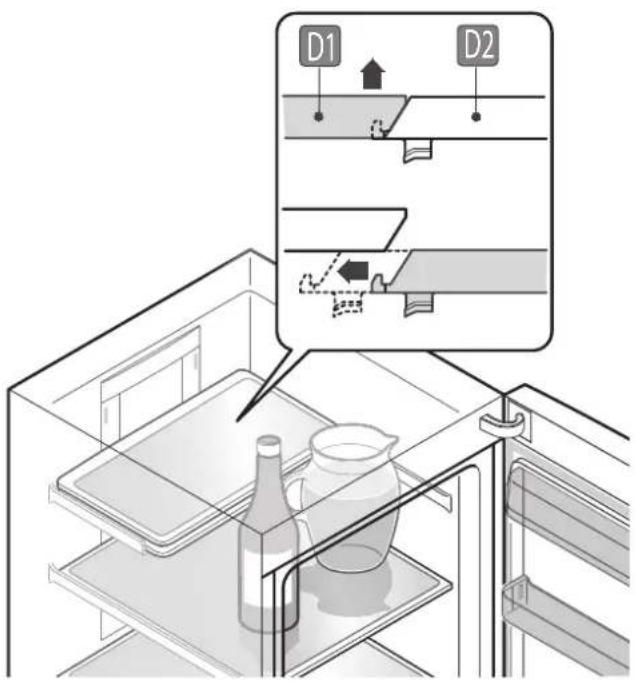
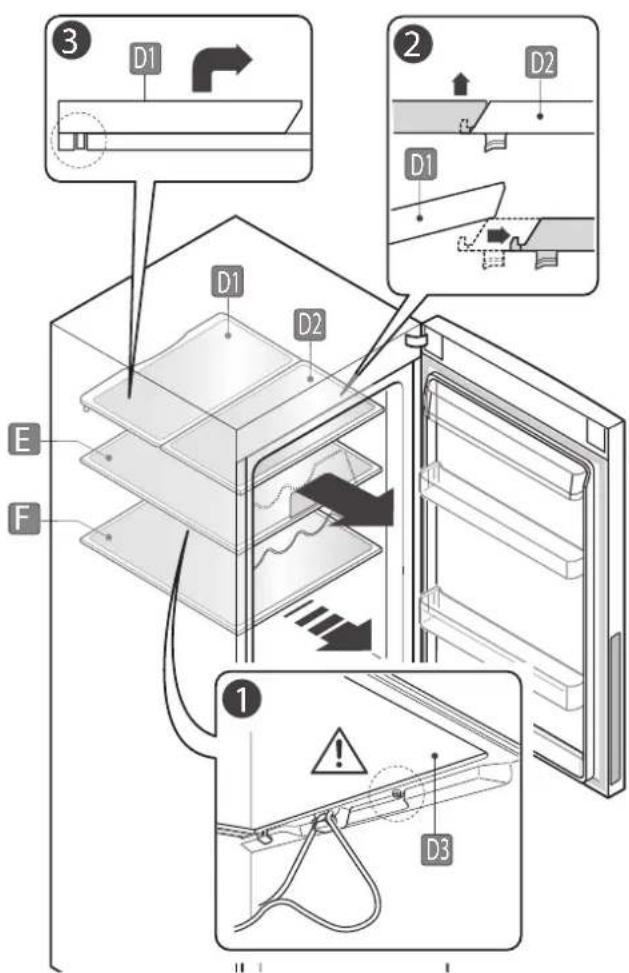
Glass top in two pieces
By a simple operation, shown in the figure below, the front glass top (D2) can be positioned under the rear one (D1).
In this way you can create space for cooling bottles (or other very high containers) in a vertical position.
| Table3-Preservingfoodsintherefrigerator |
| FoodPreservationcontainersPreservationzoneDuration | | | |
| Meat and fish (of any type) Hard cheeses | Protective film, aluminium sheets, closed glass containers, plastic for foods or steel | Drawer "Fresh Control °0C" | 1-2 days |
| Cooked foods, cold dishes, sweets | Closed containers in glass, plastic for foods or steel | Any drawer 1-2 days | |
| Fruit and vegetables Sale | package or bulk Fruit/vegetable drawers 3-4 days | | |
| Bananas, potatoes, onions and garlic | Do not preserve in the refrigerator -- | | |
| Water, wine, beer, milk, fruit juices, fizzy beverages | Food containers in glass or plastic | Balconies on the door | Refer to the best before date |
| Pickled or in oil foods, sauces, butter, spreadable cheeses, eggs | Original package | Balconies on the door | Refer to the best before date |
| Yoghurt | Original package | Any drawer | Refer to the best before date |
Advice on preserving foods: FREEZER
Description of functions
Freezing: The rapid freezing function is designed to best preserve the nutritional value of foods placed in the freezer compartment, guaranteeing complete and quicker freezing.
Advice on freezing foods
The freezer compartment is recommended for preserving already frozen foods, for freezing small quantities of foods, and for preparing ice cubes and ice cream.
IMPORTANT: a temperature of -18^ is necessary for freezing and preserving foods for a long time. This temperature considerably stops the action of microorganisms. As soon as the temperature exceeds -10^ , the decomposition process activated by the microorganisms is resumed, shortening the life of foods. For this reason, when foods have been defrosted, they can be re-frozen only after cooking in order to eliminate most of the microorganisms.
Some advice:
to preserve frozen foods, make sure that they are well preserved by the seller;
- we advise you to limit opening the compartment containing deep frozen and frozen foods and keep it open for as little time as possible;
- we advise you to freeze only fresh, high quality foods, after washing and drying them carefully;
- place the foods to be frozen in the lower drawer – this is the coldest point of the freezer compartment;
- preservation temperature must always be lower than or equal to -18^ ;
- the serial number plate indicates the maximum quantity of fresh foods which can be frozen in 24h ("freezing capacity"). A larger quantity worsens freezing quality, and considerably reduces the quality of already frozen foods;
- we advise you to activate the Super-Freeze function 24 hours before freezing, when food quantities exceed 8Kg
- freeze foods in small portions, carefully wrapped in suitable protective material (aluminium sheets or specific freezer packets), adhering well and closed, marking the packing and best before dates;
- ice cream and ice lollies should be eaten only a few minutes after they have been removed from the freezer, to avoid cutaneous lacerations to lips and tongue. For the same reason, do not touch internal parts of the freezer with wet hands;
- packets must be dry to prevent them freezing together or attaching to each other;
- the packaging must ensure that air and humidity do not come out, to prevent drying of foods and loss of the vitamins they contain;
- the bags and/or sheets must be soft to adhere well to the contents;
- arrange the foods to be frozen so that they do not come into contact with already frozen foods, to avoid defrosting;
- to defrost small quantities of fresh foods (1-2 Kg), there is no need to adjust the thermostat knob. To defrost larger quantities, enable the "Super-Freeze" function (parag. "description of refrigerator and freezer functions").
IMPORTANT: do not preserve bottled drinks, especially if fizzy, in the freezer compartment or in the low temperature cells; if the beverages freeze, the contents expand and the bottles can burst.
IMPORTANT: increasing the temperature of frozen foods, reduces their preservation time.
- If, for accidental reasons, i.e. a power cut in the domestic system, the foods in the freezer compartment have defrosted (eve if only partially), they must be consumed very quickly; they can also be re-frozen after being cooked.
- With brief interruptions (up to 6-8 hours), the foods will not alter.
Making ice cubes
The appliance is supplied with one or more trays for the production of ice cubes; fill up to 34 with drinking water and put them back in the appropriate compartment. Do not use metallic and specially sharpened objects to detach the trays. To easily detach ice cubes from the tray, pour some running water on the tray.
Advice on defrosting foods
To cook frozen foods excellently, we advise you to defrost them in the refrigerator or at room temperature, shortening defrosting time in the latter case.
If you want to cook the foods quickly, providing they are small they can be cooked directly, lengthening cooking times.
If they are of normal dimensions, they can be defrosted in a microwave oven.
When foods are defrosted, they deteriorate quickly. Therefore, they should be consumed by the next 12-24 hours and can be refrozen only after they are cooked (boiled or roasted).
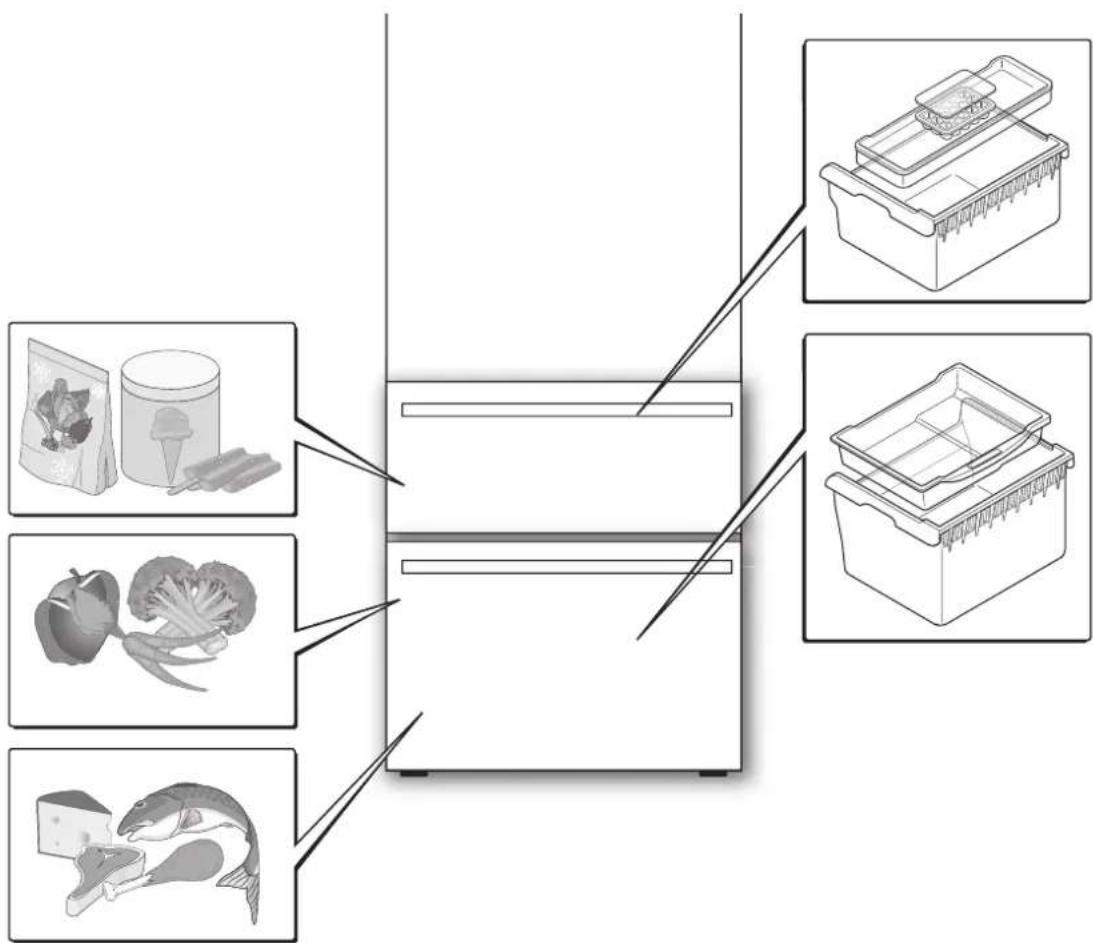
| Table4-Preservingfoodsinthefreezer |
| FoodPreservationcontainersPreservationzoneDuration | | | |
| Preservation of frozen foods, ice cubes, ice creams | Original package, well closed | top of freezer compartment | Refer to best before date |
| Freezing foods: meat and fish | Original package, well closed. Food containers resisting to cold temperatures, hermetically closed. Maximum quantity per container: 2.5 Kg | preferably at the bottom of the freezer compartment | Beef: 12 months Pork: 12 months Minced pork: 6 months Rabbit: 6 months Veal: 9 months Mutton: 9 months Poultry: 6 months Fish: 6 months |
| Freezing foods: 1st courses/ pasta dishes, fruit, vegetables, sweets | Food containers resisting to cold temperatures, hermetically closed. Maximum quantity per container: 1 Kg | top part freezer compartment | 6-12 months |

7. ROUTINE MAINTENANCE
Cleaning the appliance

Disconnect the electrical power supply before starting the job.
Internal cleaning
Clean all internal parts with tepid water and neutral soap, vinegar or sodium bicarbonate, then dry accurately. Alternatively use detergents made specifically for the refrigerator, on sale in any supermarket. Do not use abrasive detergents and/or powders, soda based detergents, or solvents which could damage the finish. To facilitate cleaning, the internal accessories can be removed (consult parag. "Dismantling components").
External cleaning
Clean all external parts with specific detergents. Do not use abrasive detergents and/or powders, soda based detergents, or solvents which could damage the finish.
Dismantling components
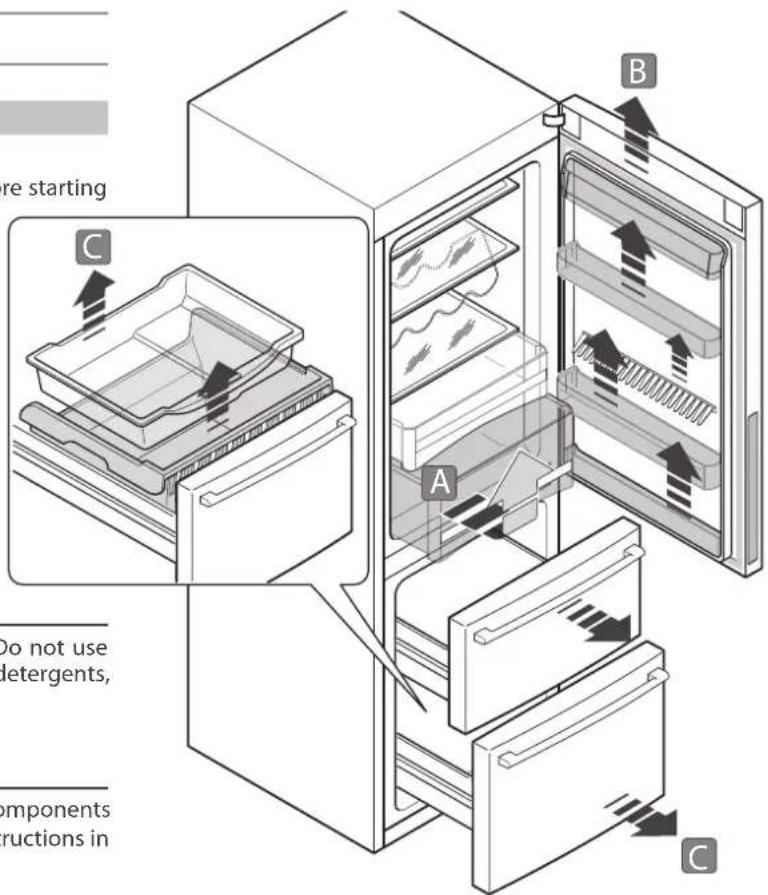
To facilitate cleaning operations, all the internal components of the appliance can be dismantled. Follow the instructions in the relevant figure.
A: Freezer drawers, fruit/vegetable drawer and "Fresh Control 0^ drawer": these drawers slide on special guides with stops, which prevent the drawers coming out entirely when opened, and risk falling on the floor. If you wish to take them out of the appliance for the cleaning operations, extract them to up to 3 / 4 of their depth, lift them up slightly and continue extracting, keeping them inclined upwards.
B: Door balconies: they are simply fitted on the guides integrated on the door. To remove them, lift them upward, firmly pushing them up.
C: Freezer drawers: they cannot be fully removed from the appliance for reasons of safety; when they have been opened up to the maximum permitted extraction 1 the internal drawers can be extracted by simply lifting them up 2.
D: Glass top in two pieces: the front top (D2) is connected to the rear top to prevent the latter coming out accidentally (see detail.); to remove it, slightly lift the rear top (D1) and withdraw the front top (D2). The rear top (D1) is restrained at its ends by two pins which prevent it coming out accidentally (see detail). To extract it, lift it upward and pull it toward yourself until you withdraw it. When you re-position the two tops (D1 and D2) make sure you connect them once again to each other.
E: Top in glass with bottle holder: the top slides on guides, and has two pins preventing the guides from coming out accidentally (see detail 1); if you wish to remove it from the appliance for the cleaning operations, lift it up slightly and extract it, keeping it inclined upwards.
F: Glass top: the top slides on guides. If you wish to remove it from the appliance for cleaning operations, take away the "Fresh Control 0^ " drawer, slightly lift up the top and extract it, continuing to hold it inclined upwards.
8. EXTRAORDINARY MAINTENANCE
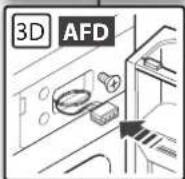
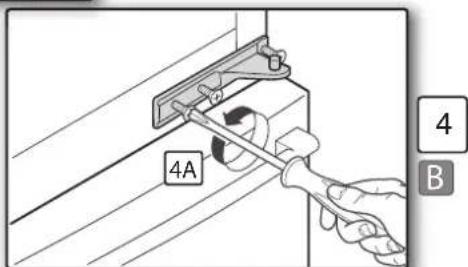
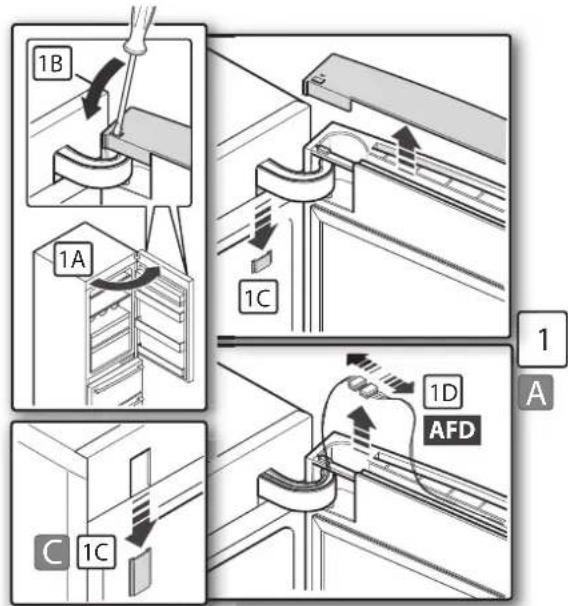
Door reversibility: dismantling door from the right
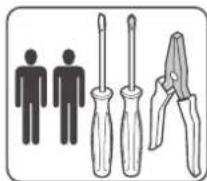
!
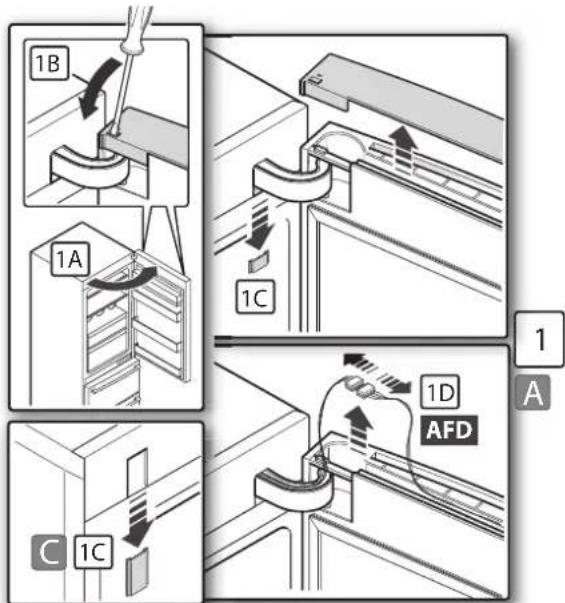
Disconnect power and empty the appliance before you start the operation.
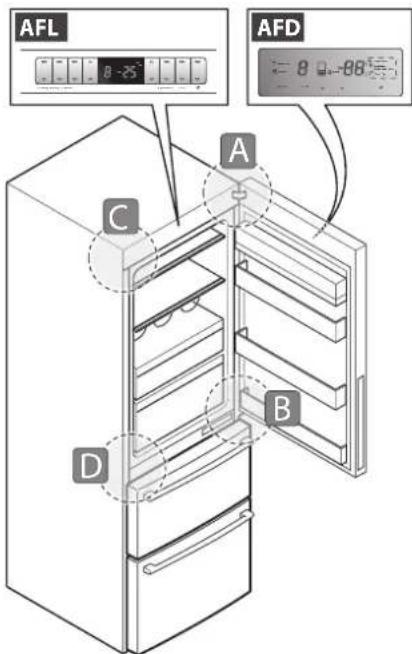
A) Open the refrigerator door;
B) using a normal screwdriver, work on the two clips to remove the head from the top end of the door and withdraw it upward;
C) using a normal screwdriver, withdraw downward the clips from the right and left side - the clips are under the upper hinge, take care not to damage them.
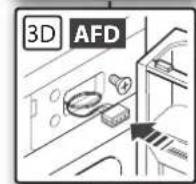
D) only for AFD model: remove the two docking blocks delicately (the two cables connect the display on the door to the equipment)
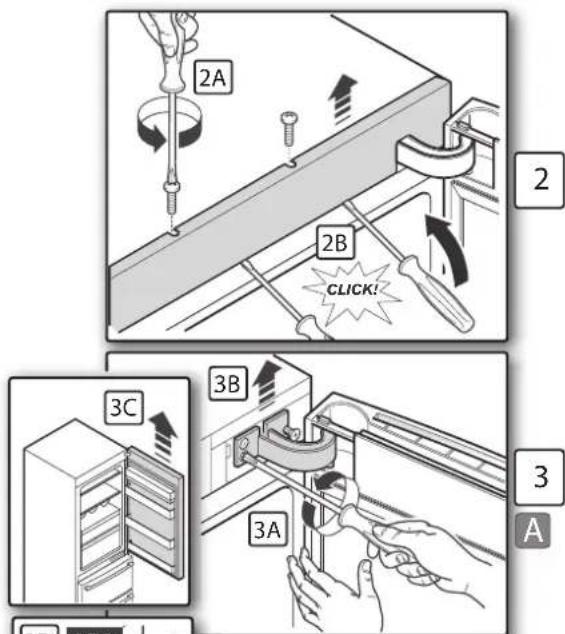
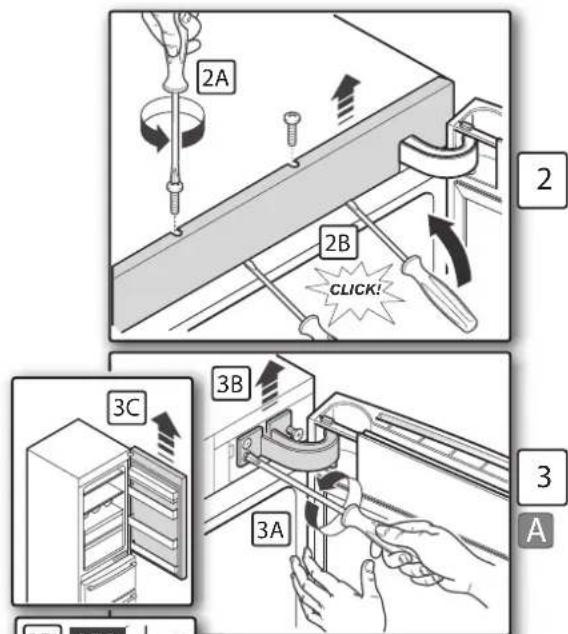
A) Unscrew the two screws which secure the front panel, located at the top;
B) To remove it, obtain leverage in several points with a normal screwdriver, taking care not to damage the panel.
3 A) While firmly holding the refrigerator door, unscrew the two screws which restrain the upper hinge on the left and loosen the third screw located on the right.
B) Remove the upper hinge, first turning it anti-clockwise and then withdrawing it upwards.
C) Next, remove the door from the refrigerator, withdrawing it upward and re-position it carefully, paying attention not to damage it.
D) only for model AFD: wind the cable and insert it in the compartment behind the hinge, making sure it does not project and obstruct the subsequent re-positioning of the front panel.
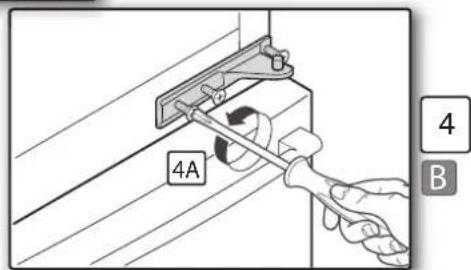
4 A) Unfasten the three screws which restrain the central hinge so that you can remove it;
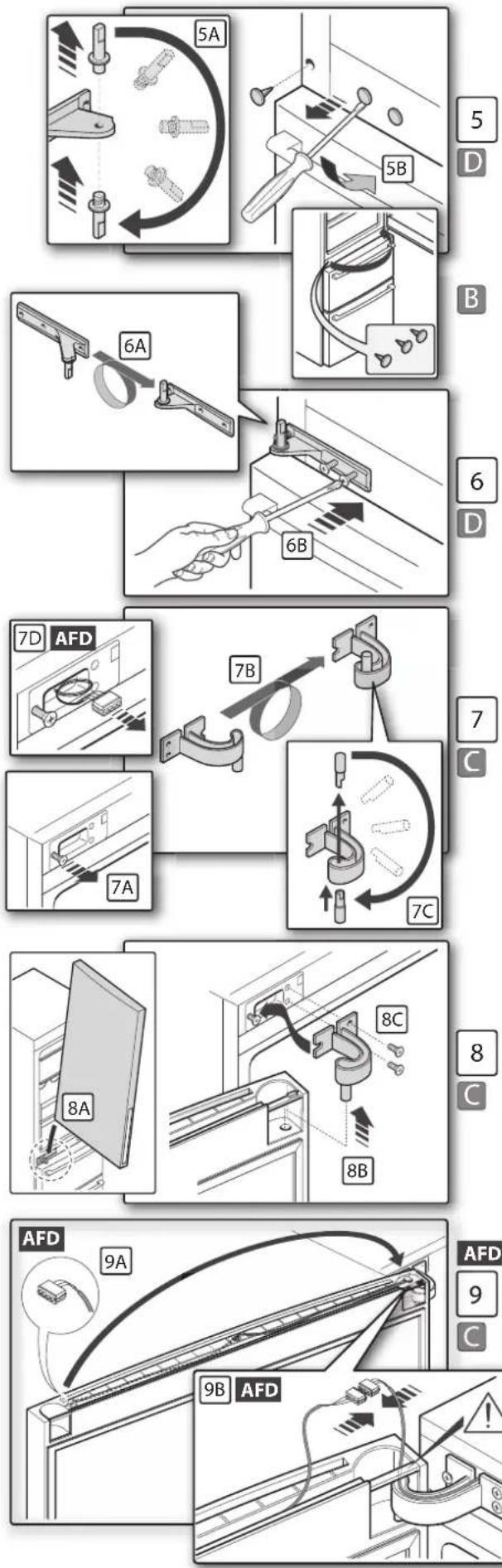
Door reversibility: mounting door from the left
5A) Take the central hinge, and with the aid of pliers, unscrew the pin, turn it upside down and re-fasten it on the hinge.
B) With the help of a normal screwdriver, withdraw the three hole-covers of the central cross piece from the left, and re-install them on the right.
6 A) Take the central hinge and turn it through 180^
B) fasten it with the screws on the left of the central crosspiece.
7 A) Slightly loosen the screw (already fitted) on the top left side of the appliance.
B) Take the top hinge and turn it upside down;
C) remove the pin (now high up) from the hinge and fit it in its lower part;
D) for AFD model only: extract the display cable from the compartment and provisionally let it hang from the appliance.
8A) Take the refrigerator door, and insert it on the pin of the central hinge,
B) Fit the upper hinge on the door and take it toward its location on the appliance
C) Insert the hinge slot on the screw at the left (loosened in step 7A);
secure the appliance's hinge, fastening two screws on it.
FAD model only: insert the display cable (removed in step 7D) inside the top slot of the hinge (see drawing 9B):
9 For AFD model only:
A) transfer the display cable, located in the slit above the refrigerator door, from left to right, always keeping it inside the slit;
B) route the cable inside the hinge slit under the door crossbeam and unite the two display cables.
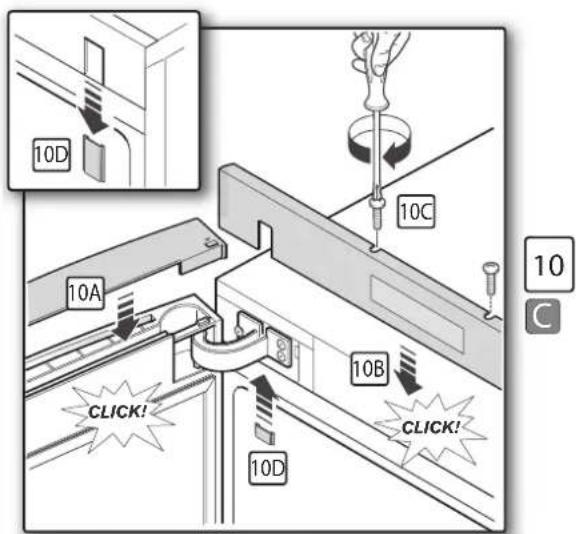
10 A) Click-fit the head (previously removed) on the top side of the refrigerator door.
B) Click-fit the front panel, applying pressure on several points;
C) secure it with two screws;
D) fit the clips on the right and left sides (previously removed).

9.TROUBLESHOOTING
1. POWER SUPPLY
| PROBLEMCHECKSSOLUTIONS | |
| APPLIANCE NOT OPERATING CHECK THE ELECTRICAL SYSTEM VISUALLY CHECK IF THE PLUG OF THE POWER CABLE IS CORRECTLY INSERTED IN THE POWER SOCKET; VISUALLY CHECK IF THE POWER CABLE AND PLUG HAVE BEEN DAMAGED. | CONTACT AN ELECTRICIAN; RECONNECT THE PLUG TO THE POWER SOCKET; CALL THE TECHNICAL SERVICE |
2. LIGHTING
| PROBLEMCHECKSSOLUTIONS | |
| INTERNAL LIGHT OFF WHEN DOOR OPENED | SEE POINT 1;
INTERNAL LIGHT OFF WHEN DOOR OPENED FAULTY LED BOARD: CALL THE TECHNICAL SERVICE.
NB: THE REPLACEMENT OPERATION MUST BE CARRIED OUT BY THE AUTHISED ASSISTANCE SERVICE |
3. TEMPERATURES TOO HIGH
| PROBLEMCHECKSSOLUTIONS | |
| INSUFFICIENT REFRIGERATOR
COOLING CAPACITY | MAKE SURE THAT FOOD IS NOT PLACED TOO NEAR THE
REFRIGERATOR WALLS AGAINST THE VENTILATION OPE-
NINGS; | RE-POSITION THE LOAD ADEQUATELY. |
| CORRECT CLOSURE OF THE DOORS AND ADHESION OF
SEALS; | CLOSE THE DOORS CORRECTLY AND CLEAN THE SEALS; |
| VALUE OF SET TEMPERATURE INCORRECT | SET THE TEMPERATURES (REFRIGERATOR/FREEZER) ACCOR-
DING TO THE INSTRUCTIONS IN THIS MANUAL; |
| MAKE SURE THAT THE APPLIANCE IS NOT INSTALLED NEAR
A HEAT SOURCE. | RE-POSITION THE APPLIANCE |
4.NOISES AND VIBRATIONS
| PROBLEMCHECKSSOLUTIONS | |
| APPLIANCE VIBRATING | MAKE SURE THAT THE APPLIANCE IS STABLE, WITH THE FEET CORRECTLY ADJUSTED; | ADJUST THE HEIGHT OF THE FEET WITH AN APPROPRIATE TOOL |
| COMPRESSOR NOISE | MAKE SURE THAT THE REAR OF THE APPLIANCE IS NOT TOO CLOSE TO THE WALL; | MOVE THE APPLIANCE; |
| NOISE INSIDE THE COMPRESSOR | CALL THE TECHNICAL SERVICE |
5. SMELLS
| PROBLEMCHECKSSOLUTIONS |
| BAD SMELLS ISSUING CHECK CORRECT PRESERVATION OF FOODS;CHECK IF THERE IS ANY LEAKAGE OF LIQUIDS INSIDE THE APPLIANCE;CHECK IF THERE ARE ANY BAD SMELLS ON THE SEALS;APPLIANCE OUT OF SERVICE FOR TOO LONG, WITH THE DOORS CLOSED. | COVER THE FOODS AND/OR USE PLASTIC CONTAINERS FOR PRESERVATION;CLEAN THE CELLS AND GLASS TOPS WITH A SPECIFIC REFRI-GERATOR DETERGENT;CLEAN THE SEALS WITH WATER AND VINEGAR;ASSESS THE CAUSE OF THE APPLIANCE 'S STOPPING . |
INDICE

- PRESENTATION 2

- SERVICE APRES-VENTE 2
Coupure du compartment frigidaire
Super congélation (Super Freeze)
Coupure du compartment frigidaire
E: Lade "Fresh Control 0^
F:Kenplaatje
G: Lade om fruit/groenten te bewaren
H:Usbakje
I: Schaal lade freezer
L: Interne lade freezer
M: Boterpotje