 ManualGo.com
 FIM 61 K.A IX - Four INDESIT - Free user manual and instructions
Find the device manual for free FIM 61 K.A IX INDESIT in PDF.


Download the instructions for your Four in PDF format for free! Find your manual FIM 61 K.A IX - INDESIT and take your electronic device back in hand. On this page are published all the documents necessary for the use of your device. FIM 61 K.A IX by INDESIT.
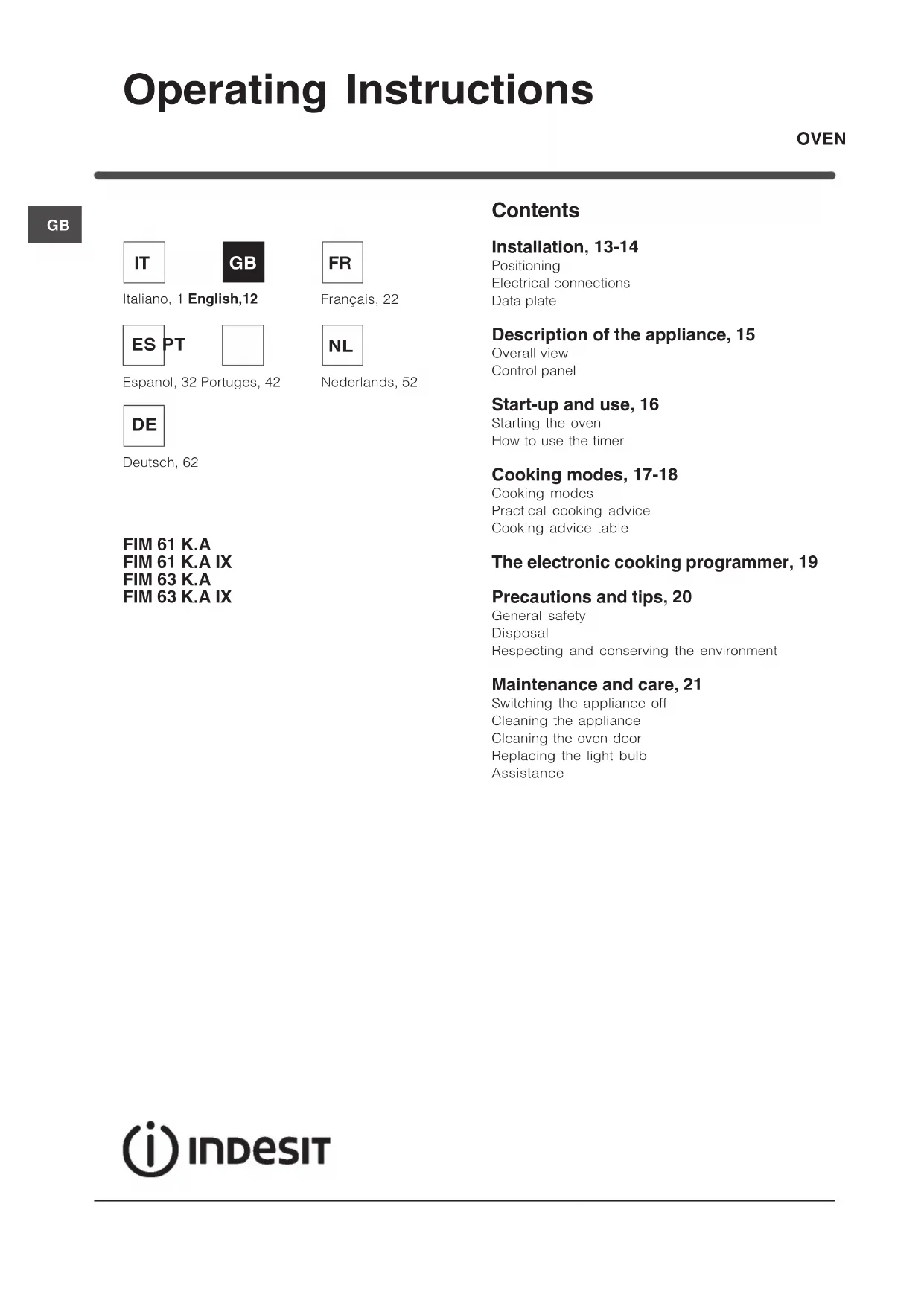
USER MANUAL FIM 61 K.A IX INDESIT
(N) Marrone (L) Giallo-
Electrical connections
Description of the appliance, 15
Start-up and use, 16
How to use the timer
Cooking modes, 17-18
Practical cooking advice
Cooking advice table
The electronic cooking programmer, 19
Precautions and tips, 20
Respecting and conserving the environment
Maintenance and care, 21
Switching the appliance off
Cleaning the appliance
Cleaning the oven door
Replacing the light bulb
Operating Instructions
! Before placing your new appliance into operation
please read these operating instructions carefully.
They contain important information for safe use, for
installation and for care of the appliance.
! Please keep these operating instructions for future
reference. Pass them on to possible new owners of
! Keep packaging material out of the reach of
children. It can become a choking or suffocation
see Precautions and tips
! The appliance must be installed by a qualified
person in compliance with the instructions provided.
Incorrect installation may cause harm to persons,
animals or may damage property.
Fitting the appliance
Use the appropriate cabinet to ensure that the
appliance functions properly.
• The panels adjacent to the oven must be made of
heat-resistant material.
• Cabinets with a veneer exterior must be assembled
with glues which can withstand temperatures of up
• to install the oven under the counter (
and in a kitchen unit, the cabinet must have the
following dimensions:
! The appliance must not come into contact with
electrical parts once it has been installed.
The consumption indications on the data plate have
been calculated for this type of installation.
To ensure good ventilation, the back panel of the
cabinet must be removed. It is advisable to install the
oven so that it rests on two strips of wood, or on a
completely flat surface with an opening of at least 45 x
Centring and fastening
Secure the appliance to the cabinet by opening the
oven door and putting 4 screws into the 4 holes of the
! All parts which ensure the safe operation of the
appliance must not be removable without the aid of a
GB Electrical connections
! Ovens equipped with a three-pole power supply
cable are designed to operate with alternating
current at the voltage and frequency indicated on
the data plate located on the appliance (
Fitting the power supply cable
1. Open the terminal
board by inserting a
screwdriver into the
side tabs of the cover.
Use the screwdriver as
a lever by pushing it
down to open the cover
Connect the wires to
terminals: the Blue wire
to the terminal marked
(N), the Brown wire to
the terminal marked (L)
and the Yellow/Green
wire to the terminal
3. Secure the cable by fastening the clamp screw.
4. Close the cover of the terminal board.
Connecting the supply cable to the mains
Install a standardised plug corresponding to the load
indicated on the data plate (
The appliance must be directly connected to the
mains using an omnipolar circuit-breaker with a
minimum contact opening of 3 mm installed between
the appliance and the mains, suitable for the load
indicated and complying with current electrical
regulations (the earthing wire must not be interrupted
by the circuit-breaker). The supply cable must not
come into contact with surfaces with temperatures
! The installer must ensure that the correct electrical
connection has been made and that it is compliant
with safety regulations.
Before connecting to the power supply, make sure
• The appliance is earthed and the plug is
compliant with the law.
• The socket can withstand the maximum power of
the appliance, which is indicated on the data plate
• The voltage must be in the range between the
• The socket is compatible with the plug of the
appliance. If the socket is incompatible with the
plug, ask an authorised technician to replace it. Do
not use extension cords or multiple sockets.
! Once the appliance has been installed, the power
supply cable and the electrical socket must be easily
! The cable must not be bent or compressed.
! The cable must be checked regularly and replaced
by authorised technicians only (
! The manufacturer declines any liability should
these safety measures not be observed. DATA PLATE Dimensions width cm 43.5 height cm 32 depth cm 40 Volume lt. 56 Electrical connections voltage: 220-240V ~ 50/60 maximum power absorbed 2800W ENERGY LABEL Directive 2002/40/EC on the label of electric ovens. Norm EN 50304 Energy consumption for Natural convection – heating mode: Traditional mode Declared energy consumption for Forced convection Class – heating mode: Baking
This appliance conforms to the following European Economic Community directives: -2006/95/EEC of 12/12/06 (Low Voltage) and subsequent amendments; - 2004/108/EEC of 15/12/04 (Electromagnetic Compatibility) and subsequent amendments; - 93/68/EEC of 22/07/93 and subsequent amendments. - 2002/96/EC and subsequent amendments.
GB Description of the appliance
* Only on certain models
position 1 SELECTOR knob THERMOSTAT knob THERMOSTATindicator lightTIMERknob*SELECTOR knob THERMOSTAT knob THERMOSTATindicator lightELECTRONICprogrammer*16
GB ! The first time you use your appliance, heat theempty oven with its door closed at its maximumtemperature for at least half an hour. Ensure that theroom is well ventilated before switching the oven offand opening the oven door. The appliance mayproduce a slightly unpleasant odour caused by theburning away of protective substances used duringthe manufacturing process. Starting the oven 1. Select the desired cooking mode by turning theSELECTOR knob.2. Select the desired temperature with theTHERMOSTAT knob. See the Cooking advice table forcooking modes and the suggested cookingtemperatures ( see Cooking Modes
). 3. When preheating is finished, the THERMOSTATindicator light will stay on: place the food in the oven.4. You may do the following during cooking:- change the cooking mode by turning the SELECTORknob.- change the temperature by turning theTHERMOSTAT knob.- stop cooking by turning the SELECTOR knob to the“0” position.! Never put objects directly on the oven bottom toavoid damaging the enamel coating.! Always place cookware on the rack(s) provided.Cooling ventilationIn order to cool down the external temperature of theoven, some models are fitted with a cooling fan thatblows out air between the control panel and the ovendoor.! Once the cooking has been completed, the coolingfan remains on until the oven has cooled downsufficiently.Oven lightIt goes on when selecting with the SELECTORknob. It stays on when a cooking mode is selected. How to use the timer
* 1. To set the buzzer, turn the TIMER knob clockwisealmost one complete revolution.2. Turn the knob anticlockwise to set the desiredtime: align the minutes shown on the knob with theindicator on the control panel.3. The timer operates in minutes: when the selectedtime has elapsed, a buzzer will sound.! The timer does not turn the oven on or off. Start-up and use * Only on certain models17
! A temperature value can be set for all cooking
modes between 60°C and MAX, except for the
BARBECUE programme, for which only the MAX
power level is recommended.
TRADITIONAL OVEN mode
Both the top and bottom heating elements will come
on. With this traditional cooking mode, it is best to use
one cooking rack only; if more than one rack is used,
the heat will be distributed unevenly.
All the heating elements (top, bottom and circular),
as well as the fan, will come on. Since the heat
remains constant throughout the oven, the air cooks
and browns food uniformly. A maximum of two racks
may be used at the same time.
The bottom and circular heating elements, as well as
the fan, will come on. This combination heats the
oven rapidly by producing a considerable amount of
heat, particularly from the bottom element. If you
use more than one rack simultaneously, switch the
position of the dishes halfway through the cooking
The top heating element comes on.
The high and direct temperature of the grill is
recommended for food that requires high surface
temperature. Always cook in this mode with the oven
The top heating element, as well as the fan, will
come on. This combination of features increases the
effectiveness of the unidirectional thermal radiation
of the heating elements through forced circulation of
the air throughout the oven. This helps prevent food
from burning on the surface, allowing the heat to
penetrate right into the food. Always cook in this
mode with the oven door closed.
The rear heating element and the fan come on,
guaranteeing the distribution of heat delicately and
uniformly throughout the oven. This mode is ideal for
baking and cooking temperature sensitive foods
such as cakes that need to rise and to prepare
certain tartlets on 3 shelves simultaneously.
Practical cooking advice
! Do not place racks in position 1 and 5 during fan-
assisted cooking. Excessive direct heat can burn
temperature sensitive foods.
! In the BARBECUE and GRATIN cooking modes,
place the dripping pan in position 1 to collect
cooking residues (fat and/or grease).
• Use position 2 and 4, placing the food that
requires more heat on 2.
• Place the dripping pan on the bottom and the rack
• Insert the rack in position 3 or 4. Place the food in
the centre of the rack.
• We recommend that you set the maximum power
level. The top heating element is regulated by a
thermostat and may not always be on.
• Use a light aluminium pizza pan. Place it on the
For a crispy crust, do not use the dripping pan
(prevents crust from forming by extending
• If the pizza has a lot of toppings, we recommend
adding the mozzarella cheese on top of the pizza
halfway through the cooking process.18
Rack position Pre-heating
Oven Duck Roast veal or beef Pork roast Biscuits (short pastry) Tarts 1
180 65-75 70-75 70-80 15-20 30-35 Multi-cooking Pizza (on 2 racks) Lasagne Lamb Roast chicken + potatoes Mackerel Plum cake Cream puffs (on 2 racks) Biscuits (on 2 racks) Sponge cake (on 1 rack) Sponge cake (on 2 racks) Savoury pies 1
2 2 and 4 2 and 4 2 2 and 4 3
Gratin Grilled chicken Cuttlefish 1.5
180 15-20 25-30 60-70 Baking Mode Tarts Fruit cakes Plum cake Sponge cake Stuffed pancakes (on 2 racks) Small cakes (on 2 racks) Cheese puffs (on 2 racks) Cream puffs (on 3 racks) Biscuits (on 3 racks) Meringues (on 3 racks) 0.5
3 2 and 4 2 and 4 2 and 4 1 and 3 and 5 1 and 3 and 5 1 and 3 and 5 15
! cooking times are approximate and may vary according to personal taste. When cooking using the grill or
pan must always be placed on the 1st oven rack from the bottom.
Cooking advice table19
GB The electronic cooking
programmer DISPLAYSET TIMEbuttonEND OFCOOKING iconCLOCK iconDURATION icon TIMER iconDECREASE TIMEbuttonINCREASE TIMEbutton •• ••
! The clock may be set when the oven is switched
off or when it is switched on, provided that a the end
time of a cooking cycle has not been programmed
After the appliance has been connected to the
mains, or after a blackout, the
numerical digits on the DISPLAY will begin to flash.
button several times until the
icon and the four digits on the display begin to
2. Use the “+” and “-” buttons to adjust the time; if
you press and hold either button, the display will
scroll through the values more quickly, making it
quicker and easier to set the desired value.
3. Wait for 10 seconds or press the
to finalise the setting.
! This function does not interrupt cooking and does
not affect the oven; it is simply used to activate the
buzzer when the set amount of time has elapsed.
button several times until the
icon and the three digits on the display begin to
2. Use the “+” and “-” buttons to set the desired
time; if you press and hold either button, the display
will scroll through the values more quickly, making it
quicker and easier to set the value.
3. Wait for 10 seconds or press the
to finalise the setting.
The display will then show the time as it counts
down. When this period of time has elapsed the
buzzer will be activated.
! A cooking mode must be selected before
programming can take place.
Programming the cooking duration
button several times until the
icon and the three digits on the DISPLAY begin to
2. Use the “+” and “-” buttons to set the desired
duration; if you press and hold either button, the
display will scroll through the values more quickly,
making it quicker and easier to set the value.
3. Wait for 10 seconds or press the
to finalise the setting.
4. When the set time has elapsed, the text END
appears on the DISPLAY, the oven will stop cooking
and a buzzer sounds.
• For example: it is 9:00 a.m. and a time of 1 hour
and 15 minutes is programmed. The programme
will stop automatically at 10:15 a.m.
Setting the end time for a cooking mode
! A cooking duration must be set before the cooking
end time can be scheduled.
1. Follow steps 1 to 3 to set the duration as detailed
button until the icon and
the four digits on the DISPLAY begin to flash.
3. use the “+” and “-” buttons to adjust the cooking
end time; if you press and hold either button, the
display will scroll through the values more quickly,
making it quicker and easier to set the desired
4. Wait for 10 seconds or press the
to finalise the setting.
5. When the set time has elapsed, the text END
appears on the DISPLAY, the oven will stop cooking
and a buzzer sounds.
Programming has been set when the
buttons are illuminated. The DISPLAY shows the
cooking end time and the cooking duration
Cancelling a programme
To cancel a programme:
button until the icon corresponding to
the setting you wish to cancel and the digits on the
display are no longer flashing. Press the “-” button
until the digits 00:00 appear on the display.
• Press and hold the “+” and “-” buttons; this will
cancel all the settings selected previously,
including timer settings.20
GB Precautions and tips
! The appliance was designed and manufactured in
compliance with international safety standards. The
following warnings are provided for safety reasons and
must be read carefully.
• The appliance was designed for domestic use
inside the home and is not intended for commercial
• The appliance must not be installed outdoors, even
in covered areas. It is extremely dangerous to leave
the appliance exposed to rain and storms.
• When handling the appliance, always use the
handles provided on the sides of the oven.
• Do not touch the appliance with bare feet or with wet
or moist hands and feet.
• The appliance must be used by adults only for
the preparation of food, in accordance with the
instructions outlined in this booklet. Any other
use of the appliance (e.g. for heating the room)
constitutes improper use and is dangerous. The
manufacturer may not be held liable for any
damage resulting from improper, incorrect and
unreasonable use of the appliance.
• When the appliance is in use, the heating
elements and some parts of the oven door
become extremely hot. Make sure you don't
touch them and keep children well away.
• Ensure that the power supply cable of other
electrical appliances does not come into contact
with the hot parts of the oven.
• The openings used for ventilation and dispersion of
heat must never be covered.
• Always grip the oven door handle in the centre: the
• Always use oven gloves to place cookware in the
oven or when removing it.
• Do not use aluminium foil to line the bottom of the
• Do not place flammable materials in the oven: if the
appliance is switched on by mistake, it could catch
• Always make sure the knobs are in the “”/“ ” position when the appliance is not in use.
• When unplugging the appliance always pull the plug
from the mains socket, do not pull on the cable.
• Never carry out any cleaning or maintenance work
without having unplugged the plug from the mains.
• In the case of a malfunction, under no
circumstances should you attempt to repair the
appliance yourself. Repairs carried out by
inexperienced persons may cause injury or further
malfunctioning of the appliance. Contact a Service
• Do not rest heavy objects on the open oven door.
• The appliance should not be operated by people
(including children) with reduced physical, sensory
or mental capacities, by inexperienced individuals
or by anyone who is not familiar with the product.
These individuals should, at the very least, be
supervised by someone who assumes responsibility
for their safety or receive preliminary instructions
relating to the operation of the appliance.
• Do not let children play with the appliance.
• Observe local environmental standards when
disposing packaging material for recycling
purposes. Observe existing legislation when
disposing of the old appliance.
• The European Directive 2002/96/EC on Waste
Electrical and Electronic Equipment (WEEE),
requires that old household electrical appliances
must not be disposed of in the normal unsorted
municipal waste stream. Old appliances must be
collected separately in order to optimise the
recovery and recycling of the materials they contain
and reduce the impact on human health and the
environment. The crossed out “wheeled bin” symbol
on the product reminds you of your obligation, that
when you dispose of the appliance it must be
separately collected.
Consumers should contact their local authority or
retailer for information concerning the correct
disposal of their old appliance.
Respecting and conserving the
• By using the appliance in the hours between late
afternoon and early morning, you can help reduce
the work load placed on electrical companies.
• Always keep the oven door closed when using the
GRILL and GRATIN mode to attain best results and
to save energy (approximately 10%).
• Regularly check the door seals and wipe clean to
ensure they are free of debris so that they stick
properly to the door and do not allow heat to
GB Switching the appliance off
Disconnect your appliance from the electricity
supply before carrying out any work on it.
Cleaning the appliance
! Never use steam cleaners or pressure cleaners on
• The stainless-steel or enamel-coated external
parts as well as the rubber seals may be cleaned
using a sponge that has been soaked in
lukewarm water and neutral soap. If these stains
are difficult to remove, use only specialised
products. After cleaning, rinse and dry
thoroughly. Do not use abrasive powders or
corrosive substances.
• Ideally, the inside of the oven should be cleaned
after each use, when it is still lukewarm. Use hot
water and detergent, rinse and dry with a soft
cloth. Do not use abrasive products.
• The accessories can be washed like everyday
crockery (even in your dishwasher).
Cleaning the oven door
Clean the glass part of the oven door using a
sponge and a non-abrasive cleaning product, then
dry thoroughly with a soft cloth. Do not use rough
abrasive material or sharp metal scrapers as these
could scratch the surface and cause the glass to
To clean more thoroughly, you can remove the oven
1. Open the oven door fully
2. Lift up and turn the small
levers located on the two
3. Grip the door on the two
external sides and close it
approximately half way. Then
pull the door towards you
lifting it out of its seat (
Inspecting the seals
Check the door seals around the oven periodically. If
the seals are damaged, please contact your nearest
After-sales Service Centre (
recommend not using the oven until the seals have
Replacing the light bulb
To replace the oven light bulb:
1. Remove the glass cover of the lamp-holder.
2. Remove the light bulb and replace it with a similar
one: Wattage 25 W, cap E 14.
3. Replace the glass cover (
! Never use the services of an unauthorised
Please have the following information handy:
• The type of problem encountered.
• The appliance model (Mod.).
• The serial number (S/N).
The latter two pieces of information can be found on
the data plate located on the appliance.
Maintenance and careFIM 61 K.A FIM 61 K.A IX FIM 63 K.A FIM 63 K.A IX Sommaire
cabeças dos parafusos
a obedecer as cores:
Azul (N) Castanho (L)
as regras locais, de maneira que as embalagens
2. levante e rode as