32PFL7532D - TV PHILIPS - Free user manual and instructions
Find the device manual for free 32PFL7532D PHILIPS in PDF.



User questions about 32PFL7532D PHILIPS
0 question about this device. Answer the ones you know or ask your own.
Ask a new question about this device
Download the instructions for your TV in PDF format for free! Find your manual 32PFL7532D - PHILIPS and take your electronic device back in hand. On this page are published all the documents necessary for the use of your device. 32PFL7532D by PHILIPS.
USER MANUAL 32PFL7532D PHILIPS
natural_image
Two Philips TV screens shown from different angles, one blank and one tilted (no text or symbols visible)PHILIPS
ADDENDUM
Important Customer Information
English
Because of the advanced technology used in your Philips Digital TV and our commitment to continually providing you with the most up-to-date product performance, we would like to highlight the following.
After you turn off your TV set in a dark room, you may notice a very faint light emitted from the screen for a few minutes. This is because the TV is scanning the network for possible software updates and new services. This is normal operation and is in accordance with all stringent quality and safety standards Philips delivers.
Information clientèle importante
Français
Thank you for purchasing this television set.
This handbook has been designed to help you install and operate your TV set.
We would strongly recommend that you read it thoroughly.
Presentation of the television 2
Remote control 2
Digital or Analogue channels ? 2
The remote control keys ....3
Mode selector 4
Installing your television set.... 4
Switching on for the first time .... 5
Understanding the information on the banner 5
6 Rearrange services 6
View or Listen to new TV services 6
Add new services 6
∑ Reinstall all services ....7
Test reception 7
Language and location preferences 8
Access restrictions 8
Setting up your favourite list 9
Information menu 9
- Downloading new software ....9
Using the Options menu ....10
TV guide 10
Recording function 11
Automatic tuning of analogue programmes 12
Program sort 12
Manual tuning of analogue programmes 12
Other settings in the install menu .... 13
Picture settings 13
Sound adjustments....13
Feature settings 13
Screen Formats 14
◀ Digital text....14
Z Analogue Teletext 15
Using in the PC monitor mode....16
Using in the HD (high definition) mode....17
Connecting peripheral equipment....18
Tips....20

Recycling
The packaging of this product is intended to be recycled. Apply to the local authorities for correct disposal.
Disposal of your old product
Your product is designed and manufactured with highly quality material and components, which can be recycled and reused. When this crossed-out wheeled bin symbol is attached to a product, it means the product is covered by the European Directive 2002/976/EC.
Please inform yourself about the local separate collection system for electrical and electronic products.
Please act according to your local rules and do not dispose of your old products with your normal household waste. The correct disposal of your old product will help prevent potential negative consequences for the environment and human health.

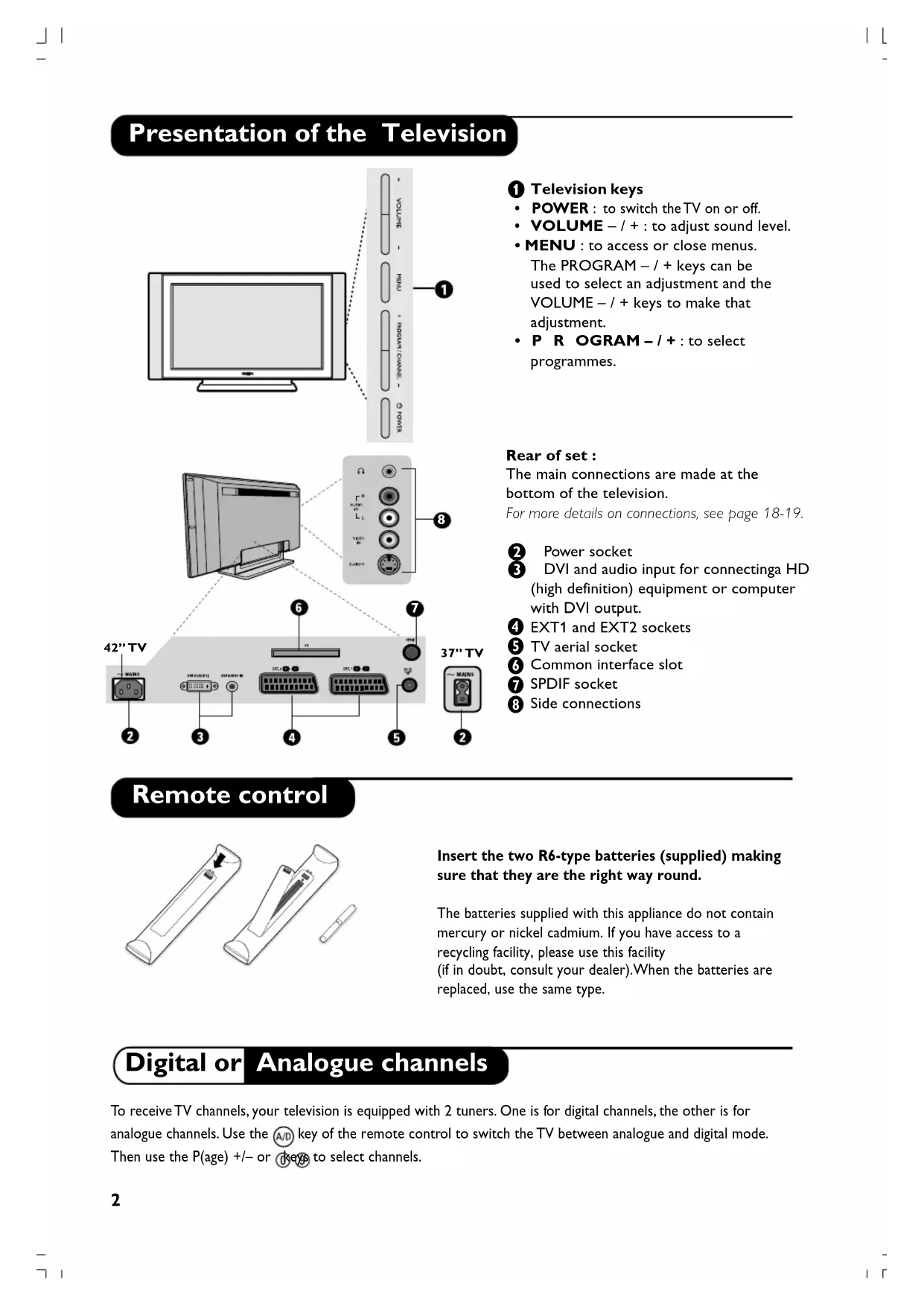
Presentation of the Television
text_image
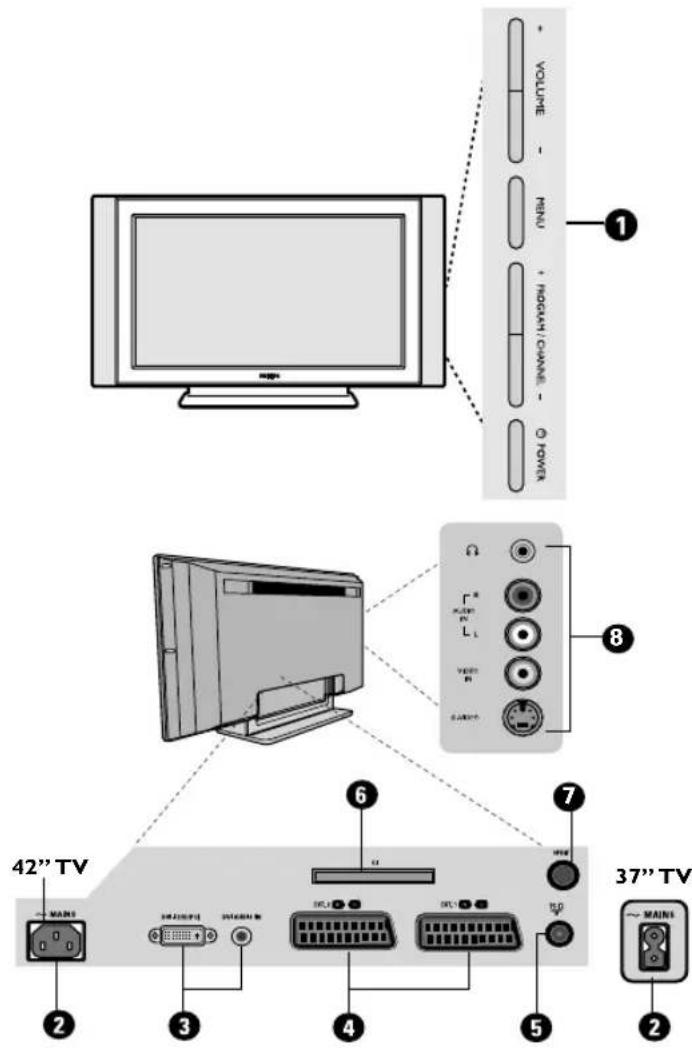
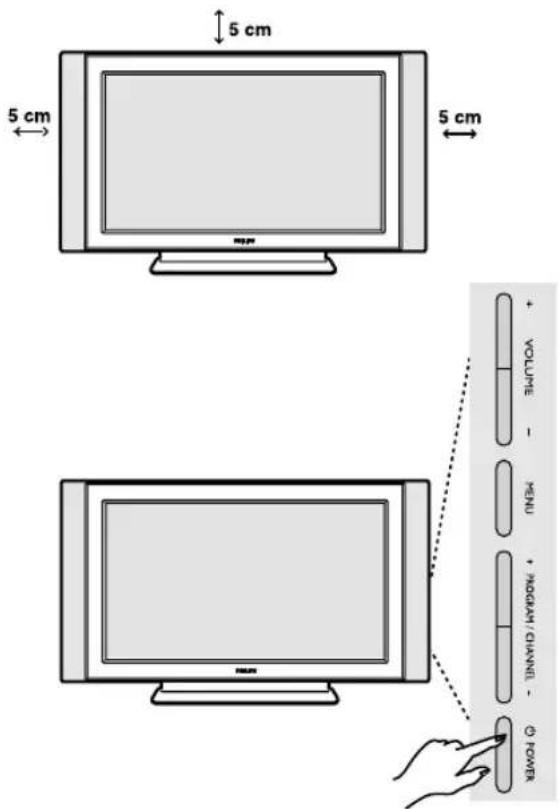
1 + VOLUME - PINU + TOMA1 TOWA1- TOWA 2 42" TV 37" TV 6 7 8 9 10 11 12 13 14 15 16 17 18 19 20 21 22 23 24 25 26 27 28 29 30 31 32 33 34 35 36 37① Television keys
• POWER : to switch the TV on or off.
• VOLUME - / + : to adjust sound level.
- MENU : to access or close menus.
The PROGRAM - / + keys can be used to select an adjustment and the VOLUME - / + keys to make that adjustment.
- P R OGRAM - / + : to select programmes.
Rear of set :
The main connections are made at the bottom of the television.
For more details on connections, see page 18-19.
2 Power socket
3 DVI and audio input for connectinga HD (high definition) equipment or computer with DVI output.
4 EXT1 and EXT2 sockets
⑤ TV aerial socket
6 Common interface slot
⑦ SPDIF socket
8 Side connections
Remote control
natural_image
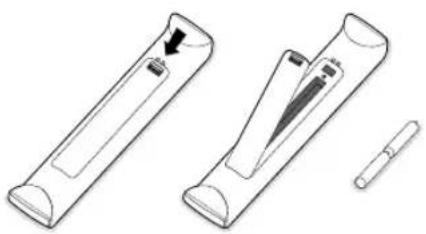
Technical line drawing of two mechanical components with a separate cylindrical part, no text or symbols presentInsert the two R6-type batteries (supplied) making sure that they are the right way round.
The batteries supplied with this appliance do not contain mercury or nickel cadmium. If you have access to a recycling facility, please use this facility (if in doubt, consult your dealer). When the batteries are replaced, use the same type.
Digital or Analogue channels
To receive TV channels, your television is equipped with 2 tuners. One is for digital channels, the other is for analogue channels. Use the A/D key of the remote control to switch the TV between analogue and digital mode. Then use the P(age) +/- or keys to select channels.
The remote control keys
text_image
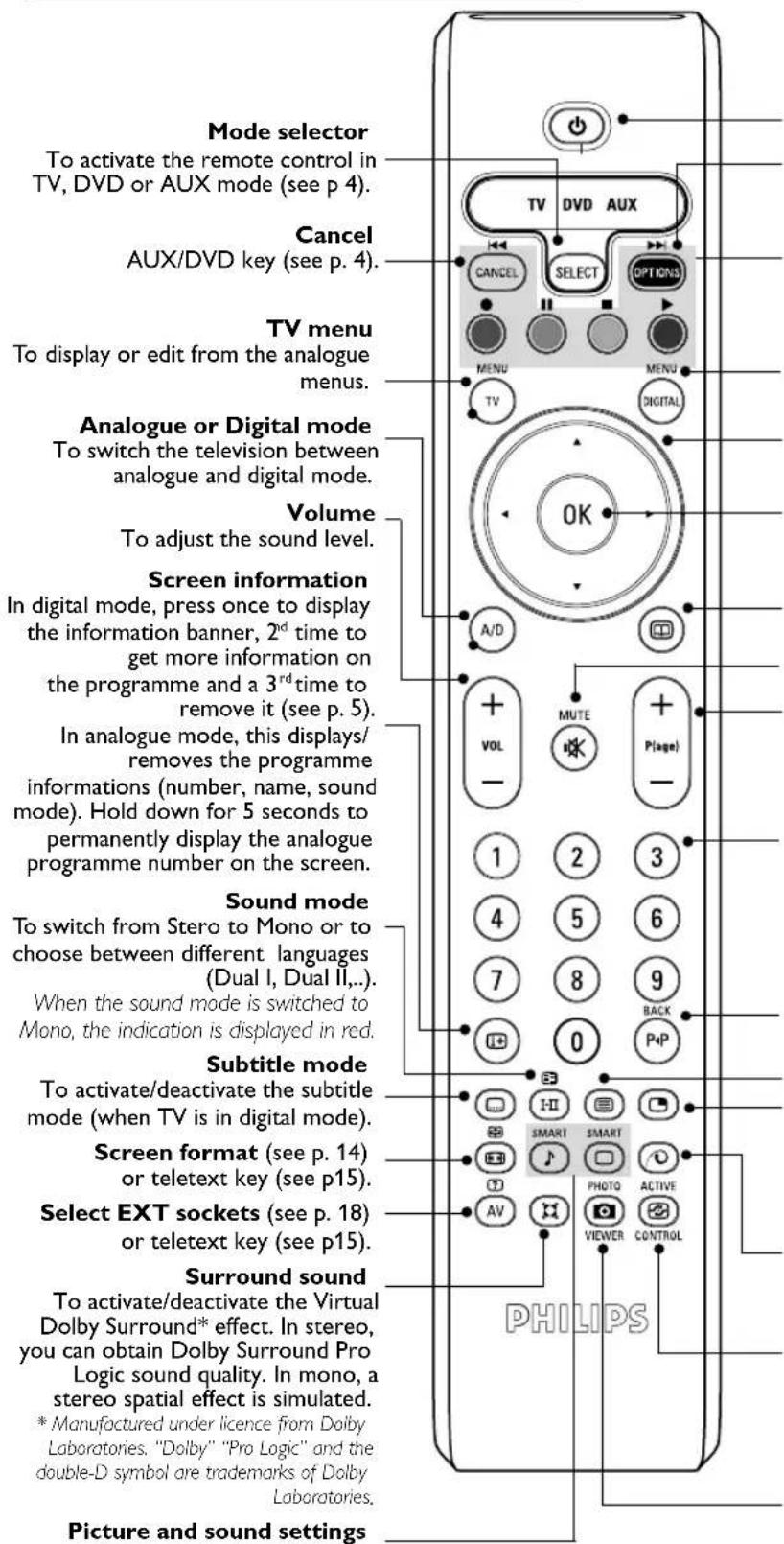
Mode selector To activate the remote control in TV, DVD or AUX mode (see p 4). Cancel AUX/DVD key (see p. 4). TV menu To display or edit from the analogue menus. Analogue or Digital mode To switch the television between analogue and digital mode. Volume To adjust the sound level. Screen information In digital mode, press once to display the information banner, 2ndtime to get more information on the programme and a 3rdtime to remove it (see p. 5). In analogue mode, this displays/ removes the programme informations (number, name, sound mode). Hold down for 5 seconds to permanently display the analogue programme number on the screen. Sound mode To switch from Stereo to Mono or to choose between different languages (Dual I, Dual II,...). When the sound mode is switched to Mono, the indication is displayed in red. Subtitle mode To activate/deactivate the subtitle mode (when TV is in digital mode). Screen format (see p. 14) or teletext key (see p15). Select EXT sockets (see p. 18) or teletext key (see p15). Surround sound To activate/deactivate the Virtual Dolby Surround* effect. In stereo, you can obtain Dolby Surround Pro Logic sound quality. In mono, a stereo spatial effect is simulated. * Manufactured under licence from Dolby Laboratories. "Dolby" "Pro Logic" and the double-D symbol are trademarks of Dolby Laboratories. Picture and sound settingsStandby
To set the TV to standby mode. To switch the TV set on again, press

Options menu (see p. 10).
Teletext features (see p. 15) and AUX/DVD keys (p. 4).
Digital menu
To display or exit from the digital menus (when TV is in digital mode).
Cursor
These 4 keys are used to move within the menu or to directly access the screen formats.
OK
Confirms selection. Also access program list in Analogue or Digital mode.
TV guide (see p. 10).
Mute
To disable or enable the sound.
Programme selection
To access the next or previous programme (or page in digital menus).
Numerical keys
For direct access to programmes. For a 2 (3) digit programme number, the second (third) digit must be entered before the dash disappears. The number, the name (and the sound mode, in analogue mode) are displayed for a few seconds.
Previous programme
To access the previously viewed programme. In Digital mode, it also used as an edit or back space key.
Teletext feature (see p. 15)
PIP on/off
Display PIP screen on TV. Subsequent presses of the key changes size of the window. For display of PIP screen in PC or HD mode, see p. 18.
Pixel + (depending on version) Switches the Pixel + demonstration mode on or off.
Active control
Optimises the picture quality depending on the quality of the incoming signal and ambient light conditions.
Unused key.
Picture and sound settings
Accesses a series of picture and sound settings.
The position Personal corresponds to the settings stored in the menus.
Mode selector
Press the SELECT (SELECT) key to select the required mode: DVD or AUX (amplifier). The remote control indicator lights up to display the selected mode. It switches off automatically after 20 seconds if left idle. The remote control automatically returns to TV mode.
The following keys are operational depending on the equipment :


fast rewind

fast forward

recording


stop

play

tv menu

cancel
OK validation

navigation and adjustments

digit keys

programme selection

audio selection

menu
Installing your television set
text_image
5 cm 5 cm + VOLUME - MENU + PROGRAM CHANNEL - Φ FOMTA① Positioning the television set
Place your TV on a solid stable surface. To avoid danger, do not expose the TV to water or a heat source (e.g. lamp, candle, radiator). Do not obstruct the ventilation grid at the rear
② Connecting the aerials
- Use the aerial connection lead supplied and connect the T socket situated at the bottom of the TV to your aerial socket.
- Connect the power lead to the television and the mains plug into the wall socket (220-240V/50 Hz).
For connecting other appliances, see pages 18-19.
3 Switching on
To switch on the set, press the POWER key. A green indicator comes on and the screen lights up. Go straight to the chapter "Switching on for the first time on page 5. If the television remains in standby mode, press the P(age) + key on the remote control.
The indicator will flash when you use the remote control.
Switch on for the first time
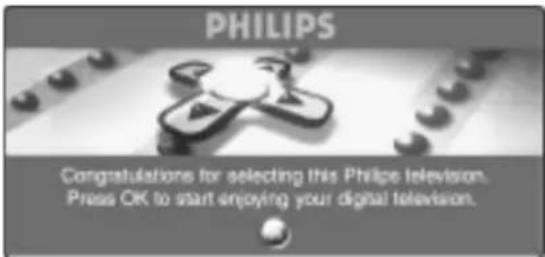
The first time the TV set is switched on, a congratulation message will appear on screen. The language of which changes every 5 seconds. If the menu is not displayed, press and hold down the MENU key on the side of the TV set for 5 seconds to display the menu.
text_image
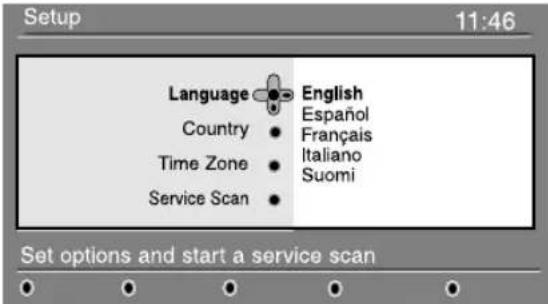
PHILIPS Congratulations for selecting this Philips television. Press OK to start enjoying your digital television.1 Press the OK key on the remote control, the moment your preferred language is visible on the screen. The Setup menu is displayed:
text_image
Setup 11:46 Language Country Time Zone Service Scan English Espanol Français Italiano Suomi Set options and start a service scan② The language, corresponding country and time zone is now preselected according to the opening screen. However, you can still change your preferences before you start a service scan.
② The language, corresponding country and time zone is now preselected according to the opening screen. However, you can still change your preferences before you start a service scan.
③ With the cursor keys, select language, country or Time zone and check if the adjustment is according to your preferences. If necessary, use the cursor keys to make your adjustment and press OK to exit.
CAUTION : if you select a wrong country, the channel numbering will not be according to the standard for your country.
4 Select service scan from the menu and press OK to start the installation. The service scan menu is displayed. All the digital and analogue programmes are searched for and stored automatically. When the search is complete, the menu will indicate the number of digital services and analogues programmes found.
5 Press the OK key twice to start watching TV. The television then displays the current programme. The installation is now complete.
NOTE : If at some point of time you decide to reset to the factory default settings, press and hold down the MENU key on the side of the TV set for 5 seconds. A congratulation message will appear on screen. Repeat steps 1 - 5 as if this was the first time you have turned on the TV.
Understanding the information in the banner
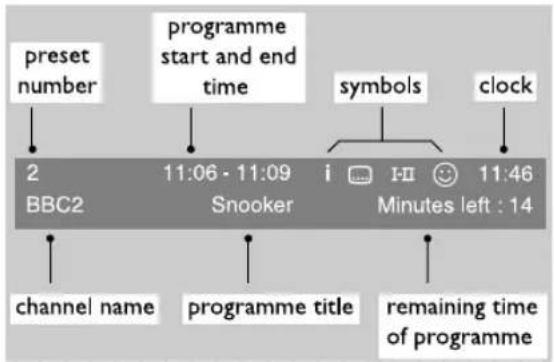
When you select a digital programme, an information banner is displayed for a few seconds at the top of the screen.
You can also use the Ⓗ key of the remote control to display this banner. A second press displays more information about the programme (when available).
Banner description
flowchart
graph TD
    A["preset number"] --> B["2 BBC2"]
    C(programme start and end time] --> D["11:06 - 11:09 Snooker"]
    E["symbols"] --> F["i i HD 11:46 Minutes left : 14"]
    G["clock"] --> H[" "]
    I["channel name"] --> J[" "]
    K(programme title] --> L[" "]
    M["remaining time of programme"] --> N[" "]
The banner contains information on the preset number, channel name, programme duration, transmission clock, programme title and the time remaining of the current programme.
Symbols description :
i more information about this programme is available: press the Ⓗ key to display or remove it.
☐ subtitling is available: if you want to display them, press the ☐ key or the OPTIONS key to access the options menu and select subtitles.
I-II other audio languages are available and can be selected in the options menu.
the selected Favourite list is displayed in the one of the colour (red, green, yellow or blue) of the activated list.
Note: A white colour 😊 will appear if the programme is stored in one or more of the favourite list which is currently not activated.
Rearrange services
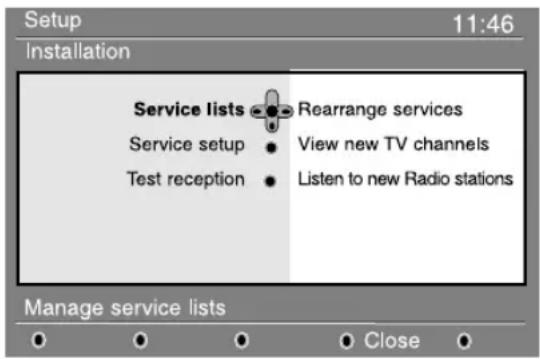
This menu allows you to change the order of the stored digital channels and radio stations.
① From the digital mode, press the Key to display the setup menu.
② Use the ▼ key to select installation and press ▶ twice to select the Service lists menu.
text_image
Setup 11:46 Installation Service lists Service setup Test reception Rearrange services View new TV channels Listen to new Radio stations Manage service lists Close③ Use the ▲▼ keys to select Rearrange services and press ▶.
④ Use the ▲ ▼ keys to select the channel you want to exchange.
5 Press OK to activate.
If you want to uninstall the selected channel, press the red key.
6 Select (▲▼) the new channel number you want to exchange it with.
7 Press OK to confirm. The exchange is done.
⑧ Repeat the operations ④ to ⑦ until all the channels are in the required order.
9 Press the MENU DIGITAL key to leave the menu.
View or Listen to new services
This menu allows you to check the availability of new TV channels or new radio stations that have been launched by the broadcaster after the initial installation.
① From the digital mode, press the Ⓗ key to display the setup menu.
② Use the ▼ key to select installation and press ▶ twice to select the Service lists menu.
③ Use the ▲▼ keys to select View new TV channels or Listen to new Radio station.
4 If new services are available, press ▶ to enter into the list and use the ▲▼ keys to move through the list.
5 Press the MENU DIGITAL key to leave the menu.
Add new services
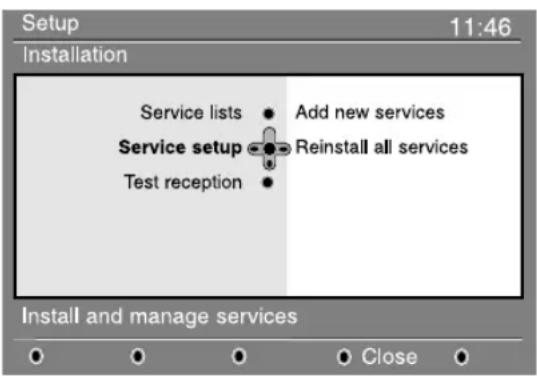
This menu allows you to search for new TV channels or radio stations that have been launched by the broadcaster after the initial installation.
text_image
Setup 11:46 Installation Service lists Add new services Service setup Reinstall all services Test reception Install and manage services Close① From the digital mode, press the ☑ key to display the setup menu.
② Use the ▼ key to select installation and press ▶.
③ Select Service setup (▼) and press ▶
4 Press ▶ to select Add new services and press OK to activate the installation.
The search begins and only new channels will be stored and added to the channel list menu. The percentage of the installation that has been completed and the number of channels found is displayed.
5 When the search is complete, select Store and press OK to accept the new services.
6 Press the MENU DIGITAL key to leave the menu.
Reinstall all services
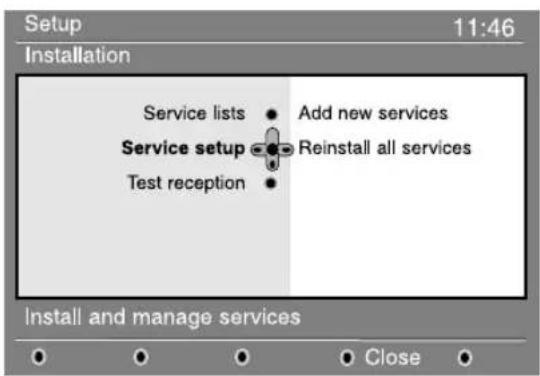
This menu allows you to reinstall all the digital TV channels and radio stations.
From the digital mode, press the key to display the setup menu.
text_image
Setup 11:46 Installation Service lists Add new services Service setup Reinstall all services Test reception Install and manage services Close② Use the ▼ key to select installation and press ▶.
③ Select Service setup (▼) and press ▶.
④ Select Reinstall all services (▼) and press ▶.
5 Press OK to start the installation.
A search is then made for all digital services which are then stored automatically.
When the search is completed, the menu will indicate the number of digital services found.
6 When the search is complete, press OK to store the services.
⑦ Press the MENU DIGITAL key to leave the menu.
Test reception
This menu allows you to check the strength of the signal you are receiving through your aerial.
① From the digital mode, press the Ⓜ key to display the setup menu.
② Use the ▼ key to select installation and press ▶ to display the installation menu.

text_image
Setup 11:46 Installation Service lists • Frequency Service setup • Network name Test reception • Signal quality Signal strength Test signal quality • • • • • Close •③ Use ▼ to select Test reception and press ▶. You obtain an indication of the actual programme frequency, the network name, the signal quality and strength.
4 You now have to enter the frequency of the digital channel you want to test.
Your TV magazine can provide the list of digital channel numbers. Use the table on page 20 to get the frequency.
5 If the signal quality and strength is poor, a message appears at the bottom of the menu prompting you to enter the frequency between the lower and the higher limit. If after keying the frequency, the reception is still poor, you can try improving, renewing, adjusting or updating the aerial. It is however advisable to contact a specialised aerial installer in order to achieve best results.
Language and location preferences
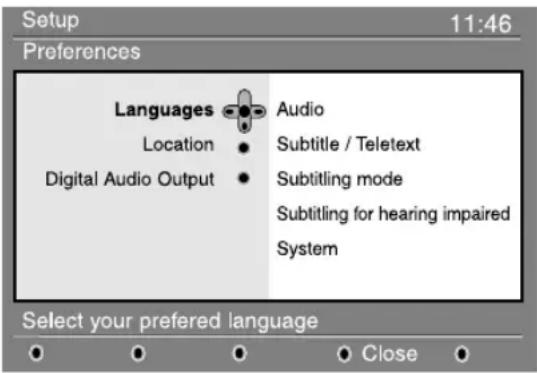
This menu allows you to select your preferred language for audio, subtitle, teletext and menu and make changes to the location (country and time zone).
① From the digital mode, press the key
to display the setup menu.
② Use the ▼ key to select preferences and press ▶.
text_image
Setup 11:46 Preferences Languages Location Digital Audio Output Audio Subtitle / Teletext Subtitling mode Subtitling for hearing impaired System Select your preferred language③ Select Languages, Location or Digital Audio Output (▼) and press ▶.
④ Use the ▲▼ keys to select a setting and
press ▶ to enter into the sub-menu. Make your adjustment and press OK or ◀ to exit.
Language default settings
• Audio : to select the audio sound language.
- Subtitle/Teletext : to select the subtitle/teletext language.
- Subtitling mode : off, on or auto (subtitle only displayed in case of original audio transmission).
- Subtitles for hearing impaired : to activate or deactivate the specific subtitle for hearing impaired (if made available by the broadcaster).
- System : to select the menu language.
Location settings
- Country : to select the country where you are located.
- Time zone : to select the time zone where you are located.
Digital Audio Output settings
To select AC3 (if the amplifier supports the Dolby Digital format) or PCM (if it doesn't support Dolby Digital format).
5 Press the MENU DIGITAL key to leave the menu.
Access restrictions
This menu allows you to setup the access restrictions of the digital channels.
① From the digital mode, press the Ⓗ key to display the setup menu.
② Use the ▼ key to select Access restriction and press ▶.

text_image
Setup 11:46 Access restrictions Set pin code protection Maturity rating TV channels Radio stations Change pin code On Off Switch pin code protection "on" or "off" Close③ Press the ▶ key to enter into the Set pin code protection menu.
4 Use the ◀▶ keys to set to on and press OK to exit. You can then access the other adjustments :
③ Press the ▶ key to enter into the Set pin code protection menu. ④ Use the ◀▶ keys to set to on and press OK to exit. You can then access the other adjustments :
Warning : the moment you use any kind of access restriction, you need to fill in the pin code when you schedule a program for recording.
- Maturity rating : select your preferred rating to lock the channel.
Maturity rating will only block certain programmes if the broadcaster provides data with the programme.
• TV channels : select the TV channel you want to lock and press OK. - Radio station : select the radio station you want to lock and press OK.
- Change pin code: press ▶ to enter in the menu. Follow the on-screen instruction to change your access code.
The default pin code is 1234. If you have forgotten your personal code, you can reset to the default pin code (1234) by enter the universal code 0711.
⑤ Press the DIGITAL key to leave the menu.
The TV is equipped with a Common Interface (CI) slot (see p.19). A CI module can enable additional services, for example Pay TV. The Access Restrictions menu will show the CI Access Restrictions when a CI module is installed. The CI module is responsible for the messages and texts on screen. In case of failure or strange behaviour, you must call your CI service provider.
Setting up your favourite list
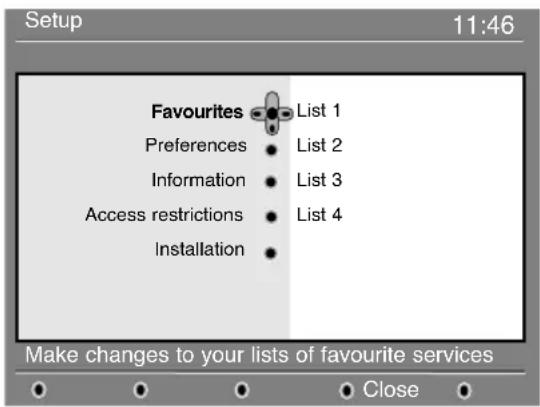
This menu enables you to create a favourite list with your preferred TV channels and radio stations. For example, each member of your family can create his/her own favourite list.
① From the digital mode, press the key to display the setup menu.
text_image
Setup 11:46 Favourites List 1 Preferences List 2 Information List 3 Access restrictions List 4 Installation Make changes to your lists of favourite services Close2 Press ▶ to enter into the favourites list menu. You have the choice to create 4 different favourite lists.
③ Use the ▲▼ keys to select your favourite list : List 1, List 2, List 3 or List 4 and press ▶.
④ Use the ▲ ▼ keys to select a setting and press ▶ to enter into the sub-menu.
- Name : use the ◀▶ keys to move around the name display area (16 characters) and the - P(age) + keys to select the characters. When the name has been entered, press OK to exit.
- Select TV channels : use the ▲▼ keys to select your favourite TV channels and confirm with Ⓞ. Press ◀ to exit.
- Select radio stations: use the ▲▼ keys to select your favourite radio station and confirm with u. Press ◀ to exit.
- Add all services : press OK if you want to add all the service into your favourite list.
- Remove all services : press OK if you want to remove all the service from your favourite list.
5 Press the MENU DIGITAL key to leave the menu.
6 Your favourite list can be selected using the options menu (see next page).
Information
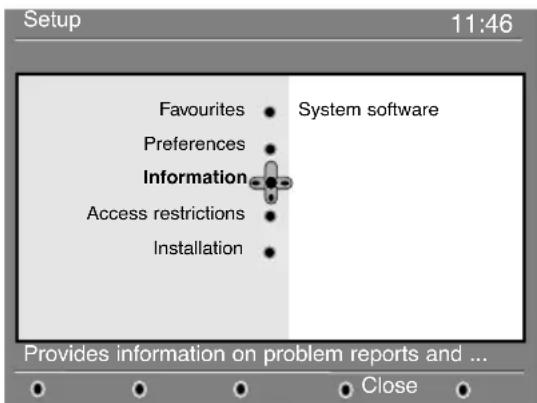
This menu provides information about the software version and the installation of new software.
① From the digital mode, press the Ⓑ️ key to display the setup menu.
② Use the ▼ key to select information and press ▶ twice.
text_image
Setup 11:46 Favourites System software Preferences Information Access restrictions Installation Provides information on problem reports and ... CloseThe software version is displayed.
3 You can activate the menu to automatically accept any software update of your digital TV. Normally the product will detect if an update is available while it is in standby mode. Next time the television is turned on a banner will appear at the bottom of the screen indicating new software is available. Selecting OK activates the software download. The software download menu will give a description of the software together with the date and time of the download. This may update certain menus, functions or add new features, but the general way in which the TV operate will not change. Once accepted the download will take place at the designated time and date. Note: The TV must be put into standby when the download is due in order for it to take place.
4 Press the MENU DIGITAL key to leave the menu.
Downloading new software
Whenever a new software is available, it is advisable to always accept and download the software. In case new software is available, you will see a message when you switch on the TV.
New software and upgrade instructions can be obtained from the website: www.philips.com/support
Using the Options menu
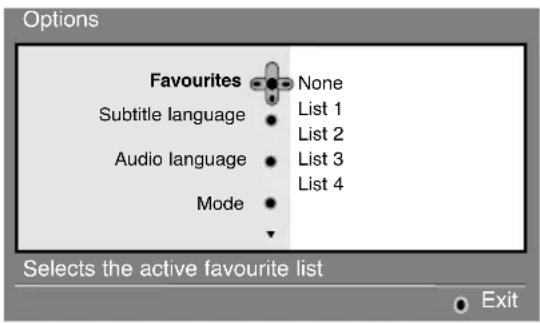
This menu gives you direct access to the: favourite list, the language selection and some other selections.
① From the digital mode, press the white OPTIONS key to display the options menu.
② Use the ▲▼ keys to select a setting and press ▶ to enter the sub-menu.
text_image
Options Favourites None Subtitle language List 1 Audio language List 2 Audio language List 3 Mode List 4 Selects the active favourite list Exit- Favourites: use the ▲▼ keys to select your favourite list and confirm with OK. The “none” option deactivate any favourite list. To create your own favourite list, see page 9.
- Subtitle language : use the lîkeys to temporarily change the language and confirm with OK.
- Audio language : to temporarily change the audio sound language. To permanently change the audio and subtitle languages, use the Preferences menu (p. 8).
- Mode: you can choose to only have radio stations, TV channels or services without audio or video.
Remark : for the UK only, the TV list will contain both radio stations and TV channels.
- Banner duration : to select the duration for which the banner is visible.
3 Press the white OPTIONS key to leave the menu.
TV guide
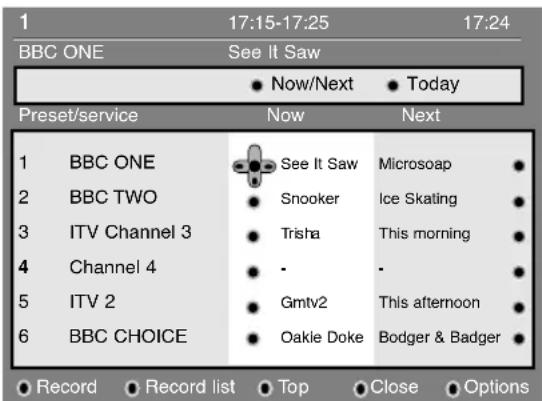
The TV guide is an Electronic Service Guide that allows you to look up digital programmes as you would in a newspaper or TV magazine. You can navigate through the list of digital programmes and obtain detailed information on the programmes. You can also program the TV to provide a digital channel to be recorded.
① From the digital mode, press the 🔒 key to display the TV guide :
text_image
1 BBC ONE 17:15-17:25 17:24 See It Saw Now/Next Today Preset/service Now Next 1 BBC ONE See It Saw Microsoap 2 BBC TWO Snooker Ice Skating 3 ITV Channel 3 Trisha This morning 4 Channel 4 - - 5 ITV 2 Gmtv2 This afternoon 6 BBC CHOICE Oakle Doke Bodger & Badger Record Record list Top Close OptionsA list of all the digital programmes in the currently selected favourite list is displayed.
② Use the ▼ key to enter into the Preset/service list or press ▶ to access Today list.
③ Use the ◀▶ keys to select a programme.
4 The TV guide features are displayed at the bottom of the screen. Use the coloured keys red, green, yellow, blue or white to activate them:
- Record (red key) : this feature enables you to record a digital channel even the TV is in standby mode. You will still have to program your video recorder. If you wish to continue watching another digital channel after setting a timer, you can do so by changing channels in the normal way. Important : In digital mode, if you change the channel when recording starts, the TV will record the last channel you have selected.
- Record list (green key) : this menu gives the list of recording schedules. You can check, modify, delete or add a new schedule by using the cursor or coloured keys as indicated on the screen.
- Top (yellow key): to go directly to the top of the list.
- Close (blue key) : to exit from the TV guide.
- Options (white ▶▶ key) : with this menu, you can select your favourite list, mode or themes. Themes are areas of interest, you can for example decide to display only : drama, news, movie, ...
5 Press the Ⓗ key if you want to display more information about the selected programme (if available).
6 Press the ☐ key to leave the menu.
Recording function
This feature enables you to record a digital channel while the TV is in standby mode. You will still have to program your video recorder. If you wish to continue watching another digital channel after setting a timer, you can do so by changing channels in the normal way.
IMPORTANT : The video recorder must be connected to EXT2. Please note that it is NOT possible to record one digital channel and watch another digital channel at the same time. You can however record a digital channel and watch an analogue channel on your TV, or vice versa.
From the digital mode, press the ☐ key to display the TV guide.
② Use the ▼ key to enter into the Preset/service list or press ▶ to access Today list.
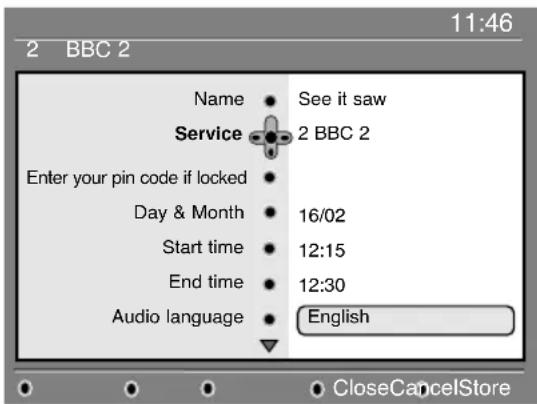
③ Press the RED key to call the Record menu.
text_image
2 BBC 2 Name • See it saw Service • 2 BBC 2 Enter your pin code if locked • Day & Month • 16/02 Start time • 12:15 End time • 12:30 Audio language • English CloseCancelStore④ Use the ▲▼ keys to select a setting and press ▶ to enter into the sub-menu. Make your adjustment and press OK or ◀ to exit.
- Name: the selected programme will be displayed here.
- Service : you can change the number of the programme you want to record. Press OK to confirm.
Note : it is only possible to change to a number that is in the currently selected favourite list.
- Enter your pin code if locked: enter your secret code only if you have activated the access restriction feature (see p.8). Press OK to confirm.
- Day & Month : enter the date by using the or - P(age) + keys. Press OK to exit
- Start time : enter the start time.
• End time : enter the end time. - Audio language : select your language and confirm with OK.
- Subtitle language : make your selection and confirm with OK.
- Subtitles for hearing impaired: select Yes or No and confirm with OK.
- Occurrence: select Once, Daily or Weekly and confirm with OK.
5 Press the RED key to store your recording. The TV guide reappears.
You can press the GREEN key to display the list of recordings you have set.
6 If you have finished watching television, you must leave it in standby in order for the recording program to be activated.
IMPORTANT : never switch off the TV with the power button when a recording has been programmed, but use the standby key on the remote control.
7 If you wish to continue watching another digital channel after setting a timer, you can do so by changing channels in the normal way.
Important : In digital mode, if you change the channel when the recording starts, the TV will record the last channel. you have selected.
8 If you are watching another digital channel when the timer is due to start, the timer alarm will sound and present you with the option of switching channels or continuing to watch the current channel.
9 You can also watch analogue channels while recording digital channels. Press the Ⓐ key to switch the TV to analogue mode.
Automatic tuning of analogue programmes
This menu allows you to automatically search for all the analogue programmes available in your region.
① From the analogue mode, press the TV
(TV menu) key to display the main menu.
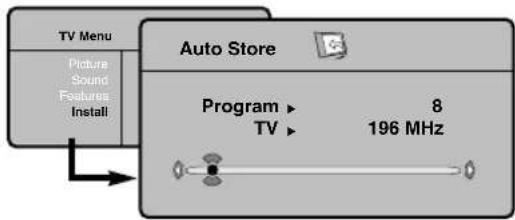
② With Cursor (▼ ▶ ) keys to select Install and then Auto Store. Press ▶ and the search begins. After several minutes, the Install menu reappears automatically.
flowchart
graph TD
    A["TV Menu"] --> B["Picture Sound Features Install"]
    C["Auto Store"] --> D["Program 8\nTV 196 MHz"]
3 If the transmitter or the cable network broadcasts the automatic sort signal, the programmes will be correctly numbered.
4 If this is not the case, the programme will be numbered in descending order strating at 99, 98, 97, etc
Use the Sort menu to renumber them.
Some transmitters or cable networks broadcast their own sort parameters (region, language, etc). Where this is the case, make your choice using the ▲▼ keys and confirm with the ▶ key.
To exit or interrupt the search, press the MENU TV key. If no picture is found, refer to the chapter entitled Tips on p.20
5 To exit from the menu, press 📋 key.
Program sort
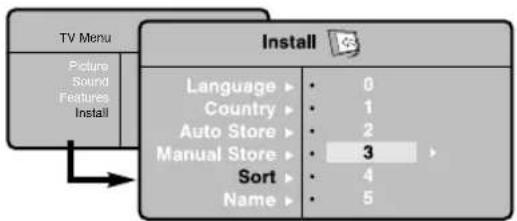
1 Press the TV key. The TV Menu is displayed on the screen.
text_image
TV Menu Picture Sound Features Install Install Language ▶ 0 Country ▶ 1 Auto Store ▶ 2 Manual Store ▶ 3 Sort ▶ 4 Name ▶ 5② With the cursor, select the Install menu followed by the Sort menu.
3 Select the programme you want to move using the ▲▼ keys and press ▶.
④ Then use the ▲▼ keys to select the new number and validate with ◀.
⑤ Repeat steps ③ and ④ for each program you wish to renumber.
6 To quit the menus, press 📊.
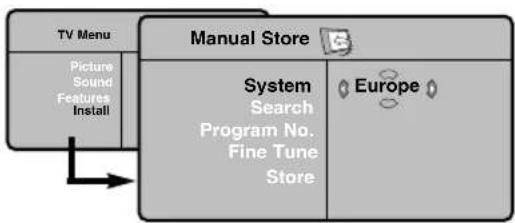
Manual tuning of analogue programmes
This menu is used to store the programmes one at a time.
① Press the TV (TV menu) key.
② With Cursor (▼ ▶ ) keys to select Install and then Manual Store.
flowchart
graph TD
    A["TV Menu"] --> B["Picture Sound Features Install"]
    B --> C["Manual Store"]
    C --> D["System Search Program No. Fine Tune Store"]
    D --> E["Europe"]
3 System : select Europe (automatic detection*) or Western Europe (BG standard), Eastern Europe (DK standard), United Kingdom (I standard) or France (LL' standard),
* Except for France (LL' standard) : in this case, select the option FRANCE.
4 Search : press ▶ key. The search starts. Once a programme is found, the scanning stops and its name is displayed (when available). Go to the next step. If you know the frequency of the required programme, this can be entered directly using the keys. If no programme is found, refer to the Tips chapter on page 20.
5 Program No : enter the required number with the ◀▶ or (0 to 9) keys.
6 Fine Tune: if the reception is not satisfactory, adjust using the ◀▶ keys.
⑦ Store : press ▶ key. The programme is stored.
⑧ Repeat steps ④ to ⑦ for each programme to store.
9 To quit the menu, press key.
Other settings in the install menu
1 Press the TV (TV menu) key and select Install menu.
② Name : If required, you can give a name to the programmes. Use the ◀▶ keys to move around the name display area (5 characters) and the ▲▼ keys and to select the characters.
When the name has been entered, use the ◀ key to exit. The name is stored.
③ To quit the menu, press Ⓗ key.
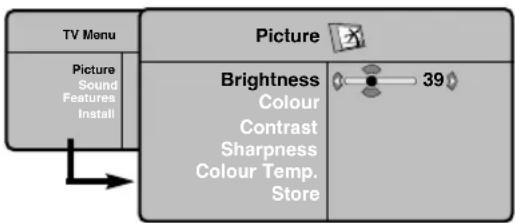
Picture settings
1 Press the TV (TV menu) key, then ▶ key. The Picture menu is displayed.
flowchart
graph TD
    A["TV Menu"] --> B["Picture"]
    B --> C["Picture"]
    C --> D["Brightness"]
    D --> E["Colour"]
    D --> F["Contrast"]
    D --> G["Sharpness"]
    D --> H["Colour Temp. Store"]
    C --> I["39"]
② Use the ▲ ▼ keys to select a setting and the ◀ ▶ keys to adjust.
③ Once the adjustments have been made, select Store and press ▶ to store them. Press Ⓗ key to exit.
Description of the adjustments :
- Brightness : this changes the picture brilliance.
• Colour : this changes the intensity of the colour. - Contrast : this changes the difference between the light and dark tones
- Sharpness : this changes the picture definition.
- Colour Temp. : this changes the colour rendering : Cold (bluer), Normal (balanced) or Warm (redder).
- Store : to store the picture adjustments and settings.
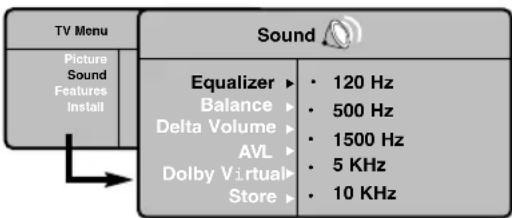
Sound settings
① Press the TV (TV menu) key, select Sound (▼) and press ▶ key. The Sound menu is displayed.
text_image
TV Menu Picture Sound Features Install Sound Equalizer ▶ 120 Hz Balance ▶ 500 Hz Delta Volume ▶ 1500 Hz AVL ▶ 5 KHz Dolby Virtual ▶ 10 KHz Store ▶② Use the ▲ ▼ keys to select a setting and the ◀ ▶ keys to adjust.
③ Once the adjustments have been made, select Store and press ▶ to store them.
4 Press Ⓗ key to exit.
Description of the adjustments :
- Equalizer : to adjust the sound tone (from bass : 120 Hz to treble 10 kHz.
• Balance : this balances the sound on the left and right speakers. - Delta Volume : this is used to compensate any volume discrepancies between the different programmes or EXT sockets. This setting is available for programmes 0 to 40 and the EXT sockets.
- A VL (Automatic Volume Leveller): this is the used to limit increases in sound, especially on programme change or advertising slots.
- Dolby Virtual: to activate/deactivate the surround sound effect. You can also access these settings with the Ⓗ key.
- Store : this is used to store the sound settings.
Feature settings
① Press ▶ (TV menu), select Features (▼) and press ▶. You can adjust:
2 Contrast + : automatic adjustment of the picture contrast which permanently sets the darkest part of the picture to black.
③ NR : attenuates picture noise (snow) in difficult reception conditions.
④ Sleep : to select an automatic standby period.
5 PIP: to adjust the size and position of the PIP screen.
6 To quit the menus, press Ⓗ.
Screen Formats
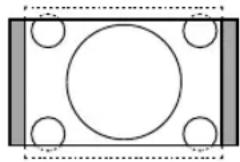
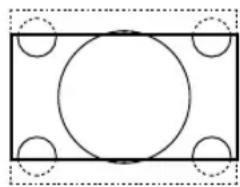
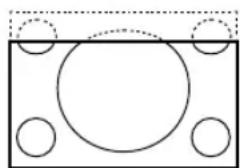
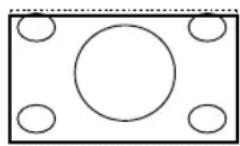
The pictures you receive may be transmitted in 16:9 format (wide screen) or 4:3 format (conventional screen). 4:3 pictures sometimes have a black band at the left and right of the screen (letterbox format). This function allows you to optimise the picture display on screen.
Press the Ⓗkey to select the different modes:
This TV set is also equipped with automatic switching which will select the correct-screen format, provided the specific signals are transmitted with the programmes. NOTE: When in HD mode, the only screen format available is Widescreen.
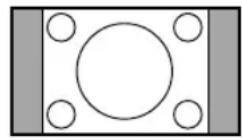
4:3
The picture is reproduced in 4:3 format and a black band is displayed on either side of the picture.
natural_image
Simple geometric diagram with a central circle and four surrounding circles, enclosed in a rectangular frame (no text or symbols)Movie Expand 14:9
The picture is enlarged to 14:9 format, a thin black band remains on both sides of the picture.
natural_image
Simple geometric diagram with a circle centered inside a rectangle, surrounded by four smaller circles (no text or symbols)Movie Expand 16:9
The picture is enlarged to 16:9 format. This mode is recommended when displaying pictures which have black bands at the top and bottom (letterbox format).
natural_image
Simple geometric diagram with a rectangle, central circle, and four smaller circles (no text or symbols)Subtitle Zoom
This mode is used to display 4:3 pictures using the full surface of the screen leaving the sub-titles visible.
Superzoom
This mode is used to display 4:3 pictures using the full surface of the screen by enlarging the sides of the picture.
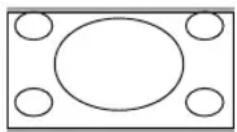
Widescreen
This mode restores the correct proportions of images transmitted in 16:9.
Note: If you display a 4:3 picture in this mode, it will be enlarged horizontally.
Digital Text
Some digital channels, which you select like any other channel, offer dedicated teletext services (for instance BBCTEXT). Some digital channels also offer information on the programme being broadcast (a message may appear at the bottom of the screen).
To use the digital teletext, follow the instructions on screen.
② Depending on the service, you can be asked to use the cursor keys, the coloured keys, the Teletext On/Off key (☐) and sometimes the numerical keys.
③ When you have finished watching teletext, select a different channel with P -/+ keys or follow the on screen instructions to return to picture.
Teletext
Teletext is an information system broadcast by certain channels which can be consulted like a newspaper. It also offers access to subtitles for viewers with hearing problems or who are not familiar with the transmission language (cable networks, satellite channels, etc.).
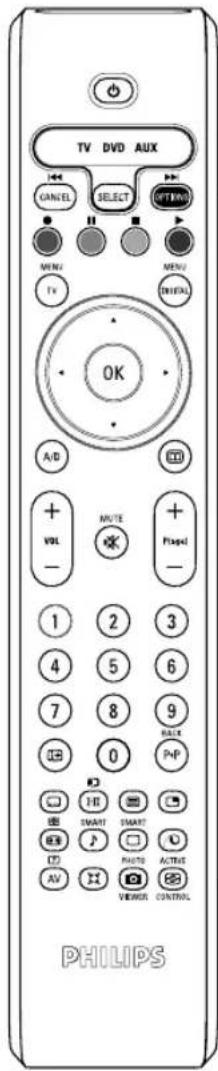
text_image
TV DVD AUX CANCEL SELECT CTRM MENU MENU TV INITIAL OK A/B + 1 2 3 VOL 0 1 2 3 - 4 5 6 7 8 9 RALL PMP 0 + 10 11 12 13 SMART SMART + 14 15 16 AUTO ACTRS AV VIEW CONTROL PHILIPS| Press : You will obtain : | |
Teletext call T'  used to call or exit teletext mode.The summary appears with a list of items that can be accessed. Each item has a corresponding 3 digit page number.If the channel selected does not broadcast teletext, the indication 100 will be displayed and the screen will remain blank (in this case, exit teletext and select another channel). used to call or exit teletext mode.The summary appears with a list of items that can be accessed. Each item has a corresponding 3 digit page number.If the channel selected does not broadcast teletext, the indication 100 will be displayed and the screen will remain blank (in this case, exit teletext and select another channel). | |
Selecting a page [DCKX] [DCKX] | Enter the number of the page required using the 0 to 9 or - P(age) + keys. Example: page 120, enter 120. The number is displayed top left, the counter turns and then the page is displayed. Repeat this operation to view another page. If the counter continues to search, this means that the page is not transmitted. Select another number. |
| Direct access Coloured areas are displayed at the bottom of the screen. to the items The 4 coloured keys are used to access the items or corresponding pages. The coloured areas flash when the item or the page is not yet available. | |
| Contents This returns you to the contents page (usually page 100). | |
| Stop sub-page Certain pages contain sub-pages which are automatically acquisition displayed successively.This key is used to stop or resume sub-page acquisition.The indication appears top left. | |
Double page To activate or deactivate the double page teletext teletext display mode.The active page is displayed on the left and the following page is displayed on the right. Press you want to hold a page (i.e. the contents page).The active page is then displayed on the right.To return to normal mode, press. display mode.The active page is displayed on the left and the following page is displayed on the right. Press you want to hold a page (i.e. the contents page).The active page is then displayed on the right.To return to normal mode, press. | |
Hidden information | To display or hide the concealed information (games solutions). |
| Enlarge a page▲▼ | This allows you to display the top or bottom part of the page and then return to normal size. |
Favourite pages[20H8]  | Instead of the standard coloured areas displayed at the bottom of the screen, you can store 4 favourite pages on the first 40 channels which can then be accessed using the coloured keys (red, green, yellow, blue). Once set, these favourite pages will become the default every time teletext is selected.Press the key to change to favourite pages mode.Display the teletext page that you want to store.Press the coloured key of your choice for 3 seconds. The page is now stored.Repeat the operation with the other coloured keys.Now when you consult teletext, your favourite pages will appear in colour at the bottom of the screen.To temporarily retrieve the standard items, press .To clear everything and return the standard items as the default, press for 5 seconds. |
Press :
① Press the MENU TV key to change to favourite pages mode.
② Display the teletext page that you want to store.
③ Press the coloured key of your choice for 3 seconds. The page is now stored.
4 Repeat the operation with the other coloured keys.
5 Now when you consult teletext, your favourite pages will appear in colour at the bottom of the screen. To temporarily retrieve the standard items, press MENU. To clear everything and return the standard items as the default, press (13) for 5 seconds.
Using in PC monitor mode
NOTE
- When using the TV as a PC monitor, slight diagonal interference lines may be observed when it is operated under electromagnetic interference environment but will not affect the performance of this product.
- For better performance, good quality DVI cable with good noise isolation filter is recommended.
PC Mode
Your TV can be used as a computer monitor.
The PIP function lets you display a superimposed image to watch the TV channels at the same time.
The PIP function only works if your PC has a digital output. You must first of all connect the computer and adjust the resolution (see p.18).
Choosing PC mode
① Press the AV key on the remote control to display the Source List.
② Use the ▲ ▼ keys to select PC and then press the cursor ▶ key to switch the TV to PC mode (DVI In).
To return to TV mode, press the AV key, select TV and validate with ▶ key.
Using PIP
While in PC mode you can call up a window for TV channels.
Attention: the PIP feature is only available if a computer is connected to the DVI In (see p. 21).
1 Press the ☐ key to display the PIP screen. The television image is reproduced in a small superimposed window.
② Subsequent presses of the ☐ key changes the size of the window, switches to dual screen and turns PIP off.
③ Use the P -/+ keys to change the programmes of the PIP screen.
Using the PC menus
Press the MENU key to access the specific settings of the PC monitor mode. Use the cursor to adjust them (the settings are automatically saved):
- Picture:
- Brightness / Contrast : to adjust the brightness and contrast.
- Horizontal /Vertical*: to adjust the horizontal and vertical placing of the image.
- Colour Temp. : this changes the colour rendering : Cold (bluer), Normal (balanced) or Warm (redder).
• Audio Selection: to choose the sound reproduced on the TV (PC/HD or TV).
- Features:
- Phase/Clock*: eliminates the horizontal (Phase) and vertical (Clock) interfering lines.
- Format : to choose between full screen or native format of the PC screens.
- PIP : to adjust the size and position of the PIP screen.
- Auto Adjust*: position is set automatically.
- Reset To Factory Setting: to return to the factory settings (default settings).
* These adjustments are not available when a computer is connected to the DVI In.
Here is the list of the different display resolutions available on your TV :
| Digital PC (DVI-I) 640 x | 640 x 350 p 800 x 600 p | 1152 x 864 p | |
| 480 p 832 x 624 p 1280 x 960 | p | ||
| 720 x 400 p 1024 x 768 | p 1280 x 1024 p | ||
| Analogue PC (YPbPr) | 640 x 350 p 720 x 400 p | 832 x 624 p | |
| 640 x 480 p 800 x 600 p | 1024 x 768 p |
Using in HD (High Definition) mode
HD Mode
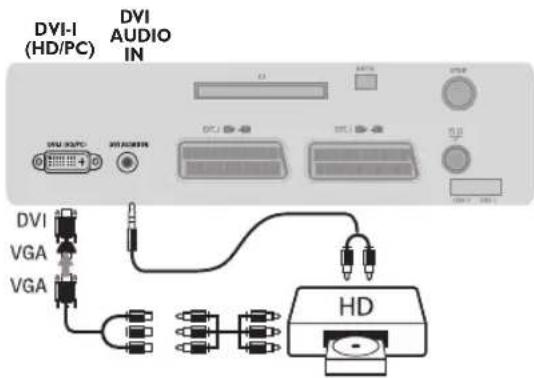
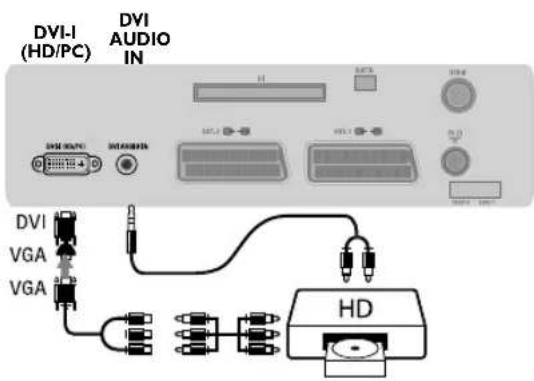
The HD (High Definition) mode allows you to enjoy clearer and sharper pictures through the DVI inputs if you are using a HD receiver/ equipment that can transmit high definition programming.
You must first of all connect the HD equipment (see p. 18).
Choosing HD mode
① Press the AV key on the remote control to display the Source List.
② Use the cursor ▲ ▼ key to select HD and then press the cursor key to switch the TV to HD mode.
To return to TV mode, press the AV key, select TV and validate with ▶ key.
Using the HD menus
Press the MENU key to access the specific settings of the HD mode. Use the cursor to adjust them (the settings are automatically saved):
Picture:
- Brightness: this changes picture brilliance.
- Colour: this changes the intensity of the colour.
- Contrast: this changes the difference between the light and dark tones.
- Sharpness: this changes the picture definition.
- Colour Temp.: this changes the colour rendering: Cold (bluer), Normal (balanced) or Warm (redder).
- Store: to store the picture adjustments and settings.
Sound:
- Equalizer: to adjust the sound tone (from bass: 120 Hz to treble: 10 kHz).
• Balance: this balances the sound on the left and right speakers. - Delta Volume: this is used to compensate any volume discrepancies between the different programs or EXT sockets. This setting is available for programs 0 to 40 and the EXT sockets.
- AVL (Automatic Volume Leveller): this is used to limit increases in sound, especially on program change or advertising slots.
- Dolby Virtual: To activate / deactivate the surround sound effect. You can also access these settings with key ✗.
- Store: this is used to store the sound settings.
Features:
- Sleep (Only available on certain versions): to select an automatic standby period.
- PIP : to adjust the size and position of the PIP screen.
- Horizontal Shift : to adjust the horizontal placing of the image.
Here is the list of the different display resolutions available on your TV :
| Digital HD (DVI-I) | EDTV 480 p HDTV 720 | p HDTV 1080 i | |
| EDTV 576 p | |||
| Analogue PC (YPbPr) | 480 i 480 p 720 p | ||
| 576 i 576 p 1080 i |
Connecting peripheral equipment
The television has 2 external sockets situated at the back of the set (EXT1 and EXT2) and sockets on the side. Press the AV key on the remote control to display Source List and select TV or peripheral equipment connected to EXT1, EXT2/SVHS2, AV/SVHS3, PC or HD.
The EXT1 socket has audio, CVBS/RGB inputs and audio, CVBS outputs.
The EXT2 socket has audio, CVBS/S-VHS inputs and audio, CVBS outputs.
The side connections has audio inputs, CVBS/S-VHS inputs, headphone out.
Video Recorder
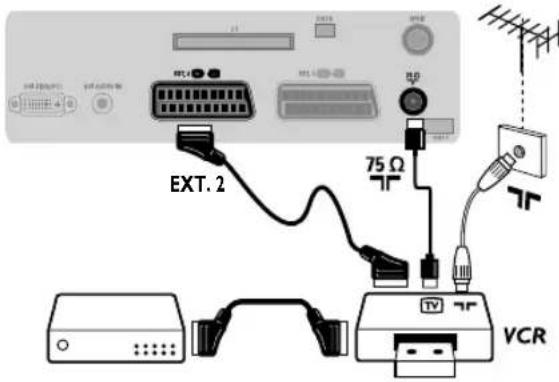
text_image
EXT. 2 75 Ω VCRHD equipment
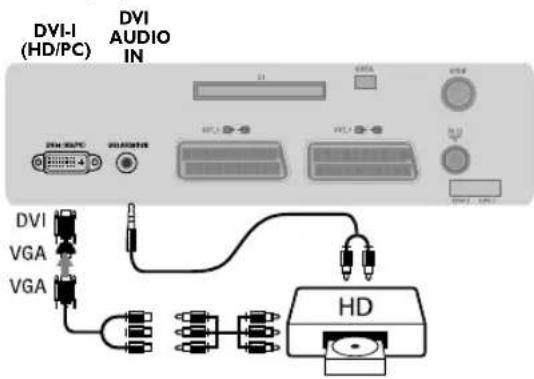
text_image
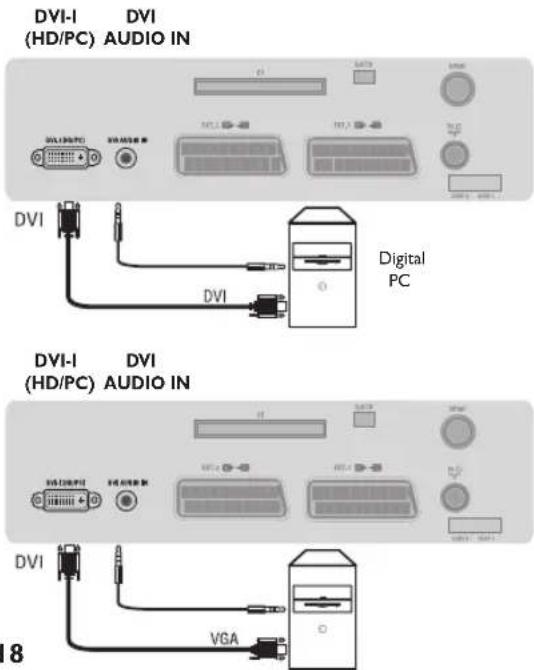
DVI-I (HD/PC) DVI AUDIO IN DVI VGA VGA HDComputer
text_image
DVI-I (HD/PC) DVI AUDIO IN DVI Digital PC DVI-I (HD/PC) DVI AUDIO IN DVI VGAVideo recorder (only)
Carry out the connections shown opposite, using a good quality euroconnector cable.
If your video recorder does not have a euroconnector socket, the only connection possible is via the aerial cable. You will therefore need to tune in your video recorder's test signal and assign it programme number 0 (refer to manual store, p. 12).
To reproduce the video recorder picture, press 0 key.
Video recorder with decoder
Connect the decoder to the second euroconnector socket of the video recorder. You will then be able to record scrambled transmissions.
Make the connections as shown opposite.
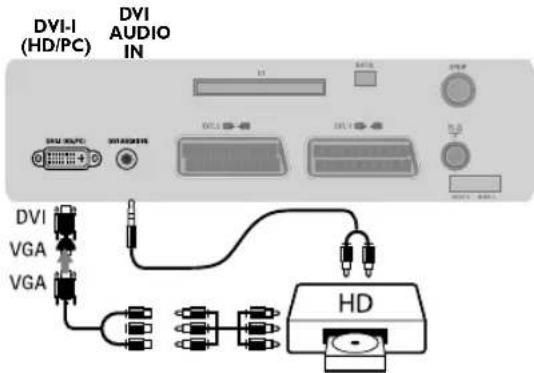
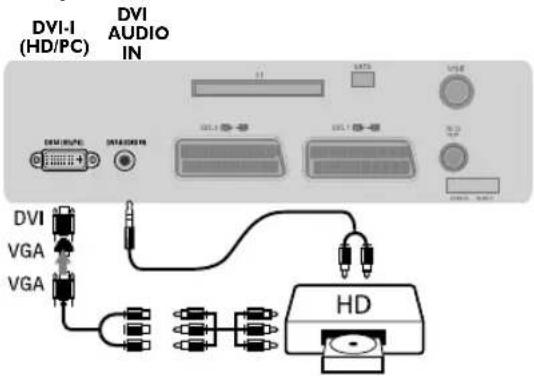
With the AV key, select HD.
For more information on using HD mode see page 17.
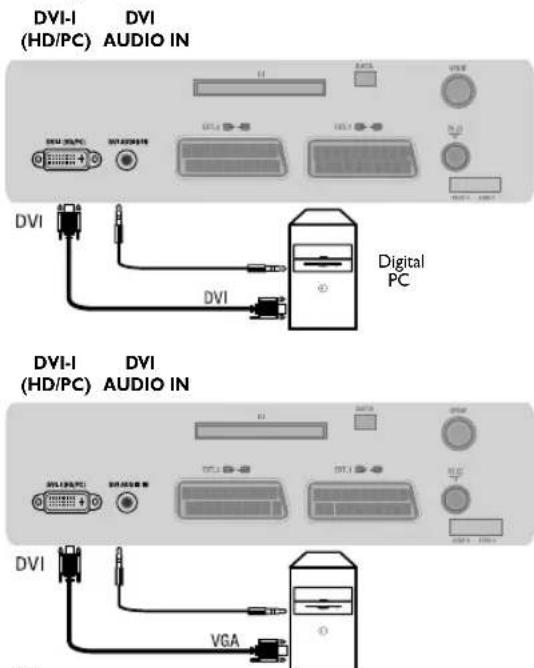
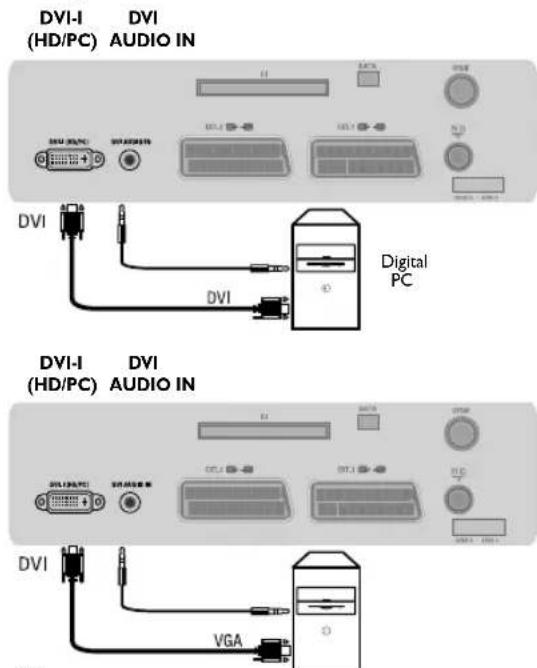
PC with DVI
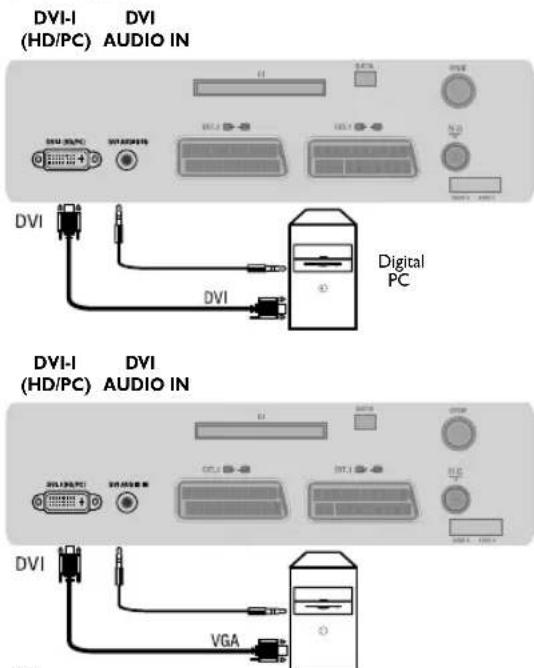
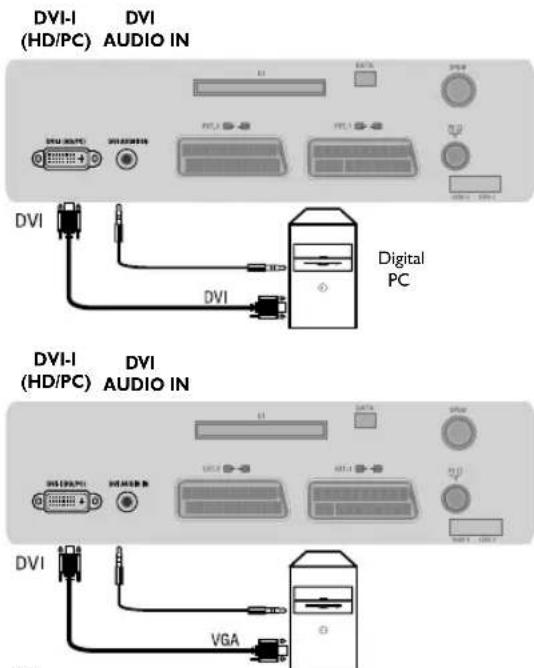
Connect the monitor output (DVI) of your computer to the DVI-I In of the TV. Connect the sound output Audio out of the computer to the input DVI Audio In of the TV.
PC with VGA
Connect the monitor output (VGA) of your computer via a VGA/DVI adaptor to the DVI In of the TV. Connect the sound output Audio out of the computer to the input DVI Audio In of the TV.
For more information on using PC mode see page 16.
Connecting peripheral equipment
Other equipment
text_image
EXT 1Side connections
text_image
Diagram showing audio equipment connections with headphones, audio/video recording device, and speaker modules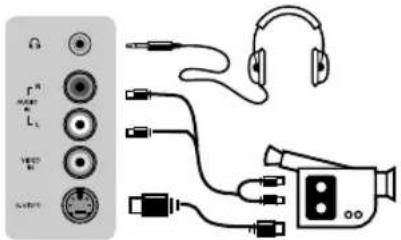
text_image
Diagram showing audio equipment connections including headphones, audio/video recording device, and speaker interface with labeled ports and connectorsAmplifier connection
text_image
SPDIF 21 3476 025 025 025 025 025 025 025 025 025 025 025 025 025 025 025 025 025 025 025 025 025 025 025 025 025 02Common interface
text_image
CD Card CI (Common interface)Satellite receiver, decoder, CDV, games, etc.
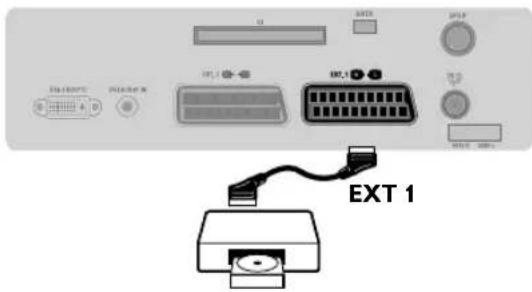
Carry out the connections shown opposite. To optimise picture quality, connect the equipment which produces the RGB signals (digital decoder, games, etc.) to EXT1, and the equipment which produces the S-VHS signals (S-VHS and Hi-8 video recorders, certain DVD drives) to EXT2 and all other equipment to either EXT1 or EXT2.
To select connected equipment
Press the AV key to select EXT1, EXT2/S-VHS2 (S-VHS signals from the EXT2 socket).
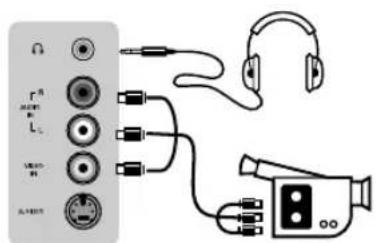
Make the connections as shown opposite.
With the AV key, select AV/S-VHS3.
For a mono set, connect the sound signal to the AUDIO L (or AUDIO R) input. The sound automatically comes out of the left and right speakers of the set.
Headphones
When headphones are connected, the sound on the TV set will be cut. The VOLUME -/+ keys are used to adjust the volume level. The headphone impedance must be between 32 and 600 Ohms.
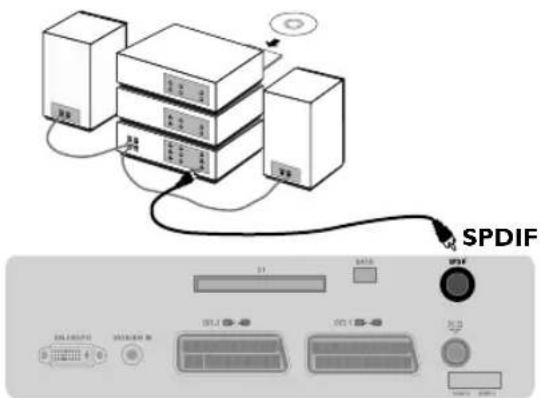
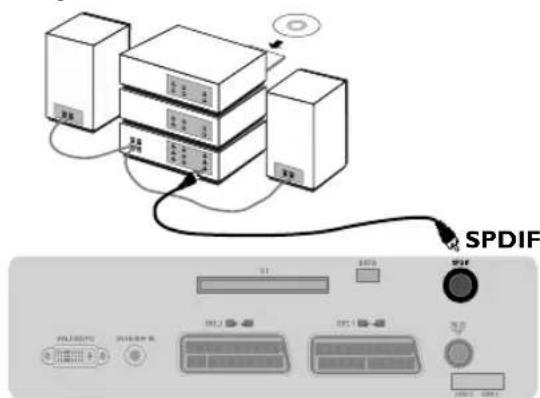
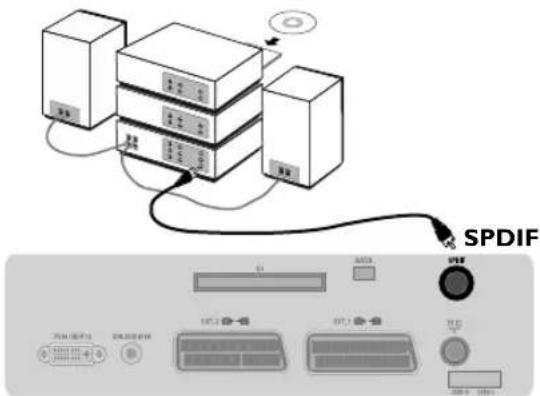
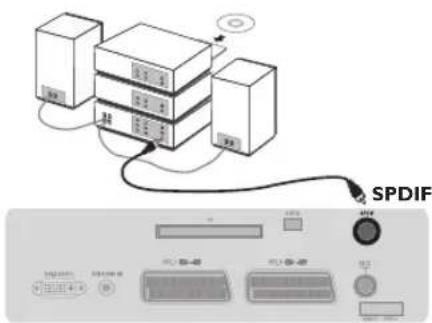
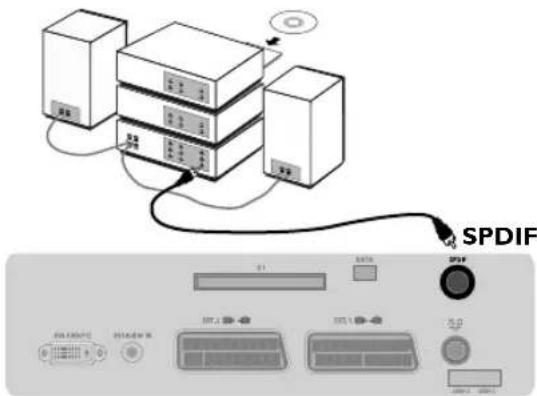
To connect to a hi-fi system, use an audio connection cable and connect the television's "SPDIF" output to a "DIGITAL IN" input on the amplifier (amplifier with coaxial digital input).
Note : If you select AC3 sound, you must have your TV connected to a Home Theatre System or amplifier. In this mode, no sound will be heard from the TV speakers directly.
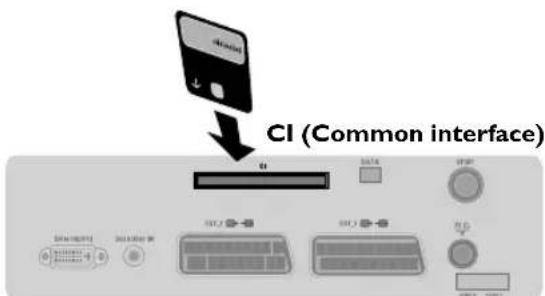
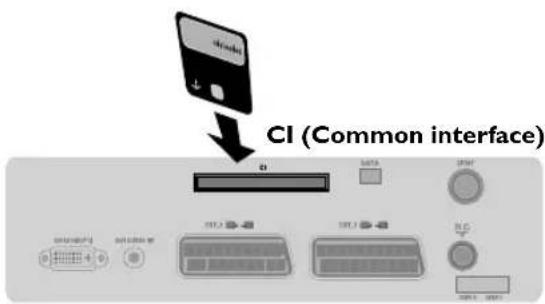
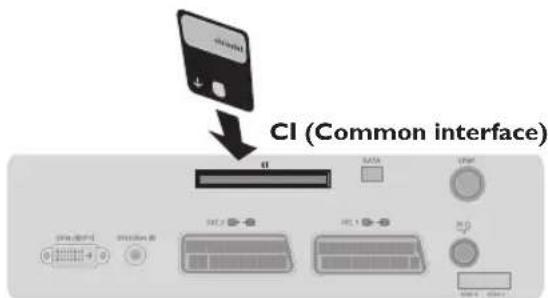
A common interface is available to connect a CAM (conditional access module) and a smartcard. Please contact your service provider to get more information about these modules.
Note : the television should always be switched off before any module is inserted in the common interface slot.
Tips
| Poor reception | The proximity of mountains or high buildings may be responsible for ghost pictures, echoing or shadows. In this case, try manually adjusting your picture: see Fine Tune (p. 12) or modify the orientation of the outside aerial. If you are using an indoor aerial, reception may be difficult in certain conditions.You can improve reception by rotating the aerial. If the reception remains poor, you will need to use an external aerial |
| No picture Have you | connected the aerial socket properly? Have you chosen the right system?(p. 12). Poorly connected euroconnector cables or aerial sockets are often the cause of picture or sound problems (sometimes the connectors can become half disconnected if the TV set is moved or turned). Check all connections. |
| No sound If on certain channels you receive a picture but no sound, this means that you do not have the correct TV system. Modify the System setting (p. 12). The amplifier connected to the TV does not deliver any sound? Check that you have not confused the audio output with the audio input. | |
| PC and PIP modes Don't work (see p. 18). | Check that you have configured the computer on a compatible display resolution |
| Remote control The | TV set does not react to the remote control; the indicator on the set no longer flashes when you use the remote control? Replace the battery. |
| Standby To save power, your set is fitted with components that give it a very low power consumption when in standby mode (less than 1 W). | |
| Cleaning the set Only | use a clean, soft and lint-free cloth to clean the screen and the casing of your set. Do not use alcohol-based or solvent-based products. |
| Still no results? Disconnect the mains plug of the TV for 30 seconds then reconnect it.If your TV set breaks down, never attempt to repair it yourself: contact your dealer's after-sales service. | |
Centre Frequencies Table (in KHz)
| Digital Frequency Nominal Centre Channel Frequency KHz | Digital Frequency Nominal Centre Channel Frequency KHz | ||
| 21 | 474 000 | 46 | 674 000 |
| 22 | 482 000 | 47 | 682 000 |
| 23 | 490 000 | 48 | 690 000 |
| 24 | 498 000 | 49 | 698 000 |
| 25 | 506 000 | 50 | 706 000 |
| 26 | 514 000 | 51 | 714 000 |
| 27 | 522 000 | 52 | 722 000 |
| 28 | 530 000 | 53 | 730 000 |
| 29 | 538 000 | 54 | 738 000 |
| 30 | 546 000 | 55 | 746 000 |
| 31 | 554 000 | 56 | 754 000 |
| 32 | 562 000 | 57 | 762 000 |
| 33 | 570 000 | 58 | 770 000 |
| 34 | 578 000 | 59 | 778 000 |
| 35 | 586 000 | 60 | 786 000 |
| 36 | 594 000 | 61 | 794 000 |
| 37 | 602 000 | 62 | 802 000 |
| 38 | 610 000 | 63 | 810 000 |
| 39 | 618 000 | 64 | 818 000 |
| 40 | 626 000 | 65 | 826 000 |
| 41 | 634 000 | 66 | 834 000 |
| 42 | 642 000 | 67 | 842 000 |
| 43 | 650 000 | 68 | 850 000 |
| 44 | 658 000 | 69 | 858 000 |
| 45 | 666 000 | ||
Introduction
text_image
Diagram showing TV setup components with labeled parts including monitor, monitor, and 37" TV portsnatural_image
Technical line drawing of a medical device with an arrow indicating a specific part (no text or symbols present)www.philips.com/support
natural_image
Simple geometric diagram with a circle centered inside a rectangle, surrounded by four smaller circles (no text or symbols)Zoom 16:9
natural_image
Pure geometric diagram with circles and dashed lines, no text or symbols presentSous-Titres
text_image
EXT. 2 75 Ω VCRRécepteur HD
text_image
DVI-I (HD/PC) DVI AUDIO IN DVI 300000000 DVI VGA VGA HDOrdinateur
text_image
DVI-I (HD/PC) DVI AUDIO IN DVI Digital PC DVI DVI AUDIO IN DVI-I (HD/PC) DVI AUDIO IN DVI VGAMagnétoscope
text_image
Diagram showing audio equipment connections including headphones, audio/video recording device, and multiple audio input/output channels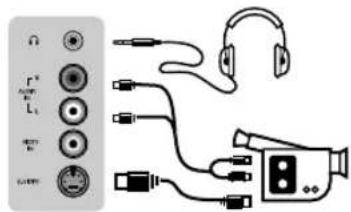
text_image
Diagram showing audio equipment connections with speaker, headphones, and audio jack componentsAmplificateur
text_image
SPDIF 01 02 03 04 05 06 07 08 09 10 SPDIF SPDIF SPDIF SPDIF SPDIF SPDIF SPDIF SPDIF SPDIF SPDIF SPDIF SPDIF SPDIF SPDIF SPDIF SPDIF SPDIF SPDIF SPDIF SPDIF SPDIF SPDIF SPDIF SPDIF SPDIF SPDIP SPDIP SPDIP SPDIP SPDIP SPDIP SPDIP SPDIP SPDIP SPDIP SPDIP SPDIP SPDIP SPDIP SPDIP SPDIP SPDIP SPDIP SPDIP SPDIP SPDIP SPDIP SPDIP SPDIP SPDIP SPDINtext_image
CI (Common interface)Teletexto digital 14
text_image
42" TV 37" TVnatural_image
Technical line drawing of a handheld device with a clip and a separate pin (no text or symbols)natural_image
Simple geometric diagram with a circle inside a rectangle and four corner circles (no text or symbols)Imag. expand 16:9
natural_image
Pure geometric diagram with circles and dashed lines, no text or symbols presentZoom Con Subtitulos
text_image
EXT. 2 75 Ω TV VCRtext_image
Diagram showing audio equipment connections with labeled components and cable routing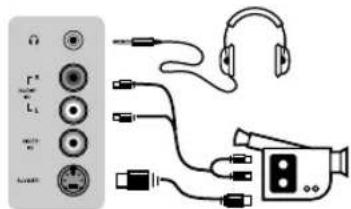
natural_image
Diagram showing audio equipment connections including headphones, audio/video equipment, and a speaker (no text or labels)text_image
CI (Common interface)natural_image
Technical line drawing of two mechanical components with a separate view showing a pin and shaft (no text or symbols)② Connecting the aerials
text_image
Setup 11:46 Installation Service lists Service setup Test reception Rearrange services View new TV channels Listen to new Radio stations Manage service lists Closetext_image
Setup 11:46 Installation Service lists Add new services Service setup Reinstall all services Test reception Install and manage services Closetext_image
Setup 11:46 Installation Service lists Add new services Service setup Reinstall all services Test reception Install and manage services Closetext_image
Setup 11:46 Installation Service lists • Frequency Service setup • Network name Test reception ← Signal quality Signal strength Test signal quality • • • • Close •text_image
Setup 11:46 Access restrictions Set pin code protection Maturity rating TV channels Radio stations Change pin code On Off Switch pin code protection "on" or "off" Closetext_image
EXT. 2 75 Ω VCRDispositivo HD
text_image
DVI-I (HD/PC) DVI AUDIO IN 12 50Hz 50Hz DVI (OUTPUT) DVI AUDIO IN VGA VGA HDComputer
text_image
DVI-I (HD/PC) DVI AUDIO IN DVI Digital PC DVI-I (HD/PC) DVI AUDIO IN DVI VGAVideoregistratore
text_image
Diagram showing two audio recording devices connected via audio/video equipment, with labeled ports and connectors.Amplicatore
text_image
SPDIF 01 02 SPDIF 03 04 05 06 07 08 09 10 11 12 13 14 15 16 17 18 19 20 21 22 23 24 25 26 27 28 29 30 31 32 33 34 35 36 37 38 39 40 41 42 43 44 45 46 47 48 49 50Common interface
text_image
CD card CI (Common interface)natural_image
Technical line drawing of a handheld device with a clip and handle (no text or symbols)text_image
VOLUME + PROGRAM CHANNEL - MENU + VOLUMEnatural_image
Simple geometric diagram with a circle centered within a rectangle, surrounded by four smaller circles (no text or symbols)16:9 Zoom
natural_image
Simple geometric diagram with a rectangle, central circle, and four smaller circles (no text or symbols)Untertitelzoom
text_image
EXT.2 75 Ω VCRHD-Ausrüstung
text_image
DVI-I (HD/PC) DVI AUDIO IN DVI VGA VGA HDComputer
text_image
DVI-I DVI (HD/PC) AUDIO IN DVI Digital PC DVI-I DVI (HD/PC) AUDIO IN DVI VGA 18Videorecorder
text_image
Diagram showing audio equipment connections with headphones, audio jack, and microphone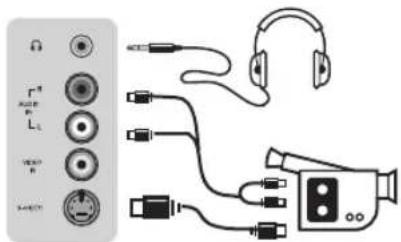
text_image
Diagram showing audio equipment connections including speaker, headphones, and video camera with labeled ports and connectorsVerstärker
text_image
SPDIF 4Common Interface
text_image
CI (Common interface)Television esittely 2
Kaukosäädin 2
DIGITAALISET VALIKOT
text_image
Diagram showing a monitor connected to a vertical panel with labeled buttons and text, including 'POWER', 'WORKING CHANNEL', 'MENU', 'VOLUME', and '+'.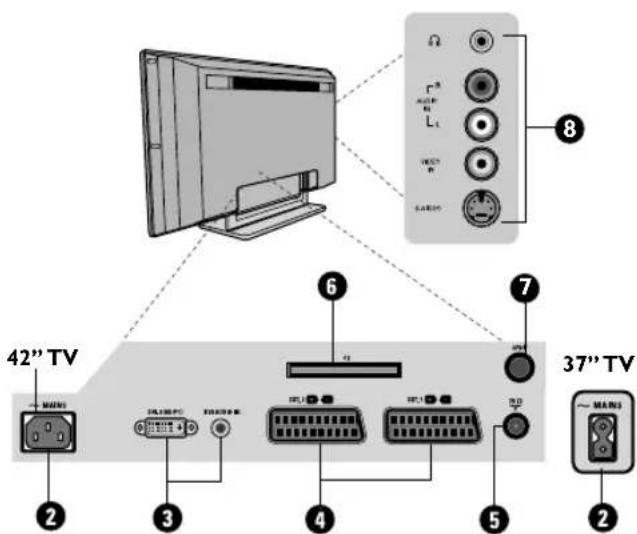
text_image
42" TV 37" TVnatural_image
Technical line drawing of a medical device with an arrow indicating a specific part (no text or symbols present)- Add all services : press OK if you want to add all the service into your favourite list.
- Remove all services : press OK if you want to remove all the service from your favourite list.
natural_image
Simple geometric diagram with a circle centered inside a rectangle, surrounded by four smaller circles (no text or symbols)Elok.laaj.16:9
natural_image
Simple geometric diagram with a rectangle, central circle, and four smaller circles (no text or symbols)Tekstizoomaus
text_image
EXT.2 75 Ω VCRKuvanauhuri
text_image
Diagram showing audio recording setup with headphones, audio jack, and video camera connectionsVahvistin
text_image
SPDIF 01 02 03 SPDIF 01.1 01.2 01.3 02 SPDIF SPDIF SPDIF SPDIF SPDIF SPDIF SPDIF SPDIF SPDIF SPDIF SPDIF SPDIF SPDIF SPDIF SPDIF SPDIF SPDIF SPDIF SPDIF SPDIF SPDIF SPDIF SPDIF SPDIF SPDIF SPDIP SPDIP SPDIP SPDIP SPDIP SPDIP SPDIP SPDIP SPDIP SPDIP SPDIP SPDIP SPDIP SPDIP SPDIP SPDIP SPDIP SPDIP SPDIP SPDIP SPDIP SPDIP SPDIP SPDIP SPDIP SPDINtext_image
CI (Common interface)text_image
Diagram showing TV setup with labeled components including monitor, power panel, and 37-inch TV ports① TV-apparatens knappar:
natural_image
Technical line drawing of a handheld device with a clip and a separate pin (no text or symbols)text_image
EXT. 2 75 Ω TV VCRHD-mottagren
text_image
DVI-I (HD/PC) DVI AUDIO IN H1 0.2% DVI VGA VGA HDComputer
text_image
DVI-I (HD/PC) DVI AUDIO IN DVI Digital PC DVI-I (HD/PC) DVI AUDIO IN DVI VGAVideobandspelare
text_image
Diagram showing audio equipment connections including headphones, video camera, and speaker modules with labeled ports and connectorstext_image
Diagram showing audio equipment connections including headphones, audio/video recording device, and speaker interface with labeled ports and connectorsHörlurar
text_image
CD Card CI (Common interface)Table of TV frequencies.
Information for users in the UK (not applicable outside the UK)
Positioning the TV
For the best results, choose a position where light does not fall directly on the screen, and at some distance away from radiators or other sources of heat. Leave a space of at least 5 cm all around the TV for ventilation, making sure that curtains, cupboards etc. cannot obstruct the air flow through the ventilation apertures. The TV is intended for use in a domestic environment only and should never be operated or stored in excessively hot or humid atmospheres.
General Points
Please take note of the section entitled 'Tips' at the end of this booklet.
Interference
The Department of Trade and Industry operates a Radio Interference Investigation Service to help TV licence holders improve reception of BBC and IBA programmes where they are being spoilt by interference.
If your dealer cannot help, ask at a main Post Office for the booklet "How to Improve Television and Radio Reception".
Mains connection
Before connecting the TV to the mains, check that the mains supply voltage corresponds to the voltage printed on the type plate on the rear panel of the TV. If the mains voltage is different, consult your dealer.
Important
This apparatus is fitted with an approved moulded 13AMP plug. Should it become necessary to replace the mains fuse, this must be replaced with a fuse of the same value as indicated on the plug.
-
Remove fuse cover and fuse.
-
The replacement fuse must comply with BS 1362 and have the ASTA approval mark. If the fuse is lost, make contact with your retailer in order to verify the correct type.
-
Refit the fuse cover.
In order to maintain conformity to the EMC directive, the mains plug on this product must not be removed.
Connecting the aerial
The aerial should be connected to the socket marked at the back of the set. An inferior aerial is likely to result in a poor, perhaps unstable picture with ghost images and lack of contrast. Make-shift loft or set-top aerials are often inadequate. Your dealer will know from experience the most suitable type for your locality. Should you wish to use the set in conjunction with other equipment, which connects to the aerial socket such as TV games, or a video camera it is recommended that these be connected via a combiner unit to avoid repeated connection and disconnection of the aerial plug.
Fitting the stand (if provided)
Use only the stand provided with the set, making sure that the fixings are properly tightened. A diagram showing how to assemble the stand is packed with the stand. Never use a make-shift stand, or legs fixed with woodscrews.

Specifications are subject to change without notice.
Trademarks are the property of Koninklijke Philips Electronics N.V. or their respective owners.
2005 © Koninklijke Philips Electronics N.V. All rights reserved.
www.phili ps.com
