KS300 - Electric scooter WAYSCRAL - Free user manual and instructions
Find the device manual for free KS300 WAYSCRAL in PDF.


| Product type | Foldable electric scooter |
| Brand | WAYSCRAL |
| Model | KS300 |
| Dimensions (L × W × H) | 114 × 47 × 123 cm |
| Net weight | 19.5 kg |
| Maximum supported load | 120 kg |
| Minimum required load | 20 kg |
| Maximum speed | 25 km/h |
| Maximum range | Up to 35 km (depending on conditions) |
| Motor | 350 W nominal, in rear wheel |
| Battery | Lithium-ion, 36 V, 13 Ah |
| Charging time | 6.5 hours |
| Brakes | Mechanical disc brakes front and rear |
| Lighting | LED front light, rear light, reflectors |
| Speed modes | 4 modes (6, 12, 18, 25 km/h) + pedestrian mode (3 km/h) |
| Protection rating | IPX5 (splash resistant) |
| Foldability | Yes, with quick folding system |
| Integrated lock | By digital code (4 digits) |
| Electronic lock | Yes, by code (default 000) |
| Cruise control | Yes, activation by holding throttle 6 s |
| Recommended tire pressure | 2.5 bar (36 PSI) |
| Sound level | < 70 dB(A) |
| Warranty | 2 years (product), 1 year (battery) |
| Operating temperature | 0 °C to 40 °C |
| Recommended minimum age | 14 years |
Frequently Asked Questions - KS300 WAYSCRAL
User questions about KS300 WAYSCRAL
0 question about this device. Answer the ones you know or ask your own.
Ask a new question about this device
Download the instructions for your Electric scooter in PDF format for free! Find your manual KS300 - WAYSCRAL and take your electronic device back in hand. On this page are published all the documents necessary for the use of your device. KS300 by WAYSCRAL.
USER MANUAL KS300 WAYSCRAL
IMPORTANT: Please read carefully and keep for future reference.

Before use, please consult the current legislation in your country.

Always wear a helmet and other suitable protective equipment.

Make sure that your battery is fully charged before riding.

Please follow the road markings, signs and traffic regulations. Make sure you are always visible to other road users.

Be aware of pedestrians and other road users.

Your KS300 scooter is not suitable for use in the rain, as you could slip and seriously injure yourself.

Do not use the scooter under the influence of drugs or alcohol.
Contents
A. General presentation of the product 51
I. About the KS300 51
II. Contents of the package 51
III. Description of the KS300 52
B. First use and adjustments 54
I. Positioning of the safety elements 54
- Lighting 54
- Bell 54
- Wearing a helmet 54
- Wearing appropriate footwear 54
- Appropriate equipment 54
II. Unpacking and assembling the scooter 55
III. Folding and unfolding the scooter 56
IV. Adjusting the stem 57
V. Braking 57
- Mechanical disc brake adjustment 58
- Changing the brake pads 59
C. How to use your KS300 59
I. Control screen interface 62
II. Electronic lock of the scooter 62
III. Control buttons 63
IV. Speed controller 64
V. Speed alarm 64
D. Error codes 65
I. Use of the anti-theft device 65
E. Instructions for use 67
I. Weight limit for users 68
II. Maximum travel distance 68
F. Using the charger 70
G. Charging procedure 72
H. Battery 73
I. Battery life 73
II.Warnings, precautions 73
III. Life of the battery 74
IV. Use of the battery 75
I. Recycling 76
J. Cleaning, maintenance and storage 77
I. Cleaning 77
II. Maintenance 77
III. Storage 82
K. Technical information 83
L. Scope of the warranty 84
Congratulations on your purchase of a WAYscRAL electric scooter!
- This guide intends to give you the information necessary for correctly using, adjusting and maintaining your scooter. Please keep the printed manual for future reference and read the instructions before using it for the first time.
- Please read this guide carefully and keep it for later use. It contains important safety and maintenance information.
- It is the user's responsibility to read this guide and follow it before using the product.
It is important to consider the warnings. - Failure to comply with these instructions exposes you to the risks of improper use of your scooter or premature wear of certain components which may cause a fall or an accident.
- If an original part is found to be defective in terms of manufacture during its warranty period, we undertake to replace it. The warranty period for electric scooters is 2 years (3 years for Spain) with proper care.
- Please keep the plastic cover out of the reach of children to avoid the risk of suffocation.
This warranty does not include labour and transportation costs. The company cannot be held responsible for out of the ordinary damage or damage due to a combination of circumstances. This warranty is only valid for the original purchaser of the product, with proof of purchase to support their claim. This warranty applies only in the case of defective components and does not cover normal wear and tear, damage caused by accident, improper use, overload, improper assembly or maintenance and any other purpose not intended for use with the electric scooter.
- No electric scooter is meant to last forever and no claim will be accepted if it is based on damage caused by improper use, competition, stunts, jumping or other similar activities. Claims must be submitted through your retailer. Your statutory rights are not affected.
- The company reserves the right to change or modify any specification without notice. All information and specifications contained in this document are correct at the time of printing.
-
Your electric scooter has been carefully designed and manufactured in accordance with the requirements of current European standards.
-
Do not dispose of the electric scooter with household waste. For further information about battery recycling, contact your local council, your local waste disposal facility or the point of sale where you purchased this product.
Conditions of use for this electric scooter
This electric scooter is designed for urban and suburban use and can be used in towns, on the road or on a paved surface where the wheels are always in contact with the ground. It is equipped with an electric motor in the rear wheel that will make all your daily trips easier, so you can go further and for longer. Your electric scooter is an adult bicycle for people over the age of 14. If the electric scooter is used by a child, responsibility falls to the parents who must supervise and ensure that the child is able to use the electric scooter safely.
Your electric scooter is not intended for use on unpaved or rough terrain. It is not intended for "off-road" use, nor for competitions. Failure to comply with this recommendation may result in a fall or an accident and may prematurely and irremediably deteriorate the condition of your electric scooter.
The KS300 is not suitable for use by pregnant women or people under the age of 14.
This scooter may be used by children aged 14 years and over under adult supervision, and by persons with reduced physical, sensory or mental capabilities or lack of experience and knowledge as long as they are properly supervised or have been given prior instructions by a person responsible for their safety on the safe use of the appliance and that the risks involved are understood. Children must not play with the scooter.
Your electric scooter has an electric motor in the rear wheel that starts after the first push and when the accelerator lever is operated. The electric motor stops as soon as one of the two brake levers is operated or if the speed exceeds 25km/h . It automatically resumes below 23km/h .
The electric scooter must be maintained properly according to the instructions in this manual.
Check regularly that the KS300 is in good condition, read this guide carefully and make sure you understand all the information about the product before using it. Take the time to learn the basic use of your scooter to avoid a serious accident in the first few months of riding it.

Warning: as with any mechanical component, a vehicle is subject to high wear and tear. The various materials and components can react differently to wear or aging. If a component exceeds its expected
lifetime, it may suddenly break and risk injury to the user. Cracks, scratches and discolouration in areas subject to high stress indicate that the component has exceeded its service life and should be replaced.
Recommendation: safe use
Before using your electric scooter, make sure that it is in good working order.
Pay particular attention to the following points:
- Nuts, screws, clamping levers, the tightening of components
- The state of the brakes
- The attachment of the handlebars to the stem
- The tightening and fixing of the wheels to the frame and fork
- Condition and pressure of the wheels
The correct position of the reflectors - The proper functioning of the lights
It is forbidden to have more than one person on the scooter - Do not use your scooter in poor light conditions.
- Avoid areas with heavy traffic or crowded areas.
- In all cases, anticipate your trajectory and adapt your speed while respecting the highway code, as well as the code that applies to the use of pavements and being careful of the most vulnerable people.
- Warn potential pedestrians or cyclists of your arrival when they cannot see or hear you.
- Walk when using pedestrian crossings.
- It is recommended to dismount the scooter when there are dangerous obstacles due to their shape, height or sliding risk.
- Do not divert the scooter from its intended use.
This scooter is not intended for acrobatics. - Make sure you remove any sharp edges from use.
In all cases, be careful for yourself and others.
components are in good working order before use.
Choose a safe place away from traffic to familiarise yourself with your new scooter. The assistance can be triggered with force, check that your handlebar is straight and that the road is clear. It takes time to get used to the product. In order to avoid a serious accident in the first few months:
Make sure you are in good health before getting on your scooter.
In the event of unusual weather conditions (rain, cold, night, etc.), be particularly vigilant and adapt your speed and your reactions accordingly.
The user must comply with the requirements of the national regulations when the electric scooter is used on public roads (lighting and signalling for example). MGTS accepts no responsibility if the user of the electric scooter does not comply with the regulations in force.

Warning: You acknowledge that you are responsible for any loss, injury or damage caused by failure to comply with the above instructions, which will automatically void the warranty.
A. General presentation of the product
I. About the KS300
The KS300 is a two-wheel electric scooter; its simple use is perfect for getting around in urban areas.
II. Contents of the package
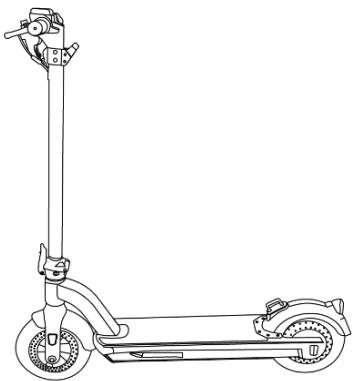
Electric Scooter KS300 (Handlebar not mounted)
- Charger
- User Guide
3 mm Allen key
4 screws for the stem

Warning: you should keep the packaging of your KS300. If you need to return the product for maintenance, it will be easier for you to send it back in its original packaging.
III. Description of the KS300
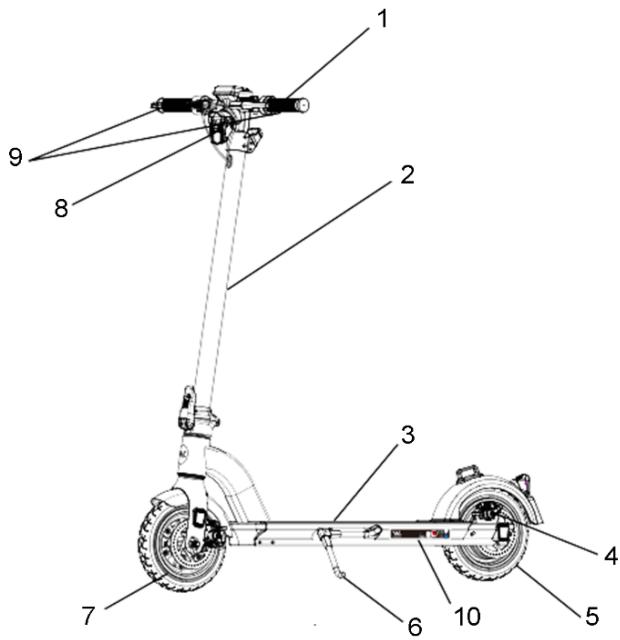
- Handlebars
- Stem
- Foot rest
- Rear disc brake
- Motor in the rear wheel
- Kickstand
- Front wheel
- Front light
- Front and rear brake lever
- EN label
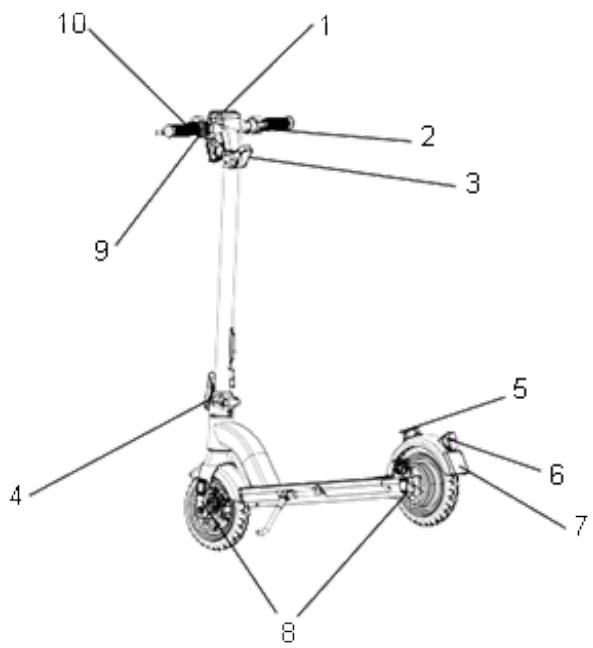
- Control screen
- Acceleration lever
- Locking hook for folded scooter
- Folding lever
- Locking loop for folded scooter
- Tail-light
- Location for the number plate (if necessary according to local regulations)
- Side reflectors
- Control buttons (on/off)
- Bell
B. First use and adjustments
I. Positioning of the safety elements
1. Lighting
You are provided with a lighting system that is composed of two reflectors (a white included in the headlight and a red fixed on the rear fender), a headlight, a rear light, two other orange reflectors positioned between the wheel spokes. The lighting system is a safety mechanism for your electric scooter and as such it must be present and in good working order. Make sure that your lighting system works properly before riding.
The front and rear lights are powered by the scooter's battery.
2. Bell
A bell is fitted to your handlebars. It will allow you to be heard at 50 m.
The bell is a safety device for your scooter and as such must be present on your handlebars.
3. Wearing a helmet
For your safety, it is strongly recommended, or even compulsory to wear a helmet, depending on the legislation in your country.
4. Wearing appropriate footwear
For safe use, shoes must be worn at all times.
For more information, ask your retailer.
5. Appropriate equipment
For your safety, use protective equipment, including: for the hands/wrists, knees and elbows.
II. Unpacking and assembling the scooter
- Open the box and take out all the parts (do not throw away the packaging as you will need it if you return the product)
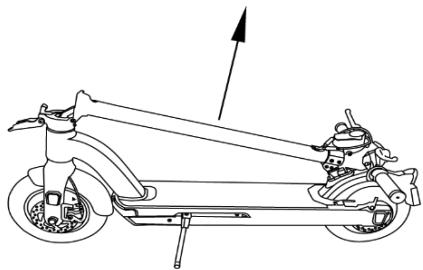
- Raise the stem by holding the handlebars.
- Raise the folding lever and ensure that it is securely locked.
- Insert the handlebars into the stem using the placement guides and the cable connection device.
- Place the holes of the locking hook opposite the holes of the stem and handlebar.
- Tighten the 2 screws (5 N.m) on each side using the 3mm key provided.
- Press the brake lever and insert the brake cable head into the brake lever holder.
- Pass the cable through the slot in the brake lever until the sheath reaches the brake lever stopper. It is necessary to pull on the sheath to perform the operation.
- Check the brake's functioning by operating the lever. The brake caliper must apply pressure to the brake disc to prevent the wheel from turning.
- Follow steps 7, 8 and 9 for each brake lever. Check that the left lever operates the front wheel brake system and the right lever operates the rear brake system.
III. Folding and unfolding the scooter
To unfold the scooter:
- Unfold the stem:
Press the side of the locking hook to open it and release it from its locking loop.
○ Remove the locking hook from the loop
o Raise the stem to its vertical position
o Raise the folding lever until the safety hook on the stem locks automatically and ensure that it is securely locked.
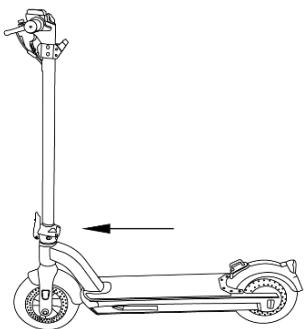
To fold the scooter:
- Lower the stem:
Lower the stem folding lever by lifting the safety hook.
Lower the stem until it is parallel to the rest.
Press the side of the locking hook to engage it from its locking loop.
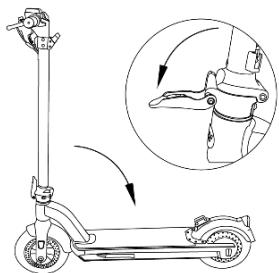
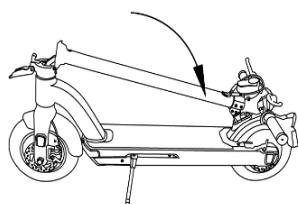

Warning: the hook on the stem is part of the folding system and must not be used as a luggage rack.
Any load attached to the handlebars will affect the stability of the electric scooter.
IV. Adjusting the stem
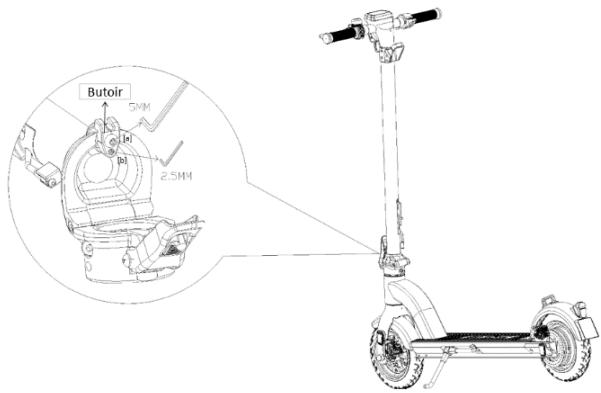
Your scooter can be folded. The manufacturer's default settings allow the stem to be unfolded and locked without any movement. It is necessary to check the folding system every 3 to 6 months. If you feel any movement in the stem while riding, please follow the steps below to adjust it.
- Use a 5 mm allen key to loosen the screw [a] (counter-clockwise) and be sure to only loosen it, do not remove the screw.
- Use a 2.5 mm allen key to tighten the screw [b] (clockwise).
- Use a 5 mm allen key to re-tighten the screw [a] (clockwise).
- Check again whether the stem can be unfolded and locked firmly and whether there is any movement.
It is recommended to replace the bumper after 2 years. Contact your nearest retailer.
V. Braking
The KS300 has a disc brake at the front and (at the rear), which gives it effective braking but must be well controlled. So, pay attention to the following points:
- To slow down, simply release the accelerator.
- When braking, do not press the brake lever too hard. Sudden braking can lead to a loss of balance and falling; gradually press on the brake lever to slow down safely.
- Do not tighten your brake cable more than necessary at the brake caliper. The front or rear wheel must not lock during emergency braking and cause a fall.
- Before each use, check that the front and rear brakes are in perfect working order.
-
The right lever activates your rear brake. The left lever activates the front brake.
-
It is recommended that you distribute your braking force approximately 60/40 between the front and rear. The brake lever should not be in contact with the handlebars, and the sheaths should not be bent at right angles so that the cables can slide with a minimum of friction. Damaged, frayed or rusty cables must be replaced immediately.

WARNING!
In rain or damp weather, braking distances are longer. It is recommended to anticipate braking in this situation. There is a risk of burning yourself if you touch the brakes after prolonged or intensive use. The brakes may become hot during use. Do not touch them after using your scooter.
- When turning and braking, the handlebar can have a negative influence on the response time of the rider.
1. Mechanical disc brake adjustment
- The pads exert pressure on a disc attached to the wheel hub. The intensity of the pressure is controlled by a lever connected to the brake by a cable. Do not operate the brake lever when the wheel is detached from the frame or the fork.
- If the brake is too tight or too loose, it is necessary to adjust the brake cable to align the caliper with the brake disc.
- To align the mechanical disc brake caliper, loosen the fixing screws of the brake caliper support. Brake with the corresponding brake lever (the brake caliper is positioned correctly) and hold the brake lever in this position while tightening the caliper bracket fixing screws.
- Check that the internal pad (inside the wheel) is at 0.2 - 0.4 ~mm from the disc. If this is not enough, tighten the pad positioning screw until a gap of 0.2 - 0.4 ~mm between the pad and the disc is obtained.
- To adjust the external pad (outside the wheel), simply modify the tension of the brake cable in order to obtain a gap of 0.2 - 0.4 ~mm , at the caliper or at the brake lever.
- Never spray oil or any lubricant on the disc or pads (when servicing the chain or the derailleur, for example). If this happens, remove the grease from the pads and disc, or change them.
- Check the alignment of the pads by turning the wheel. Your scooter is ready to ride.
-
Discs: your bicycle is fitted with disc brakes of 120 ~mm in diameter.
-
A nut and lock nut system on the brake lever allows you to adjust the cable tension and so the braking force which will vary over time depending on the wear of the brake pads.
- Brake pads are standard, replace them when your pad no longer has a friction component.
Remember that new brake pads must be broken in. They are broken in by riding for a few minutes and alternating between sudden stops and light braking.
2. Changing the brake pads
Remove the wheel and remove the worn pads from the brake caliper. Position the new pads in the caliper so that the braking surfaces come into contact. Do not touch the braking surfaces. Insert the pads one after the other into the brake caliper.
Then adjust the brakes as described in the previous paragraph.
C. How to use your KS300
- Step 1: check that the silicone cover is covering the charging connector and that your product is not damaged.
- Step 2: unfold the scooter as recommended in section "III. Folding and unfolding the scooter" and press the On/Off button. Enter the electronic lock code defined in the paragraph "Electronic lock of the scooter".
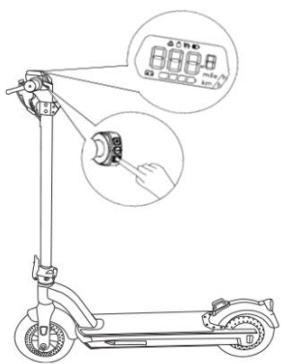
- Step 3: Once the scooter is switched on, place one foot on the foot rest and move forward by pushing the other foot forward on the ground without using the accelerator.
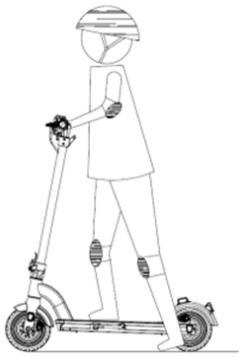
- Step 4: you must reach a speed of between 3 and 5 ~km / h to use the accelerator and switch to electric mode. To accelerate, use the "acceleration lever" near your right hand. Once in motion, you can change to adjust the speed ratio using the "+" or "-" buttons.
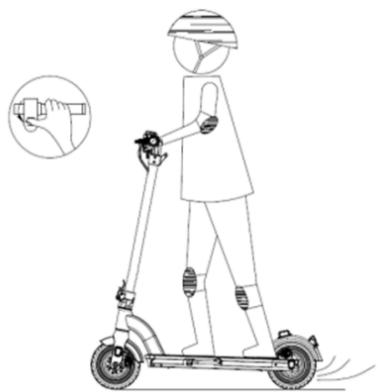
- Step 5: to brake, release the "acceleration lever" and press the brake levers.
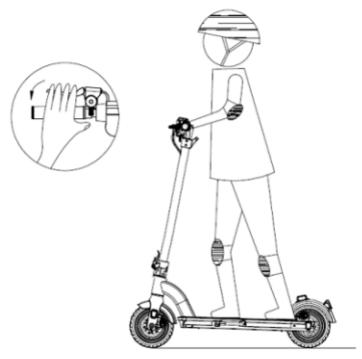
- Step 6: Once you have completed your journey, press and hold the On/Off button for 3 seconds to switch off the scooter.
- Step 7: park your scooter on level ground using the kickstand. Lock the scooter if necessary.
IMPORTANT: To stay safe, sharp turns should always be avoided when travelling at high speed.
Keep your balance when making turns to avoid falling due to the shifting centre of gravity or high speeds. Hanging a load on the handlebars affects the stability of the scooter.

The ideal position for safe riding.
I. Control screen interface
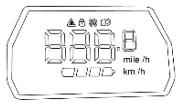
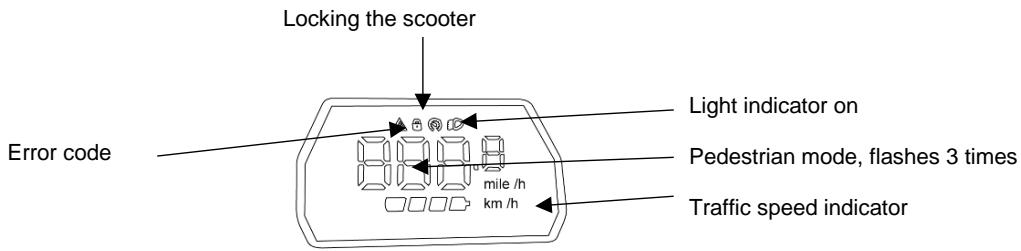
The control screen, located on the handlebars, displayed the status of the scooter, the speed, the battery charge, the front and rear lights and any error codes. It also allows you to set and enter the electronic lock code.
II. Electronic lock of the scooter

The scooter is equipped with an electronic locking system by default, which prevents the engine from being switched on. When the ignition button is pressed, the control screen beeps and the unlock code is required. By default, this code is 000. If you attempt to move the scooter without entering the code, the brakes will be activated, the front and rear lights will flash and inuious tone will sound.

Please note that this does not prevent the scooter from being physically stolen. To prevent this, use the built-in anti-theft device (see below). Ideally should be used with another anti-theft device.
Entering the code to unlock the scooter
- Press the On/Off button for 3 seconds to turn on the scooter.
- Enter the code using the buttons on the control panel.
- The cursor goes on the first digit of the code, its value can be increased or decreased using the "+" and "-" buttons. Briefly press the On/Off button to confirm and move to the next digit of the code.
- Press the On/Off button twice quickly to confirm and move to the next digit of the code.
Activate the lock code
- Turn on the scooter as described above.
- Press the On/Off button and the "+" button simultaneously for 5 seconds to activate/deactivate the lock code function.
Change the lock code of the scooter
- Press the On/Off button for 3 seconds to start the scooter.
- Enter the initial code to unlock the scooter
- Press the On/Off button and the "-" button for 10 seconds to reset the lock code.
- The cursor moves to the first digit of the code. Its value can be increased or decreased using the "+" and "-" buttons. Briefly press the On/Off button to confirm and move to the next digit.
- Press the On/Off button twice briefly to confirm the new code.
III. Control buttons

- The control button panel is on the left side of the handlebars
- On: press the On/Off button briefly to turn on the scooter.
- Off: press the On/Off button for 3 seconds to turn off the scooter.
-
Lights: press the "+" button for 2 seconds to turn on/off the front and rear lights
-
Speed modes: once in motion, press on the "+" or "-" button to change the speed mode
L1: maximum speed 6 km/h,
L2: maximum speed 12 ~km / h
L3: maximum speed 18 km/h
L4: maximum speed 25 km/h
- Pedestrian mode: press the «-» button for 3 seconds to put the scooter in pedestrian mode (speed limited to 3km/h ). On the display, the number "3" flashes and the tail light flashes every 3 seconds.
Do not press the accelerator lever at the same time as the pedestrian mode to avoid the electric scooter starting up depending on the speed mode chosen.
The pedestrian mode can be activated when the user has to walk next to the scooter. Pedestrian mode reduces the effort required by providing a speed of 3km/h .
IV. Speed controller
In order to activate the speed controller:
- Hold the acceleration lever in the same position for 6 seconds.

- The speedometer icon lights up to indicate that the speed controller is active.
To deactivate the speed controller:
- Use the brake lever or
- Press the acceleration lever
V. Speed alarm
- Your scooter has a built-in speed alarm that warns you when your speed is too high, especially when going downhill. This is triggered when the scooter's speed exceeds 30km/h .
- Pay particular attention to the alarms, as riding at this or higher speeds can cause you to lose control of your scooter and injure yourself.
D. Error codes
In case of malfunction during the use of your KS300, press the On/Off and "-" buttons simultaneously for one second. One of the following error codes appears on the display:
| Code | Meaning |
| 2 | Indicates a problem with the accelerator |
| 4 | Indicates a problem with the motor |
| 5 | Indicates a problem with the brakes |
I. Use of the anti-theft device
At the bottom of the stem is a built-in anti-theft device, in the form of a steel cable lockable with a digital code.
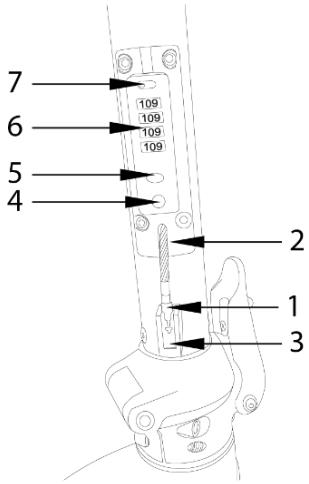
- Locking head
- Anti-theft cable
- Anti-theft cable storage bracket
- Locking mechanism
- Locking button
- Number wheels
- Code reset button
The default unlock code for the lock is : 0-0-0-0
- Unlock the anti-theft device (default code 0000)
- Slide the reset button to the right (SET mode)
- Set a new code by turning the wheels
- Slide the reset button to the left
To attach the scooter to a fixed support:
- Pull the cable of the anti-theft device
- Press the unlock button
- Insert the cable head into the lock
- Turn the wheels to lock the device
To remove the scooter from a fixed stand:
- Enter the unlock code
- Press the unlock button
- Pull the cable out of the lock
- Store the cable in the stem
After use, push the anti-theft cable upwards to pull it up into the stem and secure the cable head in the storage stand to prevent it from hanging and getting caught in the wheel.
E. Instructions for use
Your experience of driving bicycles, cars, skiing and other similar means of transport can be applied to our products and help you to ride your KS300 better.
- Before each time you ride, check that the steering system is correctly adjusted, that the folding system is locked, that the brakes and wheels are not damaged, that the tyres are in good condition and that no screws on the KS300 are loose. If you detect anything unusual, contact your local retailer.
- Fully charge the battery of the KS300 before the first use.
- Do not make any changes to the parts of the KS300, as this may reduce its performance, damage it and potentially cause serious injury.
- Its use is regulated on public roads. Check with your local authorities. Respect local traffic regulations and give way to pedestrians when riding your KS300.
- Always ride your KS300 with the lights on and wearing a high visibility waistcoat that complies with regulations.
Always look where you are going: a clear view will help you to ride your KS300 safely. - Do not drive on wet roads or in rain. This could lead to a loss of grip and result in personal injury and property damage.
- Adapt your speed to your environment so that you can stop the KS300 at any time.
- When riding with other people, keep a safe distance of at least 2 metres between you and them to avoid collisions.
It is prohibited to use under the influence of alcohol and/or drugs. - Always keep your hands on the handlebars when using the KS300, the use of a smartphone or any other object while riding is prohibited. Stay focused when driving your KS300: other activities such as making phone calls or listening to music are prohibited.
- You must wear adequate protection when using the KS300 to avoid injury in the event of a fall: shoes, helmets, gloves, knee pads, elbow pads, etc.
- Avoid driving on roads littered with debris, such as branches, rubbish or small stones.
- Avoid driving on unpaved roads or in areas with obstacles.
- Driving in the city involves coming across many obstacles, such as pavements and steps. It is recommended to avoid jumping over obstacles. It is important to anticipate and adapt your trajectory and speed based on pedestrians before coming across these obstacles. It is
also recommended to dismount the scooter when these obstacles become dangerous due to their shape, height or sliding risk.
- Do not ride your KS300 on roads with obstacles or on slippery roads where there is a risk of losing grip, such as on snow, ice or water.
- Always keep your feet on the footrest when riding. Do not jump on the scooter's footrest.
- Remember that you can be injured if you lose control, in collisions or by falling off the KS300.
- Do not use the KS300 in an unsafe environment, i.e. in areas where there are flammable products, steam, liquids, dust or fibres that could cause a fire or explosion.
- It is not permitted to mount a seat on the electric scooter to use it in a sitting position.
I. Weight limit for users
The main reasons for the weight limit:
- Ensure user safety.
-
Avoid damage to the KS300 due to overloading.
-
The maximum weight supported by the KS300 is 120kg (minimum weight: 20kg ).
- The weight of the user and their belongings must not exceed the maximum weight stated in this guide. Too much weight may result in the user falling or being injured and may damage the KS300. In addition, the user's weight must not be less than the minimum weight of 20kg . Failure to follow the recommendations may result in a loss of ability to decelerate or stop safely when going downhill.
II. Maximum travel distance
The maximum travel distance varies depending on several factors such as:
- The terrain: smooth and flat terrain increases the distance of the ride. Sloping ground reduces this distance.
- Avoid driving on steep slopes.
- The total load: The total load of the user has an impact on the distance of the ride.
-
Room temperature: storing and using the KS300 at the recommended temperature may increase the distance of the ride; using the KS300 outside of these temperature parameters reduces this distance.
-
Speed and driving habits: a low, steady operating speed increases the distance of the ride; conversely, frequent starting, stopping, accelerating and slowing down reduces the distance of the ride.
- Do not start or stop suddenly.
- Do not use the KS300 on overly steep slopes. Gearing up on a steep descent can cause the motor and battery to overheat.
- When the battery is charged, the maximum distance that can be covered is about 35km .
F. Using the charger
Before charging the battery, also be aware of the following points about the battery charger:
- Follow the instructions on the battery charger label.
- Do not use this charger near explosive gases or corrosive substances.
- Do not shake, knock, or drop the charger.
- Always protect the charger from rain and humidity; it is for indoor use only.
- The temperature tolerance of this charger is between 0 and 40^ .
- It is prohibited to dismantle the charger. In the event of a problem, take the device to a qualified repairer.
- You should only use the charger that came with your electric scooter to avoid damage. Note that failure to comply with this regulation will void the warranty.
- When charging, the battery and the charger must be at least 10cm from the wall, in a dry and ventilated place. Do not place anything in the direct vicinity of the charger during use.
- Do not touch the charger for too long during charging (risk of superficial burns).
- Do not place the charger in an unstable position.
- Do not cover the charger to avoid it overheating when charging.
- Do not submerge the product.
- Avoid all contact with water when the battery is charging. Do not touch the charger with wet hands.
- Do not use the charger with a damaged power cord or plugs. Make sure that the charger plug is properly connected to the mains for charging.
- Do not short-circuit the charger pins by using a metal object.
- Disconnect the power supply before connecting or disconnecting the connections to the battery.
- This charger is designed to charge lithium batteries, do not charge the wrong type of battery. Do not use it on a non-rechargeable battery.
- This bicycle can be used by children aged from 14 years and above and persons with reduced physical, sensory or mental capabilities or lack of experience and knowledge if they have been given supervision or instruction concerning use of the device in a safe way and understand the hazards involved. Children must not play with the scooter. Cleaning
and user maintenance must not be carried out by children without supervision.
- Children should be supervised to ensure that they do not play with the bicycle.
- Keep out of reach of children, this product is not a toy.
- The electrical socket to which the appliance is connected must be installed near the equipment and must always be easily accessible. Do not step on the charger or the cable.
- The product's external flexible cable cannot be replaced; if the cord is damaged, the product should be discarded.
- At the end of its life, take the product to a recycling centre.


means that this structure is double insulated or strengthened insulation for class II products

means that the product must be used indoors

means that the device must not be disposed of with household waste (2012/19/EU). It must be recycled.
Charger
Input voltage: 100-240 V
Output voltage: 42 V
G. Charging procedure
Recharge the scooter's battery according to the following procedure:
- The battery can be charged using a standard power outlet.
- Insert the charger plug into the scooter battery (charging connector) by lifting the silicone cover over the charging connector on the front right side of the footrest.
- Make sure that the charging connector is dry and plug the power cable of the charger into a nearby power outlet.
- When charging, the LED on the charger will be red to show that it is working correctly. When it turns green, it means that the battery is charged.
- To finish charging, you must disconnect the power plug and then the plug connected to the battery. Finally close the cap of the battery socket.
Unplug the mains plug
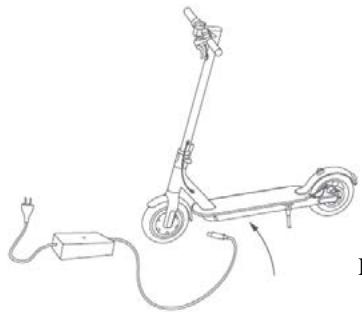
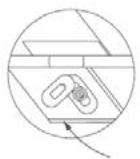
Lift the rubber flap.
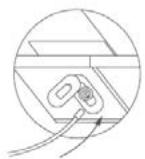
Plug the power adapter into the charging port.
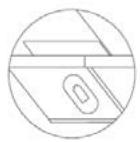
When charging is complete, replace the rubber flap.
IMPORTANT:
- Charging for too long may shorten the life of the battery. Do not leave your KS300 charging overnight.
- Keep the charging environment clean and dry.
- Do not charge the battery if the charging plug is wet.
H. Battery
This electric scooter is equipped with a high-quality Li-ion battery. Li-ion batteries have no memory effect and a wide temperature tolerance range of -10 to +40^ . The battery is placed in a compartment under the footrest of the scooter.
To ensure maximum battery life and protect it from damage, please follow the use and care instructions below.
I. Battery life
After charging your battery, it is advisable to let it sit 20 to 30 minutes before use. Your battery life depends on several usage factors:
The assistance mode selected
The weight of the user
The elevation of the road
The tyre inflation
The wind
The frequency of starts and stops
- The outside temperature
II.Warnings, precautions
It is recommended that the battery is charged regularly, or after each use. These batteries do not have a memory effect.
In order to maximise the life of your battery, it is advisable:
- To avoid very hot and very cold environments (ideal charging temperature 20^ )
- To allow the battery to cool down 30 minutes after use
- If the KS300 stops due to overheating, place it in a cool, dry place and wait for the battery and motor to cool down before using it again.

Precautions for use:
Only use the specific charger supplied to charge the battery. Do not use any power supply or electrical device other than the one supplied with the scooter.
- Only charge the battery in a properly ventilated area.
-
Do not expose the battery to heat, do not charge it in direct sunlight.
-
Do not disassemble or modify the battery housing in the footrest compartment of the scooter.
- Do not connect the (+) and (-) connections of the battery plug with a metal object.
- Do not expose the battery to liquids.
- Never use a damaged battery.
- Stop charging the battery if it is not fully charged within the theoretical charging time. Refer to the battery specifications below.
- Do not use the battery if it emits an unusual smell or becomes unusually hot.
- Keep the battery out of the reach of children.
- Charge your battery before a prolonged period of storage and repeat this operation after the storage period.
- Do not leave the battery on a long charge when not in use.
III. Life of the battery
The life of the battery depends mainly on how you use it. Do not expose the battery to temperatures below -10^ or above 40^ . This could affect its operation.
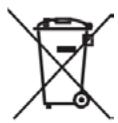
Batteries can suffer from aging of their performance after a high number of charges. This will depend on patterns of use.
This symbol means that this product contains a built-in rechargeable battery, which must not be disposed of with household waste
(2006/66/EC)
Your used battery should go to your local shop or specialised recycling depot. Most importantly, do not throw your end of life battery into the environment.
IV. Use of the battery
To ensure maximum battery life and protect it from damage, please follow the use and care instructions below:
When the battery charge is below 25% (or 114 of the maximum charge), recharge the battery as soon as possible.
When the battery icon on the control screen appears empty and flashes, this means that the voltage is low and the KS300 scooter will not have enough power to run normally. Stop the scooter as this may cause instability in the battery exchange and thus reduce the battery life.

WARNING: do not use the KS300 when the battery is low or when the system requires a safe shutdown. The battery life will be reduced if you continue to use the KS300 when the battery
voltage is low.

WARNING: the battery life may be reduced if it is in storage for a long time without regular charging as described above.
-
Do not use any metal to directly connect two poles of the battery as this could cause it to short circuit.
-
Never place the battery near a fireplace or other heat source.
- Do not shake, knock, or drop the battery.
- When the battery pack is removed from the scooter, keep it out of the reach of children to prevent accidents.
- Do not attempt to dismantle the scooter to access the battery. You must not open the battery.
- If the battery leaks, be careful not to let the liquid come into contact with your skin or eyes. If this occurs, wash with plenty of water and consult a doctor.
- For repair or replacement of the battery, contact a qualified technician.
Battery specifications
| Type | Lithium-ion |
| Rated voltage | 36 V |
| Capacity | 13 Ah |
| Charging time | 6.5 h |
| Number of cycles (≥ 70% capacity) | 500 cycles |
| Input voltage | 100-240 V |
I. Recycling
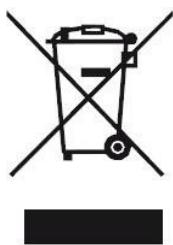
The symbol shown here and on the scooter means that the scooter is classified as electrical or electronic equipment and must not be disposed of with other household or commercial waste at the end of its life.
The WEEE Directive 2012/19/EU (Waste Electrical and Electronic Equipment Directive) was introduced to recycle appliances using the most efficient recovery and recycling techniques to minimise
environmental impacts, treat hazardous substances and avoid the increasing number of landfills.
Disposal instructions for private users:
When you no longer use the scooter, dispose of it in accordance with local recycling procedures. For further information, contact your local authority or the retailer of the device.
Disposal instructions for professional users:
Professional users should contact their suppliers, check the terms and conditions of the purchase contract and ensure that this appliance is not mixed with other commercial waste when disposing of it.
J. Cleaning, maintenance and storage
The KS300 requires regular maintenance. This section describes the important steps and requirements associated with the maintenance of your KS300.
I. Cleaning
- Check that the power supply and charging cable of the KS300 have been disconnected.
- Clean your KS300 with a soft, dry cloth.

WARNING!
-
Your KS300 is IPX5 certified. This means that it is protected from splashes. However, it should not be immersed in or sprayed with water. Therefore, never clean the KS300 with high-pressure water jets or immerse it in any liquid.
-
Do not allow water or other liquids to enter into the KS300, as this may cause irreversible damage to the electronic components.
- Your product would then be excluded from the warranty.
- Cleaning and user maintenance of the scooter must not be carried out by children without supervision.
II. Maintenance
General recommendations
- Do not make any modifications that are not specified by the manufacturer.
- Contact an approved workshop, such as Norauto/ATU/Auto 5.
Wheel and brake system maintenance:
- Remember to apply lubricating oil regularly to both ends of the brake cable to ensure its long life and proper functioning.
- Check the front and rear wheels and hub carefully before using the scooter. The wheels must not be damaged or punctured.
- Check the brakes carefully before using the scooter.
-
In the event of a problem, contact the after-sales service to have the wheels replaced.
-
Maintenance of screws and bolts:
Check the screws of each part carefully before using the scooter. The screws must not be loose or too damaged.
Note: Check that the scooter is functioning normally before each use. If there is a problem, do not use it and contact the after-sales service to have it repaired. Never modify the structure of the scooter. Any modification may result in a risk of injury, and the manufacturer will not be liable for any damage resulting from such modification.
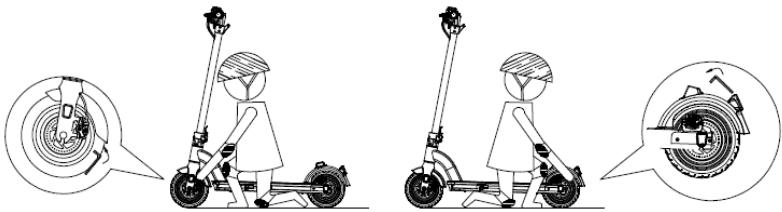
Disc brake adjustment
The pads exert pressure on a disc attached to the wheel hub. The intensity of the pressure is controlled by a brake lever, depending on the force applied by the user. Do not operate the brake lever when the wheel is detached from the frame or the fork.
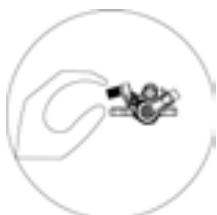
To adjust the braking force slightly, turn the micro-adjustment screw.
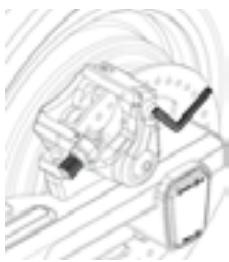
To align the mechanical disc brake caliper, loosen the fixing screws of the brake caliper support.
Brake with the corresponding brake lever (the brake caliper is positioned correctly) and hold the brake lever in this position while re-tightening the caliper bracket fixing screws.
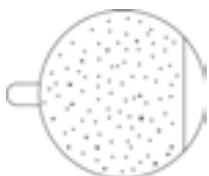
Check that the pads are between 0.2 and 0.4mm from the disc. If not, and if you do not feel comfortable with this type of operation, contact a qualified technician.
Never spray oil or any other lubricant on the disc or pads (e.g. when servicing the chain or derailleur). If this happens, remove the grease from the pads and disc or replace them.
Check the alignment of the pads by turning the wheel. Then you can hit the road!
Disc: your scooter is fitted with disc brakes of 120mm in diameter.
- Brake pads are standard models, replace them when the friction material is worn.
The reference of the brake pads fitted to your bike is as follows:
Model:
Bolids
Reference:
M05
Remember that new brake pads must be broken in. They are broken in by riding for a few minutes and alternating between sudden stops and light braking.
Replacing the brake pads
Remove the brake caliper by loosening the screws and remove the worn pads from the caliper. The pads adhere to the brake caliper magnetically. You can then simply use a small pair of pliers to take out each pad.
Insert each new pad one by one, they adhere magnetically to the brake caliper. Correctly position the new pads so that the braking surfaces come into contact.
Do not touch the braking surfaces. Insert the pads one by one into the brake caliper. Then adjust the brakes as described in the previous paragraph.
Changing the brake cable
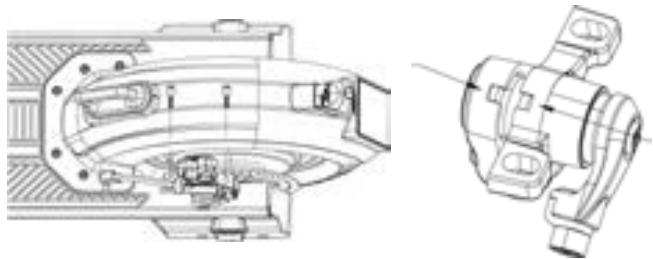
If your brake cables are damaged or deteriorated after a long period of use, it is essential to change them. To do this, follow the steps below.
- Loosen the screw on the brake caliper.
- Remove the brake cable from the brake lever.
- Remove the brake cable from its sheath.
- Insert a new brake cable into the sheath (contact your retailer for a new brake cable)
- Insert the brake cable into the brake lever.
- Adjust the braking force: see the previous chapter.
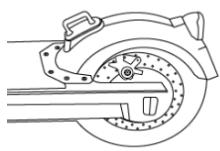
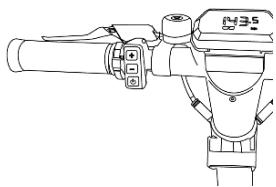
Replacing the wheels
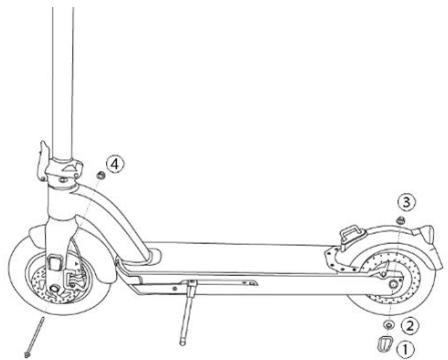
Rear wheel
- Loosen the screws ①: two on each side of the wheel.
- Remove the cover ② , then disconnect the motor cable.
- Unscrew the nuts of the motor ③: one on each side of the wheel.
- Remove the rear wheel from the scooter.
Front wheel
- Unscrew the nuts of the front wheel ④ : one on each side of the wheel.
- Remove the front wheel from the scooter.
- To replace the wheel or tube, it is recommended that you contact a qualified technician at your retailer.
Lubrication recommendations
Lubricating components is necessary for the proper functioning and life of your scooter and to prevent corrosion of components.
Use special transmission oil for brake cables. After washing: dry and then oil the mechanically moving components (brake lever and caliper axles, cable, folding parts). To ensure a watertightness, grease the stem and headset sufficiently.
Nuts and screws
| Illustration | Recommended couple (N.m) | Illustration | Recommended couple (N.m) |
| 45~47 | 48~52 | ||
| 20~25 | 4~5 |
Remarks: self-locking nuts and other types of self-locking fasteners may lose their efficacy and require regular inspection and re-tightening.
III. Storage
- Before storage, charge your KS300 at least 50% to prevent the battery from being discharged too much due to non-use for a long time.
- Do not charge the battery if the temperature is below 0^ ; place the KS300 in a warmer environment (above 5^ ) before charging.
- You must protect your KS300 to avoid its performance degrading due to dust.
- Store your scooter indoors, in a dry place, at an appropriate temperature.

WARNING: to ensure your safety, never disassemble the KS300, otherwise your warranty will be void.

RECOMMENDATION: if the scooter is not used frequently over a period of time, you should fully recharge it every 60 days. The scooter must be stored in a dry, protected place,
at a temperature between 5 and 35^ . Otherwise, the warranty will not apply due to negligence.
K. Technical information
| Name | Settings |
| Net weight | 19.5 kg |
| Minimum load | 20 kg |
| Maximum load | 120 kg (rider + luggage) |
| Maximum speed | About 25 km/h |
| Maximum battery life | Up to 35 km (depending on terrain, driving habits, rider weight, etc.) |
| Power supply | Lithium-ion battery |
| Rated power | 350 W |
| Dimensions (L*W*H) | 114*47*123 cm |
| Battery | 36 V/13 Ah |
| Temperature for use | Min=0 °C, Max=40 °C |
| Maximum wheel pressure | 36 PSI / 2.5 Bar |
| Maximum noise during use | <70 dB(A) |
L. Scope of the warranty
In the event of a problem:
- The supplier warranty is valid for normal use of the product as defined in the user guide for a period of 2 years (3 years for Spain) on the product and 1 year for the battery.
- This warranty does not cover damage caused by any cause other than the device.
- In particular, the warranty does not apply if the scooter has been damaged as the result of an impact or fall, incorrect use, connection that does not comply with the instructions in the manual, the effect of lightning, mains overvoltage, insufficient protection against heat, moisture or frost.
- The warranty does not cover the user guide.
- The warranty does not cover normal wear and tear of the product (wheels, brake cable and sheath, brake pad, wear of the footrest, wear of the mudguard, wear of the plastic protection covers, etc.)
- The warranty does not cover deterioration of the product due to misuse, including but not limited to damage caused by collisions with objects or falling.
- The warranty does not cover use of the product that is not in accordance with the precautions for use stipulated in the user manual.
- The warranty does not cover defects caused to the product by an accessory that is not provided.
- The warranty does not cover damage to the battery.
- The warranty does not cover the product or its accessories if it or they have been dismantled or modified in any way.
- The warranty does not cover products that are not identifiable by serial number. If parts have been removed, erased, modified or rendered illegible, the warranty does not apply.
-
The warranty does not cover damage caused by exposure to moisture, extreme heat or cold, corrosion, oxidation, or any liquid at all.
-
The warranty does not cover deformation, damage or breakage of the main frame due to sudden drop, overloading or repeated shocks.
Leer antes de usar

To reduce the risk of fire or short-cutting do not open the case.
Pae
Power on the supply before connecting or disconnecting to the battery.
Before using please read the instruction.
Green light refers to charged nuclei.
Bed light refers to charging

Megetac Intelligent Technology (Suzhou) Co., LTD
Address: Building 254, Shuyang Pioneer Park, Huaqiao Town, Kunshan, Jiangsu Province, PRC





MEGETAC

EC DECLARATION OF CONFORMITY
The manufacturer :
MGTS SA
represented its authorized representative :
MGTS CONCEPTION
represented by Laurent Attardo, Global Sourcing and Purchasing Director, duly authorized to compile the technical file and to draw up this declaration, declares that the new machine hereafter:
Trade name: Wayscral KS300
Generic name : E-kick scooter
Function: Kick scooter; Model: KS300
MGTS code : 35247
whose serial number is as follows: see page 1
fully complies with all applicable Union harmonisation legislation :
Directive 2006/42/CE on machinery,
- Directive 2014/30/UE on the harmonisation of the laws of the Member States relating to electromagnetic compatibility,
- Directive 2011/65/UE on the restriction of the use of certain hazardous substances in electrical and electronic equipment,
- Directive 2006/66/CE on batteries and accumulators and waste batteries and accumulators.
And harmonised standards :
EN17128:2020
EN 55014-1:2017, EN 55014-2:2015, EN 61000-3-2:2019, EN 61000-3-3:2013
EN 62321:2013
EN 62133-2:2017.
This declaration of conformity is issued under the sole responsibility of the manufacturer.