HCA62640B - Range hood BEKO - Free user manual and instructions
Find the device manual for free HCA62640B BEKO in PDF.



| Product Type | Under cabinet range hood |
| Brand | Beko |
| Model | HCA62640B |
| Width | 596 mm |
| Depth | 386 mm |
| Height | 750 mm (min) / 1080 mm (max) |
| Net Weight | 10.4 kg |
| Supply Voltage | 220 - 240 V, 50 Hz |
| Total Power | 316 W |
| Motor Power | 1 x 210 W |
| Suction Capacity | 537 m³/h |
| Number of Speeds | 3 (digital electronic controls) |
| Lighting | 2 halogen bulbs of 3 W each |
| Exhaust Duct Diameter | 120 mm or 150 mm |
| Automatic Shut-off | Yes, programmable (15 minutes) |
| Grease Filter | Washable aluminium (dishwasher safe) |
| Charcoal Filter | Optional (for recirculation), replacement every 6 months |
| Color | White |
| Minimum distance between hood and hob | 65 cm |
| Energy Class | Not specified in the manual |
Frequently Asked Questions - HCA62640B BEKO
User questions about HCA62640B BEKO
0 question about this device. Answer the ones you know or ask your own.
Ask a new question about this device
Download the instructions for your Range hood in PDF format for free! Find your manual HCA62640B - BEKO and take your electronic device back in hand. On this page are published all the documents necessary for the use of your device. HCA62640B by BEKO.
USER MANUAL HCA62640B BEKO
HCA92640BH
HCA92640WH
HCA62640W
HCA62640WH
HCA62640B
HCA62640BH
HCA62540B
HCA92540B
DE
IT
EN
SL
ES
SK
FR
UA
PL
RU
NL
RO
CZ
1 x Kunststoffabzugadapter (Ø 120/150 mm)
(Abbildung 4)
(Abbildung 7)
(Abbildung 9)
(Abbildung 10)
Hinweis:
(Abbildung 11)
Achtung!
Hinweis:
Please read this user manual first!
Dear Customer,
Thank you for preferring a Beko product. We hope that you get the best results from your product which has been manufactured with high quality and state-of-the-art technology. Therefore, please read this entire user manual and all other accompanying documents carefully before using the product and keep it as a reference for future use. If you handover the product to someone else, give the user manual as well. Follow all warnings and information in the user manual.
Remember that this user manual is also applicable for several other models. Differences between models will be identified in the manual.
Explanation of symbols
Throughout this user manual the following symbols are used:

Important information or useful hints about usage.

Warning for hazardous situations with regard to life and property.

Warning for electric shock.

This product was manufactured using the latest technology in environmentally friendly conditions.
1 Important instructions for safety and environment 22-24
1.1 General safety 22
1.1.1 Electrical safety 22
1.1.2 Product safety 23
1.1.3 Children's safety 24
1.2 Intended use 24
1.3 Compliance with WEEE regulation and disposal of the waste product ....24
1.4 Package information 24
2 Technical specifications of your appliance 25-26
3 Installing your appliance 27-32
3.1 Installation accessories....27
3.2 Installing the hood onto the wall....28
3.2.1 Boring the hanger holes....29
3.2.2 Hammering the wall plugs 30
3.2.3 Installing the hanger screws ..... 30
3.2.4 Hanging the hood onto the wall .....30
3.3 Installing the hood flue 31
3.4.1 Using with flue connection....32
3.4.2 Using without flue connection....32
3.5 Flue connection: 32
4 Operating your appliance 33-34
4.1 Digital electronic control with 3 levels .... 33
4.2 Energy efficient usage: 34
4.3 Operating the hood:....34
5 Cleaning and maintenance 35-36
5.1 Aluminum filter 35
5.1.1 Removing the aluminum filters....35
5.2.1 Replacing the carbon filter 35
5.3 Cleaning 36
5.4 Replacing the lamps....36
1
Important instructions for safety and environment
This section contains safety instructions that will help protect from risk of personal injury or property damage. All warranties will become void if you do not follow these instructions.
1.1 General safety
- Always have the installation and repairing procedures carried out by the Authorised Service Agent. Manufacturer shall not be held responsible for damages arising from procedures carried out by unauthorised persons.
- This appliance is not intended for use by persons (including children) with reduced physical, sensory or mental capabilities, or lack of experience and knowledge. Children should be supervised to ensure that they do not play with the appliance.
1.1.1 Electrical safety
- Disconnect the product from the mains during installation, maintenance, cleaning and repairing procedures.
- If the power cable is damaged, it must be replaced by the manufacturer, after sales service or a similarly qualified person (preferably an electrician) or someone designated by the importer in order to avoid possible risks.
- Operating voltage is 220 to 240 volts.
- If the appliance has a failure, it should not be operated unless it is repaired by the Authorised Service Agent. There is the risk of electric shock!
- Do not route power cable close to hobs. Otherwise power cable may cause fire since it melts down easily.
- Never plug the hood before installation is completed.
- In order to obtain the best performance, external conductor must not be longer than 4 m. It must not contain more than 2 perpendicular (90°) angles and its diameter must be min. ∅120 mm.
- Disconnect the appliance before any intervention to the internal parts of the appliance.
1
Important instructions for safety and environment
1.1.2 Product safety
- You can use a pipe with a diameter of 120 mm or 150 mm on the flue connection of the hood.
- Do not make connections to the flues connected with stoves, exhaust shafts or flues with rising flames. Observe the rules set by authorities on the discharge of exhaust air.
- The height between the lower surface of the hood and upper surface of the stove/oven should not be less than 65 cm.
- Do not operate the hood without aluminum filters and do not remove the filters while it is operated.
- Never touch the hood's lamp after they operated for a long time. Hot lamps may burn your hand.
- Avoid big flames beneath the product. Otherwise, particles on oil filter may ignite and lead to a fire.
- Turn on the hobs after placing pans or pots on it. Otherwise, rising temperature may deform certain parts of your product.
-
Turn off the hobs before taking away pans or pots.
-
Avoid inflammable materials under the hood.
- Oil may ignite while frying foods. Therefore, be careful about cloths and curtains.
- Never leave the cooker unattended when frying foods; otherwise boiled oil may cause fire.
- There is the risk of fire if your hood is not cleaned in the specified periods.
- Be extremely careful and wear gloves when cleaning the hood.
- We advise you to operate the appliance a few minutes before starting to cook in order to increase the suction power. Thus, you shall have a continuous and stable suction power when the vapors arises.
- Operate your hood for 15 minutes more after the end of cooking or frying in order to remove smell cooking vapour in the kitchen.
- When the hood is in use, especially together with gas cookers, make sure that environment is ventilated with clean air.
- Pay attention not to connect the appliance to the flues used by non-electrical devices. (E.g.: Heater flue).
1
Important instructions for safety and environment
- When a non-electrical device is concurrently used in the same room together with the hood, the negative pressure in the room must be maximum 0.4 mbar in order to prevent hood from sucking other device's exhaust into the room.
1.1.3 Children's safety
- Packaging materials are dangerous to children. Keep packaging materials in a safe place out of reach of children.
- Electrical appliances are dangerous to children. Keep children away from the product. Do not allow children play with the appliance.
1.2 Intended use
- This appliance is intended for domestic use. It is not suitable for commercial use and it must not be used out of its intended use.
- The manufacturer shall not be liable for any damage caused by improper use or handling.
- The period required for the availability of spare parts for the correct operation of the appliance is 10 years.
1.3 Compliance with WEEE regulation and disposal of the waste product
This product does not contain harmful and forbidden materials described in the "Directive on the Restriction of the Use of Certain Hazardous Substances in Waste Electrical and Electronic
Equipment" (WEEE) issued by the T.R. Ministry of Environment and Urbanization.
Complies with the WEEE Directive.
This product has been manufactured with high quality parts and materials which can be reused and are suitable for recycling. Therefore, do not dispose the product with normal domestic waste at the end of its service life. Take it to a collection point for the recycling of electrical and electronic equipment. Please consult your local authorities to learn the nearest collection point. Help protect the environment and natural resources by recycling used products.
1.4 Package information

The product package is made of recyclable material as per the National Legislation. Do not dispose of the package waste together with the household
waste or other waste and deliver them to the package collection points indicated by the local authority.
2 Technical specifications of your appliance
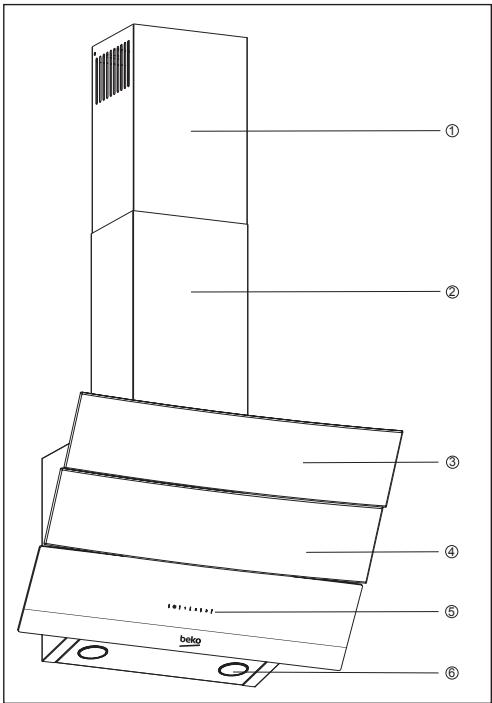
- Internal flue
- External flue
- Glass cover
- Filter (under the glass cover)
- Control panel
- Illumination
(Figure 1)
| HCA 92640 BH | HCA 92640 WH | HCA 62640 W | |
| Width | 896 mm | 896 mm | 596 mm |
| Depth | 393 mm | 393 mm | 386 mm |
| Height | 750 mm / 1130 mm | 750 mm / 1130 mm | 750 mm /1080 mm |
| Supply voltage | 220 - 240 V, 50 Hz | 220 - 240 V, 50 Hz | 220 - 240 V, 50 Hz |
| Control | With 3 levels | With 3 levels | With 3 levels |
| Lamp power | 2 x 3 W | 2 x 3 W | 2 x 3 W |
| Air outlet pipe | 120 / 150 mm | 120 / 150 mm | 120 / 150 mm |
| Capacity | 577 m3/h | 577 m3/h | 537 m3/h |
| Motor power | 1 x 210 W | 1 x 210 W | 1 x 210 W |
| Total power | 316 W | 316 W | 316 W |
| Net weight | 13 kg | 13 kg | 10,4 kg |
| Colour | Black | White | White |
Values stated on the product labels or in the documentation accompanying it are obtained in laboratory conditions in accordance with relevant standards. These values may vary depending on operational and environmental conditions of the product.
2 Technical specifications of your appliance
| HCA 62640 WH | HCA 62640 B | HCA 62640 BH | |
| Width | 596 mm | 596 mm | 596 mm |
| Depth | 386 mm | 386 mm | 386 mm |
| Height | 750 mm /1080 mm | 750 mm /1080 mm | 750 mm /1080 mm |
| Supply voltage | 220 - 240 V, 50 Hz | 220 - 240 V, 50 Hz | 220 - 240 V, 50 Hz |
| Control | With 3 levels | With 3 levels | With 3 levels |
| Lamp power | 2 x 3 W | 2 x 3 W | 2 x 3 W |
| Air outlet pipe | 120 / 150 mm | 120 / 150 mm | 120 / 150 mm |
| Capacity | 537 m 3 /h | 537 m 3 /h | 537 m 3 /h |
| Motor power | 1 x 210 W | 1 x 210 W | 1 x 210 W |
| Total power | 316 W | 316 W | 316 W |
| Net weight | 10,4 kg | 10,4 kg | 10,4 kg |
| Colour | White | White | Black |
3 Installing your appliance
Please consult the nearest Authorised Service Agent for the installation of your hood.
*Preparation of location and electrical installation for the product is under customer's responsibility.

Caution!
Remove the protective film (if any) on the hood and flue surface after the installation.

(Figure 3b)
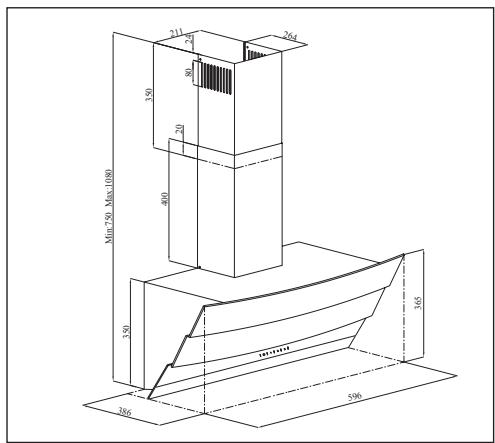
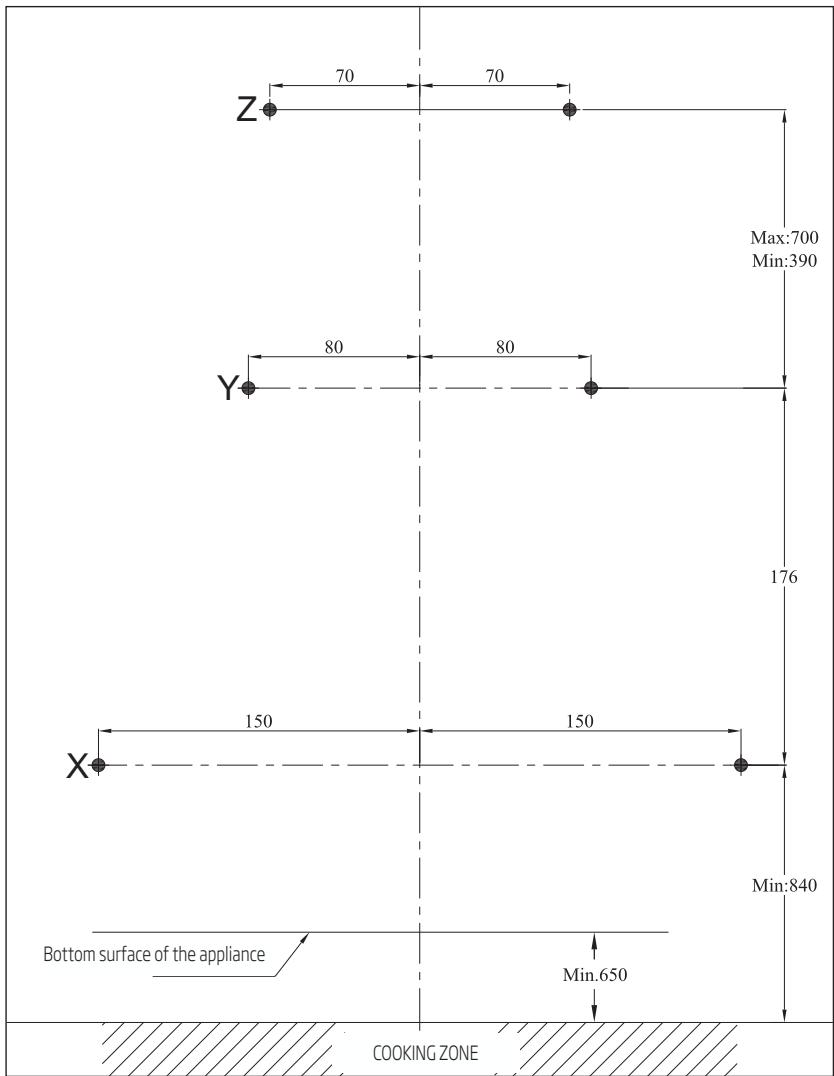
Distance between lower surface of the hood and upper surface of the hob should be at least 65 cm.
Have a qualified electrician make the electrical connection.
Install your appliance so that you can reach the power connection (plug, outlet) easily after installation.
Dimensions are given in mm.
3.1 Installation accessories
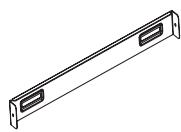
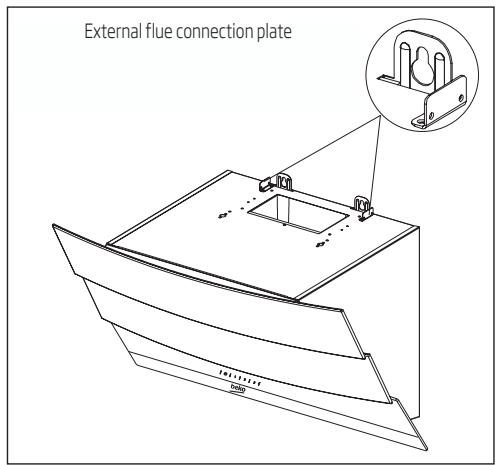
1 x flue connection plate
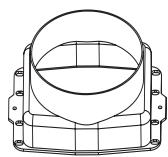
1 x ∅150 mm plastic flue
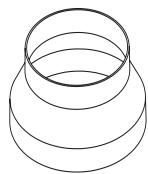
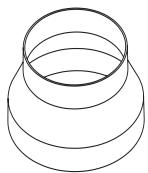
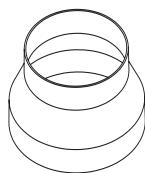
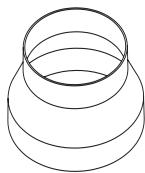
1 x ∅120/150 mm plastic flue adapter
3 Installing your appliance
Information required for the preparation of the installation place for your hood is given below.
3.2 Installing the hood onto the wall
To install the hood onto the wall, loosen the screws of hanger plates on the motor housing and pull the plates upwards. Then, tighten the screws of the hanger plates. (Figure 3a).
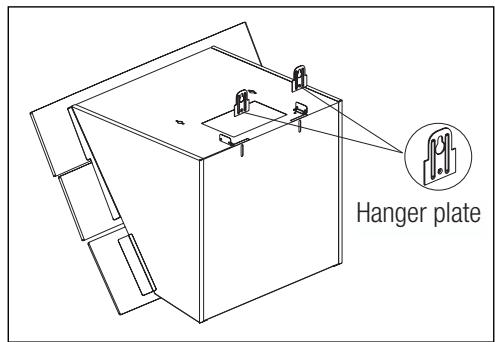
(Figure 3a)
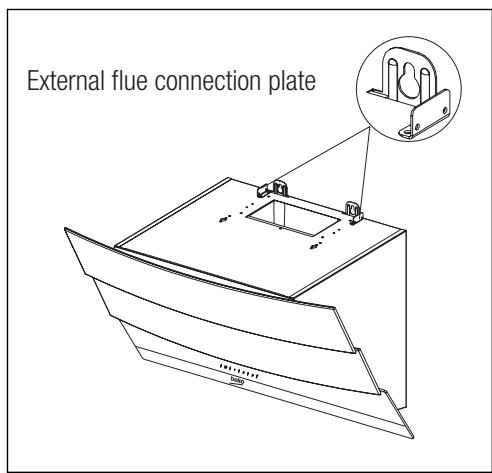
(Figure 3b)
Secure the ∅150 mm plastic flue adapter onto the top of the body with 3.5x9.5 screw included in installation accessories (Figure 4).
If you will use ∅ 120 mm flue pipe, install ∅ 120 mm flue adapter onto it.
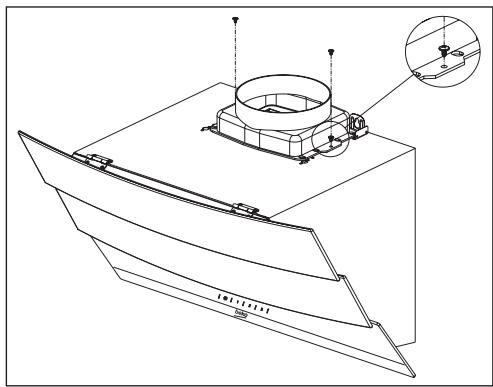
(Figure 4)
3 Installing your appliance
3.2.1 Boring the hanger holes
Affix the installation template onto the installation place of the hood. Drill the points market with (X,Y) (Figure 5) using a ∅ 10 mm bit and points market with (Z) (Figure 5) using a ∅ 6 mm bit.
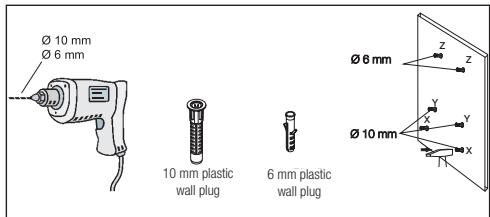
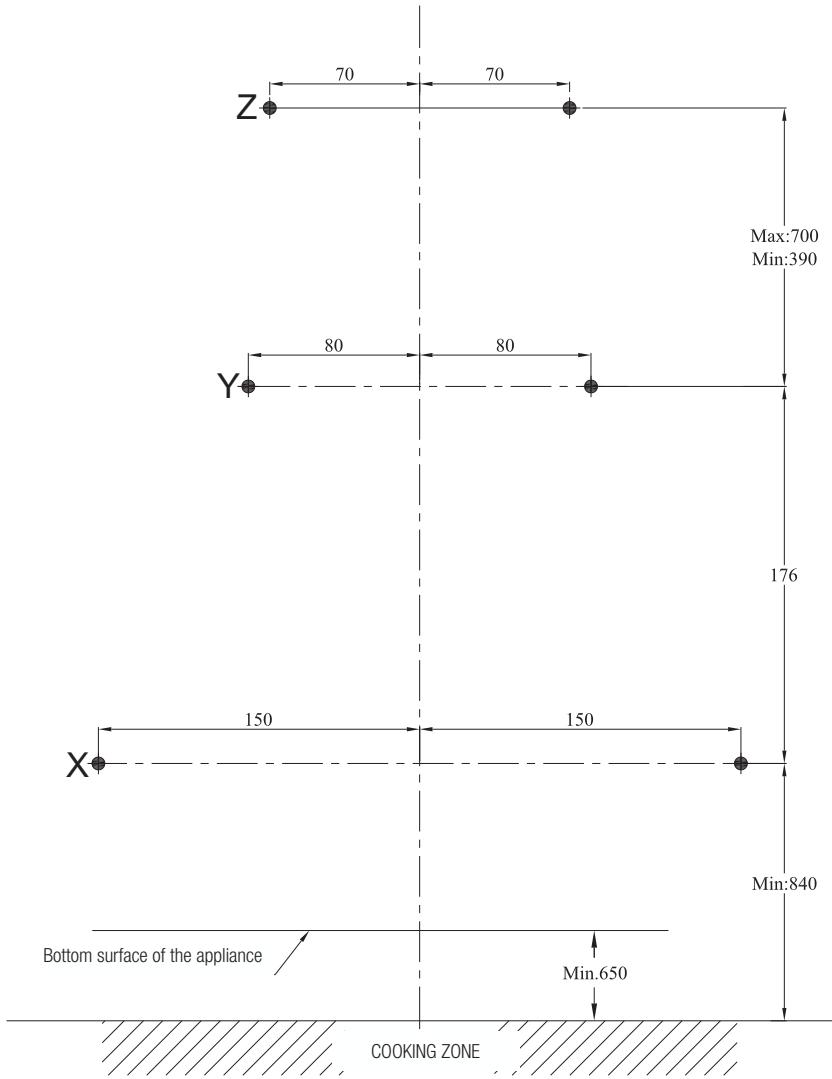
(Figure 5)
3 Installing your appliance
3.2.2 Hammering the wall plugs
Hammer ∅ 10 mm wall plugs (X,Y) into the holes drilled for hanger screws. Hammer 2 x ∅ 6 mm wall plugs (Z) into the holes drilled with a ∅6 mm bit for the external flue connection plate. (Figure 5)
3.2.3 Installing the hanger screws
Install 5.5x60 hanger screws into the ∅ 10 mm wall plugs (Y) you have hammered into the wall. There must be a gap of 5 mm between the screw head and the wall. (Figure 6)
Connect the internal flue connection plate to the 6 mm wall plugs (Z) on the wall using ∅ 3.9x22 screws. (Figure 6)
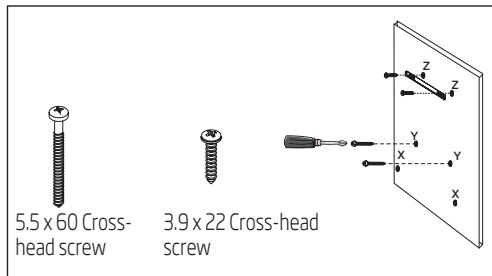
(Figure 6)
3.2.4 Hanging the hood onto the wall
- Hang the hood onto the screws you have installed into the Y holes.
- Open the side suction window of the hood by pulling it towards yourself. Install the 5.5x60 screws through the X holes located inside in order to secure the appliance.
3 Installing your appliance
3.3 Installing the hood flue
Disconnect the product from mains supply before starting flue installation. Fit the sheet metal flue parts around the body.
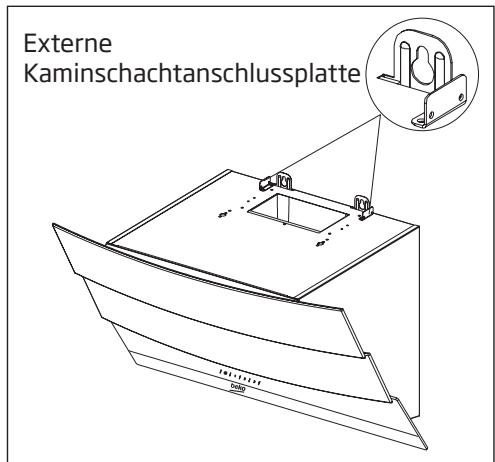
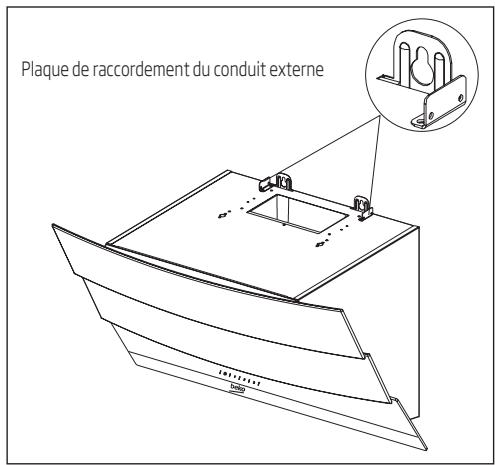
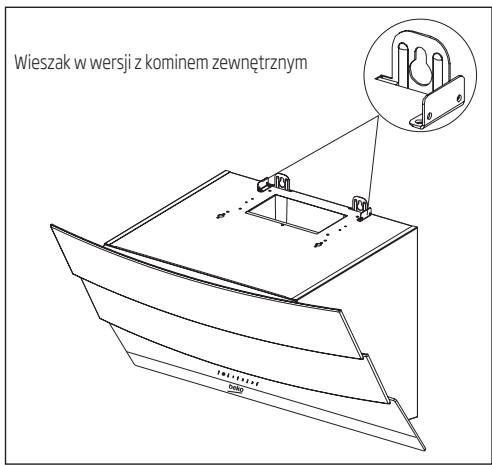
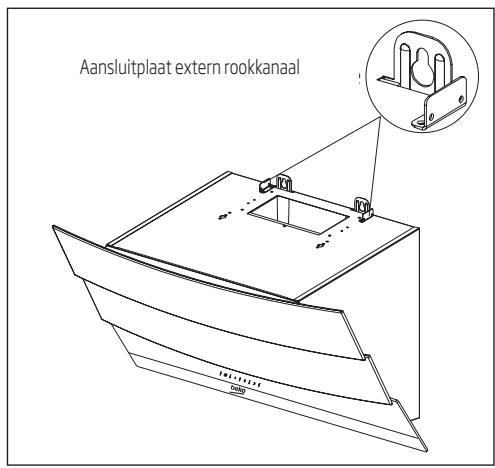
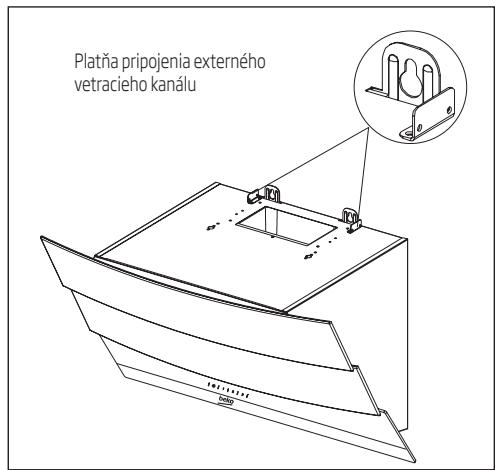
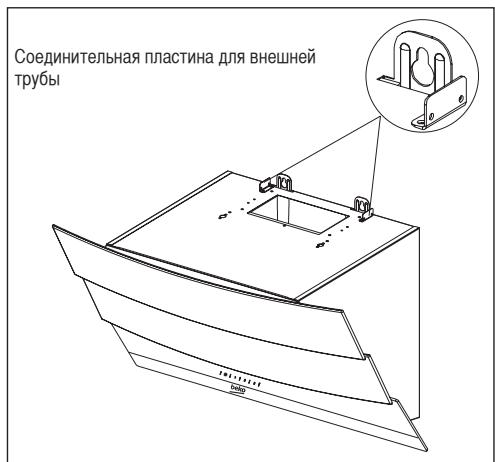
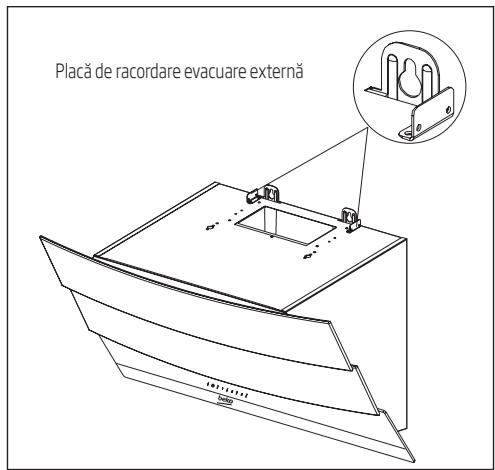
Screw the external flue to the external flue connection plates located on the motor housing. (Figure 3b / 7)
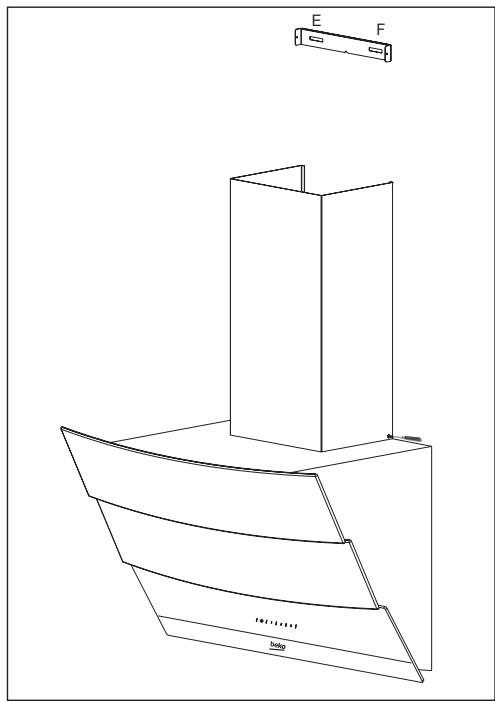
(Figure 7)
Extend and screw the internal flue from its outer edges onto the flue connection plate which was secured to the wall (Figure 8).
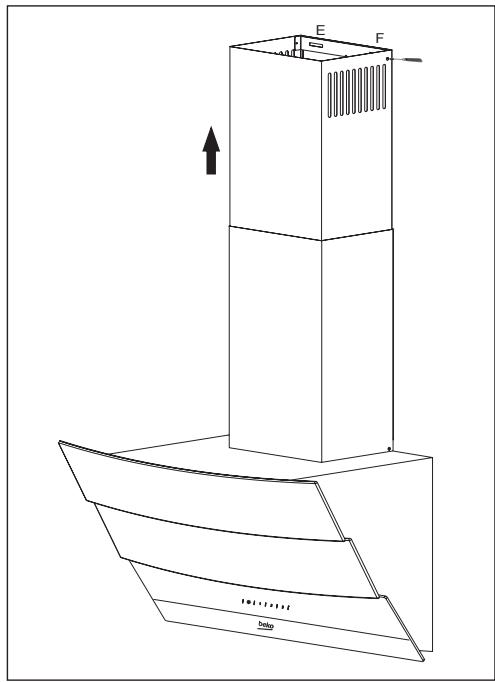
(Figure 8)
3 Installing your appliance
3.4.1 Using with flue connection
- The vapour is removed via flue pipe which is secured to the connection head on the hood.
- Diameter of the flue pipe should be equal to the diameter of connection ring. To allow the air be removed easily out of the room in horizontal arrangements, the pipe should be slightly tilted upwards (approximately 10° ).
3.4.2 Using without flue connection
- Air is filtered by the carbon filter and returned to the room. Carbon filter is used when there is no flue in the house.
- if the hood will be used without flue connection remove the diverters inside the flue adapter.
- Remove the aluminum filter. To install the carbon filter, center the carbon filter on the plastic part on both sides of the fan body, and secure it on the tabs. Secure the filter by turning the tabs to right or left.
• Install the aluminum filter.
3.5 Flue connection:
Place adapter supplied together with the hood into the ventilation hole located on the top section of the hood. Procure a pipe with a diameter of 120/150 mm. Connect one end of the pipe to the adapter and the other end to the flue.
Make sure that these two connections are secure enough
so that they will not dislocate when the hood is operated in max. speed. Check that the flaps inside flue are functional when tightened with the clamp. Fit the flue connection pipe onto the adapter. If you fit the flue connection pipe inside the adapter, air suction will not occur since the flaps that prevent air backflow will remain closed.
It is not advisable to make connections to the flues connected with stoves or exhaust shafts. Do not make connections to such flues.
Pipe connection must be as short as possible and have minimum number of elbows.
A: Flue outlet pipe
B: Flaps that prevent backflow
C: Plastic flue
3.5.1 Backflow prevention system (N-RV)
When the hood is operated, flaps are closed in order to prevent possible odours and dust from entering into the ambient from outside.
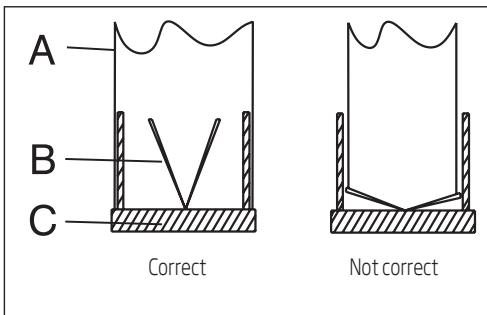
(Figure 9)
4 Operating your appliance
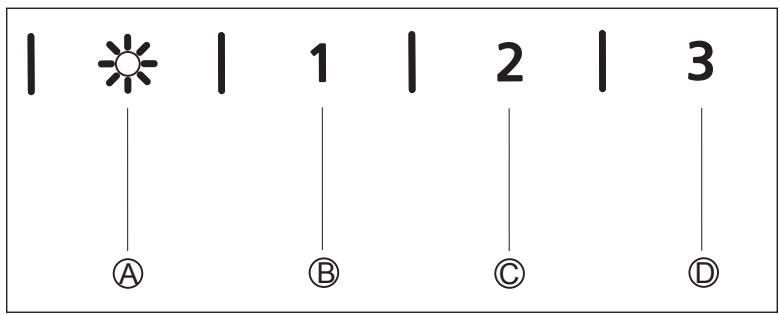
(Figure 9)
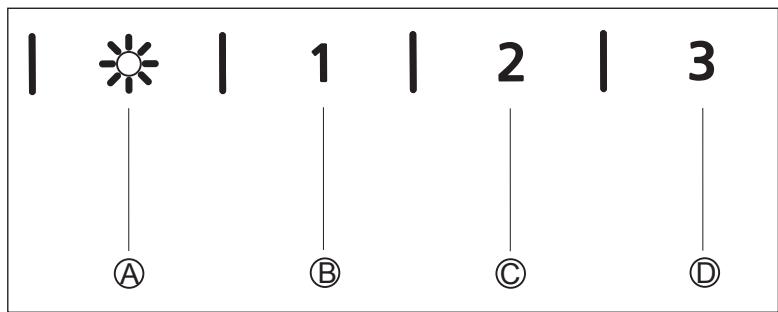
(A): Light On / Off key
(B): 1st level key
(C): 2nd level key
(D): 3rd level key
4.1 Digital electronic control with 3 levels
(A) Light On/Off Key: You can illuminate the cooking area by pressing this key.
(B) key: You can start your hood at speed level 1 by pressing this key.
When you press this key again to switch off the appliance, speed level indication on the display disappears.
(C) key: You can start your hood at speed level 2 by pressing this key.
When you press this key again to switch off the appliance, speed level indication on the display disappears.
(D) key: You can start your hood at speed level 3 by pressing this key.
When you press this key again to switch off the appliance, speed level indication on the display disappears.
Auto-stop in 15 min.:
This appliance is equipped with an Auto-Stop function which allows the appliance to ventilate the room for an additional period of time in order to remove the unpleasant odour and vapour in the room after the cooking is over. Appliance stops automatically after a certain period of time.
To enable the Auto-stop function, press any of the speed level keys (B, C, D) on the control for longer than 2 seconds. A timer with 15 minutes will be activated.
If you press the same speed level key while the Auto-stop function is enabled, function will be disabled and the appliance will stop.
If you select a different speed level this function will be disabled.
If you want your appliance to stop automatically, you must enable the Auto-stop function again.
Periodical cleaning of metal filters:
Filters must be cleaned at about every 60 hours of operation or 4 weeks depending on the frequency of usage.
4 Operating your appliance
4.2 Energy efficient usage:
- When operating the hood, adjust the speed level according to the odour and vapour intensity in order to prevent unnecessary power consumption.
- Use low speeds in normal conditions (1-2), and high speed (3) when smell and vapors are intensified.
- Lights on the hood are intended for illuminating the cooking zone.
Using them to illuminate the ambient/kitchen will result with unnecessary power consumption and inadequate illumination.
4.3 Operating the hood:
- Hood is equipped with a motor having various speed settings.
- For a better performance, we advise you to use low speeds in normal conditions, and high speeds when smell and vapors are intensified.
- You can start the hood by pressing the desired speed level key (B,C,D).
- You can illuminate the cooking area by pressing the light key. (A)
5 Cleaning and maintenance
Prior to cleaning and maintenance, unplug the appliance or turn the main switch off or loosen the fuse that supplies the hood.
5.1 Aluminum filter
This filter captures oil particles in the air. You are recommended to clean your filter every month under normal usage conditions. First remove the aluminum filters for this process. Wash the filters with liquid detergent and rinse them with water and install them back after they get dry. Aluminum filters may get discolored as they are washed; this is normal and you don't need to change your filter.
5.1.1 Removing the aluminum filters
- Push the aluminum filter lock forward.
- Then, slightly lower it and pull forward. Otherwise, you may bend the filter. (Figure 10) After the aluminum filter is washed and dried, reinstall the filter to its slot by applying above steps in reverse order.
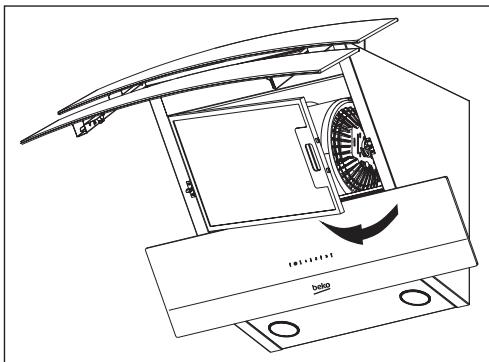
(Figure 10)
Note:
You can also wash aluminum filters in dishwasher.
Carbon filter (Using without flue)
This filter removes the cooking odours. If it is not possible to use a flue, it purifies the air which is circulated inside the kitchen. Carbon filter of your appliance will get clogged in time depending on the frequency of use, style of cooking and regular cleaning of the aluminum filters.

Caution!
Carbon filter should never be washed.
You may obtain carbon filters from Beko Authorised Service Agents.
5.2.1 Replacing the carbon filter
- Remove the aluminum filters. (Figure 10)
- To remove carbon filter, turn the tabs counterclockwise and release the filter. (Figure 11)
• Install the new carbon filter.
• Install the aluminum filters.
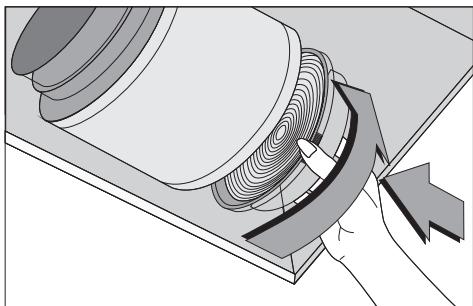
(Figure 11)
Anti-odor filters contain charcoal (active carbon). They must be changed with periods of approximately 6 months.
Regardless of using a carbon filter or not, aluminum filters must always be installed.
Do not operate your appliance without the aluminum filter in place. Using with carbon filter will decrease suction performance of the appliance.
5 Cleaning and maintenance
5.3 Cleaning
Particularly do not neglect to clean your hood immediately after you have made frying.
Use a soft cloth soaked with liquid detergent to clean the outer surface of your hood.
Never use abrasive or scratching materials for cleaning.
You may use the cleaning agents commercially available for persistent grease etc. by following the warnings on the product. In order not the scratch the brushed steel body, wipe in the same direction with the bush trace.
Do not use cleaning agents containing hydrochloric acid, bleach or abrasive powders in order to maintain the surface quality of your product. Use a cloth dampened in soapy water or special stainless steel cleaning spray for stainless steel steel surfaces. Remove the protective foil on the appliance.

Caution!
You may cause a fire if you do not follow the instructions on the cleaning and replacement of the filters of your hood.
If you need to transport the appliance:
- Keep the original packaging of the appliance. Transport the appliance with its original package, and follow the transport markings on the original package.
If you do not have the original package:
- Do not place any objects on the hood.
- Protect the outer surface from impacts.
- Pack the appliance so that it would not be damaged during transport.
5.4 Replacing the lamps
Disconnect the hood from the mains supply.
This appliance is equipped with 3 W halogen lamps.
To replace the halogen lamps, press the lamp downwards from the rear section of the lamp holder to release the lamp. Then turn it counterclockwise by 1/4 tour and remove it.
Perform the above steps in reverse order to fit the new lamps.
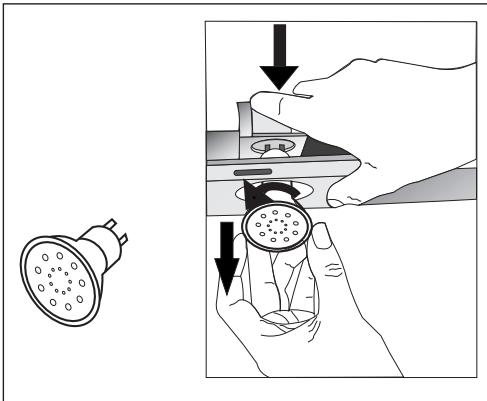
Note:
You may procure lamps from Authorised Service Agents.
Atención:
1 x chimenea plástica de ∅150 mm
(Figura 4)
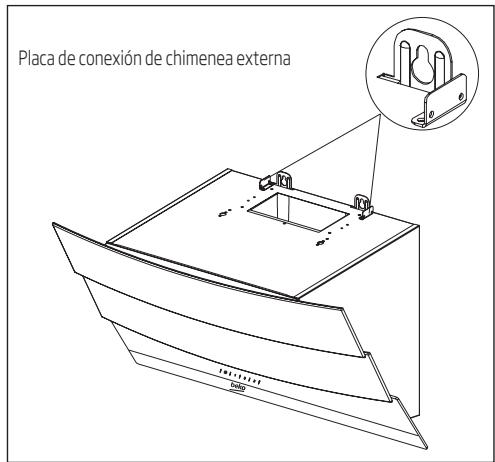
(Figura 3b)
(Figura 7)
(Figura 8)
(Figura 9)
(Figura 10)
Nota:
(Figura 11)
Atención:
Nota:
(Figure 3a
(Figure 4)
(Figure 7)
(Figure 8)
(Figure 9)
(Figure 10)
Remarque :
(Figure 11)
Remarque :
(Rysunek 4)
(Rysunek 7)
(Rysunek 9)
(Rysunek 10)
Uwaga:
(Rysunek 11)
Ostrzeżenie!
Uwaga:
1 x ∅150 mm kunststof rookkanaal
(Afbeelding 4)
(Afbeelding 7)
(Afbeelding 8)
3 Uw apparaat installeren
(Afbeelding 9)
5.1 Aluminium filter
(Afbeelding 10)
Opmerking:
U kunt de aluminium filters ook in de vaatwasmachine wassen.
(Afbeelding 11)
Waarschuwing!
Opmerking:
1 x ∅150 mm plastová trubice
(Obrázek 4)
(Obrázek 7)
(Obrázek 8)
(Obrázek 9)
(Obrázek 10)
Poznámka:
(Obrázek 11)
Poznámka:
Attenzione!
(Figura 4)
(Figura 7)
(Figura 8)
(Figura 9
Nota:
(Figura 11)
Nota:
(Slika 3a)
(Slika 4)
(Slika 5)
(Slika 6)
3.2.4 Obesiti napo na steno
- Napo obesite na vijaka, ki ste ju namestili v luknji Y.
- Odprite stransko sesalno okno na napi tako, da ga potisnete proti sebi. Namestite vijaka 5.5x60 skozi odprtini X na notranji strani, tako da ju pri-trdite na napravo.
(Slika 7)
(Slika 8)
(Slika 9)
(Slika 10)
Opomba:
(Slika 11)
V filtrih, ki očistijo vonje, je oglje (aktivni ogljik). Filtre je treba menjati približno na 6 mesecev. Tudi će ogljikovega filtra ne uporabljate, obvezno namestite aluminijasta filtra.
Opomba:
Svetilke nabavite na pooblaščenem servisu.
(obrázok 4)
(obrázok 7)
(obrázok 8)
(obrázok 9)
(A): Tlačidlo zapnutia/vypnutia žiarivky
(B): Tlačidlo 1. úrovne
(C): Tlačidlo 2. úrovne
(D): Tlačidlo 3. úrovne
(obrázok 10)
Poznámka:
(obrázok 11)
Poznámka:
(Рисунок 4)
3 Установка приладу
(Рисунок 7)
3 Установка приладу
Неправильно
(Рисунок 9)
(Рисунок 9)
(Рисунок 10)
Примітка:
(Рисунок 11)
Примітка:
Осторожно!
(рисунок 4)
(рисунок 7).
3 Установка прибора
(рисунок 9)
Рисунок 10
Примечание.
Рисунок 11
5 Чистка и уход
Примечание.
1 x adaptor evacuare din plastic ∅120/150 mm
(Figura 4)
(Figura 8)
3.4.1 Utilizarea cu racord de evacuare
Incorrect
(Figura 9)
(Figura 9)
(Figura 10)
Notă:
(Figura 11)
Notă:


- HINWEIS
- (ABBILDUNG 11)
- ACHTUNG
- PLEASE READ THIS USER MANUAL FIRST
- EXPLANATION OF SYMBOLS
- 1 IMPORTANT INSTRUCTIONS FOR SAFETY AND ENVIRONMENT 22-24
- 2 TECHNICAL SPECIFICATIONS OF YOUR APPLIANCE 25-26
- 3 INSTALLING YOUR APPLIANCE 27-32
- 4 OPERATING YOUR APPLIANCE 33-34
- 5 CLEANING AND MAINTENANCE 35-36
- 1
- IMPORTANT INSTRUCTIONS FOR SAFETY AND ENVIRONMENT
- 1.1 GENERAL SAFETY
- 1.1.1 ELECTRICAL SAFETY
- 1.1.2 PRODUCT SAFETY
- 1.1.3 CHILDREN'S SAFETY
- 1.2 INTENDED USE
- 1.3 COMPLIANCE WITH WEEE REGULATION AND DISPOSAL OF THE WASTE PRODUCT
- 1.4 PACKAGE INFORMATION
- 2 TECHNICAL SPECIFICATIONS OF YOUR APPLIANCE
- 3 INSTALLING YOUR APPLIANCE
- CAUTION
- 3.1 INSTALLATION ACCESSORIES
- 3.2 INSTALLING THE HOOD ONTO THE WALL
- 3.2.1 BORING THE HANGER HOLES
- 3.2.2 HAMMERING THE WALL PLUGS
- 3.2.3 INSTALLING THE HANGER SCREWS
- 3.2.4 HANGING THE HOOD ONTO THE WALL
- 3.3 INSTALLING THE HOOD FLUE
- 3.4.1 USING WITH FLUE CONNECTION
- 3.4.2 USING WITHOUT FLUE CONNECTION
- 3.5 FLUE CONNECTION
- 4 OPERATING YOUR APPLIANCE
- 4.1 DIGITAL ELECTRONIC CONTROL WITH 3 LEVELS
- AUTO-STOP IN 15 MIN
- PERIODICAL CLEANING OF METAL FILTERS
- 4.2 ENERGY EFFICIENT USAGE
- 4.3 OPERATING THE HOOD
- 5 CLEANING AND MAINTENANCE
- 5.1 ALUMINUM FILTER
- 5.1.1 REMOVING THE ALUMINUM FILTERS
- NOTE
- CARBON FILTER (USING WITHOUT FLUE)
- 5.2.1 REPLACING THE CARBON FILTER
- 5.3 CLEANING
- IF YOU DO NOT HAVE THE ORIGINAL PACKAGE
- 5.4 REPLACING THE LAMPS
- ATENCIÓN
- NOTA
- REMARQUE
- UWAGA
- (RYSUNEK 11)
- OSTRZEŻENIE
- 3 UW APPARAAT INSTALLEREN
- 5.1 ALUMINIUM FILTER
- (AFBEELDING 10)
- OPMERKING
- WAARSCHUWING
- (OBRÁZEK 10)
- POZNÁMKA
- (OBRÁZEK 11)
- ATTENZIONE
- (FIGURA 11)
- 3.2.4 OBESITI NAPO NA STENO
- OPOMBA
- (SLIKA 11)
- (OBRÁZOK 11)
- 3 УСТАНОВКА ПРИЛАДУ
- ПРИМІТКА
- ОСТОРОЖНО
- 3 УСТАНОВКА ПРИБОРА
- ПРИМЕЧАНИЕ
- 5 ЧИСТКА И УХОД
- 3.4.1 UTILIZAREA CU RACORD DE EVACUARE
- NOTĂ
Brand : BEKO
Model : HCA62640B
Category : Range hood