AHF571WH - Air-conditioner AIRLUX - Free user manual and instructions
Find the device manual for free AHF571WH AIRLUX in PDF.



| Product Type | Range hood (filtering group) |
| Brand | AIRLUX |
| Model | AHF571WH |
| Dimensions (W x D) | 70 cm x 52 cm |
| Power supply | 230 V ~ 50 Hz |
| Lighting power | 2 x 4 W LED (GU10 spots) |
| Motor power | 200 W (estimated) |
| Number of speeds | 3 or 4 depending on model (F1, F2, F3, P-Booster) |
| Special functions | Timer (1-15 min), booster mode (5 min), remote control (depending on version) |
| Installation types | Extraction (Ø150 mm or Ø120 mm with reducer) or recirculation |
| Grease filter | Aluminum, dishwasher safe, clean every 2 months |
| Activated carbon filter | Not washable, replace every 3 months |
| Minimum installation distance | 650 mm (electric cooking) / 750 mm (gas cooking) |
| Safety | Automatic shutdown (timer), electrical safety, overheat protection |
| Material | Stainless steel (exterior parts) |
| Maintenance | Clean with a damp cloth and mild detergent, rinse with clear water |
| Spare parts available | Grease filters, carbon filters, GU10 LED bulbs, switches |
| Repairability | Designed to be repaired by a qualified technician; replaceable power cord |
| Warranty | Refer to the purchase contract |
| Country of origin | Not specified |
Frequently Asked Questions - AHF571WH AIRLUX
User questions about AHF571WH AIRLUX
0 question about this device. Answer the ones you know or ask your own.
Ask a new question about this device
Download the instructions for your Air-conditioner in PDF format for free! Find your manual AHF571WH - AIRLUX and take your electronic device back in hand. On this page are published all the documents necessary for the use of your device. AHF571WH by AIRLUX.
USER MANUAL AHF571WH AIRLUX
- Thanks very much for choosing our product, please carefully read the following important information regarding installation safety and maintenance. And Keep this information booklet accessible for further consultations.
INSTRUCTION MANUAL
BUILT-IN HOOD
Dear Customer,
If you follow the recommendations contained in this Instruction Manual, our appliance will give you constant high performance and will remain efficient for many years to come.
CONTENTS
RECOMMENDATIONS AND SUGGESTIONS
CHARACTERISTICS
INSTALLATION & USE
MAINTENANCE
TROUBLE SHOOTING
WARRANTY CARD
RECOMMENDATIONS AND SUGGESTIONS
INSTALLATION
- The manufacturer will not be held liable for any damages resulting from incorrect or improper installation.
- Please read this instruction manual before installing and using this rangehood. Please keep this instruction manual in a safe place for future reference.
- Only a qualified and trained service technician can undertake the work of installation and servicing.
- Check that the main voltage corresponds to the one indicated on the rating plate fixed inside the hood.
- Do not connect the hood to exhaust ducts carrying combustion fumes (boilers, fireplaces, etc.)
- If the hood is used in conjunction with non-electrical appliances (e. g. gas burning appliances), a sufficient degree of ventilation must be guaranteed in the room in order to prevent the backflow of exhaust gas. The kitchen must have an opening directly with the open air in order to guarantee the entry of clean air.
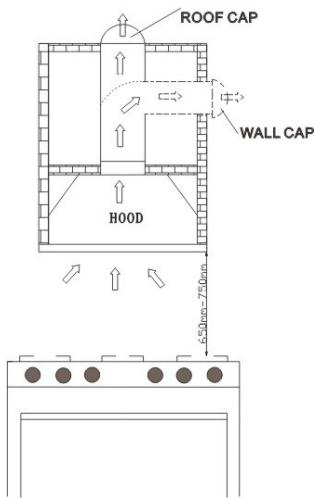
- The minimum distance is 750mm from the cooker hood to a gas hob, and
is 650mm to an electric hob. If the installation instructions for gas hobs specify a greater distance, this must be taken into account.
NOTICE: Two or more people are required to install or move this appliance. Failure to do so can cause physical injuries.
USE
- The rangehood has been designed only for domestic use to eliminate kitchen fumes.
- Never use the hood for purposes other than what it has been designed for.
- Never leave high naked flames under the hood when it is in operation.
- Adjust the flame intensity to direct it onto the bottom of the pan only; making sure that it does not engulf the pan sides.
- Deep fat fryer must be continuously monitored during use: overheated oil can burst into flame.
- The hood should not be used by children or person not instructed in its correct use.
MAINTENANCE
- Proper maintenance of the rangehood will assure proper performance of the unit.
- Disconnect the hood from the main supply before carrying out any maintenance work.
- Clean and/or replace aluminum grease filters and activated charcoal filters after specified period of time.
- Clean the hood using a damp cloth and a neutral liquid detergent.
- DISPOSAL: Do not dispose this product as unsorted municipal waste. Collection of such waste separately for special treatment is necessary.
WARNING!!
In certain circumstances electrical appliances may be a danger hazard.
- Do not check the status of the filters while the rangehood is operating.
- Do not touch the light bulbs after appliance use.
- Do not disconnect the appliance with wet hands.
-
Avoid free flame, as it is damaging for the filters and a fire hazard.
-
Constantly check food frying. Overheated oil may become a fire hazard.
- Disconnect the electrical plug prior to any maintenance.
- Children don't recognize the risks of electrical appliances. Therefore use or keep the appliance only under supervision of adults and out of the reach from children.
- Don't use this product outdoors.
- This appliance is not intended for use by persons (including children) with reduced physical, sensory or mental capabilities, or lack of experience and knowledge, unless they have been given supervision or instruction, concerning use of the appliance by a person responsible for their safety. Children should be supervised to ensure that they do not play with the appliance.
- There should be adequate ventilation of the room where the range hood is used at the same time as appliances burning gas or other fuels.
- There is a fire risk if cleaning is not carried out in accordance with instructions.
- Do not flambe under the rangehood.
- The exhaust air must not be discharged into a flue which is used for exhausting fumes from appliances burning gas or other fuels.
CHARACTERISTICS
DIMENSIONS
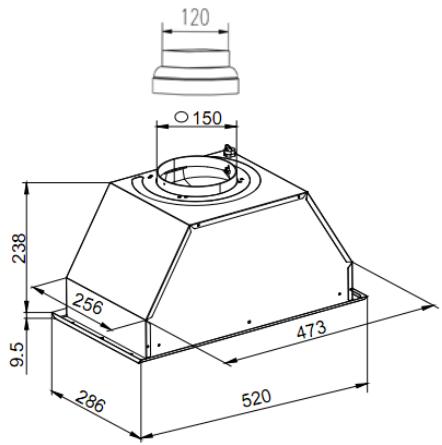
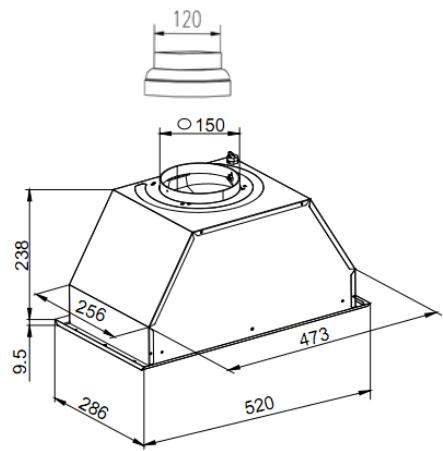
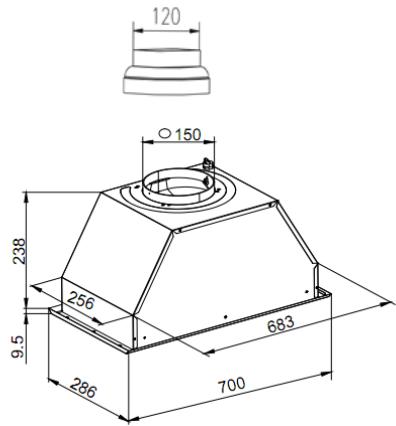
52cm
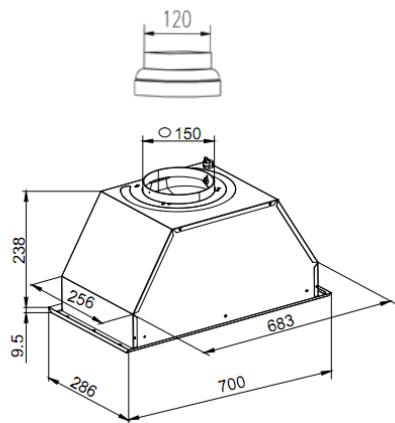
70cm
Note 1: On stainless steel hoods, carefully remove the plastic protective film from all exterior surfaces of the hood prior to final installation.
Note 2: At least two people will be required to mount the hood.
DESCRIPTION / CONNECTIONS
The hood may be installed in the Ducting or the Recalculating version.
Ducting version
The hood draws cooking fumes saturated with fumes and odour through the grease filters and expels it to the outside through an outlet pipe.
Caution: To reduce the risk of fire, use of metal ductwork is preferred.
Do not use flammable material to convey exhaust air.
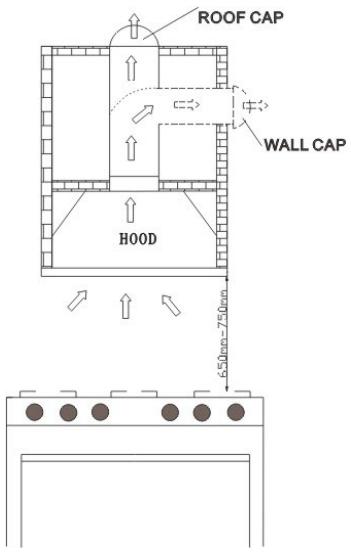
- Decide where the ductwork will run between the hood and the outside.
- A straight, short duct run will allow the hood to perform most efficiently.
- Long duct runs, elbows, and transitions will reduce the performance of the hood. Use as few of them as possible. Larger ducting may be required for best performance with longer duct runs.
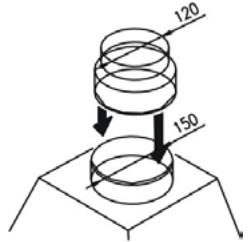
- It is recommended that 150mm round duct is to be used, however a reducer from 150mm to 120mm can be ordered supplied should 120mm be required.
- The air must not be discharged into a flue that is used for exhausting fumes from appliances burning gas or other fuels. Regulations concerning the discharge of air have to be followed. Check with the local authority and building code for exhaust ducting requirements.
- Install a roof/wall cap. Connect round ductwork to cap and work back towards hood location.
Recirculation version
The hood draws cooking fumes saturated with fumes and odor through the grease filters and charcoal filters and returns clean air into the room. For constant efficiency, the charcoal filters must be replaced periodically.
Decide from the outset on the type of installation (recirculation or ducting). For greater efficiency, we recommend you install the hood in the ducting version.
Electrical Connection
- Electrical wiring must be done by a qualified person(s) in accordance with all applicable codes and standards. Turn off electrical power at service entrance before wiring.
- If the supply cord is damaged, it must be replaced by the manufacturer, its service agent or similarly qualified persons in order to avoid a hazard.
- Do not use the plug and an extension cord other than the ones initially supplied with the hood.
INSTALLATION
Before beginning installation, to better handle the hood, we advise removing the face plate.
- The range hood is designed to operate with 150mm exhaust Ducting. If 120mm exhaust Ducting has to be used, the 120mm reducer is required.
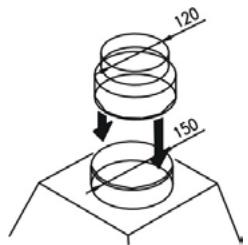
RECIRCULATING & DUCTING VERSION INSTALLATION:
Before fixing, the outlet exhaust duct for air evacuation to the outside must be installed. Use an outlet exhaust duct with: - minimum indispensable
length; -Minimum possible bends (maximum angle of bend: 90^ ); -certified material (according to local, building and fire regulations); and as smooth as possible inside. It is also advisable to avoid any drastic changes in duct cross-section (recommended diameter: 150mm).
For recirculation version, please consider some outlets for clean air returns into the room.
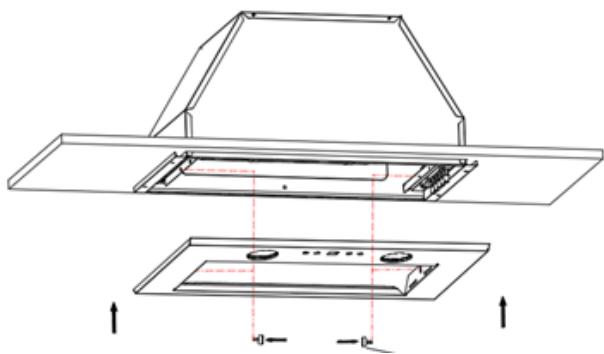
Fitting under wall unit
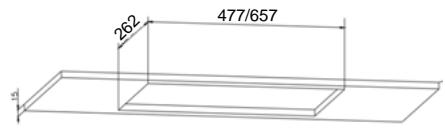
- Before fixing the hood to the unit, drill a hole of 165mm diameter for 150mm exhaust Ducting or 135mm for 120mm exhaust Ducting in the wall unit.
- In any case, check the position of the power outlet and consider where the power cable will run, since a hole might have to be made in the wall unit to accommodate it.
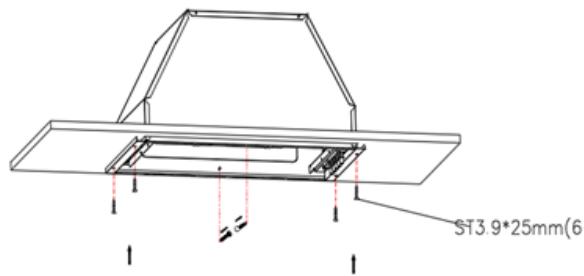
- Unscrew the 2 visible screws located on hood of both inner size of filter frame and remove the face plate. The 6 mounting holes around the unit are then accessible.
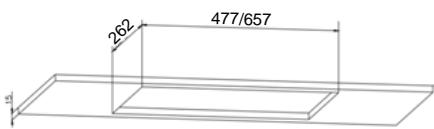
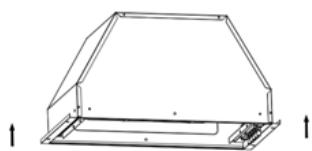
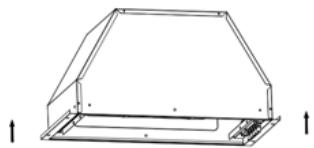
- Lift the range hood and fit through the opening of the cabinet. Secure unit by using 6 long mounting screws.
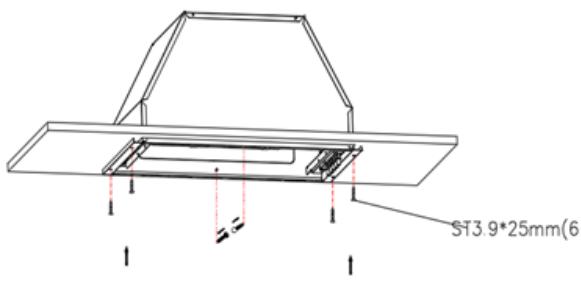
- Fit the face plate on the hood by screwing 2 screws.
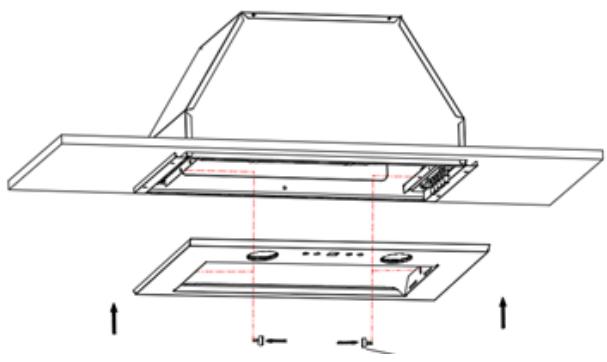
- Rotate the spot LED lights clockwise into the lamp hole.
- Make the electrical connection.
Installation is now complete.
Notice:
- Exhaust air must not be discharged into a flue which is used for exhausting fumes from appliance burning gas or other fuels.
-If the instructions for installation for the gas hob specify a greater distance than 750mm , this has to be taken into account. - The regulations concerning the discharge of exhaust air have to be followed. Check with the local authority for building codes for exhaust ducting requirements
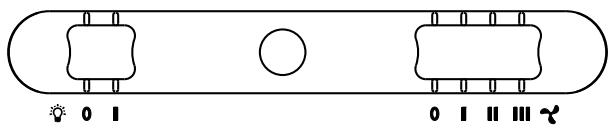
(1) OPERATION OF CONTROLS
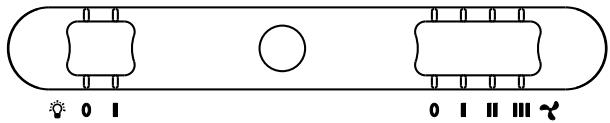
This hood may be operated using the slide switch on the face plate.
The light switch turns the lamps on and off.
The fan switch turns the fan on to three speed settings:
0-OFF
1 - LOW SPEED
2-MEDIUM SPEED
3-HIGH SPEED
(2) OPERATION OF CONTROLS (NO BOOSTER)





The hood is operated using the electronic switch on the front panel.
The power switch turns the range hood on and off.
The light switch turns the lamps on and off.
The blower switch turns the blower onto four speed settings.
Low speed show F1
Medium speed shows F2
High speed shows F3
The timer delay switch decides how long the hood stay on after switching off. Press the timer button when the motor is working, the range hood will be set with default timer as 15 minutes. Adjust the timer by press the speed button. The motor will be stop working automatically when time is up.
The hood is operated using the electronic switch on the front panel.
The power switch turns the range hood on and off.
The light switch turns the lamps on and off.
The blower switch turns the blower onto four speed settings.
Low speed show F1
Medium speed shows F2
High speed shows F3
Booster shows P
The timer delay switch decides how long the hood stay on after switching off.
Press the timer button when the motor is working, the range hood will be set with default timer as 15 minutes. Adjust the timer by press the speed button.
The motor will be stop working automatically when time is up.
Remark: In booster speed P , the range hood will be kept working in highest speed for 5 minutes, and will turn to speed three F3 automatically once time is up.
MAINTENANCE
GREASE FILTER
-
The grease filters should be cleaned frequently (every two months of operation, or more frequently for heavy use). Use a warm detergent solution.
-
Grease filters are washable.
CHARCOAL FILTER
This filter is not washable, cannot be regenerated, and should be replaced approximately every 3 months of operation, or more frequently in the case
of heavy usage.
- To install the charcoal filter, lock it until the stop click is heard.
- Install the face plate after charcoal filter is installed.
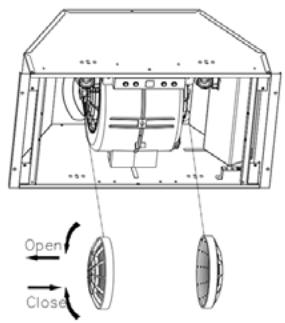
- To remove the charcoal filters, take away the face plate first, then remove the charcoal filter by turning anti-clockwise.
LAMPS
This rangehood may require two GU10 LED SPOT (AC 230V, 4W Max each).
WARNING: Always switch off the electrical supply before carrying out any operation on the appliance.
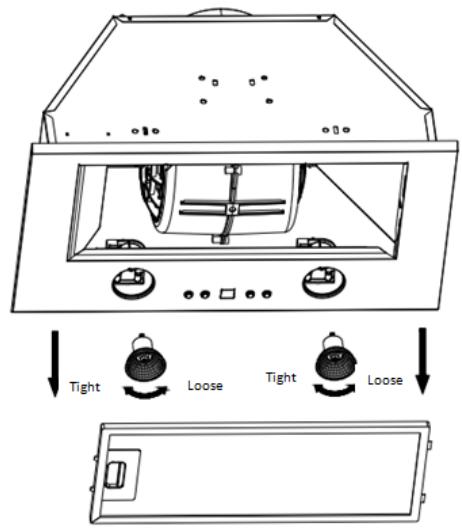
To change LED spot:
- Remove the aluminum filter.
- Loosen the LED spot anti-clockwise, and replace with LED of same kind.
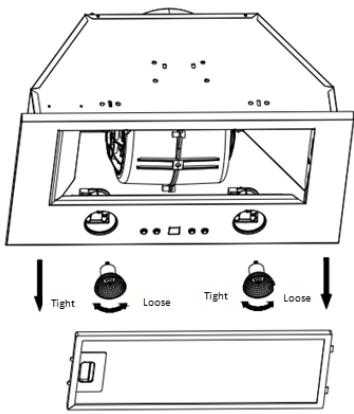
CAUTION:
- THE SURFACE, THE LIGHT COVER MAY BE HOT. TAKE CARE WHEN REPLACING LED LAMPS.
- THE LED LAMPS MAY BE HOT. TAKE CARE WHEN REPLACING LED LAMPS.
We recommend only using lamps of the same specification as the ones being replaced.
HOOD CLEANING
Stainless steel is one of the easiest materials to keep clean. Occasional care will help preserve its fine appearance.
Cleaning tips:
- Hot water with soap or detergent is all that is usually needed.
- Follow all cleaning by rinsing with clear water. Wipe dry with a clean, soft cloth to avoid water marks.
- For discolorations or deposits that persist, use a non-scratching household cleanser or stainless steel polishing powder with a little water and a soft cloth.
- For stubborn cases use a plastic scouring pad or soft bristle brush together with cleanser and water. Rub lightly in direction of polishing lines or " grain" of the stainless finish. Avoid using too much pressure that may damage the surface.
- Do not allow deposits to remain for long periods of time.
- Do not use ordinary steel wool or steel brushes. Small bits of steel may adhere to the surface causing rust.
- Do not allow salt solutions, disinfectants, bleaches, or cleaning compounds to remain in contact with stainless steel for extended periods. Many of these compounds contain chemicals that may be harmful. Rinse with water after exposure and wipe dry with a clean cloth.
- Painted surfaces should be cleaned with warm water and mild detergent only.
The rangehood may not work or work improperly. Before calling after-sales service, switch off the appliance, unplug the power supply and refer to this guide to determine the problem.
If malfunction persist, contact our After Sales Service and specify the nature of the problem, appliance model no and serial number (on the rating plate inside the hood)
| Status | Reasons | Solutions |
| No response of the lamps and the motor | 1. The plug is off from the power socket. 2. The power cord is damaged. | 1. Ensure that the plug is put into the power socket properly. 2. Replace the power cord if the power cord is damaged. |
| The fuse on the PCB board is damaged. | Replace the fuse on the PCB board. | |
| The switch is damaged. | Repair or replace the switch. | |
| The lamp doesn't work | The lamp is damaged. | Replace the damaged lamp. |
| The hood body gives out strong vibrations and a loud noise | 1. The hood has not been installed properly according to the installation process described in the instruction manual. 2. Check if the joint connection of each part is damaged. | Ensure the hood has been installed properly according to the instruction manual. |
| The air exhaust performance is bad | Check if the distance between the hood and the cooker top is too big. | The ideal distance is 65-75cm. |
| Ensure there is adequate ventilation. | Open the door and windows properly. Improve the environment. | |
| The duct is damaged. Grease Filters or charcoal filter clogged Exhaust air outlet clogged | Repair or replace the damaged duct. Replace or clean the filters Clear the air exhaust outlet |
RECOMMANDATIONS ET SUGGESTIONS
INSTALLATION
a a a a a a a a a a a a a a a a a a a a a a a a a a a a a a a a a a a a a a a a a a a a a a a a
C
jibgbl jglz
C
1 1
aill
S OBC = S COD + S_ BOC
jlaaiil aillb
a
aal lgl 1glll gllg aia jai jai gai gai all jai
gaiiill llyblia i jy g yj gaiiaiaiaiaiaiaiaiaiaiaiaiaiaiaiaiaiaiaiaiaiaiaiaiaiaiaiaiaiaiaiaiaiaiaiaiaiaiaiaiaiaiaiaiaiaiaiaiaiaiaiaiaiaiaiaiaiaiaiaiaiaiaia
Jauuall
a a 1
Aiiiaaii iiaaii aaiil aaiiie 1e gaoaagall aeg aegy
(4) a, b, c , a, b, c , a, b, c , a, b, c , a, b, c , a, b, c , a, b, c , a, b, c , a, b, c , a, b, c ,
j. (jIyJ Jai jill jn nn nn nn nn nn nn nn nn nn nn nn nn nn nn nn nn nn nn nn nn nn nn nn nn nn nn nn nn nn nn nn nn nn nn nn nn nn nn nn nn nn nn nn nn nn nn nn nn nn nn nn nn nn nn nn nn nn nn nn nn nn nn nn nn nn nn nn nn nn nn nn nn nn nn nn nn nn nn nn nn nn nn nn nn nn nn nn nn nn nn nn nn
a aaa a a a a a a a a a a a a a a a a a a a a a a a a a
aill 1gall jzjnaial glll 0jgl
gall 150 750 26
y 650 jy
J
y 1
A
aal aai j no alill gall llll baaag alliaa aai
aaii jia jialjai jai jai jai jai jai jai jai
Jill g jg laoi aiaall Jai Gai all gai
aill l 1000 1000 1000
y
aal lalai jy yj yj yj yj yj yj yj yj yj yj yj yj
Aa aac aeg aagaae aee aae aee
ddaa
y 1
alall aagj jaiaal yayyll cals no jao calill jay:alsill
Aolai aIjLoo cJy Jaiuio o
jblzao aayy jg 100000000000000000000000000
aagalliaiaieiiaaiil
jlll llll
Aiiy yjzjjz
jz jz jz jz jz jz jz jz jz jz
aaiy aie jay i yj yj 11
Jibbl Jgliae 1y g
jollal gall aill l al j
y 2
jglall jy g j 1g 1j 1j 1j 1j 1j 1j
jaiy jaiy jaiy jaiy jaiy jaiy jaiy jaiy jaiy jaiy jaiy jaiy
aaii i aaii i aai i aai i aai i aai i aai i aai i aai i aai i aai i aai i aai i aai i aai i aai i aai i aai i aai i aai i aai i aai i aai i aai i aai i aai i aai i aai i aai i aai i aai i aai i aai i
jz jz jz jzlly Jzjjz
iill 1b 101
jally jao jao aillbll o jy yaiy ai yaiy aiaa iiaa yaiy aaiy gaa
.
52cm 70cm
1 1
aill j 1 aai 1
A
111 2 2
J 1
a
Jn j 1
aaii aiee e 11
.1
Aolalgolaoaiaaiiall 2
i 3
JgbljIg 10000000000000000000000000000000000
Aaoll aagaae aagaae eae aee aee aee aee aee aee aee aee .6
y
aegell gllglll lgllll 1000000000000000000000000000000000000000000
a
ygi yagai gie jgouall. (yuii ci yagj yj yj) yki jil g i d
aaii
S OBC = S OBC
aallll 1 1 1 1 1 1 1 1 1 1 1 1 1 1 1 1 1 1
Jaggall Jaaal jda a g ygssy daa aayd a
jlll j 150
jglll jll jll gll gll gll gll gll gll gll gll gll gll gll gll gll gll gll gll gll gll gll gll gll gll gll gll gll gll gll gll gll gll gll gll gll gll gll gll gll gll gll gll gll gll gll gll gll gll gll gll gll gll
| g( x) - h^ ( x) | = | g( x) - h^ ( x) | = 1| g( x) - h|
J 1 J 1 J 1 J 1 J 1 J 1 J 1 J 1 J 1 J 1 J 1 J 1 J 1 J 1 J 1 J 1 J 1 J 1 J 1 J 1 J 1 J 1 J 1 J 1 J 1 J 1 J 1 J 1 J 1 J 1 J 1 J 1 J 1 J 1 J
150:2jall 1
a 1
| g( x) - 12g( x) | = | x_0 - 12g( x) | = | 12g( x) - 12g( x) = 0|
1
j121 0g jai
150 165 1
a 120 135
2.
JSL11 123
aagll 1glaal lal 1y 1y 1y 1y 1y 1y 1y 1y 1y 1y 1y 1y 1y .3
6 66
1 4
Lglgla Jlana 2 dcb ydlil gllal gla jld aagll .5
alauaiiull aclll 1joc oolil gaiy gall jlll
.11 1
:
e 1
. jz1 2 g
y 750 no sia aaln jiall al g y iay aaiil cailll l -
e e e e e e e e e e
aalll aaii iuii iiai biaagb jn jieill n jil g jg alall ablll
sall
sall cglgj 1
aegglg jzjia ciao jaoe blll 10
gilllgl ylllall lslil
ciee eieieieieieieieieieieieieieieieieieieieieieieieieieieieieieieieieieieieieie
0
4a 10-1
abwio 2
iue ic-3





aal jae aee eae yiey
gilllgl yllallol
4 10
(F1)
(F2) abssd aer
(F3)
aaii iie aiee eae ae eae eae eae eae eae eae eae
Lai aagaaagall jlll qal
1
.2
:
.1
la jiaie jiaai jiai jiai jiai jiai jiai jiai jiai jiai jiai jiai jiai jiai jiai jiai jiai jiai jiai jiai jiai jiai jiai jiai jiai jiai jiai jiai jiai jiai jiai jiai jiai jiai jiai jiai
gaii iit ciaiigao wiy jy ciuiy ygi
1
jia jiao geliang jie jie play ball cbai li
Jbc
y j 111 111 111 111 111 111 111 111 111 111 111 111 111 111 111 111 111 1